


1 Introduction
In his famous 1905 paper, Einstein [Reference Einstein10] based his special theory of relativity on two explicit postulates: (1) the principle of relativity, according to which all inertial observers (coordinate systems) are equivalent; and (2) the light postulate, according to which there exists a “stationary” coordinate system in which all light signals travel with the same speed. A few years later, beginning in 1910, von Ignatowsky [Reference von Ignatowsky26–Reference von Ignatowsky28] attempted to simplify the theory by removing the need for the light postulate. Assuming the principle of relativity, some ideas from electrodynamics, and various hidden assumptions, he deduced that the associated (homogeneous) coordinate system transformations must be Lorentz transformations.
Frank and Rothe [Reference Frank and Rothe11] then considered both Einstein’s and von Ignatowsky’s arguments in more detail, identifying four assumptions (rather than two) made by Einstein. They argued not only that the light postulate is unnecessary, but that two more of these assumptions can also be deduced by considering how transformations compose with one another and act on points and lines. Their system was less restrictive than von Ignatowsky’s, because transformations were shown to split into three distinct classes: Galilean transformations; Lorentz transformations; and a rather unusual class they called “Doppler” transformations [Reference Frank and Rothe11, equation (129)].
In 1978, Yu. F. Borisov presented the axiom system with which we shall mostly be concerned in this paper. In his axiom system, Borisov presented a few basic background assumptions and four explicit axioms, the fourth being a formulation of the relativity principle. Then he demonstrated that his axiom system had (up to choice of units) only two models: a relativistic one in which worldview transformations are Poincaré transformations (the more general, inhomogeneous, counterparts of von Ignatowsky’s Lorentz transformations), and a classical one in which they are Galilean [Reference Borisov7] (cf. [Reference Guts17, sec. 10, pp. 60–61]). Gyula Dávid subsequently showed (using a different framework) the existence of a model that also satisfies the relativity principle and in which worldview transformations are Euclidean isometries. He also proved (over the field of reals) a characterization theorem stating that the principle of relativity with some auxiliary assumptions implies that the worldview transformations between inertial observers are either Euclidean isometries, or else Galilean or Poincaré transformations [Reference Dávid9]. However, he eliminated the models corresponding to Euclidean isometries by adding a new assumption, that motion from one spatial location to another cannot be instantaneous. Similarly, Euclidean isometries do not appear in Borisov’s models because they are eliminated by his assumption [Reference Borisov7, Axiom II] that there is an arrow of time.
All of these studies implicitly assume that coordinates and other physically observable quantities can be represented as values from the real number field (
 $\mathbb {R}$
), even though this assumption is not well-founded. We have no empirical reason to make this assumption, because all practical measurements yield only rational approximations—even quantum electro-dynamics (QED), widely regarded as the most precisely tested physical theory so far, only boasts accuracies to around 12 decimal digits [Reference Odom, Hanneke, D’Urso and Gabrielse22]. Indeed, one of our goals in writing this paper is to investigate what properties of numbers are actually needed if we want to model certain theories. For example, two of us have previously shown elsewhere that special relativity can also be modeled over the field of rational numbers [Reference Madarász and Székely18]. We will demonstrate, in fact, that special relativity theories defined over non-Archimedean fields are fundamentally different to those defined over Archimedean fields like
 $\mathbb {R}$
, because models featuring Euclidean isometries as worldview transformations cannot be eliminated, neither by introducing Borisov’s arrow of time assumption, nor by allowing Dávid’s ban on instantaneous motion. Moreover, the group of worldview transformations contains an infinite descending chain of proper worldview transformation subgroups—this is in sharp contrast to the situation when the field is Archimedean, where no such descending chains are possible.
These results argue that non-standard analysis has an important role to play in the study of physical theories, since they show that one cannot rule out—on purely empirical grounds—the possibility that infinitesimals and other non-standard values are physically relevant; they provide strong confirmatory evidence that the common preference for using real numbers to represent scalars and coordinates is one of convention rather than necessity. While a few authors have considered the use of non-standard analysis in mathematical physics and the study of stochastic processes (e.g., [Reference Albeverio, Blaquiere, Diner and Lochak1, Reference Albeverio, Fenstad and Hoegh-Krohn2, Reference Bagarello and Valenti6, Reference Capinski and Cutland8, Reference Nelson21, Reference Perlis, Omodeo and Policriti23]), most work in the field has understandably focused on applications within mathematics itself. Our results suggest that further investigation of non-standard applications to mathematical physics is warranted, not just in terms of its usefulness as a tool for simplifying proofs, but in its own right: if non-standard scalars are taken to be physically meaningful, how does that change our understanding of the world around us?
As this brief summary illustrates, there is long history of research addressing the logical foundations of relativity theory, with each generation of researchers discovering implicit (unstated) assumptions embedded in the work of their predecessors. We believe it is important to avoid hidden assumptions wherever possible, so as to place physical theory on secure logical and strictly mathematical foundations. Our preferred approach is to express assumptions as simple, strictly formal, first-order, explicit axioms, which are then used to support formal proof-driven investigation. This provides the clarity we need for ensuring that hidden assumptions are captured explicitly (cf. [Reference Andréka, Madarász and Németi3, sec. Why FOL?] and [Reference Székely25, sec. 11]), while at the same time making it relatively simple to verify whether the axioms are strong enough to do the job we require of them [Reference Govindarajalulu, Bringsjord and Taylor16, Reference Stannett and Németi24].
1.1 Contributions
In this paper:
-
1. We reformulate Borisov’s original four axioms within an intuitively simple, but strictly formal, first-order logic framework, and convert his basic background assumptions into explicit axioms.
-
2. Instead of assuming that the structure of physical quantities is the field of real numbers, we assume only that they form an ordered field. This allows us to investigate how Borisov’s theorem depends on the structure of quantities.
-
3. We characterize the groups of worldview transformations corresponding to models of (our reformulation of) Borisov’s axiom system over any ordered field (cf. Theorems 5.10 and 5.12). Using this characterization, we show that Borisov’s
 $\textsf{Axiom III}$
is not needed to prove his main theorem (cf. Theorem 4.7).
-
4. We demonstrate (as our main contribution) how to construct Euclidean, Galilean, and Poincaré models of Borisov’s axiom system over every non-Archimedean field (cf. Theorem 4.5). In this theorem, we also demonstrate the existence of an infinite descending chain of models and transformation groups in each of these three cases, something that is not possible over Archimedean fields like
$\mathbb {R}$
. -
5. We show, in the case of non-Archimedean fields, that the Euclidean isometries appear intrinsically as worldview transformations in models of Borisov’s axioms. Neither Borisov’s assumption of time’s arrow, nor Dávid’s rejection of instantaneous motion, can eliminate them.


2 Basic notations and axioms
2.1 The underlying logical framework
Throughout this paper we consider models of the form
 $$ \begin{align*} \mathfrak{M} = \langle {\textsf{Ev}}, {\textsf{IM}},{\textsf{IOb}},{{\textsf{Q}}}, +,\cdot,\leq,{{\textsf{C}}},{{\textsf{P}}} \rangle, \end{align*} $$
where the various components are intended to have the following interpretations:
-
•
${{\textsf{Ev}}} $
is a nonempty set of events; -
•
${{\textsf{IM}}} $
is a nonempty set of inertial motions; -
•
${{\textsf{IOb}}} $
is a nonempty set of inertial observers (reference systems); -
•
$\mathfrak {Q} = ({{\textsf{Q}}} ,+,\cdot ,\leq )$
is a structure of quantities; -
•
${{\textsf{C}}} \subseteq {{\textsf{IOb}}} \times {{\textsf{Ev}}} \times {{\textsf{Q}}} ^{4}$
is a relation used to express coordinatization; and -
•
${{\textsf{P}}} \subseteq {{\textsf{IM}}} \times {{\textsf{Ev}}} $
is a relation used to express participation.


In other words, we use the following many-sorted first-order logic language:
-
•
${{\textsf{Ev}}} $
,
${{\textsf{IM}}} $
,
${{\textsf{IOb}}} $
, and
${{\textsf{Q}}} $
are four sorts representing different kinds of basic entities (events, inertial motions, inertial observers, and quantities); -
•
$+$
,
$\cdot $
, and
$\le $
are the usual operation symbols and ordering relation, defined on the sort
${{\textsf{Q}}} $
; -
•
${{\textsf{C}}} $
is a relation of sort
${{\textsf{IOb}}} \times {{\textsf{Ev}}} \times {{\textsf{Q}}} ^{4}$
, where the expression
${{\textsf{C}}} (k,e,{\vec {\mkern 0mup\mkern 2mu}} )$
represents the idea that inertial observer
$k\in {{\textsf{IOb}}} $
coordinatizes
$($
“sees”
$)$
event
$e\in {{\textsf{Ev}}} $
at coordinate point
${\vec {\mkern 0mup\mkern 2mu}} \in {{\textsf{Q}}} ^{4}$
; and -
•
${{\textsf{P}}} $
is a relation of sort
${{\textsf{IM}}} \times {{\textsf{Ev}}} $
, where the expression
${{\textsf{P}}} (i,e)$
represents the idea that inertial motion
$i\in {{\textsf{IM}}} $
participates in event
$e\in {{\textsf{Ev}}} $
, or in other words worldline of inertial motion i contains event e.


We have chosen this formal language in accordance with Borisov’s choice of basic concepts, but using some notations of the Andréka–Németi school to make it easier to connect the results of this paper to the school’s general project of logic based axiomatic foundations of relativity theories. Axiomatic approaches to relativity theory have extensive literature (see, e.g., [Reference Andréka, Madarász, Németi, Prékopa and Molnár4]). Most of these approaches use entirely different basic concepts, and hence it is not at all straightforward to check whether these different axiom systems capture the same physical theory. By showing the connection between two radically different approaches, Andréka and Németi [Reference Andréka, Németi, Baltag and Smets5] take an important first step in bringing these sporadic axiom systems together. See [Reference Friend12, Reference Friend and Molinini13] for general discussions of Andréka–Németi school’s project and methodology from points of view of epistemological significance and role in scientific explanation.
2.2 Borisov’s basic assumptions
In his paper, Borisov declares four axioms (
 ${{\textsf{Axiom I}}} $
–
 ${{\textsf{Axiom IV}}} $
), which are in turn based upon a number of basic assumptions, which we here refer to as
 ${{\textsf{BA 1}}} $
–
 ${{\textsf{BA 4}}} $
.
 $\boxed {{{\textsf{BA 1}}}}\ \ {\mathfrak {Q}} =({{\textsf{Q}}} ,+,\cdot ,\leq )$
is an ordered field in the sense of abstract algebra.
Footnote
1
 $\boxed {{{\textsf{BA 2}}} }$
For every inertial observer
 $k\in {{\textsf{IOb}}} $
, the coordinatization
Footnote
2
of k is a bijection
 ${{\textsf{C}}} _{k} \colon {{\textsf{Ev}}} \to {{\textsf{Q}}} ^{4}$
(Figure 1).
Illustrating the concepts of coordinatization, worldlines and worldview transformations, and the relationship between them.

Given inertial observer
 $k\in {{\textsf{IOb}}} $
, the binary relation
 ${{\textsf{C}}} _{k}\subseteq {{\textsf{Ev}}} \times {{\textsf{Q}}} ^{4}$
between events and coordinate points described in
 ${{\textsf{BA 2}}} $
can be defined by
 $$ \begin{align*} {{\textsf{C}}}_{k}(e,{\vec{\mkern0mup\mkern2mu}})\ \stackrel{\text{def}}{\Longleftrightarrow}\ {{\textsf{C}}}(k,e,{\vec{\mkern0mup\mkern2mu}}). \end{align*} $$
By
 ${{\textsf{BA 2}}}$
, we can introduce the worldview transformations,
 $f_{kh}$
, between inertial observers h and k as the composition of bijections
 ${{\textsf{C}}} _{k}$
and
 ${{\textsf{C}}}^{-1}_{h}$
, i.e.,
 $$ \begin{align*} f_{kh}{\;\stackrel{\text{def}}{=}\;}{{\textsf{C}}}_{k}\circ{{\textsf{C}}}^{-1}_{h} \colon {{\textsf{Q}}}^{4}\to{{\textsf{Q}}}^{4}. \end{align*} $$
Again by
 ${{\textsf{BA 2}}}$
, these worldview transformations are bijections from
 ${{\textsf{Q}}} ^{4}$
to
 ${{\textsf{Q}}} ^{4}$
, for which
 $$ \begin{align} f_{mh}= f_{mk}\circ f_{kh}\qquad\text{and}\qquad f_{kh}^{-1}=f_{hk} \end{align} $$
for all inertial observers
 $h,k,m\in {{\textsf{IOb}}} $
.
Let us define the worldline
Footnote
3
of inertial motion
 $i\in {{\textsf{IM}}} $
as
 $$ \begin{align*} {{\textsf{wl}}}(i){\;\stackrel{\text{def}}{=}\;}\big\{e\in{\textsf{Ev}} \colon {{\textsf{P}}}(i,e)\big\}, \end{align*} $$
and the worldline of inertial motion
 $i\in {{\textsf{IM}}} $
according to inertial observer
 $k\in {{\textsf{IOb}}} $
as
 $$ \begin{align*} {{\textsf{wl}}}_{k}(i){\;\stackrel{\text{def}}{=}\;}{{\textsf{C}}}_{k}[{{\textsf{wl}}}(i)]. \end{align*} $$
By
 ${{\textsf{BA 2}}}$
, worldview transformations map worldlines to worldlines, i.e., for all inertial observers
 $h,k\in {{\textsf{IOb}}} $
and every inertial motion
 $i\in {{\textsf{IM}}} $
,
 $$ \begin{align} f_{kh}[{{\textsf{wl}}}_{h}(i)]={{\textsf{wl}}}_{k}(i). \end{align} $$
The time component and space component of
 ${\vec {\mkern 0mup\mkern 2mu}} =(p_{0},p_{1},p_{2},p_{3})\in {{\textsf{Q}}} ^{4}$
are defined respectively as
 $$ \begin{align*} p_{t}{\;\stackrel{\text{def}}{=}\;} p_{0}\qquad\text{and}\qquad {\vec{\mkern0mup\mkern2mu}}_{s}{\;\stackrel{\text{def}}{=}\;} (p_{1},p_{2},p_{3}). \end{align*} $$
A set
 $\ell $
is called a line if and only if there are
 ${\vec {\mkern 0mup\mkern 2mu}} , {\vec {\mkern 0muv\mkern 2mu}} \in {{\textsf{Q}}} ^{4}$
with
 ${\vec {\mkern 0muv\mkern 2mu}} \neq (0,0,0,0)$
such that
 $\ell =\{{\vec {\mkern 0mup\mkern 2mu}} +\lambda \cdot {\vec {\mkern 0muv\mkern 2mu}} \colon \lambda \in {{\textsf{Q}}} \}$
.
The line
 $\ell $
is vertical if and only if
 ${\vec {\mkern 0mup\mkern 2mu}} _{s}={\vec {\mkern 0muq\mkern 2mu}} _{s}$
for every
 ${\vec {\mkern 0mup\mkern 2mu}} ,{\vec {\mkern 0muq\mkern 2mu}} \in \ell $
.
 $\boxed {{{\textsf{BA 3}}} }$
For every
Footnote
4
vertical line
 $\ell $
and inertial observer
 $k\in {{\textsf{IOb}}} $
, there is an inertial motion
 $i\in {{\textsf{IM}}} $
such that the worldline of i according to k is
 $\ell $
, i.e.,
 ${{\textsf{wl}}} _{k}(i)=\ell $
.
The line
 $\ell $
is of finite slope if and only if there are
 ${\vec {\mkern 0mup\mkern 2mu}} ,{\vec {\mkern 0muq\mkern 2mu}} \in \ell $
such that
 $p_{t}\neq q_{t}$
.
 $\boxed {{{\textsf{BA 4}}} }$
For every inertial motion
 $i\in {{\textsf{IM}}} $
and every inertial observer
 $k\in {{\textsf{IOb}}} $
, worldline
 ${{\textsf{wl}}} _{k}(i)$
is a line of finite slope.
2.3 Borisov’s axioms
We say that inertial motion
 $i\in {{\textsf{IM}}} $
is stationary w.r.t. inertial observer k if and only if
 ${{\textsf{wl}}} _{k}(i)$
is a vertical line. Then inertial observer
 $h\in {{\textsf{IOb}}} $
is at rest w.r.t. inertial observer
 $k\in {{\textsf{IOb}}} $
, if and only if, whenever inertial motion
 $i\in {{\textsf{IM}}} $
is stationary w.r.t. h, then i is also stationary w.r.t. k.
 $\boxed {{{\textsf{Axiom I}}} }$
There exist inertial observers
 $k,h\in {{\textsf{IOb}}} $
, where h is not at rest w.r.t. k.
Given
 ${\vec {\mkern 0muu\mkern 2mu}} =(u_{0},\ldots ,u_{n-1})\in {{\textsf{Q}}} ^{n}$
and
 ${\vec {\mkern 0muv\mkern 2mu}} =(v_{0},\ldots ,v_{n-1})\in {{\textsf{Q}}} ^{n}$
, the scalar product of
 ${\vec {\mkern 0muu\mkern 2mu}} $
and
 ${\vec {\mkern 0muv\mkern 2mu}} $
is defined in the usual way:
 $$ \begin{align*} {\vec{\mkern0muu\mkern2mu}}\cdot{\vec{\mkern0muv\mkern2mu}} {\;\stackrel{\text{def}}{=}\;} u_{0}v_{0} +\cdots + u_{n-1}v_{n-1}. \end{align*} $$
The Euclidean length of certain vectors in
 ${{\textsf{Q}}} ^{4}$
may not exist because
 ${\mathfrak {Q}} $
can be any ordered field, including for example the field of rational numbers in which square roots are not always defined. To avoid this problem, we use instead the squared-Euclidean length of
 ${\vec {\mkern 0muv\mkern 2mu}} $
, defined as
 $$ \begin{align*} \left|{\vec{\mkern0muv\mkern2mu}}\right|{{\hspace{-0.0001pt}}}^{2}{\;\stackrel{\text{def}}{=}\;} {\vec{\mkern0muv\mkern2mu}}\cdot{\vec{\mkern0muv\mkern2mu}} = v_{0}^{2}+\cdots+v_{n-1}^{2}. \end{align*} $$
We call a transformation
 $T \colon {{\textsf{Q}}} ^{4}\to {{\textsf{Q}}} ^{4}$
a trivial transformation if and only if (a) it takes vertical lines to vertical lines; and (b) it is the composition of a translation and a linear transformation preserving the squared-Euclidean length (or equivalently, preserving the scalar product). We say that transformation
 $T:{{\textsf{Q}}} ^{4}\to {{\textsf{Q}}} ^{4}$
is orthochronous if and only if
 $T(1,0,0,0)_{t}> T(0,0,0,0)_{t}$
. The set of orthochronous trivial transformations is denoted by
 ${{\textsf{Triv}}} ^{\uparrow }$
.
 $\boxed {{{\textsf{Axiom II}}} }$
-
a) Given any inertial observer
$k\in {{\textsf{IOb}}} $
and any
Footnote
5
orthochronous trivial transformation
$\varphi \in {{\textsf{Triv}}} ^{\uparrow }$
, there is an inertial observer
$h\in {{\textsf{IOb}}} $
for which the worldview transformation between h and k is
$\varphi $
, i.e.,
$f_{kh}=\varphi $
. -
b) For all inertial observers
$k,h\in {{\textsf{IOb}}} $
, if h is at rest w.r.t. k, then
$f_{kh}\in {{\textsf{Triv}}} ^{\uparrow }$
.


 $\boxed {{{\textsf{Axiom III}}} }$
Given any inertial motion
 $i\in {{\textsf{IM}}} $
, any inertial observer
 $k\in {{\textsf{IOb}}} $
, and any orthochronous trivial transformation
 $\varphi \in {{\textsf{Triv}}} ^{\uparrow }$
, there is an inertial motion
 $i^{\prime }\in {{\textsf{IM}}} $
such that
 ${{\textsf{wl}}} _{k}(i^{\prime }) =\varphi \big [{{\textsf{wl}}} _{k}(i)\big ]$
.
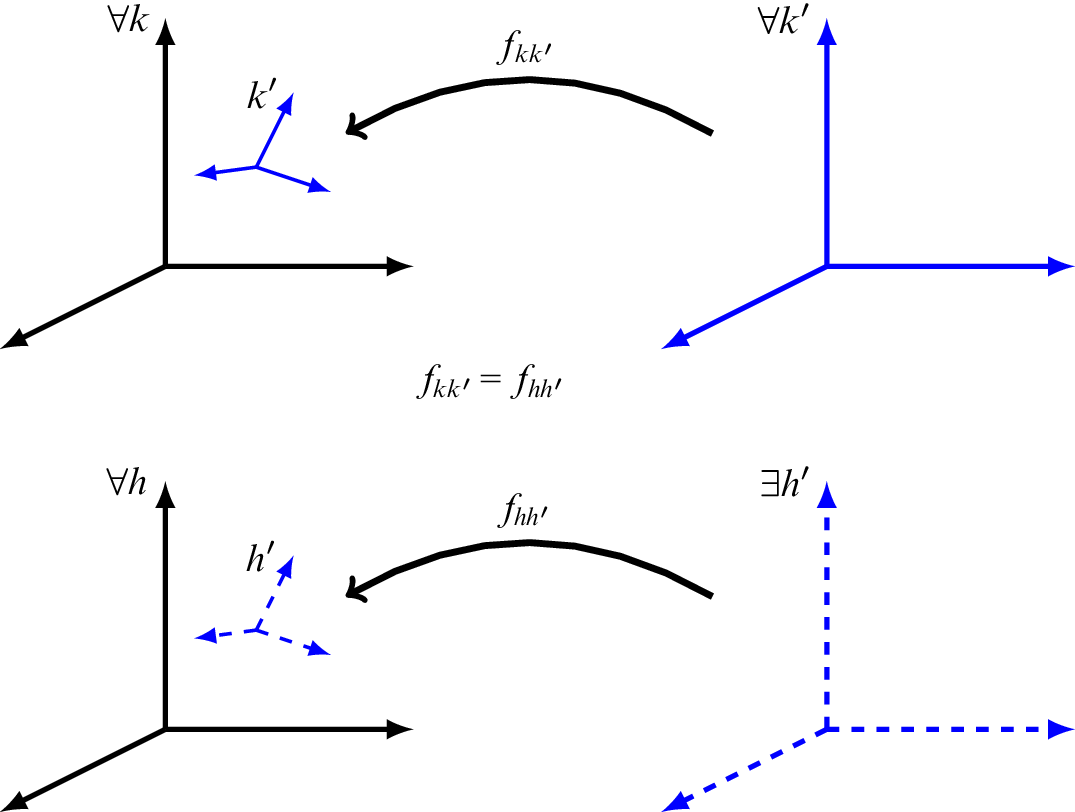
 $\boxed {{{\textsf{Axiom IV}}} }$
Given any inertial observers
 $k,k^{\prime },h\in {{\textsf{IOb}}} $
, there is an inertial observer
 $h^{\prime }\in {{\textsf{IOb}}} $
such that
 $f_{hh^{\prime }}=f_{kk^{\prime }}$
(Figure 2).
Overall, then, we capture Borisov’s axiom system formally as:
 $$ \begin{align*} \boxed{{{\textsf{Borisov}'s\, \textrm{Axioms}}}}{\;\stackrel{\text{def}}{=}\;} \big\{{{\textsf{BA}\,1}}, \dots, {{\textsf{BA}\,4}}, {{\textsf{Axiom}\,I}}, \dots,{{\textsf{Axiom}\,IV}} \big\}. \end{align*} $$
2.4
${{\textsf{Axiom IV}}}$
as a formulation of Einstein’s special principle of relativity

The principle of relativity can be formalized in several different ways (see, e.g., [Reference Gömöri14, Reference Gömöri and Szabó15, Reference Madarász, Székely and Stannett19]). In Borisov’s axiom system, Einstein’s principle of relativity is captured by
 ${{\textsf{Axiom IV}}}$
. This is so because in terms of worldview transformations
 ${{\textsf{Axiom IV}}}$
tells that no inertial observer is distinguished by how its worldview can be related to those of other observers. In this section, we are going to explore some equivalent formulations of this central assumption. To do so, for each inertial observer
 $k\in {{\textsf{IOb}}} $
, we define the worldview of k (Figure 3) to be
 $$ \begin{align*} \mathbb{W}_{k}{\;\stackrel{\text{def}}{=}\;} \big\{f_{kh} \colon h\in{\textsf{IOb}}\big\}, \end{align*} $$
and the set of worldview transformations by
 $$ \begin{align*} \mathbb{W} {\;\stackrel{\text{def}}{=}\;} \bigcup_{k \in {\textsf{IOb}}}{\mathbb{W}_{k}} = \big\{f_{kh} \colon k,h\in{\textsf{IOb}}\big\}. \end{align*} $$
Where we wish to emphasize the underlying model
 ${\mathfrak {M}} $
on which these constructs are based, we will add the model name as a suffix, and write, e.g.,
 $\mathbb {W}_{{\mathfrak {M}} }$
.
Illustrating
 ${{\textsf{Axiom IV}}}$
.

Illustrating the worldview
 $\mathbb {W}_{k}$
of inertial observer k.

We first show (Proposition 2.1) that
 ${{\textsf{Axiom IV}}}$
is equivalent to the claim that all observers have the same worldview, which is in turn equivalent to saying that each worldview is a group under composition.
Proposition 2.1. Assume
 ${{\textsf{BA 2}}}$
. Then
 ${{\textsf{Axiom IV}}}$
is equivalent to each of the following statements
 $($
and they are all equivalent to one another
 $)$
:
-
(i)
$\mathbb {W}_{k}=\mathbb {W}_{h}$
for all
$k,h\in {{\textsf{IOb}}} $
. -
(ii)
$\mathbb {W}_{k}=\mathbb {W}$
for all
$k\in {{\textsf{IOb}}} $
. -
(iii)
$\mathbb {W}_{k}=\mathbb {W}$
for some
$k\in {{\textsf{IOb}}} $
. -
(iv)
$\mathbb {W}_{k}$
is closed under composition for all
$k\in {{\textsf{IOb}}} $
. -
(v)
$\mathbb {W}_{k}$
forms a group under composition for some
$k\in {{\textsf{IOb}}} $
.


Proof.
 ${{\textsf{Axiom IV}}}$
says that, given any
 $f_{kk^{\prime }} \in \mathbb {W}_{k}$
, there is an
 $f_{hh^{\prime }} \in \mathbb {W}_{h}$
satisfying
 $f_{kk^{\prime }} = f_{hh^{\prime }}$
. So statement (i) is simply a reformulation of
 ${{\textsf{Axiom IV}}}$
in terms of worldviews (Figure 4).
(i)
 $\;\implies\; $
(ii): follows because
 $\mathbb {W} = \bigcup _{h\in {{\textsf{IOb}}} }\mathbb {W}_{h}$
.
(ii)
 $\;\implies\; $
(iii): trivial as
 ${{\textsf{IOb}}} $
is not empty.
Let us now prove the following:
 $$ \begin{align} \mathbb{W}_{k} = \mathbb{W} \implies \mathbb{W}_{k} \text{ is a group}. \end{align} $$
We know that
 $\mathbb {W}_{k}=\mathbb {W}$
is closed under inverses because
 $f^{-1}_{kh}=f_{hk}$
by (1) (which follows from
 ${{\textsf{BA 2}}}$
). It remains to show that
 $\mathbb {W}$
is closed under composition. To do so, choose any
 $f_{dc},f_{ba}\in \mathbb {W}$
. Since
 $\mathbb {W}_{k}=\mathbb {W}$
, there are observers
 $a^{\prime },d^{\prime }\in {{\textsf{IOb}}} $
such that
 $f_{ka^{\prime }}=f_{ba}$
and
 $f_{kd^{\prime }}=f_{cd}$
. Now (1) yields
 $f_{dc}\circ f_{ba}= f_{cd}^{-1}\circ f_{ba} = f_{kd^{\prime }}^{-1}\circ f_{ka^{\prime }} = f_{d^{\prime }k}\circ f_{ka^{\prime }}=f_{d^{\prime }a^{\prime }}\in \mathbb {W}$
, as required.
Diagram illustrating the steps proving Proposition 2.1.

(iii)
 $\;\implies\; $
(v): follows trivially from (3).
(v)
 $\;\implies\; $
(i): We have
 $\mathbb {W}_{h} = f_{hk} \circ \mathbb {W}_{k}$
for all
 $k, h \in {{\textsf{IOb}}} $
since, by (1),
 $f_{hm} = f_{hk} \circ f_{km}$
for all
 $m \in {{\textsf{IOb}}} $
. Therefore, since
 $f_{hk}=f_{kh}^{-1}$
by (1), we have
 $\mathbb {W}_{h}= f_{hk} \circ \mathbb {W}_{k}=f_{kh}^{-1}\circ \mathbb {W}_{k}=\mathbb {W}_{k}$
for all
 $h\in {{\textsf{IOb}}} $
if
 $\mathbb {W}_{k}$
is a group (as
 $f_{kh}\in \mathbb {W}_{k}$
).
(ii)
 $\;\implies\; $
(iv): follows trivially from (3).
(iv)
 $\;\implies\; $
(v): Since
 ${{\textsf{IOb}}} $
is not empty, we only have to prove that
 $\mathbb {W}_{k}$
is closed under composition and inverses for some
 $k\in {{\textsf{IOb}}} $
. Since, by (iv),
 $\mathbb {W}_{k}$
is closed under composition it is enough to show that it is also closed under inverses. To prove that, let
 $f_{km}\in \mathbb {W}_{k}$
be arbitrary. We need to show that
 $f_{mk}=f_{km}^{-1}\in \mathbb {W}_{k}$
. Since
 $\mathbb {W}_{m}$
is also closed under composition by (iv), we have
 $f_{mk}\circ f_{mk}\in \mathbb {W}_{m}$
. Then there is
 $h\in {{\textsf{IOb}}} $
such that
 $f_{mk}\circ f_{mk}=f_{mh}$
. Then
 $f_{mk}=f_{mk}^{-1}\circ f_{mk}\circ f_{mk}=f_{km}\circ f_{mk}\circ f_{mk}=f_{km}\circ f_{mh}=f_{kh}\in \mathbb {W}_{k}$
.□
3 Transformations
Throughout this section, we assume
 ${{\textsf{BA 1}}}$
, i.e., that
 ${\mathfrak {Q}} =({{\textsf{Q}}} ,+,\cdot ,\leq )$
is an ordered field. Let
 ${\textit {c}} \in {{\textsf{Q}}} $
and suppose
 ${\textit {c}}>0$
.
We define the
 ${\textit {c}} $
-scalar product of vectors
 ${\vec {\mkern 0mup\mkern 2mu}} ,{\vec {\mkern 0muq\mkern 2mu}} \in {{\textsf{Q}}} ^{4}$
as:

and analogously the
 ${\textit {c}} $
-Minkowski scalar product as:

(Note that the
 $1$
-scalar product coincides with the usual scalar product.) As usual, we write
 $|v|{\stackrel {\text {def}}{=}} \max \{-v,v\}$
for the absolute value of
 $v \in {{\textsf{Q}}} $
.
We say that a function
 $T \colon {{\textsf{Q}}} ^{4}\to {{\textsf{Q}}} ^{4}$
is a linear
 ${\textit {c}} $
-Euclidean isometry if and only if it is a linear transformation which preserves the
 ${\textit {c}} $
-scalar product, i.e.,
 $$ \begin{align*} T{\vec{p}} \odot_{c}\, T{\vec{q}} = \vec{p} \odot_{c}\, \vec{q} \end{align*} $$
for every
 ${\vec {\mkern 0mup\mkern 2mu}} , {\vec {\mkern 0muq\mkern 2mu}} \in {{\textsf{Q}}} ^{4}$
. We call T a
 ${\textit {c}} $
-Euclidean isometry if and only if it is a composition of a linear
 ${\textit {c}} $
-Euclidean isometry and a translation.
We say that T is a linear Galilean transformation if and only if T is a linear transformation and, for every
 ${\vec {\mkern 0mup\mkern 2mu}} , {\vec {\mkern 0muq\mkern 2mu}} \in {{\textsf{Q}}} ^{4}$
,
 $$ \begin{align*} |(T{\vec{\mkern0mup\mkern2mu}})_{t}|=|p_{t}| \qquad\text{ and }\qquad p_{t}=q_{t}=0\implies T{\vec{\mkern0mup\mkern2mu}}\cdot T{\vec{\mkern0muq\mkern2mu}} ={\vec{\mkern0mup\mkern2mu}}\cdot{\vec{\mkern0muq\mkern2mu}}. \end{align*} $$
T is a Galilean transformation if and only if it is a composition of a linear Galilean transformation and a translation.Footnote 6
We call T a linear
 ${\textit {c}} $
-Poincaré transformation if and only if it is a linear transformation which preserves the
 ${\textit {c}}$
-Minkowski scalar product, i.e.,

for every
 ${\vec {\mkern 0mup\mkern 2mu}} ,{\vec {\mkern 0muq\mkern 2mu}} \in {{\textsf{Q}}} ^{4}$
. T is a
 ${\textit {c}} $
-Poincaré transformation if and only if it is a composition of a linear
 ${\textit {c}} $
-Poincaré transformation and a translation.
In the particular case when
 ${\textit {c}} = 1$
, we sometimes revert to the more familiar standard terminology, viz. T is a Euclidean isometry if and only if it is a 1-Euclidean isometry, and a Poincaré transformation if and only if it is a 1-Poincaré transformation.
Finally, we note that T is a trivial transformation if and only if it is a Euclidean isometry taking vertical lines to vertical lines.
Throughout this paper we investigate the various groups corresponding to these different transformation classes. The notation we use for each of these transformation groups is shown in Table 1.
Transformation group notations used in this paper.

The orthochronous variants of these sets are respectively denoted by
 ${{\textsf{Triv}}} ^{\uparrow }_{{\mathfrak {Q}} }$
,
 ${{\textsf{Eucl}}} ^{\uparrow }_{{\mathfrak {Q}} }$
,
 ${{\textsf{Poi}}} ^{\uparrow }_{{\mathfrak {Q}} }$
,
 ${}_{c}{{\textsf{Eucl}}} ^{\uparrow }_{{\mathfrak {Q}} }$
,
 ${}_{c}{{\textsf{Poi}}} ^{\uparrow }_{{\mathfrak {Q}} }$
and
 ${{\textsf{Gal}}} ^{\uparrow }_{{\mathfrak {Q}}}$
.
As one would expect, all of these sets (except
 ${}_{c}{{\textsf{Eucl}}} ^{\uparrow }_{{\mathfrak {Q}} }$
) are groups under composition. To see that
 ${}_{c}{{\textsf{Eucl}}} ^{\uparrow }_{{\mathfrak {Q}} }$
is not a group, notice that while it is closed under inverses, it is not closed under composition. For example, for the case
 ${\textit {c}} =1$
, let R be a rotation of
 $45^{\circ }$
in the first two coordinates which leaves the other two coordinates fixed. Then
 $R\in {}_{c}{{\textsf{Eucl}}} ^{\uparrow }_{{\mathfrak {Q}} }$
, but
 $R\circ R\not \in {}_{c}{{\textsf{Eucl}}} ^{\uparrow }_{{\mathfrak {Q}} }$
.
Let us also note that
 $$ \begin{align*} {{\textsf{Triv}}}_{{\mathfrak{Q}}}=\bigcap_{{\textit{c}}>0}{}_{c}{{\textsf{Poi}}}_{{\mathfrak{Q}}}\cap\bigcap_{{\textit{c}}>0}{}_{c}{{\textsf{Eucl}}}_{{\mathfrak{Q}}}\cap {{\textsf{Gal}}}_{{\mathfrak{Q}}}, \end{align*} $$
and hence
 $$ \begin{align*} {{\textsf{Triv}}}^{\uparrow}_{{\mathfrak{Q}}}=\bigcap_{{\textit{c}}>0}{}_{c}{{\textsf{Poi}}}^{\uparrow}_{{\mathfrak{Q}}}\cap\bigcap_{{\textit{c}}>0}{}_{c}{{\textsf{Eucl}}}^{\uparrow}_{{\mathfrak{Q}}} \cap{{\textsf{Gal}}}^{\uparrow}_{{\mathfrak{Q}}}. \end{align*} $$
Let us introduce the following notations for the squared
 ${\textit {c}} $
-Euclidean length and squared
 ${\textit {c}} $
-Minkowski length:

We note that squared 1-Euclidean length coincides with the squared-Euclidean length.
Finally, we introduce the following notations for the standard basis of
 ${{\textsf{Q}}} ^{4}$
:

Proposition 3.2. Let L be a linear transformation. Then the following are equivalent:
-
(i)
$L\in {}_{c}{{\textsf{Eucl}}} _{{\mathfrak {Q}} }$
. -
(ii) Given any
, -
(iii) Given any
${\vec {\mkern 0mup\mkern 2mu}} \in {{\textsf{Q}}} ^{4}$
,
$\|L{\vec {\mkern 0mup\mkern 2mu}} \|^{2}_{\textit {c}} =\|{\vec {\mkern 0mup\mkern 2mu}} \|^{2}_{\textit {c}} $
, i.e., L preserves the squared
${\textit {c}} $
-Euclidean length.


Proof. (i)
 $\;\implies\; $
(ii) and (i)
 $\;\implies\; $
(iii) hold by definition (this is what we mean by
 ${\textit {c}}$
-Euclidean transformations,
 ${\textit {c}} $
-scalar product, and squared
 ${\textit {c}} $
-Euclidean length).
(ii)
 $\;\implies\; $
(i) follows by direct calculation in the standard basis because L is a linear transformation and
 $\odot _{\textit {c}} \colon {{\textsf{Q}}} ^{4}\times {{\textsf{Q}}} ^{4}\rightarrow {{\textsf{Q}}} $
is a bilinear function.
(iii)
 $\;\implies\; $
(i) follows because
 $\odot _{\textit {c}} $
is symmetric, whence we can write
 $$ \begin{align*} {\vec{\mkern0mup\mkern2mu}}\odot_{\textit{c}}{\vec{\mkern0muq\mkern2mu}} =\frac{\|{\vec{\mkern0mup\mkern2mu}}+{\vec{\mkern0muq\mkern2mu}}\|^{2}_{\textit{c}} -\|{\vec{\mkern0mup\mkern2mu}}\|^{2}_{\textit{c}}-\|{\vec{\mkern0muq\mkern2mu}}\|^{2}_{\textit{c}}}{2} \quad\text{ for every }{\vec{\mkern0mup\mkern2mu}},{\vec{\mkern0muq\mkern2mu}}\in{{\textsf{Q}}}^{4} \end{align*} $$
and the claim follows immediately.□
The proofs of Propositions 3.3 and 3.4 below are analogous and we leave the details to the reader.
Proposition 3.3. Let L be a linear transformation. Then the following are equivalent:
-
(i)
$L\in {{\textsf{Gal}}} _{{\mathfrak {Q}} }$
. -
(ii)
and -
(iii) Either
$(L{\vec {\mkern 0mup\mkern 2mu}} )_{t}=p_{t}$
for all
${\vec {\mkern 0mup\mkern 2mu}} \in {{\textsf{Q}} } ^{4}$
or else
$(L{\vec {\mkern 0mup\mkern 2mu}} )_{t}{\;=\;} -p_{t}$
for all
${\vec {\mkern 0mup\mkern 2mu}} \in {{\textsf{Q}}} ^{4};$
and
$p_{t}=0\implies |L{\vec {\mkern 0mup\mkern 2mu}} |^{2} =|{\vec {\mkern 0mup\mkern 2mu}} |^{2}. $
□


Proposition 3.4. Let L be a linear transformation. Then the following are equivalent:
-
(i)
$L\in {}_{c}{{\textsf{Poi}}} _{{\mathfrak {Q}} }$
. -
(ii) Given any
, -
(iii) Given any
${\vec {\mkern 0mup\mkern 2mu}} \in {{\textsf{Q}}^{4}}$
,
$\|L{\vec {\mkern 0mup\mkern 2mu}} \|^{2}_{{\textit {c}} ,\mu }=\|{\vec {\mkern 0mup\mkern 2mu}} \|^{2}_{{\textit {c}} ,\mu }$
, i.e., L preserves the squared
${\textit {c}}$
-Minkowskian length. □


4 Theorems
In this section we outline the various theorems that we’ll be proving in this paper; the proofs follow in Sections 5 and 6. Our main result is Theorem 4.5, showing how Borisov’s theorem changes when fields other than
 $\mathbb {R}$
are considered. Whenever we speak about a set
 ${{\textsf{G}}} $
of transformations as a group, we mean the group
 $\langle {{\textsf{G}}} ,\circ \rangle $
. Recall that if we assume
 ${{\textsf{BA 2}}} $
and
 ${{\textsf{Axiom IV}}}$
, then
 $\mathbb {W}_{k}=\mathbb {W}$
for every
 $k\in {{\textsf{IOb}}} $
and
 $\mathbb {W}$
is a group (by Proposition 2.1). Recall also what Borisov’s theorem states:
Borisov’s Theorem [Reference Borisov7]; Suppose that
 ${{\textsf{Borisov's}\, \textrm{Axioms}}} $
hold and that
 ${\mathfrak {Q}} $
is the ordered field
 $\mathbb {R}$
of reals. Then there are just two possibilities: either
 $$ \begin{align*} \mathbb{W}&={{\textsf{Gal}}}^{\uparrow}_{\mathbb{R}}, \text{ or else }\\ \mathbb{W}&={}_{c}{{\textsf{Poi}}}^{\uparrow}_{\mathbb{R}} \text{ for some }{\textit{c}}>0.\\[-16pt] \end{align*} $$
In the first-order logic framework developed in this paper, it can be shown that Borisov’s Theorem remains true if we omit the assumption that
 ${\mathfrak {Q}} $
is the ordered field
 $\mathbb {R}$
of reals, and simply assume instead that
 ${\mathfrak {Q}} $
is an Archimedean ordered field in which every positive number has a square root (we omit the details). It is an open question whether the statement remains true if we omit the assumption that positive numbers have square roots. Note, however, that if we drop the assumption that
 ${\mathfrak {Q}} = \mathbb {R}$
without adding anything new, then Borisov’s Theorem is no longer valid, because
 $\mathbb {W}$
can then be a proper subgroup of
 ${{\textsf{Gal}}} ^{\uparrow }$
and
 ${}_{c}{{\textsf{Poi}}} ^{\uparrow }$
. Indeed,
 $\mathbb {W}$
can even be an orthochronous subgroup of
 ${}_{c}{{\textsf{Eucl}}} $
.
As usual, we will write
 ${{\textsf{H}}} \le {{\textsf{G}}} $
to mean that
 ${{\textsf{H}}} $
is a subgroup of
 ${{\textsf{G}}} $
, and
 ${{\textsf{H}}} <{{\textsf{G}}} $
to indicate that it is a proper subgroup. Analogously, we write
 ${\mathfrak {M}} <{\mathfrak {M}} ^{\prime }$
to mean that
 ${\mathfrak {M}} $
is a proper submodel of
 ${\mathfrak {M}} ^{\prime }$
.
Theorem 4.5 (Main theorem).
Let
 ${\mathfrak {Q}} $
be any non-Archimedean ordered field. Then, for every
 ${\textit {c}}>0$
, there are models
 ${\mathfrak {M}} ^{E}$
,
 ${\mathfrak {M}} ^{G}$
and
 ${\mathfrak {M}} ^{P}$
of
 ${{\textsf{Borisov's}\, \textrm{Axioms}}}$
over
 ${\mathfrak {Q}} $
such that
 $$ \begin{align*} {{\textsf{Triv}}}^{\uparrow}_{{\mathfrak{Q}}}&< \mathbb{W}_{{\mathfrak{M}}^{E}} \subset{}_{c}{{\textsf{Eucl}}}^{\uparrow}_{{\mathfrak{Q}}}, \\ {{\textsf{Triv}}}^{\uparrow}_{{\mathfrak{Q}}}&< \mathbb{W}_{{\mathfrak{M}}^{G}} < {{\textsf{Gal}}}^{\uparrow}_{{\mathfrak{Q}}}, \\ {{\textsf{Triv}}}^{\uparrow}_{{\mathfrak{Q}}}&< \mathbb{W}_{{\mathfrak{M}}^{P}} < {}_{c}{{\textsf{Poi}}}^{\uparrow}_{{\mathfrak{Q}}}.\\[-16pt] \end{align*} $$
Moreover, in each of these three cases, there is a strictly descending countably infinite chain of models
 $$ \begin{align*} & \cdots < {\mathfrak{M}}^{E}_{i} < \cdots < {\mathfrak{M}}^{E}_{1}<{\mathfrak{M}}^{E}_{0},\\ & \cdots < {\mathfrak{M}}^{G}_{i} < \cdots < {\mathfrak{M}}^{G}_{1}<{\mathfrak{M}}^{G}_{0},\\ & \cdots < {\mathfrak{M}}^{P}_{i} < \cdots < {\mathfrak{M}}^{P}_{1}<{\mathfrak{M}}^{P}_{0}\\[-16pt] \end{align*} $$
over
 ${\mathfrak {Q}} $
of
 ${{\textsf{Borisov's}\, \textrm{Axioms}}}$
such that
 $$ \begin{align*} & {{\textsf{Triv}}}^{\uparrow}_{{\mathfrak{Q}}}<\cdots<\mathbb{W}_{{\mathfrak{M}}^{E}_{i}}<\cdots < \mathbb{W}_{{\mathfrak{M}}^{E}_{1}} <\mathbb{W}_{{\mathfrak{M}}^{E}_{0}}\subset{}_{c}{{\textsf{Eucl}}}^{\uparrow}_{{\mathfrak{Q}}}, \\ & {{\textsf{Triv}}}^{\uparrow}_{{\mathfrak{Q}}}<\cdots< \mathbb{W}_{{\mathfrak{M}}^{G}_{i}}<\cdots < \mathbb{W}_{{\mathfrak{M}}^{G}_{1}} <\mathbb{W}_{{\mathfrak{M}}^{G}_{0}} <{{\textsf{Gal}}}^{\uparrow}_{{\mathfrak{Q}}}, \\ & {{\textsf{Triv}}}^{\uparrow}_{{\mathfrak{Q}}}< \cdots< \mathbb{W}_{{\mathfrak{M}}^{P}_{i}}<\cdots < \mathbb{W}_{{\mathfrak{M}}^{P}_{1}} <\mathbb{W}_{{\mathfrak{M}}^{P}_{0}} <{}_{c}{{\textsf{Poi}}}^{\uparrow}_{{\mathfrak{Q}}}.\\[-36pt] \end{align*} $$
□
Note the use of subset (
 $\subset $
)—as opposed to subgroup (
 $<$
)—inclusion in the cases involving
 ${}_{c}{{\textsf{Eucl}}} ^{\uparrow }_{{\mathfrak {Q}} }$
(and likewise below); this is because, as observed on page 10,
 ${}_{c}{{\textsf{Eucl}}} ^{\uparrow }_{{\mathfrak {Q}} }$
is not a group.
Theorem 4.6. Let
 ${\mathfrak {Q}} $
be an ordered field and let
 ${{\textsf{G}}} $
be a group for which either
 $$ \begin{align*} {{\textsf{Triv}}}^{\uparrow}_{{\mathfrak{Q}}} &< {{\textsf{G}}} \subset {}_{c}{{\textsf{Eucl}}}^{\uparrow}_{{\mathfrak{Q}}}, \text{ or}\\ {{\textsf{Triv}}}^{\uparrow}_{{\mathfrak{Q}}} &< {{\textsf{G}}} \le {{\textsf{Gal}}}^{\uparrow}_{{\mathfrak{Q}}}, \text{ or}\\ {{\textsf{Triv}}}^{\uparrow}_{{\mathfrak{Q}}} &< {{\textsf{G}}} \le {}_{c}{{\textsf{Poi}}}^{\uparrow}_{{\mathfrak{Q}}}. \end{align*} $$
Then there is a model
 ${\mathfrak {M}}$
of
 ${{\textsf{Borisov's}\, \textrm{Axioms}}}$
over
 ${\mathfrak {Q}} $
such that
 $\mathbb {W}_{{\mathfrak {M}} }={{\textsf{G}}} $
. □
We also show that Borisov’s Theorem remains true if we remove
 $\textsf{Axiom III}$
from
 ${{\textsf{Borisov's}\, \textrm{Axioms}}}$
:
Theorem 4.7. Assume
 ${{\textsf{Borisov's}\, \textrm{Axioms}}} \setminus \{\textsf{Axiom III} \}$
and that
 ${\mathfrak {Q}} $
is the ordered field
 $\mathbb {R}$
of reals. Then there are two possibilities: either
 $$ \begin{align*} \mathbb{W}&={{\textsf{Gal}}}^{\uparrow}_{\mathbb{R}}, \text{ or else} \\ \mathbb{W}&={}_{c}{{\textsf{Poi}}}^{\uparrow}_{\mathbb{R}}\ \text{ for some }{\textit{c}}>0. \end{align*} $$
□
Remark 4.8. If we don’t require
 ${\mathfrak {Q}} $
to be the field
 $\mathbb {R}$
of reals, then using results in [Reference Madarász, Stannett and Székely20] the following can be proved: Assume
 ${{\textsf{Borisov's}\, \textrm{Axioms}}} \setminus \{\textsf{Axiom III} \}$
and that every positive number has a square root in
 ${\mathfrak {Q}} $
. Then either
 $$ \begin{align*} {{\textsf{Triv}}}^{\uparrow}_{{\mathfrak{Q}}} &< \mathbb{W}\subset{}_{c}{{\textsf{Eucl}}}^{\uparrow}_{{\mathfrak{Q}}}, \text{ or}\\ {{\textsf{Triv}}}^{\uparrow}_{{\mathfrak{Q}}} &< \mathbb{W}\leq {{\textsf{Gal}}}^{\uparrow}_{{\mathfrak{Q}}}, \text{ or}\\ {{\textsf{Triv}}}^{\uparrow}_{{\mathfrak{Q}}} &< \mathbb{W}\leq{}_{c}{{\textsf{Poi}}}^{\uparrow}_{{\mathfrak{Q}}}\ \text{ for some}\ \ {\textit{c}}>0. \end{align*} $$
Moreover, the statement remains true even if we replace
 ${{\textsf{BA 4}}}$
with the more general assumption: “For every inertial motion
 $i\in {{\textsf{IM}}} $
and every inertial observer
 $k\in {{\textsf{IOb}}} $
,
 ${{\textsf{wl}}} _{k}(i)$
is a line.” It is an open question if they remain true if we omit the assumption that positive numbers have square roots.
The next result, Corollary 4.9, is a direct consequence of Borisov’s Theorem and Theorem 4.6.
Corollary 4.9. Let
 ${\mathfrak {Q}} $
be the ordered field
 $\mathbb {R}$
of reals. Then there is no group
 ${{\textsf{G}}} $
for which
 $$ \begin{align*} {{\textsf{Triv}}}^{\uparrow}_{\mathbb{R}} &< {{\textsf{G}}} \subset {}_{c}{{\textsf{Eucl}}}^{\uparrow}_{\mathbb{R}}, \text{ or}\\ {{\textsf{Triv}}}^{\uparrow}_{\mathbb{R}} &< {{\textsf{G}}} <{{\textsf{Gal}}}^{\uparrow}_{\mathbb{R}}, \text{ or}\\ {{\textsf{Triv}}}^{\uparrow}_{\mathbb{R}} &< {{\textsf{G}}} <{}_{c}{{\textsf{Poi}}}^{\uparrow}_{\mathbb{R}}.\end{align*} $$
□
Corollary 4.9 fails for more general choices of
 ${\mathfrak {Q}} $
because (by Theorem 4.5) for all non-Archimedean fields
 $\mathfrak {Q} $
, there are strictly descending countably infinite chains of subgroups such that
 $$ \begin{align*} {{\textsf{Triv}}}^{\uparrow}_{{\mathfrak{Q}}}&<\cdots < {{\textsf{G}}}^{E}_{i} <\cdots<{{\textsf{G}}}^{E}_{1}<{{\textsf{G}}}^{E}_{0} \subset {}_{c}{{\textsf{Eucl}}}^{\uparrow}_{{\mathfrak{Q}}},\\ {{\textsf{Triv}}}^{\uparrow}_{{\mathfrak{Q}}}&<\cdots < {{\textsf{G}}}^{G}_{i} <\cdots<{{\textsf{G}}}_{1}^{G}<{{\textsf{G}}}_{0}^{G} <{{\textsf{Gal}}}^{\uparrow}_{{\mathfrak{Q}}}, \text{ and}\\ {{\textsf{Triv}}}^{\uparrow}_{{\mathfrak{Q}}}&<\cdots < {{\textsf{G}}}^{P}_{i} <\cdots<{{\textsf{G}}}^{P}_{1}<{{\textsf{G}}}^{P}_{0}<{}_{c}{{\textsf{Poi}}}^{\uparrow}_{{\mathfrak{Q}}}. \end{align*} $$
5 Worldview transformation groups and model constructions
The symmetric group over
 ${{\textsf{Q}}} ^{4}$
is denoted by
 ${{\textsf{Sym}}} ({{\textsf{Q}}} ^{4})$
. The time-axis is defined as
 $$ \begin{align*} {\textbf{t}} {\;\stackrel{\text{def}}{=}\;} \big\{ (t,0,0,0)\in {{\textsf{Q}}}^{4} \colon t \in {{\textsf{Q}}}\big\}. \end{align*} $$
Theorem 5.10. Assume
 ${{\textsf{Borisov's}\, \textrm{Axioms}}} \setminus \{{{\textsf{Axiom III}}} \}$
. Then
 $\mathbb {W}$
is a group satisfying:
-
(i)
${{\textsf{Triv}}} ^{\uparrow }_{{\mathfrak {Q}} }<\mathbb {W}\le {{\textsf{Sym}}} ({{\textsf{Q}}} ^{4});$
-
(ii) for every
$f\in \mathbb {W}$
,
$f[{\textbf {t}} ]$
is a line of finite slope
$;$
-
(iii) if
$f\in \mathbb {W}$
takes vertical lines to vertical lines, then
$f\in {{\textsf{Triv}}} ^{\uparrow }_{{\mathfrak {Q}} }$
.


Proof.
(i) We know from Proposition 2.1 that
 $\mathbb {W}\le {{\textsf{Sym}}} ({{\textsf{Q}}} ^{4})$
, and
 ${{\textsf{Axiom II}(a)}}$
tells us that
 ${{\textsf{Triv}}} ^{\uparrow }_{{\mathfrak {Q}} }\le \mathbb {W}$
. So it is enough to show that there is some
 $f\in \mathbb {W}\setminus {{\textsf{Triv}}} _{{\mathfrak {Q}} }$
. By
 ${{\textsf{Axiom I}}}$
, there are
 $k,h\in {{\textsf{IOb}}} $
such that h is not at rest w.r.t. k, i.e., there is
 $i\in {{\textsf{IM}}} $
such that
 ${{\textsf{wl}}} _{h}(i)$
is a vertical line but
 ${{\textsf{wl}}} _{k}(i)$
is not a vertical line. Since, by equation (2),
 $f_{kh}$
takes
 ${{\textsf{wl}}} _{h}(i)$
to
 ${{\textsf{wl}}} _{k}(i)$
and trivial transformations take vertical lines to vertical ones, we have
 $f_{kh}\not \in {{\textsf{Triv}}} _{{\mathfrak {Q}} }$
, as required.
(ii) Let
 $f_{kh}\in \mathbb {W}$
. By
 ${{\textsf{BA 3}}}$
, there is
 $i\in {{\textsf{IM}}} $
such that
 ${{\textsf{wl}}} _{h}(i)={\textbf {t}} $
. By
 ${{\textsf{BA 4}}}$
,
 ${{\textsf{wl}}} _{k}(i)$
is a line of finite slope. Now, by equation (2),
 $f_{kh}[{\textbf {t}} ]=f_{kh}\left [{{\textsf{wl}}} _{h}(i)\right ]={{\textsf{wl}}} _{k}(i)$
, as claimed.
(iii) Finally, suppose
 $f_{kh}\in \mathbb {W}$
takes vertical lines to vertical lines. We will prove that h is at rest w.r.t. k. Let i be an arbitrary inertial motion which is stationary according to h, i.e.,
 ${{\textsf{wl}}} _{h}(i)$
is a vertical line. Since
 $f_{kh}$
maps
 ${{\textsf{wl}}} _{h}(i)$
to
 ${{\textsf{wl}}} _{k}(i)$
,
 ${{\textsf{wl}}} _{k}(i)$
is also a vertical line. Thus h is at rest w.r.t. k. Hence, by
 ${{\textsf{Axiom II}(b)}}$
,
 $f_{kh}\in {{\textsf{Triv}}} ^{\uparrow }_{{\mathfrak {Q}} }$
as required.□
For every
 ${\mathfrak {Q}} =({{\textsf{Q}}} ,+,\cdot ,\le )$
and
 ${{\textsf{G}}} \subseteq {{\textsf{Sym}}} ({{\textsf{Q}}} ^{4})$
, we will construct a model
 ${\mathfrak {M}} ({{\textsf{G}}} )$
as follows:
 $$ \begin{align*} \begin{array}{c} {\textsf{Ev}}{\;\stackrel{\text{def}}{=}\;}{{\textsf{Q}}}^{4},\quad {\textsf{IM}}{\;\stackrel{\text{def}}{=}\;}\{g[{\textbf{t}}] \colon g\in{{\textsf{G}}}\},\quad {\textsf{IOb}}{\;\stackrel{\text{def}}{=}\;}{{\textsf{G}}}, \\[4pt] {{\textsf{C}}}(k,e,{\vec{\mkern0mup\mkern2mu}}){\ \stackrel{\text{def}}{\Longleftrightarrow}\ } k(e)={\vec{\mkern0mup\mkern2mu}},\qquad {{\textsf{P}}}(i,e){\ \stackrel{\text{def}}{\Longleftrightarrow}\ } e \in i, \\[4pt] \mathfrak{M}({{\textsf{G}}}){\;\stackrel{\text{def}}{=}\;}\langle {\textsf{Ev}},{\textsf{IM}},{\textsf{IOb}},{{\textsf{Q}}},+,\cdot,\le,{{\textsf{C}}},{{\textsf{P}}}\rangle. \end{array}\end{align*} $$
Proposition 5.11. Suppose
 ${{\textsf{G}}} ^{\prime } \subset {{\textsf{G}}} \subseteq {{\textsf{Sym}}} ({{\textsf{Q}}} ^{4})$
. Then
 ${\mathfrak {M}} ({{\textsf{G}}} ^{\prime })< {\mathfrak {M}} ({{\textsf{G}}} )$
.
Proof. The proposition easily follows from the definitions of
 ${\mathfrak {M}} ({{\textsf{G}}} )$
and
 ${\mathfrak {M}} ({{\textsf{G}}} ^{\prime })$
.□
Theorem 5.12. Suppose
 ${\mathfrak {Q}} $
is an ordered field and
 ${{\textsf{G}}} $
is a group for which:
-
(1)
${{\textsf{Triv}}} ^{\uparrow }_{{\mathfrak {Q}} }<{{\textsf{G}}} \le {{\textsf{Sym}}} ({{\textsf{Q}}} ^{4});$
-
(2) For every
$g\in {{\textsf{G}}} $
,
$g[{\textbf {t}} ]$
is a line of finite slope
$;$
-
(3) If
$g\in {{\textsf{G}}} $
takes vertical lines to vertical lines, then
$g\in {{\textsf{Triv}}} ^{\uparrow }_{{\mathfrak {Q}} }$
.


Then
 ${\mathfrak {M}} ({{\textsf{G}}} )$
satisfies
 ${{\textsf{Borisov's}\, \textrm{Axioms}}} $
. Furthermore,
 $\mathbb {W}_{{\mathfrak {M}} ({{\textsf{G}}} )}={{\textsf{G}}} $
.
Remark 5.13. Assume that
 ${\mathfrak {Q}} $
is an ordered field in which every positive number has a square root and that
 ${{\textsf{G}}} $
is a group for which the conditions of Theorem 5.12
hold. Then by Theorem 5.12
and Remark 4.8
, either
 $$ \begin{align*} {{\textsf{Triv}}}^{\uparrow}_{{\mathfrak{Q}}}&<{{\textsf{G}}}\subset{}_{c}{{\textsf{Eucl}}}^{\uparrow}_{{\mathfrak{Q}}},\text{ or}\\ {{\textsf{Triv}}}^{\uparrow}_{{\mathfrak{Q}}}&<{{\textsf{G}}}\leq {{\textsf{Gal}}}^{\uparrow}_{{\mathfrak{Q}}},\text{ or}\\ {{\textsf{Triv}}}^{\uparrow}_{{\mathfrak{Q}}}&<{{\textsf{G}}}\leq{}_{c}{{\textsf{Poi}}}^{\uparrow}_{{\mathfrak{Q}}}\ \text{ for some } {\textit{c}}>0. \end{align*} $$
□
Proof of Theorem 5.12
It is easy to see that
 ${{\textsf{C}}} _{k} =k$
and
 ${{\textsf{wl}}} (i)=i$
for every
 $k\in {{\textsf{IOb}}} $
and
 $i\in {{\textsf{IM}}} $
, whence
 $f_{kh}=k\circ h^{-1}$
and
 ${{\textsf{wl}}} _{k}(i)=k[i]$
.
Axioms
 ${{\textsf{BA 1}}}$
and
 ${{\textsf{BA 2}}}$
hold by construction. To prove
 ${{\textsf{BA 3}}}$
, let
 $\ell $
be a vertical line and
 $k\in {{\textsf{IOb}}} ={{\textsf{G}}} $
. Then, there is
 $f\in {{\textsf{Triv}}} ^{\uparrow }_{{\mathfrak {Q}} }$
such that
 $f[{\textbf {t}} ]=\ell $
. It follows that
 $k^{-1}\circ f\in {{\textsf{G}}} $
since
 ${{\textsf{Triv}}} ^{\uparrow }_{{\mathfrak {Q}} }\subseteq {{\textsf{G}}} $
and
 ${{\textsf{G}}} $
is a group. Let
 $i = (k^{-1}\circ f)[{\textbf {t}} ]\in {{\textsf{IM}}} $
. Then
 ${{\textsf{wl}}} _{k}(i) = k[i]=f[{\textbf {t}} ]=\ell $
. Thus
 ${{\textsf{BA 3}}}$
holds.
To prove
 ${{\textsf{BA 4}}}$
, suppose
 $i\in {{\textsf{IM}}} $
and
 $k\in {{\textsf{IOb}}} ={{\textsf{G}}} $
. We have to prove that
 ${{\textsf{wl}}} _{k}(i)$
is a line of finite slope. By the definition of
 ${{\textsf{IM}}} $
in
 ${\mathfrak {M}} ({{\textsf{G}}} )$
,
 $i=g[{\textbf {t}} ]$
for some
 $g\in {{\textsf{G}}} $
. Since
 ${{\textsf{G}}} $
is a group,
 $k\circ g\in {{\textsf{G}}} $
. But now, by assumption (2),
 ${{\textsf{wl}}} _{k}(i)=k[i]=(k\circ g)[{\textbf {t}} ]$
is a line of finite slope. Thus
 ${{\textsf{BA 4}}}$
holds.
Let us now prove
 ${{\textsf{Axiom I}}}$
. By assumption (1), we can fix some
 $g \in {{\textsf{G}}} \setminus {{\textsf{Triv}} } ^{\uparrow }_{{\mathfrak {Q}} }$
. By assumption (3), there is a vertical line
 $\ell $
such that
 $g[\ell ]$
is not vertical. Let us fix such an
 $\ell $
. Let
 ${{\textsf{Id}}} $
denote the identity transformation of
 ${{\textsf{Q}}} ^{4}$
. Then
 ${{\textsf{Id}}} , g \in {{\textsf{IOb}}} ={{\textsf{G}}} $
. By the already proven
 ${{\textsf{BA 3}}} $
, there is
 $i\in {{\textsf{IM}}} $
such that
 ${{\textsf{wl}}} _{{{\textsf{Id}}} }(i)=\ell $
. So, by equation (2),
 ${{\textsf{wl}}} _{g}(i)=f_{g{{\textsf{Id}}} }\big [{{\textsf{wl}}} _{{{\textsf{Id}}} }(i)\big ]=g[\ell ]$
. Therefore, i is stationary w.r.t. inertial observer
 ${{\textsf{Id}}} $
but is not stationary w.r.t. inertial observer g, which proves
 ${{\textsf{Axiom I}}}$
.
To prove
 ${{\textsf{Axiom II}(a)}}$
, let
 $k\in {{\textsf{IOb}}} $
and
 $\varphi \in {{\textsf{Triv}}} ^{\uparrow }_{{\mathfrak {Q}} }$
. We have to prove that there is
 $h\in {{\textsf{IOb}}} $
such that
 $f_{kh}=\varphi $
. Let
 $h = (k^{-1}\circ \varphi )^{-1}$
. Then
 $h\in {{\textsf{G}} } ={{\textsf{IOb}}} $
since
 ${{\textsf{G}}} $
is a group and
 $f_{kh}=k\circ h^{-1}=\varphi $
, which is what we wanted to prove.
To prove
 ${{\textsf{Axiom II}(b)}}$
, let
 $k,h\in {{\textsf{IOb}}} $
be such that h is at rest w.r.t. k. We have to prove that
 $f_{kh}\in {{\textsf{Triv}}} ^{\uparrow }_{{\mathfrak {Q}} }$
. Let
 $\ell $
be an arbitrary vertical line. By the already proven
 ${{\textsf{BA 3}}} $
, there is
 $i\in {{\textsf{IM}}} $
such that
 ${{\textsf{wl}}} _{h}(i)=\ell $
. Since
 $\ell $
is vertical, i is stationary w.r.t. h. Thus i must be stationary w.r.t. k because h is at rest w.r.t. k. Hence
 ${{\textsf{wl}}} _{k}(i)$
is also a vertical line. By equation (2),
 $f_{kh}$
takes
 ${{\textsf{wl}}} _{h}(i)=\ell $
to vertical line
 ${{\textsf{wl}}} _{k}(i)$
. Since
 $\ell $
was an arbitrary vertical line,
 $f_{kh}$
takes vertical lines to vertical ones. Since
 ${{\textsf{G}}} $
is a group, we have
 $f_{kh}=k\circ h^{-1}\in {{\textsf{G}}} $
. Hence, by assumption (3), we have that
 $f_{kh}\in {{\textsf{Triv}}} ^{\uparrow }_{{\mathfrak {Q}} }$
, which is what we wanted to prove.
To prove
 $\textsf{Axiom III} $
, let
 $i\in {{\textsf{IM}}} $
,
 $k\in {{\textsf{IOb}}} $
, and
 $\varphi \in {{\textsf{Triv}}} ^{\uparrow }_{{\mathfrak {Q}} }$
. We have to prove that there is an inertial motion
 $i^{\prime }\in {{\textsf{IM}}} $
such that
 ${{\textsf{wl}}} _{k}(i^{\prime })=\varphi \big [{{\textsf{wl}}} _{k}(i)\big ]$
. Let
 $g\in {{\textsf{G}}} ={{\textsf{IOb}}} $
such that
 $i=g[{\textbf {t}} ]$
. Then
 $k^{-1}\circ \varphi \circ k\circ g\in {{\textsf{G}}} $
because
 ${{\textsf{G}}} $
is a group containing
 ${{\textsf{Triv}}} ^{\uparrow }_{{\mathfrak {Q}} }$
. Let
 $i^{\prime } = (k^{-1}\circ \varphi \circ k \circ g)[{\textbf {t}} ]$
. Then
 $i^{\prime }\in {{\textsf{IM}}} $
by the definition of
 ${{\textsf{IM}}} $
in
 ${\mathfrak {M}} ({{\textsf{G}}} )$
and
 $$ \begin{align*} k[i^{\prime}] = k\big[(k^{-1}\circ\varphi\circ k\circ g)[{\textbf{t}}]\big] = (\varphi\circ k) \big[g[{\textbf{t}}]\big]=\varphi\big[k[i]\big]. \end{align*} $$
Since
 ${{\textsf{wl}}} _{k}(i^{\prime })=k[i^{\prime }]$
and
 ${{\textsf{wl}}} _{k}(i)=k[i]$
, this proves that
 ${{\textsf{wl}}} _{k}(i^{\prime })=\varphi \big [{{\textsf{wl}}} _{k}(i)]$
.
To prove
 ${{\textsf{Axiom IV}}}$
, let
 $k,k^{\prime },h\in {{\textsf{IOb}}} $
. We have to prove that there is
 $h^{\prime }$
such that
 $f_{kk^{\prime }}=f_{hh^{\prime }}$
, i.e.,
 $k\circ k^{\prime {-1}}=h\circ h^{\prime {-1}}$
. Such
 $h^{\prime }$
exists because
 ${{\textsf{IOb}}} = {{\textsf{G}}} $
is a group: setting
 $h^{\prime }=k^{\prime }\circ k^{-1}\circ h\in {{\textsf{IOb}}} $
yields
 $f_{kk^{\prime }}=f_{hh^{\prime }}$
.
It remains to show that
 $\mathbb {W}_{{\mathfrak {M}} ({{\textsf{G}}} )}={{\textsf{G}}} $
. This is straightforward because, by definition and because
 ${{\textsf{G}}} $
is a group,
 $$ \begin{align*} \mathbb{W}_{{\mathfrak{M}}({{\textsf{G}}})} = \big\{f_{kh} \colon k,h\in {{\textsf{G}}}\} = \{k\circ h^{-1} \colon k,h\in{{\textsf{G}}}\big\} = {{\textsf{G}}}, \end{align*} $$
as required.□
In the proof of Theorem 4.6, we will use the following lemma.
Lemma 5.14. Assume
 ${{\textsf{BA 1}}}$
. Assume
 $L\in {}_{c}{{\textsf{Eucl}}} ^{\uparrow }_{{\mathfrak {Q}} }\cup {{\textsf{Gal}} } ^{\uparrow }_{{\mathfrak {Q}} }\cup {}_{c}{{\textsf{Poi}}} ^{\uparrow }_{{\mathfrak {Q}} }$
for some
 ${\textit {c}}>0$
and that L takes vertical lines to vertical lines. Then
 $L\in {{\textsf{Triv}}} ^{\uparrow }_{{\mathfrak {Q}} }$
.
Proof. Without loss of generality, we can assume that L is linear. In this case, we only have to prove that L preserves the squared-Euclidean length, i.e., that
 $|L{\vec {\mkern 0mup\mkern 2mu}} |^{2}=|{\vec {\mkern 0mup\mkern 2mu}} |^{2}$
for every
 ${\vec {\mkern 0mup\mkern 2mu}} \in {{\textsf{Q}}} ^{4}$
.
Then
 and
 because L is an orthochronous linear transformation that takes vertical lines to vertical lines. The only point on
 ${\textbf {t}} $
with positive time component and squared
 ${\textit {c}} $
-Minkowskian (squared
 ${\textit {c}}$
-Euclidean) length of
 ${\textit {c}} ^{2}$
is
 . Therefore,
 by Propositions 3.2–3.4.
Let
 ${\vec {\mkern 0mup\mkern 2mu}} =(p_{t},p_{x},p_{y},p_{z})\in {{\textsf{Q}}} ^{4}$
be arbitrary but fixed. We have to prove that
 $|L {\vec {\mkern 0mup\mkern 2mu}} |^{2}=|{\vec {\mkern 0mup\mkern 2mu}} |^{2}$
. By the linearity of L and
 , we have
 $$ \begin{align} L(p_{t},0,0,0)=(p_{t},0,0,0). \end{align} $$
We also have
 $$ \begin{align} L(0,p_{x},p_{y},p_{z})=(0,q_{x},q_{y},q_{z})\quad\text{and}\quad q_{x}^{2}+q_{y}^{2}+q_{z}^{2}=p_{x}^{2}+p_{y}^{2}+p_{z}^{2} \end{align} $$
for some
 $q_{x},q_{y},q_{z}\in {{\textsf{Q}} } $
because of the following. If
 $L\in {}_{c}{{\textsf{Poi}}} ^{\uparrow }_{{\mathfrak {Q}} }$
, then
 $L(0,p_{x},p_{y},p_{z})_{t}=0$
because
 as L is a linear
 ${\textit {c}} $
-Poincaré transformation. Hence
 $L(0,p_{x},p_{y},p_{z})=(0,q_{x},q_{y},q_{z})$
for some
 $q_{x},q_{y},q_{z}\in {{\textsf{Q}}} $
, and
 $q_{x}^{2}+q_{y}^{2}+q_{z}^{2}=-\|L(0,p_{x},p_{y},p_{z})\|^{2}_{{\textit {c}} ,\mu }=-\|(0,p_{x},p_{y},p_{z})\|^{2}_{{\textit {c}} ,\mu }=p_{x}^{2}+p_{y}^{2}+p_{z}^{2}$
by Proposition 3.4. A completely analogous proof based on Proposition 3.2 shows that (5) holds when
 $L\in {}_{c}{{\textsf{Eucl}}} ^{\uparrow }_{{\mathfrak {Q}} }$
. And if
 $L\in {{\textsf{Gal}}} ^{\uparrow }_{{\mathfrak {Q}} }$
, then (5) holds by Proposition 3.3.
Thus, by linearity of L and equations (4) and (5), we have
 $$ \begin{align*} |L{\vec{\mkern0mup\mkern2mu}}|^{2} &= |L(p_{t},0,0,0)+L(0,p_{x},p_{y},p_{z})|^{2} = |(p_{t},q_{x},q_{y},q_{z})|^{2}\\ & = p_{t}^{2}+q_{x}^{2}+q_{y}^{2}+q_{z}^{2} = p_{t}^{2}+p_{x}^{2}+p_{y}^{2}+p_{z}^{2} = |{\vec{\mkern0mup\mkern2mu}}|^{2} \end{align*} $$
as claimed.□
Proof of Theorem 4.6
Let
 ${{\textsf{G}}} $
be a group for which
 ${{\textsf{Triv}}} ^{\uparrow }_{{\mathfrak {Q}} }<{{\textsf{G}}} $
and either
 ${{\textsf{G}}} \subset {}_{c}{{\textsf{Eucl}}} ^{\uparrow }_{{\mathfrak {Q}} }$
, or
 ${{\textsf{G}}} \le {{\textsf{Gal}}} ^{\uparrow }_{{\mathfrak {Q}} }$
or
 ${{\textsf{G}}} \le {}_{c}{{\textsf{Poi}}} ^{\uparrow }_{{\mathfrak {Q}} }$
. Then
 ${{\textsf{G}}} $
satisfies assumptions (1) and (2) of Theorem 5.12 because elements of
 ${{\textsf{G}}} $
are orthochronous linear transformations composed with translations.
 ${{\textsf{G}}} $
also satisfies assumption (3) of Theorem 5.12 by Lemma 5.14. By Theorem 5.12,
 ${\mathfrak {M}} ({{\textsf{G}}} )$
is a model of
 ${{\textsf{Borisov's}\, \textrm{Axioms}}}$
and
 $\mathbb {W}_{{\mathfrak {M}} ({{\textsf{G}}} )}={{\textsf{G}}} $
.□
Proof of Theorem 4.7
Assume
 ${{\textsf{Borisov's}\, \textrm{Axioms}}} \setminus \{{{\textsf{Axiom III}}} \}$
and that
 ${\mathfrak {Q}} $
is the ordered field
 $\mathbb {R}$
of reals. Then, by Theorem 5.10,
 $\mathbb {W}$
is a group satisfying assumptions (1)–(3) of Theorem 5.12. Hence
 ${\mathfrak {M}} (\mathbb {W})$
is a model of
 ${{\textsf{Borisov's}\, \textrm{Axioms}}} $
and
 $\mathbb {W}_{{\mathfrak {M}} (\mathbb {W})}=\mathbb {W}$
. The statement now follows by Borisov’s Theorem.□
6 Proof of the main theorem (Theorem 4.5)
Throughout this section, we assume
 ${{\textsf{BA 1}}}$
, i.e., that
 ${\mathfrak {Q}} =({{\textsf{Q}}} ,+,\cdot ,\leq )$
is an ordered field. Let us now prove our main result, Theorem 4.5. To do so, we first introduce some additional notation. The set of infinitesimals is defined as follows:
 $$ \begin{align*} {\mathcal{E}}{\;\stackrel{\text{def}}{=}\;}\big\{x\in{{\textsf{Q}}} \colon |nx|<1 \text{ for every natural number } n \big\}, \end{align*} $$
where
 $nx$
is an abbreviation for
 $\underbrace {x+\cdots +x}_{n\text -times}$
when
 $x \in {{\textsf{Q}}} $
and
 $n \in \mathbb {N}$
.
A quantity
 $x\in {{\textsf{Q}}} $
is said to be
-
• infinitesimal if and only if
$x\in {\mathcal {E}} $
; -
• unlimited if and only if
$1/x\in {\mathcal {E}} $
; and -
• limited if and only if it is not unlimited.


Let us note that x is limited if and only if
 $|x|<n$
for some natural number n.
When
 ${\mathfrak {Q}} $
is an Archimedean field, we have
 ${\mathcal {E}} =\{0\}$
(and hence there are no unlimited numbers), but in non-Archimedean fields there are infinitely many unlimited and infinitesimal numbers.
We call a set
 ${\mathcal {C}} $
a cloud (see Figure 5) if and only if the following hold:
-
•
$\{0\} \subset {\mathcal {C}} \subseteq {\mathcal {E}} $
; -
• if
$x\in {\mathcal {C}} $
and
$|y|\le |x|$
, then
$y\in {\mathcal {C}} $
; -
• if
$x\in {\mathcal {C}} $
, then
$2x\in {\mathcal {C}} $
.


Illustration for clouds
 ${\mathcal {C}} $
and
 ${\mathcal {E}} $
, and the balls
 $B_{{\mathcal {C}} }$
and
 $B_{{\mathcal {E}} }$
.

It is easy to see that (a) there is a cloud in
 ${\mathfrak {Q}} $
if and only if (b)
 ${\mathcal {E}} $
is a cloud if and only if (c)
 ${\mathfrak {Q}} $
is non-Archimedean.
Lemma 6.15. Suppose
 ${\mathfrak {Q}} $
is non-Archimedean. Given any non-zero
 $\varepsilon \in {\mathcal {E}} $
, there is a smallest cloud
 ${\mathcal {C}} _{\varepsilon }$
containing
 $\varepsilon $
. It is the intersection of all clouds containing
 $\varepsilon $
, and moreover
 $$ \begin{align*} {\mathcal{C}}_{\varepsilon} = \{ \alpha\in{{\textsf{Q}}} \colon |\alpha| \leq |n\varepsilon| \text{ for some } n \in \mathbb{N} \}. \end{align*} $$
Proof. Let
 $\mathbb {C}_{\varepsilon } = \{ {\mathcal {C}} \colon {\mathcal {C}} \text { is a cloud containing } \varepsilon \}$
and define
 ${\mathcal {C}} _{\varepsilon }^{*} = \bigcap \mathbb {C}_{\varepsilon }$
. Note first that
 ${\mathcal {E}} $
is a cloud containing
 $\varepsilon $
, so
 $\mathbb {C}_{\varepsilon }$
is non-empty and
 ${\mathcal {C}} _{\varepsilon }^{*} \subseteq {\mathcal {E}} $
.
We know that
 ${\mathcal {C}} \in \mathbb {C}_{\varepsilon } \implies \{0,\varepsilon \} \subseteq {\mathcal {C}} $
, so
 $\{0,\varepsilon \} \subseteq {\mathcal {C}} _{\varepsilon }^{*}$
. Thus, because
 $0 \neq \varepsilon $
, we have
 $\{0\} \subset {\mathcal {C}} _{\varepsilon }^{*} \subseteq {\mathcal {E}} $
. If
 $x \in {\mathcal {C}} _{\varepsilon }^{*}$
then
 $x \in {\mathcal {C}} $
for all
 ${\mathcal {C}} \in \mathbb {C}_{\varepsilon }$
. Thus if
 $|y|\le |x|$
, we have that
 $y \in {\mathcal {C}} $
for all
 ${\mathcal {C}} \in \mathbb {C}_{\varepsilon }$
and hence
 $y \in {\mathcal {C}} _{\varepsilon }^{*}$
. The proof that
 $2x \in {\mathcal {C}} _{\varepsilon }^{*}$
whenever
 $x \in {\mathcal {C}} _{\varepsilon }^{*}$
is equally straightforward. This shows that
 ${\mathcal {C}} _{\varepsilon }^{*}$
is a cloud containing
 $\varepsilon $
, whence it is the smallest such cloud.
Now define
 ${\mathcal {C}} _{\varepsilon } = \{ \alpha \colon |\alpha | \leq |n\varepsilon | \text { for some } n \in \mathbb {N} \}$
. We need to show that
 ${\mathcal {C}} _{\varepsilon } = {\mathcal {C}} _{\varepsilon }^{*}$
. Notice first that
 ${\mathcal {C}} _{\varepsilon }$
is certainly a cloud. First, it contains both 0 and
 $\varepsilon $
, and all elements of
 ${\mathcal {C}} _{\varepsilon }$
are infinitesimal. Second, if
 $x \in {\mathcal {C}} _{\varepsilon }$
, there exists some n for which
 $|x| \le |n\varepsilon |$
, whence
 $|2x| \le |(2n)\varepsilon |$
and so
 $2x \in {\mathcal {C}} _{\varepsilon }$
. And finally, if
 $|y|\le |x|$
, then
 $|y| \le |x| \le |n\varepsilon |$
, so
 $y \in {\mathcal {C}} _{\varepsilon }$
. From this it follows that
 ${\mathcal {C}} _{\varepsilon }$
is a cloud containing
 $\varepsilon $
, and hence
 ${\mathcal {C}} _{\varepsilon }^{*} \subseteq {\mathcal {C}} _{\varepsilon }$
.
It remains to show that
 ${\mathcal {C}} _{\varepsilon } \subseteq {\mathcal {C}} _{\varepsilon }^{*}$
, so choose any
 $\alpha \in {\mathcal {C}} _{\varepsilon }$
and any
 ${\mathcal {C}} \in \mathbb {C}_{\varepsilon }$
. By definition, there exists
 $n \in \mathbb {N}$
such that
 $|\alpha | \le |n\varepsilon |$
. Choose
 $m \in \mathbb {N}$
such that
 $n \le 2^{m}$
and observe that
 $2^{m}\varepsilon \in {\mathcal {C}} $
, because
 $\varepsilon \in {\mathcal {C}} $
and
 ${\mathcal {C}}$
is closed under doubling. Since
 $|\alpha | \le |n\varepsilon | \le |2^{m}\varepsilon |$
it follows that
 $\alpha \in {\mathcal {C}} $
. Thus
 $\alpha $
belongs to every cloud containing
 $\varepsilon $
, and so
 $\alpha \in {\mathcal {C}} _{\varepsilon }^{*}$
. It follows that
 ${\mathcal {C}} _{\varepsilon } \subseteq {\mathcal {C}} _{\varepsilon }^{*}$
, as required.□
Corollary 6.16. Every non-Archimedean field contains infinitely many clouds.
Proof. It is enough to show that for each
 $\varepsilon \in {\mathcal {E}} $
, the smallest cloud containing
 $\varepsilon ^{2}$
does not contain
 $\varepsilon $
. We argue by contradiction. If
 $\varepsilon \in {\mathcal {C}} _{\varepsilon ^{2}}$
, then Lemma 6.15 tells us that there exists
 $n \in \mathbb {N}$
such that
 $|\varepsilon | \le |n\varepsilon ^{2}|$
. It follows that
 $1 \le |n\varepsilon |$
, which contradicts the assumption that
 $\varepsilon \in {\mathcal {E}} $
.□
Lemma 6.17. Let
 ${\mathcal {C}} $
be a cloud. Then
-
(i)
$x,y\in {\mathcal {C}} \implies x+y\in {\mathcal {C}} ,$
-
(ii)
$x\in {\mathcal {C}} \text { and } y \text { is limited }\implies xy\in {\mathcal {C}} .$


Proof. To prove (i), let
 $x,y\in {\mathcal {C}} $
. Without loss of generality, we can assume that
 $|y|\le |x|$
. Then, by the triangle inequality,
 $|x+y|\le |x| + |y| \le 2|x|$
. Hence
 $x+y\in {\mathcal {C}} $
.
To prove (ii), let
 $x\in {\mathcal {C}} $
and y be limited. Without loss of generality, we can assume that
 $x>0$
and
 $y>0$
. Since y is limited there is a natural number n such that
 $y<n$
. Since
 $x>0$
, we have
 $xy<nx$
. There is a natural number k such that
 $n<2^{k}$
. Hence
 $0<xy<2^{k}x$
. We have
 $2^{k}x\in {\mathcal {C}} $
since
 ${\mathcal {C}} $
is closed under doubling. Consequently,
 $xy\in {\mathcal {C}} $
.□
Let
 ${\mathcal {C}} $
be a cloud. Then the
 ${\mathcal {C}} $
-ball around

is defined as follows:

see Figure 5.
By Proposition 6.18 below, the
 ${\mathcal {C}} $
-balls and “
 ${\mathcal {C}} $
-boxes” around
 are the same sets.
Proposition 6.18. Let
 ${\mathcal {C}} $
be a cloud. Then
 $$ \begin{align*} (1+t,x,y,z)\in B_{{\mathcal{C}}} \iff t,x,y,z\in {\mathcal{C}}. \end{align*} $$
Proof. By definition,
 $(1+t,x,y,z)\in B_{{\mathcal {C}} }$
if and only if
 $t^{2}+x^{2}+y^{2}+z^{2}\le r^{2}$
for some
 $r\in {\mathcal {C}} $
. So, if
 $(1+t,x,y,z)\in B_{{\mathcal {C}} }$
, we have
 $\max \{|t|,|x|,|y|,|z|\}\le r$
for some
 $r\in {\mathcal {C}} $
. Consequently,
 $t,x,y,z\in {\mathcal {C}} $
. The converse follows because
 $t^{2}+x^{2}+y^{2}+z^{2}\le (2\max \{|t|,|x|,|y|,|z|\})^{2}$
.□
Proposition 6.19. Let
 $f \colon {{\textsf{Q}}} ^{4}\to {{\textsf{Q}}} ^{4}$
be a linear transformation and let
 ${\mathcal {C}} $
be a cloud. Assume that
 ,
 ,
 are limited and
 . Then
 $f[B_{\mathcal {C}} ]\subseteq B_{\mathcal {C}} $
.
Proof. Suppose
 $(1+t,x,y,z)\in B_{\mathcal {C}} $
. We need to show that
 $f(1+t,x,y,z)\in B_{\mathcal {C}} $
.
Note first that
 $t,x,y,z\in {\mathcal {C}} $
by Proposition 6.18. Since f is linear,

For all
 ${\vec {\mkern 0mup\mkern 2mu}} ,{\vec {\mkern 0muq\mkern 2mu}} \in {{\textsf{Q}}} ^{4}$
, we have
 $$ \begin{align} \left|{\vec{\mkern0mup\mkern2mu}}+{\vec{\mkern0muq\mkern2mu}}\right|{{\hspace{-0.0001pt}}}^{2}\le 2\left|{\vec{\mkern0mup\mkern2mu}}\right|{{\hspace{-0.0001pt}}}^{2}+2\left|{\vec{\mkern0muq\mkern2mu}}\right|{{\hspace{-0.0001pt}}}^{2}, \end{align} $$
since
 $(a+b)^{2}\le 2a^{2}+2b^{2}$
for all
 $a,b\in {{\textsf{Q}}} $
. Consequently, we have

for some positive
 $r_{0}\in {\mathcal {C}} $
by Lemma 6.17 since

is also limited as

. By inequality (6),

There is a positive
 $r_{1}\in {\mathcal {C}} $
such that

because

. Therefore,

Since
 $2\max \{r_{0},r_{1}\}\in {\mathcal {C}} $
, we have
 $f(1+t,x,y,z)\in B_{\mathcal {C}} $
, which is what we wanted to prove.□
Given any set
 ${{\textsf{Trf}}}$
of transformations, we will write
 ${{\textsf{Lin}}} {{\textsf{Trf}}} $
for the set of transformations in
 ${{\textsf{Trf}}}$
which are linear, i.e.,
 $$ \begin{align*} {{\textsf{Lin}}} {{\textsf{Trf}}} {\;\stackrel{\text{def}}{=}\;}\{ f\in {{\textsf{Trf}}} \colon f \text{ is linear}\}. \end{align*} $$
In particular, if
 ${\mathcal {C}} $
is a cloud we will be interested in the following sets of linear transformations:

We will also refer below to the following sets of affine transformations:
 $$ \begin{align*} {{\textsf{Eucl}}}^{\uparrow}_{{\mathfrak{Q}}}({\mathcal{C}}) &{\;\stackrel{\text{def}}{=}\;} {{\textsf{Tran}}}_{{\mathfrak{Q}}}\circ{{\textsf{Lin}}}{{\textsf{Eucl}}}^{\uparrow}_{{\mathfrak{Q}}}({\mathcal{C}}),\\ {{\textsf{Gal}}}^{\uparrow}_{{\mathfrak{Q}}}({\mathcal{C}}) &{\;\stackrel{\text{def}}{=}\;} {{\textsf{Tran}}}_{{\mathfrak{Q}}}\circ{{\textsf{Lin}}}{{\textsf{Gal}}}^{\uparrow}_{{\mathfrak{Q}}}({\mathcal{C}}),\\ {{\textsf{Poi}}}^{\uparrow}_{{\mathfrak{Q}}}({\mathcal{C}}) &{\;\stackrel{\text{def}}{=}\;} {{\textsf{Tran}}}_{{\mathfrak{Q}}}\circ {{\textsf{Lin}}}{{\textsf{Poi}}}^{\uparrow}_{{\mathfrak{Q}}}({\mathcal{C}}), \end{align*} $$
where
 ${{\textsf{Tran}}} _{{\mathfrak {Q}} }$
is the set of translations.
Proposition 6.20. Let
 ${\mathcal {C}} $
be a cloud. Then
 $$ \begin{align*} {{\textsf{Lin}}}{{\textsf{Eucl}}}^{\uparrow}_{{\mathfrak{Q}}}({\mathcal{C}}) &= \big\{f\in{{\textsf{Lin}}}{{\textsf{Eucl}}}^{\uparrow}_{{\mathfrak{Q}}} \colon f[B_{\mathcal{C}}]= B_{\mathcal{C}}\big\},\\ {{\textsf{Lin}}}{{\textsf{Gal}}}^{\uparrow}_{{\mathfrak{Q}}}({\mathcal{C}}) &= \big\{f\in {{\textsf{Lin}}} {{\textsf{Gal}}}^{\uparrow}_{{\mathfrak{Q}}} \colon f[B_{\mathcal{C}}]= B_{\mathcal{C}}\big\},\\ {{\textsf{Lin}}}{{\textsf{Poi}}}^{\uparrow}_{{\mathfrak{Q}}}({\mathcal{C}}) &= \big\{f\in {{\textsf{Lin}}}{{\textsf{Poi}}}^{\uparrow}_{{\mathfrak{Q}}} \colon f[B_{\mathcal{C}}]= B_{\mathcal{C}}\big\}. \end{align*} $$
Proof. Let
 $f \in {{\textsf{Lin}}} {{\textsf{Eucl}}} ^{\uparrow }_{{\mathfrak {Q}} }\cup {{\textsf{Lin}} } {{\textsf{Gal}}} ^{\uparrow }_{{\mathfrak {Q}} }\cup {{\textsf{Lin}}} {{\textsf{Poi}}} ^{\uparrow }_{{\mathfrak {Q}} }$
and let
 ${\mathcal {C}} $
be a cloud. It is enough to show that

If
 $f\in {{\textsf{Lin}}} {{\textsf{Poi}}} ^{\uparrow }_{{\mathfrak {Q}} }$
, then

because

for every
 ${\vec {\mkern 0mup\mkern 2mu}} \in {{\textsf{Q}}} ^{4}$
and

by Proposition 3.4. Thus

If
 $f\in {{\textsf{Lin}}} {{\textsf{Eucl}}} ^{\uparrow }_{{\mathfrak {Q}} }\cup {{\textsf{Lin}}} {{\textsf{Gal}} } ^{\uparrow }_{{\mathfrak {Q}} }$
,

because
 $f^{-1}$
is linear and preserves the Euclidean distance of
 and
 by Propositions 3.2 and 3.3.
So
 in all three cases. Thus
 if and only if
 and hence
 ${{\textsf{Lin}}} {{\textsf{Eucl}}} ^{\uparrow }_{{\mathfrak {Q}} }({\mathcal {C}} )$
,
 ${{\textsf{Lin}}} {{\textsf{Gal}}} ^{\uparrow }_{{\mathfrak {Q}} }({\mathcal {C}} )$
and
 ${{\textsf{Lin}}} {{\textsf{Poi}}} ^{\uparrow }_{{\mathfrak {Q}} }({\mathcal {C}} )$
are closed under taking inverse. Therefore, it is enough to show that

Hence, by Proposition 6.19, it is enough to show that
 implies that
 ,
 ,
 are limited.
If
 $f \in {{\textsf{Lin}}} {{\textsf{Gal}}} ^{\uparrow }_{{\mathfrak {Q}} }$
or
 $f\in {{\textsf{Lin}}} {{\textsf{Eucl}}} ^{\uparrow }_{{\mathfrak {Q}} }$
,
 . Hence they are limited.
To complete the proof in the last remaining case, let
 $f \in {{\textsf{Lin}}} {{\textsf{Poi}}} ^{\uparrow }_{{\mathfrak {Q}} }$
. We will prove that for every

,

. To prove this, let

and let

Then

,

and
 $q_{t}^{2}-\left |{\vec {\mkern 0muq\mkern 2mu}} _{s}\right |{{\hspace {-0.0001pt}}}^{2}=\|f({\vec {\mkern 0mue\mkern 2mu}} _{i})\|^{2}_{1,\mu } =\|{\vec {\mkern 0mue\mkern 2mu}} _{i}\|^{2}_{1,\mu }={-1}$
by definition of Poincaré transformations and Proposition 3.4. Consequently,
 $$ \begin{align*} p_{t}\cdot q_{t} ={\vec{\mkern0mup\mkern2mu}}_{s}\cdot{\vec{\mkern0muq\mkern2mu}}_{s}, \quad \left|{\vec{\mkern0mup\mkern2mu}}_{s}\right|{{\hspace{-0.0001pt}}}^{2} = p_{t}^{2}-1, \quad\text{and}\quad \left|{\vec{\mkern0muq\mkern2mu}}_{s}\right|{{\hspace{-0.0001pt}}}^{2} = q_{t}^{2} + 1. \end{align*} $$
Therefore, by the Cauchy–Schwarz inequality,Footnote 7
 $$ \begin{align*} (p_{t}\cdot q_{t})^{2} = ({\vec{\mkern0mup\mkern2mu}}_{s}\cdot{\vec{\mkern0muq\mkern2mu}}_{s})^{2} \leq \left|{\vec{\mkern0mup\mkern2mu}}_{s}\right|{{\hspace{-0.0001pt}}}^{2}\cdot \left|{\vec{\mkern0muq\mkern2mu}}_{s}\right|{{\hspace{-0.0001pt}}}^{2} = (p_{t}^{2}-1) \cdot (q_{t}^{2} +1) = (p_{t}\cdot q_{t})^{2}-q_{t}^{2}+p_{t}^{2}-1. \end{align*} $$
Thus
 $(p_{t}\cdot q_{t})^{2}\leq (p_{t}\cdot q_{t})^{2}-q_{t}^{2}+p_{t}^{2}-1$
. This is equivalent to
 $q_{t}^{2} \leq p_{t}^{2}-1$
, which is equivalent to
 $q_{t}^{2}+(q_{t}^{2} +1) \leq p_{t}^{2} +(p_{t}^{2}-1)$
, which is equivalent to
 $q_{t}^{2}+\left |{\vec {\mkern 0muq\mkern 2mu}} _{s}\right |{{\hspace {-0.0001pt}}}^{2}\leq p_{t}^{2} + \left |{\vec {\mkern 0mup\mkern 2mu}} _{s}\right |{{\hspace {-0.0001pt}}}^{2}$
. Thus
 $\left |{\vec {\mkern 0muq\mkern 2mu}} \right |{{\hspace {-0.0001pt}}}^{2} \leq \left |{\vec {\mkern 0mup\mkern 2mu}} \right |{{\hspace {-0.0001pt}}}^{2}$
, i.e.,

. Now

is limited because

. Therefore,

,

and

are limited, too.□
Lemma 6.21. Suppose
 $p_{t},p_{x},r_{t},r_{x}\in {{\textsf{Q}}} $
satisfy
 $p_{t}^{2} + p_{x}^{2} = r_{t}^{2}-r_{x}^{2} =1$
, and let q be any value in
 ${{\textsf{Q}}} $
. Then there exist
 $f\in {{\textsf{Eucl}}} _{{\mathfrak {Q}} }$
,
 $g\in {{\textsf{Gal}}} _{{\mathfrak {Q}} }$
and
 $h\in {{\textsf{Poi}}} _{{\mathfrak {Q}} }$
such that

Proof. Let f be the linear transformation that takes
 ,
 ,
 ,
 to
 $(p_{t},p_{x},0,0)$
,
 $(-p_{x},p_{t},0,0)$
,
 ,
 , respectively. Let g be the linear transformation that takes
 ,
 ,
 ,
 to
 $(1,q,0,0)$
,
 ,
 ,
 , respectively. Let h be the linear transformation that takes
 ,
 ,
 ,
 to
 $(r_{t},r_{x},0,0)$
,
 $(r_{x},r_{t},0,0)$
,
 ,
 , respectively. Then, using Propositions 3.2–3.4, it is easy to check that
 $f\in {{\textsf{Eucl}}} _{{\mathfrak {Q}} }$
,
 $g\in {{\textsf{Gal}}} _{{\mathfrak {Q}} }$
and
 $h\in {{\textsf{Poi}}} _{{\mathfrak {Q}} }$
.□
Theorem 6.22. Let
 ${\mathcal {C}} $
be a cloud. Then
 $$ \begin{align*} {{\textsf{Triv}}}^{\uparrow}_{{\mathfrak{Q}}} <& {{\textsf{Eucl}}}^{\uparrow}_{{\mathfrak{Q}}}({\mathcal{C}}) \subset {{\textsf{Eucl}}}^{\uparrow}_{{\mathfrak{Q}}},\\ {{\textsf{Triv}}}^{\uparrow}_{{\mathfrak{Q}}} <& {{\textsf{Gal}}}^{\uparrow}_{{\mathfrak{Q}}}({\mathcal{C}})< {{\textsf{Gal}}}^{\uparrow}_{{\mathfrak{Q}}},\\ {{\textsf{Triv}}}^{\uparrow}_{{\mathfrak{Q}}} <& {{\textsf{Poi}}}^{\uparrow}_{{\mathfrak{Q}}}({\mathcal{C}})< {{\textsf{Poi}}}^{\uparrow}_{{\mathfrak{Q}}}. \end{align*} $$
Moreover, there is a subcloud
 ${\mathcal {C}} ^{\prime } \subset {\mathcal {C}} $
such that
 $$ \begin{align*} {{\textsf{Triv}}}^{\uparrow}_{{\mathfrak{Q}}} <& {{\textsf{Eucl}}}^{\uparrow}_{{\mathfrak{Q}}}({\mathcal{C}}^{\prime}) < {{\textsf{Eucl}}}^{\uparrow}_{{\mathfrak{Q}}}({\mathcal{C}}) \subset {{\textsf{Eucl}}}^{\uparrow}_{{\mathfrak{Q}}},\\ {{\textsf{Triv}}}^{\uparrow}_{{\mathfrak{Q}}} <& {{\textsf{Gal}}}^{\uparrow}_{{\mathfrak{Q}}}({\mathcal{C}}^{\prime}) < {{\textsf{Gal}}}^{\uparrow}_{{\mathfrak{Q}}}({\mathcal{C}}) < {{\textsf{Gal}}}^{\uparrow}_{{\mathfrak{Q}}},\\ {{\textsf{Triv}}}^{\uparrow}_{{\mathfrak{Q}}} <& {{\textsf{Poi}}}^{\uparrow}_{{\mathfrak{Q}}}({\mathcal{C}}^{\prime}) < {{\textsf{Poi}}}^{\uparrow}_{{\mathfrak{Q}}}({\mathcal{C}}) < {{\textsf{Poi}}}^{\uparrow}_{{\mathfrak{Q}}}. \end{align*} $$
Proof. To prove the first part of the theorem, it is enough to show that
 $$ \begin{align*} {{\textsf{Lin}}}{{\textsf{Triv}}}^{\uparrow}_{{\mathfrak{Q}}} <& {{\textsf{Lin}}}{{\textsf{Eucl}}}^{\uparrow}_{{\mathfrak{Q}}}({\mathcal{C}}) \subset {{\textsf{Lin}}}{{\textsf{Eucl}}}^{\uparrow}_{{\mathfrak{Q}}}, \\ {{\textsf{Lin}}}{{\textsf{Triv}}}^{\uparrow}_{{\mathfrak{Q}}} <& {{\textsf{Lin}}}{{\textsf{Gal}}}^{\uparrow}_{{\mathfrak{Q}}}({\mathcal{C}}) < {{\textsf{Lin}}}{{\textsf{Gal}}}^{\uparrow}_{{\mathfrak{Q}}}, \\ {{\textsf{Lin}}}{{\textsf{Triv}}}^{\uparrow}_{{\mathfrak{Q}}} <& {{\textsf{Lin}}}{{\textsf{Poi}}}^{\uparrow}_{{\mathfrak{Q}}}({\mathcal{C}}) < {{\textsf{Lin}}}{{\textsf{Poi}}}^{\uparrow}_{{\mathfrak{Q}}}, \end{align*} $$
because
 ${{\textsf{Trf}}} ={{\textsf{Tran}}} _{{\mathfrak {Q}} }\circ {{\textsf{Lin}}} {{\textsf{Trf}}} $
for each of the relevant transformation groups
 ${{\textsf{Trf}}} $
.
Since
 ${{\textsf{Lin}}} {{\textsf{Gal}}} ^{\uparrow }_{{\mathfrak {Q}} }$
and
 ${{\textsf{Lin}}} {{\textsf{Poi}}} ^{\uparrow }_{{\mathfrak {Q}} }$
are groups, we have
 $$ \begin{align*} {{\textsf{Lin}}}{{\textsf{Gal}}}^{\uparrow}_{{\mathfrak{Q}}}({\mathcal{C}}) \le {{\textsf{Lin}}} {{\textsf{Gal}}}^{\uparrow}_{{\mathfrak{Q}}}\ \text{ and }\ {{\textsf{Lin}}} {{\textsf{Poi}}}^{\uparrow}_{{\mathfrak{Q}}} ({\mathcal{C}})\le {{\textsf{Lin}}}{{\textsf{Poi}}}^{\uparrow}_{{\mathfrak{Q}}} \end{align*} $$
by Proposition 6.20. By Lemma 6.21, there are
 $g\in {{\textsf{Lin}}} {{\textsf{Gal}}} ^{\uparrow }_{{\mathfrak {Q}} }$
and
 $h\in {{\textsf{Lin}}} {{\textsf{Poi}}} ^{\uparrow }_{{\mathfrak {Q}} }$
such that
 and
 . Clearly for such g and h, we have
 $g\not \in {{\textsf{Lin}}} {{\textsf{Gal}}} ^{\uparrow }_{{\mathfrak {Q}} }({\mathcal {C}} )$
and
 $h\not \in {{\textsf{Lin}} } {{\textsf{Poi}}} ^{\uparrow }_{{\mathfrak {Q}} }({\mathcal {C}} )$
because
 $(1,1,0,0), \left (\frac {5}{3},\frac {4}{3},0,0\right )\not \in B_{\mathcal {C}} $
. Therefore,
 ${{\textsf{Lin}}} {{\textsf{Gal}}} ^{\uparrow }_{{\mathfrak {Q}} } ({\mathcal {C}} )< {{\textsf{Lin}}} {{\textsf{Gal}}} ^{\uparrow }_{{\mathfrak {Q}} }$
and
 ${{\textsf{Lin}}} {{\textsf{Poi}}} ^{\uparrow }_{{\mathfrak {Q}} } ({\mathcal {C}} )< {{\textsf{Lin}}} {{\textsf{Poi}}} ^{\uparrow }_{{\mathfrak {Q}} }$
.
Since
 ${{\textsf{Lin}}} {{\textsf{Eucl}}} ^{\uparrow }_{{\mathfrak {Q}} }$
does not form a group, we need to adopt a different approach to prove that
 ${{\textsf{Lin}}} {{\textsf{Eucl}}} ^{\uparrow }_{{\mathfrak {Q}} }({\mathcal {C}} )$
is a group. Let
 $f,g \in {{\textsf{Lin}}} {{\textsf{Eucl}}} ^{\uparrow }_{{\mathfrak {Q}} }({\mathcal {C}} )$
. Then
 $f\circ g\in {{\textsf{Lin}} } {{\textsf{Eucl}}} _{{\mathfrak {Q}} }$
and
 $f^{-1}\in {{\textsf{Lin}}} {{\textsf{Eucl}}} _{{\mathfrak {Q}} }$
. By Proposition 6.20, we have
 $(f\circ g)[B_{\mathcal {C}} ]=B_{\mathcal {C}} $
and
 $f^{-1}[B_{\mathcal {C}} ]=B_{\mathcal {C}} $
. Thus we have
 and
 because
 ,
 and
 ${\mathcal {C}} \subseteq {\mathcal {E}} $
. Hence
 $f\circ g\in {{\textsf{Lin}}} {{\textsf{Eucl}}} ^{\uparrow }_{{\mathfrak {Q}} }({\mathcal {C}} )$
and
 $f^{-1}\in {{\textsf{Lin}} } {{\textsf{Eucl}}} ^{\uparrow }_{{\mathfrak {Q}} }({\mathcal {C}} )$
. Consequently,
 ${{\textsf{Lin}}} {{\textsf{Eucl}}} ^{\uparrow }_{{\mathfrak {Q}} }({\mathcal {C}} )$
is a group and
 ${{\textsf{Lin}}} {{\textsf{Eucl}}} ^{\uparrow }_{{\mathfrak {Q}} } ({\mathcal {C}} )\subseteq {{\textsf{Lin}}} {{\textsf{Eucl}}} ^{\uparrow }_{{\mathfrak {Q}} }$
. Hence
 ${{\textsf{Lin}}} {{\textsf{Eucl}}} ^{\uparrow }_{{\mathfrak {Q}} } ({\mathcal {C}} )\subset {{\textsf{Lin}}} {{\textsf{Eucl}}} ^{\uparrow }_{{\mathfrak {Q}} }$
as
 ${{\textsf{Lin}}} {{\textsf{Eucl}}} ^{\uparrow }_{{\mathfrak {Q}} }$
is not closed under composition.
 ${{\textsf{Lin}}} {{\textsf{Triv}}} ^{\uparrow }_{{\mathfrak {Q}} }$
is a subgroup of
 ${{\textsf{Lin}}} {{\textsf{Eucl}}} ^{\uparrow }_{{\mathfrak {Q}} }({\mathcal {C}} )$
,
 ${{\textsf{Lin}}} {{\textsf{Gal}}} ^{\uparrow }_{{\mathfrak {Q}} }({\mathcal {C}} )$
and
 ${{\textsf{Lin}}} {{\textsf{Poi}}} ^{\uparrow }_{{\mathfrak {Q}} }({\mathcal {C}} )$
because
 for every
 $f\in {{\textsf{Lin}}} {{\textsf{Triv}}} ^{\uparrow }_{{\mathfrak {Q}} }$
.
To prove that
 ${{\textsf{Lin}}} {{\textsf{Triv}}} ^{\uparrow }_{{\mathfrak {Q}} }$
is a proper subgroup of these groups, let
 $\varepsilon \in {\mathcal {C}} $
be such that
 $\varepsilon>0$
. Let
 $$ \begin{align*} \textstyle p_{t} = \frac{2\varepsilon+1}{2\varepsilon^{2}+2\varepsilon+1}, \quad p_{x} = \frac{2\varepsilon^{2}+2\varepsilon}{2\varepsilon^{2}+2\varepsilon+1}, \quad r_{t} = \frac{2\varepsilon^{2}+2\varepsilon+1}{2\varepsilon+1}, \quad r_{x} = \frac{2\varepsilon^{2}+2\varepsilon}{2\varepsilon+1}, \end{align*} $$
and notice that
 $p_{t}^{2} {{\kern-2pt}+{\kern-2pt}} p_{x}^{2} {{\kern-2pt}={\kern-2pt}} r_{t}^{2} {{\kern-2pt}-{\kern-2pt}} r_{x}^{2} {{\kern-2pt}={\kern-2pt}} 1$
, because
 $(2\varepsilon ^{2}+2\varepsilon +1)^{2}-(2\varepsilon ^{2}+2\varepsilon )^{2} =(2\varepsilon +1)^{2}$
.
By Lemma 6.21, there exist transformations
 $f\in {{\textsf{Lin}}} {{\textsf{Eucl}}} ^{\uparrow }_{{\mathfrak {Q}} }$
,
 $g\in {{\textsf{Lin}}} {{\textsf{Gal}}} ^{\uparrow }_{{\mathfrak {Q}} }$
and
 $h\in {{\textsf{Lin}}} {{\textsf{Poi}}} ^{\uparrow }_{{\mathfrak {Q}} }$
such that

It now follows, by Proposition 6.18, that
 . To see this, note that
 $0<\varepsilon ^{2}<\varepsilon <1$
, whence
-
•
$\textstyle 1-2\varepsilon <1-2\varepsilon ^{2}<1-\frac {2\varepsilon ^{2}}{2\varepsilon ^{2}+2\varepsilon +1}=\frac {2\varepsilon +1}{2\varepsilon ^{2}+2\varepsilon +1}=p_{t}$
and
$p_{t}<1$
; -
•
$\textstyle 0<p_{x}$
and
$p_{x}=\frac {2\varepsilon ^{2}+2\varepsilon }{2\varepsilon ^{2}+2\varepsilon +1}<2\varepsilon ^{2}+2\varepsilon <4\varepsilon $
,


so that
 $1-2\varepsilon < p_{t} < 1$
and
 $0 < p_{x} < 4\varepsilon $
. Similarly,
-
•
$\textstyle 1<r_{t}=\frac {2\varepsilon ^{2}+2\varepsilon +1}{2\varepsilon +1}< 2\varepsilon ^{2}+2\varepsilon +1<1+4\varepsilon $
; -
•
$\textstyle 0<r_{x}=\frac {2\varepsilon ^{2}+2\varepsilon }{2\varepsilon +1} <2\varepsilon ^{2}+2\varepsilon <4\varepsilon ,$


whence
 $1<r_{t}<1+4\varepsilon $
and
 $0<r_{x}<4\varepsilon $
.
Therefore,
 $f\in {{\textsf{Lin}}} {{\textsf{Eucl}}} ^{\uparrow }_{{\mathfrak {Q}} }({\mathcal {C}} )$
,
 $g\in {{\textsf{Lin}}} {{\textsf{Gal}}} ^{\uparrow }_{{\mathfrak {Q}} }({\mathcal {C}} )$
and
 $h\in {{\textsf{Lin}}} {{\textsf{Poi}}} ^{\uparrow }_{{\mathfrak {Q}} }({\mathcal {C}} )$
, but
 $f,g,h\not \in {{\textsf{Lin}}} {{\textsf{Triv}}} ^{\uparrow }_{{\mathfrak {Q}} }$
because
 ,
 and
 . Thus
 ${{\textsf{Lin}}} {{\textsf{Triv}}} ^{\uparrow }_{{\mathfrak {Q}} }$
is a proper subgroup of groups
 ${{\textsf{Lin}}} {{\textsf{Eucl}}} ^{\uparrow }_{{\mathfrak {Q}} }({\mathcal {C}} )$
,
 ${{\textsf{Lin}}} {{\textsf{Gal}}} ^{\uparrow }_{{\mathfrak {Q}} }({\mathcal {C}} )$
and
 ${{\textsf{Lin}}} {{\textsf{Poi}}} ^{\uparrow }_{{\mathfrak {Q}} }({\mathcal {C}} )$
.
Finally, let
 ${\mathcal {C}} ^{\prime }$
be any cloud that does not contain
 $\varepsilon $
. As we saw in the proof of Corollary 6.16 we can take, e.g.,
 ${\mathcal {C}} ^{\prime } = {\mathcal {C}} _{\varepsilon ^{2}}$
. To complete the present proof, it only remains to prove that
 ${{\textsf{Eucl}}} ^{\uparrow }_{{\mathfrak {Q}} }({\mathcal {C}} ^{\prime })$
,
 ${{\textsf{Gal}}} ^{\uparrow }_{{\mathfrak {Q}} }({\mathcal {C}} ^{\prime })$
and
 ${{\textsf{Poi}}} ^{\uparrow }_{{\mathfrak {Q}} }({\mathcal {C}} ^{\prime })$
are proper subgroups of
 ${{\textsf{Eucl}}} ^{\uparrow }_{{\mathfrak {Q}} }({\mathcal {C}} )$
,
 ${{\textsf{Gal}}} ^{\uparrow }_{{\mathfrak {Q}} }({\mathcal {C}} )$
and
 ${{\textsf{Poi}}} ^{\uparrow }_{{\mathfrak {Q}} }({\mathcal {C}} )$
, respectively. Moreover, to prove this, it is enough to show that
 .
We have
 $$ \begin{align*} p_{x}=\frac{2\varepsilon^{2}+2\varepsilon}{2\varepsilon^{2}+2\varepsilon+1}>\frac{2\varepsilon}{2\varepsilon^{2}+2\varepsilon+1}>\frac{2\varepsilon}{2}>\varepsilon, \end{align*} $$
and similarly
 $$ \begin{align*} r_{x}= \frac{2\varepsilon^{2}+2\varepsilon}{2\varepsilon+1}> \frac{2\varepsilon}{2\varepsilon+1}> \frac{2\varepsilon}{2}>\varepsilon. \end{align*} $$
Thus
 $p_{x},r_{x}\not \in {\mathcal {C}} ^{\prime }$
as
 $\varepsilon \not \in {\mathcal {C}} ^{\prime }$
. Hence, by Proposition 6.18,
 .□
Changing the units used to express spatial distance is represented by the following space scaling bijections. Given any
 $\lambda>0$
, we write
 $S_{\lambda } \colon {{\textsf{Q}}} ^{4}\to {{\textsf{Q}}} ^{4}$
for the map:
 $$ \begin{align*} S_{\lambda} \colon (t,x,y,z)\mapsto (t,\lambda x,\lambda y, \lambda z), \end{align*} $$
and note that
 $S_{\lambda }^{-1}=S_{\frac {1}{\lambda }}$
.
Proposition 6.23. For every
 ${\textit {c}}>0$
,
 $$ \begin{align*} \begin{aligned} S_{\textit{c}} \circ{{\textsf{Eucl}}}^{\uparrow}_{{\mathfrak{Q}}} \circ S_{\textit{c}}^{-1} &={}_{c}{{\textsf{Eucl}}}^{\uparrow}_{{\mathfrak{Q}}},\\ S_{\textit{c}} \circ{{\textsf{Triv}}}^{\uparrow}_{{\mathfrak{Q}}} \circ S_{\textit{c}}^{-1} &={{\textsf{Triv}}}^{\uparrow}_{{\mathfrak{Q}}}, \end{aligned} \qquad\quad \begin{aligned} S_{\textit{c}} \circ{{\textsf{Poi}}}^{\uparrow}_{{\mathfrak{Q}}} \circ S_{\textit{c}}^{-1} &={}_{c}{{\textsf{Poi}}}^{\uparrow}_{{\mathfrak{Q}}},\\ S_{\textit{c}} \circ{{\textsf{Gal}}}^{\uparrow}_{{\mathfrak{Q}}} \circ S_{\textit{c}}^{-1} &={{\textsf{Gal}}}^{\uparrow}_{{\mathfrak{Q}}}. \end{aligned} \end{align*} $$
Proof. Since for all
 $T\in {{\textsf{Tran}}} _{{\mathfrak {Q}} }$
and
 ${\textit {c}}>0$
, there is
 $T^{\prime }\in {{\textsf{Tran}}} _{{\mathfrak {Q}} }$
such that
 $S_{{\textit {c}}}\circ T=T^{\prime }\circ S_{{\textit {c}}}$
, it is enough to check the statements for linear transformations. For all
 ${\textit {c}}>0$
and
 ${\vec {\mkern 0mup\mkern 2mu}} \in {{\textsf{Q}}} ^{4}$
,
 $$ \begin{align*} \|S_{\textit{c}} {\vec{\mkern0mup\mkern2mu}}\|^{2}_{\textit{c}}= {\textit{c}}^{2}\|{\vec{\mkern0mup\mkern2mu}}\|^{2}_{1}\quad \text{ and }\quad \|S_{\textit{c}} {\vec{\mkern0mup\mkern2mu}}\|^{2}_{{\textit{c}},\mu}= {\textit{c}}^{2}\|{\vec{\mkern0mup\mkern2mu}}\|^{2}_{1,\mu}. \end{align*} $$
Therefore, if
 $L {\;\in\;} $
Lin
 $ {{\textsf{Eucl}}} ^{\uparrow }_{{\mathfrak {Q}} }$
, then by Proposition 3.2,
 $$ \begin{align*} \left\|S_{\textit{c}} L S_{\frac{1}{{\textit{c}}}}{\vec{\mkern0mup\mkern2mu}}\right\|^{2}_{\textit{c}}={\textit{c}}^{2}\left\|L S_{\frac{1}{{\textit{c}}}}{\vec{\mkern0mup\mkern2mu}}\right\|^{2}_{1}={\textit{c}}^{2} \left\|S_{\frac{1}{{\textit{c}}}}{\vec{\mkern0mup\mkern2mu}} \right\|^{2}_{1}=\left\|S_{\textit{c}} S_{\frac{1}{{\textit{c}}}}{\vec{\mkern0mup\mkern2mu}} \right\|^{2}_{\textit{c}}=\|{\vec{\mkern0mup\mkern2mu}}\|^{2}_{\textit{c}}. \end{align*} $$
Thus, by Proposition 3.2,
 $S_{\textit {c}} L S_{\textit {c}}^{-1}\in {{\textsf{Lin}} } {}_{c}{{\textsf{Eucl}}} _{{\mathfrak {Q}} }$
. If we compose any orthochronous transformation from left or right with
 $S_{\lambda }$
, we get an orthochronous transformation. Therefore, we also have
 $S_{\textit {c}} L S_{\textit {c}}^{-1}\in {{\textsf{Lin}}} {}_{c}{{\textsf{Eucl}}} ^{\uparrow }_{{\mathfrak {Q}} }$
. Therefore,
 $S_{\textit {c}} \circ {{\textsf{Eucl}}} ^{\uparrow }_{{\mathfrak {Q}} } \circ S_{\textit {c}}^{-1} \subseteq {}_{c}{{\textsf{Eucl}}} ^{\uparrow }_{{\mathfrak {Q}} }.$
Similarly, by Proposition 3.2, if
 $L\in {{\textsf{Lin}}} {}_{c}{{\textsf{Eucl}}} ^{\uparrow }_{{\mathfrak {Q}} }$
, then
 $$ \begin{align*} {\textit{c}}^{2}\left\|S_{\frac{1}{{\textit{c}}}} L S_{\textit{c}}{\vec{\mkern0mup\mkern2mu}}\right\|^{2}_{1}=\left\|S_{{\textit{c}}} S_{\frac{1}{{\textit{c}}}}L S_{{\textit{c}}} {\vec{\mkern0mup\mkern2mu}}\right\|^{2}_{\textit{c}}=\left\|L S_{{\textit{c}}} {\vec{\mkern0mup\mkern2mu}}\right\|^{2}_{\textit{c}}=\left\|S_{{\textit{c}}}{\vec{\mkern0mup\mkern2mu}} \right\|^{2}_{\textit{c}}={\textit{c}}^{2}\|{\vec{\mkern0mup\mkern2mu}}\|^{2}_{1}. \end{align*} $$
So
 $S_{{\textit {c}}}^{-1} L S_{\textit {c}} \in {{\textsf{Lin}}} {{\textsf{Eucl}}} ^{\uparrow }_{{\mathfrak {Q}} }$
and thus
 $S_{\textit {c}}^{-1}\circ {}_{c}{{\textsf{Eucl}}} ^{\uparrow }_{{\mathfrak {Q}} }\circ S_{\textit {c}} \subseteq {{\textsf{Eucl}}} ^{\uparrow }_{{\mathfrak {Q}} }$
, which is equivalent to
 ${}_{c}{{\textsf{Eucl}}} ^{\uparrow }_{{\mathfrak {Q}} }\subseteq S_{\textit {c}} \circ {{\textsf{Eucl}}} ^{\uparrow }_{{\mathfrak {Q}} } \circ S_{\textit {c}}^{-1}$
. Consequently,
 $$ \begin{align} S_{\textit{c}} \circ{{\textsf{Eucl}}}^{\uparrow}_{{\mathfrak{Q}}} \circ S_{\textit{c}}^{-1} ={}_{c}{{\textsf{Eucl}}}^{\uparrow}_{{\mathfrak{Q}}}. \end{align} $$
An analogous proof based on Proposition 3.4 using
 $\|\ldots \|^{2}_{{\textit {c}} ,\mu }$
in place of
 $\|\ldots \|^{2}_{\textit {c}} $
shows that
 $$ \begin{align*} S_{\textit{c}} \circ{{\textsf{Poi}}}^{\uparrow}_{{\mathfrak{Q}}} \circ S_{\textit{c}}^{-1} ={}_{c}{{\textsf{Poi}}}^{\uparrow}_{{\mathfrak{Q}}}. \end{align*} $$
Since
 $S_{\lambda }$
takes vertical lines to vertical lines for any
 $\lambda $
, elements of
 $S_{\textit {c}} \circ {{\textsf{Triv}}} ^{\uparrow }_{{\mathfrak {Q}} }\circ S_{\textit {c}}^{-1}$
take vertical lines to vertical ones. On the other hand,
 $S_{\textit {c}} \circ {{\textsf{Triv}}} ^{\uparrow }_{{\mathfrak {Q}} }\circ S_{\textit {c}}^{-1}\subseteq {}_{c}{{\textsf{Eucl}}} ^{\uparrow }_{{\mathfrak {Q}} }$
by
 ${{\textsf{Triv}}} ^{\uparrow }_{{\mathfrak {Q}} }\subseteq {{\textsf{Eucl}}} ^{\uparrow }_{{\mathfrak {Q}} }$
and (7). Therefore, by Lemma 5.14,
 $S_{\textit {c}} \circ {{\textsf{Triv}}} ^{\uparrow }_{{\mathfrak {Q}} }\circ S_{\textit {c}}^{-1}\subseteq {{\textsf{Triv}}} ^{\uparrow }_{{\mathfrak {Q}} }$
. Analogously,
 $S_{\textit {c}}^{-1}\circ {{\textsf{Triv}}} ^{\uparrow }_{{\mathfrak {Q}} }\circ S_{\textit {c}} = S_{\frac {1}{{\textit {c}}}}\circ {{\textsf{Triv}}} ^{\uparrow }_{{\mathfrak {Q}} }\circ S_{\frac {1}{{\textit {c}}}}^{-1} \subseteq {{\textsf{Triv}}} ^{\uparrow }_{{\mathfrak {Q}} }$
. Consequently,
 $$ \begin{align*} S_{\textit{c}} \circ{{\textsf{Triv}}}^{\uparrow}_{{\mathfrak{Q}}} \circ S_{\textit{c}}^{-1} ={{\textsf{Triv}}}^{\uparrow}_{{\mathfrak{Q}}}. \end{align*} $$
Assume
 $L\in {{\textsf{Lin}}} {{\textsf{Gal}}} ^{\uparrow }_{{\mathfrak {Q}} }$
. Let
 ${\vec {\mkern 0mup\mkern 2mu}} =(p_{t},p_{x},p_{y},p_{z})\in {{\textsf{Q}}} ^{4}$
. Then, we have that
 $$ \begin{align*} (S_{\textit{c}} L S_{\textit{c}}^{-1}{\vec{\mkern0mup\mkern2mu}})_{t} = p_{t}, \end{align*} $$
since
 $(L{\vec {\mkern 0muq\mkern 2mu}} )_{t} =q_{t}$
and
 $(S_{\textit {c}} {\vec {\mkern 0muq\mkern 2mu}} )_{t}=q_{t}$
for any
 ${\vec {\mkern 0muq\mkern 2mu}} \in {{\textsf{Q}}} ^{4}$
. If
 $p_{t}=0$
, then
 $$ \begin{align*} \left|S_{\textit{c}} L S_{\textit{c}}^{-1} (0,p_{x},p_{y},p_{z})\right|{{\hspace{-0.0001pt}}}^{2} &= \left|S_{\textit{c}} L\left(0,\frac{p_{x}}{{\textit{c}}},\frac{p_{y}}{{\textit{c}}},\frac{p_{z}}{{\textit{c}}}\right)\right|{{\hspace{-0.0001pt}}}^{2} \\ &= {\textit{c}}^{2}\left|L\left(0,\frac{p_{x}}{{\textit{c}}},\frac{p_{y}}{{\textit{c}}},\frac{p_{z}}{{\textit{c}}}\right)\right|{{\hspace{-0.0001pt}}}^{2}, \end{align*} $$
since
 $L\left (0,\frac {p_{x}}{{\textit {c}}},\frac {p_{y}}{{\textit {c}}},\frac {p_{z}}{{\textit {c}}}\right )_{t}=0$
as
 $L\in {{\textsf{Lin}} } {{\textsf{Gal}}} _{{\mathfrak {Q}} }$
and
 $\left |S_{\textit {c}} {\vec {\mkern 0muq\mkern 2mu}} \right |{{\hspace {-0.0001pt}}}^{2} ={\textit {c}} ^{2}\left |{\vec {\mkern 0muq\mkern 2mu}} \right |{{\hspace {-0.0001pt}}}^{2}$
for every
 ${\vec {\mkern 0muq\mkern 2mu}} \in {{\textsf{Q}}} ^{4}$
with
 $q_{t}=0$
. Then
 $$ \begin{align*} {\textit{c}}^{2}\left|L\left(0,\frac{p_{x}}{{\textit{c}}}, \frac{p_{y}}{{\textit{c}}},\frac{p_{z}}{{\textit{c}}}\right)\right|{{\hspace{-0.0001pt}}}^{2}={\textit{c}}^{2} \left|\left(0,\frac{p_{x}}{{\textit{c}}},\frac{p_{y}}{{\textit{c}}},\frac{p_{z}}{{\textit{c}}}\right)\right|{{\hspace{-0.0001pt}}}^{2}= \left|(0,p_{x},p_{y},p_{z})\right|{{\hspace{-0.0001pt}}}^{2}, \end{align*} $$
since
 $L\in {{\textsf{Lin}}} {{\textsf{Gal}}} _{{\mathfrak {Q}} }$
. Consequently,
 $$ \begin{align*} p_{t}=0\implies \left|S_{\textit{c}} L S_{\textit{c}}^{-1}{\vec{\mkern0mup\mkern2mu}}\right|{{\hspace{-0.0001pt}}}^{2}=\left|{\vec{\mkern0mup\mkern2mu}}\right|{{\hspace{-0.0001pt}}}^{2}. \end{align*} $$
Therefore, by Proposition 3.3,
 $S_{\textit {c}} L S_{\textit {c}}^{-1} \in {{\textsf{Gal}}} ^{\uparrow }_{{\mathfrak {Q}} }$
and analogously
 $S_{\textit {c}}^{-1}L S_{\textit {c}} =S_{\frac {1}{c}}L S_{\frac {1}{c}}^{-1}\in {{\textsf{Gal}}} ^{\uparrow }_{{\mathfrak {Q}} }$
. Therefore,
 $$ \begin{align*} S_{\textit{c}} \circ{{\textsf{Gal}}}^{\uparrow}_{{\mathfrak{Q}}} \circ S_{\textit{c}}^{-1} ={{\textsf{Gal}}}^{\uparrow}_{{\mathfrak{Q}}}. \end{align*} $$
□
For every
 ${\textit {c}}>0$
let us introduce the following sets of affine transformations:
 $$ \begin{align*} {}_{c}{{\textsf{Eucl}}}^{\uparrow}_{{\mathfrak{Q}}}({\mathcal{C}})&{\;\stackrel{\text{def}}{=}\;} S_{{\textit{c}}}\circ {{\textsf{Eucl}}}^{\uparrow}_{{\mathfrak{Q}}}({\mathcal{C}})\circ S_{\textit{c}}^{-1},\\ {}_{c}{{\textsf{Gal}}}^{\uparrow}_{{\mathfrak{Q}}}({\mathcal{C}})&{\;\stackrel{\text{def}}{=}\;} S_{{\textit{c}}} \circ {{\textsf{Gal}}}^{\uparrow}_{{\mathfrak{Q}}}({\mathcal{C}})\circ S_{\textit{c}}^{-1},\\ {}_{c}{{\textsf{Poi}}}^{\uparrow}_{{\mathfrak{Q}}}({\mathcal{C}})&{\;\stackrel{\text{def}}{=}\;} S_{{\textit{c}}}\circ{{\textsf{Poi}}}^{\uparrow}_{{\mathfrak{Q}}}({\mathcal{C}})\circ S_{\textit{c}}^{-1}. \end{align*} $$
Theorem 6.24. Let
 ${\mathcal {C}} $
be a cloud. Then there is a subcloud
 ${\mathcal {C}} ^{\prime } \subset {\mathcal {C}} $
such that
 $$ \begin{align*} {{\textsf{Triv}}}^{\uparrow}_{{\mathfrak{Q}}} < & {}_{c}{{\textsf{Eucl}}}^{\uparrow}_{{\mathfrak{Q}}}({\mathcal{C}}^{\prime}) < {}_{c}{{\textsf{Eucl}}}^{\uparrow}_{{\mathfrak{Q}}}({\mathcal{C}}) \subset {}_{c}{{\textsf{Eucl}}}^{\uparrow}_{{\mathfrak{Q}}},\\ {{\textsf{Triv}}}^{\uparrow}_{{\mathfrak{Q}}} <& {}_{c}{{\textsf{Gal}}}^{\uparrow}_{{\mathfrak{Q}}}({\mathcal{C}}^{\prime}) < {}_{c}{{\textsf{Gal}}}^{\uparrow}_{{\mathfrak{Q}}}({\mathcal{C}})< {{\textsf{Gal}}}^{\uparrow}_{{\mathfrak{Q}}},\\ {{\textsf{Triv}}}^{\uparrow}_{{\mathfrak{Q}}} <& {}_{c}{{\textsf{Poi}}}^{\uparrow}_{{\mathfrak{Q}}}({\mathcal{C}}^{\prime})< {}_{c}{{\textsf{Poi}}}^{\uparrow}_{{\mathfrak{Q}}}({\mathcal{C}})< {}_{c}{{\textsf{Poi}}}^{\uparrow}_{{\mathfrak{Q}}}. \end{align*} $$
Proof of Theorem 4.5
By Theorem 6.24, there are strictly descending countably infinite chains of subgroups such that
 $$ \begin{align*} {{\textsf{Triv}}}^{\uparrow}_{{\mathfrak{Q}}} &< \cdots < {{\textsf{G}}}^{E}_{i} <\cdots<{{\textsf{G}}}^{E}_{1}<{{\textsf{G}}}^{E}_{0} \subset {}_{c}{{\textsf{Eucl}}}^{\uparrow}_{{\mathfrak{Q}}},\\ {{\textsf{Triv}}}^{\uparrow}_{{\mathfrak{Q}}} &< \cdots < {{\textsf{G}}}^{G}_{i} <\cdots<{{\textsf{G}}}_{1}^{G}<{{\textsf{G}}}_{0}^{G} <{{\textsf{Gal}}}^{\uparrow}_{{\mathfrak{Q}}},\\ {{\textsf{Triv}}}^{\uparrow}_{{\mathfrak{Q}}} &< \cdots < {{\textsf{G}}}^{P}_{i} <\cdots<{{\textsf{G}}}^{P}_{1}<{{\textsf{G}}}^{P}_{0}<{}_{c}{{\textsf{Poi}}}^{\uparrow}_{{\mathfrak{Q}}}. \end{align*} $$
Groups
 ${{\textsf{G}}} ^{E}_{i}$
’s,
 ${{\textsf{G}}} ^{G}_{i}$
’s, and
 ${{\textsf{G}}} ^{P}_{i}$
’s satisfy assumptions (1) and (2) of Theorem 5.12, and by Lemma 5.14, they also satisfy assumption (3). Let
 ${\mathfrak {M}} _{i}^{E} = {\mathfrak {M}} ({{\textsf{G}}} _{i}^{E})$
,
 ${\mathfrak {M}} _{i}^{G} ={\mathfrak {M}} ({{\textsf{G}}} _{i}^{G})$
and
 ${\mathfrak {M}} _{i}^{P} ={\mathfrak {M}} ({{\textsf{G}}} _{i}^{P})$
. Then, by Theorem 5.12 and Proposition 5.11, the various
 ${\mathfrak {M}} _{i}^{E}$
,
 ${\mathfrak {M}} _{i}^{G}$
and
 ${\mathfrak {M}} _{i}^{P}$
satisfy the statement of Theorem 4.5.□
7 Open questions
According to Theorem 4.6, whenever
 ${\mathfrak {Q}} $
is an ordered field and
 ${{\textsf{G}}} $
is a group for which either
 $$ \begin{align*} {{\textsf{Triv}}}^{\uparrow}_{{\mathfrak{Q}}} &< {{\textsf{G}}} \subset {}_{c}{{\textsf{Eucl}}}^{\uparrow}_{{\mathfrak{Q}}},\text{ or}\\ {{\textsf{Triv}}}^{\uparrow}_{{\mathfrak{Q}}} &< {{\textsf{G}}} \le {{\textsf{Gal}}}^{\uparrow}_{{\mathfrak{Q}}},\text{ or}\\ {{\textsf{Triv}}}^{\uparrow}_{{\mathfrak{Q}}} &< {{\textsf{G}}} \le {}_{c}{{\textsf{Poi}}}^{\uparrow}_{{\mathfrak{Q}}}, \end{align*} $$
there exists a model
 ${\mathfrak {M}}$
of
 ${{\textsf{Borisov's}\, \textrm{Axioms}}}$
over
 ${\mathfrak {Q}} $
such that
 $\mathbb {W}_{{\mathfrak {M}} }={{\textsf{G}}} $
.
By Corollary 4.9, if
 ${\mathfrak {Q}} =\mathbb {R}$
, there are no groups strictly between
 ${{\textsf{Triv}}} ^{\uparrow }_{{\mathfrak {Q}} }$
and
 ${}_{c}{{\textsf{Eucl}}} ^{\uparrow }_{{\mathfrak {Q}} }\ ({{\textsf{Gal}}} ^{\uparrow }_{{\mathfrak {Q}} }$
,
 ${}_{c}{{\textsf{Poi}}} ^{\uparrow }_{{\mathfrak {Q}} }$
). Contrary to this, if
 ${\mathfrak {Q}} $
is a non-Archimedean field, then there are groups
 ${{\textsf{G}}} _{1}$
,
 ${{\textsf{G}}} _{2}$
, and
 ${{\textsf{G}}} _{3}$
such that
 $$ \begin{align*} {{\textsf{Triv}}}^{\uparrow}_{{\mathfrak{Q}}} &< {{\textsf{G}}}_{1} \subset {}_{c}{{\textsf{Eucl}}}^{\uparrow}_{{\mathfrak{Q}}}, \\ {{\textsf{Triv}}}^{\uparrow}_{{\mathfrak{Q}}} &< {{\textsf{G}}}_{2} \le {{\textsf{Gal}}}^{\uparrow}_{{\mathfrak{Q}}},\text{ and}\\ {{\textsf{Triv}}}^{\uparrow}_{{\mathfrak{Q}}} &< {{\textsf{G}}}_{3} \le {}_{c}{{\textsf{Poi}}}^{\uparrow}_{{\mathfrak{Q}}}. \end{align*} $$
Moreover, there are infinitely many such groups by Theorem 6.24. These groups were constructed from clouds in a very specific way. It is natural to ask whether all the groups strictly between
 ${{\textsf{Triv}}} ^{\uparrow }_{{\mathfrak {Q}} }$
and
 ${}_{c}{{\textsf{Eucl}}} ^{\uparrow }_{{\mathfrak {Q}} } ({{\textsf{Gal}}} ^{\uparrow }_{{\mathfrak {Q}} }$
,
 ${}_{c}{{\textsf{Poi}}} ^{\uparrow }_{{\mathfrak {Q}} }$
) can be constructed from clouds the same way. More precisely, does the following hold?
Question 1. Suppose
 ${{\textsf{G}}} _{1}$
,
 ${{\textsf{G}}} _{2}$
, and
 ${{\textsf{G}}} _{3}$
are groups satisfying
 $$ \begin{align*} {{\textsf{Triv}}}^{\uparrow}_{{\mathfrak{Q}}} &< {{\textsf{G}}}_{1} \subset {}_{c}{{\textsf{Eucl}}}^{\uparrow}_{{\mathfrak{Q}}}, \\ {{\textsf{Triv}}}^{\uparrow}_{{\mathfrak{Q}}} &< {{\textsf{G}}}_{2} < {{\textsf{Gal}}}^{\uparrow}_{{\mathfrak{Q}}}, \text{ and}\\ {{\textsf{Triv}}}^{\uparrow}_{{\mathfrak{Q}}} &< {{\textsf{G}}}_{3} < {}_{c}{{\textsf{Poi}}}^{\uparrow}_{{\mathfrak{Q}}}. \end{align*} $$
Do there exist clouds
 ${\mathcal {C}} _{1}$
,
 ${\mathcal {C}} _{2}$
, and
 ${\mathcal {C}} _{3}$
such that
 $$ \begin{align*} {{\textsf{G}}}_{1}&={}_{c}{{\textsf{Eucl}}}^{\uparrow}_{{\mathfrak{Q}}}({\mathcal{C}}_{1}),\\ {{\textsf{G}}}_{2}&={}_{c}{{\textsf{Gal}}}^{\uparrow}_{{\mathfrak{Q}}}({\mathcal{C}}_{2}), \\ {{\textsf{G}}}_{3}&={}_{c}{{\textsf{Poi}}}^{\uparrow}_{{\mathfrak{Q}}}({\mathcal{C}}_{3})? \end{align*} $$
Even if the answer to Question 1 turns out to be negative in general, it would be interesting to discover whether such clouds exist for specific classes of ordered fields, e.g., the class of real closed fields.
It is also worth noting how the consequences of Borisov’s assumptions sometimes change when we replace
 $\mathbb {R}$
with other ordered fields, and sometimes remain the same.
For example, according to Borisov’s Theorem, when
 ${\mathfrak {Q}} $
is the field
 $\mathbb {R}$
there are only two possibilities for the set of space-time worldview transformations: either
 $\mathbb {W}={{\textsf{Gal}}} ^{\uparrow }_{\mathbb {R}}$
, or
 $\mathbb {W}={}_{c}{{\textsf{Poi}}} ^{\uparrow }_{\mathbb {R}}$
for some
 ${\textit {c}}>0$
. As explained on page 12, however, this result remains valid if we replace
 $\mathbb {R}$
with any other Archimedean field, provided every positive number has a square root.
Question 2. It remains an open question whether the existence of square roots is actually necessary in this situation.
On the other hand, while Theorem 4.7 shows that Borisov’s Theorem remains valid if we omit
 $\textsf{Axiom III}$
, nonetheless as explained in Remark 4.8, if we simply retain the assumption of square roots without requiring
 ${\mathfrak {Q}} $
to be
 $\mathbb {R}$
, we can show instead that either
 $$ \begin{align*} {{\textsf{Triv}}}^{\uparrow}_{{\mathfrak{Q}}} &< \mathbb{W}\subset{}_{c}{{\textsf{Eucl}}}^{\uparrow}_{{\mathfrak{Q}}},\text{ or}\\ {{\textsf{Triv}}}^{\uparrow}_{{\mathfrak{Q}}} &< \mathbb{W}\leq {{\textsf{Gal}}}^{\uparrow}_{{\mathfrak{Q}}},\text{ or}\\ {{\textsf{Triv}}}^{\uparrow}_{{\mathfrak{Q}}} &< \mathbb{W}\leq{}_{c}{{\textsf{Poi}}}^{\uparrow}_{{\mathfrak{Q}}}\ \text{ for some } {\textit{c}}>0, \end{align*} $$
and this remains true even if we replace
 ${{\textsf{BA 4}}}$
with the more general assumption that the worldlines of inertial motions according to inertial observers are lines (but not necessarily of finite slope).
Question 3. Once again, it remains an open question if these results remain valid if we omit the assumption that positive numbers have square roots.