Introduction
Infants can be exposed to chemicals either prenatally, by trans-placental passage of chemicals, or postnatally by breastfeeding, their own diet and by other external pathways (air inhalation, dust, hand-to-mouth exposure) after birth.
The placenta is the link between mothers and fetuses, and has multiple function, including transport of nutrients or oxygen and elimination of metabolic waste products. It was thought to be a barrier for drugs and chemicals but, during the last decades, evidence has accumulated that chemicals (incl. drugs) can be transferred across the placenta, by passive diffusion mechanism or active transporters.Reference Giaginis, Theocharis and Tsantili-Kakoulidou 1 , Reference Myren, Mose, Mathiesen and Knudsen 2 Most of the chemicals detected in food can pass the placental barrier, and can reach the developing internal organs of the fetus, especially the brain, and some of them can accumulate.
Several pieces of evidence suggest that fetuses and infants may be more sensitive to pollutants than adults.Reference Landrigan, Garg and Droller 3 First, children’s metabolic pathways are immature – especially during the fetal period and the first year after birth – suggesting that metabolism and detoxification are not as efficient in infants as they are in adults. Furthermore, development processes during these periods are also more easily disturbed. Due to their higher body surface area relative to their size, even low exposure levels during this window could have detrimental effects, sometimes asymptomatic at the time of exposure but appearing later on.Reference Barouki, Gluckman, Grandjean, Hanson and Heindel 4
To add some complexity to this issue, the effects of environmental contaminants on children’s health can be highly dependent on exposure timing.Reference Liu, Bobb and Lee 5 Many sequential developmental processes exist in early life. The development of the fetus is unidirectional and specifically-timed. It is a complex and coordinate subsequent cellular events.Reference Nowakowski and Hayes 6 Several studies have investigated whether the prenatal exposure to environmental contaminants can negatively affect fetal growth and a wide range of health defects. Birth weight has been extensively studied as a proxy of fetal growth and low birth weight (LBW) <2500 g as a marker of intrauterine growth retardation.Reference Schoeters, Den Hond and Koppen 7 – Reference Wigle, Arbuckle and Turner 9
To provide a summary of epidemiological evidence on the association between prenatal exposure to chemicals and prenatal and postnatal growth, we presented systematic review articles and international meta-analyses, when available, or recent research articles when summarizing articles were not available. Any type of exposure assessment was selected. For postnatal growth we looked at studies using data of children under 11 years of age to avoid the potential effect of puberty. We are going to present first persistent organic pollutants (POPs), then, non-persistent pollutants (i.e. phthalates, bisphenol A (BPA) and environmental phenols), toxic heavy metals (i.e. cadmium, lead and mercury) or arsenic and, finally, other chemicals (i.e. mycotoxins and acrylamide).
Persistent organic pollutants
POPs are carbon-based chemicals. Due to their high stability they have a long half-life and are found throughout the environment. They are toxic for humans and wildlife. 10 Most POPs are results of human activities, related to the use of pesticides or generated as by-products of industrial or combustion processes. Once in the environment, POPs accumulate in fatty tissue of living organisms, reaching the greatest concentrations at the top of the food chain (large fish, mammals and predatory birds). For non-accidentally and non-occupationally exposed populations, the major pathway of human exposure is from the ingestion of contaminated food. The main source (around 95%) of POPs intake is through dietary intake of animal fats.Reference Magliano, Loh, Harding, Botton and Shaw 11
We focused on exposure to POPs that have been studied in relation with child growth, namely: polychlorinated biphenyls (PCBs), polychlorinated dibenzo-p-dioxins (PCDD), polychlorinated dibenzofurans (PCDF), dichlorodiphenyl trichloroethane (DDT) and its metabolite dichlorodiphenyl dichloroethene (DDE), hexachlorobenzene (HCB), brominated flame retardants, perfluoroalkyl substances (PFAS).
Polychlorinated biphenyls
Of the 209 different types of PCBs, 13 exhibit a dioxin-like toxicity.Reference Giesy and Kannan 12 Their persistence in the environment corresponds to the degree of chlorination, with higher chlorinated PCBs having longer half-lives. 13 PCBs are listed as probable human carcinogens. 14
Large numbers of people have been accidentally exposed to PCBs through two cases of PCB food contamination of rice bran cooking oil during manufacture. Consumption of PCB-contaminated rice oil in Japan in 1968 and in Taiwan in 1979 caused pigmentation of nails and mucous membranes and swelling of the eyelids, along with fatigue, nausea and vomiting.Reference Lu and Wong 15 Prenatally exposed Taiwanese children showed developmental delays and behavioural problems 7 years after the accident.Reference Chen, Yu, Rogan, Gladen and Hsu 16 Another incidence of accidental exposure was the PCB contamination by industrial waste of the Lake Michigan in 1976. Children of mothers who consumed large amounts of contaminated fish from Lake Michigan showed poorer short-term memory function at age 4-year.Reference Jacobson, Jacobson and Humphrey 17
In non-accidentally exposed population, a large meta-analysis showed that prenatal exposure to PCB‑153 has been inversely associated with birth weight. More specifically, they reported a 150-g (95% confidence interval (CI): –240, –50 g) reduction per 1 μg/l increase in cord serum PCB‑153.Reference Govarts, Nieuwenhuijsen and Schoeters 18 Nevertheless, prenatal exposure to PCBs does not have an established negative association with LBW, defined as a newborn with birth weight <2500.Reference El Majidi, Bouchard, Gosselin and Carrier 19 Concerning postnatal growth, a study pooling the data of seven birth cohorts did not show any association between prenatal exposure to PCB 153 and postnatal growth from birth to 24 months, while postnatal PCB-153 was associated with decreased weight growth at European exposure levels.Reference Iszatt, Stigum and Verner 20
Dioxins and furans
Dioxins (PCDDs) and furans (PCDFs) are classes of POPs and refer to a group of toxic chemical compounds that share certain physico-chemical characteristics.
Dioxins and furans have been associated with a number of adverse effects in humans (such as immune and enzyme disorders or chloracne), and are classified as possible human carcinogens. 21 Diet, particularly animal products, is the major source of exposure for humans to dioxins and furans for humans. Furans persist in the environment for long periods (several days in the air), and are classified as possible human carcinogens. 22 Dioxins and furans have also been detected in breast-fed infants.Reference Leung, Kerger and Paustenbach 23
A small meta-analysis including only two cohorts studies showed an increased risk of LBW after prenatal exposure to dioxins.Reference Pan, Liu and Li 24 A recent pooled analysis of three birth cohorts examined the effect of prenatal exposure to dioxins and dioxins like compounds and body mass index (BMI) at 7 years in Norway, Belgium and Slovakia.Reference Iszatt, Stigum and Govarts 25 Dioxins (PCDD, TCDD), furans (PCDF) and dioxin-like compounds (some PCBs) appeared to be associated with higher weight growth between 0 and 24 months (adjusted estimate for change in z-score: β=0.07, 95% CI: −0.01, 0.14). At 7 years, dioxins exposure was associated with a significant increase in BMI in girls but not in boys. Furthermore, girls had a 54% increased risk of being overweight at 7 years.
Dichlorodiphenyl trichloroethane and dichlorodiphenyl dichloroethene
DDT is used to control these infectious diseases, and it is sprayed on a variety of agricultural crops, especially cotton. DDT is also applied to protect against the transmission of disease from mosquitoes, such as malaria, in several developing countries. 26 Its chemical stability, its persistence (as much as 50% can remain in the soil 10–15 years after application), and its past widespread use result to present detection of DDT residues in the environment, even in remote regions of the planet, such as the Arctic. 27 Although residues in domestic animals have declined steadily over the last two decades, food-borne DDT remains the greatest source of exposure for the general population. DDE is the primary metabolite of DDT.
The acute effects of DDT on humans are limited, but long-term exposures have been associated with chronic health effects. 28 Findings regarding an association between exposure to DDT and DDE and birth weight have been inconsistent. Several studies reported a negative association between DDT levels and birth weight.Reference Longnecker, Klebanoff, Zhou and Brock 29 – Reference Weisskopf, Anderson and Hanrahan 32 On the other hand, several studies did not find any association between level of prenatal or postnatal exposure to DDT or DDE and birth weight.Reference Bjerregaard and Hansen 33 – Reference Rogan, Gladen and McKinney 39 In the meta-analysis of 12 European birth cohorts,Reference Govarts, Nieuwenhuijsen and Schoeters 18 the relation between cord serum DDE and birth weight was not statistically significant. Concerning postnatal growth, Iszatt et al.Reference Iszatt, Stigum and Verner 20 showed a positive association between prenatal exposure to DDE and growth from birth to 24 month from the pooled analysis of seven European birth cohorts.
Hexachlorobenzene
HCB was first introduced as a fungicide in 1945 to treat seeds and crops and was widely used to control wheat bunt. It is also a by-product of the manufacture of certain industrial chemicals and exists as an impurity in several pesticide formulations. 40 The primary route of exposure to HCB for the general population is from foods such as fatty fish.
Several studies reported a negative association between HCB levels and birth weight.Reference Guo, Jin and Cheng 41 – Reference Vafeiadi, Vrijheid and Fthenou 43 On the other hand, several studies did not find any association between levels of prenatal exposure to HCB and birth weight.Reference Ribas-Fito, Sala and Cardo 38 , Reference Fenster, Eskenazi and Anderson 44 , Reference Sagiv, Tolbert, Altshul and Korrick 45 After reviewing the literature, Tang-Peronard et al.Reference Tang-Peronard, Andersen, Jensen and Heitmann 46 reported an inconsistent association between HCB exposure during pregnancy and obesity risk. One study found that prenatal exposure to HCB increased the risk of overweight among children aged 6 yearsReference Smink, Ribas-Fito and Garcia 47 and the association was stronger for children whose mothers smoked during pregnancy. Another study, showed a positive association with rapid growth in the first 6 months of life and obesity in infancy (14 months of age).Reference Valvi, Mendez and Garcia-Esteban 48 The prospective study of Verhulst et al.Reference Verhulst, Nelen and Hond 49 , on the contrary, found no effect of prenatal exposure on growth among children aged 1–3 years. However, the small sample (n=138) and the lack of adjustment for several potential confounders in this study may have affected the result.
Polybrominated diphenyl ethers
Polybrominated diphenyl ethers (PBDEs) are a group of bromide-containing compounds. Although there are approximatively 209 PBDE congeners, only three major commercial mixtures (which contain a limited number of congeners, present in penta-, octa- or deca-brominated forms) have been used as flame-retardants since 1965. PBDEs have very low water solubility, and when these substances are released to water, they typically bind to sediment. Humans can be exposed to PBDEs in a wide variety of ways, including consumption of contaminated foods, inhalation or skin contact. 50
A reviewReference Zheng, Zhang and Sommer 51 stated that there is not enough evidence to support or refute the negative relationship between PBDEs and birth weight. To date, five epidemiological studies have examined whether PBDE exposure during pregnancy affects birth weight, with three studiesReference Chao, Wang, Lee, Wang and Papke 52 – Reference Wu, Xu and Liu 54 reporting an increased risk for LBW and two studiesReference Mazdai, Dodder, Abernathy, Hites and Bigsby 55 , Reference Tan, Loganath, Chong and Obbard 56 reporting no association. The link between PBDEs and postnatal growth and obesity was classified by Vrijheid et al.Reference Vrijheid, Casas, Gascon, Valvi and Nieuwenhuijsen 57 as ‘no evidence’ as only one study showed a positive association in girls, and negative in boys between maternal prenatal exposure to PBDEs and BMI at 7 years.
Poly- and perfluoroalkyl substances
PFAS, also known as perfluorinated compounds, are a category of man-made organofluorinated compounds. Fluorocarbons are both lipophobic and hydrophobic. 58 The most abundant PFAS are perfluorooctanoic acid (PFOA) and perfluorooctanesulfonic acid (PFOS), they are resistant to degradation processes, which allow them to persist in the environmentReference Lindstrom, Strynar and Libelo 59 and have long half-lives in human body (3.8 and 5.4 years, respectively).Reference Olsen, Burris and Ehresman 60 Humans are exposed to PFAS through intake of contaminated foods or through water, air and dermal exposure due to widespread use since the 1950s as surfactants and emulsifiers in consumer and industrial products. Their unique water- and oil-repelling characteristics make them suitable for diverse applications in manufacturing of food packaging and containers (e.g. microwave popcorn bags) or non-stick cookware. Evidence suggests that the primary route of exposure in non-occupationally exposed populations is through the food sources.Reference Lindstrom, Strynar and Libelo 59 , Reference Fromme, Tittlemier, Volkel, Wilhelm and Twardella 61 , Reference Haug, Huber, Becher and Thomsen 62 PFASs have been detected in human blood, breast milk and cord blood.
Regarding the association between prenatal PFAS exposure and fetal growth, two recent systematic reviewReference Bach, Bech and Brix 63 , Reference Johnson, Sutton and Atchley 64 found a decrease of birth weight, birth length or ponderal index for the increase in maternal serum or plasma PFOA or PFOS. One study reported a negative association between maternal PFOA or PFOS levels and postnatal growth in early infancy (5 and 12 months, weight and BMI),Reference Andersen, Fei and Gamborg 65 later results from the same study showed no association at 7 years for BMI and waist circumference.Reference Andersen, Fei and Gamborg 66 While, another study found a positive association between levels of prenatal exposure to PFOS and 20 month old infant weight.Reference Maisonet, Terrell and McGeehin 67
Non persistent pollutants
Parabens, bisphenols, oxybenzone/benzophenone-3 (OXBE), triclosan (TRCS) and triclocarban (TRCB) are man-made chemicals used in various consumer products. Apart from TRCB, all these compounds have a phenol group in their chemical structure and can be referred to as ‘environmental phenols’. Environmental phenols and phtalates are a class of chemicals that do not persist in the environment or into the body once absorbed but are also endocrine disrupting chemicals (EDCs).Reference Philippat, Botton and Calafat 68 The potential influence of each category of non-persistent pollutants is described below. We have focused on the most abundant and frequently studied non-persistent pollutants: phthalates, BPA and other environmental phenols.
Phthalates
Phthalates, or diesters of 1,2-benzenedicarboxylic acid (phthalic acid), are used in manufacturing of cellulose ester films, consumer articles such as toothbrushes, tool handles and toys, medical devices and drugs, ingredients in cosmetic. 69 , Reference Hauser, Duty, Godfrey-Bailey and Calafat 70 Due to their widespread use, phthalates enter the environment by a variety of routes, and exposure to these compounds in industrialized countries is ubiquitous. 71 , Reference Blount, Silva and Caudill 72
Two reviews of the literatureReference Vrijheid, Casas, Gascon, Valvi and Nieuwenhuijsen 57 , Reference Marie, Vendittelli and Sauvant-Rochat 73 do not support an association of phthalates and body size at birth, mainly because of limitations and methodological differences between studies. Vrijheid et al.Reference Vrijheid, Casas, Gascon, Valvi and Nieuwenhuijsen 57 had classified the evidence for an effect of phthalates on fetal growth as ‘insufficient’. Some epidemiological studies showed that prenatal or childhood phthalate exposures were associated with child adiposity but, overall, the associations remain inconsistent.Reference Braun 74 One prospective study reported negative associations between prenatal urinary concentrations of metabolites of high molecular weight phthalates and BMI gain during childhood in boys.Reference Valvi, Casas and Romaguera 75 In another study, prenatal maternal urinary concentrations of non-Di-ethylhexyl phthalate metabolites were negatively associated with BMI in boys at 5 years.Reference Maresca, Hoepner and Hassoun 76 In a pooled analysis of three prospective cohort studies representing 707 US children, Buckley et al.Reference Buckley, Engel and Braun 77 reported a sex-specific association between monoethyl phthalate (MEP) during pregnancy and BMI at 4–7 years, which was negative in girls and positive (although not statistically significant) in boys. In a population of boys, maternal urinary concentrations of MEP was positively associated with weight growth velocity from 2 years onwards, with weight at 3 and 5 years and with BMI at 5 years.Reference Botton, Philippat and Calafat 78 A study relying on a multi-pollutants analysis did not find any association between prenatal phthalates exposure and BMI at 7 years.Reference Agay-Shay, Martinez and Valvi 79
Bisphenol A
BPA is a synthetic monomer that was first developed in the 1890s and is used in many consumer products, including plastics (as a polymer, i.e., polycarbonate plastic), polyvinyl chloride, food packaging, dental sealants and thermal receipts.Reference Le, Carlson, Chua and Belcher 80 , Reference Munguia-Lopez, Gerardo-Lugo, Peralta, Bolumen and Soto-Valdez 81 Humans are exposed to BPA through their diet, inhalation of household dust and dermal exposure.Reference Geens, Aerts and Berthot 82 , Reference Vandenberg, Hauser, Marcus, Olea and Welshons 83
A reviewReference Rochester 84 showed that the evidence of BPA affecting birth weight is equivocal. The authors stated that the literature does not support a clear link between prenatal BPA exposure and altered birth weight in the offspring and conclude that more studies, examining exposures at several time points during gestation, are needed. Snijder et al.Reference Snijder, Heederik and Pierik 85 showed in their study, where maternal urinary BPA levels were assessed, that the negative association between BPA and fetal growth was sensitive to the numbers of BPA measurements. Another review had classified the evidence for an effect of BPA on fetal growth as ‘insufficient’.Reference Vrijheid, Casas, Gascon, Valvi and Nieuwenhuijsen 57 The epidemiological studies on the relationship between BPA and overweight or obesity in children are also inconclusive. Results from cross-sectional studies mainly show that higher urinary BPA concentrations are positively associated with obesity,Reference Bhandari, Xiao and Shankar 86 – Reference Wang, Zhou and Tang 89 but the direction of the relationship cannot be established using such a design. Few prospective cohort studies examined early-life BPA exposure in association with later childhood BMI.Reference Philippat, Botton and Calafat 68 , Reference Braun, Lanphear and Calafat 90 – Reference Valvi, Casas and Mendez 93 One study found that higher prenatal BPA exposure was associated with higher BMI or weight-for-height among children,Reference Valvi, Casas and Mendez 93 another study did not found any association between prenatal BPA with postnatal growth,Reference Philippat, Botton and Calafat 68 while one other reported higher exposure in early childhood was related with lower BMI later in childhood.Reference Braun, Lanphear and Calafat 90 The most recent study found that higher BPA concentrations in children’s urine at 4 years of age were associated with higher BMI z-score, whereas prenatal urinary BPA concentrations were negatively associated with BMI and adiposity measures in girls and positively in boys.Reference Vafeiadi, Roumeliotaki and Myridakis 92
Other environmental phenols
Commonly studied environmental phenols, other than BPA, include parabens, OXBE, TRCS (TRCS) and TRCB. Parabens are alkyl or aryl esters of para-hydroxy benzoic acid and have mainly been used as antimicrobial preservatives in food, personal care products and pharmaceuticals.Reference Boberg, Taxvig, Christiansen and Hass 94 OXBE is mainly used as UV filters in sunscreens and as UV stabilizer in some food packaging.Reference Krause, Klit and Blomberg Jensen 95 TRCS and TRCB are used as antimicrobial and antifungal agent in products like toothpaste, soaps, detergents and other hygiene and pentachlorophenol.Reference Witorsch and Thomas 96 Although these environmental phenols are non-persistent chemicals and have short elimination half-lives in humans (parabens: 1–7 h, OXBE: <24 hReference Kim and Choi 97 and TRCS: 2 daysReference Sandborgh-Englund, Adolfsson-Erici, Odham and Ekstrand 98 ), their widespread use and potential endocrine disrupting properties have made them chemicals of concern.Reference Bergman, Heindel and Kasten 99 , Reference Ghazipura, McGowan, Arslan and Hossain 100
Environmental phenols can be found in air and water after release from the manufacture, use, and disposal of products containing these compounds. In soil, they are likely to move to groundwater. Low levels of phenol have been found in foods such as smoked summer sausage, smoked pork belly, mountain cheese, fried bacon, fried chicken and black fermented tea. 101
Evidence concerning the effect of phenol exposure on a lower size at birth is limited.Reference Slama and Cordier 8 In the French Etude des Determinants pré et postnataux de la santé de l’enfant (mother-child cohort study of prenatal and early postnatal determinants of child health and development) mother–child cohort, exposure to these chemicals and pre and post-natal growth has been studied. TRCS concentration in maternal mid-pregnancy urine sample was negatively associated with growth parameters measured at the third ultrasound examination but not earlier in pregnancy.Reference Philippat, Botton and Calafat 68 At birth, this phenol exposure tended to be negatively associated with head circumference but not with weight or height. Parabens concentration in maternal mid-pregnancy urine was positively associated with weight at birth. This positive association remained until 3 years for methylparaben.
Toxic heavy metals
Toxic heavy metals, such as cadmium, lead, arsenic and mercury, are a group of toxic compounds among which endocrine disrupting activities have been described for some, but not all, of them. They are ubiquitous environmental pollutants. The most common sources of exposure for the general population are through air inhalation and dietary intake. Exposure to heavy metals can occur through inhalation of contaminated air. Air contamination occurs through gasoline and coal combustion, industrial emissions and the spraying of metal-based pesticides.
Cadmium
Cadmium is a heavy metal which occurs both naturally and as a pollutant associated with many modern industrial processes throughout the world. In the general population, the main exposure sources of cadmium are smoking, due to high cadmium content in tobacco leaves, and cadmium-contaminated foods resulting from production in contaminated soil. 102 Cadmium is known to have endocrine disrupting activitiesReference Slama and Cordier 8 and is also a human carcinogen, classified as group I by the IARC. 103
Lead
Lead occurs naturally in the environment. However, most of the high levels found throughout the environment come from human activities. 104 Lead is a highly toxic compound to the human body. Since the earliest recorded times, lead has been widely used in human life. The metal has been smelted, applied as a cosmetic, painted on buildings and glazed on ceramic pots. On the other hand, lead may be the oldest recognized chemical toxin. 105
Arsenic
Arsenic is a naturally occurring element that is widely distributed in the Earth’s crust and exists in several forms. Arsenic combined with oxygen, chlorine or sulphur is called inorganic arsenic. When combined with carbon and hydrogen is referred to organic arsenic. 106 Arsenic is a potent toxicant and carcinogen. 107 Drinking water is one of the major sources of arsenic exposure in some parts of the world and it is present in a wide variety of foods including fish and rice.Reference Carlin, Naujokas and Bradham 108
Mercury
Mercury occurs naturally in the environment and exists in several forms. These forms can be organized under three headings: metallic mercury (also known as elemental mercury), inorganic mercury and organic mercury. 109 Mercury is formed mainly by bacterial methylation of inorganic mercury into the organic form methylmercury. This transformation occurs in aquatic sediments with bioaccumulation in the food web. Fish and other seafood contain the highest concentrations of mercury, with only small amounts in other food groups.Reference Clemens, Monperrus, Donard, Amouroux and Guerin 110
A number of studies have reported a negative association between in utero lead exposure and birth weight, but the literature is more limited for the other metals.Reference Slama and Cordier 8 Nevertheless, a recent reviewReference Vrijheid, Casas, Gascon, Valvi and Nieuwenhuijsen 57 including prospective studies and meta-analysis published after the 1st of September 2015, reported for prenatal growth a negative association between heavy metals (lead, mercury, cadmium) and arsenic and had classified the evidence as ‘moderate’. Concerning postnatal growth, 10 studies on prenatal or postnatal exposure to heavy metals (cadmium, arsenic, mercury or lead) showed negative associations with postnatal growth in children but, due to a limited number of studies per specific heavy metals, authors classified evidence as ‘insufficient’.Reference Vrijheid, Casas, Gascon, Valvi and Nieuwenhuijsen 57 A recent cross-sectional study in homeless children aged under 6 years did not show strong evidence for negative association between metals (lead, mercury, cadmium) or arsenic and weight or height, although some negative trends between arsenic or cadmium and height were observed.Reference Fabelova, Vandentorren and Vuillermoz 111
Others chemicals
Mycotoxins
A mycotoxin is a toxic metabolite produced by fungi colonizing crops.Reference Marin, Ramos, Cano-Sancho and Sanchis 112 One of the most studied mycotoxin is aflatoxin, known to be a human carcinogens. 113 Milk and dairy products are the most important food sources of aflatoxin. Zearalenone is another type of mycotoxin, present in grains and other plant foods through fungal contamination by Fusarium species,Reference Marin, Ramos, Cano-Sancho and Sanchis 112 and in animal products (e.g. meat, eggs and dairy products) through deliberate introduction of zeranol into livestock to promote growth and improve beef/meat production. Zeranol is a synthetic derivate of zearalenone. Finally, trichothecene mycotoxin deoxynivalenol (DON) is a mycotoxin produced in wheat, barley and corn following infestation by Fusarium species in the weld and during storage.Reference Marin, Ramos, Cano-Sancho and Sanchis 112
A review reported six studies with significant associations or correlations between LBW and aflatoxin while one study did not find any correlation.Reference Shuaib, Ehiri, Abdullahi, Williams and Jolly 114 In a longitudinal study of 138 Gambian infants, exposure to aflatoxin during pregnancy was inversely associated with height-for-age and weight-for-age Z-score in the 1st year of life.Reference Turner, Collinson and Cheung 115 Another longitudinal study of 200 infants from Benin showed a negative association between aflatoxin-albumin adducts in infants blood at recruitment, and height-for-age Z-score and weight-for-height Z-score 4–8 months later.Reference Gong, Hounsa and Egal 116
To our knowledge no epidemiological study has investigated the association between zearalenone and prenatal growth. In a case–control study of girls, where cases had precocious puberty, no significant correlation between urinary zearalenone levels and BMI was found in any group.Reference Asci, Durmaz and Erkekoglu 117 Another cross sectional study showed that girls with detectable urinary zearalenone levels tended to be shorter.Reference Bandera, Chandran and Buckley 118
Experimental animal studies on DON’s chronic toxic effects indicated that growth was the parameter most likely to be affected by DON.Reference Pestka 119 To our knowledge no previous epidemiological study has linked the effect of DON exposure to prenatal or postnatal growth.Reference Smith, Stoltzfus and Prendergast 120 , Reference Wu, Groopman and Pestka 121
Acrylamide
Acrylamide is a colourless, odourless, low molecular weight, highly water-soluble organic compound. It is a known neurotoxic for humans and animals and was classified as probably carcinogenic in humans (group 2A) by the International Agency for Research on Cancer. 122 It is a chemical arising in a wide variety of carbohydrate-containing foods during frying or baking at high temperatures.
Three longitudinal studies have shown a relationship between higher maternal acrylamide exposure and lower birth weight or higher risk of having a small for gestational age baby.Reference Duarte-Salles, von Stedingk and Granum 123 , Reference Pedersen, von Stedingk and Botsivali 124 To our knowledge one study showed a positive association between acrylamide exposure and postnatal growth.Reference Kadawathagedara, Botton and de Lauzon-Guillain 125
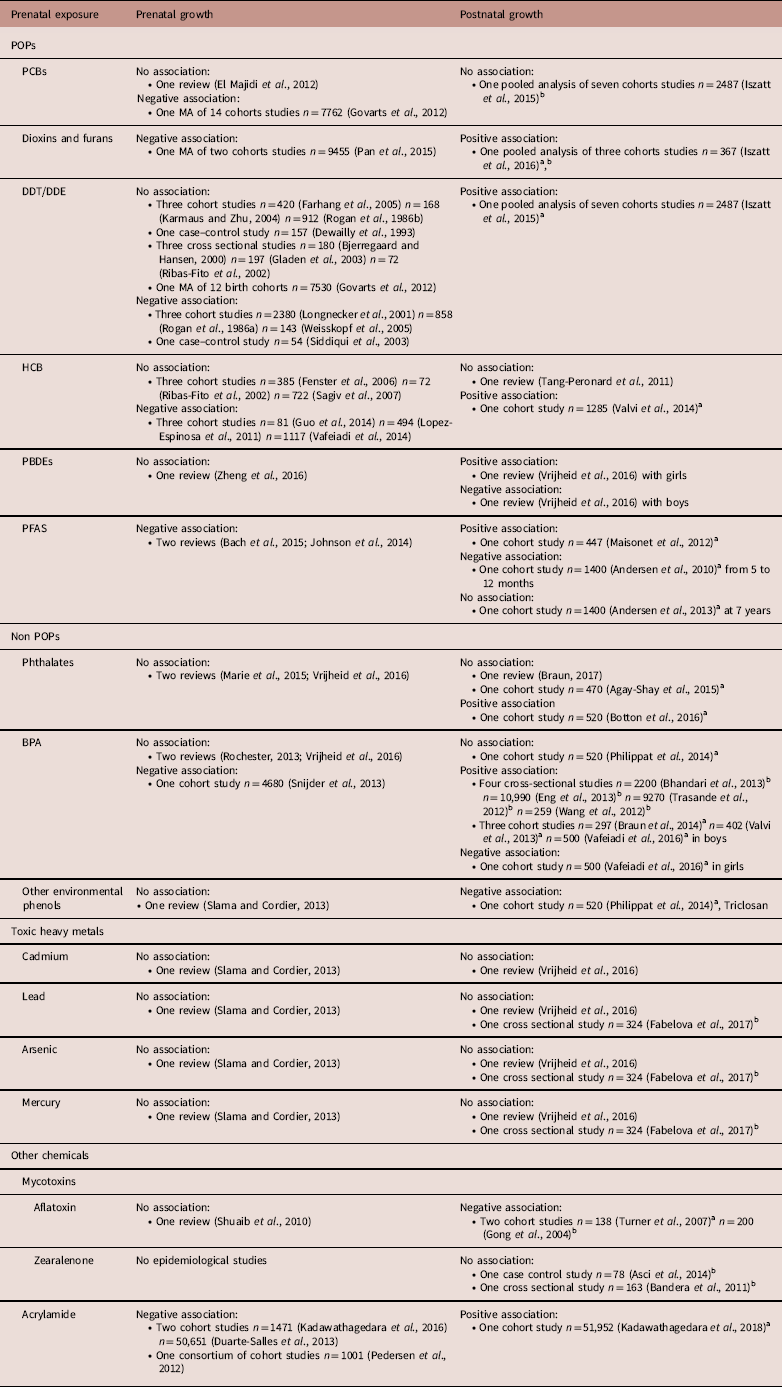
The literature evidence on prenatal exposure to environmental contaminants and pre or post-natal growth presented was summarized in Table 1.
Summary of the literature on prenatal exposure to environmental contaminant’s and child growth

POP, persistent organic pollutant; PCB, polychlorinated biphenyl; MA, meta-analysis; DDT, dichlorodiphenyl trichloroethane; DDE, dichlorodiphenyl dichloroethene; HCB, hexachlorobenzene; PBDE, polybrominated diphenyl ethers; PFAS, perfluoroalkyl substances; BPA, bisphenol A.
Studies are only recent research articles not included in summarizing articles.
For postnatal growth association.
a Prenatal exposure.
b Postnatal exposure.
Potential mechanisms
Epigenetic modifications
In studies related to the developmental origins of health and disease hypothesis, the epigenetic modifications due to adverse environmental exposure are often cited as a possible mechanism.Reference Desai, Jellyman and Ross 126 These modifications could induce heritable and persistent changes in gene expression without altering the DNA sequence. The three major molecular substrates that are involved in this process are the DNA, proteins that form the core around which the DNA wraps (histones) and a specific form of RNA molecules (noncoding RNA). Epigenetic changes include DNA methylation, chromatin folding or binding and packaging of DNA around nucleosomes and, finally, covalent modifications of the histone proteins.Reference Desai, Jellyman and Ross 126 A recent review found that in the context of child health, the impact of environmental modification on the epigenome are of small magnitude. However, these small environmental effects (maternal smoking, exposure to heavy metals or phthalates and phenols) on the epigenome have been replicated across populations and across time. Therefore, the authors conclude about the need of having critical discourse on findings such small effects. Meanwhile, they advocate the research to emphasis the studies on the dynamic nature of the epigenome with the help of longitudinal studies.Reference Breton, Marsit and Faustman 127
Endocrine disrupting chemicals
According to World Health Organization,Reference Bergman, Becher and Blumberg 128 ‘An endocrine disruptor is an exogenous substance or mixture that alters function(s) of the endocrine system and consequently causes adverse health effects in an intact organism, or its progeny, or (sub) populations’. They can mimic or interfere with the effects of endogenous hormones.Reference Newbold, Padilla-Banks, Snyder, Phillips and Jefferson 129 EDCs can potentially affect all the human hormonal systems ranging from metabolism to growth, neurodevelopment or reproduction.Reference Bergman, Becher and Blumberg 128 , Reference Kabir, Rahman and Rahman 130 , Reference Maqbool, Mostafalou, Bahadar and Abdollahi 131 Many studies are suggesting that these chemicals could have an obesogenic effect, known as the ‘environmental obesogenic hypothesis’.Reference Iszatt, Stigum and Verner 20 , Reference Vafeiadi, Roumeliotaki and Myridakis 92 , Reference Valvi, Casas and Mendez 93 In the increase of obesity prevalence, EDCs might play a role beyond traditional risk factors.Reference Tang-Peronard, Andersen, Jensen and Heitmann 46 , Reference Heindel, Newbold and Schug 132 Because by definition they interfere with hormonal actions, sex-specific effects are expected for many EDCs.Reference Heindel, Blumberg and Cave 133 Moreover, the fetal and early postnatal periods would be of high susceptibility to these environmental exposures.Reference De Long and Holloway 134 , Reference Diamanti-Kandarakis, Bourguignon and Giudice 135
Oxidative stress
Another possible biological pathway between exposure to environmental contaminants and growth is through oxidative stress. Oxidative stress is an imbalance between the production and elimination of reactive species that leads to damages in macromolecules. The principal reactive species are reactive oxygen species (ROS) and reactive nitrogen species. Most environnemental contaminants induce abnormal ROS generation.Reference Rodriguez-Rodriguez, Ramiro-Cortijo and Reyes-Hernandez 136 Oxidative stress seems to be implicated in suboptimal fetal conditions, due to poor intrauterine environment and alterations of physiologic systems of cardiovascular control (e.g. renin–angiotensin–aldosterone system, hypothalamic–pituitary–adrenal axis).Reference Rodriguez-Rodriguez, Ramiro-Cortijo and Reyes-Hernandez 136
Conclusion
Environment factors can affect the development of the fetus. For instance, a widely studied exposure as exposures to tobacco smoke during pregnancy was well documented in association with child’s growth.Reference Carles, Charles and Forhan 137 Mounting evidence suggests that child’s growth may also be influenced by prenatal or postnatal exposures to some environmental contaminants (e.g. PCBs, DDE) but, for other chemicals than tobacco, the literature is sparse and characterised by large inconsistencies.
To gain knowledge about these associations, research in epidemiology should focus mainly on improving exposure assessment. The use of biomarkers is widespread in environmental studies, but the use of these data has important limitation. For example, when assaying non-persistent chemicals (phthalates, BPA), the characterisation of the exposure is difficult due to short half-life for some chemicals and high within-subject variability. On the contrary, POPs or for some metals that have long half-lives (up to years) and the use of biomarker measurement can give a good estimate of long-term past exposure. Moreover, studying the contaminants as mixtures and not individually could be interesting to deal with the exposures to many individual contaminants at low doses, some sharing similar mechanisms and routes of exposure (e.g. diet or tobacco smoke). In fact, exposures may be highly correlated, within and between the different chemical classes (e.g. PCBs, PBDEs, PFASs and phthalates) (Robinson et al.Reference Robinson, Basagana and Agier 138 ) and it can be challenging to identify the chemicals responsible for growth impairment.
Finally, we also need to pay attention about considering growth as a whole, reporting the associations at least with height, weight and weight-for-height as well.
To conclude, only limited associations were reviewed here between exposure to environmental contaminants and child’s prenatal or postnatal growth. New-borns, infants and children need to be considered as sensitive populations and policies aiming to reduce the exposure of this population are needed.
Financial Support
This research was supported by Agence Nationale de la Recherche (ANR) (grant number ANR-14-CE21-0002). Support for M.K. was provided by a doctoral grant from CORDDIM (field of major interest of the Île-de-France Regional Council ‘Cardiovascular/Obesity/Kidney/Diabetes’).
Conflicts of Interest
None
Acknowledgement
None