Health technology assessment (HTA) relies centrally on cost-effectiveness analysis (CEA) to inform decisions about the value of new and existing technologies. Concerns for health equity, or the fair distribution of health benefits, challenge the relevance of this information. CEA describes how resources should be allocated across health interventions so as to maximize health benefits within a given budget, or relative to a threshold level of societal willingness to pay. In cases where considerations of fairness or equity are relevant, the social value of providing a particular health intervention may differ from the value of the individual health benefits it produces. The best overall policy may thus diverge from the most efficient course of action recommended by CEA.
Although efficiency and equity are widely recognized as vital, independent goals for health systems (50) it has proven difficult to foster dialogue between them. For those seriously concerned with fair distribution of health, CEA may often seem beside the point. For others, CEA results expressed in quantitative terms may seem decisive, leaving little place for consideration of other goals.
While equity has been largely neglected in empirical CEA studies (Reference Sassi, Archard and Le Grand34;Reference Weatherly, Drummond and Claxton47) there is now a substantial body of exploratory work illustrating methods to bring equity and efficiency into closer dialogue. To promote approaches to HTA that are both evidence-based and values-based, our objective was to summarize formal methods to integrate equity concerns with CEA.
Sassi and colleagues published a review exploring similar themes. They found that methods to integrate equity concerns into CEA were urgently needed, but that formal approaches available at that juncture were unsatisfactory and required further development (Reference Sassi, Archard and Le Grand34). Considerable methodological work has been done in the intervening decade and a new review building on this earlier foundation is pertinent and timely. As a key reason for the neglect of equity in CEA may lie at the normative level, our review contributes a new analytic lens examining the implicit and explicit notions of fairness that have been raised in this literature.
METHODS
Data Sources and Study Selection
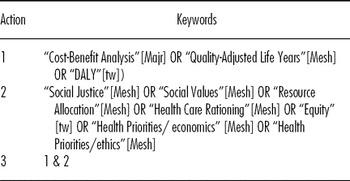
We searched the Pub Med database (1966 to date) on February 19, 2008 (updated March 6th, 2011) using the search string described in Table 1. We searched EMBASE (1980 to date) on February 22, 2008 (updated March 6th, 2011) using a modified Pub Med strategy.
PubMed Search Strategy

Note. No date or language restrictions were applied.
Each author independently reviewed the titles and abstracts of articles retrieved by the database search. The criterion used to assess relevancy was: Article describes or elaborates on a formal proposal to integrate equity with CEA? We sought to identify all papers whose primary purpose was to advance quantitative methods enabling equity concerns to be considered explicitly with cost-effectiveness results for health interventions and, thereby, to influence recommended program rankings. We used the term CEA to encompass both cost-effectiveness and cost-utility designs as defined by Drummond and colleagues (Reference Drummond, Sculpher, Torrance, O'Brien and Stoddart15). Because of the exploratory nature of the topic, all original research articles, reviews, commentaries or editorials were candidates for inclusion. Review papers were retained only if judged to have made a novel contribution. Monographs, reports, and conference abstracts were not reviewed. No language restrictions were applied. We checked article bibliographies and consulted experts to identify additional relevant studies.
Using the same relevancy criterion, each author independently reviewed all articles selected for full text screening. Review was not blinded. We excluded papers that were not about CEA, not about equity, or failed to offer specific, formal methodological proposals. Articles whose primary purpose was (i) to assess the fit of public values with the standard CEA model or (ii) to elicit empirical values for equity preferences were also judged not to satisfy the relevancy criterion and were excluded. Many have been reviewed elsewhere (34;Reference Schwappach35;Reference Shah37;Reference Tsuchiya41;Reference Tsuchiya, Dolan and Shaw42). Authors jointly determined study inclusion on the basis of their individual assessments; consensus was reached through discussion. Lists of all papers included (Supplementary Table 1) and excluded (Supplementary Table 2) after full text review can be viewed online at www.journals.cambridge.org/thc2012013.
Data Extraction and Synthesis
Each author extracted relevant information independently using a standardized data extraction form pretested on a subset of the sample, and wrote a synopsis of the central argument. The following fields were extracted from each study: (i) identification (authors; journal; date of publication; type of study, study location, funding sources); (ii) study design and methods (perspective, design, outcomes, interventions considered, respondent sample for empirical studies); and (iii) equity concepts. Extraction was not blinded. Consensus was reached through discussion. No attempt was made to assess overall study quality. To aid in narrative synthesis, papers are grouped by methodological approach. An expert panel reviewed key results and helped to refine equity concepts.
RESULTS
Overview
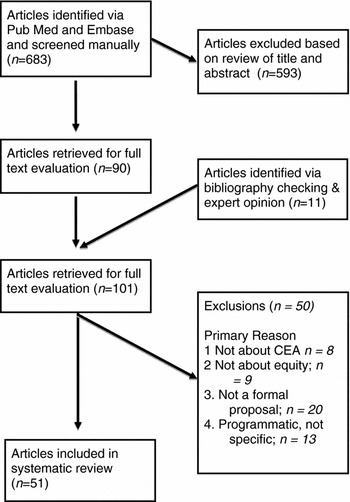
The search strategy yielded 695 unique records of which 102 were selected for full text screening and 51 retained for review (Figure 1).
Flow diagram describing study selection.

The fifty-one studies took three broad approaches to facilitate quantitative consideration of equity concerns in CEA (Table 1): integration of distributional concerns through equity weights and social welfare functions (33 of 51; 65 percent), exploration of the opportunity costs of alternative policy options through mathematical programming (9 of 51; 18 percent), and multi-criteria decision analysis (9 of 51; 18 percent). We critically review their main features. A detailed appendix describing each study is available from the corresponding author.
Equity Weights and Social Welfare Functions
An equity weight in CEA expresses the extent to which society is prepared to sacrifice overall health benefits to promote a more equitable distribution of these benefits. Weights were proposed in relation to patient age (Reference Bleichrodt, Diecidue and Quiggin8;Reference Rodriguez and Pinto32;Reference Williams48), sex (Reference Tsuchiya and Williams43), to reflect severity of the initial health state and limited health potential (Reference Nord29;Reference Nord, Pinto, Richardson, Menzel and Ubel30), to give individuals consideration proportional to their potential for health (Reference Johannesson21;Reference Stolk, van Donselaar, Brouwer and Busschbach39), and to reflect preferences for concentration of health benefits (Reference Mortimer28;Reference Rodriguez-Miguez and Pinto-Prades33). Supplementary Table 3 (which can be viewed at www.journals.cambridge.org/thc2012013) provides an exposition of the main proposals.
The trade-off that society is willing to make to promote a more equitable distribution of health can also be represented formally as a social welfare function (SWF), a real-valued function that ranks social states. A health-related SWF ranks all possible distributions of the variable health (life-years, QALYs). A SWF can combine concern for total health with an aversion to inequalities between social groups, or in overall lifetime health. It can also give priority to those with least health. Several diverse functional forms have been proposed. Wagstaff suggested that concerns about the degree of overall inequality in health could be incorporated in the QALY approach through an isoelastic SWF that includes a parameter indicating the degree of aversion to inequality in health outcomes. Isoelasticity means that the ratio between percentage change of x's welfare over percentage change of y's welfare is constant. A similar SWF underlies Atkinson's income inequality index. The attractiveness of the parametric SWF approach is its ability to capture both efficiency and equity considerations in a unified framework (Reference Wagstaff46).
Bleichrodt proposed a SWF that can incorporate concerns for average utility (or QALYs) as well as ex ante and ex post equity in the distribution of QALYs (Reference Bleichrodt7). He proposes a two-component multi-attribute utility function where the first component is total number of QALYs and the second a summary index of inequality (Theil's entropy measure) reflecting the ex post distribution. Next, he proposes a third component reflecting ex ante equity (fair chances of health benefit). This study incorporates equity with average health through use of an inequality measure E. As discussed by Atkinson, Sen, and others, such SWFs can be written as: W = average (1-E) (Reference Sen36).
Dolan introduced a class of health-related SWFs (including the Cobb-Douglas SWF) that allow efficiency and equity to be considered independently and then combined (Reference Dolan14). This class of health related SWFs can in principle incorporate both “pure” or univariate inequality in health and bivariate health inequalities related to social group variations (Reference Wolfson and Rowe49). Dolan was concerned about equity defined in terms of pre- and posttreatment health status derived from various interpretations of the concept of “need”: (a) need as capacity to benefit (posttreatment minus pretreatment health status); (b) need as pretreatment health status only.
Lindholm, Rosen, and Emmelin published a series of studies based on a random sample questionnaire of 449 Swedish politicians (Reference Lindholm and Rosen24;Reference Lindholm, Rosen and Emmelin25) The survey asked how politicians would trade off average health gains for a more equal distribution of life-years between two socioeconomic groups. This trade-off was formalized by applying Atkinson's SWF directly to health, and including a parameter to indicate explicitly the decision-maker's degree of aversion to inequality in health outcomes.
Although Wagstaff and Lindholm et al. introduced similar social welfare functions, inequity is defined by Wagstaff as degree of overall inequality in health, while Lindholm and colleagues define inequity as inequality in health between socioeconomic groups (Reference Lindholm, Rosen and Emmelin25;Reference Wagstaff46). A SWF written in the form W = average (1-E) is flexible enough to incorporate each type of inequality. The inequality measure E can be the univariate Gini for overall inequality, and the bivariate Concentration index for social group inequality (Reference Wolfson and Rowe49).
Mathematical Programming
Different concepts of equity can be formally expressed in a constrained maximization framework using mathematical programming (MP). Equity is represented as an opportunity cost. MP extends the standard CEA approach. Although CEA aims to maximize aggregate health, its standard decision-rules rely on strong assumptions of constant returns to scale, independent treatment options, and perfect divisibility. CEA may thus fail to represent health resource allocation problems realistically and to capture the true opportunity costs of a decision (Reference Birch and Gafni6).
Stinnett and Paltiel introduce mathematical programming (MP) as a more general approach to resource allocation that enables relaxation of restrictive assumptions and consideration of neglected distributional concerns (Reference Stinnett and Paltiel38). They first demonstrate that resource allocation based on CEA can be expressed as an equivalent linear programming problem. They then show that mixed integer programming, which permits use of continuous (linear) and integer variables, enables consideration of more complex scenarios than does standard CEA by introducing appropriate budgetary, practical, and ethical constraints (Reference Stinnett and Paltiel38).
In linear programming, the cost of equity is the shadow price of relaxing an equity constraint. In MP more generally, one may solve with and without equity constraints and compute the difference in optimal objective function values. The result can be interpreted as the opportunity cost of equity.
Stinnett and Paltiel sketch several strategies to address ethical dilemmas from the CEA literature (Reference Stinnett and Paltiel38). Some interventions, such as immunization or screening programs, must reach target levels to be ethically or practically viable. This can be addressed by stipulating that a program must be implemented above some minimum level or not implemented (Reference Anand2). Standard CEA algorithms allow for “mixed solutions” offering treatments of unequal effectiveness to individuals within a homogeneous treatment population. For example, it is possible to recommend that some fraction of the population be screened annually, while the complementary fraction is screened biennially. This might be considered unacceptable on grounds of fairness (Reference Cantor10;Reference Ubel, DeKay, Baron and Asch45). Mixed solutions can be excluded by stipulating that implementation of any positive portion of one program requires that another program not be implemented. This is termed “global mutual exclusivity” (Reference Baltussen and Niessen3). One might be concerned that resources be allocated fairly or proportionately among population groups. One could, for example, stipulate that at least some minimum percentage of resources be targeted to interventions for a particular disadvantaged group. Alternatively, one could impose a constraint that ties the amount invested in (or net health benefits delivered to) one group, to the corresponding measures for another (Reference Stinnett and Paltiel38).
Six papers apply MP to specific resource allocation problems. Two general kinds of equity constraints are discussed: proportional allocation, which specifies equity as proportional or fair treatment between groups (Reference Cleary, Mooney and McIntyre11;Reference Earnshaw, Richter and Sorensen16;Reference Kaplan and Merson23;Reference Zaric and Brandeau51), and nondiscrimination, which imposes a constraint that one not be allowed to differentiate amongst members of the “same” group for reasons of fairness, even when indicated on efficiency grounds (Reference Cleary, Mooney and McIntyre11;Reference Epstein, Chalabi, Claxton and Sculpher17;Reference Zenios, Wein and Chertow52).
Multi-criteria Proposals
The multi-criteria approach views equity as potentially irreducible to a single dimension. Baltussen and Niessen introduce multi-criteria decision analysis (MCDA) as a practical approach to aid policy makers, particularly those in developing countries, to distribute health resources while satisfying multiple objectives (Reference Baltussen and Niessen3). For Baltussen and Niessen, health equity concerns the extent to which interventions reach and benefit disadvantaged groups, such as the poor, or certain ethnicities, or otherwise vulnerable populations, such as the severely ill, or children. Multiple equity-related criteria may be important, as well as criteria reflecting efficiency, and budgetary and practical constraints.
Policy Makers Require Transparent and Systematic Approaches to Consider All Criteria Simultaneously
MCDA is designed to furnish policy makers with a ranking of health interventions that reflects their own objectives. The final ordering must allow for a trade-off between various criteria, and should reflect the relative importance of criteria (Reference Baltussen and Niessen3).
Methodologically, MCDA involves two steps. First, one constructs a “performance matrix.” The lines of the matrix represent individual health interventions. Column headings present the criteria against which intervention performance is to be assessed. Criteria can be measured on various scales—binary, nominal, ordinal, or ratio. Each internal cell of the matrix represents the performance of an individual intervention on a specific criterion. Second, the information in the matrix must be processed to produce a ranking. Although this can be done through deliberation (Reference Makundi, Kapiriri and Norheim27), due to informational complexity, Baltussen and Niessen favor quantitative methods. The key idea is to convert the information in the matrix into consistent numerical values from which a score can be calculated. This involves constructing scales that represent preferences for the expected consequences of each intervention option, weighting the scales to represent the relative importance of each criterion, and calculating weighted averages to yield an overall assessment of each intervention (Reference Baltussen and Niessen3).
Several studies have now applied MCDA methods (Reference Baltussen, Stolk, Chisholm and Aikins4;Reference Baltussen, ten Asbroek and Koolman5;Reference Goetghebeur, Wagner and Khoury19;Reference Jehu-Appiah, Baltussen and Acquah20). In Ghana and Nepal, criteria were selected through discussions with a small group of health policy makers. The relative importance of criteria was established through econometric analysis of discrete-choice experiments that present scenarios describing tradeoffs among criteria to a larger group of policy makers. The authors find that MCDA is a feasible and generalizable approach to priority setting that should be strongly embedded in the organizational context (Reference Baltussen, Stolk, Chisholm and Aikins4;Reference Baltussen, ten Asbroek and Koolman5;Reference Jehu-Appiah, Baltussen and Acquah20).
DISCUSSION
This review has identified three formal mechanisms to consider equity in the context of CEA, all of which are technically feasible. Yet, despite sustained methodological work spanning 2 decades, consideration of equity issues remains peripheral to CEA (Reference Sassi, Archard and Le Grand34;Reference Weatherly, Drummond and Claxton47). A central problem relates to the fact that equity is understood in multiple ways, each demarcating a distinct set of intuitions concerning fairness. Each method takes a distinct approach to how values should articulate with cost-effectiveness evidence. We synthesize the major findings below. An important limitation of this review concerns the failure to assess the quality of studies with respect to conceptualization and empirical implementation.
Equity Weights and Social Welfare Functions
Authors advocating these approaches have usually envisioned a definitive amendment to the QALY model incorporating specific values for equity weights, or identification and parameterization of a correct form of the SWF.
To justify specification of weights or parameters, several studies looked to empirical surveys of stated preferences of members of the general public or decision makers. At least six problems arise from this approach, reflecting difficulties in eliciting true and stable preferences (Reference Lloyd26), and questions about the normative role public opinion is being called upon to play: (i) The manner in which questions are asked is known to influence responses (Reference Ubel44); (ii) Large-scale surveys elicit opinions rather than considered judgments; (iii) Questions are posed in isolation; however, we require information on the joint effects of equity dimensions (Reference Sassi, Archard and Le Grand34); (iv) The average value is a statistical compromise imposed on a wide distribution of opinion (Reference Johri, Damschroder, Zikmund-Fisher and Ubel22); (v) Even where a clear consensus exists, majority opinion can simply be wrong (Reference Brock, Murray, Salomon, Mathers and Lopez9); (vi) The public may not have well-considered judgments about complex distributive issues. Public consultation is clearly important in democratic societies and improved techniques are being developed (Reference Fishkin18). However, public opinion by itself offers insufficient normative grounds to justify the choice of specific values for equity weights or functional forms.
SWF studies have also sought guidance from theories of fair distribution from welfare economics or moral and political philosophy. These theories offer coherent and sophisticated normative frameworks that can be used as analytic lenses. However, they are developed at a high level of generality and their application to concrete problems of health policy is challenging.
To summarize, surveys reveal no consensus on specific values for weights, parameter values or functional forms, and studies offer no strong theoretical basis to establish such values. We, therefore, believe that exploratory use of these techniques, for example in sensitivity analyses, is most promising.
Mathematical Programming and the Exploration of Opportunity Costs
Developed primarily by researchers engaged in cost-effectiveness modeling, MP shares many features of the SWF approach. Specifically, maximization and health equity are presented in a unified framework, and equity is conceived as a constraint on an optimization problem with a quantifiable cost. MP studies trace the opportunity costs of alternative policy options leaving the choice of which option to pursue to decision makers. Accordingly, pure efficiency results are presented separately from equity-based scenarios.
To support normative claims, MP studies advocate general principles such as equality or proportionality in health benefits or financial investment between groups, defined in terms of clinical characteristics, risk factors, socio-demographically or geographically (Reference Cleary, Mooney and McIntyre11;Reference Earnshaw, Richter and Sorensen16;Reference Epstein, Chalabi, Claxton and Sculpher17;Reference Kaplan and Merson23;Reference Stinnett and Paltiel38;Reference Zaric and Brandeau51;Reference Zenios, Wein and Chertow52). Horizontal equity, or the principle of equal treatment for equal need, has also been invoked (Reference Epstein, Chalabi, Claxton and Sculpher17). Zenios and colleagues discuss a compelling case where heterogeneity between patient subgroups results in kidney transplantation being less cost-effective for black than for white Americans. While the logic of efficiency would suggest defining subgroup-specific cost-effectiveness ratios and potentially restricting transplantation to those with more favorable cost-effectiveness, equity is addressed through a constraint preventing race from influencing access to treatment (Reference Zenios, Wein and Chertow52).
In the kidney transplantation example, the criterion for defining groups is intuitively morally important. However, for the majority of analyses, the definition of what constitutes a group often seems ad hoc or of questionable moral relevance. Several studies attempt to address equity by giving all stakeholder groups a slice of the pie, without asking why these groups should have special fairness claims. With a notable exception (Reference ANAND1;Reference Anand2), MP papers are not clearly linked to the theoretical literatures on equity. Their main focus to date has been to explore and advance technical methods that can be used to address fairness concerns in CEA. Despite considerable strengths in modeling and methods, the lack of a clear normative basis is currently a limiting factor to their utility.
Multi-criteria Decision Analysis
In MCDA, equity and efficiency figure among several priority-setting concerns that contribute to define a ranking of health interventions (Reference Baltussen and Niessen3). To identify relevant concerns, MCDA draws on the values of a small group of stakeholders. The exercise to identify and weigh criteria contributes to procedural fairness by encouraging clarity, transparency, and discussion among stakeholders, as well as appropriate use of scientific evidence. Studies have generally recruited individuals with an elected or managerial responsibility for the public's health to ensure that use of their values to inform health priorities is legitimate (Reference Baltussen, Stolk, Chisholm and Aikins4;Reference Baltussen, ten Asbroek and Koolman5;Reference Jehu-Appiah, Baltussen and Acquah20). Through recognition of the plurality of relevant concerns and its pragmatism, MCDA has made a substantial contribution to priority setting. It has modest data and modeling requirements and can be done relatively quickly in a variety of settings.
MCDA is an empirical and context-specific approach about which several important questions can be posed. One might be worried that selection of criteria is somewhat arbitrary in that it depends on a small group of individuals. Moreover, criteria selected to date have sometimes been defined in overlapping terms, reflecting the lack of a clear theoretical relationship between these criteria and a broader theory of justice. The stability of econometric results is also at issue, as it is unclear to what extent rankings are sensitive to the composition of the respondent group. A fractional factorial design allows for estimation of all main effects, but not of interactions. The design of the experiments published thus far has been orthogonal, without correlations between the attributes. Nonorthogonal designs could be considered in future to model situations of dependence between attributes and those for which the choice probabilities are dependent on the attribute levels. Informational loss related to the aggregation process may result in lack of transparency in final rankings. Perhaps most importantly, one might be concerned that the aggregation function used to construct the final ranking is empirically and statistically driven rather than being based on cultivation of judgment. It combines on an equal footing the best-known scientific evidence and opinions of uncertain validity. Deliberative approaches to MCDA merit exploration, as do methods integrating qualitative dimensions (Reference Makundi, Kapiriri and Norheim27).
CONCLUDING REMARKS
Viable techniques now exist to facilitate consideration of equity in CEA. These range from descriptive approaches (Reference Cookson, Drummond and Weatherly12) to the quantitative methods studied in this review. In our view, the principal obstacles impeding their use now lie at the normative rather than the technical level. We conclude with two recommendations for HTA bodies seeking to strengthen consideration of equity in decision making.
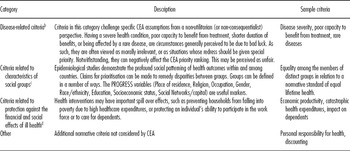
The term “equity” is used to refer to a multiplicity of concepts and values. Talking at cross-purposes has often hindered understanding. As a practical tool to focus discussion, HTA bodies require a comprehensive map of the principle equity concerns. Based on this review, Table 2 provides a synthesis of additional normative criteria relevant to CEA. Achieving greater clarity at the conceptual level will facilitate effective data gathering on the equity effects of interventions and the tradeoffs between maximizing overall health benefits and equity considerations. Greater conceptual clarity will also help to ensure that such data are reliable, valid, and contribute to the cumulative growth of knowledge on interventions to promote health equity.
Additional Normative Criteria to Be Considered in Conjunction With Cost-Effectiveness Resultsa

a A synthesis of normative criteria relevant to priority setting and not “adequately” considered by CEA. In some cases, the criteria are not considered, while in others the normative stance taken by CEA might warrant interrogation.
b These issues have dominated the debate in high-income countries. Criteria concern fair allocation of specific interventions (secondary prevention, treatment, cure) for individuals with a defined health need.
c Although health equity is usually discussed in terms of social group differences these issues are less prominent in CEA. Allocation of treatment interventions based on social group characteristics may be viewed as potentially discriminatory. However, targeting to disfavoured groups may be viewed as appropriate when interventions act on upstream factors such as the social determinants of health, prevention and health promotion (Reference Weatherly, Drummond and Claxton47). In resource-limited settings, social group factors may be viewed as relevant to allocating all types of interventions (Reference Norheim and Asada31;40).
d Concerns for fair distribution can also apply to the costs of ill health. These criteria may be especially relevant in settings with substantial poverty and lacking a strong social safety net, typical of many low- and middle-income countries.
Value pluralism is a universal feature of democratic societies, and there is no widely accepted normative source on which to ground normative choices. Cost-effectiveness rankings provide extremely important and useful information for resource allocation choices. However, many additional criteria related to the many dimensions of equity, and other goals such as feasibility and affordability are also relevant to HTA decisions. To foster the best overall decision under specific circumstances, we recommend that HTA bodies use techniques for explicit consideration of equity such as those reviewed in this study as part of a deliberative process that emphasizes procedural fairness through accountability, transparency, consistency, and the proper use of scientific evidence (Reference Daniels13). While we value the insights they can provide, we eschew using quantitative techniques for consideration of equity to provide a definitive ranking of priorities. These techniques can do most when used in an open-ended manner as part of a fair decision-making process.
SUPPLEMENTARY MATERIAL
Supplementary Table 1 www.journals.cambridge.org/thc2012013
CONTACT INFORMATION
Mira Johri, PhD, MPH, Associate Professor, Departement of Health Administration, University of Montreal, Montreal, Canada
Ole Frithjof Norheim, MD, PhD, Professor, Department of Public Health and Primary Care, University of Bergen, Bergen, Norway
CONFLICTS OF INTEREST
Mira Johri's institute has received consultancy payment for her work from World Health Organization and honoraria for her work from Copenhagen Consensus Panel on HIV/AIDS 2011. The other author reports having no potential conflicts of interest.