Climate, setting the stage
Climate mediates distribution, continuity and persistence of ecologically permissive environments through episodes of perturbation and stability. Climate cascades further mediate the dynamics of faunal assembly and the structure of biodiverse systems over time. They influence the potential for invasion/geographical expansion and isolation/diversification (and extinction) of complex biotas, and ultimately determine patterns of emergent disease from local to intercontinental scales (e.g. Hoberg & Brooks, Reference Hoberg and Brooks2015; Scheffers et al., Reference Scheffers, De Meester, Bridge, Hoffmann, Pandolfi, Corlett, Butchart, Pearce-Kelly, Kovacs, Dudgeon, Pacifici, Rondinini, Foden, Martin, Mora, Bickford and Watson2016). Environmental and ecological perturbation can be stochastic and linked to single circumscribed or isolated events on varying spatial dimensions, or may be manifested as episodic processes with recurrent downstream and overlapping effects on diversity over extended temporal and spatial scales (Hoberg & Brooks, Reference Hoberg and Brooks2008; Barnosky et al., Reference Barnosky, Hadley and Bascompte2012; Galbreath & Hoberg, Reference Galbreath and Hoberg2015). Recurrent events reflect wobbling climate (e.g. in a simple sense the variation between warm and cold regimes of varying duration and extent) contributing to environmental disruption and ecological heterogeneity. Oscillations between episodes of perturbation (facilitating geographical expansion by species) and stability (population isolation) were primary contributors to the assembly of faunal mosaics on broad macroevolutionary scales (e.g. Hoberg et al., Reference Hoberg, Galbreath, Cook, Kutz and Polley2012; Hoberg & Brooks, Reference Hoberg and Brooks2015). Climate and episodic processes interact with evolution, ecology and biogeography to determine the structure and complex mosaic that is the biosphere (e.g. Jansson & Dynesius, Reference Jansson and Dynesius2002; Stigall, Reference Stigall2010). These are the processes that will be explored in the following discussion that links empirical and theoretical issues of relevance to parasitology.
Parasites and parasite–host assemblages, within this expansive environmental matrix determined by climate, are key components in a general explanatory paradigm for global biodiversity (e.g. Brooks & Hoberg, Reference Brooks and Hoberg2000; Dobson et al., Reference Dobson, Lafferty, Kuris, Hechinger and Jetz2008). Myriad parasites describe a complex tapestry at the intersection of evolution, ecology and biogeography, and provide insights about the history and future of the biosphere. This view is based on observations of predictable associations (evolutionary and ecological conservatism) linking hosts and parasites in space and time. These linkages reveal temporally deep structure and persistence of ecological associations (Hoberg & Brooks, Reference Hoberg and Brooks2008). Parasites with complex life cycles are thus direct indicators of intricate food webs. They reveal considerable spatial, temporal and trophic connectivity because they track broadly and predictably across trophic levels, spanning local populations to extensive landscapes, across a continuum of evolutionary to ecological time (e.g. Hoberg, Reference Hoberg, Reaka-Kudla, Wilson and Wilson1997; Lafferty et al., Reference Lafferty, Dobson and Kuris2006).
We are exploring the intricacies of faunal assembly in the context of Quaternary time frames of the past 2.6 million years, a period dominated by episodic shifts in climate that began with cooling trends during the late Pliocene and continued through dramatic and episodic alternation between glacial and interglacial stages (e.g. Dynesius & Jansson, Reference Dynesius and Jansson2000; Harris, Reference Harris2005; Jansen et al., Reference Jansen, Overpeck, Briffa, Duplessy, Joos, Masson-Delmotte, Olago, Otto-Bliesner, Peltier, Rahmstorf, Ramesh, Raynaud, Rind, Solomina, Villalba, Zhang, Solomon, Qin, Manning, Chen, Marquis, Averyt, Tignor and Miller2007; Masson-Delmotte et al., Reference Masson-Delmotte, Schulz, Abe-Ouchi, Beer, Ganopolski, González Rouco, Jansen, Lambeck, Luterbacher, Naish, Osborn, Otto-Bliesner, Quinn, Ramesh, Rojas, Shao, Timmermann, Stocker, Qin, Plattner, Tignor, Allen, Boschung, Nauels, Xia, Bex and Midgley2013). The Quaternary brackets the Pleistocene, ending with the termination of the ultimate glacial stage about 11.7 kyr bp, the Holocene (our current interglacial) and the Anthropocene. Inception of the Anthropocene, during relatively recent human history (perhaps in the 1750s or substantially deeper in time), is consistent with the pervasive and expanding impact of human dispersal, burgeoning population, agriculture, technology and globalization. Environmental thresholds and tipping points are being reached due to accelerating climate warming, environmental perturbation and overlapping (interacting) crises for biodiversity, species invasions and emerging infectious diseases (e.g. Steffen et al., Reference Steffen, Grinevald, Crutzen and McNeil2011; Brooks & Hoberg, Reference Brooks, Hoberg and Rohde2013; Hoberg & Brooks, Reference Hoberg, Brooks and Rohde2013; Ruddiman, Reference Ruddiman2013; Capinha et al., Reference Capinha, Essl, Seebens, Moser and Pereira2015; Waters et al., Reference Waters, Zalasiewicz and Summerhayes2016).
Climate interacting with geography sets the stage upon which the evolutionary and ecological play is enacted, and regionally this is especially evident in high-latitude environments of the Northern Hemisphere (e.g. Hopkins, Reference Hopkins, Hopkins, Matthews, Schweger and Young1982; Hewitt, Reference Hewitt2004; Callaghan et al., Reference Callaghan, Björn, Chernov, Chapin, Christensen, Huntley, Ims, Johansson, Jolly, Jonasson, Matveyeva, Panikov, Oechel and Shaver2004a, Reference Callaghan, Björn, Chernov, Chapin, Christensen, Huntley, Ims, Johansson, Jolly, Jonasson, Matveyeva, Panikov, Oechel, Shaver, Elster, Henttonen, Laine, Taulavuori, Taulavuori and Zöcklerb; Harris, Reference Harris2005). The structure and diversity of northern systems developed in a crucible of dynamic and episodic climate/environmental change extending over the past 3.5 million years. Implications of climate on biological complexity and insights from northern systems are contributing to new evaluations of the nature of diversity and a broadening understanding of the fundamental processes involved in faunal assembly across the biosphere (e.g. Hoberg et al., Reference Hoberg, Galbreath, Cook, Kutz and Polley2012; Cook et al., Reference Cook, Galbreath and Bell2017). Climate is a pervasive driver of biotic structure, and processes that cause episodic biotic expansion, geographical colonization and downstream outcomes of faunal mixing, host switching and isolation are equivalent across evolutionary and ecological scales (e.g. Hoberg & Brooks, Reference Hoberg and Brooks2008, Reference Hoberg, Brooks and Rohde2013). Elucidation of historical dynamics in the Arctic and elsewhere has implications for recognizing and anticipating the consequences of geographical expansion, shifting distributions and ecological collision – events that are unfolding in the arena of accelerating climate change (Parmesan, Reference Parmesan2006; Lafferty Reference Lafferty2009; Lawler et al., Reference Lawler, Shafer, White, Karieva, Maurer, Blaustein and Bartlein2009; Hoberg & Brooks, Reference Hoberg, Brooks and Rohde2013, Reference Hoberg and Brooks2015; Hope et al., Reference Hope, Waltari, Payer, Cook and Talbot2013a, Reference Hope, Greiman, Tkach, Hoberg and Cook2016). Insights from high-latitude host–parasite systems provide a pathway to explore the intricacies of faunal assembly, perturbation and emergent disease.
Coevolutionary thinking contrasts with complexity thinking
Explanations of an interaction between climate, perturbation and diversity require recognition of the inherent complexity of host–parasite systems (connections to a broader biosphere) and the core evolutionary/coevolutionary drivers of diversity and faunal assembly. In this regard, parasitology has to an extent been linked to an inappropriate paradigm over the past century, emphasizing cospeciation processes and expectations of diversification through modification by descent of associated host–parasite lineages (reviewed, for example, in Brooks, Reference Brooks1979; Klassen, Reference Klassen1992; Brooks & McLennan, Reference Brooks and McLennan1993, Reference Brooks and McLennan2002; de Vienne et al., Reference de Vienne, Refregier, Lopez-Villavicencio, Tellier, Hood and Giraud2013; Brooks et al., Reference Brooks, Hoberg and Boeger2015). In a biosphere considered to be dominated by relative stability and gradual change, a mechanistically simple picture of host-centric evolution for parasites with origins of considerable host specificity emerged. These assumptions conceptually established the parasitological paradox about the apparent enigma of widespread host colonization in associations apparently dominated by host–specific parasites (see Agosta et al., Reference Agosta, Janz and Brooks2010). A simplicity-based view of the biosphere is countered by considerable empirical observations and the nature of episodic perturbation, dispersal and host/geographical colonization as factors central to diversification, assembly and persistence of intricate faunal mosaics (e.g. Hoberg & Brooks, Reference Hoberg and Brooks2008, Reference Hoberg, Brooks and Rohde2013; Hoberg et al., Reference Hoberg, Galbreath, Cook, Kutz and Polley2012; Araujo et al., Reference Araujo, Braga, Brooks, Agosta, Hoberg, von Hathental and Boeger2015; Stigall et al., Reference Stigall, Bauer, Lam and Wright2017).
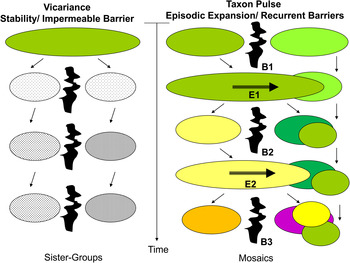
As a consequence, cospeciation and the biogeographical counterpart, vicariance, hold limited explanatory power in developing a robust understanding of the history of host–parasite assemblages and, more broadly, the biosphere (Hoberg & Brooks, Reference Hoberg and Brooks2008, Reference Hoberg, Brooks, Morand and Krasnov2010, Reference Hoberg, Brooks and Rohde2013) (fig. 1). Descriptions of the world should explicitly recognize and incorporate the role of complexity and contingency. Further, the importance of complexity in the biosphere has considerable implications for anticipating and mitigating responses related to invasion and emergence of disease among assemblages of hosts and parasites across environments under increasing disruption (Brooks & Hoberg, Reference Brooks, Hoberg and Rohde2013).
Vicariance and taxon pulses. Vicariance represents geographical isolation resulting from the origin of a static impermeable barrier to dispersal and gene flow, ultimately over time driving the divergence of sister taxa in adjacent regions. Taxon pulses represent the outcomes of episodic events of expansion (faunal collision) and isolation (stability), across barriers of intermittent duration and geographical extent, resulting in origins of complex mosaics chronologically and spatially for populations, species and faunal assemblages. Modified from Hoberg & Brooks (Reference Hoberg, Brooks, Morand and Krasnov2010).

Origins of complexity – a wobbling climate
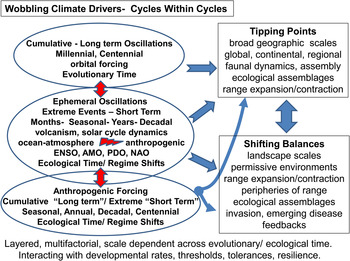
Climate wobbling or oscillation is a primary determinant of environmental structure and diversity (e.g. Jansson & Dynesius, Reference Jansson and Dynesius2002; Jansen et al., Reference Jansen, Overpeck, Briffa, Duplessy, Joos, Masson-Delmotte, Olago, Otto-Bliesner, Peltier, Rahmstorf, Ramesh, Raynaud, Rind, Solomina, Villalba, Zhang, Solomon, Qin, Manning, Chen, Marquis, Averyt, Tignor and Miller2007; Stigall, 2010; Barnosky et al., Reference Barnosky, Hadley and Bascompte2012; IPCC, Reference Stocker, Qin, Plattner, Tignor, Allen, Boschung, Nauels, Xia, Bex and Midgley2013; Masson-Delmotte et al., Reference Masson-Delmotte, Schulz, Abe-Ouchi, Beer, Ganopolski, González Rouco, Jansen, Lambeck, Luterbacher, Naish, Osborn, Otto-Bliesner, Quinn, Ramesh, Rojas, Shao, Timmermann, Stocker, Qin, Plattner, Tignor, Allen, Boschung, Nauels, Xia, Bex and Midgley2013; Stocker et al., Reference Stocker, Qin, Plattner, Stocker, Qin, Plattner, Tignor, Allen, Boschung, Nauels, Xia, Bex and Midgley2013). Cycles within cycles are apparent, with drivers that are layered, multifactorial and complex, influencing the dynamics and duration of climate states and shifts in environmental structure on varying temporal and spatial scales (heterogeneity in timing and distribution of warming and cooling events) in Earth history (fig. 2).
Climate oscillations across temporal and spatial scales in Earth history. Large-scale processes, such as glacial cycling, are driven by long-term, millennial forcing and orbital dynamics which serve to determine faunal assemblages across expansive geographical regions. Short-term events, or ephemeral oscillations, cycle within the dynamics of trends emerging from evolutionary time, while interacting or determining forcing in ecological time. Prominent regime shifts in ocean–atmosphere forcing include ENSO (El Niño Southern Oscillation), AMO (Atlantic Multi-Decadal Oscillation), PDO (Pacific Decadal Oscillation) and NAO (North Atlantic Oscillation). Anthropogenic forcing, with a signature of directional warming linked to atmospheric CO2, involves incremental (cumulative) and embedded extreme events. These are now the dominant outcomes emerging from accelerating change in global temperatures. Scales and duration of events contribute to hard tipping points and shifting balances for temperature regimes (and precipitation) which influence the occurrence of permissive environments, organismal distribution and faunal structure.

Episodic events on geological timescales during the Quaternary are attributable to orbital eccentricity (100,000-year cycles), obliquity (41,000 years) and precession (23,000 years) (Dynesius & Jansson, Reference Dynesius and Jansson2000; Jansson & Dynesius, Reference Jansson and Dynesius2002; Harris, Reference Harris2005; Jansen et al., Reference Jansen, Overpeck, Briffa, Duplessy, Joos, Masson-Delmotte, Olago, Otto-Bliesner, Peltier, Rahmstorf, Ramesh, Raynaud, Rind, Solomina, Villalba, Zhang, Solomon, Qin, Manning, Chen, Marquis, Averyt, Tignor and Miller2007). These forces explain transitions from glacial to interglacial stages (Masson-Delmotte et al., Reference Masson-Delmotte, Schulz, Abe-Ouchi, Beer, Ganopolski, González Rouco, Jansen, Lambeck, Luterbacher, Naish, Osborn, Otto-Bliesner, Quinn, Ramesh, Rojas, Shao, Timmermann, Stocker, Qin, Plattner, Tignor, Allen, Boschung, Nauels, Xia, Bex and Midgley2013) and are reflected in the duration and extent of cooling and warming during the late Pliocene and through the Pleistocene. Such events in evolutionary time are the foundations for trends in regional, continental and intercontinental faunal structure, and controlled large-scale range fluctuations of terrestrial and marine biotas of the Holarctic (e.g. Repenning, Reference Repenning1980; Hoberg et al., Reference Hoberg, Galbreath, Cook, Kutz and Polley2012). Across the 2.6 Myr of the Pleistocene, oscillations were initially in 41-kyr intervals, whereas after 800 kyr bp 100,000-year intervals were typical. Glacial cycles involved a prolonged and irregular period of ice-sheet expansion (glacial maximum), termination with accelerated retreat and decay associated with rapid warming, and subsequently a short interval (interglacial) characterized by mild or warm conditions (Denton et al., Reference Denton, Anderson, Togweiller, Edwards, Schaefer and Putnam2010). Extreme glacial maxima were associated with substantial reductions in sea level, approaching −120 m and exposing broad expanses of continental shelf. This permitted Beringia to link western North America to Eurasia as an iconic land bridge facilitating biotic exchange between the continents (e.g. Hopkins, Reference Hopkins1959; Repenning, Reference Repenning1980, Reference Repenning2001; Rausch, Reference Rausch1994; Waltari et al., Reference Waltari, Hoberg, Lessa and Cook2007; Cook et al., Reference Cook, Galbreath and Bell2017). Fragmentation and development of refugial zones leading to isolation are generally attributed to glacial maxima, although patterns of range restriction or colonization can represent taxon-specific responses within larger faunal assemblages (e.g. Shafer et al., Reference Shafer, Cullingham, Côté and Coltman2010; Hope et al., Reference Hope, Takebayashi, Galbreath, Talbot and Cook2013b). Interglacials were associated with sea-level rise, intercontinental isolation across Beringia (but oceanic communication linking the Pacific and Atlantic through the Arctic Basin) and retreat of continental glaciers in North America and Eurasia driving regional expansion and secondary faunal contact (e.g. Hoberg, Reference Hoberg1992; Hoberg & Adams, Reference Hoberg and Adams2000; Galaktionov et al., Reference Galaktionov, Blasco-Costa and Olson2012; Galbreath & Hoberg, Reference Galbreath and Hoberg2012). Overlapping episodes of biotic expansion, ecological collision, mixing and subsequent isolation involved phylogenetically and ecologically disparate taxa. These episodes were the foundation for assembly of complex macroevolutionary mosaics that represent much of the contemporary terrestrial and marine fauna across the Holarctic (e.g. Hoberg, Reference Hoberg1995; Repenning, Reference Repenning2001; Shafer et al., Reference Shafer, Cullingham, Côté and Coltman2010; Galaktionov et al., Reference Galaktionov, Blasco-Costa and Olson2012; Hoberg et al., Reference Hoberg, Galbreath, Cook, Kutz and Polley2012; Cook et al., Reference Cook, Galbreath and Bell2017; Galaktionov, Reference Galaktionov2017).
Large-scale oscillations play counterpoint to events at millennial/centennial/annual scales (fig. 2) (Masson-Delmotte et al., Reference Masson-Delmotte, Schulz, Abe-Ouchi, Beer, Ganopolski, González Rouco, Jansen, Lambeck, Luterbacher, Naish, Osborn, Otto-Bliesner, Quinn, Ramesh, Rojas, Shao, Timmermann, Stocker, Qin, Plattner, Tignor, Allen, Boschung, Nauels, Xia, Bex and Midgley2013). Termination of the most recent glacial advances and the Last Glacial Maximum (LGM) ensued at 20 kya, with incremental warming leading to the end of the Pleistocene about 11.7 kya. The tumultuous nature of this termination, with abrupt shifts between stadial and interstadial conditions (oscillations on decadal to centennial scales), occurred across several thousand years and correlated with the breakdown and retreat of Northern Hemisphere continental glaciers (Jansen et al., Reference Jansen, Overpeck, Briffa, Duplessy, Joos, Masson-Delmotte, Olago, Otto-Bliesner, Peltier, Rahmstorf, Ramesh, Raynaud, Rind, Solomina, Villalba, Zhang, Solomon, Qin, Manning, Chen, Marquis, Averyt, Tignor and Miller2007; Denton et al., Reference Denton, Anderson, Togweiller, Edwards, Schaefer and Putnam2010; Masson-Delmotte et al., Reference Masson-Delmotte, Schulz, Abe-Ouchi, Beer, Ganopolski, González Rouco, Jansen, Lambeck, Luterbacher, Naish, Osborn, Otto-Bliesner, Quinn, Ramesh, Rojas, Shao, Timmermann, Stocker, Qin, Plattner, Tignor, Allen, Boschung, Nauels, Xia, Bex and Midgley2013; Henry et al., Reference Henry, McManus, Curry, Roberts, Piotrowski and Keigwin2016). Variability is demonstrated across a minimum of 25 abrupt events in the last glacial stage that have been identified in the North Atlantic–Greenland record. Episodes of meltwater/iceberg discharges occurred on timescales of 10–100 years for Dansgaard–Oeschger events, during Heinrich stadial events and the period of about 12 kya that defined the Younger Dryas stadial at the termination of the LGM (Denton et al., Reference Denton, Anderson, Togweiller, Edwards, Schaefer and Putnam2010; Masson-Delmotte et al., Reference Masson-Delmotte, Schulz, Abe-Ouchi, Beer, Ganopolski, González Rouco, Jansen, Lambeck, Luterbacher, Naish, Osborn, Otto-Bliesner, Quinn, Ramesh, Rojas, Shao, Timmermann, Stocker, Qin, Plattner, Tignor, Allen, Boschung, Nauels, Xia, Bex and Midgley2013; Schmittner, Reference Schmittner2016). Interstadials of short duration were accompanied by gradual cooling and then accelerated transition to full stadial conditions that subsequently persisted for centuries to millennia. In these time frames, episodic perturbation characterized terrestrial and marine systems, and expansion corridors or refugial isolation of biotas was influenced by the distribution of suitable (permissive) habitats and sea-level changes in excess of 10–30 m.
Events attributable to orbital dynamics are a contrast with anthropogenic effects, which have come to dominate climate forcing over the past 250 years (IPCC, Reference Stocker, Qin, Plattner, Tignor, Allen, Boschung, Nauels, Xia, Bex and Midgley2013). Although relative stability has characterized the past 2000 years, climate shifts of centennial duration have been identified in the Medieval Climate Anomaly from 950 to 1250 (warming) and the Little Ice Age from 1450 to 1850 (cooling), constituting multidecadal variation bordering on Anthropocene time frames (Masson-Delmotte et al., Reference Masson-Delmotte, Schulz, Abe-Ouchi, Beer, Ganopolski, González Rouco, Jansen, Lambeck, Luterbacher, Naish, Osborn, Otto-Bliesner, Quinn, Ramesh, Rojas, Shao, Timmermann, Stocker, Qin, Plattner, Tignor, Allen, Boschung, Nauels, Xia, Bex and Midgley2013). The input from pulses of volcanism during this period appears limited to relatively short-term cooling and rapid recovery to baseline conditions, whereas the 11-year solar cycle, and trends between solar minima and maxima, accounts for a relatively minor component of fluctuations in annual global temperatures (e.g. Trenberth et al., Reference Trenberth, Jones, Ambenje, Bojariu, Easterling, Klein Tank, Parker, Rahimzadeh, Renwick, Rusticucci, Soden, Zhai, Solomon, Qin, Manning, Chen, Marquis, Averyt, Tignor and Miller2007; Masson-Delmotte et al., Reference Masson-Delmotte, Schulz, Abe-Ouchi, Beer, Ganopolski, González Rouco, Jansen, Lambeck, Luterbacher, Naish, Osborn, Otto-Bliesner, Quinn, Ramesh, Rojas, Shao, Timmermann, Stocker, Qin, Plattner, Tignor, Allen, Boschung, Nauels, Xia, Bex and Midgley2013).
Substantial sources of internal climate variability on relatively short temporal scales, however, are driven by ocean–atmosphere dynamics and temperature regime shifts that have downstream influence on habitats, productivity cycles and diversity in marine and terrestrial systems in ecological time (fig. 2). For example, global mean temperature is directly influenced by variability of the El Niño Southern Oscillation (ENSO), persistent since at least the Pliocene, which influences the extent of interannual shifts in warming and cooling (e.g. Masson-Delmotte et al., Reference Masson-Delmotte, Schulz, Abe-Ouchi, Beer, Ganopolski, González Rouco, Jansen, Lambeck, Luterbacher, Naish, Osborn, Otto-Bliesner, Quinn, Ramesh, Rojas, Shao, Timmermann, Stocker, Qin, Plattner, Tignor, Allen, Boschung, Nauels, Xia, Bex and Midgley2013; Stocker et al., Reference Stocker, Qin, Plattner, Stocker, Qin, Plattner, Tignor, Allen, Boschung, Nauels, Xia, Bex and Midgley2013). Other oceanic and atmospheric regime shifts are represented by the Pacific Decadal Oscillation (PDO), which drives dynamics between cool and warm phases in sea surface temperatures of the eastern Pacific, and the Atlantic Multi-Decadal Oscillation (AMO) and the North Atlantic Oscillation (NAO), which determine fluctuations and climate shifts that influence North America and Siberia (Chavez et al., Reference Chavez, Ryan, Lluch-Cota and Ñiquen2003; Hurrell et al., Reference Hurrell, Kushnir, Otterson and Visbeck.2003; Sydeman et al., Reference Sydeman, Poloczanska, Reed and Thompson2015). Shallow climate shifts are also seen in the apparent warming hiatus (1993–2012), which may reflect decadal-level oscillations that can either enhance or dampen short-term trends against the broader background of upward incremental warming of the past century (Stocker et al., Reference Stocker, Qin, Plattner, Stocker, Qin, Plattner, Tignor, Allen, Boschung, Nauels, Xia, Bex and Midgley2013). Among these and other regime phenomena, El Niño/La Niña is a primary component of internal natural forcing interacting with external solar and volcanic mechanisms. Collectively these drivers directly contrast with an expanding signature for anthropogenic and multidecadal determinants controlling climate (e.g. Masson-Delmotte et al., Reference Masson-Delmotte, Schulz, Abe-Ouchi, Beer, Ganopolski, González Rouco, Jansen, Lambeck, Luterbacher, Naish, Osborn, Otto-Bliesner, Quinn, Ramesh, Rojas, Shao, Timmermann, Stocker, Qin, Plattner, Tignor, Allen, Boschung, Nauels, Xia, Bex and Midgley2013).
Anthropogenic forcing dominates the contemporary regime of an incremental increase in global atmospheric, oceanic and terrestrial surface temperatures over the past 250 years (Trenberth et al., Reference Trenberth, Jones, Ambenje, Bojariu, Easterling, Klein Tank, Parker, Rahimzadeh, Renwick, Rusticucci, Soden, Zhai, Solomon, Qin, Manning, Chen, Marquis, Averyt, Tignor and Miller2007; IPCC, Reference Stocker, Qin, Plattner, Tignor, Allen, Boschung, Nauels, Xia, Bex and Midgley2013; Stocker et al., Reference Stocker, Qin, Plattner, Stocker, Qin, Plattner, Tignor, Allen, Boschung, Nauels, Xia, Bex and Midgley2013). The Arctic is undergoing twice the rate of warming relative to other regions of the planet. More generally, the cascading impact of contemporary climate change on biological systems is readily apparent across the Northern Hemisphere (e.g. Harvell et al., Reference Harvell, Mitchell, Ward, Altizer, Dobson, Ostfeld and Samuel2002; Callaghan et al., Reference Callaghan, Björn, Chernov, Chapin, Christensen, Huntley, Ims, Johansson, Jolly, Jonasson, Matveyeva, Panikov, Oechel and Shaver2004a, b; Parmesan, Reference Parmesan2006; Lawler et al., Reference Lawler, Shafer, White, Karieva, Maurer, Blaustein and Bartlein2009; Hoberg et al., Reference Hoberg, Kutz, Cook, Galaktionov, Haukisalmi, Henttonen, Laaksonen, Makarikov, Marcogliese and Meltofte2013; Hope et al., Reference Hope, Waltari, Payer, Cook and Talbot2013a, Reference Hope, Waltari, Malaney, Payer, Cook and Talbot2015, Reference Hope, Greiman, Tkach, Hoberg and Cook2016; Meltofte et al., Reference Meltofte, Barry, Berteaux and Meltofte2013). Accumulating temperature anomalies have been recognized across subarctic and Arctic latitudes over the past 50 years (Trenberth et al., Reference Trenberth, Jones, Ambenje, Bojariu, Easterling, Klein Tank, Parker, Rahimzadeh, Renwick, Rusticucci, Soden, Zhai, Solomon, Qin, Manning, Chen, Marquis, Averyt, Tignor and Miller2007). Furthermore, an apparent upward inflection (or tipping point) for accelerated warming is evident in the middle 1970s, which for biological systems and parasite development and transmission represented a critical threshold (e.g. Kutz et al., Reference Kutz, Hoberg, Polley and Jenkins2005, Reference Kutz, Hoberg, Molnár, Dobson and Verocai2014). Coincidental oscillations and regime shifts in the PDO over this period of time may have further dampened trajectories for overall warming trends of longer duration attributable to anthropogenic forcing (Chavez et al., Reference Chavez, Ryan, Lluch-Cota and Ñiquen2003; Trenberth et al., Reference Trenberth, Jones, Ambenje, Bojariu, Easterling, Klein Tank, Parker, Rahimzadeh, Renwick, Rusticucci, Soden, Zhai, Solomon, Qin, Manning, Chen, Marquis, Averyt, Tignor and Miller2007; Stocker et al., Reference Stocker, Qin, Plattner, Stocker, Qin, Plattner, Tignor, Allen, Boschung, Nauels, Xia, Bex and Midgley2013).
Pleistocene worlds – an exemplar of historical foundations
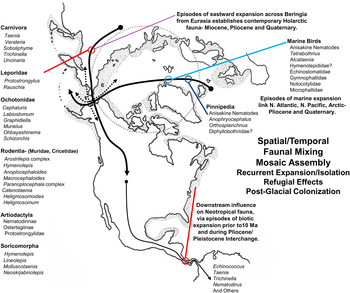
Contemporary host–parasite assemblages distributed across the Holarctic reflect a history of episodic expansion and isolation. Events were directly influenced by climate drivers and habitat perturbation/stability extending from the late Pliocene. Diversity arose and was partitioned across the Beringian nexus, which has been an intermittent corridor for episodic expansion and collision between the Siberian and Nearctic terrestrial faunas (reviewed in Waltari et al., Reference Waltari, Hoberg, Lessa and Cook2007; Hoberg et al., Reference Hoberg, Galbreath, Cook, Kutz and Polley2012; Cook et al., Reference Cook, Galbreath and Bell2017) (fig. 3). These processes are mirrored by events at the Bering Strait, which influenced the connectivity and continuity of host–parasite assemblages circulating in marine birds and mammals from the North Atlantic through the Arctic basin to the North Pacific (e.g. Hoberg, Reference Hoberg1992, Reference Hoberg1995; Galaktionov et al., Reference Galaktionov, Blasco-Costa and Olson2012; Galaktionov, Reference Galaktionov2017). Processes driving extensive faunal mixing include episodes of geographical and host colonization, which were central to faunal assembly and diversification across the Holarctic. These events had cascading influences through the Nearctic and into the Neotropical region, beginning in the late Tertiary and culminating with cyclic events linked to climate oscillations of the Quaternary (e.g. Repenning, Reference Repenning2001; Jansson & Dynesius, Reference Jansson and Dynesius2002; Hoberg et al., Reference Hoberg, Galbreath, Cook, Kutz and Polley2012; Hope et al., Reference Hope, Takebayashi, Galbreath, Talbot and Cook2013b). The essential lesson links (1) climate oscillations on varying temporal and spatial scales as mediators of environmental structure representing regimes of either perturbation or relative stability; (2) changing distributions for a range of permissive (and non-permissive) environments, which are suitable for persistence of phylogenetically and historically disparate biotic assemblages; (3) faunal assembly in terrestrial and marine environments as an episodic process resulting from extensive host colonization; and (4) episodic expansion/isolation and overlapping faunal collision, forming macroevolutionary mosaics across varied temporal and geographical scales for complex host–parasite assemblages. With a minimum of 20 major climate oscillations and glacial cycles over the late Pliocene and Pleistocene, along with complex stadial–interstadial forcing on finer temporal scales, the potential for considerable environmental heterogeneity and biotic complexity is evident (Repenning, Reference Repenning2001; Jansson & Dynesius, Reference Jansson and Dynesius2002; Hope et al., Reference Hope, Takebayashi, Galbreath, Talbot and Cook2013b; Galbreath & Hoberg, Reference Galbreath and Hoberg2015).
Faunal dynamics across the Beringian nexus. Holarctic region at the height of the last glacial maximum about 20 kya, showing the degree of exposure of the continental shelf, and the Beringian nexus as a dispersal corridor linking Eurasia, North America and, secondarily, the Neotropical zone. Faunal interchanges across Beringia have occurred through the middle to later Tertiary (Tertiary processes were to an extent bi-directional). During the late Pliocene inception of climate gradients and cooling leading to the Quaternary glacial stages led to predominant expansion from west to east across Beringia into North America. A diverse assemblage of mammalian hosts and parasites (taxa shown are representative, and not an exhaustive treatment for faunal diversity) were influenced by episodic expansion/isolation across Beringia and at continental/regional scales in Eurasia and the Nearctic. Concurrently, events linking the North Pacific, Arctic and Atlantic basins mirrored events in the terrestrial realm, with episodic expansion and isolation relative to the Bering Strait. Modified from the original presented in Hoberg et al. (Reference Hoberg, Galbreath, Cook, Kutz and Polley2012).

Explanations of complexity – Stockholm Paradigm
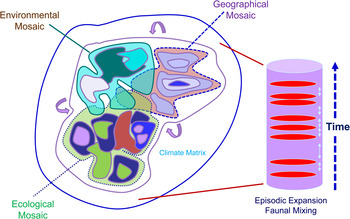
An understanding of the dynamics of high-latitude systems, the history of the Beringian nexus and downstream patterns of diversity depend on explanations of complexity in biotic assembly and persistence. A central role for cospeciation and vicariance as primary organizers of diversity in northern systems is not apparent (e.g. Hoberg & Brooks, Reference Hoberg and Brooks2008, Reference Hoberg, Brooks, Morand and Krasnov2010; Hoberg et al., Reference Hoberg, Galbreath, Cook, Kutz and Polley2012; Haukisalmi et al., Reference Haukisalmi, Hardman, Hoberg and Henttonen2014, Reference Haukisalmi, Hardman, Fedorov, Hoberg and Henttonen2016). Complexity, evident in patterns of distribution and diversification across diverse parasite and vertebrate host taxa in northern systems, demonstrates interacting and episodic mechanisms in biogeography and evolution that drive assembly of Macroevolutionary Mosaic Faunas (e.g. Hoberg, Reference Hoberg2005, Reference Hoberg2010; Hoberg & Brooks, Reference Hoberg and Brooks2008; Hoberg et al., Reference Hoberg, Galbreath, Cook, Kutz and Polley2012; Araujo et al., Reference Araujo, Braga, Brooks, Agosta, Hoberg, von Hathental and Boeger2015; Galbreath & Hoberg, Reference Galbreath and Hoberg2015) (fig. 4). Mosaic structure emergent from Quaternary systems is manifested as a macroevolutionary process, involving parasite assemblages on continental, regional and landscape scales. These assemblages were shaped by episodes of dispersal spanning deep evolutionary time and extending into the Anthropocene, encompassing populations, species and faunas (e.g. Hoberg & Brooks, Reference Hoberg and Brooks2008, Reference Hoberg, Brooks, Morand and Krasnov2010, Reference Hoberg, Brooks and Rohde2013; Hoberg et al., Reference Hoberg, Galbreath, Cook, Kutz and Polley2012; Cook et al., Reference Cook, Galbreath and Bell2017).
Faunal mosaic structure in space and time (modified from the original presented in Brooks & Hoberg, Reference Brooks, Hoberg and Rohde2013). Historically, assembly of faunal mosaics has resulted from episodes of environmental change, biotic expansion, mixing and ecological collision, countered by periods of relative stasis or stability, within a matrix controlled largely by oscillations in climate. Mosaic assembly develops as a cumulative process and, at any point in time, reflects the inputs and overlap of geographical, environmental and ecological determinants. In contemporary time, mosaics continue to emerge from anthropogenic forces of introduction, invasion and accelerating climate change.

The biogeographical history and radiation of the Holarctic fauna, for example, across a diverse spectrum of helminth parasite taxa characteristic of mammalian and avian hosts in terrestrial and marine environments, is broadly consistent with processes defined in the Stockholm Paradigm (SP) (Hoberg et al., Reference Hoberg, Kutz, Cook, Galaktionov, Haukisalmi, Henttonen, Laaksonen, Makarikov, Marcogliese and Meltofte2013; Araujo et al., Reference Araujo, Braga, Brooks, Agosta, Hoberg, von Hathental and Boeger2015; Hoberg & Brooks, Reference Hoberg and Brooks2015). The SP constitutes a synthesis and formal integration of macro- and microevolutionary dynamics, ecology and biogeography involved in diversification and faunal assembly (Brooks & McLennan, Reference Brooks and McLennan2002; Hoberg & Brooks, Reference Hoberg and Brooks2008). A synoptic view of host range and specificity, and the central significance of geographical and host colonization, emanates from this perspective, which further aids in understanding invasion and emergent disease in ecological time (e.g. Brooks & McLennan, Reference Brooks and McLennan2002; Hoberg & Brooks, Reference Hoberg and Brooks2008, Reference Hoberg and Brooks2015; Agosta et al., Reference Agosta, Janz and Brooks2010; Brooks & Hoberg, Reference Brooks, Hoberg and Rohde2013).
As general descriptors, four primary and interrelated drivers represent the interacting components of the SP (Hoberg & Brooks, Reference Hoberg and Brooks2015). The central premise is a robust description and explanation of the role of episodic perturbation and ecological dynamics in the development and persistence of complex faunal associations integrating outcomes from the Taxon Pulse (Erwin, Reference Erwin and Ball1985), Ecological Fitting (Janzen, Reference Janzen1985), Oscillation (Janz & Nylin, Reference Janz, Nylin and Tilmon2008) and the Geographic Mosaic Theory of Coevolution (Thompson, Reference Thompson2005).
The dynamics of episodic environmental perturbation/stability, recurrent invasion driven by expansion, geographical colonization/isolation and the potential for faunal radiation are described in the Taxon Pulse (TP), which provides a macroevolutionary perspective for the evolution of complex systems (Erwin, Reference Erwin and Ball1985; Halas et al., Reference Halas, Zamparo and Brooks2005; Hoberg & Brooks, Reference Hoberg and Brooks2008, Reference Hoberg, Brooks, Morand and Krasnov2010). The TP, as exemplified by episodic expansion at the Beringian nexus, defines the context of ecological collision and the spatial/temporal opportunities for biotic mixing, host colonization and faunal outcomes of recurrent shifts in climate oscillation/environmental perturbation and stability. Recurrent cycles of the TP alternate between expansion states (perturbation) and stability states (geographical isolation) resulting in complex mosaics. They are a direct contrast to single events of isolation associated with static barriers and vicariance resulting in sister-species (faunas) over time (e.g. Hoberg & Brooks, Reference Hoberg, Brooks, Morand and Krasnov2010) (fig. 1). At more limited regional scales, the TP describes the dynamics of recurrent and secondary contact for species or populations under environmental forcing (e.g. Koehler et al., Reference Koehler, Hoberg, Dokuchaev, Trabenkova, Whitman, Nagorsen and Cook2009; Galbreath & Hoberg, Reference Galbreath and Hoberg2015; Bell et al., Reference Bell, Calhoun, Hoberg, Demboski and Cook2016).
Events of host colonization occur where opportunity (expansion phase of TP) converges with capacity, defined by Ecological Fitting (EF), and the interaction of potential and realized host range (Janzen, Reference Janzen1985; Brooks & McLennan, Reference Brooks and McLennan2002; Agosta et al., Reference Agosta, Janz and Brooks2010). Mechanisms for EF may involve resource tracking, where similar attributes are presented by ancestral and novel hosts, or by colonization in ‘sloppy fitness space’ through the exploitation of novel host-based resources that are beyond or outside of the range of conditions in which the species evolved (Agosta & Klemens, Reference Agosta and Klemens2008; Agosta et al., Reference Agosta, Janz and Brooks2010; Araujo et al., Reference Araujo, Braga, Brooks, Agosta, Hoberg, von Hathental and Boeger2015). Ecological fitting in sloppy fitness space facilitates translocation (geographical colonization and invasion), introduction and host switching, and has been an essential characteristic of faunal assembly on evolutionary and ecological timescales (Agosta & Klemens, Reference Agosta and Klemens2008; Hoberg & Brooks, Reference Hoberg and Brooks2008, Reference Hoberg, Brooks, Morand and Krasnov2010, Reference Hoberg, Brooks and Rohde2013; Agosta et al., Reference Agosta, Janz and Brooks2010). In a simplistic sense, opportunity is established through perturbation and the disruption of physical, biological or historical barriers that previously limited exposure to infection or maintained ecological isolation of populations, species, faunas and biotas in space and time (e.g. Elton, Reference Elton1958; Hoberg & Brooks, Reference Hoberg and Brooks2008; Hoberg, Reference Hoberg2010; Araujo et al., Reference Araujo, Braga, Brooks, Agosta, Hoberg, von Hathental and Boeger2015).
Alternating trends for generalization and specialization linked to host range and resources emerge in the context of the Oscillation Hypothesis (OH) (Janz & Nylin, Reference Janz, Nylin and Tilmon2008). Oscillation interacts with EF, determining the potential for host exploitation and colonization (e.g. Brooks & McLennan, Reference Brooks and McLennan2002; Hoberg & Brooks, Reference Hoberg and Brooks2008). Oscillation embodies the dynamic nature of microevolutionary aspects of coevolution represented by co-accommodation (or co-adaptation) (Brooks, Reference Brooks1979) influencing the degree of specialization (or specificity) demonstrated by parasites through reciprocal adaptation in associated lineages. Changing opportunities established by TP/EF that are influenced by spatial/ecological dynamics, or the temporal and geographical arena for ecological isolation, interact with trends in specialization and generalization of the OH to determine faunal assembly and structure (Hoberg & Brooks, Reference Hoberg and Brooks2008; Araujo et al., Reference Araujo, Braga, Brooks, Agosta, Hoberg, von Hathental and Boeger2015).
Opportunity and capacity determine host range and faunal structure at any point in time. Dynamics across evolutionary time, however, control outcomes downstream and are influenced at local scales by Geographic Mosaics of Coevolution (GMC) (Thompson, Reference Thompson2005) that determine the complexity of evolutionary interactions linking hosts and parasites through co-accommodation and cospeciation (Brooks, Reference Brooks1979). Cospeciation processes are thus limited in scale and are generally restricted to the stability or isolation phases defined in the TP dynamic.
Insights about deeper evolutionary events, ecology, biogeography and complexity inform us about the possible range of responses in systems under new regimes of environmental forcing, including ecological perturbation linked to climate change (e.g. Hoberg et al., Reference Hoberg, Polley, Jenkins, Kutz, Veitch and Elkin2008a, Reference Hoberg, Polley, Jenkins and Kutzb, Reference Hoberg, Kutz, Cook, Galaktionov, Haukisalmi, Henttonen, Laaksonen, Makarikov, Marcogliese and Meltofte2013; Galaktionov, Reference Galaktionov2017). TP, EF, OH and GMC operate as generalities in faunal assembly and persistence in oscillating and stochastic environments (Hoberg & Brooks, Reference Hoberg and Brooks2008). Host colonization allowed by EF is associated with episodes of climate change, ecological perturbation and biotic expansion. Mosaic structure on macroevolutionary scales is a fundamental consequence, resulting from climate oscillations, changing environmental structure, recurrent geographical expansion and host colonization over extended time frames (fig. 4).
As a synthesis, the SP is a fundamentally different view of the biosphere that codifies the nature of complexity in faunal assembly and evolution (e.g. Hoberg et al., Reference Hoberg, Agosta, Boeger and Brooks2015; Stigall et al., Reference Stigall, Bauer, Lam and Wright2017). SP contrasts with prevailing paradigms that embrace relative simplicity (e.g. cospeciation drivers) and are no longer appropriate generalizations (e.g. reviewed in Brooks et al., Reference Brooks, Hoberg and Boeger2015). In a world that is experiencing increasing levels of perturbation and breakdown of ecological isolation, an understanding of complexity and contingency provides a pathway to proactive recognition and anticipation of emerging infectious diseases (e.g. Brooks et al., Reference Brooks, Hoberg, Gardner, Boeger, Galbreath, Herczeg, Mejía-Madrid, Racz and Tsogtsaikhan Dursahinhan2014).
Exploring a contemporary or Anthropocene framework
Events unfolding in the Quaternary, across the Pleistocene and during the Anthropocene, share generalities with respect to pattern, process and outcome under regimes of climate oscillation or directional warming. As in Pleistocene time frames, accelerating climate forcing is associated with development of novel environmental associations, geographical expansion and invasion or extinction. Changing geographical distributions due to transitions in habitats, ambient temperature (seasonal shifts and extremes), phenology for migration, trophic structure and other factors are leading to rapid changes in host–parasite systems (e.g. Hoberg et al., Reference Hoberg, Kutz, Cook, Galaktionov, Haukisalmi, Henttonen, Laaksonen, Makarikov, Marcogliese and Meltofte2013; Jenkins et al., Reference Jenkins, Castrodale, de Rosemond, Dixon, Elmore, Gesy, Hoberg, Polley, Schurer, Simard and Thompson2013; Kutz et al., Reference Kutz, Hoberg, Molnár, Dobson and Verocai2014; Galaktionov, Reference Galaktionov2017). Faunal shifts and expansion result in new (secondary) contact zones, invasion of novel pathogens, accelerated host switching and increasing recognition of ephemeral emergence of disease (e.g. Jenkins et al., Reference Jenkins, Castrodale, de Rosemond, Dixon, Elmore, Gesy, Hoberg, Polley, Schurer, Simard and Thompson2013; Laaksonen et al., Reference Laaksonen, Oksanen and Hoberg2015, Reference Laaksonen, Oksanen, Kutz, Jokelainen, Holma-Suutari, Hoberg, Paulsen, Bauer and Smulders2017).
Global climate warming has a disproportionate influence across Arctic ecosystems, and the consequences of this change are yet to be fully realized (IPCC, Reference Stocker, Qin, Plattner, Tignor, Allen, Boschung, Nauels, Xia, Bex and Midgley2013; Meltofte et al., Reference Meltofte, Barry, Berteaux and Meltofte2013; Cook et al., Reference Cook, Galbreath and Bell2017). In particular, there is a pressing need to understand the influence of climate change for parasite life cycles, geographical ranges, transmission dynamics and emergent patterns of disease, which have implications for ecological sustainability and food security (e.g. Kutz et al., Reference Kutz, Hoberg, Polley and Jenkins2005, Reference Kutz, Hoberg, Molnár, Dobson and Verocai2014; Jenkins et al., Reference Jenkins, Veitch, Kutz, Hoberg and Polley2006, Reference Jenkins, Castrodale, de Rosemond, Dixon, Elmore, Gesy, Hoberg, Polley, Schurer, Simard and Thompson2013; Hoberg et al., 2008a, b; Laaksonen et al., Reference Laaksonen, Oksanen and Hoberg2015; Galaktionov, Reference Galaktionov2017). Powerful exemplars are evident for changing dynamics across terrestrial environments in transmission and distribution for protostrongylid lungworms in the Central Canadian Arctic (e.g. Kutz et al., Reference Kutz, Hoberg, Polley and Jenkins2005, Reference Kutz, Hoberg, Molnár, Dobson and Verocai2014; Hoberg & Brooks, Reference Hoberg and Brooks2015) and vector-borne filarioid nematodes in northern Finland (e.g. Laaksonen et al., Reference Laaksonen, Pusenious, Kumpula, Venäläinen, Kortet, Oksanen and Hoberg2010, Reference Laaksonen, Oksanen and Hoberg2015, Reference Laaksonen, Oksanen, Kutz, Jokelainen, Holma-Suutari, Hoberg, Paulsen, Bauer and Smulders2017); in addition, Galaktionov (Reference Galaktionov2017) explored the outcomes of unfolding perturbation in Arctic marine systems.
In the historically disjunct terrestrial systems involving free-ranging ungulates (caribou, reindeer and muskoxen), temperature-driven tipping points since 1970 have induced rapidly changing geographical and host range by influencing larval nematode development (thresholds and resilience). These effects caused amplification of parasite populations within core host distributions (Kutz et al., Reference Kutz, Hoberg and Polley2001, Reference Kutz, Hoberg, Polley and Jenkins2005). For example, after 1970, due to acceleration in developmental rates for infective larvae (in gastropod intermediate hosts), the multi-year transmission dynamics for the muskoxen lungworm (Umingmakstrongylus pallikuukensis Hoberg, Polley Nishi and Gunn, 1995) was reduced to a single year. A primary outcome is seen as an increase in infection pressure and parasite populations in muskoxen definitive hosts (Kutz et al., Reference Kutz, Hoberg, Polley and Jenkins2005). Shifting balancing points over the past decade further influence distribution on the periphery of rapidly expanding ranges where oscillations in temperature are determinants of permissive environments. Ephemeral shifts in temperature regimes (including the occurrence of short-term extreme events embedded in longer term incremental warming) consequently have served to facilitate or limit the potential for geographical colonization and establishment (Laaksonen et al., Reference Laaksonen, Pusenious, Kumpula, Venäläinen, Kortet, Oksanen and Hoberg2010, Reference Laaksonen, Oksanen, Kutz, Jokelainen, Holma-Suutari, Hoberg, Paulsen, Bauer and Smulders2017; Kutz et al., Reference Kutz, Checkley, Verocai, Dumond, Hoberg, Peacock, Wu, Orsel, Seegers, Warren and Abrams2013; Hoberg & Brooks, Reference Hoberg and Brooks2015).
Subtle temperature variation controls the outcomes for introductions on landscape scales constituting the balancing points between successful establishment or local extirpation (Laaksonen et al., Reference Laaksonen, Oksanen and Hoberg2015). Thus, a northward shift in permissive environments, where transmission was historically limited, coincided with geographical colonization during the past decade for lungworms in muskoxen and caribou to the low Arctic islands of Canada for the first time (Kutz et al., Reference Kutz, Checkley, Verocai, Dumond, Hoberg, Peacock, Wu, Orsel, Seegers, Warren and Abrams2013). Concurrently ongoing geographical expansion for filarioid nematodes in Finland has been associated with warming and shifting distributions of suitable range for vector and parasite development. Such northward expansion involving phylogenetically disparate parasites in Canada and Fennoscandia indicates that these ongoing processes linked to climate are a generality rather than isolated, idiosyncratic events.
Climate wobbling in ecological time, such as that emerging from ocean–atmosphere regime shifts, may interact with anthropogenic forcing to create permissive environments (temperature, precipitation and humidity in terrestrial systems; sea surface temperature in marine systems) suitable for persistence of ecological assemblages, establishment and transmission (e.g. Hoberg, Reference Hoberg1996; Mouritsen & Poulin, Reference Mouritsen and Poulin2002; Hoberg et al., Reference Hoberg, Kutz, Cook, Galaktionov, Haukisalmi, Henttonen, Laaksonen, Makarikov, Marcogliese and Meltofte2013; Sydeman et al., Reference Sydeman, Poloczanska, Reed and Thompson2015; Galaktionov, Reference Galaktionov2017). Processes associated with geographical colonization in evolutionary time across the Beringian nexus represent analogues for events occurring during the Anthropocene. These observations suggest equivalence of mechanisms for expansion and invasion across scales of space and time, and the influential role of an oscillating climate in development and persistence of complex systems (Hoberg & Brooks, Reference Hoberg and Brooks2008, Reference Hoberg and Brooks2015).
Anthropogenic climate forcing, manifested in long-term incremental change and short-term extreme events for temperature and precipitation (IPCC, Reference Stocker, Qin, Plattner, Tignor, Allen, Boschung, Nauels, Xia, Bex and Midgley2013, Reference Field, Barros, Dokken, Mach, Mastrandrea, Bilir, Chatterjee, Ebi, Estrada, Genova, Girma, Kissel, Levy, MacCracken, Mastrandrea and White2014), must be accounted for in anticipating responses in complex host–parasite systems (e.g. Hoberg et al., Reference Hoberg, Kutz, Cook, Galaktionov, Haukisalmi, Henttonen, Laaksonen, Makarikov, Marcogliese and Meltofte2013). Regimes of perturbation that create new ecotones, promote sympatry among terrestrial mammalian assemblages (for example, domesticated and free-ranging wild ungulates) and degrade ecological isolation are associated with amplification of populations, host colonization, pathogen emergence and disease (Hoberg et al., Reference Hoberg, Polley, Jenkins, Kutz, Veitch and Elkin2008a; Kutz et al., Reference Kutz, Hoberg, Molnár, Dobson and Verocai2014; Hoberg & Brooks, Reference Hoberg and Brooks2015). Models for spatial and temporal alteration in temperature and precipitation across terrestrial environments, sea surface temperature, seasonal and interannual dynamics for ice, and production cycles in marine environments, suggest complex responses. Among these are anticipated and observed bouts of expansion/retraction and shifts, structural and trophic perturbations, and local extinction with respect to geographical range and downstream patterns of disease (e.g. Harvell et al., Reference Harvell, Mitchell, Ward, Altizer, Dobson, Ostfeld and Samuel2002; Lafferty, Reference Lafferty2009; Pinsky et al., Reference Pinksy, Worm, Fogarty, Sarmiento and Levin2013; Sydeman et al., Reference Sydeman, Poloczanska, Reed and Thompson2015; Galaktionov, Reference Galaktionov2017). New regime states will establish faunal mosaics emerging from geographical and host colonization linking processes in evolutionary and ecological time, and emphasize the nature of biotic assembly that is addressed in the multi-factorial Stockholm Paradigm (e.g. Hoberg & Brooks, Reference Hoberg and Brooks2008, Reference Hoberg and Brooks2015; Araujo et al., Reference Araujo, Braga, Brooks, Agosta, Hoberg, von Hathental and Boeger2015; Wernberg et al., Reference Wernberg, Bennett and Babock2016).
Outcomes of accelerating climate warming
Perspectives from a contemporary slice of time do not allow observation of oscillation processes (e.g. Hoberg & Zarlenga, Reference Hoberg and Zarlenga2016). Lag times due to life-history dynamics, developmental rates and potential for amplification within host–parasite assemblages introduce complicating factors (e.g. Laaksonen et al., Reference Laaksonen, Oksanen and Hoberg2015, Reference Laaksonen, Oksanen, Kutz, Jokelainen, Holma-Suutari, Hoberg, Paulsen, Bauer and Smulders2017). Across ecological timescales, oscillations (resulting in a shifting balance for environments, transmission and distributional change, such as expansion or contraction) can be recognized through strategic monitoring across multiple annual cycles (e.g. Kutz et al., Reference Kutz, Checkley, Verocai, Dumond, Hoberg, Peacock, Wu, Orsel, Seegers, Warren and Abrams2013; Laaksonen et al., Reference Laaksonen, Oksanen and Hoberg2015). In deeper time, oscillation processes must be demonstrated in a coevolutionary and phylogenetic context. In this regard, palaeontology provides a temporal and spatial perspective that may extend to relatively fine scales (Stigall, Reference Stigall2010; Stigall et al., Reference Stigall, Bauer, Lam and Wright2017).
The assessment of change in environments under rapid transition requires a permanent record of faunal structure and archival baselines linked to specimens and information against which perturbation can be recognized (e.g. Hoberg et al., Reference Hoberg, Kutz, Cook, Galaktionov, Haukisalmi, Henttonen, Laaksonen, Makarikov, Marcogliese and Meltofte2013; Cook et al., Reference Cook, Galbreath and Bell2017). Archival baselines are the record of change on extended timescales and provide a picture of the assemblages that occur in an environment, and those that occur nearby and can invade over time. Biological archives establish an understanding of the ecological players, with direct significance for identification of critical pathways, mechanisms and outcomes of ecological perturbation. In this arena, the recently articulated DAMA protocol (for Documentation, Assessment, Monitoring and Action) outlines a necessary shift from a reactive to proactive stance relative to understanding environmental change, ecological perturbation and emerging disease (Brooks et al., Reference Brooks, Hoberg, Gardner, Boeger, Galbreath, Herczeg, Mejía-Madrid, Racz and Tsogtsaikhan Dursahinhan2014; Hoberg et al., Reference Hoberg, Agosta, Boeger and Brooks2015).
Climate change driven by anthropogenic forcing has supplanted a history of episodic variation and is eliminating ecological barriers and constraints on development and distribution for pathogen transmission. Our historical perspective indicates that ecological collision in evolutionary and ecological time creates new conditions and redraws maps for distributions of hosts, parasites and diseases. Emergence of diseases and unanticipated cascades can drive perturbations in terrestrial, marine and aquatic systems, directly influencing ecological integrity and sustainability in northern systems and globally.
Acknowledgements
The current manuscript emerged from a keynote plenary lecture presented by E.P.H. during the 12th European Multicolloquium of Parasitology (EMOP XII) in Turku, Finland, 20–24 July 2016. E.P.H. extends appreciation to Heikki Henttonen, Antti Oksanen and organizers of EMOP XII for making it possible to contribute to the conference. Some concepts explored in our paper reflect discussions held at the workshop: ‘Changing species associations in a changing world: a Marcus Wallenberg Symposium’ (MWS 2015.0009) with funding to Sören Nylin; organized and hosted by Sören Nylin and Niklas Janz at the Tovetorp Field Station near Stockholm, Sweden, 11–13 March 2016. Further, E.P.H. extends thanks to Kirill Galaktionov for insightful exchanges and discussions about climate change across marine systems in the Arctic.
Financial support
We acknowledge support of the National Science Foundation (NSF) as this perspective represents a continuing contribution of the Beringian Coevolution Project and the Integrated Inventories of Biomes of the Arctic through grants from the NSF to J.A.C., E.P.H., K.E.G. and E. DeChaine (DEB- 0196095, 0415668 and 1250810).
Conflict of interest
None.