




No CrossRef data available.
Article contents
Health-care decision-making processes in Latin America: Problems and prospects for the use of economic evaluation
Published online by Cambridge University Press: 02 March 2005
Abstract
Objectives: The use of economic evaluation studies (EE) in the decision-making process within the health-care system of nine Latin American (LA) and three European countries was investigated. The aim was to identify the opportunities, obstacles, and changes needed to facilitate the introduction of EE as a formal tool in health-care decision-making processes in LA.
Methods: A comparative study was conducted based on existing literature and information provided through a questionnaire applied to decision makers in Argentina, Brazil, Colombia, Cuba, Mexico, Nicaragua, Peru, Portugal Spain, United Kingdom, Uruguay, and Venezuela. Systematic electronic searches of HEED, NHS EED, and LILACS were conducted to identify published economic evaluation studies in LA from 1982 onward.
Results: There is relatively little evidence of the conduct and use of EE within the health care systems in LA. Electronic searches retrieved 554 records; however, only 93 were EE. In the nine LA participating countries, broad allocation of health-care resources is primarily based on political criteria, historical records, geographical areas, and specific groups of patients and diseases. Public-health provision and inclusion of services in health-insurance package are responsibilities of the Ministry of Health. Decisions regarding the purchase of medicines are primarily made through public tenders, and mainly based on differences in clinical efficacy and the price of health technologies of interest.
Conclusions: To expedite the process of incorporating EE as a formal tool to inform decision-making processes within the health-care systems in LA countries, two main conditions need to be fulfilled. First, adequate resources and skills need to be available to conduct EE of good quality. Second, decision-making procedures need to be modified to accommodate “evidence-based” approaches such as EE.
Information
- Type
- GENERAL ESSAYS
- Information
- International Journal of Technology Assessment in Health Care , Volume 21 , Issue 1 , January 2005 , pp. 1 - 14
- Copyright
- © 2005 Cambridge University Press
In the past decade, a large number of Latin American countries have undertaken a profound reform of their health-care systems. Although some of the objectives of these reforms are country-specific, a common issue among countries is the need to establish a mechanism that ensures a more efficient allocation of scarce resources, as well as guaranteeing a wider provision of health-care services on the basis of local population needs and equity (17). In this respect, Latin American countries may benefit from the experiences of other countries where the same issues have been part of government agendas for a longer time. The creation of regulatory or advisory bodies seeking to inform the decision-making process on the provision of health-care services has been the preferred option in several countries, such as Australia, Canada, and the United Kingdom among others (2;21;22) . On the basis of available clinical and economic evidence regarding the effectiveness and cost-effectiveness of the health technologies of interest, these bodies issue recommendations on their use and provision. In this process, economic evaluation (EE) studies have become an increasingly valuable tool to inform the decision-making process. The quantity of published literature in EE has increased considerably in the past 10 years, although evidence of their formal use to inform the decision-making process within different health-care systems has emerged only recently (8).
In the context of a multinational project, the Thematic Network on the Economic Evaluation of Healthcare Programmes and its Applications to Decision Making in Latin American Countries (NEVALAT) funded by the European Union, a comparative analysis of the decision-making processes within the health-care systems in nine Latin American countries (Argentina, Brazil, Colombia, Cuba, Mexico, Nicaragua, Peru, Uruguay, Venezuela) and three European countries (Portugal, Spain, and United Kingdom) was undertaken. The research had two main objectives; first, to compare the decision-making process within the health-care systems to identify the opportunities and obstacles for introducing economic evaluation as a formal tool for decision making. Second, to identify the changes that would need to be introduced in the structure and organization of national health-care systems to facilitate the use of economic evaluation in health-care decision making in the future.
METHODS
A comparative study based on existing literature and information provided (through a questionnaire) by the Latin American and European participants in the NEVALAT project was conducted. In addition, electronic searches of HEED, NHS EED, and LILACS databases (4;7;15) were conducted to identify published economic evaluation studies conducted in Latin America. Identified studies were classified as full/partial economic evaluations, according to the information provided in the structured abstract; if this information was not on the database, the full paper was obtained and reviewed.
The NEVALAT participants were asked to respond to the questionnaire based on their experience but to consult others when they were unsure of the answers. In the case of Colombia, Cuba, and Mexico, the answers reflect the views of representatives from the Ministry of Health, and local Social Security Institutions. The questionnaire was divided into three main sections: the first referred to the overall design of the health-care system with respect to health financing, and the institutional arrangements for making decisions. Respondents were asked to provide any general literature describing the decision-making processes in their health-care systems. In the second section, participants were asked to provide information regarding the roles and responsibilities of various parties in making decisions about (i) broad allocations of health-care resources to different parts of the health care sector (e.g., priority setting), (ii) provision of public-health interventions (e.g., immunization programs), (iii) reimbursement of new drugs, (iv) inclusion of services in health-insurance packages, (v) adoption of new technologies (e.g., devices), (vi) major capital investments (e.g., new hospitals). In this section, participants were also asked to provide information about the existing use of economic studies in health-care decisions in the areas described above.
Finally, in the third section, participants were asked about the existence of any formal body or agency (e.g., a section of the Ministry of Health) with a particular responsibility for assessing health technologies and programs. In addition, European researchers with experience of the Latin American region were contacted to identify relevant nonpublished literature and alternative sources of information. The archives of the World Health Organization (WHO) and the Pan-American Health Organization (PAHO) were also checked to identify information describing the health-care decision making processes in the nine participant Latin American countries (16). Participants were also asked to identify local areas in which the use of economic evaluation studies is currently considered as relevant/priority. As well as to described the factors that could facilitate/prevent in-house conduction of this type of studies.
RESULTS
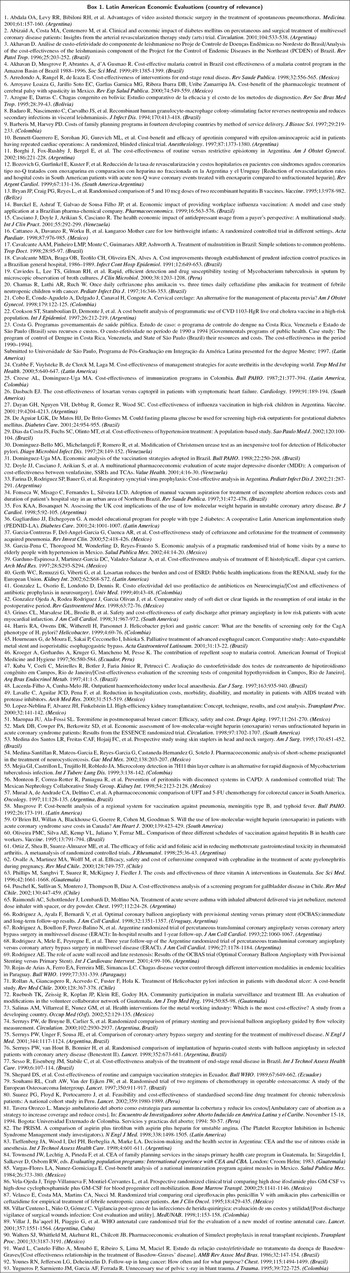
Electronic searches retrieved 554 potential economic evaluation studies. Of these, only ninety-three were economic evaluations, thirty-five were partial economic evaluations (cost consequences studies) (1), and fifty-eight full economic evaluations (cost-minimization, cost-effectiveness, or cost-utility studies) (12). The rest of the studies were mainly partial health-care evaluations (cost studies, clinical studies, and cost of illness studies). Full references of the ninety-three studies identified as well as the country/Latin American region they refer to are provided in Box 1. A third of the identified economic evaluation studies was conducted in the context of multinational studies in which only or some Latin American countries took part. Brazil was the highest producer of single-country economic evaluations (twenty studies), followed by Mexico (thirteen studies), Argentina (eight studies), and Colombia (five studies). It is worth noticing that, in many cases, these studies were jointly designed and coordinated by international and local researchers. Although a large number of disease areas were the subject of study, the clinical areas more frequently investigated were cardiovascular related diseases (20 percent); virus, parasites, and infectious diseases (15 percent); reproductive system (11 percent); immunization (10 percent); and digestive system (10 percent). In the past 5 years, there has been a change in trend regarding the most frequently used type of study. Currently, cost-effectiveness analysis (forty-eight studies) is the preferred type of analysis among the identified Latin American economic evaluation, outweighing the volume of cost consequence analyses (thirty-five studies) published in the first half of the 1990s. Measurement of health benefits in terms of changes in quality of life was reported in only two cost-utility analyses.

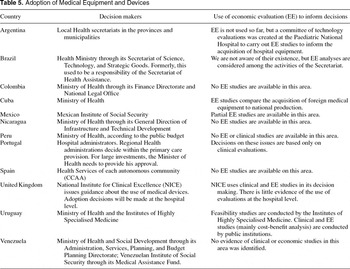
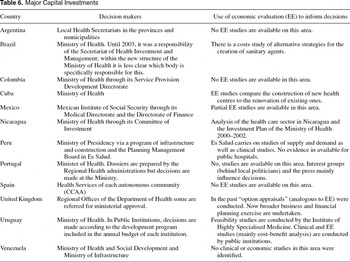
The responses to the decision-making questionnaire are summarized in tabular form below (Table 1–6). Overall, the results show that there is little evidence of the conduct and use of economic evaluation studies in decision-making processes within the health-care systems of the Latin American countries participating in the NEVALAT project.


Broad Allocation of Resources
As one might expect, the broad allocation of resources within the health-care systems is primarily based on political criteria, or historical records of previous budget allocations according to different governmental levels, geographical areas, and specific groups of patients or diseases (Table 1). Evidence of the development of some partial economic evaluations in this area was identified in Peru, Cuba, and Brazil, but no clear evidence of the use of such studies in the decision-making process was identified (10;14;19) .
Provision of Public Health Interventions
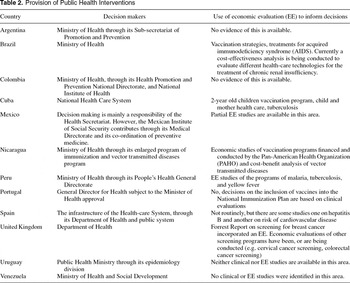
The provision of public-health interventions is usually a direct responsibility of the Ministry of Health (Table 2). However, different sectors within the health-care system (public, social security, and private) are often involved in the delivery of services to the general population. Decisions regarding the provision of public-health interventions are made according to political criteria, and evidence from clinical studies. In Colombia, Brazil, Peru, Nicaragua, and Mexico, there are some examples of clinical and economic studies conducted to inform decisions regarding different vaccination strategies (5;23). For example, in Peru, economic evaluation studies were conducted in the context of three different vaccination programs: malaria, tuberculosis, and yellow fever (1;3;15) .
Reimbursement of New Drugs
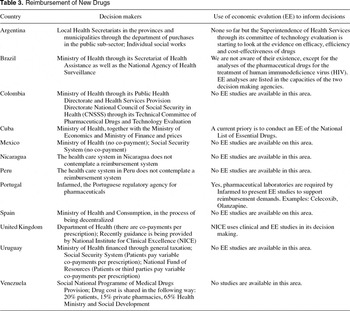
Decisions regarding the purchase of drugs by the governmental public agencies is primarily made through public tenders and mainly based on differences in clinical efficacy, as well as in the price of the health-care technologies of interest (Table 3). Monopsonic purchases ensure a reduction in the costs of new drugs to the health-care system; this process allows health-care institutions to provide new drugs at preferential prices. Copayments per prescription and/or prescription item are required in some cases, for instance in Uruguay individuals in social security institutions are requested to pay a variable copayment per prescription, unlike in Mexico where the provision of new drugs in social security institutions is free of charge.
In Venezuela, the acquisition of new medical drugs is regulated by the Social National Programme of Medical Drugs Provision. The cost of drugs is shared in the following way: 20 percent patients, 15 percent private pharmacies, 65 percent Health Ministry and Social Development.
Inclusion of Services in Health Insurance Packages
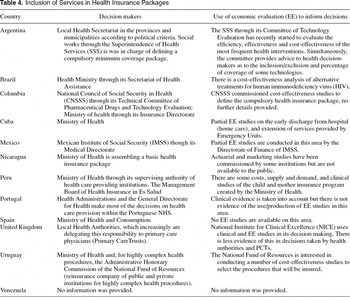
The composition of the health insurance packages is again mainly regulated by the Ministries of Health (Table 4). Whereas evidence of the presence of some economic/actuarial analysis in this area was mentioned in the responses to the questionnaire, the reports are usually of a confidential nature and, thus, evidence of their contribution to the decision-making process is even more difficult to ascertain. In Nicaragua, for example, several actuarial and marketing studies were commissioned by the Ministry of Health for private institutions to facilitate the development of a new basic health insurance package. In Uruguay, an insurance company of public and private institutions for highly complex health procedures known as Fondo Nacional de Recursos, (The National Fund of Resources, FNR) is interested in evaluating the technologies currently included in their plan according to criteria of clinical effectiveness and cost-effectiveness to select the health procedures that will be eligible for insurance.
Within the social security sector in Argentina, there is a body; “The Superintendence of Health Services” (La Superintendencia de Servicios de Salud), which is specifically in charge of defining a compulsory minimum coverage package to be included in the health insurance plan of every single health-care institution (Obras Sociales). Recently, this body has established that its recommendations will be evidence based according to criteria of clinical effectiveness and cost-effectiveness.
In Colombia, the Technical Committee of Pharmaceutical Drugs and Technology Evaluation is the body responsible for defining the minimum coverage of the basic insurance package. When the “compulsory health-care package” was defined in Colombia, cost-effectiveness and burden of disease studies were commissioned to evaluate the economic impact of the new package. In recent years, economic studies have been commissioned to evaluate “costly diseases” to make decisions regarding re-insurance.
Adoption of Medical Equipment and Devices
Examples of feasibility and cost-benefit studies were identified in Uruguay (18). The rest of the participant countries pointed out a lack of evidence of the use of economic studies in this area (Table 5).
Major Capital Investments
Finally, decisions regarding major capital investments within the health-care systems in all eight Latin American countries were the responsibility of the Ministries of Health (Table 6). In Cuba, there are examples of economic evaluation studies comparing the effectiveness and cost-effectiveness of constructing new health centers versus renovating existing ones (13). Whereas in Peru, supply and demand studies as well as clinical ones are conducted within the social security system, Es Salud (20).
Local Priority Areas for the Conduction Economic Evaluation Studies (Availability of Resources and Requirements)
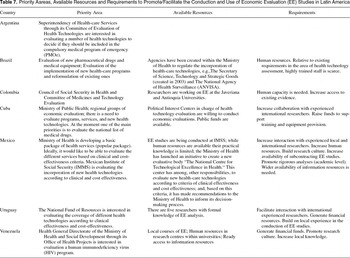
The inclusion/exclusion of health-care technologies in national, social security, and private insurance packages, according not only to criteria of clinical effectiveness and safety but also cost-effectiveness, is a frequent topic of interest in several Latin American countries. Such is the case in Argentina, Cuba, Mexico, and Uruguay (Table 7). In Cuba, the evaluation of the national drug formulary is considered as a high priority; in fact, the government has already created several regional groups as well as one at national level to get this process started. Highly trained human resources have been identified in all the participant Latin American countries; however, they are not only limited in number, but as importantly, they have little if any “know-how experience” in the conduct of economic evaluation studies. Promotion and coordination of collaboration between experienced researchers in economic evaluation and Latin American researchers is perceived as a key element to increase the use and conduct of such studies.

Ready access to local and international information resources was also singled out as one of the main obstacles Latin American researchers encounter in their daily research activities. Limited financial funds, and poor interaction between the academic sector, and private and public health-care institutions, were also repeatedly mentioned as factors preventing a wider use and conduct of economic evaluation studies.
DISCUSSION
According to both the literature review (ninety-three studies) and the survey, relatively few economic evaluation studies of health-care technologies are available in the Latin American countries participating in NEVALAT. There is also very little evidence of the use of existing economic evaluation studies as a tool to inform the decision-making process within the National Healthcare Systems. There is, however, a considerable interest in having a deeper understanding of the methods of conducting economic evaluations, as well as the potential ways in which the results from such analyses can contribute to the decision-making process.
Lack of a clearly defined set of criteria to facilitate or guide the decision-making processes within the Latin American health-care systems was identified as one of the main obstacles preventing the use of economic evaluation studies. In general, the responses to the survey showed that the decisions regarding the allocation of resources to different areas of health care are mainly driven by governmental policies. The ways in which such policies are developed are not very explicit.
The structure of the nine Latin American health-care systems analyzed was similar. With the exception of Cuba, the provision of health care was organized through a combination of public, social security, and private sectors. Surprisingly, only in Argentina and Colombia was there a regulatory body with the power to regulate the provision of health-care services in the social security sector.
From the results of the survey, the general impression is one of potential for the use of economic evaluation, rather than evidence of actual use. Nevertheless, several interesting initiatives were identified. For example, in Uruguay the incorporation of new highly specialized services in the basic health-care package is regulated by an insurance company, the FNR. Through the FNR, all public and private health-care institutions insure their members against “catastrophic events,” that is, those health-care interventions that are associated with high costs and relatively low frequency but that could become a heavy financial burden for any health-care institution. Currently, a main priority of the FNR agenda is to establish a formal process to assess the clinical effectiveness and cost-effectiveness of readily available health-care technologies. Similarly, in Cuba, a priority within the National Healthcare System is the evaluation of the national drug formulary, according not only to clinical effectiveness criteria but also from an economic perspective.
The results from the three European countries participating in the NEVALAT project allow us to compare and contrast experience with Latin America. The first point to note is that experience varies widely among the European countries themselves, with the United Kingdom indicating the most formal use of economic evaluation. In general, lack of skilled researchers to conduct studies is not a major problem in the European Union, although the number of studies varies by country. Rather, it is the existence of institutional arrangements, which drives the level of its use.
In particular, Infarmed in Portugal (for certain new drugs) and National Institute of Clinical Excellence (NICE) in the United Kingdom (for health technologies having a major impact on the health-care system) have led to an increase in the formal use of economic evaluation (11;22). However, it should be noticed that these institutional changes are themselves quite recent, with the new legal requirement for Infarmed being introduced only in 1998 and the establishment of NICE being only in April 1999. In this respect, the Latin American countries may not be so far behind Europe.
Therefore, to facilitate the conduct and use of local economic evaluations of health-care technologies in Latin America, several measures will have to be taken. First, the human resources to perform economic evaluation studies will have to be increased. A common concern among the NEVALAT participants was a lack of familiarity with the techniques/methods to conduct full economic evaluation studies. In this respect, networks of expert researchers in the area (such as NEVALAT) may be of great value to facilitate the provision of courses in economic evaluation and the use of expertise from countries with relatively more experience in the area.
Second, the dissemination and access to the existing literature on economic evaluations of health-care technologies will have to be improved to make the results of these studies readily available to local decision-makers in Latin America. However, caution should be exercised in directly applying results from economic evaluation studies of health-care technologies conducted in different countries and/or settings. The clinical and cost-effectiveness of a health technology usually is heavily influenced by local factors such as demographic characteristics of the study population, local diet, availability of services, and incentive structures. Currently, several studies are being carried out to investigate ways in which the results from existing studies can be generalized or transferred, from one location to other contexts (6;9).
Third, those areas in which formal evidence from economic evaluation studies will be of more immediate use in decision making need to be identified. Then, the necessary steps need to be taken to encourage the implementation and use of studies. For example, in Argentina, a regulatory body The Superintendence of Health Services, has already been created to define the minimum coverage of the health-care insurance package provided by the social security system. This institution, through its Committee of Technology Evaluation, has started recently to evaluate the effectiveness and cost-effectiveness of the most commonly used health-care interventions. How these evaluations will be performed and by whom has not been the subject of much discussion. Nevertheless, this approach is perceived as a first step for the introduction of a more transparent and objective set of criteria for the decision-making process within a sector of the Argentinean health-care system.
Similarly, in Cuba, a current priority is to evaluate the effectiveness and cost-effectiveness of medicines on the National List of Essential drugs. Given this objective, the Centre for the Study of Pharmaco-epidemiology and the Centre for Pharmaceutical Drugs Research have organized groups of researchers to conduct economic evaluations of the list of essential drugs. However, as with the previous example, no details are yet available on the way in which such evaluations will be undertaken.
It is worth noticing that the interest in incorporating evidence-based approaches into health-care decision making process within Latin America is rapidly evolving into concrete initiatives. For example, in 2003, national bodies with the responsibility of conducting health-care technology evaluation as well as formulating recommendations to the Ministries of Health have been created in Brazil (The Science, Technology and Strategic Goods Secretariat and The National Agency of Health Surveillance ANVISA) and in Mexico ( National Centre for Technological Excellence in Health).
CONCLUSIONS
In conclusion, the results from the survey highlighted an increasing interest in introducing economic evaluations of health-care technologies as a formal tool to inform the decision-making processes within the eight participating Latin American countries. In some countries, this is even perceived as a priority within the health-care system. The exchange of expertise (through the NEVALAT project) between researchers with a more hands-on experience on the conduct and use of economic evaluations, and those with a deeper knowledge of the reality and functioning of the local Latin American health-care systems may help to expedite the process of incorporating economic evaluation studies as a formal tool to inform the decision-making process within the health-care systems in Latin American countries.
POLICY IMPLICATIONS
Although there is an expressed need for economic evaluation in Latin America, very few examples of the use of studies exist. To promote the use of economic evaluation in this region two main conditions need to be fulfilled. First, adequate resources and skills need to be available to conduct economic evaluations of good quality. Second, decision-making procedures need to be modified so as to accommodate evidence-based approaches such as economic evaluation.
CONTACT INFORMATION
Cynthia P. Iglesias, MSc (cpiu1@york.ac.uk), Research Fellow, Centre for Health Economics/Department of Health Sciences, University of York, University Campus, York YO10 5DD, UK
Michael F. Drummond, DPhil (chedir@york.ac.uk), Director, Centre for Health Economics, University of York, University Campus, York YO10 5DD, UK
Joan Rovira, PhD (jrovira@soikos.com), Professor, Department of Economic Theory in Faculty of Economic and Managerial Sciences, University of Barcelona, Digonal 690, Barcelona 08034, Spain; Director of Research, SOIKOS Consultancy Firm, SOIKOS, Serdenya 229-336 6-4, Barcelona 08013, Spain
References
Alcázar Valdivia L,
Balcázar Suárez RA,
Francke Ballve P, et al.
1999.
Impacto económico de la Malaria en el Perú.
Convenio de cooperación entre el Ministerio de Salud del Perú y la Agencia de los Estados Unidos para el Desarrollo Internacional, (USAID).
Lima Perú:
USAID;
Australian Pharmaceutical Benefits Advisory Committee. Available at: www.health.gov.au/pbs/general/listing/committee.htm.
Balcazar Suarez RA,
Francke Ballve P,
Portocarrero GA, et al.
1999.
Impacto económico de la tuberculosis en Perú.
Ministerio de Salud. Proyecto Vigia. Lima Perú:
USAID;
BIREME. Latin American and Caribbean Health Sciences Literature (LILACS),
2003.
Available at: http://www.bireme.br/bvs.
Cataño C,
Rojas G.
1992:
Evaluación costo-eficiencia de estrategias de control y prevención de la malaria en comunidades de la costa pacífica colombiana.
Facultad de Ciencias Económicas. Universidad de Antioquia. Medellín,
Colombia:
49.
Cook JR,
Drummond M,
Glick H,
Heyse JF.
2003
Assessing the appropriateness of combining economic data from multinational clinical trials.
Stat Med.
22:
1955–
1976.Google Scholar
CRD.
2003.
NHS Economic Evaluation Database (NHS EED).
United Kingdom:
Centre for Reviews and Dissemination, University of York
Drummond M,
Dubois D,
Garattini L, et al.
1999
Current trends in the use of pharmacoeconomics and outcomes research in Europe.
Value Health.
2:
323–
332.Google Scholar
Drummond M,
Pang F.
Transferability of economic evaluation results.
In: Drummund M,
McGuire A, eds.
2001.
Economic evaluation in health care—Merging theory with practice.
Chapt. 11.
Oxford:
Oxford University Press/Office of Health Economics;
Galvez AM,
Gálvez M,
Sanabria G.
Economic evaluation alongside an antenatal trial in developing countries. Report on Cuba.
HPP Report Series.
Norfolk, UK:
UEA Norwich School of Health Policy and Practice.
Instituto Nacional da Farmácia e do Medicamento.
Available at: www.infarmed.pt.
Kielhorn A,
Graf von der Schulenburg J-M.
2000.
The health economics handbook.
Adis International;
Martínez Ravelo R,
Rivalta del Sol D,
Peña Gallo A,
Díaz Machado O.
1989
El costo en un hospital pediátrico.
Rev Cuba Pediatría.
61:
675–
681.Google Scholar
Nunes A.
O Impacto Econômico da AIDS/HIV no Brasil.
Texto para discussãon 505. Agosto 1997.
Brasil:
IPEA.
OHE-IFPMA.
2003.
Health economic evaluation database (HEED).
London:
Office for Health Economics;
Pan American Health Organization.
1998–1999.
Country specific profile of health services system: Program on organization and management of health systems and services division of health systems and services development.
PAHO;
Pan American Health Organization.
1998.
Health in the Americas.
PAHO;
Rodríguez M,
Soler A,
Deleón G, et al.
1995;
Impacto económico y relación costo efectividad Unidad de Medicina Intensiva.
3:
147.Google Scholar
Salinas Ortiz J,
Sánchez Módena C,
Recuenco S.
2000.
Estudio de costos y evaluación de estrategias para la prevención y control de la fiebre amarilla en el Perú (Informe final).
Lima:
Ministerio de Salud, Proyecto Vigia;
Sanabria C.
2001.
Estudio de costos del Programa de Atención Integral de Salud (PAIS) en las poblaciones de las Comunidades Indígenas del Alto Amazonas.
Perú:
Ministerio de Salud del Perú, Dirección Regional de Salud de Loreto (informe parcial);
The National Drug Scheduling Advisory Committee.
Available at: www.napra.org.
The National Institute for Clinical Excellence.
Available at: www.nice.org.uk.
Ugá MAD.
1988:
Economic analysis of the vaccination strategies adopted in Brazil in 1982.
Boletim da OPAS.
Brazilia:
OPAS;
22.
Box 1 Latin American Economic Evaluations (country of relevance)

Broad Allocation of Resources/Setting Priorities
Provision of Public Health Interventions
Reimbursement of New Drugs
Inclusion of Services in Health Insurance Packages
Adoption of Medical Equipment and Devices
Major Capital Investments
Priority Aareas, Available Resources and Requirements to Promote/Facilitate the Conduction and Use of Economic Evaluation (EE) Studies in Latin America
 You have
Access
- 71
- Cited by