Many seniors are unable to live independently. In 2002, 7 per cent of people over age 65 were living in institutions in Canada; the highest rates (9%) have been reported in the Netherlands and Sweden (NationMaster, 2002). Although there is no universal definition for a nursing home or a long-term care (LTC) organization, these facilities typically provide nursing care 24 hours a day, assistance with activities of daily living (ADLs), room and board, and other services such as physiotherapy (Ribbe et al., Reference Ribbe, Ljunggren, Steel, Topinkova, Hawes and Ikegami1997). The majority (62%) of Ontario’s 625 LTC homes are operated as for-profit homes (Berta, Laporte, & Valdmanis, Reference Berta, Laporte and Valdmanis2005). All funded LTC homes in Ontario are annually inspected by the Ministry of Health and Long-Term Care (MOHLTC) to assess compliance with provincial standards and policies.
Compelling evidence links physical activity to positive health outcomes among both frail and healthy seniors. For example, the results of a recent Cochrane review concluded that physical rehabilitation treatments can be effective in improving the functional levels of people in LTC homes (Forster et al., Reference Forster, Lambley, Hardy, Young, Green and Burns2009). For LTC residents, tailored physical activity programs have also been shown to have four beneficial results: (a) prevent falls (Cameron et al., Reference Cameron, Murray, Gillespie, Robertson, Hill, Cumming and Kerse2010; Gillespie et al, Reference Gillespie, Robertson, Gillespie, Lamb, Gates, Cumming and Rowe2009; Norris, Walton, Patterson, Feightner, & The Canadian Task Force on Preventative Health Care, 2003), (b) improve muscular strength and function (Fiatarone et al., Reference Fiatarone, O’Neill, Ryan, Clements, Solares and Nelson1994; Ouslander et al., Reference Ouslander, Griffiths, McConnell, Riolo, Kutner and Schnelle2005), (c) contribute to better sleep and awake patterns (Alessi et al., Reference Alessi, Martin, Webber, Cynthia, Harker and Josephson2005; Alessi, Yoon, Schnelle, Al Samarrai, & Cruise, Reference Alessi, Yoon, Schnelle, Al-Samarrai and Cruise1999), and (d) contribute to reduced periods of agitation (Alessi et al., Reference Alessi, Yoon, Schnelle, Al-Samarrai and Cruise1999). Despite these findings for positive outcomes, however, low levels of physical activity have consistently been reported among residents living in LTC homes (Bates-Jensen et al., Reference Bates-Jensen, Alessi, Cadogan, Levy-Storms, Jorge and Yoshii2004; Ice, Reference Ice2002; Ruuskanen & Parkatti, Reference Ruuskanen and Parkatti1994). Moreover, the need for a greater focus on the promotion of physical activity for LTC residents was identified in the 2004 provincial policy document Commitment to Care: A Plan for Long-Term Care in Ontario (Smith, Reference Smith2004).
Only a few studies have examined barriers to physical activity specifically within a LTC context. In one such study, Chen (Reference Chen2010) examined residents’ perceptions regarding barriers to physical activity living in LTC homes in Taiwan. Content analysis revealed barriers such as poor physical health, frailty, fear of injury, past history of a sedentary lifestyle, lack of knowledge about physical activity, and a lack of accessible and convenient spaces for physical activity. In another study, MacDonald (Reference MacDonald2006) examined family and staff perceptions of the impact of the LTC environment on leisure involvement for residents with Alzheimer’s disease living in a LTC home in Canada. Some of the barriers reported by family members included lack of staff, inflexible routines, physical environment (e.g., residents’ rooms that were too small to accommodate activity), and limited opportunities for leisure activities. Further, staff identified impediments posed by inflexible routines, lack of staff, discrimination of individuals with Alzheimer’s disease, and overmedication of residents.
Other authors, who have conducted intervention studies, have observed that funding and staffing constraints in LTC homes act as barriers to exercise programming (Bates-Jensen, Alessi, Al-Samarrai, & Schnelle, Reference Bates-Jensen, Alessi, Al-Samarrai and Schnelle2003; Ouslander et al., Reference Ouslander, Griffiths, McConnell, Riolo, Kutner and Schnelle2005; Schnelle et al., Reference Schnelle, Alessi, Simmons, Al Samarrai, Beck and Ouslander2002). While “physical activity” is generally more broadly conceptualized than “exercise”, barriers to the implementation of formal exercise programs have been identified. Lazowski et al., (Reference Lazowski, Ecclestone, Myers, Paterson, Tudor-Locke and Fitzgerald1999) conducted a needs assessment of 27 LTC homes in London, Ontario, prior to implementing a group exercise intervention that was provided by trained in-house staff. This needs assessment revealed the following barriers: (a) limited funds for exercise equipment and staff, (b) lack of exercise training, (c) safety concerns, (d) difficulty motivating residents, and (e) the challenge of providing exercise programs to residents with diverse physical and cognitive abilities (Lazowski et al., Reference Lazowski, Ecclestone, Myers, Paterson, Tudor-Locke and Fitzgerald1999). Overall, however, relatively little is known about the factors that influence physical activity in LTC settings.
The research findings we describe in this article reflect the analysis of one component of a multi-component study that examined factors influencing the physical activity of residents in both for-profit and not-for-profit LTC homes. Two components of the study have been reported elsewhere: (a) walkabout interviews with LTC administrators to elicit their perceptions regarding factors that influence the physical activity of LTC residents (Benjamin, Edwards, & Caswell, Reference Benjamin, Edwards and Caswell2009); and (b) safety scans of the physical environment and walkabout interviews with one resident at each facility, which have been reported in an unpublished master’s thesis (Morgan, Reference Morgan2008). The third component of the study, which is described here, involved focus groups with staff, residents, and their significant others, examining their perceptions of factors that influence the physical activity of LTC residents.
Guiding Conceptual Model
This qualitative research was guided by a socio-ecological model (Green, Richard, & Potvin, Reference Green, Richard and Potvin1996; Richard, Potvin, Kishchuk, Prlic, & Green, Reference Richard, Potvin, Kishchuk, Prlic and Green1996; Sallis et al., Reference Sallis, Cervero, Ascher, Henderson, Kraft and Kerr2006; Sallis & Owen, Reference Sallis and Owen1997). This model describes multiple levels of influence (intrapersonal, interpersonal, organizational, physical environment, public policy) and their interconnections. It has been widely used in studies of health behaviors including physical activity, tobacco use, and weight management (Chomitz et al., Reference Chomitz, McGowan, Wendel, Williams, Cabral and King2010; Larson et al., Reference Larson, Schlundt, Patel, Wang, Beard and Hargreaves2009; Resnick et al., Reference Resnick, Orwig, D’Adamo, Yu-Yahiro, Hawkes and Shardell2007; Sallis et al., Reference Sallis, Cervero, Ascher, Henderson, Kraft and Kerr2006). We adopted the socio-ecological model to guide this research because of the growing acknowledgement that physical activity can be influenced by factors at multiple levels including individual health status, organizational policies, and the physical environment (Sallis et al., Reference Sallis, Cervero, Ascher, Henderson, Kraft and Kerr2006). Specifically, this model guided the identification of our different data sources for the overall study and the development of our interview schedules; moreover, it informed our approach to data analysis.
Methodology
Recruitment
At the time of our study, which was approved by the University of Ottawa Health Sciences Research and Ethics Board and other affiliated ethics boards, there were 28 LTC homes in the Ottawa region. We purposefully selected one pilot site to test our interview guides, using a convenience sampling approach. We selected this pilot site because it was conveniently located for our research team (i.e., accessible by public transport) and it was a large facility (i.e., more than 100 beds), which would facilitate recruitment. We included the data from this pilot site in the final analyses because no revisions were made to the interview guides following pilot testing.
The remaining 27 LTC homes were divided into two groups (13 for-profit; 14 non-profit). We decided to stratify our sample on the basis of ownership because there was some evidence to suggest that staffing and resident care differs based on this factor. For example, one study conducted in Canada reported that staffing levels were higher in non-profit homes compared to for-profit homes, which suggests that spending decisions differ in the two type of homes (McGregor et al., Reference McGregor, Cohen, McGrail, Broemeling, Adler and Schulzer2005). We randomly selected six non-profit and six for-profit homes. We then made phone contact with the administrators of these homes. One of the sites could not participate, and we randomly selected a replacement site. Our final sample included one pilot site and 12 randomly selected study sites.
We asked the 13 administrators (of the 1 pilot site and 12 study sites) to send us a letter granting institutional permission for us to conduct the study, as required by our ethics board. Only nine letters were returned, including one from the pilot site. These nine sites comprised our final sample. Six of these nine sites were non-profit homes (included the pilot site) and three were for-profit homes. We did not specifically inquire about five sites’ reasons for refusal (one site refused initially, and four sites subsequently refused to respond to our request for letter of support). Some of the sites may have refused because they were too busy to participate due to competing activities including accreditation, other research projects, and annual inspections by the Ministry of Health and Long-Term Care.
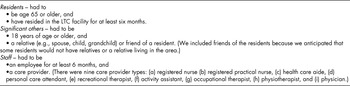
Three different groups of participants (i.e., staff, residents, and their significant others) were recruited because we anticipated that each group would have a different perspective regarding the promotion of physical activity. Eligibility criteria for all participants included the ability to speak English or French and to provide written, informed consent. Table 1 details the group-specific eligibility criteria for inclusion in the study.
Criteria for eligibility, by specific group, for inclusion in the study on promotion of physical activity

Administrators were asked to select a clinical contact person (e.g., nurse, recreation staff member) to help the research team with the logistics of the study (e.g., room bookings for interview locations and times). The contact person was asked to distribute a letter of information to staff, residents, and their significant others who met the inclusion criteria and who the contact person thought might be interested in participating in the study. The clinical contact person, who then provided the research team with a list of these people, was not involved in the consent process. Written, informed consent was obtained prior to each focus group by a member of the research team.
Data Collection
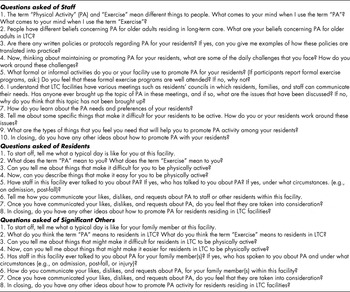
Data were collected, using a semi-structured interview guide (see Table 2), during separate one-hour focus group sessions with staff, and with residents and their significant others at each participating LTC home. Interview questions were guided by both the literature on barriers to physical activity in LTC homes, and the socio-ecological model. For example, we asked about challenges of providing physical activity and how staff attempted to work around these challenges. Furthermore, we asked about individual perceptions of physical activity among residents, their significant others, and staff and queried policies and protocols influencing physical activity.
Questions for focus group participants (staff, residents, and significant others)

Focus groups were co-facilitated by several members of the research team who had health sciences backgrounds and experience as interviewers and group facilitators. These focus group sessions were audiotaped and transcribed verbatim. Most of the focus groups (n = 21) were held in English; the remainder (n = 5) were conducted in French. We decided to include both front-line workers, managers, and supervisors in our staff focus groups to ensure an adequate number of participants, but held separate focus groups for residents and significant others, given their respectively larger numbers.
Data Analysis
The software program QSR N6 was used to assist with data storage and management. We divided the focus group interview transcripts by facility, for review by research team members. We proceeded with content analysis, with each team member independently developing a preliminary coding structure for the transcripts they reviewed. We then met as a team to develop a final coding structure, by comparing results of content coding across transcripts. After applying the final coding structure, we worked as a group to identify emerging themes. We then constructed matrices to help us further refine themes and compare findings according to type of respondent (resident, significant other, staff) and ownership status of the LTC homes (Miles & Huberman, Reference Miles and Huberman1994).
Establishing Rigor and Trustworthiness
Credibility and auditability are two criteria used to judge the rigor and trustworthiness of qualitative data (Devers, Reference Devers1999). Three strategies were used to ensure credibility and accountability: (a) taping and verbatim transcription of the interviews, (b) independent coding followed by group meetings for data analysis and interpretation, and (c) the maintenance of a detailed audit trail. French transcripts were coded in their original language by two fluently bilingual team members; quotes that were used to illustrate the findings were translated by the French members of the team.
Findings
A total of 26 focus groups were held, which included 42 participants in the “significant others” focus groups, 48 participants in the resident focus groups, and 62 participants in the staff focus groups. Table 3 provides a breakdown of the composition of the focus groups. Most of the participants in the “significant other” focus groups were relatives (spouse, sibling, child, niece/nephew, sister-in-law) of the residents and three were friends. Participants in the staff focus group included representatives from the following categories: registered nurses, registered practical nurses, health care aides or personal care attendants, nursing supervisors, physiotherapists, and staff or managers from recreation/activity, restorative care, volunteer, and housekeeping services. We conducted a significant-others focus group in all but one facility where we had scheduling difficulties arising from work schedules of potential participants.
Types and number of focus groups, and participants

Meaning of the Terms Physical Activity and Exercise
Participants defined exercise in many ways. Their responses spanned a wide range of possible activity: motion exercises, movement, formal classes of exercise, ADLs, and social activities like bingo. Similarly, a wide range of definitions for physical activity was provided. These definitions were similar to those used for the term exercise. When the participants made a distinction between the two terms, it was to say that exercise was more planned, structured, and/or organized than physical activity. Physical activity was described as the more “day to day” activities or “general” movement. For example, one participant stated:
I would say physical activity is a little more general; it’s in the activity where there’s movement of the body, whereas exercise is a little more specific – it might be a little more of a program or a sport … Like walking is a physical activity but unless it’s programmed [where a person is] to walk a certain distance within a certain time or push yourself, it’s only then it’s an exercise. — Significant other, facility #4)
One of the most talked-about activities was “mobility” in the form of walking or propelling oneself in a wheelchair. This was considered both physical activity and exercise. Most of the facilities provided formal activity programs such as group exercise programs, walking programs, gardening, morning stretch, ball toss, yoga, and physiotherapy. Examples of informal activities included encouraging residents to do their own ADLs, residents self-propelling themselves in their wheelchairs, and going for a walk.
Beliefs about Physical Activity and Exercise
Regardless of group membership, participants felt that physical activity was “good for your health” (both mental and physical) and helped to maintain function: “The more they [residents] stay mobile, the less they fall” — (Significant other, facility #3). Staff and significant others commented that residents had to “use it or lose it” and talked about the importance of encouraging residents to do things for themselves: “and by doing that [exercise], it would help them maintain their ability to transfer, their ability to feed themselves, their ability to dress themselves or at least prolong that ability” — (Staff, facility #7). Some participants mentioned that physical activity was important for the residents’ mental well-being and pride, and gave the residents something to anticipate. Negative beliefs were mentioned infrequently. A handful of staff and significant others believed that residents were not active because they had never been “joiners” in group activities in the first place, or because they did not have a past history of being active.
Major Themes
The main goal of this analysis was to describe the perceptions that staff, residents, and residents’ significant others held of barriers and facilitators to physical activity for residents. Three main themes emerged: (a) inadequate support for physical activity, (b) pervasive institutional routines, and (c) physical environment constraints. Although barriers to physical activity dominated our study findings, participants in the three groups offered a number of suggestions to address these constraints and, in so doing, thereby reveal some potential facilitators of physical activity.
Inadequate Support for Physical Activity
Despite strong views that physical activity was important, support for physical activity was described as inadequate. Some of the responses reflected organizational factors that impeded the provision of programs and activities specifically geared to physical activity such as lack of funding for exercise programs, and the use of substitute staff.
Although participants in the three groups thought that physical activity opportunities should be provided for LTC residents, they felt that funding and staffing constraints acted as major barriers:
They fund, but they never fund enough. They expect that [expectation that we have to cope] from you and then they’ll say, we’ll give money, but it doesn’t cover [costs for staffing]. — (Staff, facility #7)
The use of replacement staff, especially on weekends, was seen as an organizational impediment to the promotion of physical activity. Significant others noted that residents were more willing to participate in physical activities when coaxed by a favored care provider rather than by less-familiar staff who came from an agency or worked on a casual basis. A participant stated: “I think here, too, there’s a lot of continuity of staff, so you’ll get one resident who’ll always be with the same staff member, so they learn to trust them a lot more” — (Staff, facility # 9). Some of the regular staff used positive motivational and interpersonal skills to “cajole” residents into being more physically active: “But it’s amazing who she [a recreation staff member] can get to participate in exercises … like residents that I can’t get to lift their arm to put their shirt on, she can get them using dumbbells” — (Staff, facility #9).
This personal rapport facilitated physical activity. Other responses highlighted the inadequate nature of the programs that were provided, since they were not geared to the diverse needs and characteristics of the residents. Participants in all three groups identified the need for tailored programs as existing exercise programs were either not physically challenging enough or not the resident’s activity of choice: “I think that the activities are geared to people with Alzheimer’s” — (Resident, facility #5). When activities were not individualized to the residents’ interests or physical abilities, some of the residents did not participate because they found the exercises “boring” or “not stimulating enough”. For example, one resident commented:
As far as the activities – recreational activities – go, I don’t find them very stimulating for me. I have a computer… and I play solitaire … which I find quite interesting. I have certain programs on TV that I like to watch at night and of course I read in between. And I keep my door shut, so I shut out all the noises. I go for a walk everyday when I’m well enough. — (Resident, facility #5)
Participants described a range of strategies used to provide physical activity in response to staffing constraints. For instance, significant others described taking residents for walks and encouraging residents to participate in group activities. However, as one respondent noted, without continuous reinforcement of these alternate measures, physical inactivity ensued and resultant health declines could be rapid:
And I walk her [resident] to the end of the hall and back, and she’s quite capable of doing it, but I know that the few days that I’ve missed doing that, I can see a decline in her ability to do it. —(Significant other, facility #5)
Pervasive Institutional Routines
All three groups of participants described the pervasive routines in their LTC homes that often interfered with opportunities for physical activity. Care practices were highly structured in a tight timetable of daily activities. Staff described the challenges of orchestrating the physical movement of residents while ensuring that their basic care needs of hygiene, elimination, and feeding were met. It was particularly difficult to get all residents up, bathed, dressed, toileted, and transported to the dining room in the mornings. Consequently, some staff identified shortcuts they used to meet care demands, such as wheeling rather than walking residents to the dining room.
You might have a resident who’s able to walk but is in a wheelchair because of long distances … But if she’s at the other end of the hallway and you want to bring her to breakfast but it’s going to take you a half hour to get there, there’s no way that’s going to happen because, you know, nursing or PSWs [personal support workers] need to be tending to their other residents who need to get to breakfast. — (Staff, facility #1)
Similarly, staff described the challenges of adhering to rigid timetables for meals. “You don’t want to rush the residents too fast, but yet you got to get everyone there on time … breakfast should be at nine instead of eight, because then everyone would be able to get up for breakfast” — (Staff, facility #4).
Despite the hurried efforts of staff to ensure that they completed their care, some residents described long periods of idleness: “Well, you know, you try to read; you can only watch so much of that idiot television and most of the time, a lot of the time you spend just in bed relaxing” — (Resident, facility #5). In a few cases, this was by choice. For example, one resident said: “Well, I don’t do much. I go to exercise twice a week and I try to get outside. And I like to sleep” — (Resident, facility #3).
When personal care activities such as bathing conflicted with scheduled exercise or physical activity programs, the personal care activity typically took precedence over physical activity. Residents themselves opted for adherence to routines such as bathing.
Some residents – let’s say they have an appointment or something scheduled like a bath – [and this means] that they refuse to participate in anything [else] because they don’t want to miss that bath, even if it’s at three o’clock in the afternoon. And those little things are hard to work around. — (Staff, facility #7)
Although some of the more physically independent residents were able to incorporate some flexibility into their daily physical activity routine (e.g., independent walking), lower-functioning residents were less able to do so because of dependence on staff and the necessity of having to work around staff routines. As one participant pointed out: “Sometimes it’s the timing … you know, they [residents] want to go outside, but, whoops, there’s nobody to go with [them]. The timing’s not right” — (Staff, facility #8). Lastly, staff and significant others talked about the challenges of trying to fit physical activity into the residents’ already busy schedules. For example, one participant commented:
One has to take into consideration the daily routine … when we want to come to see my mum, she will just have finished her bath which normally is before breakfast, but it depends on when they start and where they wind up. And she loves to go to church … then you’ve only got a half an hour before lunch … then bridge at one … how am I going to fit in physical activity? You can’t push her very fast. It [exercise] almost has to be a religion like the church. — (Significant other, facility #1)
Staff, residents, and their significant others all had suggestions for strategies that might be used to address the constraints they observed. Participants in both the staff and significant other focus groups commented that more volunteers were needed. For example, one participant said,: “And we have the volunteers, but we still need more” — (Staff, facility #1). A majority of the significant others felt that staff members were “overworked.” For instance, some participants commented that the nursing staff should not be burdened with the additional task of providing physical activity because of their heavy workloads. Significant others suggested alternatives such as “volunteers”, “university students”, or “trained professionals.” Other staff members talked about how they delegated responsibility regarding physical activity to residents and significant others:
And there [are] a lot of residents that do take it upon themselves, they ask us to put together a little exercise booklet … so … when you train the people with the exercise, they can carry out those exercises. And I also hand the responsibility to families, too, to do their part when they come, if the resident can be walked, take advantage of it, do some walking. It doesn’t have to be very long for it to be beneficial. — (Staff, facility #4)
Physical Environment Constraints
The third theme concerned aspects of the physical environment that acted as barriers to physical activity. Lack of space in the LTC homes was a common barrier raised by all three sets of focus group participants. Only two study sites had a room specifically designated for physiotherapy or restorative care, and one resident described how this space could not accommodate three people comfortably: “There were three of us [residents] crammed in a room … And it was very cramped, and people had to wait for somebody else to finish before they get to start” — (Resident, facility #7). In most cases, activity programs were held in multipurpose areas such as lounges. These venues were not conducive to physical activity programs, as equipment had to be set up and then cleared away after each session to accommodate other activities.
Staff described an increase in the amount of resident care equipment that was now in the LTC homes. This equipment required more storage room, and diminished the number of areas where there was adequate space for physical activity. A staff member commented:
Well, you’ve got to deal with people who want TV … so there’s couches and chairs, but you have [a] wheelchair and Geri-chair … So space … is limited, so instead of getting maybe 20 independent people in that small room, now you got wheelchairs and Geri-chairs, you’re down to ten people so you’re not meeting that need of all those who want to be there, just because of limited space. — (Staff, facility #1)
Physical bottlenecks in the physical environment – including narrow hallways, a limited number of elevators and steep ramps – reduced maneuverability for staff, residents, and their families. For example, in one facility, residents had difficulty accessing the garden:
Well we did have a gated [area] in [the] backyard….. We did, yeah. But it still wasn’t the safest place [for everyone all at once]. Big cement thing, and a ramp to go down. The ramp was unfit, it was too steep …. The front patio is nice, but it is hard to get in and out; that door’s heavy. We looked at getting the proper push button, the automatic door openers, but it just wasn’t accommodating, and the width of the door [was a problem]. — (Staff, facility #9)
In another facility, staff complained of having to push residents up a steep ramp inside the building as residents were unable to propel themselves over it. This affected both residents and staff:
Part of it too is the building … I used to work on the first floor and if we had to bring [brand name of a geriatric chair] up and down that ramp to take them [residents] to activities, it was a killer – like, do I really wanna do this today!? … That’s a physical barrier for our residents. — (Staff, facility #1)
The lack of generic exercise equipment or specialized therapeutic physiotherapy equipment – “there’s no parallel bars … there’s no equipment” – was also raised. In some instances, residents had offered to donate pieces of exercise equipment (e.g., a stationary bicycle) to the home, but these were not accepted because of a lack of storage space. Residents observed that the exercise equipment was often outdated and complained that if it broke, there was no means to repair or replace it.
When constraints in the physical and organizational environment intersected, this also had a detrimental effect on physical activity options for residents. For example, even when a resident could afford to hire private physiotherapists, lack of space was problematic:
I even inquired for the sake of just talking, What if I was to hire my own physio people? Well then, are they going to fit into what they’re already doing? ’Cause the room is always occupied. So I can’t just walk in there because I hired somebody to give me additional [physio]. It’s [physio room] only a small room, and only one person can be on one thing at any one time, so that’s not even an answer, if you had the money to do that. — (Resident, facility #4)
The ambience within the facility was felt to hinder physical activity. Some residents and significant others felt that the facility was either too quiet or still: “it’s the morgue in here” — (Significant other, facility #5), and thus not stimulating enough to encourage physical activity. In other facilities the setting was described as too noisy, which decreased residents’ concentration. Both significant others and staff felt that more music would be conducive to promoting physical activity:
Residents love music. They love to dance, even if they’re not able to physically get up and dance, the hands go or the foot taps… People are drawn to music from infancy right on up – music just gets you going: it’s just a natural. — (Staff, facility #7)
Participants provided suggestions to overcome challenges in the physical environment. Some of these suggestions were related to the design of LTC homes, and others were related to changes that could be made within existing structures or grounds of the LTC homes and settings. Participants proposed that larger rooms, wider hallways, and accessible multi-purpose rooms would help residents more easily maneuver around the facility with their assistive devices and participate in the activities offered. They also noted that a designated exercise room would be greatly beneficial and that wider corridors, U-shape hallways, and brighter and well-lit areas would be more conducive environments in which to encourage residents to walk. Although some significant others suggested that small equipped exercise areas (e.g., an area equipped with pulleys for arm exercises) should be available, others felt that these exercise areas would be unsafe unless they were adequately supervised. Outside spaces – such as a park, a garden, a patio, or a courtyard – that were easily accessible and with room to sit and rest, paved walkways, and secure areas were other environmental features that participants felt would facilitate physical activity. Residents and significant others deemed these outdoor facilities as very important.
Discussion
Multi-level Influences and the Need for Multi-level Strategies
This study has improved our understanding of the multi-level factors that facilitate or hinder physical activity in long-term care. Across the three themes of inadequate support for physical activity, pervasive institutional routines, and physical environment constraints, respondents noted the inter-relationships among factors influencing physical activity at individual, organizational, and system levels. These findings highlight the need for multi-strategy approaches to effect changes.
Efforts to enhance physical activity were most apparent at the organizational level, with staff attempting various means to encourage physical activity. These efforts were consistent with a generally positive attitude towards the benefits of physical activity among staff, significant others, and residents. However, these efforts were largely overwhelmed by the constraints of the physical environment and rigid institutional routines.
Participants indicated that care practices in the LTC homes were organized around fairly rigid routines, which offset opportunities for physical activity. This created significant constraints in adapting physical activity programs to the diverse needs of residents. Similar results were found in a qualitative study in which staff and family members perceived that highly structured routines in the LTC setting acted as barriers to leisure opportunities for residents (MacDonald, Reference MacDonald2006).
The prominence of physical barriers to providing physical activity options for residents was notable. These barriers involved the intersection of both permanent structures in the built environment – such as ramps, heavy doors, and narrow hallways – and the increased use of large pieces of equipment such as patient lifts. Interdisciplinary teams of care providers as well as architects, engineers, and building contractors will need to work together to determine how existing spaces can be retrofitted and how future LTC facilities can be designed to better support physical activity.
Personal support workers (PSWs) provide the greatest proportion of direct resident care in the LTC setting. Currently, the provision of physical activity is not part of a PSW’s role in Ontario’s LTC homes. Nonetheless, PSWs could play a vital role in assisting, encouraging, facilitating, and motivating residents to be more active, although this is offset by staffing and funding constraints and by inflexible work routines, which impede the promotion of physical activity.
A pragmatic approach would be to incorporate the promotion of physical activity into PSWs’ daily care practices so that it is not regarded as an additional service. This would require a shift in thinking, changes in the way work is organized in LTC homes, and an interdisciplinary approach. Collaboration and problem solving among interdisciplinary group members and residents could be instrumental in yielding creative, resident-centered interventions to increase opportunities for physical activity in long-term care. As well, further dialogue between regulatory bodies, compliance auditors and administrators, staff, and resident groups could generate pragmatic policy recommendations and identify relevant outcome indicators.
Similar to the needs assessment conducted by Lazowski et al. (Reference Lazowski, Ecclestone, Myers, Paterson, Tudor-Locke and Fitzgerald1999), we found that most of the homes in our study provided some type of formal group exercise program, two to three times per week. However, some of the residents expressed the desire for more exercise and the need for tailored exercise programs. Staffing constraints were repeatedly identified as a limitation; this is an issue that has been raised by other authors (Chen, Reference Chen2010; Lazowski et al., Reference Lazowski, Ecclestone, Myers, Paterson, Tudor-Locke and Fitzgerald1999; Ouslander et al., Reference Ouslander, Griffiths, McConnell, Riolo, Kutner and Schnelle2005). Practical approaches to offset staffing constraints, such as volunteer programs, and ways to better incorporate physical activity into the resident’s daily care routines were identified by some participants. A combination of approaches is needed to meet the substantial needs for physical activity in long-term care. Addressing these programming needs will also require an examination of existing institutional policies and practices, including a review of human resource requirements.
This study yielded interesting findings regarding how relationships between staff and residents enabled physical activity. For instance, some staff members were reported as using exceptional motivational skills to encourage residents to be more physically active or developed trusting relationships with residents. These individuals should be identified and recognized as “champions”. These champions can play a pivotal role in motivating and influencing residents to participate and succeed in physical activity initiatives, and in demonstrating successful motivational techniques to their colleagues and the residents’ family members. The use of “motivational” skills by staff members may reflect their own self-efficacy and outcome expectancy (confidence in encouraging physical activity and believing that doing so will result in positive outcomes for the resident). Furthermore, these champions may enhance the self-efficacy of residents, whereby the resident feels more positive about their physical activity capabilities.
Embedding physical activity into daily resident care, planning the redesign of physical spaces, and building awareness among staff and family members of effective approaches to encourage physical activity may all help to promote physical activity in the LTC setting.
Cost-Effectiveness of Physical Activity Programs
There is a paucity of information on the cost-effectiveness of physical activity programs. For instance, Schnelle et al. (Reference Schnelle, Alessi, Simmons, Al Samarrai, Beck and Ouslander2002) indicated that it would take a ratio of one aide to five residents to implement their incontinence care and exercise program into practice. Although the current aide to resident ratio in Ontario LTC homes varies considerably, there is evidence to suggest that they care for more than five residents. For example, PSWs reported that they cared for between 11 to 30 residents on their last shift (Armstrong & Daly, Reference Bates-Jensen, Alessi, Al-Samarrai and Schnelle2004).
Ouslander et al. (Reference Ouslander, Griffiths, McConnell, Riolo, Kutner and Schnelle2005) indicated that the delivery of a combined incontinence care and exercise program costs about three times more than usual care in terms of staff time. According to Ouslander et al., (Reference Ouslander, Griffiths, McConnell, Riolo, Kutner and Schnelle2005) the exercise intervention was designed so that it could be delivered with ususal care routines such as toileting, making if more feasible to implement into practice. In a review of the literature, Forster et al. (Reference Forster, Lambley, Hardy, Young, Green and Burns2009) concluded that the economic case for residents’ rehabilitation while in long-term care has yet to be made. Cost-effectiveness studies are needed to examine the potential gains in improved health and quality of life for residents that may be accrued if the negative health effects of immobility and inactivity are offset.
Limitations
Although the findings contribute important insights about factors influencing physical activity in long-term care, there are several study limitations. First, a review of the policies or routines that surround the promotion of physical activity in LTC settings was not conducted at individual sites. Second, although constraints in the physical environment emerged as a major theme, we did not measure the actual space available for physical activity in each facility. Next, keeping significant others and residents on the topic of physical activity was challenging in some of the focus groups. Some significant others used the focus group meeting to voice their concerns about the care in general, and some residents talked more about recreational type of activities (e.g. bingo, cards) rather than physical activities (e.g. exercise class). Lastly, we did not conduct separate focus groups for supervisory versus non-supervisory staff. This may have made both groups of employees more hesitant to express their views about staff and manager-related influences on physical activity.
Areas for Future Research
Incorporating daily physical activity in the care practices of LTC settings is one means of working around these constraints. Future research could examine whether more flexibility in institutional routines might allow the emergence of creative options for physical activity. Another area of fruitful inquiry could be the examination of the factors that influence the creation and adoption of institutional routines with a particular focus on the tension between being resident centered on the one hand and meeting regulatory and organizational obligations on the other.
Since pervasive routines often mitigated opportunities for residents’ physical activity, future ethnographic studies are needed to further examine the organizing factors (e.g., institutional routines and policies, Ministry standards of care) that influence the promotion of physical activity.
Lack of space for physical activity and the challenges of maneuvering residents in the LTC settings were identified as common barriers. To further our understanding of the role of environmental factors, physical activity patterns in LTC settings with ergonomically designed space could be compared with physical activity patterns in LTC settings lacking such space to more thoroughly examine the impact of the built environment.
In the long term, intervention studies are required to assess the impact of multi-strategy approaches that tackle human resources, factors within the physical environment, staff-resident relationships, and organizational aspects. These organizational aspects include, for example, institutional routines on residents’ uptake of physical activity and associated long-term health and service delivery outcomes.
Our understanding of knowledge utilization, transfer, and translation of physical activity guidelines and programming in the LTC setting is limited. Future research is needed in this area. For example, recommended practice guidelines for outcome-focused physical activity programming in LTC homes have been developed by the Seniors Health Research Transfer Network (SHRTN) Community of Practice on Activity and Aging in partnership with the Canadian Centre for Activity and Aging (SHRTN, 2009). It would be enlightening to study the utilization, transfer, and translation of these new guidelines in LTC homes in Ontario and to determine the impact that barriers and facilitators, including those identified in this study, may have on their implementation.