Clostridium difficile infection (CDI) remains a significant healthcare-associated infection. Patients with hematologic malignancy (heme) and/or bone marrow transplant (BMT) may represent an important reservoir of C. difficile. To better characterize the CDI epidemiology for this patient population, we examined the prevalence of toxigenic C. difficile colonization at admission to our heme/BMT unit, and we evaluated the risk of subsequent CDI during hospital stay.
METHODS
We conducted a prospective cohort study at a 566-bed academic medical center. We enrolled all patients admitted to the hospital’s heme/BMT unit between May 12 and September 24, 2015, with the following characteristics: (1) an anticipated length of hospital stay of at least 1 night; (2) not admitted as a bone marrow donor; and (3) not diagnosed with CDI within the first 24 hours of admission or at any previous time within the study period. We defined CDI according to the clinical practice guidelines by Cohen et al.Reference Cohen, Gerding and Johnson 1 The University of Wisconsin–Madison Institutional Review Board exempted this study from review as a quality improvement project.
We extracted demographic and clinically relevant variables from electronic medical records, including previous history of CDI, comorbidities, and medication use during hospitalization and within the 30 days prior to admission.
For microbiological identification, we inoculated 0.1 g of stool into prereduced C. difficile Brucella broth and incubated it anaerobically at 36°C. We plated 50 µL broth enrichment to C. difficile Brucella agar and incubated it anaerobically at 36°C for 48 hours. Isolates suspected to be C. difficile by Gram stain and catalase tests were confirmed by in-house polymerase chain reaction (PCR), which was also used to evaluate the presence of toxin genes tcdA, tcdB and cdtB.Reference Warrack, Duster, Van Hoof, Schmitz and Safdar 2
We compared the frequency of variables between patients with and without CDI during 1 admission for every unique patient. We compared categorical variables using the χ2 test and the Fischer’s exact test, and we compared continuous variables using the Student t test or Wilcoxon rank-sum test. On bivariate analyses, for patients with multiple admissions during the study period, we included only 1 admission per patient, as follows: (1) the admission that identified colonization with toxigenic C. difficile (TCD) or non-toxigenic C. difficile (NTCD) on admission, and/or symptomatic CDI during the hospital stay or (2) otherwise, for patients free of C. difficile, we chose the first admission during the study period.
For multivariate analysis, we included all admissions during the study period. We conducted regression analyses using a generalized estimating equations model fit with a binomial family and the exchangeable correlation structure to adjust for correlation between measures of exposures taken from the same patient over multiple admissions. The multivariate model included all variables with a P value<.20 on bivariate analysis, as well as any additional potential confounders deemed clinically relevant. We ran a series of nested models and chose the best-fitting model using the quasi-likelihood criterion. We used STATA 14 software (StataCorp, College Station, TX) for our analyses, and we considered statistical significance a two-tailed P value≤.05.
RESULTS
A total of 358 patients were enrolled in the study; 322 (90%) were sampled for colonization status. Among those sampled, 41 patients (12.7%) were colonized with C. difficile; toxigenic C. difficile (TCD) was present in 30 of these 322 samples (9.3%), and nontoxigenic C. difficile (NTCD) was present in 11 of these 322 samples (3.4%).
Overall, CDI developed in 12 of 358 patients (3.4%), with a median hospital stay of 4 days before symptom onset. Among the 30 patients colonized with TCD, 4 patients (13.3%) developed CDI during their hospital stays. None of the patients colonized with NTCD developed CDI. None of the 36 patients with missing screening samples (10%) developed CDI.
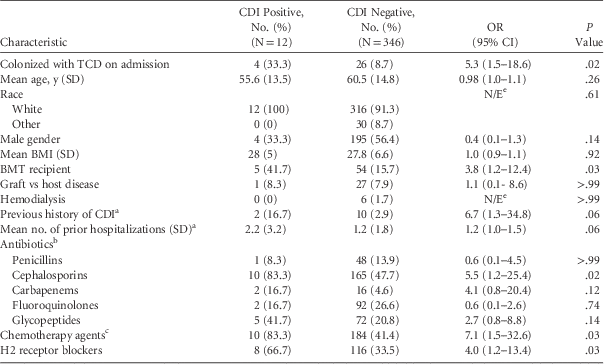
Table 1 presents the clinical and demographic characteristics for patients who did and did not develop CDI during their hospital stay according to our bivariate analyses. Patients who developed CDI were more likely to have received a BMT, cephalosporins, or certain chemotherapy agents.
Clinical and Demographic Characteristics for Patients who Did and Did Not Develop Symptomatic Clostridium difficile Infection (CDI) During Hospital Stay, Bivariate Analysis

NOTE. OR, odds ratio; CI, confidence interval; TCD, toxigenic Clostridium difficile strain; SD, standard deviation; N/E, not estimable; BMI, body mass index; BMT, bone marrow transplant; LTCF, long-term care facility.
a Within the previous year.
b Within the previous 30 days.
c Includes alkylating agents, antimetabolites, and endocrine therapies.
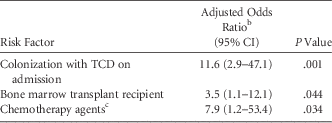
Table 2 shows the independent risk factors associated with CDI development during hospitalization for the 456 total patient admissions included in the multivariate analysis. After adjusting for age, gender, BMT status, and significant chemotherapy agents, the odds of developing a CDI was 11.6 times greater in TCD patients than in patients who were not colonized (95% confidence interval [CI], 2.9–47.1; P=.001). Other independent risk factors for CDI were BMT status and significant chemotherapy agents.
Independent Risk Factors for the Development of Symptomatic Clostridium difficile Infection During Hospital Stay, Multivariate AnalysisFootnote a

NOTE. CI, confidence interval; TCD, toxigenic Clostridium difficile strain.
a N=456 patient admissions.
b Risk adjusted by age and gender.
c Within previous 30 days.
DISCUSSION
Among our patients with hematological malignancies, 9.3% were colonized with TCD at admission, and colonization with a toxigenic strain was an independent risk factor for developing CDI during hospitalization. Jain et alReference Jain, Croswell and Urday-Cornejo 3 and Bruminhent et alReference Bruminhent, Wang and Hu 4 reported 12% and 10.7% colonization rates at hospital admission, respectively, among their BMT populations. Taken together, these studies suggest that the heme/BMT patient population is a significant reservoir of C. difficile colonization, at least in large academic medical centers in the Midwest.
This finding has important implications. First, colonized patients are at increased risk of developing symptomatic disease. In our study, this risk was 13.3%. In a recent meta-analysis of C. difficile colonization at hospital admission, the risk of developing CDI during the hospital stay was 18.4%.Reference Zacharioudakis, Zervou, Pliakos, Ziakas and Mylonakis 5 Given the fragile health status of patients with hematological malignancies, the additional morbidity from CDI development can negatively affect their clinical outcomes.Reference Selvey, Slimings, Joske and Riley 6 Second, patients with asymptomatic colonization may contribute to the horizontal transmission of C. difficile pathogens within the healthcare setting, especially if their colonization status is not recognized.Reference Lanzas and Dubberke 7
Therefore, the heme/BMT patient population should be considered for additional infection control measures, such as active surveillance and contact isolation of asymptomatic carriers, at least in hospitals with a high colonization pressure. The study by Lanzas et alReference Lanzas and Dubberke 7 found that active surveillance for C. difficile could decrease new colonization by 40%–50% and incidence of hospital-onset CDI by 10%–25%, supporting this strategy. While other interventions aimed at reducing disease incidence (eg, intestinal decolonization of asymptomatic carriers with oral vancomycin or metronidazole) have been disappointing,Reference Johnson, Sambol and Brazier 8 antimicrobial stewardship efforts (eg, fluoroquinolone restrictionReference Kallen, Thompson and Ristaino 9 or piperacillin-tazobactam substitutionsReference Owens, Donskey, Gaynes, Loo and Muto 10 ) do show promise. The role of prophylactic probiotics as a strategy to reduce disease incidence in C. difficile–colonized heme/BMT patients deserves further study.
Our study has several limitations. We did not have access to strain-specific molecular information to confirm that the CDI and colonizing strains were identical. Admission samples were missing for 10% of our study cohort, which may have led to over or underestimation of our true colonization rates. This was an observational study, it was subject to the inherent limitations of this study design. Because diarrhea occurs frequently in these patients due to other factors, such as graft-versus-host-disease or chemotherapy, distinguishing between colonization and symptomatic CDI in a patient already colonized may be difficult, leading to an overestimation of CDI rates. Finally, our study reflects the experience of a single academic medical center and may have limited generalizability to other settings.
In summary, we found that the heme/BMT patient population is at increased risk for C. difficile colonization, and this population should be considered for specific infection control interventions aimed at reducing the burden of transmission and disease within the hospital setting.
ACKNOWLEDGMENTS
Financial support: Financial support was provided by R03 and R18 grants from the Agency for Healthcare and Research Quality.
Potential conflicts of interest: All authors report no conflicts of interest relevant to this article.