Implications
It was hypothesized that low birth weight (LBW) litters would benefit more from maternal marine n-3 long-chain polyunsaturated fatty acid (mLCPUFA) supplementation than medium/high birth weight (MHBW) litters. Therefore, when fed only to sows with a predicted LBW phenotype, supplementation should help to reduce the gap in growth rate between LBW and MHBW litters, decreasing the variation in BW at slaughter. However, maternal mLCPUFA supplementation only improved growth rate until weaning in MHBW litters and decreased litter size at birth. Therefore, maternal mLCPUFA supplementation is not a good strategy to overcome the negative effects of a LBW litter phenotype.
Introduction
Uniformity in BW at time of slaughter is critical for efficient use of all-in/all-out systems (Deen, Reference Deen1997). As events in utero, like maternal malnutrition or intra-uterine crowding (IUC), can have effects on birth weight, muscle fibre numbers and postnatal growth performance to slaughter (Foxcroft et al., Reference Foxcroft, Dixon, Novak, Putman, Town and Vinsky2006; Rehfeldt and Kuhn, 2006; Bérard et al., Reference Bérard, Pardo, Béthaz, Kreuzer and Bee2010), it is worthwhile to explore management options for gestating and lactating sows to decrease the variation in BW in the grow–finish barn.
Previous research in the same population of sows as used in the present study was based on the underlying hypothesis that, after accounting for the predicted effect of increased numbers of pigs born on birth weight, the large residual variation in litter average birth weight in litters of 9 to 16 pigs born reflects the negative effects of relative IUC driven by high ovulation rates (Smit et al., Reference Smit, Spencer, Almeida, Patterson, Chiarini-Garcia, Dyck and Foxcroft2013b). That research showed (1) that litters with a low average birth weight (LBW) take 9 days longer to reach slaughter weight than litters with a high average birth weight (HBW) and (2) that litter birth weight phenotype is repeatable within sows. As marine oil-based n-3 long-chain polyunsaturated fatty acid (mLCPUFA) supplementation to sows during (parts of) gestation and lactation has been shown to increase offspring growth rate (Rooke et al., Reference Rooke, Sinclair, Edwards, Cordoba, Pkiyach, Penny, Penny, Finch and Horgan2001a and Reference Rooke, Sinclair and Edwards2001b; Mateo et al., Reference Mateo, Carroll, Hyun, Smith and Kim2009; Smit et al., Reference Smit, Patterson, Webel, Spencer, Cameron, Dyck, Dixon and Foxcroft2013a), feeding n-3 LCPUFA only to sows with a predicted LBW litter phenotype might help to reduce the gap in growth rate between LBW and HBW litters. However, before implementing such a management strategy, it is important to first investigate whether n-3 LCPUFA diet enrichment of multiparous sows results in the same increase in growth rate as seen in gilts by Smit et al. (Reference Smit, Patterson, Webel, Spencer, Cameron, Dyck, Dixon and Foxcroft2013a), and if LBW litters react similarly to maternal n-3 LCPUFA supplementation as medium birth weight (MBW) or HBW litters.
The objectives of this trial were: (1) to confirm the repeatability of litter birth weight phenotype in a commercial sow population; (2) in all litters, to investigate the effects of mLCPUFA enrichment to the sow in gestation and lactation on litter characteristics from birth until weaning; and (3) within litters between 9 and 16 pigs total born, to investigate the effects of mLCPUFA enrichment to the sow in gestation and lactation, litter birth weight phenotype and potential interactions on pre- and postnatal development of the litter until weaning.
The research presented in this and a companion paper used the same population of sows and the same strategic approach as Smit et al. (Reference Smit, Spencer, Almeida, Patterson, Chiarini-Garcia, Dyck and Foxcroft2013b). This approach consisted of classifying only litters with 9 to 16 pigs total born as LBW, MBW or HBW, to exclude the effects that very large or small litters have on birth weight and instead focus on the large variation in litter average birth weight shown by sows that produce litters of a more normal size. The present paper describes the overall experimental approach used, data on the repeatability and characteristics of LBW litters, and effects of sow n-3 LCPUFA enrichment and litter birth weight on litter performance until weaning. Effects on fatty acid composition of sow serum, milk, colostrum and piglet organs, as well as post-weaning performance of some of the litters will be presented in a companion paper (Smit et al., submitted).
Material and methods
Animals and treatments
This study was performed according to Canadian Council on Animal Care guidelines and JBS United Inc. ethical guidelines. Multiparous Large White×Landrace terminal line sows (Camborough; PIC, Nashville, TN, USA) were managed according to approved protocols at the JBS United Inc. sow research farm (Bache Farm; JBS United Inc., Sheridan, IN, USA). A total of 163, parity four to eight sows (mean parity=4.9±0.9) that were a part of five consecutive weekly breeding groups used in a previous study (Smit et al., Reference Smit, Spencer, Almeida, Patterson, Chiarini-Garcia, Dyck and Foxcroft2013b), were rebred after weaning and pair-matched by parity and litter average birth weight recorded for the previous three litters. Within pairs (n=80), sows were allocated to be fed either standard corn/soyabean meal-based gestation and lactation diets (CON; Supplementary Table S1), or the same diets enriched at the expense of corn with 0.5% of an existing mLCPUFA supplement rich in EPA and DHA (mLCPUFA, Gromega Ultra 365; JBS United Inc.; Supplementary Table S1) stabilized to prevent auto-oxidation. A level of 0.5% of the mLCPUFA supplement was chosen based on product recommendations, which are based on previous in-house research (JBS United Inc.).The fatty acid composition of the gestation and lactation diets, analysed at the Agricultural Experiment Station Chemical Laboratories (Columbia, MO, USA), can be found in Supplementary Table S1. Diets were fed from weaning, during rebreeding, throughout gestation and from farrowing until the end of a 21-day lactation. Three sows (two mLCPUFA and one CON) not allocated to a pair owing to uneven numbers of sows in some weaned groups, and additional sows in a pair where the pair-matched sow was not pregnant, were considered as ‘incomplete pairs’ in the analysis.
Sows were housed in gestation crates and fed gestation diets from weaning until a few days before farrowing, and were then moved to farrowing crates (mean sow BW including foetuses: 269.3±32.6 kg) where they received lactation diets until weaning (mean sow BW: 261.9±25.6 kg). In gestation, sows were fed according to their body condition, with an average feed intake of 2.4 kg/day. Lactation feed was started at ~2.6 kg/day. After farrowing, a step-up regimen was implemented to get sows on full feed (6.7 to 7.0 kg) by day 7 post-farrowing. Water was freely available through a nipple drinker. Creep feed was not provided to piglets at any point during the lactation period.
Sows were induced to farrow with a 2-ml injection of a prostaglandin F2α analogue (Lutalyse; Pfizer Animal Health, New York, NY, USA) at day 114 of gestation if no signs of parturition were apparent. A biodegradable mat was placed behind the sow on the expected day of farrowing in an attempt to catch placentae. Within 24 h after birth, all piglets were ear-tagged and individual birth weight of all pigs born was recorded. Litter average birth weight was calculated as total birth weight of all pigs in a litter, divided by the total number of pigs born in that litter. Each litter between 9 and 16 total pigs born was classified as LBW, MBW or HBW litter, as described previously (Smit et al., Reference Smit, Spencer, Almeida, Patterson, Chiarini-Garcia, Dyck and Foxcroft2013b), independent from sow dietary treatment. In short, litters more than 1 s.d. below or above the mean litter birth weight for each litter size between 9 and 16 total pigs born were initially designated as LBW and HBW, respectively. However, owing to the small proportion of HBW litters identified, MBW and HBW were combined into one class (medium/high birth weight (MHBW)) in this study for analysis of litter birth weight effects. Cross-fostering of piglets, to standardize litters suckled to 10 to 12 pigs/sow, occurred within sow dietary treatment only, but irrespective of birth weight classification within treatment. Each time a piglet was removed or added to a litter, the date, piglet weight and reason for removal or addition were recorded.
Measurements before weaning
Within 24 h after birth and before cross-fostering, sow ID, parity, date of birth, total number of piglets born, number of piglets born alive, number of stillborns, number of mummies, and individual birth weight and sex of all piglets born, were recorded for each litter. All pigs were again individually weighed the day before weaning.
Up to a maximum of two male and two female stillborn piglets, or piglets that died within 12 h after birth from any litter were dissected within 24 h after birth. Lungs were removed and a ‘lung floatation’ test determined whether piglets were stillborn (lungs not floating) or died soon after birth (lungs floating). The wet weights of the brain, liver, small intestine, thymus, kidneys, adrenals, heart, lungs and the Semitendinosus muscle of the right leg were recorded at necropsy, and samples of brain, liver and muscle tissues were saved and stored at −20ºC until later analysis (see companion paper of Smit et al., submitted). Piglets that were smaller than 2 s.d. below the litter average birth weight were considered to be runts and were not dissected. Only piglets with an individual birth weight within 0.5 kg from the litter average birth weight were considered for subsequent statistical analysis.
The number of placentae recovered and total placental wet weight for each sow farrowed were recorded, from which an average placental wet weight was calculated. However, placental data were only used for subsequent statistical analysis when more than 50% (calculated as number of placentae/total number of pigs born×100) of the placentae in a litter were recovered, which occurred in 76 litters.
Immunoglobulin G (IgG) measurements
Blood samples were taken from all sows on day 113 of gestation into non-heparinized vacutainer tubes (BD; Fisher Scientific, Ottawa, ON, Canada) and held at ambient temperature until centrifugation (Jorvet J-502, Jorgensen Laboratories, Loveland, CO, USA) at 1034×g. Serum was then harvested and frozen at −20ºC until analysis for IgG concentrations.
IgG in sow serum was assayed using a pig IgG ELISA Quantitation Kit (Ref. E100-104; Bethyl, Montgomery, TX, USA). The plates were coated with 100 μl of goat anti-pig IgG-Fc fragment diluted at 1% in 0.05 M carbonate–bicarbonate solution (pH 9.6; Sigma, St Louis, MO, USA). Subsequently, the plates were blocked for 30 min at room temperature, or overnight at 4ºC, with TBS (Fisher Scientific) containing 1% BSA (Sigma). Serum samples were diluted 1 : 1.6×10⁵ in TBS with 0.05% Tween 20 (Caledon, Georgetown, ON, Canada) and 1% BSA, added in duplicate to the plates (100 μl/well) and incubated for 1 h at room temperature. Thereafter, the plates were incubated for 1 h at room temperature with 100 μl peroxidase-labelled anti-pig IgG-Fc fragment diluted 1 : 7.5×10⁴ in TBS with 0.05% Tween 20 and 1% BSA. Then, 100 μl of a substrate containing 3,3',5,5'-tetramethylbenzidine was added and the plate was placed in the dark. Between each step, plates were washed five times with a plate washer (Skanwasher 400; Molecular Devices, Sunnyvale, CA, USA) with TBS containing 0.05% Tween 20. The colorimetric reaction was stopped after 15 min with 100 μl of a 0.18 M H2SO4 solution (Fisher Scientific) and absorbance at 450 nm was recorded using an ELISA plate reader (Spectramax M3; Molecular Devices). An assay sensitivity of 23 ng/ml as described by Devillers et al. (Reference Devillers, Farmer, Mounier, Le Dividich and Prunier2004) was consistent with the upper limits of the confidence interval of the lowest point on the curve in the current assays. Dilution curves of serum (1 : 20 000 to 1 : 320 000) were parallel to standard curves. The intra-assay CV was calculated as the mean CV of 20 duplicate samples within each assay and was 12.3%. Inter-assay CV could not be calculated owing to issues with stability of samples used as internal standards after thawing and refreezing, but each assay contained similar numbers of CON and mLCPUFA samples. Only samples that were run for the first time and that had duplicates with a CV<20% were used in the final analyses, which resulted in 67 serum samples being used for analysis. Two serum samples with biologically unrealistic high values of IgG concentration were considered outliers and also removed from the analysis.
Statistical analysis
Correlation analysis was performed for repeatability of litter birth weight phenotype using the CORR procedure in SAS (SAS Institute, Cary, NC, USA). Categorical data like farrowing rate and pre-weaning mortality were analysed using the generalized logit function (proc CATMOD in SAS). All other data were analysed using the MIXED procedure of SAS as a randomized incomplete block design, with blocks based on sow pairs. If one sow of a pair was not pregnant or was taken off trial at any other point in time, the other sow of the pair remained on trial and was considered an incomplete block. Sow was used as the experimental unit for all parameters before weaning, including treatment effects on litter growth, and all individual measurements of piglets before weaning were averaged within a litter (sow) before statistical analysis. The model for the entire data set included sow treatment (CON or mLCPUFA) as a fixed effect and pair as a random effect. Data from necropsied pigs were analysed individually; the model included treatment and sex as fixed effects, and pair and pig-within-sow as random effects. The analysis of the subset of litters with 9 to 16 total pigs born was set up as a 2×2 factorial design, evaluating litter birth weight and sow dietary treatment effects in the absence of effects of prolific litters (see Smit et al., Reference Smit, Spencer, Almeida, Patterson, Chiarini-Garcia, Dyck and Foxcroft2013b) and had sow treatment (CON or mLCPUFA), litter birth weight classification (LBW or MHBW) and their interaction as fixed effects and pair as a random effect. The interaction term was excluded from the model if it was not significant.
Data are presented as least square means, unless otherwise stated, and data in the figures as means. P<0.05 were considered significant and P<0.10 were used to describe trends.
Results
Repeatability of litter average birth weight
Correlation analysis between litter average birth weight of the current litters and the three preceding litters within sows established correlations (P<0.001) between litter average birth weight of the current litter and the previous litter (r=0.49), between the current litter and the previous two litters together (r=0.49), as well as between the current litter and the previous three litters together (r=0.50). The per cent of sows in LBW, MBW and HBW categories in two consecutive farrowings is given in Supplementary Figure S1 and indicates that none of the sows switched between the LBW and HBW categories in consecutive farrowings.
Effects of mLCPUFA enrichment to the sow on litter characteristics from birth until weaning in all litters
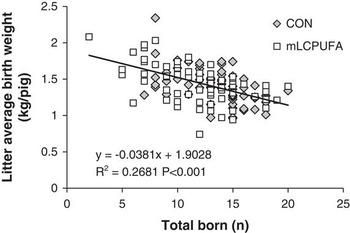
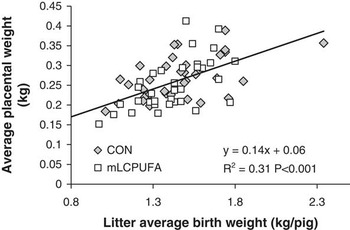
Of the 163 sows weaned, 85.9% were bred successfully and 95.7% of bred sows farrowed (64 CON and 70 mLCPUFA sows), including 53 complete sow pairs. Breeding rate and farrowing rate were similar for CON and mLCPUFA sows. The total number of pigs born (11.9 v. 13.4, r.s.d.=3.4) and born alive (10.8 v. 12.3, r.s.d.=3.3) were lower (P=0.01) in mLCPUFA than CON sows, respectively, whereas the number of stillborn and mummified pigs were similar between treatments. The negative relationship between litter size (total born) and litter average birth weight was similar for CON and mLCPUFA litters (Figure 1). Average placental weight was not related to litter size, but was positively related to litter average birth weight for both CON and mLCPUFA litters (Figure 2) and the slopes of the regression lines describing these relationships for CON and mLCPUFA were not significantly different (t=1.5, d.f.=64, P=0.14).
Relationship between litter size (total pigs born) and litter average birth weight for sows fed diets with (mLCPUFA) or without (CON) marine n-3 LCPUFA enrichment (n=133). The slopes of the regression lines for CON and mLCPUFA were not significantly different, therefore, a common regression line is shown. mLCPUFA=sows fed diets rich in marine oil-based n-3 long-chain polyunsaturated fatty acid; CON=sows fed control diets.

Relationship between litter average birth weight and litter average placental wet weight for litters from sows fed diets either with (mLCPUFA) or without (CON) marine n-3 LCPUFA enrichment (n=74). The slopes of the regression lines for CON and mLCPUFA were not significantly different, therefore, a common regression line is shown. Columns without a common superscript are different at P<0.05. mLCPUFA=sows fed diets rich in marine oil-based n-3 long-chain polyunsaturated fatty acid; CON=sows fed control diets.

Of the 131 necropsied piglets, 105 had a birth weight within 0.5 kg from the litter average birth weight, 51 were true stillborns (lungs not floating) and 54 died within 12 h after birth (lungs floating). As there was no significant effect of stillborn v. liveborn, all 105 necropsied piglets were analysed together for effects of sow dietary treatment. Necropsied piglets had similar average individual birth weights for both treatments and neither sex nor treatment had a significant effect on any of the tissue weights or brain : tissue weight ratios (data not shown).
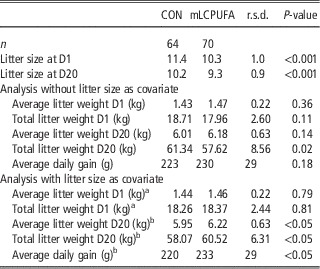
After cross-fostering within treatment, the litter size at days 1 and 20 of lactation was again higher (P<0.001) in CON than mLCPUFA litters (Table 1). Average and total litter weight at day 1 were similar between treatments. Average litter weight at day 20 and average daily gain (ADG) were not different between treatments owing to differences in litter size; when using litter size as covariate in the model, average litter weight at day 20 and ADG were higher (P<0.05) in mLCPUFA than CON litters. Owing to the higher litter size, total litter weight at day 20 was higher (P<0.05) in CON than mLCPUFA litters, but when using litter size as covariate in the model, total litter weight at day 20 was higher (P<0.05) in mLCPUFA than CON litters (Table 1). Pre-weaning mortality (17.0% and 18.2% for CON and mLCPUFA, respectively) was similar between treatments.
Litter information after cross-fostering for all litters born to sows fed diets with (mLCPUFA) or without (CON) marine-based n-3 LCPUFA enrichment

mLCPUFA=sows fed diets rich in marine oil-based n-3 long-chain polyunsaturated fatty acid; CON=sows fed control diets.
Data are the LSMeans.
a Litter size at day 1 of lactation (D1) was used as a covariate.
b Litter size at day 20 of lactation (D20) was used as a covariate.
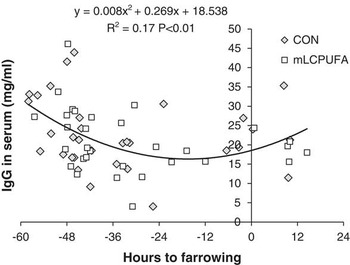
Figure 3 shows the quadratic relationship between IgG concentration in serum and time to farrowing, which was significant for mLCPUFA (P<0.05) and was a trend for CON (P=0.07). Therefore, the time to farrowing was included as a covariate in the analysis. There was no effect of treatment on IgG concentration in serum of sows around day 113 of gestation (22.7 v. 21.8 mg/ml serum for CON and mLCPUFA sows, respectively; r.s.d.=8.0, P=0.68).
Relationship between IgG concentration in sow serum and time to farrowing for sows fed diets either with (mLCPUFA) or without (CON) marine n-3 LCPUFA (n=64). The slopes of the regression lines for CON and mLCPUFA were not significantly different, therefore, a common regression line is shown. mLCPUFA=sows fed diets rich in marine oil-based n-3 long-chain polyunsaturated fatty acid; CON=sows fed control diets.

Effects of mLCPUFA enrichment to the sow, litter birth weight phenotype and potential interactions on pre- and postnatal development until weaning in litters between 9 and 16 total pigs born
There was no interaction between sow dietary treatment and litter birth weight phenotype for any of the litter characteristics at birth.
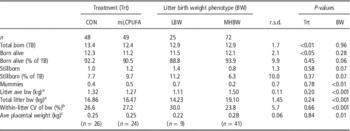
Like in the entire data set, total number of pigs born and number born alive were again lower (P<0.01 and P<0.05, respectively) in mLCPUFA than CON sows (Table 2). The number of stillborns and mummies were similar between treatments. Litter average birth weight, within-litter CV of birth weight and average placental weight were not different between treatments (Table 2).
Characteristics at birth for litters between 9 and 16 total pigs born with a low litter average birth weight (LBW) or medium/high litter average birth weight (MHBW) from sows being fed either diets with (mLCPUFA) or without (CON) marine n-3 LCPUFA enrichment

CON=sows fed lactation diets; mLCPUFA=sows fed diets rich in marine oil-based n-3 long-chain polyunsaturated fatty acid; LBW=low birth weight litters; MHBW=medium/high birth weight litters; ave=average; bw=birth weight.
Data are the LSMeans. There were no significant interactions between treatment and litter birth weight category.
a Total number of pigs born in litter used as covariate.
b Within-litter CV of birth weight was calculated as within-litter standard deviation of birth weight/litter average birth weight×100.
c Only taking into account litters where >50% of the placentae were recovered.
By design, litter average birth weight was lower (P<0.001) in LBW than MHBW litters. Within-litter CV of birth weight was greater (P<0.001) and average placental weight was lower in LBW than MHBW litters (Table 2). The total number of pigs born and the number born alive were not different between LBW and MHBW birth weight categories (Table 2). The number of stillborns tended to be higher (P=0.07) and the number of mummies was higher (P<0.01) in LBW than MHBW litters.
Of the 105 necropsied piglets with a birth weight within 0.5 kg from the litter average birth weight, 69 came from litters between 9 and 16 total pigs born, 34 were true stillborns (lungs not floating) and 35 died within 12 h after birth (lungs floating). As there was no significant effect of stillborn v. liveborn, all 69 necropsied piglets were analysed together for effects of sow dietary treatment and litter birth weight phenotype.
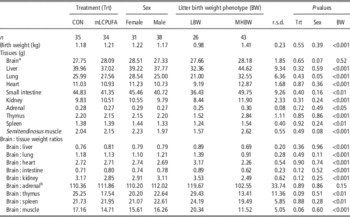
There were no significant effects of sow dietary treatment and sex on tissue weights and brain : tissue weight ratios, except females had heavier lungs than males (P=0.05; Table 3). Individual birth weight and tissue weights of necropsied pigs were higher (P<0.05) in MHBW than LBW litters, except for brain weight, which was similar (Table 3). This resulted in higher (P<0.05) brain : tissue weight ratios for LBW than MHBW litters, except for brain : adrenal weight ratio (P=0.15; Table 3). There was an interaction between sow dietary treatment and litter birth weight phenotype for brain : kidney, brain : thymus and brain : muscle weight ratio; there was no effect of sow dietary treatment in MHBW litters, but in LBW litters the weight ratios were higher for CON than mLCPUFA litters (Supplementary Table S2).
Effect of marine n-3 LCPUFA supplementation to sows, sex and litter birth weight phenotype on tissue weights and brain : tissue weight ratios of necropsied pigs for litters between 9 and 16 total pigs born

CON=sows fed control diets; mLCPUFA=sows fed diets rich in marine n-3 LCPUFA; LBW=low birth weight litters; MHBW=medium/high birth weight litters.
Data are the LSMeans. There were no three-way interactions between treatment, litter birth weight phenotype and sex.
a There was an interaction between sex and litter birth weight phenotype (P<0.05) (see Supplementary Table S2).
b There was an interaction between treatment and litter birth weight phenotype (P<0.05) (see Supplementary Table S2).
There was no interaction between sow dietary treatment and litter birth weight phenotype for pre-weaning mortality rate. Pre-weaning mortality rate was similar between sow dietary treatments (17.6% and 18.4% for CON and mLCPUFA, respectively, P=0.83). Pre-weaning mortality rate was higher (P<0.01) in LBW (23.6%) than MHBW (15.7%) litters.
There was no interaction between sow dietary treatment and litter birth weight phenotype for IgG concentration. Like in the entire data set, in litters with 9 to 16 total pigs born IgG concentration in serum was again similar (P=0.62) at 113 days of gestation for mLCPUFA (22.1 mg/ml serum) and CON sows (23.1 mg/ml serum; r.s.d.=7.2). IgG concentration in serum was also similar (P=0.39) for MHBW (21.4 mg/ml) and LBW sows (23.7 mg/ml; r.s.d.=7.2).
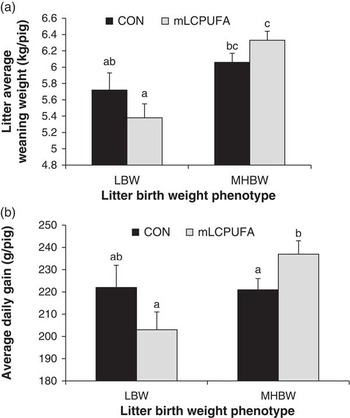
There was an interaction (P<0.05) between treatment and litter birth weight category for weaning weight and ADG. Both weaning weight (Figure 4a; P<0.001) and ADG (Figure 4b; P<0.01) were greater in MHBW litters than LBW litters from mLCPUFA-enriched sows, whereas there was no effect of birth weight category in litters from CON sows. Moreover, weaning weight tended to be higher (P=0.08) and ADG was significantly higher (P<0.05) in mLCPUFA than CON litters for MHBW litters, whereas there was no effect of treatment in LBW litters (Figure 4a and b).
The interaction between treatment (sows were fed diets either with (mLCPUFA) or without (CON) marine n-3 LCPUFA enrichment) and the litter average birth weight (LBW=low birth weight and MHBW=medium/high birth weight) for (a) weaning weight and (b) average daily gain (n=97). mLCPUFA=sows fed diets rich in marine oil-based n-3 long-chain polyunsaturated fatty acid; CON=sows fed control diets.

Discussion
Repeatability of litter birth weight phenotype in a commercial sow population
This study confirmed our previous findings that litter birth weight phenotype is repeatable within sows (Smit et al., Reference Smit, Spencer, Almeida, Patterson, Chiarini-Garcia, Dyck and Foxcroft2013b). This study clearly shows that sows giving birth to HBW litters are very unlikely to give birth to a LBW litter next, and vice versa. Together with the observations that the correlation coefficient is reasonably high (r=0.49), it can be concluded that litter average birth weight is repeatable, thus predictable and, therefore, manageable, within sows. For example, sows with a predicted LBW phenotype could all be moved into one farrowing room, which would become a ‘high priority room’ for intensive postnatal care. Drying off piglets in that room could prevent against hypothermia, and having personnel check that room frequently can decrease the number of piglets crushed by the sow. In addition, given the implications of LBW for intra-uterine growth retardation (IUGR) and limited development of the gut and immune system, interventions to ensure adequate colostrum intake, like split-suckling and colostrum supplementation, would be indicated.
Effects of mLCPUFA enrichment to the sow on litter characteristics from birth until weaning in all litters
The smaller litter size at birth that we observed in litters from mLCPUFA-enriched sows was not consistent with our previous findings (Smit et al., Reference Smit, Patterson, Webel, Spencer, Cameron, Dyck, Dixon and Foxcroft2013a) and reports from others. Most researchers found no effect of n-3 LCPUFA supplementation to sows on litter size at birth (Gunnarsson et al., Reference Gunnarsson, Pickova, Högberg, Neil, Wichman, Wigren, Uvnäs-Moberg and Rydhmer2009; Mateo et al., Reference Mateo, Carroll, Hyun, Smith and Kim2009; Leonard et al., Reference Leonard, Sweeney, Bahar, Lynch and O’Doherty2010), whereas others found an increase in litter size (Webel et al., Reference Webel, Otto, Webel, Moser, Spencer and Orr2003; Spencer et al., Reference Spencer, Wilson, Webel, Moser and Webel2004; Smits et al., Reference Smits, Luxford, Mitchell and Nottle2011). Rooke et al. (Reference Rooke, Sinclair and Ewen2001c) showed a linear decrease in litter size with increasing amounts of salmon oil to the sows diets, but the authors concluded that this finding was unlikely to have been caused by the salmon oil inclusion, as they started supplementing sows at day 60 of gestation, well after the time period at which litter size in the pig is established.
It is not clear why the decrease in litter size in the current trial occurred. It has been shown in cattle that n-3 polyunsaturated fatty acids inhibit luteal cell progesterone secretion in vitro (Hinckley et al., Reference Hinckley, Clark, Bushmich and Milvae1996). Decreased progesterone concentration in the early luteal phase in cattle has been shown to reduce embryo survival (Mann et al., Reference Mann, Lamming and Payne1998). However, supplementing diets with fish meal (Mattos et al., Reference Mattos, Staples, Williams, Amorocho, McGuire and Thatcher2002) or fish oil (Bilby et al., Reference Bilby, Sozzi, Lopez, Silvestre, Ealy, Staples and Thatcher2006) has not been shown to change luteal progesterone production in cows. In pigs, supplementing sow diets with fish oil, rich in EPA and DHA, did not affect circulating progesterone levels 60 to 72 h after ovulation (Smit et al., Reference Smit, Patterson, Webel, Spencer, Cameron, Dyck, Dixon and Foxcroft2013a). It is, therefore, unlikely that the lower litter size at birth was related to changes in progesterone level during early pregnancy. Another option would be that the level of prostaglandin E2 (PGE2), of which the n-6 PUFA amino acid (AA) is the precursor, was reduced in the allantoic fluid, owing to competition between n-3 and n-6 PUFAs for the same enzymes. PGE2 in the allantoic fluid has been related to larger litter size (Giguère et al., Reference Giguère, Girard, Lambert, Laforest and Matte2000). Brazle et al. (Reference Brazle, Johnson, Webel, Rathbun and Davis2009) showed that supplementing gilts from puberty onwards with the same fish oil product as used in the current trial increased DHA concentration in the chorioallantois, but the AA levels, which were expected to drop, were not different between supplemented and control gilts. This suggests that the decrease in litter size is also not likely owing to changes in PGE2 synthesis. More research is needed to understand the exact mechanisms by which n-3 LCPUFA affects the reproductive system, and why the outcome of n-3 LCPUFA supplementation to sows in terms of litter size are so variable.
Because of the importance of DHA for brain development, a higher brain weight for pigs born from n-3 LCPUFA-enriched sows might have been expected. Indeed, Rooke et al. (Reference Rooke, Sinclair and Ewen2001c), who added salmon oil to sow diets in the amounts of 0, 5, 10 and 20 g/kg diet, showed a quadratic relationship between brain weight and salmon oil supplementation, so that brain weight increased when including salmon oil in the amounts of 0 to 10 g/kg, but decreased with the addition of 20 g/kg salmon oil. In the current trial, the diet was enriched with fish oil by 0.5%, which translates to 5 g/kg, but brain weight measured in stillborn pigs from control and mLCPUFA-enriched sows was not different. However, the EPA and DHA content of Gromega was much higher than that of the salmon oil used by Rooke et al. (Reference Rooke, Sinclair and Ewen2001c), making it quite possible that the Gromega product would produce a response on the decreasing part of the quadratic relationship of brain weight to birth weight described by these authors, resulting in no difference in brain weight between piglets from control and mLCPUFA-enriched sows in the present study. None of the other piglet tissue weights differed for piglets from mLCPUFA v. control sows, resulting in similar brain : tissue weight ratios in both treatment groups.
When looking at the entire data set, although birth weight was similar between treatments, BW at weaning and ADG were higher in litters from mLCPUFA-enriched compared with control sows. This is in agreement with our previous findings (Smit et al., Reference Smit, Patterson, Webel, Spencer, Cameron, Dyck, Dixon and Foxcroft2013a) and findings from other studies (Rooke et al., Reference Rooke, Sinclair, Edwards, Cordoba, Pkiyach, Penny, Penny, Finch and Horgan2001a and Reference Rooke, Sinclair and Edwards2001b; Mateo et al., Reference Mateo, Carroll, Hyun, Smith and Kim2009). Economically, the total litter weight at weaning is the most important revenue for farrow-to-wean operations. Total litter weight depends on both number of pigs and BW of those pigs. The higher ADG in litters from mLCPUFA-enriched sows could not compensate for the lower number of pigs born. Consequently, total litter weight at weaning was lower in mLCPUFA than CON litters. Therefore, this study suggests that feeding mLCPUFA to sows would not be economically beneficial. However, our marine oil contained more EPA than DHA. Products with a different EPA : DHA ratio may show different results.
Effects of mLCPUFA enrichment to the sow, litter birth weight phenotype and potential interactions on pre- and postnatal development until weaning in litters between 9 and 16 total pigs born
Measurements of organ weights and brain : organ weight ratios were performed on stillborn piglets and piglets that died within 12 h after birth, with an individual birth weight within 0.5 kg from the litter average birth weight. Assuming that a stillbirth is a consequence of events occurring during the farrowing process, and is a relatively random process in relation to pig size and potential viability, the selected stillborn pigs used in this study are likely to be representative of the developmental state of their littermates. Considering that there were no significant differences between stillborn and liveborn piglets for any of the organ weights or weight ratios, the piglets that died within 12 h after birth were likely good representatives of their littermates as well.
An increase in brain : liver weight ratio, indicative of brain sparing, and a lower placental weight, are indicative of IUGR (Cooper, Reference Cooper1975; Town et al., Reference Town, Patterson, Pereira, Gourley and Foxcroft2005) and the litters in the current trial classified as LBW showed these benchmarks of IUGR. LBW litters are hypothesized to be a result of IUC in early gestation (Foxcroft et al., Reference Foxcroft, Dixon, Dyck, Novak, Harding and Almeida2009; Smit et al., Reference Smit, Spencer, Almeida, Patterson, Chiarini-Garcia, Dyck and Foxcroft2013b). When the number of embryos exceeds 14, IUC is a limiting factor for litter size born (Dziuk, Reference Dziuk1968) and Knight et al. (Reference Knight, Bazer, Thatcher, Franke and Wallace1977) defined days 30 to 40 of gestation as the critical period when uterine capacity exerts its effects. This suggests that in IUC litters, an increased number of foetuses die after day 30 of gestation compared with normal litters. Indeed, van der Lende and Schoenmaker (Reference van der Lende and Schoenmaker1990) showed that foetal mortality in pig populations increases with increasing ovulation rate, and as reviewed by Foxcroft et al. (Reference Foxcroft, Dixon, Novak, Putman, Town and Vinsky2006), it has been suggested that mature commercial sows with very high ovulation rates have high rates of early foetal loss. As ossification starts at the very early foetal stage, dead foetuses are not resorbed by the sow but are mummified instead. These mummified foetuses are expelled from the uterus at farrowing (as described by van der Lende and van Rens, Reference van der Lende and van Rens2003), but the smaller mummies can be easily missed. Nonetheless, we found a significant increase in number of mummies in LBW v. MHBW litters in the current trial and, together with the tendency for higher number of stillborns in LBW than MHBW litters, this suggests a higher foetal death rate and problems with the farrowing process in LBW litters. The size of the mummies, which could indicate the time of death, was not measured in this trial.
mLCPUFA enrichment to sows during the period from weaning to farrowing did not result in differences in brain :liver weight ratio, placental weight or pre-wean mortality rate in litters between 9 and 16 total pigs born, suggesting that mLCPUFA enrichment does not affect the processes related to IUGR. The fact that there was no interaction between treatment and birth weight category for placental weight, pre-wean mortality rate, tissue weights and most of the brain : tissue weight ratios, supports this suggestion.
Low birth weight litters did not only have more piglets with a LBW compared with MHBW litters, but the within-litter variation in birth weight was also higher. This has important implications for management in the grow–finish barn, where all-in/all-out systems require tight BW groups. We hypothesized that feeding mLCPUFA in gestation and lactation to sows with a predicted LBW phenotype could narrow the gap in BW in the grow–finish barn between offspring from sows with HBW and LBW phenotypes. However, maternal mLCPUFA enrichment did not affect within-litter variation in birth weight, nor was there an interaction between sow dietary treatment and litter birth weight phenotype.
Another way to decrease the gap in BW in the grow–finish barn would be to improve postnatal growth rates of LBW litters v. MBW and HBW litters. For litters between 9 and 16 total pigs born, there was an interaction between treatment and litter birth weight phenotype for weaning weight and ADG. However, the observation that mLCPUFA enrichment increased weaning weight (tendency) and ADG in MHBW but not in LBW litters was inconsistent with our hypothesis that LBW litters would benefit most from mLCPUFA supplementation. Based on the results reported by Smit et al. (Reference Smit, Patterson, Webel, Spencer, Cameron, Dyck, Dixon and Foxcroft2013a), nutritional supplementation with mLCPUFA in gestation appeared to have the potential to help LBW pigs express more of their growth potential postnatally. Clearly, this was not the case. In humans, it has been shown that placentae from IUGR (LBW) pregnancies decreased the flux of essential fatty acids and preformed LCPUFA to the foetus (Magnussen et al., Reference Magnussen, Waterman, Wennergren, Jansson and Powell2004), and these placentae had decreased levels of AA and DHA, which lowered AA and DHA levels in the foetus relative to their LA and ALA precursors (Cetin et al., Reference Cetin, Giovannini, Alvino, Agostoni, Riva, Giovannini and Pardi2002). The decrease in flux of fatty acids in IUGR placentae was because of disrupted lipid metabolism and altered microvillous plasma membrane lipid hydrolase activities (Magnussen et al., Reference Magnussen, Waterman, Wennergren, Jansson and Powell2004). Although the structure of the pig placenta is different from that of the human, it is possible that similar processes occur in the pig. If fatty acid transport to the foetus is decreased in LBW litters in the same manner as described for IUGR human placentae, this could be the reason why mLCPUFA enrichment resulted in a lack of a positive response in BW and ADG in LBW compared with MHBW litters. It could mean that, although EPA and DHA were higher in sow serum in all n-3 LCPUFA-supplemented sows, they could not be transported to the foetus with the same efficiency in LBW as MHBW litters. It has been shown previously that feeding n-3 LCPUFA to gilts and sows during gestation increases DHA levels in the embryo (Brazle et al., Reference Brazle, Johnson, Webel, Rathbun and Davis2009; Smit et al., Reference Smit, Patterson, Webel, Spencer, Cameron, Dyck, Dixon and Foxcroft2013a). DHA is important for brain development (Innis, Reference Innis2007) and in central dopamine metabolism (Ng and Innis, Reference Ng and Innis2003), which in turn affects feeding behaviour (McEntee and Crook, Reference McEntee and Crook1991). A change in behaviour owing to higher DHA levels in the brain could lead to increased postnatal growth rates (Rooke et al., Reference Rooke, Sinclair and Edwards2001b). Therefore, it seems reasonable to suggest that decreased efficiency in fatty acid transport in LBW litters compared with MHBW litters may be one of the reasons why improved growth after birth after mLCPUFA supplementation was not seen. Post-weaning growth rates for LBW litters from sows fed with or without mLCPUFA enrichment will be discussed in a companion paper (Smit et al., submitted).
IgG concentration in sow serum
Although the absolute values of IgG concentration in sow serum reported in this trial were slightly higher than those reported by others (Devillers et al., Reference Devillers, Farmer, Mounier, Le Dividich and Prunier2004; Foisnet et al., Reference Foisnet, Farmer, David and Quesnel2010), the decrease of IgG concentration in sow serum in the 2 days before farrowing was consistent with those reports and an increase of serum IgG concentration after farrowing was also found by Foisnet et al. (Reference Foisnet, Farmer, David and Quesnel2010). The large variation in serum IgG concentration between sows, as shown by the high residual standard deviation, was also observed by Foisnet et al. (Reference Foisnet, Farmer, David and Quesnel2010). Neither litter birth weight classification, nor mLCPUFA enrichment of the sow, had an effect on IgG concentration in sow serum before farrowing.
Conclusion
In conclusion, litter birth weight phenotype was repeatable within sows and LBW litters showed the benchmarks of IUGR (lower placental weight and brain sparing effects). mLCPUFA treatment to the sow in gestation and lactation did not affect sow serum IgG levels, decreased litter size at birth and weaning, increased ADG and average litter weight at weaning, but resulted in lower total litter weight at weaning than CON sows. mLCPUFA enrichment only improved growth rate in MHBW but not in LBW litters. Overall, maternal mLCPUFA supplementation does not appear to be an effective management strategy for mitigating the negative effects of a LBW litter phenotype and does not seem beneficial in improving overall herd production. However, supplementation with products that have a different EPA : DHA ratio than the product used in this study may give different results.
Acknowledgements
The authors would like to thank the JBS United team for the care of the animals and their expertise in trial conduct, as well as Joan Turchinsky for her help in the lab. We acknowledge financial support of EmbryoGene, ALMA, PIC, Alberta Innovates and the Canadian Swine Research and Development Cluster.
Supplementary material
To view supplementary material for this article, please visit http://dx.doi.org/10.1017/S1751731114002390.