Introduction
Post-traumatic stress disorder (PTSD) may follow man-made or intended traumas (e.g. rape or physical assault) or accidental trauma (e.g. motor vehicle accident) and also life-threatening illness associated with surgery (Boer et al. Reference Boer, Mahler, Unlu, Lamme, Vroom, Sprangers, Gouma, Reitsma, de Borgie and Boermeester2007) or treatment in an intensive care unit (ICU) (Kapfhammer et al. Reference Kapfhammer, Rothenhausler, Krauseneck, Stoll and Schelling2004). The latter two conditions have been found to be associated with memories of traumatic experiences from ICU treatment (Schelling et al. Reference Schelling, Stoll, Haller, Briegel, Manert, Hummel, Lenhart, Heyduck, Polasek, Meier, Preuss, Bullinger, Schüffel and Peter1998; Jones et al. Reference Jones, Giffiths, Humphris and Skirrow2001; Schelling et al. Reference Schelling, Richter, Roozendaal, Rothenhäusler, Stoll, Nollert, Schmidt and Kapfhammer2003; Samuelson et al. Reference Samuelson, Lundberg and Fridlund2007; Boer et al. Reference Boer, van Ruler, van Emmerik, Sprangers, de Rooij, Vroom, de Borgie, Boermeester and Reitsma2008). Such memories can persist for many years and may occur as symptoms of PTSD or subthreshold disease with an incidence between 14% and 38% after prolonged treatment in an ICU (Tedstone & Tarrier, Reference Tedstone and Tarrier2003; Kapfhammer et al. Reference Kapfhammer, Rothenhausler, Krauseneck, Stoll and Schelling2004; Boer et al. Reference Boer, Mahler, Unlu, Lamme, Vroom, Sprangers, Gouma, Reitsma, de Borgie and Boermeester2007). Because of the high incidence of traumatic memories and PTSD in survivors of life-threatening illness, prophylactic pharmacological approaches to prevent stress-related disorders after ICU treatment are needed (Kapfhammer et al. Reference Kapfhammer, Rothenhausler, Krauseneck, Stoll and Schelling2004; Schelling, Reference Schelling2007). In line with experimental evidence that adrenergic catecholamines enhance memory of emotionally arousing experiences, traumatic memories from the ICU and PTSD symptom intensity in such patients correlate positively with the administered dosage of β-adrenergic agonists such as epinephrine (Schelling et al. Reference Schelling, Richter, Roozendaal, Rothenhäusler, Stoll, Nollert, Schmidt and Kapfhammer2003). Therefore, it can be speculated that an opposite strategy, namely the administration of β-adrenergic antagonists (β-blockers, BBs) to critically ill patients, may have a preventive effect. Indeed, several pilot studies, performed in different clinical settings, have suggested that secondary prophylaxis of PTSD with BBs may be possible (Famularo et al. Reference Famularo, Kinscherff and Fenton1988; Pitman et al. Reference Pitman, Sanders, Zusman, Healy, Cheema, Lasko, Cahill and Orr2002; Vaiva et al. Reference Vaiva, Ducrocq, Jezequel, Averland, Lestavel, Brunet and Marmar2003).
As CS patients routinely require post-operative treatment in an ICU and often receive epinephrine and BBs sequentially, the clinical setting of CS allows the detailed examination of possible effects of β-adrenergic stimulation and blockade on emotional memory and PTSD symptom development. In the early post-operative phase and during ICU therapy, the short-term administration of epinephrine for acute cardiac dysfunction is often required. Once stable cardiovascular conditions have been achieved and treatment with epinephrine is no longer required, BBs are often administered because of their anti-ischaemic and anti-hypertensive properties. CS may therefore constitute a useful model to study the role of the (nor)adrenergic system in the formation of traumatic memories and the later development of PTSD symptoms. Furthermore, as females are known to remember emotionally relevant information better than males, have a well-documented higher risk for PTSD (Tolin & Foa, Reference Tolin and Foa2006; Olff et al. Reference Olff, Langeland, Draijer and Gersons2007), and sex-specific effects of BBs on emotional memory have been described in preclinical studies (Cahill & van Stegeren, Reference Cahill and van Stegeren2003), we postulated differential effects of epinephrine and BBs in male and female patients.
Method
Study design
During a predefined period of 6 months, we prospectively identified 222 adult (aged >18 years) cardiac surgical patients who underwent coronary artery bypass grafting (CABG) or cardiac valve replacement at the Department of Cardiac Surgery at the Klinikum Grosshadern, a major tertiary care centre of the Ludwig-Maximilian University, Munich, Germany. Patients with combined coronary artery and valve disease, those undergoing emergency procedures, those with severe alcohol or drug abuse, or with major pre-existing mental or neurological disease were excluded. The study was approved by the Institutional Review Board of the Ludwig-Maximilian University, and data protection met the standards set by German law.
Instruments and key measures
General patient assessment consisted of demographics, a detailed evaluation of cardiac disease, intra-operative data (e.g. duration of surgery and cardiopulmonary bypass) and the prospective recording of predefined ICU treatment variables, including the totally administered dosage of epinephrine, glucocorticoids and the sedative drug propofol.
Administration of β-adrenergic antagonist
The BB metoprolol was administered orally to a subset of patients, according to a standardized protocol. The use of metoprolol was left to the discretion of the attending physicians (anaesthesiologists and cardiac surgeons). Drug administration was initiated at a dosage of 23.75 mg and titrated upwards slowly in steps of 23.75 mg to a maximum dose of 100 mg/day, as tolerated. Tolerance was defined as a sustained heart rate >60 beats/min.
Pre-operative assessment
One day before their scheduled operation, the patients were approached by trained research assistants and received a detailed explanation of the purpose of the study. The patients were informed that we were interested in their present and post-operative state of physical and mental health, without any direct referral to traumatic memories or PTSD symptoms. After written informed consent was obtained, the patients completed validated questionnaires evaluating traumatic memories and chronic stress symptoms including those of PTSD.
Follow-up
One week after discharge from the ICU, while in the normal cardiovascular ward, the patients were approached again and asked to complete the same instruments on traumatic memories and stress symptoms as they did pre-operatively. At 6 months after CS, the patients were contacted by telephone and, after repeated oral consent, received the same set of questionnaires. The final study population consisted of 128 patients with complete questionnaires at all three time-points.
Evaluation of traumatic memories
All patients completed a structured and validated questionnaire evaluating different categories of traumatic memory (Stoll et al. Reference Stoll, Kapfhammer, Haller, Briegel, Krauseneck, Durst and Schelling1999). A category of traumatic memory as measured by the inventory was defined as the patient's subjective recollection of respiratory distress/dyspnoea or feelings of anxiety/panic, pain or nightmares at any time between 1 week before CS and discharge from the ICU (Schelling et al. Reference Schelling, Stoll, Haller, Briegel, Manert, Hummel, Lenhart, Heyduck, Polasek, Meier, Preuss, Bullinger, Schüffel and Peter1998, Reference Schelling, Kilger, Roozendaal, Briegel, Dagge, Rothenhausler, Nollert and Kapfhammer2004; Stoll et al. Reference Stoll, Kapfhammer, Haller, Briegel, Krauseneck, Durst and Schelling1999). The patients were asked to answer each of the four items ‘yes’ or ‘no’, independent of the number of occasions the adverse experience occurred (only frequencies were scored). The number with which these four items is answered ‘yes’ by a subject is termed the number of categories of traumatic memory (NTRM). The intensity of traumatic memories was not evaluated specifically.
Chronic stress symptoms and PTSD
The severity of stress symptoms was measured using a previously validated questionnaire (Stoll et al. Reference Stoll, Kapfhammer, Haller, Briegel, Krauseneck, Durst and Schelling1999). This instrument, comparable to the Impact of Event Scale (IES), evaluates the presence and intensity of 10 stress symptoms: sleep disturbance, nightmares, depression, hyper-alertness, withdrawal (emotional numbing and inability to care for others), generalized irritability, frequent changes in mood, feelings of guilt and fear, avoidance reactions with regard to the ICU, and increased muscle tension. When evaluating these symptoms, the patients were asked to think back to the past few days (‘presently – that means in the past few days – I suffer from … ’), and then they were asked if they had symptoms expressed by statements such as: ‘Jumpiness, I am easily frightened by sudden sounds or sudden movements’ (to evaluate hyper-alertness), ‘fear of places and situations which remind me of the intensive care unit’ (to evaluate avoidance reactions), or ‘a bad conscience, blame myself, have guilt feelings’ (to evaluate guilt). Patients rated their symptoms using a scale from 1 (never) to 7 (always). A summary score could then be calculated that ranges from 10 to 70 points, with increasing scores indicating a higher prevalence and higher intensity of PTSD symptoms. This questionnaire has been validated in patients after ICU therapy and showed a high internal consistency (Cronbach's α=0.93) and a high test–retest reliability (intra-class correlation coefficient r=0.89) (Stoll et al. Reference Stoll, Kapfhammer, Haller, Briegel, Krauseneck, Durst and Schelling1999).
Statistics
Continuous variables between subgroups were compared by ANOVA or t tests. Discrete variables were analysed with the χ2 test or Fisher's exact test, when appropriate. The NTRM and PTSD scores across the three time-points in the whole study sample were compared by one-way repeated-measures ANOVA (RM-ANOVA), followed by an all pair-wise multiple comparison procedure (the Holm–Sidak method). The interaction of BBs with patients' sex was analysed by creating a repeated-measure general linear model (RM-GLM) with time-points of measurement as the within-subject factor and β-adrenergic antagonist use and patients' sex as between-subject factors. All statistical calculations were performed using SPSS version 15.0 (SPSS Inc., USA). The results are expressed as mean±standard deviation (s.d.) except in Figs 2 and 3, where mean±standard error of the mean (s.e.m.) was used to increase clarity. A p value <0.05 was considered as statistically significant.
Results
Patient selection, baseline demographic and treatment data
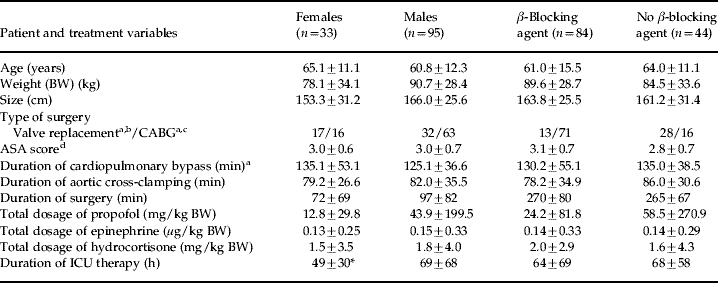
Of the 222 patients screened during the evaluation process, 153 were included in the study. Of these patients, 128 individuals (84%) had complete questionnaires at 6 months after CS and represent the final study population. Figure 1 shows the patient selection in detail. Baseline or treatment variables did not differ significantly between male (n=95) and female patients (n=33) with the exception of a shorter duration of post-operative ICU therapy in female patients (Table 1).
Flowchart showing the patient identification and selection process. From 153 patients with complete pre-operative questionnaires, 128 (84%) provided completed questionnaires 6 months after discharge from the intensive care unit (ICU).

Comparison of baseline patient and treatment data of the study population according to β-adrenergic drug status and sex

BW, Body weight; CABG, coronary artery bypass grafting; ASA, American Society of Anesthesiologists; ICU, intensive care unit; s.d. standard deviation.
Values are mean±s.d. or n/n.
a For all CABG and valve replacement procedures the same type of cardiopulmonary bypass using membrane oxygenators associated with moderate hypothermia (32±0.20°C, mean±s.d.) was used. Pump flow on cardiopulmonary bypass was adjusted to maintain a mean arterial pressure >60 mmHg and a minimal flow rate of 2.4 l/min/m2 body surface area. Myocardial protection was achieved by infusion of cold hyperkalemic cardioplegia solution (Bretschneider solution).
b Patients were considered for aortic valve replacement when a pressure gradient >50 mmHg or an orifice area <1 cm2 was present in aortic stenosis or in symptomatic patients with aortic regurgitation with an end-diastolic volume index (EDVI) >160 ml/m2 or an end-systolic volume index (ESVI) >90 ml/m2 or an ejection fraction<45%.
c Indications for coronary bypass surgery were angina resistant to medical therapy not appropriate for cardiological intervention.
d ASA classification of peri-operative risk.
* Indicates p<0.01 when compared to male patients.
Administration of the β-adrenergic antagonist
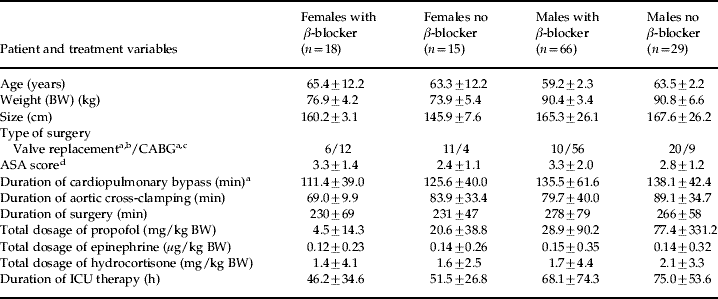
Eighty-four patients received metoprolol whereas 44 patients were not treated with a BB. We found no pre- or peri-operative differences in baseline or treatment variables between patients who received metoprolol and those who did not (Table 2). All patients who were treated with metoprolol were discharged from the ICU and from the hospital with a dosage of either 47.5 or 75 mg, with no difference between male and female patients. Thus, patients who had received metoprolol completed the questionnaires on traumatic memories and PTSD stress symptoms while under the influence of β-adrenergic blockade.
Baseline and treatment data of the study population according to subgroups

BW, Body weight; CABG, coronary artery bypass grafting; ASA, American Society of Anesthesiologists; ICU, intensive care unit; s.d., standard deviation.
Values are mean±s.d. or n/n.
a,b,c,d For notes see Table 1.
NTRM and PTSD symptoms in the complete study sample
One week after discharge from the ICU, NTRM in the total study sample increased from 2.1±1.2 pre-operatively to 2.5±1.2, and then declined to 1.6±1.2 at 6 months after CS (p<0.01 across all three time-points, RM-ANOVA). NTRM did not differ significantly between male and female patients at 1 day before CS (baseline) (p=0.63). At 1 week after discharge from the ICU, NTRM in male patients was significantly higher than in female patients (p=0.03), with no significant difference between the sexes at 6 months after CS (p=0.92). BB use had no effect on NTRM (Type III sum of squares=1.11, F=0.46, p=0.50, RM-ANOVA) in the total study population.
PTSD symptom scores increased from 22.7±10.4 at baseline to 24.1±9.9 at 1 week after discharge from the ICU and remained at this level (24.0±10.5) at 6 months after CS. This increase was, however, not statistically significant (p=0.19) and was not influenced by the administration of metoprolol (Type III sum of squares=245.9, F=1.2, p=0.28). There was no difference in PTSD symptom scores between sexes at any time-point (p>0.63). PTSD symptom scores correlated with NTRM at each of the three time-points of evaluation (r=0.42–0.49, p<0.01). NTRM from ICU at 6 months after CS correlated weakly with the total dosage of epinephrine administered in the ICU (r=0.24, p=0.01, n=114).
Differential association of epinephrine-related sequelae, BB administration and sex
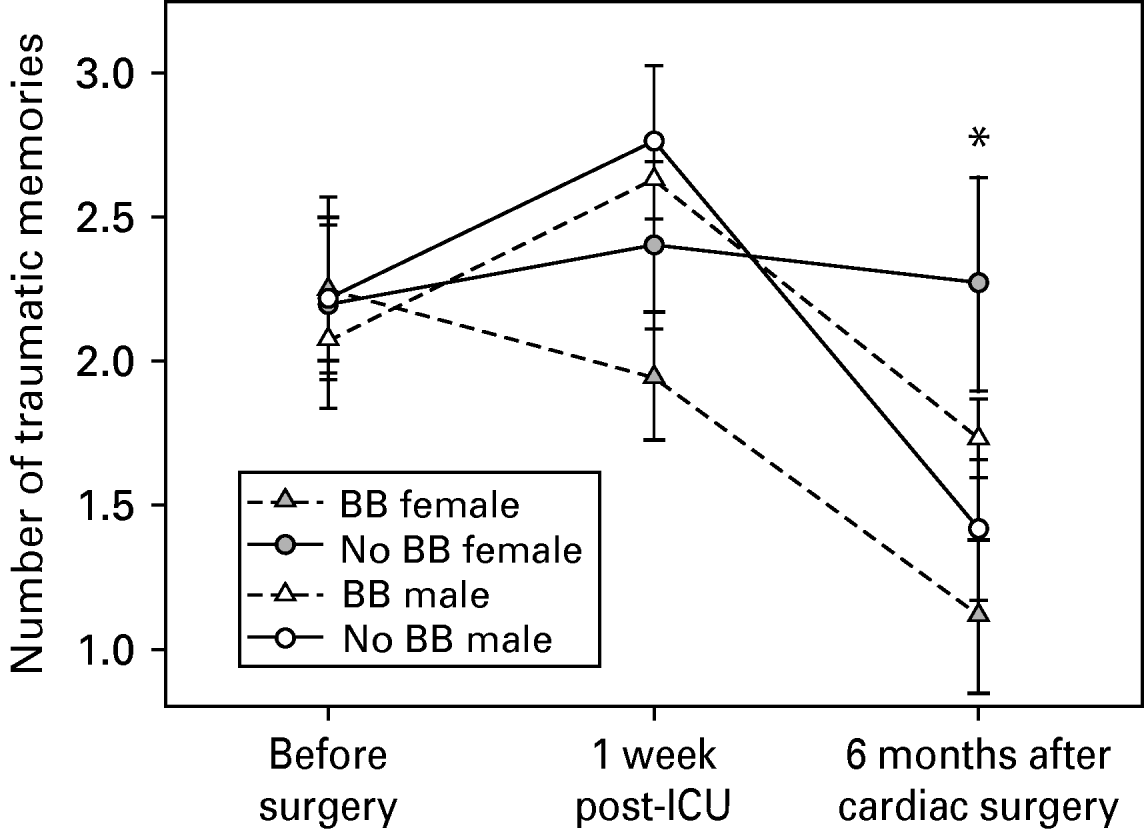
Partial correlation analyses revealed that the correlation between NTRM at 6 months after CS and the total dosage of administered epinephrine was only significant in male patients (r=0.33, p<0.01, n=95) and not in females (r=0.21, p=0.29, n=33). RM-GLM on NTRM at 6 months after CS demonstrated a significant interaction between sex and metoprolol use. At this time-point, female patients who had received metoprolol showed a significantly lower NTRM from the ICU when compared to females without BB treatment (p=0.02). Metoprolol use had no effect on NTRM in male patients (p=0.27) (Fig. 2). The RM-GLM on PTSD symptoms also demonstrated a significant sex×BB treatment×time-point of measurement interaction. PTSD symptom scores at 6 months were significantly lower in female patients who were treated with metoprolol than in female patients who did not receive the β-adrenergic antagonist (p=0.03), without a significant difference in males (p=0.66) (Fig. 3).
Sex-related effects of β-adrenergic blockade (BB) after cardiac surgery (CS) on traumatic memories from adverse experiences during the peri-operative period. A traumatic memory is defined as the patient's subjective recollection of one of four different categories of stressful experiences during the peri-operative period of CS: (1) respiratory distress/dyspnoea, (2) anxiety/panic, (3) pain and (4) nightmares/hallucinations. The number of these categories remembered by the patient is termed the number of categories of traumatic memory present (NTRM). The NTRM was determined at 1 day pre-operatively, 1 week after discharge from the intensive care unit (ICU) and at 6 months after leaving the ICU. * Indicates a significantly higher NTRM in female patients who did not receive a BB (p=0.02, t test). The repeated-measure general linear model (RM-GLM) demonstrated a significant interaction between time-point of measurement, β-adrenergic agent use and sex (Type III sum of squares=7.19, F=6.8, p=0.01). Data are mean±s.e.m.

Sex-related effects of β-adrenergic blockade (BB) with metoprolol in cardiac surgical patients on post-traumatic stress disorder (PTSD) symptom intensity at 1 day before cardiac surgery (CS), 1 week after leaving the intensive care unit (ICU) and at 6 months after ICU discharge. * Indicates a significant difference in PTSD symptom scores between female patients treated with the BB and female individuals who did not receive the drug (p=0.02, t test). A repeated-measure general linear model (RM-GLM) showed a significant interaction between time-point of measurement, β-adrenergic agent use and sex (Type III sum of squares=949.2, F=4.6, p=0.04, RM-GLM). Data are mean±s.e.m.

Discussion
This observational study indicates differential effects of the administration of clinical doses of β-adrenergic agonists and antagonists to male and female patients with regard to traumatic memories and PTSD symptoms. In particular, β-adrenergic stimulation with exogenous epinephrine enhanced memory for adverse experiences mainly in males, whereas the BB metoprolol selectively reduced memory for post-operative adverse events and PTSD symptom scores in females.
Emotionally arousing events are known to induce the secretion of adrenal stress hormones, which act on memory for emotionally relevant information (McGaugh & Roozendaal, Reference McGaugh and Roozendaal2002; Roozendaal et al. Reference Roozendaal, Quirarte and McGaugh2002). Increased adrenergic signalling by β-adrenergic agonists administered systemically or locally into the amygdala enhances the consolidation of emotional memory, and this effect can be reversed by β-blockade (Cahill et al. Reference Cahill, Pham and Setlow2000; Roozendaal et al. Reference Roozendaal, Quirarte and McGaugh2002, Reference Roozendaal, Barsegyan and Lee2008; Cahill & Alkire, Reference Cahill and Alkire2003). These findings are corroborated by our study in critically ill patients, which found a significant relationship between the administered dosage of epinephrine and NTRM. This relationship was, however, only found in male patients. There is good evidence of differences in outcome of acute stress between male and female individuals (Andreano & Cahill, Reference Andreano and Cahill2009). However, because the mean age of the patients in the present study cohort was relatively high (males: 60 years; females: 65 years), a crucial influence of sex hormones as described by the same authors is unlikely (Andreano et al. Reference Andreano, Arjomandi and Cahill2008). Of note, sexual dimorphism in our study was not only evident after β-adrenergic stimulation but we also found differential, albeit opposite, effects of β-adrenergic blockade. Comparable sex-specific effects of BBs on emotional memory have been described in healthy human volunteers (Cahill & van Stegeren, Reference Cahill and van Stegeren2003). In one study, the administration of the BB propranolol to female subjects led to a significant decrease in amygdala activation (as determined by functional magnetic resonance imaging) at encoding of highly aversive images, which was parallelled by a later impairment in long-term memory performance. No BB effect on amygdala activity and traumatic memory was seen in male individuals (van Stegeren et al. Reference van Stegeren, Goekoop, Everaerd, Scheltens, Barkhof, Kuijer and Rombouts2005). The study designs used in previous investigations of BB effects on traumatic memory in volunteers differ, however, from that of our study. In volunteer investigations, BB administration was limited to the period of encoding and consolidation of emotionally relevant information (van Stegeren et al. Reference van Stegeren, Everaerd, Cahill, McGaugh and Gooren1998; O'Carroll et al. Reference O'Carroll, Drysdale, Cahill, Shajahan and Ebmeier1999; Cahill & van Stegeren, Reference Cahill and van Stegeren2003). By contrast, in the present study β-blockade was still present when the patients completed the questionnaires evaluating traumatic memories and PTSD symptom scores. Therefore, it is possible that BBs may also have affected NTRM and PTSD symptom scores through sexual dimorphic influences on the retrieval of traumatic memories (de Quervain et al. Reference de Quervain, Aerni and Roozendaal2007; Tollenaar et al. Reference Tollenaar, Elzinga, Spinhoven and Everaerd2009).
It is of interest to note that the sex-specific effects of metoprolol on traumatic memory in our study were mirrored by their effects on PTSD symptom scores. The lower NTRM in female patients during BB treatment translated into significantly lower PTSD symptom scores whereas PTSD scores were not influenced by BB therapy in males. These observational findings suggest that β-blockade might be useful specifically as a therapeutic approach for the primary or secondary prevention of PTSD in female patients. BB use on PTSD symptoms has been explored in a limited number of controlled pilot trials, which showed either no effect (Stein et al. Reference Stein, Kerridge, Dimsdale and Hoyt2007) or only moderate efficacy (Famularo et al. Reference Famularo, Kinscherff and Fenton1988; Pitman et al. Reference Pitman, Sanders, Zusman, Healy, Cheema, Lasko, Cahill and Orr2002; Stein et al. Reference Stein, Kerridge, Dimsdale and Hoyt2007). However, none of these prior studies were designed explicitly to examine the influence of sex on BB effects.
Pharmacodynamic and pharmacokinetic properties of β-adrenergic drugs could account, at least in part, for the sex-related differences in metoprolol efficacy. Lean body weight in males is generally higher than in females, which will result in higher BB dosage requirements. However, in our study metoprolol was given in fixed dosage increments, not adjusted to lean body weight. Pharmacological studies in healthy volunteers with the BB metoprolol have further demonstrated higher maximum concentration and area under the plasma concentration–time curve in women than in men, which resulted in greater drug exposure in females (Luzier et al. Reference Luzier, Killian, Wilton, Wilson, Forrest and Kazierad1999). Thus, as suggested in the study of van Stegeren et al. (Reference van Stegeren, Goekoop, Everaerd, Scheltens, Barkhof, Kuijer and Rombouts2005), it could be that male patients require higher doses of BBs to impair memory encoding and consolidation. In one study in men, propranolol at a low dose (40 mg) did not show impairing effects on short- and long-term memory for emotionally aversive information but it did when the dosage was increased to 80 mg (Maheu et al. Reference Maheu, Joober, Beaulieu and Lupien2004).
In contrast to propranolol, which is lipophilic and known to block both peripheral and central β-adrenoceptors (van Stegeren et al. Reference van Stegeren, Everaerd, Cahill, McGaugh and Gooren1998), metoprolol has mainly peripheral effects, although some central effects have been described, including an impairing effect on emotional memory (Cruickshank & Neil-Dwyer, Reference Cruickshank and Neil-Dwyer1985; Drayer, Reference Drayer1987; O'Carroll et al. Reference O'Carroll, Drysdale, Cahill, Shajahan and Ebmeier1999). Peripheral β-adrenoceptors are activated during the physiological stress response, and also by systemically administered catecholamines, and are known to enhance emotional memory by activation of afferent vagal pathways to the brainstem (Introini-Collison et al. Reference Introini-Collison, Saghafi, Novack and McGaugh1992). These effects could be blocked by peripherally acting BBs (van Stegeren, Reference van Stegeren2008). In addition, the systemic inflammatory response to cardiopulmonary bypass and major surgery may increase the permeability of the blood–brain barrier (Moody, Reference Moody2006), allowing the diffusion of more hydrophilic BBs such as metoprolol into the brain.
Our study has several limitations. Because of its observational design, small differences between patients who were treated with metoprolol and those who were not could have influenced the formation of traumatic memories and PTSD symptoms, although we did not find significant discrepancies in variables known to influence peri-operative stress exposure (Schelling et al. Reference Schelling, Richter, Roozendaal, Rothenhäusler, Stoll, Nollert, Schmidt and Kapfhammer2003). Another limitation is the unequal sample sizes with regard to sex distribution and BB use, which could have influenced the statistical analyses of epinephrine and BB effects. Therefore, additional controlled-design studies are warranted using a larger patient sample. Even when these limitations are taken into account, our study indicates that sex influences need to be considered as a standard variable in both study design and analyses in many areas of clinical investigation (Cahill, Reference Cahill2005, Reference Cahill2006; van Stegeren, Reference van Stegeren2008).
Acknowledgements
This study is part of the dissertation of M.G. at the Faculty of Medicine of Ludwig-Maximilians University of Munich (unpublished).
Declaration of Interest
None.