The swadeshi movement in late colonial India was conceived as a vehicle for industrial development, an expression of nationalist ideals, and a socially engineered institution to galvanize mass support for political independence. The movement gathered momentum just as economic nationalism permeated the British empire more generally. For instance, the interwar ‘patriotic selling’ campaigns unleashed feelings of national protectionism within different parts of the empire.Footnote 1 Swadeshi, however, sought to channel nationalist sentiments to protest against being part of the ‘British world’ itself. Swadeshi had greater resonance with Indian consumers and successfully moulded a patriotic consumer culture by labelling products as national as opposed to foreign.Footnote 2 The comparative longevity of swadeshi can be attributed to how it transformed from a simplistic call for a ‘boycott’ of British goods to a cultural anti-globalization response by Indian businesses, political elites, and consumers alike.Footnote 3 Swadeshi, as a form of economic patriotism, can be distinguished from similar expressions of nationalism within the empire and dominions because it became a political and cultural phenomenon to secure both economic and political sovereignty.
During the 1930s, swadeshi (literally meaning ‘of one's own country’) brought together disparate interest groups – capitalist, mercantile, nationalist, socialist, philanthropic, and more – in a tenuous alliance. Accordingly, the term swadeshi simultaneously referred to a way of protecting village crafts and those who derived their livelihood from them, as a form of economic non-cooperation and political protest, as a device for protectionism, as a standard that private enterprises had to meet, and so on. These subtle variations to the swadeshi framing are detectable throughout the interwar period. Simultaneously, the notion that Indian capital needed to be used for the benefit of Indian nationals became established as a key principle within nationalist thought by the 1930s. This principle also formed a central tenet of post-independence development planning and protectionist policies. I refer to this notion – Indian capital for Indian industries – as swadeshi capitalism. By the 1940s, this form of capitalism legitimized the state's protection of Indian capital and management of industrial investments as a strategic necessity for the nation's development.
The maturation of swadeshi capitalism during the struggle for political independence uncovers an important narrative concerning Bombay's commercial classes, their reasons for seeking alliances initially with the colonials and subsequently with the nationalists, and their shifting preferences for the extent to which the domestic economy was being integrated into the global economy. Bombay merchants had thrived on mercantile capitalism in the late nineteenth century.Footnote 4 They prospered from the increased globalization of the Indian economy revolving around the industrialization of cotton and textile manufacturing (see section II). In contrast, the swadeshi capitalism of the 1930s and 1940s supported by the Bombay industrialists eschewed unbridled globalization and sought to protect Indian capital from it (see section IV). This vision, as articulated in the so-called Bombay Plan of 1944, underlined the importance of indigenous capital for planned development and for the mediation of economic and social relationships.Footnote 5 Alongside this transition to industry-based capitalism, we can also detect a hardening of economic nationalism that became intolerant of India's integration with the global economy. At its most extreme, this hard nationalism resulted in autarchic protectionism after 1950, a version of development policies that rejected engagement with Bombay capitalists and their version of swadeshi capitalism.
By situating the links between the Indian business community and the political leadership in colonial India within the context of swadeshi, the article examines how the politics of this period grappled with the notions of economic nationalism and planned capitalism. The intellectual clash between Friedrich Hayek and John Maynard Keynes regarding government ‘interference’ in the market provided a backdrop to similar debates among various factions of Indian nationalists and socialists, thereby shaping the multiple approaches to economic planning in the 1930s.Footnote 6 Even as leading Indian businessmen quizzed Keynes over the consequences of his monetary policies on India's fiscal sovereignty, colonial administrators were laying down the rudimentary infrastructure to aid a nascent form of economic planning in India.Footnote 7 This article seeks to further excavate links between swadeshi non-cooperation, nationalism, anti-globalization, and economic planning. It does this by interrogating the role of Bombay's business classes in the context of the longer-term maturation of economic ideology and nationalism (see section III). In historicizing swadeshi capitalism as a form of economic nationalism, the article deconstructs the movement's discursive role in presenting itself as an amalgam of nationalist responses to colonial hegemony and economic globalization. This narrative of swadeshi lifts the movement from its somewhat narrow confines of South Asian political history and connects it to the broader historiographical turn of decolonizing capitalism. As section I shows, the article links the normally disconnected histories of nationalism and capitalism.
I
The term swadeshi was used by contemporaries to promote the consumption of domestically manufactured goods as opposed to imported products. However, when foreign firms with production facilities in India claimed their products too were swadeshi, such a crude distinction became untenable. It politicized the problem of how to determine the legitimacy of swadeshi-labelled products. Accordingly, swadeshi became linked to the extent of Indian capital used in the manufacturing of a given product. Thus, it became a method of certifying the Indian-ness of products and was not just a political slogan for promoting the use of Indian-made products.
The marriage of swadeshi and capitalism in India was not entirely disharmonious. Nationalistic space in colonial India – the very idea of India as a unified whole – was a site of economic conflict and violence, where contesting notions of economic prosperity collided, and where widely contrasting economic futures were imagined. Some, like Gandhi, looked into past history to spur their vision of a particular economic future (for example, preservation of village industries). In contrast, Bombay capitalists envisioned a vastly different economic space requiring large amounts of capital for industrial development aided by ‘production of power and capital goods’.Footnote 8 Western (meaning primarily English) economic thought unsurprisingly shaped much of the economic homogenization of colonial spaces in India, particularly with the introduction of state-issued paper currency and other monetary institutions.Footnote 9 Indians with a Western education and familiar with ideas of economists such as Frederich List or John Stuart Mill challenged the colonial view of India's political economy.Footnote 10 Simultaneously, nationalists resurrected the vision of ancient (Hindu) versions of a political economy that allowed a prominent role for a developmental state to provide an alternative trajectory for India's future.Footnote 11 By marrying such nationalist imaginings to a future where sovereign control over capital could be clearly established, the framers of swadeshi capitalism hoped to use it to aid the transition of India from colonial-era capitalism. Notwithstanding the recent material turn in the study of global capitalism, this alternative trajectory, and apparently anomalous nature of Indian capitalism, is worthy of historical excavation.Footnote 12
Paradoxically, while swadeshi's ideals promoted economic sovereignty, its practices required restricting several economic activities. Economic nationalism through restriction of particular economic freedoms is a distinguishing aspect of swadeshi capitalism. This form of capitalism sought to transcend the ‘rule of contract law’ that made the market a central aspect of imperial economic governance.Footnote 13 Although the performative aspects of such rule may have been conceived to embed the market both as an object of colonial governance and as a stage for colonial politics, taming the market became a nationalist agenda in India, mirroring similar developments in late Victorian Britain.Footnote 14 Securing India's economic sovereignty through swadeshi capitalism involved replacing some market freedoms with a techno-legal framework to render indigenous capital manageable by the state for the benefit of Indian nationals through state intervention.
The attempts to shackle economic freedom and private enterprise was contested, especially by the big business interests who had historically benefited by co-operating with the colonial state and the colonial production of market-based capitalism. Despite these tensions, by 1936, some Indian business leaders had aligned themselves with the Indian National Congress (INC) political leadership. By the time that the Bombay Plan was published in 1944, the alliance between the two groups had been institutionalized in the early attempts at economic planning.Footnote 15 Thus, as swadeshi's role to promote Gandhian self-sufficiency among the Indian masses faded by the 1930s, the swadeshi principle of protectionism and capital controls filtered into the various national plans that were drawn up between 1938 and 1944. These swadeshi principles were retained by the national planning process after 1950, although the process itself became opaque and disengaged from the Indian business community as a whole.Footnote 16
The initial scepticism of the Bombay commercial classes regarding the swadeshi movement gradually transformed into cautious support of the nationalist vision as they came to back planned development based on industrial rather than mercantile capitalism.Footnote 17 This paralleled the reimagining of capitalist practices from a means to accumulate and control capital into a technocratically managed system where planned capitalism simultaneously ensured a greater degree of national economic sovereignty and a more orderly, equitable, and productive use of capital. The realignment of both attitudes – political and capitalist – and visions of how planned capitalism should function for the benefit of Indian nationals was a drawn-out and contested process that co-constituted the nationalist and swadeshi movements during the 1930s. Political leaders struggled to temper the more extreme socialist demands to curtail the ability of private enterprises to profit from capitalism. In turn, Bombay's industrialists were inherently suspicious of those socialist elements within the nationalist movement who sought to counter the resistance by businesses to any form of control. Mass civil disobedience, picketing, and boycotting of businesses suspected of selling foreign goods were not the best way to capture the political support of the commercial classes.
Swadeshi, as a form of economic non-cooperation, thus confronted the capitalist practices that Bombay's businessmen had developed during the nineteenth century. However, swadeshi also provided an opportunity for businesses to push back against the hardening of imperial policies that discriminated against indigenous commercial interests.Footnote 18 Ultimately, it was British imperial policies in India which helped to overcome the mutual scepticism between the commercial and nationalist groups in India. The swadeshi brand of industrial capitalism that emerged in the 1930s was distinct from the mercantile swadeshi capitalism of the nineteenth century. However, where the swadeshi response to colonialism was steeped in politics, the development planning process that inherited the swadeshi protectionist principles became increasingly technocratic and disengaged from the capitalists after 1950.
II
Historicizing the distinct forms of indigenous capitalism reveals a range of different attitudes among Bombay's commercial classes with regards to the capitalist integration of India into the global economy. By the end of the nineteenth century, Bombay had become a major metropolis and industrial hub that, more than Calcutta, Surat, or Madras, further integrated India into the global economy. Cotton trading and later the cotton textile industries were the fulcrum of this rapid transformation, which happened within a matter of generations.Footnote 19 Indian merchants and entrepreneurs forged close links between trade, industry, and finance that proved crucial in sustaining industrialization beyond the nineteenth century. The changing structure of internal and foreign trade played an important role in Bombay's ascendancy, especially as foreign trade gravitated towards this region away from Calcutta. With the establishment of the Bombay Presidency, a highly centralized province within the colonial possessions in western India, the physical and urban infrastructure that developed within the island city transformed it into a metropolis of political and economic importance.Footnote 20
Indian intermediaries were prominent in the nexus of capital that connected trade, manufacturing, and finance within the city, enabling capital to move seamlessly between private commercial and public infrastructure activities. The interconnections are most evident in the case of the cotton industry, where financial capital moved from cotton trading into textile manufacturing through the intermediation of Indian stockbrokers. Contemporaries such as Dinshaw Wacha, a millowner and local politician, recalled the heady days of speculation in cotton futures in the early 1860s, when, encouraged by the rising demand for Indian raw cotton because of the American Civil War, traders such as Premchund Roychund and his associates actively moved into brokerage of company stocks.Footnote 21 Roychund was an enigmatic figure who also represented the financial interests of Europeans and European banks feeding the speculative bubble around cotton trade in the region, as well as real estate development in Bombay.Footnote 22 His various speculative activities enabled both foreign capital, such as that managed by the Asiatic Banking Corporation, the forerunner of numerous financial institutions set up during this period, and the wealth derived from the cotton-broking business to fuel the ‘mania for share speculation’.Footnote 23 In the ensuing financial crash of 1864, Indian businesses run by Parsi traders such as Nowrosjee Wadia (who established Bombay Dyeing) and Jamshetji Tata (who had set up Alexandra Mills) survived by spreading risks and investing in textile manufacturing. Similarly, Ardeshir Godrej set up his lock-manufacturing business with a sum of 5,000 rupees borrowed from Merwanji Cama, whose family had become wealthy through real estate speculation in Bombay. More generally, the Parsi community had benefited from British rule from the early days of the East India Company in the seventeenth century, an association that had transformed their economic, political, and social status in western India and especially in Bombay.
The ‘joint enterprise’ of the colonial government along with Indian and European mercantile capital also produced a distinctive urban infrastructure that, although serving different interests, aided the economic and industrial interests of both Indian and Anglo-European communities.Footnote 24 The ill-fated Backbay Reclamation Company, in which the equally feckless Asiatic Banking Corporation invested a substantial amount of capital on the recommendation of Roychund, was only one of about a hundred such land reclamation and real estate development companies floated at the time. The Backbay Reclamation Company, like its contemporary the Elphinstone Land Company, had not been a speculative venture to begin with. These enterprises had responded to the increasing need to accommodate the ‘first tide of labour immigration’ into the city after about 1858.Footnote 25 They were also established to meet the land-hungry expansion of the railway corporations.Footnote 26 Such improvement projects were conceived to be carried out by the ‘pioneers of public works by private enterprise’, into which both Indian and European capital was invested, demonstrating the close links between Bombay capitalists and the colonials.Footnote 27
The nexus of capital that connected trade, finance, and manufacturing in Bombay was also accompanied by the proliferation of an indigenous middle class. The ascendancy of this class, fraught with contradictions and ambivalence, was predicated on a series of concomitant developments, both economic and political in nature.Footnote 28 The commodification of agriculture, mechanization of industries, reorganization of banks and financial markets, and introduction of British company law and a British-inspired legal system into India attracted up-country merchants to metropolitan cities such as Bombay and Calcutta. It further encouraged the growth of entrepreneurial groups that benefited from the nexus of capital that formed around the metropolitan networks. The middle classes were overwhelmingly drawn from such mercantile and industrial groups. However, the existence of the vernacular educated classes who remained distinct from the commercial classes complexifies the nature of the Indian middle class in this period.
The political and cultural gulf between such different middle-class groupings would become significant after about 1905. In Bombay, the wide gulf between the English- or Marathi-speaking educated middle class and the predominantly Gujarati-speaking commercial classes spilled over from local politics into national politics once swadeshi in the form of boycott began to gain traction.Footnote 29 To complicate matters, the Gujarati-speaking Parsi community (who were distinct culturally and religiously from the Gujarati-speaking bania merchants) had historically been able to straddle racial boundaries. They traded with and produced for both Indian and colonial consumers. Ardeshir Godrej's soaps had a substantial following within the Indian community, where his ‘vegetable’ soaps appealed to Hindus who rejected soaps made from animal fats. At the same time, European consumers consistently rated his soaps equal to any manufactured by foreign firms or imported into India. Nonetheless, as the political, social, and cultural transformations in India began to reflect the concerns and contradictions of the middle classes, the relations between the middle class and the subaltern groups whose interests they claimed to represent displayed an uneasy relationship between class and caste.Footnote 30 As the growth of this middle class came to be reflected in the range of consumer industries that were established in India, the concerns of these businesses and their middle-class consumers came to constitute the politics of swadeshi nationalism.
With its unequivocal demand for economic autonomy, the swadeshi movement, inspired by Rabindranath Tagore's Bengali renaissance, provided a coherent platform for the nationalist critique of colonialism. Although it was Curzon's Partition of Bengal in 1905 that led to ‘the greatest anti-British upsurge in India since 1857’, pockets of resistance had existed before that time.Footnote 31 The vision promoted by the economic nationalism of swadeshi, in the form of a boycott of British products, ultimately coalesced around a range of nationalist and cultural organizations. This coming together of the various manifestations of nationalism gave substance to a national economic space and the various political platforms needed to secure its autonomy.Footnote 32
Nationalistic attitudes had germinated a marriage between Indian traditions and science and technology earlier in the nineteenth century. Prafulla Chandra Ray, who established the Bengal Chemical and Pharmaceutical Works in 1893, adapted Western approaches to manufacturing pharmaceutical products, to promote deshiyio oushad or indigenous medicine.Footnote 33 This swadeshi spirit of combining indigenous enterprise, local traditions, and Western technologies was also present among nineteenth-century Bombay entrepreneurs. Godrej's innovative techniques to manufacture his ‘vegetable’ soaps and his patented series of safety locks and burglar-proof safes borrowed Western manufacturing techniques (such as mechanization) but produced for a local market that was immersed in Indian tradition. His soap-manufacturing process (established 1920), developed by Godrej himself, was chemically sophisticated in terms of its use of refined vegetable oils, was free of alkalis, and used no animal fats at all. To an orthodox Hindu middle class this was instantly appealing, given their aversion to using imported or locally produced ‘Western-style’ soaps made from animal (and at times human) fat.Footnote 34 Godrej's efforts to produce his swadeshi soaps had its origins in the Bombay swadeshi movements instigated by B. G. Tilak, who became an ardent advocate of nationalism in the form of boycott of British goods.Footnote 35
Not all Bombay merchants and industrialists welcomed Tilak's firebrand nationalism and his establishment of the Swadeshi Vastu Pracharini Sabha (Society to Promote the use of Swadeshi Goods). The society's activities to eschew imported manufactures and instead encourage the use of indigenously manufactured articles were generally ignored by local textile millowners. The mercantile elite of the Bombay Presidency Association could barely tolerate Tilak; this feeling was reciprocated.Footnote 36 Other industrialists, such as Ratan Tata, supported Tilak by becoming directors of the Bombay Swadeshi Cooperative Stores in 1905. But the nature of local racial, class, and religious politics meant that many non-Hindu communities and prominent Hindu merchants stayed away from the Bombay swadeshi movement.Footnote 37 Tilak's message of swadeshi resonated, however, with the city's Marathi- and Gujarati-speaking lower middle classes, ‘especially small merchants, shopkeepers, teachers, and journalists’.Footnote 38 Nevertheless, the Bombay swadeshi movement had begun to unravel by 1908, only resurrected by the return to India of Mohandas Karamchand Gandhi from South Africa.
By drawing on a variety of national and international ideologies of nationalism, Gandhi sought to popularize a particular swadeshi style based on khaki or homespun cloth. It was different from the science-inspired swadeshi manufacturing of Ray or Godrej. Through his Satyagraha Ashram (established 1917), as well as other organizations such as the All-India Khaddar Broad and the All-India Spinners Association, Gandhi sought to promote swadeshi politics with a view to establishing India's economic autonomy and attaining swaraj (self-government).Footnote 39 Given that cloth could ‘evoke power symbols of community and right conduct’ because of its historical role in India's society, swadeshi-based nationalism, symbolized through the act of using homespun cloth made in India, united a fairly heterogeneous population towards political dissent.Footnote 40 Gandhi had intended the use of homespun cloth to be more than merely symbolic. He sought to make spinning a ‘creative’ (that is, productive) and communal act uniting village-based local economies.Footnote 41 The INC did not entirely share this vision, although they did support Gandhi's Non-cooperation Resolution of 1920, which envisioned swadeshi as a route to swaraj. Gandhian swadeshi also enabled women to actively engage in economic non-cooperation, either through private acts (such as promising not to buy articles made of foreign spun cloth) or through public political acts (such as picketing shops selling foreign cloth under the banner of organizations like the Desh Sevika Sangh, the Women's National Protection Association).Footnote 42 While the practical role of Gandhian swadeshi, like its earlier Bengali incarnation, in the attainment of political independence in 1947 is questionable, the swadeshi principles survived these early attempts and became institutionalized in the form of both an anti-colonial and an anti-globalization critique.
III
As swadeshi developed into a particular form of ‘patriotic duty’ for every Indian – whether producer or consumer – the discursive practices surrounding it changed between 1920 and 1934. The institutionalization of swadeshi as a demonstrative form of economic nationalism morphed from the somewhat straightforward ‘protection’ of village crafts and Indian manufacturing to a more complex array of criteria defining the term. This complexification was a response to the fluid economic environment of the interwar years as well as the practical issues of organizing economic non-cooperation on a massive scale throughout the country. Swadeshi was never intended to be restricted only to textile piece-goods or the production of hand-spun cloth. Gandhi's ‘cent per cent swadeshi’ embraced protection of the village production of many essential commodities such as sugar.Footnote 43 When the INC invoked the language of swadeshi, it was to include the protection of virtually all ‘power-driven’ domestic industrial sectors, which for Gandhi were just as undesirable as competition from foreign manufacturers. Nonetheless, the nationalists as well as the commercial classes soon realized that the simple distinction between ‘Indian-made’ and ‘foreign-made’ was insufficient and did not necessarily discriminate in favour of Indian capital and enterprise. Framing swadeshi products as ‘goods produced in India’ as opposed to imported goods was both too simplistic and counter-productive. From such debates, a definition of swadeshi that incorporated ownership of capital by Indians emerged in 1931.
The INC's Boycott Resolution of 1923 made economic non-cooperation an integral part of the nationalist swaraj movement by connecting the boycott of British-made goods to the ‘triple boycott’ of British-run legislative councils, law courts, and schools/colleges. Economic non-cooperation became a ‘principal (economic) weapon in the fight for swaraj’.Footnote 44 The framers of the resolution, who included Motilal Nehru, Subhash Chandra Bose, Vithalbhai Patel, and J. N. Mehta, were cognizant that economic non-cooperation was not going to be a ‘simple proposition’, but they wanted to build upon the ‘success’ of Gandhian swadeshi that had popularized the notion that India could be ‘self-contained’ in manufacturing terms.Footnote 45 Consequently, the INC called for the ‘immediate boycott’ of twenty-seven product categories and the simultaneous promotion of Indian-made goods in these categories. The economic context surrounding the 1923 Boycott Resolution was the resumption of manufacturing imports into India following the wartime hiatus between 1914 and 1919. The list of ‘boycottable’ commodities in the resolution contained a mixture of ‘undesirable’ products – such as liquors, wines, and alcohol – and products aimed at the consumerist middle class – such as textiles, soaps, furniture, glassware, toys, cutlery, and shoes. Economists such as Maneklal Vakil reckoned that economic non-cooperation was an effective way to achieve fiscal autonomy, and was a legitimate ‘political weapon to put pressure on an opponent’.Footnote 46 Indeed, the 1923 resolution claimed that boycott of British goods in India was just as legal as the British and French boycott of German goods had been during the First World War.Footnote 47
The nationalists thus visualized economic non-cooperation both as a voluntary act by an individual and as a social act organized through national political protests. Consequently, organizing swadeshi meant institutionalizing the concept in particular ways, in addition to mobilizing mass support for it at the grassroots level. Jawaharlal Nehru was convinced that boycott activities needed to be backed up by an efficient nationwide organization and ‘well-thought out schemes to achieve economic effects’.Footnote 48 The appetite to take direct and co-ordinated action against the commercial classes who were not co-operating with the organized boycott had crystallized within India's political leadership.
Boycott of and propaganda against the use of foreign cloth was an issue around which mass opinion could be mobilized at a local level more easily than boycott of other foreign consumer and industrial goods. In 1928, the INC established central and provincial boards to co-ordinate and organize boycott activities across India. The Central Board was set up with the dual aim of boycotting the Indian Statutory Commission (also known as the Simon Commission) as well as promoting the boycott of foreign cloth.Footnote 49 Nonetheless, many senior party functionaries, such as Sarojini Naidu, were sceptical about how such a strategy would work in practice.Footnote 50 Local boycott activities, which were unsanctioned by the boards and which often descended into picketing of businesses and confiscation of suspected foreign cloth, only alienated already sceptical local businesses.
The swadeshi goal to combine economic non-cooperation (boycott) and the encouragement of domestic manufacturing industries had unanticipated consequences when colonial protectionist duties prompted several foreign firms to establish manufacturing facilities in India. Indian entrepreneurs were not the main beneficiaries of the colonial government's increasingly protectionist policy towards industry in the country.Footnote 51 The creation of the Tariff Board in 1923, following the 1921–2 Fiscal Commission, initiated a policy of ‘discriminating protection’.Footnote 52 An increase in the general tariff to 15 per cent, levied strictly for revenue purposes, amounted to de facto protection, but was accompanied by higher tariffs in select industries. The main beneficiaries of tariff reforms were large foreign companies who transferred small parts of their productive capacity to India.Footnote 53 Indian economists at the time complained that ‘a very large proportion of Indian industry is still controlled by external capital and the control of this capital has become an important problem, especially since the policy of protection has been accepted’.Footnote 54
During 1930 and 1931, as many businesses began to feel the deleterious effects of economic depression, the INC received several complaints from small businesses that the combination of boycott and protectionism at times worked against their interests. A clearer definition of swadeshi products became more urgent once the colonial government introduced tariff reform and protectionist duties gradually after 1923. The case of the match industry illustrates these issues stemming from the intersection of protectionist duties introduced by the Tariff Board, swadeshi propaganda by the INC, and the shifting preference of Indian consumers to buy locally manufactured products. During the 1920s, the Swedish Match Company (SMC) had been increasing its investment in production facilities in India.Footnote 55 The multinational was gradually able to replace its imports of matches into India with increased production from domestic factories, allowing it to capture a greater share of the Indian market (Figure 1). The SMC had effectively edged out the Japanese firms from the Indian market, while simultaneously out-competing the small-scale Indian businesses making matches.Footnote 56 Indian businessmen complained about the company's allegedly ‘unfair competition’ during the hearings before the Tariff Board, in testimonies such as those by Ahmed Fatehully and Adamjee Hajee Dawood, who owned match-manufacturing facilities in Bombay.Footnote 57 Between 1922 and 1928, the SMC had increased its share of the domestic market from 24 per cent to 44 per cent. Following tariff reforms, its continuing strategy to expand domestic manufacturing allowed it to command a 58 per cent share of domestic consumption by 1932.Footnote 58
Market share of the Swedish Match Company, 1922–38
Source: based on Hans Modig, Swedish match interests in British India during the interwar years, trans. William Christopher Barrett (Stockholm, 1979), table 8.

Complicating this situation was the fact that the SMC claimed that its matches were swadeshi since they were not on the banned list of foreign products issued by the INC. The Indian Match Manufacturers’ Association vociferously complained to the INC about the SMC's swadeshi claims, with the association's representative urging the INC ‘to counter the wrong statement of [the SMC] that matches manufactured in India by the Swedish factories under Swedish control with foreign capital are swadeshi goods [and clarify] if under Congress definition and standard [the] matches manufactured in India by the Swedish capitalists are Swadeshi or not’.Footnote 59 Such squabbles illuminate the contested nature of swadeshi's economic geography. The Indian Merchants’ Chamber (IMC), Calcutta, as well as the Bombay Provincial Congress Committee, reported on the ‘hardships’ that Indian manufacturers faced because products made in India using foreign capital were being branded swadeshi.Footnote 60
As Indian firms lobbied the INC to clearly establish the criteria for firms claiming to manufacture swadeshi products, the party struggled to address this problem in many sectors, such as tea. Nationalists began to boycott tea packaged and sold by foreign firms such as Brooke Bond, even as the Indian Tea Cess Committee (a British association) claimed that all teas produced in India were swadeshi. Exhibitions promoting Indian teas featured ‘swadeshi’ brands by both Indian and foreign-owned packers and distributors.Footnote 61 The Swadeshi Tea Distribution Company from Jalpaiguri questioned whether tea produced on estates owned and managed by British firms could be claimed to be swadeshi, whereas the Swadeshi Mart in Jamkhandi wanted the INC to declare the Belapur Sugar Company ‘semi-swadeshi’, as a substantial proportion of its capital was ‘foreign-owned’.Footnote 62 Chand Brothers, retailers and distributors of tobacco products, complained that the Imperial Tobacco Company, which had begun manufacturing cigarettes in India, were claiming that their products were swadeshi as they were ‘purely Indian’.Footnote 63 Bombay capitalists, too, feared that ‘the increased attachment of Indian public to swadeshi goods may lead to exploitation of the purchasing public’ by foreign firms unless there was a ‘proper check’ of products and firms claiming to be swadeshi.Footnote 64 On the whole, Indian businesses – small and large – welcomed protective duties on imports of manufactures by the colonial government, but they were restive about the fact that the boycott movement had led foreign firms to claim that they were manufacturing swadeshi products.
Certifying authentic swadeshi products and discouraging untruthful claims in advertising became integral to the institutionalization and organization of swadeshi. Voluntarily co-opting themselves into the swadeshi ecology, many small- and medium-scale businesses sought to be on approved lists compiled by the INC and its local affiliates. Manufacturers and traders, especially those dealing in cotton textiles and cloth, signed swadeshi pledges to ensure they were not targeted for boycott. The party received scores of letters from small businesses seeking ‘certificates’ to show that they were not on the boycott list.Footnote 65 The INC was thus inundated by declarations and pledges, invitations for swadeshi promotions, clarifications of criteria for meeting the swadeshi standard, and requests for certificates. Local party functionaries and affiliated swadeshi organizations also wanted clarification about who could issue these certificates and compile lists of approved businesses and products. The Mahila Satyagraha Samiti (a women's organization) sought clarity on whether they could inspect shops and certify them as ‘swadeshi selling shops’. Meanwhile, there were several reports of overzealous supporters entering shops to inspect without authorization.Footnote 66 The Bombay Provincial Congress Committee, in contrast, reported their inability to systematically inspect businesses and supervise local swadeshi activity: the situation is ‘hopeless’, claimed one internal memo.Footnote 67
The INC thus found itself boxed in and pressured on how it intended to resolve the issue of establishing genuine swadeshi and identifying spurious swadeshi products. Compiling lists of approved firms was closer to the party's political aims of boycott rather than certifying individual products and inspecting shops and factories where they were produced or sold. Boycott lists could also be used to pressure individual businessmen to align them with the INC's objectives, or at least to bring them to the negotiating table. Local swadeshi organizations and party functionaries could use these lists to picket commercial premises of firms suspected of dealing in foreign goods.Footnote 68 Organizationally, lists of approved businesses, especially within the textile industry, were something that the party could effectively achieve, and they had considerable symbolic and practical value. The view that emerged within the INC leadership was that other strategies of organizing swadeshi, such as compiling catalogues and holding exhibitions for other commodities, needed to be delegated to local leagues. Accordingly, the central INC committee confirmed that it would not issue certificates and that the local leagues could issue them if they wanted. Instead, the central party would continue to compile lists of approved and banned businesses, focusing mainly on the textile industry. Other businesses – for example, the Bikaner Glass and Pottery Works – were directed to be included in the swadeshi directories, such as those published by the Bombay Swadeshi League.Footnote 69
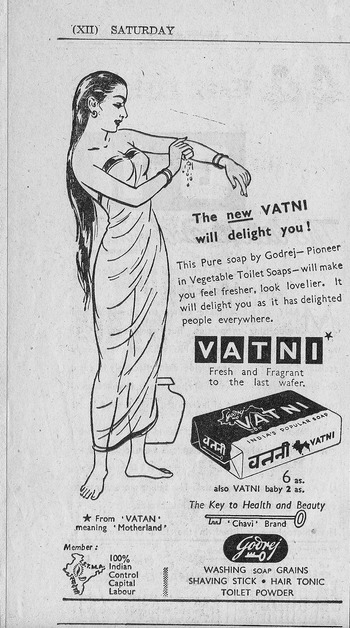
Through these discourses emerged the consensus view that swadeshi products needed to be defined on the basis of ‘Indian-ness’ of the capital used by the businesses who manufactured these products. Agreement over this swadeshi standard was the result of intense negotiations between nationalists, capitalists, and the business community at large. Eventually, the principle that any product claiming to be swadeshi needed to be manufactured using capital managed by Indians was generally accepted by most. With G. D. Birla mediating between the INC and the textile millowners, about 250 mills signed a declaration in 1931, agreeing that at least 75 per cent of each mill's capital was to be held by Indians.Footnote 70 Mills signing this declaration included both ‘Indian’ businesses, such as Swadeshi Mills managed by the Tatas, and ‘non-Indian’ mills, such as businesses managed by E.D. Sassoon & Co. and James Finlay & Co. The directory in which the names of the businesses signing this declaration appeared also listed more than forty businesses to be boycotted as they were not amenable to the INC's demands. The connection between swadeshi and the ownership of capital, clearly established in the case of textile mills by 1931, was picked up by non-textile businesses such as Godrej Soaps, who began stressing the Indian-ness of their capital to legitimize their swadeshi credentials (see bottom left in Figure 2). This particular soap, introduced sometime between 1926 and 1932, emphasized the ‘100% Indian control’ of capital in its manufacture, in addition to the brand name, Vatni, which means ‘of or from the motherland’.Footnote 71
Advertisement for Godrej soap, showing the swadeshi mark (bottom left)
Source: Godrej supplement to the Times of India (Bombay) on the occasion of the launch of the ‘first all-Indian typewriter’ made by Godrej, 24 September 1955, Mumbai, Godrej Archives, Centenary collection, MS06-01-94-80.

The ecology of swadeshi was further bolstered by the burgeoning visual and print culture of swadeshi exhibitions, which helped to co-opt businesses and consumers into its national geography. Employing strategies similar to those used in the earlier industrial and empire exhibitions, which displayed the technological superiority of foreign manufacturing techniques, the swadeshi exhibitions were intended to popularize the appeal of home manufactures.Footnote 72 The annual exhibitions of khaki textiles, beginning with the 1923 INC meeting that had adopted the Boycott Resolution, displayed a range of textile products such as dhotis, saris, shirtings, towels, blankets, and other knitted products. The ‘rhetorical consistency’ of the swadeshi exhibitions tied the large numbers of attendees to a particular vision of a unified nation, transcending religion, region, class, and caste.Footnote 73 The extensive reach of the exhibitions, in terms both of the cities and towns where they were held and also of the extensive press coverage they received, enabled the nationalists to construct a national geography around swadeshi. The visual culture of the swadeshi exhibitions connected the visitors to a host of other Indian-made consumer products besides khaki and textiles: biscuits, shoes, buttons, cigarettes, combs, cookers, fruit syrups, glassware, inks, lanterns, medicines, paints and varnishes, soaps and other toiletries, and so forth. Visitors were encouraged to soak in the material, technological, and experiential demonstrations of the achievements of Indian manufacturing capacity. The Bombay Swadeshi League and the Allahabad Swadeshi League, for instance, produced detailed catalogues and directories listing hundreds of thousands of individual businesses deemed to be genuine swadeshi. The print culture of product catalogues shown at the swadeshi exhibitions and the accompanying directories of manufacturers sought to connect the two aspects of the ‘true spirit of swadeshi’: that both the production and consumption of swadeshi commodities were a ‘duty of a true Indian’.Footnote 74 On balance, buying into the swadeshi ecology made good commercial sense for petty traders and capitalist elites alike. Despite their misgivings about the radical forms of swadeshi – picketing of shops and factories, and confiscation of stocks – Bombay's industrial elite co-opted the swadeshi spirit and melded it with their vision about the future of capitalist enterprises in a politically autonomous India.
IV
After 1931, nationalist politics institutionalized the primacy of Indian-owned capital for economic development and legitimized the protection of domestic industry as a strategy for planned development. Nonetheless, this politics continued to confound and frustrate private capitalist interests regarding the functioning of swadeshi capitalism within the confines of the national planning process. Many Bombay capitalists broadly agreed that some form of state control of capital was required, although the exact nature of state intervention and control was differently visualized and keenly contested by the various groups.Footnote 75 Big business remained suspicious of the socialist influence on national planning, as they had during the organization of boycott activities during the 1928–31 period. In turn, the nationalists remained sceptical of the capitalists’ intentions. Despite mutual distrust, some sections of Bombay's commercial classes were willing to co-operate with the Indian nationalists, just as a generation earlier they had showed willingness to work with the colonials.
Many Indian businessmen were generally sympathetic to the nationalist aims for greater political independence, and in fact extended financial support to the early nationalist movements. Nonetheless, the radicalization exhibited by the swadeshi movement in organizing the boycott and picketing of businesses suspected of selling foreign goods led to the evaporation of support from merchants in the early 1930s. In 1921, the Tilak Swaraj Fund promoted by Gandhi had attracted large donations from industrial centres like Bombay considerably more than other parts of the country, such as the Punjab.Footnote 76 Godrej, with his successful small-scale manufacturing business, had personally donated 300,000 rupees – almost 10 per cent of the total amount raised for the fund in Bombay.Footnote 77 Such enthusiastic support began to dissipate in 1930–1 as many in the business community began to question the necessity and effectiveness of mass civil disobedience. Bombay's business leaders had traditionally expressed a preference for constitutional opposition, exhibited by their attempts to use the legal and legitimate colonial institutions to oppose imperial policies.Footnote 78 The Bombay Presidency Association, influential in early INC politics, and the Indian Merchants’ Chambers that spawned ‘anti-non-cooperationists’ including Purshottam Thakurdas and L. R. Taisree, preferred to work through colonial institutions such as the Bombay Municipal Corporation to promote both swadeshi and swaraj.Footnote 79 In the eyes of the Bombay merchants, mass civil disobedience carried the threat of radicalizing labour, as well as the threat to private property, as demonstrated by increasing reports of violent action against businesses suspected of trading in foreign goods. Notwithstanding this increasing scepticism on the part of big business merchants, the swadeshi movement had considerable support from small businesses, petty traders, and merchants.
The pushback from the business classes against the hard-line swadeshi approach to non-cooperation came to a head during the series of civil disobedience actions following Gandhi's protest against the salt taxes in Dandi in 1930. Boycott of goods and picketing of businesses, as an expression of non-cooperation, turned violent as party workers confiscated stocks of cloth and other suspected foreign goods from the stores and warehouses of merchants. The restiveness of the merchants following such acts did considerable damage both to both the party and to swadeshi's reputation for non-violent protest. The INC received numerous letters from small merchants complaining of capital being locked in sealed or confiscated inventories; the party was asked to remedy this situation by releasing capital so that ‘merchants will not hold a grudge against the boycott movement’.Footnote 80 G. D. Birla posed similar arguments to Motilal Nehru on behalf of Bombay industrialists and sought to negotiate a common ground between the INC and the Bombay millowners. He questioned the sustainability of ‘indefinite picketing’ as a political strategy and urged Nehru that it was ‘good to compromise’ with the traders, as they could not be compelled to burn the stocks of cloth they carried. Birla offered Nehru a choice: either the INC could continue rigorous picketing and alienate merchants or it could relax vigilance and get merchants to co-operate voluntarily.Footnote 81
The pushback and attempts to reach a compromise between the business communities and the nationalists resulted in the linking of swadeshi activities to the protection of Indian capital. The capitalists realized that the process of economic planning could also provide such protection. This changed attitude of the industrial elites towards the nationalists may be attributed to the realization that discursive practices of swadeshi such as those evident during the civil disobedience movement of the 1930s were a useful device to exert pressure on the colonial state.Footnote 82 Although mass civil disobedience was generally not good for business, the protection offered by swadeshi was an effective retaliation against the colonial-era tariff reforms and the accompanying foreign investment in manufacturing facilities that was effectively limiting the participation of Indians in the development of domestic industrial sectors. Birla's ‘plea for planning’ was not only a blueprint for Indian businesses to overcome the economic distress of the 1930s depression years, but also a plea to them to accept the principle that state intervention in the form of a planned economy regulating capital investment was in the interests of the Indian business community as a whole.Footnote 83
The burgeoning interest in a planned economy around 1934 thus provided a model to deal with the immediate effects of economic depression and the lopsided effects of interwar globalization on Indian industry. By the late nineteenth century, Indian economic thought had already begun to imagine a far greater and more active role for the state in economic matters, in divergence with Western (especially British) notions of political economy. The idea of planning had already germinated within Indian economic thought even before it gained traction with the INC leadership.Footnote 84 In fact, Keynes's writings about the government's control of the economy resonated with Indian economists and businessmen.Footnote 85 In 1934, N. R. Sarkar from Bengal and G. D. Birla from Bombay, both industrialists and leading figures in the Federation of Indian Chambers of Commerce and Industry, urged the business and political elite to embrace economic planning as a way out of the economic depression of the 1930s.Footnote 86 Birla claimed, ‘we cannot improve our lot until we decide to take mass action, well-thought out, well-planned, launched with necessary authority to make it a success. Government intervention thus becomes necessary.’Footnote 87
The ebb and flow of capitalist–state relations hinged upon the degree to which Indian businesses and nationalists co-opted the key ideological principles of swadeshi and then used these principles to frame their ideas about planning. Swadeshi provided a means for the growing participation of businessmen in politics that straddled the entire spectrum of domestic business interests, from the big business capitalists to the mass of small traders and entrepreneurs forming the bulk of the commercial classes.Footnote 88 Thus, the Indian capitalists were willing to accept an active role for the state in independent India after 1934.Footnote 89 They also actively inserted themselves in policy debates, in order to retain their voice in shaping India's fiscal sovereignty in the post-war world economic order. Bombay businessmen such as Sarabhai Prataprai lobbied hard to safeguard India's accumulated sterling balances during the Second World War. Prataprai wrote to J. K. Mehta, secretary of the IMC, in 1944, arguing that the sterling balances (nominally amounting to nearly 10 billion rupees) should be utilized to purchase ‘foreign mercantile investments’ in India before the British government ‘gathered them for the capitalization of pensions and provident funds of Britons in India’.Footnote 90 The IMC, in turn, lobbied the imperial government to have an Indian delegation representing industrial and commercial interests at the Bretton Woods Conference, where the issue of India's sterling balances could be debated at an international forum. In the end, the Indian delegation to the conference was comprised only of ‘non-official representatives’, who remained unsuccessful in settling the issue of repatriating India's sterling balances. The IMC noted a general feeling of ‘disappointment and subordination’, further consolidating the view that international institutions such as the Bretton Woods Conference and its successor, the International Monetary Fund, were a ‘collaboration between politically advanced and powerful countries’.Footnote 91 Although not all Indian businessmen agreed that the IMC should lobby for repatriation of India's sterling balances, these experiences further helped to institutionalize the swadeshi principles of anti-globalization, self-sufficiency, and protectionism as part of the process of planned capitalism that Indian business interests had come to support.
The ecology of planning, however, was essentially different from that of swadeshi. Where swadeshi was rooted in the mass political mobilization of consumers, businesses, and grassroot activists, planning became a supra-political activity. As Chatterjee has argued, planning was to be ‘a bureaucratic function, to be operated at a level above the particular interests of civil society [outside] the normal processes of representative politics’.Footnote 92 Where swadeshi was promoted as an inclusive political ‘duty’ of Indians, Jawaharlal Nehru's vision of planning was that it should be an exclusive domain of policy-making based on the ‘superior rationality of scientists and economists’.Footnote 93 The INC, which in the interwar years had begun to closely identify itself with a post-independence ‘state’, translated this as an attempt to monopolize planning and exclude the capitalist classes from the process: Nehru was keen to exclude other dissenting political voices as well.Footnote 94 Nonetheless, there was never a clean break from swadeshi's inclusivity to planning's exclusivity. Planning only became an institutionally embedded technocratic function once the Planning Commission was established in 1950, amid widespread debate, as part of the post-independent central government machinery. However, the principle of regulating capital linked swadeshi and planning, two essentially different approaches to economic nationalism.
The 1944 Bombay Plan was one of the many proposals for a planned development of the Indian economy that attempted to steer the planning agenda between 1934 and 1950. While there was little consensus between the various overlapping intellectual ideas underpinning the several planning proposals, especially on what exactly planning involved, they all shared a common vision of some form of state control of the economy.Footnote 95 The intellectual ideas straddled colonial administrators (such as George Schuster), socialists and the so-called Nehruvians, Gandhians (including Gandhi's economic adviser, J. C. Kumarappa), technocrats such as Visvesvaraya, and those on the extreme left such as B. N. Banerjee and G. D. Parikh. The Bombay Plan was situated somewhere within this intellectual melee for India's planned development, being an expression by the big business capitalists of the desire to protect Indian capital and resources for ‘the benefit of Indian nationals’.Footnote 96
The manner in which the plan visualized the role of state intervention went beyond just protecting the narrow sectoral interests, in terms both of specific industries and of domestic markets for their products. The plan signalled a willingness by the capitalists to make the transition from mercantile modes of state–business relations to a more strategic mode of planned economic development through industrialization.Footnote 97 It also signalled the institutionalization of the relationship between India's business leaders and the nationalist political leadership, with the alignment of their respective aspirations.Footnote 98 The framers of the 1944 plan accepted the reality of state control while campaigning for a ‘temporary role’ for the state in terms of management of capital, and new capital issues in the financial markets.Footnote 99 The business leaders argued that the broader social objectives of securing more equitable distribution of resources, preventing inflation, and generally providing ‘an orderly development of resources’ required state management in the form of controls on international trade to ‘conserve foreign exchange and promote Indian industries’.Footnote 100 The capitalists thus presented protectionism as an intermeshing of social justice and protecting narrower commercial interests, and argued that the aims of industry were not antithetical to those of broader Indian society.
The plan was well publicized in India and internationally, but attracted criticism from those Indians who simultaneously mistrusted the motives of its capitalist framers and considered their proposals as overly ‘industry focussed’.Footnote 101 The wartime profiteering through price hikes of scarce consumer products by Indian traders and industrialists had added to the general mistrust of the commercial classes. Although the Bombay Plan refracted the swadeshi principles of self-sufficiency and protectionism, its proposals did not envision autarchic state control of the economy: this only emerged during the post-1950s planning process.
The INC had attempted to monopolize the agenda for and the form of economic planning since the mid 1930s; the party was able to achieve this only after 1950. The Report of the Economic Programme Committee of the Congress Party (January 1948) created a furore among prominent Indian capitalists and big business leaders, particularly regarding the extent of state regulation of capital. An IMC meeting in Calcutta in February 1948 recorded a ‘discordant note’ among industrialists on the question of the proposed ceiling on income from capital investments: they remarked that ‘there would be a serious setback to confidence among industrialists and investors’ which would ‘arrest the growth and development of future industries by drying up the flow of capital’.Footnote 102 Big business thus strongly objected to the INC's attempt to place controls on Indian capital, not just foreign capital. Although the subsequent scaling back of capital controls have been seen by some as ‘watering down regulation to favour private business’, other historians have situated this reduction as part of the broader inability of the INC to maintain an effective ‘control regime’ between 1947 and 1950.Footnote 103
An industrial policy based on control of all capital (domestic and foreign) was thus substantially different from the earlier swadeshi interpretations of capital control, which did not regulate Indian capital, but only foreign capital invested in India. This form of economic control was not what the Indian capitalists had desired. With domestic capital controls becoming increasingly likely, the IMC attempted to involve themselves in the planning process by securing a representation of business interests on the newly established Planning Commission in 1950. While ‘welcoming’ the establishment of the commission, the IMC advocated the appointment of ‘a person of high eminence drawn from the sphere of commerce and industry with insight into problems of industrial undertakings and practical experience in major industries’.Footnote 104 However, the commission, with Jawaharlal Nehru as its chairman, became an exclusive, supra-political institution, which functioned in a fairly opaque fashion throughout the 1950s and beyond, largely shunning engagement with Indian capitalists, and with members ‘appointed not so much for their economic expertise but for their socialist leanings and views of India's political future’.Footnote 105
In a departure from the vision of the Bombay capitalists, swadeshi's version of economic nationalism became overshadowed by autarchy and import-substitution policies. Even though the swadeshi principle of protecting Indian capital – and protecting the Indian public from the excesses of capitalism – continued to resonate within the ecology of planning, post-independence economic nationalism had hardened by rejecting globalization in its many forms. This was in stark contrast to the indigenous mercantile capitalism of the 1880s that had embraced global integration of India's economy. The development plans after 1950, based on what Roy describes as ‘indiscriminate protectionism’, were nevertheless a tool to ‘nurture indigenous capital’ not just a tool for state-led industrialization.Footnote 106 Planned capitalism in post-1950s India was thus a variant of the swadeshi capitalism that had emerged during the interwar years.
V
This article has shown that swadeshi was the fulcrum that supported the expressions of nationalism and capitalism in late colonial India. Superficially, it was similar to the various expressions of economic nationalism permeating several parts of the British empire in the interwar years. The ‘state’ had a role in such economic nationalism. In Britain, it was through the government-sponsored but short-lived Empire Marketing Board. In India, the nationalist ‘state’ promoted swadeshi to keep the colonial state out of the ‘inner domain’ of India's economic prosperity.Footnote 107 Swadeshi capitalism – protection of Indian capital for the benefit of Indian nationals – was a cultural, political, and economic response to colonialism. In the 1930s, the indigenous commercial classes in Bombay responded to the particular manner in which colonialism shaped the global integration of India's economy. This attitude contrasted sharply with the merchants in nineteenth-century Bombay, who had greatly benefited from the lax controls over mobility of capital between trade, finance, and industry.
The participation of the business classes in the politics of nationalism helped to overlay a radical, grittier form of economic nationalism over the intellectually driven version of the nineteenth-century ‘moderates’.Footnote 108 But as capitalism transitioned from mercantile activities to capital-hungry industrialization, nationalism was itself reframed from being anti-colonial in 1905 to being anti-globalization by the 1950s. In this more extreme form, the nationalists had returned swadeshi to its intellectual underpinnings. Swadeshi provided the nationalists with a strong anti-globalization rhetoric, using it in conjunction with a sophisticated vocabulary of state-directed planning as a vehicle for India's social development. The Bombay capitalists who had come to support swadeshi's principles of state regulation of capital in the 1930s found themselves disengaged from the autarchic version of economic nationalism by 1950.
Swadeshi was, and continues to be, an eclectic discursive device in India deriving ideas from various strands of nationalism. At the time under discussion in this article, it was institutionalized to galvanize political support from the masses, a vehicle to protect and develop domestic industries, a device to preserve and resurrect Indian traditions, and a normative standard for individuals and organizations. The term continues to resonate with some of these meanings in the twenty-first century.Footnote 109 It transcended the simple boycott of British goods and was a complex cultural response to colonialism and economic globalization.