

Since the middle years of the twentieth century, new classical music has been viewed in US culture either as something to be tolerated on symphony programmes or as a fringe phenomenon appealing only to an elite group of listeners often associated with the ‘academy’. Yet despite all odds, the creation and performance of new classical music continues into the new millennium and to some extent has thrived because of the constantly changing conditions in which all music is created, performed, disseminated, and marketed in the United States. The contributions in this forum focus on the situations of new music in the cultural, economic, political, and social environments of the present in United States. In ‘Art-Religion for a Global New Age’, Andrea Moore examines the music of Tan Dun around the turn of the millennium, arguing that his market-friendly multiculturalism reanimated the power of art-religion for the post-Cold War era. In ‘Conducting Business’, Marianna Ritchey demonstrates how contemporary business literature deploys a musical analogy to promote ‘creativity’ as an economic resource in capitalist systems. She considers a recent opera about Steve Jobs that by aestheticizing corporate power serves to ‘orchestrate’ our lives. In ‘The New Music Scene: Passionate Commitment in the Twenty-First-Century Gig Economy’, Judy Lochhead examines the technological and economic conditions that have paved the way for a flourishing of a new music scene in North America. Considering performances by Yarn/Wire and Ensemble Dal Niente, she argues that these conditions have resulted in new taste cultures that foster passionate commitment. In ‘The Boundaries of “Boundarylessness”: Revelry, Struggle, and Labor in Three American New Music Ensembles’, John Pippen analyses the labour of three new music ensembles – Eighth Blackbird, Third Coast Percussion, and Ensemble Dal Niente – as a negotiation between conflicting concerns: art as anti-commericial and neoliberal discourses of value. He frames the building in which all three ensembles rehearse as a metaphor for how the musicians negotiate these conflicting concerns. In her afterword, ‘Boundaries of the New: American Classical Music at the Turn of the Millennium’, Anne Shreffler directly addresses the concept of ‘boundarylessness’ which is so often claimed for new music, demonstrating the persistence of boundaries, particularly those of gender and race.
Abstract
This contribution examines the music and career of composer Tan Dun around the turn of the millennium. I read Tan's work against the backdrop of post-Cold War fantasies about impending ‘global harmony’ and the dissolution of borders, arguing that his market strategy combined performances of cultural particularity with appeals to old ideas about classical music's universalism. This strategy was apparent in his music, which shares aesthetic qualities with both New Age and world music, and in his rhetoric, where he consistently claimed to operate beyond both generic and national boundaries. Focusing on three of Tan's works, I argue that his market-friendly multiculturalism worked partly by reanimating the residual power of Kunstreligion, updating its musical religiosity for millennial audiences in search of spiritual meaning.
During the last years of the twentieth century, new music culture in the United States and Western Europe increasingly included music by composers from outside those territories. Such music was often programmed or commissioned in ways that called attention to its roots outside ‘the West’, as it created useful marketing opportunities for concert presenters. In July 1996, for example, the Lincoln Center Festival presented a programme called ‘Tan Dun and New Generation East’, which featured the music of Tan, Toshio Hosokawa, and Somei Satoh, among others. The programme notes claimed that this ‘New Generation East’ was developing a tradition ‘without national boundaries’, drawing on its ‘Asian roots’ to produce music ‘infused with a mystical sensibility’.Footnote 1 A few years later, in late summer 2000, the Europäisches Musikfest Stuttgart presented four newly written settings of the Passion of Christ commissioned from a self-consciously multicultural group of composers – Tan Dun, Sofia Gubaidulina, Osvaldo Golijov, and Wolfgang Rihm – as a tribute to Bach. The terms of the commission, titled ‘Passion 2000’, called for each composer to select a canonic gospel and write a setting in his or her language of origin. That same year, in November, the Silk Road Ensemble, led by cellist Yo-Yo Ma, made its debut in New York, launching a project that continues to be marketed as featuring ‘a global array of cultures’.Footnote 2
Each of these is an example of a trend towards high-profile ‘multicultural’ programming in new music culture of the 1990s and early 2000s. This trend saw the emergence and success of a number of immigrant composers on Western concert stages, including the Chinese immigrants Tan Dun and Chen Yi, the Argentinian Osvaldo Golijov, and a cohort of former Eastern bloc composers such as Sofia Gubaidulina and Henryk Górecki. Many of the latter had already been successful in the West, but found in this period an especially receptive audience for their work. These composers tended to build their professional identities on two platforms: first, a recognizable connection with classical music culture, produced through conservatory training, professional networks, and awards; and second, an explicit connection to a language, culture, or territory of personal origin, usually produced in both musical and biographical terms.
In this contribution, I focus on the composer Tan Dun (b. 1957) and his music of the late 1990s. Tan is part of a cohort of Chinese composers sometimes referred to as the ‘Class of 1978’, after the year that the Central Conservatory in Beijing reopened and admitted its first post-revolution class. Other high-profile composers in this group include Chen Yi and Zhou Long, as well as Bright Sheng (who trained in Shanghai). Each of these composers immigrated to the United States in the late 1980s, many of them to study at Columbia University.Footnote 3 This educational lineage gave them the cultural capital they needed to enter new music circles, where they often distinguished themselves through the explicit use of Chinese music and allusions in their work. This was largely successful as a strategy of distinction, yet Frederick Lau argues that there was a tension between these composers’ musical depictions of ‘Chineseness’, and their desire to be successful beyond that frame. Lau argues, ‘Tan, [Bright] Sheng, Chen [Yi] and others make constant reference to Chineseness in their music, yet how they want to be perceived and marketed as globalized transnational composers does not quite match up to the Chinese elements in their music’.Footnote 4 Whether or not the others have in fact striven to be perceived as ‘globalized’ is not always clear. Zhou Long's biography, for example, identifies him as a ‘pioneer in transferring the idiomatic sounds and techniques of ancient Chinese musical traditions to modern Western instruments and ensembles’. This suggests a strategy more binary than global. Tan, on the other hand, has sought to be perceived as a ‘global’ composer – that is, one whose music draws from and potentially speaks to an undelimited world. In support of this perception, Tan often aligns himself and his work with the old disputed concept of musical ‘universalism’, an alignment I examine here.
Tan is a unique figure in composition, one who has been successful on both the smaller stages of new music culture and the global stages of phenomena such as the Olympics, celebrations of the year 2000, and the YouTube Symphony Orchestra. At the same time, his musical thinking, especially about borders and boundaries, seems to have anticipated a position taken up by many of today's younger composers: that of rejecting musical and generic boundaries. My goal here is to link Tan's multiculturalism to trends in wider post-Cold War culture of the 1990s and early 2000s in the United States. In particular, I link his multiculturalism to millennialist fantasies about impending ‘global harmony’ and the dissolution of borders, such fantasies also informing multiple marketing campaigns by multinational brands.
Having lived in the United States since 1986, Tan was already moving away from his more avant-garde experiments in the early 1990s, and recognizing that a combination of cultural particularity with appeals to elusive ideas of ‘universal’ music was a highly effective market strategy. Tan approached this strategy both musically – particularly in his music's similarity to market genres such as New Age and world music – and discursively, in interviews, articles, and programme notes, where he has regularly claimed to operate beyond both generic boundaries and national borders. The kind of market-friendly multiculturalism Tan employs has several contributing factors: a deep understanding of classical music's universalizing tropes and tendencies; tireless participation in high-profile events; often-contradictory claims about his music and background; and the ability to remain in near-constant circulation as a composer and conductor. I focus especially on two of Tan's works from the late 1990s: Symphony 1997 (Heaven Earth Mankind), written for the handover of Hong Kong to China, and 2000 Today: A World Symphony for the Millennium (World Symphony), which accompanied portions of the BBC's 28-hour millennial broadcast, 2000 Today.
In a period of rapid economic globalization, conflations of the global and universal were a norm, not an exception, allowing proponents of globalization to frame democratic liberalism as a ‘universal’ system, and the spread of economic liberalism as part of and path to that system. In the United States, free trade and the elimination of barriers to global capital were hallmarks of the 1990s under the Clinton administration, whose neoliberal foreign and domestic policies were often justified in terms of opportunity, national security, and especially the promotion of world peace. Clinton's words to the Council on Foreign Relations in 1998 exemplify the ideological merging of global markets with global political harmony: ‘No nation, rich or poor, democratic or authoritarian, can escape the fundamental economic imperatives of the global market … The forces behind the global economy are also those that deepen democratic liberties … these things [matter] not only to the wealth of nations but to the health of freedom.’Footnote 5 This conflation of global markets with ‘freedom’ was already familiar discursive territory, and a foundation of the United States's foreign policy.
Scholars and pundits sought to understand emerging tensions between the local (or national) and the global (or universal), sometimes formulating metaphorical objects as stand-ins for the local and global. Political scientist Benjamin R. Barber created the ‘Jihad vs. McWorld’ formulation, arguing that ‘the tendencies of … the forces of Jihad [local] and the forces of McWorld [global] operate with equal strength in opposite directions, the one driven by parochial hatreds, the other by universalizing markets, the one re-creating ancient subnational and ethnic borders from within, the other making national borders porous from without’.Footnote 6 Thomas Friedman took a similarly binary approach with his metaphor of The Lexus and the Olive Tree: ‘Olive trees … represent everything that roots us, anchors us, identifies us and locates us in this world … a family, a community, a tribe, a nation, a religion … Indeed, one reason that the nation-state will never disappear, even if it does weaken, is because it is the ultimate olive tree—the ultimate expression of whom we belong to—linguistically, geographically and historically.’ By contrast, Friedman argued, the Lexus ‘represents all the burgeoning global markets, financial institutions and computer technologies with which we pursue higher living standards today’.Footnote 7
Such arguments echo those of geographer Manuel Castells, whose massive scholarly study of what he called ‘the information age’ analysed an epoch-defining tension between local identity and ‘global flows’. Castells argued that market capitalism and information technology had created a global ‘network society’ in worldwide tension with local, historically rooted identities. It was this tension that was often mirrored in multicultural music of the 1990s, where classical music culture stood for the global or universal, and composers’ culture or cultures of origin occupied the local, ‘rooted’ position.
Yet even as the global was considered threatening to the local, its ‘fundamental economic imperatives’ were understood – as Clinton stated – as the best and perhaps only path to world harmony and peace. ‘Universalizing markets’, in Barber's terms, were a bulwark against ‘ancient’ hatreds, and borders themselves became a symbol of a doomed, tribal, parochial outlook. By way of these metaphors, Tan's music was purely McWorld, as he vigorously rejected both generic boundaries and national borders, appropriating the ‘local’ where it served his interest, and couching it all in terms of a universal music.
In his negotiation of this tension between particularity and universality, Tan evokes the idea of ‘flexible citizenship’, anthropologist Aihwa Ong's framework for understanding professional-class Chinese migrants of the 1990s. Ong suggests that this class, of which Tan can be considered part, embraced cultural and political flexibility, and created a form of ‘citizenship’ that was responsive to the global market while also being regulated by multiple nation-states; that is, it adapted to 1990s globalization by developing a multinational form of political belonging.Footnote 8 In doing so, these flexible citizens also took a role in (re)-defining ideas of ‘Chinese-ness’ in the United States, acting – as Tan has often claimed to do – as mediators between East Asia and the West, and creating a new middle ground between particular identities.Footnote 9
Tan has consistently occupied such a middle ground, striking a balance between his depictions of Chineseness and his claims to global citizenship. He has successfully created an aura of exoticism around himself through a series of discursive tropes that illustrate his Chinese identity, which have been repeated by critics and programme note writers across countless publications and several decades. Among these are his regular references to ‘ancient’ or ‘timeless’ rituals of his native Hunan village – which may have played well to simplistic ideas about Chinese culture itself as ancient and timeless – along with allusions to ‘shamanism’ and ‘magic’. All these evocative terms help locate Tan just outside the frame of disenchanted contemporary life, and hint at a special access, presumably arising from his Chinese upbringing, to other ways of being.
In more explicitly political terms, Tan and the rest of the Chinese cohort were children during the Great Leap Forward, and teenagers in the early years of the Cultural Revolution. Especially crucial to Tan's self-depiction are his regular references to doing manual labour as a rural rice planter during the Cultural Revolution. As many composers of the post-Cold War period understood, personal narratives that involved religious or political persecution by a communist regime were generally well received among American audiences. Such an observation does not downplay the seriousness of the political conditions under which these composers worked but rather it acknowledges the eagerness with which their stories were heard at a moment of Western triumphalism, when seeming confirmation of state communism's evils may have been especially well received.
Even as he relied on these stories to help perform a version of ‘Chineseness’ that US audiences would embrace, however, Tan's larger project has consistently been structured around a vociferous denial of musical boundaries. On his personal website, where he offers extensive insights into his work, he makes his intentions clear with a highlighted sentence at the top of his extended biography, which reads: ‘Tradition and innovation forge a symbiotic relationship for Tan Dun whose multifaceted output simultaneously erases the boundaries between cultures and artistic disciplines.’ A claim of erasing boundaries between cultures is both enormous and imprecise. Yet the belief that he is doing so has allowed Tan to use musical materials that other Chinese composers might have considered off limits for political reasons, most notably a recurring use of ‘Tibetan chant’ samples in works such as Water Passion After St. Matthew (2000) and World Symphony.Footnote 10 The freedom to engage in what Frank Oteri calls ‘pan-ethnic eclecticism’, in Tan's own estimation, comes from within:
The liberation I feel as an artist is granted to myself from myself. I must treat everything – all of music history and culture – as having no boundaries. No matter what the era, culture or language, everything can inspire you to think outside of limitations and boundaries. Given this freedom, tremendous things can happen in your musical imagination. The only questions are: how and when will you create it? These are my challenges for the new millennium.Footnote 11
Kunstreligion in a global New Age
Somewhat paradoxically, Tan has often used icons of Western culture as part of his project of thinking ‘outside of boundaries’. One of the early instances of this comes in his 1994 piece Ghost Opera, for string quartet and pipa, which brought Tan wider attention through its performances by the Kronos Quartet with pipa player Wu Man. Ghost Opera is partly based on quotations from Well-Tempered Clavier and The Tempest, using Bach and Shakespeare as lodestars while interspersing them with quotes from the Chinese folk song ‘Little Cabbage’. In a similar vein, but reaching even further, the texts for 2000 Today include those by Lao Tzu and Li Po, along with the Bible, Tennyson, Wordsworth, Shelley, and Dante. While, contra Lau, Tan has in fact been perceived as a globalized and transnational composer, his combining of such canonic Western references and a West-friendly idea of Chineseness has largely served him well. Yet that same combination may have imposed limitations on how seriously he could be taken by classical or new music culture; musicologist Mina Yang writes, ‘Tan has built a worldwide reputation … on a signature style that incorporates elements of Chinese and Asian vintages that are recognized as expressive of an Oriental essence. Yet he seems to understand that the very exoticism that appeals to the mass market may keep him out of the pantheon of great composers extending back to Bach.’Footnote 12 The idea of a ‘pantheon of great composers’ has no more currency than that of musical universalism in music scholarship, but Tan has in fact used references to the most central and historically canonic composers for their existing associations with claims about ‘universal’ musical meaning or significance.
Tan often uses references to canonic composers for their existing associations with ideas about ‘universal’ musical meaning or significance.Footnote 13 In an interview about the premiere of Water Passion After St. Matthew, for example, music critic Claus Spahn (from the German newspaper Die Zeit) focused on Tan's relationship with Bach's music, and Bach's role in Tan's musical life and output. Tan displayed a well-honed ability to address an audience with the language of classical music's Kunstreligion, the religion of art, drawing on the long-standing notion of Bach as a healer, and contrasting the emotional and spiritual effect of Bach's music with Beethoven's. Even while appealing to this insider's discourse, however, Tan also polished his own image as a musical outsider and innocent – an enigmatic Other whose late discovery of Bach after a childhood disrupted by the Chinese Cultural Revolution was an example of the universal dimensions of great German music. Describing his first experience of hearing classical music around 1977, Tan said, ‘Beethoven struck me at the time as a kind of cleansing material, like a strong coffee. But Bach was medicine … [I understood that] it was about hope and deep faith … The structure, the form, the order – it is sounding architecture.’ Spahn responded, ‘What you're saying speaks directly to the cliché image of Bach as the artist for all living conditions, from whose music a universal strength flows, which can bring comfort even to the furthest corners of the earth.’ Rather than speaking or objecting to the label of ‘cliché’, Tan simply responded, ‘Isn't it so? His music doesn't just speak to the Western art tradition. It also speaks to the humane.’Footnote 14
With this kind of discourse, Tan reanimates the old ideology of Kunstreligion, art-religion, a term coined by Schleiermacher and defined by musicologist Elizabeth Kramer as the idea that ‘art is thought to enunciate divine ideas and feelings, artistic experience is compared to religious ritual, and artistic works are seen as divine presences on earth’.Footnote 15 Though Kunstreligion may be largely moribund, its traces can still be found in public concert life, where, among other things, they contribute to the evangelizing nature of many musical ‘outreach’ efforts. This includes giving justification to the El Sistema programme in Venezuela, whose controversial founder, the late José Antonio Abreu, was famous for his pronouncement that ‘the huge spiritual world that music produces in itself … ends up overcoming material poverty. From the minute a child is taught to play an instrument he is no longer poor.’Footnote 16
It is also Kunstreligion that makes classical music the ongoing standard for symbolically or historically weighty occasions. Public commemorations of 9/11, musicologist Peter Tregear has shown, have demonstrated the still-extant power of the musical canon to imply a unified public space, and by extension, a unified public.Footnote 17 For many such occasions, especially celebratory moments, it is Beethoven who continues to be a predictable choice, in particular the Ninth Symphony. While the symphony in its entirety remains a concert-hall staple, it is the ‘Ode to Joy’ alone that has become ‘universally adaptable’, as Nicholas Cook, Slavoj Žižek, and others have demonstrated.Footnote 18 Adapted by states with ideologies as disparate as Nazi Germany, the Soviet Union, and white-supremacist Rhodesia, the People's Republic of China also had use for the symphony and the ‘Ode to Joy’ between the Great Leap Forward and the beginning of the Cultural Revolution.Footnote 19 Canonic music has been used to stand in for now-obsolescent liturgical music, solemnizing occasions while avoiding the political risks of seeming to ‘officially’ elevate one religion over another.
Tan has frequently been commissioned to write music that builds on this ceremonial tradition. One of the most significant such commissions was for the festivities around the 1997 handover of Hong Kong to China. For this occasion, Tan produced a piece titled Symphony 1997: Heaven Earth Mankind, from which an excerpt was performed at the ceremonies themselves. A 1997 bulletin from the Hong Kong Government Information Services office published on 1 July 1997 (the day of the official handover itself) described the piece as involving ‘performances by world-class cellist Yo Yo Ma, Cantonese singing star Jacky Cheung, the Asian Youth Orchestra, Yip's Children's Choir and the Imperial Bells Ensemble of China playing a set of magnificent, bronze chime bells’.Footnote 20 This last was a reference to the bianzhong, a massive set of Chinese imperial bells unearthed in 1978, which Tan would later sample in World Symphony. In Heaven Earth Mankind, the bianzhong stood for a kind of apolitical, but cultural, ‘Chinese’ identity that presumably encompassed Hong Kong people as well as mainland Chinese. Finally, the Asian Youth Orchestra, based in Hong Kong, was founded in 1987 to ‘celebrate the excellence of young Asian musicians’, according to its founder.Footnote 21 The orchestra's institutional orientation was thus more pan-Asian than specifically Chinese (or even Hong Kongese), and made it an apt symbol for the handover.
Tan has often deployed Beethoven as part of his universalizing program, and Heaven Earth Mankind refers to the ‘Ode to Joy’ several times. The first such reference comes in the middle of the second movement, ‘Dragon and Phoenix’. A section called ‘Jubilation’ opens with fanfare-style brass and piccolo, and a chanting chorus; as the texture thickens, the chorus chants an almost perfect rendition of the ‘Ode to Joy’ melody itself. In the first statement, Tan alters the phrase slightly at the last second, by eliding the cadence into the next phrase, while subsequent statements vary the theme by repeating pitches within it. These references are underscored by propulsive, syncopated rhythms that are tossed around the orchestra from woodwinds to strings to xylophone – yet despite emerging from such a different musical context, they are unmistakable.Footnote 22 A second ‘Ode to Joy’ reference comes in the final movement, ‘Song of Peace’, which was the excerpt performed at the handover. This movement (which Tan later published as a standalone piece) opens with the sound of the bianzhong, underscored by low strings. This brooding introduction is soon dispelled by the high tessitura of the children's choir, which sings a D major melody that briefly outlines the opening pitches of the ‘Ode to Joy’ (F♯ ascending to A; D ascending to F♯). This second allusion is based not only on pitch, but also on timbre and register. It seems to specifically refer to the massive choral climax that follows the Turkish march and fugue episodes in Beethoven's finale.Footnote 23
With these references to the Ninth Symphony, Tan creates a musical echo, indicating that his own work is part of Beethoven's lineage. But he creates a political echo, as well. Perhaps the most public and widely viewed performance of Beethoven's Ninth in the decade preceding Heaven Earth Mankind was the one that celebrated the collapse of the Berlin Wall in 1989, when Leonard Bernstein conducted the symphony at the Brandenburg Gate in Berlin. The Hong Kong handover marked the onset of political unification for two entities that had long been split, and it is no accident that Tan's allusions to Beethoven evoke the German occasion; indeed, in his extended biography, he openly alludes to it. Tan also names Beethoven in his programme notes for the piece, saying, ‘Every artist searches, everyday, to discover the unity of the eternal and external … Our ancestors thought true concordance was the perfect unification of heaven, earth, and mankind. I believe Li Po and Mahler thought so, and Beethoven and Schiller too.’Footnote 24 Perhaps there was some hope of also evoking the sense of historical resolution that had initially greeted the fall of the Wall (which is precisely what Bernstein's performance celebrated, rather than the formal political unification two years later).
Of Heaven Earth Mankind, critic Mark Swed wrote, ‘I doubt that any composer has ever served quite so many masters – commercial, political and spiritual – so successfully or so exuberantly in a symphony before.’ The subheading of his review said ‘“Symphony 1997” makes the colony's story universal by employing musical styles from around the world.’ As Swed also noted, Tan had a great ability to tap into audience desires for experiences that were ‘spiritual’, without necessarily being doctrinally religious. Tan himself said of Heaven Earth Mankind and the occasion it marked, ‘Everybody is thinking about politics, but to me this is a religious event, an opportunity to talk to the soul.’Footnote 25
While canonic classical music has often taken this public spiritual role, other genres have also served audiences’ spiritual desires. World music in particular has often filled a similar function, as Steven Feld and Timothy Taylor have shown.Footnote 26 In world music, the desire for non-specific ‘spirituality’ was often attached non-Western musicians; Taylor writes, ‘Mostly, listeners’ demands for authentic spirituality apply to Others, whose perceived enigmatic qualities are often interpreted as spiritual.’Footnote 27 Late twentieth-century concert culture also saw a surge in what Richard Taruskin dismissed as ‘sacred entertainments’, an implicitly kitschy category including the Passion 2000 works, John Adams's oratorio El Niño, and pieces by James MacMillan, Philip Glass, and Arvo Pärt. Most of the works in question foregrounded their ‘multicultural’ content, which Taruskin (referencing the New York Times columnist David Brooks) argued was a predictable element in a late twentieth-century process of forging ‘personal authenticity, constructed not in terms of a wholly original world view but in terms of eclecticism – an individual selection from among the unlimited choices on the global cultural and spiritual menu’.Footnote 28
Unlimited global choices – musical, spiritual, and cultural – are Tan's bread and butter. His ready use of an array of ‘world’ instruments and techniques exploited the existing spiritual associations many listeners had with world music. The recurring use of Tibetan overtone singing samples, for example, may have appealed to those listeners who had already made multiphonic or overtone singing unexpectedly popular in the 1990s. Among the best-known performers were the Tibetan Gyuto monks, who gained widespread attention for their 1986 release on the New Age label Windham Hill, and again in 1995, when they recorded the album Supralingua with the drummer Mickey Hart's ensemble, Planet Drum. In Taylor's analysis of the monks’ success, he again demonstrates the connection between Western spiritual pursuits and their attachment to non-Western sounds. As packaged for Western listeners, Taylor argues, the monks’ music left the sounds ‘so decontextualized and deritualized that they are evacuated of the meanings of their own surroundings, and of little interest to a western listener as music. But these sounds are made interesting in the way they are packaged for consumption as the essence of ancient, eastern spirituality.’Footnote 29 Tan has often used similar language in talking about his personal background and beliefs, connecting them with vague notions of the mystical and timeless, and presenting himself as – if not a representative – at least a bearer or transmitter of ‘ancient eastern spirituality’.
New Age music, New Age thought
Tan's connection with the spiritual desires of listeners does not end there. His music also shares a great deal with the more explicitly spiritual, though still non-doctrinal, New Age music and philosophy.Footnote 30 While for many composers of the late twentieth century, the idea that their music ‘sounded New Age’ would have been a mortal insult, Tan has never spoken out against use of this term to describe his music, although it is a regular part of critics’ response. Mina Yang describes the presence of New Age sounds in Tan's Water Passion, and it is clear that she intends this as criticism, writing that this style produces ‘a piece less than transcendentally sublime and rather more suggestive of New Age music … [creating] a generalized spiritual ambience’.Footnote 31 In Yang's analysis, insofar as he sounds New Age, Tan falls short of his quasi-religious universalizing goal. By contrast, I propose that Tan's aesthetic is precisely intended to evoke ‘spiritual’ responses – indeed, that a ‘generalized spiritual ambience’ is a desirable outcome – and argue that both the philosophical and the political foundations of New Age complement Tan's artistic programme neatly.
Sociologist Paul Heelas's widely cited book on New Age notes consistencies among the many definitions of New Age, finding it widely concerned with ‘the human (and planetary) condition and how it can be transformed’.Footnote 32 One of the key transformations anticipated in New Age thought is a dissolution of borders and the uniting of the world. Richard Kyle writes, ‘Global unity is central to New Age political thought. New Agers believe that there is to be a new world order characterized by internationalism – nations are to be united politically and economically … If god, humanity, and nature are all one, it follows that there should be no boundaries between nations.’Footnote 33 For Tan, this aspirational boundaryless state can be anticipated in his music, where countless styles, cultures, aesthetics, languages, and other markers of place and identity are thrown together.
As Yang argues, Tan's music uses many of the sonic markers of New Age music, as well. Dennis Hall's study of New Age music identifies five generic attributes: a constantly shifting character; a deliberate blurring of boundaries between genres, especially ‘between classical music and mood music’; playfulness, irony, and a ‘penchant for quotation’; aggressive multiculturalism; and a sense that the music is ‘anti-intellectual in its stance yet devoted to learning’.Footnote 34 For Hall, New Age music's dominant quality – implied already by its name, and in keeping with Heelas's analysis – is that it is presented as an agent of either transition or transformation.Footnote 35
Susan Grove Hall also surveyed the sonic landscape of New Age, describing it thus: ‘Perceptions of the natural environment dominate titles of the music. Sounds of ocean surf, bird song, crickets whirring, often introduce or interweave within the music.’Footnote 36 This has immediate applications to Tan's work, which often calls for performers to splash water, hit stones together, and do other things that are both aurally and visually associated with nature; his titles often make such references as well, including Earth Concerto, Piano Concerto: The Fire, Yi1: The Intercourse of Fire and Water, and more. Helfried Zrzavy identifies ‘the incorporation of environmental sounds’ as ‘one of the hallmarks of the New Age sound’. Zrzavy's stylistic catalogue also includes improvisation, cyclic structures, and the ‘infusion of ethnic stylings from a wide variety of cultures’.Footnote 37 Taken together, these descriptions circumscribe a repertoire based in sounds of nature, cyclic in construction, generically omnivorous, and making claims to a spiritual experience, all of which are regular features of Tan's oeuvre as well. While Tan's rhetoric encourages listeners to associate his music with the Austro-German canonic lineage, at least in part, his actual musical style thus suggests an equally robust alignment with the ideological and aesthetic principles of New Age, and a music designed to offer generally spiritual, rather than specifically religious, experiences.
Interest in non-religious spirituality was apparent outside of music as well. One notorious example was a craze for elaborate typologies of angelic protectors in the 1980s and 1990s. Harold Bloom described the angel trend as part of a widespread ‘endlessly entertaining saturnalia of ill-defined yearnings’, a description which has a great deal in common with Taruskin's ‘sacred entertainments’.Footnote 38 In her study of this angel craze, Emily Bauman identifies two post-war ‘flurries of interest’ in pseudo-Christian angelic lore: the first begins immediately after the Second World War; the second, she writes, ‘begins around the time of the collapse of the Berlin Wall … Angels usher in the Cold War and usher it out again, presenting before us the threshold of an unknown order’.Footnote 39
The ‘unknown order’ of the post-Cold War period, and its unique combination of historical triumphalism and uncertainty, may have contributed to listeners’ desire for music with a spiritual dimension. Taruskin writes, ‘In the super-affluent, triumphant post-Cold War decade audiences sought through art the monumentalization of their own experience’, adding that during this period of ‘gross materialism and commercialism’ classical music ‘was being marketed for its powers of “uplift” to a guiltily affluent audience’.Footnote 40 Outside of classical music, there were also the ‘crossover’ successes of the 1990s, such as the 1994 ‘Chant’ (a recording of Gregorian chant). Also released in 1994 was a heavily promoted recording, Vision: The Music of Hildegard von Bingen, which all but completed the appropriation of Hildegard's legacy into the genre and political thinking of New Age.Footnote 41
Tan's Water Passion, too, was ‘spiritual’ without being religious. In his interview with Spahn, Tan identified the use of water in his Passion as ‘the most important element, standing not only for baptism, but also for renewal, rebirth, the cyclical … the sound of water in my composition is like a passacaglia theme, it is always present’. Spahn challenged Tan's easy ecumenicism, saying ‘None of this really sounds like the Christian meaning of the gospel’, to which Tan responded pragmatically: ‘But I come from another culture … sometimes I go to the (Buddhist) temple and sometimes to church. My past is the East, my present the West. From these two life-worlds, a very special faith has developed for me.’Footnote 42 Here, in a nutshell, is New Age syncretism as a universalizing artistic programme.
This distinction between the spiritual and religious is especially pronounced in Tan's Water Passion because of its putatively religious foundation. The piece is animated by a self-serious sense of ritual, which, by being unanchored to any specific religious practice, helps convert the specifically Christian Passion into the generally spiritual Water Passion. The piece opens with a sense of ceremony that exemplifies this conversion, as three percussionists, carefully lit, enter through the audience and walk to the stage while playing waterphones. Once arrived, they form three points of a triangle, taking places downstage right, upstage centre, and downstage left: a simple evocation of a trinity. The process of abstraction through which Tan puts the Passion story begins here, with one of Christianity's core precepts and symbols converted into a stylistic and visual element – the trinity is evoked, while its religious, liturgical, and doctrinal meanings are stripped from it. Tan does this kind of abstracting throughout the piece, compressing texts and musical gestures so that they become less closely linked to the particular narrative at hand, and more multivalent for listeners.
Tan's music thus brought to its listeners what Veit Erlmann, writing about world music, called ‘a new aesthetic form of the global imagination’. As with world music and New Age music, Tan's work operated through largely depoliticized representations of difference, which had also caught on in mainstream culture. Erlmann's conclusion about world music was that, despite its ‘celebration of difference’, it ultimately ‘seems to articulate the inchoate feeling expressed by a 1990 AT&T commercial: we are all connected’.Footnote 43
Indeed, this kind of connected universalizing became a staple of marketing and advertising (and remains so today, particularly in the marketing of cloud computing, virtual assistants, and other technologies of surveillance). Tan's market-friendly multiculturalism also bears some resemblance to the massive advertising campaign of the Italian clothing line Benetton, titled ‘United Colors of Benetton’ (now the official name of the clothing line itself). This campaign launched in 1985 with ads that traded in national and ethnic differences, while putting forth what Henry Giroux, in a stark critique, called ‘an appeal to international harmony and a warmed-up diet of liberal pluralism’.Footnote 44 In the Benetton ads, the categories of difference included everything from nationality to language to flags to sexuality to overt racial markers. An early United Colors television commercial literally segues from one national anthem to another, accentuating nationality through music and ethnicity through image, formulating both as differences around which to unify. At the same time, the quick shifts between anthems suggests that boundaries and borders are, at the least, becoming porous, if not negligible altogether.Footnote 45 The dominant theme of the Benetton campaign has been, in the words of sociologists Les Back and Vibeke Quaade, ‘the accentuation of difference coupled with a simple statement of transcendence and global unity’.Footnote 46 Although Benetton also became known for the use of sometimes shocking political images, its essential message of ‘united colours’ never wavered.
Boundaryless music at the millennium
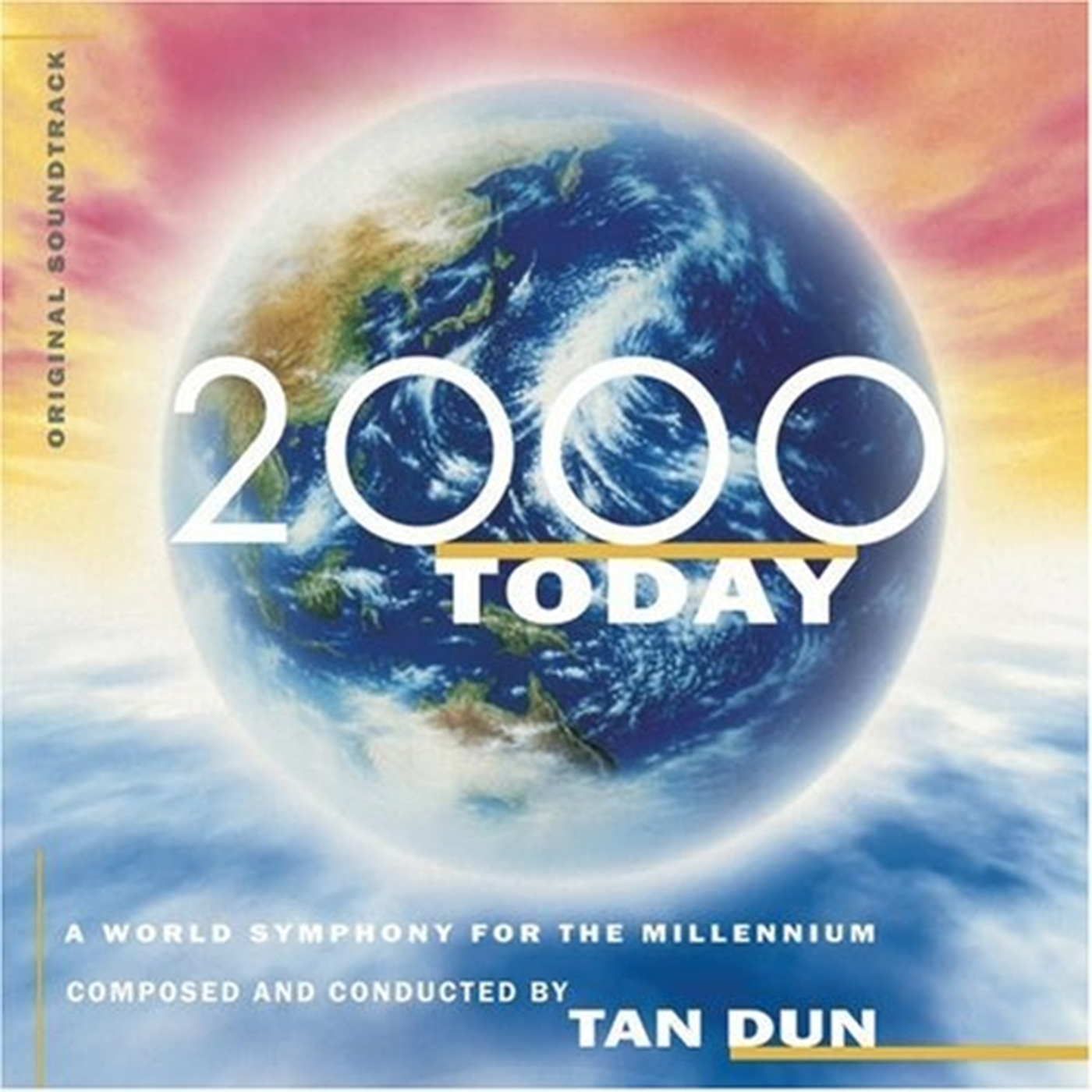
The year 2000 was good for Tan Dun. In addition to the premiere of Water Passion After St Matthew, he won an Academy Award for Crouching Tiger, Hidden Dragon, and his most millennium-specific piece, 2000 Today: A World Symphony for the Millennium (World Symphony) (Figure 1) premiered on television. World Symphony was commissioned for the worldwide broadcast titled 2000 Today, a 28-hour trip across the world's time zones that ushered in the year 2000.Footnote 47 The piece exemplifies Tan's style, immersing the listener in an aural world where a dizzying array of instruments, sounds, texts, and allusions are thrown together. The titles of the movements are geographically evocative, but mostly non-specific, allowing Tan room to play with whatever implications they might carry: ‘Africa, Africa’, for example, or ‘The East’ or ‘Sunrise’. These movements include, but are far from limited to, Tibetan chant, steel drums, clanking stones, banjos, odaiko drums, and trumpet fanfares, as well as lines on the staff reserved for what Tan labels ‘World Instruments’. According to the score, these are to be understood as follows: ‘1 World Pluck: Pipa, Banjo, and Sita (sic); 1 World Wind: Souna, erhu, Recorder, Tibetan horns, etc.; 1 World Percussion: s/he will lead all percussionists in the orchestra to play world percussion instruments: Odaiko, Tars, Djembes, Stones, water, Native American Drums, Paigu, etc.; 1 Electronic Sampler’ (the last was responsible for the Tibetan overtone singing, among other things).
Cover art, 2000 Today: A World Symphony for the Millennium (Sony Classical-0615292000).
World Symphony is built on a primary theme that recurs across movements, which its liner notes describe as follows:
Serving as the centerpiece of the symphony's mosaic form, and heard in every movement, is an easily recognizable ‘chant’: the gently lush, ascending theme first heard in the string at the beginning of the piece. It has the flavor of an ancient scale, an Indian raga, a gamelan melody – to which counterpointed musical material is added to capture the poetic spirit of the world's regions. In the work's finale, Tan blends the chant and all its counterpoints into a ‘Unity’. Here, with a sense of inevitability, the chant musically unifies the earth's culture as one.Footnote 48
Listening to World Symphony, it is difficult to discern precisely how this theme is raga-like, or ancient, or taken from gamelan, but it is easy enough to hear how a casual listener, reading that description, could accept it at face value; after all, and crucially, only ‘flavor’ is being claimed, not expertise. Yet it is the suggestion that this music can offer a version of unifying ‘the earth's culture as one’ that speaks to Tan's personal art-religion, articulating a spirit of a renewed and borderless world. And for the listener, it seems clear enough what a musical depiction of borderlessness sounds like to Tan. In the first movement, ‘Beyond Light’, the ‘chant’ enters almost immediately in the strings, and is quickly joined by an assortment of ‘world music’ sounds: a sampled Tibetan monk offers overtone singing, the odaiko drums interject, followed by the paigu drums, and so on. At other points in the piece, the sampler also provides the sounds of didgeridoo, as well reviving the bianzhong.
Crucially, Tan adds elements from Western concert and vernacular music to this stew as well. Lush string sections and trumpet fanfares are regular features of World Symphony, evoking classic film scores, and in the movement ‘Dreams’, Tan combines a set of pulsing ‘Native American’ drums with a trumpet fanfare that, in its register and use of ascending and descending leaps of a sixth or seventh, greatly resembles Aaron Copland's Fanfare for the Common Man. In the middle of the same movement, ‘World Instrument I’ takes over; in the recording, it seems to be a sitar, but playing a phrase that is clearly intended to evoke American old-time music and banjo.Footnote 49 This amalgamation – Native American drums, banjo, Copland, with the sampler adding ‘Native American chant’ – might suggest an ‘American’ movement (except for the sitar), and its depiction of the idea of ‘America’ is entirely in keeping with the claim to be illustrating ‘the poetic spirit’ of a place. The World Symphony recording concludes with the ‘official 2000 Today anthem’, Tan's arrangement of the Bob Marley hit ‘One Love’, sung in this case by a world beat supergroup consisting of Marley's son, Ziggy, the Gipsy Kings, and the Boys’ Choir of Harlem, who according to the programme notes were ‘singing about a world united by love’.
Despite their many similarities, one key distinction should be drawn between Tan's work and the actual market genre of world music. Where groups such as the Gyuto monks found a way to monetize an existing and highly specialized practice, marketing it to Western listeners seeking a spiritual music, Tan's World Symphony calls for generalists, not specialists, to perform it. By updating the old orchestral instrumental groupings (strings, brass, woodwinds, percussion) for this project – Pluck, Wind, Percussion, Sampler – Tan flattens the significant technical, historical, and cultural distinctions between, for example, a banjo and a sitar. At the same time, this instrumentation suggests that eradicating those distinctions is part of the point of a global unity project. A generalist aesthetic, drawing from a vast array of musical traditions, thus emerges in World Symphony, and the usual musical boundaries of specialization were attenuated. Tan's aesthetic required him to be a generalist, as well, upending any remaining notions of the composer as specialist. In this way, Tan was in the vanguard: since these pieces were written, the idea of creating boundaryless music has caught on more broadly, manifesting itself in the current moment in a widespread discourse about ‘post-genre’ music.
The television broadcast 2000 Today was in many ways identical in aesthetic to its soundtrack. It included an even more remarkable variety of locales and performances, including those by the French ambient and New Age composer Jean-Michel Jarre, who played at the Egyptian pyramids, and Björk performing in Iceland. World Symphony was largely used in the broadcast as underscoring for montages of diverse ‘cultures’ and short speeches by global VIPS, all interspersed with live reports from different locations. Among the most prominent of the global figures in the broadcast was Kofi Annan, then Secretary-General of the United Nations. Annan's millennial report to the UN, titled ‘We the Peoples’, opened with text evocative of the 2000 Today millennial celebrations, reading in part, ‘for 24 hours the human family celebrated its unity through an unprecedented display of its rich diversity’.Footnote 50 Annan was also a participant in the 2000 Today broadcast itself, in a short segment underscored by Tan's music.
World citizen, flexible citizen
Historian Richard Kyle describes the idea of global unity as one of the cores of New Age political thought, writing, ‘New Agers believe that there is to be a new world order characterized by internationalism – nations are to be united politically and economically … If god, humanity, and nature are all one, it follows that there should be no boundaries between nations.’Footnote 51 If these are understood as spiritual concepts, Tan's music is an especially apt aural manifestation. World Symphony’s emphasis on regions, rather than nations, carries a hint of fading borders, which easily played into fantasies about a unified, globalized world. But they could also be understood economically as tools of capital. Michael York makes an explicit connection between New Age's approach to world religions and liberal capitalism, writing, ‘Rather than a rejection of free market principles, New Age endorses a spiritualized counterpart of capitalism – one which seeks ever extended markets, new sources of marketable goods, and expanding profits.’Footnote 52 Tan has sought ever-extended markets, and his music reflects an ongoing pursuit of new sources for stylistic incorporation. Taruskin writes of the sacred entertainment works that they appealed to a ‘pressing need for personal autonomy and unlimited choice’, neither of those hallmarks of traditional Western religions, but both hallmarks of consumer culture. As Martin P. Davidson wrote in 1994, ‘Capital has fallen in love with difference … from World Music to exotic holidays in Third-World locations, ethnic TV dinners to Peruvian knitted hats, cultural difference sells.’Footnote 53
No composer understood this better than Tan, who capitalized on his difference while arguing against any boundaries that difference might erect. Doing this by ‘capturing the spirit’ of the world's regions – or, more ambitiously, uniting the earth, both claimed as the animating missions of 2000 Today – has both spiritual and political ambitions; New Age political thought goes so far as to take such unification as a specific goal. A similar theology seems to animate Tan's music, which intersects easily with more political ideas about the global-as-universal. Thus, when Tan claims that a particular musical device should be understood as a global ‘unity’ theme, as in World Symphony, he offers his music as an apt soundtrack, perhaps even a harbinger of, such beliefs and ambitions.
York writes that New Age's appropriation of spiritual beliefs and practices from around the world ‘translates into the rationale and justification for appropriating whatever third-world institution has appeal to the individual religious consumer, along with the “freedom” to market what one allocates to others’.Footnote 54 A similar process of appropriation and marketing marks Tan's musical pluralism. There is a great deal of resonance between the range of musical materials available to the late twentieth-century composer and the range of spiritual materials confronting the late twentieth-century spiritual seeker. If the Western musical seeker could choose from ancient scales, ragas, talas, gamelan, reggae, and more, the Western spiritual seeker likewise had, in York's arguments, ‘religious options on an unprecedented scale … Through gaining multiple perspectives, the religious consumer can now more easily than ever choose to become de-conditioned from the prevailing acculturation of his/her society and, in some cases even, re-conditioned into a new spiritual practice of his/her own choosing.’Footnote 55 The composer can do likewise, even if – as is often the case among religious consumers, as well – the perspectives in question are only marginally acquired. Conversely, the composer Chou Wen-Chung, who helped members of the Class of 1978 come to the United States, expressed his disappointment in what he saw as a practice of ‘combining cultural artifacts in a superficial way, without a deep understanding of the cultural legacies involved’, as he told the New York Times in 2001, adding ‘It's not the kind of situation I wanted. What I'm looking for is a spiritual digestion of one's legacies.’Footnote 56
An approach like the one advocated by Chou would require relinquishing Tan's ‘boundary-less’ identity, which, in musical, linguistic, political, personal terms, extends so far that his music can attach or be attached to almost any kind of occasion. As I have shown, this identity has been foundational to Tan's career, and he shows little sign of changing it. It also again suggests Tan as someone taking the role of ‘flexible citizen’, in Ong's terms, as when she argues, ‘Among transnational Chinese subjects, those most able to benefit from their participation in global capitalism celebrate flexibility and mobility … flexibility, migration, and relocations, instead of being coerced or resisted, have become practices to strive for rather than stability.’Footnote 57 Tan has been predictive of the flexible, adaptable, and high-status worker that late capitalism so values.Footnote 58
Tan demonstrated a pronounced form of musical adaptability from early in his career, straddling lines between avant-garde and traditional, acoustic and electronic, Chinese and American, Chinese and international. While such flexibility is now commonplace among today's ‘post-genre’ composers, Tan was among the first to adopt it and explicitly promote it as an aesthetic. He has consistently showed an ability to please audiences and critics alike (though sometimes with different pieces), to accommodate, to adapt to diverse musical situations with compositions as well-received as the opera Marco Polo (for which he won the prestigious Grawemeyer Award in 1998), and as critically ignored as World Symphony. Furthermore, Tan himself has become a global figure, accepting commissions from all over the world, and through his work as a conductor, keeping not only in musical but in personal circulation. He conducted the world premiere of Water Passion in Stuttgart, and has conducted it many times since; of the thirty-six performances or performance runs included in the complete performance history (as of April 2015), Tan has conducted half of them, in places including Leipzig, Rome, Seoul, and St Petersburg. Based in New York, he has also overseen (since 2011) a permanent show in the water cities outside Shanghai, Water Heavens. This performance is another stylistic and spiritual amalgamation, and it is one place where Tan has monetized an existing spiritual practice, rather than simply incorporating reference to it. The performance space for Water Heavens was built across the water from a monastery, and the show includes live chant by the monks, which Tan combines with rock music and Bach – something for everyone, from the composer for all occasions.
On the topic of borders and New Age thought, Maria O'Loughlin writes, ‘Cultural borders fluctuate as the flow of global information accelerates and definitions of personal and institutional identity lose their hermetic seal. As the spiritual expression of this phenomenon, the New Age is a global fugue of migrant magic and cultural exchange. Pre-modern, eastern and esoteric spiritualities mingle in a challenge to static religious identities.’Footnote 59 It is easy to imagine such phrases being used to describe Tan's music, on his detailed website, or used as headlines and pull quotes. Music critics have called Tan ‘hard to define, but easy to appreciate’ (Mark Swed); said that Tan ‘epitomizes the cross-cultural musicians of the 21st century’; and, from the Netherlands the claim, ‘What Tan Dun composes is “world music”, music that brings together everything that you had always wanted to hear. The composer Tan Dun is therefore a citizen of the world, a man who can blend all styles.’Footnote 60
After the millennium
Near the end of the 1990s, it would have been difficult to count the number of books, essays, newspaper and magazine articles, and scholarly pieces that began with one of two variations on a millennial theme: ‘As the millennium approaches’, or ‘As the millennium draws to a close’. The year 2000, as historian Charles Strozier writes, ‘reverberates with our deepest psychological dread … No one in our culture can entirely escape the millennial hysteria of the 1990s.’ Strozier linked this hysteria to concepts of the ‘end time’, which, he argued, ‘means that moment (which is at the same time a process) of moving out of human history and into God's time. But as a cultural artifact 2000 connects as well with secular forms of the apocalyptic.’Footnote 61 The apocalyptic mode, familiar from popular culture both secular and religious, predicted imminent and total catastrophe, but it was only one possibility. On the other side was the ‘renewal’ mode of millennialist thought, predicting some form of restoration or redemption and the coming of a ‘New Age’. This redemptive mode resonates with Tan's music and discourse, and further resonates with one of New Age's most consistent interests – again in Paul Heelas's words, it is ‘the human (and planetary) condition and how it can be transformed’ that is of most pressing concern.Footnote 62
Yet the turn of the millennium, although not terribly remote in chronological terms, seems quite far in ideological and political terms. World music, cross-cultural music, post-genre music, boundaryless, global, universal music: it is difficult to know to what extent Tan's aesthetic will continue to have a place in a world that in many places seems bent reviving its ‘parochial hatreds’, in Benjamin Barber's words. The re-emergence of overt white nationalism, the rise of the far right in places such as Hungary, Italy, and the United States all virulently reject the advertising claims of the 1990s, and raise questions about the usefulness of a compositional style that insists on piling the world's sounds atop one another. When US president Donald Trump spoke to a welcoming crowd in Warsaw in 2017, he extolled the virtues of the West, saying, ‘The fundamental question of our time is whether the West has the will to survive. Do we have the confidence in our values to defend them at any cost? Do we have enough respect for our citizens to protect our borders? Do we have the desire and the courage to preserve our civilization in the face of those who would subvert and destroy it?’ And in listing the achievements of the West, Trump said this: ‘We write symphonies. We pursue innovation. We celebrate our ancient heroes, embrace our timeless traditions and customs, and always seek to explore and discover brand-new frontiers.’Footnote 63 When symphonies are foregrounded as bearers of white supremacist and white nationalist values, what room is there for Tan's approach: the Lexus to this olive tree retrenchment, explicitly non-nationalist, which, in Frank Oteri's words, can effect a ‘grandiose global coming together?’Footnote 64
For now, Tan seems untouched by such questions. The ease of appreciating his music, to which Mark Swed refers, has made Tan a concert hall favourite, an awards-winning phenomenon – including the Golden Lion Award for Lifetime Achievement at the 2017 Venice Biennale – and certainly an easy choice for programmers seeking to commission new music for public occasions. He has also recently been appointed Dean of the Conservatory of Music at Bard College, giving him an even higher profile in new and classical music circles.Footnote 65 In attempting a close study of Tan's works, one finds quickly that the usual tools of analysis may be inadequate, as all of his references, techniques, and allusions are either instantly identifiable in the score or recording, or openly referred to by him in interviews or programme notes. Tan's music – and Tan himself – are routinely described as ‘exuberant’, ‘naive’, ‘happy’, ‘open-hearted’, etc., adjectives it is difficult to imagine being applied to his contemporaries, and which can also raise some questions about their exoticizing potential.Footnote 66
The pieces described here, whatever their universalist pretentions, may be ‘anti-intellectual’ in the way Dennis Hall described New Age music, placing accessibility above compositional systems or polemics, and eschewing most of the arguments that characterized twentieth-century composition. It is largely this kind of musical anti-intellectualism, and audience appeal, that has made ‘New Age’ an epithet for (too easily) accessible new music, music that rejects the demand for intellectual complexity. Still, while there might be better musical descriptions of his work, given his peripatetic career, devotion to the Western canon, and commitment to a boundaryless practice, there can hardly be a description more likely to meet his approval than O'Loughlin's contrapuntal trope for New Age multiplicity: a ‘global fugue of migrant magic’.Footnote 67
When Tan was appointed UNESCO Goodwill Ambassador in 2013, he said he would work to ‘promote intercultural dialogue and water preservation’. Yet even as he barely hinted at a political project, Tan brought attention back to his personal mythology: ‘[Water is] related to my childhood memories … the sounds of the water have … claimed a big part of my artistic activities’. The work of politics is not Tan's work, and yet he continues to brush up against it, and remains committed to the eradication of whatever boundaries – political, generic, spiritual – that he finds. Judging by his output and his schedule, he remains prolific and energetic. Like the New Age philosophy his musical career seems to epitomize, he remains stubbornly optimistic, and typically obscure: ‘I feel that I live for the future. But to look for answers about the future necessitates a search for traces of the past. The traces of the past will provide a lot of answers about the future. It's same for the sound, for the color, for the form, for all kinds of art.’Footnote 68
Back at the turn of the millennium, critic Claus Spahn, who interviewed Tan before the Passion 2000 premieres, was overall unimpressed with Passion 2000 afterwards. Of Water Passion he wrote: ‘And when Christ has died on the cross, when the thunderclaps of the giant earthquake have sounded, Tan gives a sermon on the old hippie message: One world, one peace, one religion.’ Spahn was perhaps even more correct than he knew. And there could hardly have been a more apt headline for his German-language review of the multicultural Passion 2000 than the one it was given, which so clearly evoked a familiar slogan that it ran in English without translation: ‘United Colours of Bach’.Footnote 69
Abstract
In this contribution, I examine the ways contemporary business literature deploys a musical analogy in establishing the new idea that business is a high art form. This discourse links musical practices to practices of business, in particular to those of management. I locate this musical analogy within a broader discourse that figures ‘creativity’ itself as a renewable economic resource, one that must be capitalized on if firms are to survive in a fast-changing economy. I argue that the musical analogy helps to bolster contemporary capitalist systems by normalizing capitalist power structures and making them seem just and beautiful. To explore this claim, I investigate a recent opera that glorifies Steve Jobs, arguing that it works to aestheticize corporate power and smooth over any anxieties we may feel about the way that that power orchestrates our lives.
Recently, the Bloomberg corporation produced an ad that ran during screenings of The Met: Live in HD. The ad opens with beautiful aerial shots of Manhattan, as we hear music from the Act I prelude from Lohengrin. We see a man getting ready for his day at the office, tying his tie, his face lost in serious thought. Then we see a singer backstage at the Met, having her make-up done as she similarly prepares for her job. As the music begins to swell, we see close-up shots of hands playing violins and hands typing on computer keyboards; then the ad cuts from a singer onstage mid-aria to a woman giving a PowerPoint presentation. Similarly, a close-up of James Levine dramatically conducting is followed by one of a finger confidently pressing a computer key. Businesspeople attending a corporate meeting nod their heads at what a speaker is saying; chorus people on the stage of the Met react to the action of the narrative. On the stage, a king and queen raise their joined hands high; in the boardroom, two businessmen shake hands to seal a deal. As the music climaxes and subsides, over a shot of an enthusiastic opera audience, text appears that emphasizes the similarity between Bloomberg and the Met: ‘We share a passion for drama.’Footnote 70
As striking as this ad may seem, the ideas it expresses are not unusual. Over the past several decades, business has become increasingly conflated with art in the public discourse. Books with titles such as The Art of Business or How to Master the Art of Selling have proliferated, promising to teach businesspeople, entrepreneurs, and corporate managers how to ‘think like an artist’ in order to take risks and encourage innovation.Footnote 71 This discourse often deploys an analogy with music, comparing business practices with those of composers and conductors. In such literature, business becomes a time-based art form, akin to dance or opera; as in the Bloomberg ad, the businessman's suit and tie are his theatrical costume, donned nervously before his performance in the corporate boardroom, and the PowerPoint presentation has all the calculated gestural drama of an operatic aria. The ad implies that Bloomberg supports the Met not because it is good PR or because such charitable outlays provide massive tax write-offs for corporations. Rather, Bloomberg sees in the Met a kindred spirit, one similarly engaged in providing the world with beauty.
In what follows, I examine the ways business literature deploys a musical analogy in establishing the new idea that business is a form of high art. This discourse links the concrete practices of music – and especially of conducting – to those of business management. I locate this musical analogy within a broader discourse that figures ‘creativity’ itself as an endlessly renewable economic resource, one that must be pursued and capitalized on if firms are to survive in a fast-changing economy. Thanks to this new formulation of creativity, many business schools and corporations have begun incorporating lessons from the world of art into the performance of business. Most often, these pedagogical initiatives focus on the specific type of musical labour that is deployed in conducted orchestral performance: university business departments, corporate arts-based learning firms, and business literature routinely use orchestras and conductors as metaphors for administered business.
In assessing managerial discourses for what they reveal about shifting cultural values, I am influenced by the sociologists Luc Boltanski and Eve Chiapello, who analysed twentieth-century managerial literature in order to chart major changes in how the boss/employee dynamic is conceptualized and propagandized.Footnote 72 The authors argue, among other things, that capitalism became energized by incorporating the criticisms that artists levelled at it in the 1960s; I argue that the musical analogy similarly bolsters contemporary capitalism, because it helps normalize capitalist power structures and make them seem just and beautiful. To explore this claim, I briefly investigate a recent opera that glorifies the visionary leadership of Steve Jobs, arguing that it works to aestheticize corporate power and smooth over any anxieties we may feel about the way that that power orchestrates our lives. Indeed, I argue that the opera fetishizes authoritarianism, that this reverence for power also characterizes the reception of classical music generally, and that it runs through the business discourses that are shaping our world.
In my conclusion, I address some of the affinities between older ideas of musical and artistic autonomy and capitalist accumulation. For two centuries theorists and critics articulated a diametrical opposition between art and business; today that opposition is largely overcome, and art and business appear as simply two different approaches to generating revenue and changing the world. In the literature I examine, wealth and power often provoke the kind of sublime awe that was once reserved for works of great art. Ultimately, I argue that the musical analogy represents merely another example of capitalism transforming itself in order to assure our continued participation in the system.
The musical analogy
Contemporary managerial literature often relates the various practices of business to those of musical performance, a comparison also suggested in the Bloomberg/Met advertisement that opened this contribution. According to this rubric, staged music and plays have much to teach the business world:
A corporate executive gives the same presentation 30–40 times. How does that executive keep it fresh and inspiring? Look to the theatre and dance companies who perform twice a day, every day during a run. Another example: team-building skills are important to the increasingly remote and technologically connected workforce. How does a manager keep his team focused on the same corporate goals? Look to the orchestras and dance companies that must work in concert (no pun intended) for every performance.Footnote 73
Such writers also frequently compare corporate managers to composers of symphonies, and management practices to compositional practices. In the edited volume Managing Creativity, for example, the very first argument the authors lay out – the argument that provides the justification for the whole book – is that business management should be considered an art form akin to musical composition. They demonstrate this argument via a comparison between a musical score and the various ‘marks on paper’ that are used to spread knowledge in a business:
Musical composition uses the language of musical notation to present new ideas. A musical score is a form of conversation: ‘notes are words’. Creative or artistic processes involve decisions as to how to edit, arrange or present material … this is equally true of management. The ‘marks on paper’ that constitute management are no less creative and productive.Footnote 74
After establishing this understanding of musical composition, the authors go on to demonstrate that a musical score is analogous to: an organizational chart showing the infrastructure of a firm; a marketing survey; double-entry bookkeeping; and a budget. Ultimately, they see all ‘management technologies’ as ‘forms of composition’, a fact that justifies taking business management seriously as a creative art form. Similarly, an essay in The Routledge Companion to Creativity compares the ‘genius-level creativity’ of Beethoven to the exemplary leadership skills of Napoleon, arguing that leadership and composition ‘have a lot in common’.Footnote 75 The author notes that both Beethoven and Napoleon ‘made a name for themselves, or left a mark on history, by exerting impact through products’, and ultimately draws an important comparison with modern business management: ‘Bill Gates of Microsoft is to the economy what Beethoven is to music and Napoleon is to war.’Footnote 76
However, while managerial discourses frequently compare managers to composers, it is the metaphor of the orchestra, with its visionary leader (the conductor), that recurs most powerfully. In Talent Wants to be Free, for example, the business consultant and Harvard professor Orly Lobel argues that good bosses are the ones that do not try to inhibit their employees’ creativity with restrictive contracts and intellectual property agreements. In one of her illustrations of this argument, Lobel compares Riccardo Muti to Henry Ford, noting that like Ford, Muti is too rigid and controlling, and as a result his orchestras hate him and do not play well. By contrast, Lobel approvingly describes Herbert von Karajan, who has the ‘gift’ of ‘commanding without controlling’. By giving his musicians the space to explore their own creativity, Karajan allows their full potential to ‘flourish’, an assertion Lobel bases on the fact that Karajan closes his eyes when he conducts, ‘signaling to his orchestra that the harmony should be found internally’.Footnote 77
It is interesting that the Western classical orchestra has become such a powerful analogy for contemporary business, given that in certain respects the kind of music – as well as the labour and social formations – the orchestra evokes is becoming increasingly anachronistic. Where contemporary neoliberal discourse promotes job and skill flexibility for workers, orchestral musicianship is a highly specialized skill set. Where neoliberalism propagandizes the gleaming future to which high-tech innovations will deliver us, classical music is widely seen as a relic of the past. Finally, where contemporary management literature insists that firms must become less hierarchical in allowing autonomous employees to pursue their own creativity and work collaboratively on projects, the orchestra remains a rigidly hierarchized group undertaking, one that has more in common with the old business models of the past than with the highly differentiated networks of the present. The improvisatory, non-hierarchical practices of some kinds of group jazz musicking, for example, would seem like more appropriate analogues for the ideal business environment preached by management discourses, and yet in such discourses it is the classical orchestra – and specifically its conductor – that recurs most urgently. I will argue that this recurrence has much to show us about the worship of power that actually undergirds contemporary perceptions of what businesses do, and what makes them great.
As these examples may suggest, the musical analogy in business literature is one facet of a broader discourse on ‘creativity’ that has transformed corporate and municipal policy as well as the way business students are taught and managers are trained. This discourse positions creativity as a prime facilitator of economic growth and as an important resource that institutions as well as individuals must cultivate in order to amass profits. These ideas can be tied to the work of the urban studies scholar Richard Florida, whose 2002 book The Rise of the Creative Class established the idea that ‘a new social class’ of people is providing the foundation for a new economy.Footnote 78 For Florida, ‘creatives’ can be found in a diverse array of industries, including not only art and music but also science, engineering, finance, education, law, and health care – anyone ‘whose economic function is to create new ideas, new technology and/or new creative content’ counts as a member of this rising class, because this kind of person engages in ‘complex problem solving that involves a great deal of independent judgment and requires high levels of education or human capital’.Footnote 79 Florida wants the creative class to ‘attain class consciousness’ so that they can begin wielding the political power that is their right. Because this rising class will be driving the economy more and more, cities and companies that want to survive must radically transform their policies in order to appeal to the types of people who embody this prized resource. The Rise of the Creative Class thus instigated a major shift in how companies and cities structured their development plans, incentive schemes, and marketing campaigns.Footnote 80
Florida's work – as well as how influential it has been – indicates the degree to which values such as creativity and diversity have been transformed by market logic. Wendy Brown discusses this kind of ‘economization’ of values that were once grounded in morality or ethics, arguing that it is symptomatic of neoliberalism's reformulation of all individual and institutional action as ‘rational entrepreneurial action’.Footnote 81 For example, Florida recommends that cities use a ‘gay index’ to assess which neighborhoods have the most gays and lesbians in them, and thus determine which areas manifest the kind of ‘open culture’ that is attractive to creatives. In arguing for this practice, Florida asserts that diversity ‘is not a private virtue but an economic necessity’, and suggests that even staunch cultural conservatives should work to attract sexual minorities to their firms and neighbourhoods, because such diversity has been proven to correlate with financial profit.Footnote 82 In these ways he consistently uses economic profitability as a trump card to play against bigotry, and thus positions himself as a progressive hero. However, the fact that he suggests discarding moral beliefs when those beliefs are not economically expedient should give us pause; such an argument can just as easily be deployed against progressive goals, if pursuing those goals can be shown to hinder economic growth. The kind of liberal worldview represented in Florida's work is thus an essentially amoral one, which substitutes data analysis and the profit motive for ethically or socially responsible thinking.
This kind of amoral construction of creativity also instrumentalizes it, turning it into a set of skills that can and should be taught to business students and corporate employees. Indeed, cities and firms are racing to become more creative, now that creativity is such a profitable resource. Myriad books, articles, and corporate initiatives promise to teach workers and CEOs how to be more creative, which, perhaps unsurprisingly, entails learning to ‘think like an artist’.Footnote 83 To facilitate this change in corporate thinking, businesses and business schools are establishing arts programmes and creativity grants, and even artist residencies. The University of Chicago's Booth School of Business, for example, founded a ‘Visiting Artist and Social Entrepreneur’ residency in 2013, which brings MBA students together with professional artists from various disciplines. According to the Booth School, learning about the arts helps students learn ‘to innovate, to throw out the rule book and to consider a new way of doing things’.Footnote 84 Businesses can also outsource this kind of experience to new corporate arts-based learning firms that lead seminars and workshops to help employees unleash and manage their innate creativity by identifying their inner artist. One such firm is Creativity at Work, whose website breaks down the artistic process and its attendant business lessons:
Learning how to think like an artist means learning how to:
– Reframe problems in order to generate new perspectives.
– Observe information to decipher complexity, make meaning and discern emerging futures.
– Find relationships between unrelated ideas and events.
– Use imagination to spark ideas.
– Work at the edge of your potential.
– Take conceptual risks.
– Work within constraints.
– Use all the senses to surface insights.
– Transform vision into action.Footnote 85
Attaining this skill set will enhance things such as ‘hosting strategic conversations’, ‘meetings and think tanks’, ‘new product development’, and, somewhat ominously, ‘culture change’. The book Creativity, Inc. argues that when businesses implement this kind of ‘systemic creativity’, then creativity ‘swirls’ throughout the whole company, and workers at every level come up with ‘blockbuster ideas that turn into multimillion-dollar products or even billion-dollar new businesses. Or they create ingenious marketing campaigns that ratchet up revenue.’Footnote 86
We can see that within business discourses like these, ‘art’ is instrumentalized as a set of learnable, transferable skills that will help individuals identify economically profitable ideas and approaches to leadership, and develop the courage to implement those ideas. This perspective is also present in Richard Florida's work, which lumps wildly disparate practices together as examples of undifferentiated creativity, and asserts that this creativity must be exploited to maximize corporate and municipal profits. Once instrumentalized in this way, art-making becomes simply capitalist value creation.
The business literature on creativity certainly urges all employees to embrace their inner artist as a means of becoming more productive for their firms. But this discourse is most interesting when it applies the lessons of art – and particularly of music – to those of business management. This represents the ongoing transformation of the ‘boss’ that Boltanski and Chiapello chart: in previous eras of capitalism, bosses visibly occupied the top position in a very defined power hierarchy; today, by contrast, bosses are supposed to be ‘team leaders’ who work alongside their employees on diffuse projects, using their superior ‘vision’ to coax out employees’ inner creativity. The perceived affinity between managers and musical conductors has thus begun activating a wide variety of corporate creativity initiatives in recent years, as firms strive to learn the secrets of these great leaders who are so adept at nurturing creativity amongst their workers.
In recent years, classical music practitioners have started capitalizing on this corporate prerogative by trying to insert music into management training. The Israeli conductor Itay Talgam bills himself as a ‘conductor and business consultant’, for example, one who can help businesses learn lessons from orchestras and classical musicians. In his popular TED Talks as well as in his 2015 book, The Ignorant Maestro: How Great Leaders Inspire Unpredictable Brilliance, Talgam discusses among other things the way conductors must turn audiences into ‘stakeholders’ for performances, as well as the notion that business managers should embrace the core value of conducting, which is ‘enabling other people's stories to be heard’.Footnote 87 The corporate arts-based learning firm Music and Management undertakes similar pedagogical initiatives, and claims to ‘bring music to life in a startling way that is highly relevant to business today’.Footnote 88 Music and Management provides ‘a range of musical experiences to address specific learning objectives’. Corporations that hire this firm are able to send employees to special workshops in which they sit in an orchestra or a jazz big band, observe the ensemble performing music together, and then talk with the musicians and conductor, engaging in ‘an interactive discussion about teamwork, risk-taking and innovation within a fast-moving business environment’. Business schools are experimenting with orchestra-based pedagogy as well; in one pilot programme, budding executives sat in on orchestra rehearsals in order to ‘better understand the dynamics of corporate management’.Footnote 89 Such undertakings not only lend corporate power the perception of prestige that still adheres to classical music but also work to establish a new notion that music is just another business practice, like undertaking market research, cultivating venture capital, or running a start-up.
Music schools, too, may be starting to experiment with lending their accumulated musical wisdom to management training. In 2014 Northwestern's Bienen School of Music offered workshops to students in the Kellogg School of Management. Management students sat interspersed amongst one of the Bienen School's orchestras, while its conductor, Stephen Alltop, led the ensemble through some Beethoven, and then spoke for two hours about the lessons musical performance and conducting have to offer business managers. ‘Like a conductor, most CEOs don't make their product’, Alltop said, ‘they are charged with having a vision, and the more compelling, persuasive and passionate their vision, the more inspired their work force is going to be.’ After the workshop, Alltop said he was surprised by how ‘naturally’ the business students related to the experience; Management Professor Holly Raider explained that ‘it was the approach and the extent of the metaphor of the conductor as leader and how the participants were immersed in it that really hit home with them’.Footnote 90 These pedagogical projects integrate music with business such that the lessons of one are described as fitting ‘naturally’, ‘obviously’, and ‘beautifully’ into the goals of the other.Footnote 91
The increasingly routine analogy drawn between orchestras and businesses may come as a surprise to musicologists and serious fans of classical music. After all, one of the most powerful ideologies that has energized Western art music since the early nineteenth century is the one that identifies such music as profoundly indifferent to the whims of the commercial marketplace and the petty squabbling of the hucksters and opportunists who populate it. Music by great masters such as Beethoven or Brahms has long been mythologized as articulating a transcendent realm, populated by our highest ideals; the notion of attaching that music and its performance to the tawdry world of business management – a world commonly seen as at best indifferent to art and at worst actively hostile to it – may seem ridiculous.
And yet, it was the development of this very canon of high art music that necessitated the new labour formation represented by the orchestra conductor, a labour formation that dovetails precisely with the one concurrently developing within bourgeois industrial capitalism. Until well into the nineteenth century, orchestras and other ensembles did not have conductors in the modern sense of the word; they were led by individual members who also contributed to the performance by playing an instrument. The rise of the conductor was necessitated by the growth in orchestra size and the size of the halls these groups played in; it is perhaps no accident that this evolution was coterminous with the division of labour required by factory production. As Jacques Attali argues, ‘the metaphor of the orchestra’ as it began developing in the 1850s thus served a social and symbolic function, namely, ‘to convince people of the rationality of the world and the necessity of its organization.’Footnote 92 For Attali, the orchestra represents ‘the image of programmed labor in our society’, and the conductor ‘is thus the representation of economic power’.Footnote 93 Since the 1850s, this deeply embedded notion ‘has never been absent’ from classical music discourse.Footnote 94
Adorno also examined the figure of the conductor and what this figure has to tell us about bourgeois society. For Adorno – as for Attali – the conductor's fundamental role is to exert organizing power over the productive forces of the orchestra. Adorno argues that Wagner was the first to write ‘conductor's music in the grand style’, by which he means music that ‘is conceived in terms of the gesture of striking a blow … the whole idea of beating is fundamental to it’.Footnote 95 For Adorno, this spectacle of regulative violence is compelling to audiences because it both disciplines and represents normative bourgeois citizenship: the conductor ‘is the spokesman for all and so encourages an attitude of speechless obedience in all’.Footnote 96
Aestheticizing power
The musical analogy with business is most often activated by business schools, business writers, and conductors themselves. However, composers, too, can articulate this connection, and perhaps even more effectively. A recent opera about Steve Jobs foregrounds the association of great business management with musical conducting diagnosed above, and uses this analogy to aestheticize power and those who wield it over others. Titled The (R)evolution of Steve Jobs, it is the newest entry into the growing celebratory discourse surrounding the founder of Apple. It, like much of the rest of this literature, insistently figures Jobs as first and foremost a great artist, one whose innovations are on a par with those of J. S. Bach, Picasso, Bob Dylan, and Ansel Adams. As do many of the texts in the Jobs discourse, the opera explicitly compares Jobs to an orchestral conductor. Ultimately, I suggest that the opera – like the myriad books and movies that have examined Jobs since his death – celebrates him not for any of his specific creations or contributions to society, but rather for the very power he wielded. In the Jobs discourse, the various manifestations of his ability to control and dominate others emerges as a major – perhaps even the defining – feature of his creative genius.
RSJ was written by the composer Mason Bates, who often glorifies technology and the founders of tech corporations in his work.Footnote 97 The text is by the Pulitzer-winning librettist Mark Campbell. In composing the libretto, Campbell took his lead from Walter Isaacson's Reference Isaacson2011 authorized biography of Jobs, as well as from the two biopics that have been released since Jobs's death. The biography, biopics, and opera all work to position Jobs as an artist, and often deliberately associate him with musical creativity.
One of the most oft-repeated anecdotes from Jobs's life story also emphasizes the connection between his genius and that of conductors. As a young man, Jobs dropped acid in a wheat field and had an aural hallucination in which he ‘conducted’ the plants and dirt and rocks as they played the music of J. S. Bach. This story is related in many of the biographies and corporate histories I have read, as well as in the 2013 biopic starring Ashton Kutcher. It is also one of the major set pieces in the opera; as Jobs blissfully conducts, his admiring girlfriend watches him and sings an aria about his genius. Years later, while creating the Apple II prototype with his friend and Apple co-founder Steve Wozniak, Jobs is frustrated by his inability to explain his vision for this new computer. Suddenly, he remembers the acid trip and the transformative experience of conducting Bach in the great outdoors. ‘Let's have … Sound. Sound. Sound!’ he sings, in a long aria that conflates music and computers:
The routine association drawn between Jobs and great conductors and composers seems odd – Jobs was not even a musician, for example – but a reason for it is suggested in a scene from the Danny Boyle biopic: in the pit of the San Francisco Opera House, a tearful Wozniak accuses Jobs of being a mediocre engineer who never actually made anything, who simply bullies his friends and employees and takes credit for their work. Jobs does not deny these charges (really, they are more or less true); instead he justifies them by comparing himself to the conductor Seiji Ozawa: the musicians may actually play the music, Jobs says, but ‘I play the orchestra.’
Comparing Jobs to great conductors and other creative geniuses helps business writers and the creators of RSJ emphasize the widespread belief that Jobs was a visionary leader, someone whose brilliant insight and superior vision compelled people to do their best work for him. In Mason Bates's words, Jobs was ‘a visionary of Jesus-like charisma’.Footnote 98 Walter Isaacson regularly calls Jobs ‘a visionary leader’, and ultimately dubs him ‘the greatest business executive of our era’.Footnote 99 In this discourse, Jobs is often figured as an ideal manager, the kind of manager that other managers should seek to emulate; books and articles encourage aspiring executives to ‘lead like Steve Jobs’ by learning to think as Jobs thought. For many writers, this entails learning to think like an artist. According to a 2013 Forbes article, for example, understanding Steve Jobs's similarities to Pablo Picasso is crucial to successful business management: ‘how both men approached the creative process holds valuable lessons for all leaders who want to kick-start their own creative juices or encourage creativity to flourish in their organizations’.Footnote 100
Judging by these assessments of his visionary leadership, we might expect to find that Jobs's management style adhered to the ideal one described in today's managerial discourse. According to the contemporary management training models discussed above, the best managers are those who guide without being controlling: Orly Lobel praises Karajan for allowing his musicians to develop their own unique creativity; Creativity at Work suggests giving employees the time and space to work on their own ideas, independent of managerial direction. This literature explicitly condemns the kind of old-fashioned management style represented by tyrants such as Henry Ford, who exerted an extreme degree of control over his employees and over the production process. Today's best managers, by contrast, are not bosses but ‘team leaders’, people who may gently guide and suggest but whose true talent is identifying individual employees’ strengths and helping them nurture those strengths through creative exploration.
It is odd, then, to see the way the Jobs discourse describes his actual management style. In the biographies and corporate histories of Apple, as well as in the biopics and in RSJ, Jobs emerges as a frightening dictator; even the most hagiographic accounts describe him as vindictive, self-centred, egomaniacal, pathologically controlling, and often pointlessly cruel.Footnote 101 Isaacson calls Jobs someone ‘whose charisma and ego led him to abuse power’, and quotes a Pixar co-founder who calls Jobs ‘a bully’ and ‘a televangelist’.Footnote 102 A writer for Esquire noted Jobs's ‘conscious readiness, even a perverse eagerness, to put people down, humiliate them, show he was smarter’.Footnote 103 Jobs often got his way by screaming at people and even threatening them; Isaacson describes him as ‘a CEO prone to tantrums and withering blasts’.Footnote 104 This certainly does not sound like the kind of nurturing, collaborative ‘team leader’ promoted by contemporary managerial literature.
In all the books and articles about Jobs that I have read, however, his cruel, petty behaviour, and his insistence on monomaniacally controlling every aspect of product design down to the tiniest detail, are not only excused, but also often actively celebrated as manifestations of a specifically creative genius. The tech writer Eric Jackson observes that ‘we have heard stories of Steve Jobs yelling or dressing down staff. He's a control freak, we've heard – a perfectionist.’ However, for Jackson, these qualities are merely evidence of Jobs's superior commitment to his creative vision: ‘The bottom line is that he is in touch with his passion.’Footnote 105 After describing Jobs throughout his biography as ‘abusive’, ‘autocratic’, ‘obnoxious’, ‘boorish’, ‘nasty to others’, and ‘an asshole’, Isaacson waves these traits away, not only by pointing out that ‘wanting control was ingrained in his nature’, but also by associating this controlling nature with Jobs's status as an artist. ‘He thought of himself as an artist, which he was, and he indulged in the temperament of one.’Footnote 106
Conflating Jobs's antisocial behaviour with the natural behaviour expected of artists allows these commentators to celebrate it. This conflation also happens in musical discourse – orchestra conductors’ cruel and controlling behaviour is sometimes excused by commentators who insist either that the art these conductors generate should be considered separately from their personal behaviour, or that such bad behaviour actually indicates the depth of their artistry. Similarly, for Jobs's fans, his ability to force others to his will emerges as a major aspect of his creative genius. As Isaacson puts it, ‘sometimes it's nice to be in the hands of a control freak’. It does not matter if bosses are bad people, so long as what they create is good; at its darkest, this discourse almost seems to suggest that such bosses do great things because they are bad people. In one particularly arresting passage, Isaacson insists that while Jobs's ‘nasty edge’ was sometimes a liability, ‘it did, at times, serve a purpose. Polite and velvety leaders, who take care to avoid bruising others, are generally not as effective at forcing change.’Footnote 107
The opera ends on the kind of grateful and laudatory note that is common to the discourse surrounding Jobs: at his funeral (which he watches over from Heaven, accompanied by his Buddhist spiritual guide Kōbun Chino Otogawa) messages of gratitude and blessing in all the languages of the world are projected onto the set, as the chorus sings, ‘Have a safe journey Steve … thanks for making great things … one generation, notre génération, nós te amamos, iSad, iTriste, iTraurig, iKanashi … making better clouds.’
Jobs's biographers, as well as the filmmakers, librettists, and composers who have apotheosized him since his death, work hard to interpolate authoritarianism with artistry. They link Jobs's ability to ‘force change’ to his ‘creativity’; effectively wielding power over others here becomes a stirring expression of artistry akin to conducting a symphony. Jobs ‘played the orchestra’, which justifies his tyrannical behaviour as well as the fact that he himself never actually invented anything or engineered a product.
Indeed, the regular comparison of business management to orchestra conducting helps naturalize a capitalist labour relation in which people who produce nothing are considered greater contributors to the economy than the workers they supervise.Footnote 108 The conductor seems to be calling forth music using the force of his own will (famous conductors are overwhelmingly men). In both managerial discourse and classical music criticism, conductors are figured as omniscient creative geniuses whose overarching vision is what allows musicians to transcend the restrictions of collective labour. It thus makes sense that business commentators would appropriate this particular musical role in explaining what it is that great bosses do. As Attali puts it:
The ruling class … identifies with the orchestra leader, the creator of the order needed to avoid chaos in production. It has eyes only for him. He is the image it wishes to communicate to others and bestow upon itself.Footnote 109
Using music to deify authoritarianism is certainly nothing new. Lully exalted the Sun King in all his works, and musicologists have argued that the performances of these operas helped condition Louis XIV's subjects to celebrate his absolute power over their lives.Footnote 110 Many of the opera serias of the eighteenth century were projects in myth-making, in which the composer figured his king as a God or a hero from ancient legends. Bates and Campbell also mythologize their subject, turning him into a wise role model, a just and even-handed lord, a world-builder we can be proud of and grateful for. But where Lully's celebration of authoritarianism was straightforward, Bates's and Campbell's is disguised: in RSJ, power is glorified via a new idea of art, one that reconfigures capitalists as artists, and art-making as little more than canny brand management. By extolling the creative genius of Steve Jobs in the form of an opera, Bates and Campbell (and the opera's co-commissioning and co-producing institutions) have helped to glorify the kind of corporate power that is radically transforming our world.
Absolute capitalism
In certain respects, the discourses examined thus far represent a radical break in historical ideas of what business and art are, as well as the relationship between them. In the early nineteenth century, art became figured as a refuge from the demands of commercial culture. In the famous preface to his novel Mademoiselle de Maupin, the French poet and critic Théophile Gautier laid out the Romantic conception of art. The preface attacks his enemies, the journalists who assess artistic products in terms of what benefit (or detriment) they have for society. For Gautier, demanding that art must serve a social purpose defeats its whole raison d’être. He counters the view that art ought to be judged on its usefulness: ‘To begin with, it is not very useful that we are on the earth and alive’, he writes, before brutally extending the ideology of utilitarianism to its absurd logical conclusion: if we value things primarily based on how useful they are to human life, he says, then all we really require is a piece of bread twice a day, and ‘a hollow cube measuring seven or eight feet every way, with a hole to breathe through’.Footnote 111 Art, Gautier insists, is indispensable to us precisely because it is not useful. Making and appreciating things that do not contribute to our physical survival is beautiful, because it is absurd and pointless; this pointless, useless creativity is what separates us from other beasts.
The idea of ‘absolute music’ was an aspect of these nineteenth-century attempts to preserve a special space for art that was separate from the marketplace. Via this rubric, music's abstract nature suddenly became a positive attribute; where for centuries music's content had been understood to be its lyrics and emotional effect on listeners, in the early nineteenth century, critics began arguing that music's content was its form. E. T. A. Hoffmann formulated an early theory of musical autonomy, arguing that music without words or programmatic titles – music, in other words, that could not communicate concrete ideas – was more capable of revealing ‘the spirit world of the infinite’.Footnote 112 Later in the century, Eduard Hanslick extended Hoffmann's arguments, asserting that music's emotional effect did not constitute its meaning; rather, ‘pure’ music's meaning consists only of its own internal logic. Such music generates its own coherence, without requiring external referents, as texted music does. Mark Evan Bonds points out that Hanslick's insistence on rigidly separating music's essence from its emotional effect on the listener is what was ‘radical’ in his thought.Footnote 113 This notion was also highly influential; instrumental music's perceived status as a hermetic, purely aesthetic art quickly raised its level of prestige in Romantic culture.
Gautier was deliberately warding off critics’ attempts to instrumentalize art by insisting it serve a purpose; his espousal of l'art pour l'art established some of the time-honoured stereotypes about art that still linger today: authentic art stems from individual inspiration and expression rather than a desire to earn money or fame. These nineteenth-century ideas about art positioned it as antithetical to commercial concerns, thus the ideal of autonomy became attached to art products that lacked wide consumer appeal.
The long-standing (and, of course, largely fantastical) notion that the creation of true art is a commercially disinterested practice totally separate from the commercial sphere would seem to rub awkwardly against the prerogatives of contemporary business. Indeed, in the phenomenon of corporate arts-based learning and business school art residencies, we can see that cultural understandings of art have been transformed. No longer is art seen as a refuge from commerce; rather, it has become merely another set of tools business can use to increase profits. In other words, art has been made useful, and it is this usefulness that makes it valuable to business (which in turn enhances the value of art at a time when it is seen as increasingly irrelevant). In a post on its website about the lessons business can learn from the artist Damien Hirst, for example, Creativity at Work neatly separates the content or impact of art from its ability to generate capital, although it does so in order to make the opposite point that Gautier articulates: regardless of what business people may think of Hirst's artworks, ‘they cannot help admiring a man who parted art-lovers from £70.5 m ($126.5m) on the day that Lehman Brothers collapsed’.
At the same time, we can see some surprising affinities between business and art as it was understood by nineteenth-century idealists such as Gautier or Hoffmann. Like autonomous art, business is expected to follow only its own internal logic, which is the need to accumulate capital. Within this belief system, all other concerns must be formulated with respect to their effect on this process of accumulation. Even when business commentators argue that corporations should become more socially responsible, for example by curbing emissions, such assertions are always couched in terms of how social responsibility will ultimately increase profits.Footnote 114 Here we may think of Richard Florida's insistence that tolerance and diversity are good because they make our cities more economically profitable; similarly, the multi-billionaire Sir Richard Branson asserts ‘I believe in business because I believe business is a force for good. By that I mean that doing good is good for business.’Footnote 115
The hermeticism of contemporary business ideology leads to an odd value system; in business and managerial literature, the simple spectacle of capital accumulating sometimes provokes the kind of awe that Hoffmann experienced when listening to a Beethoven symphony. Many of these authors describe specific businesses or business people in terms of how they identified a new market opportunity and gained power and money, not in terms of what they actually created, produced, or contributed to the world. Books about the business insights of great CEOs such as Bill Gates or Sam Walton relentlessly focus on their immense personal wealth as an awesome symbol of their greatness; Walter Isaacson concludes his paean to Steve Jobs's genius by saying his main contribution to the world was the creation of Apple itself, ‘a place where imagination was nurtured, applied, and executed in ways so creative that it became the most valuable company on earth’.Footnote 116 In this literature, a person's or firm's ability to accumulate capital becomes an automatic testament to their genius, and is considered emotionally stirring for its own sake.
In The New Spirit of Capitalism, Boltanski and Chiapello argue that capital itself has finally become ‘genuinely abstract’.Footnote 117 Liberated from the gold standard, there is no longer any limit to its accumulation, and ‘profit’ is assessed by comparing balance sheets, rather than by the satisfaction of any actual desires or needs. Thus capitalism (much like absolute music) ‘identifies its purpose in itself’.Footnote 118 Furthermore, what we value about people and companies that find success within capitalism often seems abstract – just as Hoffmann loved the way Beethoven's music eschewed concrete meaning in order to make apparent the spirit world of the infinite, we worship the founders of Microsoft, Virgin Airlines, Wal-Mart, and Amazon for the way they revealed hitherto unseen markets. This abstraction is nowhere more obvious than in the realm of speculative finance; in this world, firms buy and trade assets based on the possibility of those assets becoming profitable in the future, and billionaires such as Warren Buffett are revered as ‘wizards’ for the way they reap massive profits based on things that have not happened yet. Today, such asset trading is largely done by computers using algorithms, and is nearly instantaneous. We live in a glowing network of data in which abstract values are calculated by robots, and numbers indicating amounts of theoretical wealth are transferred digitally from one offshore account to another and back again. This instantaneous flow of numbers around the globe certainly has concrete effects on our lives – depending on where the numbers are concentrated at any given time, wars begin or end, leaders are assassinated or installed, waves of forced migration or sudden prosperity transform societies, we lose our jobs, we get new jobs, we die in a state-sanctioned genocide – but the process has become so vast and unknowable that we can only feel our insignificance in the face of it. Hoffmann's description of Beethoven's Fifth Symphony seems apropos for describing the sublime abstraction of contemporary capital, which ‘opens up to us the realm of the monstrous and the immeasurable’ and makes us aware of ‘giant shadows that surge back and forth, driving us into narrower and narrower confines until they destroy us’.Footnote 119
We need to believe in the essential justness of these processes, and of the power hierarchy governing our lives, because the alternative would be to question it, and such questioning leads to either revolt or nihilistic despair. The power structure finds many ways to disseminate a benevolent image of itself, in order to reassure us that it is acceptable for some people to wield political power over others, and for that power to be linked to economic wealth. One feature of this propaganda is its emphasis on the meritocratic virtues of capitalism; although capitalism is predicated on some people accumulating the wealth of other people, we are also told that this system makes it theoretically possible for everyone to become equally wealthy.
A similar contradiction riddles the celebratory discourse on creativity as an economic resource. Within this discourse, creativity, which was once perhaps associated primarily with artists, now becomes a defining aspect of the human species: ‘every single human being is creative’, Florida declares in The Creative Class Revisited, asserting that creativity is ‘what sets us apart from all other species’ and that it is ‘innate in each of us and shared by every one of us’.Footnote 120 This vision of humanity as an essentially creative species bears some resemblance to Gautier's observations about how art is what separates us from beasts. Unlike Gautier, however, Florida values the creative impulse for its ability to generate profits; art is good because it is useful, not because it is not. Florida's formulation of creativity as a universal and innate feature of humanity also generates a tension with his other great claim, which is that creative people represent a special ‘class’ that must attain ‘class consciousness’ if the new economy is to fully flourish. This uneasy rhetorical contradiction is one that underlies much of the creativity discourse that has emerged in the wake of Florida's book: on the one hand, creativity is an innate aspect of every human being, and it is each of our responsibility to invest our human capital wisely so as to maximize this innate quality; while on the other hand, these same commentators blandly accept the fact that some people simply have more of this innate creativity than others, and that this special group must be carefully cultivated by businesses and cities, often at the expense of lamentably uncreative people such as service workers, janitors, and of course the homeless.Footnote 121
It is interesting to see the way discourses promoting contemporary capitalism have fixated on the orchestra as a means of associating the depredations of corporate power with creative genius, because on its surface this association might seem to reflect a misunderstanding of how orchestral music is actually made. While business commentators such as Orly Lobel may talk about individual creativity and freedom of expression and the need for CEOs to relinquish their control mentalities, the orchestra is the most authoritarian of all music genres. Its individual performers train for decades and practise relentlessly in order to perfect an extremely specialized set of technical skills, which they then deploy in reproducing written instructions with exactitude. Conductors are the highest paid of any orchestra employees, garnering superstar salaries and enormous prestige; furthermore, they are expected to wield absolute control over ‘their’ musicians in order to realize artistic perfection. Finally, orchestral conducting is predominantly a white man's game, which would seem to clash against contemporary corporations’ loud promotion of the many ‘diversity initiatives’ they are undertaking to be more inclusive of women and people of colour. So, in some ways the association with the orchestra would seem to be a mismatch for contemporary business discourses, which strive to present their flexible labour formations and relations of production as enabling individual creativity and freedom of choice.
As the various hagiographies of Steve Jobs suggest, despite corporations’ superficial capitulation to demands for social justice, it is nonetheless very much in their interest to associate capitalism's supposed empowering and liberatory qualities with those of an authoritarian, elite-centric musical practice such as the traditional classical orchestra, a practice that has long been supported by similar assertions about the transcendent nature of great art. In the discourse surrounding disgraced Metropolitan Opera Music Director James Levine, for example, his vision and creative genius were persistently used as trump cards to play against people who tried to question his reprehensible treatment of other human beings. In a gloomy VAN magazine article, Ben Miller sums up this attitude: ‘How could the rumors be true if Levine's performances were so great?’ Miller quotes for example BSO Music Director Andris Nelsons, who has said that sexual harassment does not occur in classical music because ‘art makes people better humans’.Footnote 122 By appropriating music's mantle of creativity and transcendence, capital can seem liberating, positive, and good for humanity; but by relentlessly associating this creativity with the organizational structure of the orchestra (rather than that of free jazz, or a rock band, or any number of other collective musical labour formations), capital can subtly glorify the kind of racist, patriarchal, and elitist power dynamic that is essential to its continued functioning.Footnote 123
Max Weber noted that capitalism is essentially an absurd system, and argued that it can only assure our continued participation by seeming to adhere to real moral values that are external to it.Footnote 124 The system cannot justify itself in its own terms, because its only reason for existence – the accumulation of capital – is fundamentally an amoral one, one that robots are more successful at than humans are. Associating capital accumulation with ‘creativity’ is one method for justifying our participation in the system, as well as for justifying the vast inequality the system generates. If corporate tycoons are artists in the same way that Beethoven or Seiji Ozawa are artists, then the enormous wealth they accumulate and the political power they wield over our lives must be justified. We accept their wielding of power because they are ‘visionaries’ with superior knowledge of how our future should be sculpted; and we accept the legitimacy of their vast wealth because we still hold a deep-seated belief that true artists do not care about such things – such wealth is merely a well-deserved byproduct of the pursuit of creative innovation, rather than its sole point. Just as Weber argued that Puritanism still ‘wanders around in our lives as the ghost of beliefs no longer anchored in the substance of religion’, I suggest that nineteenth-century ideas about the transcendent, commercially disinterested nature of authentic art still linger in the Western cultural consciousness, even now that art has been financialized. This ghostly echo of Gautier's l'art pour l'art helps us reassure ourselves that by enabling and fostering creativity, capitalists are selflessly adding value to our world.
Abstract
Since the early years of the new millennium, an explosion of new music groups has coalesced into a palpable new scene in North America. This scene has flourished because 1) twenty-first-century culture has embraced freelancing as viable way to work and employ others, 2) digital media have made self-marketing and information sharing easier and less expensive, and 3) changing cultures of taste, forming around the values of difference in digital platforms, foster passionate commitment of performers and listeners. Using observations by Sherry Ortner about the rise of the Indie film industry, I show how this new music scene has flourished. I focus on two 2015 performances of the new music groups, Yarn/Wire and Ensemble Dal Niente, to exemplify the flourishing of the new music scene.
Writing for Forbes business magazine in March 2017, Karsten Strauss identified ‘10 Great Gig Jobs’ listed by their ‘projected growth outlooks’.Footnote 125 In order of increasing potential, they are: truck driver, multimedia artist, carpenter, sound engineer, accountant, management analyst, software developer, occupational therapist, web developer, and translator. The gig economy now plays an important role in the labour market of North America, and, as a recent Intuit study shows, by 2020 over 40 per cent of the workforce will be in the gig economy.Footnote 126 This move toward a labour market of freelancers or contingent workers is largely a result of neoliberal economic and political policies put into place over the last half century, but it is a trend that increased after the Great Recession of 2007–09. For workers, the move to freelance work is touted as giving more ‘control’ over work schedules and circumstances. But the relentless hustle for paying work means that workers live with constant uncertainty about their long-term financial well-being. For businesses, the move to freelancers allows employers to hire workers on an as-needed basis and frees them from providing pensions, and, in the United States, health insurance coverage.Footnote 127
While not listed among those workers with the greatest ‘growth potential’ by Forbes, musicians have long operated in a ‘gig’ economy. The term gig apparently comes from musical parlance – jazz musicians shortening ‘engagement’ to ‘gig’. According to linguist Geoff Nunberg, the word entered ‘hipster’ lexicon in the 1950s when it indicated a short-term job providing money for food but without the restrictions of place and a fixed schedule.Footnote 128 And recent research by Dale Chapman has demonstrated how changes to tax law to accommodate jazz musicians in the 1940s provides a ‘pre-history’ of today's gig economy.Footnote 129 While the hustle for gigs is nothing new in the music industry, the growing cultural and economic focus on freelancing has led to increased attention on entrepreneurship in the workplace and in higher music education. Now common in the curricula of conservatories, music schools, and music departments around North America, entrepreneurship programmes are considered a central component of musical training. Broadly conceived as career development, the instruction focuses on verbal communication skills, stage presence, audience cultivation, successful grant writing, and even more on how to develop a dynamic digital media presence (web design, social media, etc.).
The convergence of an increasing prevalence of freelancing in the broader economy with new forms of communication and information-sharing made possible by digital media has enabled an unexpected development in classical music circles. Since the early years of the new millennium, an explosion of new music groups has coalesced into a palpable new scene in North America. This scene has flourished because 1) twenty-first-century culture has embraced freelancing as viable way to work and employ others and 2) digital media have made self-marketing and information sharing easier and less expensive. These two factors do not in themselves explain why there has been an explosion of successful new music groups, since any classical musical group operates in the gig economy and has access to digital media. But there is a third factor relevant to the practice of new music, one that is an epiphenomenon of twenty-first-century digital media: 3) changing cultures of taste, forming around the values of difference in digital platforms, foster passionate commitment.Footnote 130
Here I argue that these three factors provide the fertile ground for the flowering of a dynamic scene of contemporary classical music in the twenty-first century. I begin by considering recent work of anthropologist Sherry Ortner on the Indie film industry which provides insight into how taste cultures develop around difference and how they foster passionate commitment. Then, I consider two relatively recent performances by two well-known new music groups to exemplify the practices that have contributed to this flowering of a new music scene. These two performances are the New York-based Yarn/Wire quartet performing the music of Sufjan Stevens as live music for his film Roundup, and the Chicago-based Ensemble Dal Niente performing the music of Rebecca Saunders.
In her Not Hollywood: Independent Film at the Twilight of the American Dream, Ortner considers the success of Indie films not simply in relation to Hollywood blockbusters but also in the context of changing social and economic conditions in North America. Ortner articulates three general conditions that form the basis of a flourishing Indie film scene over the last twenty-five years. These conditions are: 1) a passionate attitude from directors to tell the truth about an unevenly globalizing world – including the loss of manufacturing jobs and the demise of unions; 2) the rise of niche audiences, and hence markets, that reflect the cultural diversification of taste cultures, and 3) the growing desire of audience members who crave unique and challenging experiences. Ortner argues that Indies did serve and continue to serve a niche in the film industry and that they emerged as a result of specific economic and social conditions over the last twenty-five years. On the basis of interviews, Ortner found that the directors, actors, and producers of Indie films were passionate to tell the stories they felt ‘urgently’ needed to be told about the effects of neoliberal economic policies and of globalization. Their passionate attitudes overcame concerns about commercial viability, and hence the films produced were typically ‘edgy’, low-budget productions. The passionate address of pressing social, political, and economic issues found receptive niche audiences. The increasing demographic diversity amongst audiences and the expanded diversification of aesthetic options available for viewers led to the growth of taste cultures around these pressing social, political, and economic issues. Audience members were ready to be challenged and to use movies to explore a broad array of cultural, economic, and political matters. And directors were interested in ‘shaking up the complacent or passive audiences’ in order to unmask sociopolitical problems.Footnote 131
Ortner's study of the emergence and workings of the Indie film industry in relation to its historical/cultural context resonates in productive ways with the emergence of a vibrant contemporary classical music scene in the new millennium, a scene constituted by performers, composers, and listeners. Performers and composers in this scene demonstrate both a passionate commitment to the creation and performance of new music and a sophisticated historical/cultural awareness of the music's place in the broad spectrum of global music-making. There is, on one hand, a ‘We Care If You Listen’ attitude, and on the other, an embrace of the broad array of musical styles resulting from contemporary social, political, and economic conditions and from new audio technologies.Footnote 132 The musicians involved are not content to programme music in accordance with market-driven notions of audience familiarity or expectations about what types of music will attract paying listeners.Footnote 133 This passionate commitment to the new is reflected in the mission statements of the two groups considered here. For instance, Yarn/Wire, itself a unique ensemble of two pianists and two percussionists, promote themselves as presenting ‘adventurous music’ that ‘point[s] toward the emergence of a new and lasting repertoire that is “spare and strange and very, very new.” (Time Out NY)’. Ensemble Dal Niente, an instrumental collective, ‘presents and performs new music in ways that redefine the listening experience and advance the art form. The programming … seeks to challenge convention and create engaging, inspiring, and immersive experiences which connect audiences with the music of today’.Footnote 134 The passionate commitment of new music performers and composers is matched by that of listeners who are drawn to the prospect of unique and challenging listening experiences. Like viewers for the Indie film scene, listeners play active roles in helping to define niche listening cultures which offer sonic encounters of and in the present.
In her study of the Indie film industry, Ortner sets out to ‘make sense of the relative success of this movement’ with respect to ‘changes in American society and American cultures’.Footnote 135 In particular, she focuses on the role of neoliberal economic policies and globalization to demonstrate how niche audiences of Indie films emerged and why creators and viewers alike craved challenging, edgy films. For the musical groups I consider, there are some clear parallels to the Indie film industry but there some differences as well. For instance, neoliberal economic policies have led to the growth of the ‘gig’ economy generally, but as I pointed out earlier, musicians and composers are no strangers to this economy. The increasing reliance on a contingent workforce puts a new perspective on the activities of musicians, but the growth of the ‘gig’ economy in North America was itself fuelled by new tools for entrepreneurship that arose from digital technologies. Twenty-first-century web-based entrepreneurial tools proved invaluable for performers and composers, along with new recording technologies and sound distribution platforms. The greater availability of music through web-platforms also led to the development and proliferation of listening cultures and audience enthusiasm around those listening cultures. And the development of specialized listening cultures was coordinated with listener curiosity and a desire to be challenged and to experience music in live contexts.Footnote 136
Ortner's observations about the unlikely success of Indie films provide a good starting point for understanding the flourishing of the new music scene in the twenty-first century. In the next part of this contribution, I examine two recent performances by Yarn/Wire and Ensemble Dal Niente, considering some of the factors that contribute to the flourishing of these groups and of the new music scene. From observation of this scene over the last several years, I have identified five operational principles, shown in Table I, that provide a framework for considering recent practices in the new music scene. I have not, however, included musical excellence – compelling musical works and performances – since that is a goal for all professional musical organizations. The five operational principles are considered in the contexts, on one hand, of a passionate commitment to music created and performed in the present and, on the other, of the emergence of niche listening cultures that value the challenges of difference. Put another way, these principles may be understood as ways of enacting passionate commitment and emergent listening cultures.
Yarn/Wire is a quartet of two pianists and two percussionists. Their unique instrumentation has made it necessary for them to actively seek out and commission composers for new works. They met while students in the DMA programme at Stony Brook, and the group formed in 2004.Footnote 137 Each of them performs as part of Yarn/Wire but also as a freelancer in the New York City metro area. Their website, the homepage shown in Figure 2, has a polished, cool look, with information about the group, its events, links to videos and recordings, press reviews, and a support link that includes a place to donate and a list of donors. Every year Yarn/Wire hosts a fundraiser with guest performers, and in 2016 they began the Yarn/Wire Institute, a summer program for performers and composers characterized as ‘immersive and collaborative’ which is intended to ‘expand [participants’] skills and knowledge of 21st century music’. The group also maintains a Twitter account and an active Facebook page that has additional videos and a more personalized feel for the group, its players and their activities. Maintenance of all the digital media is handled, for the most part, by members of the group.
Yarn/Wire website Yarnwire.org (accessed July 2018).
In January 2015, Yarn/Wire performed with Indie Rock composer and musician Sufjan Stevens in the Harvey Theater at the Brooklyn Academy of Music (BAM). Stevens composed the music as a live accompaniment for a video, Roundup, that he made with videographers Aaron and Alex Craig at the 2013 Rodeo in Pendleton, Oregon. The project was commissioned by BAM and it was Stevens's decision to compose music for Yarn/Wire. He knew them through personal connections and had wanted to write music for them when this opportunity arose.
The creative process for Roundup’s music involved procedures from both the classical and the popular music traditions. During his compositional process, Stevens met with the group to get a sense of instrumental possibilities, especially for percussion. He then composed and notated the music, submitting a score to Yarn/Wire. Another round of creative work occurred during a seven-day, 9–5 rehearsal period, during which Stevens and the members of Yarn/Wire made changes and additions to the score.Footnote 138 An excerpt of the score provided to the quartet as a basis for a collaborative musical creation is given in Example 1. While all members of Yarn/Wire collaborated in the process of ‘making’ the music, in the end the final decisions were made by Stevens. Another aspect of how the creative process differed from classical norms had to do with the interventions of the BAM staff. Relatively early in the process, the BAM staff learned that Stevens intended only for Yarn/Wire to perform. The staff intervened, asking that Stevens perform with the group during the film screening and that he perform a solo song after the film ended – all things which Stevens agreed to. Overall, the compositional/creative process was a kind of hybrid of classical and popular procedures.
Stevens, Round-Up, score excerpts: a) Prelude/Columbia River; b) Round-Up: Opening Titles.

All six performances of Roundup were sold out, partially the result of considerable PR work by the BAM staff. Figure 3 shows all members of the quartet in their performing set-up, positioned at the front of the theatre, and Figure 4 gives another view, with Stevens in the foreground and in front of the video screen. The audience for the event was decidedly different from those at most contemporary classical concerts, largely a result of Stevens's status as an Indie musician. In general, the audience was younger, and while most people were there to attend a Sufjan Stevens event, they were also engaged with the Yarn/Wire sound world. On the other side of the equation, those of us who attended to hear Yarn/Wire accompany a silent film participated in a live film and music event that revives an older tradition in a new context.
Yarn/Wire performing at BAM, January 2015.
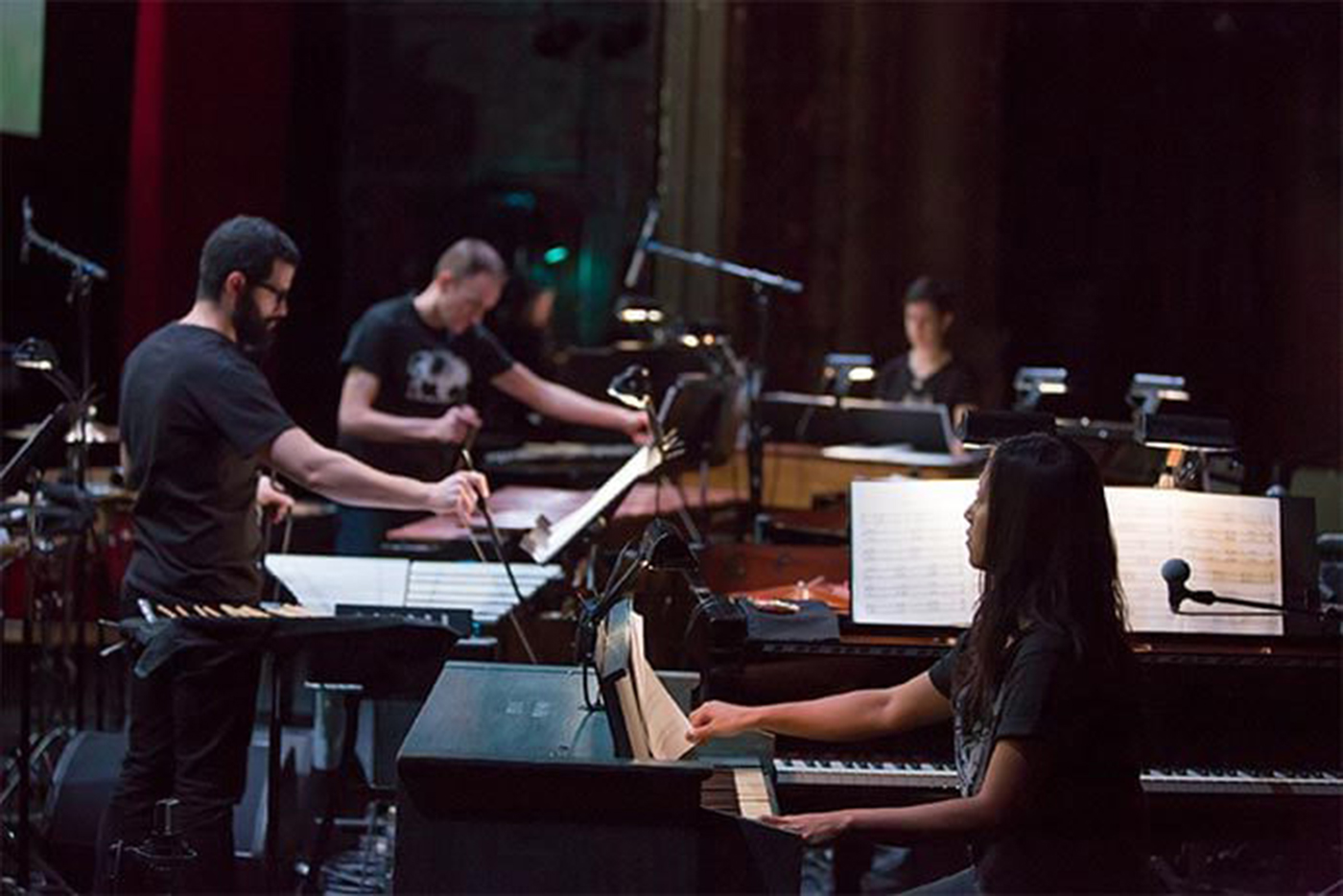
Yarn/Wire performing with Sufjan Stevens at BAM, January 2015.

Overall, this performance highlights some of the operating principles shown in Table 1. Yarn/Wire's performance with Sufjan Stevens involves a cross-genre collaboration in which the quartet became secondary creators but without attribution – a practice typical in the popular music tradition. The relatively long rehearsal process also differs from classical norms in which players work on their own to perfect a notated part. For audience members, the performance was a special kind of multi-sensory experience involving music coordinated with visuals of the rodeo on screen and of the live performers producing sound at the front of the theatre. And the audience was striking for not only its generational diversity but also the apparent diversity of musical tastes.
Guiding principles: passionate commitment/passionate listening

Ensemble Dal Niente, formed in 2005 by composers completing degrees at Northwestern University, takes its name from a piece by Helmut Lachenman.Footnote 139 Over the last decade, the ensemble has defined itself as a new music collective with a clear mission to ‘drive musical discourse with adventurous projects that exhibit an ambitious range of aesthetic values tied to contemporary life and culture’. It is a relatively large group of musicians, configured differently for the specific works to be performed. Like any such musical organization, Ensemble Dal Niente has various staff positions dedicated to making the organization run and a consortium of artistic coordinators.Footnote 140
The front page of Ensemble Dal Niente's website, shown in Figure 5, includes a promotional video that personalizes the players and underscores each person's dedication and passionate commitment to the group's mission. The text below the video invites ‘ambitious listeners’ to new and challenging sonic experiences. The front page also includes links to projects, events, media, a blog, and a place to donate. The media section includes a sampling of recorded performance, a list of recordings put out by the Ensemble or its members and videos. Most of the videos are of performances, but one is an abstract, graphic video setting of George Lewis's Assemblage by Alejandro Acierto. The blog includes interviews of composers with Ensemble performers and other similar opportunities for composers to discuss music performed by the Ensemble. The projects section is designed mostly for concert programmers, showing themed programmes, including some with an educational focus. Another project for the Ensemble, the ‘Proximity’ series, is devoted to the music of a single composer who typically attends rehearsals, attends the concert, and interacts with members of the audience. With the goal of introducing composers whose music is little performed in Chicago, the series plays a broadly educational role for the regional community.
Ensemble Dal Niente website Dalniente.com (accessed July 2018).

The Ensemble Dal Niente concert I consider here was in the Proximity series from 2015 focusing on the music of Rebecca Saunders, a UK-born but Berlin-based composer. Ensemble Dal Niente encountered Saunders during their performances at the Darmstadt Summer Courses, where they won the Kranichstein Prize for Interpretation in 2012. The programme for the Chicago concert included music from across Saunders's career: Stirrings Still II (2008), Molly's Song 3 – Shades of Crimson (1996), Fury II (2009), Shadows (2013), and Into the Blue (1996). Usually involving collaborative work with the composer, this Proximity event was handled differently since Saunders was unable to travel to Chicago. Ensemble Dal Niente conductor, Michael Lewanski, arranged for the composer to hear recorded rehearsals to which she responded either by email or by a video-chat with Lewanski. While it is not uncommon now for there to be live, long-distance interactions between composers and performers, such an arrangement proved difficult because of the seven-hour time difference between Berlin and Chicago. The opening measures of Molly's Song 3 – Shades of Crimson, shown in Example 2, give a sense of the rhythmic character of Saunders's music and of the complex coordination required in performance. From his long-distance interactions with the composer, Lewanski was able to shape the performances according to his understanding of the composer's wishes.
Rebecca Saunders, Molly's Song 3, score excerpt.
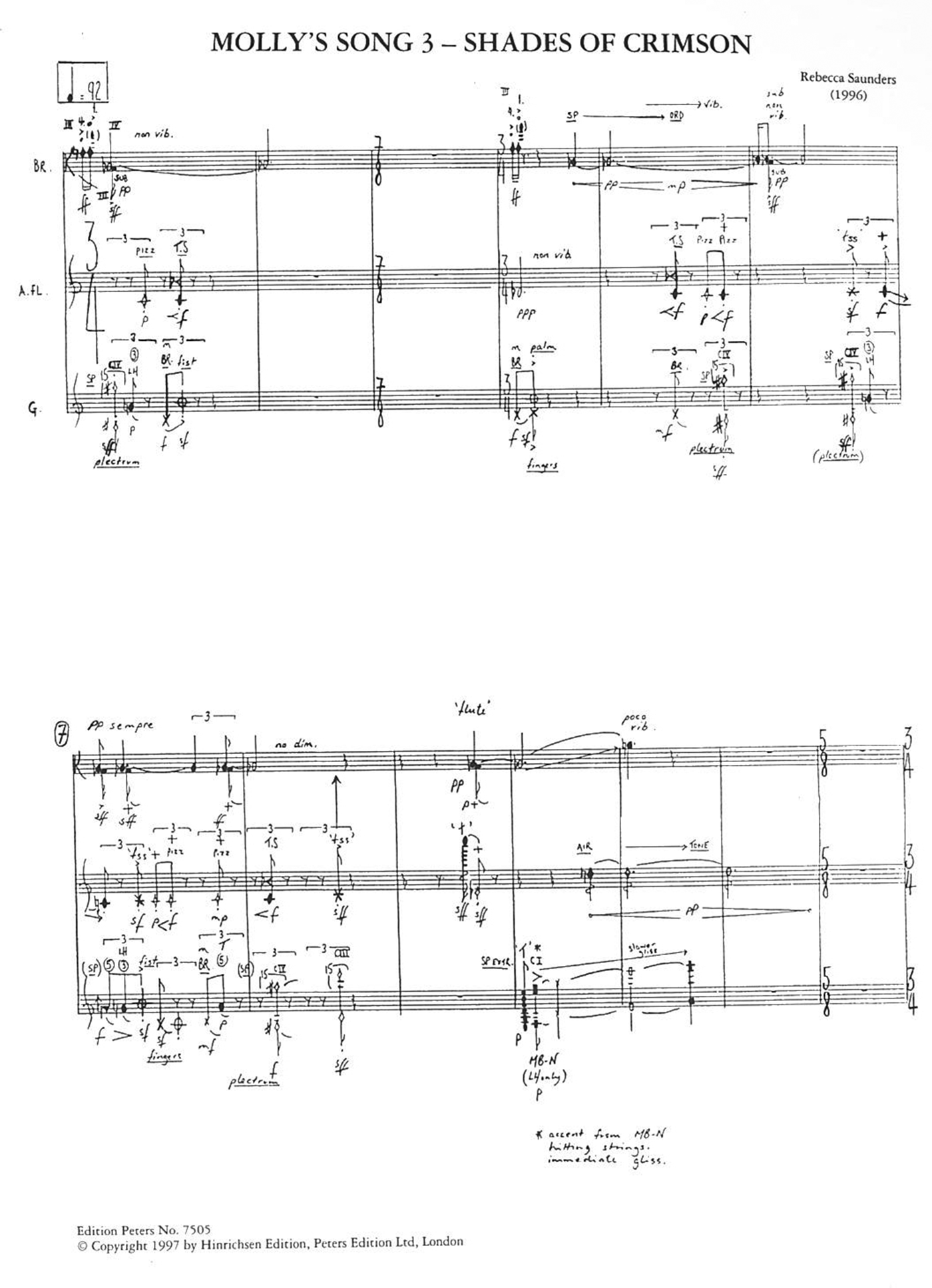
The 23 April concert was held at Constellation, an informal performance venue in Chicago that is a repurposed space for collaborative arts performances. It is a small intimate setting, with a bar, that allows for easy interactions between composers, performers, and listeners. Constellation books diverse types of music, and given its multiple performing spaces, it is possible on any given evening to mingle with listeners having significantly different musical tastes. Thus, the venue itself assists in the project of putting diverse listeners in the same performance space. The concert entailed a formal presentation of the works, with the conductor speaking about each piece. In the absence of the composer, Lewanski took on the role of contextualizing the music, since one of the goals of the Proximity concerts is to make connections with the audience. Such in-concert conversations are a central component of the Ensemble's overall mission, which, as Lewanski says in another context, is to break down the ‘cultural narratives about what difficult music is’.Footnote 141
Concluding remarks
The flourishing of a new music scene, like that of the Indie film industry, depends on the passionate commitments of performers and composers about the importance of art that is fully enmeshed in the present. This passion is matched by listeners who also desire musical experiences of our time and crave artistic encounters that engage and challenge. The successes of new music groups, such as Yarn/Wire and Ensemble Dal Niente, have been shaped by larger cultural, economic, and technological changes affecting virtually all parts of the world – this success is a welcome and positive development. But it is important to note that not all change is necessarily positive, as Ortner tracks in Not Hollywood. The flourishing of the Indie film industry arose from the passionate commitments of producers, directors, actors, and audiences as they made ‘edgy’ films that often exposed the negative consequences of economic changes linked to neoliberal capitalism at the turn of the millennium. My focus here has been on the flourishing of the new music scene in North America and not explicitly on how music of the present reflects and shapes our present – something that is eloquently expressed by the other articles in this forum. It is worth noting that this flourishing marks a significant change from mid- to late twentieth-century attitudes towards ‘new’ music, and the explosive growth of new music groups since the turn of the millennium may indeed herald a long-lasting trend in classical music – only time will tell if this will be sustained. But for now, we may observe that the performance and creation of new music has, despite the odds against it, flourished in the larger cultural, economic, and technological changes of the twenty-first century.
Abstract
This contribution analyses the labour of three new music ensembles – Eighth Blackbird, Third Coast Percussion, and Ensemble Dal Niente – as a negotiation between conflicting values. On the one hand, ensemble members persist in the historic discourses of art as anti-commercial. On the other, they appeal to dominant neoliberal discourses that collapse distinctions between financial and non-financial forms of value. As a result of the conflicts between historical artistic and neoliberal discourses, ensemble work consists of constant struggle and constant revelry. I treat the building that houses the ensembles as a living metaphor for this oscillation. Once home to a thriving family-owned business, the building now houses small-scale niche businesses, mostly artist-driven. I thus show neoliberalism's manifestation within new music while also demonstrating its limits.
A brick building stands at 4045 North Rockwell just off Irving Park in Chicago. Little distinguishes its three-storey industrial exterior from its surroundings. Upon entering the first floor, one finds old filing cabinets and discarded machinery. A few workers and the building owner occasionally drift through this space, remnants of a once thriving photo album business. A set of concrete stairs ascends through the middle of this building. Everything about this space suggests storage, decay, and stasis. Seemingly out of place, a few smart bikes rest against a wall, one with an expensive Brooks saddle. Head up the stairs and something changes. You hear music: drums, strings, and woodwinds echoing through the empty corridors. On the second floor, you find four-time Grammy winning ensemble Eighth Blackbird. Continue ascending and, besides a decrepit bathroom, you see stunning original posters for Three Floyd's Brewing Company, The Black Keys, and even the Chicago Symphony Orchestra. Two more new music ensembles, Third Coast Percussion and Ensemble Dal Niente, rent space here. The groups’ rehearsals – filled with minimalist pulses, organized industrial clangs, and dense melodies – invigorate this space and transform it. Where manufacturing has left, artists and musicians take root, and they are revelling in the rubble.Footnote 142
By examining the work of the musicians populating this building, I argue that what appears to some as revelling is often born of struggle. The three ensembles struggle to appeal to newly dominant neoliberal discourses, which require workers to revel in precarity. Neoliberalism emphasizes turning the self into an enterprise, positions marketplaces as the preferred index of success, and seeks to erase (or ‘liberate’) divisions between work life and private life.Footnote 143 Accordingly, all three ensembles can be viewed as ‘entrepreneurs’Footnote 144 engaged in ‘boundaryless’Footnote 145 music-making and self-promotion. All three groups construct brands that portray them as highly successful musicians profiting from a blend of musical styles and flexible labour practices. The market for new music, largely comprising universities and festivals, is eager to embrace such ensembles because they reinforce a newly ascendant emphasis on flexibility, self-promotion, and diversity valued under neoliberal regimes of value.Footnote 146
However, these ensembles’ promotion of their flexibility and eclecticism masks the precarious nature of their labour. Ethnographic research and study of ensemble finances demonstrate a level of precarity often undiscussed publicly or clearly explained to students. Though residencies with major education institutions feature prominently in ensemble biographies, all three groups are best understood as adjunct faculty. At the same time, however, they are promoted as inspiring models for students’ careers. Furthermore, the three ensembles do not embrace neoliberalism to the extent seen in recent analyses of new music and educational institutions, but they do appeal to neoliberal values as part of a way to distinguish themselves.Footnote 147 The ensembles I study remain bound up in what Bourdieu has called an ‘economy of symbolic goods’.Footnote 148 Despite persistent professions of entrepreneurship and financial success, many of these musicians maintain a disavowal of the purely economic. In this contribution, I argue that the three ensembles move back and forth between revelry in struggle as they negotiate between these conflicting values within new classical music.
Researching Eighth Blackbird, Third Coast Percussion, and Ensemble Dal Niente brings a much-needed specificity to the broader analyses of new music and labour that have currently been published. I draw here on interviews conducted over the past several years, as well as fieldwork conducted from 2018 to 2019, when I travelled across the country numerous times for trips ranging in duration from a few days to a few weeks. I interviewed members of Ensemble Dal Niente, Third Coast Percussion, and Eighth Blackbird, other occupants of 4045 North Rockwell, the landlord, and members of the Chicago new music community. All three groups specialize in new music and are registered as 501(c)3 non-profit organizations, though there are some differences among them. Formed in 1996, Eighth Blackbird has established itself as one of the best known and respected new music ensembles in the country. The organization consists of six musicians in a ‘Pierrot plus’ configuration (flute, clarinet, percussion, piano, violin/viola, and cello), with several additional full- and part-time staffers, representation from concert agents, and long-running residencies at American higher-education music schools. Third Coast Percussion began in 2004 as a student-run percussion quartet. It has since grown to a full-time organization with several additional employees, and in 2017 the quartet won a Grammy for Third Coast Percussion | Steve Reich. Ensemble Dal Niente is a performer-led organization able to perform orchestral pieces with singers, though it often presents shows of chamber music. Unlike the two full-time groups, Ensemble Dal Niente is a part-time job for most of its performing members, with a few members taking on more work to administer the ensemble and its projects.
Neoliberalism and musical labour
Analysing the promotional material of all three ensembles demonstrates the pervasiveness of ‘boundaryless entrepreneurship’ as a mode of discourse. Such rhetoric marks an important shift within discourses and practices in new music that indicates a tentative embrace of neoliberal ideals. Discussing the music and public statements of composers such as Judd Greenstein, Missy Mazzoli, and especially Mason Bates, Marianna Ritchey outlines persistent attempts on the part of these composers and their advocates to position themselves as somehow moving beyond the boundaries of traditional classical music and its institutional biases.Footnote 149 Previous generations of modernist composers also celebrated transgression through innovation, but they maintained disdain for popular music and by extension popular cultural realm and large audiences.Footnote 150 In contrast, boundarylessness, as it appears for both the composers studied by Ritchey and the ensembles I discuss here, frequently touts relationships with musicians that can be marketed as ‘popular’. As David Blake has recently demonstrated, this trend reflects a broader shift in taste characteristic of newly dominant ‘omnivore’ tastes, both among educated elites in general and in the musical academy.Footnote 151 In new music, people typically employ boundarylessness to mean a combination of musical gestures viewed as somehow foreign to the classical music canon, with its emphasis on acoustic works written according to eighteenth- and nineteenth-century aesthetics. Thus Robin demonstrates the perceived success of a collaboration between the new music ensemble yMusic and singer-songwriter Ben Folds, despite the uneven remuneration of student composers.Footnote 152 In terms of musical qualities, Ritchey identifies boundarylessness as an emphasis on anything that could signify popular music ostensibly foreign to the musical academy. Ultimately, the musical qualities of ‘boundarylessness’ are so numerous as to be of questionable significance. Nevertheless, musicians and arts workers typically point to electric guitars, turn-tables, laptops, as well as musical gestures Ritchey describes as ‘typically diatonic and often predominantly consonant’ when describing boundarylessness.Footnote 153
Boundarylessness also figures prominently in analyses and celebrations of neoliberal labour. In neoliberalism, the individual is an enterprise that must compete on the market, and that should be flexible, take on risk, and embark on numerous endeavours as part of a ‘boundaryless career’. Boltanski and Chiapello have located these attributes as part of a ‘new spirit’ of capitalism, identifying it as a recurring trope in contemporary managerial texts.Footnote 154 In this new environment, workers celebrate a move away from the tedious stability provided by long-term employment at a single firm. To some extent, this shift results from workers themselves reacting against previous generations who were viewed as mired in bureaucratic and meaningless work.Footnote 155 The ‘new spirit’ encourages individuals to strike out on their own and work outside the perceived boundaries of the firm. To facilitate such labour, people develop ‘portfolio careers’ that piece together a more project-based employment at several places.
Returning to musical labour, the discourse of neoliberal flexibility and portfolio careers has gained prominence in recent years. Moore argues that schools of music have developed entrepreneurship programmes in order to respond both to a perceived decline in the status of classical music in general – the ‘death of classical music’ debate – and to the financial crises of the early twenty-first century: ‘Musical entrepreneurship has become the most widely promoted, disseminated, and supported of these possible solutions.’Footnote 156 Similar to Ritchey's critique of boundarylessness, Moore connects the embrace of musical entrepreneurship with the embrace of neoliberalism on the part of arts administrators. The result is the valorization of what Guy Standing has called ‘precarious labor’.Footnote 157
In the performing arts, of course, labour has been precarious for centuries, and many have constructed personae in part as a promotional move. From Franz Liszt's exploitation of military heroism, to P. T. Barnum's promotion of Norwegian singer Jenny Lind, to freelance classical musicians working in the twenty-first century, musicians have long engaged in self-promotion, flexible labour, and work that could be considered an enterprise of the self.Footnote 158 Neoliberal ideals of flexibility, entrepreneurship, and boundarylessness have become newly embraced by musical academies because they provide musicians and arts workers with ways to describe their work that dovetail with the values of contemporary capital and its discourses.
Revelry: the building and the b(r)ands
During my fieldwork with ensembles working at 4045 N. Rockwell, I was routinely struck by the parallels between the space rented by the three ensembles and broader economic shifts in the United States. Both witnessed dramatic changes over the past few decades. Prior to its existence as a multi-use leased space, 4045 N. Rockwell had been home to a family-owned luxury photo album manufacturing business. At its peak in the 1990s, the business had employed upwards of two hundred and fifty people. By the time I arrived in 2014, however, the business was all but shuttered: employees had been laid off, and only a few orders remained to be filled. Over the years of my fieldwork, the business dwindled steadily, though tenant occupancy increased. When I last visited in winter 2018, the owners had sold off the heavy machinery used to create the albums. Based on interviews with the business owners, the advent of digital photo technology had contributed to this decline.Footnote 159 The family who owned the business transitioned to managing the building itself and leasing out space to various occupants. Tenants included several poster makers, a wine maker, an internet radio station, a bicycle bag company, offices for a performing arts non-profit, and the three ensembles I researched.
The building thus echoed a more general trend in the United States: a space once occupied by working- and middle-class workers had been abandoned, only to be re-claimed by elite cultural producers. As several authors have shown, manufacturing in the United States has declined while, at the same time, boutique venues have flourished as cities sought to encourage a ‘creative class’ that, it was argued, would bring new prosperity.Footnote 160 Timothy Taylor has described this kind of shift as symptomatic of neoliberalism more generally.Footnote 161 A feature of this shift includes emphasis on niche markets, as producers attempt to cater to a newly legitimate plethora of tastes. Where mid-twentieth-century cultural producers sold a canon of works, musical and otherwise, to large audiences, they gradually reset their sights on the ‘conquest of cool’.Footnote 162 This ‘cool’ is then mobilized as part of a heretofore unprecedented level of commodification:
The emergence of a new phase of capitalism means that the class system must be changing – the middle class is getting squeezed, as many have observed and discussed. With respect to cultural production, it is members of a new class who find what is hip, cool, and edgy and who both promulgate this ideology and employ it to sell anything from commodities to Obamacare.Footnote 163
The situation at 4045 N. Rockwell provides a particularly stark example of this class shift. An American-owned and -operated business of a few hundred has faded, and a new group of cultural producers have taken their place.Footnote 164 The changes seen at 4045 N. Rockwell parallel broader economic developments. All three ensembles I studied enthusiastically leveraged ideas of ‘what is hip, cool, and edgy’ to sell their musical performances. They are part of Taylor's ‘new class’ who would employ the ideology of cool to ‘sell anything’, even avant-garde music.
‘Hip, cool, and edgy’ manifested in ensemble promotional material and in performances in response to the debates underway within new/classical music communities. For the three ensembles I study, boundarylessness appears most consistently in rhetorical and visual celebrations that reinforce ideas of a pop-culture friendly orientation. Members of all three ensembles frequently emphasize the diversity of musical influences found in a given programme. Each of the ensemble's biographies emphasizes some kind of cross-generic connection between traditional classical repertoires and pop music. Promoting its twenty years of touring and performance, Eighth Blackbird's online biography proclaims:
Anniversary celebrations continue throughout the 2016–17 season with tours of music from Filament and Hand Eye, as well as keystone performances celebrating Steve Reich's 80th birthday, a fresh round of raucous shows with ‘Appalachian post-punk solipsist’ (The Wanderer) Will Oldham (Bonnie Prince Billy), and world premieres by Holly Harrison, Pulitzer Prize-winner David Lang, and Ned McGowan. This season marks debuts in Paris, at Justin Vernon's (Bon Iver) and Aaron Dessner's (The National) Eaux Claires Festival, with the San Francisco Symphony, and also includes a three-week return to Australia.
Third Coast Percussion similarly focuses on repertoire and collaborations that seem to cross generic boundaries.
For over ten years, the ensemble has forged a unique path in the musical landscape with virtuosic, energetic performances that celebrate the extraordinary depth and breadth of musical possibilities in the world of percussion. The quartet's curiosity and eclectic taste have led to a series of unlikely collaborations that have produced exciting new art. The ensemble has worked with engineers at the University of Notre Dame, architects at the Frank Lloyd Wright Foundation, dancers at Hubbard Street Dance Chicago, and musicians from traditions ranging from the mbira music of Zimbabwe's Shona people, to indie rockers, to some of the world's leading concert musicians. Through extensive workshopping and close contact with composers, Third Coast Percussion has commissioned and premiered new works from Donnacha Dennehy, Glenn Kotche, Lei Liang, Gavin Bryars, Christopher Cerrone, Timo Andres, Marcos Balter, Ted Hearne, and today's leading up-and-coming composers through their Emerging Composers Partnership Program. These works have become part of the ensemble's core repertoire and seen hundreds of performances across North America and throughout Europe.
Finally, Ensemble Dal Niente touts its work with bands Deerhoof and a wide variety of composers:
Dal Niente works with a range of composers, from emerging and established living artists to the post-World War II avant-garde generation. Recent projects include a collaboration with Deerhoof and Marcos Balter; a tour of Latin American countries; performances and recordings of works by George Lewis; an East Coast tour of German music; the Hard Music, Hard Liquor concert series and its annual Party.
All three of these examples point to ostensibly cross-genre collaborations – Byce Dessner and Bon Iver for Eighth Blackbird; Glenn Kotche (drummer for Wilco) for Third Coast Percussion; and Deerhoof for Ensemble Dal Niente – while also name dropping some of the most prominent composers in new music today (e.g. David Lang, Donnacha Dennehy, and George Lewis, respectively). These collaborations connote a musical world that finds artists and collaborators from within the academy and without. All three groups also celebrate collaborations with scientists, visual artists, and dancers in projects that are similarly promoted as somehow challenging the stereotypical conventions of the classical music concert hall.
Visual work by the groups also reinforces notions of boundarylessness. Publicity photos feature members smiling, often professionally posed in appealing ways. The groups often appear outside the concert hall, either in industrial spaces similar to 4045 N. Rockwell, or in unspecified play spaces. Through dress and environment, these ensembles present themselves as agglomerations of individual artists with their own skills and sensibilities rather than homogeneous members of traditional ensembles. These attributes come together to deliver stunning performances of new music that provide new insight into difficult to understand new musical works. Musicians are portrayed as both casual (as in Figures 6 and 7), and focused, (as in Figures 8 and 9).
Eighth Blackbird publicity photo. Photo by Saverio Truglia. Used with permission.

Third Coast Percussion. Photo by Saverio Truglia. Used with permission.
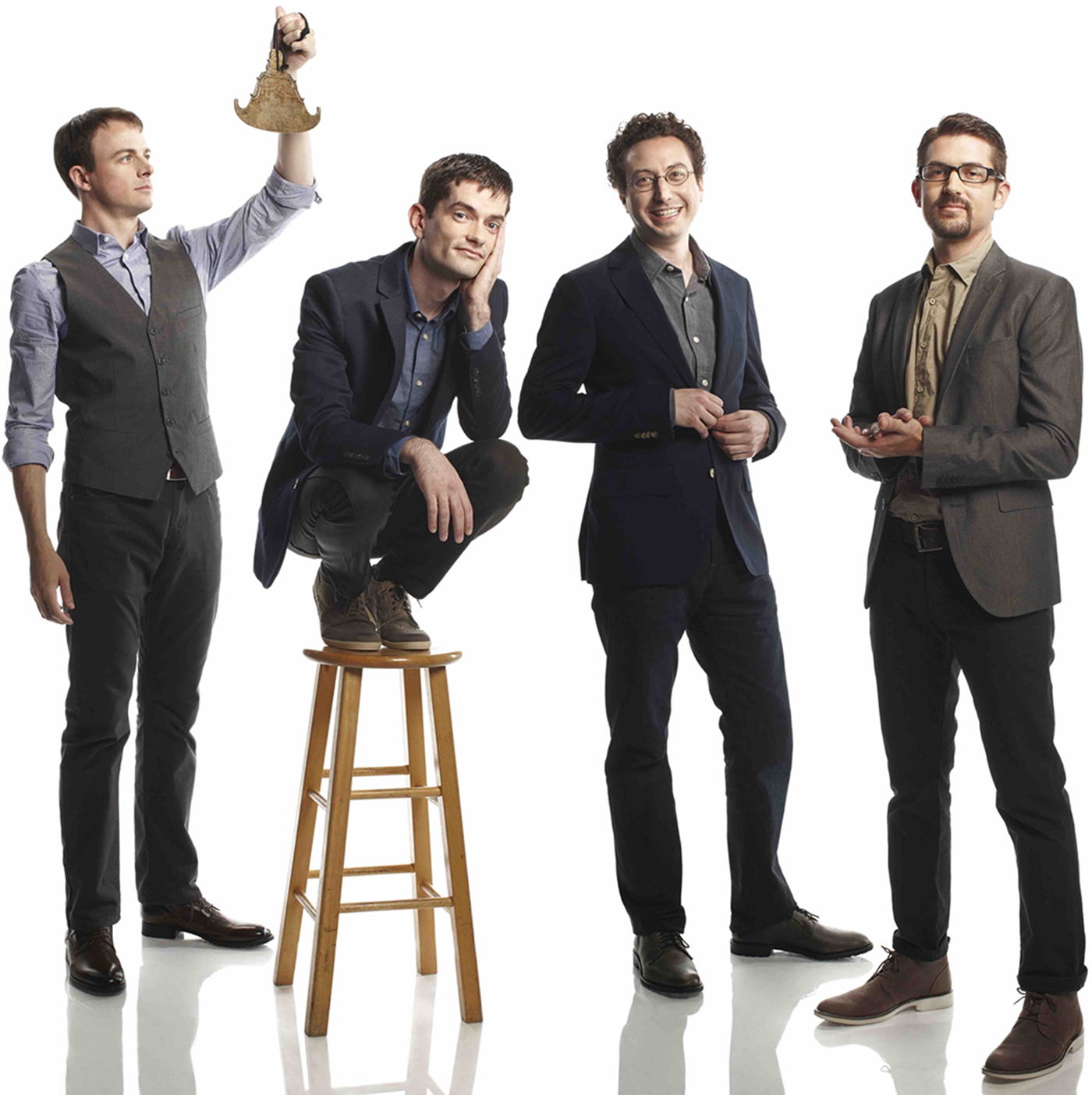
Ensemble Dal Niente publicity photo.

Eighth Blackbird publicity photo. Photo by Saverio Truglia. Used with permission.

The brands portrayed in these publicity photos and articulated in these bios all demonstrate an embrace of boundarylessness that has become widely celebrated in new/classical music. In many ways, ensemble members employ boundarylessness as a response to the stereotypical view that the musical academy is oriented towards a certain kind of ‘difficult’ music, that is, music comprising complex and difficult to discern processes. Susan McClary used this term to theorize the discourse surrounding music by composers engaged in an anti-populist justification for the inaccessible nature of their musical works. More recently, Robin has shown contemporary musicians responding to McClary's critiques while also seeking to express their personal musical tastes.Footnote 165 From the 1980s on, composers sought a more inclusive setting for musical practices. Boundarylessness became in part an index of a more stylistically diverse and generally welcoming scene than that found in demonized (and reductively stereotyped) musical institutions.
This anti-institutionalism manifests in all three ensemble's promotional rhetoric and brands; it is a central aspect of what ‘boundaryless’ means in this community. In ethnographic interviews, members of both Eighth Blackbird and Third Coast described to me a desire to portray the ensembles as somehow not ‘academic’. In an interview from 2015, Eighth Blackbird cellist and founding member, Nick Photinos, explained the ensemble's approach to me this way:
JP: Why do you think demeanor is important? Like, ‘casual’? Why is that an important part of [Eighth Blackbird's image]?
NP: I think that's a reaction to new music concerts that we've all gone to [where] everyone's wearing black and it's a very serious atmosphere and it's for academics only, and you're not allowed to laugh and just not wanting to have that experience ourselves in the concert hall, like not wanting to promote that. So, by casual I mean it's just that it's OK to laugh, it's OK to show emotion in the concert. If you clap in the wrong place we're not gonna stare at you. It's more of an attitude that we take as well in preparing this and having fun with it.Footnote 166
Former Eighth Blackbird employee Kyle Vegter offered such an assessment when I asked him to describe the group's brand in 2011:
It's them [Eighth Blackbird] playing really difficult music, really virtuosically. It's making new music more approachable. It's explaining the concepts behind new music. So I think it's breaking down the sort of like wall of classical music, the sort of big institutional wall that classical music has built for itself.Footnote 167
Robert Dillon, founding member of Third Coast Percussion, described his ensemble's brand to me thusly:
Summer of 2012, we did a branding campaign, which was like let's try to like have a good hard look at our identity and figure out what we wanna be. [For Third Coast Percussion] there's this element of real professionalism, and I think it's professional but welcoming. Like ‘this is worth your time. [Our] stuff is together,’ you know? But also we're nice guys. ‘Come talk to us,’ you know? And the music that we play is also like really well-crafted and high quality, but it's also like welcoming and cool, not in the sense of like happy music, but in the sense that like people can connect to it. It's meaningful and it's human, like there's no academic wall in a way. There's no prerequisites required to come to the concert and have a meaningful experience.Footnote 168
Dillon's invocation of a perceived boundary between the academy and the rest of the world echoes Vegter's use of ‘academic’, as well as Photinos's description of new music concerts as ‘academics only’ above. The desire to move beyond ‘academic’ illustrates the boundaryless aesthetic widely lauded in contemporary new music culture.
For Ensemble Dal Niente, ‘boundarylessness’ portrays the ensemble as true to the critical mission of much avant-garde music. In some ways, Ensemble Dal Niente has much in common with previous generations of new music ensembles who performed musical works unsupportable outside of an academic or institutional context.Footnote 169 The chamber orchestra has much stronger ties to the European avant-garde associated with Darmstadt and other institutional entities with composers who write precisely the kind of ‘difficult’ music identified by McClary. As a part-time ensemble, the group's members earn most of their incomes outside of their work with Dal Niente. Repertoire choices certainly reflect the interests of ensemble members, but they also demonstrate Ensemble Dal Niente's greater programming freedom. The ensemble gains considerable freedom to engage in eclectic projects exclusively, rather than chase down every potential gig, as the two full-time ensembles must. At the same time, the demands of foundations that award grants encourage the group to portray themselves as engaging as diverse an audience as possible.
Conversations with Ensemble Dal Niente members demonstrate a wariness of the kind of enthusiastic boundarylessness seen in the two full-time ensembles. Despite participating in a branding workshop similar to that of Third Coast Percussion, musicians struggled to articulate a coherent brand for Ensemble Dal Niente. Ben Melsky, executive director of the orchestra, put it this way:
We did this sort of like branding workshop, like, a summer ago we got this grant to work with these consultants … And what they came up with was ‘adventurous connections.’ I don't like it. I think it takes the stakes out too much. I think making connections is really important, but I think it doesn't do so necessarily with things that are adventurous. I think [Dal Niente] does so by taking risks. I think that's a different connotation. I think what's really important about Dal Niente is that fact that it's an organization that actually takes a lot of artistic risk that other artistic organizations don't take, because of financial reasons, for artistic reasons, because the personnel are not interested in doing it. I think that's crucial to us. But I think what I'm looking for is it's not only a risk, but it's a risk that we think is worth taking, like the value of the ensemble, the values of the ensemble are reflected in the different people that we, different projects and different composers that we present.Footnote 170
This emphasis on risk appeared only occasionally in conversations with Eighth Blackbird and Third Coast Percussion, partly because the two full-time ensembles had been able to invest more time in the construction of brands. To be clear, musicians in all three ensembles have played music they enjoyed and music that some members did not care for. In spite of the struggle to articulate a brand, Melsky and other Ensemble Dal Niente members felt compelled to provide a coherent narrative about the work of the ensemble, and especially to celebrate and emphasize the diversity of the types of music performed, as seen in the above-cited bio excerpt and in Melsky's emphasis on difference. While the aesthetic distinctions between the ensembles are well understood by members, Ensemble Dal Niente nevertheless deploys ‘boundarylessness’ as a marketing tactic in both print and image, a fact that demonstrates the importance of the concept to new music's marketplaces.
To sum-up, the boundarylessness touted by the three ensembles reinforces relatively recent goals important to the new and classical music institutions and presenters. In this context of a field actively seeking new ways to attract audiences, employ students, respond to a past of elitist music-making, and gain cultural relevance, the three new music ensembles of 4045 N. Rockwell emerge as attractive success stories. They have taken a repertoire that is difficult to play, broadly unknown, and frequently reviled and made it look cool. Incredible performances bear witness to musical prowess, and 4045 N. Rockwell emerges as a testament to their apparent financial success. Bohemian studio space can seem like evidence of musicians’ success in making it ‘in the real world’. Ensemble Dal Niente, Third Coast Percussion, and Eighth Blackbird can all afford to pay rent in an ostensibly self-supporting manner. True to the missions of boundaryless musical ensembles, they have used 4045 N. Rockwell for performances, fundraisers, and recordings, all things for which it was never designed, but that add an exciting energy to this space.
Publicity photos, snappy copy, and branding all consolidate ensembles’ goals and project a marketable identity. But these ensemble brands do more than that: they mask struggle. Promotional material does not tell the story of all the work that goes into getting to the rehearsal. It can gloss over the renting and moving of gear, the actual playability of parts, and the frustrations felt at various points in the production process. Online biographies do not show what it is like, for example, to move a bunch of equipment upstairs while two people are sick with colds and trying to figure out who will carry what suitcases on the plane that takes off at six a.m. tomorrow morning from O'Hare. To analyse that side of musical labour, I turn now to the struggle and challenges faced by the three ensembles.
Struggle
While members of the three ensembles enjoyed the benefits of the class shift described by Taylor, they struggled constantly in order to maintain the economic and social standing of their groups. They are all registered as 501(c)3 non-profit entities reliant on grants for specific projects. In the absence of the tenure-oriented employment associated with symphony orchestras, these ensembles often work either as freelancers or adjunct faculty, depending on the gig. The boundarylessness celebrated in both neoliberalism and classical music also meant that boundaries between personal and professional domains were often blurred, and work–life balance was often impossible. Ensemble members were themselves well aware of this challenge, and spoke of it openly. Michael Lewanski, conductor and co-artistic director of Ensemble Dal Niente, addressed the tenuous nature of the new music scene and of 4045 N. Rockwell. Writing for New Music Box in autumn 2016, Lewanski described the Chicago new/classical music scene and Dal Niente as an ‘instantiation of the contingent’.Footnote 171 By this, Lewanski explains in the article, he meant that multiple factors and forces – a pool of talented individuals, institutional support, and a certain DIY ethos – had come together to create a new music scene that was exciting but unstable. This description applies exceptionally well to 4045 N. Rockwell; it is, after all, a real ‘instantiated’ place. However, in contrast with purpose-built buildings such as Chicago's Symphony Center on Michigan Avenue, 4045 N. Rockwell also remains in many ways contingent and ever-changing. For Lewanski, instantiation of the contingent pertained both to repertoire and to work, to aesthetics and to labour, two separate but ultimately interwoven issues that shaped the fabric of daily life for him and many musicians:
It's hard to find funding. And while it's not hard to make a living (it's not as expensive as many East or West Coast metropolises), it's hard making a living in music in Chicago. There are only a few universities and full-time orchestras, and there are a lot of people.Footnote 172
While all three groups can point to exciting work that crosses the traditional generic boundaries of classical music, their respective budgets demonstrate strong ties to arts-funding institutions. About a third of Eighth Blackbird's and Third Coast Percussion's respective incomes come from grants and donations (‘contributed’), with the remaining two-thirds coming from gigs (‘earned’). Ensemble Dal Niente's split of contributed versus earned is closer to about 55 per cent contributed and 45 per cent earned. Economist Robert Flanagan has argued that the performing arts, and classical symphony orchestras especially, are endangered by a ‘cost disease’ wherein the cost of labour outpaces the growth of productivity.Footnote 173 Building on arguments of William Baumol and William Bowen,Footnote 174 Flanagan studied the budgets of the fifty largest symphony orchestras in the United States from 1987 to 2005. In his research, Flanagan consistently cites the division between earned and contributed as an indicator of overall financial health. Orchestras, he finds, have seen their earned incomes decline consistently so that, on average by 2005, only 41 per cent of income came from ‘earned’ sources such as ticket sales, royalties, and other market-based sources. In light of this finding, Eighth Blackbird and Third Coast Percussion would seem to perform quite well, given their high levels of income derived from earned sources, and Ensemble Dal Niente is at least about average which, given the historically low level of market interest in their repertoire, seems quite good.
However, viewing the budgets in the manner outlined by Flanagan misrepresents the nature of the three ensembles’ markets. Unlike orchestras who rely at least somewhat on ticket sales for revenue, the three ensembles usually earn fees regardless of the size of the audience. In general, all three ensembles secure fees guaranteed by the venue presenter. Furthermore, the venues in which the ensemble perform are usually themselves a part of a subsidized musical institution, either a school of music, or the concert series of a university. These venues themselves rely on grants and donations, both for individual concerts and for general operating expenses. It is more accurate, then, to understand the ensembles’ financial standing as based not the kind of open market in entertainment in general, but as reliant on a specialized market controlled by venue presenters, as a market with some autonomy from the vicissitudes of the broader US financial market. Viewed thusly, one could view all of the ensemble's income, with the exception of the small fraction from merchandise, as contributed.
Understanding the extent to which these ensembles rely on institutions raises interesting questions when considered in light of their boundaryless branding. In this light, Eighth Blackbird's and Third Coast Percussion's respective anti-academic rhetoric may seem inconsistent, or even duplicitous, and we might expect that such funded institutions might take offence at it. Music institutions, however, have tended to embrace these anti-institutional brands as part of their own self-marketing. Despite their anti-academic stances, for example, all three ensembles enjoyed residencies at the country's top schools and conservatories. Eighth Blackbird has been in residence for many years at the University of Richmond, while also working at the University of Chicago and the Curtis Institute. Third Coast Percussion has held residencies at the University of Notre Dame, and Dal Niente has been in residence for the June in Buffalo new music festival at SUNY Buffalo. These residencies vary in length and in curricular integration, but they routinely see all three groups teaching student performers and composers, giving masterclasses in performance strategies, and mounting elaborate productions.
These relationships suggest the extent to which various academic institutions themselves fear presenting a stodgy and overly specialized image. Rhetoric about creating students ready for the real world serves dominant neoliberal ideologies, which base success largely on financial prosperity. While altruistic or aesthetic values (playing music because it is valuable for human expression, for example) remain important, many music departments justify their existence in part through their ability to prepare students for work. Residency collaborations with these highly skilled and very successful ensembles reinforce the institutions’ abilities to market themselves as supportive of musical pursuits that extend beyond the academy and towards the market. Furthermore, such employment-oriented motives reinforce broader justifications of the arts as drivers of economic growth, a trend identified by several as indicative of neoliberalism's reconfiguration of values in general.Footnote 175
Where the distinction between earned and contributed can be problematic, the ensemble budgets do tell a consistent story: there is money to be made from the performance of new music. Budgets show that Dal Niente had earned around $250,000 each year; Third Coast Percussion's budget has fluctuated between $430,000 and about $550,000 over the past several years; and Eighth Blackbird's budget fluctuates between $800,000 and $1 million. This success has been hard won, and budget shortfalls always threaten the stability of groups, even for Eighth Blackbird. The three ensembles do work in a market, though that market is itself the product of individual donations, grants, and institutional support.
Securing gigs requires venue presenters to learn about an ensemble and understand what it does. As a result, ensembles must frequently introduce themselves to presenters over and over again. In part to facilitate this process, Eighth Blackbird and Third Coast Percussion have routinely attended annual gatherings of venue presenters and performers such as the Chamber Music America Conference in New York City and Arts Midwest. Third Coast Percussionist David Skidmore described attending these events to me in a 2014 interview, outlining a variety of levels of participation ranging from simply attending all the way to being hired as a paid performer. At Midwest, performing organizations can also rent a booth as a way to promote themselves to presenters from around the country. According to Skidmore:
it's a marketplace, so it's a very transactional environment, people come by literally looking to buy your product, so it's weird. [laughs] I mean it's really important and we've gotten really used to it and we're comfortable now. But you do stand there all day long just smiling at people as they walk by hoping that they, you know, will come and hire you.Footnote 176
Conferences offer numerous opportunities for both parties to meet and discuss possible projects, an important part in the struggle to make new music economically viable. Skidmore emphasized that, unlike traditional classical music ensembles such as string quartets, new music ensembles have to go to extra lengths to secure gigs:
You still have to be great at what you're doing, but as a string quartet you can win any one of like a handful of competitions and people will book you, because that probably means that you're really, really great. There are fewer such opportunities for non-traditional chamber music ensembles.
Anticipating the concerns of presenters, Skidmore described the folder of press materials Third Coast Percussion distributed to possible presenters:
[P]ress materials gives somebody an idea of who you are, so in our instance we have a folder with these really sleek things that we spend a lot of time on, like photos [and] bios, a list of where we played recently, quotes from the press, quotes from presenters who've worked with us, and then information about the residency activities that we do. And now, often we'll include sample tech riders because there are people who want to hire us who are afraid we're gonna be too much of a pain so we, you know, show those people that we're organized and that we're not gonna be as big of a pain as they think [laughs].
Thus, even for high-profile ensembles like Eighth Blackbird, securing gigs and creating projects requires substantial work as many venues seek extensive conversations with ensembles about what exactly the performers will play, what it sounds like, and how it fits with other programme offerings at that venue. One performer bemoaned this state of affairs, arguing that this quibbling over programmes happens only in classical music. A result of this constant process of negotiation is that the two full-time ensembles tend to perform new music viewed as somehow more audience-friendly. Rob Dillon of Third Coast Percussion described repertoire selection as ‘a type of “natural selection” which means that a program that interests presenters may be performed dozens of times, whereas another program we're also excited about may only get one performance, if presenters aren't getting on board’.Footnote 177 For Eighth Blackbird and Third Coast, this has meant more frequent performances of music by Steve Reich, as opposed to their other projects that might seem less accessible. To be sure, all three ensembles play a wide variety of music; Eighth Blackbird, for example, built much of its reputation within the new music field on staged or semi-staged performances of Schoenberg's Pierrot Lunaire. Third Coast Percussion has commissioned avant-garde dramatic works such as David T. Little's Haunt of Last Nightfall (2010), a work about the slaughter of villagers in El Salvador in 1981 by American-backed soldiers. However, these pieces appear less frequently in touring shows in part because of the need to negotiate with presenters. In this way, the market decides the boundaries to be crossed by these ‘boundaryless’ ensembles.
Understanding the gig negotiation process further illustrates how ensembles must negotiate professional boundaries. During my fieldwork with Eighth Blackbird, I worked with Eighth Blackbird's former managing Director Peter McDowell and founding member Matthew Duvall to draw up a chart outlining the steps that lead up to a gig (see Figure 10). For Eighth Blackbird, gigs could originate either from the group or from an outside source soliciting the ensemble members, from McDowell, or from their agent David Lieberman Artists. After initial conversations about tentative dates and repertoire, parties usually discuss fees and expenses. For Eighth Blackbird, the agent handles many, if not all, of the initial conversations. However, certain presenters might express interests in specific repertoire, which necessitates a conversation between one of the Eighth Blackbird performers, usually Nick Photinos, Lisa Kaplan, or Matthew Duvall. Sometimes gig opportunities would be set aside for a later date, or sometimes a project required the availability of external funds such as a grant or donor. Managing the labour required for gigs has led to performers taking on dual roles, operating both as musicians and as business agents of one kind or another. The general contours of the outline I created for Eighth Blackbird can apply to all three groups, with the removal of agents from the process. For each ensemble, gigs required at least several conversations, lasting anywhere from a few weeks to a few years, depending on the scope of the project (especially for multi-year residency activities).
Eighth Blackbird's gig flowchart, created by the author in consultation with ensemble members. This chart works for Third Coast Percussion and Ensemble Dal Niente, but without the mediation of booking agents.
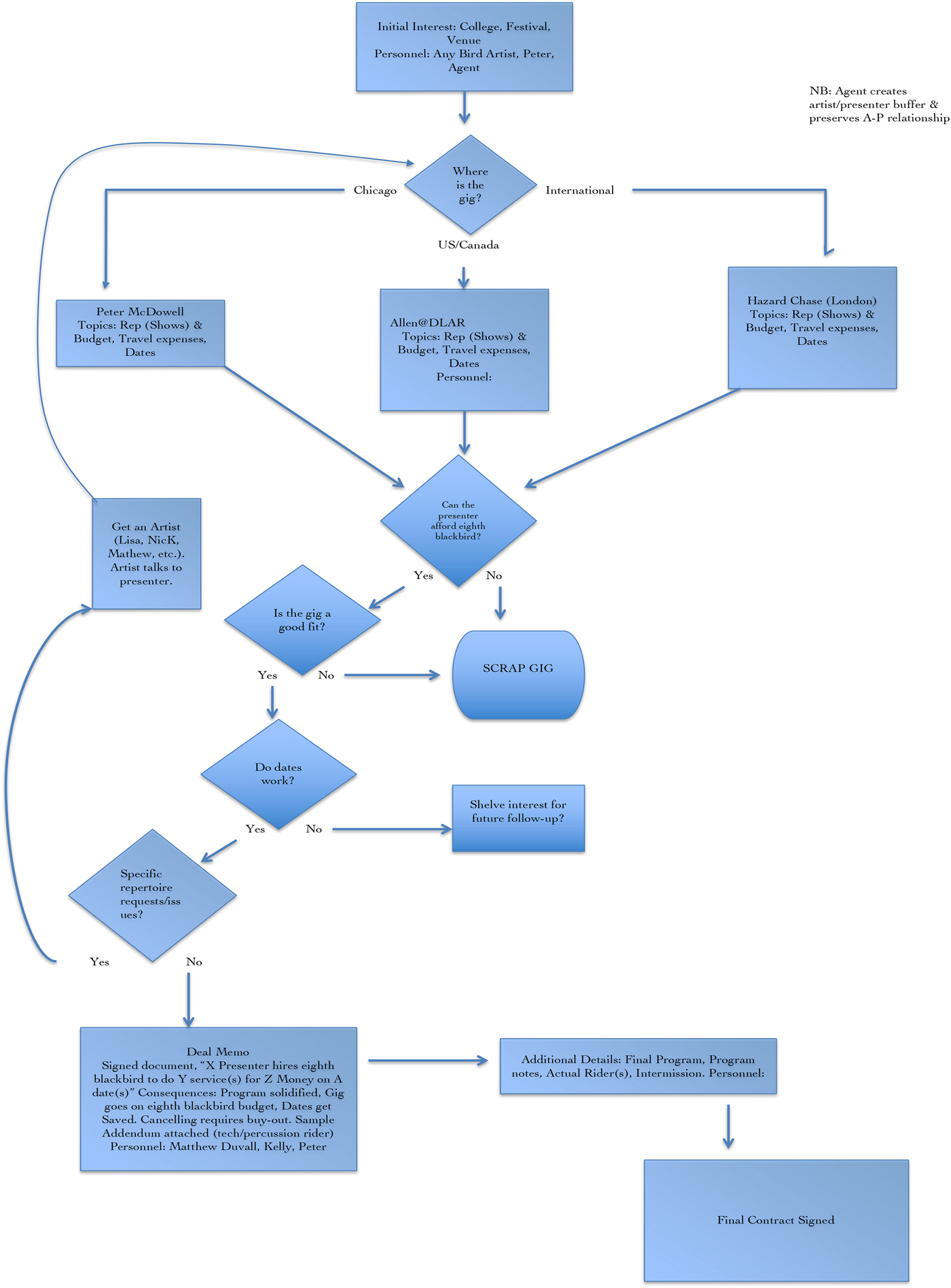
One of the working realities of this type of labour model meant that certain musicians were frequently managing the business of future gigs while on site at other gigs. During down time between rehearsals, for example, musicians often held conversations about future gigs. A good example of such a day came from my first day of fieldwork with Third Coast Percussion in 2014, shortly before the above-cited conversation with David Skidmore. I met the group at the University of Chicago's Rockwell Chapel where they played for the church's non-denominational service. Afterwards, the group held an informal ‘instrument petting zoo’ that allowed children to come play with some of the percussion equipment. I thanked the minister, Elizabeth, and got her card. She told me, ‘With a group like Third Coast, you can't go wrong.’ Load up after the event took over an hour, and was followed by a one-hour van ride back to Rockwell. David Skidmore was on the phone during much of the load up, busy working out the details of an upcoming gig. I had intended to set up interviews with Skidmore during the drive, but even in the van his phone never left his ear for long as he arranged to sub for Eighth Blackbird percussionist Matthew Duvall. When we finally arrived back at the studio, I offered to help David unload the van, an arduous process that involves squatting awkwardly to lift pieces of instruments onto the building's loading dock. At one point, I felt a muscle in my back spasm and I wondered if Third Coast has health insurance. All the instruments were re-assembled upstairs in preparation for tomorrow's rehearsal.
During this day I saw musicians at their most flexible, performing an ecumenical service, teaching children how to play a thumb piano, and promptly moving on to a rehearsal for the next gig, all the while managing the possibility of other performances and substituting with Eighth Blackbird. This kind of labour was a constant feature of my fieldwork with all three ensembles, and was succinctly summarized by Ensemble Dal Niente soprano Amanda DeBoer-Bartlett who noted one evening, ‘There's no sitting in new music.’
Besides the constant set-ups and tear-downs, life in 4045 N. Rockwell can also be a struggle. It is not beautiful, nor warm, nor especially waterproof. The rent has gone up most years. The acoustics are wonky at best: sound bleeds out when you want it to stay in an area, and concerts in the space can be acoustically unsatisfying, a challenge when playing, say, spectral music by James Tenney. Thus 4045 N. Rockwell is utopic only in a certain promotional context or in the sense that it affords musicians a degree of personal agency.
Despite the practical challenges posed by the building, many of musicians I interviewed often spoke with pride and are proud of their space. Matthew Duvall, founding member and percussionist in Eighth Blackbird, demonstrated this affection when he showed me around the then-new space in 2014, pointing out all the rooms they had, the storage space for percussion, and the potential for recording. Greg Beyers, percussionist in Ensemble Dal Niente, suggested that they could develop 4045 N. Rockwell into a dedicated artist's space with a major grant. He shared these ideas with me while we painted one of the walls in anticipation of the 2016 Dal Niente Party, held at the Rockwell Studios. One of the poster makers emphasized her pride to me in passing when she criticized a Chicago Tribune article that described the building as akin to a bombed out Soviet warehouse. As Figure 11 demonstrates, the spaces occupied by groups become highly personalized. They speak to some degree of success and inter-ensemble community. They become charged with meanings. In my fieldwork, I often returned to the building with a sense of eagerness, excited to see what I would find inside its paint-flecked walls.
Ensemble Dal Niente members embrace after the 2016 party held at 4045 N. Rockwell. Photo by the author.
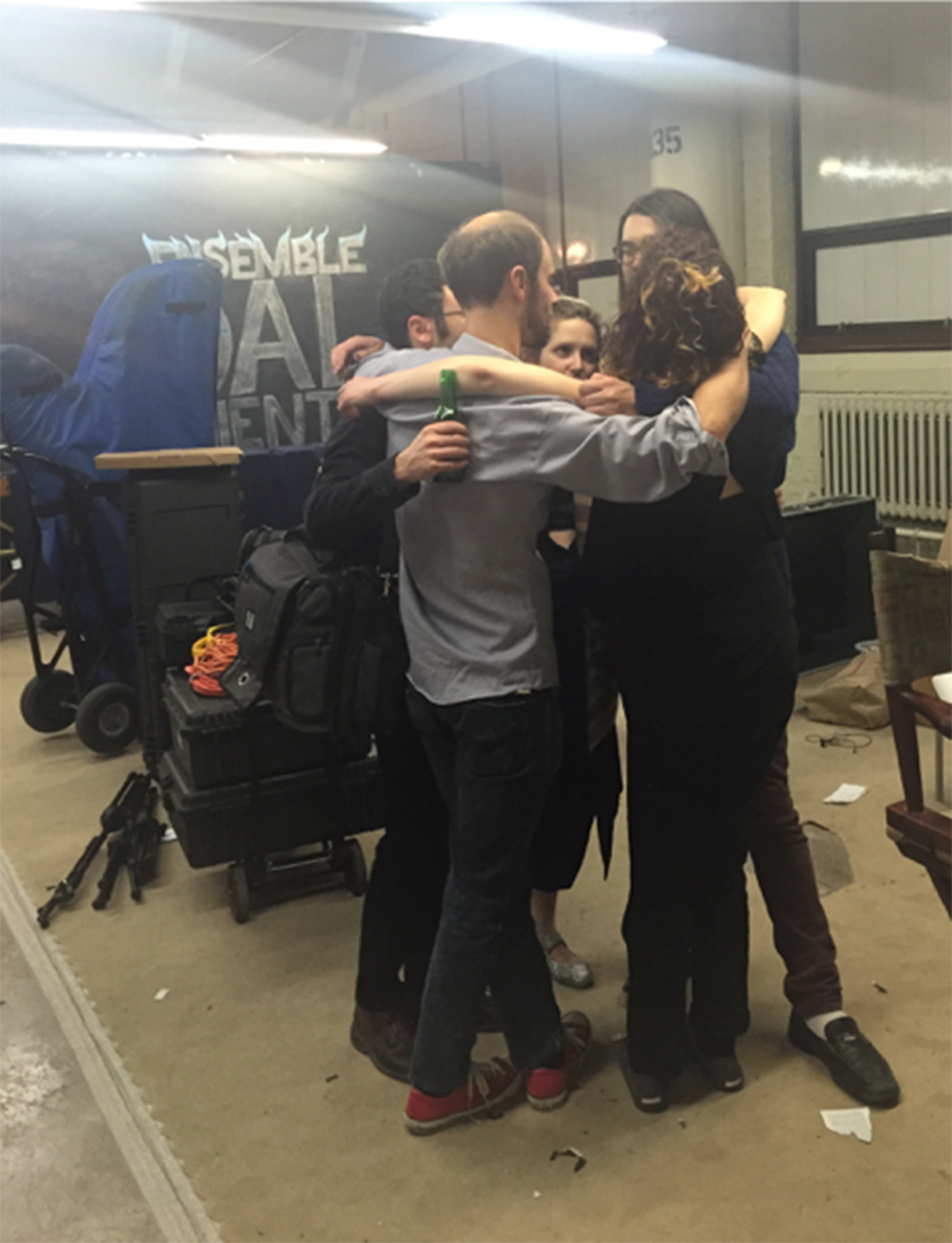
Conclusion
Revelry and struggle map onto a dichotomy between boundarylessness versus boundaries. Though I have isolated concrete examples of revelry and struggle, these qualities often appear simultaneously in actual fieldwork. A musician can be up one minute after a successful run-through and down the next when her smartphone alerts that she did not receive a much-needed grant. The boundary/boundarylessness dichotomy reinforces extant theorizations of neoliberalism in new music by drawing attention to the contrast between publicity materials and the actual working realities faced by musicians in all three groups.Footnote 178 Eighth Blackbird, Third Coast Percussion, and Ensemble Dal Niente each operate with a financial model similar to that seen in previous new music ensembles, relying heavily on institutional support instead of ticket sales.Footnote 179 However, where these previous ensembles figured as part of a project that supported new autonomous works of art, the three ensembles I study are celebrated and position themselves as engaged in a project of outreach and audience recruitment. This distinction suggests a shift away from a rigorous anti-populist stance of modernist composers seen in McClary's composers of ‘difficult’ music and towards promotion of musical works as broadly accessible. At the same time, musicians present themselves as producing art, and continue to rely on financial structures that are partially removed from a broader market, where ticket sales, for example, would measure professional success.
In the current institutional environment, musicians must demonstrate their marketability. As scholars such as McClary, Taylor, and Bernard Gendron have argued, disparate artistic genres now compete across generic boundaries, and succeed in part by their ability to traverse such boundaries.Footnote 180 Eighth Blackbird, Third Coast Percussion, and Ensemble Dal Niente still work in a regime of value that seeks to valorize art works as art, though a new orientation towards entrepreneurialism encourages ensembles to speak in market-defined terms. Despite reorientations in the notion of what can constitute ‘new music’, institutional presenters continue to have a strong say in what music gets performed.
This complex interplay of seemingly conflicting discourses constitutes the hegemony of the field. New music ensemble members and employees are not simply for or against neoliberalism.Footnote 181 Rather, they create narratives that appeal to aspects of neoliberal and historic artistic discourses, even when doing so potentially reconfigures the value of musical art. As a result of these contradictions, revelry and struggle are part of the daily life of these ensembles. Only by untangling their dual manifestation can we begin to understand the complexities of working in new music and the extent to which capitalism informs these practices. To do so requires that we recognize both the agency of individuals and the limits on their agency.
Abstract
My ‘Afterword’ considers the concept of boundaries, and what it means to claim their absence. On the one hand, the aspiration to ‘boundarylessness’ is liberating. ‘Genre-free’ music-making creates space outside of traditional institutions in which musicians can cultivate a non-hierarchical aesthetic that leads to artistic synergies. But institutions have the positive effect of amplifying human energy and power. They continue past the lifetime of individuals. Their lack is sorely felt in the precarious new music economy. ‘Boundarylessness’ as an attitude may open doors and minds, the authors of these contributions conclude, but ultimately it is a privilege. Moreover, the claim of boundarylessness masks the stubborn boundaries that remain in the new music scene, particularly those of gender and race.
‘Boundarylessness’ is the watchword of the new music scene today. This concept, reflecting in equal parts ‘branding’ and genuine belief, indicates a commitment to the equality of all musical genres and idioms, an openness to new forms of concert presentation, and a flexible (i.e. non-institutional) workforce. Above all, boundarylessness offers a welcoming and inclusive message. We are no longer invested in defending an exclusive terrain reserved for those who can identify pitch-class sets by ear, composers and performers of new music today proclaim. The top conservatory graduates that make up US-based groups, such as the International Contemporary Ensemble, Eighth Blackbird, yarn/wire, and Dal Niente (to name only a few), have put aside the old ‘contemporary music wars’ that once reigned between Uptown and Downtown, serial and tonal, classical and popular, notated and improvised music. New music groups today move freely across national borders, aesthetic hierarchies, genres, media, and styles. In doing so, they have built audiences and community, redefining how ‘new music’ is perceived.Footnote 182
The four authors in this Forum offer critiques of the utopian claim that there are no more boundaries. In detailed interpretive case studies, they look beyond the ‘branding’ to investigate the economic and social conditions that have shaped new music from 1989 to today. If, in traditional arts ecosystems, power was exerted by large organizations, today, in our infinitely more dispersed and atomized cultural environment, individuals and small groups are increasingly ‘going it alone’, by necessity and by choice. The freedom of choosing your next project, the limitless possibilities of digital media, and the passionate commitment of these musicians has led to a stunning resurgence of new musical production, as Judith Lochhead writes in ‘The New Music Scene: Passionate Commitment in the Twenty-first Century Gig Economy’. But having freed themselves of all sorts of limiting baggage as well as from their regular pay cheques, musicians are ‘reveling in the rubble’, in Susan McClary's memorable phrase (quoted in John Pippen's contribution to this Forum). Their ‘entrepreneurship’ is just another form of the hustling for gigs that musicians have always done.Footnote 183 Boundaries are not just aesthetic and economic. In ‘Art-Religion for a Global New Age’, Andrea Moore describes how Asian musicians living in the West (her example is Tan Dun) are said to be ‘developing a tradition “without national boundaries”’, building successful careers as ‘flexible citizens’ in a purportedly egalitarian globalized economy, and providing an ersatz spirituality to a population steeped in secular affluence. In ‘Conducting Business’, Marianna Ritchey shows how, even as the economic support for any kind of non-commercial music has been hollowed out (especially since the Great Recession of 2008–09), the corporate world has disingenuously appropriated classical music culture in its advertising as a trope of innovation and teamwork. In an age in which there seems to be no more boundaries, these contributions show, it turns out, they have only been redrawn. Pippen's contribution, ‘The Boundaries of “Boundarylessness”: Revelry, Struggle, and Labour in Three American New Music Ensembles’, speaks directly to this point.
These analyses are offered, I believe, with complete sympathy for musicians in their efforts to realize their artistic visions and build careers in an unforgiving environment. The critique is structural. Whereas the labour of a musician usually is thought to consist of perfection of their art in order to create polished performances, musicians today must also fill the vacuum left by absent or failing institutions. Today's new music groups have to take on the roles formerly played by publishers, newspapers, radio stations, recording companies, and concert venues. The lack of institutional structures is a big hole to fill, and it is to the enormous credit of these groups that some manage to make it work, by dint of spectacularly good musicianship, alert management, and a steady reliance on university residencies, as Pippen shows in his study of Eighth Blackbird, Third Coast Percussion, and Ensemble Dal Niente.Footnote 184
What does it actually mean to claim the absence of boundaries? In one sense, it is a declaration of freedom from rigid labour practices. Certainly many musicians perceive new music subculture as a liberation from the conservatory routine that most of them come from. Not having work on the clock, as professional orchestras do, enables better-rehearsed performances and more interesting project-based work.Footnote 185 The proclamation of ‘boundarylessness’ is also a rhetorical move that asserts that one is not beholden to the powers that create the boundaries. ‘“Classical” and “jazz” are business terms’, explains composer and pianist Vijay Iyer, merely a ‘convenience’ set up long ago for the marketing of music.Footnote 186 ‘Genre-free’ music-making, therefore, creates space outside of traditional institutions in order to allow a practice in which musicians of different traditions can work together. Moreover, as Pippen explains, ‘[b]oundarylessness became in part an index of a more stylistically diverse and generally welcoming scene than that found in demonized (and reductively stereotyped) musical institutions’. The old hierarchies of taste and privilege have been suspended, the term implies; we welcome all audiences, even those who do not traditionally attend new music concerts.
Have all musical hierarchies really tumbled in recent years, pulled down like Confederate statues? What are the implicit rules for participation in this open, non-hierarchical, ‘boundarylessness’ aesthetic and political space?
Boundaries separate discrete, adjacent territories. They may be marked by invisible lines on a map, by physical borders, or by walls. A boundary designates the separated areas as different from one another, even if the difference is only arbitrary (such as when a border is drawn through a previously unified region). Walls are used to physically separate populations, often against their will – or else there would be no need for one. Political boundaries are a demonstration of power. Musical boundaries are also a result of negotiations about power and influence, as they uphold aesthetic hierarchies, usually those in which more prestigious types of music mirror the tastes of the affluent.
Yet the presence of a boundary (perceived or real) also indicates that the territories are adjacent to each other. Neighbours react to, and (if allowed) interact with each other. Even the most heavily policed borders, such as the Berlin Wall, had crossing points. Boundaries behave dialectically: the presence of a boundary, even a blurry one, tends to accentuate the differences between the territories, but it also encourages a heightened attention to and knowledge of the other, and often a desire to cross over the boundary. (The motto of the Boston Modern Orchestra Project, ‘Music Formerly Known as Classical’, names the boundary while simultaneously proclaiming its distance from it.)
The most interesting new music today aims not just to do better performances, but also to reframe the concert experience, emphasizing collaboration, improvisation, audience participation, theatrical elements, and other means that provide a shared sensory experience as a respite from the virtual world.Footnote 187 At the same time, the larger culture still clings to nineteenth-century notions of the idealized Great Composer, Great Work, and Great Conductor, and Ritchey's contribution shows how the corporate world uses these familiar ideological tropes about classical music to its advantage.
One reason why the musical boundaries of yesteryear were perceived so strongly was that New Music's institutions used to be more robust. They also tended overwhelmingly to support the most elite forms of high art music. Nonesuch Records established a distinctive new music catalogue under the visionary leadership of Theresa Sterne, the State Department financed tours for classical composers, the Rockefeller Foundation supported the Louisville Orchestra, and the Fromm Foundation, Perspectives of New Music – there are many other examples. Any organization, business, or association will have specific purposes and goals, while excluding others. There will be priorities for its spending and fund-raising, a geographical or national focus, a desired clientele or audience, and perhaps a building or campus whose design affects how people interact. Institutions of all types have traditions and ‘ways of doing things’, and they may get in a rut or go off track. But institutions have the positive effect of amplifying human energy and power. They continue past the lifetime of individuals. It is not clear yet what kinds of institutional models will emerge to provide steady financing and long-term continuity for current and future new music groups. But whatever they may be, they will set boundaries of their own choosing and operate within them.
Some boundaries are harder to remove than others. Like classical music in general, the new music scene still exhibits massive disparities in terms of race and gender. New music audiences, composers, performers, and supporting institutions are overwhelmingly white.Footnote 188 Yes, Julius Eastman is finally being recognized, twenty-nine years after his untimely and tragic death. And Ornette Coleman, Henry Threadgill, and, most recently, Kendrick Lamar have been awarded Pulitzer Prizes in composition for their visionary works.Footnote 189 But prizes do not help those who are not taken seriously to begin with. For George Walker, the first African-American composer to win the Pulitzer (in 1996, for his Lilacs for voice and orchestra), the prize had no effect, as he related in a 2015 interview: ‘[N]ot a single orchestra approached me about doing the piece or any piece … It materialized in nothing.’Footnote 190 More than twenty years ago, George Lewis made a powerful case for acknowledging African-American contributions to new music in the twentieth and twenty-first centuries. In doing this we also need to reconfigure traditional notions of what constitutes ‘new’ or ‘experimental’ music, Lewis emphasized, and ask whose voices are being heard.Footnote 191
While women are well represented among composers and performers of new music, there has been increasing attention to the disparities of opportunity and barriers to full access for female and non-binary participants in the new music scene. Organizations have borrowed the lingo of Silicon Valley startups seeking venture capital (using descriptors such as ‘innovative’, ‘disruptive’, ‘creative’, ‘adventurous’, ‘breaking rules’), a vocabulary that favours stereotypically male traits.Footnote 192 Austrian composer Olga Neuwirth, whose works have been performed at top venues in Europe and the United States, characterizes the new music scene as ‘still white, male, and patriarchal’, like classical music in general.Footnote 193 In 2016, American composer Ashley Fure published her research on the number of works by male and female composers that had been performed at the Darmstädter Ferienkurse (Darmstadt Summer Courses) since its founding in 1946.Footnote 194 The massive gender disparity that she revealed, while predictable, was a controversial issue during the festival that summer. Fure subsequently co-founded the organization Gender Relations in Darmstadt (GRID), which has morphed into the broader-based Gender Relations in New Music (GRiNM).Footnote 195 In a powerful essay recounting her experiences, Fure points out that greater inclusion is good for the health of the culture. Referring to women composers, she writes, ‘The canon needs us.’Footnote 196 There has been a lot of discussion on this topic recently, and maybe a little progress, but there is still a long way to go.Footnote 197
So evidently all the boundaries have not yet been eradicated, music or in life – nor could they ever be. ‘Boundarylessness’ as an attitude opens doors and minds, the authors of these contributions conclude, but ultimately it is a privilege. Moving freely around the world can be fulfilling for individuals voluntarily pursuing work opportunities, education, or a forum for their art. But involuntary migration – from a war-torn nation, for example – is a different story. Stopped at the barbed-wire borders of Hungary in 2015, or the US-Mexican border in 2018, a refugee from war and hardship is not living in a boundaryless world. The migrant is not allowed to be a ‘flexible citizen’, as Moore points out (quoting Aihwa Ong). Boundarylessness is a privilege of citizens of affluent First World countries, who are positioned to enjoy ‘unlimited global choices’ (Moore). Those working from this position, such as Tan Dun, are free to move around the world and to explore any musical culture they desire, but the reverse is not true. It is no accident that multi-cultural musical organizations such as the Silk Road Ensemble and the West-Eastern Divan Orchestra are based in the United States and Germany, respectively.Footnote 198 Johannes Kreidler's controversial performance art piece Fremdarbeit (Outsourcing) of 2009 illustrated the conundrum with stunning (if somewhat tasteless) clarity. Even if musical compositions are not usually outsourced to cheap labourers in China and India, as Kreidler claimed to have done to create the work, the piece unveiled the privileged position of the white European composer. At the same time, Kreidler raised fundamental questions about originality, authorship, and the power structures behind new music, and the work continues to be debated today.Footnote 199
The four authors in this volume ask important questions: Who gets to be a composer? What counts as new music? Who gets to decide? Rather than restricting their view to musical works and performances, attempting to label whatever the new ‘-isms’ might be, they combine musicological, historical, and ethnographic methods to uncover the economic and social factors behind new music production in the twentieth and twenty-first century, pursuing the problem in all its dialectical complexity. These authors, along with other scholars today, are charting out a new research area that focuses on the newest music in innovative and unorthodox ways. Theodore W. Adorno wrote that the musical past can only be accurately perceived from the vantage point of new music.Footnote 200 Not because newer is better, or because it is okay to be anachronistic, but because the structures and conditions that come into view when analysing current music require us to reassess the structures and conditions of the past. In defining the ‘boundaries of the new’, boundaries of all kinds can be redrawn in a new historiography of past and present.


