Estimates on the prevalence of extended-spectrum beta-lactamase–producing Enterobacteriaceae (ESBL-E) carriage at hospital admission in the Netherlands range from 4.2% to 8.6%.Reference Reuland, Al Naiemi and Kaiser 1 – Reference Platteel, Leverstein-van Hall and Cohen Stuart 5 Infections with ESBL-E are associated with increased rates of morbidity and mortality, increased treatment costs, and prolonged hospital stays.Reference Schwaber, Navon-Venezia, Kaye, Ben-Ami, Schwartz and Carmeli 6 – Reference Maslikowska, Walker and Elligsen 8 Hence, healthcare-associated outbreaks with these microorganisms are feared. Many outbreaks in hospitals with ESBL-E have been reported.Reference Paterson and Bonomo 9 Outbreaks in rehabilitation clinics, however, have been reported less frequently. It is unclear whether these outbreaks are indeed rare, whether they occur but remain unnoticed, or whether they are just not reported. Nevertheless, the potential risk of nosocomial spread in rehabilitation centers is expected to be high due to the presence of shared rooms and patients sharing facilities and medical devices for a prolonged period of time. In addition, the need for intensive personal care and psychological vulnerability of rehabilitating patients challenge the containment of outbreaks.
We report an outbreak of ESBL-producing Klebsiella pneumoniae (ESBL-K. pneumoniae) that occurred in a rehabilitation center in Rotterdam, Netherlands, in 2016. Our description focuses on (1) the microbiological analysis including source identification and (2) the outbreak measures taken in the context of the rehabilitation setting.
Materials and methods
Setting
The Rijndam Rehabilitation Center specializes in complex rehabilitation and has 123 beds with 34,578 clinical admission days in 2016. The outbreak took place on a 40-bed ward for patients with spinal injuries and other complex chronic impairments. Each week, 1–2 patients are newly admitted, with an average length of stay of 79 days in 2016. The ward consists of 12 multiple-occupancy rooms (4-bed rooms [n = 4] and 2-bed rooms [n = 8]), 8 single-occupancy rooms, 10 bathrooms, 1 room for physical and occupational therapy, and 1 room for consuming meals and recreation. Due to spinal cord injuries, many admitted patients to this ward have a neurogenic bladder and bowel function and are therefore at risk of incontinence for urine and feces. There is no exchange of nurses, physicians and patients between wards. Hand hygiene compliance rates on this ward from August to December 2016 ranged from 69.5% to 76.2%.
Start of the outbreak
The outbreak investigation started in October 2016 with the identification of 3 ESBL-K. pneumoniae isolates from clinical cultures of 3 patients on the same ward. Multiple-locus variable number tandem repeat analysis (MLVA) and amplification fragment-length polymorphism (AFLP) showed that 2 of the 3 isolates had identical genotypes (the “outbreak strain”). This finding led to the screening of 36 other patients admitted to the ward. Among these, 7 additional patients colonized with an ESBL-K. pneumoniae were identified, and 6 of the isolates were genetically indistinguishable from the outbreak strain.
Case identification and definitions
A case was defined as a patient colonized or infected with ESBL-K. pneumoniae, genetically indistinguishable from the outbreak strain determined by MLVA and AFLP, isolated from any specimen during the study period. Cases were identified by screening for ESBL-E, using a rectal and throat swab from all patients, an optional wound swab, and a urine sample if an indwelling urine catheter was present. Patient data were retrospectively collected from the electronic patient records of Rijndam Rehabilitation Center and the laboratory information system of the department of Medical Microbiology and Infectious Diseases of the Erasmus MC University Medical Center (Erasmus MC).
Routine infection control measures
Infection control guidelines of Rijndam Rehabilitation Center are based on the Dutch Working party for Infection Prevention (WIP) guidelines.Reference Kluytmans-Vandenbergh, Kluytmans and Voss 10 Patients colonized or infected with ESBL-E are placed on contact precautions in a single room. Contact precautions include wearing a disposable gown and gloves before touching a patient or the patient’s immediate environment, in addition to basic infection control measures, such as disinfection of hands and wrists with alcohol-based hand rub according to ‘My Five Moments for Hand Hygiene’ defined by the WHO. 11
Microbiological methods
Sterile cotton swabs with Amies medium without charcoal (Copan, Brescia, Italy) were used for the ESBL-E screening cultures from patients and the environment. The swabs were directly plated on Brilliance ESBL agar (Oxoid, Basingstoke, UK) and incubated for 2 days. For culturing cotton cloths, tryptic soy broth (TSB) with 50 mg/L vancomycin and 2 mg/L ceftazidime was used as a selective-elective medium. After overnight incubation at 35°C, 10 µL broth was subcultured onto ESBL agar. Identification of bacteria was performed with MALDI Biotyper (Bruker Daltonik GMbH, Bremen, Germany). Susceptibility testing was performed using VITEK2 (bioMérieux, Marcy l’Etoile, France), and clinical break points were interpreted according to EUCAST guidelines (bacteria version 6.0). ESBL production was confirmed in isolates with reduced susceptibility to cefotaxime and/or ceftazidime (minimum inhibitory concentration [MIC] >1 mg/L) using the combination disk-diffusion method (ESBL + AmpC Screen Kit; Rosco Diagnostica, Taastrup, Denmark).
Molecular typing and clonal relatedness
We performed MLVA according to the method of Brink et al (2014)Reference Brink, von Wintersdorff and van der Donk 12 with minor modifications, and we performed AFLP according to the method of van Burgh et alReference van Burgh, Maghdid and Ganjo 13 with minor modifications. We used HpyCHIV4 and MseI restriction enzymes in combination with a selective G residue for HpyCHIV4 and GG for MseI. Selected ESBL-K. pneumoniae isolates from patients and environment with identical MLVA and AFLP genotypes, but with different susceptibility to gentamicin, were subjected to whole-genome multilocus sequencing (wgMLST) on a MiSeq platform generating 2 × 150 bp reads. Sequences were assembled using CLC Genomic Workbench version 10.0.1 software (Qiagen Bioinformatics, Venlo, Netherlands) and were subsequently analyzed using SeqSphere software version 4.0.0 (Ridom GmbH, Münster, Germany). The presence of plasmid sequences was evaluated using the online Plasmidfinder tool.Reference Carattoli, Zankari and Garcia-Fernandez 14 Resistance genes were identified using the online Comprehensive Antibiotic Resistance Database (CARD).Reference Jia, Raphenya and Alcock 15
Ethics statement
Written approval to perform this study was received from the Medical Ethics Research Committee of the Erasmus MC (MEC-2015-306) and from the research coordinator and director of Rijndam Rehabilitation Center (2017FS050_2016FS039).
Results
Course of the outbreak and outbreak measures
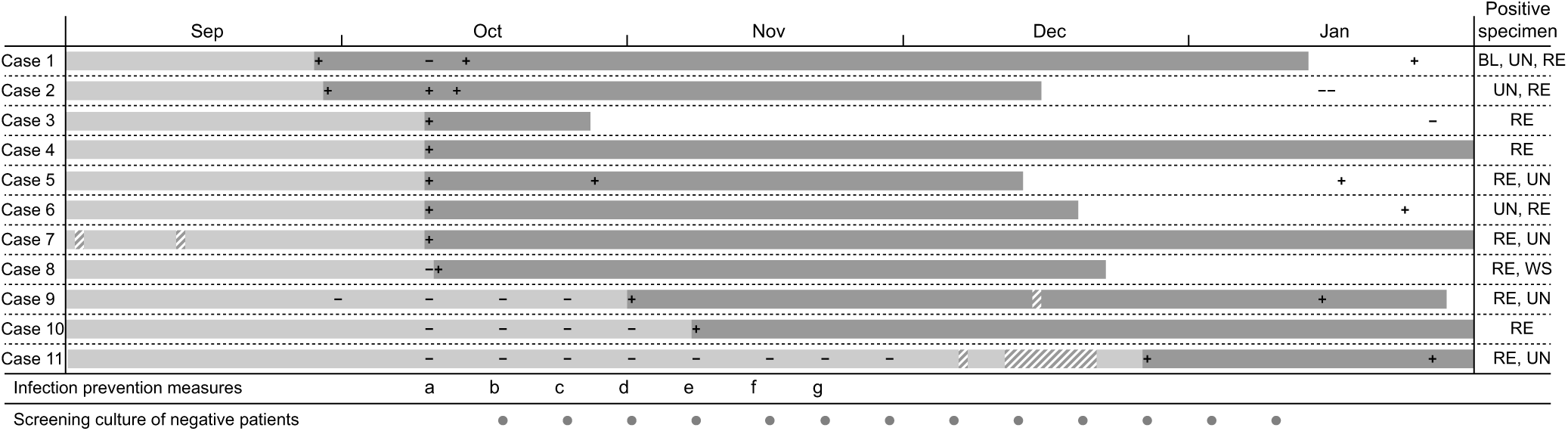
The outbreak management team (OMT), composed of a clinical microbiologist, an infection prevention practitioner, medical staff from the ward, a communications consultant, and representatives of the management board of the rehabilitation center, decided on the following specific outbreak measures: (1) Environmental samples were obtained by swabbing designated sites in the direct patient environment (ie, doorknobs, hand wash basins, light switches, shower chairs, and shower mats) as well as in the therapy and recreation room, kitchen, and staff rooms to identify possible reservoirs for ESBL-K. pneumoniae. (2) The entire ward was cleaned and thereafter disinfected using a chlorine-based disinfectant 250 ppm (for large surfaces) or 70% alcohol (for small surfaces). (3) Due to a limited number of single rooms, patients with the outbreak strain were cohorted. Bedroom doors were provided with instruction posters for contact precautions for healthcare workers and visitors. (4) Patients who had been nursed in the same room as an unexpected case (contact patients) and patients not colonized with ESBL-E demonstrated by culture were screened for colonization once weekly during the outbreak period. Awaiting results of the cultures, we did not isolate these contact patients. (5) Because the outbreak measures were time-consuming for the healthcare workers, we decided to stop admitting new patients during the first 4 weeks of the outbreak. During this period, 2 additional cases were identified, upon which extra outbreak measures were taken. Audits of high-risk processes were performed and infection control measures were reinforced following observation of personnel on the ward by infection control practitioners. In the following 6 weeks of weekly surveillance, no additional cases were identified. The outbreak ended after 8 weeks, after 3 weeks of no additional cases. Outbreak cases remained in contact isolation—in private rooms when possible—as long as they were admitted, despite any successive negative cultures. Two weeks after the outbreak ended, the outbreak strain was unexpectedly found in an additional patient. This patient had missed the previous 2 weekly monitoring cultures due to a hospital admission for 10 days because of a pneumonia. The OMT postulated that this patient had acquired the outbreak strain previously, prior to hospitalization, and that antibiotic treatment had resulted in selection of the outbreak strain to a detectable level. Therefore, no reinforced infection control measures were taken. Overall, the outbreak strain was found in 11 patients (Fig. 1). Cases 1 and 2, from whom the outbreak strain had been recovered from clinical samples, had clinical symptoms of infection (ie, urosepsis and urinary tract infection). The other nine cases were considered colonized. Three other patients carried a unique genotype ESBL-K. pneumoniae.
Timeline of admissions to the rehabilitation ward of patients colonized or infected with ESBL-K. pneumoniae outbreak strain. Light grey bar, patient is admitted without having a culture with the outbreak strain. Dark grey bar, patient is admitted and known to be either colonized or infected with the outbreak strain based on a positive culture. Diagonally striped bar, admitted to Erasmus Medical Center, an acute-care hospital nearby the rehabilitation center. No bar, discharged. (a) Screening culture of all patients; (b) cleaning and disinfection of ward, cohorting of patients, audit and environmental cultures; (c) taking washing machine temporarily out of service for feces-contaminated medical aids and clothes; (d) reinforcement of laundering protocol; (e) environmental cultures; (f) audit of high-risk processes; and (g) extensive cleaning of sanitary rooms. Note. BL, blood; UN, urine; RE, rectum; WS, wound secretion.

Extended measures based on environmental cultures
In total, 163 environmental cultures were taken. Only the cultures taken from a single household washing machine (designated machine A) tested positive for the outbreak strain. The outbreak strain was repeatedly cultured from the filter and inner surface of this household washing machine (varioPerfect iQ700, WM14S443NL, Siemens, Germany) present on the ward. When this result was presented in the OMT, it became clear that the rehabilitation center applied a “no-absorbent material or diaper policy” to reduce the risk of developing pressure ulcers. Consequently, lifting slings and patient clothing were frequently soiled with feces, which were washed in machine A, with a laundry detergent without activated oxygen bleach (AOB) often at low temperatures (ie, 30–40°C), despite the existing protocol demanding a minimal temperature of 60°C. The clothing was air dried in an unventilated room. The OMT decided on taking this machine temporarily out of service. In addition, samples of another household washing machine (designated machine B) present on the ward (used for washing non–feces-contaminated personal clothing) and a professional washing machine (machine C, which was used for bed linen and towels) were cultured for ESBL-producing microorganisms. Machines B and C repeatedly tested negative for the outbreak strain.
Proving the washing machine as a potential source of transmission
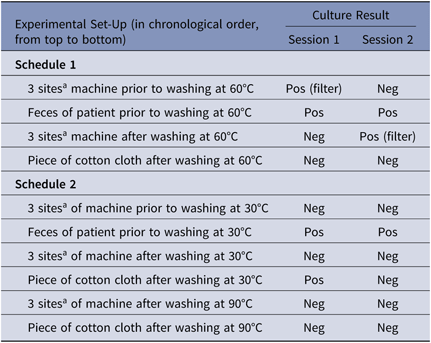
An experiment with machine A was designed to (1) investigate the potential role in transmission of the outbreak strain and (2) design a laundering protocol without risk of transmission of ESBL-E. This experiment (Table 1) consisted of 2 different schedules performed twice (session 1 and 2). We obtained 40 samples of several sites of the machine and feces-contaminated cotton cloths from an outbreak case during the laundering schedules and cultured them for ESBL-K. pneumoniae. The machine, including the filter, was not additionally cleaned prior to the experiment. In session 1 of schedule 2, the cloth remained ESBL-K. pneumoniae positive after laundering at 30°C. After laundering at ≥60°C in both schedules, the ESBL-K. pneumoniae was not detected in the cloth. However, in session 2 of schedule 1, the ESBL-K. pneumoniae was detected after washing at 60°C in the filter of the machine, a site where debris may also accumulate. Because the filter is situated downstream of the basket in which the clothes were placed, the risk of contamination from the filter to the basket in the consecutive laundering cycle was considered very low. In response to the finding this suspected source of transmission, a reinforced laundering protocol was implemented. Clothing of and medical aids used by different patients had to be washed separately, on the full wash cycle time at ≥60°C. In exceptional cases, in which certain clothes could not be washed at 60°C, 30–40°C was allowed, only if an additional ‘empty’ basket washing program at 95°C was performed subsequently. Due to compliance issues, this exception was prohibited after a few months. Finally, the rubber ring and exterior surfaces of the door and buttons had to be cleaned and disinfected after every washing program.
Washing Machine Experiment With Feces-Contaminated Clothes of a Patient Colonized With the ESBL-K. pneumoniae Outbreak Strain

Note. Pos, positive; Neg, negative. Experiments were carried out with washing machine A.
a (1) Filter: drain pump filter and water filter; (2) inner surface: rubber and basket; and (3) outer surface: control buttons, door handle and detergent drawer.
Outbreak cases and microbiological findings
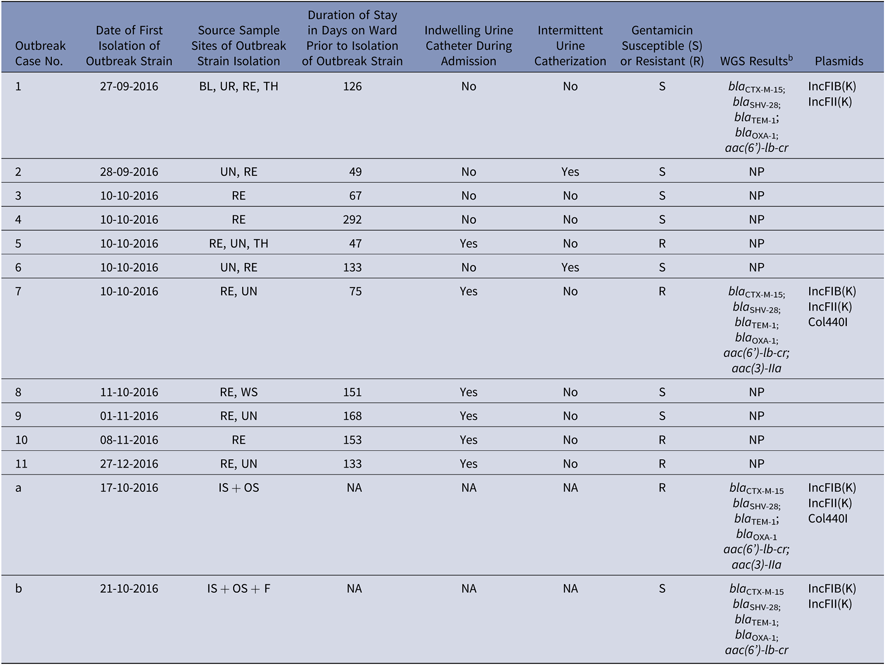
Although the ESBL-K. pneumoniae isolates found in the outbreak cases and machine A showed identical AFLP and MLVA patterns, susceptibility to gentamicin differed (Table 2). Therefore, a gentamicin-susceptible and gentamicin-resistant clinical isolate as well as 2 environmental isolates were selected for additional typing using wgMLST. The results showed that all 4 isolates were of sequence type (ST)307. The isolates susceptible to gentamicin (MIC ≤ 1 mg/L) cultured from machine A and patient 1 (Table 2) were genetically very closely related, differing in 3 core genes. The isolates resistant to gentamicin (MIC, >8 mg/L), cultured from machine A and patient 7 (Table 2) were also closely related with differences in only 5 core genes. Despite the fact that all isolates were of ST307, the gentamicin-susceptible and gentamicin-resistant clusters differed in 39 core genes, which is beyond the defined cluster alert of 15 differences. Genome analysis using CARD revealed that all 4 isolates contained the ESBL-genes bla CTX-M-15 and bla SHV-28, and also the aac(6’)-Ib-cr gene, conferring resistance to tobramycin, amikacin, kanamycin, ciprofloxacin, and norfloxacin.Reference Robicsek, Jacoby and Hooper 16 Notably, the gentamicin-resistant isolates carried an aac(3)-IIa gene, which is described to confer resistance to gentamicin.Reference Jana and Deb 17 , Reference Ramirez, Traglia, Lin, Tran and Tolmasky 18 Moreover, the gentamicin-resistant isolates carried an additional plasmid that was not present in the gentamicin-susceptible isolates.
Outbreak Casesa and Environmental Isolates
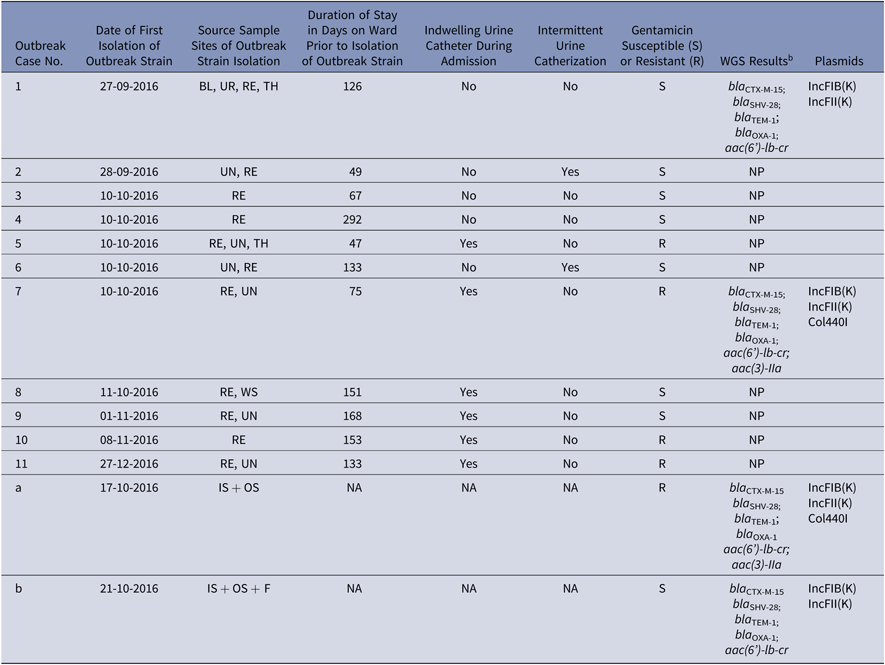
Note. UN, urine; RE, rectum; TH, throat; BL, blood; WS, wound secretion; IS, inner surface of washing machine A (ie, rubber and basket); OS, outer surface of washing machine A (ie, control buttons, door handle and detergent drawer); F, filter (ie, drain pump filter and water filter of washing machine A); NA, not applicable; NP, not performed.
a Patients infected and/or colonized with the ESBL-K. pneumoniae outbreak strain.
b Only resistance genes are shown, conferring resistance to beta-lactam antibiotics and aminoglycosides.
Discussion
An outbreak of an ESBL-K. pneumoniae ST307 occurred on a single ward in a rehabilitation center, and the household washing machine used for laundering feces-contaminated patient clothing and medical aids played a key role in transmission of the outbreak strain. The following findings support this hypothesis: (1) The household washing machine was repeatedly positive for the outbreak strain during the outbreak period. (2) Prior to recognition of the outbreak, soiled personal clothing items from different patients were regularly washed simultaneously at 30–40°C with laundry AOB-free detergent, risking cross-contamination of clothes from a contaminated piece to a noncontaminated piece or from persistent contamination of the inside of the washing machine, and our experiment revealed that the outbreak strain could still be cultured from a cotton cloth after washing at 30°C. (3) The outbreak was contained after the reinforcement of protocols on the use of the washing machine. However, we could not determine how many transmissions were directly related to the use of this washing machine.
Several studies on household washing machines demonstrate that laundering at temperatures below 60ºC allow gram-negative bacteria to survive in greywater and cloths.Reference Arild, Brusdal, Halvorsen Gunnarsen, Terpstra and Kessel van 19 – Reference Honisch, Stamminger and Bockmuhl 21 This can lead to formation of biofilms, which offers survival and growing conditions for bacteria and subsequent spreading to different laundry items.Reference Gattlen, Amberg, Zinn and Mauclaire 22 Persistence of biofilms during consecutive washing cycles might have contributed to transmission of the outbreak strain between patients. Scott and BloomfieldReference Scott and Bloomfield 23 , Reference Scott and Bloomfield 24 showed in 2 different studies that several gram-negative bacteria, including Klebsiella pneumoniae, survived and even increased in number on soiled cloths after a slow drying process at room temperature. Spreading of the outbreak strain via dried patient clothing could have contributed as well. The potential role of laundering in transmission of bacteria is reasoned upon in several studies, and a few outbreaks with Bacillus cereus via hospital linen with the potential role of washing machines have been described.Reference Cheng, Chen and Leung 25 – Reference Hosein, Hoffman and Ellam 27 However, no studies on outbreaks with multidrug-resistant Enterobacteriaceae via a household washing machine had been described until recently, when Schmithausen et alReference Schmithausen, Sib and Exner 28 published a report about the transmission of ESBL-K. oxytoca among newborns.
According to Sinner's cycle, 4 parameters are interconnected in the reduction in microbial contamination of textile items in the laundering process: mechanical and chemical action, duration, and temperature.Reference Bockmuhl 29 The contribution of each parameter is not entirely clear and differs between type of textiles and machines, for example, between household and industrial washing machines. Studies on the domestic setting with household washing machines demonstrate that decontamination efficacy is increasing with temperature; 1 study showed a sufficient 7-log reduction of bacterial load at 60°C.Reference Lakdawala, Pham, Shah and Holton 30 Prolonging the wash cycle and the use of AOB-containing detergents could compensate for a low washing temperature in the inactivation or removal of microorganisms.Reference Honisch, Stamminger and Bockmuhl 21 , Reference Rehberg, Frontzek, Melhus and Bockmuhl 31 However, because AOB-containing detergents often cannot be used due to their damaging action on colored personal clothing, temperature and duration are still the most important factors. A heated drying process, using tumble drying or ironing, can additionally decrease bacterial load.Reference Walter and Schillinger 32 – Reference Smith, Neil, Davidson and Davidson 34
To our knowledge, this is the first report of an outbreak with ESBL-K. pneumoniae assumingly transmitted via a household washing machine in a rehabilitation center. According to the Dutch WIP 2014 guideline for laundry of hospital linen, 35 the laundering process must meet the norms of the NEN-EN 14065 36 and NEN-EN-ISO 9001/C1, 37 which only professional laundry services can achieve. Currently, no specific national guidelines are available for laundering in rehabilitation centers.
The outbreak strain belonged to ST307, which has recently been identified as a potential emerging virulent clone due to characteristics that promote long-term survival and growth in environments outside humans.Reference Villa, Feudi and Fortini 38 The wgMLST analysis on 2 patient isolates and 2 isolates obtained from the washing machine revealed a small difference of 39 core genes between the isolates that were susceptible and those that were resistant to gentamicin. Analysis of the genome data showed that the isolates (n = 2) resistant to gentamicin harbored an aac(3)-IIa gene sequence, in the literature associated with resistance to gentamicin, among other aminoglycosides.Reference Jana and Deb 17 , Reference Livermore, Winstanley and Shannon 39 This can explain the difference in susceptibility to gentamicin between the isolates because the gentamicin-susceptible isolates (n = 2) lacked this gene sequence. The sequences of the strains are highly similar, so the outbreak strain may have acquired or lost this particular aac(3)-IIa gene (speculatively located on a plasmid) prior to or during the outbreak period, and both strains may have spread among the patients simultaneously. However, this issue remains unresolved.
Our study has some limitations. First, we did not use an enrichment broth, except for the cultures of the cloths in the experiment with the washing machine. Therefore, we may have missed potential environmental sources, as well as patients colonized with low levels of ESBL-K. pneumoniae. Second, only a selection of isolates was analyzed with wgMLST, due to costs.
Controlling an outbreak in a rehabilitation center is challenging because the risk of spread is high due to utilization of shared devices and therapy and recreation rooms for a long period of time, as well as to a patient population with fecal incontinence. However, even in this setting, we showed that it was possible to control the outbreak.
In conclusion, our data strongly suggest that the washing machine played a key role in transmission of the outbreak strain. We assume that this transmission route may also occur in other healthcare institutions, where feces-contaminated clothes are washed in household washing machines. In addition, we stress the need for development and implementation of feasible infection prevention and outbreak management guidelines for rehabilitation centers.
Acknowledgments
We thank all infection control practitioners, nurses, and physicians on the ward and board of directors for their support.
Financial support
This study did not receive any specific grant from funding agencies in the public, commercial, or not-for-profit sectors.
Conflict of interest
All authors report no conflicts of interest relevant to this article.