Introduction
In the United States, sugarbeets are typically grown in the northern latitudes as a summer crop. Sugarbeets are also produced in the Imperial Valley of California as a cool-season crop (Kaffka and Tharp Reference Kaffka and Tharp2013). In these areas, sugarbeets are grown for the edible-sugar market and account for approximately half of the U.S. edible-sugar production, with the remainder produced from sugarcane (Saccharum officinarum L.). Federal regulations limit sales of edible sugar to maintain an economically sustainable balance between domestic supply and consumption (McMinimy 2016). Excess sugar from either crop can be stored until marketing conditions are favorable for sale or immediately used for alternative industrial products. Many industrial products normally derived from petroleum can also be produced from excess sugar, among them bioplastics, precursors to industrial chemicals, pharmaceuticals, animal feed, and biofuels (Finkenstadt Reference Finkenstadt2014). For biofuels, sucrose is extracted from either sugarcane or sugarbeet and fermented. Ethanol can be produced more efficiently from sugarbeet or sugarcane, theoretically reducing greenhouse gas emissions compared with biofuels generated from grain crops that require enzymatic conversion of starches to sugars before fermentation (Panella Reference Panella2010).
In the southeastern United States, a large portion of the arable cropland is fallow during the winter months. With the exception of orchard crops, small fruits, and perennial forages, we can extrapolate that only 10.5% of the managed cropland in Georgia is planted to cool-season crops, which include cereal grains, onions, crucifers, carrots, and leafy-green vegetables (USDA-Census of Agriculture 2014). The remainder is fallow during winter months. In contrast to the majority of traditional sugarbeet production areas where the crop is grown in the summer months, it was proposed by Webster et al. (Reference Webster, Grey, Scully, Johnson, Davis and Brenneman2016) that sugarbeet could be grown in the subtropical southeastern United States during winter months and produce yields comparable to yields in traditional sugarbeet production areas. These preliminary studies determined optimum planting dates to be in mid-autumn, with harvest the following spring from April through June, similar to the sugarbeet production system in the Imperial Valley of California (Kaffka and Tharp Reference Kaffka and Tharp2013). Conceptually, sugarbeet planting would coincide with completion of the previous crop harvest. For this to be a viable cropping system in the region, sugarbeet harvest the following spring must allow ample time to plant peanut (Arachis hypogaea L.) or cotton (Gossypium hirsutum L.).
Weed management in sugarbeet crops grown in the southeastern United States has not been previously studied. In traditional northern sugarbeet production regions, effective weed control options include glyphosate in glyphosate-resistant varieties (Armstrong and Sprague Reference Armstrong and Sprague2010; Kahn Reference Kahn2015; Kemp et al. Reference Kemp, Taylor and Renner2009; Kniss et al. Reference Kniss, Wilson, Martin, Burgener and Feuz2004; Wilson and Sbatella Reference Wilson and Sbatella2011). With widespread incidence of weed resistance to glyphosate in the southeastern United States, it is prudent to lessen selection pressure and develop diverse weed management systems in alternative crops that are not reliant on glyphosate (Owen Reference Owen2016; Shaner Reference Shaner2014). Other herbicides registered for use on sugarbeet include ethofumesate, phenmedipham+desmedipham, clopyralid, and triflusulfuron. With the exception of clopyralid use on cruciferous crops, growers do not use these herbicides on any crop in the southeastern United States. Cutleaf eveningprimrose, lesser swinecress, wild radish, and henbit are recognized as common and troublesome weeds of cool-season crops in the region (Webster Reference Webster2012, Reference Webster2014). None of these cool-season weeds is listed on any of the herbicide labels as being controlled (Anonymous 2017a,b,c,d), although wild mustard [Brassica kaber (DC.) Wheeler], a weed in the Brassicaceae family similar to wild radish, is listed on the phenmedipham+desmedipham and triflusulfuron labels as being controlled in sugarbeet. There is little published information or anecdotal knowledge of expected performance when using these herbicides to control cool-season weeds in the southeastern United States. Similarly, there is no information on sugarbeet response to these herbicides in the coastal plain region of the southeastern United States. Therefore, we initiated studies to evaluate herbicides presently registered for use in sugarbeet on cool-season weeds commonly present in the southeastern United States.
Materials and Methods
Irrigated research trials were conducted at the University of Georgia Ponder Research Farm near Ty Ty, GA (31.510884° N, −83.645913° W) for three seasons beginning in 2013 and concluding in 2016. Experiments were conducted at different, but adjoining fields each year, each site having similar histories. The soil was a Tifton loamy sand (fine-loamy, kaolinitic, thermic Plinthic Kandiudults) with 86% sand, 6% silt, 8% clay, and 0.9% organic matter, pH 5.9. The soil at this location is representative of soils in the southeastern U.S. lower coastal plain region and is naturally infested with cool-season weeds that are common to the region.
Land preparation included moldboard plowing in early October and seedbeds conditioned using a field cultivator and power-tiller. This seedbed preparation system was similar to the system reported by Bollman and Sprague (Reference Bollman and Sprague2009), which had quicker sugarbeet seed germination and emergence than did other tillage systems. During seedbed preparation, 840 kg ha−1 of 10-10-10 fertilizer was applied by broadcasting and then incorporated with the power-tiller. Betaseed® ERR-303 (Betaseed, Bloomington, MN) were planted October 29, 2013, November 4, 2014, and October 15, 2015 in three rows evenly spaced 46 cm apart and centered on a flat seedbed (1.8 m wide) using vacuum planters (Monosem Inc., Edwardsville, KS) that placed seeds at a density of 8.7 seed m−1, at a depth of 0.8 cm. The ERR-303 variety had performed well in earlier trials in Georgia (Webster et al. Reference Webster, Grey, Scully, Johnson, Davis and Brenneman2016). In January of each year, sugarbeet plants were side-dressed with 112 kg ha−1 27-0-0 (calcium ammonium nitrate), which included 4% Ca and 1% Mg. Foliar and soil-borne diseases were managed by fungicide applications beginning in the early spring and repeated at 3-wk intervals. The first application was tetraconazole (0.11 kg ai ha−1), followed by alternating applications of azoxystrobin (0.28 kg ai ha−1) and prothioconazole (0.18 kg ai ha−1). Overhead irrigation was used to supplement rainfall, which was often necessary late in the season (April through June). Overall, this is the same general crop maintenance regime reported by Webster et al. (Reference Webster, Grey, Scully, Johnson, Davis and Brenneman2016).
Treatments were a 2 by 8 factorial arranged in a randomized complete block design with four replications. Treatments included all possible combinations of two pre-emergence (PRE) herbicide treatments and eight post-emergence (POST) herbicide combinations, each at registered rates. PRE herbicide treatments were ethofumesate (1.3 kg ai ha−1; Nortron SC®, Bayer CropScience LP, Research Triangle Park, NC) and a nontreated PRE. POST herbicide treatments were a commercial mixture of phenmedipham (0.41 kg ai ha−1) plus desmedipham (0.41 kg ai ha−1) (Betamix®, Bayer CropScience LP), triflusulfuron (17.5 g ai ha−1) (UpBeet®, E.I. DuPont Nemours and Company, Wilmington, DE), clopyralid (0.11 g ai ha−1) (Stinger®, Dow AgroSciences LLC, Indianapolis, IN), phenmedipham + desmedipham+triflusulfuron, phenmedipham+desmedipham+clopyralid, phenmedipham+desmedipham+triflusulfuron+clopyralid, triflusulfuron+clopyralid, and nontreated POST. A non-ionic surfactant (0.25% v/v) was added to all herbicide treatments that included triflusulfuron. PRE treatments were applied immediately after planting sugarbeet and activated with irrigation (7.6 mm) the same day as application. POST treatments were applied when the majority of the emerged weeds were at the cotyledon to two-leaf stage of growth. All herbicide treatments were applied with a tractor-mounted CO2-pressurized plot sprayer, calibrated to deliver 234 L ha−1 at 207 kPa using low-drift Turbo TeeJet® spray tips (TeeJet® Technologies, Glendale Heights, IL). Plots were 1.8 m wide and 6.1 m long.
Visual estimates of weed control compared to nontreated plots were assessed approximately 6 wk after herbicide treatment each year using a scale of 0 to 100 where 0=absolutely no weed control and 100=complete weed control. Crop phytotoxicity was assessed at the same time as weed control ratings using the same scale with 0=no visible injury (an estimated composite of foliar necrosis, crop stunt, and stand reduction) and 100=complete stand reduction. Crop yields were obtained by pre-harvest flail mowing to cut tops of sugarbeet plants and tall weeds, followed by harvest using small-scale equipment based on commercial designs.
Data were analyzed using PROC GLIMMIX (SAS Institute Inc., Cary, NC). Degrees of freedom were partitioned to test singularly and in combination the effects of PRE herbicides and POST herbicides on visual estimates of weed control, injury, and sugarbeet yield. Means were separated using Tukey-Kramer’s LSD (P≤0.05).
Results and Discussion
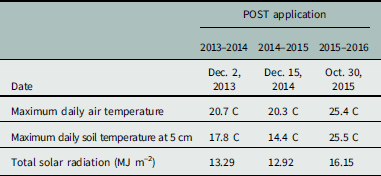
Weed species compositions varied among years. Additionally, temperatures were warmer when herbicide treatments were applied during the 2015–2016 season compared to the previous seasons (Table 1), and the warmer temperatures appeared to affect herbicide behavior. Therefore, all data were analyzed by year.
Environmental conditions during POST herbicide applications on sugarbeet at Ty Ty, GAFootnote a .

a Data were recorded at the Ty Ty station of the Georgia Automated Weather Network, approximately 200 m from the location of these experiments; http://www.georgiaweather.net.
Weed Control
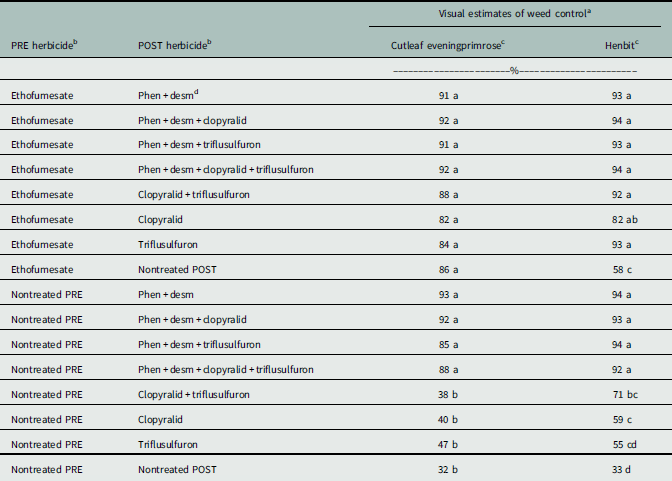
During the 2013–2014 season, all herbicide treatments that included ethofumesate PRE provided similar levels of cutleaf eveningprimrose control, with no improvement in control with additional POST herbicide treatment (Table 2). When not previously treated with ethofumesate PRE, any POST treatment containing phenmedipham+desmedipham controlled cutleaf eveningprimrose similarly to systems that used ethofumesate applied PRE. When not treated with ethofumesate, cutleaf eveningprimrose control with POST applications of clopyralid and/or triflusulfuron was poor and did not differ from the nontreated control.
Interactive effects of PRE and POST herbicides for cool-season weed control in sugarbeet in Ty Ty, GA (2013–2014).

a Means in a column followed by the same letter are not different according to Tukey-Kramer’s LSD (P≤0.05).
b Clopyralid (0.11 kg ai ha–1); ethofumesate (1.3 kg ai ha–1); phenmedipham (0.41 kg ai ha–1) + desmedipham (0.41 kg ai ha–1), pre-mixed; triflusulfuron (17.5 g ai ha–1). A non-ionic surfactant (0.25% v/v) was added to all treatments that included triflusulfuron.
c Weed densities: Cutleaf eveningprimrose, 5 plants m–2; henbit, 5 plants m–2.
d Abbreviations: Phen, phenmedipham; desm, desmedipham.
Henbit was not effectively controlled in 2013–2014 by ethofumesate PRE alone (Table 2). When POST applications of phenmedipham+desmedipham, clopyralid, and/or triflusulfuron were performed sequentially after ethofumesate, henbit control was improved. When not treated with ethofumesate, any POST treatment containing phenmedipham+desmedipham improved henbit control compared to clopyralid and/or triflusulfuron alone. When not previously treated with ethofumesate, henbit control from triflusulfuron alone did not differ from the nontreated control.
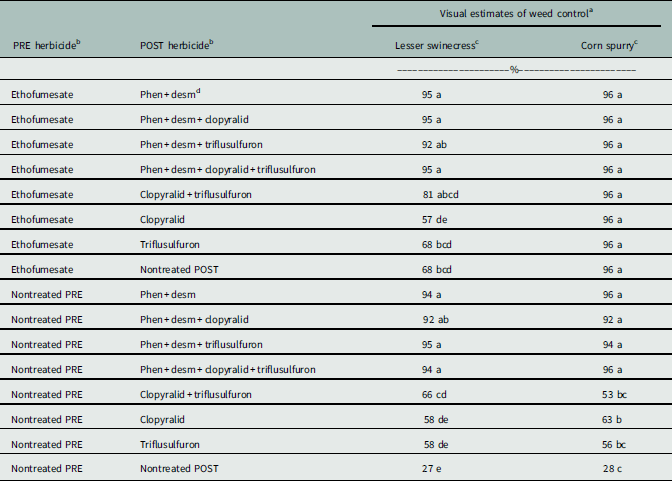
Lesser swinecress was effectively controlled in 2014–2015 by any POST treatment containing phenmedipham+desmedipham, with ethofumesate applied PRE not improving control (Table 3). Lesser swinecress control with POST applications of clopyralid and/or triflusulfuron was not different from control provided by ethofumesate alone. Corn spurry was effectively controlled by PRE application of ethofumesate (Table 3). In the absence of ethofumesate, all POST treatments containing phenmedipham+desmedipham effectively controlled corn spurry better than clopyralid and/or triflusulfuron alone.
Interactive effects of PRE and POST herbicides for cool-season weed control in sugarbeet in Ty Ty, GA (2014–2015).

a Means in a column followed by the same letter are not different according to Tukey-Kramer’s LSD (P≤0.05).
b Clopyralid (0.11 kg ai ha–1); ethofumesate (1.3 kg ai ha–1); phenmedipham (0.41 kg ai ha–1) + desmedipham (0.41 kg ai ha–1), pre-mixed; triflusulfuron (17.5 g ai ha–1). A non-ionic surfactant (0.25% v/v) was added to all treatments that included triflusulfuron.
c Weed densities: Corn spurry, 5 plants m–2; lesser swinecress, 5 plants m–2.
d Abbreviations: Phen, phenmedipham; desm, desmedipham.
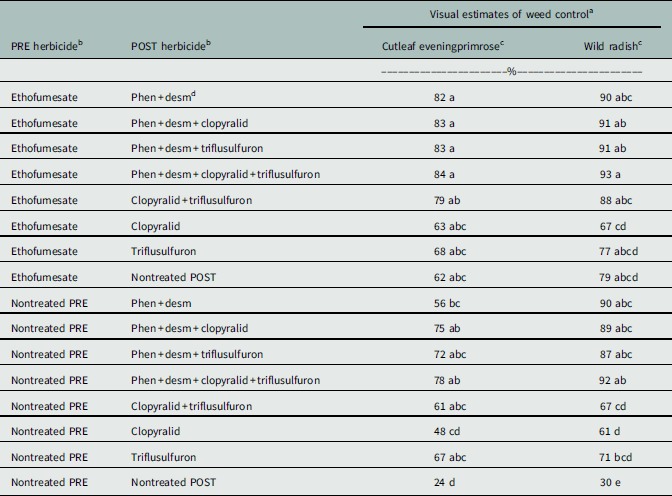
Cutleaf eveningprimrose was the predominant species in 2015–2016. There were no differences in cutleaf eveningprimrose control among any treatment that included PRE application of ethofumesate (Table 4). When not treated with ethofumesate, POST applications of phenmedipham+desmedipham alone or clopyralid alone did not adequately control cutleaf eveningprimrose. Regardless of the herbicide treatment in 2015–2016, the level of cutleaf eveningprimrose control (Table 4) was inconsistent and generally less than in 2013–2014 (Table 2). It was observed that cutleaf eveningprimrose emerged in 2015–2016 at two distinct times, soon after planting and again several weeks later. Ethofumesate applied PRE along with POST treatments containing phenmedipham+desmedipham controlled early-emerging cutleaf eveningprimrose but failed to control the later-emerging weeds. This suggests that control of cutleaf eveningprimrose with POST applications of phenmedipham+desmedipham may be challenged by weed emergence after the initial application.
Interactive effects of PRE and POST herbicides for cool-season weed control in sugarbeet in Ty Ty, GA (2015–2016).

a Means in a column followed by the same letter are not different according to Tukey-Kramer’s LSD (P≤0.05).
b Clopyralid (0.11 kg ai ha–1); ethofumesate (1.3 kg ai ha–1); phenmedipham (0.41 kg ai ha–1) + desmedipham (0.41 kg ai ha–1), pre-mixed; triflusulfuron (17.5 g ai ha–1). A non-ionic surfactant (0.25% v/v) was added to all treatments that included triflusulfuron.
c Weed densities: Cutleaf eveningprimrose, 10 plants m–2; wild radish, 5 plants m–2.
d Abbreviations: Phen, phenmedipham; desm, desmedipham.
Of the POST herbicide treatment combinations evaluated, phenmedipham+desmedipham and/or triflusulfuron provided the best control of wild radish when applied after PRE applications of ethofumesate (Table 4). When not treated with ethofumesate, treatments containing phenmedipham+desmedipham and triflusulfuron controlled wild radish better than clopyralid alone.
Visible Injury
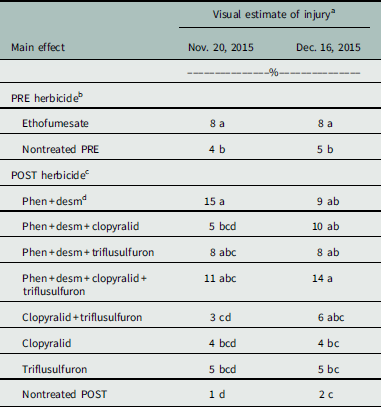
No herbicide treatments injured sugarbeet in 2013–2014 and 2014–2015 seasons (data not shown). However, in 2015 there was a significant main effect for herbicide injury but no interaction between PRE and POST applications (Table 5). Ethofumesate PRE injured sugarbeet when phytotoxicity was rated in mid-November and mid-December, respectively. In the 2015–2016 season, ethofumesate was applied PRE in mid-October when the daily maximum air temperature was 31 C. There are cautionary statements on the ethofumesate label about POST applications injuring sugarbeet if temperatures exceed 27 C (Anonymous 2017b), but there are no temperature precautions regarding PRE ethofumesate applications. However, our results suggest that elevated temperatures may also increase phytotoxicity when ethofumesate is applied PRE. POST treatments containing phenmedipham+desmedipham also injured sugarbeet (5% to 15%) at both rating dates. In the 2015–2016 season, POST treatments were applied in late October with the maximum air temperature on the day of application at 25.4 C and maximum 5-cm soil temperature at 25.5 C (Table 1). Sugarbeet response to phenmedipham+desmedipham is temperature sensitive. Starke and Renner (Reference Starke and Renner1996) reported increased injury when temperatures were <15 C as a result of cool temperatures delaying crop recovery. Phenmedipham+desmedipham has also been reported to severely injure sugarbeet and reduce crop stand when applied at temperatures >22 C (Winter and Weise Reference Winter and Weise1978). Lati et al. (Reference Lati, Mou, Rachuy and Fennimore2016) also correlated injury to spinach (Spinacia oleracea L.) from phenmedipham with sunlight intensity. Total daily solar radiation when POST herbicides were applied during the 2015–2016 season was greater than either of the December applications the previous years (Table 1). It appears that POST applications in October coincided with warmer temperatures and intense solar radiation in the 2015–2016 season that were not seen the previous seasons, and phenmedipham + desmedipham injured sugarbeet when applied during those conditions.
Main effects of PRE and POST herbicides on visual estimates of injury at Ty Ty, GA (2015–2016).

a Means for each main-effect treatment level within a column followed by the same letter are not different according to Tukey-Kramer’s LSD (P≤0.05).
b Ethofumesate (1.3 kg ai ha–1). PRE treatments were applied one day after planting, October 16, 2015.
c Clopyralid (0.11 kg ai ha–1); phenmedipham (0.41 kg ai ha–1) + desmedipham (0.41 kg ai ha–1), pre-mixed; triflusulfuron (17.5 g ai ha–1). A non-ionic surfactant (0.25% v/v) was added to all treatments that included triflusulfuron. POST treatments were applied October 30, 2015.
d Abbreviations: Phen, phenmedipham; desm, desmedipham.
Sugarbeet Yield
When averaged across all weed control treatments, sugarbeet yielded 57,650, 58,330, and 35,740 kg ha−1 in 2013–2014, 2014–2015, and 2015–2016, respectively (data not shown). Webster et al. (Reference Webster, Grey, Scully, Johnson, Davis and Brenneman2016) evaluated sugarbeet planting dates and cultivars in experiments conducted in the same region. Weeds were effectively managed in those trials and were not a treatment effect. Average yields in their trials ranged from 42,040 to 91,340 kg ha−1. Considering differences in research objectives and treatment structure, sugarbeet yields in our trials were grossly similar to those reported by Webster et al. (Reference Webster, Grey, Scully, Johnson, Davis and Brenneman2016).
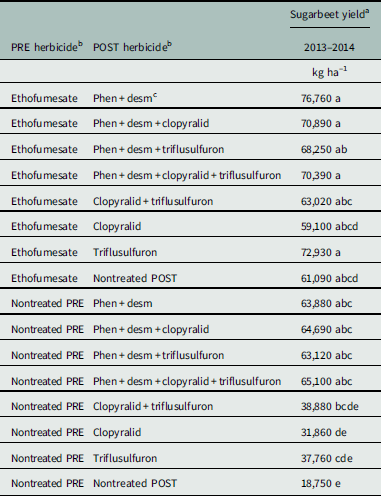
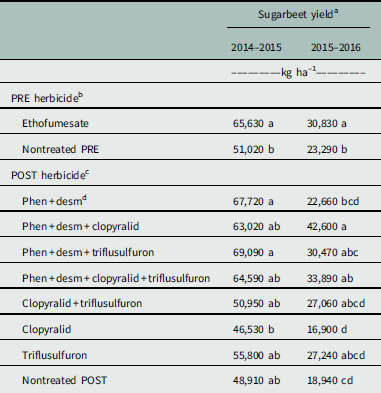
There was a significant interaction between effects of PRE and POST herbicides on sugarbeet yield in 2013–2014 (Table 6). Following PRE application of ethofumesate, sugarbeet yield did not differ among the POST herbicide combinations. When not treated with ethofumesate, only sugarbeet treated with POST combinations containing phenmedipham+desmedipham yielded more than the nontreated control. When not treated with ethofumesate PRE, sugarbeet treated with clopyralid and/or triflusulfuron alone POST yielded similarly to the nontreated control—a reflection of poor weed control (Table 2). For the 2014–2015 and 2015–2016 growing seasons, there were no interactions between PRE and POST herbicides for sugarbeet yield; therefore, the data are presented as main effects (Table 7). Sugarbeet treated with ethofumesate PRE yielded more than the nontreated PRE in both years. Of the POST treatments, the highest yielding sugarbeet crops in 2014–2015 were treated with any combination that contained phenmedipham+desmedipham and any treatment that contained triflusulfuron.
Interactive effects of PRE and POST herbicides on sugarbeet yield at Ty Ty, GA (2013–2014).

a Means in a column followed by the same letter are not different according to Tukey-Kramer’s LSD (P≤0.05).
b Clopyralid (0.11 kg ai ha–1); ethofumesate (1.3 kg ai ha–1); phenmedipham (0.41 kg ai ha–1) + desmedipham (0.41 kg ai ha–1), pre-mixed; triflusulfuron (17.5 g ai ha–1). A non-ionic surfactant (0.25% v/v) was added to all treatments that included triflusulfuron.
c Abbreviations: Phen, phenmedipham; desm, desmedipham.
Main effects of PRE and POST herbicides on sugarbeet yield (2014–2015, 2015–2016) at Ty Ty, GA.

a Means for each main effect treatment level within a column followed by the same letter are not different according to Tukey-Kramer’s LSD (P≤0.05).
b Ethofumesate (1.3 kg ai ha–1).
c Clopyralid (0.11 kg ai ha–1); phenmedipham (0.41 kg ai ha–1)+desmedipham (0.41 kg ai ha–1), pre-mixed; triflusulfuron (17.5 g ai ha–1). A non-ionic surfactant (0.25% v/v) was added to all treatments that included triflusulfuron.
d Abbreviations: Phen, phenmedipham; desm, desmedipham.
In 2015–2016, the same general yield responses were seen, with the exception of phenmedipham+desmedipham alone, which was not among the highest yielding plots. Additionally, many of the highest yielding POST herbicide treatments also yielded similarly to the nontreated control. The yield anomalies seen in 2015–2016 are attributed to reduced cutleaf eveningprimrose control (Table 4) and injury from any treatment that included phenmedipham+desmedipham (Table 5). Reduced weed control was due to cutleaf eveningprimrose emerging after POST applications and injury due to the late-October applications when temperatures were warm and solar radiation was intense.
Phenmedipham+desmedipham controlled a broad-spectrum of cool-season weeds in sugarbeet. POST applications were made to seedling weeds no larger than the two-leaf stage of growth. As phenmedipham+desmedipham is strictly a POST herbicide and provides no residual weed control, application timing is critical for season-long management of cool-season weeds. This limitation was evident, as in 2015–2016, when cutleaf eveningprimrose emerged very early in the season. In that season, the first flush of weeds was controlled, but the early-season application missed later-emerging weeds. Furthermore, early-emerging weeds will dictate when phenmedipham+desmedipham applications are made. Temperature and solar radiation may exceed thresholds for herbicide injury at early application dates. Waiting for cooler temperatures and less intense sunlight to lessen chances for phytotoxicity would also mean larger weeds for POST control. This presents a significant managerial challenge for sugarbeet production in the southeastern United States, where the crop would be planted during the early autumn when elevated temperatures and intense solar radiation are likely.
These results also demonstrate both the value and limitations of ethofumesate for cool-season weed control in sugarbeet. For cutleaf eveningprimrose control, ethofumesate applied PRE was not needed to supplement phenmedipham+desmedipham in 2013–2014. However, the conditions of 2015–2016 are an example of scenarios of PRE applications of ethofumesate in the early autumn when warm temperatures are likely and possibly injuring sugarbeet. In our trials, ethofumesate was applied in the 2015–2016 season when the daily maximum temperature was 31 C and phytotoxicity averaged 8% (Table 5). It appears that sugarbeet injury from PRE applications of ethofumesate are possible if temperatures are too warm at the time of application. This risk is countered by the benefit of ethofumesate to suppress cool-season weeds long enough for POST applications of phenmedipham+desmedipham to be made later in the season when conditions are not conducive for sugarbeet phytotoxicity from this herbicide combination.
These results also explain the role of triflusulfuron and clopyralid for cool-season weed control in sugarbeet. Triflusulfuron controlled wild radish comparably to phenmedipham+desmedipham—but without the injury concerns. However, triflusulfuron does not adequately control cutleaf eveningprimrose. Clopyralid did not adequately control any of the cool-season weeds present in these trials and does not appear to have a role in sugarbeet production in the southeastern United States.
Sugarbeet grown as a biofuel crop in the southeastern United States is presently in the developmental stage. From an agronomic perspective, success will depend on sugarbeet production being integrated into normal plantings of peanut and cotton, without compromising either warm-season crop. Within the restrictive sugarbeet planting and harvesting period, weed control challenges persist. It appears that ethofumesate and phenmedipham+desmedipham are needed for consistent broad-spectrum weed control, but the risk of herbicide phytotoxicity due to warm temperatures and intense sunlight may limit grower options. Additionally, each of the herbicides evaluated in these trials is priced according to sugarbeet production for edible sugar, a regulated commodity—not for biofuel. Future sugarbeet research is needed in the U.S. southeastern region to refine herbicide rates and determine the feasibility of mechanical weed control integrated with herbicides.
Acknowledgments
We acknowledge the contributions of Daniel R. Evarts and Raymond Boyd, whose technical skills made these studies possible.