

Writing in the early twelfth century about the Devon monastery of Tavistock, William of Malmesbury observed that its local cult, like that of others elsewhere in England, relied on oral traditions rather than writing, and explained why this was the case:
Rumon is celebrated there as holy and buried as a bishop. He is adorned with a beautiful shrine but what is said about him is not buttressed by the solid authority of writing. You will find this situation in many other places in England as well: that no doubt as a result of enemy violence, all records of the past have been destroyed, leaving only the bare names of the saints and of any miracles they still perform.Footnote 1
The destruction of earlier records by “enemy violence” is now recognized as a general trope of hagiographical writings from across north-western Europe in this period, be the enemy the north men, Danes, or Hungarians; it is unlikely that any such writings as alluded to by William ever existed.Footnote 2 Although modern scholars, therefore, reject William's explanation of the reasons for the absence of hagiography, they follow him in accepting that Anglo-Norman churchmen did not inherit a substantial written legacy from their Anglo-Saxon predecessors in support of the cult of saints and in seeking to explain why Anglo-Norman churchmen were so interested in recording the histories of local cults.Footnote 3 But, as we shall see, modern historiography has focused mainly on monastic communities that commissioned hagiographical texts for particular cults and, by doing so, largely ignores the cultic histories of secular communities in this period. Moreover, this research concentrates on a relatively narrow range of material — that is, the narrative and poetic lives and accounts of translations and those of miracles, largely treating other sorts of liturgical evidence, much of it helpfully edited, that is calendars, litanies, chants, relic lists, and martyrologies, as ancillaries to them.Footnote 4 In focusing on only one strand within the surviving record, historians of Anglo-Norman cults have lagged behind scholars working on the continental materials from the same period. In particular the musicologists Susan Boynton and Margot Fassler have demonstrated the value of exploring a range of liturgical materials for evidence of developments in the institutional identities of two important ecclesiastical communities in this period, the powerful central Italian monastery of Farfa and the influential French cathedral of Chartres.Footnote 5 More recently, Fassler helped edit an important collection of essays on the ways in which cantors contributed to the making of history in medieval monastic, and to a lesser extent cathedral, communities through liturgy and historical writing.Footnote 6 Whilst highlighting the centrality of, and richness of, the liturgical evidence, these works pay greater attention to the chants, hymns, and lections associated with particular cults than the more normative texts of the type considered here, whose contents as well as structure were much more rigid.Footnote 7 Normative is used here to distinguish those liturgical texts whose form and content were broadly similar across different institutions, such as calendars, litanies, relic lists, martyrologies, and sacramentaries, from the more narratival texts used in the support of particular cults, such as saints’ lives, translation accounts, miracle collections, and hymns.
Building on their approach, this article sets out to provide a corrective to the current work of Anglo-Norman historians through a case study of one mid-twelfth-century manuscript, a copy of the ninth-century historical martyrology composed by Usuard, now Exeter Cathedral Library MS 3518 (hereinafter Exeter 3518), which was made for Exeter cathedral's secular community of canons. By arguing that this manuscript is based on an earlier, eleventh-century English exemplar, it suggests firstly the value of investigating such normative liturgical material for what it can tell us about how one Anglo-Norman secular community, at least, understood their history and secondly that this particular community inherited a very helpful textual, as well as oral, legacy from the pre-Conquest period. Uncovering the different layers of additions to this ninth-century text reveals how this manuscript, which was, as we shall see, in daily use throughout the later twelfth and thirteenth centuries, embodied the Exeter community's understanding of their own past and reveals how they situated their own history within that of the universal Church. In offering a perspective from a secular, albeit regular, community on current interpretations of the memory of saints across the Conquest, it helps switch modern scholars’ attention away from specific cults to focus instead on the ways in which communities sought to place their local church within the wider communion of saints.
Lacunae in Modern Scholarship
Secular communities like that of Exeter cathedral are generally disregarded in modern accounts of the development and circulation of hagiographical writings in this period. This is because the hagiographical narratives written in England in the period between 950 and 1130 were produced by and for monastic communities. It is now recognized that the Anglo-Norman resurgence was preceded by an earlier revival in hagiographical writing within England that began ca. 950 and lasted until the second quarter of the eleventh century.Footnote 8 Starting in the great centers of the tenth-century reform movement, this initial revival later spread to smaller houses as Anglo-Saxon churchmen began to record previously undocumented local cults in lives, translation, and miracle accounts.Footnote 9 The same monastic monopoly on authorship and audience is also true of the compositions in the third wave of hagiographical writing, those commissioned by members of the new Anglo-Norman hierarchy in the first sixty or so years after the Conquest. However, monasteries served only a minority of churches at this time. As the Old English tract, Secgan be Þam Godes sanctum Þe on Engla lande ærost reston (The Resting Places of the English Saints) [ca. 1031]), listing the location of some eighty-nine named cults in late Anglo-Saxon England, demonstrates, most cults in this period were associated instead with secular communities.Footnote 10 But, in James Campbell's words, seculars “did not write books”; as a consequence, almost nothing is known about such cults beyond their names and whereabouts before they were taken over, and subsequently documented, by reforming monks in the later eleventh and twelfth centuries.Footnote 11
Modern research instead focuses almost exclusively on the hagiographical texts written by and for these reformed communities. Earlier scholars, beginning with David Knowles and Richard Southern, following Eadmer's comments that Lanfranc was initially opposed to English cults, argued that churchmen set out to document established local cults in the face of skepticism from the new Norman hierarchy in the post-Conquest period.Footnote 12 Susan Ridyard rejected this view, showing instead that the explosion in the production of Anglo-Latin hagiography in the later eleventh and early twelfth centuries owed more to the efforts of individual Norman churchmen who wanted to establish their authority over particular local churches.Footnote 13 Rosalind Love went further, suggesting that it also represents Anglo-Norman attempts to assimilate culturally into an unfamiliar, more vernacular world through the control and documentation of existing cults.Footnote 14 Subsequent scholars have shied away from generalizations, and in doing so highlighted that the main reason why individual communities commissioned narrative hagiographies for particular cults was to support claims to authority at moments of institutional crisis or change; at the same time, they have shown that the decision to document a particular Anglo-Saxon cult often led to the deliberate neglect of other existing ones previously observed by that community.Footnote 15
At the same time, those working on Anglo-Saxon hagiography across the later tenth and earlier eleventh centuries have drawn attention to the significance of a considerable body of liturgical evidence for the knowledge of English saints in this period.Footnote 16 In particular they have focused scholars’ attention, through easily available modern editions, on calendars and litanies, as well as relic lists; martyrologies, by contrast, have been rather more neglected.Footnote 17 Although those working on the Anglo-Norman period also recognize the value of such liturgical material, they generally look to it only to supplement the narrative texts. Its significance was recognized in 1999, for example, by Jay Rubenstein, who pointed out how the calendrical evidence from Christ Church, Canterbury, provided support for Eadmer's avowal that Lanfranc was not interested in English saints, and suggested that the excision of local cults from Canterbury's calendar resulted not so much from the new archbishop's skepticism but rather from his desire to promote more universal saints.Footnote 18 He devoted the bulk of his attentions, though, to Eadmer's hagiographical writings. More recently Benjamin Pohl has investigated the obit notices in the martyrological and necrological evidence from the Norman house of Bec to suggest they served as sources for Robert of Torigni's twelfth-century redaction of the Gesta Normannorum Ducum.Footnote 19
In 1983 John M. McCulloh observed that historical martyrologies have largely been left out of the historiographical turn to hagiography.Footnote 20 This still remains largely true over thirty years later. Despite their potential, they have not yet been much studied by students of Anglo-Norman cults. Yet they provide valuable evidence of the state of knowledge about saints’ cults within a community because martyrologies were practical books. From the Aachen reforms of the early ninth century onwards, it was the custom to read from martyrologies daily in chapter in both monastic and canonical communities as guides to the cults to be remembered the coming day.Footnote 21
More recently, researchers working on the eighth and ninth centuries have begun to recognize the value of historical martyrologies as records of churchmen's knowledge of saints’ cults, understanding of Christian history, and the role of their own locality within it.Footnote 22 The compilers of influential texts, including those by Bede, the Anonymous of Lyon and Ado of Vienne, created a historical geography of the Christian world for their readers. Entries arranged according to the Roman calendar set out not just the names of the saints to be commemorated on that day but the location of their cults and sometimes, in the case of martyrs, named the emperor under whom they were persecuted and the torments they suffered. To date, scholars of the later Anglo-Saxon reforms have focused mainly on the idiosyncratic vernacular text now known as the Old English Martyrology rather than the Latin products of the Carolingian reforms.Footnote 23 They have, however, noted the introduction of one product of the ninth-century Frankish reforms, the Latin historical martyrological text compiled by Usuard of Saint-Germain-des Prés (d. 877). Usuard's work became, at least in northern continental Europe, one of the most popular martyrologies amongst eleventh- and twelfth-century monasteries, and surviving manuscripts, as we shall see, testify to its popularity in England from the late eleventh century onwards.Footnote 24 But only one manuscript of this text now survives from Anglo-Saxon England: Cambridge, Corpus Christi College, MS 57 (hereinafter CCCC 57). Mechthild Gretsch has linked the introduction of its model to England to the monastic reformer and archbishop of Canterbury, Dunstan (d. 988).Footnote 25 CCCC 57 was probably written at Canterbury in the late tenth century; the later addition of obits reveal it was in use in the regular, reformed community at Abingdon by the 1040s.Footnote 26 No surviving martyrological manuscripts have yet been linked to secular communities in eleventh-century England.
Like litanies, historical martyrologies appear on the one hand to be scholarly compilations of accumulated traditions; on the other hand, like calendars as well as litanies, they were generally adapted to incorporate cults local to the house owning them.Footnote 27 These twin features make it very difficult to identify early recensions in the case of many of the earlier martyrological texts, but Usuard's compilation is rather different because an authorial copy still survives.Footnote 28 It is possible therefore to establish its earliest recensions with some certainty, and to identify the entries added to this text later. These additional entries make it more possible to track the textual ancestry of a particular manuscript. Drawing on the surviving copies of Usuard written in England in the tenth, later eleventh, and twelfth centuries, this article suggests that the mid-twelfth-century copy, now Exeter 3518, is based on an eleventh-century exemplar.
Exeter Cathedral Library MS 3518: The Manuscript, Its Contents and Context
Exeter 3518 was made for the canons of Exeter cathedral. The secular cathedral community at Exeter was a new foundation, established by Bishop Leofric (1046–72) after he transferred the see there from Crediton in 1050.Footnote 29 The books copied and owned by the Exeter community in the late eleventh and early twelfth centuries have received a good deal of attention from students of both Old English and Latin culture in this period.Footnote 30 Richard Gameson and Rodney Thomson have each suggested that Exeter's library was, in many ways, typical for a cathedral community at the time, both monastic and secular.Footnote 31 The musicologist Jesse Billett argues that Exeter under Leofric acquired its chant book (the “Leofric Collectar,” now London, British Library, MS Harley 2961) from a reformed monastic community, probably that of Winchester; this raises the possibility that Exeter also acquired its martyrology from a reformed monastic community.Footnote 32 This case study is therefore likely to be representative of other regular communities at this time. Focusing on a text used in daily chapter, it aims to redress the current biases in research on the Anglo-Norman cult of saints towards other sorts of narrative hagiography and towards monastic communities. By allowing investigation of the various influences at work for how the cult of saints came to be documented in one late eleventh-century secular community, it also opens up fresh ways for understanding the role played by Latin liturgical texts in how and why Anglo-Norman churchmen came to document local cults.
The Manuscript Evidence
Exeter 3518 is a partial copy in sixty-two folios of Usuard's Martyrology. It survives in a medieval binding of bare wooden boards (with a more modern loose leather cover); there are no flyleaves or pastedowns.Footnote 33 At some point in its history the manuscript lost both its initial and penultimate quires, as well as the outer bifolium of the final quire. Thus the text begins part way through the entry for 8 February instead of on 1 January; the entries between 9 October and 6 December are also missing, as is some text for 31 December.Footnote 34 The main text is written in a formal Romanesque script which exhibits various “West Country” features and dates to the middle decades of the twelfth century; the colored initials follow the pigments used in other twelfth-century Exeter manuscripts.Footnote 35 It is a medium-sized book, now measuring 220 x 162 mm with a written space of 180 x 100mm in twenty-seven long lines. It was seemingly designed to have obits and other notices added to its wide margins, although these have been partially cropped by a later binder. Some 400 obits and notices have been added in many different hands over the course of the twelfth and thirteenth centuries whilst at least seven obits have later been erased.Footnote 36 Several dated obits are written in a hand similar to that which wrote the main text, the latest being that for “Adela, mother of Stephen king of England” (d. 1137) (fol. 6v), giving a likely terminus post quem for the manuscript. The location of some of the cults in the main text and the names of the bishops, cathedral clergy, and benefactors in the obits all suggest that this manuscript was written for and used by the Exeter cathedral chapter.
As mentioned above, Exeter is an eleventh-century foundation. The cathedral was established in 1050 when Leofric obtained papal consent to transfer the seat of the see from Crediton, eight miles to the northwest, where it had been first established in 909, to the existing church of St. Peter on the site of the forum in the Roman city of Exeter.Footnote 37 “Brought up and educated in Lotharingia,” in the words of William of Malmesbury, Leofric committed energy and resources to the education of his clergy.Footnote 38 “After the Lotharingian pattern,” he established the community serving the cathedral as a house of canons following the Rule of Chrodegang, which had been initially popularized under Louis the Pious.Footnote 39 He endowed the community with lands, vessels and other ornaments, and books.Footnote 40 In recent years considerable attention has been paid to the ways in which Exeter's first bishop, Leofric, and his two Norman successors, Osbern (1072–1103) and William de Warelwast (1107–1137), assembled Exeter's library up to 1125.Footnote 41 But Exeter 3518's later date has meant that it has commanded relatively little attention, except from specialists in the local cults of Devon and Cornwall. Indeed, when J. N. Dalton published the Exeter Ordinale in 1909, he based his edition of the Exeter martyrology on a later fourteenth-century copy of Usuard commissioned by Bishop John Grandisson (1327–1369), now Cambridge, Corpus Christi College MS 93 (hereinafter CCCC 93), which omits many local entries.Footnote 42 G. H. Doble recognized its importance for the early history of Cornish cults and published in 1940 the variants in the main text of Exeter 3518 from CCCC 93 as an appendix to J. N.Dalton's 1909 edition of the latter manuscript.Footnote 43 His research has subsequently been taken up by later scholars of early medieval Cornwall and its saints.Footnote 44 More recently David Lepine and Nicholas Orme published the obits as part of their study of Exeter's medieval records for death and memory, and Robert Bartlett drew upon the manuscript very briefly to make some observations about martyrologies as a genre in his recent history of the medieval cult of saints.Footnote 45 There is, however, no study of Exeter 3518 as a whole in its historical and cultural context.
The text in Exeter MS 3518 belongs to the second recension of Usuard's text.Footnote 46 Usuard was a monk of Saint-Germain-de-Prés writing in the three decades before his death ca. 877, and by the eleventh and twelfth centuries his work had become extremely popular.Footnote 47 He drew upon the works of his early ninth-century Frankish predecessors to compile the first martyrology to include entries of the saints to be remembered on every day of the year. He recorded some 2000 saints in a piece that is encyclopedic in its scope, combining synthesis with original research. It is in effect a work of salvation history, including entries for some Old Testament prophets and New Testament figures with early Christian apostles and martyrs and more recent saints. He ranges from Palestine and the eastern Mediterranean of the early Church to seventh-century England and ninth-century Spain, including details of the Christians martyred at Cordoba in the 850s. The houses owning his text often added more local cults. The end result is a text that links familiar local cults to ones that were more remote, geographically and temporally, to create a work that secured the local church within the wider framework of Christian history.
The careful scholarship of Jacques Dubois demonstrates that Usuard's authorial text survives now in three main recensions:
• The “primitive” recension, that is the version of the text Usuard completed between 20 October 858 and 20 September 859. This recension can be dated with such precision because it includes an entry for SS George and Aurelius, whose relics were brought from Cordoba to Paris by Usuard on 20 October 858, but not one for the martyrdom of Bishop Eulogius of Cordoba. Eulogius was killed on 11 March 859, but Usuard entered his name on 20 September in later recensions, hence the terminus ad quem. This version has so far been identified in twelve manuscripts.Footnote 48
• The first recension represents the version of Usuard's text completed post 20 September 859; it circulated widely within the area covered by the Frankish Empire from the 860s and now survives in numerous manuscripts from the ninth century onwards.Footnote 49 Dubois suggested that the popularity of this version owed much to royal support. As his own work, together with that of Overgaauw, demonstrates, the first recension was usually introduced by the letter-preface in which Usuard dedicated his work to the Frankish ruler Charles the Bald, setting out his aims in compiling the text and his sources.Footnote 50 This letter-preface was also often followed by an Augustinian text on how the feasts of the apostles and martyrs should be celebrated, known from its incipit as Festivitates, which is also found in other ninth-century martyrological texts.Footnote 51
• The second recension represents the version of Usuard's text kept at his own community of Saint-Germain-des-Prés which he continued to revise between 859 and his death in 877; it now survives in at least 22 manuscripts. It is not accompanied by the letter-preface to Charles the Bald, nor, usually, any other prefatory material. Other than later copies made at and for Saint-Germain-des-Prés, this version circulated mainly in Normandy and England.Footnote 52
At first sight, given the patterns in geographical circulation highlighted above, it is unsurprising to find that the text of Exeter 3518 belongs to the second recension. But it is worth following the implications of this further for the second recension seems to have come to England first, not via Normandy after the Conquest, but rather sometime in the tenth century via Flanders. The earliest surviving manuscript of Usuard with an English provenance is CCCC 57.Footnote 53 This is a monastic chapter book, containing a copy of the Rule of Benedict, alongside the text of the second recension (without the prefaces), and various other texts associated with the Aachen monastic reforms of the early ninth century. Timothy Graham and Mechtild Gretsch have both studied this manuscript in detail without focusing on the martyrology in particular. Whilst the later addition of obits reveals that it was in use at the monastery of Abingdon by the 1040s, Richard Gameson suggests it was not copied there, but rather probably written at Christ Church, Canterbury, in the late tenth century on the grounds of both script — the use of the same monumental display script as is found in other Canterbury manuscripts — and interpolations into the text of the Benedictine Rule that are also found in a mid-eleventh-century manuscript with an early provenance from Christ Church, Canterbury.Footnote 54 Its original martyrological text is remarkably close to that in the late ninth-century Saint-Germain-des-Prés copy of the second recension, with only six modifications to that version; some twenty-one cults, mostly southern English or Flemish, were subsequently added in Anglo-Saxon hands in blank spaces and margins. Gretsch therefore suggested that CCCC 57 was perhaps based on a continental exemplar brought back to Glastonbury by the monastic reformer Dunstan from his exile in Flanders in the 940s for various reasons in which the evidence from the martyrology plays only a minor part. Gretsch's principal argument for attributing CCCC 57's exemplar to Dunstan is based first around the overall theme of the contents of the manuscript and its interest in the text of the Rule of Benedict, as mediated by the Anianian reforms of the early ninth century; secondly, she suggests that because the names of various cults associated with the tenth-century English reformers were added in later hands to the main text of the martyrology that it was based on a copy that predates their deaths. Following David Dumville, she attributes the manuscript to Glastonbury because it replaces Usuard's reference to St. Patrick of Nevers with a reference to the Irish St. Patrick on 24 August, whose cult is recorded at Glastonbury.Footnote 55 Gretsch's arguments have subsequently been amplified by Merete Geert Andersen's analysis of the five other cults added to Usuard's text by the original scribe of CCCC 57 which point to St. Peter's Ghent, Toul, Glastonbury, and Wimborne, and similarly fit with Dunstan's career as abbot of Glastonbury and archbishop of Canterbury.Footnote 56 Glastonbury claimed the relics of two of these five additional cults: those of St. Aidan, first bishop of Lindisfarne (31 August), and St. Cuthbert whose translation was recorded in the martyrology on 4 September. A further two of these entries seemingly point to the origins of CCCC 57's exemplar in the Low Countries: St. Ansbert of Rouen (9 February), whose relics were brought to St. Peter's, Ghent in 944, and St. Mansuetus of Toul (2 September). The final entry relates to St. Cuthburga of Wimborne (Dorset), whose feast is found in three English calendars from before 1100.Footnote 57
CCCC 57 is the only copy of any version of Usuard to survive from Anglo-Saxon England; the next earliest English manuscripts both date from the turn of the twelfth century:
• Durham, Cathedral Library, MS B.IV.24 (Durham, s. xi/xii); this is a copy of Usuard's first recension and survives in a chapter book with the Rule of Benedict and a copy of Lanfranc's Constitutions amongst other texts.
• London, British Library, MS Cotton Vitellius C.xii, fols. 114–57 (St. Augustine's, Canterbury, s.xi/xii); this is a copy of Usuard's second recension.Footnote 58
Andersen has published a handlist of thirty-two medieval manuscripts of Usuard with an English provenance now surviving in British libraries; nineteen of these are copies of the second recension, and three other late medieval manuscripts represent what Andersen categorized as a mixed tradition of first and second recensions.Footnote 59 Both she and Michael Lapidge have postulated that other copies of Usuard must have circulated within eleventh-century England.Footnote 60 Andersen further suggests that the Canterbury origins of CCCC 57 help to explain how and why the second recension became so dominant in later medieval England.Footnote 61 But in the absence of other pre-Conquest manuscripts, the early history of the circulation of Usuard within England, and the role of Canterbury in this, remains unclear.
Investigation of the context in which these two late eleventh-century copies were made helps highlight what is distinctive about that for Exeter 3518. Like Abingdon, and unlike Exeter, Durham and St. Augustine's were both Benedictine communities, although Durham had only recently become one at the time it acquired its martyrology.Footnote 62 The chapter at Durham cathedral was reformed as a monastic community under its Norman bishop William de Calais in 1083, just over thirty years after Exeter was established as a canonical community under Bishop Leofric.Footnote 63 In other ways the cathedral churches of late eleventh-century Durham and Exeter are very similar, for both witnessed the rapid growth of their libraries under their initial reforming bishop and, in Exeter's case, their immediate successors; by contrast Abingdon and St. Augustine's, as older and more established monastic communities, did not experience the same spike in acquisitions. But Durham is exceptional in acquiring the earliest surviving English copy of the first recension of Usuard: why did Exeter not acquire this recension of the text? Here Thomson's observation that Exeter's bibliographical acquisitions in this period lack the Normanness of the Durham collection assembled at the same time is helpful.Footnote 64 Durham's later monastic turn meant it had a more pressing need to conform to the mainstream of European practice than the secular community at Exeter. St. Augustine's, by contrast, as a more established community — albeit one drawn into occasional conflict with Lanfranc — is more likely to have drawn on existing English traditions for its copy of the second recension, which privileged Augustine and his companions and the early bishops of Canterbury amongst its additional entries.Footnote 65
Exeter 3518 was written at Exeter in the middle decades of the twelfth century but is it a copy of a text new to Exeter at that point or a later copy of one already known in Exeter? And if so, when did Exeter's canons first acquire a copy of Usuard's text? Exeter 3518 is a copy of the second recension, but there is other evidence that suggests that by the late eleventh century the Exeter community was also aware of the text of the first recension: this is the manuscript now Cambridge, Corpus Christi College, MS 201 (hereinafter CCCC 201), pp. 179–272.Footnote 66 CCCC 201 is a compilation assembled by Archbishop Parker in the sixteenth century, who added this final section to a collection of devotional and homiletic material copied at New Minster, Winchester in the first half of the eleventh century. This final section includes a copy of Bishop Theodulf of Orléans's episcopal Capitulary in Latin and Old English and a homily in Old English, both written in the same scriptorium that copied other manuscripts for Bishop Leofric in the third quarter of the eleventh century; this is generally assumed by scholars to have been based at Exeter. The homily concludes on the first outer leaf of a bifolium; a later eleventh-century hand, seemingly also based at Exeter, added the text of Usuard's letter-preface to Charles the Bald and part of the Festivitates preface on the inner sides of the bifolium (CCCC 201, pp. 260–61). The Festivitates text must therefore seemingly have been always incomplete, for the final verso folio of this bifolium has been left blank.Footnote 67 As we have already noted, this prefatory material is only associated with copies of the first recension of Usuard's text, the earliest surviving English manuscript of which is that made for Durham in the 1090s. It may of course be only coincidence that the Usuard material in CCCC 201 was copied at around the same time as the Durham manuscript, but we have to ask why the Exeter scribe wrote only a partial text. This bifolium may represent an interest in a new version of a text that was already familiar to its copyist who naturally, therefore, focused on the most distinctive aspects of what distinguished the first from the second recension. In other words, CCCC 201 raises the possibility that the second recension was already known at Exeter in the late eleventh century.
There are other grounds for this hypothesis. In the inventory of books and other items Leofric gave to his cathedral community mention of the martyrologium follows immediately after the regula canonicorum.Footnote 68 The combination of Rule and Martyrology are commonly found together in codices generally known as medieval chapter books because extracts from both texts were recited daily in chapter.Footnote 69 Neil Ker therefore suggested that the surviving bilingual version of the Enlarged Rule for Canons of Chrodegang, now Cambridge, Corpus Christi College, MS 191 (hereinafter CCCC 191), which was copied at Exeter under Leofric, was originally produced as a companion volume to a now lost Latin martyrology and a surviving copy of the vernacular Old English Martyrology, now Cambridge, Corpus Christi College, MS 196 (hereinafter CCCC 196).Footnote 70 Ker further suggested that CCCC 191 was not only linked to CCCC 196 but also to the Exeter section of CCCC 201.Footnote 71 Others have followed him in linking this Old English Martyrology manuscript to Exeter's bilingual copy of Chrodegang's Rule.Footnote 72 But Gneuss observed that although the term martyrologium was used of both Latin and vernacular texts in Anglo-Saxon England, its use in the Leofric inventory “probably also denotes the Latin book for the chapter office.”Footnote 73 Although he did not set out any further grounds for his judgment, it is odd that the Enlarged Rule, seemingly listed in Latin in the inventory, existed in both Latin and Old English, but we have no surviving eleventh-century Latin text of a martyrology to accompany the Old English text.Footnote 74 The version of the Rule of Chrodegang known at Exeter provided that each day in chapter after the lesson for the day the saints to be remembered should be announced.Footnote 75 But the Old English Martyrology is unsuitable for this purpose, and it is unlikely that it functioned as a chapter book. Indeed its most recent editor, Christine Rauer, has argued, on the grounds that its textual structure is very different from that of other martyrologies, that it was unsuitable for use in chapter: “the communal or ceremonial reading which other martyrologies experienced seems less likely in the case of the Old English Martyrology.”Footnote 76 A second partial and error-ridden text of the Old English Martyrology copied into the margins of a vernacular translation of Bede's Historia Ecclesiastica was also in Exeter by the late eleventh century, and suggests that this book would have been read privately at Exeter rather than in chapter.Footnote 77 The final piece of evidence Ker adduced for his thesis that the Bilingual Rule of Chrodegang was accompanied by both a Latin and Old English martyrology is the entry in the 1327 inventory of Exeter's library that lists among the service books a “Martirologium Latinum et Anglicum: Circumcisio.”Footnote 78 As “Circumcisio” is the incipit for the second recension of Usuard, Ker suggested that Leofric originally had a Latin martyrology to sit alongside his Latin rule. It might even be a reference to Exeter 3518 before the initial quire went missing, suggesting that in the fourteenth century it was bound with a vernacular martyrology. It is not, however, obvious that it refers to the Old English Martyrology. The wording refers to a single “martyrology” in two languages, not to two very different martyrological texts. It is in any case unlikely that it refers to a time when Exeter 3518 was bound with the Old English Martyrology now in CCCC 201 as the measurements of the two codices make this improbable.Footnote 79 The evidence reviewed so far, therefore, raises the possibility that the second recension of Usuard might have been known in Exeter since at least the late eleventh century but it is far from conclusive.
Indeed, Usuard's text might not have been introduced under Bishop Leofric but rather under one of his Norman successors: Bishop Osbern, Bishop William de Warelwast, or his nephew, Bishop Robert de Warelwast (1138–55). Leofric's two immediate successors were both closely linked to the royal household, but also had strong links to Normandy. Bishop Osbern's father was a member of the ducal household, although Osbern himself joined the court of Edward the Confessor whilst Edward was in exile in Normandy, before transferring to the court of William in 1066; Bishop William de Warelwast also came from Normandy, before joining the court of William Rufus, and he was succeeded in turn by his nephew, Robert.Footnote 80 The second recension text could therefore have been brought to Exeter directly from Normandy, which was the region, other than England, where this version circulated most widely. Whilst Leofric ensured that his reformed clergy had the necessary service books, Bishop William appears to have been specifically interested in saints and introducing Norman texts about them to his cathedral's canons: the 1327 inventory lists some twelve works bequeathed by “Bishop William” de Warelwast, including two collections of hagiography according to the “Use of Rouen”: “Communis Liber Sanctorum de Usu Rotomagensi” and “Unus Liber Sanctorum de eodem Usu.”Footnote 81 Other evidence, however, points to Bishop William's interest in his more immediate locality: Stephen Marritt has suggested that charters issued by the chapter under Bishop William testify to an interest in Exeter's Anglo-Saxon past in the 1120s.Footnote 82 The manuscript evidence therefore suggests that it is highly likely that a copy of the second recension of Usuard was known in Exeter by the late eleventh century, but whether it was introduced by Leofric or one of his two immediate successors, and in particular whether it was based on an English or Norman model, requires the further investigation of the text of Exeter 3518.
The Evidence of Anglo-Saxon Cults
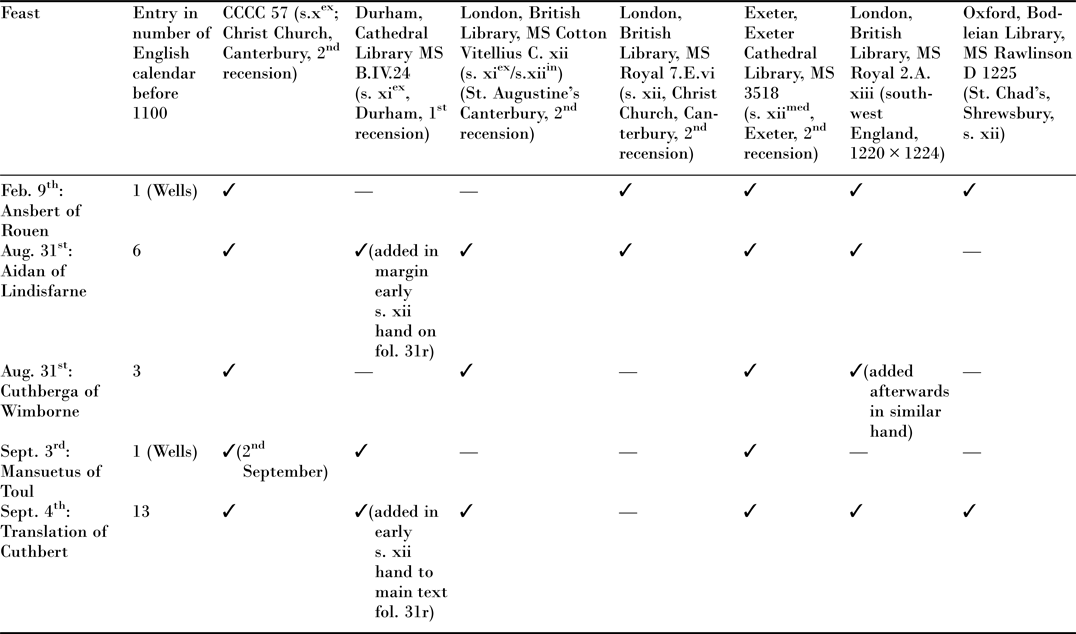
In order to help resolve these questions we must therefore investigate Exeter 3518's text and in particular a sample from the almost one hundred additional entries included in the main text that do not appear in the Saint-Germain-de-Prés “authorial” manuscript of Usuard's second recension. Additional cults in martyrologies, like those in litanies, generally constitute records of textual transmission. In order to help locate the model for Exeter 3518, the additions have been compared to six other English manuscripts of Usuard's text from the eleventh and twelfth centuries; for further context the evidence for knowledge of these cults in English calendars from before 1100 has also been included. This comparison suggests that the additions to Exeter 3518 are clearly grounded in tenth- and eleventh-century English traditions. As Table 1 demonstrates, Exeter 3518 is exceptional amongst near-contemporary English martyrological manuscripts in including five out of the six additional (to Usuard's original text) entries included in the main text of the tenth-century Anglo-Saxon copy, now CCCC 57 (but not the alterations to the text for St. Patrick noted above). The calendar evidence for the cults added into the main text of CCCC 57 suggests that, with the exception of the widespread cult of the translation of Cuthbert, knowledge of these cults was confined mainly to Canterbury and western England. Thus Aidan features in calendars from Christ Church, Canterbury (later at Exeter); Wilton; Sherborne; Evesham (or possibly Worcester); and Wells.Footnote 83 Cuthberga appears in calendars from Canterbury (or Glastonbury), Sherborne, and New Minster, Winchester.Footnote 84 The two Lotharingian cults (Ansbert in Ghent and Mansuetus in Toul) otherwise feature only in a calendar in a collection associated with Bishop Giso of Wells.Footnote 85 Bishop Leofric, like Giso, was educated in Lotharingia and his own life therefore offers another conduit by which these two cults entered Exeter 3518; this is a point to which we return below as these are not the only additional cults from the Empire in this manuscript.Footnote 86
A comparison of the “Additional Entries” in the main text of CCCC 57 with other English manuscripts of Usuard from the eleventh and twelfth centuries.

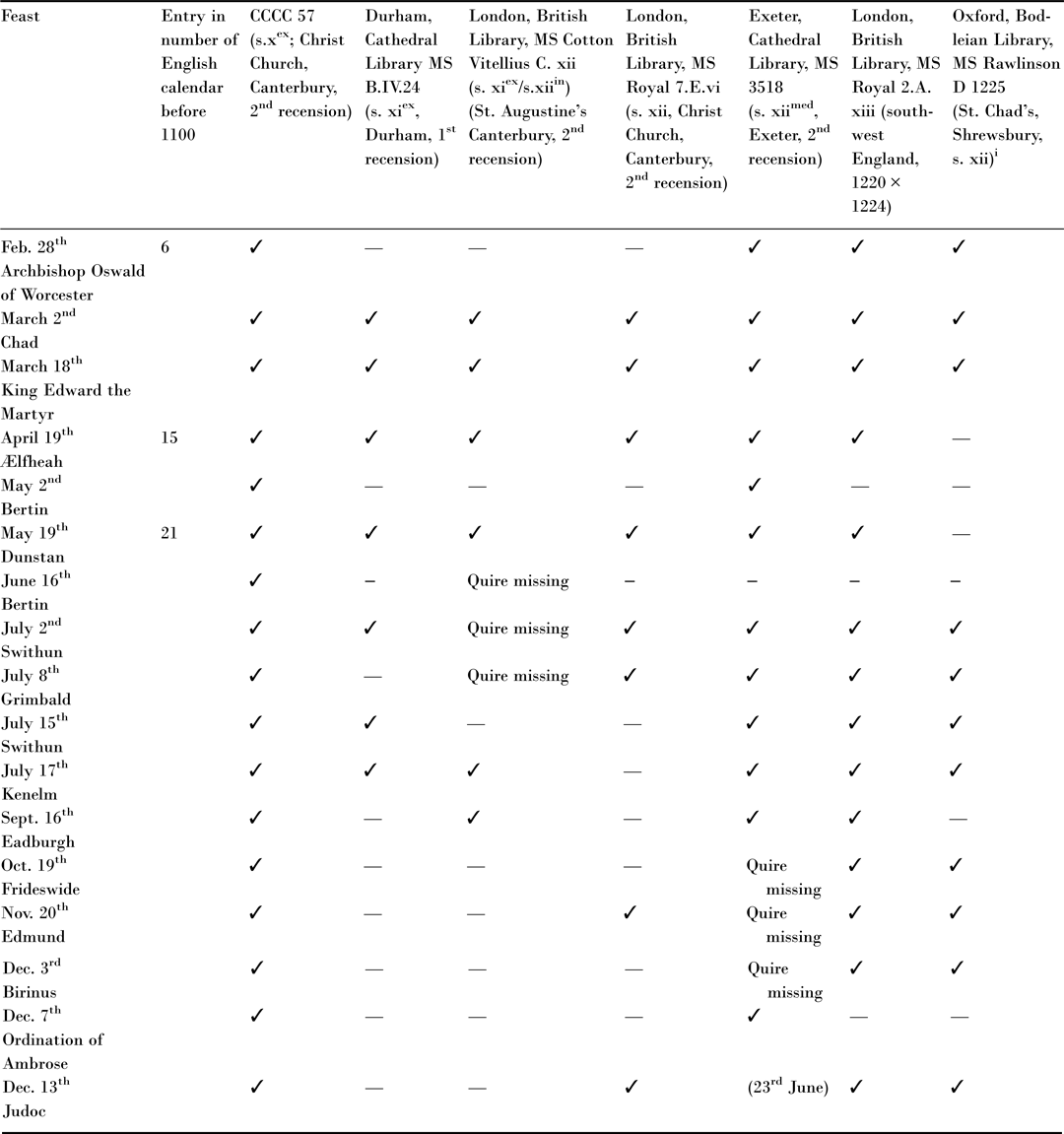
Further, as Table 2 demonstrates, Exeter 3518 is also exceptional in including all but one of the entries added into CCCC 57 later in the Anglo-Saxon period. Exeter 3518 is, therefore, established upon tenth- and eleventh-century English traditions. Unlike the earlier CCCC 57, it memorializes within its main text all the leading bishops of the tenth- and early eleventh-century reform movement: Oswald, Ælfheah, Dunstan, Wulfsige, and Æthelwold.Footnote 87 The calendrical and martyrological evidence in Table 2 also suggests that the cults for these figures were widely known across southern England before the end of the eleventh century. Other cults associated with the reformers of the late Anglo-Saxon church in Exeter 3518 that can be widely found in both the martyrological and calendrical material from this period include those for Saint Edward, king and martyr, his sister Edith, Saints Swithun, Kenelm, and Neot.Footnote 88 The presence of this material in Exeter 3518 testifies to the fact that it was based upon English traditions but does not help us to identify or date its exemplar more precisely.
A comparison of the entries added later in the Anglo-Saxon period to CCCC 57 with other English manuscripts of Usuard from the eleventh and twelfth centuries

i The entries for Oswald and Edward the Martyr were added slightly later in the margin on fols. 35r, 40r; an extensive entry for Chad was added at the end of that for 2 March in a slightly later s. xii hand, fol. 35v.
CCCC 57 was not, however, the model for Exeter 3518. As the comparison of the texts of a sample of entries in the Appendix reveals, there is considerable variation in the wording of entries across the different martyrological manuscripts. It suggests that there was not a single exemplar for these changes, and, pace Andersen, Christ Church Cathedral, Canterbury is unlikely therefore to be the source of all these copies of Usuard. Rather these differences indicate the circulation of a much larger number of manuscripts than now survive, each presumably being updated according to local calendars. But it is also possible to reach some firmer conclusions about Exeter 3518. It is clearly grounded in cults that came to the fore in the late Anglo-Saxon period, suggesting its possible roots in an earlier exemplar. At the same time, as the examples given in the Appendix demonstrate, the compiler of Exeter 3518 was unique amongst his English contempories in locating the subjects of these supplementary entries in Great Britain (“in brittannia maiori”) rather than just in Britain (“in brittannia”). Usuard had not felt any need to distinguish Britain from Brittany when recording British cults so this qualification may be deliberate.Footnote 89 It is at least possible that Exeter 3518 may have been prepared for a Lotharingian or, perhaps more likely, Norman audience of clerics already familiar with Britanny and for whom such a distinction would be helpful when introduced to new cults whilst listening to, and reading aloud from, the martyrology.Footnote 90 If not all early English copies of Usuard came from Christ Church, Canterbury, nevertheless the inclusion of certain entries suggests Exeter 3518's debt to that church and hint at a possible date in the late eleventh century. Several apparent errors in the entries for the eighth-century saints Eadburh of Lyminge and her sister Mildburh point to disputes over the possession of their relics by rival communities in post-Conquest Canterbury. Two entries in Exeter 3518 read: “In Great Britain in the province of Kent in the place that is called Lyminge [the feast of] the virgin Saint Eadburh”(15 June); “The translation of Saint Eadburh” (18 July).Footnote 91 As Canon Doble pointed out, the compiler of Exeter 3518 (or of his model) had seemingly confused two saints called Eadburh.Footnote 92 The feast more usually commemorated on 15 June is that of the tenth-century Saint Eadburh of Nunnaminster, Winchester, daughter of King Edward the Elder.Footnote 93 From the twelfth century onwards Eadburh of Lyminge (Kent), an eighth-century abbess of Minster-in-Thanet, was usually commemorated on 13 December, or sometimes in November; there is no earlier evidence for her cult.Footnote 94 The compiler of Exeter 3518 also made another apparent error; in the entry for 13 July he recorded the cult of Saint Mildrith, Eadburh's predecessor as abbess of Minster-in-Thanet, but placed her at Wenlock in Shropshire.Footnote 95 In doing so the compiler seems to have confused Mildrith with her sister, Mildburh whose cult was located at Wenlock from at least the late ninth century and usually observed on 23 February, occasionally on 25 June.Footnote 96 Mildrith's feast is generally 12 or 13 July.Footnote 97 Whilst Mildburh herself is recorded in Exeter 3518 under 23 February, as in three late Anglo-Saxon calendars, the Exeter compiler gave no location for her cult.Footnote 98 The calendars confirm that, unlike Saint Eadburh of Lyminge, Saints Mildrith and to a lesser extent her sister, Mildburh, were widely commemorated in later Anglo-Saxon England. Eadburh of Lyminge's cult, however, came to the fore only after her relics, alongside those of Mildrith, were translated in 1085 by Archbishop Lanfranc from Lyminge, having been taken there for safety during Viking raids, to his new foundation, St. Gregory's Priory, Canterbury.Footnote 99 The community of St. Gregory's possession of Mildrith was contested by St. Augustine's, Canterbury who claimed that Mildrith's relics had already been translated to their church from their original location in Thanet in 1030. That the details of these three closely connected cults had become muddled in MS 3518 is perhaps best explained as being due to the oral updating of an existing text in the light of recent cultic developments, rather than any attempt to reconcile two contradictory written accounts, whilst the mention of Lyminge may hint that this element of Exeter 3518 has its origins in the archbishop's circle in late eleventh-century Christ Church, rather than that of St. Augustine's.
The Evidence of Eleventh- and Twelfth-century Continental Cults
Other entries also point to a cultic layer in Exeter 3518 from the late eleventh or early twelfth century that could have reached Exeter either directly from Normandy or via Canterbury. An entry on 9 May refers to the translation of the relics of St. Nicholas in 1087 from Myra in Anatolia to Bari in Italian Apulia.Footnote 100 Late eleventh- and early twelfth-century Norman monasteries played an important role in the dissemination of John of Bari's account of the translation, and the collections of miracles worked at his new tomb.Footnote 101 The cult could have come to Exeter direct from Normandy: both Leofric's immediate successors as bishops of Exeter, Osbern and William de Warelwast, had strong connections to Normandy.Footnote 102 It is, however, also possible that his cult was mediated via Canterbury; the Norman monastery of Bec was central to the dissemination of Nicholas's miracle collection and Anselm of Bec, archbishop of Canterbury (1093–1109), attended Urban II's council held in 1098 at the shrine of St. Nicholas of Bari, and composed a prayer to St. Nicholas. Exeter could also have acquired direct knowledge of the cult from the papal court: William de Warelwast, later bishop of Exeter, was in Rome shortly afterwards as the King's representative in the dispute with Anselm. This feast was added in slightly later hands to the texts of both the Durham and St. Chad's, Shrewsbury martyrologies, but is not found in the Christ Church, Canterbury martyrology; if it has a Canterbury origin it is a later twelfth-century one.Footnote 103
Another strand, however, suggests a clearer connection between Exeter 3518 and Normandy. Exeter 3518 includes two feasts for St. Audoenus, the seventh-century bishop of Rouen and patron of the abbey of St. Ouen, Rouen. The date of his main feast, on 24 August, was widely recorded in early medieval Francia and England, and his entry on this date in Exeter 3518 is copied word for word from Usuard's text.Footnote 104 However, Exeter 3518 concludes its entry for 14 May with mention of a second feast which is not in Usuard: “In the city of Rouen the ordination of Saint Audoenus bishop and confessor.”Footnote 105 There is no evidence, calendrical or otherwise, that this May feast was otherwise known in England in the eleventh century; however, it is noted in two Rouen calendars, both from St. Ouen, which date from the late eleventh and twelfth centuries respectively.Footnote 106 And Bishop William de Warelwast's gift of two “Libri sanctorum de Usu Rotomagensi” to Exeter cathedral, noted above, offers a direct conduit by which knowledge of this particular aspect of St.-Ouen's cult might have been transmitted to Exeter sometime in the first third of the twelfth century.Footnote 107 Whilst there is a tradition that the cult and life of St. Audoenus were known at Christ Church, Canterbury from the mid-tenth century onwards, when his relics were seemingly translated there from Rouen, unfortunately all the evidence for the early period comes from the early twelfth century and from a time when the ownership of his relics had become contentious within England.Footnote 108 The personal as well as liturgical connections between early twelfth-century Exeter and Rouen — Bishop William took his name from a village on the demesne of another abbey in the diocese of Rouen — therefore provide the more convincing explanations for the inclusion of the cult of Saint Audoenus's ordination in Exeter 3518.Footnote 109
Clearly some additions should be linked to Bishop William de Warelwast's early twelfth-century episcopate, but there are also various features of Exeter 3518 that indicate its debt to cults introduced to Exeter from the Empire during Bishop Leofric's pontificate in the third quarter of the eleventh century. The mention of the Lotharingian cults of Symeon of Trier (d. 1035) (1 June), Odwulf of Utrecht (12 June) and Eucharius of Trier (8 December), may be linked to the fact he was brought up there.Footnote 110 Similarly, the inclusion of other recent cults from the Empire may also be associated with Exeter's founding bishop: Bishop Heribert of Cologne (d. 1021) (16 March); Bishop Udalrich of Augsburg (d. 973) (4 July); Wencelas of Bohemia (d. 935) (28 September); and Alexius in Rome (17 July), whose cult was closely associated with Otto III (d. 1002).Footnote 111 Whilst Odwulf's relics were translated to Evesham in 1030, none of these cults is mentioned in the other surviving English martyrologies with the exception of Heribert.Footnote 112 He features only in the Durham martyrology; the wording there is different from that in Exeter 3518, indicating these entries are independent of each other.Footnote 113 None of these cults feature in any surviving eleventh-century English calendars either.Footnote 114 Only one English litany from this period features four of these saints: Symeon, Odwulf, Udalrich, and Eucharius. It is in a psalter copied at Exeter under Bishop Leofric, now London, British Library, MS Harley 863.Footnote 115 This litany is one of the longest to survive from Anglo-Saxon England, mentioning around three hundred saints by name. Michael Lapidge therefore described it as a “scholarly compilation.”Footnote 116 It is a testament to the interest shown by the Exeter community under its first bishop in collecting information about saints from across the Christian world. The encyclopedic nature of Usuard's text, and the additions to it in Exeter 3518, also fits into this intellectual context very well.
The presence of another more recent European cult can be more securely linked to the interests of the church of Exeter and to the episcopacy of Bishop Leofric or perhaps his successors. The entry added at the end of that for 19 April, “In Rome Leo pope and confessor,” refers to Pope Leo IX (1048–1054).Footnote 117 Leo IX's cult was widely commemorated in Germany and Lotharingia on this date but much less so in northern France.Footnote 118 He is not widely recorded in English liturgical materials, seemingly appearing in no eleventh-century calendars, any other martyrology, and only one litany: his name was added later, albeit in a script from the second half of the eleventh century, to that in the Harley 863 psalter copied in Exeter under Bishop Leofric.Footnote 119 Leo IX had particular significance for Exeter and its founding bishop: Leofric sought papal approval for the transfer of the seat of the see from Crediton to Exeter, and a copy of Leo IX's bull was recorded in the sacramentary now known as the Leofric Missal as part of a series of texts on the early history of the see copied at Exeter under Bishop Leofric.Footnote 120 Whilst the calendar in the Leofric Missal was not, however, updated to include Leo IX, it is entirely possible that a different eleventh-century Exeter calendar, now lost, was the source for this entry in Exeter 3518.
The Evidence of South-west Cults
Exeter 3518 also records a considerable number of south-west cults: at least nine located across Devon and Cornwall, and a further seven from Somerset, Wiltshire, and Dorset. There is no theme linking these entries other than geography. By contrast, all the local cults added to Usuard's text in the St. Augustine's martyrology explicitly relate to their patron, St. Augustine of Canterbury, his companions and successors, and most of those added to the Durham martyrology relate to their patron, St. Cuthbert.Footnote 121 This difference is probably in part a reflection of this secular cathedral community's own cultic history. Unlike the monastic communities of Durham and St. Augustine's, whose local liturgical devotions were focused around their founding bishops, St. Cuthbert and St. Augustine, and their respective companions and associates, Exeter lacked a single cult or a written tradition upon which it could draw. Instead, Exeter's local liturgical year was focused around its extensive collection of relics, which it commemorated on 22 May in the words of the entry in Exeter 3518: “In Great Britain in the city of Exeter the translation of the relics of the saints which were translated and are commended for their great and many miracles.”Footnote 122 Exeter tradition from the eleventh century onwards recorded King Æthelstan as having granted one third of his entire relic collection, some 138 items according to the eleventh-century relic lists, together with various grants of property, to the minster church of SS. Peter and Mary in Exeter ca. 930, which became the cathedral church in 1050.Footnote 123 Exeter's collection ranged from relics of Christ to those of very local saints. It is not, however, clear whether the feast on 22 May celebrates the original translation of the relics in 930 or their relocation from the old minster church to the new cathedral building, begun in 1114 and consecrated in 1133.Footnote 124 The importance attached to these relics — as evidenced by the survival of two eleventh-century lists, one in Latin and one in Old English — perhaps hints at an earlier origin for the feast, but in any case they had achieved a central place in the liturgical year of the Exeter community by the time Exeter 3518 was copied in the 1130s or 1140s. The May feast testifies to Exeter's catholic interest in multiple cults in contrast to the rather narrower focus in many English monastic communities at this time.
There is some overlap between the relic lists and the patrons of several local churches mentioned in Exeter 3518. One of these, just outside the east gate of the city, is dedicated to St. Sidwell: “The virgin martyr St. Sidwell who is found in Britain at the gates of the walls of Exeter” (1 August).Footnote 125 According to the notice in the eleventh-century Old English relic list, she was a virgin martyr killed by her father's hired man.Footnote 126 Her cult is peculiar to Exeter in this period.Footnote 127 She was also linked in the martyrology to the feast commemorating the translation of St. Juthwara, referred to there as the “sister of St. Sidwell the virgin,” to Sherborne on 13 July.Footnote 128 This entry is one of the earliest references to Juthwara's cult; it is not mentioned in any of the surviving eleventh-century English litanies and calendars, although the translation of her cult to Sherborne is mentioned by Goscelin of Saint-Bertin in his late eleventh-century life of Bishop Wulfsige.Footnote 129 It is impossible to know whether knowledge of the Sherborne cult came to Exeter, therefore, only in the twelfth century, but it seems probable in any case that the text was emended at Exeter to include reference to the apparently oral tradition that she was related to Exeter's own virgin saint, Sidwell.
The patrons of various of the major churches from across Exeter's diocese in Devon and Cornwall also feature in Exeter 3518.Footnote 130 Their inclusion might appear natural, testifying to the links that the cathedral clergy wished to make with their wider locality. But in two cases there is evidence to suggest that their presence may also testify to memories from Exeter's pre-Leofrician past. Exeter 3518 mentions the burial of St. Rumon the confessor at Tavistock in Great Britain as the last entry on 30 August.Footnote 131 Tavistock was the most significant monastery in Devon, founded sometime in the late tenth century.Footnote 132 Rumon does not feature in any version of the Exeter relic list, nor in any of the litanies and calendars surviving from eleventh- and twelfth-century Exeter, nor in other English copies of Usuard. He is mentioned in the early eleventh-century Old English Secgan text.Footnote 133 But Tavistock enjoyed close ties to the bishopric at Crediton under Leofric's predecessor, Lyfing, who held the abbacy of Tavistock until shortly before his death in 1046.Footnote 134 Whoever compiled Exeter 3518 may therefore have drawn on eleventh-century traditions, either written or oral, which predated the moving of the see from Crediton to Exeter.Footnote 135
Similarly St. Nectan, patron of the minster church of Hartland in north Devon, is not mentioned in any other surviving Exeter material, but was entered into the martyrology for 17 June.Footnote 136 The community was reformed as a house of Augustinian canons under Bishop Bartholomew of Exeter (1161–84); this event seems to have been the stimulus for the composition of various texts.Footnote 137 The twelfth-century canons of Hartland believed that Æthelstan had granted land to the community in the tenth century and that another prominent West Country figure, Gytha, wife of Earl Godwin and mother of King Harold, had given land at Hartland to the community in the eleventh century.Footnote 138 Whilst Gytha is recorded in Domesday Book as owning land there, the other aspects of this story had become muddled by the time the inventio was composed for the canons of Hartland: this records how the body of St. Nectan was discovered by the priest of Hartland in the time of King Æthelstan and Bishop Lyfing of Crediton, and that the bishop in recognition of the saint's authority made various gifts to the church at Hartland, including a door to the vestry that was still in use when the text was written.Footnote 139 As noted above, Æthelstan played an important role in Exeter cathedral's foundation myth and it is possible that Exeter's canons, therefore, are the source of this confused chronology.
This review of a sample of the cults added into the main text suggests Exeter 3518 is firmly grounded in late Anglo-Saxon traditions, some dating from Leofric's episcopate, others which appear to predate it, but also with a sprinkling of evidence to suggest more recent influences. However, these additions are not in themselves evidence that Exeter 3518 draws on an eleventh-century martyrological text; whilst some of these entries could have been compiled from oral traditions, others are more likely to have come from now lost calendars. What can be concluded with much more certainty is that the evidence of the over three hundred saints from across the Christian world and Christian history in the litany in the Harley 863 Psalter copied at Exeter under Bishop Leofric testifies to the community's scholarly interest in recording saints in the third quarter of the eleventh century; a litany of that length is not very practical. The catholicity of the additional entries included in Exeter 3518 seventy or so years later is testament to the continuing manifestation of that interest in the mid-twelfth century. The degree of independence shown by Exeter 3518 from surviving Canterbury material also suggests that the simple model postulated by Andersen for the promotion of Usuard in England via eleventh-century Canterbury is not sustainable and requires, at the very least, considerably more nuance and allowance for the significance of local forces at work. The evidence considered thus far suggests that the Exeter martyrology is unique amongst the surviving English martyrologies in including such a wide range of cults, both local and national, from the tenth and eleventh centuries. It also suggests that it is feasible that Exeter 3518 could have been based on a late eleventh-century exemplar compiled under either Bishop Leofric or one of his two immediate successors, but the evidence is not conclusive.
The Evidence of the Obits
The final section of this article briefly considers the evidence of some of the 400 obits recorded in the margins of Exeter 3518 for the light this casts on the composition and history of the martyrology. The majority of entries refer to members of the cathedral community. Many, but not all are dated and some of the dated obits refer to people who had died before the manuscript was written: including “Leofric the first bishop of Exeter, 1072” (11 February), “Brihtric, priest and canon, 1083” (16 February), and “Lanfranc, archbishop of the church of Canterbury” (d. 1089, 26 May).Footnote 140 As David Lepine and Nicholas Orme established, the compilers of Exeter 3518 omitted all but two of the seventeen obits added at Exeter into the eleventh-century calendar of the Leofric Missal, the service book seemingly in use at Exeter under Bishop Leofric. The only obits to be transferred across into Exeter 3518 are those for Leofric and Brihtric.Footnote 141 For example, an obit for Leofric's predecessor, Bishop Lyfing (19 March), is recorded in the Leofric Missal calendar but not Exeter 3518.Footnote 142 This process of selection reflects a version of the community's history which began with the cathedral seat's transfer there from Crediton in 1050 rather than one which acknowledged its roots in a different place and earlier times. This is consonant with what else we know of the Exeter community's attitude to their earlier bishops in the twelfth century: later tradition recorded the translation of the bodies of the first two bishops, Leofric and Osbern, at the consecration of the new cathedral in 1133, suggesting they were regarded as its founders by the community.Footnote 143 The decision to include Archbishop Lanfranc but not his successor, Anselm (d. 21 April 1109), perhaps reflects the fact that Bishop William de Warelwast led William Rufus's appeal against Anselm at the papal court in the 1090s.Footnote 144 The hand that entered the obits for Leofric, Brihtric, and Lanfranc is very similar, if not identical, to that which wrote the main text, as is that which added the obits for two royal women, Mathilda, wife of Henry I (1 May 1118) and Adela of Blois, mother of Stephen, king of the English (8 March 1137).Footnote 145 The decision to include their names but neither Kings Henry nor Stephen probably reflects particular moments in the community's history rather than a particular affinity between the cathedral community and royal women. The bishop and cathedral supported King Stephen in the civil war, and in his successful siege of Exeter castle in 1136, for example, which may explain why they were anxious to commemorate the death of the queen mother a year later.Footnote 146
But this process of layering, and the recognition that selectivity also underlies the obit entries in the martyrology, provides important background to the marginal notice added next to the entry for 25 September, written in a similar hand to that which wrote the main text:
1066. Harold, son of Earl Godwin, king of the English, having killed Harold, king of the Northmen and all his most victorious army, triumphed in that battle, furthermore, Earl Tostig, brother of the aforesaid king of the English was killed by the English with the king of the Northmen.Footnote 147
This reference to the Battle of Stamford Bridge, at which Harold Godwineson defeated and killed his own brother Tostig and Harold Hardrada of Norway, is notably different in its wording to the other obits: the level of detail is more extensive, and the focus is not so much on memorializing the men killed that day but rather on the day's events. It is analogous to an entry from a set of annals, but there are no close parallels for this text in any surviving historical writings.Footnote 148 Although Tostig had a reputation for piety in his lifetime, he had become a political embarrassment by the time his name was copied at Exeter in the mid-twelfth century. Why therefore did Exeter's canons choose to retain this notice in their martyrology, when the Durham community deleted the names of Godwin and Tostig from their Liber Vitae, for example?Footnote 149 It is unfortunate that the relevant folio for the battle of Hastings (14 October) is now missing, so we cannot know whether the Exeter community was similarly interested in the deaths of Tostig's brothers, King Harold, Gyrth, and Leofwine. There is, however, no obit in Exeter 3518 for their father Godwin (d. 14 April 1053) or mother Gytha, suggesting that the September 25 notice is included more as a matter of historical interest than because of loyalty to this family.Footnote 150 In comparison, the St. Augustine's copy of Usuard includes a notice, added in a later twelfth-century hand, linking Harold's death to that of “very many brothers of ours,” that is laymen in confraternity with the abbey.Footnote 151 It contains no mention of any other members of Harold's family, suggesting the significance of this notice lay as much with commemorating benefactors in confraternity with the community as with remembrance of key events in national history. The city of Exeter had been a holding of Earl Godwin's family and Gytha, Harold, and Tostig's mother, was reportedly in the city when the Conqueror's army arrived to besiege the city in 1067.Footnote 152 It is possible therefore that the inclusion of Tostig's death points to the way in which the Exeter community of the twelfth century chose to link their own history to events on the national stage in a similar way to that of St. Augustine's.
Conclusions
Martyrologies are very tricky texts to work with precisely because they contain the sorts of layering of textual traditions uncovered above. Although none of the textual and manuscript evidence adduced here is decisive in itself, cumulatively it means there is good reason to suspect that Exeter 3518 is based on a copy of the second recension, which was already known at Exeter by the late eleventh century. This dating may be refined further to suggest this exemplar was probably brought to Exeter under Bishop Leofric. It was Leofric who introduced the need for a martyrology through the imposition of Chrodegang's Enlarged Rule of Canons on the Exeter community and Leofric's Lotharingian background also explains several of the cults found in Exeter 3518.
There are at least two possibilities as to how this putative exemplar for Exeter 3518 was compiled. The first is that the close parallels with the subjects of the additional entries in CCCC 57 suggest the exemplar for Exeter 3518 was an English manuscript of Usuard written in England before the Conquest. Exeter acquired other service books from Canterbury under Leofric and his successors, and, when coupled with the evidence for the confusion in the entries for the cult of St. Eadburh, it is likely that Canterbury was the ultimate source of the martyrology.Footnote 153 This sort of careful reworking of a Canterbury model is closely paralleled in the revisions made to various of the rites in another Exeter manuscript, the pontifical probably written for Bishop Leofric, London, British Library, MS Additional 28188, which Helen Gittos has shown was heavily indebted to earlier Canterbury traditions.Footnote 154 However, given the substantive differences in the wording of the additional entries from all other existing manuscripts, Exeter 3518 is clearly not based on a text closely related to CCCC 57. Rather the variance in wording for the same cults in these and other English manuscripts of the period suggests several different copies of Usuard's texts circulated amongst the reform houses of late Anglo-Saxon England. There are precedents for Exeter adapting material from other southern cathedrals: Christopher A. Jones has demonstrated that the Exeter pontifical also included revisions of Aethelwoldian-era Winchester material.Footnote 155 There is therefore every reason to believe that the late eleventh-century community of Exeter might have made similar changes to an Anglo-Saxon copy of Usuard. There is also a second possibility, namely that the compilers of Exeter 3518 drew upon a Canterbury-influenced calendar to revise a copy of Usuard they had acquired independently. Given the nature of the surviving evidence the former is more probable, but both hypotheses are feasible.
Exeter's eleventh-century books are, as Richard Gameson observed, not just the product of a particular moment and reforming impulse, but rather a reflection of the ongoing commitment of Leofric and his two successors to establishing a basic “working” collection for their cathedral's canons.Footnote 156 Leofric's commitment to vernacular texts has understandably attracted considerable interest from Old English scholars and focused attention on those manuscripts like the tenth-century collection of poetry known as the Exeter Book, which make his library exceptional.Footnote 157 But the presence at Exeter in the later eleventh century of Usuard's text, a work which was widely copied in eleventh- and twelfth-century Lotharingia, fits with other indications that many of Exeter's late eleventh-century books were much more conventional and part of the European mainstream of post-Carolingian religious culture and canonical practice.
The Exeter community under its late eleventh-century bishops had a clear interest in collecting information about saints. The relic lists copied in Latin and Old English, the extensive list of saints in the Harley 863 litany and the additions made to Exeter 3518, all testify to a thought-world which valued the cult of saints as a collective endeavor, rather than privileging a particular cult. It has been suggested that there is something rather old fashioned about Exeter's catholic interest in saints’ relics and collections, but it is an approach that they shared with several Lotharingian communities.Footnote 158 Moreover, it can as easily be interpreted as a feature of a community that is part of the same intellectual milieu out of which Archbishop Lanfranc, with his preference for universal rather than local saints, emerged.Footnote 159
Current debates about the attitude of Anglo-Norman churchmen to the Anglo-Saxon cults focus almost exclusively on accounts of particular cults rather than more normative liturgical texts like this martyrology.Footnote 160 If we are really to understand the history of local saints’ cults in secular communities such as that in Exeter, which unlike their monastic counterparts did not establish a tradition of narrative history writing, we need to recognize the role played by texts such as this one in constructing and reinforcing the community's knowledge of the saints. Daily readings in chapter over the course of each year reinforced traditions, both oral and written, as much as office lections, building up memories of the patrons of individual churches within its diocese, and at the same time establishing continuity with the tenth-century past of the Anglo-Saxon reformers, and the eleventh-century past of prominent patrons of the community who tied its history to that of the nation and of the universal Church.Footnote 161
This case study has sought to show the value of investigating normative materials. Doing so allows a much more nuanced interpretation of the Anglo-Norman revival of interest in particular local cults. Exeter's reform as a secular community of canons under the Rule of Chrodegang makes it something of a hybrid between the less well-documented secular communities serving many churches in the eleventh century and the reformed monastic communities that often succeeded them. In pointing to the influence of an eleventh-century Anglo-Latin version of a ninth-century martyrological text on the late eleventh-century and twelfth-century Exeter cathedral community, it suggests there was more textual continuity between these two constituencies than has previously been thought.Footnote 162 Recognizing the potential of normative texts such as this thus allows us to begin to understand how communities like Exeter, which lacked a written historical tradition, nevertheless maintained and built their own historical consciousness through the cult of the saints. At the same time it reminds us that the Anglo-Norman churchmen who documented English local cults inherited a very helpful textual legacy from their Anglo-Saxon predecessors.
Appendix
A Comparison of the Text of a Sample of Entries between Five of the Earliest English Manuscripts of Usuard and the Text in Exeter 3518.
CCCC 57: Christ Church, Canterbury, s. xex (later added to at Abingdon in s. ximed) (2nd recension); digital images available at Parker Library on the Web https://parker.stanford.edu/parker/actions/page.do?forward=home (last accessed 14 June 2017)
Durham, Cathedral Library, MS B.iv.24: Christ Church, Canterbury, s. xiex (added to at Durham in s. xiiin); 1st recension
London, British Library, MS Cotton Vitellius C. xii: St. Augustine's, Canterbury s. xiex (2nd recension)
London, British Library, MS Royal 7.E.vi: Christ Church, Canterbury, s. xii (2nd recension)
Exeter, Cathedral Library, MS 3518: Exeter, s. xiimed (2nd recension)
Oxford, Bodleian Library, MS Rawlinson D 1225: prov. St. Chad's, Shrewsbury, s.xii (2nd recension)
1) 28 February: Oswald, archbishop of York
CCCC 57, fol. 49r: “Ipso die depositio sancti oswaldi archiepiscopi.”
Durham, Cathedral Library, MS B.IV.24: no entry for Archbishop Oswald.
London, British Library, MS Cotton Vitellius, C. xii: no entry.
London, British Library, MS Royal 2 7 E.vi: no entry.
Exeter MS 3518, fol. 5r: “Item in britannia maiori apud Wircestram sancti oswaldi archiepiscopi et confessoris.”
Oxford, Bodleian Library, MS Rawlinson D 1225, fol. 35r (added in s. xii hand in the margin): “In britannia ciuitate uigornia depositio sancti osuualdi eboracensis archiepiscopi.”
2) 19 April: Aelfheah
CCCC 57, fol. 55r (added in later s. xi hand above the line): “Eodem die passio sancti aelfegi archiepiscopi et martyris.”
Durham, MS B.IV.24, fol. 20v: “Eodem die passio sancti elfeagi archiepiscopi.”
Exeter, MS 3518, fol. 13v: “In brittannia maiori apud cantuarbiram sancti aelfegi archiepiscopi et martyris.”
London, British Library, MS Cotton Vitellius, C. xii: no entry.
London, British Library, MS Royal 7 E.vi, fols. 21v–22r: “Eodem die SANCTI ÆLFEGI cantuariensis archiepiscopi qui ab exercitu paganorum post dirutam illius urbem post cruentam innocentis populi cedem post te(m)pli expoliationem uinctus abductus est et per septem menses uariis tormentorum suppliciis cruciatus tandem furentium manibus paganorum lapidatus.”
Oxford, Bodleian Library, MS Rawlinson D 1225: no entry.
3) 19 May: Dunstan
CCCC 57, fol. 60r (added in later s. xi hand above the line): “Eodem die deposiuit sanctus dunstanus archiepiscopus in Christo.”
Durham, MS B.IV.24, fol. 23r: “Ipso die depositio sancti dunstani archiepiscopi cantuariae ubi etiam sepultus usque hodie crebris refulgent miraculis.”
London, British Library, MS Cotton Vitellius, C. xii, fol. 130r: “Eodem die depositio sancti beati dunstani archiepiscopi et confessoris.”
London, British Library, MS Royal 7 E.vi, fol. 28v: “In ciuitate dorobernia natale sancti patris nostri DUNSTANI archiepiscopi qui ab ipso matris utero sanctificatus omne tempus uitae suae magnifice duxit unde et glorioso fine quieuit.”
Exeter, MS 3518, fol. 22r: “In brittannia maiori ciuitate cantuarbiria sancti dunstani archiepiscopi et confessoris.”
Oxford, Bodleian Library, MS Rawlinson D 1225: no entry.
4) 31 August: Aidan, bishop of Lindisfarne and Cuthburh, abbess of Wimborne
CCCC 57, fol. 76r: “Eodem die sancti aedani episcopi cuius animam sanctus cuthberhtus in caelum ab angelis ferri uidit. Eodem die sanctae cuthburge uirginis.”
Durham, MS B.iv.24, fol. 31r (added early s. xii hand in right hand margin): “In britannia sancti aidani primi lindisfarnensis episcopi. Eodem die commemoratio sanctarum reliquiarum eiusdem ecclesiae.” No entry for Cuthburh.
Exeter, MS 3518, fol. 47r: “In brittannia maiori apud durelmam depositio sancti aidani episcopi et confessoris cuius relique sunt repositae in ecclesia sancti cuthberti. Ipso die sanctae cuthburgae uirginis.”
London, British Library, MS Cotton Vitellius, C. xii, fol. 139r: “In britannia depositio sancti aidani episcopi et confessoris. Eodem die natale sanctae cuthbergis uirginis.”
London, British Library, MS Royal 7 E.vi, fol. 49v: “Eodem die sancti aidani episcopi (cuius-struckthrough)”(last line on page; end of entry with obits erased at top of fol. 50r).
Oxford, Bodleian Library, MS Rawlinson D 1225: no entry.