Osteoporosis is a systemic skeletal disease characterised by reduced bone mass and the deterioration of bone microarchitecture(Reference Compston, McClung and Leslie1). According to relevant research, osteoporosis can lead to serious repercussions, including an increased mortality rate among the middle-aged and elderly, chronic pain, bone fragility, fractures and reduced quality of life, imposing considerable social and economic costs(Reference Cerani, Zhou and Forgetta2–Reference Christensen, Clausen and Petersen4). Efforts are being undertaken to enhance awareness of osteoporosis, facilitate timely diagnosis and implement preventive interventions to lessen the burden of osteoporosis on individuals and society worldwide(Reference Gregson, Armstrong and Bowden5).
Ultra-processed foods (UPF) are industrially manufactured products produced by breaking down entire foods into their component parts (e.g. fats, sugars, starch and protein isolates) and then modifying and recombining these elements with additives, like flavours, colours and emulsifiers(Reference Monteiro, Cannon and Levy6). These foods have replaced many unprocessed and lightly processed foods and now account for a considerable component of the diet globally(Reference Baker, Machado and Santos7,Reference Monteiro, Moubarac and Cannon8) . A growing body of epidemiological research has indicated that rising dietary consumption of UPF leads to a decline in the overall nutritional quality of the diet(Reference Moubarac, Batal and Louzada9–Reference Steele, Baraldi and da Costa Louzada16), which can increase various health problems(Reference Ciaffi, Mancarella and Ripamonti17,Reference Pagliai, Dinu and Madarena18) that harm human bone health, such as type 2 diabetes, CVD, cancer, obesity and inflammatory bowel disease(Reference Lane, Gamage and Du19–Reference Vázquez-Lorente, García-Gavilán and Shyam24). Further, a cross-sectional study of individuals over 20 years suggested that greater consumption of UPF was linked to a heightened risk of osteoporosis(Reference Wang, Xie and Zhai25).
Studies based on animal models have found that consuming a UPF diet during postnatal development alters the microbiome and severely disrupts skeletal development, bone parameters and bone marrow adiposity(Reference Zaretsky, Griess-Fishheimer and Carmi26,Reference Travinsky-Shmul, Beresh and Zaretsky27) . Furthermore, evidence has suggested that an increase in fast-food outlets near living environments is associated with decreased bone mineral content in infants(Reference Vogel, Parsons and Godfrey28), and fast food is a typical type of UPF(Reference Mendoza, Smith-Warner and Rossato29). Although recent studies have shown that UPF consumption can impact bone health, no prospective research has directly examined this relationship in human populations.
Using data of 163 855 participants from the UK Biobank cohort, we examined the relationship of UPF intake with bone mineral density (BMD) and fractures after adjusting for potential confounders. We also explored the interactions of sex, age, BMI, smoking status and drinking status with UPF intake on BMD at various sites, hip fractures and all fractures.
Materials and methods
Study design and participants
The participants in this study were selected from the UK Biobank, a large prospective cohort study that includes nearly 500 000 individuals aged 40–69 years at recruitment from 2006 to 2010 in the UK. Additional information about the UK Biobank has been provided elsewhere(Reference Bycroft, Freeman and Petkova30). From the initial UK Biobank sample of 502 619 participants, 110 participants were excluded due to loss to follow-up (due to dropout). After excluding 1079 participants with missing hip fracture data, 11 963 with missing all fracture data, 291 496 with missing or unusual UPF intake data and 54 490 with self-reported or baseline fractures, 185 043 participants remained. Due to missing data on age, sex, ethnicity, BMI and other covariates and baseline total energy intake being abnormal (men: < 800 or > 4200 kcal/d; women: < 600 or > 3500 kcal/d), a further 21 188 participants were excluded, leaving a final study sample of 163 855 participants (Figure 1). Consequently, our study included 163 855 participants, of which 20 546, 20 546, 20 268 and 21 218 had complete data for femur neck, femur trochanter, lumbar spine (LS) and total body BMD, respectively.
Flow chart of sample selection used in this study. UPF, ultra-processed food.

The North West Multi-Center Research Ethical Committee granted UK Biobank ethical approval (REC reference: 11/NW/03820). All participants gave their written informed consent prior to enrolment, and the research was carried out in alignment with the ethical principles set forth in the Declaration of Helsinki. The UK Biobank (ID: 29256) approved the current analysis.
Exposure measurement
The definition of UPF is derived from the NOVA classification(Reference Monteiro, Cannon and Levy6,Reference Petrus, do Amaral Sobral and Tadini31) , with specific content shown in online Supplementary Table 1. Information on UPF intake was collected from the Oxford WebQ(Reference Chen, Wellens and Kalla32) (https://www.ceu.ox.ac.uk/research/oxford-webq), a validated web-based 24-h dietary recall questionnaire designed for a range of applications in large prospective studies. Participants in the UK Biobank cohort were invited to fill out the Oxford WebQ questionnaire, which has been validated to demonstrate strong concordance with the UK Biobank FFQ(Reference Greenwood, Hardie and Frost33), on five occasions over 5 years. Participants were asked to choose the number of portions they consumed for each item, with instructions clarifying the size of one portion, such as one slice of bread, one rasher of bacon or one ‘serving’ for certain specific foods. Comprehensive information regarding the questionnaire is accessible elsewhere (https://biobank.ndph.ox.ac.uk/showcase/label.cgi?id=100090).
Food items included in estimating UPF intake(Reference Chen, Wellens and Kalla32) are listed in online Supplementary Table 2. To reduce bias, the consumption of each UPF was calculated using all available recalls from the five valid questionnaire rounds (requiring ≥ 1 valid WebQ). And UPF intake was computed as the total of all these dietary components, excluding extreme intake values, defined as the mean plus or minus three times standard deviations, from the analysis.
Outcomes measurement
Dual-energy X-ray absorptiometry was utilised to measure BMD at multiple anatomical sites, including the femur neck (fields 23 299 and 23 208), femur trochanter (fields 23 295 and 23 215), L1–L4 (field 23 204) and total body BMD (field 23 236). To ensure representativeness, the femur BMD values were calculated as the averages for both the left and right sides.
The International Classification of Diseases, 10th Revision (ICD-10), was utilised to identify cases of hip and all fractures during follow-up. A comprehensive list of ICD-10 codes for the recorded fracture instances is provided in online Supplementary Table 3. In the UK Biobank, the occurrence of hip and all fractures was determined from hospital inpatient (Category 2000), which included admissions with intended overnight stays and day cases.
Covariates assessment
Information regarding age, sex, ethnicity, assessment centre and the Townsend deprivation index was obtained from the baseline questionnaire. Townsend deprivation index was utilised as a geographic proxy indicator of socio-economic status, with higher scores indicating greater deprivation(Reference Adams, Ryan and White34). BMI (kg/m2) was calculated by dividing weight (kg) by the square of height (m). Physical activity was evaluated using metabolic equivalent task (MET)-minutes per week, determined by totalling the duration of walking, moderate and vigorous activities, each weighted by their corresponding energy expenditures(Reference Cassidy, Chau and Catt35). Alcohol intake and smoking status were classified as ‘Never’, ‘Previous’ or ‘Current’, with ‘Prefer not to answer’ responses omitted from the study. Serum vitamin D data were obtained from the biomarkers (category 717) of the UK Biobank, and serum vitamin D level was measured by chemiluminescence immunoassay (DiaSorin LIAISON XL)(Reference Lin, Smeeth and Langan36). Total energy intake was calculated using the mean value of five measurements.
Statistical analysis
An ANOVA was conducted for continuous variables, while a χ2 test was employed for categorical variables to compare the means or proportions of characteristics across UPF tertiles. Restricted cubic spline (RCS) regression fitted for linear regression and Cox proportional hazard models was performed to estimate the probable non-linearity of UPF intake with BMD at numerous sites and incident fractures, respectively. UPF intake was divided into tertiles based on its distribution: Tertile 1 (the lowest tertile), Tertile 2 and Tertile 3 (the highest tertile). Multivariable linear regression models were used to analyse the associations between UPF intake and BMD at different sites. Given the potential non-linearity between UPF intake and BMD at some sites, we also reported categorical results, with the lowest UPF intake as the reference group and the other tertiles as dummy variables in the model. We further performed trend tests by including the median UPF intake for each tertile in the model as a continuous variable. Covariates for adjustment include age, age squared, sex, ethnicity, BMI, assessment centre, physical activity (MET-min/week), Townsend deprivation index, smoking status, drinking status, total energy intake and serum vitamin D. Cox proportional hazard models were applied to explore the associations of UPF intake and hazard ratios (HR) for incident hip fractures and all fractures. Considering the linear link between UPF intake and incident risk of hip and all fractures and the limited number of incident occurrences, we standardised UPF intake to provide HR per sd increment rather than classifying it in Cox models. The Schoenfeld residuals test was utilised to evaluate the proportional hazards assumption. In the Cox model, we introduced a time-dependent covariate, that is, the original covariate multiplied by the log of the time to hip or all fractures, when continuous covariates did not meet the proportional hazards assumption, and we stratified categorical covariates when they did not meet the proportional hazards hypothesis. We used Poisson regression, with follow-up time as an offset variable, to estimate the incidence rates of hip fractures and all fractures per 10 000 person-years.
To investigate whether sex, age and BMI modified the associations of UPF intake with BMD and fractures, we included interaction terms between UPF consumption and each of these covariates in the multiple linear and Cox regression models mentioned above. The models were adjusted for the covariates previously specified. Additionally, we performed stratified analyses based on sex, age groups and BMI categories.
To further validate the robustness of the results, we conducted several sensitivity analyses. First, we additionally adjusted the original model for potential residual confounding factors, including season, alcohol amount in addition to drinking status, dietary supplement use, glucocorticoid use and anti-osteoporosis medication use. And in women-only analyses, we additionally adjusted the original model for menopausal status and hormone replacement therapy use. Second, acknowledging that excluding participants with baseline fracture records or self-reported fractures might underestimate the impact of UPF on BMD, we re-analysed the data without excluding individuals with fractures at baseline or self-reported fractures, adjusting for prior fracture history as a covariate when fractures were used as the outcome.
To evaluate potential selection bias, we compared baseline characteristics between participants who were included and those who were excluded. Differences were quantified using the absolute standardised mean difference (SMD). As a rule of thumb, an absolute SMD ≥ 0·20 was considered evidence of meaningful imbalance between included and excluded participants(Reference Ronner, Giannini and Miano37).
All statistical analyses were conducted using SAS version 9.4 (SAS Institute Inc.) and R version 4.2.2. Statistical significance was defined as a two-tailed P < 0·05.
Results
Table 1 presents the baseline characteristics of the 163 855 included individuals, stratified by UPF intake categories. The mean (sd) age was 56·0 (8·0) years. Among all participants, 89 251 (54·5 %) were women and 157 175 (95·9 %) were of White ethnicity. The mean (sd) BMI was 26·9 (4·6) kg/m2, the mean (sd) total energy intake was 8717·4 (2338·7) KJ and the mean (sd) UPF intake was 8·1 (3·7) servings. We documented 1097 hip fractures and 7889 all fractures during a mean follow-up of 12·0 years.
Baseline characteristics of participants

Table 1 Long description
The table presents baseline characteristics of 163 855 participants stratified by UPF intake categories. It has 16 rows and 12 columns. Column headers are: All (n 163 855), Tertile 1* (n 54 710), Tertile 2* (n 54 932), and Tertile 3* (n 54 213). Each column is further divided into n and % sub-columns. Row labels include Sex, Age (year), Age groups, BMI (kg/m2), BMI categories, MET (min/week), Vitamin D (nmol/l), Total energy (kJ), Townsend deprivation index, Ethnicity, Smoking status, Drinking status, UPF intake (serving), Femur trochanter BMD (g/cm2), Femur neck BMD (g/cm2), Lumbar spine BMD (g/cm2), Total body BMD (g/cm2), Hip fractures, and All fractures. Each row provides specific data points for each category. Notable trends include the majority of participants being women and of White ethnicity, with varying distributions across UPF intake tertiles.
UPF, ultra-processed food. BMD, bone mineral density.
* Tertile 1, Tertile 2 and Tertile 3 were the lowest, intermediate and highest tertiles of ultra-processed food intake, respectively.
† The average follow-up time for diagnosis of hip fractures and all fractures was 12·1 and 12·0 years, respectively.
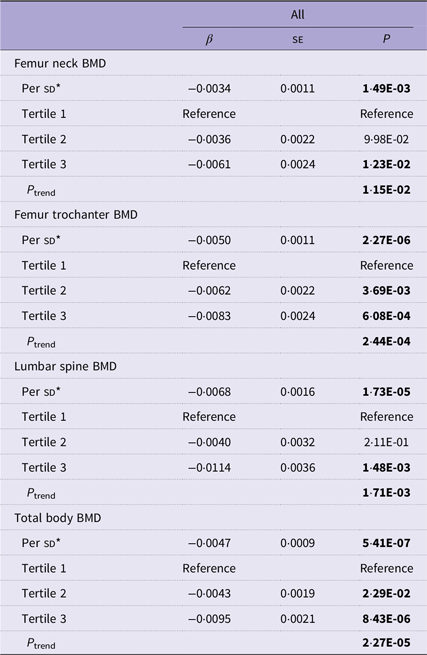
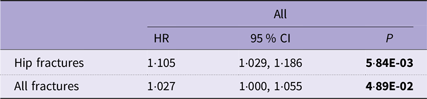
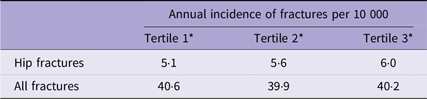
We identified significant associations between UPF intake and BMD at all four sites in the multivariable linear regression models adjusted for age, sex, ethnicity, BMI, assessment centre, physical activity (MET-min/week), Townsend deprivation index, smoking status, drinking status, total energy intake and serum vitamin D. In comparison to participants with the lowest UPF intake (Tertile 1), those with the highest UPF intake (Tertile 3) exhibited a marked decrease in BMD at femur neck (β (se) = −0·0061 (0·0024), P < 0·05), femur trochanter (β (se) = −0·0083 (0·0024), P < 0·001), LS (β (se) = −0·0114 (0·0036), P < 0·01) and total body (β (se) = −0·0095 (0·0021), P < 0·001) (Table 2). Additionally, per sd increment of UPF intake was associated with 10·5 % and 2·7 % higher risks of incident hip fractures (HR, 95 % CI 1·105, 1·029, 1·186; P < 0·01) and all fractures (HR, 95 % CI 1·027, 1·000, 1·055; P < 0·05), respectively (Table 3). The results of Poisson regression showed that for hip fractures, the incidence rate in Tertile 3 was 6·0 per 10 000 person-years, compared with 5·1 per 10 000 person-years in Tertile 1. This suggests a potential positive correlation between higher UPF intake and hip fracture risk. However, for all fractures, the overall incidence rates were similar across the three tertiles (Tertile 1 :40·6, Tertile 2 :39·9 and Tertile 3 :40·2) (Table 4).
Association between intake of ultra-processed foods and BMD

BMD, bone mineral density; MET, metabolic equivalent task.
The multiple linear models were adjusted for age, sex, ethnicity, BMI, assessment centre, physical activity (MET-min/week), Townsend deprivation index, smoking status, drinking status, total energy intake and serum vitamin D.
The bold P values indicate P < 0·05.
* Per sd referred to per sd increment in ultra-processed food intake. Tertile 1, Tertile 2 and Tertile 3 were the lowest, intermediate and highest tertiles of ultra-processed food intake, respectively.
Association between intake of ultra-processed foods and incident fractures

HR, hazard ratio; MET, metabolic equivalent task.
The HR is presented as HR per 1 sd in ultra-processed food intake. The Cox regression models were adjusted for age, sex, ethnicity, BMI, assessment centre, physical activity (MET-min/week), Townsend deprivation index, smoking status, drinking status, total energy intake and serum vitamin D.
The bold P values indicate P < 0·05.
Annual incidence of hip and all fractures per 10 000 people by ultra-processed food intake tertiles

* Tertile 1, Tertile 2 and Tertile 3 were the lowest, intermediate and highest tertiles of ultra-processed food intake, respectively.
In the RCS regression analysis, we only found a complex non-linear association with inverted U-shapes between UPF intake and femur trochanter BMD (P for non-linear < 0·05) (Figure 2). However, no non-linear associations were observed between UPF intake and femur neck BMD, LS BMD, total body BMD, hip fractures and all fractures (all P for non-linear > 0·05) (Figures 2 and 3).
Non-linear associations between UPF intake and BMD. RCS models were fitted for linear regression for BMD at femur neck, femur trochanter, LS and total body. The red vertical dashed lines indicate the peak UPF intake values, while the blue dashed vertical lines indicate the trough UPF intake values. The RCS models were adjusted for age, sex, ethnicity, BMI, assessment centre, physical activity (MET-min/week), Townsend deprivation index, smoking status, drinking status, total energy intake and serum vitamin D. UPF, ultra-processed food; BMD, bone mineral density; RCS, restricted cubic spline; MET, metabolic equivalent task.

Non-linear associations between UPF intake and incident fractures. RCS models were fitted for Cox proportional hazards models for fractures. The horizontal dashed line indicates HR = 1. The RCS models were adjusted for age, sex, ethnicity, BMI, assessment centre, physical activity (MET-min/week), Townsend deprivation index, smoking status, drinking status, total energy intake and serum vitamin D. UPF, ultra-processed food; RCS, restricted cubic spline; HR, hazard ratio; MET, metabolic equivalent task.

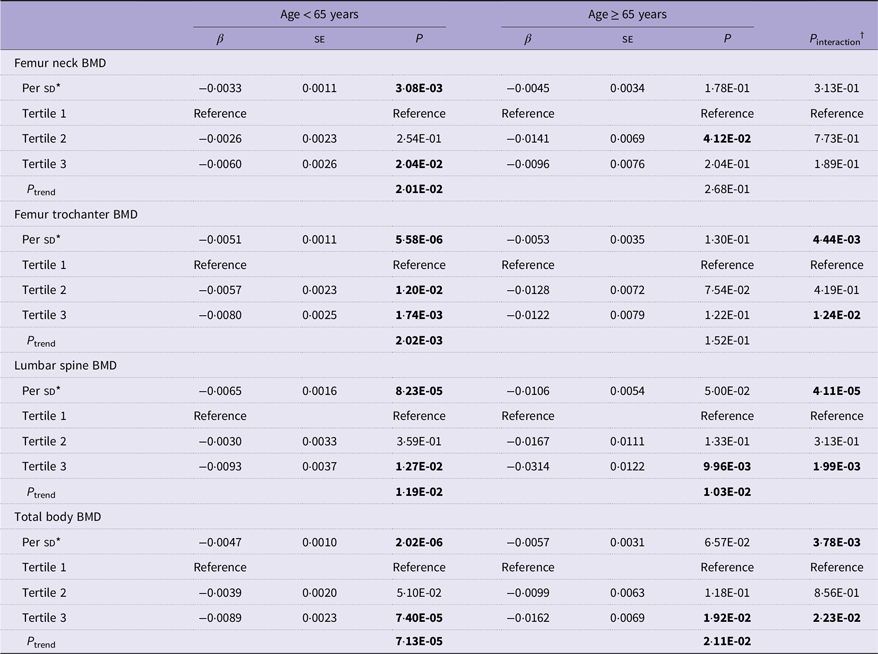
In multiple linear models, we found significant interactions between UPF intake and age on BMD at the femur trochanter, LS and total body (all P interaction < 0·01) (Table 5). We subsequently analysed the relationship between UPF intake and bone health outcomes stratified by age group (< 65 years and ≥ 65 years). Among participants under 65 years of age, we found significant associations between UPF intake and BMD at all four sites (all P < 0·01). In detail, in the population under 65 years of age, higher UPF intake (in sd) was linked to lower BMD at femur neck (β (se) = −0·0033 (0·0011), P < 0·01), femur trochanter (β (se) = −0·0051 (0·0011), P < 0·001), LS (β (se) = −0·0065 (0·0016), P < 0·001) and total body (β (se) = −0·0047 (0·0010), P < 0·001). For participants aged 65 years or older, there were no significant associations between a per-sd increment in UPF intake and BMD at the four sites (all P > 0·05) (Figure 4, Table 5). However, there were no significant interactions between UPF intake and age on hip and all fractures (all P interaction > 0·05) (Table 6, online Supplementary Figure 1).
Association between intake of ultra-processed foods and BMD stratified by age groups

Table 5 Long description
The table presents data on the relationship between ultra-processed food (UPF) intake and bone mineral density (BMD) at different sites, stratified by age groups ( 65 years and 65 years). The table has 16 rows and 10 columns. Column headers are: Age 65 years, Beta, SE, P, Age = 65 years, Beta, SE, P, P interaction. Row labels include Femur neck BMD, Femur trochanter BMD, Lumbar spine BMD, and Total body BMD, each with tertiles and trend values. Row 1: Femur neck BMD, Per sd, -0.0033, 0.0011, 3.08E-03, -0.0045, 0.0034, 1.78E-01, 3.13E-01. Row 2: Tertile 1, Reference, Reference, Reference, Reference, Reference. Row 3: Tertile 2, -0.0026, 0.0023, 2.54E-01, -0.0141, 0.0069, 4.12E-02, 7.73E-01. Row 4: Tertile 3, -0.0060, 0.0026, 2.04E-02, -0.0096, 0.0076, 2.04E-01, 1.89E-01. Row 5: P trend, 2.01E-02, , , 2.68E-01, , , . Row 6: Femur trochanter BMD, Per sd, -0.0051, 0.0011, 5.58E-06, -0.0053, 0.0035, 1.30E-01, 4.44E-03. Row 7: Tertile 1, Reference, Reference, Reference, Reference, Reference. Row 8: Tertile 2, -0.0057, 0.0023, 1.20E-02, -0.0128, 0.0072, 7.54E-02, 4.19E-01. Row 9: Tertile 3, -0.0080, 0.0025, 1.74E-03, -0.0122, 0.0079, 1.22E-01, 1.24E-02. Row 10: P trend, 2.02E-03, , , 1.52E-01, , , . Row 11: Lumbar spine BMD, Per sd, -0.0065, 0.0016, 8.23E-05, -0.0106, 0.0054, 5.00E-02, 4.11E-05. Row 12: Tertile 1, Reference, Reference, Reference, Reference, Reference. Row 13: Tertile 2, -0.0030, 0.0033, 3.59E-01, -0.0167, 0.0111, 1.33E-01, 3.13E-01. Row 14: Tertile 3, -0.0093, 0.0037, 1.27E-02, -0.0314, 0.0122, 9.96E-03, 1.99E-03. Row 15: P trend, 1.19E-02, , , 1.03E-02, , , . Row 16: Total body BMD, Per sd, -0.0047, 0.0010, 2.02E-06, -0.0057, 0.0031, 6.57E-02, 3.78E-03. Row 17: Tertile 1, Reference, Reference, Reference, Reference, Reference. Row 18: Tertile 2, -0.0039, 0.0020, 5.10E-02, -0.0099, 0.0063, 1.18E-01, 8.56E-01. Row 19: Tertile 3, -0.0089, 0.0023, 7.40E-05, -0.0162, 0.0069, 1.92E-02, 2.23E-02. Row 20: P trend, 7.13E-05, , , 2.11E-02, , , .
BMD, bone mineral density; MET, metabolic equivalent task.
The multiple linear models were adjusted for age, sex, ethnicity, BMI, assessment centre, physical activity (MET-min/week), Townsend deprivation index, smoking status, drinking status, total energy intake and serum vitamin D.
The bold P values indicate P < 0·05.
* Per sd referred to per sd increment in ultra-processed food intake. Tertile 1, Tertile 2 and Tertile 3 were the lowest, intermediate and highest tertiles of ultra-processed food intake, respectively.
† P interaction referred to P value for interactions between ultra-processed food intake and age on BMD at all four sites.
Association of intake of ultra-processed foods and BMD stratified by potential confounders. The HR is presented as HR per 1 sd in UPF intake. The models were adjusted for age, sex, ethnicity, BMI, assessment centre, physical activity (MET-min/week), Townsend deprivation index, smoking status, drinking status, total energy intake and serum vitamin D. BMD, bone mineral density; HR, hazard ratio; UPF, ultra-processed food; MET, metabolic equivalent task.

Figure 4 Long description
Panel A: This panel contains four forest plots showing the association of ultra-processed food intake with bone mineral density (BMD) at different sites: Femur neck BMD, Femur trochanter BMD, LS BMD, and Total body BMD. Each plot includes subgroups based on sex, age groups, BMI categories, smoking status, and drinking status. The x-axis represents the beta coefficient (β) with 95 percent confidence intervals (CI), and the y-axis lists the subgroups. Each subgroup is represented by a point estimate with error bars indicating the confidence intervals. Panel B: This panel contains the same four forest plots as Panel A, but with additional information on P values and P interaction values for each subgroup. The structure and axes are identical to those in Panel A, providing a detailed breakdown of the statistical significance and interaction effects within each subgroup.
Association between intake of ultra-processed foods and incident fractures stratified by age groups

HR, hazard ratio; MET, metabolic equivalent task.
The HR is presented as HR per 1 sd in ultra-processed food intake. The Cox regression models were adjusted for age, sex, ethnicity, BMI, assessment centre, physical activity (MET-min/week), Townsend deprivation index, smoking status, drinking status, total energy intake and serum vitamin D.
The bold P values indicate P < 0·05.
* P interaction referred to P value for interactions between ultra-processed food intake and age on incident fractures.
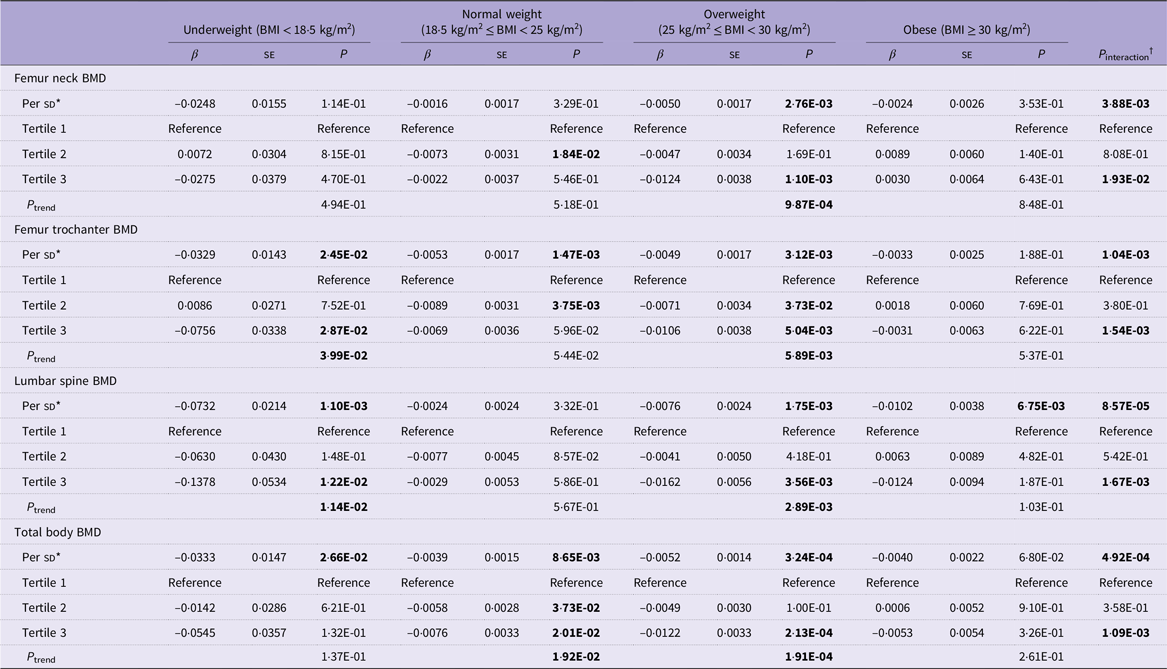
Significant interactions were also observed between UPF intake and BMI on BMD at the femur neck, femur trochanter, LS and total body (all P interaction < 0·01) (Table 7). We then separately analysed the associations between BMD at the four aforementioned sites and UPF intake among individuals in different BMI categories (underweight, normal weight, overweight and obese). Notably, underweight participants showed a more marked decrease in femur trochanter BMD (β (se) = −0·0329 (0·0143), P < 0·05), LS BMD (β (se) = −0·0732 (0·0214), P < 0·01) and total body BMD (β (se) = −0·0333 (0·0147), P < 0·05), respectively, per sd increment of UPF intake. Moreover, in individuals with normal weight, higher UPF intake (in sd) was related to lower BMD at the femur trochanter (β (se) = −0·0053 (0·0017), P < 0·01) and total body (β (se) = −0·0039 (0·0015), P < 0·01) (Figure 4, Table 7). However, no significant interactions were identified between UPF intake and BMI on hip and all fractures (all P interaction > 0·05) (Table 8, online Supplementary Figure 1).
Association between intake of ultra-processed foods and BMD stratified by BMI categories

BMD, bone mineral density; MET, metabolic equivalent task.
The multiple linear models were adjusted for age, sex, ethnicity, BMI, assessment centre, physical activity (MET-min/week), Townsend deprivation index, smoking status, drinking status, total energy intake and serum vitamin D.
The bold P values indicate P < 0·05.
* Per sd referred to per sd increment in ultra-processed food intake. Tertile 1, Tertile 2 and Tertile 3 were the lowest, intermediate and highest tertiles of ultra-processed food intake, respectively.
† P interaction referred to P value for interactions between ultra-processed food intake and BMI on BMD at all four sites.
Association between intake of ultra-processed foods and incident fractures stratified by BMI categories

HR, hazard ratio; MET, metabolic equivalent task.
The HR is presented as HR per 1 sd in ultra-processed food intake. The Cox regression models were adjusted for age, sex, ethnicity, BMI, assessment centre, physical activity (MET-min/week), Townsend deprivation index, smoking status, drinking status, total energy intake and serum vitamin D.
The bold P values indicate P < 0·05.
* P interaction referred to P value for interactions between ultra-processed food intake and BMI on incident fractures.
No significant interactions were noted between UPF intake and sex, smoking status and drinking status on BMD at all four sites, hip fractures and all fractures (all P interaction > 0·05) (online Supplementary Tables 4–9, Supplementary Figure 1).
After further adjustment for potential residual confounding factors, including season, alcohol amount, dietary supplement use, glucocorticoid use and anti-osteoporosis medication use, the overall pattern of associations remained consistent (online Supplementary Tables 10 and 11). For example, for femur neck BMD, the per-sd association was slightly attenuated but remained negative and statistically significant (β = −0·0031 g/cm2, P < 0·01) compared with the original analysis (β = −0·0034 g/cm2, P < 0·01). After further adjustment of the original model for menopausal status and hormone replacement therapy use among women, the overall pattern of associations remained consistent (online Supplementary Tables 12 and 13). For example, for femur neck BMD, the per-sd association remained negative and statistically significant (β = −0·0042 g/cm2, P < 0·05) compared with the original women-only analysis (β = −0·0044 g/cm2, P < 0·01). When participants with baseline or self-reported fractures were included in the analysis, the results were consistent with the original findings (online Supplementary Tables 14 and 15). For instance, the β value for total BMD was −0·0046 g/cm2 (P < 0·001), compared with −0·0047 g/cm2 (P < 0·001) in the original analysis. The results of the sensitivity analysis further support the robustness of the original findings.
In addition, baseline characteristics were generally comparable between included and excluded participants. Using an absolute SMD threshold of 0·20, no covariate showed a meaningful imbalance, suggesting limited risk of selection bias (online Supplementary Table 16).
Discussion
In this study involving 163 855 participants from the UK Biobank, we observed that higher UPF intake was associated with lower BMD levels at various sites. This association was more pronounced among participants under 65 years of age and those who were underweight. Furthermore, we found that higher UPF consumption was associated with an increased risk of hip fractures and all fractures.
Evidence has shown that increased UPF intake may be detrimental to bone health. For instance, a cross-sectional study of adults over 20 years of age found that greater consumption of UPF was associated with a higher risk of osteoporosis(Reference Wang, Xie and Zhai25). Furthermore, studies have demonstrated that increased consumption of UPF can exacerbate various health issues detrimental to human bone health, including type 2 diabetes, CVD, cancer, obesity and inflammatory bowel disease(Reference Lane, Gamage and Du19–Reference Ewid, Al Mutiri and Al Omar23,Reference Zhao, Liu and Liu38) . Additionally, a prospective study of pregnant women and their offspring suggested that an increase in fast-food outlets near living environments was associated with decreased bone mineral content in infants(Reference Vogel, Parsons and Godfrey28), and fast food represents a typical category of UPF(Reference Mendoza, Smith-Warner and Rossato29). Moreover, an animal study has shown that UPF impair bone quality and adversely affect bone development by disrupting endochondral ossification(Reference Zaretsky, Griess-Fishheimer and Carmi26). Nonetheless, evidence regarding the direct association between UPF intake and human bone health, especially from prospective studies, is lacking.
We found that participants with higher UPF intake had significantly lower BMD levels and a higher risk of incident fractures, especially hip fractures. These results are consistent with previous research indicating that poor dietary quality negatively impacts human bone health(Reference Monteiro, Cannon and Moubarac39,Reference Fardet and Rock40) . In addition, our findings extend previous studies by providing direct prospective evidence in humans. The impact of UPF intake on bone health is likely multifactorial. First, the high content of added sugars, salts and unhealthy fats in UPF can directly damage bone structure and strength(Reference Monteiro, Cannon and Moubarac39). Second, UPF often lacks vital vitamins and minerals necessary for bone metabolism and maintenance, such as Ca, vitamin D and other micronutrients(Reference Fardet and Rock40). Moreover, UPF might harm bone development by altering the gut microbiota and increasing marrow adiposity(Reference Travinsky-Shmul, Beresh and Zaretsky27). Additionally, high UPF intake can lead to chronic low-grade inflammation, which may adversely affect bone health(Reference Hu41).
Notably, our current study found a complex non-linear association consisting of inverted U-shapes between UPF intake and femur trochanter BMD. Given that this pattern was observed only at the trochanter site, the possibility that it represents a chance finding cannot be excluded. The following considerations may tentatively explain the initial increase in femur trochanter BMD at low levels of UPF intake, although these interpretations remain speculative. First, low levels of UPF consumption may be accompanied by modest increases in total energy intake, which could transiently improve overall metabolic status and exert a short-term, non-specific energetic supplementation effect on bone metabolism(Reference Hill and Peters42). Such effects are unlikely to be specific to UPF but rather reflect short-term changes in energy balance. Moreover, the femur trochanter consists primarily of cancellous bone, which has a larger surface area and more dynamic metabolic activity than other bone sites. This may render it more sensitive to short-term systemic or metabolic fluctuations(Reference Seeman and Delmas43), potentially contributing to the observed non-linear pattern. However, as UPF intake increases, these transient or non-specific effects are likely to be outweighed by the well-established adverse nutritional and metabolic consequences of high UPF consumption, resulting in a decline in BMD. Importantly, experimental evidence directly supporting the biological mechanisms underlying this non-linear association remains limited. Therefore, the interpretations proposed above should be regarded as hypothetical, and further biological and mechanistic studies are warranted to elucidate the underlying pathways.
We found that the associations between UPF intake and BMD at all four sites were more marked among participants under 65 years of age. This can be partly explained by the fact that in younger populations, the body’s capacity to digest and absorb unhealthy fats from UPF(Reference Monteiro, Cannon and Moubarac39) is stronger(Reference Song, Hu and Qin44), which may increase the impact of UPF intake on BMD. Interestingly, among underweight participants, the associations between UPF intake and BMD at the femur trochanter, LS and total body were more pronounced compared with those with normal weight. This might be due to the fact that BMI is positively associated with BMD(Reference Lee, Lee and Sung45) and low BMI is a well-documented risk factor for future fractures involving osteoporotic fractures(Reference De Laet, Kanis and Odén46). However, no significant interactions were observed between UPF intake and sex on BMD at all four sites, hip fractures and all fractures. The probable reason is that the incidence of certain risk factors affecting bone health, such as inflammatory bowel disease(Reference Ewid, Al Mutiri and Al Omar23), did not show a statistically significant difference based on sex(Reference Chen, Wellens and Kalla32).
This study has several strengths. First, the current research evaluated the relationship between UPF intake and human bone health, ranging from cross-sectional studies on BMD to longitudinal studies on fractures, and the conclusions were consistent. Second, our study was prospective and had a large sample size, which enhanced the inference of causal associations. Third, the BMD was measured using dual-energy X-ray absorptiometry, which is the standard method for evaluating BMD and the gold standard for diagnosing osteoporosis. Fourth, we assessed the robustness of our findings through a series of sensitivity analyses. Fifth, we evaluated potential selection bias introduced by participant exclusions by comparing baseline characteristics between included and excluded participants using SMD. However, this research also has some limitations. First, the UK Biobank cohort is not entirely representative of the general population, as participants tend to be healthier and have a more favourable socio-economic status, potentially introducing selection bias and limiting the generalisability of the findings(Reference Fry, Littlejohns and Sudlow47). Second, the exclusion of participants with implausible energy intakes improved data validity, but the substantial reduction in sample size may have limited the generalisability of our findings. Third, although the mean UPF intake calculated from five repeated Oxford WebQ assessments reduces random error from short-term variability and improves estimation of habitual dietary patterns(Reference Greenwood, Hardie and Frost48), it may not fully capture long-term stable diets, and UPF classification based on the NOVA system may introduce misclassification bias. Fourth, in this study, hip and all fractures were ascertained from hospital inpatient records, a method that may have resulted in an underestimation of the true fracture incidence in this study, particularly for non-hip and minor fractures. Fifth, we did not further adjust the primary models for Ca and protein intake because these variables had substantial missingness that markedly reduced the analytic sample size, and higher UPF consumption was significantly associated with lower Ca and protein intake (all P < 0·001), which could lead to overadjustment. Sixth, although we adjusted for numerous potential confounders, residual confounding could not be entirely ruled out. Lastly, we cannot dismiss the possibility that the significant results from the non-linearity analysis occurred by chance.
Conclusion
In conclusion, higher UPF intake was associated with lower BMD, and the association was more marked among participants under 65 years of age and those who were underweight. Additionally, higher UPF intake was linked to an increased risk of fractures captured in hospital inpatient records.
Supplementary material
For supplementary material/s referred to in this article, please visit https://doi.org/10.1017/S0007114526106710
Acknowledgements
The authors express their gratitude to the participants and the UK Biobank team for their cooperation and exceptional commitment. This research was conducted under approved project number 29256.
This study is supported by grants from the National Natural Science Foundation of China (82373572), the Natural Science Foundation of Guangdong Province of China (2024A1515012184), the Shenzhen Science and Technology Program (ZDSYS20230626091203007), the National Heart, Lung, and Blood Institute (HL071981, HL034594 and HL126024), the National Institute of Diabetes and Digestive and Kidney Diseases (DK091718, DK100383 and DK078616), the Boston Obesity Nutrition Research Center (DK46200) and the US–Israel Binational Science Foundation Grant (2011036). LQ was a recipient of the American Heart Association Scientist Development Award (0730094 N). The funders had no role in study design, data collection and analysis, interpretation of data, writing of the report and the decision to submit the paper for publication.
H. Hu: Conceptualisation, Formal analysis, Writing – original draft and Software; H. Huang and L. C.: Software, Validation and Writing – review and editing; L. Q.: Supervision and Writing – review and editing; T. Z.: Conceptualisation and Writing – review and editing.
The authors declare no conflicts of interest.
The data supporting the findings of this study are available through the UK Biobank project, subject to registration and an application process. Further information can be found at the UK Biobank website (https://www.ukbiobank.ac.uk).