Currently, numerous studies are conducted on the tactical learning acquired by players on sports teams over the course of intervention (Causer & Ford, Reference Causer and Ford2014; Causer & Williams, Reference Causer, Williams, O’Donoghue, Sampaio and McGarry2013; Williams & Ford, Reference Williams, Ford and Williams2013) or through ex post facto research design (Fernández-Echeverría, Moreno-Arroyo, Gil-Arias, Claver-Rabaz, & Moreno-Arroyo, Reference Fernández-Echeverría, Moreno-Arroyo, Gil-Arias, Claver-Rabaz and Moreno-Arroyo2014; Serra-Olivares, Reference Serra-Olivares2014). However, beyond learning the sport itself, acquiring tactical and motor skills in sports is directly related to perceived sports competency (Viciana, Mayorga-Vega, & Blanco, Reference Viciana, Mayorga-Vega and Blanco2014), an enormously important variable in physical self-concept (Mayorga-Vega, Cocca, Viciana, & de Rueda, Reference Mayorga-Vega, Cocca, Viciana and de Rueda2012) also directly related to how much physical activity individuals get in their free time. In fact, athletic abilities and individuals’ perceptions of them are determining factors in Welk’s (Reference Welk1999) Youth Physical Activity Promotion model. That is, those variables predict normal physical activity (Jaakkola, Yli-Piipari, Huotari, Watt, & Liukkonen, Reference Jaakkola, Yli-Piipari, Huotari, Watt and Liukkonen2015), such that the more capable a player perceives him or herself to be, the more competent s/he will feel, and the more that will influence the amount of daily physical activity they get. With those benefits in mind, also remember that the Ministry of Education, Culture, and Sport (2014, 2015) promotes tactical learning through team sports in elementary and secondary school for Spanish children and adolescents, according to the assessment criteria set forth by Spanish national curriculum for elementary and secondary education. Therefore, measuring tactical skills in sport is tremendously important in the context of athletics as well as education.
Logically, measuring tactical skills depends on the type or mode of sport being examined. Specific features of invasion court-shared games (Thorpe, Bunker, & Almond, Reference Thorpe, Bunker, Almond, Piéron and Graham1984) include teamwork, decision-making every moment of the game, and time limitations being a decisive part of the process (García-González, Araujo, Carvalho, & Del Villar, Reference García-González, Araujo, Carvalho and Del Villar2011). Furthermore, knowledge about how to transition between plays, anticipate and intercept the ball, choosing between those correctly from moment to moment, and knowing how to execute those actions are the tactical skills players most need in this mode of sport. In all those skills, there is a distinction between procedural and declarative knowledge (Turner & Martinek, Reference Turner and Martinek1999). Procedural knowledge means choosing the right motor actions in playing the game (McPherson, Reference McPherson1994); whereas declarative knowledge refers to knowing the game rules and objectives behind deploying those skills (Williams & Davids, Reference Williams and Davids1995). Both are necessary to consider someone a “smart player” in a particular mode of sport; and having tactical skills might translate to a player “reading the play correctly” or “doing the right thing at the right time” (Bjurwill, Reference Bjurwill1993). Knowing what to do and how to do it, then, takes both types of knowledge (declarative and procedural).
In Spanish, there are instruments tailored to certain sports – for instance the procedural knowledge in volleyball questionnaire by Moreno, Del Villar, García-González, García-Calvo, and Moreno (Reference Moreno, Del Villar, García-González, García-Calvo and Moreno2013); Iglesias’s protocol (Reference Iglesias2006) to assess procedural knowledge in basketball; and Sánchez-Mora, García, del Valle, and Solera’s test (Reference Sánchez-Mora Moreno, García López, del Valle Díaz and Solera Martínez2011) and Serra-Olivares’s test (2014), which measure declarative and procedural knowledge components in handball and soccer, respectively. All those questionnaires pose multiple-choice questions about different sport situations, and objectively measure declarative and procedural knowledge about a specific sport modality, with the cognitive complexity inherent in the questions/responses.
Unfortunately, there is currently no instrument available in Spanish to measure the subjective component of learning, that is, individuals’ perceptions of their tactical knowledge. The only instrument offered in the scientific literature to date is the Tactical Skills Inventory for Sports by Elferink-Gemser et al. (Reference Elferink-Gemser, Visscher, Richart and Lemmink2004). It has been used in past studies by English-speaking researchers and in English-speaking contexts, demonstrating not only its validity (Elferink-Gemser et al., Reference Elferink-Gemser, Visscher, Richart and Lemmink2004) but also its viability in applied research (Nortje, Dicks, Coopoo, & Savelsbergh, Reference Nortje, Dicks, Coopoo and Savelsbergh2014). Its simplicity and the fact that it can be applied in many contexts and sports modalities make the Tactical Skills Inventory for Sports particularly scientifically useful in the contexts of sport as well as education. However, it has not yet been applied in Spanish-speaking contexts because there is no validated Spanish-language version of it.
Thus, this study’s overall purpose was to adapt and validate a version of the Tactical Skills Inventory for Sports in Spanish for use in school contexts. To be specific, the aim was to: a) adapt/translate the Tactical Skills Inventory for Sports by Elferink-Gemser et al. (Reference Elferink-Gemser, Visscher, Richart and Lemmink2004) according to Muñiz, Elosua, and Hambleton’s (Reference Muñiz, Elosua and Humbleton2013) recommendations; b) test the factor structure of the resulting Spanish version of the Tactical Skills Inventory for Sports; and c) verify the adapted version’s factorial invariance for participants who regularly practice invasion sports versus non-practitioners.
Method
Participants
The sample was comprised of 540 participants 12.89 ± 1.73 years of age (10 to 17 years old), of which 333 were males 12.87 ± 1.69 years old and 207 were females 12.93 ± 1.79 years old. Of the total sample, 286 participants regularly played invasion sports, while 254 did not play that type of sport. Participants from three different schools were invited to participate, all in their third year of elementary school or first year of secondary school. Given that sport content is taught during elementary and secondary school by Spanish teachers according to indications by the Ministry of Education, Culture, and Sport (2014; 2015), all participants had previously received invasion sports instruction and tactical skills assessment in school. All participants took part in filling out the questionnaire voluntarily, their parents or guardians were informed about the study, and they were assured that their responses and results would be anonymous.
Instrument
The original Tactical Skills Inventory for Sports by Elferink-Gemser et al. (Reference Elferink-Gemser, Visscher, Richart and Lemmink2004) consists of 22 items; respondents indicate how capable they think they are at several tactical actions described on a Likert-type scale from 1 to 6 (very poor to excellent; or almost never to always). The tactical skills on the questionnaire are divided into four factors: factor 1, positioning and deciding (nine items); factor 2, knowing about ball actions (four items); factor 3, knowing about others (five items); and factor 4, acting in changing situations (four items). Factors 1 and 4 measure perceived procedural knowledge and focus on choosing the right actions during the game, while factors 2 and 3 measure perceived declarative knowledge and focus on knowledge of the game. An important, defining element of invasion sports is possession of the ball (Oslin, Mitchell, & Griffin, Reference Oslin, Mitchells and Griffin1998). The questionnaire therefore distinguishes tactical moves with the ball (offense, factors 1 and 2) from tactical moves without the ball (defense, factors 3 and 4). As such, its four factors cover the main tactical actions that take place during invasion sports.
Adapting the instrument
The methodological steps undertaken to translate-adapt this questionnaire were based on the work of Muñiz et al. (Reference Muñiz, Elosua and Humbleton2013), who made timely methodological recommendations based on International Test Commision guidelines for proper test translation and adaptation. The norms Hambleton and Zenisky (Reference Hambleton, Zenisky, Matsumoto and van de Vijver2011) proposed about adjusting adapted test items were also taken into account.
Precondition guidelines
As described in the Introduction, the construct being evaluated (tactical skills in invasion sports) was analyzed so its most important elements would be maintained over the course of test adaptation. In the adapted version, therefore, the declarative (factors 2 and 3) and procedural knowledge (factors 1 and 4) involved in these skills is clear (Turner & Martinek, Reference Turner and Martinek1999), because tactical moves can be made whether the team has possession of the ball (offense phase, factors 1 and 2) or not (defense phase, factors 3 and 4), a defining aspect of this sport modality (Oslin et al., Reference Oslin, Mitchells and Griffin1998). These are cross-cultural elements considering that sports are regulated games based on the same tactical principles in any culture (Thorpe et al., Reference Thorpe, Bunker, Almond, Piéron and Graham1984). The target population of the original questionnaire (Elferink-Gemser et al., Reference Elferink-Gemser, Visscher, Richart and Lemmink2004) and the samples of later empirical studies of this instrument (Nortje et al., Reference Nortje, Dicks, Coopoo and Savelsbergh2014) were young athletes and students 11 to 18 years of age. Therefore, the present test adaptation study focused sampling on those ages and contexts.
Development guidelines: item translation and pilot study
Items on the original questionnaire were translated independently into Spanish by two researchers, both experts on questionnaire construction and validation with good knowledge of the English language. Their two versions of the questionnaire were compared and debated through in-depth analysis of each item, ultimately agreeing on the most correct translation. Familiarity with the language and terminology of the original, and each item’s overall complexity and level of abstraction, tense, format, and scoring were all taken into consideration, and literal translation was preferred as long as it did not alter the resulting meaning or expression in Spanish.
Next, back-translation was carried out. A professional translator and native English speaker with extensive experience translating scientific articles translated the questionnaire’s items, at that point written in Spanish. The back-translation in English ultimately had 10 items the same as the original version by Elferink-Gemser et al. (Reference Elferink-Gemser, Visscher, Richart and Lemmink2004), while the other items (12) were nuanced or modified, summarized/classified as follows: (1) synonyms: in some cases, there were simple substitutions of synonyms, like “game/match”; “correct/right”; “coach/trainer”; “afterwards/subsequently”; “position/positioning”; “gets the ball/receives the ball” that scarcely impact the meaning of the item; (2) words that cannot be translated literally because they suggest some additional nuance in Spanish, and thus something must be changed or added to correctly contextualize the item’s meaning: “analysis” rather than “judgment” (in Spanish, juicio [judgment] is not the best word choice to apply to a sports play, so it was translated “analysis of the play,” which does happen, thus the back-translation, too, included “analysis” instead of the original wording, “judgment”); “view of the play” rather than “overview” (the original item did not include “of the play” but in Spanish that was needed to complete the phrase (visión del juego), ergo the back-translation included “of the play”); “plays” instead of “proceeding actions” (in Spanish it was translated “plays” instead of the original wording, “proceeding actions,” which are not part of sports nomenclature in Spanish. Therefore the back-translation said “plays,” not “proceeding actions”); and (3) different ways to express the same thing: “my ability to get open” instead of “my getting open”; “my choice of position” versus “my choosing position;” and the translation of “como pasar de la no posesión del balón a la posesión del balón [from not possessing the ball to ball possession],” which was back-translated “like going from not having possession of the ball…” whereas the original wording was “as from not possessing the ball…”; using the possessive genitive with or without apostrophe, as in “in possession of the ball or when my team is in possession of the ball” versus “in ball possession or in team’s ball possession”.
That being said, as Brislin established (Reference Brislin, Lonner and Berry1986), literal translation does not guarantee equivalency between the original and adapted tests, and back-tranlsation should not be considered the sole procedure for verifying the quality of an adapted test. A literal translation is generally a poor translation, but it does bring about high equivalency between original and adapted versions of a test (Muñiz et al., Reference Muñiz, Elosua and Humbleton2013). Instead, analysis and adjustment of the target language (Spanish in this case) are needed, as demonstrated in the descriptions above.
In order to confirm the viability of the questionnaire and detect any shortcomings, it was first administered to a pilot sample of 150 participants with the same features as the final sample (students the same age who had taken classes on tactical skills in invasion sports). In that initial administration of the questionnaire, survey respondents were often uncertain of just one thing: the concept of “interception.” For that reason, the final protocol created by the survey researcher to administer the test explains and clarifies the meaning of that term for all participants.
Confirmation guidelines
These refer to technical aspects of the adapted test’s psychometric properties, and their equivalency to the original (data collection, equivalency, reliability, and validation). In this study, the Results section will report on those parameters and analyze factorial invariance between samples of participants who do and do not regularly practice invasion sports.
Administration guidelines
The questionnaire was administered by the same individual following the same protocol in every group surveyed. The survey researcher had extensive knowledge about the constructs being measured, was informed about the study’s purpose and items’ linguistic particularities, and paid special attention to respondents’ potential doubts about the meaning of items. He or she had experience administering the test in earlier studies and was given a detailed protocol to follow, in writing, by the principal investigator. A pilot study prior to data collection served as a training for this task of informing about and resolving specific issues in administering the test.
The questionnaire was administed to each group of students in the classroom during Physical Education after requesting permission from the proper school authorities and agreeing with the teacher on a day and time to administer it. The process lasted approximately 25 minutes from inicial explanation through completion. Since there were two types of scale (almost never to always, and very poor to excellent, depending on the item), the survey researcher explained both choices with a sample item before going on to administer the questionnaire. He or she stated that the study was unrelated to the class in terms of scoring; on the contrary, it was part of outside research. Respondents were told about the formal aspects of providing initial data – truthfulness, anonymity, and that answers be given individually without consulting a classmate. Finally, the survey researcher offered to clear up any doubt respondents might have while filling out the questionnaire.
Scoring and interpretation guidelines
In our case, the analysis that followed of factorial invariance (see Results) compared mean factor scores in two samples (regular practitioners of invasion sports, and non-practitioners), finding significant differences in favor of practitioners. The two samples’ results were comparable, then, given measurement equivalency, and the results’ interpretation was consistent with the inherent logic of our sample conditions – regular invasion sports practitioners scored higher than non-practitioners on every factor of the questionnaire.
Documentation guidelines
Prieto and Muñiz’s (Reference Prieto and Muñiz2000) guidelines about how to interpret scores when the questionnaire gets administered in the future were folowed. Sections above outline the main changes and adaptations made during the translation process. The Results section will likewise describe alterations to items in each factor with respect to the original instrument, and the statistical antecedents that led those changes to be made.
Data Analysis
To determine if it would be pertinent to conduct factor analyses, means, standard deviations, skewness, kurtosis, and discriminant indexes were calculated for every item. The significance of Bartlett’s test was also determined, and the KMO (Kaiser-Meyer-Olkin) test of sampling adequacy was applied.
Later, two measurement models were compared: Model 1’s (M1) four factors had the same distribution of items as the original questionnaire; and Model 2 (M2) reflected the four-factor structure of the model above, but items not adequately explained by that model were eliminated (factor loadings < .70).
To carry out confirmatory factor analyses, AMOS 21 software (Arbuckle, Reference Arbuckle2012) was utilized; variances of the error terms were established as free parameters; and for each latent variable (factor), one of the associated structural coefficients was fixed to one so its scale would be the same as one of the superficial variables (items). Maximum likelihood estimation was employed, and Thompson’s (Reference Thompson2004) recommendation was followed such that when conducting confirmatory factor analysis, not only the theoretical model’s goodness of fit was corroborated, but also that of various alternate models; goodness of fit indices were computed for those as well to ultimately select the best model.
To evaluate the model’s goodness of fit, the Chi-squared statistic, goodness of fit index (GFI), and root mean square error of approximation (RMSEA) were all applied as measures of absolute fit. The adjusted goodness of fit index (AGFI), Tucker-Lewis index (TLI), and comparative fit index (CFI) were employed to measure incremental fit. The ratio of Chi-squared over degrees of freedom (CMIN/DF) and the Akaike information criterion (AIC) were used as measures of parsimonious fit (Gelabert et al., Reference Gelabert, García-Esteve, Martín-Santos, Gutiérrez, Torres and Subirà2011). The values considered acceptable for these indices to possess goodness of fit have been previously established in the literature (Hu & Bentler, Reference Hu and Bentler1999): GFI and CFI should be ≥ .90; RMSEA should be under .08; and CMIN/DF should be under 5.
Next, following Abalo, Lévy, Rial, and Varela’s (Reference Abalo, Lévy, Rial, Varela and Lévy2006) recommendations, the questionnaire’s factorial invariance was analyzed for regular practitioners of invasion sports and non-practitioners, each time starting with the best measurement model yielded in the last stage. After establishing factorial invariance, the difference in mean between the two groups on each factor was estimated using the sample of non-practitioners of invasion sports as a reference point, fixing that sample’s means to zero and freely estimating the means for the sample of regular invasion sports practitioners. The constraints to regression coefficients and intercepts needed for means comparison were applied automatically, using the software AMOS 21 (Arbuckle, Reference Arbuckle2012) and Cohen’s d to calculate the effect size of differences found to be significant.
Last, the reliability of each dimension of each measurement model was computed using Cronbach’s alpha coefficient (Nunnally & Bernstein, Reference Nunnally and Bernstein1995) and the coefficient omega (Revelle & Zinbarg, Reference Revelle and Zinbarg2009).
Results
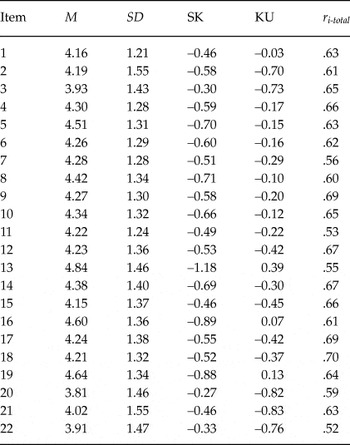
Table 1 compiles the results of descriptive analyses and discriminant indexes (corrected item-total correlations) for each of the 22 items that comprise the four dimensions of the questionnaire. Responses on all items had mean scores between 3.81 and 4.84, and standard deviations were always greater than 1 (responses ranged from 1 to 6). All values of skewness and kurtosis were within the range ± 1.2, suggesting that the variables reasonably fit a normal distribution. Regarding discriminant indexes, all items showed satisfactory discriminant power (Brzoska & Razum, Reference Brzoska and Razum2010).
Descriptive Analysis and Discriminant Indexes of Items on the Tactical Skills Inventory for Sports. Total Sample

Note: M = mean; SD = standard deviation; SK = skewness; KU = kurtosis; r i-total = corrected item-total correlation.
The significance of Bartlett’s test (5775.136, p < .001) and the KMO measure of sampling adequacy (.958) indicated a very adequate correlation between items and good sampling adequacy, respectively, suggesting factor analysis would be pertinent (Ferrando & Anguiano-Carrasco, Reference Ferrando and Anguiano-Carrasco2010).
Confirmatory Factor Analysis for the Total Sample
The overall results of confirmatory factor analysis (GFI = .904; RMSEA = .060; CFI = .930) for the model M1 indicate the measurement model was acceptable (Table 2).
Absolute, Incremental, and Parsimonious Fit Indexes for the Models Produced. Total Sample

Note: GFI = goodness of fit index; RMSEA = root mean square error of approximation; AGFI = adjusted goodness of fit index; TLI = Tucker-Lewis index; CFI = comparative fit index; CMIN/DF = chi-squared fit index over degrees of freedom; AIC = Akaike information criterion.
* p < .05.
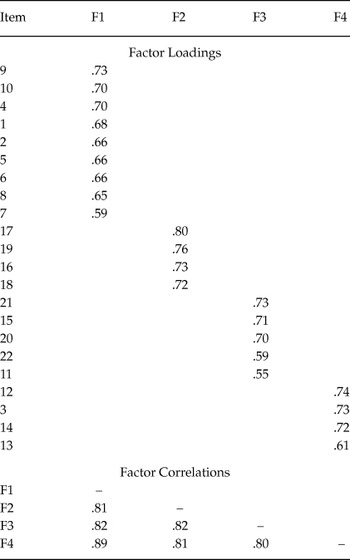
The four factors in M1 together explained approximately 59% of variance. On the other hand, according to the results in Table 3, only 3 of the 22 items had factor loadings under .60 on the dimensions they were predicted to belong to (items 7, 11, and 22). High intercorrelations were observed among the four factors, reflecting poor discriminant validity between them.
Standard Confirmatory Factor Analysis Solutions for the M1 Model. Total Sample

Note: F1 = positioning and deciding; F2 = knowing about ball actions; F3 = knowing about others; F4 = acting in changing situations.
Overall results of confirmatory factor analysis on the second model tested (M1b), which had a four-dimensional structure and eliminated items 7, 11, 13, 18, and 22 because their factor loadings were the lowest on each factor (GFI = .955; RMSEA = .044; CFI = .974), indicated this measurement model was an improvement on the one above and had optimal goodness of fit (Table 2). This model’s four factors explained, altogether, approximately 64% of variance.
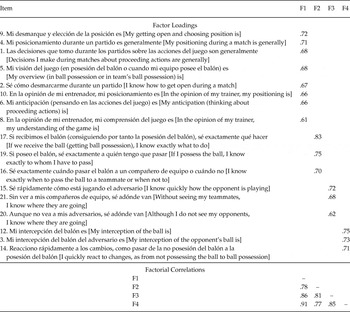
According to the results in Table 4, all items had factor loadings over .60 on their predicted dimensions, and high intercorrelations were observed between the four factors, indicating poor discriminant validity among them.
Standard Solutions from Confirmatory Factor Analysis for the M1b Model. Total Sample

Note: F1 = positioning and deciding; F2 = knowing about ball actions; F3 = knowing about others; F4 = acting in changing situations.
Confirmatory Factor Analysis in Samples of Regular Invasion Sport Practitioners, and Non-practitioners
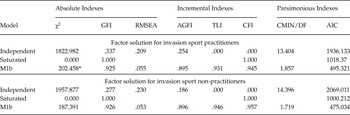
According to the results in Table 5, confirmatory factor analysis of the 17 items grouped into four factors (M1b) was acceptable in the sample of invasion sport practitioners (GFI = .925 and RMSEA = .055), with measures of incremental fit and parsimonious fit significantly greater than the independent model, and very similar to the saturated model.
Absolute, Incremental, and Parsimonious Indexes for the Models Produced. Confirmatory Factor Analysis in Samples of Regular Practioners of Invasion Sports, and Non-Practitioners

Note: GFI = goodness of fit index; RMSEA = root mean square error of approximation; AGFI = adjusted goodness of fit index; TLI = Tucker-Lewis index; CFI = comparative fit index; CMIN/DF = chi-squared fit index divided by degrees of freedom; AIC = Akaike information criterion.
* p < .05.
Conversely, confirmatory factor analysis in the sample of non-practitioners of invasion sports (Table 5) indicated the four-factor measurement model was again acceptable (GFI = .926 and RMSEA = .053), with measures of incremental and parsimonious fit significantly higher than in the independent model, and quite similar to the saturated model.
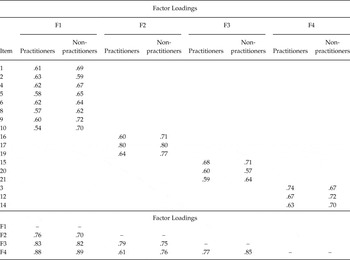
According to the results in Table 6, four of the 17 items had factor loadings under .60 on their predicted dimensions among invasion sport practitioners (items 5, 8, 10, and 21), while among non-practitioners, only items 2 and 20 had factor loadings on their predicted dimensions under .60. Moreover, in both samples, high intercorrelations were observed between the four factors, indicating discriminant validity challenges.
Standard Solutions from Confirmatory Factor Analysis in Samples of Invasion Sports Regular Practitioners, and Non-practitioners

Note: F1 = positioning and deciding; F2 = knowing about ball actions; F3 = knowing about others; F4 = acting in changing situations.
Factorial Invariance between Regular Invasion Sports Practitioners and Non-practitioners
The goodness of fit indices calculated (Table 7) led us to accept the basic measurement models as equivalent in the two samples. Although the value of Chi-squared exceeded the requirements to accept the hypothesis of invariance, the indices CFI = .951, RMSEA = .038, and AIC = 565.851 contradicted that conclusion, so the base invariance model (unrestricted model) was accepted.
Goodness of Fit Indexes for each of the Models Tested on Factorial Invariance between Practitioners (n = 286) and Non-practitioners of Invasion Sports (n = 254)

Note: χ2 = Chi squared; df = degrees of freedom; Δχ2 = change in Chi squared; Δdf = change in degrees of freedom; GFI = goodness of fit index; NFI = normed fit index; CFI = comparative fit index; RMSEA = root mean square error of approximation; AIC = Akaike information criterion.
* p < .05.
Progressively adding constraints to that base model of factor loadings, measurement invariance was examined. The values presented in Table 7 led us to accept that level of invariance. The global fit index (GFI = .923) and root mean square error of approximation (RMSEA = .038) continue to provide information consistent with that. Furthermore, the Akaike information criterion (AIC = 555.920) and Bentler’s comparative fit index (CFI = .950) did not change much from the previous model. The criterion used to assess nested models, proposed by Cheung and Rensvold (Reference Cheung and Rensvold2002), suggests that if the difference in CFI between two nested models decreases by .01 or less, the constrained model is considered good and thus indicative of factorial invariance. The difference in CFIs this study found led us to accept the measurement invariance model. It was concluded that so far, factor loadings have been equivalent in the two samples.
After establishing measurement invariance across samples, the equivalency of intercepts (strong factorial invariance) was evaluated next. The indices (Table 7) showed that this model had acceptable goodness of fit, both evaluating it on its own and nested with the measurement invariance model. The difference between Bentler’s comparative fit indexes was .007; the global fit index was .916; and root mean square error of approximation was .039. Having accepted that strong invariance, the two models evaluated were equivalent in terms of factorial coefficients, and intercepts.
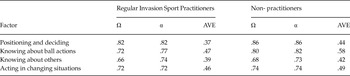
Most of the factors obtained through confirmatory factor analysis had values of internal consistency over .70 in both samples (regular invasion sports practitioners, and non-practitioners), indicating adequate internal consistency for that type of subscale, especially considering the limited number of items (Table 8).
Omega and Alpha Coefficients and Mean Extracted Variance for the Factors Obtained

Note: AVE = Average Variance Extracted.
Factor Means Comparison: Regular Invasion Sports Practitioners Versus Non-practitioners
Means comparison results indicated that average scores on the four factors (positioning and deciding, knowing about ball actions, knowing about others, and acting in changing situations) were significantly higher in practitioners than non-practitioners, with high effect size measures according to Cohen’s (Reference Cohen1988) criterion (.895, p < .001, d = 1.08; 1.073, p < .001, d = 1.04; .855, p < .001, d = .97; and .984, p < .001, d = 1.05, respectively).
Discussion
This study’s first concrete objective was to adapt and translate the Tactical Skills Inventory for Sports by Elferink-Gemser et al. (Reference Elferink-Gemser, Visscher, Richart and Lemmink2004) according to Muñiz et al.’s recommendations (2013). Adapting the questionnaire into Spanish required certain logical modifications to the original, as described in Methods, so the translation would have the highest possible item comprehension for the sample – Spanish students 10 to 17 years old. Its applicability was then confirmed through a pilot study and final data collection.
The present study’s second objective was to examine the factor structure of the Spanish version of the Tactical Skills Inventory for Sports. The analyses conducted in this research led us to conclude that the instrument presented in M1b, with 17 items and four factors, is a viable, valid measure of tactical skills in invasion team sports among Spanish youths. Psychometric properties were within the range this type of study requires. Values of Cronbach’s coefficients pertaining to the different factors of tactical skills ranged from .72 to .86, indexes like those of Elferink-Gemser et al.’s original questionnaire (Reference Elferink-Gemser, Visscher, Richart and Lemmink2004), which fell between .72 and .89, and therefore indicating good internal consistency (Nunnally & Berstein, Reference Nunnally and Bernstein1995). Correlations equal to the original were found between factors, and while they were assumed to be part of the same construct, discriminant validity was low.
The questionnaire’s component factors were: (a) factor 1, positioning and deciding, with eight items (1, 2, 4, 5, 6, 8, 9, and 10), covers decision-making during the game, getting open, anticipating, positioning, and seeing and comprehending the game; (b) factor 2, knowing about ball actions, with three items (16, 17, and 19) covers passing and moving the ball; (c) factor 3, knowing about others, with three items (15, 20, and 21) taps knowledge about the opponent as well as teammates; and (d) factor 4, acting in changing situations, with three items (3, 12, and 14), covers intercepting the ball and switching gear during transitions in the game. Factors 1 and 4 measure perceived procedural knowledge and focus on choosing the right actions during the game; meanwhile, factors 2 and 3 measure perceived declarative knowledge and focus on knowledge of the game. Factors 1 and 2 center on tactical moves with the ball (offense), while factors 3 and 4 center on tactical moves without the ball (defense). As such, the questionnaire covers – with four factors – the main tactical actions that take place during invasion team sports (Oslin et al., Reference Oslin, Mitchells and Griffin1998), just as Elferink-Gemser et al.’s original did (2004).
This study’s third and final objective was to verify the adapted version’s factorial invariance in participants who regularly play invasion sports versus non-practitioners. The original questionnaire’s construct validity was confirmed in an independent study of 76 elite hockey players and 72 youth hockey league players (12 to 18 years old), with the former scoring higher than the latter on every component factor of tactical skills, and on tactical skills overall. On the adapted Spanish version, two subsamples were evaluated – regular invasion sports practitioners, and non-practitioners – and differences favoring regular practitioners were observed on every factor. The results certainly represent strong evidence of structural reliability, lending measurement validity to the adapted instrument.
As discussed in the Introduction, having access to this translated version of the Tactical Skills Inventory for Sports by Elferink-Gemser et al. (Reference Elferink-Gemser, Visscher, Richart and Lemmink2004) will allow us to measure perceived tactical abilities in invasion sports in Spanish-speaking youths. Related lines of research with other psychological variables in sport, like physical self-concept (Mayorga-Vega et al., Reference Mayorga-Vega, Cocca, Viciana and de Rueda2012) and sports competency (Viciana et al., Reference Viciana, Mayorga-Vega and Blanco2014), as well as studies related to sports learning and performance in school contexts in Spanish populations, will be enriched now that this important perceptual variable can be evaluated. Furthermore, declarative and procedural knowledge of tactical skills, in offense as well as defense, can be evaluated using this instrument. Similarly, in keeping with Welk’s (Reference Welk1999) Physical Activity Promotion model, and the psychological mediation already demonstrated between sport and regular physical activity (Jaakkola et al., Reference Jaakkola, Yli-Piipari, Huotari, Watt and Liukkonen2015), it will now be possible to assess the influence in Spanish populations of tactical skills in sport, in the amount that constitutes normal physical activity for youths of different ages who play sports.
According to Gelabert et al. (Reference Gelabert, García-Esteve, Martín-Santos, Gutiérrez, Torres and Subirà2011), the factorial validity of an instrument should be demonstrated in a wide variety of samples, and therefore new studies will be needed to conclude the future viability of this questionnaire.
Two limitations were present in this study. First, the sample was entirely made up of third-grade elementary school students, and first-year secondary school students, which threatens the possibility that these results can be generalized to populations of other ages, young-adult athletes for instance. The second limitation stems from the assessment instrument itself; being based on self-report, it may contain social desirability bias.
To examine the validity of the Spanish version of the questionnaire in other populations, like young-adult athletes or practitioners of different sport modalities; or to link objective measures of tactical skills to observation-based instruments like the Game Performance Assessment Instrument (GPAI) and the subjective questionnaire validated in the present research (that is, convergent validity) are fertile areas for future research.
It was confirmed that the Spanish version of the Tactical Skills Inventory for Sports is valid, reliable, and available to be applied in research in Spanish school-aged samples, as in the present study.
The four-factor structure of the original Tactical Skills Inventory for Sports was replicated for this Spanish version, which therefore can measure all important aspects of tactical skills in sport (in other words, perceived declarative and procedural knowledge in offensive and defensive sports situations).
The factor structure in regular practitioners and non-practitioners of invasion sports turned out to have acceptable equivalency, in terms of factorial coefficients and intercepts, showing high structural reliability. This version’s construct validity was confirmed as well, with highly significant differences favoring regular practitioners, thus bolstering the instrument’s measurement validity.