

Introduction
An ongoing debate in behavioral science is about whether small differences in the wording of messages can have outsized effects on behavior. A leading example of this debate is scholarship about whether subtle linguistic cues that link a desired behavior to a person's social identity are able to induce dramatic behavioral change by priming that identity. One operationalization of this concept is the argument that describing a person using a predicate noun (e.g., “to be a voter”) emphasizes a behavior as an attribute of that person's social identity that can be claimed by engaging in that behavior. The theory argues that the use of a predicate noun, in contrast to describing a person's potential behavior using a verb (e.g., “to vote”), introduces a subtle linguistic cue that more clearly primes the behavior as related to one's identity and thus increases the likelihood that the person engages in it.
This argument, applied to the domain of political behavior, was initially advanced in an influential article in the Proceedings of the National Academy of Sciences by Bryan et al. (Reference Bryan, Walton, Rogers and Dweck2011), who reported that priming a person's social identity as a voter using a predicate noun (instead of using a verb) in a 10-item Internet survey questionnaire completed either on the day before or the day of the election dramatically increased turnout by 11–14 percentage points in the 2008 general election in California and in the 2009 New Jersey gubernatorial election. If a subtle intervention of this sort can reliably produce such large behavioral effects, it would open the door to numerous promising opportunities in multiple domains to use policy to shape behavior. However, subsequent attempts to reproduce the result by Gerber et al. (Reference Gerber, Huber, Biggers and Hendry2016, Reference Gerber, Huber and Fang2018) have found no difference between the effectiveness of noun and verb wording in increasing turnout, but there are multiple study parameters that vary across these studies.
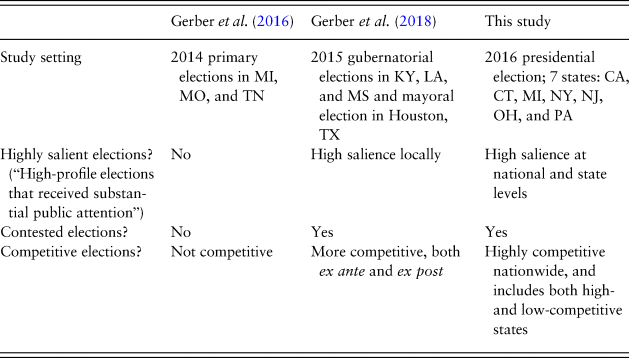
In particular, in a response to the Gerber et al. (Reference Gerber, Huber, Biggers and Hendry2016) study, three of the four original authors of the Bryan et al. (Reference Bryan, Walton, Rogers and Dweck2011) study argued that replications must occur in contexts where the psychological phenomenon of interest could plausibly emerge such that a person's identity as a “voter” is salient enough to motivate behavioral change (Bryan et al., Reference Bryan, Walton and Dweck2016). Specifically, Bryan et al. (Reference Bryan, Walton and Dweck2016) argue that the psychological context would be reproduced only in electoral contexts that are both highly competitive and highly salient, and that the electoral settings from Gerber et al. (Reference Gerber, Huber, Biggers and Hendry2016) (2014 primary elections in Michigan, Missouri, and Tennessee) did not meet these criteria. The electoral settings from the Gerber et al. (Reference Gerber, Huber and Fang2018) study – which include contested gubernatorial elections in Kentucky, Louisiana, and Mississippi, as well as a contested mayoral election in Houston, all of which occurred in 2015 – are arguably open to the same critique.
This preregistered experiment, in which both the design of the experiment and the analysis of the data it produces are prespecified, addresses this major criticism and tests whether priming a registered voter's identity as a voter using a predicate noun (instead of a verb) leads to dramatic increases in actual turnout in a highly competitive and highly salient electoral context: the 2016 presidential election. In addition, several other aspects of the experiment were designed in order to address potential questions about the robustness, replicability, and generalizability of the initial finding from Bryan et al. (Reference Bryan, Walton, Rogers and Dweck2011) compared to subsequent work.
First, the treatments were delivered via an Internet survey on the day before Election Day in order to replicate the mode and timing of treatment delivery used by Bryan et al. (Reference Bryan, Walton, Rogers and Dweck2011). Second, the experiment includes only subjects who were confirmed – by prematching against administrative voter records prior to the election – as being registered to vote in the 2016 presidential election. This eliminates individuals who could not vote in certain states. Third, subjects were also restricted to exclude confirmed registrants who voted by mail or absentee in 2014 in order to focus on registered voters for whom receiving any prime about their social identity as a voter from an Internet survey on the day of or the day before the election could plausibly change whether they vote. Fourth, the experiment included subjects from the two states examined by Bryan et al. (Reference Bryan, Walton, Rogers and Dweck2011) – California and New Jersey – as well as from five other states: Connecticut, Michigan, New York, Ohio, and Pennsylvania. The seven states included in this experiment varied in terms of how competitive the presidential election was expected to be ex ante, which allows us to assess the robustness of noun wording effects across varying state-specific contexts of electoral competitiveness in an election that was both highly salient and highly competitive at the national level. Table 1 summarizes the key conditions that Bryan et al. (Reference Bryan, Walton and Dweck2016) argue are necessary to create the psychological context for noun wording to have a greater effect than verb wording on turnout and how they are satisfied by the present study and prior replication studies.
Conditions that Bryan et al. (Reference Bryan, Walton and Dweck2016) argue are necessary to create the psychological context for noun wording to be more effective than verb wording and how this and prior replication studies satisfy these conditions.

Study design
Subjects
The experiment was conducted during the 2016 presidential election in November. The 2219 subjects in our field experiment were US citizens from seven states (California, Connecticut, Michigan, New York, New Jersey, Ohio, and Pennsylvania) who were recruited from an online survey panel administered by YouGov and who were confirmed to be registered to vote in the November 2016 election prior to the experiment.Footnote 1
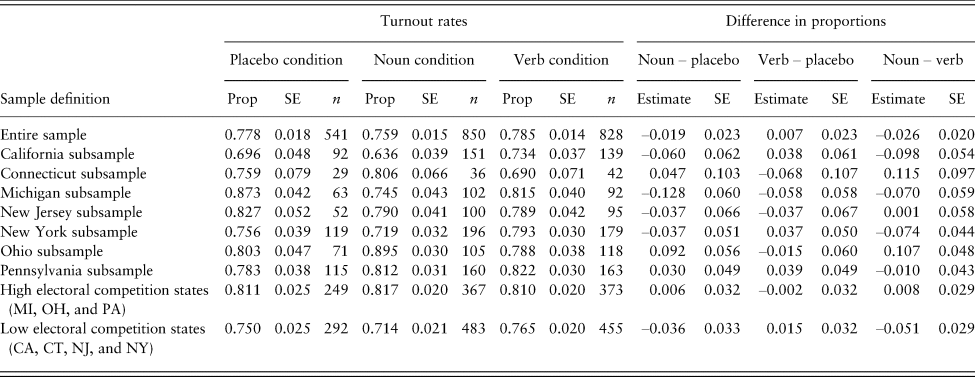
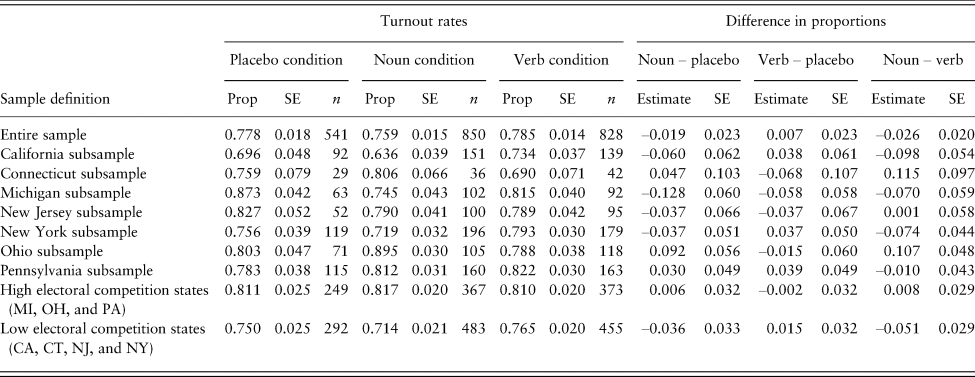
We focus on confirmed registrants from these seven states for the reasons described earlier. We restricted the total share of subjects from California and Ohio (combined) to 30% due to concerns that the incidence of early voting in these states is high; the remaining 70% of subjects were recruited from the other five states (CT, MI, NJ, NY, and PA). The breakdown of the number of subjects recruited by state and treatment condition is reported in Table 2.
Nonparametric estimates of turnout rates in the 2016 general election and differences in turnout rates between treatment arms.
Importantly, we excluded registrants who voted by mail or absentee in 2014 because these subgroups were the least likely to be mobilized to vote in person on Election Day by an intervention administered on the day before Election Day. The subject pool included registrants who voted on Election Day, voted early, or did not vote at all in 2014.Footnote 2
To replicate a key detail of the subject recruitment procedure from the experiments from study 3 by Bryan et al. (Reference Bryan, Walton, Rogers and Dweck2011), subjects were recruited into our field experiment on the day before Election Day.
Treatments and randomization procedure
Subjects were randomly assigned to receive either a 10-item questionnaire using noun wording (“voter”), a 10-item questionnaire using verb wording that refers to the act of voting as a behavior (“voting/to vote”) or a placebo condition asking how often the subject went to different retail establishments in the past week.
The full text of each treatment script is presented in the online Supplementary Information. The noun and verb treatment scripts are identical to those used in the study by Gerber et al. (Reference Gerber, Huber and Fang2018), and are nearly identical to those used in study 3 by Bryan et al. (Reference Bryan, Walton, Rogers and Dweck2011) and Gerber et al. (Reference Gerber, Huber, Biggers and Hendry2016), where the minor differences do not alter the substantive meaning of the questions or the psychological interpretation of either treatment.
Treatment scripts were delivered using an Internet-based survey, replicating the treatment delivery mode used in study 3 by Bryan et al. (Reference Bryan, Walton, Rogers and Dweck2011) and in Gerber et al. (Reference Gerber, Huber and Fang2018).
The probability of assignment to each experimental condition was 37.5% for the noun condition, 37.5% for the verb condition, and 25.0% for the placebo condition. Respondents in the panel were enrolled in the experiment and assigned to a treatment arm immediately upon providing informed consent. We verify that the randomization is valid using randomization inference (see Supplementary Appendix) and present balance tables in Tables S1 and S2.
Outcomes
Our outcome measure is turnout in the 2016 general election, a behavior measured using voter files. Turnout data were supplied by the vendor, who located subjects in the voter files by matching on full name, address, year or date of birth, and gender. The turnout variable is coded 1 if the subject voted in the 2016 general election and 0 otherwise. This coding procedure is standard in the field experimental literature on voter mobilization. Subjects who cannot be located in state voter files after the election are coded as having not voted (i.e., outcome equals 0) to avoid introducing post-treatment bias that arises from differential attrition across treatment conditions.Footnote 3
Results
Following our preanalysis plan, our primary analysis assesses the effect of the noun condition on turnout relative to assignment to the verb condition. In addition, we assess the effectiveness of the noun and verb conditions on turnout, both relative to the placebo condition.
We begin in Table 2 by presenting mean turnout rates by treatment arm and nonparametric estimates of differences in turnout rates between arms (noun versus verb, noun versus placebo, and verb versus placebo). In Table 3, we supplement this nonparametric estimation with regression analysis, which allows us to test the robustness of our findings to the inclusion of individual-level covariates and state-level fixed effects. In particular, we estimate the following equation using ordinary least squares:
 $$Y_i = \alpha + \beta _1N_i + \beta _2V_i + \gamma {\boldsymbol X}_{\boldsymbol i} + \varepsilon _i$$
where Yi is turnout in the 2016 general election (1 = yes, 0 = otherwise); Ni is assignment to the noun condition (1 = yes, 0 = no); Vi is assignment to the verb condition (1 = yes, 0 = no); Xi is a vector of pretreatment covariates that include subjects’ demographic characteristics (age, age squared divided by 100, gender, race, education, party identification, ideology, survey date, and past turnout in the 2016 primary and presidential primary elections) and state fixed effects; and εi is the error term. Pretreatment covariates are provided by YouGov. We estimate standard errors using the conservative Neyman estimator. The bottoms of the regression tables report estimates of differences in effects across conditions and formal statistical tests of these differences. In order to test whether the noun condition is more effective at increasing turnout than the verb condition, we test the null hypothesis that β 1 – β 2 = 0 and calculate p-values and 95% confidence intervals (CIs) for a one-sided test (for an alternative hypothesis that β 1 – β 2 > 0). We additionally assess whether the noun condition is more effective as compared to the placebo and test the null hypothesis that β = 0 and calculate p-values and 95% CIs for a one-sided test (for an alternative hypothesis that β 1 > 0).
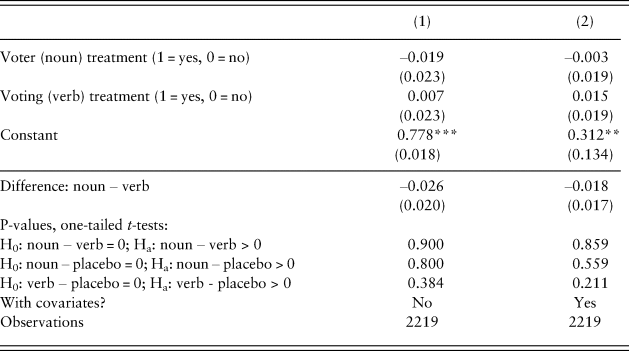
Regression estimates of the effect of noun and verb treatments on turnout in the 2016 general election.
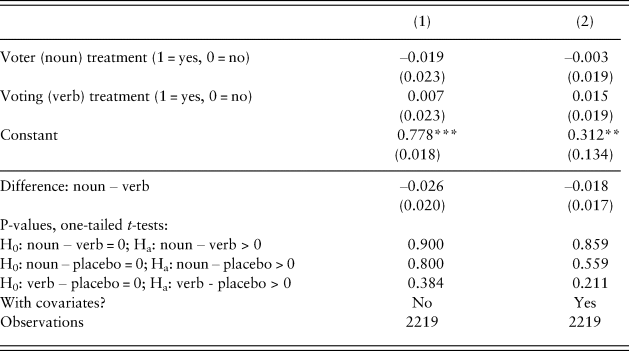
*p < 0.1, **p < 0.05, ***p < 0.01, two-tailed t-tests unless otherwise specified.
The outcome variable is turnout in the 2016 general election (1 = yes, 0 = no). Covariates included in the covariate adjusted specification include age, age squared divided by 100, gender, race, education, survey date, party identification, ideology, past turnout in the 2016 primary and presidential primary elections and state fixed effects.
In all cases, results are similar for the nonparametric and regression analyses, and so we focus primarily on the nonparametric results shown in Table 2 for ease of presentation.
Pooled analysis
Nonparametric estimates pooling across all states appear in the first row of Table 2. A total of 77.8% of registrants in the placebo condition voted compared to 75.9% in the noun condition and 78.5% in the verb condition. Focusing on the difference between the noun and verb conditions, the last column of Table 2 shows that those in the noun condition were 2.6 percentage points less likely to vote than in the verb condition, although this difference is not statistically distinguishable from 0 (z = –1.280, p = 0.899, h = –0.062, 95% CI = –0.062, 1). The 95% CI therefore excludes the positive estimates of 11–14 percentage points reported in the field experimental studies in Bryan et al. (Reference Bryan, Walton, Rogers and Dweck2011). Additionally, those in the noun condition were 1.9 percentage points less likely to vote than those who received no mobilization effort in the placebo condition, but this difference is not statistically significant (z = –0.838, p = 0.797, h = –0.046, 95% CI = –0.057, 1).
The regression estimates reported in Table 3 are highly similar. The column (1) specification, without covariates, matches the nonparametric results (b(2216) = –0.026, p = 0.900, d = –0.031, 95% CI = –0.060, 1). In the column (2) specification that incorporates state fixed effects and individual-level covariates, we continue to estimate that the noun treatment is less effective than the verb treatment at inducing turnout (b(2180) = –0.018, p = 0.859, d = –0.026, 95% CI = –0.046, 1). Notably, the noun treatment is also no more effective than the placebo message (b(2180) = –0.003, p = 0.559, d = –0.004, 95% CI = –0.034, 1).
Overall, these results provide little evidence that the noun treatment is more effective than the verb treatment at causing people to vote. We consistently estimate that the noun treatment is less effective than the verb treatment at causing voting; although these differences are not statistically significant, they are relatively precisely estimated and exclude large positive effects. Nor is the noun message more effective than the placebo message.
Robustness: by state and by electoral competitiveness
In accordance with our preanalysis plan, we also examined differences by state and by ex ante electoral competitiveness.Footnote 4 Subsetting by state necessarily reduces the sample sizes for different comparisons, and as such will increase sampling variability and the imprecision of our estimates. Per Table 2, in four states we estimate that the noun treatment is less effective than the verb treatment (California (estimate = –0.098, z = –1.809, p = 0.963, h = –0.212, 95% CI = –0.187, 1), Michigan (estimate = –0.070, z = –1.185, p = 0.880, h = –0.170, 95% CI = –0.167, 1), New York (estimate = –0.074, z = –1.675, p = 0.952, h = –0.173, 95% CI = –0.146, 1) and Pennsylvania (estimate = –0.010, z = –0.223, p = 0.588, h = –0.025, 95% CI = –0.080, 1)) and in three states it is more effective (Connecticut (estimate = 0.115, z = 1.184, p = 0.123, h = 0.267, 95% CI = –0.045, 1), New Jersey (estimate = 0.001, z = 0.009, p = 0.496, h = 0.001, 95% CI = –0.096, 1) and Ohio (estimate = 0.107, z = 2.229, p = 0.015, h = 0.297, 95% CI = 0.028, 1)). Only one of these nonparametric estimates is statistically distinguishable from 0 at test size α = 0.05 given the smaller sample sizes.
Consistent with the greater role of sampling variability in smaller samples, the covariate adjusted regressions in Table S3 show that the largest estimated differences between the noun and verb conditions – both positive and negative differences – are attenuated in models with covariates and none are statistically significant. For example, in Connecticut, the 11.5 percentage point greater turnout among those in the noun rather than verb condition (b(104) = 0.115, p = 0.125, d = 0.131, 95% CI = –0.050, 1) is reduced to 3.6 percentage points when adjusting for pretreatment covariates (b(79) = 0.036, p = 0.353, d = 0.043, 95% CI = –0.123, 1), and the unadjusted estimate of 10.7 percentage point greater turnout in Ohio (b(291) = 0.107, p = 0.017, d = 0.143, 95% CI = 0.024, 1) is reduced to 4.9 percentage points with covariate adjustment (b(263) = 0.049, p = 0.109, d = 0.083, 95% CI = –0.017, 1). Similarly, the turnout rate in the noun condition is 9.8 percentage points lower than in the verb condition in California (b(379) = –0.098, p = 0.963, d = –0.106, 95% CI = –0.188, 1), but this effect is reduced to 3.3 percentage points with covariate adjustment (b(350) = –0.033, p = 0.787, d = –0.047, 95% CI = –0.101, 1). There is no state, therefore, in which there is statistically significant evidence that the noun condition is more effective than the verb treatment.
In light of the possibility that the noun treatment would be effective only in those competitive electoral environments where one's identity as a voter were potentially meaningful, we also present results by whether a state was deemed competitive in the 2016 election. In three states – Michigan, Ohio and Pennsylvania – pre-election forecasts led us to believe that the race would be close, and, in fact, those races were close, producing unexpected Republican victories in Michigan and Pennsylvania. Per Table 2, in these three states, turnout is 0.8 percentage points higher in the noun than verb conditions, but this estimate is not statistically significant (z = 0.272, p = 0.393, h = 0.020, 95% CI = –0.039, 1). In Table S4, where we adjust for state fixed effects and pretreatment covariates, this difference remains close to 0, and switches sign to –0.5 percentage points (b(954) = –0.005, p = 0.584, d = –0.008, 95% CI = –0.042, 1), which is again not significant. We note that, in all specifications, in the less competitive states the estimated effect of the noun treatment is to reduce turnout compared to the verb treatment. These estimates range from –3.0 percentage points (b(1194) = –0.030, p = 0.886, d = –0.039, 95% CI = –0.070, 1) to –5.1 percentage points (b(1227) = –0.051, p = 0.961, d = –0.058, 95% CI = –0.098, 1), but again none are significant.
Discussion
The promise for behavioral public policy of a psychological theory that claims subtle linguistic interventions can make salient a feature of one's identity and therefore change behavior is transparent. Rather than seeking to persuade or cajole, policymakers can seek to harness a person's own sense of self to encourage desirable behavior. In the domain of politics, this idea is particularly exciting, and an initial and influential study by Bryan et al. (Reference Bryan, Walton, Rogers and Dweck2011) provided promising evidence that the use of noun language could prime individual's identities “as voters” to increase political participation in comparison to similar language using verbs (“voting”). Subsequent replication attempts did not yield similarly promising evidence (Gerber et al., Reference Gerber, Huber, Biggers and Hendry2016, Reference Gerber, Huber and Fang2018), but they differed in ways that a subset of the authors of the original study argued were consequential (Bryan et al., Reference Bryan, Walton and Dweck2016).
In light of this ongoing controversy, we provide novel evidence from a large-scale preregistered field experiment conducted during the 2016 presidential election that directly addresses these differences between the initial study and prior replication studies. Our experiment yields little evidence that priming subjects’ identities as a voter by using noun language increases turnout compared to verb language, even in the salient 2016 presidential election and in competitive states. Moreover, neither treatment appears effective relative to a placebo message without any political content. In prespecified regression specifications controlling for pretreatment covariates, the point estimates from these studies for a noun versus verb treatment comparison are generally negative, and 95% CIs exclude the effects reported in Bryan et al. (Reference Bryan, Walton, Rogers and Dweck2011). These results therefore imply both that those original results may have reflected sampling variability and that the estimates from different contexts (and differences in treatment delivery) reported in Gerber et al. (Reference Gerber, Huber, Biggers and Hendry2016, Reference Gerber, Huber and Fang2018) are more representative of treatment effects even in competitive presidential contexts and with a design more closely mirroring the keystone study.
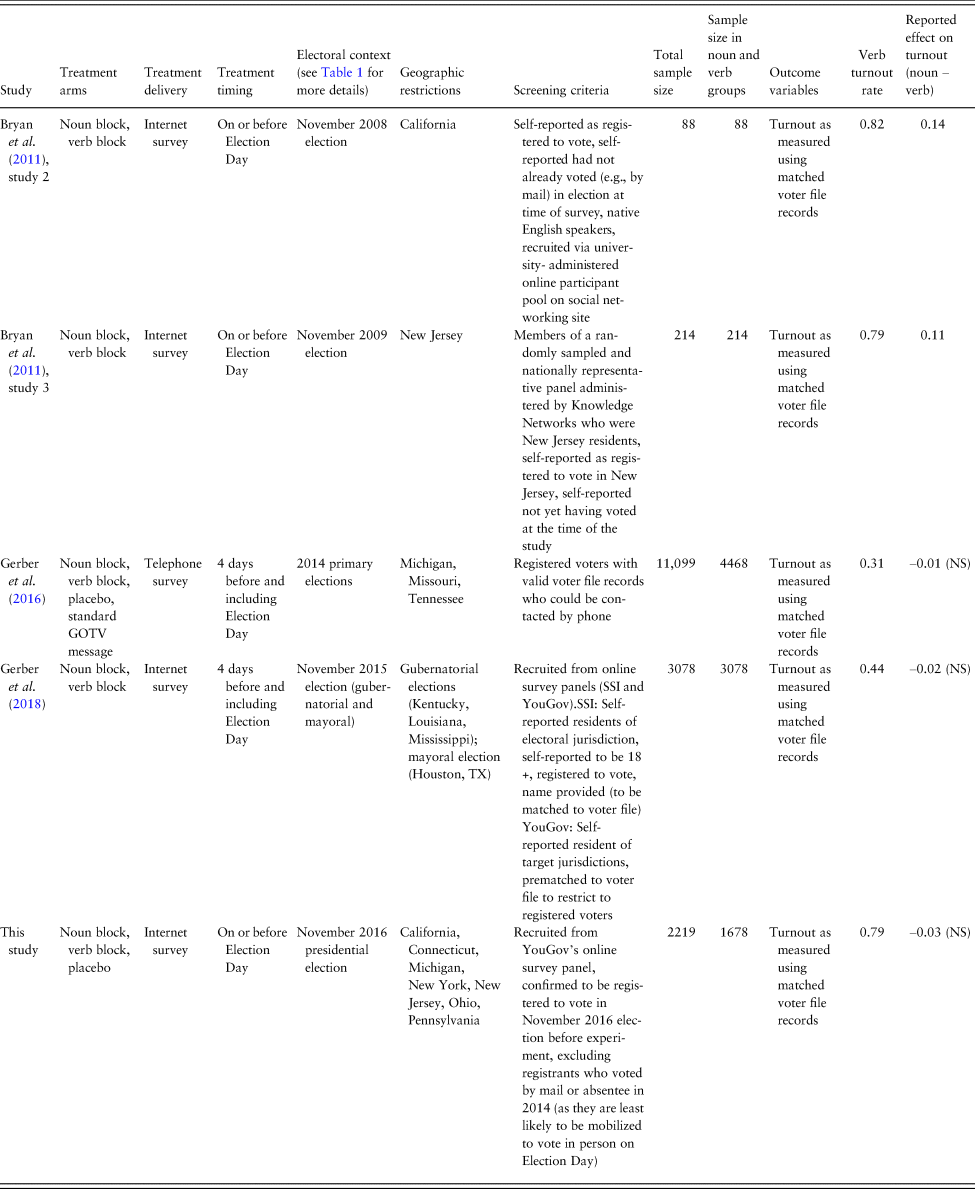
Overall, these results are disappointing, because they reveal that despite the potential promise of using subtle linguistic manipulations to encourage the prosocial behavior of voting, these messages appear largely ineffective. These messages, despite being longer and more complex than other mobilization messages (and therefore more costly to deliver), are not effective in promoting voting vis-à-vis one another or a nonpolitical placebo message. Additionally, the evidence undercuts the value of the theoretical perspective for efforts to encourage voting. More generally, the results reveal the importance of sustained and careful replication of prior work. In light of criticism of the study reported in Gerber et al. (Reference Gerber, Huber, Biggers and Hendry2016) on the grounds that it was not an appropriate replication, this study addresses the arguments raised in Bryan et al. (Reference Bryan, Walton and Dweck2016) by more carefully recreating the context and method of treatment delivery in the original study. In this regard, and as Table 4 summarizes, careful comparison across studies and sustained efforts that help to rule out potential design-related sources of differences in results are shown, in this case, to lead to better and more dispositive evidence.
Summary of experimental studies testing noun wording (versus verb wording) on turnout.
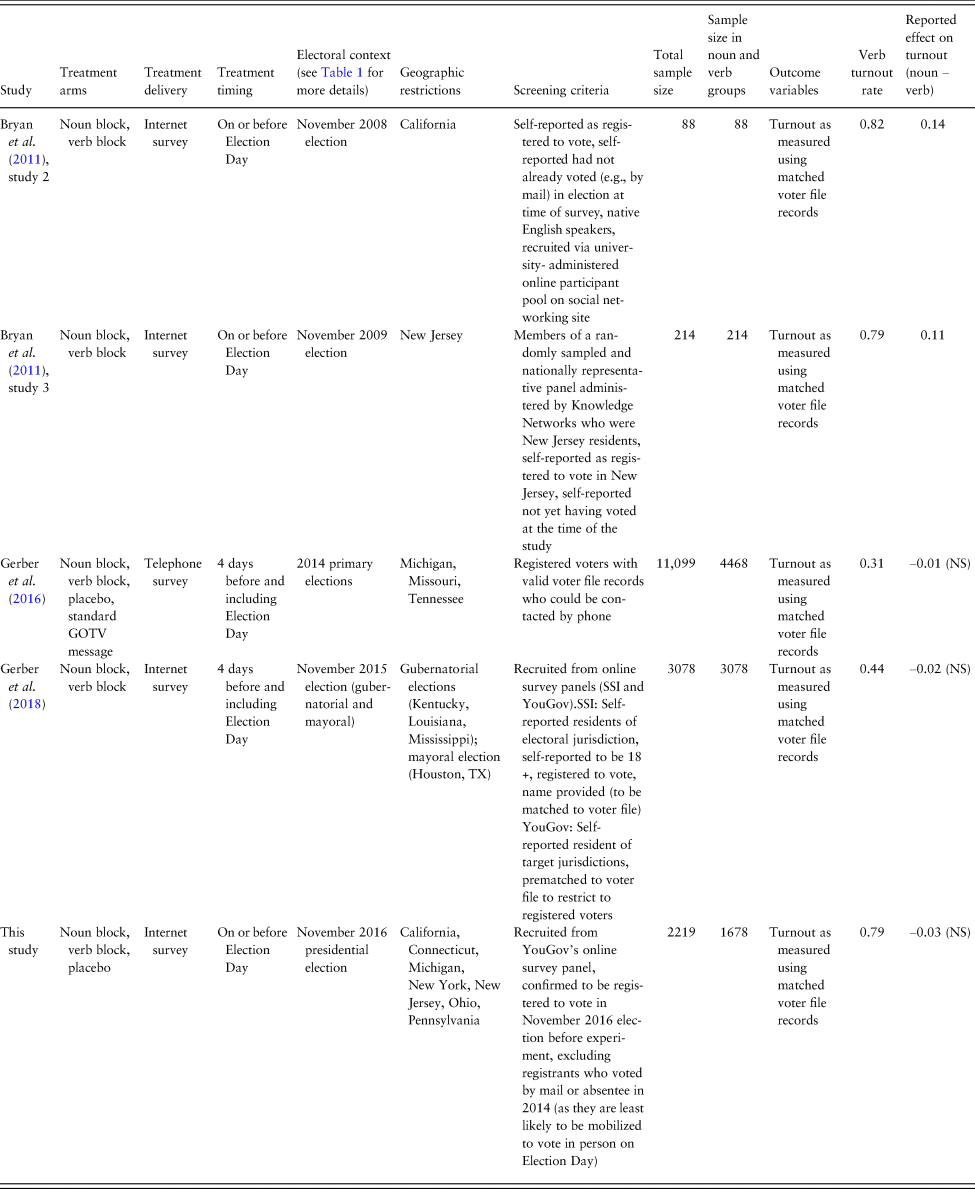
GOTV = get out the vote; NS = nonsignificant; SSI = Survey Sampling International.
Thus, across this study and two earlier similar studies (that differ in the important features identified by Bryan et al. Reference Bryan, Walton and Dweck2016), the weight of the evidence is that noun treatments are not more effective than verb language at increasing political participation.
Supplementary Material
To view supplementary material for this article, please visit https://doi.org/10.1017/bpp.2020.57.