


1. Introduction
The determinants of productivity growth in economies where technological progress results from research and development (R&D) activity have been formalized by the New Growth Theory over the last two decades.Footnote 1 In this framework, horizontal (vertical) innovations improve the quantity (quality) of intermediate goods, and sustained growth obtains through endogenous technical change (ETC hereafter). In the field of resource economics, this generation of models has been exploited to provide new answers to an old question: the problem of sustaining growth in the presence of natural resource scarcity. A vast body of recent literature extends endogenous growth models to include natural resources as an essential input – see e.g. Barbier (Reference Barbier1999), Scholz and Ziemes (Reference Scholz and Ziemes1999), Groth and Schou (Reference Groth and Schou2002), and Grimaud and Rougé (Reference Grimaud and Rougé2003). The central aim of this literature is to determine whether technical progress is effective in ensuring sustained consumption over the long-run. These contributions present models where (i) the direction of technical change is exogenous, and (ii) technical progress is, explicitly or implicitly, resource-augmenting.Footnote 2
It should be stressed that assumption (ii) is crucial with respect to the sustainability problem: in the vast majority of growth models with exhaustible resources, ever-increasing consumption requires that the rate of resource-augmenting progress strictly exceeds the utility discount rate. The same reasoning underlies neoclassical models of optimal growth, where the rate of resource-saving progress is exogenous. Hence, most contributions in this field share the view that innovations increase, directly or indirectly, the productivity of natural resources. However, to our knowledge, the existence of purely resource-augmenting technical progress has not been micro-founded so far, and one may object that the above models are conceptually biased in favor of sustainability: since technological progress may in principle be capital- rather than resource-augmenting, specifications (i)–(ii) might reflect a convenient, but strong assumption.
Recently, three contributions by Acemoglu (Reference Acemoglu1998, Reference Acemoglu2002, Reference Acemoglu2003) developed models with directed technical change (DTC), where final output is obtained by means of two inputs, e.g. capital and labor, and technical progress may be either labor- or capital-augmenting, or both. The respective rates of technical progress are determined by the relative profitability of developing factor-specific innovations, and the direction of technical change is endogenous. These models can be considered an up-to-date formalization of the Hicksian notion of induced innovations – innovations directed at economizing the use of those factors that become expensive due to changes in their relative prices.Footnote 3
This paper investigates whether, and under what circumstances, technical change is endogenously directed towards resource-augmenting innovations. We tackle the issue in a two-sector DTC framework, where exhaustible resources and accumulable man-made capital are both essential for production. This allows us to represent in more general terms the so-called capital–resource economy – the central paradigm in resource economics since the pioneering contributions of Dasgupta and Heal (Reference Dasgupta and Heal1974) and Stiglitz (Reference Stiglitz1974). Elaborating on Acemoglu (Reference Acemoglu2003), we assume an R&D sector where capital- and resource-augmenting innovations increase the number of varieties of factor-specific intermediates. Our first result is that any balanced growth equilibrium features purely resource-augmenting technical change. This result is derived without specifying preferences and innovation technologies, and crucially hinges on the interplay between productive efficiency in the final sector and the Hotelling rule – which characterizes an efficient depletion path for an exhaustible stock of resources. We then show that the balanced growth equilibrium is stable and unique under specifications of preferences and innovation technologies that are widely used in the growth literature: with utility-maximizing consumers, the economy converges to a unique balanced growth path, exhibiting purely resource-augmenting technical change in the long run. On the one hand, this result provides a micro-foundation for capital–resource models featuring resource-augmenting progress, in both the Solow–Ramsey and ETC frameworks: this contradicts the view that such models are too optimistic with respect to sustainability. On the other hand, the main conclusion is compatible with alternative assumptions regarding saving behavior and innovation technologies: if the economy converges to balanced growth while following different consumption–investment rules – or exploiting different innovation technologies – technical change is purely resource-augmenting in the long run.
The plan of the paper is as follows. Section 2 provides a classification of capital–resource economies in terms of technology specifications, and defines implicit and explicit rates of resource-augmenting technical progress. Section 3 presents the model and characterizes the balanced growth equilibrium, showing that productive efficiency requires a zero net rate of capital-augmenting progress. Section 4 includes utility-maximizing consumers and innovation technologies, showing that the balanced growth equilibrium is unique and stable. Section 5 concludes.
2. Growth theory and resource economics
The much celebrated Symposium on the Economics of Exhaustible Resources is often recalled as the first close encounter between growth theory and resource economics. The capital–resource model of Dasgupta and Heal (Reference Dasgupta and Heal1974), Solow (Reference Solow1974), and Stiglitz (Reference Stiglitz1974) – i.e. an extended neoclassical growth model including exhaustible resources as a production factor – has since been considered a central paradigm in resource economics. More recently, several authors exploited new growth theories to analyze capital–resource economies with endogenous technical change: see, for example, Barbier (Reference Barbier1999), Scholz and Ziemes (Reference Scholz and Ziemes1999), Groth and Schou (Reference Groth and Schou2002), Grimaud and Rougé (Reference Grimaud and Rougé2003), and Bretschger and Smulders (Reference Bretschger and Smulders2003).
A central aim of this literature is to determine whether, and under what circumstances, technical progress is effective in ensuring sustained consumption (Bretschger, Reference Bretschger2005). In this regard, the common denominator of both early and recent models is that a strictly positive rate of resource-augmenting progress is necessary to obtain non-declining consumption in the long run. We use italics in order to stress that the type of technological progress is a crucial element in capital–resource economies: from the perspective of sustainability, the ‘direction’ of technical change (whether it is resource-augmenting or capital-augmenting) is even more important than its ‘nature’ (i.e., whether it is exogenous or endogenous). To clarify this point, consider the following technologies


where Y is output, K is man-made capital, R is an exhaustible resource extracted from a finite stock, F is concave and homogeneous of degree one, and α1 + α2 ≤ 1. Technology (1) features an explicit rate of resource-augmenting progress equal to Ṁ/M: the underlying assumption is that the economy develops resource-saving techniques that directly increase the productivity of R. Technology (2) combines the Cobb–Douglas form with disembodied technical progress: the Hicks neutral rate is equal to Ȧ/A.
First, consider the neoclassical framework: in this case, technology (1) exhibits M(t) = e ηt, with η > 0 exogenous and constant. Then, if consumption obeys the standard Keynes–Ramsey rule, a necessary condition for sustained consumption in the long run is ρ ≤ η, where ρ is the utility discount rate.Footnote 4 This is a generalization of the well-known result by Stiglitz (Reference Stiglitz1974), who instead assumed technology (2), setting A(t) = e ωt with ω > 0 exogenous and constant. In this case, the necessary condition for non-declining consumption becomes ρ ≤ ω/α 2. Hence, from the perspective of sustainability conditions, what is crucial is not the total effect of technical change on output levels (ω) but rather its resource-saving effect.Footnote 5 Indeed, technology (2) can be rewritten as Y = K α 1 (e (ω/α 2)t R)α2, where (ω/α 2) is the implicit rate of resource-augmenting progress. This implies that assuming disembodied progress in association with a Cobb–Douglas form is not innocuous for the problem at hand: under specification (2), technical change is indirectly resource-augmenting. The same reasoning applies with respect to ETC models, where Ṁ/M or Ȧ/A are determined endogenously by R&D activity. On the one hand, sustained consumption still requires that the resource-augmenting rate be at least equal to the discount rate: see, for example, Amigues et al. (Reference Amigues, Grimaud and Moreaux2004). On the other hand, also in this framework, most technology specifications fall in either category (1) or (2). For example, technical progress is explicitly resource-augmenting in Amigues et al. (Reference Amigues, Grimaud and Moreaux2004), whereas Aghion and Howitt (Reference Aghion and Howitt1998: ch. 5), Barbier (Reference Barbier1999), Scholz and Ziemes (Reference Scholz and Ziemes1999), and Grimaud and Rougé (Reference Grimaud and Rougé2003) assume variants of the Cobb–Douglas form (2).Footnote 6 Hence, the common denominator of capital–resource models is that technological progress is, explicitly or implicitly, resource-augmenting by assumption. But is this assumption plausible? One might object, in principle, that technical progress can be purely capital-augmenting instead. For example, suppose that Y = ϒ (NK, R), where N represents purely capital-augmenting progress and ϒ exhibits an elasticity of substitution below unity. In this case, the production function does not allow for implicit resource-augmenting progress, and prospects for sustainability change dramatically. It follows from these considerations that a crucial issue is to determine whether (1) and (2) exhibit sound microeconomic foundations: if not, all mentioned contributions are conceptually biased in favor of sustainability because technologies (1) and (2) reflect a convenient, but strong assumption.
Tackling this issue requires assuming that the direction of technical change is endogenous. In the context of two-sector economies, the DTC framework has been developed by Acemoglu (Reference Acemoglu1998, Reference Acemoglu2002, Reference Acemoglu2003), who assumes that the rates of capital- and labor-augmenting technical change are determined by the relative profitability of factor-specific innovations. In particular, Acemoglu (Reference Acemoglu2003) shows that a typical capital–labor economy exhibits purely labor-augmenting progress under directed technical change. In the field of environmental economics, models with DTC are analyzed by Di Maria and Smulders (Reference Di Maria and Smulders2004), Di Maria and van der Werf (Reference Di Maria and Van der Werf2008), and André and Smulders (Reference André and Smulders2006). To our knowledge, however, the existence of purely resource-augmenting technical progress in a capital–resource economy has not been micro-founded so far.Footnote 7 In order to address this point, this paper studies whether, and under what circumstances, R&D activity is endogenously directed towards resource-augmenting innovations, given the alternative of developing capital-augmenting innovations. In particular, we assume a CES technology of the form Y = F(NK, MR) with an elasticity of substitution below unity, and investigate the endogenous dynamics of N and M along the balanced growth path. At the conceptual level, a major difference with respect to Acemoglu (Reference Acemoglu2003) is in the aim of our analysis. We tackle the issue of the direction of technical change in the perspective of sustainability, since sustained consumption in the long run may not be feasible in capital–resource economies. The sustainability problem does not arise in the standard capital–labor economy, which generally exhibits sustained consumption even in the absence of technical change. At the analytical level, the first difference with respect to Acemoglu (Reference Acemoglu2003) is that we substitute fixed labor with a resource flow extracted from an exhaustible stock, which implies that input units and factor rewards (that is, R and resource rents) are necessarily time-varying: the extracting sector exploits the natural stock over an infinite time-horizon, and resource prices therefore obey the Hotelling rule (Hotelling, Reference Hotelling1931). In this regard, we prove that the Hotelling rule fully supports the time paths of intermediate goods prices that are compatible with balanced growth. Another difference with respect to Acemoglu (Reference Acemoglu2003) is our characterization of the balanced growth equilibrium. In this respect, we follow a bottom–up approach: first, we characterize the balanced growth equilibrium on the basis of conditions for productive efficiency and show that technical progress is purely resource-augmenting in such an equilibrium. Second, we verify that the economy actually converges to the balanced growth path – and therefore exhibits zero capital-augmenting progress in the long run – assuming utility-maximizing consumers, and innovation technologies à la Acemoglu (Reference Acemoglu2003). This strategy emphasizes that our results could be extended to other environments with similar supply-side structures: since productive efficiency conditions alone suffice to ensure that balanced growth paths feature purely resource-augmenting progress, economies that exhibit other consumption–investment rules, and innovation technologies consistent with balanced growth, will also be characterized by purely resource-augmenting technical progress.
3. A capital–resource economy
The supply side of the economy consists of five sectors: (i) the final sector which assembles capital-intensive and resource-intensive goods ( and
 ). These goods are produced by (ii) competitive firms, using n varieties of capital-specific intermediates (y Kj with j ∈ (0, n), and m varieties of resource-specific intermediate goods (y Rj with j ∈ (0, m]), respectively. Factor-specific intermediates are supplied by (iii) monopolists producing y Kj by means of available man-made capital (K), and producing y Rj by means of extracted resource (R); the resource is supplied by (iv) an extracting sector that exploits a finite stock (H) of exhaustible natural capital. Finally, (v) the R&D sector consists of firms that employ scientists to design new blueprints for factor-specific intermediates, thus increasing either n or m. Innovation is ‘directed’ in that the number of scientists employed to develop capital- or resource-specific designs ultimately depends on the relative profitability of the resulting patent.
Aggregate output Y equals

where γ ∈ (0, 1) is a weighting parameter, and σ is the (constant) elasticity of substitution between and . From the point of view of sustainability, the interesting case features σ < 1: when resource-intensive goods are essential, natural resource scarcity binds the economy over the entire (infinite) time-horizon. The CES production function in (3) can be viewed as a generalization of the production functions commonly used in the growth literature, as it includes both the Leontief and Cobb–Douglas forms as special cases. Departing from the Cobb–Douglas form is necessary to our aim, since technological progress is input neutral when σ = 1. On the other hand, the constancy of the substitution elasticity is helpful in demonstrating the existence of balanced growth equilibria, as balanced growth is generally associated with constant input shares. Since the result of purely resource-augmenting technical change in the long run derived below builds on the assumption that the economy converges to balanced growth, technology (3) is a convenient specification here. However, the existence of a balanced growth equilibrium generally hinges on the convergence of input shares towards stationary values – a result which may be consistent with alternative specifications of the production function. Indeed, the main result of this paper rests substantially on the degree of homogeneity of the aggregate production function – which allows us to develop our analysis in terms of the augmented factor ratio – rather than on the special functional form assumed here.
Competitive firms produce and by means of factor-specific intermediates, y Kj and y Rj. In each instant, there are n varieties of y Kj and m varieties of y Rj, and factor-intensive goods are produced according to technologies

where β ∈ (0,1). Intermediates y Kj and y Rj are supplied by monopolists who hold the relevant patent, and exploit linear technologies

where K j indicates units of man-made capital used to produce y Kj, and R j indicates units of resource used to produce y Rj.Footnote 8 Denoting aggregate capital by K, and the total amount of extracted resource by R, markets clear when

For simplicity, we assume that the capital stock, K, does not depreciate. The amount of resource, R, is supplied by the extracting sector. Denoting the interest rate by r and the resource price by q, the present-discounted value of future profits for the extracting sector is
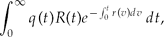
where we have ruled out extraction costs for simplicity. Assuming that the natural resource is exhaustible, extraction plans face the following constraints

where H indicates the resource stock.
As long as the number of factor-specific intermediates is constant, the production functions in (4) exhibit constant returns to scale. Once the number of intermediates is allowed to change as a consequence of purposive R&D activities, the returns to scale become increasing, and the economy grows endogenously. The engine of growth is thus represented by increases in the number of varieties (n and m) that result from R&D activity. The growth rates of n and m are determined by innovation technologies that, for the moment, are left unspecified for the sake of generality.
Competitive equilibrium
We now characterize the competitive equilibrium of the production side of the economy by the set of efficiency conditions that guarantee maximal profits in the respective sectors at each point in time. Final good producers maximize profits taking the prices of factor-specific goods, p K and p R, as given. Taking aggregate output as the numeraire good, first-order conditions read

The producers of the factor-specific goods, and , maximize profits

subject to technologies (4). In the last equation, the price of the jth capital-specific (resource-specific) intermediate is denoted by χ jK (χ jR, respectively). The resulting demand schedules for sector-specific intermediates are

Each monopolist holding a patent takes the relevant demand schedule as given, and chooses the price of the produced variety in order to maximize instantaneous profits

Profit-maximizing conditions for the monopolists yield

which imply that equilibrium instantaneous profits π jK and π jR are equal across varieties. From the market clearing condition (6), we have

so that equilibrium profits read

Substituting equilibrium quantities from (12) in the market clearing conditions (4), and integrating, we obtain the relation between primary inputs and factor-specific goods

Plugging these expressions into the demand for intermediates (10), and using (11), we can solve for the rental price of capital and the price of the resource, obtaining

To simplify notation, define the elasticity-adjusted indices of intermediate varieties as  and
 . Using (14) we can rewrite equilibrium aggregate output as

Expression (16) elucidates the role of the expansion of intermediates' varieties in this model. An increase in N raises the productivity of K, while an increase in M positively affects the productivity of the resource. For this reason, we will refer to Ṅ/N and Ṁ/M as the rates of capital-augmenting and resource-augmenting technical progress, respectively.
Exploiting the homogeneity of degree one of the production function, it is convenient to express the augmented output–resource ratio Y/MR as

where we have indicated the production function in intensive form as f(x) and defined the augmented capital–resource ratio

Our analysis of the production side of the economy is completed by the efficiency conditions for the extracting sector. Mining firms maximize profits (7) subject to the resource constraints in (8). The efficient depletion path is therefore characterized by the standard Hotelling rule

according to which the growth rate of the resource price equals the interest rate in each instant.
A crucial difference between the present model and the capital–labor economy studied in Acemoglu (Reference Acemoglu2003) is that equilibrium prices (15) and the Hotelling rule jointly determine the dynamic behavior of the augmented input ratio in the competitive equilibrium. To see this, rewrite – using (9) and (16) – intermediates' prices as


where the sign of both derivatives follows from σ < 1. On the basis of (19) and (20) we can prove the following
Lemma 1. In the competitive equilibrium, the dynamics of the augmented capital–resource ratio are described by

Proof. Differentiate (20) to get

From (15) and (19), the interest rate equals

Differentiating the expression for q in (15), we obtain  /q = (ṗ R/p R) + (Ṁ/M). Substituting ṗ R/p R from (22), /q = r according to Hotelling's rule, and the interest rate from (23), we obtain the dynamic law (21).
Equation (21) shows that the augmented capital–resource ratio increases (decreases) when the interest rate exceeds (falls short of) the net rate of resource-augmenting technical change, Ṁ/M. Neoclassical and ETC models with purely resource-augmenting technical progress can be seen as particular cases of this general rule: the basic difference here is that N and Ṁ/M are both endogenous. If we normalize N = 1 and assume Ṁ/M = η > 0 (exogenous constant) in equation (21), we have the dynamic rule for the capital–resource ratio in the Ramsey model with exogenous progress (see Valente, Reference Valente2005: eq. (16)). Alternatively, normalizing N = 1 and keeping Ṁ/M endogenously determined by R&D activity, we have purely resource-augmenting progress à la Amigues et al. (Reference Amigues, Grimaud and Moreaux2004).
Balanced growth equilibrium
A central result of the present analysis is that the above relations suffice to characterize the behavior of capital- and resource-augmenting rates of technological progress in a balanced growth equilibrium (BGE); that is, the interplay between capital accumulation and resource extraction allows us to conclude that in such an equilibrium – without specifying innovation technologies, nor assuming a particular behavior on the part of consumers – there exists only one type of technical progress. Indeed, we follow a bottom–up approach: first, we define BGE's and show that in such equilibria the direction of technical progress is exclusively resource-augmenting; second, we specify consumers' preferences and innovation technologies, showing that the economy actually converges to a unique BGE in the long run. This bottom–up strategy is different from the top–down approach followed in Acemoglu (Reference Acemoglu2003), and aims at emphasizing that our result of purely resource-augmenting technical progress can be extended to any economy that approaches balanced growth while satisfying the conditions for productive efficiency.Footnote 9 Still, the focus on balanced growth equilibrium is not arbitrary, since the assumption of essential inputs, in combination with standard preference specifications, yields a typical result of the literature on economic growth: any non-cyclical asymptotic equilibrium with σ < 1 is a BGE (e.g. Acemoglu (Reference Acemoglu2003, proposition 1). This rules out ex-post other types of equilibria. In line with this reasoning, we will rule out explosive asymptotic growth rates (lemma 2), and show that the economy converges to the BGE by virtue of saddle-point stability of the linearized dynamic system (proposition 4). Using the standard definition: a balanced growth equilibrium is a competitive equilibrium where all endogenous variables grow at finite and constant rates – with growth rates possibly zero or even negative. As a first step, we can prove the following result:
Proposition 1. In a BGE, the augmented input ratio, x, is constant.
Proof. From (17), the growth rate of aggregate output can be rewritten as

By definition, Y, M, R, and x ≡ NK/MR must all grow at constant rates in a BGE. As a consequence, the term in parentheses above must be constant as well, requiring

We now show that (25) is only possible when ẋ = 0. Suppose not, i.e. let ẋ/x ≠ 0 in the BGE. From (19) we get

since σ < 1 and – according to (24) – the growth rates of x and f(x) differ, equations (25) and (26) cannot hold at the same time with ẋ/x ≠ 0. Hence, it must be the case that ẋ/x = 0 in a BGE.
Proposition 1 establishes that augmented capital and augmented resource must grow at the same rate along a balanced growth path.Footnote 10 This implies the standard result that, in such an equilibrium, factors must display constant production shares. On the basis of proposition 1, it can be shown that a BGE is characterized by purely resource-augmenting technological progress. More precisely:
Proposition 2. In a balanced growth equilibrium

Proof. From the previous result we know that a BGE requires ẋ = 0. It then follows from (21) that a stationary input ratio in a competitive equilibrium requires

Since ẋ = 0 and Ṁ/M is constant in a BGE, expression (28) implies that N must be constant as well. We thus have the standard result that the interest rate is constant in a balanced growth equilibrium.
Proposition 2 establishes that a BGE is characterized by a positive net rate of resource-augmenting progress, together with a zero net rate of capital-augmenting progress. This result is explained as follows. On the one hand, balanced growth requires a constant input ratio, and therefore a constant price of the resource-intensive good ṗ R = ẋ = 0). On the other hand, due to the exhaustibility of the resource stock, the price of raw resources q grows indefinitely, in compliance with Hotelling's rule. As a consequence, balanced growth can only be obtained if the number of resource-complementary intermediates grows over time: a BGE requires a positive rate of resource-augmenting progress in order to compensate for the dynamic productivity loss generated, at each point time, by increased resource scarcity. Note that the constancy of N in a balanced growth equilibrium derives from the fact that constant input shares require both Ṁ/M and Ṅ/N be constant; since the number of capital-augmenting intermediate varieties would also bear level effects on the interest rate – see the central term in (28) – it follows that the only way to obtain a constant growth rate in M while satisfying the Hotelling rule is that N achieves a steady state. This is evidently compatible with the typical result that balanced growth features a constant interest rate, even though proposition 2 does not postulate that a constant interest rate is actually necessary for obtaining balanced growth.
Proposition 2 informs us that, when we focus on a BGE as the relevant long-run equilibrium concept – which is the case in all the literature mentioned above – the mere fact of perfect competition in production implies a rate of capital-augmenting technical change equal to zero. It is clear, however, that the scope of this result can only be assessed by defining the conditions under which the economy actually converges to the BGE. This issue is tackled in the next section, where we specify innovation technologies in R&D sectors, and individual preferences governing intertemporal consumption choices.
4. Long-run equilibrium
Asymptotic paths and balanced growth
The results of the previous section imply that, if the economy achieves a BGE while satisfying the conditions for a competitive equilibrium, technical progress is purely resource-augmenting. To ascertain whether the economy actually achieves a BGE, we need to model the behavior of consumption and savings, as well as specify the innovation technologies that determine the growth rates of intermediates' varieties. In this section, we show that the standard Keynes–Ramsey rule – which governs consumption and investment choices when consumers maximize present-value utility – together with innovation technologies à la Acemoglu (Reference Acemoglu2003) actually imply long-run convergence of the economy towards a unique balanced growth equilibrium.
Increases in intermediates' varieties are obtained through the efforts of specialized workers (scientists) employed in the R&D sector: firms developing capital- and resource-augmenting innovations employ S K and S R scientists, respectively. Following Acemoglu (Reference Acemoglu2003), the rate of innovation in each sector is determined by the following production functions


where δ > 0 is the obsolescence rate of both innovations, and b K and b R are constant productivity indices. The number of scientists affects the productivity of R&D firms through S K φ (S K) and S R φ (S R). The function φ (·) is assumed to be continuously differentiable and strictly decreasing, such that ∂(S i φ (S i))/∂ S i > 0. On the one hand, assuming φ′ (·) < 0 captures crowding effects among scientists (when more scientists are employed in one sector, the productivity of each declines); on the other hand, the net effect of a marginal increase in employed scientists on the rate of innovation is positive: Ṡ K > 0 increases ṅ/n. Crowding effects are not internalized by R&D firms, so that b R φ (S R) and b K φ (S K) are taken as given when firms compete for hiring scientists.Footnote 11
Scientists are fully mobile between the two types of activities: in each instant, they can be freely reallocated between capital- and resource-augmenting activities, depending on the relative profitability of the two types of innovations. The number of existing scientists (S) suffices to have a stationary mass of varieties (ṁ = ṅ = 0), that is

where  K and R satisfy b K K φ (K) = δ and b R R φ (R) = δ by definition.
Consumers' behavior follows the standard criterion of present-value optimality. The representative agent exhibits logarithmic instantaneous preferences and a constant utility discount rate ρ > 0. Denoting aggregate consumption by C, an optimal consumption path is a plan {C(t)}t = 0∞ that maximizes

subject to the aggregate wealth constraint

where rK is capital income (r is the marginal reward of capital), qR represents resource rents, w is the wage rate, and S is total specialized labor provided to R&D firms, so that wS is total labor income.Footnote 12 Qualitatively, our results would not change if we substituted logarithmic preferences with a different CIES instantaneous utility function: in (31), the intertemporal elasticity of substitution is set to one to simplify the exposition. Along the optimal path, consumption dynamics follow the standard Keynes–Ramsey rule

The analysis is carried out in three steps. First, we rule out explosive paths as possible long-run equilibria of this economy: as the growth rate of the economy must be finite, the Keynes–Ramsey rule requires the interest rate to fall within finite boundaries in an asymptotic equilibrium; this implies that any non-cyclical asymptotic equilibrium must feature a constant interest rate. Second, we show that any non-cyclical asymptotic equilibrium with constant interest rate is in fact a BGE – a standard result that hinges upon the fact that a constant r implies that resource rents grow at a constant rate by virtue of Hotelling's rule. Third, we show that the BGE is unique and saddle-point stable. Since the system converges to the balanced growth path in the long run, the economy displays purely resource-augmenting technical progress by virtue of our previous results (see proposition 2).
Beginning with the first step, we prove that:Footnote 13
Lemma 2. The long-run interest rate must be constant in any non-cyclical competitive equilibrium.
Proof. From now on, we denote by y ∞ the limit limt → ∞ y(t), for any variable y. We proceed by contradiction to rule out unbounded consumption growth. Suppose that (Ċ/C)∞ = ∞. This in turn requires that Ẏ/Y)∞ = ∞, in order to satisfy the aggregate constraint of the economy (see (42) below). Rearranging (17) gives

This expression has the following implications: if x ∞ = ∞, then  , which implies (Ẏ/Y)∞ = (Ṁ/M)∞ + (Ṙ/R)∞. Since the number of scientists is finite, as is the resource stock, it must be the case that (Ṁ/M)∞ + (Ṙ/R)∞ < ∞, implying that Y itself cannot grow at an infinite rate. Also, if x ∞ =
 , where is a finite constant, then (Ẏ/Y)∞ = (Ṁ/M)∞ + (Ṙ/R)∞ < ∞ by the same reasoning. Finally, x ∞ = 0, then [γ x(t)(σ − 1)/σ + (1 − γ)]σ/(σ − 1) → 0 as t → ∞, so that (Ẏ/Y)∞ < (Ṁ/M)∞ + (Ṙ/R)∞ < ∞. Consequently, (Ẏ/Y)∞ = ∞ cannot be an equilibrium, implying that (Ċ/C)∞ = ∞ cannot be an equilibrium either. Since (Ċ/C)∞ must be finite and the discount rate ρ is constant, satisfying the Keynes–Ramsey rule (33) requires that the interest rate fall within finite boundaries, which is consistent with either a cyclical non-explosive asymptotic equilibrium or an equilibrium with constant interest rate. Therefore, any non-cyclical asymptotic equilibrium must feature a constant interest rate.
While Lemma 2 guarantees that the interest rate must be asymptotically constant, it does not ensure that such an equilibrium features balanced growth. Recall that only if ẋ = Ṅ = 0 will an asymptotic equilibrium be a BGE. The purpose of the next paragraph is therefore to show that ṙ = 0 requires ẋ = Ṅ = 0 in equilibrium – i.e. that an equilibrium with constant interest rate implies balanced growth. Formally, we must rule out the cases where r is constant but x and N are time-varying: indeed, (23) suggests that ṙ = 0 generally requires (ṗK/p K) = − (Ṅ/N), which may be the case when the two terms are either both zero or equal in absolute value and of opposite sign. In the first case, (ṗK/p K) = − (Ṅ/N) = 0, we have balanced growth, whereas the second case is potentially a non-balanced growth equilibrium. This last possibility is ruled out in Proposition 3 below, which shows that r can be constant in equilibrium only if (ṗK/p K) = − (Ṅ/N) = 0 – that is, a constant interest rate implies balanced growth.
Firms developing innovations choose the sector where they will concentrate their efforts on the basis of the relative profitability of research. R&D activities result in the attribution of patents that can be sold on the market. The value of each patent equals the present discounted value of the profit stream implied by capital- and resource-augmenting innovations, i.e.

where the discount rate is given by the equilibrium interest rate plus the assumed depreciation rate, δ. From (13), we can substitute instantaneous profits and obtain equilibrium present-value streams


Under our specification of the innovation functions, the value of the marginal innovation in the two types of firms is respectively given by b K φ (S K)nV K and b R φ (S R)mV R. In general, the equilibrium wage rate of scientists is given by

which takes into account possible corner solutions. When the equilibrium levels of S K and S R are both positive, however, we have uniform wage rate and S K + S K = S, so that

at any instant when both types of innovations are developed at the same time.
Using (15), and the expressions for the prices of the intermediate goods in (19) and (20), we can also derive the following expression for the relative capital share

When capital- and resource-intensive goods are complements, an increase in the augmented capital–resource ratio (x) leads to a decrease in the relative capital share (ξ), a decrease in the price of capital-intensive goods (p K), and an increase in the price of resource-intensive goods (p R). On the basis of the above relations, we can prove the following:
Proposition 3. Any asymptotic equilibrium displaying a constant interest rate exhibits a constant input ratio, and is therefore a BGE.
Proof. The proof builds on the fact that x ∞ = 0 and x ∞ = ∞ have the following implications


Expressions (39) and (40) are proved in the appendix. From (39), if the augmented capital–resource ratio approaches zero, all scientists are employed in developing capital-augmenting innovations, and the number of resource-specific intermediates m will approach zero due to depreciation. From (40), in the opposite case, x diverges to infinity, all scientists are employed in resource-augmenting innovations, and the number of capital-specific intermediates will approach zero in the long run. But neither (39) nor (40) are compatible with a constant interest rate. From (15), ṙ ∞ = 0 requires

which implies that ṗ∞K and Ṅ ∞ are either both zero or of opposite sign. First, suppose that ṗ∞K > 0 and Ṅ ∞ < 0: from (19), ṗ∞K > 0 ⇒ ẋ ∞ < 0 ⇒ x ∞ = 0; but then, expression (39) would imply Ṅ ∞ > 0, which contradicts the supposition. Second, suppose that ṗ∞K < 0 and Ṅ ∞ > 0: from (19), ṗ∞K < 0 ⇒ ẋ ∞ > 0 ⇒ x ∞ = ∞; but then, expression (40) would imply Ṅ ∞ < 0, which contradicts the supposition. Hence, in order to have a constant interest rate, we need ṗ∞K = Ṅ∞ = 0, which implies ẋ ∞ = 0 from (19). From (21), a competitive equilibrium with ẋ ∞ = 0 and Ṅ ∞ = 0 also requires (Ṁ/M)∞ = r. It follows from ẋ = Ṅ = 0 and (17) that Ẏ/Y = r + Ṙ/R =  /K. Being the output–capital ratio Y/K constant over time, the aggregate resource constraint of the economy

implies that output grows at the same rate of consumption: if not, either K or C would become negative in finite time, violating the constraints of the consumer's problem.Footnote 14 We thus have Ċ/C = Ẏ/Y = /K = r − ρ constant, and Ṙ/R = Ẏ/Y − Ṁ/M = − ρ constant as well, ensuring that any asymptotic equilibrium displaying a constant interest rate is a BGE.
It follows from lemma 2 and proposition 3 that any non-cyclical asymptotic equilibrium is a BGE. In the economy under study, this equilibrium is characterized by the following dynamics for the factor intensive goods, output, and consumptionFootnote 15

for the flow of resources

for the number of intermediates in each sector


and, finally, for profits


Expressions (43) and (44) follow from the proof of proposition 3. Expressions (45) and (46) follow from proposition 1, and the definition of the innovation technology. Finally (47) and (48) are derived from the expressions of equilibrium profits in (13).
Substituting (47)–(48) in (34)–(35) we obtain the BGE values of patents. If the economy converges to balanced growth, we have


for any t sufficiently large. Equations (49)–(50) imply that both nVK and mVR will grow at the balanced rate r * − ρ.
As n is constant in a BGE, the number of scientists employed in capital-augmenting innovations must equal K. It follows that the growth rate of this economy is given by

We can now prove the following:
Proposition 4. The BGE is unique and locally saddle-point stable.
Proof. We first establish uniqueness. In the BGE both types of innovation must occur at the same time, and the value of employing a scientist in any of the two types of activities must then be the same, that is

where S *K = K and S *R = S − K. Substituting (49) and (50) in the equation above, we obtain the following expression for the relative capital share consistent with BGE

where we have made use of r * = ρ + g * from the Keynes–Ramsey rule. This expression implies that a unique level of ξ = ξ*, and hence of x = x *, from (38), is compatible with balanced growth. The BGE is therefore unique in this economy.
As regards stability, the dynamic behavior of the economy around the BGE can be approximated by five linear differential equations with the following variables

All the above variables are stationary in the BGE. In the Appendix we show that the Jacobian matrix obtained from the linearization procedure, evaluated at the steady state, x *, N *, S *K, C */K *, R */H *, has three positive and two negative eigenvalues. As a consequence, the equilibrium dynamics are locally saddle-point stable, implying that the economy will converge to the balanced growth path described above, provided that the economy is not too far from the steady-state equilibrium.
Remarks
In the model of Acemoglu (Reference Acemoglu2003), final output is a combination of capital-intensive and labor-intensive goods, and the balanced growth path features purely labor-augmenting technical change. The model presented in this paper extends the benchmark DTC model to include natural capital, with raw labor inputs replaced by resource flows extracted from an exhaustible natural stock. In this case, the long-run equilibrium features purely resource-augmenting technical change. A crucial step of the proof has been to show that the equilibrium time path of resource prices – which obeys the standard Hotelling rule – fully supports the time path of intermediate goods prices that is compatible with balanced growth. In this regard, the asymmetric role of the two types of innovation follows immediately from equilibrium conditions (15): since balanced growth typically requires a constant interest rate (the rental price of capital), and given that resource prices must grow forever, fulfilling (15) at given prices p K and p R clearly requires differentiated innovation rates (ṁ/m ≠ ṅ/n). Since intermediate prices are constant along balanced growth paths, a positive rate of resource-augmenting progress is necessary to obtain balanced growth.
From proposition 2, the asymptotic rate of resource-augmenting progress exactly equals the interest rate. A similar result can be obtained in the neoclassical framework, but following an inverse logic: for a given exogenous rate of resource-augmenting progress η, the marginal product of capital converges to η, determining constant factor shares in the long run (Stiglitz, Reference Stiglitz1974). In the present context, conversely, the rate of technical change is endogenous and its behavior complies with the Hicksian principle of induced innovations: technical change tends to be directed towards those factors that become expensive, in order to compensate relative scarcity with increased real productivity. As a consequence, balanced growth requires that Ṁ/M converges to the growth rate of the resource price, which is in turn equal to the interest rate.
A possible extension of the above discussion would be to analyze a model where final output uses three raw inputs: capital, labor, and an exhaustible resource. Apart from the technical challenge represented by the characterization of asymptotic equilibria in such an economy, one might conjecture that, also in this case, the direction of technical change would be dictated by the intrinsic characteristics (in term of reproducibility) of the raw inputs, at least in the long run. In view of the above discussion, one may expect that, along balanced growth paths, the (net) rate of technical change would be zero for the accumulating factor (capital), equal to a positive value (smaller than the rate of interest) for the factor in fixed supply (labor, or land), and to the interest rate for the exhaustible resource. Another point regards the assumption of poor substitution possibilities, which is crucial for obtaining a unique BGE in this model. With σ > 1, the economy may exhibit multiple equilibria, and positive rates of capital-augmenting technical progress in the long run. However, in the present context, our assumption σ < 1 relies on a precise economic reasoning: natural resource scarcity matters for sustainability only insofar as exhaustible resources are essential for production. From an empirical perspective, it is difficult to assess the ‘true’ elasticity of substitution between capital and exhaustible resources. The scant empirical literature on the issue provides a limited number of estimates for the elasticity of substitution between capital and energy (σK, E), rather than between capital and exhaustible resources, for nested CES models. Prywes (Reference Prywes1986) reports estimates for σK, E in 2-digit industries in the US for the period 1971–1976 ranging between –0.57 and 0.47 (his estimates for the (KE)L nest range from 0.21 to 1.58); Chang (Reference Chang1994) uses Taiwanese data and obtains an elasticity of 0.87, while his σKE, L = 0.45. More recently Van der Werf (Reference Van Der Werf2007) estimates nested CES production functions for 12 countries and seven industries between 1978 and 1996. In his preferred specification – the (KL)E one – he finds elasticities of substitution between the (KL) aggregate and energy ranging from 0.15 to 0.62 across countries and sectors.Footnote 16 As in general it would be even more difficult to substitute away from an aggregate comprising all exhaustible resources (including fossil fuels and minerals) rather than energy alone, we are confident that assuming σ < 1 is not only the most interesting case from a theoretical perspective, but also the most empirically plausible one.
As regards preference specifications, the analysis can be easily amended to allow for a non-unit intertemporal elasticity of substitution, as in

which features a constant elasticity of intertemporal substitution, θ−1. Since the analysis of sections 2 and 3 does not postulate any particular form of preferences, lemma 1, and propositions 1 and 2 remain valid. Moreover, the proof of proposition 3 is unchanged except for the last sentence that would then read: under preferences (52), the BGE equilibrium would be characterized by

so that the only sensible difference would be in the growth rate of extracted raw inputs, which equals

Also in this case, Ṙ/R is strictly negative since the transversality condition on capital requires r > θ− 1 (r − ρ), and the characterization of the balanced growth equilibrium is qualitatively unchanged.
To conclude, note that the condition for non-declining consumption in the long run can be expressed as

which is obtained by imposing (Ċ/C)∞ = (Ṁ/M)∞ − ρ ≥ 0 in the BGE. From (53), lower monopoly profits for intermediate firms, as well as higher depreciation rates for innovations, reduce prospects for sustained consumption in the long run. As intuitive, the economy will display sustained growth in the long run only if the productivity of R&D firms developing resource-augmenting innovations is high enough to compensate for the effects of technological obsolescence (δ) and consumers' impatience (ρ).
5. Conclusion
The vast majority of capital–resource models assumes that technological progress is, explicitly or implicitly, resource-augmenting. This assumption is necessary to obtain sustained consumption in the long run, but it has not been micro-founded so far. At least in principle, R&D activity can also be directed towards capital-augmenting innovations, leaving room for the possibility that technical change does not exhibit resource-saving properties: in this case, most capital–resource models would be too optimistic with respect to the problem of sustainability, and specifying resource-augmenting progress would be a convenient, but strong assumption. Elaborating on Acemoglu (Reference Acemoglu2003), we addressed the problem in the context of a two-sector economy with directed technical change, where the respective rates of capital- and resource-augmenting progress are determined endogenously by the relative profitability of factor-specific innovations. We characterized the balanced growth path, showing that the rate of capital-augmenting technical progress must be zero: in such an equilibrium, the direction of technical change is purely resource-augmenting. Under standard specifications of preferences and innovation technologies, the balanced growth path is stable and unique, and the economy exhibits a positive rate of resource-augmenting technical progress in the long run. This result provides sound microfoundations for the broad class of capital–resource models in both the Solow–Ramsey and the endogenous growth framework, and contradicts the view that such models are conceptually biased in favor of sustainability.
We have shown that the net rate of resource-saving progress must equal the interest rate along the balanced growth path. While this confirms a standard result of the neoclassical model, the presence of directed technical change provides a different, and very intuitive explanation for this result. On the one hand, since the natural resource stock is exhaustible, the growth rate of the resource price is exactly equal to the interest rate (Hotelling, Reference Hotelling1931). On the other hand, balanced growth requires that the rate of resource-saving progress exactly offsets the growth in the resource price: this is in compliance with the view that factor-specific innovations are induced by the need for enhancing the real productivity of scarce resources, in order to compensate for their increased expensiveness (Hicks, Reference Hicks1932). We do not know whether Hicks and Hotelling were close friends, but making them meet 75 years later has been a great pleasure for us.
Appendix
Proof of expressions (39) and (40)
The results in (39) and (40) hold true in a capital–labor economy as well, so that the proof is identical to that of lemma 1 in Acemoglu (Reference Acemoglu2003: 28–29). Recalling that the value of an innovation is given by the present value of the stream of instantaneous profits (πi with i = K, R), we define the index of relative profitability of the two types of innovations as

Using (34, (35), (38), (A.1), and the equilibrium conditions of instantaneous profits we have

Since σ < 1, if x ∞ = 0, then Δ∞ = ∞. This implies S ∞K = S and S ∞R = 0, from which (ṅ/n)∞ = b K φ (S) S − δ and (ṁ/m)∞ = − δ as claimed in (39). Conversely, if x ∞ = ∞, then Δ∞ = 0. From (36) it follows that S ∞K = 0 and S ∞R = S, and hence (ṅ/n)∞ = − δ while (ṁ/m)∞ = b R φ (S)S − δ as in (40).
Local stability of the BGE
The dynamics of the system are represented by five differential equations representing the dynamics of x, N, S K, c ≡ C/K, and u ≡ H/R.
Let us start with the equation describing the evolution of x over time.
Substituting (30) for Ṁ/M = (1 − β) β− 1 (ṁ/m) in (21) we get

Differentiating the right-hand side of (A.3) with respect to x we have

Evaluating (A.4) at the steady-state equilibrium, making use of f x (x)β N = r = Ṁ/M from (28), we obtain

where f xx < 0 implies a xx < 0. Differentiating (A.3) with respect to N we have

and with respect to S we have

where the sign comes from ∂(Ṁ/M)/∂S K < 0. Differentiating with respect to c and u, we get a xc = a xu = 0.
The equation for the evolution over time of N follows from (29)

which implies a Nx = a NN = 0 and, by differentiation with respect to S K

Again, we obtain a Nc = a Nu = 0.
The third equation is obtained as in Acemoglu (Reference Acemoglu2003: 32). Since S *K > 0 and S *R > 0, the equilibrium condition (37) holds in an open set around the BGP equilibrium where both types of innovations are developed. Differentiating (37) and substituting (29)–(30) we have

where


where the capital share ξ (x) is defined in (38) and exhibits ∂ ξ/∂ x < 0. Differentiating (A.10) with respect to S K and x we have

where a little algebra shows that a Sx > 0 and a SS > 0. Once more, a Sc = a Su = 0.
The fourth equation illustrates the dynamic behavior of the consumption to capital ratio: c ≡ C/K. Using the Keynes–Ramsey rule, the production function in intensive form in (17), and r = f x (x) β N, we get

The partial derivatives of this expression with respect to the other relevant variables, evaluated at the steady state, are

Finally, the fifth differential equation we consider concerns the dynamics of the variable u ≡ R/H. Using the fact that û = Ř + u, and the definition of x from (18), we get

The coefficients of the linear approximation are

Thus, the system of differential equations that approximates the behavior of the economy around the balanced-growth path can be written as follows

Or, in matrix notation, (ẏ}/y) = J × (y − y*). The determinant of the coefficients matrix, J, can be written as

where

Hence, a uu > 0 and a cc > 0 are two positive eigenvalues of J. Studying the determinant and the characteristic equation of A, we can determine the sign of the three additional eigenvalues of the system. Since the determinant of A is a xNa NSa Sx > 0, we have either three positive roots, or one positive and two negative (or complex with negative real part) roots. The three remaining eigenvalues (λi) are also zeros of

where (a Sxa xS − a xxa SS) > 0 and a Sxa NSa xN > 0. Hence, regardless of the sign of (a xx + a SS), the polynomial always shows one variation of signs (either −,+,+,+ or −,−,+,+). This implies the existence of one and only one positive root by Descartes' rule.
Our analysis thus shows that the system in (A.16) has three positive and two negative roots. As a consequence, the system is saddle-point stable if there exist three independent jump variables that, at time zero, set the economy along the unique stable manifold bringing the system towards the saddle-point equilibrium. In the economy under study, the initial values of K, M, N, and H are given, whereas the optimality conditions of consumers, R&D firms, and resource suppliers imply that C, S K, and R are independent jump variables. In terms of the variables appearing in the linearized system – (A.16) – this means that C 0, S K0, and  correspond to the three independent jump variables needed to achieve the stable manifold. The stable roots correspond to N 0, which is given at time zero, and to u 0 – which is not independent at time zero as
 . Hence, the system is saddle-point stable around the balanced growth equilibrium represented by the steady-state point of system (A.16).



