


Normatively, democratic constitutions should express how citizens want to govern themselves collectively. Little is known, however, about how citizens’ constitutional preferences can be elicited and aggregated in practice. An intuitively appealing approach is to allow various forms of popular participation during a constitution-making process, including a popular vote to accept or reject the draft constitution (Fishkin Reference Fishkin2011). Based on the Chilean experience with democratic constitution making, this article identifies unanticipated and previously unexplored distortions that can lead to incongruence between the preferences of voters and representatives regarding the extent and direction of constitutional change.
Based on the Chilean experience with democratic constitution making, this article identifies unanticipated and previously unexplored distortions that can lead to incongruence between the preferences of voters and representatives regarding the extent and direction of constitutional change.
Our study focuses on two factors. First, the composition of the electorate might shift over the course of the process. One possible reason is the changes in the rules governing participation. In Chile, voting was voluntary in the election of delegates but mandatory in the constitutional plebiscite. Another possibility is that the intrinsic motivation of individuals to participate may be weaker in the earlier, more procedural phases of the constitutional process and stronger at the end, when voters decide on the constitutional alternative. Consistent with these effects, the participation of registered voters increased from 43.26% in the 2021 Constitutional Convention election to 86.02% in the 2022 plebiscite.Footnote 1 The size of the electorate increased 98.8% from one election to the next.
Second, in an environment shaken by intense social mobilizations against the political and social status quo, the incentive to demand radical change might be stronger at the beginning of the process. For example, this may occur during the election of convention delegates, when results are still reversible, rather than at the end, when the final plebiscite is held to ratify the constitution. This effect is magnified if voting is voluntary for the election of the constituent body, when people motivated to reform are the most likely to participate, but becomes mandatory in the plebiscite to ratify the new text, forcing those who are indifferent or opposed to reform to cast a vote. The problem is that a progressive choice early in the process would send potentially misleading signals to constitution drafters regarding the extent to which voters want to depart from the status quo.
Constitutional and parliamentary elections data, delegate votes during the constitutional convention, and an original online survey with more than 3,000 respondents highlight the joint influence of shifts in the composition of the electorate and in the extent of change acceptable to voters on the outcome of the constitutional process. Most delegates to the Constitutional Convention resisted compromising with more conservative or centrist delegates, which was consistent with their interpretation of voter choices in the delegate elections. The draft constitution that emerged was a significant departure from the status quo and diverged significantly from the preferences of the median voter in the final referendum.
CHANGES IN PARTICIPATION RATES AND COMPOSITION OF THE ELECTORATE DURING THE CONSTITUTIONAL PROCESS
On November 15, 2019, Chilean political parties agreed on a process of constitutional change in response to massive, often violent social protests against the social and political status quo. In the October 2020 plebiscite, almost 80% of voters supported adopting a new constitution by means of a fully rather than partially elected convention. Voters elected the delegates to the convention in May 2021. Nonpartisan delegates predominated: 67% were independents. Correspondingly, the percentage of seats of traditional right and center-left parties was significantly lower than in the legislature at the time: 23.9% and 16.1% of the seats in the convention and 46.4% and 27.7% in the legislature, respectively. Among the 155 delegates, there were 78 men and 77 women; 17 delegates belonged to indigenous communities.
The delegates drafted a constitutional proposal that significantly expanded social rights, decentralized power, strengthened the power of the legislature vis-à-vis the executive, protected minorities, established gender parity, and allowed citizens direct participation in policy making. In broad terms, most of these changes responded to widely shared criticism of the 1980 constitution (Negretto Reference Negretto2021). Yet, when the proposal was submitted for popular ratification in September 2022, 62% of the electorate rejected it.
Other studies of the constitution-making process in Chile attribute this outcome to factors such as a vigorous campaign against the constitution, changes in the relative popularity of politicians who had endorsed and opposed it, and mistakes by delegates—most of whom were political novices.Footnote 2 This study focuses instead on systematic issues that are likely to arise in any constitution-making process that involves citizens in different stages and across changing conditions.
One issue is the occurrence of significant shifts in those who participate. The enormous variation in the composition of the electorate in the Chilean case would not have mattered if the intrinsic motivation to vote were similar among those for and against constitutional change. If this were the case, the composition of the electorate would have remained unchanged even as the participation rate doubled in the final constitutional plebiscite. Instead, however, nonparticipants early in the constitutional-process elections apparently were much less in favor of change and much less progressive than those who always participated.
We found direct evidence of a greater preference for constitutional reform among those who participated early in the process in an online survey in Chile with 3,017 respondents. Participants in the survey were selected using a quota sampling technique to resemble various relevant characteristics of the target population of interest: Chileans older than 18 and allowed to vote by October 2020, when the first plebiscite to authorize the replacement of the constitution was held.Footnote 3 Those who indicated that they did not vote in the 2021 election of convention delegates but did vote in the 2022 plebiscite were significantly more likely to reject the constitutional proposal than respondents who voted in both elections.
Specifically, among the 2,641 respondents who voted in the 2022 plebiscite, 469 did not participate in the 2021 election of delegates.Footnote 4 Of those who did not participate in 2021 and voted in 2022, 80.4% cast a vote to reject the constitutional draft or deliberately invalidated their vote. In contrast, of those who voted in both elections, only 51% rejected the proposed constitution or cast a null or blank ballot.Footnote 5 We found a similar association between participation in the 2020 plebiscite and rejection of the proposal in 2022.
COMPARING VOTER PREFERENCES: ELECTION OF DELEGATES TO THE CONSTITUTIONAL CONVENTION VERSUS PARLIAMENTARY ELECTIONS
One way to determine whether voters made unusually progressive choices in the delegate election is to compare their delegate preferences with their choices in proximate parliamentary elections. Of course, the choice sets of voters and the stakes vary across the different elections; therefore, the comparisons are imperfect. Election rules also were different in that the convention election allowed voting for lists of independents, established gender parity in the distribution of seats, and created reserved seats for indigenous delegates.
Nevertheless, the Constitutional Convention had a remit to address—and, in fact, did address—issues ranging from gender and the environment to pension reform that also were salient in the 2021 parliamentary election. Thus, if voters expressed their true preferences, their vote in the election for constitutional delegates should be similar to their vote in the subsequent parliamentary election. In addition, special rules for the delegate election favored independent, female, and indigenous candidates but did not predetermine the vote for progressive candidates and parties.Footnote 6
Table 1 presents evidence of a significant divergence in voter preferences among the different elections.Footnote 7 It reports results of ordinary least squares regressions for which the dependent variable was the vote share of left-leaning candidates minus the vote share of right-leaning candidates across 346 municipalities in the 2021 delegate election and the 2021 and 2017 parliamentary (deputies) elections.Footnote 8 The 2021 parliamentary election was only a few months after the election of delegates to the convention. The variable ranged from -100 to 100.Footnote 9
Difference in Vote Shares Relative to 2021 Parliamentary Election: Left-Leaning Candidates Compared to Right-Leaning Candidates
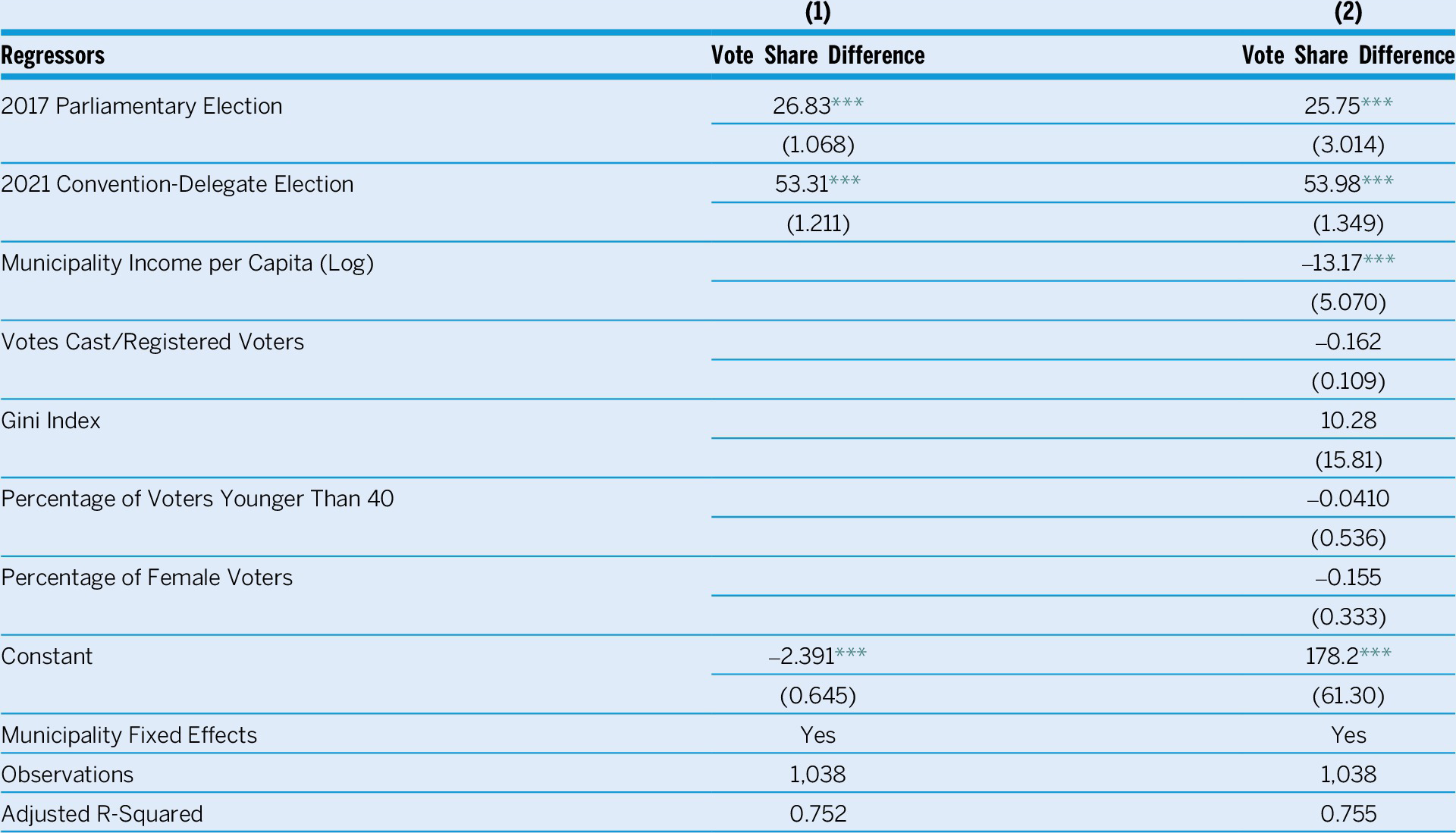
Notes: Numbers in parentheses are robust standard errors clustered by municipality.
*** p<0.01;
** p<0.05.
The key independent variables were the two dummy variables for votes in the 2017 parliamentary election (i.e., deputies) and in the 2021 convention delegates election. Estimated coefficients indicate how much greater was the vote share of left-leaning candidates in the respective election compared to the omitted comparison group, the 2021 parliamentary election. All estimates control for fixed effects by municipality.Footnote 10 Other controls included income per capita (log), the percentage of the electorate that participated, the Gini index of income inequality, the percentage of voters younger than 40, and the percentage of women at the municipal level.Footnote 11
The results reveal substantial partisan swings across elections. Specifically, compared to the 2021 parliamentary election, the 2017 election increased the vote-share difference in favor of left-wing candidates by approximately 26 percentage points, on average, holding all else constant. However, the coefficient for the 2021 convention-election variable shows that the vote-share difference from the 2021 parliamentary election was much larger: 53 percentage points. That is, the electorate that chose the delegates to the Constitutional Convention exhibited a much stronger preference for left-leaning candidates than the electorate in the 2021 parliamentary elections. These results are consistent with the conclusion that voters supported significantly greater departures from the status quo in the Constitutional Convention election than in the parliamentary elections before and after it.
PROGRESSIVE DELEGATES DRAFTED A PROGRESSIVE CONSTITUTION: PLURINATIONALITY
Especially given their lack of prior political experience, convention delegates had ample reason to suppose that a progressive constitutional proposal would be welcomed by Chilean voters and little reason to believe that they had to compromise with opponents of radical change (Larrain, Negretto, and Voigt Reference Larrain, Negretto and Voigt2023). The constitutional process was triggered by massive social protests in 2019; in 2020, an overwhelming majority of voters supported a process to write a new constitution; and, in 2021, voters elected a large majority of left-leaning delegates to write the new constitution. Consistent with this history and with their stated preferences, convention delegates drafted a document that—among other things—declared Chile a plurinational state, guaranteed indigenous groups access to their own judicial institutions, and recognized property rights over their traditional lands. However, before the 2022 plebiscite, polls revealed that plurinationality—along with the regulation of the health system and education—was among the issues that elicited greatest concern among those who considered rejecting the constitutional proposal.Footnote 12
Delegate voting on Article 79 recognizing the property rights of indigenous peoples over their lands, territories, and resources illustrates the impact of voter decisions in the election of delegates. Voting data from the Constitutional Convention suggest that it would not have passed if voters had chosen delegates the same way that they had selected legislators in parliamentary elections.
Articles required the support of two thirds of the delegates in the plenary. As indicated in table 2, none of the right-leaning delegates supported it. However, the 47 abstentions and votes against were barely less than the one-third vote share (i.e., 51 votes) needed to block approval. If the representation of right-leaning parties had been similar to that of the existing or future Chilean Congress, Article 79 would not have passed. Instead, the articles approved by the delegates closely reflected the preferences of voters as they had expressed them in the election of delegates in 2021.
Delegate Votes on Indigenous Collective Property Rights (Article 79)

Note: Plenary vote May 4, 2022. Source: https://sala.cconstituyente.cl/.
Given the publicity surrounding the convention proceedings, Chileans were aware of the decisions that delegates were making before the draft proposal was finished and of the internal conflict. Coincidentally, popular support for the new constitution declined during the drafting process. On March 13, 2022, a few days after the plenary began to vote on the first reform proposals from the thematic committees, representative polls showed that 31.8% would be inclined to reject it. By the end of July, after the convention had submitted its final draft, opposition had deepened: 50% of respondents were willing to reject and only 37% to approve the draft.Footnote 13
Data from our online survey echo the polling results. Table 3 compares respondent positions on the constitutional proposal with the declaration of Chile as a plurinational state. Only 20.1% (267) of those who rejected the constitutional proposal supported plurinationality compared to 58.8% (681) of those who approved it.
Support for Plurinational State and Support for Constitutional Proposal

Source: Authors’ survey; see text.
CONCLUSION
Our analysis in this article suggests that neither the composition of the electorate nor the incentives of voters to support deep institutional changes were constant during the course of the process. Early in the process, these factors shaped an electorate that expressed significant support for a radical repudiation of the status quo. By the end of the process, however, voters who were less enthusiastic about reform in general and radical transformations in particular participated in greater numbers. Therefore, although the delegates to the Constitutional Convention produced a constitutional proposal that was consistent with the apparent will of the electorate that chose them, it turned out to be more progressive than the preferences of the median voter of the electorate that finally decided whether or not to approve it.
This brief account of Chile’s experience with constitutional reform points to a broader program of research. In a world in which citizens express increasing disappointment with the performance of democracy and demand profound changes, it is crucial to understand how the factors that led to the disconnect between citizens and their representatives in Chile can affect similar reform efforts in other countries. In addition, given the growing importance of electoral support for fringe candidates and extreme platforms, it is worth exploring the extent to which protest voting in the election of constitution makers might widen the gap between the constitutions that convention delegates propose and those that the electorate is willing to accept. We are addressing these issues in a forthcoming study.
ACKNOWLEDGMENTS
This research significantly benefited from the expert research assistance of Ignacia Abufhele. Cristián Ayala and Cristina Marchant (Dirección de Estudios Sociales, Universidad Católica de Chile) offered invaluable suggestions for the survey and its implementation. We also are grateful to David Altman, Ezequiel González Ocantos, Carlos Meléndez, Kimana Zulueta-Fülscher, and two anonymous reviewers for their useful comments on a previous version of this article. Gabriel L. Negretto acknowledges that The Fondo Nacional de Desarrollo Científico y Tecnológico (Chile) funded part of the research for this article through the grant FONDECYT Regular No. 1200060.The findings and interpretations in this article are those of the authors and do not necessarily reflect the views of the Inter-American Development Bank or the governments that it represents.
DATA AVAILABILITY STATEMENT
Research documentation and data that support the findings of this study are openly available at the PS: Political Science & Politics Harvard Dataverse at https://doi.org/10.7910/DVN/LR89AZ.
CONFLICT OF INTEREST
The authors declare that there are no ethical issues or conflicts of interest in this research.



