Introduction
There are two characteristics of metal production in Bronze Age China (c. 1700–256 BC) that cannot be ignored. One is the use of lead and tin in the alloy from the very earliest period. The second is the remarkable scale of the bronze industry. Some of the vessels cast during the Erlitou period (c. 1600 BC; Figure 1) contain over 30 per cent lead (IA CASS 2014: 1515–18; Pollard et al. Reference Pollard, Bray, Hommel, Hsu, Liu and Rawson2017a & Reference Pollard, Bray, Hommel, Hsu, Liu and Rawsonb). Leaded tin-bronze was subsequently used to cast the majority of ritual vessels in central China during the Erligang (c. 1500–1300 BC) and Anyang (c. 1300–1045 BC) periods of the Shang, and also continued into the Western Zhou period (1045–771 BC). The sources of this lead are, therefore, of great importance in understanding the nature of the Shang and Zhou bronze industries.
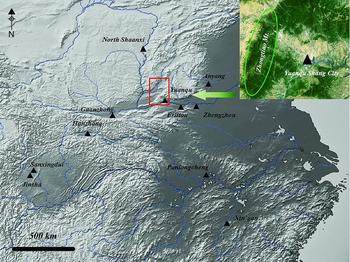
Map of China showing sites mentioned in the text.

One of the many puzzles regarding the earliest stage of metal casting in Bronze Age China is how and why the Erlitou craftsmen learned to cast copper with tin and lead as the alloying elements, given that the most probable source of bronze technology for China (the steppe communities) did not use lead (Hsu et al. Reference Hsu, Bray, Hommel, Pollard and Rawson2016). Pre-Erlitou metalwork from the Hexi corridor in the north-west (Mei Reference Mei, Hanks and Linduff2009), Shimao in the north (Rawson Reference Rawson2017) and the Chifeng area to the north-east suggest the sources from which bronze technology from the steppe may have been introduced to central China. In many of these objects, the alloys were typically of arsenical copper or tin bronze, as found in the steppe. Some examples of early leaded bronze are, however, known in the north and the north-east.
Lead was added from the beginning of bronze vessel production at Erlitou on the Central Plains. Adding lead can significantly reduce the melting temperature of the alloy and increase its fluidity, both features that were critically important for producing Shang bronze vessels with elaborate decoration cast in multi-piece ceramic moulds. The lower melting point is important, as it allows greater superheating during the pour, meaning that the metal will stay liquid for longer when in the mould. Although these technological advances are important, they do not fully explain the observed practice of adding lead. Deposits containing lead are relatively common around the Central Plains and the periphery, and are thus assumed to be more easily accessible and cheaper than tin and copper, but the huge scale of consumption by the entire metal industry across Shang China meant that the supply and management of lead had to be stable and sophisticated. It is the diachronic changes in this supply network that we attempt to reveal here.
Identifying metal flows in Bronze Age China has always been challenging. In most Shang and Zhou ritual bronzes, the lead levels are sufficiently high (around 5–20 per cent) that the measured lead isotope ratio in a particular object must be reflective of the added lead, rather than traces introduced by the copper or tin. Despite several decades of applying lead isotopic analysis to sourcing the lead used in the Shang period, a full understanding is still lacking. The network supplying the lead was very probably variable, dependent on changing interactions between the metropolitan centre and the metalliferous regions, and may have overlapped with the circulation of tin and copper, at least to some degree. It must therefore be understood as a dynamic system.
Lead isotope research on Bronze Age China
There are several relevant reviews of lead isotope work in China (e.g. Cui & Wu Reference Cui and Wu2008: 14; Jin Reference Jin2008: 33–47), but very few papers have discussed this issue in English. During the 1980s, before most archaeologists accepted that Shang culture reached as far south as the Yangtze River, Jin Zhengyao and his colleagues argued that the lead contained in the ritual vessels of Anyang might have originated in south-west China, specifically north-east Yunnan (Jin Reference Jin and Jin1987; Jin et al. Reference Jin, Mabuchi, Chase, Chen, Miwa and Hirao1995, Reference Jin, Zhu, Chang, Xu, Zhang and Tang2004). This interpretation was based on their important and now well-known observation that Shang Dynasty bronzes often contain lead of a kind usually described as ‘highly radiogenic’ (206Pb/204Pb ≈ 22), although we prefer to label it ‘anomalous’, as discussed below. Moreover, the same research showed that the Western Zhou generally used lead with a lower ratio of 206Pb/204Pb (≈ 17.5), often referred to as ‘common lead’. It was argued that north-east Yunnan appeared to be the only region in China capable of yielding radiogenic lead similar to that found in the Anyang bronzes. Furthermore, the predominance of objects containing radiogenic lead at the sites of Sanxingdui, Hanzhong and Jinsha in the south-west, and Panlongcheng and Xin'gan in the south, seemed to reinforce the idea of a lead supply external to the Central Plains—from somewhere south of the Yangtze River (Jin et al. Reference Jin, Chase, Hirao, Peng, Mabuchi, Miwa and Zhan1994, Reference Jin, Mabuchi, Chase, Chen, Miwa and Hirao1995, Reference Jin, Zhu, Chang, Xu, Zhang and Tang2004; Li Reference Li2002; Wang et al. Reference Wang, Jin, Li, Tian, Li and Zhao2008; Tian Reference Tian2013: 37–38, 102–103).
The lead isotopes in archaeological objects led Zhu and Chang (Reference Zhu and Chang2002) to propose 2.5 Gya as the geological age of the original lead deposits, and limiting the probable sources to north-east Yunnan, the Qinling Mountains, Qingchengzi in north-east China and the Yangtze River Valley. Zhu (Reference Zhu2010) pointed out that north-east Yunnan was still the most probable candidate, even though the lead isotopes of archaeological objects and the geological ores were not perfectly matched. These suggestions of a lead source in south-west China have raised difficult questions for specialists in Chinese bronzes. It is very distant from the Central Plains, although significant quantities of ivory may have been obtained from south-western China during the Shang period. There is also currently insufficient archaeological evidence for researchers to understand the nature of possible contacts between Yunnan and the Shang world of the Central Plains.
Saito et al. (Reference Saito, Han and Sun2002) concluded that the south-west region around the border of Yunnan, Sichuan and Guizhou provinces could not have been the source of radiogenic lead. Importantly, they also suggested that the seemingly linear relationship presented by lead isotopes in the Shang objects when plotted as a conventional isotope ratio bi-plot is, in fact, a mixing line between lead from different sources, rather than an isochron. Isochrons are used in geological samples to calculate the age of the deposit; in archaeology, this age is sometimes used to identify the location of the source material. If, in archaeological samples the line is not a true isochron, however, it cannot provide the geological age of the deposit. The age that Saito et al. (Reference Saito, Han and Sun2002) calculated from the ‘isochron’ formed by Shang Dynasty objects was approximately 5 Gya, which is older than the age of the Earth, and suggests that it is more probably a mixing line. From archaeological rather than geological evidence, Saito et al. (Reference Saito, Han and Sun2002: 294) proposed the Qinling Mountains as the source of radiogenic lead, but noted that “such a high radiogenic lead mine has not been found” in the Qinling Mountains. Subsequently, however, Zhu et al. (Reference Zhu, Gao and Zhang2006) demonstrated that three chalcopyrite samples and the host rock from the Mujiazhuang copper mine in the Qinling Mountains contain radiogenic lead, thus renewing the suggestion that some of the radiogenic lead may have originated there.
Peng was also among the early scholars who introduced lead isotopic analysis into Chinese archaeology (Peng et al. Reference Peng, Deng and Liu1985). His analyses of both ore and objects dating from the Erligang period to the Eastern Zhou suggested three source regions, and that the local source often appeared to be the major supplier of metals for local workshops (Peng et al. Reference Peng, Sun, Huang, Zhang, Liu and Lu1997, Reference Peng, Liu, Liu and Hua1999, Reference Peng, Wang, Sun, Liu and Chen2001). As none of these arguments appear conclusive, it is apparent that more discussion concerning the source(s) of the lead is necessary, and that radiogenic lead is often at the centre of this debate.
Rather than focusing on the sources of radiogenic lead, Cui and Wu (Reference Cui and Wu2008) investigated the sources of common lead isotopes. To address the issue of overlapping sources, they plotted the isotopes as vectors, instead of as raw data, based on the methodology proposed by Zhu (Reference Zhu1995). Based on this approach, Cui and Wu made two important points. The first is that the vectors (a variable defined by Zhu and produced by his aforementioned methodology) for most of the objects dating from Erlitou to Western Zhou were associated with Yangtze province, but also lie close to the south China province, as defined by Zhu (Cui & Wu Reference Cui and Wu2008: 35). The second is that Anyang could have exploited two different common lead sources (Cui & Wu Reference Cui and Wu2008: 37), one of which may have been the same as that exploited during the Erlitou period, which was abandoned during the early Anyang phase and revisited in the later Anyang period (see below).
The recent paper by Sun et al. (Reference Sun, Zhang, Guo, Li, Jiang, Zartman and Zhang2016) has provided a further provocative contribution to the debate. They too have modelled ages for the lead sources (around 2 Gya) and concluded that Africa could be the source of the lead for Chinese bronzes. It has subsequently been pointed out that Africa is not the only possible source of lead deposits of the required age (e.g. Molofsky et al. Reference Molofsky, Killick, Ducea, Macovei, Chesley, Ruiz, Thibodeau and Popescu2014; Killick Reference Killick2016). More significant, however, is the complete lack of any other archaeological evidence for such long-distance contact in the Chinese Bronze Age.
In this article, we synthesise published data from the lead isotope analysis of Erlitou, Shang and Western Zhou dynasty bronzes. We pay particular attention to the excavated objects from Anyang dated to the four Yinxu phases (Jin Reference Jin2008: 162–63), which allow us to look in more detail at the change in lead isotope values from the Shang to the Western Zhou. Importantly, we present these data in a different way to any of the preceding publications. This allows us to supplement the previous conclusions about the changing sources of lead over time. We also compare these data to modern geochemical ore data within China, in an attempt to identify the possible source(s) of these leads.
Lead isotopes in Erlitou, Shang and Zhou Dynasty bronzes
It is becoming increasingly clear that a new methodology is needed to interpret lead isotope data from archaeological objects, and one that differs from that employed in ore geochemistry, as individual objects may be made from lead from more than one geological source, or may contain lead that has been mixed or recycled. Conventional lead isotope bi-plots, which in geochemistry use 204Pb as the denominator, are based on the evolutionary curves for the creation of radiogenic 206Pb, 207Pb and 208Pb from 238U, 235U and 232Th, respectively (Pollard & Heron Reference Pollard and Heron2008: 308–11). These were designed specifically for calculating the geological age of the deposit using isochrons. Although this model age can be a useful parameter in archaeology, it is compromised if lead from multiple sources is mixed. Archaeological lead isotope interpretation is, hence, usually based on comparison between ore and object data in conventional bi-plots.
Our previous analysis of lead isotope data from Shang and Zhou bronzes use a different approach, namely plotting 1/Pb concentration against 206Pb/204Pb ratio (Pollard & Bray Reference Pollard and Bray2015). The advantage of this for data from archaeological objects is that mixtures of lead from two different sources plot as linear mixing lines (Pollard & Bray Reference Pollard and Bray2015). Additionally, each diagram represents the lead isotope ratio for each object, while also giving the lead concentration in the object. This allows us to distinguish between objects in which the isotope ratio is dominated by the signal from the lead source (as in a leaded bronze) and those with very low lead content, where the lead isotope ratio probably comes from traces of lead in the copper. There is then potential for mixing lines to show where lead from different sources is combined, or when copper from one source is mixed with lead from another.
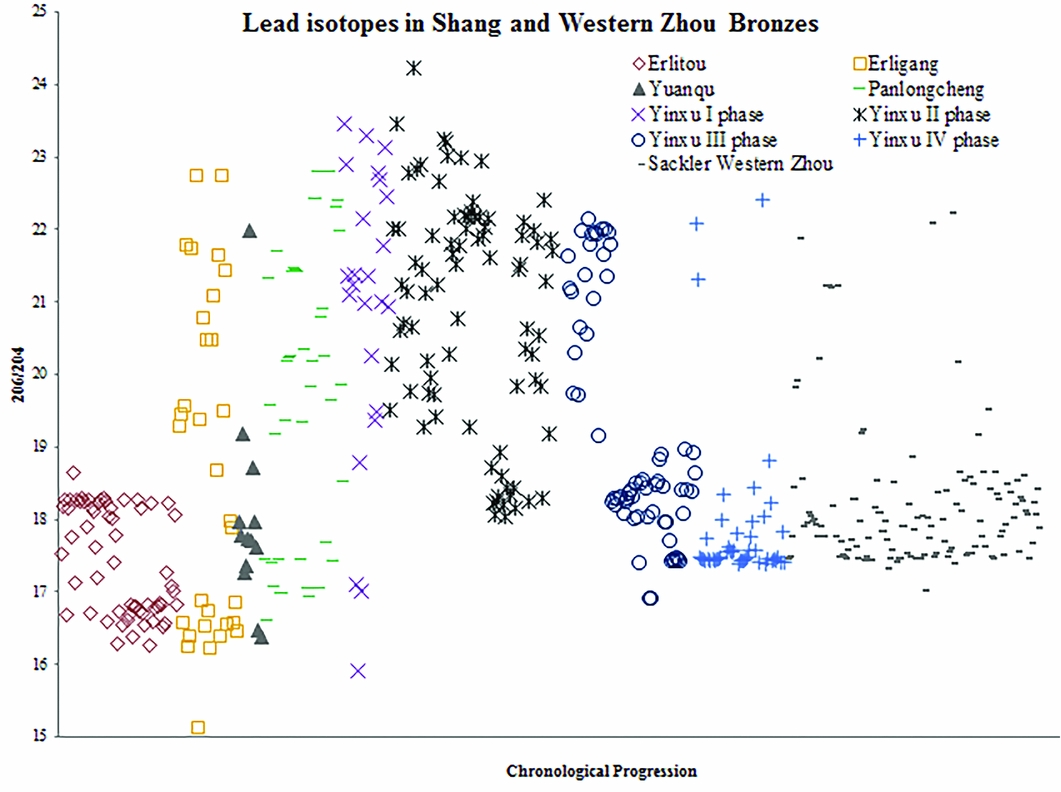
There is a relatively substantial database of lead isotope measurements on Chinese bronzes, although the majority of these are not associated with chemical data from the same object. We cannot, therefore, produce 1/Pb vs isotope ratio plots. We can, however, plot the single isotope ratio as a sequence for each individual period or site, which reveals some important structures within the data. By grouping the data according to the chronological sequence of sites, we can reveal distinctive patterns of diachronic change. Within each group, however, the order of samples along the horizontal axis is arbitrary. Objects with similar isotopic ratios still show up as strong horizontal lines in these diagrams. If we assume that horizontal lines with different isotopic values represent different sources (although single sources can, of course, show a range of values), then changes in the value of these lines may represent a switch in ore source. Essentially, these diagrams combine, in a simple way, both isotopic and archaeological information. Here we present the data in terms of 206Pb/204Pb, with the online supplementary material (OSM) presenting the same diagrams for both 207Pb/204Pb and 208Pb/204Pb.
Figure 2 plots the lead isotope data from vessels of Erlitou, the Erligang (Zhengzhou) period of the Shang, the Anyang period of the Shang divided into the four Yinxu phases, the Western Zhou period and the sites of Yuanqu and Panlongcheng (Erligang period). In the Erlitou period (c. 1600 BC) there is no evidence for the use of ‘radiogenic’ lead (taken here to be 206Pb/204Pb above approximately 19), but at least two distinct ‘common’ isotope values seem to be present (206Pb/204Pb around 16.5–17 and 206Pb/204Pb around 18–18.5), with some possible mixing between them. The lower of these two signatures (206Pb/204Pb around 16.5) appears to continue into the Erligang (Zhengzhou) period (c. 1500–1300 BC), but the higher signature is less well represented, if at all, in Erligang. This ‘common’ lead is, however, supplemented in the Erligang period by lead containing a radiogenic component (206Pb/204Pb around 19–23), the significance of which is discussed below. The data from Panlongcheng is included to show that the pattern of radiogenic isotopes is similar to the values found at the Erligang capital, Zhengzhou. Panlongcheng is an Erligang-period settlement just to the north of the Yangtze River and is widely believed to be associated with securing metal supplies from the south for Zhengzhou (Liu & Chen Reference Liu and Chen2009: 116–19). The common lead signature at Panlongcheng is, however, closer to a middle value of 206Pb/204Pb (around 17–17.5), i.e. different from the two identified in the Erlitou period and the one in the Zhengzhou data. This difference between the lead isotopes from Panlongcheng and Erligang may, therefore, have important implications for understanding the nature of the metal circulation between Panlongcheng and Zhengzhou during the Erligang phase of the Shang.
206Pb/204Pb values for vessels from Erlitou, Erligang, Panlongcheng, Yuanqu, Anyang, Western Zhou (data from Rawson Reference Rawson1990; Peng et al. Reference Peng, Liu, Liu and Hua1999, Reference Peng, Wang, Sun, Liu and Chen2001; Sun et al. Reference Sun, Han, Chen, Zhai, Ban and Tian2001; Jin Reference Jin2008; Cui et al. Reference Cui, Tong and Wu2012; Tian Reference Tian2013; Liu Reference Liu2015).

The Erligang pattern is broadly continued into the Anyang period of the later Shang (c. 1300–1045 BC), but with some differences in detail. Fortunately, finer chronological resolution within the Anyang period can be gained using the data reported by Jin (Reference Jin2008: 162–63) and Liu (Reference Liu2015) on bronzes excavated from Anyang. In Jin's dataset, ritual bronze vessels are allocated to the four widely used Yinxu phases from Anyang on the basis of stratigraphy, the typologies of bronze and pottery, and the oracle bones found in these contexts (Zou Reference Zou1964a & Reference Zoub; Zheng & Chen Reference Zheng and Chen1985). The earliest phase, Yinxu I, has a wide scatter of lead isotope values, ranging from 206Pb/204Pb below 16, up to ‘radiogenic’ values of 23.5. In this respect, it matches more closely the previous Erligang (Zhengzhou) and Panlongcheng patterns than it does the subsequent Yinxu phases. Yinxu phase II is scattered across a similar but not identical range, consisting of a tight ‘low’ grouping at 206Pb/204Pb around 18–19, which could correspond to the higher of the two Erlitou groups, and going up to radiogenic values of >24. Phase III shows a ‘radiogenic’ group between 19 and 22, and predominantly (but not exclusively) the same ‘common’ group at around 18, as seen in phase II. Phase IV is, however, strikingly different, in that, with the exception of two points, the ‘radiogenic’ lead has disappeared and the values are mostly very consistent around a common value of 17.5. This is similar to the ‘common’ lead values seen most notably at Panlongcheng. This shift from ‘radiogenic lead’ to ‘common lead’ in the Shang Dynasty has also been confirmed by a dataset in Liu (Reference Liu2015), which is primarily focused on tools, weapons and chariots of various styles. The Western Zhou data include a continuation of this ‘low’ source (around 17.5) that first appears in Yinxu phase III and dominates phase IV, but also contains a wider scatter of ‘common’ lead with values between 18 and 19. This could include the common lead source identified in phase III. In the Western Zhou data, furthermore, the radiogenic component has virtually disappeared. These trends in the radiogenic data were initially published by Jin (Reference Jin2008: 31), but here we can add observations on the patterning in common lead.
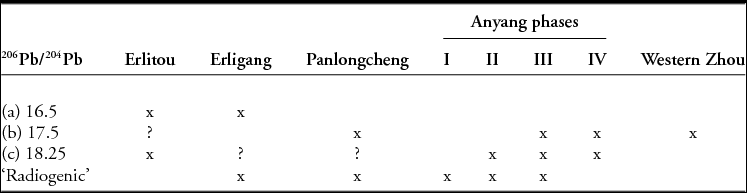
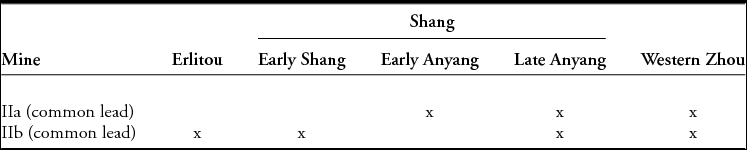
Table 1 lists the three different values of ‘common’ lead identified above, labelled by their approximate 206Pb/204Pb ratio, plus the ‘radiogenic’ lead (characterised by 206Pb/204Pb greater than approximately 19), which may be from one or several sources, as discussed below. This is to be compared with Table 2, from Cui and Wu (Reference Cui and Wu2008: 43, tab. 3-1), in which they identify two different sources of common lead labelled as IIa and IIb. When converted to an approximate 206Pb/204Pb ratio, their group IIa corresponds to a value of 206Pb/204Pb around 18–18.2, and IIb around 17.6, roughly equivalent to our groups (c) and (b), respectively. Despite minor differences in detail, we essentially confirm Cui and Wu's (Reference Cui and Wu2008) pattern, which suggests that more than one source of common lead was probably exploited in the Bronze Age. It is also possible that some of the sources used in the Erlitou and early Shang (Erligang) periods were revisited in the later Shang. The observed continuity between the late Shang and the Western Zhou is important, as the archaeology of the transition between these is complex and intensely debated (Li et al. Reference Li, Yue and Liu2007; Lu Reference Lu2011; Huang 2013/Reference Huang2014).
Summary of the different values of lead isotopes present in successive periods, based on Figure 2. ‘x’ means present, and ‘?’ is possibly present.

Description of two sources of common lead in Cui and Wu (Reference Cui and Wu2008: 43, tab. 3-1).

Where does this lead come from?
This analysis supplies considerable information on the chronology of changes in lead supply from the Erlitou into the Erligang and late (Anyang) Shang, and then into the Western Zhou. It presents a dynamic picture of multiple sources of lead that change over time, some of which may have been revisited in later periods. It does not, however, indicate the actual location of these sources. As the presence of ‘radiogenic’ lead has been critical to many of the previous discussions about its source, we consider briefly here the general nature of radiogenic leads.
It is conventional to classify lead-bearing deposits into two types—ordinary or common deposits, and anomalous deposits. It is now apparent that anomalous deposits are, in fact, more common than ordinary deposits. Ordinary lead deposits have simple evolutionary histories, with the lead being derived from the lower crust and mantle by volcanic activity. Anomalous lead occurs in deposits with complex evolutionary histories, experiencing radiogenic lead contamination from the upper crust. In general, the isotopic composition of these deposits cannot be explained by simple models of isotope evolution, such as the two-stage (Stacey-Kramers) or the more widely applicable multi-stage (Cumming and Richards) models (see Pollard & Heron Reference Pollard and Heron2008: 311–21).
Deposits that contain anomalous lead can have very variable isotopic ratios throughout, depending on the original distribution of uranium and thorium. Thus, single ‘anomalous deposits’ can range from ‘common’ lead values of 206Pb/204Pb below 16 up to ‘radiogenic values’ in excess of 30. Moreover, this variation can extend spatially throughout the deposit, so that ‘common’ and ‘radiogenic’ lead can be found in adjacent areas. It is not, therefore, necessary to assume that the ‘common’ and ‘radiogenic’ forms of lead in Shang and Zhou bronzes came from different deposits—they could have been obtained from different locations within the same area.
When considering anomalous leads, it is also important to consider the equivalent figures for 207Pb/204Pb and 208Pb/204Pb, as both radiogenic 206Pb and 207Pb originate from uranium (238U and 235U, respectively), but 208Pb arises from the decay of thorium (232Th). The equivalent figures to those shown above for 206Pb/204Pb (see OSM) show that the anomalous lead in the Shang bronzes is derived from sources containing both U238 and Th232, because both 206Pb and 208Pb are raised above the values in common lead.
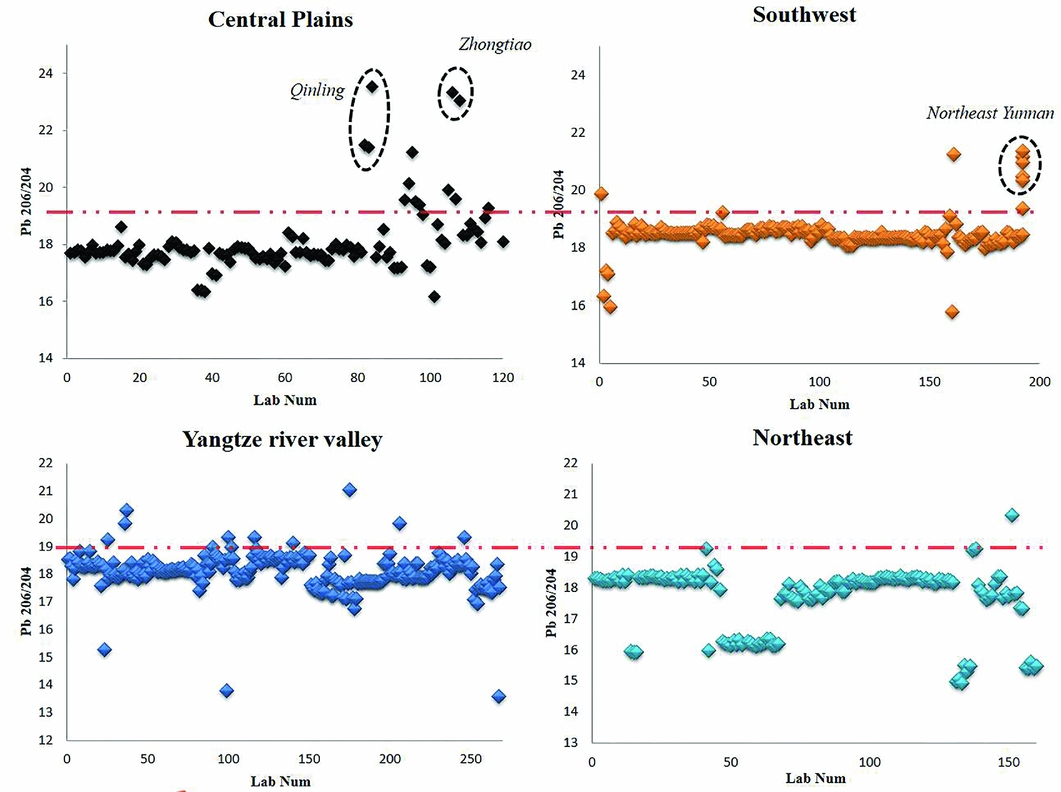
Figure 3 shows a compilation of modern lead isotope 206Pb/204Pb data for lead and copper ores from China. It is unlikely to cover all the possible sources available in the Bronze Age comprehensively, and, again, the horizontal order within the plots of each region is arbitrary. It shows that, in addition to north-east Yunnan, mineral deposits in the Central Plains area are capable of producing metalliferous ores with 206Pb/204Pb values as high as 23 (as well as ‘common’ lead values around 18). Some of the high Central Plains values are from the Zhongtiao Mountains. This is of particular interest, as it is the nearest source of metalliferous minerals to the Erlitou and Erligang centres of power, as shown in the inset map in Figure 1. Figure 3, therefore, shows that several of the metallogenic provinces within China could supply both common and anomalous lead—for example, sources in the Qinling Mountains, the Zhongtiao Mountains, along the Yangtze River and the south-west (Yunnan), originally identified as the probable source of this metal (Jin et al. Reference Jin, Mabuchi, Chase, Chen, Miwa and Hirao1995, Reference Jin, Zhu, Chang, Xu, Zhang and Tang2004; Pan & Dong Reference Pan and Dong1999; Xu et al. Reference Xu, Wang, Li and Guo2005; Zhu et al. Reference Zhu, Gao and Zhang2006). Thus, it is difficult to rule out any of these possibilities. It is important to mention that the geological data used here include both chalcopyrite and galena, but we can cautiously assume that any galena associated with ‘radiogenic’ chalcopyrite may also contain radiogenic lead. More data are, however, clearly required.
Lead isotope values for modern ore data from various parts of China (data collected from various published literature).

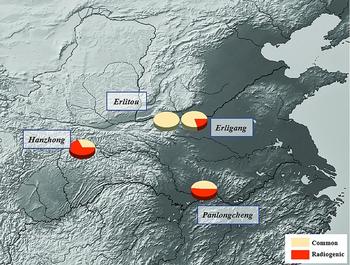
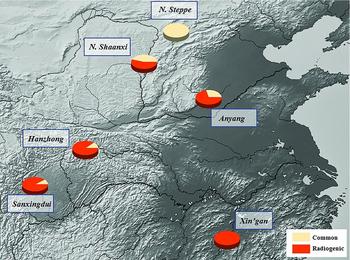
Figures 4 and 5 show the ratio of ‘common’ to ‘radiogenic’ lead in archaeological objects from a number of sites in China in the Erlitou and Erligang (pre-Anyang) periods (Figure 4), and in the Anyang period (Figure 5). These show that the use of both common and anomalous lead was virtually ubiquitous across China during the Bronze Age after the Erlitou period, with a predominance of objects containing ‘radiogenic’ lead towards the south and west, as at Sanxingdui, Hanzhong and Xin'gan. This may support a southern source for radiogenic lead.
Ubiquity of ‘common’ and ‘radiogenic’ lead in archaeological objects from the Erlitou and Erligang (pre-Anyang) periods from different sites in China.

Ubiquity of ‘common’ and ‘radiogenic’ lead in archaeological objects from the Anyang period from different sites in China.

Conclusions
We have confirmed a systematic but changing pattern in lead use during the Chinese Bronze Age. For common lead, the pattern is similar to that previously proposed by Cui and Wu (Reference Cui and Wu2008), but is derived using a different and simpler methodology. In addition to the radiogenic lead, they suggested that two non-radiogenic sources were being exploited during the Anyang period, one of which had been used during the Erlitou period but abandoned during the early Anyang phase. We certainly observe one non-radiogenic source of lead in the Erlitou period that continues into the Erligang, but perhaps not into the Anyang phase. We can, however, agree that there were at least two sources of non-radiogenic lead exploited during the Anyang period.
The original attribution of the ‘radiogenic’ lead to north-east Yunnan remains a strong possibility, but we have also demonstrated the potential for other sources closer to the Central Plains. Given that uranium is widely distributed throughout the Chinese metalliferous regions (Dahlkamp Reference Dahlkamp2009: 32, fig. 1.1), many lead deposits could contain pockets of radiogenic lead. The presence of radiogenic lead itself may not be diagnostic of a single specific source. Multiple sources of ‘radiogenic’ lead, which could be related to the multiple sources of ‘common’ lead, is a possibility, but there was no way of distinguishing between ‘radiogenic’ and ‘common’ lead in Bronze Age China. Figure 3, however, suggests that common lead is widespread and that radiogenic lead is rather rare, assuming that the sampling is representative. In terms of the balance of probability, the chances of extracting radiogenic lead from a source dominated by common lead seem quite small and the chances of extraction from multiple sources even smaller. This suggests that a single source of radiogenic lead for all the Shang objects is most probable.
The changes in categories of lead isotopes do not necessarily imply that the bronze casters acquired metal from entirely new sources. Lead can vary isotopically within a single mine. It is probable, however, that different sources were accessed over the five centuries during which the Erlitou, Erligang and Anyang foundries operated. As the quantities of lead added to Erlitou bronzes vary randomly, knowledge of sources and recipes was probably limited. From the Erligang period onwards, lead was, however, clearly managed carefully, as is seen in the similar levels of lead control at Zhengzhou and Panlongcheng. Furthermore, information is provided by the distinctive colours of bronze, as determined by the addition of lead. Thus, the bronzes in Fu Hao's tomb contained relatively little lead, thereby producing a brighter bronze colour; this must have been a deliberate choice. By the same reasoning, late Anyang bronzes with a high lead content had a duller colour. If the quantities of lead were managed in this way, then the workshops and methods of procurement must also have been managed. We therefore suggest that changes in the quantity of added lead will certainly, on some occasions, reflect changes in sources and management.
The obvious archaeological question to ask is how geographically significant are these apparent changes in lead sources? Specifically, is the loss of the radiogenic source (or sources), starting in Yinxu Phase II at Anyang and continuing throughout the Western Zhou, the result of a major shift in lead supply? The answer will probably come from a combination of new archaeological fieldwork, further chemical and isotopic analysis of ores and objects, and a consideration of the social organisation of the Erlitou, Shang and Zhou polities. The Erlitou state (if such it was) was relatively small scale, and was less likely to have been able to command resources over large distances. Hence, we suggest that the Zhongtiao Mountains merit further exploration as a source of metal in this period. By contrast, the Shang, especially during the Erligang phase (as exemplified by the establishment of Panlongcheng), certainly had influence as far south as the Yangtze River (Bagley Reference Bagley1977; Wang Reference Wang, Steinke and Ching2014). The occurrence of anomalous lead in vessels from both Panlongcheng and Zhengzhou needs more careful consideration as to what this might mean for the source(s) of the lead, but it does suggest that the same source might have been used. The nature of Shang power has given rise to many models and theories, yet there is no consensus as to how the Anyang-period Shang polity was organised. It is, however, clear that from Yinxu Phases II–IV, the Shang were major consumers of many types of resources, bringing copper, tin and lead from a wide range of mines to the foundries at Anyang (Pollard et al. Reference Pollard, Bray, Hommel, Hsu, Liu and Rawson2017a & Reference Pollard, Bray, Hommel, Hsu, Liu and Rawsonb). The subsequent Western Zhou Empire covered a similar if not larger area, but was organised rather differently. The changes in the sources of lead used may reflect the political fluctuations and upheavals that are known from both archaeological evidence and bronze inscriptions.
The method illustrated here for the presentation of isotope data from archaeological objects has the merit of simplicity and clarity. It enables visualisation of the archaeological complexity within the data. Moreover, methods based on geological approaches (e.g. isotope ratio bi-plots and the use of isochrons) are potentially misleading if human manipulation has resulted in mixing lead from different sources.
Acknowledgements
This paper was financially supported by the European Research Council Advanced Grant (FLAME, 1300505) and the National Natural Science Foundation of China (41473010).
Supplementary material
To view supplementary material for this article, please visit https://doi.org/10.15184/aqy.2017.149