Continuity and change in leisure activity patterns play an important role in the adjustment processes associated with ageing (Kelly Reference Kelly1993; Kleiber Reference Kleiber1999). However, most studies, so far, had focused on the significance of continuity, and mostly examined daily leisure activities. Previous research suggested that the tendency for innovation among older adults is rather rare (Atchley Reference Atchley1999; Kelly Reference Kelly1987; Long Reference Long1987), and that change in activity in later life is mostly associated with the reduction of levels of activity or simple substitution of less challenging alternatives (Iso-Ahola, Jackson and Dunn Reference Iso-Ahola, Jackson and Dunn1994; Janke, Davey and Kleiber Reference Janke, Davey and Kleiber2006; Lefrancois, Leclerc and Poulin Reference Lefrancois, Leclerc and Poulin1998; Strain et al. Reference Strain, Grabusic, Searle and Dunn2002). The benefits of new experiences in older adults' leisure were brought to centre stage only recently, through a series of studies that led to suggesting the Innovation Theory of Successful Ageing (Nimrod Reference Nimrod2008a; Nimrod and Hutchinson Reference Nimrod and Hutchinson2010; Nimrod and Kleiber Reference Nimrod and Kleiber2007).
Since novelty plays a key role in the travel experience (Bello and Etzel Reference Bello and Etzel1985; Cohen Reference Cohen1972, Reference Cohen1979), tourism may serve as a valuable sphere for new experiences in later life. This article explores how older adults use the opportunity for new experiences that can be gained through tourism, and whether the Innovation Theory of Successful Ageing can help to explain their tourism experience.
Literature review
Leisure plays a key role in older adults' wellbeing. Although its effect appears to vary somewhat in different contexts and among different subgroups, most evidence (e.g. Fernandez-Ballesteros, Zamarron and Ruiz Reference Fernandez-Ballesteros, Zamarron and Ruiz2001; Kelly Reference Kelly1987; McKenna, Broome and Liddle Reference McKenna, Broome and Liddle2007; Nimrod Reference Nimrod2007a) shows a strong positive association between activity involvement and subjective wellbeing in old age. Such evidence provides strong support for the Activity Theory (Havighurst Reference Havighurst, Williams, Tibbitts and Donahue1963), which suggests that being involved and maintaining the activities and social interactions of middle age for as long as possible is essential to wellbeing. In addition, leisure seems to be a central factor explaining successful coping with later life transitions and negative life events (Duggleby, Bateman and Singer Reference Duggleby, Bateman and Singer2002). Maintaining relationships with family and friends, spirituality, and staying physically and mentally active and involved were found to be effective mechanisms for coping with retirement (e.g. Long Reference Long1987; Nimrod Reference Nimrod2007a), spousal loss (e.g. Janke, Nimrod and Kleiber Reference Janke, Nimrod and Kleiber2008; Utz et al. Reference Utz, Carr, Neese and Wortman2002) and adapting to a major health decline (e.g. Duke et al. Reference Duke, Leventhal, Brownlee and Leventhal2002; Silverstein and Parker Reference Silverstein and Parker2002).
Leisure in later life is characterised by a high level of continuity. Although older adults have more available time due to retirement and fewer parental responsibilities, they do not tend to participate in more activities than prior to retirement (Janke, Davey and Kleiber Reference Janke, Davey and Kleiber2006; Long Reference Long1987; Nimrod Reference Nimrod2007b). They usually continue to participate in the same activities they had enjoyed before retiring (Iso-Ahola, Jackson and Dunn Reference Iso-Ahola, Jackson and Dunn1994; Parnes et al. Reference Parnes, Crowley, Haurin, Less, Morgan, Mott and Nestel1985), or return to old activities in which they showed high interest and high ability in the past (Atchley 1993; Kelly Reference Kelly1987). At most, they increase their participation in the same activities (Janke, Davey and Kleiber Reference Janke, Davey and Kleiber2006; Rosenkoetter, Garris and Engdahl Reference Rosenkoetter, Garris and Engdahl2001). This tendency may be explained by the Continuity Theory (Atchley Reference Atchley1999), which claims that continuity is a primary adaptive strategy for dealing with changes associated with normal ageing.
As people age, they face more constraints on their participation, including, among others, reduced income, declining health and loss of significant partners (Jackson Reference Jackson1993; McGuire Reference McGuire1984). As a result they tend to decrease their level of participation, especially in outdoor and physical activities (Son et al. 2007). However, the effect of constraints may differ according to gender (Stanley and Freysinger 1995) or sociodemographic and health characteristics (Strain et al. Reference Strain, Grabusic, Searle and Dunn2002).
Tourism may be considered as a form of leisure (Norris and Wall Reference Norris and Wall1994; Thornton Reference Thornton1995), as well as a context for leisure activities (Brey and Lehto Reference Brey and Lehto2007; Thomas and Butts Reference Thomas and Butts1998). Postmodern tourism literature suggests that the distinctions between tourism and everyday life are decreasing due to the fact that experiences that were once confined to tourism are currently accessible in various everyday contexts (Lash and Urry Reference Lash and Urry1994; Munt Reference Munt1994). We can be exposed to the French culture through mass media, meet people from Brazil through online communities, and try out new food in Vietnamese restaurants. Accordingly, some scholars argue that leisure and tourism are complementary and should be studied together (e.g. Ryan Reference Ryan and Seaton1994; Shaw and Williams Reference Shaw and Williams1994). Tourism fits all the definitions of leisure, but it has several other distinct characteristics. The distance from home environment may increase tourists' level of hedonic pleasure seeking and decrease their predisposition to follow norms or fulfil responsibilities (Carr Reference Carr2002; Patterson Reference Patterson2006). These unique characteristics may catalyse tourists' openness to new experiences.
During the past decade, older adults have been drawing increased attention from tourism researchers, as well as from service providers. Several trends have influenced this interest, including the ageing of populations in most western countries and in many non-western countries, as well as changes in older adults' socio-demographics and travel patterns, which made them an appealing target population for the global tourism industry (for a review, see Patterson Reference Patterson2006, chap. 4; Schröder and Widmann Reference Schröder, Widmann, Conrady and Buck2007). Studies examining tourism in later life have explored several areas of interests, including descriptive characteristics of older adults' tourism behaviour (e.g. Georggi and Pendyala Reference Georggi and Pendyala1999; Hossain, Bailey and Lubulwa Reference Hossain, Bailey and Lubulwa2003), associations between various socio-demographics and seniors' tourism (e.g. Peterson Reference Peterson2007; Zimmer, Brayley and Searle Reference Zimmer, Brayley and Searle1995), motivations for tourism (e.g. Sellick Reference Sellick2004; Shoemaker Reference Shoemaker2000), factors influencing decision making (e.g. Bai et al. Reference Bai, Jang, Cai and O'Leary2001; Kerstetter and Pennington-Gray Reference Kerstetter and Pennington-Gray1999), constraints on tourism in old age (e.g. Blazey Reference Blazey1992; Burnett and Bender Baker Reference Burnett and Bender Baker2001; Fleischer and Pizam Reference Fleischer and Pizam2002), differences between older and younger tourists (e.g. Gibson and Yiannakis Reference Gibson and Yiannakis2002; You and O'Leary Reference You and O'Leary2000), associations between retirement status and travel activity (e.g. Blazey Reference Blazey1992), and sub-segments within the older adults segment (e.g. Pennington-Gray and Lane Reference Pennington-Gray and Lane2001; Shoemaker Reference Shoemaker2000).
The benefits that older adults gain from their tourism experiences were relatively less examined than their behaviour and preferences. Yet, existing qualitative studies provided some in-depth understandings regarding the benefits realised from tourism. White and White (Reference White and White2004) found that some retirees celebrated their entrance to retirement by taking prolonged trips. These trips served as a neutral, transitional zone between voluntary or imposed endings and new beginnings, where reviews of the past and plans for the future were made. Weiss (Reference Weiss2005) found that travelling provided challenges, often shared with spouses, which involved planning, solving unexpected problems, facing new situations, new people, new foods and so forth. Successful coping with such challenges led to a sense of accomplishment, which was demonstrated by returning with stories and photographs to display. Roberson (Reference Roberson2001) found that the travel experience provided older tourists with new perspectives of the living conditions in their home countries, and led to more appreciation of them. In addition, travelling led to changes in self-perceptions and attitudes, and enhanced a sense of independence and freedom.
While these studies may imply that new experiences are a significant component in older adults' tourism, other studies provide somewhat contradicting findings. For example, Gibson (Reference Gibson2002) found that for most retirees, leisure travel was a meaningful component of life, and it became so significant only upon retirement, when they felt that they had more freedom to enjoy it. However, after about five years, for many of the retirees the novelty of travelling had diminished or was constrained. A study that examined themes in recent retirees' narratives of tourism (Nimrod Reference Nimrod2008b) found that retirees' tourism corresponded with their present realities, as well as with pursuits, relationships and roles adopted prior to retirement. This led to suggesting that tourism served as a mechanism that helped retirees preserve a sense of internal continuity. It was argued that this was definitely the case for retirees who always travelled to the same destinations, or owned a vacation house, but it also characterised tourism narratives that focused on exploring unfamiliar destinations and experiencing new places, people, cultures, and so forth.
Older adults' openness to innovation was examined in the realm of consumer behaviour research. Whereas older consumers were found to be among the last to adopt new products and services (Bowe Reference Bowe1988; Gilly and Zeithaml Reference Gilly and Zeithaml1985), Leventhal (1997) suggested that they will try new products, but for different reasons than the younger market. They will generally not just buy things for their newness, and will accept a novel practice only when they feel they would benefit from making the purchase (Schiffman and Sherman Reference Schiffman and Sherman1991). Szmigin and Carrigan (Reference Szmigin and Carrigan2001) examined older innovators in the category of leisure and tourism services. Their findings suggested that when it comes to trying new vacation and travel services, older adults were quite innovative, and that within the group of 50 years old and over, chronological age did not seem to have an impact on the tendency for innovation. However, their study only examined declarative statements regarding visiting new destinations or trying out new tour packages, but did not explore older adults' behaviour and tourism experiences. The present study aimed to explore patterns of innovation in older adults' tourism in practice.
The Innovation Theory of Successful Ageing was suggested by Nimrod and Kleiber (Reference Nimrod and Kleiber2007), following an exploratory study which utilised a qualitative approach with a sample of adult learners. According to the Innovation Theory:
1. Innovation in leisure (i.e. adding a new activity to the leisure repertoire) in later life may result from various triggers. While some of them are internal, others are external, instrumental or even imposed. However, in most cases, the motivation for innovation is intrinsic.
2. While in some cases innovation represents an opportunity for renewal, refreshment and growth that is, in some respects, a continuation of earlier interests and capacities (self-preservation innovation), in others it represents an opportunity for reinvention of self (self-reinvention innovation).
3. There is a consistency within individuals with regard to the type of innovation to which they are attracted.
4. Innovation has a positive impact on elders' wellbeing.
A study of retirement-age women (Liechty and Yarnal Reference Liechty and Yarnal2009) supported the four tenets of the Innovation Theory of Successful Ageing. It also added to our understanding of innovation by suggesting that innovation fosters further innovation. Positive experiences of adding a new activity reinforce the participant's ability and desire to add more activities.
While the aforementioned studies were based on interviews with older adults who were relatively young and healthy, a recent study (Nimrod and Hutchinson Reference Nimrod and Hutchinson2010) tried to examine whether innovation could play a role in the adaptation to changes in physical health that limited everyday activities. Following interviews with older adults who lived with chronic health conditions, it was suggested that changes in health might serve as precursors for innovation, having either a direct or indirect influence, and that the main role of innovation among older adults with chronic health condition was preserving a sense of continuity (self-preservation innovation). This seemed to have a positive impact on elders' wellbeing, and led to suggesting that innovation may take an integral part in the process of coping with declined health and physical impairments.
The Innovation Theory of Successful Ageing proposes to consider innovation as a growth mechanism that enables one to broaden and deepen the sense of meaning in life, which leads to greater wellbeing and satisfaction with life (Nimrod and Hutchinson Reference Nimrod and Hutchinson2010; Nimrod and Kleiber Reference Nimrod and Kleiber2007). A quantitative research project studying recent retirees (Nimrod Reference Nimrod2008a) demonstrated that innovators (i.e. people who took up at least one brand new leisure activity after retiring from work) experienced significantly higher life satisfaction than non-innovators. In addition, one of the differentiating life satisfaction dimensions was the enjoyment of daily activities, which indicated that the difference in overall life satisfaction was, to some extent, associated with activity patterns. These findings provided preliminary support for Innovation Theory's claim that innovation is associated with enhanced wellbeing among older people. This study also suggested that innovation is not as rare as previously thought (Atchley Reference Atchley1999; Kelly Reference Kelly1987; Long Reference Long1987), since half of the recently retired individuals added at least one brand new activity to their leisure repertoire after retirement.
The Innovation Theory of Successful Ageing complements, rather than contradicts, existing ageing theories, such as the Activity Theory (Havighurst Reference Havighurst, Williams, Tibbitts and Donahue1963), the Continuity Theory (Atchley Reference Atchley1999) and the Selective Optimization with Compensation (SOC) model (Baltes and Baltes Reference Baltes and Baltes1990; Baltes and Carstensen Reference Baltes, Carstensen, Bengston and Schaie1999). Innovation provides more opportunities for staying involved and maintaining social interactions, which according to the Activity Theory (Havighurst Reference Havighurst, Williams, Tibbitts and Donahue1963) are essential to wellbeing. The Continuity Theory (Atchley Reference Atchley1999) suggests that people will maintain their external reality (e.g. lifestyle and activities) in order to maintain internal continuity (in their self-perceptions, valued roles and life goals) when adapting to changes associated with ageing. In Innovation Theory, this same outcome results from self-preservation innovation. Self-preservation innovation reflects external discontinuity that provides internal continuity. Self-reinvention innovation, on the other hand, is about both external and internal change. Innovation Theory is also consistent with the SOC model, as the idea of Selection (S) holds potential for innovation, especially in cases of loss-based selection: ‘loss-based reorganization can include the development of new goals, a focus on the most important goals, or the adaptation of new standards that can be achieved with the available resources’ (Freund and Baltes Reference Freund and Baltes2002: 643).
Innovation is different from the concept of novelty-seeking that has been used in the broader tourism literature for several decades. This concept was mostly used for examining tourists' motivations. However, while many tourists are motivated by the desire to experience novelty, they do not necessarily exhibit the same level of exploratory behaviour and adventurousness when they travel. Hence, novelty seeking is a psychological motive that may be reflected in behaviour (Crompton Reference Crompton1979; Dann Reference Dann1977, Reference Dann1981; Lee and Crompton Reference Lee and Crompton1992; Snepenger Reference Snepenger1987). Innovation, according to the Innovation Theory of Successful Ageing, is a process. It is associated with a specific behaviour (i.e. involvement in a new leisure activity) that may have psychological outcomes (self-preservation or self-reinvention, enhanced sense of meaning in life, and wellbeing). Hence, innovation is a behaviour that may have psychological effects. The Innovation Theory also relates to the triggers and motivations for innovation. However, based on current studies of innovation in leisure in later life (Nimrod and Hutchinson Reference Nimrod and Hutchinson2010; Nimrod and Kleiber Reference Nimrod and Kleiber2007), novelty seeking is not a salient motivation for innovation. The development of new interests is not about novelty and arousal seeking per se. It involves shaping new directions for either self-preservation or deep intrapersonal change.
This study aimed to explore patterns of innovation in older adults' tourism, and to examine whether innovation is associated with the benefits gained from the overall tourism experience. More specifically, the study was designed to answer the following questions: How often are older adults exposed to various new experiences in their tourism? Do certain types of new experiences correlate with each other? Can certain groups of older tourists be characterised by the types of new experiences they go through? And if so, do they also differ in terms of socio-demographics, travel patterns, destination activities, and benefits gained from the overall tourism experience? By answering these questions, a better understanding of older adults' tourism can be gained, as well as enhanced knowledge regarding the role of innovation in later life.
Method
To answer the above research questions, which focus on issues of frequencies (e.g. frequencies of various experiences), correlations (e.g. between innovation and benefits gained) and segmentation of older tourists, the research design was based on a quantitative approach. The study applied this approach as it is appropriate for examining such statistics, unlike qualitative methods which are more suitable for understanding subjective feelings and meanings.
Data collection and sampling
The study was based on a national mail survey of 298 independent male and female Israeli retirees. The sampling criteria for the study were age (50+ years), retirement status (formally retired), and having at least one experience of travelling abroad in the past year. Consistent with published criticism on referring to age alone when identifying older adults (e.g. Blazey Reference Blazey1992; Farana and Schmidt Reference Farana and Schmidt1999), both age and retirement status were used in this study. The decision to include retirees who are in their fifties was based on recent statistics that shows that even though the official retirement age in Israel is 67, a growing number of Israelis retire before they are 60 years old (Ahdut and Gera Reference Ahdut and Gera2008). Respondents who had officially retired but were still working occasionally or part-time were included in the sample, and the issue of work status served as a background characteristic.
Recruitment was conducted by using a commercial database of Israeli retirees. Three thousand retirees were contacted by telephone. Only one in three contacts matched the sampling criteria for the study (age 50+ years, formally retired, and travelled abroad in the past year). About 70 per cent of those (N=660) agreed to participate, and were sent a questionnaire by mail, along with a stamped envelope for returning the completed questionnaire. Those who did not return the completed questionnaire after three weeks were reminded to do so by telephone. Of the 660 questionnaires sent, 298 were returned (a 45 per cent return rate).
Sample characteristics
The sample included retirees ranging from 50 to 88 years old. Most of them (45 per cent) were 60–69, and the mean age was 66. Sixty-two per cent were female, 79 per cent were married, 98 per cent had children (mean=2.8), and 81 per cent had grandchildren (mean=5.6). Sixty-six per cent had at least some post-secondary education, 56 per cent had a relatively high income (over 8,000 Israeli Shekels a month per household), and 71 per cent perceived their health as good or very good.
Sixty-seven per cent classified themselves as secular, 53 per cent were born in Israel, 66 per cent had American/European origins, and 22 per cent were of Asian/African origin. Fifty-seven per cent retired prior to the official retirement age and 31 per cent did so by their own choice. Eighteen per cent retired after the official retirement age. Sixty-nine per cent still worked part-time or occasionally, and 38 per cent had a spouse who was still working. Retirement duration ranged from less than a year to 23 years (mean=7.3), with most participants (41 per cent) retired for three to nine years.
Measurement
Closed-ended questions were asked regarding: (a) the respondent's most recent travel abroad, (b) destination activities, (c) new experiences, (d) benefits gained from the overall tourism experience, and (e) background characteristics (e.g. socio-demographics and work status). The questionnaire was tested in a pilot study with a convenience sample of 30 retirees who met the sampling criteria. The pilot study examined the understandability of the questions. In addition, it examined the questionnaire's reliability by using a test–retest procedure at 14 days interval. Analysis indicated a high level of reliability for all tested variables (correlations between the first and the second responses were above 0.7). Following the pilot study, several modifications were made as described below.
Last travel descriptors
The questionnaire began with several informative questions regarding the respondents' last travel abroad, including: country/countries visited, duration (number of days), travel format (independent, organised tour, package deal, or other), travel companions (number and who they were), and the travel purpose (tourism, vacation, visit of family or friends, or other). In addition, at the end of the questionnaire respondents were asked to mention how many times they had travelled abroad and how many times they had gone on vacation in Israel in the past year.
Destination activities
Respondents were asked to report how engaged they were in various destination activities during their last trip abroad, using a five-point quasi-interval scale ranging from one (not at all) to five (very much). The list of activities was adopted from a study by You and O'Leary (Reference You and O'Leary2000). Following the pilot study, several modifications were made. Activities that no one in the pilot study was involved in (e.g. ‘horse-back riding’ and ‘hunting’) were taken out of the list. Other activities that were not included in the original list but were mentioned by the pilot interviewees in an ‘other activities’ open-ended option (e.g. ‘sitting in cafés’ and ‘taking cruises’) were added. The final list included 26 destination activities.
New experiences
Respondents were asked to report to what extent they were involved in various new experiences during their last trip abroad, using a five-point quasi-interval scale ranging from one (not at all) to five (very much). The list of new experiences included ten items, composed by the authors and based on the literature review. Sample items are: ‘visiting places never visited before’, ‘trying new food’ and ‘learning something new about life in general’. All items were tested in the pilot study and showed a high level of reliability (correlations between the first and the second responses were 0.70–0.95). Only one item that no one in the pilot study experienced (‘trying a new type of accommodation’) was not included in the final measurement.
Benefits gained from the overall tourism experience
Respondents were asked to indicate their agreement or disagreement to a list of 20 statements regarding the benefits they had gained from the trip, on a five-point quasi-interval scale ranging from one (not at all) to five (very much). The tool used was based on Kelly's scale of leisure benefits (1978), which was translated into Hebrew and validated by Nimrod (Reference Nimrod2007a). This scale was also modified following the pilot study. Three statements that no one agreed with were omitted, and three statements based on the literature review were added (‘I enjoyed planning it’, ‘I enjoyed anticipating it’ and ‘I enjoyed sharing my stories with others upon return’).
Background information
The last part of the questionnaire included demographic and socio-demographic questions. The variables examined were: age, gender, education, marital status, number of children, number of grandchildren, household income, spouse's occupation, religious orientation and origin (i.e. place of birth of the respondent and his/her father). Health perception was examined using a scale of five, ranging from one (very bad) to five (very good). Other questions examined the respondent's and spouse's present work status, retirement duration, and retirement pattern (i.e. at official retirement age, early retirement by respondent's own choice, early retirement forced by employer, early retirement as a result of poor health, or late retirement).
Data analysis
The data analysis had a number of steps, the first being a factor analysis of the new experiences data. Procedures utilised principal components extraction and Varimax rotation with Kaiser normalisation. This rotation solution rotated the loadings so that the variance of the squared loading in each column was maximised, and provided a clear interpretation of the factors. To control the number of factors extracted from the data a minimum eigenvalue of 1.0 was used with attributes loading at greater than 0.4. Each factor was interpreted and labelled, based upon each rotated factor loading, in particular based on the highest loading of each factor.
In the next stage, the new experiences factors were subjected to a k-means cluster analysis, which specified the groups with similar patterns of innovation. Each group was further identified by its travel patterns and background characteristics, using cross-tabulation and chi-square tests, as well as multivariate analysis of variance (MANOVA) followed by one-way analysis of variance (ANOVA) and the least significant difference tests (LSD) post hoc technique. The latter procedures were also used to identify significant differences between the groups in destination activities as well as in benefits gained from their overall tourism experience.
A confidence interval of 95 per cent was applied for all statistical tests, and only significant findings were selected for presentation in this article.
Results
Involvement in new experiences
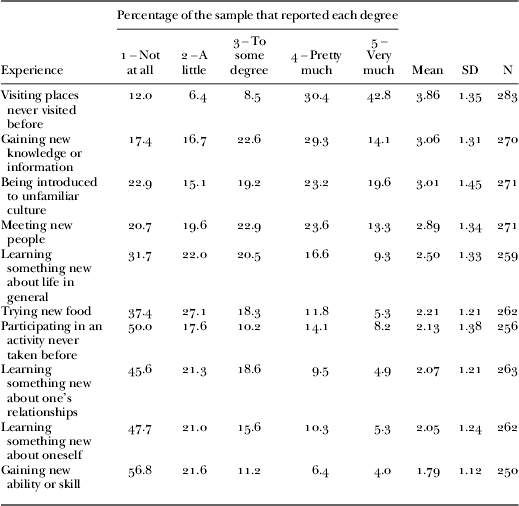
Participants' involvement in new experiences (at any degree) during their last travel abroad was quite high. As can be seen in Table 1, the most frequent new experiences reported were visiting new places, gaining new knowledge, being introduced to an unfamiliar culture, and meeting new people. Only 12–23 per cent of the sampled respondents reported not having experienced them at all, while 77–88 per cent of respondents reported these experiences at least to some extent, and the mean degree was above 2.8. Also frequently reported were learning something new about life (68% reported experiencing it at least to some extent, mean=2.50) and trying new food (62% reported experiencing it at least to some extent, mean=2.21). The most uncommon experiences were participating in a new activity and gaining a new ability or skill, yet more than 43 per cent of the sample reported being involved with these experiences at least to some extent.
Frequency of new experiences in the last travel abroad
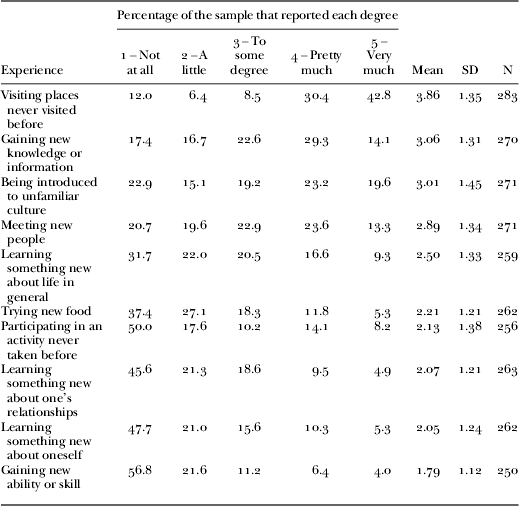
Note: SD: standard deviation.
External and internal innovation
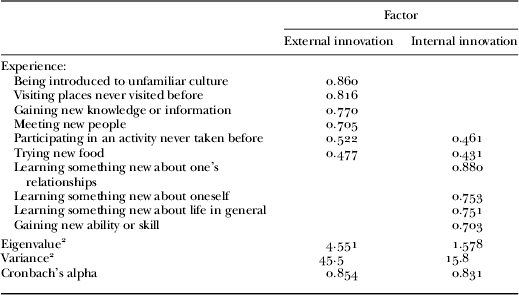
Factor analysis of new experiences data identified two factors. The percentage of variance explained by the factors was 61.3. With the minimum factor loading level of 0.4, all experiences were included in at least one of the factors and two were included in both (participating in a new activity and trying new food). Factor labels came from the authors' interpretation of the common characteristics of the correlated data. As presented in Table 2, the first factor, labelled ‘external innovation’, explained 45.5 per cent of the variance and showed a Cronbach's alpha of 0.854. It included the aforementioned most frequent new experiences such as being introduced to unfamiliar cultures, visiting new places, gaining new knowledge, and meeting new people. The common characteristic of these experiences was that they were associated with the external environment visited. The second factor, ‘internal innovation’, consisted of experiences that were associated with some intrapersonal processes and with new understandings of more personal issues, such as learning something new about one's relationships, oneself, and about life in general, as well as gaining a new ability or skill. These were relatively less frequent experiences compared to those included in the first factor.
Factor structure of new experiences
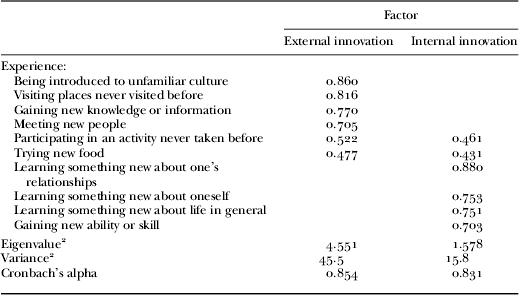
Notes: Only loadings of at least 0.4 are tabulated. 1. These two factors explained 61.3% of the variance. 2. This factor analysis was conducted on 10 variables. Therefore, the maximum eigenvalue is 10 and the relative percentage of variance explained is exactly ten times the eigenvalue.
The two items that cross-loaded were associated with both internal and external innovation. It is clear why participating in a new activity never taken up before can be associated with external items, such as gaining new knowledge, as well as with intrapersonal processes, such as learning something new about oneself. It is also clear why trying out new food is associated with external items, such as being introduced to an unfamiliar culture. However, the association between trying out new food and internal innovation is somewhat harder to explain, and further research is needed to explore the deeper meanings of culinary adventures.
Groups of older tourists defined by types of innovation experienced
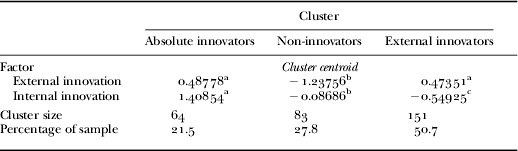
Cluster analysis conducted on the new experiences' factors identified three groups of older tourists. Results are presented in Table 3. The first group, labelled absolute innovators, which consisted of 21.5 per cent of the sampled respondents, had the highest cluster centroid score in the ‘internal innovation’ factor as well as a high cluster centroid score in the ‘external innovation’ factor. The second group, non-innovators, which included 27.8 per cent of the sample, scored lowest on the ‘external innovation’ factor. In the ‘internal innovation’ factor, it scored lower than the absolute innovators and higher than the third group. The third and largest group, labelled external innovators, consisted of 50.7 per cent of the sample. It scored similar to the absolute innovators and higher than the non-innovators on the ‘external innovation’ factor. In the ‘internal innovation’ factor it scored significantly lower than the other two groups.
The three clusters of older tourists
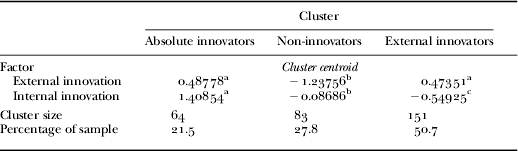
Note: Means that are significantly different are denoted by different letters.
Differences in travel patterns and background characteristics, and destination activities among the three groups
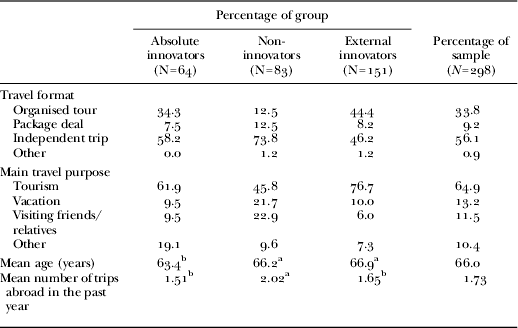
Additional data were used to portray the groups further. While the study examined many variables relating to travel patterns and background characteristics, there were only very few differences among the groups. Table 4 shows that the external innovators, relatively more than the other groups, tended to travel in an organised tour, whilst the non-innovators tended to travel independently. The external innovators also tended to define the purpose of their travel as tourism, whilst more respondents who belonged to the non-innovators group defined their travel purpose as vacation or as visiting friends and relatives. The absolute innovators' travel format and main purpose were similar to those of the whole sample, but they tended to mention other travel purposes more than the other groups. The most frequent purposes they mentioned were attending an event, exploring one's roots and education. In most cases they could be referred to as tourism.
Travel patterns and background of the three groups
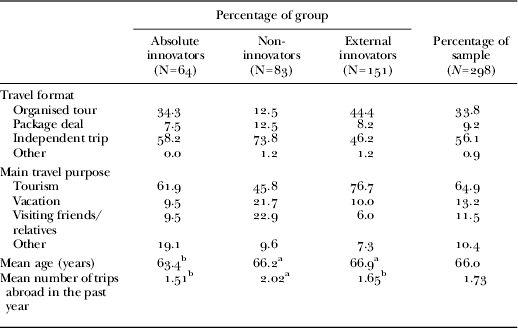
Note: Pearson chi-square <0.05 in all cross-tabs presented. Means that are significantly different are denoted by different letters.
Results also show that the absolute innovators were significantly younger than the other groups. Their mean age was 63.4, whilst the means of the other groups were above 66 years old. The non-innovators travelled abroad significantly more often than the other groups. In the year prior to the survey their mean number of travels was about two, whilst the other groups travelled about 1.5 times on average. There were no significant differences among the groups with regard to other background characteristics that were examined in this study (e.g. gender, education, income and health).
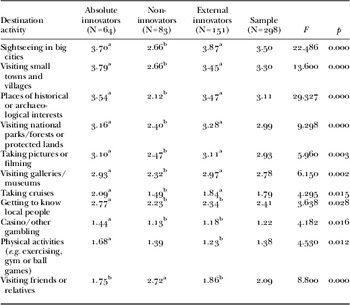
A MANOVA followed by ANOVA and LSD tests were conducted to assess if there were differences between the three groups in the mean scores of the level of engagement in various destination activities during the last travel abroad. The assumption of homogeneity of variance/covariance was tested and confirmed. A significant difference was found: Wilks' lambda=0.625, F(210, 420)=5.053, p=0.000. Results are displayed in Table 5. As shown, significant differences were found in only 11 out of the 26 activities examined. Results indicated that the non-innovators were significantly less involved than the other two groups in most activities. These differences were found in activities that may be described as typical tourism activities, such as sightseeing in big cities, visiting places of historical interests or taking pictures. Only in one activity, namely visiting friends or relatives, the non-innovators were significantly more involved than the other two groups. Differences between absolute innovators and external innovators were relatively rare, and were found mostly in activities that were not popular among the study participants, such as gambling and physical activities (mean close to one, i.e. not at all). These differences indicated a higher level of involvement among the absolute innovators.
Differences in destination activities among the three groups

Note: Only activities with significant differences are presented. Means that are significantly different are denoted by different letters. On most items the absolute innovators and external innovators do not differ significantly from each other, but the non-innovators are significantly less involved.
Differences in benefits gained among the three groups
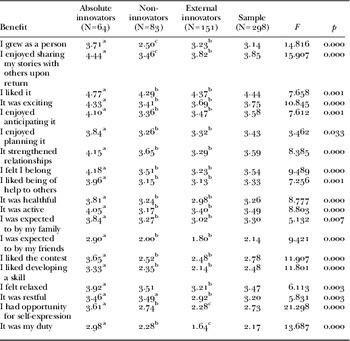
When examining benefits gained from the overall tourism experience (Table 6), more differences among the three groups were found. A MANOVA followed by ANOVA and LSD tests were conducted to assess if there were differences between the three segments in the mean scores of the level of agreement to a list of statements regarding the benefits gained from the last travel abroad. The assumption of homogeneity of variance/covariance was tested and confirmed. A significant difference was found: Wilks' lambda=0.474, F(105, 210)=2.376, p=0.000. As shown, significant differences were found in 19 out of the 20 statements examined. In most cases, results indicated that the absolute innovators reported a significantly higher level of agreement than the other two groups. These differences were found in various benefits, including general benefits such as ‘I liked it’ or ‘it was exciting’; pre-travel benefits such as enjoying the anticipation or the planning; social benefits such as strengthened relationships and sense of belonging; health-related benefits; meeting role expectations; and benefits associated with challenge such as enjoying the contest or developing a skill.
Differences in benefits gained among the three groups

Note: Means that are significantly different are denoted by different letters. On most items the non-innovators and external innovators do not differ significantly from each other, and they report these benefits significantly less than the absolute innovators.
Other significant differences between absolute innovators and external innovators were found in six benefits, and they all indicated a higher level of agreement among the absolute innovators. The absolute innovators were more inclined than the external innovators to report that they had grown as a person and that they enjoyed sharing their stories with others upon return. In these two benefits, the level of agreement among external innovators was significantly higher than among non-innovators. The absolute innovators were also more inclined than the external innovators to report benefits associated with relaxation, including ‘I felt relaxed’ and ‘it was restful’. In the former there were no differences between the non-innovators and the other groups, whilst in the latter, the level of agreement among non-innovators was higher than among external innovators, and similar to the level of agreement among absolute innovators.
There were two benefits that the absolute innovators reported more than the non-innovators, and the non-innovators reported more than the external innovators. The first benefit was having an opportunity for self-expression. This implies that while ‘internal innovation’ associates with self-expression, ‘external innovation’ does not. The second benefit was ‘It was my duty’. In this case, it is possible that the order was reversed, and that it was the external innovators group who benefited, more than the other groups, from a sense of freedom from obligations.
Discussion
While previous studies that examined patterns of innovation among older adults have focused on daily leisure activities only, this study was the first to explore innovation in the context of tourism. Incorporating the study of innovation with the study of tourism behaviour (i.e. travel patterns and destination activities) and psychological outcomes (i.e. benefits gained), provided several insights regarding the role of innovation in the overall tourism experience. Moreover, it led to suggesting a new principle to the Innovation Theory of Successful Ageing.
Previous research (i.e. Roberson Reference Roberson2001; Weiss Reference Weiss2005; White and White Reference White and White2004) suggested that for older adults tourism is an opportunity for new experiences, which may lead to new knowledge, perceptions and attitudes. The present study suggests that this opportunity is well utilised by older tourists, as a high percentage of the study participants reported being involved in various new experiences. For most of them, tourism is a context for learning and exploring. For that purpose they visit new places, explore other cultures, meet new people and acquire new knowledge. For some of them, tourism is also a context for self-exploration and development. This leads to the conclusion that the tendency for innovation in later life is not as rare as previously suggested (i.e. Atchley Reference Atchley1999; Iso-Ahola, Jackson and Dunn Reference Iso-Ahola, Jackson and Dunn1994; Long Reference Long1987). In fact, along with the study which indicated that half of recently retired individuals were innovators in their daily leisure activities (Nimrod Reference Nimrod2008a), it may even be concluded that older adults are rather innovation-oriented. This conclusion is consistent with the findings of Szmigin and Carrigan (Reference Szmigin and Carrigan2001) which suggested that older adults were quite innovative when it came to trying out new vacation and travel services. Moreover, this may suggest that current older adults are less conservative than elders' stereotypes might portray.
The study's findings led to identifying two types of innovation experienced in older adults' tourism. The most frequently experienced is ‘external innovation’. It is associated with the external environment visited, and involves learning about unfamiliar cultures, visiting new places, gaining new knowledge, meeting new people, and so forth. Less frequently experienced is ‘internal innovation’, which is associated with certain intrapersonal processes and with new understandings of more personal issues, such as learning something new about one's relationships, oneself, and about life in general. These two types of innovations seem to be the mirror image of what the Continuity Theory (Atchley Reference Atchley1999) described as internal and external continuity.
When examining these two types of innovations in terms of the Innovation Theory of Successful Ageing (Nimrod and Kleiber Reference Nimrod and Kleiber2007), they may be associated with the two archetypes of innovation in later life: self-reinvention innovation and self-preservation innovation. Self-reinvention innovation represents an opportunity for reinvention of self. It is characterised by self-discovery and growth. The ‘internal innovation’ experienced in tourism reflects various dimensions of self-discovery (learning something new about oneself, relationships, etc.). In addition, among the three sub-segments identified in this study, only the absolute innovators, who have experienced ‘internal innovation’ in their last travel abroad, were more inclined than other older tourists to report that they had experienced a sense of growth. Self-preservation innovation represents an opportunity for renewal, refreshment and growth, that is, in some respects, a continuation of earlier interests and capacities. The ‘external innovation’ experienced in older adults' tourism seems to fall into this category. While it provides a sense of development and probably excitement as a result of expanded knowledge and worldview, it does not reflect a deeper process of self-discovery. It is possible, though, that ‘external innovation’ is a catalyst of ‘internal innovation’.
The three sub-segments identified in this study, namely the absolute innovators, the non-innovators and the external innovators, differ in their travel patterns and main travel purpose. The non-innovators tended to travel independently, and more respondents who belonged to this group defined their travel purpose as vacation or as visiting friends and relatives. This seemed to affect their destination activities. They were less involved than the other two groups in typical tourism activities, such as sightseeing in big cities, visiting places of historical interest or taking pictures. They were also less involved in new experiences. Since they seem to travel abroad more often than the other two groups, it is possible that in other travels they are more tourism-oriented and experience more innovation. On the other hand, if they are more experienced tourists, it is possible that tourism, as an experience, is not as innovative for them as it is for others. They may represent the retirees for whom the novelty of travelling has diminished or was constrained (Gibson Reference Gibson2002).
The other two groups travel for tourism and share similar travel patterns and destination activities. Nevertheless, while they all experience a similar level of ‘external innovation’, only some of them (21.5% versus 50.7% of the sample) also experience ‘internal innovation’. It is hard to determine, based on the findings, what conditions lead to ‘internal innovation’. The differences between absolute innovators and external innovators, in terms of activity, were few and marginal, so it does not seem to be related to what they do. Absolute innovators tended to travel more independently whereas more external innovators travelled in an organised tour. It is possible, then, that being in charge and somewhat more autonomous provides greater opportunity for self-discovery. Absolute innovators are also significantly younger than external innovators. It is possible that they are somewhat less experienced tourists, and as a result, the tourism experience is more impactful. While there are no differences between the groups in terms of retirement duration and patterns, it is also possible that this group is more occupied than the external innovators with existential issues, as previously observed by White and White (Reference White and White2004). It is also probable that the need for self-discovery decreases with age. However, it is also reasonable to assume that experiencing ‘internal innovation’ is a matter of coincidence. It may be triggered and catalysed by ‘external innovation’, but it may also be a result of the break in routine and of particular circumstances, interpersonal dynamics, or intrapersonal processes that occur during travelling.
While the differences between absolute innovators and external innovators in terms of destination activities were rather minor, and these groups mostly differed from the non-innovators in that regard, the two groups considerably differed when benefits gained were examined. In this case, there were many significant differences between absolute innovators and the other groups, while the differences between external innovators and non-innovators were relatively few and minor. The absolute innovators reported a significantly higher level of agreement with statements describing various benefits, including general benefits, pre- and post-travel benefits, social benefits, health-related benefits, meeting role expectations, challenge, relaxation, growth and self-expression. It seems that experiencing ‘internal innovation’, rather than ‘external innovation’, amplified their overall tourism experience.
These findings may be explained by the Innovation Theory of Successful Ageing (Nimrod Reference Nimrod2008a; Nimrod and Hutchinson Reference Nimrod and Hutchinson2010; Nimrod and Kleiber Reference Nimrod and Kleiber2007), which suggests that people do not just enjoy the fact that they are doing something new. According to the theory, new experiences may make older adults feel active, dynamic, vital, daring and youthful. However, the most significant role of innovation is serving as a growth mechanism, which leads to greater wellbeing and satisfaction with life. The findings from this study support this premise. They show that it is not the new experiences per se, but rather the new explorations and self-discovery, which lead to a sense of growth as a result of tourism. Perhaps this does not change the level of happiness in older tourists' daily lives (Milman Reference Milman1998), but it certainly may be considered as a benefit that results from tourism and contributes to older adults' quality of life (Dann Reference Dann2001).
The findings from this study also suggest a new and rather important theoretical principle to the Innovation Theory of Successful Ageing. According to the theory, self-preservation innovation and self-reinvention innovation ‘share a similar impact on elders' wellbeing’ (Nimrod and Kleiber Reference Nimrod and Kleiber2007: 18). This study shows that ‘internal innovation’, rather than ‘external innovation’, provides more benefits and, overall, a more significant experience. If ‘internal innovation’ is associated with self-reinvention innovation and ‘external innovation’ is associated with self-preservation innovation, we can generalise from this study of tourism to leisure in later life. Specifically, it is suggested that self-reinvention innovation in leisure may have more contribution to older adults' wellbeing than self-preservation innovation. While self-preservation innovation can preserve a sense of continuity, which is in itself an important benefit; self-reinvention innovation has the potential to change dramatically the way individuals perceive themselves and life in general, and in so doing, significantly enhance their wellbeing.
Limitations and future research
The study explored many aspects of experiences of innovation in older adults' tourism, yet there is still a lot of ground to be covered, and there are still many questions to be answered by further research. Since the study was conducted in Israel, a central issue to be explored is the cultural context of the study. Future studies should examine whether these findings apply everywhere or differ in various countries.
This study focused on retirees who travelled in the year preceding the survey, and did not relate to a population that travels at a low frequency. Hence, the sample is probably biased towards relatively well-to-do retirees. This is also reflected in the sample characteristics that show that many of the study participants were still working to some extent (part time or occasionally) and were reasonably wealthy and well educated. This population may prefer to go on more expensive holidays that have an educational or heritage focus, and have a different tendency for innovation than other older adults. Moreover, even with regard to this specific population, the study does not represent the respondents' experiences in their tourism travel in Israel and abroad over longer periods, and does not differentiate between seasoned travellers and those who were venturing abroad for the first time.
Future research should examine the experiences of innovation in more diverse populations and over a longer period of time. Moreover, since most background and travel patterns were not associated with innovation, future investigations should also explore situational triggers for innovation, as well as personality orientations. In addition, research should explore when, and under what circumstances, ‘internal innovation’ occurs, and whether its effect lasts over time.
Innovation theory contributes a new emphasis to the study of ageing. However, it requires further development, both theoretically and methodologically. The next steps should include developing tools to measure the two archetypes of innovation, which would include a mechanism for measuring the degree of innovation (e.g. by weighting the new experiences for intensity and duration). Future research should also include measures of personality or motivation, which may provide interesting information about the factors that lead to innovation. Longitudinal studies are also required, to test the benefits of innovation over time.
Acknowledgements
The study was supported by grants to the first author from Sapir Academic College and the University of Haifa.