All men are liable to error; and most men are, in many points, by passion or interest, under temptation to it.
—John Locke 1690Footnote 1The more people attach their identity to a nation, the more likely they are to feel stronger emotions toward other countries when those countries are seen as either contributing positively to the observer's country's goals or frustrating them. The emotions then bias the formation of beliefs in ways that release the observer from normative restrictions and license actions driven by the emotions.
Hafner-Burton and colleagues describe the new research frontier as including not only the heterogeneity in preferences and beliefs but also the origins of beliefs.Footnote 2 Lake describes this as one of the “primary aspirations of a behavioral theory of war.”Footnote 3 Most previous research on perceptions in international relations concentrates on identifying beliefs—exploring how, in the face of incoming information, people rely on prior beliefs, grab onto stereotypes and storylines, and employ heuristics.Footnote 4 By contrast Lake, in his study of Iraq War decision making, found that it was not these cognitive mistakes that were the most puzzling but what he called the self-delusions on which people doubled down.Footnote 5 They were not easily attributable to information overload. Rather, they took work to hang onto and, as I argue, licensed people to act as their emotions preferred.
Our understanding of the role emotions play in decision making has grown significantly since the cognitive revolution came to the study of international relations.Footnote 6 Mercer, for instance, suggests that emotions shape appraisals of other countries and strengthen the confidence in beliefs beyond what evidence can warrant.Footnote 7 Yarhi-Milo explores the origins of one of Mercer's “emotional beliefs,” that is, beliefs about another country's intentions.Footnote 8 Her theory of selective attention emphasizes prior beliefs and the emotions triggered by vivid information. I push further in this direction, trying to explain why emotions are triggered more in some observers than in others and what impact this has on the construction of beliefs.
The more someone attaches his or her own identity to the nation, the more they will feel the possible threats to the nation and the more inclined they will be to construct beliefs that license acting on those emotions. In other words, the attachment to the nation will evoke emotions that motivate reasoning in predictable directions. Although in many ways this is an old idea, it is not reflected clearly in dominant theories of international relations.Footnote 9 Realists, for example, expect the high stakes involved to impose a “reality principle” upon actors, at least in the long run, and rational bargaining theory either assumes that these biases are taken into account when communicating or that they play little role in shaping the signals seen and the meaning attached to them. Debates about rational deterrence theory raised questions about these assumptions but the psychological alternatives have not been integrated fully into prevailing theories.Footnote 10
As Hafner-Burton and others explain, incorporating psychological perspectives has been difficult partly because they can involve a laundry list of biases and too few specific expectations.Footnote 11 They are often seen as providing better post hoc explanation than ex ante prediction. The theory I propose here aims to connect the prior work on cognitive beliefs with the burgeoning literature on identity and motivated reasoning in a way that anticipates when and for whom intense emotions are likely to fire and predicts the affect they are likely to have on the formation of beliefs. In addition, I seek to shed light on the ways signals will be read. Some rational theories of communication assume the meaning of an act is intrinsic to the act. Others take into account prior beliefs about the actor.Footnote 12 I expect emotions felt toward the actor to shape the interpretations of the act in ways that release the observer from moral prohibitions that would otherwise limit the range of acceptable countermoves. In this way, it is not simply information coming in from the outside that shapes beliefs or even the prior beliefs an observer had, but also their internal emotional desires that are affecting belief formation.
National Identity and Motivated Reasoning
Differences in Beliefs
Morgenthau concluded that the intentions people attribute to other countries is the most important judgment they make in international relations.Footnote 13 As Jervis demonstrated, it underpins the strategy selected to deal with the other country.Footnote 14 With incentives to deceive and no clearly valid indicators, the uncertainty inherent in these judgments sits at the heart of the security dilemma.Footnote 15 Yarhi-Milo finds that leaders do not draw these judgments from a careful read of the other's behavior or from its military capabilities, although some intelligence analysts do rest inferences on military trends.Footnote 16 Because leaders often hold these beliefs far more confidently than evidence could warrant, Mercer calls them “emotional beliefs.”Footnote 17 The argument here runs in a similar direction but tries to explain when emotions will fire and for whom and how that will shape the formation of conscious beliefs.
Yarhi-Milo finds that leaders disagreed sharply over how to interpret the behavior of other countries even though these leaders lived in the same country and were subject to similar geopolitical structural pressures. Decades earlier, Holsti and Rosenau tracked the split in beliefs about the Soviet Union that divided the American elite and fueled debates about US foreign policy.Footnote 18 A good bit of attention has been paid to the values and ideological dispositions that might explain these within-country differences.Footnote 19 Before I dig into within-country differences, I want to draw attention to cross-country differences in beliefs.
Consider beliefs about the Iraq War. According to Pew surveys, in 2004 only 18 percent in the United States believed the US was motivated by oil and only 11 percent thought it was driven by a desire for domination.Footnote 20 In contrast, the majority in France (58%) and Germany (60%) attributed Washington's intervention to an interest in oil and plenty thought it wanted to dominate (53% in France and 47% in Germany). In the United States, less than a third questioned that the fear of Iraq's weapons of mass destruction (WMD) was genuine. Meanwhile, large majorities in France (82%) and Germany (69%) concluded that the United States lied on purpose and 65 percent of Germans and 61 percent of the French described the War on Terror as a fraud disguising imperial ambitions.Footnote 21 Two-thirds (67%) of Americans believed the intervention had defensive intentions.
These differences in public opinion reflect differences in media coverage, no doubt, but this only begs the question of why the media in democratic societies like France and Germany would be so different than media in the United States. Moreover, these differences are not limited to the mass public. Among the American elite it is not only neoconservatives that argue the United States had defensive intentions.Footnote 22 Lake, for instance, argues that prior to the war the question in Washington was whether the US would prevent Iraqi domination of the Gulf.Footnote 23 In Europe, the idea that Iraq could compete with the United States is typically seen as implausible, given the decade of sanctions and Washington's victories in 1990 and 2003. Like most Americans, Jervis also concludes that the fear of WMD was sincere and the intelligence errors on this score reasonable.Footnote 24 In the face of European criticism, there was renewed interest among the US elite in anti-Americanism and Washington's history of being driven by moral zeal and righteous intentions.Footnote 25 More than two-thirds (69%) of the American public in 2004 saw the United States as motivated by a desire to bring democracy to Iraq. Very few in France (16%) or Germany (24%) agreed.Footnote 26
It is not only stark differences in beliefs across countries that propel this look for the origins of beliefs but also findings such as Tingley's that emphasize the differences in the way individuals see power held by other countries and power held by their own.Footnote 27 Different ideological dispositions might explain some of this but attachments to nations seem likely to capture more. Ethnocentrism and patriotism were factors Hurwitz and Peffley pointed to long ago that ironically have not had the impact on our understanding of decision making that they should, given the interest in identity politics.Footnote 28 Although partisanship motivating reasoning has come to play an important role in theories explaining domestic politics, analogous ideas are not as well integrated in theories of international relations.Footnote 29 There remains a disconnection between, on the one hand, an intuitive sense that national identities motivate biases and, on the other hand, a theoretical inclination to believe that the high stakes involved push beliefs in the direction of convergence. More often than not, rational bargaining theories assume that signals will have common meanings to the sender and receiver alike and that with more information beliefs will converge on reality. The theory I propose here suggests something different might happen. Instead of information flowing in from the environment, emotions triggered by identity attachments that reside in the observer may motivate the search for and interpretation of information. Moreover, they may do so in ways that make deciding easier by bringing into balance what the person wants to do emotionally with what they think is morally appropriate. In this case, as more information comes in and people think harder, beliefs polarize.
Avoiding tradeoffs
Jervis explains that at the heart of motivated reasoning is “the actor's need to understand the world in a certain way in order to avoid painful value tradeoffs.”Footnote 30 When people face a choice between two values they sometimes construct a mental picture that dissolves the tradeoff.Footnote 31 They do this by portraying in their minds the two values as mutually reinforcing rather than as mutually exclusive. For instance, instead of seeing guns coming at the expense of butter someone might construct a mental picture in which an investment in guns has spinoffs that increase the production of butter. It is also not uncommon to see people letting how much they want something shape their expectations of its likelihood and costs.Footnote 32 Underlying motives have also been found to drive the search for information and judgments people make about leaders.Footnote 33 Neuroscientists find that this is true not simply in a figurative sense. Different parts of the brain do the work in confirmation and disconfirmation.Footnote 34
Heider found that tradeoffs between feelings of like and dislike on the one hand and normative values on the other are especially painful.Footnote 35 These occur when someone likes someone and is confronted with information about them that suggests they have done something bad. It can be just the reverse, of course, if they dislike someone and hear they did something good. Heider argued that people were motivated to keep their feelings about someone and their cognitive pictures of these other people in balance, meaning they attach positive attributes to those they like and negative attributes to those they dislike.
Beliefs that an observer knows are rationalizations do not ease painful tradeoffs. Consequently, beliefs that are motivated by emotions are understood by the observer to be well founded. As Mercer finds, the more intense the emotions get the more difficult it is for the observer to recognize that other people could legitimately see it another way.Footnote 36 This is because as emotions intensify, the desire to act on them increases and this motivates in an unconscious way the production of a picture of reality that licenses acting as the emotions suggest. In the political world, this involves the construction of beliefs about the situation that release people from the normative prohibitions that would otherwise pertain. Although there are psychological theories that argue emotions about others anchor subsequent cognitive appraisals, we do not need that sweeping of an assumption here.Footnote 37 Instead, I will simply assume that as emotion increases in intensity so does the probability that it will be balanced with congruent conscious beliefs. Of course, this raises the questions of why these emotions intensify in some people more than others.
Identity attachments as emotional fuel
In social identity theory, people derive some of who they are from attributes they personally possess and part of who they are from the groups they belong to.Footnote 38 The theoretical intuition here is that as more of the person's sense of themself is tied to the nation, the more sensitive they will be to the threats and opportunities other countries represent to the nation. When, in the appraisal of the observer, another country either contributes to or frustrates the achievement of the desires s/he has for their country, emotions of like or dislike are evoked and intensify as attachment to the nation increases. This is consistent with Akerlof and Kranton's predictions in the realm of identity economics and parallels the contentions of Cottam and Cottam.Footnote 39 In a rational model, the mechanism driving this is the increasing value of the group to the person. As its magnitude grows so does the magnitude of the expected payoffs associated with threats and opportunities. A cognitive perspective might draw attention to a second mechanism that defines information related to these as salient. The theory developed here does not depend on which mechanism is in play but on the association between attachment and more intensely felt emotions.
Other research finds that different emotions produce different behavioral inclinations. Anger, for example, leads to a readiness to attack, fear induces cautiousness, and liking fuels cooperation.Footnote 40 These emotional desires can run contrary to norms that define the range of appropriate action. Norms, however, usually have a situational escape clause. They prohibit certain kinds of action—for example, killing, unless certain situational conditions prevail, such as when you face imminent threat. As the intensity of emotion increases so does the motivation to construct beliefs that evoke these escape clauses. This allows the observer to act upon the emotional inclination while believing that s/he is acting in a morally appropriate fashion, thereby dissolving the painful tradeoff.
Because attachment is defined as tying more of self-identity to the nation, as attachment increases so should emotionally motivated beliefs. Highly attached people should feel stronger about the possible threats and opportunity the nation faces and thus confront more painful tradeoffs; they should want more badly to act on the emotions unleashed by the appraisals but, at the same time, feel a stronger desire to retain the positive image of the nation as a morally appropriate actor. Of course, the unconscious motivating power of emotion is not always strong enough to erase tradeoffs. When it fails to do so and people act anyway, they feel guilty and not infrequently engage in subsequent compensatory pro-social behavior.Footnote 41 This can happen at the national level too but is constrained by the social reality that many nationalists will not share the sense of guilt and oppose politically those who do. Often this involves scapegoating other countries, insisting the observer's country is actually the victim, and criticizing compatriots who say otherwise as naive or disloyal.Footnote 42
Two commonly motivated beliefs
When emotions of dislike and feelings of threat become strong, the most typical motivated belief is an enemy image.Footnote 43 This belief attributes immutably aggressive intentions to the country and pictures it as unconstrained by normative conventions. This usually fuels anger.Footnote 44 It also sets the stage for relaxing normative constraints. If the other is dangerous and unconstrained by norms, then extraordinary means for dealing with it are warranted. In this belief, any cooperative behavior on the part of the other country is attributed to the observer's country's strength, thereby rendering the belief nonfalsifiable.Footnote 45 As escalation increases, the dehumanization of the people in the other country is common. This involves picturing the others as animals or machines, which makes it easier to kill them without remorse.Footnote 46
Fear and anger are not the only emotions that motivate beliefs. The desire to seize an opportunity can as well. Fitzsimons and Shah find that when people feel others are instrumentally valuable, they are inclined to attribute more positive attributes to them.Footnote 47 Gruenfeld finds that when this involves a large power asymmetry, it often produces objectification—seeing others as objects and treating them as means to an end.Footnote 48 Beliefs about these others then form depending on whether they acquiesce to or resist the objectification.Footnote 49 Gruenfeld's team examines the process in the context of gender relationships. Here I explore it in the relationship between two countries. The belief that is typically motivated to license acting on the emotional perception of opportunity is the colony image.Footnote 50 It eases the tradeoff between the urge to use the other in an instrumental fashion and the desire to respect the prevailing norms of self-determination and sovereignty.
Two arguments are common in the colony stereotype. The first is that the other country is divided between moderate responsible people and agitating radical ones, with the moderate ones said to be interested in development but inept and mired in traditional ways. The radical group is pictured as motivated by personal aggrandizement and extremist dogmas. This dichotomous picture of the scene paints intervention as a benign effort to protect the moderate responsible people from the radical extremists. The second argument is that the people in the other country care more about economic payoff and decisive displays of power than about self-determination. Nationalism is not seen as a key motivator of resistance. Intervention is framed not as violating the norm of self-determination but as nurturing necessary preconditions for independence.
Three Hypotheses
My theory leads to three hypotheses. The first can be stated this way:
H1:
Attachment to the nation associates positively with more intense emotional appraisals of the international situation. In other words, as attachment increases so does the judgment that potentially threatening situations represent bigger problems.
The second hypothesis explores whether these emotional appraisals motivate beliefs about another country's intentions. It can be stated like this:
H2:
As national attachment increases so will the inclination to attribute defensive intentions to countries that are liked and aggressive intentions to countries that are disliked.
This second hypothesis has a corollary that pertains to the enactment of norms.
H2a:
As national attachment increases so will the inclination to punish countries that are disliked and to forgive those that are liked when the two are doing the same thing that can be seen as violating a norm.
The third hypothesis involves the formulation of the colony image. It can be stated this way:
H3:
As national attachment and the perceived instrumental utility of a foreign country increase beliefs about the importance of nationalism in the country will decline as will assessment of the popular support for those leaders opposing the observer's country.
A Strategy for Evaluating the Theory
Testing these hypotheses in the natural setting is difficult. Measuring leaders' attachment to the nation is potentially filled with bias given the lack of agreed-upon indicators. Even if leaders agreed to provide direct reports in an interview, the variation among them might be small. People are not likely to become leaders if they are not attached to the nation or at least report that they are. It also is difficult to determine whether people are biased in their interpretation of one country compared to the next because no two countries are in exactly the same situation. Consequently, differences in how their actions are perceived may be attributable to differences in the situation and not to appraisals of the actor. Moreover, it is difficult to evaluate an association between national attachment and beliefs without controlling for other possible explanations, like differences in knowledge.
My research strategy relies on a survey that I designed and Knowledge Networks administered to a sample of 2,520 people drawn from the adult population in the United States.Footnote 51 The analyses weight responses to mirror the sociodemographic characteristics of the electorate. The survey was in the field between 18 November and 13 December 2004 when the country was at war and national attachments may have been salient to many. Nevertheless, there was substantial variation. The instrument began with measures of attachment and then turned to questions about globalization, a series of experiments, and questions about Iraq. With numerous participants, reliable measures, and experiments that held everything constant except the actor doing the act, I am able to overcome some of the obstacles facing a study in the natural setting. The tradeoff in doing this is that my participants are not holding senior foreign policy roles and may differ from those who do.
Before concluding that the rigor I buy is not worth the cost, there are five points to consider. First, my experiments add to case studies done by Jervis, Vertzberger, McDermott, Yarhi-Milo, and many others that find elites do not decide as rational models expect.Footnote 52 Second, with wide variation in levels of education, knowledge, and income I can see if people with high education, income, and knowledge respond differently than the rest. Third, there are no reasons to think officials are less attached to the nation than the participants here and no compelling reasons to think their emotions are weaker. To the contrary, Morgenthau argued the risk of motivated reasoning is greater among those carrying the burden of the decision.Footnote 53 Moreover, emotionality has been found to increase with political sophistication and motivated reasoning as evident, or more so, among the more knowledgeable and sophisticated.Footnote 54 Fourth, if participants do not take the exercise seriously the emotions evoked should be weak and motivated reasoning minimal. Finally, if participants need leadership cues to figure out what to believe the findings here should be weaker than among elites.
Measuring attachment to the nation
To measure attachment I used three questions: “1) When someone says something bad about the American people, how strongly do you feel it is as if they said something bad about you? 2) How much does being an American have to do with how you feel about yourself?Footnote 55 3) How much do you feel that what happens to America in general will be your fate as well?” Previous studies distinguished attachment from chauvinism so I measured that concept too with four questions:Footnote 56 “1) How superior is the United States compared to other nations? 2) How much better would the world be if people from other countries were more like Americans? 3) How many things about America make you ashamed? 4) Do you agree or disagree that patriots should support America even if it is in the wrong?”Footnote 57
Measuring emotional sensitivity
To measure emotional sensitivity I reminded participants about threats globalization might involve. In one condition they read, “Nowadays, people, money, and ideas travel across national boundaries very quickly. In the face of this globalization, a number of Americans believe the country now faces serious threats to our national security and safety.” In two other conditions either “our economic well-being and jobs” or “our cultural values and way of life” replaced the phrase “our national security and safety.” Regardless of the condition, participants were asked, “How big a problem do you think this is: a very big problem, a fairly big problem, a problem, not too big of a problem, or no problem at all?”
Measuring the motivation of beliefs about intentions
Identity-substitution experiments describe a situation or set of attributes and vary only the actor. They allow us to see the beliefs driven by the emotional appraisal of the actor separate from judgments about the situational attributes being held constant. In this study, participants read a vignette that said “[England, Israel, China, or Iran] recently improved its ability to strike with its air force and missiles into neighboring countries. Some people think it is doing this simply to better defend itself, other people think it is doing this so it can be more aggressive. What do you think? Are they getting weapons to be more aggressive or more defensive?”
Immediately after expressing this motivational attribution, participants were asked “If all the other members of the United Nations Security Council decided to stop [England, Israel, China, Iran]’s military escalation and asked the United States to join with them, what do you think the United States should do? 1) Strongly support the United Nations and agree to use economic sanctions against [England, Israel, China, Iran] if needed; 2) Support the United Nations verbally but not agree to any sanctions against [England, Israel, China, Iran]; 3) Not support the UN decision but not veto it either; 4) Veto the UN decision and verbally endorse [England, Israel, China, Iran]’s right to arm itself; or 5) Veto the UN decision and materially help the country arm itself.”
Because the acquisition of capabilities could affect the balance of power, I designed a second experiment that did not. In it a country responds to a terrorist attack exercising its right to self-defense but also takes the law into its own hands, violating another's sovereignty and imposing collective punishment. The act is neither so outrageous nor so acceptable that there is no room for interpretation. This is the appropriate context because the argument here is not that situation no matter how extreme never dominates reasoning. It is that the most common international situations involve enough complexity that motivated reasoning can play an important role.
In this Retaliating-for-Terrorism experiment, participants read: “Terrorism has raised questions of how countries should behave. Countries should be allowed to protect themselves but, on the other hand, should not just do whatever they want. Imagine, for example, that terrorists blew up a bus in [England, Israel, China, Iran] killing twenty people and [England, Israel, China, Iran] then took the law into its own hands and retaliated against the village in the foreign country it said the terrorists came from, killing fifteen people and wounding seventy-five others. If in this case, the United Nations decided that [England, Israel, China, Iran] should pay a $5 million fine and pay compensation to the survivors in the village, what do you think the United States should do? 1) Support the United Nations verdict and insist that [England, Israel, China, Iran] pay the fine and compensation; 2) Support the United Nations verdict and insist that [England, Israel, China, Iran] pay the compensation but not the fine; 3) Not support the United Nations verdict but ask [England, Israel, China, Iran] not to do this again; 4) Reject the United Nations verdict and defend the action of [England, Israel, China, Iran].”
Measuring beliefs about the domestic situation in another country
In the colony image nationalism is downplayed as is the popularity of forces opposed to the observer's country. Consequently, participants were asked: “When you think about the opposition to the US in Iraq do you think it is: a) very narrow, mostly Saddam Hussein's holdouts and foreign terrorists; b) fairly narrow, has a hard core but also includes a growing number of other people; c) fairly broad, the hard core has been joined by many Iraqi nationalists; or d) very broad, led by Iraqi nationalists and Islamic leaders of many sectors of Iraq.” Participants were also asked this similar question about the Middle East: “Some people say the problems the United States faces in the Middle East are mostly caused by the nature of the culture there and the character of Muslim leaders; other people say America's problems are mostly caused by its own behavior in the area, especially its support for Israel and its ties to oil-rich monarchs. Where are your views in this debate? Do you feel the problems stem: entirely from the Middle East, mostly from the Middle East, evenly from Middle East and US behavior, mostly from US behavior, or entirely from US behavior?”
Empirical Findings
Reaction to Globalization
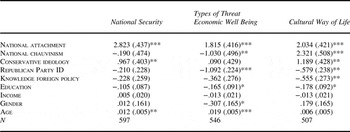
When asked how big a problem globalization was, more people in the national security (75%) and economic well-being (73%) conditions than in the cultural values condition (47%) thought the country faced a fairly big or very big problem.Footnote 58 More importantly, in all three conditions the appraisals that concluded there was a problem were associated with the strength of national attachment.Footnote 59 Table 1 presents the results of an ordinal regression model that shows this association remains significant when we control for other factors. This is consistent with Hypothesis 1 that connects attachment to more emotional sensitivity.
Determinants of the Magnitude of Perceived Problems

Table 1 also shows that national chauvinism is associated with more sanguine appraisals of possible economic threats. Those higher in chauvinism appear confident that the United States can compete. This appraisal might reflect feelings of opportunity more than threat, something another study might explore further. Mansfield and Mutz find that sociotropic considerations shape trade preferences as much or more than material attributes and the results here also suggest that the role identity attachments play deserves more attention.Footnote 60
Emotions and Beliefs About Intentions
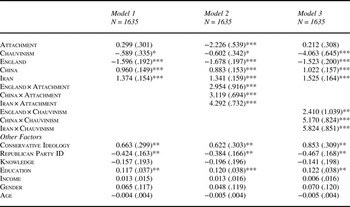
On a 101-point thermometer, Americans feel differently about England (70), Israel (50), China (43), and Iran (24) and substituting one country for another makes a large impact on the way Americans interpret an action. In the Acquiring-Military-Capability experiment, 84 percent attribute England's move to defensive as opposed to offensive intentions while only 29 percent do that for Iran with the percent making this defensive attribution for Israel (58%) and China (41%) following the descending pattern evident in the emotion scores.Footnote 61 Table 2 presents the results of regression models that explore the relationship. In Model 1, the impact of manipulating the country involved is clear. People are less likely to attribute offensive intentions to England than to Israel and more likely to attribute them to China and Iran than to Israel.
Factors Associated with Attributing Offensive Intentions to Acquiring Capability Binary Logit Coefficients and (standard errors)

Note: Significance shown as *p ≤ .1; **p ≤ .05; ***p ≤ .001.
This experiment also explored whether the same act evoked different behavioral reactions depending on the actor. This involved mentioning the United Nations, which might have evoked special objections in 2004. The distribution of sentiments expressed toward the United Nations in this study, however, was similar to that found in other studies done years before and in the years since.Footnote 62 Even a cursory look at the responses reveals that claims about an American aversion to the United Nations are exaggerated.Footnote 63 In this experiment, 79 percent of Americans supported the UN multilateral route when the vignette involved Iran. More than two-thirds (69%) did when China was involved and a majority (54%) did even when it involved Israel. When England was the country mentioned only 33 percent chose to oppose the acquisition of capability.
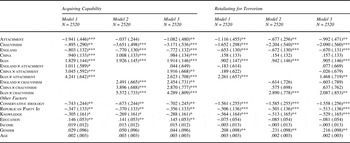
In the Retaliation-for-Terrorism experiment the pattern was similar. Eighty-three percent backed the United Nations and insisted that at least compensation if not also a fine be paid when Iran was involved. Only 52 percent made that choice when it involved England. As might be expected, a percentage in between preferred these UN options when the vignette involved China (68%) and Israel (67%). Of course, the central theoretical question is not simply whether Americans read the same action differently when it's done by different actors but whether the tendency to do so is related to national attachment. The regression models summarized in Table 3 suggest it is.
Determinants of Preference to Punish for Acquiring Capability or Retaliating for Terror
Binary Logit Coefficients and (standard errors)

Note: Significance shown as *p ≤ .1; **p ≤ .05; ***p ≤ .001.
The models in Tables 3 take ideology, party identity, and sociodemographic factors into account and the significance of the countries involved and national attachment remain clear. When acquiring capability, England is consistently treated better than Israel and Israel better than China or Iran. When retaliating for terrorism, England is consistently treated better than Israel and Israel better than Iran. China is treated roughly the same as Israel. The difference between the two experiments when it comes to China is likely to reflect concerns about relative gains and power in the first experiment that are absent in the second. The results for England, Israel, and Iran across both experiments support Hypotheses 2 and its corollary H2a.
Examining the interactions between the national identity variables and the country involved imposes the stiffest test of the theoretical argument. These interactions are significant for all the countries in the Acquiring-Capability experiment and for Iran in the Retaliating-for-Terrorism experiment. The significance of these interactions holds for both attachment and chauvinism when they are included in a single model. Interpreting the substantive nature of the interaction is easier when we look at them separately. If we divide the chauvinistic scale into five groups and look at the 20 percent highest in chauvinism, 81 percent of them chose to stick with the UN and demand that Iran pay at least compensation or that plus a fine. Meanwhile, among this group only 35 percent chose that policy when England was involved and 60 percent of them did in the cases of both China and Israel. Among the 20 percent who were lowest on chauvinism there was much less variation in how different countries were treated. Eighty-three percent of them supported the UN-imposed compensation and/or fine when the case involved Iran and 71, 79, and 76 percent of them did when it involved China, Israel, and England respectively. It appears that national attachment as well as chauvinism motivate people to interpret and react to the same act differently, depending on the country involved. That is because the countries evoke different emotions that motivate the construction of beliefs that allow the observer to apply normative standards in different ways while believing they are abiding by these standards.
Attachment and Beliefs About the Domestic Scene in Another Country
The questions that asked about Iraq and the Middle East revealed a sharp cleavage in American beliefs. With regard to Iraq, 50 percent of respondents chose one of the two answers that recognized Iraqi nationalism and thus did not resemble the colony image. Fifty percent also chose one of the other two answers that did not feature Iraqi desires for self-determination and did resemble the colony image.Footnote 64 When considering the Middle East, 47 percent blamed anti-Americanism on Islam and Muslim leaders while 53 percent attributed it to both sides equally or to Washington's behavior mostly.Footnote 65
Hypothesis 3 expects this cleavage to associate with the national identity variables and this is the case. Among the 20 percent most deeply attached to the nation, the gap between those endorsing some part of the colony pattern widens from 50:50 to 55 and 45 percent. Among those least attached the ratio reverses, with only 43 percent endorsing some version of the colony image and 57 percent rejecting it. The difference is larger between the most chauvinistic (63 to 37%) and the least chauvinistic (34 to 67%). A similar pattern is evident in the responses to the question about anti-Americanism in the Middle East. Among the most attached more endorse some version of the colony image (60%) than reject it (40%) while among the least attached fewer endorse it (24%) than reject it (76%). The difference is starker still among the most and least chauvinistic. In the former group, 72 percent adopt some version of the image and 28 percent reject it. Meantime, in the least-attached group only 21 percent endorse it and 79 percent reject it.Footnote 66
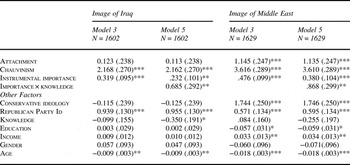
The regression models in Table 4 explore the relationship between the national identity variables and these beliefs. They include a measure of the instrumental importance someone puts on the Middle East.Footnote 67 It is clear that chauvinism and the instrumental importance attached to the Middle East associate with the inclination to construct a mental picture that resembles the colony image. Attachment does as well in the context of the Middle East more broadly. Identification with the Republican Party and a conservative ideology also associate with the image.
Determinants of the Construction of Colony Images Ordinal Logit Coefficients and (standard errors)

Note: Significance shown as *p ≤ .1; **p ≤ .05; ***p ≤ .001.
Just as interesting is the lack of association between either knowledge or education and these beliefs. This suggests it is not information about Iraq and the Middle East that is driving the difference. Instead, the instrumental importance put on the Middle East interacts with knowledge, suggesting that the polarization we see in beliefs is motivated by the relative importance people attach to the region with those who know more about it taking more extreme positions on both sides of the belief questions.
Conclusion
The most common origins of beliefs are the stimuli coming from the environment. In many cases, they are so powerful that beliefs about the environment will converge. Rho and Tomz find, however, that even in the face of the same information beliefs sometimes diverge.Footnote 68 How elastic beliefs can be in the face of the same information is a question Baum and Groeling explore, finding that beliefs about US casualties in Iraq did start to converge after a year or two. Beliefs about the progress being made and the likely outcomes, however, remained polarized.Footnote 69 Gelpi finds similarly and argues that rational models do not explain these persisting differences.Footnote 70 A theory of motivated reasoning might.
The findings here lead to three conclusions. The first is that to understand the role that norms play we need to explore the process by which beliefs about the situation form. When these beliefs are motivated by national attachments they are likely to lead to the inconsistent enactment of norms. Although Americans are often accused of applying double standards, this criticism is difficult to evaluate in the natural setting because situations are never exactly the same. My experiments held the situation constant and produced fairly stark results in this regard. The same act was judged and reacted to differently depending on the actor involved and feelings about that actor.
Second, it makes sense to be on guard for motivated biases when evaluating the opposition to intervention in target countries. Jervis finds that as the Iranian revolution progressed, the CIA underestimated Iranian nationalism.Footnote 71 He suggests analysts might have gotten it right had they gathered more information from the street.Footnote 72 The results here suggest the blind spot may have had other origins too. After all, the posters, slogans, and political caricatures were hard to miss and the CIA did have a picture of the opposition groups.Footnote 73 What its analysts did not see was the popularity of these groups and their coalescing around an anti-American cause. This is odd only three years after the US departure from Vietnam and less than two years from when President Carter drew attention to nationalism there and across the developing world.Footnote 74 Cognitive theories would expect analysts to be looking for it everywhere and no one missed it the following year when China invaded Vietnam or the year after that when the Soviet Union threatened Poland.
I found a sharp cleavage in American beliefs about the role nationalism played in Iraq. This cleavage was unrelated to levels of education or knowledge about foreign affairs but it was associated with attachment to America and the instrumental importance an American put on the Middle East. It also associated with ideological disposition—nothing in this study suggests ideology does not matter. Ideological differences, however, were taken into account in all the multivariate analyses I did. The significance of attachment to the nation was still very clear. Ideological dispositions do not explain as easily the cross-national differences I pointed to at the outset. They should crosscut state boundaries and lessen mean cross-national differences between France, Germany, and the United States.
Third, bargaining theories often assume, at least implicitly, that the signals sent are those received and that beliefs are updated in proportion to the diagnostic value of new information. A similar Bayesian learning process is thought to occur in neorealist and liberal theories as states and the people who live in them adjust to new information about the material and normative structures in the system. In these theories, the information coming from the environment determines beliefs. Because people need to manage too much information beliefs may be simplified and sticky once formed. The process of belief formation, however, is seen as an outside-to-inside process.
The theory proposed here includes unconscious factors on the inside motivating the formation of conscious beliefs about the outside, with attachments to the nation and the emotional appraisals these unleash playing key roles. In this theory, the meaning of so-called signals resides not in the acts themselves but in the combination of the act and emotions about the actor doing them. Likewise, beliefs about situations and what is normatively appropriate follow as much from attachment to the nation and the emotional desires this gives rise to as they do from the norm itself. Similarly, the beliefs and preferences about policy proposals are likely to form in response to who proposes them and how the observer feels about that actor, not simply the content of the proposal.Footnote 75
If people anticipate motivated reasoning and adjust accordingly, they might reduce its impact on communication. This is not simple, however. Kahneman finds that people readily accept that psychological processes bias the beliefs of other people but are reluctant to accept that they bias their own reasoning too.Footnote 76 He finds that a fast intuitive reasoning that he calls System 1 is common and a careful System 2 reasoning quite rare. “People,” Kahneman concludes, “can overcome some of the superficial factors that produce illusions of truth when strongly motivated to do so. On most occasions, however, the lazy System 2 will adopt the suggestions of System 1 and march on.”Footnote 77 In this study, it appears that people are not only not motivated to turn System 2 on but are motivated to keep it turned off or to activate it only in a biased way.
Haidt describes a rational rider on an emotion-driven elephant.Footnote 78 The degree to which someone attaches his or her identity to the nation energizes that elephant. When exploring loyalty, Haidt finds that people can easily believe almost anything that supports their team, and they find ways to disbelieve those things that do not.Footnote 79 My theory suggests this may be because they are seeking to avoid painful tradeoffs. They want to act on the inclinations of the emotion and they want to do so while believing they are acting in the morally appropriate fashion. If this is so, then anticipating and overcoming motivated beliefs is difficult because they are serving an important psychological function. If observers are consciously aware that they are just rationalizing then the tradeoff is not eased and the decision remains painful. When beliefs are being derived from underlying attachments and emotions, observers are motivated to accept them as accurate reflections of reality. This is what eases the tradeoff. Rather than abandoning these beliefs, observers are likely to get angry when naysayers call them into question.
In numerous settings, emotions are practical. They alert us to danger, for example, and keep us alive. Normal social relationships rely on our ability to predict how what we say and do will affect the emotions of others and how that will make us feel in the future.Footnote 80 The essential role emotions play in life makes it possible to argue they are integral parts of rational reasoning, not subversive of it.Footnote 81 Because the word rational has such polemical power the fight over what to include in the concept is probably inevitable. Rather than joining that fight, I will close by simply suggesting that when reasoning is motivated by strong emotions, beliefs are likely to form in ways that do not follow the logical rules of evidence and statistical inference that Kahneman includes in System 2.Footnote 82 Decisions in these moments may be easier to make because painful tradeoffs have been eased but they will not necessarily be better in a strategic or normative sense. They also are likely to deviate from the expectation of statistically rational models. They are predictable, however, and thus it makes sense to include in our theories of international relations the role national attachments are likely to play in the formation of beliefs.