Introduction
External auditory canal exostosis, more commonly known as ‘surfer's ear’, is characterised by bony protrusions within the external auditory canal.Reference Seftel1, Reference Everline, Nathanson and Renneker2 This abnormal bone growth occurs as a result of an ‘evaporative cooling effect’, wherein consequential hyperaemia and vasodilation after exposure to cold water lead to increased osteoblast activity and hyperostosis near the tympanic ring.Reference King, Kinney, Iacobellis, Alexander, Harris and Torre3, Reference Cooper, Tong, Neil, Owens and Tomkinson4
The stage of external auditory canal exostosis is directly related to the duration of cold water exposure, with regular exposure increasing the risk of external auditory canal exostosis development by 10 per cent per annum.Reference Harrison5–Reference Nakanishi, Tono and Kawano9 In the UK, 500 000 surfers per year are exposed to seawater below 19 °C, the critical temperature for external auditory canal exostosis development.Reference Kroon, Lawson, Derkay, Hoffmann and McCook10–13
Estimates suggest that external auditory canal exostosis is present in 63 per cent of UK surfers, and that 28 per cent are afflicted with symptoms including otalgia, recurrent otitis externa and hearing loss.Reference Alexander, Lau, Beaumont and Hope14, Reference Attlmayr and Smith15 Surgical intervention is the sole means of restoring auditory canal patency and eradicating these symptoms.Reference Seftel1, Reference Everline, Nathanson and Renneker2
Earplugs limit cold water entry to the ear when surfing and can reduce the incidence of external auditory canal exostosis.Reference Timofeev, Notkinan and Smith16 Despite this, their use is limited amongst surfers, with only 2–15 per cent currently reporting regular practice.Reference Alexander, Lau, Beaumont and Hope14, Reference Reddy, Abdelrahman, Lau and Flanagan17
Awareness of the preventability of external auditory canal exostosis may influence earplug use amongst surfers and halt the growing prevalence of this condition.Reference Attlmayr and Smith15 However, there is currently little evidence regarding surfers’ awareness of external auditory canal exostosis and their attitude to earplug use. One cross-sectional study reported that 60 per cent of surfers were aware of surfer's ear.Reference Reddy, Abdelrahman, Lau and Flanagan17 That study was limited to 92 participants and, as such, the findings may not be generalisable to surfers across the UK.
This study reports the findings of a cross-sectional survey conducted to determine the proportion of surfers aware of external auditory canal exostosis and to establish the levels of knowledge regarding this condition. In addition, it explores: surfer characteristics associated with knowledge of external auditory canal exostosis, attitudes amongst surfers towards earplug use, and favourable means of educating the surfing population.
Materials and methods
Ethical considerations
The University of Birmingham Internal Ethics Review Committee approved the study in January 2015.
Study design
A cross-sectional survey of UK surfers was conducted. A questionnaire was designed to collect data, utilising a tick-box format of categorical options and Likert scales, in four sections as below.
Section one addressed surfer characteristics. Participants were asked to report their age, gender, surfing habits and standard (using the Hutt surfing skill scaleReference Hutt, Black and Mead18 (beginner = 1, 2, 3; intermediate = 4, 5; and advanced = 6, 7, 8)), earplug use, external auditory canal exostosis related aural symptoms, and diagnosis of and past surgical treatment for external auditory canal exostosis.
Section two focused on surfers’ awareness and knowledge of external auditory canal exostosis. The proportion of surfers aware of external auditory canal exostosis was assessed using an explicit yes or no question. Those answering ‘yes’ were directed to consider 10 factual statements, with 5-point Likert scales used to ascertain participants’ external auditory canal exostosis ‘knowledge’.
Section three examined surfers’ attitude to earplug use. Ten attitude statements with five-point Likert scales attempted to explore the barriers felt by participants towards wearing earplugs when surfing.
Finally, section four addressed information provision. Participants identified the most preferable means for delivery of external auditory canal exostosis advice.
The questionnaire was informed by existing literature, lay texts, and discussions with surfers and otolaryngologists who are experienced in external auditory canal exostosis. It was piloted with four experienced surfers and amended correspondingly prior to distribution.
Setting
Data collection occurred between January and April 2015. Links to the online questionnaire were distributed to the member lists of a national surfing organisation (Surfing Great Britain) and to 12 surf clubs from across the UK, and distributed in person to surfers at beaches in South Wales and Devon.
Participants
Individuals were eligible to participate if they had surfed for more than 6 months in the UK and were aged 18 years or older. Participants were informed that submission of a completed questionnaire signified consent to use of their anonymised data in analysis and publication.
Sample size
The only existing survey of surfers’ awareness of external auditory canal exostosis in the UK estimated a level of awareness of 60 per cent.Reference Reddy, Abdelrahman, Lau and Flanagan17 Based on this, a sample size of 369 was required to detect a 60 per cent proportion of surfers aware of external auditory canal exostosis, with a 5 per cent margin of error and 95 per cent confidence intervals (CIs).19
Data management
The five-point Likert scale response options for the knowledge and attitude statements were coded from −2 to +2 (strongly agree to strongly disagree). Data generated from these responses were used to calculate a total score out of ±20.
Participants with scores of −20 to +5 (who responded incorrectly to more than five statements) were classified as having poor knowledge of external auditory canal exostosis. Those with scores of +6 to +14 were considered to have good knowledge and those with scores of +15 to +20 were classified as having excellent knowledge. In this study, ‘awareness’ was considered a positive answer to the initial yes/no question and ‘knowledge’ was considered a good or excellent response to the Likert statements. The 10 attitude statements categorised participants as having an overall positive (total attitude score of more than 0), neutral (score of 0) or negative (score of less than 0) attitude towards earplug use.
Statistical methods
Statistical analysis was undertaken using SPSS® software, version 19.0. Descriptive analysis was undertaken to generate means and standard deviations (SDs). Univariate analysis (chi-square and Fisher's exact tests) and multivariate analysis (a binary logistic regression) were used to explore relationships between external auditory canal exostosis knowledge and surfer characteristics.
Results
Background characteristics
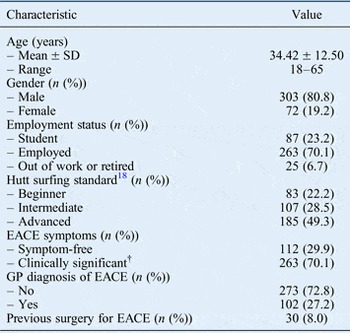
Of 402 questionnaires that were returned, 375 were fully completed and included in the analysis. There were 303 (80.8 per cent) male respondents and 72 (19.2 per cent) female respondents. The mean age of the sample was 34.42 years (SD = 12.50) (Table I). A previous positive diagnosis of external auditory canal exostosis was reported by 102 participants, 30 of whom had undergone surgery for the condition. Earplugs were used by 40.0 per cent of the respondents (n = 150; 95 per cent CI = 35.0–44.9).
Patients' background characteristics*

* Total n = 375.
† Clinically significant symptoms were: otalgia, otitis externa, tinnitus and temporary deafness. SD = standard deviation; EACE = external auditory canal exostosis; GP = general practitioner
Awareness and knowledge of external auditory canal exostosis
A total of 323 individuals (86.1 per cent; 95 per cent CI = 82.3–89.3) reported that they were aware of external auditory canal exostosis.
Data derived from the subsequent ‘knowledge’ Likert statements revealed that 36 of the 323 individuals had poor knowledge of external auditory canal exostosis, 172 had good knowledge and 115 had excellent knowledge (Figure 1).
Flowchart of participation, highlighting: (1) respondents’ awareness of external auditory canal exostosis (based on responses to a yes/no question); (2) their level of knowledge about the disease (based on responses to knowledge Likert statements); and (3) existence of knowledge (binary knowledge categories, as used for univariate and multivariate analyses).

After combining those individuals with a ‘good’ and ‘excellent’ response to the knowledge statements, 76.6 per cent (287 out of 375; 95 per cent CI = 72.0–80.5) were classified as having ‘knowledge’. After combining those with no awareness and a ‘poor’ knowledge response, 23.4 per cent (n = 88; 95 per cent CI = 19.5–28.0) were classified as having ‘no knowledge’.
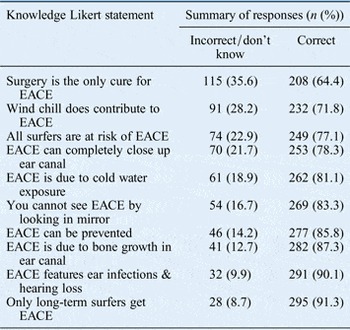
There was variability in the proportion of aware surfers who held knowledge, particularly regarding the treatment for external auditory canal exostosis: only 35.6 per cent demonstrated knowledge that surgery is required to correct external auditory canal exostosis (Table II).
Responses of ‘aware surfers’ to knowledge likert scale statements*

* A total of 323 surfers were aware of external auditory canal exostosis. EACE = external auditory canal exostosis
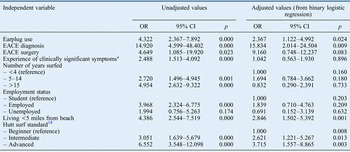
Univariate and multivariate analyses were performed to identify surfer characteristics associated with ‘knowledge’ versus ‘no knowledge’. All independent variables from section one of the questionnaire were tested, controlling for age and gender (Table III).
Unadjusted and adjusted odds ratios for surfer characteristics predictive of ‘knowledge’ over ‘no knowledge’

Age and gender were controlled for in all variables.
* Clinically significant symptoms were: otalgia, otitis externa, tinnitus and temporary deafness. OR = odds ratio; CI = confidence interval; EACE = external auditory canal exostosis
Four independent variables were significantly associated with ‘knowledge’ in the multivariate analysis: Hutt's surfing standardReference Hutt, Black and Mead18 (compared to the beginner surfer (reference), the odds ratio for the intermediate surfer was 2.621 (p = 0.013), and the odds ratio for the advanced surfer was 3.715 (p = 0.003)), living less than five miles from the nearest surfing beach (odds ratio = 2.846, p = 0.001), being an earplug user (odds ratio = 2.367, p = 0.024) and a previous positive diagnosis of external auditory canal exostosis (odds ratio = 15.837, p = 0.009). Experience of clinical symptoms and the number of years surfed were not significantly associated with knowledge.
Attitudes to earplug use
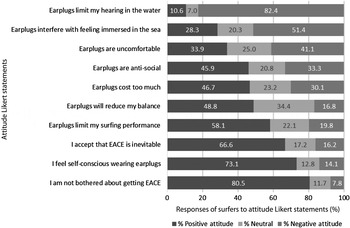
Of the respondents, 69.6 per cent were categorised as having a positive attitude towards earplug use (Figure 2). Three leading barriers to earplug use emerged from the attitude Likert data: 82.4 per cent agreed that earplugs adversely affect hearing, 51.4 per cent agreed that earplugs interfere with the feeling of immersion in the sea and 41.1 per cent agreed that earplugs are uncomfortable. Of the 225 individuals who did not wear earplugs, 56.0 per cent (n = 126) said they would use earplugs if they knew more about external auditory canal exostosis.
Responses of 375 surfers to attitude Likert scale statements. EACE = external auditory canal exostosis

Information provision
Of all the respondents, 84.0 per cent (n = 315) reported that they would benefit from greater levels of surfing-related health advice. Overall, 61.1 per cent of respondents favoured the delivery of surfing health advice via social media, 9.3 per cent via magazine articles, 8.3 per cent via a medical speaker at surf club meetings and 5.3 per cent via leaflets at general practitioner surgeries.
Discussion
Synopsis of key results
The findings indicate that 86.1 per cent of surfers are aware of external auditory canal exostosis; however, further investigation showed that not all ‘aware’ surfers were necessarily well informed about the implications of external auditory canal exostosis. This proportion is greater than Reddy and colleague's estimate of 60 per cent;Reference Reddy, Abdelrahman, Lau and Flanagan17 nevertheless, experienced surfers were predominantly represented in the current study's sample (49.3 per cent were advanced in terms of Hutt's surfing standardReference Hutt, Black and Mead18).
The presence of symptoms, previous surgery, number of years’ surfing experience and employment status were associated with knowledge in the unadjusted analysis; however, these factors were not significant contributors in the multivariate model when the effect of age, gender and all other independent variables were controlled for. The multivariate analysis findings suggest that surfers who used earplugs were twice as likely to have knowledge about external auditory canal exostosis as surfers who did not (odds ratio = 2.37). In addition, those with a previous diagnosis of external auditory canal exostosis were considerably more likely to have knowledge of the condition than those without a diagnosis (odds ratio = 15.83). This suggests that many surfers may gain knowledge about external auditory canal exostosis through interaction with a medical practitioner, rather than from health promotional sources.
Over half of the respondents did not use earplugs (60.0 per cent); however, the majority of these individuals (56.0 per cent) reported that they would use earplugs if they knew more about external auditory canal exostosis.
It is possible that surf organisations are currently under-utilised as sources for surfing health advice. Respondents indicated that more health information would be welcome via several routes, although the most effective means of delivering this is inconclusive. Social media was the most popular choice amongst the participants (61.1 per cent). Indeed, social media has proven benefits as a health education tool.Reference Jones, Eathington, Baldwin and Sipsma20 Therefore, education via social media through surf schools and organisations for the novice, symptom-free population may be useful to minimise the number of surfers developing this condition.
Strengths and limitations
This is the largest study of external auditory canal exostosis to date. By employing both in person and online recruitment methods, the questionnaire was accessible to surfers across the UK, and, as such, the findings are likely to be generalisable to the UK's surfing population. Unlike previous studies, this survey used several questions to assess knowledge of external auditory canal exostosis, making this a more robust determination of knowledge level. Nevertheless, although the aural symptoms self-reported are presumed to be those specified, other otological morbidities may have been misreported by the participants.
Applicability of study
Previous studies have attempted to capture the burden of this disease by examining surfers’ ears at various locations worldwide. The estimated prevalence of external auditory canal exostosis is: 30.0 per cent in Australia,Reference Hurst, Bailey and Hurst21 59.8 per cent in JapanReference Nakanishi, Tono and Kawano9 and 61.0 per cent in the Basque Coast.Reference Altuna Mariezkurrena, Gómez Suárez, Luqui Albisua, Vea Orte and Algaba Guimerá22 Therefore, based on current literature, this places the external auditory canal exostosis prevalence in the UK as the highest worldwide (63.0 per cent).Reference Attlmayr and Smith15
Studies agree that it takes approximately 10 years of surfing, which equates to over 5000 hours, in order to acquire clinically significant disease.Reference Cooper, Tong, Neil, Owens and Tomkinson4, Reference Alexander, Lau, Beaumont and Hope14, Reference Hurst, Bailey and Hurst21–Reference Lennon, Murphy, Fennessy and Hughes24 Thus, this produces a 10-year lag-phase, which may make external auditory canal exostosis an increasing part of the future ENT surgeon's workload.Reference Lennon, Murphy, Fennessy and Hughes24 Currently in the Royal Cornwall Hospital, an average of 13 external auditory canal exostosis operations are completed annually.Reference Attlmayr and Smith15 Over the last 9 years, this represents an average increase of 1.23 operations per year, supporting the ‘lag-phase’.Reference Attlmayr and Smith15
• External auditory canal exostosis, or ‘surfer's ear’, is estimated to affect 63 per cent of UK surfers, the highest estimated prevalence worldwide
• Evidence suggests that earplug use when surfing may prevent growth of exostoses
• Of surfers surveyed, 23.4 per cent had no knowledge of this condition
• Knowledge of external auditory canal exostosis was associated with earplug use, higher surfing standard, living close to a surfing beach and a positive diagnosis
• Eighty-four per cent stated they would benefit from improved surfing health advice delivery, e.g. via social media
• Medical practitioners should make relevant individuals aware of the risk of disease progression with continued, unprotected surfing
Studies agree that earplug use can reduce the need for surgical intervention. In Alexander and colleagues’ cross-sectional study, subjects were less likely to have evidence of external auditory canal exostosis if they were regular users of earplugs.Reference Alexander, Lau, Beaumont and Hope14 Likewise, a 10-year follow up of post-operative patients showed that earplug use significantly reduced external auditory canal exostosis recurrence.Reference Timofeev, Notkinan and Smith16
These benefits of earplug use and the consequences of surfing without earplugs should be recognised by health practitioners, and surfing organisations should appreciate their role in educating individuals about the risk of external auditory canal exostosis progression with continued, unprotected surfing.
Conclusion
The current findings suggest that a proportion of the UK's surfing community are unaware of external auditory canal exostosis. Surfers with knowledge of external auditory canal exostosis are more likely to use earplugs. With surfing becoming an increasingly popular sport in the UK, improved awareness of external auditory canal exostosis amongst the currently unaware and undiagnosed populations is likely to be valuable. An educational social media campaign may improve surfers’ knowledge of external auditory canal exostosis, earplug habits and, in turn, the burden of this preventable condition.
Acknowledgements
The authors would like to thank Dr Sayeed Haque for his statistical advice, Dr Frederique Tan for her guidance, Tom Anderson, from Surfing Great Britain, and all surf clubs and participants.