Clinical Implications
• At 6 months of treatment, agomelatine has statistically significant superiority over the investigated SSRIs on the HAM-D scores, on HAM-D response rates and on CGI-I scores but the difference does not reach statistical significance for HAM-D remission rates, and for CGI-I response or CGI-I remission rates.
• At 6 months of treatment, agomelatine shows a trend to better adherence compared to the investigated SSRIs.
Introduction
The efficacy of antidepressants in patients with major depression has been investigated in over 1000 randomized clinical trials (RCTs). One meta-analysis of 182 trials reported response rates of 53.8% for antidepressants and of 37.3% for placebo.Reference Papakostas and Fava1 Recently, several articles were published that expressed criticism on the efficacy of antidepressants because of publication and reporting bias, and because of the relatively small effect sizes for antidepressants.Reference Moreno, Sutton and Turner2–Reference Fournier, DeRubeis and Hollon4 The same methodological issues are also found in trials that have investigated the efficacy of psychotherapy in depression.Reference Cuijpers, van Straten, Bohlmeijer, Hollon and Andersson5, Reference Cuijpers, Smit, Bohlmeijer, Hollon and Andersson6 Although major guidelines recommend treatment of major depression for (at least) 6–9 months after remission, most RCTs are limited to acute phase trials of 6–8 weeks, comparing the efficacy of an antidepressant versus placebo. The knowledge on the long-term efficacy of antidepressants is mainly based on relapse or recurrence prevention studies with a placebo substitution design, ie, patients are treated open-label with active medication, and treatment responders are then randomized to continue with medication or switch to placebo in a double-blind manner.Reference Zimmerman, Posternak and Ruggero7
The comparative efficacy of different antidepressants has been less frequently investigated, although several meta-analysis results have been published, eg, between one antidepressant and active comparators,Reference Bauer, Tharmanathan, Volz, Moeller and Freemantle8, Reference Cipriani, Furukawa and Salanti9 between two different classes of antidepressants,Reference Papakostas, Thase, Fava, Nelson and Shelton10 or between many individual antidepressants,Reference Thase, Ninan, Musgnung and Trivedi11 suggesting small but sometimes significant differences between drugs. One representative example showing this difference is a meta-analysis that found response rates to be 4.3% higher in patients treated with serotonin-norepinephrine reuptake inhibitors (SNRIs) than in patients treated with selective serotonin reuptake inhibitors (SSRIs).Reference Papakostas, Thase, Fava, Nelson and Shelton10
But again, most of these studies were acute phase trials. Long-term RCT data comparing two antidepressants are scarce and are most often based on an extension design, where patients are randomized to two different antidepressants during the acute phase and where the two treatments are then continued for 24 weeks.
Most of these studies are performed in psychiatric outpatients, with inclusion and exclusion criteria bringing into question the ecological validity of RCTs, but some of the small differences in acute phase trials (such as a slight superiority of venlafaxine versus citalopram, fluoxetine, paroxetine, and sertraline) have recently been (partially) replicated in a more naturalistic primary care setting during a 6-month trial (a randomized, open-label, rater-blinded study). While no significant differences were found on the primary endpoint (remission rates at 6 months), most secondary endpoints showed a slight but significant superiority of venlafaxine over the other antidepressants.Reference Thase, Ninan, Musgnung and Trivedi11
Agomelatine is an antidepressant with melatonergic (MT1 and MT2) agonistic and 5-HT2C antagonistic properties, with significant short-term efficacy relative to placebo, as well as evidence of relapse prevention (up to 10 months).Reference Kennedy and Rizvi12 Four short-term, head-to-head, comparative studies where agomelatine was compared with fluoxetine, with sertraline, and (twice) with escitalopram, respectively, have been published.Reference Hale, Corral and Mencacci13–Reference Corruble, Belaidi and Goodwin16 In each of these studies, an extension phase was available up to 6 months of total treatment.
The present manuscript reports the results of the meta-analysis on the long-term outcome of agomelatine versus SSRIs in these four studies, reporting on efficacy, completion rates, tolerability, and safety.
Materials and Methods
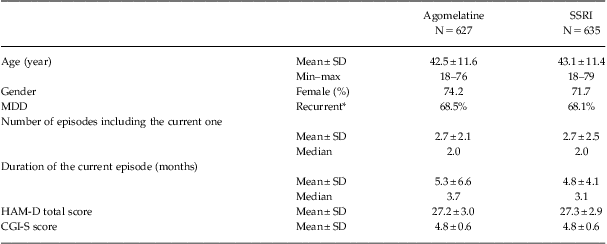
The present meta-analysis is based on results from these 4 studies with identical design where the acute-phase, head-to-head study had an extension phase up to 24 weeks.Reference Hale, Corral and Mencacci13–Reference Corruble, Belaidi and Goodwin16 Patient demographics and disease characteristics are listed in Table 1.
Patients’ demographics and disease characteristics at baseline—FAS
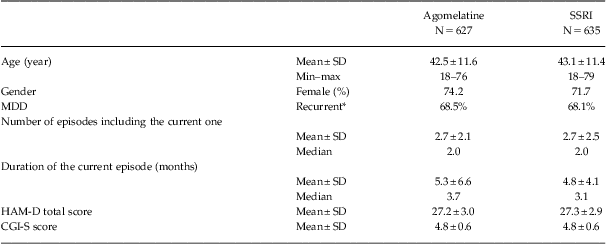
*Information not collected in the study 056.
Studies included in the analysis had the following characteristics:
• Two-arm, head-to-head, double-blind, randomized studies comparing the agomelatine and SSRIs, in non-elderly adult outpatients fulfilling DSM-IV-TR criteria for major depressive disorder (MDD), where 6 months of treatment was planned for all patients, and where the pivotal depression efficacy scale was the 17-item Hamilton Depression Rating Scale (HAM-D17) and the comparison of efficacy was specified in the protocol.
• These 4 studies had an entry HAM-D17 score of ≥22 (moderate to severe), except for one study in which HAM-D17 score was ≥25 (severe).Reference Hale, Corral and Mencacci13 All the studies were performed in accordance with the ethical principles laid out in the Declaration of Helsinki (1964) and its text revisions applicable at the time, and were approved by relevant local ethics committees. All patients had given written informed consent.
• The pivotal short period in the individual studies varied; 6 weeks versus escitalopramReference Quera-Salva, Hajak and Philip15 and sertraline,Reference Kasper, Hajak and Wulff14 8 weeks versus fluoxetine,Reference Hale, Corral and Mencacci13 and 12 weeks in the second study versus escitalopram.Reference Corruble, Belaidi and Goodwin16 The long-term depression efficacy analysis in each individual study was at 24 weeks of treatment. A dose increase (agomelatine: from 25 to 50 mg; fluoxetine: from 20 to 40 mg; sertraline: from 50 to 100 mg; escitalopram: from 10 to 20 mg) was noted in 24.8% of patients treated with agomelatine and in 22.4% of patients treated with SSRIs. Data from the four studies were pooled.
• Efficacy was examined with the HAM-D 17 score [response (a decrease of at least 50% from baseline) and remission (HAM-D total score below or equal to 6 points)] and with the Clinical Global Impression of Improvement (CGI-I) score [response (CGI-I of 1 or 2, much or very much improved) and remission (CGI-I of 1, very much improved)] using the last observation carried forward (LOCF) analysis at 24 weeks. The subgroup of severely depressed patients (baseline HAM-D17 total score of 25 or more) was also analyzed.
• The safety data were derived from spontaneous reporting of adverse events during studies, and were analyzed as the number and percentage of patients with at least one emergent adverse event (EAE) leading to study drug discontinuation. The number of patients with abnormal liver function tests (3 times above the upper limit of normal) in each group was analyzed.
Statistics
The meta-analytic method provided an estimate of the overall average treatment effect based on the individual effect of treatment compared to SSRI estimated in the four studies. The difference between agomelatine and SSRI was estimated for each study based on the last post-baseline value of HAM-D total score on the 6-months treatment period (LOCF approach) using an analysis of covariance adjusted for baseline and center (as random effect).
The homogeneity of the treatment effect across studies was analyzed based on the estimation of a difference between treatments in each study. Moreover, a test of heterogeneity in the treatment effect across the studies was also carried out.
The overall treatment effect compared with SSRI was estimated using a random effects model, which is appropriate in case of homogeneity of treatment effects between studies and in case of quantitative heterogeneity. The same meta-analytic method was used on the CGI-I score, and on response and remission defined by the HAM-D and CGI-I, to provide additional estimates of the overall treatment effect of agomelatine and its accuracy as compared to SSRIs. For those meta-analyses, unadjusted estimates of treatment effect in each individual study were used.
The safety analyses were performed in the safety set (SS) in the pool of the four studies and consisted of patients having received at least one dose of the studied treatment (636 patients on agomelatine and 648 patients on SSRIs). Type I error was set at 5% two sided for all analyses.
Results
Efficacy
Hamilton Depression Rating Scale
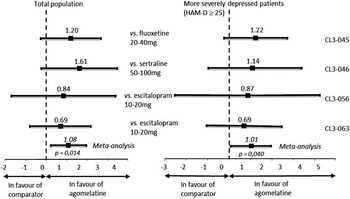
The HAM-D-17 score at the last post-baseline assessment on the 24-week treatment period was significantly lower in patients treated with agomelatine than in patients treated with SSRIs. The overall estimate of the difference was 1.08 (0.44) points (P = 0.014) in the full analysis set of patients (FAS) and 1.01 (0.50) points (P = 0.040) in the subgroup of patients with severe depression (baseline HAM-D ≥ 25) (Figure 1).
Long-term efficacy of agomelatine versus SSRIs in all patients and in the subgroup of more severe patients (final HAM-D-17 scores).

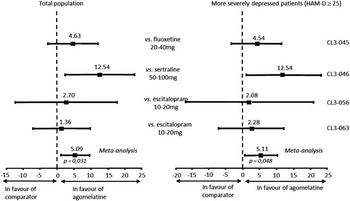
HAM-D response rates at the end of 24 weeks were significantly higher in patients treated with agomelatine than in patients treated with SSRIs. The overall estimate of the difference was 5.09% (2.36) (P = 0.031) in the FAS and 5.11% (2.59) (P = 0.048) in the subgroup of patients with severe depression (Figure 2). At the end of 24 weeks, response rates in the individual studies were 78.95%, 76.00%, 76.47%, and 82.61% for agomelatine, while for the SSRIs they were 74.32% (fluoxetine), 63.46% (sertraline), 73.77% (escitalopram), and 81.25% (escitalopram) in the FAS.
Long-term efficacy of agomelatine versus SSRIs in all patients and in the subgroup with more severe patients (final % responders on HAM-D-17).

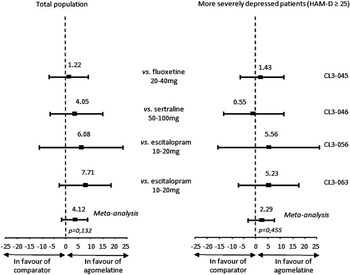
HAM-D remission rates at the end of 24 weeks were numerically but not significantly higher in patients treated with agomelatine than in patients treated with SSRIs. The overall estimate of the difference was 4.12% (2.79) (P = 0.139) in the FAS and 2.29% (3.07) (P = 0.445) in the subgroup of patients with severe depression (Figure 3). At the end of 24 weeks, remission rates in the individual studies were 51.42%, 55.33%, 47.06%, and 65.84% for agomelatine, while for the SSRIs they were 50.19% (fluoxetine), 51.28% (sertraline), 40.98% (escitalopram), and 58.13% (escitalopram) in the FAS.
Long-term efficacy of agomelatine versus SSRIs in all patients and in the subgroup with more severe patients (final % remitters on HAM-D-17).

Clinical Global Impression of Improvement (CGI-I)
The CGI-I score at 24 weeks was significantly lower in patients treated with agomelatine than in patients treated with SSRIs. The overall estimate of the difference was 0.15 ± 0.07 points (P = 0.020) in the FAS and 0.17 ± 0.07 points (P = 0.020) in the subgroup of patients with severe depression.
The overall estimate of the difference in CGI-I response rates at the end of the 24 weeks was 3.82% (2.26) (P = 0.091) in the FAS and 4.41% (2.51) (P = 0.08) in the subgroup of patients with severe depression).
The overall estimate of the difference in CGI-I remission rates at the end of the 24 weeks was 2.09% (2.70) (P = 0.439) in the FAS and 1.60% (2.98) (P = 0.590) in the subgroup of patients with severe depression.
Completion rates
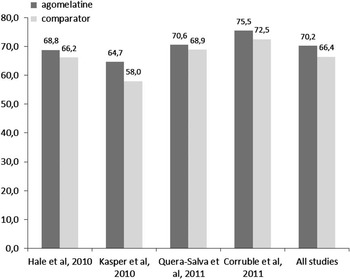
In the FAS, the percentage of patients who completed the 6-month treatment was 70.2% for patients treated with agomelatine versus 66.4% for patients treated with SSRIs [difference = 3.86 (2.60); P = 0.138] (Figure 4).
Percentage of patients who completed the 6-month trial with agomelatine or SSRIs.

Tolerability and safety
The percentage of patients reporting at least one treatment emergent adverse event was not different in patients treated with agomelatine than in patients treated with SSRIs (65.9% versus 67.4%). Psychiatric emergent adverse events were more frequently reported by patients treated with SSRIs than in patients treated with agomelatine (13.1% versus 7.6%; P = 0.001). The percentage of patients with at least one emergent adverse event leading to treatment discontinuation was 9.4% for patients treated with SSRIs versus 6.6% for patients treated with agomelatine (P = 0.065).
The percentage of patients spontaneously reporting treatment emergent sexual disorders was borderline significantly lower in patients treated with agomelatine than in patients treated with SSRIs (2.9% versus 1.3%; P = 0.050). In male patients, treatment emergent sexual disorders were 3.6% with agomelatine and 8.7% with SSRIs (P = 0.076); in female patients, percentages were 0.4% and 0.7%, respectively (P = 0.685). The percentage of patients with a clinically significant (≥7%) weight increase was not different in patients treated with agomelatine and in patients treated with SSRIs (7.5% versus 8.7%, ie, 5.7% for fluoxetine, 9.6% for escitalopram, and 12.5% for sertraline). A change to an upper body mass index (BMI) class was noted in 8% of patients treated with agomelatine and in 7.7% of patients treated with SSRIs (6.4% for escitalopram, 7.6% for fluoxetine, and 10.3% for sertraline).
Significant emergent transaminase increases (>3 times the upper limit of normality) were found in 0.34% of patients treated with SSRIs (N = 2), 1.79% of patients treated with agomelatine 25 mg (N = 8), and in 2.61% in patients treated with agomelatine 50 mg (N = 4). The percentage of suicidal and self-injury behavior was not significantly different in patients taking agomelatine compared to patients taking SSRIs (0.8% versus 0.3%).
Discussion
The present meta-analysis shows that agomelatine has, compared with SSRIs, a statistically significant superiority for the HAM-D score, for the HAM-D response rate, and for the CGI-I score and a numerical but not statistically significant advantage for HAM-D remission rate, for CGI-I response rate, and for CGI-I remission rate. The magnitude of superiority is comparable in the total FAS and in the subgroup of patients with severe depression (baseline HAM-D ≥25), confirming the previously published efficacy of agomelatine through the full range of depression severity. A meta-analysis of 3 acute-phase treatment studies comparing agomelatine and placebo showed an increasing superiority over placebo with increasing baseline severity: a difference in final HAM-D of 2.06 for patients with a baseline HAM-D of 22–25, 3.31 for patients with a baseline HAM-D of 26–27, 3.46 for patients with a baseline HAM-D of 28–30, and 4.45 for patients with a baseline HAM-D of >30.Reference Montgomery and Kasper17
However, although it is known that the outcome is better in head-to-head trials (where all patients get active treatment) compared to placebo-controlled trials, the HAM-D remission rates at 6 months in the present meta-analysis are only about 50%, again confirming the suboptimal results obtained with current depression treatment strategies.Reference Sinyor, Levitt and Cheung18 A recently published open-label study in patients with major depressive disorder showed 6-month remission rates (LOCF) of only 32–35.5% depending on which antidepressant was used.Reference Thase, Ninan, Musgnung and Trivedi11
The relevance of these differences in favor of agomelatine (a 5.09% superior HAM-D response rate) can be better understood when compared to differences found between other antidepressants or antidepressant groups. Combined serotonergic-noradrenergic antidepressants as well as escitalopram have been suggested to show “superior” efficacy compared to (other) SSRIs, at least in short term trials,Reference Papakostas, Thase, Fava, Nelson and Shelton10, Reference Kennedy, Andersen and Thase19 and the magnitude of the superiority was in the same range as reported here in the present meta-analysis. Indeed, a meta-analysis showed that 8-week response rates were 63.6% for combined serotonergic-noradrenergic antidepressants versus 59.3% for SSRIs (difference of 4.3%; P = 0.003).Reference Papakostas, Thase, Fava, Nelson and Shelton10 Another meta-analysis showed that 8-week response rates were 62.1% for escitalopram versus 58.3% for the other SSRIs (difference of 3.8%; P = 0.0089).Reference Kennedy, Andersen and Thase19
These findings again open the discussion on the difference between “statistically significant” superiority and “clinically meaningful” superiority (and “health economical” superiority). In trials comparing antidepressants with placebo, an NNT (numbers needed to treat) ≤10 is often suggested as clinically meaningful, while in trials comparing 2 active treatments, no such cut-off has been defined. So it is open to discussion how clinically meaningful the presently found differences are. A cautious statement could be that agomelatine is, from a clinical point of view, at least as efficacious as the 3 SSRIs in this meta-analysis, even if two studies included escitalopram, which is known to have some degree of superiority compared to other SSRIs.Reference Kennedy, Andersen and Thase19 The same reasoning can be applied on the difference in final HAM-D score (1.08 points), as the National Institute for Clinical Excellence guidelines consider a difference between an antidepressant and placebo of 3 points as “clinically meaningfull.” The chance of getting an active antidepressant (depending on the number of treatment arms, and of a placebo arm or not) is known to significantly influence outcome, and in the present meta-analysis, all patients were treated with active medication, which makes it more difficult to find differences.Reference Sinyor, Levitt and Cheung18
However, what is a clinically meaningful difference cannot only be based on outcomes in randomized clinical trials alone, since only about 10% of daily practice patients can be included in RCTs due to inclusion and exclusion criteria, and hence results from RCTs cannot automatically be extrapolated to routine patients.Reference Zimmerman, Mattia and Posternak20, Reference Demyttenaere, Verhaeghen and Dantchev21
The percentage of patients who completed the 6-month treatment in these 4 studies was numerically but not statistically significant higher for agomelatine than for the SSRIs. But again, although included in a clinical trial, only 2 patients of 3 continued their treatment up to 24 weeks, which is better than in a naturalistic setting, but below what guidelines recommend. The low percentages of patients with at least one emergent adverse event leading to treatment discontinuation confirm the good tolerability of the antidepressants used in these 4 trials. The literature on which adverse events bother patients most is limited, but one study found that sexual side effects were reported to be the most bothersome side effects (47%) followed by insomnia (36.5%) and weight changes (35%).Reference Goethe, Woolley, Cardoni, Woznicki and Piez22 The prevalence of treatment emergent sexual side effects differs depending on what methodology is used to assess these (spontaneous self-report versus questionnaires), and the present meta-analysis shows that statistically significantly fewer patients self-reported sexual side effects with agomelatine than with the SSRIs. This is in line with data from acute phase trials and with data in healthy volunteers where drug-induced sexual side effects were more frequent with venlafaxine and with paroxetine than with agomelatine.Reference Kennedy, Rizvi, Fulton and Rasmussen23, Reference Montejo, Prieto and Terleira24 The present meta-analysis also shows no significant differences in effect on body weight between agomelatine and the investigated SSRIs. Regarding safety issues, the percentage of dose-dependent treatment emergent transaminase increases are comparable with the figures reported in the acute phase trials. No statistically significant difference in suicidal or self-injury behaviors were noted in this meta-analysis, and the figures suggest that long-term treatment again does not represent an additional risk.
Conclusion
The present meta-analysis of 4 24-week, head-to-head trials comparing agomelatine with fluoxetine, sertraline, and escitalopram shows that, from a clinical point of view, agomelatine is at least as efficacious as the investigated SSRIs, with a trend to fewer discontinuations due to adverse events.
Disclosure
Koen Demyttenaere has the following disclosures: AstraZeneca, speakers bureau, honoraria; Eli Lilly, consultant/speakers bureau, consulting fees/honoraria; Lundbeck, consultant/speakers bureau, consulting fees/honoraria; Servier, speakers bureau, honoraria; Shire, consultant, consulting fee. Emanuelle Corruble has the following disclosures: Servier, consultant, honoraria; Lundbeck, consultant, honoraria; Eisai, speaker, honoraria; BMS, speaker, honoraria. Anthony Hale has the following disclosures: Sevier, advisor, speaker, honoraria; Janssen, advisor, speaker, honoraria; Eli Lilly, advisor, speaker, honoraria; Lundbeck, speaker, honoraria. Maria Antonia Quera Salva has the following disclosures: Servier, research, research support; Vinci Foundation, research, research support; Vanda, research, research support. Françoise Picarel-Blanchot has the following disclosure: Institut de Recherches Internationales Servier, employee. Siegried Kasper has the following disclosures: Bristol Myers Squibb, research, research support (grant); Eli Lilly, GlaxoSmith Kline, research, research support (grant); Lundbeck, Novartis, research, research support (grant); Organon, Pfizer, Seprecor, research, research support (grant); Servier, research, research support (grant); AstraZeneca, consultant/advisor, consulting fees; Bristol Myers Squibb, consultant/advisor, consulting fees; Eli Lilly, GlaxoSmithKline, consultant/advisor, consulting fees; Janssen, Lundbeck, consultant/advisor, consulting fees; Merck Sharp and Dome, consultant/advisor, consulting fees; Organon, Pfizer, consultant/advisor, consulting fees; Schwabe, consultant/advisor, consulting fees; Sepracor, Servier, consultant/advisor, consulting fees; Angelini, AstraZeneca, speaker's bureau, honoraria. Siegried Kasper has the following disclosures: Bristol Myers Squibb, speaker's bureau, honoraria; Eli Lilly, Janssen, speaker's bureau, honoraria; Lundbeck, speaker's bureau, honoraria; Merck Sharp and Dome, speaker's bureau, honoraria; Organon, Pierre Fabre, speaker's bureau, honoraria; Pfizer, Schwabe, speaker's bureau, honoraria; Sepracor, Servier, speaker's bureau, honoraria.