1. INTRODUCTION
Son preference and discrimination against female children in China have produced a consistently male-biased sex ratio at birth and excess female infant and child mortality. The result is a shortage of women and an unbalanced sex structure in the population of China. Using 1990 census data, Ansley Coale and Judith BanisterFootnote 1 estimated that if China had been experiencing both a normal sex ratio at birth (usually the range is from 102 to 107 male births for every 100 female births) and normal survival rates by sex, then the sex ratio of China's total living population should not exceed 102 males per 100 females. Since the actual sex ratio of the total population shown by the 1990 census was 107 males for every 100 females, clearly there was a marked deficit of women. In order to measure the deficit of women caused by gender discrimination, Amartya SenFootnote 2 coined the term ‘missing women’, although in some literature the term ‘missing girls’ is preferred to ‘missing women’.Footnote 3 In this paper we use ‘missing women’, but this refers to both women and girls.
SenFootnote 4 proposed an estimate of ‘missing women’ by comparing the sex ratios by age in an actual population with those in a model population which was assumed to have experienced a normal sex ratio at birth and non-gender-biased mortality rates. If the sex ratio of the ‘actual’ population exceeded that in the model population, then the missing fraction of the female population who would have to be alive in order for the actual sex ratio to equate with the model sex ratio can be used to estimate the number of missing women.Footnote 5
The phenomenon of ‘missing women’ is prevalent in many Asian countries, not just China.Footnote 6 Estimates for the 1990s show that in India alone there were 39.1 million missing females, comprising 7.9 per cent of the expected number of women in the absence of such a phenomenon. In Pakistan the number was 4.9 million, accounting for 7.8 per cent of the expected number of women; and in Bangladesh, 3.7 million, about 6.9 per cent. China, with the largest population in the world, has 40.9 million ‘missing women’ in the 2000 census data, 6.7 per cent of the expected female population.Footnote 7 It is estimated that in the past three decades since 1980, 163 million girls, who according to biological averages should have been born, have gone missing from the world.Footnote 8
There have always been missing women throughout Chinese history. Certainly, infanticide and abandonment of female children were both prevalent before 1950. In the late nineteenth century, a missionary questioned 40 women aged 50 years or above. Together they had given birth to 183 sons and 175 daughters, but while 126 of the sons survived to the age of 10 years, only 53 of the daughters did so. The women admitted to killing 78 of their female children.Footnote 9 Female infanticide, mainly driven by a strong preference for sons due to Chinese patriarchal intuitions, became more prevalent when resources such as food and money were limited, as a means of making sure that boys would receive relatively more resources and thus have better chances of survival.Footnote 10 In the first half of the twentieth century, wars and famines meant that families felt compelled to allocate their limited resources to their sons, which resulted in higher than normal mortality of female children and a higher proportion of missing females.Footnote 11 Since 1980, China's low fertility, resulting from both rapid socio-economic change and strict birth control policies, has driven the sex ratio at birth to increase continuously as the stringent fertility control policies implemented by governments at various levels have contributed markedly to a higher than normal sex ratio at birth. The reduced number of children, mandated by fertility control policies, entails a lower probability of having a son and leads people to turn to sex-selective abortion to ensure the birth of at least one son when the sex and number of children are in conflict.Footnote 12 In the 1982 census, China's sex ratio at birth was 108.5 males per 100 females, and this rose to 111.3 in the 1990 census, and worsened further to 116.9 in the 2000 census.
At present, there are two sets of ‘missing women’: those who go missing before birth and those who are ‘lost’ after birth.Footnote 13 The first set are mainly the result of sex-selective induced abortion, which produces a high sex ratio at birth, while the second set arises from infanticide and the abandonment of female children as well as from the biased treatment of girls' illnesses leading to excess female infant and child mortality.Footnote 14 Yong Cai and William Lavely differentiated between ‘nominally’ and ‘truly’ missing women.Footnote 15 ‘Truly’ missing refers to females who have disappeared both before and after birth for the reasons just listed. The ‘nominally’ missing includes not only the truly missing but also those who are living but whose births were not registered. The latter are ‘falsely missing’ from the statistics.
The phenomenon of missing women reflects the ideology of son preference and discrimination against girls, which has deep social roots in China. The strict patrilineal family system that has existed throughout most of Chinese history has led to son preference. Patrilineage determines the dominant status of men when inheriting property, in living arrangements, in the continuity of families, and within the family power structure. The social structure too is governed by men; only men can continue the family lineage, and children can only acquire social status and take their place in the social structure through their father. A woman is evaluated according to her fertility, especially her ability to bear male children. A custom of patrilocality in China entails that when daughters marry they become part of their husbands' families, retaining only a sentimental relationship with their natal families from whom they receive no substantial benefits and to whom they have no responsibilities. Sons inherit most of a family's material resources; daughters can only acquire mobile articles in the form of dowries or inheritance. Patriarchy in China curtails women's opportunities to take part in economic activities outside the family and therefore limits their external communication. As a result, women have had to depend on men, leading to their low status both within the family and in society.Footnote 16 In addition, features of China's economic system and public policy, such as the currently unsound social security system and the strict birth control policy that has been in effect since 1980, have, it has been argued, stimulated or intensified the need for a son.Footnote 17 Both the low status of women and son preference have led to various forms of discrimination against girls, such as insufficient investment in the rearing of female children, the excessive punishment of girls, their abandonment, and, in some extreme cases, infanticide, as well as sex-selective induced abortions of female fetuses, producing a relatively high sex ratio at birth and low survival rate of female babies and girls.Footnote 18
Many scholars have estimated the number and percentage of missing women in China at different time periods.Footnote 19 Two points emerge from these studies. First, they mainly used statistics for a specific year, or years, when a Chinese census was conducted, leading to estimates of missing women either corresponding to some specific periods of time or corresponding to the whole population in a given census year. As a result, the number of Chinese women who have ‘gone missing’ across the whole of the twentieth century has not yet been estimated, although this is important to the understanding of historical demographic change in China. Second, in these analyses, data are usually not adjusted for the under-reporting of females in the censuses, especially the most recent ones, such as the 2000 census in which, it is widely acknowledged, there was serious undercounting affecting the estimates of those ‘missing’. All of these important issues need to be addressed further.
The phenomenon of missing women has led to a shortage of marriageable females in the ‘supply and demand system’ in which potential spouses are successively compared, selected and, finally, married. Males, therefore, have tended to suffer from a marriage squeeze throughout China's history with many being unable to find a spouse. Before the founding of the People's Republic of China in the late 1940s, the infanticide and abandonment of female children made missing women a significant social phenomenon and the number of surplus single males resulting from the marriage squeeze have been seen as a source of societal unrest posing a threat to social stability.Footnote 20 By studying the historical dynamics of the number of missing women over the course of the twentieth century, we can explore the sociodemographic consequences of the missing women in the hope that this knowledge will help to reduce gender discrimination and contribute to reducing the sex ratio imbalance in order to allay the threat of social unrest in the future.
This paper, which consists of five more parts, thus aims to estimate the numbers of and trends in China's missing women over the twentieth century. First, we introduce and evaluate the methods used and, second, we evaluate the census statistics employed. Third, we report on the results for selected periods within the twentieth century. Fourth, we present discussion of the ‘bare branches’ phenomenon that arose as a direct consequence of the women missing from China. Finally, we discuss what the phenomenon of missing women has meant for Chinese society in the twentieth century and consider its present-day implications and offer possible countermeasures.
2. METHODOLOGY
Methods to estimate the number and percentage of missing women can be generally divided into two approaches. One method, which we call the ‘overall-sex-ratio’ approach, is to use the sex ratio of the total population.Footnote 21. Applying the sex ratio of a chosen benchmark population to the number of men in a population under investigation in a given year, the expected number of women in the study population can be estimated. The difference between the women expected and the women alive in the observed population provides the number of missing women. It should be noted that the number of missing women estimated by this overall-sex-ratio approach is based on the existing observed surviving population in the given year.
An alternative method of estimating the missing women is to study the missing women in individual cohorts, using census data, in what we call a ‘cohort-sex-ratio’ approach. This was proposed by Coale and BanisterFootnote 22 and followed by Monica Das Gupta and Shuzhuo Li,Footnote 23 who studied China, but also South Korea and India as well, and Yong Cai and William Lavely,Footnote 24 whose work was solely concerned with China. First, these authors assume that the sex ratio at birth and the survival status of men and women of each birth cohort are ‘normal’ under a given life expectancy, and then estimate the expected sex ratio of each cohort in each of a series of five censuses implemented between 1953 and 2000 to estimate the proportion of missing women at the time of different censuses for the same birth cohort, or to estimate the expected sex ratio of each birth cohort in the nearest subsequent census. Second, they calculate the expected female population according to the number of surviving men in each census and the sex ratio assumed to apply, and then estimate the number and percentage of the missing women for each birth cohort.Footnote 25 As the number of survivors in the population of each birth cohort differs at different censuses, and the expected sex ratio of each birth cohort is also different at each census date, so the number of missing women for the same birth cohort at different censuses differs, and the percentage of missing women in the same birth cohort differs at different censuses.
We use Coale and Banister's cohort-sex-ratio approach to estimate the missing women in twentieth-century China using data from the 1953, 1964, 1982, 1990 and 2000 censuses.Footnote 26 To ensure the consistency of the estimated data, we use the following birth cohort segments of the twentieth century: 1900–1945, 1946–1963, 1964–1980 and 1981–2000. The birth cohorts between 1900 and 1945 are represented by the statistics for people aged from 7 to 52 years old in the census of 1953. For the birth cohorts between 1946 and 1953, we take account of the increasing sex ratio and the excess girl child mortality in this period of famineFootnote 27 by combining the birth cohorts between 1946 and 1953 with those between 1954 and 1963 and producing a sex ratio curve based on the statistics for the population aged 0 to 17 years old in the census of 1964. As China began its strict birth control policy in 1980, the year 1980 is taken as a watershed. The sex ratio curve of birth cohorts between 1964 and 1980 is calculated from statistics for people aged 1 to 17 years old in the census of 1982. For the birth cohorts between 1981 and 2000, the sex ratio curve is calculated based on statistics of the population aged 0 to 19 years old in the census of 2000.
Coale and BanisterFootnote 28 and Das Gupta and LiFootnote 29 defined the percentage of missing women as the ratio between the estimated missing female population and the observed female surviving population, while here we define the percentage of missing women as the ratio between the missing female population and the expected female population.
3. DATA EVALUATION AND ADJUSTMENT
Data employed here can be divided into two types according to the above-mentioned methods: the first are the data of different ages and genders from the five censuses of 1953, 1964, 1982, 1990 and 2000 in China; the second type comprise the statistics used to calculate the expected sex ratio.
Regarding evaluation and adjustment of census data, the accuracy of population census statistics in terms of age and sex exerts a rather strong influence on the estimation of the missing female population. The record of age is believed to be quite accurate in each of the five Chinese censuses used,Footnote 30 with little misreporting of age or age-heaping. However, two factors in the census statistics deserve special consideration. One is the military population. In the 1953 and 1964 censuses, there is no tabulation of soldiers by age. In the census of 1982, the statistics of the army in terms of different genders are provided in the form of lists of people in 5-year intervals. We adopt Coale and Banister'sFootnote 31 method to adjust the statistics on soldiers and incorporate the military population.
The second factor is misreporting of the population, in terms of numbers rather than ages. This included both general under-reporting in all five censuses and over-reporting for young age groups in the 2000 census. Generally speaking, due to the strict household registration systems in place in China, there was little under-reporting of individuals in the 1953 and 1964 censuses, but in the census of 1953, there were altogether 10.4 million people whose gender and age were not recorded. For the purposes of our analysis we assume that the gender and age structure of these people are consistent with those of the overall population recorded in the census and allocate them to various age groups. As there is no hard evidence of misreporting in the 1964 census, we do not adjust the data from this census.
Different levels of misreporting existed in the censuses of 1982, 1990 and 2000, and the under-reporting of young people may have been especially severe in these three censuses, particularly the 2000 census. In this paper, as stated above, we estimate the missing female population by using birth cohorts between 1964 and 1980 and between 1981 and 2000 according to the census statistics of 1982 (1–17 years old) and 2000 (0–19 years old), respectively. In order to reduce the influence of misreporting, we need to adjust the results of the censuses of 1982 and 2000 for each relevant age group.
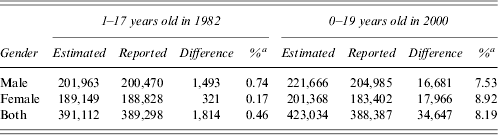
We adopt reverse survival analysis to adjust the statistics of 1- to 17-year-olds in the 1982 census using the data from the 1990 census, in a way very similar to that used in a study on the adjustment of population size and age structure in the 2000 census by Shuzhuo Li et al. Footnote 32Table 1 shows that after adjustment it is estimated that in the 1982 census for the cohorts born between 1964 and 1980, who were 1–17 years old in 1982, the number of individuals under-reported is 1.49 million for men and 0.32 million for women, so 1.81 million for both genders. We use the adjusted age- and sex-specific population for age 1–17 years old in 1982 to estimate the number of missing women.
Reported and estimated population in the 1982 and 2000 censuses (in thousands)
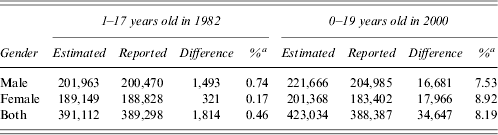
a Calculated by dividing ‘difference’ by ‘estimated’ × 100.
Source: S Li, Q. Jiang and F. Sun, ‘Analysis of the size and structure of China's population in the 2000 census’, Population Journal 28, 5 (2006), 5.
In the 2000 census, Li et al. found that the population aged 0–19 years was under-reported by 16.68 million men and 17.97 million women, a total of 34.65 million for both genders.Footnote 33 The under-reporting rate, shown in Table 1, is therefore relatively much higher than in the 1982 census, and the rate of under-reporting is rather higher amongst women than amongst men. If we use the 2000 census data directly without adjustment to estimate the number of missing women, we will get a deviant result. Therefore, we use the adjusted age-sex-specific population for age 0–19 years old in 2000 to estimate missing women for the 1981–2000 birth cohorts. For details of this adjustment, please refer to Li et al. Footnote 34
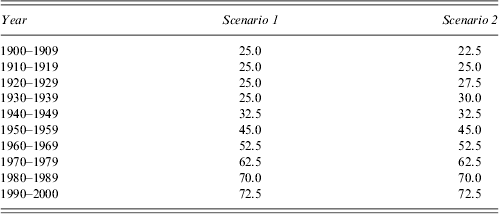
Data for calculating the expected sex ratio also require some discussion. As many other scholars have done,Footnote 35 we chose the Coale–Demeny West model life table as the basis for estimating the number of missing women in China, and also took 106 males per 100 females to be the normal sex ratio at birth. Another factor that has to be considered is female life expectancy at different ages. For life expectancy between 1900 and 1990, we use the data from Coale and BanisterFootnote 36 and Das Gupta and Li.Footnote 37 For life expectancy between 1990 and 2000, we use the estimated values from Li et al.'s ‘Mortality research on China's fifth census data’ as reference.Footnote 38 The specific data are shown in Scenario 1, laid out in Table 2. However, life expectancy may not actually have been constant at 25 years old for the 40 years between 1900 and 1939. Therefore, we employ life expectancy Scenario 2, in which the life expectancy between 1900 and 1939 varies linearly, as shown in Table 2. Generally speaking, as the life expectancy in Scenario 1 is lower for the first four decades, the estimated number of missing women under this Scenario is relatively higher. Therefore, we define the estimated number of missing women based on Scenario 1 as an upper limit and consider this as the main result for discussion, while taking the estimated results based on Scenario 2 as a lower limit.
Estimated female life expectancies at birth (years)
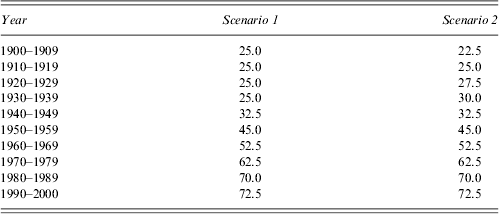
Sources: Years 1900 to 1989 from A. J. Coale and J. Banister, ‘Five decades of missing females in China’, Demography 31, 3 (1994), 478; and M. Das Gupta and S. Li, ‘Gender bias in China, South Korea and India 1920–1990: the effects of war, famine, and fertility decline’, Development and Change 30 (1999), 648. Years 1990 to 2000 from S. Li, F. Sun, Q. Jiang, X. Zou, R. Guan and P. Hu, ‘Mortality research on China's fifth census data’ (in Chinese), in China's transitional population: collection of monograph on 2000 census (Beijing, 2005), 121.
With the above data and methods, we estimate in different periods the number and percentage of missing women by birth cohort between 1900 and 2000. We divide the twentieth century into four periods: the late Qing Empire period (1900–1910), the Republic of China period (1911–1949), the Orthodox Communist period (1950–1979) and the Economic Reform period (1980–2000).
4. NUMBER AND TRENDS OF MISSING WOMEN
Under Scenario 1 in Table 2, our adjusted data and modified methods give the estimated number of missing women across the entire twentieth century in China as 35.59 million, which amounts to 4.65 per cent of the expected number of females without the phenomenon of missing women. If Scenario 2 applies, the number of missing women decreases to 31.78 million and the percentage declines to 4.17.
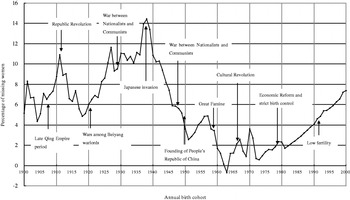
Figure 1 illustrates trends in the estimated upper limit of missing women in birth cohorts between 1900 and 2000. For some cohorts, the estimation refers to pre-mature females. Here we do not identify the difference and use missing women for all the cohorts. The results represent the percentage of missing women for each annual birth cohort as compared with the expected number of females of that specific birth cohort in the corresponding census data.
Percentage of missing women by birth cohorts in corresponding censuses during 1900–2000. The percentage is the number of missing women for those birth cohorts divided by the expected females for those cohorts in the censuses specified in the Methodology section. Birth cohorts 1900 to 1945, 1953 census; birth cohorts 1946 to 1963, 1964 census; birth cohorts 1964 to 1980, 1982 census; birth cohorts 1981 to 2000, 2000 census. (Source: authors' own calculation.)

Figure 1 indicates that the percentage of missing Chinese women varies greatly over the twentieth century. Before 1949, the overall percentage of missing women was relatively high (generally above 6 per cent). In the 1900s, the percentage remained relatively stable, until around 1910, that is, at the end of Qing Empire and the Republican Revolution, when the percentage rose to a local peak of around 11 per cent, after which it declined until 1920. Thereafter the percentage of missing women generally tended to rise until the late 1930s, that is, at the beginning of the war against the Japanese, it reached its highest value for the twentieth century of around 14 per cent, and then began to steadily decline. After 1949, although the percentage of missing women fluctuated, it remained generally below 4 per cent until the late 1970s. Between 1950 and 1980, there are two local peaks on the graph: one is during the Great Famine in the late 1950s when around 5 per cent of women are estimated to have been missing and the other is during the Cultural Revolution in the mid 1960s when approximately 3 per cent of women were missing. With the implementation of the economic reform and strict birth control programme, the percentage of missing women has been continuously increasing since the early 1980s, although the peak value in 2000 is, at just over 7 per cent, still much lower than the maximum for the twentieth century.
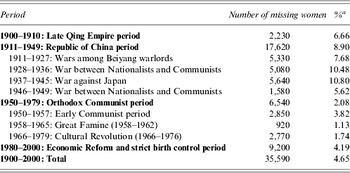
In order to examine reasons for these trends in the percentage of missing women, in Table 3 we present the numbers and percentages of missing women in each period previously defined.
Number and percentage of missing women during the twentieth century, by period (in thousands)

a Calculated as the sum of missing women for those birth cohorts divided by the sum of the expected females for those cohorts in the censuses specified in the methodology section × 100.
Source: Authors' own calculations.
During the late Qing Empire of 1900–1910 and during the Republican Revolution of the early 1910s China experienced political instability and social unrest. The number of missing women from the birth cohorts of 1900–1910 was 2.23 million; 6.6 per cent of the expected total of females for 1900–1910 birth cohorts in the 1953 census.
During the ‘Republic of China’ period, from 1911 to 1949, the number of missing women in the birth cohorts was 17.62 million or a high 8.90 per cent of the expected total of females for 1911–1949 birth cohorts in the corresponding census. This period can be further divided into four smaller periods, as shown in Table 3. The first of these runs from 1911 to 1927. Yuan Shikai, the second president of the Republic of China (Nationalist China) who succeeded Sun Yat-sen, the first president and founding father of the Republic of China, assumed power in 1912, but after his death in 1916 there was a long period of fighting over power and territories among the Beiyang warlords, such as Zhang Zuolin's Fengtian clique in northeastern China, Duan Qirui's Wan clique, and Feng Yuxiang's northwestern clique, who were divided into factions, ushering in a period of regional division in the late 1910s and early 1920s, followed by the war between Nationalists and Beiyang warlords in the mid 1920s. In the second period from 1928 to 1936, the percentage of missing women in the birth cohorts increased because of the fierce conflict among Nationalist warlords and that between the Nationalists and Communists, as well as the resistance against the Japanese invasion of Northern China. The large-scale Japanese invasion of China began in 1937, and the percentage of missing women rose quickly to a maximum during the ensuing war which ran until 1945. During the conflict among the Nationalist warlords and that between the Nationalists and Communists, as well as war against the Japanese invaders, resources were depleted and people were constrained by the limited materials for subsistence. As a result, families would allot the limited food to their sons to ensure their survival and girls were differentiated against in intra-household distributions, or even abandoned. From 1946 to 1949, a war was waged between the Nationalists and the Communists but this was less severe than the war against Japan. People who lived in different territories ruled by different parties were encouraged to grow crops to support military needs, so constraints on food and subsistence materials were to a certain extent relieved. The discrimination against females in terms of food allocation may have been relieved and, as a result, the percentage of missing women declined.
In the ‘Orthodox Communist’ period, from 1950 to 1979, the number of missing women in the birth cohorts reached 6.54 million or 2.08 per cent of the expected number, a notably low level in the context of twentieth-century China. Again, this period can be divided into three shorter periods, but these show little variation in their percentage of missing women, as shown in Table 3. After the founding of the People's Republic of China in 1949, warfare ceased and there was a period of relative social stability and economic prosperity from 1950 to 1957. In 1958, Mao launched the Great Leap Forward, an economic movement through which he envisaged the economy of China overtaking the economies of the United States and United Kingdom within a short period of time. Unfortunately, this strategy resulted in the Great Famine which engulfed the whole of China in the late 1950s and early 1960s. In 1966, Mao launched the Cultural Revolution, in an attempt to maintain the purity of communism and to strengthen his power, resulting in a 10-year period of political turmoil and social instability which lasted until the late 1970s when, with the end of the Cultural Revolution, economic reform began. In 1974, during the Cultural Revolution, the Chinese government established a birth control policy characterised by ‘late marriage and childbearing, more spacing and fewer children’. When the number of children families could have was constrained, people turned to sex-selective abortion to terminate a female fetus or infanticide, to ensure having a son under the limit set. However, the policy was not strictly enforced, so did not drive an increase in the sex ratio at birth.
In 1980, however, the government launched a strict birth control policy, restricting most couples to only one child. This policy, together with rapid economic development and socio-cultural change, caused a steady decline in fertility to below-replacement level; the total fertility rate for 2000, as estimated from the 2000 census, was around 1.5–1.6 children per woman, and that for 2010, estimated from the census of that year, was below 1.5 children per woman.Footnote 39 At such low levels of fertility, parents cannot always guarantee to achieve the gender configuration of their children which they desire, and pre-natal sex identification techniques, such as ultrasound-B, have become widely available to the Chinese population since the late 1980s, allowing sex-selective abortion,Footnote 40 the sex ratio at birth has increased rapidly, from a normal value of around 107 males per 100 females in 1982 to the much higher value of around 120 males per 100 females in 2000. The percentage of missing women in the birth cohorts during the period 1980–2000 has risen steadily, averaging 4.19 per cent and reaching a total of 9.2 million women for those birth cohorts.
It is important that throughout the twentieth century in China, all the peak years in terms of the percentage of missing women, shown in Figure 1, correspond roughly to the occurrence of political and social turmoil or to periods during which family resources were relatively scarce: the Republican Revolution (1910), the Japanese invasion (1937), the Great Famine (1959) and the Cultural Revolution (1966), and after the implementation of the strict birth control policy (1980) which actually restricted the number of children per family. Thus, discrimination against females, as a reflection of the patriarchal and patrilineal systems in China, appears to have intensified in these periods of stress on family resources.Footnote 41 For instance, during the periods of war in the first half of the twentieth century, young men were forced to join the Chinese army, and the common people were required to supply operational rations. They also suffered harassment by the warring militias and had to flee from their hometowns when these came under attack.Footnote 42 Wars, as well as famines, resulted in severe resource scarcity and families would allot their limited resources to their sons who were perceived as more useful. Consequently, girls were seen as a burden and were more likely to suffer discrimination; abandonment and infanticide of female children became widespread, and their mortality rate was also higher than normal during these periods. Such phenomena were seen not only in China, but also in India and South Korea.Footnote 43 However, since the mid 1980s, the main approach used by Chinese couples to achieve the desired gender configuration amongst their children has changed from the infanticide and abandonment of female children used in the first half of the century to sex-selective induced abortion aided by new technology, a shift observed by Coale and Banister.Footnote 44
5. BARE BRANCHES-A DIRECT CONSEQUENCE OF MISSING WOMEN
The phenomenon of ‘missing women’ has made it impossible for many males in China to find a spouse. Referred to as ‘bare branches’ in Chinese, these men are over marriageable age but, involuntarily, unable to marry, and therefore have no wife and children, just like a bare branch of a tree without leaves. Throughout China's history, there have been quite a large number of such men. During the period from the sixteenth century to the late nineteenth century, over 20 per cent of all males in China were considered to be ‘bare branches’. Statistics from the early 1800s show that about one-quarter of males aged 30 to 35 years were single and that 10–15 per cent of 45-year-old males were ‘bare branches’.Footnote 45 A survey carried out by Mao Zedong in the Republic Era showed that a total of 23 per cent of rural peasants were bare branches.Footnote 46 Unlike European countries where high proportions of celibates have been documented amongst both males and females, China only had a high celibacy rate amongst males, while virtually all females were able to get married.
As most bare branches were single involuntarily they sought solutions in less socially acceptable unions and sexual outlets, which led to the popularity of non-mainstream forms of marriage and allegedly to an increase in adultery, prostitution and sexual assaults.Footnote 47 Lower-class bare branches were the least stable elements of the population, and were inclined to commit crimes and generally disrupt the social order.Footnote 48 They played a major role in collective conflicts and were the main source of membership for secret societies, brotherhood associations, bandit groups, and other similar organisations, many of which were viewed as antisocial, before the founding of the People's Republic.Footnote 49 It is estimated that there were large numbers of bandits in the 1920s and 1930s, most of whom were bare branches.Footnote 50 The very lack of a wife drove many bare branches to banditry. Often the motivation for many young males to join such groups was precisely to find a wife and many bandit groups routinely lured young males to their ranks by promising to select female captives for them.Footnote 51
Recently China's bare branches have drawn much attention.Footnote 52 As outlined above, the sex ratio at birth in China began to deviate from the normal range in the early 1980s, and has continued to rise during the past three decades. Though some optimistic research studies assert that the sex ratio at birth in China has begun to decline,Footnote 53 the 2010 census showed a sex ratio at birth of 118.06 males per 100 females for 2010, an increase when compared with the sex ratio of 116.9 males per 100 females seen in the 2000 census. The cohorts born in the 1980s are now of marriageable age. For the years 2015 to 2045, the ratio of potential marriageable males to females is predicted to be over 115:100, and China will face an annual surplus of one million males who cannot find a spouse in the domestic marriage market, because males outnumber females.Footnote 54 As women tend to marry men whose socio-economic status is equal to or higher than their own, it is the men from the lowest socio-economic strata who struggle to find a wife.Footnote 55 Researchers studying the effect of these surplus males on China's socio-economic development have suggested that they may be a source of social instability,Footnote 56 a concern which China's media have recently heightened by reporting the existence of a large number of ‘bare branch villages’ in many provinces, causing grave concern for social stability in these areas.
6. CONCLUSION AND DISCUSSION
Demographic and social issues, such as the size and ageing of the Chinese population, the demand and supply of labour, and the marriage squeeze, have attracted much attention from academics, the general public and the Chinese government. The phenomenon of ‘missing women’ is a key component of these issues. For example, ‘missing women’ may have little influence on the current population size, but its accumulated impact will exert a significant influence upon population growth and result in important social problems.Footnote 57 Using data from five censuses from the second half of the twentieth century, we estimated the number and percentage of missing women across the century in China, and showed how peaks in the numbers of missing women coincided with important historical, political and social events.
Using the assumptions of life expectancy laid out in Scenario 1 in Table 2, the estimated total number of females ‘missing’ from China across the twentieth century from the birth cohorts between 1900 and 2000 is 35.59 million, representing 4.65 per cent of the sum of the expected females for those cohorts in the censuses specified in the methodology section. However, if life expectancy is assumed to increase linearly every 10 years between 1900 and 1939 (that is, Scenario 2 in Table 2), rather than remain stable, then the number of missing women would decrease to 31.78 million and the percentage also decline to 4.17 per cent; the estimates are strongly affected by the choice of key parameters.
The phenomenon of missing women indicates that females in China suffer from discrimination from the moment of conception, inducing a gender imbalance in the Chinese population and causing a male marriage squeeze, as those birth cohorts with a high sex ratio at birth are now gradually reaching marriageable age. The marriage pressure on young men, and the existence of ‘bare branch villages’, may potentially engender further social problems impairing the welfare of the overall society and harming the long-term sustainable development of the Chinese population and society.Footnote 58
Recently, as China's ‘missing women’ and ‘bare branches’ have been given much attention, the Chinese government has become aware of the seriousness of the problem of the country's high sex ratio at birth and has taken a variety of measures aimed at combating it. For example, China's nationwide Care for Girls campaign aims to provide a favourable living environment for girls and to enhance female social status. The campaign itself includes many specific measures such as adding extra scores for girls in high school entrance examination, or giving extra bonuses to families with only daughters In addition, doctors and clinics that practise non-medical abortion are subject to fines or revocation of licences.Footnote 59 China should, on the one hand, strengthen such countermeasures already implemented by its institutions, culture and economy, and, on the other, it should loosen or terminate the stringent fertility policy currently in place. That policy has successfully accomplished its task of controlling population growth and size, and it is now necessary to pay serious attention to the negative side effects it has engendered, and to proceed with its careful modification.
ACKNOWLEDGEMENTS
The work reported in this paper is jointly supported by the 985-3 Project of Xi'an Jiaotong University and the Spanish Ministry of Science and Innovation (CSO2009-11883/SOCI).