Introduction
The genus Parmelia s. str. belongs to the parmelioid crown of Parmeliaceae and includes c. 40 currently accepted species (Divakar et al. Reference Divakar, Crespo, Wedin, Leavitt, Hawksworth, Myllys, McCune, Randlane, Bjerke and Ohmura2015; Molina et al. Reference Molina, Divakar, Goward, Millanes, Lumbsch and Crespo2017). The genus is characterized by having a foliose thallus with simple to furcate and squarrose rhizines, a non-pored epicortex, effigurate to elongate pseudocyphellae on the upper surface, isolichenan, and cylindrical or bifusiform conidia (Crespo et al. Reference Crespo, Kauff, Divakar, Del-Prado, Pérez-Ortega, Amo de Paz, Ferencova, Blanco, Roca-Valiente and Núñez-Zapata2010; Thell et al. Reference Thell, Crespo, Divakar, Kärnefelt, Leavitt, Lumbsch and Seaward2012). Parmelia s. str. is a widespread genus in the Northern Hemisphere distributed in boreal-temperate Europe, North America and eastern Asia (Hale Reference Hale1987; Hawksworth et al. Reference Hawksworth, Blanco, Divakar, Ahti and Crespo2008, Reference Hawksworth, Divakar, Crespo and Ahti2011; Crespo et al. Reference Crespo, Kauff, Divakar, Del-Prado, Pérez-Ortega, Amo de Paz, Ferencova, Blanco, Roca-Valiente and Núñez-Zapata2010). The Australasian species have been segregated in the genus Notoparmelia A. Crespo et al. (Ferencova et al. Reference Ferencova, Cubas, Divakar, Molina and Crespo2014) and previously some East Asian species with punctate pseudocyphellae at the lobe edges were accommodated in the genus Nipponoparmelia (Kurok.) K. H. Moon et al. (Crespo et al. Reference Crespo, Kauff, Divakar, Del-Prado, Pérez-Ortega, Amo de Paz, Ferencova, Blanco, Roca-Valiente and Núñez-Zapata2010). Within Parmelia s. str., the P. saxatilis group is a monophyletic clade that includes P. discordans Nyl., P. ernstiae Feuerer & A. Thell, P. hygrophila Goward & Ahti, P. imbricaria Goward et al., P. mayi Divakar et al., P. omphalodes (L.) Ach., P. pinnatifida Kurok., P. saxatilis (L.) Ach., P. serrana A. Crespo et al., P. submontana Nádv. ex Hale and P. sulymae Goward et al., all accepted species characterized by the presence of simple to bifurcate rhizines on the lower surface (Divakar et al. Reference Divakar, Leavitt, Carmen Molina, Del-Prado, Lumbsch and Crespo2016; Molina et al. Reference Molina, Divakar, Goward, Millanes, Lumbsch and Crespo2017). Of these, seven species (P. discordans, P. ernstiae, P. omphalodes, P. pinnatifida, P. saxatilis, P. serrana and P. submontana) are known from Europe (Hawksworth et al. Reference Hawksworth, Blanco, Divakar, Ahti and Crespo2008). The group has its centre of diversity in temperate regions of the Northern Hemisphere but has a cosmopolitan distribution (Hale Reference Hale1987). While its occurrence in Antarctica has been confirmed with molecular data (Øvstedal & Lewis Smith Reference Øvstedal and Lewis Smith2001; Crespo et al. Reference Crespo, Molina, Blanco, Schroeter, Sancho and Hawksworth2002), its presence in southern South America (Stenroos Reference Stenroos1991; Elvebakk et al. Reference Elvebakk, Bjerke and Stovern2014) and New Zealand (Galloway & Elix Reference Galloway and Elix1983) is not well understood and requires additional studies. Several more or less cryptic species within the complex have been discovered recently in Europe and North America, including P. ernstiae, P. imbricaria, P. mayi, P. serrana and P. sulymae (Feuerer & Thell Reference Feuerer and Thell2002; Molina et al. Reference Molina, Crespo, Blanco, Lumbsch and Hawksworth2004, Reference Molina, Del-Prado, Divakar, Sánchez-Mata and Crespo2011b, Reference Molina, Divakar, Goward, Millanes, Lumbsch and Crespo2017). While the European species of the P. saxatilis complex have been thoroughly studied, the Asian species of the complex are currently less well known.
In the Iberian Peninsula, molecular investigations on Parmelia s. str and parmelioid lichens in general have been carried out over the last two decades. The first molecular phylogeny on parmelioids was published in 1998 (Crespo & Cubero Reference Crespo and Cubero1998), and the first intraspecific molecular studies on P. saxatilis and P. sulcata Taylor were published in 1997, 1999 and 2002 (Crespo et al. Reference Crespo, Bridge, Cubero and Hawksworth1997, Reference Crespo, Bridge, Hawksworth, Grube and Cubero1999, Reference Crespo, Molina, Blanco, Schroeter, Sancho and Hawksworth2002). Subsequently, Molina et al. (Reference Molina, Crespo, Blanco, Lumbsch and Hawksworth2004) described P. serrana in the P. saxatilis group from Spain and confirmed the monophyly of P. ernstiae, reporting it from the Iberian Peninsula. Later, Divakar et al. (Reference Divakar, Molina, Lumbsch and Crespo2005) detected an additional species from the Iberian Peninsula, P. barrenoae Divakar et al., hidden within the collective name P. sulcata. Recently, an additional cryptic species, P. encryptata A. Crespo et al., which is in part sympatric with P. sulcata, was described from the Iberian Peninsula (Molina et al. Reference Molina, Divakar, Millanes, Sanchez, Del-Prado, Hawksworth and Crespo2011a). Apart from these, P. mayi, P. imbricaria and P. sulymae were segregated from P. saxatilis in North America (Molina et al. Reference Molina, Del-Prado, Divakar, Sánchez-Mata and Crespo2011b, Reference Molina, Divakar, Goward, Millanes, Lumbsch and Crespo2017). A first DNA barcode study on Parmelia s. str. species was published in 2016 (Divakar et al. Reference Divakar, Leavitt, Carmen Molina, Del-Prado, Lumbsch and Crespo2016).
In Europe, seven species are currently recognized in the group: Parmelia discordans, P. ernstiae, P. omphalodes, P. pinnatifida, P. saxatilis, P. serrana, and P. submontana (Kurokawa Reference Kurokawa1976; Hale Reference Hale1987; Feuerer & Thell Reference Feuerer and Thell2002; Molina et al. Reference Molina, Crespo, Blanco, Lumbsch and Hawksworth2004; Hawksworth et al. Reference Hawksworth, Blanco, Divakar, Ahti and Crespo2008, Reference Hawksworth, Divakar, Crespo and Ahti2011; Thell et al. Reference Thell, Elix, Feuerer, Hansen, Kärnefelt, Schüler and Westberg2008). The delimitation of P. discordans and P. omphalodes is currently unclear, with ITS sequence data failing to separate the taxa as reciprocally monophyletic clades (Ossowska et al. Reference Ossowska, Guzow-Krzemińska, Kolanowska, Szczepańska and Kukwa2019). However, recent studies using RADseq data suggest that closely related lichen-forming fungal species may require genome-wide data to test their delimitation (Grewe et al. Reference Grewe, Lagostina, Wu, Printzen and Lumbsch2018).
Our studies of parmelioid lichens in the Iberian Peninsula led to the discovery of an additional, hitherto overlooked lineage occurring in southern Spain that is described below, and which represents the eighth species of the P. saxatilis group in Europe. Interestingly, all species of the P. saxatilis complex known to occur in Europe have also been found in the Iberian Peninsula. We discuss this fact and the discovery of the new species which we interpret as a potential relict species in light of the impact of the Pleistocene glaciations on the European lichen flora.
Materials and Methods
Phenotypic examination
This study stems from a two decade-long investigation about the diversity of parmelioid lichens in the Iberian Peninsula. Morphological and anatomical characteristics of samples included in Table 1 were studied using a Nikon SMZ-1500 dissecting microscope and a Nikon Eclipse-80i compound microscope (Nikon, Badhoevedrop, the Netherlands). The images were taken in natural light with a Zeiss Touit 2.8/50 mm macro lens (Carl Zeiss AG, Leipzig, Germany) attached to a Fujifilm XT-1 camera (Fujifilm, Tokyo, Japan). Spot tests and thin-layer chromatography (TLC) were carried out following standard procedures (Orange et al. Reference Orange, James and White2010), using solvent system C, with concentrated acetone extracts at 50 °C spotted onto silica gel 60 F254 aluminium sheets (Merck, Darmstadt, Germany). The aluminium sheets were dried for 10 min in an acetic acid atmosphere to maximize resolution. For synonyms of included species, see elsewhere (Hillmann Reference Hillmann and Rabenhorst1936; Hale Reference Hale1987). For comparison, we examined the morphology of specimens of other Parmelia species, deposited in the herbarium MAF.
Specimens of Parmelia used in this study, including sample code, collection details, voucher and GenBank Accession numbers. Newly obtained sequences for this study are in bold and missing data are indicated with a dash (—).

DNA isolation, PCR amplification and sequencing
Twenty-six specimens representing three species of the Parmelia saxatilis group were selected to obtain new sequences of the internal transcribed spacer (ITS) rDNA and the protein coding single-copy gene Mcm7 (MS456) as molecular markers. For dataset I, a total of 63 specimens were used to generate ITS and Mcm7 sequences. Of these, 34 were newly generated for this study (Table 1). For dataset II, the ITS sequences of 155 specimens from different geographical regions, especially of species belonging to the P. saxatilis complex and representing all species of the P. saxatilis group, were gathered (see Supplementary Material Table S1, available online). Parmelia sulcata was selected as the outgroup since the P. sulcata group is sister to the P. saxatilis group (Molina et al. Reference Molina, Divakar, Goward, Millanes, Lumbsch and Crespo2017).
Total genomic DNA was extracted from fresh and herbarium specimens using the DNeasy Plant Mini Kit (Qiagen, Hilden, Germany) in accordance with the manufacturer's instructions, with the slight modifications described previously (Crespo et al. Reference Crespo, Blanco and Hawksworth2001). Dilutions 1:10 (v:v) of total DNA were used for PCR amplifications of the genes coding for the nuclear ITS and the single-copy gene Mcm7 (MS456). Primers, PCR and Sanger sequencing conditions were as described previously (Schmitt et al. Reference Schmitt, Crespo, Divakar, Fankhauser, Herman-Sackett, Kalb, Nelsen, Nelson, Rivas-Plata and Shimp2009; Molina et al. Reference Molina, Divakar, Goward, Millanes, Lumbsch and Crespo2017).
Sequence alignment and phylogenetic analyses
Sequence fragments generated for this study were assembled and edited using the program SeqMan v.7 (Lasergene R, DNASTAR, Madison, WI, USA). Sequence identity was assessed using the mega-BLAST search function in GenBank (Sayers et al. Reference Sayers, Barrett, Benson, Bolton, Bryant, Canese, Chetvernin, Church, DiCuccio and Federhen2011). Each dataset was aligned separately using MAFFT v.7 (Katoh & Toh Reference Katoh and Toh2008) implementing the G-INS-I alignment algorithm, ‘1PAM/K = 2’ scoring matrix with an offset value of 0.0, and the remaining parameters set to default values. In contrast to the alignment of the Mcm7, the ITS alignment contained a number of ambiguous regions which were removed using the least stringent option in Gblocks v.0.91b (Castresana Reference Castresana2000; Talavera & Castresana Reference Talavera and Castresana2007) on the Gblocks web server (http://molevol.cmima.csic.es/castresana/Gblocks_server.html). Nucleotide substitution models were selected using the Akaike Information Criterion (AIC) (Akaike Reference Akaike1974) as implemented in jModelTest (Posada Reference Posada2008). The general time-reversible (GTR) substitution model, with the assumption of a gamma distribution (GTR + G), was used for the ITS. The GTR substitution model with estimation of invariant sites (GTR + I) was selected for the complete Mcm7 region.
The alignments were analyzed using maximum likelihood (ML) and a Bayesian approach. Maximum likelihood analyses were performed using the RAxML v.8.2.6 program (Stamatakis Reference Stamatakis2006, Reference Stamatakis2014) as implemented on the CIPRES Web Portal, with the GTRGAMMA model. In the concatenated data matrix, a total of five partitions was used for the MrBayes analysis: the two loci were treated as separate partitions and we used a three-partition approach for the protein-coding Mcm7 marker, taking the first, second and third codon positions as separate model partitions. Nodal support was evaluated using the ‘rapid bootstrapping’ option with 1000 replicates (Stamatakis et al. Reference Stamatakis, Hoover and Rougemont2008). We used an ML approach to examine the heterogeneity in the phylogenetic signal between the two loci in the concatenated dataset. The bootstrap support value was used to detect incongruence between the two loci alignments. We interpreted high bootstrap values as being strong support for a particular node and identified the conflicting nodes by comparing each gene partition with a threshold between conflicting (> 70% bootstrap) and non-conflicting (< 70% bootstrap) nodes (Hillis & Bull Reference Hillis and Bull1993). If no conflict was evident, it was assumed that the two datasets were congruent and could be combined.
The Markov chain Monte Carlo (MCMC) analyses were conducted using MrBayes v.3.2.7 (Ronquist et al. Reference Ronquist, Teslenko, van der Mark, Ayres, Darling, Höhna, Larget, Liu, Suchard and Huelsenbeck2012). The concatenated two-locus dataset was partitioned as described in the ML analysis, specifying the best-fitting model as described above, allowing unlinked parameter estimation and independent rate variation. Four parallel runs of eight million generations were produced, starting with a random tree and employing eight simultaneous chains each, in which one in every 1000 trees was sampled. The first 25% of trees was discarded as burn-in of the chains. We used AWTY (Nylander et al. Reference Nylander, Wilgenbusch, Warren and Swofford2008) to compare split frequencies in the different runs and to plot cumulative split frequencies to ensure that stationarity was reached. A majority-rule consensus tree with average branch lengths was calculated using the sumt option in MrBayes. Only clades that received bootstrap support ≥ 70% in the ML analysis and posterior probabilities ≥ 0.95 in the MrBayes analysis were considered to be well supported. Phylogenetic trees were illustrated using FigTree v.1.4.2 (Rambaut Reference Rambaut2009).
Species trees and divergence time estimates
In addition, we performed a divergence time analysis to estimate the split of Parmelia saxatilis and the new taxon described here. Multilocus species tree methods may provide more accurate hypotheses of evolutionary relationships and more biologically realistic estimates of divergence times relative to concatenated gene tree approaches (Heled & Drummond Reference Heled and Drummond2010; McCormack et al. Reference McCormack, Heled, Delaney, Peterson and Knowles2011). Thus, we used the coalescent-based hierarchical Bayesian model StarBEAST2 implemented in BEAST v.2.4.3 (Bouckaert et al. Reference Bouckaert, Heled, Kuehnert, Vaughan, Wu, Xie, Suchard, Rambaut and Drummond2014) to estimate a species tree and divergence times for the Parmelia saxatilis group. StarBEAST2 estimates the species tree directly from the sequence data and incorporates the coalescent process and the uncertainty associated with gene trees and nucleotide substitution model parameters (Heled & Drummond Reference Heled and Drummond2010). As population assignments are required a priori for StarBEAST2 analyses, we assigned all individuals with multilocus sequence data to a ‘species’ group based on the monophyletic cluster recovered in the ITS gene tree and that corresponded to previously recognized species-level lineages based on DNA barcode analyses (Divakar et al. Reference Divakar, Leavitt, Carmen Molina, Del-Prado, Lumbsch and Crespo2016). We used the molecular evolution rates for ITS estimated for Melanelixia O. Blanco et al. (2.43 × 10⁻⁹ substitution per site per year) (Leavitt et al. Reference Leavitt, Esslinger, Divakar and Lumbsch2012a) to estimate the time to the most recent common ancestor (MRCA). This rate is similar to other estimates of ITS substitution rates for lichen-forming fungi (e.g. 2.38 × 10⁻⁹ substitution per site per year, Oropogon Th. Fr., Parmeliaceae; Leavitt et al. Reference Leavitt, Esslinger and Lumbsch2012b) and a non-lichenized fungus (2.52 × 10⁻⁹ substitution per site per year, Erysiphales; Takamatsu & Matsuda Reference Takamatsu and Matsuda2004). The partitioned data matrix was analyzed in BEAST v.2.4.3 (Drummond & Rambaut Reference Drummond and Rambaut2007; Drummond et al. Reference Drummond, Suchard, Xie and Rambaut2012; Bouckaert et al. Reference Bouckaert, Heled, Kuehnert, Vaughan, Wu, Xie, Suchard, Rambaut and Drummond2014), using a relaxed clock model (uncorrelated lognormal), implementing a Yule model prior for the node heights and gamma-distributed population sizes for the species tree prior and a piecewise linear population size model with a constant root. Analyses were performed using two independent MCMC runs of 50 million generations, with a sampling tree every 5000th generation. The program Tracer was used to evaluate chain mixing and convergence, considering effective sample size (ESS) values > 200 as a good indicator. The trees of the two runs were combined using LogCombiner v.2.4.3 after excluding the first 25% of sampled trees as burn-in. TreeAnotator v.2.4.3 (Drummond et al. Reference Drummond, Suchard, Xie and Rambaut2012; Bouckaert et al. Reference Bouckaert, Heled, Kuehnert, Vaughan, Wu, Xie, Suchard, Rambaut and Drummond2014) was used to obtain the median node heights and posterior distributions of estimated divergence dates of the sampled trees. Node age and 95% highest posterior density (HPD) were mapped on the maximum clade credibility (MCC) tree.
Species delimitation in the Parmelia saxatilis group was also tested using the multispecies coalescent model implemented in the program BP&P v.3.2 (Yang & Rannala Reference Yang and Rannala2014). BP&P has been shown to be among the most accurate empirical species delimitation methods (Dowton et al. Reference Dowton, Meiklejohn, Cameron and Wallman2014; Leavitt et al. Reference Leavitt, Divakar, Crespo and Lumbsch2016). The posterior distribution for species delimitation models is sampled using a reversible-jump Markov chain Monte Carlo (rjMCMC) method. We used the unguided species delimitation algorithm (Yang Reference Yang2015). This algorithm explores different species delimitations and different species phylogenies, with fixed specimen assignments to populations. The program attempts to merge populations into one species and uses the nearest neighbour interchange (NNI) or subtree pruning and regrafting (SPR) algorithms to change the species tree topology (Yang & Rannala Reference Yang and Rannala2014). BP&P gives the posterior probability of each delimited species and the posterior probability for the total number of delimited species. The species tree from StarBEAST2 was used to infer the speciation probabilities by BP&P which incorporates the NNI algorithm that allows changes in the species tree topology, eliminating the need for a fixed user-specified guide tree. The data was analyzed with both algorithms 0 and 1: using theta (θ) prior assigned to gamma distributions of G~ (2, 100), assuming intermediate ancestral population sizes; combined with root age (τ0) assigned G~ (2, 2000), assuming relatively shallow divergences among species. Rates were allowed to vary among loci (locus rate = 1), and the analyses were set for automatic fine-tune adjustments. The prior distribution of θ and τ0 can result in strong support for models containing more species (Leaché & Fujita Reference Leaché and Fujita2010). Therefore, exploratory analyses were also performed using different combinations of the theta (θ) and tau (τ) priors spanning a range of possible population sizes and divergence times (results not shown). Each rjMCMC analysis was run for 100 000 generations, sampling each generation, and specified a burn-in of the first 8000 generations. Each analysis was run twice to confirm consistency between runs.
Results and Discussion
Molecular analyses
Thirty-four new sequences were generated for this study and aligned with 68 sequences obtained from previous studies published by our Parsys working group (Table 1; Divakar et al. Reference Divakar, Crespo, Wedin, Leavitt, Hawksworth, Myllys, McCune, Randlane, Bjerke and Ohmura2015; Molina et al. Reference Molina, Divakar, Goward, Millanes, Lumbsch and Crespo2017). The final, concatenated, two-locus alignment contained 1121 aligned positions, of which 147 were variable. Of these variable characters, 90 occurred in the ITS region and 57 in the Mcm7. The single-locus phylogenies showed no conflict (data not shown) and hence a concatenated analysis was performed. The partitioned ML analysis of the concatenated data matrix yielded the optimal tree with a likelihood value of Ln = −2753.88. The mean LnL value of the four parallel runs of the Bayesian analysis was −2807.10 with a standard deviation of ±7.84. The Bayesian phylogeny and ML tree were largely congruent and therefore only the 50% majority-rule consensus tree of the Bayesian tree sampling is shown, with bootstrap (BS) values ≥ 70% and posterior probability (PP) values ≥ 0.95 indicated on the nodes (Fig. 1). For the Bayesian analyses, ESS values were high (> 200) for all parameters indicating adequate sampling of the posterior distribution.
Phylogenetic relationships of Parmelia spp. of the P. saxatilis group based on a Bayesian analysis of a concatenated dataset set of ribosomal (ITS) and nuclear protein-coding (Mcm7) markers. Bayesian posterior probabilities ≥ 0.95 from the MrBayes analysis and maximum likelihood (ML) bootstrap values ≥ 70% from the RAxML (Stamatakis Reference Stamatakis2006, Reference Stamatakis2014) analysis are indicated above branches. The country and province from which individuals were collected is indicated in parentheses. Parmelia sulcata was used as outgroup.

The larger dataset of the ITS marker including 155 samples contained 479 aligned positions, of which 117 were variable. The resulting ML phylogenetic tree is illustrated in Supplementary Material Fig. S1 (available online). All new sequences generated for this study have been deposited in GenBank under accession numbers MT580478–MT580503 and MT583819–MT583826.
The phylogenetic tree (Fig. 1) based on the concatenated dataset showed most currently accepted species in the Parmelia saxatilis complex, for which more than one sequence was included, as well-supported monophyletic groups with the exception of P. hygrophila which was paraphyletic with a monophyletic P. submontana nested within as in a previous study (Molina et al. Reference Molina, Divakar, Goward, Millanes, Lumbsch and Crespo2017). Most relationships among species in the group lacked support, with the exception of the sister-group relationship of P. serrana and P. sulymae, and the sister-group relationship of P. saxatilis s. str. and a clade consisting of samples from southern Spain, which is described below as a new species. The sister-group relationship of the former agreed with a previous study, although only one sample of P. serrana was included there (Molina et al. Reference Molina, Divakar, Goward, Millanes, Lumbsch and Crespo2017).
The MCC species tree is depicted in Fig. 2. The diversification of the Parmelia saxatilis group was estimated to have begun during the late Miocene, c. 8.47 Ma (95% HPD = 5.28–11.44 Ma) (Fig. 2). Moreover, our analysis of divergence times by the species tree approach revealed estimates for divergences within the P. saxatilis group that were similar to those found in a previous study (Molina et al. Reference Molina, Divakar, Goward, Millanes, Lumbsch and Crespo2017). The separation of the P. saxatilis s. str. lineage and the new taxon was estimated to have occurred during the Pleistocene, c. 2.13 Ma (95% HPD = 0.52–3.76 Ma). This separation was also supported by the species tree with a PP value of 0.97 (Fig. 2). Climatic changes during the Pleistocene are hypothesized as being a major contributor to biological diversity (Moyle et al. Reference Moyle, Filardi, Smith and Diamond2009). Parmelia serrana is another morphologically cryptic species of this complex, which is sympatric with the new taxon. However, it is phylogenetically distinct and formed a strongly supported sister relationship with a North American endemic species, P. sulymae (Fig. 1). Remarkably, P. serrana diverged from its closest extant relative, P. sulymae, much earlier than Parmelia saxatilis s. str. and the new taxon, during the Pliocene, c. 4.78 Ma (95% HPD = 1.82–7.73) (Fig. 2). This is correlated with the appearance of the Mediterranean climatic rhythm causing evolution of Mediterranean vegetation (Suc Reference Suc1984). The Mediterranean climatic conditions consist of a temperate climate characterized by dry summers with rainfall concentrated during the other seasons and lower temperatures during winter. The split of P. discordans and P. omphalodes occurred during the Pleistocene, c. 2.09 Ma (95% HPD = 0.52–4.01) and this is in concordance with our previous study (Molina et al. Reference Molina, Divakar, Goward, Millanes, Lumbsch and Crespo2017).
Time-calibrated species trees for Parmelia spp. (P. saxatilis group) inferred from two loci (ITS and Mcm7) using the program StarBEAST2 (Bouckaert et al. Reference Bouckaert, Heled, Kuehnert, Vaughan, Wu, Xie, Suchard, Rambaut and Drummond2014). Putative species used in the StarBEAST2 analysis were based on our previous DNA barcoding study of Parmelia (Divakar et al. Reference Divakar, Leavitt, Carmen Molina, Del-Prado, Lumbsch and Crespo2016). Posterior probabilities (PP) ≥ 0.50 are shown above branches. The 95% highest posterior density intervals (HPD) are shown as dark grey bars, and numbers below the nodes indicate estimated node ages (millions of years ago, Ma). The posterior probabilities of each delimited species calculated by BP&P (Yang & Rannala Reference Yang and Rannala2014) are indicated on the right side of each putative species. The grey box indicates species/lineages not supported as separate species by BP&P.

Parmelia saxatilis s. str. and the new species were supported as distinct taxa (PP values 0.93) by a multispecies coalescent-based species delimitation approach and the BP&P (Fig. 2). BP&P provides the posterior probability of each delimited species and the posterior probability for the number of delimited species in a group. Within the P. saxatilis group, BP&P supported the presence of 11 species (including the newly discovered taxon) with the highest probability (PP = 0.4964), in contrast to the current 12 species scenario based on phenotypic features. Posterior probabilities of each delimited species are provided in Fig 2. Parmelia hygrophila and P. submontana were not supported as separate species by BP&P. This is in agreement with the results of our phylogenetic analyses and a previous study (Molina et al. Reference Molina, Divakar, Goward, Millanes, Lumbsch and Crespo2017). The separation of P. discordans and P. omphalodes was weakly supported by BP&P analysis (see Fig. 2).
It is worth emphasising that out of 47 samples analyzed of the Parmelia saxatilis complex from different localities in the Iberian Peninsula (including two from the Canary Islands), 34 were grouped in the P. serrana clade, seven in the P. ernstiae clade, five belonged to the newly described species and just one sample grouped in the P. saxatilis s. str. clade; this suggests that the presumed widespread P. saxatilis s. str. is indeed a rare species in the Iberian Peninsula (Supplementary Material Fig. S1). Parmelia serrana seems to be the most widespread taxon in the P. saxatilis complex and is more successful in colonizing diverse habitats in the Iberian Peninsula, including the Canary Islands. We hypothesized that the appearance of a Mediterranean climatic rhythm might have played a crucial role in the diversification of P. serrana in the Iberian Peninsula. However, this needs to be confirmed by an additional population-scale study of the P. saxatilis complex. Within other parts of Europe, different proportions of species in the complex are found, with some strong signatures of climatic response (Thell et al. Reference Thell, Tsurykau, Persson, Hansson, Åsegård, Kärnefelt and Seaward2017; Corsie et al. Reference Corsie, Harrold and Yahr2019; Tsurykau et al. Reference Tsurykau, Bely, Golubkov, Persson and Thell2019). Similarly, samples analyzed from outside Europe such as individuals from Antarctica, Canada, Chile, the Kola Peninsula (Russia) and the USA belonged to P. saxatilis s. str. However, samples from Morocco, the Republic of Adygea (Russia), South Korea and Turkey were grouped in the P. serrana clade (see Supplementary Material Fig. S1).
The discovery of a new lineage in southern Spain and the fact that all species of the Parmelia saxatilis complex occurring in Europe also occur in Spain is remarkable and allows us to hypothesize that the Iberian Peninsula might have served as a refugium for this group of lichens during Pleistocene glaciations. Pleistocene glaciations had major impacts on the temperate flora and fauna (Hewitt Reference Hewitt2000, Reference Hewitt2004), and were especially severe in Europe where the Alps formed a major barrier for these moving populations (Taberlet et al. Reference Taberlet, Fumagalli, Wust-Saucy and Cosson1998; Hewitt Reference Hewitt2000). In his seminal paper, Poelt (Reference Poelt1963) discussed the impact of the glaciations on the lichen flora in Europe and the potential survival of species there with oceanic distributional patterns (such as most species in the P. saxatilis complex) in close proximity to glaciers. The Iberian Peninsula was characterized by a cold-adapted fauna and flora during the Pleistocene (Sala et al. Reference Sala, Pablos, Gómez-Olivencia, Sanz, Villalba, Pantoja-Pérez, Laplana, Arsuaga and Algaba2020), so that survival of species of the complex seems plausible. The Iberian Peninsula has been discussed as an important refugial area for plants (de Heredia et al. Reference de Heredia, Carrion, Jimenez, Collada and Gil2007; Postigo-Mijarra et al. Reference Postigo-Mijarra, Morla, Barron, Morales-Molino and Garcia2010) and also lichen-forming fungi (Barreno Reference Barreno1991). Recent molecular data are consistent with the Iberian Peninsula having been a refugial area for lichenized fungi (Núñez-Zapata et al. Reference Núñez-Zapata, Cubas, Hawksworth and Crespo2015; Alors et al. Reference Alors, Dal Grande, Cubas, Crespo, Schmitt, Molina and Divakar2017; Fackovcova et al. Reference Fackovcova, Slovak, Vdacny, Melicharkova, Zozomova-Lihova and Guttova2019). A population-level biological study will be necessary to test our hypothesis of refugial survival of species in the P. saxatilis complex in the Iberian Peninsula.
Species of the Parmelia saxatilis complex are widely distributed in all continents except Australia and the diversification occurred during the Pleistocene. Our results allow us to hypothesize that long-distance dispersal might have played a crucial role in colonizing transcontinental regions. In lichenized fungi, wide distributional ranges have often been attributed to long-distance dispersal (Geml et al. Reference Geml, Kauff, Brochmann and Taylor2010; Amo de Paz et al. Reference Amo de Paz, Crespo, Cubas, Elix and Lumbsch2012; Del-Prado et al. Reference Del-Prado, Blanco, Lumbsch, Divakar, Elix, Molina and Crespo2013; Leavitt et al. Reference Leavitt, Fernández-Mendoza, Pérez-Ortega, Sohrabi, Divakar, Vondrák, Lumbsch and St. Clair2013, Reference Leavitt, Kirika, Amo de Paz, Huang, Hur, Grewe, Divakar and Lumbsch2018; Núñez-Zapata et al. Reference Núñez-Zapata, Alors, Cubas, Divakar, Leavitt, Lumbsch and Crespo2017; Cubas et al. Reference Cubas, Lumbsch, Del-Prado, Ferencova, Hladun and Divakar2018; Divakar et al. Reference Divakar, Wei, McCune, Cubas, Boluda, Leavitt, Crespo, Tchabanenko and Lumbsch2019).
Taxonomy
Parmelia discordans Nyl.
Meddn. Soc. Fauna Flora Fenn. 13, 40 (1886); type: Russia [formerly Finland], Hogland Island [=Gogland, Suursaari], 1868, Brenner (H-NYL 34916―lectotype).
Distinguished by an absence of soralia and isidia, a uniformly dark brown thallus, laminal and marginal pseudocyphellae, non-squarrose rhizines, and by containing protocetraric and ±lobaric acids as characteristic substances (Thell et al. Reference Thell, Thor, Ahti, Thell and Moberg2011).
Additional specimen examined
Spain: Asturias: Caso, Campo de Caso, Parque Natural de Redes, carretera de Campo de Caso a Tarna, km 57, cañón del río Nalón, 43°07ʹ01ʺN, 05°15ʹ15ʺW, 870 m, 2012, V. J. Rico 4441 (MAF-Lich. 17865).
Parmelia ernstiae Feuerer & A. Thell
Mitt. Inst. Allgem. Bot. Hamburg 30-32, 52 (2002); type: Germany, Niedersachsen, Lüneburg, Soltau-Fallingbostel, Hof Möhr, Alfred Töpfer Academy of Nature Conservation, on Fraxinus excelsior, 80 m, 14 April 2000, G. Ernst (HBG 4619―holotype).
Morphologically and chemically close to the Parmelia saxatilis agg. (Corsie et al. Reference Corsie, Harrold and Yahr2019). In our areas it is distinguished from other isidiate species by producing lobaric and salazinic acids as main substances and by occurring only on tree bark, although these features are not consistent in other geographical regions. See Table 1 for specimens studied. The Iberian Peninsula material contained atranorin and chloroatranorin, together with salazinic, consalazinic, lobaric, protolichesterinic and lichesterinic acids.
Parmelia omphalodes (L.) Ach.
Meth. Lich., 204 (1803); type: Dillenius, Historia Muscorum, Tab. 24, fig. 80A, (1741) (OXF―lectotype).
The species is characterized by the absence of isidia and soredia, non-squarrose rhizines, marked laminal and marginal pseudocyphellae, laminal pseudocyphellae mostly unconnected with marginal ones and the presence of salazinic and ±lobaric acids as characteristic substances (Thell et al. Reference Thell, Thor, Ahti, Thell and Moberg2011; Ossowska et al. Reference Ossowska, Guzow-Krzemińska, Kolanowska, Szczepańska and Kukwa2019). See Table 1 for specimens studied.
Parmelia pinnatifida Kurok.
J. Jap. Bot. 51, 378 (1976); type: Helvetia, Schleicher 257 (H-ACH 1297A―lectotype).
Morphologically close to Parmelia omphalodes, but distinguished by a uniform dark brown thallus, narrower and overlapping lobes, mainly marginal pseudocyphellae and salazinic, protolichesterinic and ±lobaric acids as characteristic substances (Thell et al. Reference Thell, Thor, Ahti, Thell and Moberg2011).
Additional specimen examined
Spain: Navarra: carretera de Elizondo-Bearzun, km 5, 400 m, 22 v 1994, J. Etayo (MA-Lichen 5794).
Parmelia rojoi A. Crespo, V. J. Rico & Divakar sp. nov.
MycoBank No.: MB 835851
Differing from Parmelia saxatilis by having a more fragile thallus and narrower isidia. It is supported as a distinct lineage from other Parmelia species according to ITS sequences and by coalescent-based genetic analyses of multiple loci (Figs 1 & 2).
Type: Spain, Andalucía, Málaga, Cortes de La Frontera, Parque Natural de Los Alcornocales, La Sauceda, 487 m, 36°31ʹ45.4ʺN, 05°35ʹ10.5ʺW, 18 October 2018, A. Crespo, V. J. Rico, P. K. Divakar & C. Ruibal DNA6593, 6600 (MAF-Lich. 22797―holotype; 22798―isotype). GenBank Accession numbers: MT580485 (ITS), MT583824 (Mcm7).
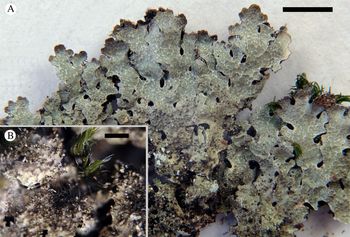
(Fig. 3)
Parmelia rojoi (holotype). A, habitus. B, detail of isidia. Scales: A = 5 mm; B = 1 mm. In colour online.

Thallus saxicolous, orbicular to irregular, loosely to moderately attached, up to 5 cm diam. Lobes fragile when dry, linear to branched, contiguous to slightly imbricate, up to 4.5 mm wide; upper surface grey, brownish and slightly pruinose mainly on margins, dull, smooth to finely reticulate or foveolate and cracked, tips square to rounded; margins developing sparse secondary lobules; lower surface black to brown at margins, with black, simple to furcate, abundant, not squarrose rhizines. Pseudocyphellae marginal and laminal, effigurate, numerous across the surface, linear to mainly irregularly shaped but forming a continuous network. Isidia laminal, globose to frequently cylindrical and branched, up to 0.15 mm diam., fragile when dry, with brownish tips, rarely spathulate then forming laminal secondary lobules. Medulla white.
Apothecia unknown.
Pycnidia sparse and immersed in lobe margins; conidia 5.5–7.5 × 1 μm.
Secondary chemistry
Medulla C−, K+ red, KC−, P+ orange. TLC: atranorin (major), chloroatranorin, lichesterinic, protolichesterinic, galbinic, salazinic (major) and consalazinic acids. Lobaric acid absent.
Etymology
The species is named in honour of Juan M. Rojo, Professor of Physics and friend of the authors.
Habitat and distribution
So far known only from the Cádiz and Málaga provinces in southern Spain at lower elevations (c. 487 m). It is a saxicolous species growing on sun-exposed sandstones in humid forests of different Quercus and Olea species. It is sympatric with Parmelia serrana and also with the epiphytic P. ernstiae.
Notes
This is an almost cryptic species segregated from Parmelia saxatilis, from which it is morphologically and chemically only slightly different but genetically distinct (Figs 1 & 2). Parmelia rojoi differs from P. saxatilis in two minor features: it develops a more fragile thallus and narrower isidia; and contains lichesterinic and protolichesterinic acids, with an absence of lobaric acid. In isidia morphology and chemistry it is also similar to P. ernstiae and P. serrana; however, P. ernstiae from the Iberian Peninsula contains lobaric acid and P. serrana has mainly clustered laminal isidia or along margins and ridges. It is worth noting that in the absence of consistent diagnostic features, ITS sequence-based sample identification of this newly described species is highly recommended.
Only five sterile specimens from Málaga and Cádiz (Spain) are known of this taxon (see also Table 1).
Parmelia saxatilis var. glauca Maheu & Gillet, described from Agla, close to the coast of Tangier on rocks in Morocco (Maheu & Gillet Reference Maheu and Gillet1925), could be conspecific with P. rojoi but unfortunately we have not been able to study material of this taxon.
Parmelia saxatilis (L.) Ach.
Meth. Lich., 204 (1803); type: Sweden, sine loc., c. 1740, C. Linnaeus (LINN 1273⋅62, second specimen from the bottom―lectotype); Sweden, Västerbotten, Umeå, October 1998, S. Ott (MAF-Lich. 6882―epitype).
Morphologically characterized by mainly laminal isidia, which are globose to frequently cylindrical and branched, up to 0.3 mm diam. and a thicker thallus than the closely related P. rojoi. The Iberian Peninsula material contained atranorin and chloroatranorin, together with salazinic, consalazinic and sometimes ±lobaric acid. A detailed description of morphological and chemical features can be found in Molina et al. (Reference Molina, Crespo, Blanco, Lumbsch and Hawksworth2004, Reference Molina, Del-Prado, Divakar, Sánchez-Mata and Crespo2011b).
Additional specimens examined
Spain: Castilla y León, Ávila: Candeleda, desde el Refugio Albarea hasta Puerto de Candeleda, sobre roca, 10 vii 2015, P. K. Divakar & F. Dal Grande (MAF-Lich. 21288); ibid., Sierra de Gredos, 2300 m, v 1999 (MAF-Lich. 6883).
Parmelia serrana A. Crespo, M. C. Molina & D. Hawksw
In Molina et al., Lichenologist 36, 48 (2004); type: Spain, Madrid, Sierra del Guadarrama, Navacerrada, S of Antón Real, close to the junction of roads M 601 and M 607, 40°43.996ʹN, 04°01.438ʹW, alt. 1300 m, on Quercus pyrenaica, 4 February 2003, A. Crespo & P. K. Divakar (MAF-Lich. 9756―holotype; BM, HBG, TNS, UPS, US―isotypes).
Morphologically and chemically this species is close to the Parmelia saxatilis agg. (Corsie et al. Reference Corsie, Harrold and Yahr2019). In our analyzed material it is distinguished from other isidiate species by producing salazinic and protolichesterinic acids as main substances, developing mainly clustered laminal isidia or along margins and ridges, and by being mostly saxicolous. See Table 1 for specimens studied. The Iberian Peninsula material contained atranorin and chloroatranorin, together with salazinic, consalazinic, protolichesterinic and lichesterinic acids but lobaric acid was not detected. However, lobaric acid is reported in northern European samples (Thell et al. Reference Thell, Tsurykau, Persson, Hansson, Åsegård, Kärnefelt and Seaward2017; Corsie et al. Reference Corsie, Harrold and Yahr2019; Tsurykau et al. Reference Tsurykau, Bely, Golubkov, Persson and Thell2019), and the sample identification requires confirmation in a multilocus phylogeny including a coalescent-based species delimitation approach. A detailed description of morphological and chemical features can be found in Molina et al. (Reference Molina, Crespo, Blanco, Lumbsch and Hawksworth2004, Reference Molina, Del-Prado, Divakar, Sánchez-Mata and Crespo2011b).
Parmelia submontana Nádv. ex Hale
Smithson. Contrib. Bot. 66, 44 (1987); type: Czech Republic, Bohemia, Hlinsko, Planavy, 1931, Nádvorník s. n. (PRM—lectotype; US―isolectotype).
Distinguished by long, sparingly branched, down-rolled lobes, numerous orbicular soralia with isidia-like structures, small pseudocyphellae, sparse, mostly simple rhizines, and salazinic acid as the main substance (Hale Reference Hale1987; Thell et al. Reference Thell, Thor, Ahti, Thell and Moberg2011). See Table 1 for specimens studied.
Key to the species of the Parmelia saxatilis group in Europe
1 Thallus without soredia or isidia, saxicolous species 2
Thallus sorediate or isidiate 4
2(1) Medulla K−, with protocetraric and ±lobaric acids as characteristic substancesParmelia discordans
Medulla K+ red, with salazinic and ±lobaric acids as characteristic substances 3
3(2) Lobes usually up to 2 mm wide, pseudocyphellae mainly marginalParmelia pinnatifida
Lobes usually up to 4 mm wide, pseudocyphellae marginal and laminalParmelia omphalodes
4(1) Thallus sorediate to sorediate-isidiate, epiphytic species; lobes elongate, sparingly branched Parmelia submontana
Thallus isidiate 5
5(4) Mainly epiphytic Parmelia ernstiae
Mainly saxicolous 6
6(5) Isidia laminal or along margins or ridges, clustered Parmelia serrana
Isidia mainly laminal, preferably in the central part 7
7(6) Isidia up to 0.3 mm in diameter Parmelia saxatilis
Isidia up to 0.15 mm in diameter, thallus fragile Parmelia rojoi
Acknowledgements
This study was supported by the Spanish Ministerio de Ciencia e Innovacion (CGL2013-42498-P, PID2019-105312GB-I00) and the Santander-Universidad Complutense de Madrid (PR75/18-21605, PR87/19-22637 and G/6400100/3000). Sequencing was performed in the Centro de Genómica y Proteómica del Parque Científico de Madrid, where Maria Isabel García Saez is especially thanked. We gratefully acknowledge the valuable feedback from two anonymous reviewers and the editor, that greatly improved this study. We also thank the Parque Natural de Los Alcornocales staff (Cádiz) for providing permission and facilities to collect specimens of Parmeliaceae.
Author ORCID
Pradeep Divakar, 0000-0002-0300-0124.
Supplementary Material
To view supplementary material for this article, please visit https://doi.org/10.1017/S0024282920000341