Italy is the fifth country for goat milk production in the European Union (FAOSTAT, 2009) and goat milk is even more appreciated by the consumers and the dairy industry. Owing to the increasing utilization of goat milk in the cheese industry, the study of rennet coagulation of milk is a central topic in dairy technology and several methods have been proposed. Formagraph, since it was invented in 1980, is one of the most utilized instruments (Kübarsepp et al. Reference Kübarsepp, Henno, Kärt and Tupasela2005) and it is based on the optical measurement of the time required for the formation of the coagulum and its firmness. Formagraph instrument senses the drag force of the milk clot (O'Callaghan et al. Reference O'Callaghan, O'Donnell and Payne2002), evaluating the movement of loop pendulums immersed in linearly oscillating samples of coagulating milk (Mc Mahon & Brown, Reference McMahon and Brown1982). It is a time-consuming technique, because each analysis takes at least 30 minutes. For this reason, it is difficult to observe coagulation properties of fresh milk of many animals in a short time. Mid-infrared spectroscopy has been proposed as an alternative technique for assessing milk coagulation properties of a large number of cows, such as in sire evaluation (Dal Zotto et al. Reference Dal Zotto, De Marchi, Cecchinato, Penasa, Cassandro, Carnier, Gallo and Bittante2008). However, the cost of milk analyzers based on infrared reflectance spectroscopy, even if they are able to measure many milk traits other than renneting properties (De Marchi et al. Reference De Marchi, Fagan, O'Donnell, Cecchinato, Dal Zotto, Cassandro, Penasa and Bittante2009), is about four- or fivefold higher than those utilizing the optical measurement of coagulating milk.
Time-related inconveniences deriving from the Formagraph method could be overcome through storage of milk samples and postponement of analyses. The study of renneting properties of goat milk has begun in the 1980s (Ambrosoli et al. Reference Ambrosoli, Di Stasio and Mazzocco1988), and many researchers have dealt with the effects of genetic basis (Vegarud et al. Reference Vegarud, Devold, Opheim, Loeding, Svenning, Abrahamsen, Lien and Langsrud1999; Clark & Sherbon, Reference Clark and Sherbon2000), heat (Raynal & Remeuf, Reference Raynal and Remeuf1998; Alloggio et al. Reference Alloggio, Caponio, Pasqualone and Gomes2000), cooling at 4°C (Raynal & Remeuf, Reference Raynal and Remeuf2000), calcium addition (Castillo et al. Reference Castillo, Payne, Hicks, Laencina and López2002) and ultrafiltration (Espinoza & Calvo, Reference Espinoza and Calvo1998; Mehaia & El-Khadragy, Reference Mehaia and El-Khadragy1998) treatments on rennetability of goat milk. To our knowledge and on the basis of the most common database of science research literature, no study has examined the relationships between goat milk after freezing at low-temperatures or preservative treatment and its renneting properties.
With the aim to achieve more knowledge on the analysis of coagulation characteristics using the Formagraph method, this study was designed to investigate the effect of storage by means of a chemical preservative-compound or freezing at different low temperatures on renneting properties of individual goat milk samples, with regards to the influence of the stage of lactation and the farm.
Materials and Methods
Animals and samples
The study was performed in three commercial goat farms (F1, F2 and F3) located in Sardinia, Italy. Fifty-five healthy goats in F1, 56 in F2 and 58 in F3 were randomly selected among the five-year-old goats at fourth parturition which occurred in the first ten days of February. All the goats were of Sarda breed; they were extensively reared, fed pasture and hand-milked once daily in the morning.
Milk samples were taken at monthly intervals, throughout the entire lactation, from March (45 days in milking) to July (165 days in milking, before the goats entered the dry period). For each goat, an individual milk sample was collected in two 50 ml sterile plastic containers and transported at +4°C to the laboratory within 2 h after collection.
Analysis of milk, storage and renneting procedures
With the aim to provide a general view on the data regarding milk characteristics, the first container was analysed for total protein, fat, lactose content and pH according to the International Dairy Federation (IDF) standard (IDF 141C:2000) by using an I.R. spectrophotometer (Milko-Scan 133B; Foss Electric, DK-3400 Hillerød, Denmark), and freezing point (FP) in Hortvet degrees (H°) according to IDF 108:2002 by a thermistore cryoscope (Astor 4000/SE Double; Astori Tecnica, Poncarale BS, Italy). Data according to the farm and the stage of lactation are shown in Table 1.
Means±standard deviation of milk composition, freezing point (FP) and pH of fresh milk, according to the farm and the stage of lactation measured as days in milking

F: farm; DIM: days in milking
The second container was divided in four subsamples of 10 ml each to determine coagulation properties. The first subsample was kept at +4°C and analysed within 12 h after collection to obtain data from fresh milk (subsample FM). The other subsamples were analysed after storage. The second subsample (Bronopol, BP) was combined with 50 μl of the preservative compound Bronopol (Knoll Pharmaceuticals, Nottingham, UK) and analysed after it was held for 24 h at room temperature (+25°C). Because of its action on the microbial membrane which brings about the production of free radicals, growth inhibition and death of bacteria (Butler & Stergiadis, Reference Butler and Stergiadis2011), Bronopol is commonly used as a preservative. It is officially approved for milk production controls of the Italian National Association of Breeders (2008) and also suitable for measurement of rennet clotting time (Dal Zotto et al. Reference Dal Zotto, De Marchi, Cecchinato, Penasa, Cassandro, Carnier, Gallo and Bittante2008). Furthermore, it has little effect on milk composition during a wide range of routine analyses such as mid-infrared (Barbano et al. Reference Barbano, Wojciechowski and Lynch2010) or fatty acid profiles (Butler & Stergiadis, Reference Butler and Stergiadis2011). The third subsample (F-20) was kept for 48 h at −20°C and analysed after thawing at room temperature (+25°C). The fourth subsample (F-80) was kept for 72 h at −80°C and analysed after thawing at room temperature (+25°C). All the samples, either of fresh milk or conserved by freezing and Bronopol, were analysed, always in the same order, using the Formagraph instrument (Foss Italia SPA, Padova, Italy) and the following procedure. Each sample of 10 ml was maintained at 35° C for 30 min before it was mixed with 200 μl of a solution 1·6/100 (v/v) of the rennet enzyme (Naturen standard/160, Chr. Hansen Italia spa, Parma, Italy); immediately after enzyme addition, samples were analysed, keeping them at 35°C. The clotting time (r) in min, the curd firming time (k20) in min and curd firmness (a30) in mm were obtained by means of the Formagraph graphic representation (Mc Mahon & Brown, Reference McMahon and Brown1982).
Statistical analyses
The data regarding renneting properties of fresh milk were subjected to a repeated measures analysis of variance (ANOVA) using the General Linear Model (GLM) based on the following model:

where Yijk is the analysed parameters, μ is the general mean, Fi is the random effect of the farm (i=3), Mj is the fixed effect of the month of the stage of lactation (j=5) measured as days in milking (DIM), FMij is the interaction effect between the month and the farm and ek(ij) is the error effect. Relationships between renneting properties of fresh versus stored milk were investigated by means of different statistical methods. Firstly, a one-way repeated measures ANOVA was used to detect differences among the four levels of the storage condition of milk. Afterwards, data were processed by the Pearson product moment correlation coefficient to measure the degree of linear relationship between the variables. Moreover, regression analysis was used to achieve prediction models regarding milk and the relative plots; prediction models were obtained using least square method and significance was calculated using F-test and Student's t-test. All statistical analyses were performed using the R software (R Development Core Team, 2008) and model effects were declared significant at P<0·05. For both the two-way GLM and one-way ANOVA, multiple comparison of the means was performed using the Tukey's method.
Results and Discussion
Table 2 illustrates results regarding renneting parameters of fresh milk. For 26 samples, which represent only 3% of the samples of this study, renneting parameters of fresh milk were not recordable because r was higher than 30 min. The absence of a recordable value of r for fresh milk samples was always confirmed after storage, given that also the related subsamples, frozen or stored with bronopol, had a clotting time higher than 30 min. The main cause of the high values of clotting time registered for these samples is unknown, but the low rennetability of goat milk may be the result of several factors such as genetics (Clark & Sherbon, Reference Clark and Sherbon2000), plasminogen activation (Fantuz et al. Reference Fantuz, Polidori, Cheli and Baldi2001) or subclinical mastitis (Leitner et al. Reference Leitner, Merin and Silanikove2004).
Means and standard error (s.e.) of clotting time (r), curd firming time (k20) and curd firmness (a30) of fresh milk, according to the farm and the stage of lactation measured as days in milking

F: farm; DIM: days in milking;
ab means in the same row with different lower-case letters differ significantly (P<0·05) in F comparison;
levels of significance:
* =P<0·05; ***=P<0·001; NS=not significant
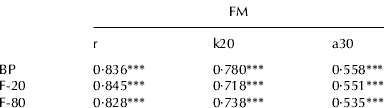
The comparison of milk renneting parameters according to storage conditions is shown in Table 3. No statistical differences were recorded. High positive correlation coefficients (P<0·001) were recorded between the values of r, k20 and a30 of fresh and stored milk using Bronopol, frozen at −20°C and −80°C (Table 4). On the whole, statistical analysis demonstrated no significant differences among the three renneting parameters of fresh milk versus those of stored milk and, in particular, r had the highest values of correlation coefficient while a30 the lowest.
Means±standard deviation of clotting time (r), curd firming time (k20) and curd firmness (a30) of milk according to storage conditions

FM: fresh milk; BP: milk stored with bronopol for 24 h; F-20: milk frozen at −20°C for 48 h; F-80: milk frozen at −80°C for 72 h; level of significance: NS=not significant
Correlation coefficients of clotting time (r), curd firming time (k20) and curd firmness (a30) between fresh and stored milk, according to storage conditions (n=819)
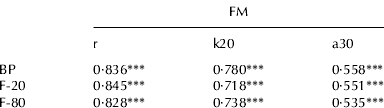
FM: fresh milk; BP: milk stored with bronopol for 24 h; F-20: milk frozen at −20°C for 48 h; F-80: milk frozen at −80°C for 72 h; level of significance:
*** =P<0·001
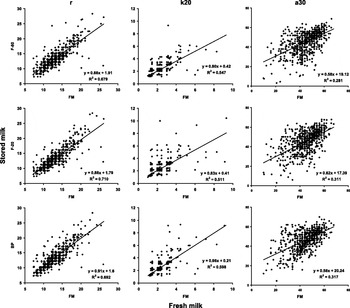
Linear regression plots and the relative prediction models are reported in Fig. 1. The highest R2 values were recorded for r, ranging from 0·679 (regarding the relationship between fresh and frozen milk at −80°C) and 0·710 (fresh vs. frozen milk at −20°C) while the lowest for a30 ranging from 0·281 (fresh vs. frozen milk at −80°C) to 0·317 (fresh vs. stored milk using Bronopol). All prediction models showed significance value at P<0·001. In the evaluation scale of predictive models (Dal Zotto et al. Reference Dal Zotto, De Marchi, Cecchinato, Penasa, Cassandro, Carnier, Gallo and Bittante2008; De Marchi et al. Reference De Marchi, Fagan, O'Donnell, Cecchinato, Dal Zotto, Cassandro, Penasa and Bittante2009), values of R2 between 0·50 and 0·65 allow the discrimination of high and low values of milk traits, between 0·66 and 0·81 an approximate prediction and between 0·82 and 0·90 a good prediction. The values of R2 for clotting time obtained in the present study (between 0·692 and 0·710) are higher than the value reported by De Marchi et al. (Reference De Marchi, Fagan, O'Donnell, Cecchinato, Dal Zotto, Cassandro, Penasa and Bittante2009) regarding prediction of coagulation properties of cow milk by mid-infrared spectroscopy (0·62). This feature could allow to predict, with an adequate accuracy, clotting time of fresh goat milk by using data achieved with stored milk, given that prediction of milk renneting properties of fresh milk is a relevant objective in breeding programs based on milk recording (Cecchinato et al. Reference Cecchinato, De Marchi, Gallo, Bittante and Carnier2009). On the other hand, R2 for a30 was between 0·281 and 0·317 and, in agreement with the evaluation scale and other studies regarding cow milk analysis using mid-infrared spectroscopy (Cecchinato et al. Reference Cecchinato, De Marchi, Gallo, Bittante and Carnier2009; De Marchi et al. Reference De Marchi, Fagan, O'Donnell, Cecchinato, Dal Zotto, Cassandro, Penasa and Bittante2009), predictive models for this variable were not useful. Indeed, similarly to data about cow milk (Dal Zotto et al. Reference Dal Zotto, De Marchi, Cecchinato, Penasa, Cassandro, Carnier, Gallo and Bittante2008), a30 was more sensitive to storing conditions than r.
Linear regression plots of fresh versus stored milk for r (clotting time) measured in minutes, k20 (curd firming time) in minutes and a30 (curd firmness) in millimetres (n=819). FM: fresh milk; BP: milk stored with bronopol for 24 h; F-20: milk frozen at −20°C for 48 h; F-80: milk frozen at −80°C for 72 h.

As regards Bronopol addition, this preservative compound did not significantly modify the renneting properties, even though Sánchez et al. (Reference Sánchez, Sierra, Lungo, Corrales, Morales, Contreras and Gonzalo2005) reported highest contents of total protein and total solids in goat milk samples preserved by using Bronopol. In the same study (Sanchez et al. 2005), it was also shown the storage of goat milk at −20°C has a significant effect on total protein content but, even if it should be taken into account they consider this feature of scarce significance. In our study, freezing did not cause significant differences to the renneting parameters and similar results were also recorded on goat and sheep dairy products. Park & Drake (Reference Park and Drake2005) and Van Hekken et al. (Reference Van Hekken, Tunick and Park2005) registered a minimal loss of texture and sensory quality and no significant differences after freezing at −20°C and thawing of soft goat cheese. Alvarenga et al. (2001) demonstrated that frozen storage at −20°C does not affect chemical and physical properties of semi soft-cheese and Katsiari et al. (Reference Katsiari, Voutsinas and Kondyli2002) found no significant differences in yoghurt made from sheep milk frozen at −20°C for up to 6 months.
In conclusion, renneting properties of goat milk throughout all the stages of lactation could be determined in fresh milk, or after storage with the same result. In particular, Bronopol addition to goat milk is a suitable choice to avoid time-related inconveniences and the refrigerated transportation of samples from the farm to the laboratory. These results showed that assessment of milk coagulation properties of a large number of goats, for the evaluation of the potential genetic value, planning of breeding programs and improvement of cheese-yield, is achievable using the Formagraph method.
This research was supported by CIPE funds (APQ Ricerca Intervento P5a-Biodiversità Animale).