


In December 1740, Prussian troops crossed the border into Silesia, the most northerly province of the Habsburg Monarchy. The newly crowned Prussian king, Frederick II, counted on that Maria Theresia, the young Habsburg ruler, would be unable to defend her territory and that none of her allies would come to her rescue. After roughly two months, the Prussian forces controlled the poorly guarded province, and they also managed to defeat an Austrian army at Mollwitz in April 1741. There was a brief armistice in October 1741 between the two powers, and later, following British mediation, a peace treaty was signed in June 1742 that confirmed the Prussian control of Silesia. The treaty ended the so-called First Silesian War.Footnote 1 Around the same time as Prussia was driving the First Silesian War, Sweden declared war on Russia in July 1741 with the purpose of taking advantage of Russian internal turmoil following Czar Anna’s death in 1740. The Swedish government hoped that with French diplomatic and financial support it would be possible to regain some of the territory that had been lost at the end of the Great Northern War (1700–21). Swedish forces were therefore gathered in Finland, but before the army was ready to march into Russian territory, a Russian force defeated a smaller Swedish contingent at the battle of Lappeenranta in August 1741. This defeat prevented a major Swedish attack, but a smaller Swedish force moved eastward in November 1741, which resulted in a ceasefire. At the end of the winter, the new Russian ruler broke the agreement, and in June 1742, a Russian army crossed into Finland. The Swedish army retreated to Helsinki and surrendered there in August 1742. The following year, a peace treaty was signed, which resulted in Sweden’s cession of territory in Finland to Russia.Footnote 2
The First Silesian War and the Russo-Swedish War can be seen as examples of rather limited European interstate conflicts with few major battles, but which still had major repercussions for the states that were involved in them and the markets that provided goods for the armies and navies. Although the battles were limited, the deployment of large military units for several years required the mobilization of resources, such as foodstuffs and fodder, on a large scale. Thus, the states needed financial means and organizational efforts to coordinate procurements, but they also needed the involvement of merchants and other private actors to get hold of the necessary goods. As Rafael Torres Sánchez, Pepijn Brandon and Marjolein ‘t Hart have argued, wars in the eighteenth century created inexhaustible sources of business opportunities for entrepreneurs who could meet the demand from states. A co-dependence therefore existed between states and military entrepreneurs throughout the century, which shaped both processes of state formation and market developments.Footnote 3 However, these developments differed between states and regions, and there was no single model for private-state cooperation.
The purpose of this article is to examine how two middle-ranking states in the Baltic Sea region, Prussia and Sweden, organized their procurement of foodstuffs during military campaigns, and how, in particular, the two states interacted with merchants to acquire the necessary resources. To address these issues, a transnational perspective, which focuses on flows of information, goods, and capital between different locations rather than internal developments within existing political entities or domestic economies, will be utilized.Footnote 4 This perspective will be combined with a contractor state approach to state formation, which focuses on the spending of states rather than the mobilization of tax revenues and borrowing. Given that early modern states spent a large proportion of their available resources on warfare, and that they were dependent on the assistance of merchants and other private actors to equip, clothe, feed, and deploy armies and navies, this approach concentrates on the state-private relationship in the warfare resource-mobilizing process. Scholars using this approach focus on how these relationships were structured and reproduced, and what the consequences of this collaboration were for the entrepreneurs and for the state. The contractor-state approach has mostly been utilized to analyze developments in Britain, France and Spain, but it has seldom been used to investigate the situation in northern or eastern parts of Europe.Footnote 5 Thus, in this article, the Baltic Sea region is seen as a transnational market with several actors (both state representatives and private entrepreneurs) and nodes, which were affected by exchanges of capital, goods and information. The market effects were not necessarily restricted to the immediate theaters of war since the procurements could be done further away in areas with more resources and involve producers and networks of merchants who were not necessarily directly involved in the wars. We can therefore not just examine the direct effects in Silesia and Finland of the military campaigns if we want to comprehend the consequences of the Silesian Wars and the Russo-Swedish War on how governments and merchants navigated the existing market conditions during wartime.
In the existing literature on commerce in the Baltic Sea during the eighteenth century, scholars have largely neglected the issue of warfare. Instead, they have focused on the growth of long-distance trade between the region and markets in Asia, America, and the Mediterranean, which mostly has been interpreted as a consequence of increasing global demand for products such as bar iron, tar, and hemp, and rising consumption of salt, sugar, tea, and coffee in the Baltic region.Footnote 6 Historians have examined how merchants from Denmark and Sweden utilized warfare to seek business opportunities, but they have concentrated on how Scandinavian merchants used neutrality shipping in wars between the major powers in the Atlantic and the Mediterranean.Footnote 7 Another theme in the literature concerns more long-term trends of the relative economic decline of German towns such as Lübeck and Danzig, and how first Dutch and then British shipping became more prominent in Baltic trade.Footnote 8 Most of the research on long-distance trade, however, has focused on ships that passed the Sound, which means that trade within the Baltic is often neglected. Yrjö Kaukiainen has argued that if we examine intra-Baltic trade in other sources, we will find that Lübeck was far from a stagnant city and that its merchant fleet fared well during the second half of the eighteenth century.Footnote 9
When it comes to the states of Prussia and Sweden and their mobilization of resources during the military campaigns in the early 1740s, scholars have never compared their efforts. Instead, their developments have mostly been analyzed from a national perspective. Sweden has been characterized as a declining European power that tried to come to terms with its weak public finances and limited military capacity. Thus, it had lost its major power status in northern Europe and the relative advantages that had been explored in the seventeenth century, when Sweden reached its position as a major power, could no longer be utilized successfully at reasonable political costs. In the seventeenth century, the Swedish state used successful aggressive coercive policies against neighboring territories to gain advantages, and it relied on an effective mobilization of limited domestic resources as well as the employment of influential military entrepreneurs to gain access to international assets. The rise of both Prussia and Russia as militarily important states in the Baltic Sea region made such expansive warfare more difficult and costly in the eighteenth century.Footnote 10
However, it is important not to overemphasize the narrative of decline. The Swedish state still had a relatively large army and navy, and its capacity to borrow internal funds had been strengthened by the creation of the Bank of the Estates in 1668. During the Great Northern War (1700–21), the state also created government structures to handle centralized procurement of necessary resources, and a system of public credit. Moreover, the merchant communities in Stockholm and Gothenburg were well-integrated into European mercantile trading networks, and they could provide important services to the state.Footnote 11 All these developments were utilized during the military campaign in 1741. A special centralized procurement commission consisting of leading government administrators was set up in Stockholm, which negotiated with merchants about the acquisition of goods. The commission used a combination of specific ear-marked taxes, French subsidies and loans from the Bank of the Estates to finance the acquisitions, but what impact these actions had on the relationship between the state and merchants has not been explored.Footnote 12
In contrast to the Swedish case, Prussia has been described as a rising European power, which, through aggressive military actions, tried to overcome some of its structural weaknesses, such as a small population, scattered territorial possessions, and limited commercial centers. Thus, Prussia around 1740 has been characterized as a state that depended on agricultural production and had no system of handling long-term debt. Thus, the state’s large military depended on the collection of grain and other products from the provinces, which were stored in government warehouses, and on extracting resources from enemy territory during war. According to Geoffrey Parker, the originality of Prussia’s system lay principally in the improvements in supply, which allowed the army to move relatively swiftly if it stayed in proximity to Prussian territory. Although there were towns, such as Königsberg and Stettin in the Prussian realm, which were integrated into the European economy, these seem to have played a limited role in the war efforts.Footnote 13 However, the exact role of merchants and market mechanisms in the Prussian system needs to be explored further.
These descriptions of the Prussian and Swedish systems show that scholars have primarily focused on the types of resources that the two states mobilized and how these resources were collected. Clearly, several types of resources and methods existed, which can be related to different forms of states. In the literature, historians have identified three ideal types, namely first the domain state, which primarily depends on the domains of kings to sustain their activities; second the tax state, which relies on permanent taxes from land and trade to fund its expenditure; and third the fiscal state, or the fiscal-military state, which pays for large-scale warfare through a combination of permanent taxes and organized borrowing.Footnote 14 The contractor state can be seen as a version of the fiscal-military state as it relies on the resources from taxes and borrowing to maintain its interactions with various private actors, but scholars stress that the dynamic within the state during wartime is driven by the cooperation between state representatives and entrepreneurs rather than the activities within the state apparatus.Footnote 15
The contractor state approach has seldom been applied to developments in the Baltic Sea region during the eighteenth century before. By comparing the situations in Prussia and Sweden in the 1740s, especially by examining the interactions between state representatives and merchants and the transnational flows of resources, new insights will be gained about how the military supply systems actually worked in the two states, which in turn will increase our understanding of the operations of the two states and how the Baltic Sea region should be placed within a broader European context of state-merchant interaction.
To answer the questions about how the military supply systems functioned in Prussia and Sweden during the 1740s, several sources will be investigated. First, I will analyze material from the procurement commission in Sweden, such as minutes, ledgers, and contracts, and then material from the secret cabinet in Prussia detailing the procurement of goods for the army during the Silesian wars. These sources will help to identify the key actors involved and the goods that were procured, but also the strategies governments and merchants pursued during wartime. Second, I will complement these sources with an investigation of toll records in Stockholm to get more information about the strategies of merchants. Third, I will bring the different parts together to summarize the findings and discuss the role of war in structuring the relationships between states and merchants in the Baltic Sea region.
The Swedish System of Military Supplies During the War Against Russia, 1741–43
One big challenge for the Swedish military effort against Russia in 1741 was the lack of local resources, such as grain, peas, beef, and pork, in Finland. Finland was a so-called deficit region in agricultural terms, meaning that even in peacetime there often was a need to import grain. Given the increase of tens of thousands of people to feed daily during the build-up of the army and the subsequent military campaign in Finland, the supply system was put under strain. Moreover, there was limited hope of the troops being able to live off enemy territory when crossing the border because the material circumstances on the Russian side were like Finland. Foodstuffs therefore had to be taken from Finland. Like most European states, the Swedish state had set up a war commissariat, which oversaw the government’s supplies and their storage and distribution in Finland. The commissariat also procured goods locally in Finland, from peasants and merchants, but it soon became clear that the available volumes were totally insufficient for the needs of the army. The solution to this problem was the establishment of a centralized procurement system. Thus, a procurement commission (Utredningskommission) was formed in Stockholm to coordinate the supply activities. The procurement activities were financed by taxes and French subsidies. The taxes were then used as collateral to borrow funds from the Bank of the Estates. This arrangement made more funds available quickly since the collection of taxes was associated with time lags. In August 1742, the commission had received around 4 million daler silvermynt (hereafter abbreviated dsm) in funds from the bank, 2.3 million dsm in subsidies, and 490,000 dsm in taxes.Footnote 16 The commission, which comprised several top-ranking government officials and a leading merchant in the capital, Thomas Plomgren, relied on the cooperation of the resources of the merchant community in Stockholm in particular and their networks throughout Europe to get hold of supplies. The commission cooperated with the war commissariat in Finland in the sense that the commission depended on information from the commissariat about the volume of goods that were needed in Finland. The commission then used this information to procure the demanded goods and send them to the crown storage facilities in Hamina, Helsinki and Porvoo. The commissariat oversaw the storage facilities and the distribution of the goods to the army. To execute this latter task, the commissariat relied on the assistance of local peasants who provided horses and wagons in exchange for payment.Footnote 17
When the procurement commission in Stockholm started its acquisitions in March 1741, the members initiated contact with leading merchants in the capital, who specialized in the import of foodstuffs. It was only they who had the knowledge, business contacts in foreign trading ports, and credit to acquire the necessary goods in sufficient volumes to be able to serve the Crown in a satisfactory manner. Thus, the merchants who negotiated with the commission were front figures for international social networks of merchants that had the capacity to operate on transnational markets.Footnote 18 However, each merchant network did not trade in all commodities, and it was not active on all markets since it only handled goods it was knowledgeable in and in locations where they had associates. For example, a merchant house that concentrated on the export of bar iron from Stockholm to England did not necessarily have the capacity to purchase large volumes of grain from Königsberg or Memel, and a merchant who focused on the import of grain from Swedish Pomerania to Stockholm did not always have the capacity to purchase herring from Norway. This specialization meant that the commission had to interact with several networks of merchants to get hold of the necessary supplies.
In total, the commission calculated that they had to feed around 28,000 men in Finland daily, a number which only included the army and not the navy. If that is broken down into different commodities, the army demanded 62,052 lispund of dried bread (527,442 kilograms. One lispund equaled 8.5 kilograms), 17,236 barrels of beer, 6,018 barrels of peas, and 3,818 barrels of salted beef per month during the campaign.Footnote 19 This shows that grain, such as rye and malt, was a crucial commodity for the commission to get hold of.
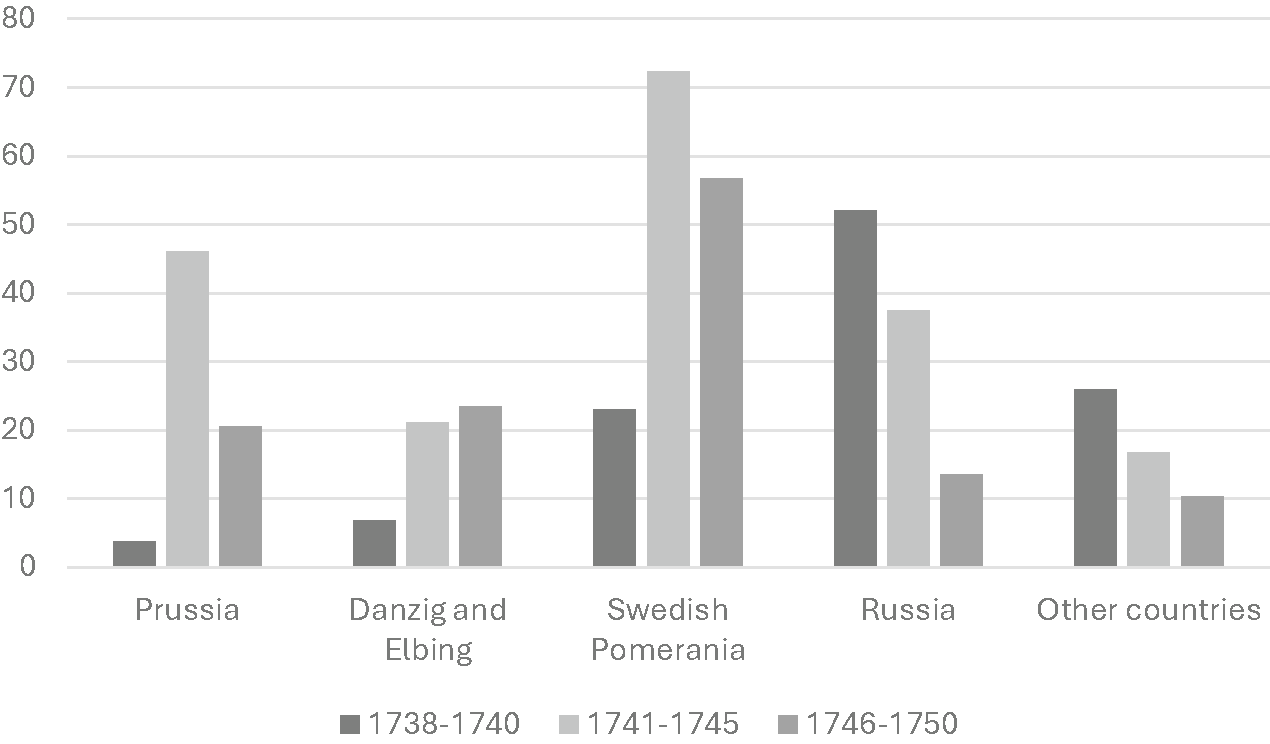
Traditionally, the Swedish realm had relied on imports of rye from Reval and Riga in the Russian Baltic provinces, while locations such as Danzig, Königsberg, Stralsund and Stettin had played more minor roles. Figure 1 shows how the war resulted in a reduction in the imports from the Russian Baltic provinces and that this reduction continued after the war. This source of grain had to be replaced by other markets, and we can see in the figure that Swedish Pomerania increased its exports to Finland and Sweden, but also ports in Prussia and Danzig expanded their exports of grain. It is noteworthy that Prussian ports, such as Königsberg and Stettin, managed to expand their exports despite the demands from the Prussian Crown for resources. One explanation behind the expansion during the period 1741–1745 is that the exports generated important toll revenues for the Prussian state, which could be utilized to cover urgent expenditure. It was not until 1744–45 that the Prussian state started to focus more on restricting exports and increasing imports of grain from neighboring territories.Footnote 20
Import of rye to the Swedish realm by country, 1738–1750 (1,000 barrels).
Source: Historisk statistik, 138.

Figure 1. Long description
The Y-axis represents the volume of rye in 1,000 barrels, ranging from 0 to 80 in increments of 10. The X-axis lists five source regions. A legend at the bottom identifies three time periods: dark gray for 1738-1740, light gray for 1741-1745, and medium gray for 1746-1750.
* Prussia: Imports start low at approximately 4 units, peak sharply at 46 in the second period, and drop to 21 in the third.
* Danzig and Elbing: Shows a steady increase from 7 to 21, then 24 units.
* Swedish Pomerania: Increases significantly from 23 to a peak of 73, then declines to 57.
* Russia: Starts high at 52, decreases to 38, and falls further to 14.
* Other countries: Shows a continuous decline from 26 to 17, then 11 units.
However, the Swedish state could not move from a dependence on Reval and Riga to locations in Prussia and Swedish Pomerania without the ability of merchants in Stockholm to utilize their network contacts in places such as Stralsund and Stettin to expand the exports from there. One merchant, who was instrumental in this shift, was Johan Albert Kantzow. He was born in Stralsund in 1713, but he moved to Stockholm, where he established himself as a merchant in 1736, specializing in the grain trade. In 1752, he strengthened his ties to the Pomeranian merchant community in Stockholm when he married Christina Maria Hebbe, daughter of the merchant Christian Hebbe.Footnote 21
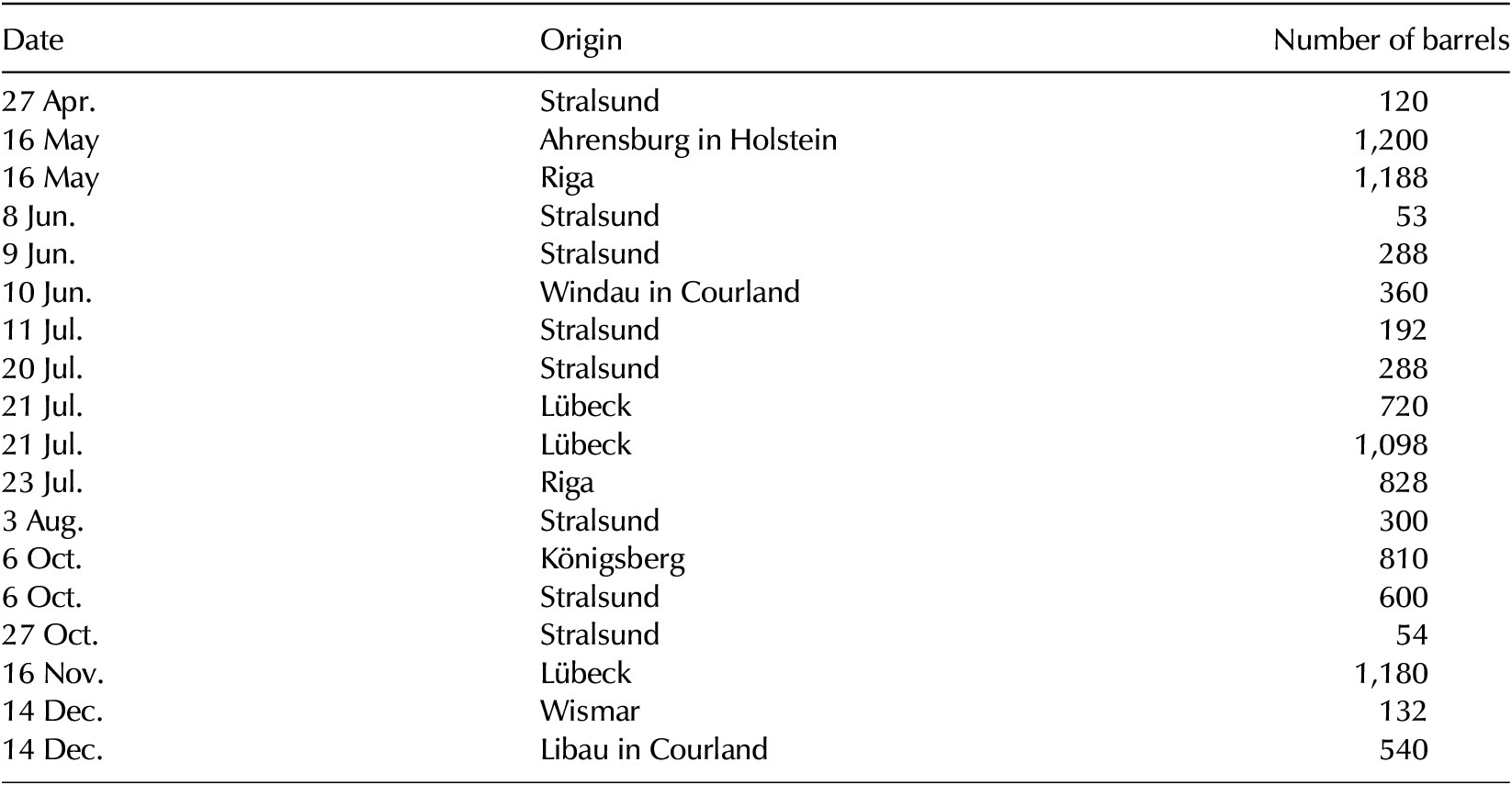
Table 1 clarifies that Kantzow was active in several markets in 1741, including Riga in the Russian Empire. In 1738, before the war, he had also imported grain from Reval, Riga and Stralsund,Footnote 22 but after the war broke out between Sweden and Russia, he concentrated his activities in Swedish possessions (Stralsund and Wismar), in Prussian territories (Königsberg), and in Courland in the east and in Lübeck in the western part of the Baltic Sea. In 1742, the same trend continued when Kantzow purchased grain in Stralsund and Wismar, but also in Kolberg in Prussian Pomerania, and in Memel and Windau in Courland.Footnote 23 Thus, there were several markets that had the capacity to deliver the required quantities, and Kantzow had connections in these markets to arrange the deliveries. The procurement commission utilized these connections and signed several contracts with Kantzow regarding the supply of rye to the Crown. In 1741, Kantzow was the third largest supplier to the procurement commission.Footnote 24
Import of rye to Stockholm in 1741 by Johan Albert Kantzow

Table 1. Long description
The table consists of three columns: Date, Origin, and Number of barrels.
* 27 April: Stralsund, 120 barrels.
* 16 May: Ahrensburg in Holstein, 1,200 barrels.
* 16 May: Riga, 1,188 barrels.
* 8 June: Stralsund, 53 barrels.
* 9 June: Stralsund, 288 barrels.
* 10 June: Windau in Courland, 360 barrels.
* 11 July: Stralsund, 192 barrels.
* 20 July: Stralsund, 288 barrels.
* 21 July: Lübeck, 720 barrels.
* 21 July: Lübeck, 1,098 barrels.
* 23 July: Riga, 828 barrels.
* 3 August: Stralsund, 300 barrels.
* 6 October: Königsberg, 810 barrels.
* 6 October: Stralsund, 600 barrels.
* 27 October: Stralsund, 54 barrels.
* 16 November: Lübeck, 1,180 barrels.
* 14 December: Wismar, 132 barrels.
* 14 December: Libau in Courland, 540 barrels.
Source: Stockholm City Archives, Stockholm stads centrala drätselarkiv, Stadskamreraren, Räkenskaper, Verifikationer, vol. 280.
Another leading supplier of grain to the commission was the merchant Christian Hebbe, who was born in Greifswald in Swedish Pomerania in 1698. His parents, the leather manufacturer Erdman Hebbe and Anna Kruse, sent him to Stockholm when he was around 12 years old to work as an apprentice in his uncle’s merchant house. After leaving Johan Kruse’s house, Hebbe started to work as an accountant for the merchant Georg Bernhard von Scheven, before he established his own merchant house in Stockholm in 1723. Concurrently, he took over the trading business of von Scheven. In 1725, Hebbe consolidated his position in the mercantile community in the Swedish capital when he married Elisabet Catharina Küsel, who was the daughter of the leading merchant Simon Friedrich Küsel. The marriage meant that Hebbe, besides gaining access to his father-in-law’s network, became brother-in-law to the merchants Hinrich Hahr and Baltzar Nettelblad, who also traded in the Baltic Sea.Footnote 25 These network ties in Stockholm, and in northern Germany, made it possible for him to trade large volumes of foodstuffs, and to provide the Swedish Crown with goods during wartime.
In Hebbe’s first contacts with the procurement commission in March 1741, he made it clear that he was unwilling to cooperate with other merchants in a consortium to provide large volumes of goods at predetermined prices because of the high risk involved. Instead, he preferred to make individual offers and to sign contracts with the commission for each delivery.Footnote 26 Such an arrangement was beneficial for Hebbe since he could alter prices over time depending on how the different markets developed, but he had to negotiate with the commission every time he had a commodity to sell. There was no guarantee that the commission would accept every offer because they interacted with several merchants. Thus, instead of organizing public auctions with open bids, the commission interacted on a regular basis with several merchants with the purpose of gaining information about available volumes, prices, and delivery times but without disclosing what they were willing to pay or the terms of the contracts they had already signed. This contracting mechanism was constructed to increase competition between the merchants, and to allow merchants to provide offers when they had something to sell, and for the commission to contact potential suppliers when they needed commodities.
Hebbe signed a total of 17 contracts with the commission during 1741, starting at the end of March and ending in November. The contracts amounted to 236,373 dsm, which was much more than the second largest supplier, the merchant Johan Clason, who signed contracts in 1741 valued at 187,762 dsm, and the third largest supplier, the merchant Johan Albert Kantzow, who agreed to contracts worth 117,559 dsm. Hebbe’s brother-in-law, Hinrich Hahr, came forth with contracts valued at 71,330 dsm.Footnote 27 The contracts were usually structured in the same way. The merchant received part of the sum when the contract was signed, and the rest of the sum was paid to the merchant after the delivered goods had arrived in either Finland or Sweden, and had been inspected by a government official, usually the warden of the Crown warehouse. For example, Hebbe received the first part of 9,666 dsm in July and the second part of 9,666 dsm in October for a delivery of rye. However, if the time between signing the contract and the delivery was limited, then the merchant received one single payment. For example, Hebbe signed a contract on 7 August 1741 regarding the delivery of 420 barrels of peas and around 8,500 kilograms of dried beef. The goods arrived in Stockholm at the end of September, and they were inspected on 14 October. Hebbe then received his payment of 6,759 dsm on 20 October.Footnote 28 This procedure shows that the commission did not have to deal with foreign currency, and they did not have to pay for the time it took for the merchant to make the preliminary arrangements with skippers and merchants in foreign ports, but Hebbe and other Swedish-based merchants received their payment rather quickly after the delivery of the goods. It was then the Swedish-based merchants who had to distribute the payment to their business partners overseas through bills of exchange.
One of the first contracts Hebbe signed concerned the delivery of 1,600 barrels of peas from Swedish Pomerania, 300 barrels of groats and 8,500 kilograms of pork from Scania, and 18,403 kilograms of pork from Holstein. Hebbe demanded a price of 40 daler copper coins (hereafter abbreviated dkm) per barrel for the peas, and he was unwilling to sell them for anything less than that price even if the members of the commission tried to reduce it (1 dsm was worth 3 dkm). He also claimed that they were tasty and that they were easy to boil. Regarding the groats and the pork from Scania, Hebbe first requested 54 dkm per barrel for the groats and 13 dkm per lispund for the pork, but after pressure from the commission he was willing to reduce the price on the groats first to 51 and then to 50 dkm per barrel, and first to 12 and then very unwillingly to 11.5 dkm per lispund for the pork. According to his own statement, Hebbe had paid 10.5 dkm for the pork, which meant that he only profited 1 dkm per lispund. In relation to the pork from Holstein, which was more expensive but also seen as of better quality than the pork from Scania, Hebbe first requested 15 dkm per lispund. However, after some negotiation, he agreed to sell it to the commission for 14 dkm.Footnote 29 In total, Hebbe received 19,983 dsm in March, and 20,286 dsm in August when all the goods had been delivered.Footnote 30 In comparison, the highest-ranking official in the Debt Office, the commissioner, received 1,000 dsm per year in salary.Footnote 31
After the first contracts, especially regarding the delivery of grain, were signed, several ensued in the following months. However, Hebbe could not always provide the goods the commission desired. In September, for example, the commission realized that the local supply of oats in Finland was too limited. The members therefore decided that they had to procure the commodity, which was vital for the army’s horses, from foreign ports, but they received a reply from Hebbe that it was difficult to get hold of oats because the harvest had not yet begun, but also that the supply in Courland was limited and that the Prussian Crown had already procured large volumes of oats in Königsberg and Danzig. The commission therefore had to turn to another merchant, Anders Plomgren, who could provide 3 to 4,000 barrels of oats from Wismar.Footnote 32
Similar concerns about the actions of other states and how they would affect both prices and the availability of grain were raised a month later when the commission received an offer from Hebbe to buy 1,400 barrels of rye from Königsberg and 2,500 barrels of rye from Pomerania that he was willing to sell to the commission for 32 dkm per barrel. The commission was eager to buy as much rye as possible given the market conditions, but the members were still trying to negotiate the lowest possible price. Thus, the members managed to get Hebbe to lower the price to 31 dkm, but they decided to postpone the decision on the assumption that they could lower the price even further. Later, the negotiations continued, and Hebbe eventually agreed to a price of 30.5 dkm per barrel. They also agreed to sign a contract for 230 barrels of peas for 34 dkm per barrel. The rye and the peas were subsequently inspected on 2 November, and Hebbe received a payment of 52,463 dsm for the goods on 19 November.Footnote 33
As already stated, Christian Hebbe was not the only importer of grain and other foodstuffs to Stockholm. There were around 15 major merchant houses which were involved in such trade and which signed contracts with the commission in 1741.Footnote 34 Many of them had a similar background to Hebbe, such as Johan Albert Kantzow. This picture is confirmed if we examine the top importers of oats and peas to Stockholm. In 1741, it was Jürgen Hinrich Röhl who was the top importer of oats with 2,923 barrels from Rostock and Wismar; second came Johan Albert Kantzow with 1,472 barrels from Lübeck, Memel and Stralsund; third came Anders & Thomas Plomgren with 1,420 barrels from Rostock and Wismar; and fourth came Christian Hebbe with 988 barrels from Memel, Rostock, Stralsund, Wismar, and Wolgast.Footnote 35 It is noteworthy that no oats were imported from Prussian ports such as Königsberg and Stettin, which indicates that there were limited supplies there due to the Prussian Crown’s procurement of the commodity.
A similar picture emerges if we turn to the import of peas to Stockholm the same year. The dominant importer of this commodity was Christian Hebbe, who arranged the arrival of 5,915 barrels in the capital from Rostock, Stralsund, Wismar and Wolgast. Second was Johan Albert Kantzow with 1,673 barrels from Memel and Stralsund, while the third largest importer was Lüning & von Bippen with 761 barrels from Lübeck and Stralsund, and fourth came Jürgen Hinrich Röhl with 759 barrels from Stralsund.Footnote 36 These figures confirm what we learnt about the structure of the trade with oats, namely that no peas came from Prussian ports and that most of the commodity was imported from either Mecklenburg or Swedish Pomerania.
The procurement commission also had contact with two Swedish government officials in Swedish Pomerania, Nils Gyllenpatron and Ture Gustaf Klinckowström, who functioned as intermediaries between the commission and the merchant community in the province. By employing these officials, the commission made sure that they had another channel open to get hold of grain and peas. Thus, the members were not solely dependent on merchants such as Hebbe and Kantzow to acquire information about market conditions and to procure Pomeranian goods.Footnote 37
But not all the suppliers to the commission in 1741 came from Swedish Pomerania. One merchant with a different background was Anders Rothstein, who was born in 1698 as the son of the councilor Simon Rothstein in the small town of Alingsås in the western part of Sweden. After he was orphaned at a young age, Rothstein eventually moved to Stockholm, where he established a business selling flax in 1730.Footnote 38 Although he continued with flax, he also had the capacity to deal with grain and flour in relatively large quantities. In 1741, he signed five contracts worth a total of 29,368 dsm to provide around 6,800 kilograms of rye flour and 400 barrels of barley to Helsinki and around 12,750 kilograms of rye flour and 233 barrels of groats to Hamina, but also around 1,700 barrels of rye, 200 barrels of barley, and 138 barrels of peas to Stockholm. Some of these goods came from the Swedish provinces of Östergötland and Gotland, but also from Riga. His flax business depended on imports from Riga, which meant that he had established contacts there that could also provide rye. Because of the war, the rye from Livonia was shipped through Flensburg in Holstein before it arrived in Stockholm.Footnote 39 This shows that Rothstein’s activities complemented the supplies provided by the merchants with ties in Pomerania, which gave the procurement commission more options.
Nevertheless, the key merchants in supplying the Swedish army and navy with vital supplies had well-established contacts in Swedish Pomerania. As we have seen, these merchants acted independently of each other and signed individual contracts for all transactions. In December 1741, this situation changed when Hebbe and Kantzow, together with Philip Andreas von Bippen and Christian Lüning, Johan Jürgen Refunck and Jürgen Hinrich Röhl, declared that they were interested in forming a consortium to deliver grain and peas to the Swedish state as soon as the water opened for shipping in the spring of 1742. They claimed that they could provide 6,000 barrels of peas at the cost of 32 dkm in Finland or 30 dkm in Sweden per barrel, 6,000 barrels of rye for 29 dkm per barrel when delivered in Sweden, and 6,000 barrels of barley at 23 dkm per barrel when delivered in Sweden. They also stressed that their offer had to be kept secret because they feared that suppliers in Pomerania would not just increase their prices if they knew about the large purchase, but also that they would question the sincerity of their business partners in Stockholm if they were not informed about the plans. The members of the procurement commission, for their part, thought the offer was good in the sense that they would get hold of large quantities of the demanded goods in a few transactions and that the suppliers would have an interest in purchasing the goods at low prices in order to profit from the transactions, especially considering that prices were predicted to rise on international markets. However, the commission thought that they could negotiate a further reduction in prices. They therefore urged the merchants to submit more details about their offer.Footnote 40
In their reply, the merchants sent a preliminary contract to the commission in which they increased the promised volumes of peas, rye and barley to 7,000 to 8,000 barrels of each commodity. They also stated that they could send all goods to Finland, but they were also open to delivering to towns in Sweden. The offered prices were the same as earlier if the goods were delivered to Stockholm, but they were slightly reduced for goods shipped to Finland. Moreover, the merchants promised to deliver the stipulated goods during the spring and finish the deliveries at the end of May, while the commission was expected to pay the merchants shortly after the goods were delivered. When the commission considered the offer, they discussed the high price and the problems associated with shipping the goods to Finland, but also the need to gain access to large quantities of grain. The discussion ended with a decision to accept the merchants’ offer since it was believed that the benefits of the offer were greater than the negative effects.Footnote 41 Subsequently, the consortium delivered the promised quantities in both Finland and Sweden in May and June 1742, and they received 66,666 dsm in June 1742 and then another payment of 100,000 dsm in August 1742 for their deliveries. The amount of 25,933 dsm was still outstanding at the end of 1742.Footnote 42
The decision to join forces instead of signing individual contracts was probably driven by the problems associated with internal competition between the involved merchants at a time when demand for grain from the Swedish state as well as other states was increasing in preparation for the military campaign in 1742. In other words, the existing networks experienced constraints in their abilities to get hold of limited supplies, and the cost of expanding their capacities was probably greater than the perceived advantages. It therefore became more beneficial to cooperate since cooperation increased the sharing of information about supplies, shipping capacity, and prices among the participants. It also promised to strengthen their bargaining position in relation to their business associates in Pomerania. For the commission, the reduction in competition between the merchants threatened to increase prices on grain, but the cooperation had the advantage of making it easier to acquire large quantities in a few transactions. In the end, the reduction in the number of negotiations and transactions became more attractive than trying to uphold competition between the merchants.Footnote 43
The Swedish system of organizing supplies for the military campaign against Russia depended heavily on cooperation with merchants in Stockholm to get hold of the necessary goods. The merchants offered important information about prices and the availability of various commodities, but they also provided short-term credit to the state by starting to plan deliveries with relevant skippers and business associates before they received any payment. The Swedish state can therefore clearly be characterized as a contractor state in the 1740s.Footnote 44 The system depended on transactions on international markets around the Baltic Sea. Thus, Courland, East Prussia, Holstein and Pomerania, as well as Livonia, all played important roles for the Swedish war effort since the available resources in Finland were so limited. The increasing transnational flows of goods, capital, and information affected not just the ability of the Swedish state to wage war, but they also created business opportunities for merchants throughout the region to profit from the growing demand.
The Prussian System of Military Supplies During the Silesian Wars, 1740–45
Unlike the Swedish system of military procurement, the Prussian state did not establish a special commission to handle the procurement of necessary goods during the Silesian campaign. Instead, it relied on a state bureaucracy that centralized the resources from the provinces and a special treasury under personal royal control that accumulated reserves from the domains. There was also the canton system, which provided recruits from registered male inhabitants to each regiment. Thus, the campaign against Silesia (1740–42) was financed by 12 million talers of ordinary revenue, 8.7 million from existing reserves, and 3.2 million from contributions levied in Silesia. By 1744–45, the government had accumulated another 6.2 million, which was used in the Second Silesian War. The rest of the expenses were covered by 6.2 million talers of ordinary revenue, 4 million from Bohemia and Saxony, and 1.36 million in loans from the Brandenburg estates.Footnote 45 Just as Sweden and many other states, Prussia used a war commissariat to organize the acquisition of resources in the region where the army was located.Footnote 46 Unlike Finland, however, Silesia was considered a rich province with a strong agrarian economy, which meant that the Prussian war commissariat could rely on a relative abundance of local resources at least in the initial phase of the campaign.Footnote 47 The organizational challenges were therefore far greater for the Swedish state apparatus.
To get a glimpse into how the Prussian supply system worked during the first Silesian campaign, we can examine several reports from Silesia in May 1742. The Prussian officials wanted to establish a warehouse in the area around Neisse. Given the available waterway with connections to the river Oder, and thereby the Baltic Sea, the area was of strategic importance, especially from a military supply perspective since the war commissariat could use both land and sea transports, and, if needed, it was possible to utilize both local and more distant resources to replenish the warehouse. The existing warehouse had quantities of rye, flour, bread, barley, and oats in storage, but the Prussian officials wanted to increase the volume of goods by bringing in more rye and oats from the towns of Brieg and Breslau in Silesia. The Prussian officials received 200 horses from Bohemia and 1,000 wagons from the chamber in Breslau to execute these transports. They also received assistance from the merchants Berger, Lange and Conrad in Breslau, who promised to push the deliveries to the utmost.Footnote 48 The sources do not tell us how the contact between the Prussian state officials and the merchants was established, but it was part of setting up the system of contributions that the Prussians required Silesian officials to organize. Thus, there is no mention of any payments to the merchants or information about local prices. It could also be seen as a process whereby the Prussians used contributions to forcefully get access to credit among the mercantile community in Breslau since it was very unlikely that the merchants could deliver such quantities without using their credit in the region.
This interpretation is strengthened by another report from Neisse the same day in which it is stressed that the large army corps consisting of 16 battalions of musketeers, 4 battalions of grenadiers, 30 squadrons of cavalry and dragoons, and 30 squadrons of hussars would be located in the region. This amounted to around 26,000 men, which would require large volumes of foodstuffs and fodder during a period of four months. Some of the flour and oats could be supplied from Breslau and Brieg, but the sheer volume of goods would be very difficult to acquire in a short period of time, even if local entrepreneurs were involved. The local officer therefore suggested that the Prussian authorities had to involve the Upper Silesian Estates in the deliveries and that they could write off the cost from the contribution they intended to provide to the Prussian state. The contribution would, in other words, be reduced, and it would not increase the burden of the Estates. It was even suggested that the Estates could issue bonds to handle the deliveries and to defer the payments to a date in the future.Footnote 49 Thus, the Prussian state would utilize the credit of the Estates to get access quickly to the necessary goods. Moreover, when the Prussian state also planned to establish a field hospital in Neisse in 1742, the officials counted on resources from the occupied province to pay for the procurement of beds, linens and other utensils.Footnote 50
A few days later, it was reported that the volume of rye, flour, barley and oats had increased in the warehouse in Neisse and that 320 wagons had arrived from Brieg and were available for future transport. A further 300 wagons would also soon arrive from Oppeln, Jagerndorff and Troppau and be able to transport flour and fodder to the troops. Additionally, 100 wagons had been commandeered from the villages between Neisse and Neustadt and could be used to send supplies to the troops around Jagerndorff. Moreover, it was reported that the merchants Berger and Lange from Breslau had delivered quantities of rye, barley and oats to the town of Ratibor, and that around 48 ships had arrived in Neisse during the month of April with supplies of flour, rye and oats from Breslau.Footnote 51
One of the military commanders had also been in contact with several merchants in Upper Silesia, who claimed that they could use their contacts in Poland to get hold of the remaining quantities of wheat, rye, oats, barley and hay that they were obliged to deliver to the Prussian troops, but such acquisitions required money. The quantities from Poland were calculated to sustain 19 infantry battalions and 60 cavalry squadrons, or around 26,000 men, for around two to three weeks. To facilitate the procurement from Poland, the Prussians utilized an advance payment of the cost of winter quarters in Bohemia to send to the merchants. This sum was subsequently repaid to the Prussians from the contribution in Upper Silesia.Footnote 52 Thus, the Prussian state did not actually provide any of its own resources to acquire the goods in the Polish-Lithuanian Commonwealth. Instead, it relied on the credit of the merchant community in Silesia, which it got access to through the demands of the contribution.
These events in 1742 show that the initial Prussian campaign in Silesia required very limited resources from the Baltic Sea region. Of course, the Prussian warehouses in places such as Kolberg, Königsberg, and Stettin were important before the attack when the forces were still on Prussian territory. As we have seen in Swedish sources, there were reports that the Prussian Crown had procured large quantities of oats, which made it difficult for other states to acquire the commodity from East Prussia or Pomerania. But during the actual campaign the Prussian state relied heavily on contributions from Silesia, and on the participation of merchants in towns such as Breslau and Brieg. The foodstuffs and fodder therefore primarily originated from Silesia, but also from the Polish-Lithuanian Commonwealth. Like the Swedish state, the Prussian Crown could not avoid involving merchants in the procurement of goods since it was not sufficient to only rely on the local war commissariat to get hold of the necessary goods. However, the merchants were largely coerced into the relationship with the Prussian state through the payment of the contribution.
In August 1744, Prussia restarted the war with the Habsburg monarchy by invading Bohemia, but the troops had to retreat at the end of the year. However, a series of Prussian military victories in 1745 and the occupation of Austria’s ally Saxony forced Maria Theresia to agree to a cessation of hostilities. In December 1745, the peace treaty was signed, which provided guarantees for the Prussian possession of Silesia, and which ended the Second Silesian War.Footnote 53
During the Second Silesian War, more of the resources had to be brought into Silesia from outside, and resources also had to be procured through market transactions and by using more open contracting mechanisms since Silesia was no longer an enemy territory. In December 1744, after the retreat from Bohemia, it was reported that several of the government warehouses in the Prussian provinces were being filled with grain and fodder, and that they would be able to transport goods to the army in Silesia. Moreover, the procurement was made through the assistance of both merchants and public officials, arrangements which worked better than relying on the local activities of the warehouse staff. In other words, the merchants and public officials were able to get hold of the necessary goods in greater quantities and at better prices than relying on local procurement in the vicinities of the warehouses.Footnote 54
The capacity of the existing royal warehouses to supply the army with goods was limited, which became apparent when a cavalry regiment entered Züllichau in western Silesia at the end of 1744. The chamber in the province of Neumark was involved in the negotiation with an entrepreneur regarding the delivery of fodder to the regiment, but there was no money available locally. The regiment therefore had to advance money to the chamber after deducting their forage funds so that they could procure the necessary supplies.Footnote 55 The central administration in Berlin was also aware, given the high prices and existing shortages within the Prussian realm, that it became necessary to expand the procurement of essential goods to foreign territories, such as the Polish-Lithuanian Commonwealth and Mecklenburg. The only province within the Prussian realm that still had reasonable prices was Magdeburg, while prices in Silesia were exceedingly high. Moreover, the chambers in Neumark and Pomerania reported that several subjects no longer had any grain because of demand from foreign buyers and limited imports. Thus, the situation could easily deteriorate locally if there was no inflow of foreign goods.Footnote 56
As a response to these reports, government officials in Berlin limited exports from Baltic ports, while attempting to increase the import of grain from Danzig and Rostock to Stettin. From Stettin, shipments could reach Silesia by using the river Oder. The Prussian officials were also aware that nothing could be accomplished without money and the ability to pay foreign suppliers immediately upon delivery.Footnote 57 The availability of credit was limited for the Prussian state, and there were no intermediaries, such as the leading merchants in Stockholm during the Swedish campaign, that could handle some of the transaction costs.
A few days after the new policy had been implemented, the Prussian government was able to acquire oats in Mecklenburg and Swedish Pomerania, and rye in the Polish-Lithuanian Commonwealth and in Mecklenburg. The purchases in Mecklenburg and Swedish Pomerania were handled by a local Prussian government official, Kammerer Schmid from Prentzlow in Brandenburg, located close to the two provinces, while the purchases in Poland had been organized by a Prussian district administrator called von Hohnstedt. This solution was similar to the Swedish procurement commission’s contact with the Swedish officials Gyllenpatron and Klinckowström in Swedish Pomerania. According to a report, prices were tolerable, but they were very likely to increase. It was therefore important to expedite the purchases as quickly as possible. However, it was more difficult to procure hay and oats since almost everything had already been purchased by merchants along the Oder and on the border to Poland.Footnote 58 Some of the costs were covered by resources provided by the central government, such as the 17,370 talers used by Schmid in Mecklenburg and Swedish Pomerania, but there were outstanding costs totaling 497,022 talers remaining to be paid in February 1745.Footnote 59 Nevertheless, the allocation of funds shows that the Prussian government prioritized payments to the external suppliers.
The supply challenges continued during 1745. In November, it was reported that in Magdeburg nothing more could be purchased due to the high prices. In East Prussia, the situation was so bad that whatever was still in stock had to be left to the subjects and could not be used externally. The situation was similar in Neumark and in Prussian Pomerania. The government had therefore requested the merchant and manufacturing firm Splitgerber in Berlin to use its contacts in Livonia to get hold of goods, but a ban on exports of grain was in place there. It was also difficult to acquire anything from Mecklenburg. The only location the government had hope to be able to procure rye from was Swedish Pomerania.Footnote 60
All these actions show how the rising demand for foodstuffs and fodder due to the continuing military activities forced the Prussian government to move beyond the existing system of warehouses within the Prussian realm to also purchase goods externally. Thus, Mecklenburg, the Polish-Lithuanian Commonwealth, and Swedish Pomerania were all included in the market activities of the Prussian government. They also tried to expand their purchases to Livonia, but it was not possible to procure anything from there in 1745. In other words, the war led to increasing commercial activities for the Prussian state and to an expansion of the relationship with the existing transnational market for commodities, in much the same way as the Swedish state had done in 1741–42. By doing so, the Prussian government followed the logic of the contractor state, which relied on commercial actors to get hold of necessary supplies.Footnote 61 The government tried to purchase goods from locations with the lowest prices, but often it was not enough to have sufficient funds available when demand outstripped supply. As a result, there were shortages that could not be solved by simply providing more money to merchants or producers.
Although shortages were common during wartime, the Prussian state’s lack of credit made it more difficult to handle transactions and forced the state to have ready money available when paying suppliers on the transnational market. But often these resources were limited and not sufficient to meet the demand. The limited ability of the Prussian state to borrow and the subsequent use of floating debts can be seen in 1747 when the government discussed how to pay for outstanding marching costs during the first campaign in 1740 and 1741. Close to 40,000 talers were still outstanding, and officials were uncertain which funds should pay for them.Footnote 62 Similarly, there were outstanding debts of 40,000 talers for artillery and provision horses. The horses had not been paid for when their owners in the countryside had delivered them to the state. Instead, the owners had been promised to get back the horses after the campaign together with a 12 percent premium. However, the demand for horses during the war had driven up the local prices, which increased the costs for the state. Additionally, the state also had to compensate the owners for lost or damaged horses.Footnote 63 These issues were at least partly solved by allocating the cost to the different provinces. The province of Magdeburg, for example, had paid 6,687 talers for horses and other marching costs, but 33,249 talers were still outstanding in April 1747.Footnote 64 Local suppliers had no other option than to wait for when either the provinces or the central treasury had the ability to pay them. The Prussian state therefore had a limited ability to pay its suppliers on time.
Conclusion
The purpose of this article has been to examine how two middle-ranking states in the Baltic Sea region, Prussia and Sweden, organized their procurement of foodstuffs before and during military campaigns, and how the two states interacted with merchants to acquire the necessary goods. The transnational perspective, which focuses on flows of information, goods, and capital between different locations and how these flows impact developments in various sites, has shown how the Baltic Sea region functioned as a transnational commodity market with several nodes belonging to several political entities. The Swedish state depended to a greater extent on this market than Prussia, and leading merchants in Stockholm to get hold of the necessary goods, mainly because there were limited local resources available in Finland. The Prussian state, meanwhile, utilized to a larger degree resources from its own warehouses and goods acquired from Silesia through the contribution. The availability of local foodstuffs in Silesia made such a policy easier to implement. However, the Prussian demand still had consequences for the markets in the Baltic Sea region, especially during the mobilization of the army before and during the early stages of the campaign, by price increases and limiting the ability of other actors to purchase goods. Later, during the Second Silesian War, the Prussian war efforts required a broadening of the geographic focus of their procurement, and their interactions with merchants, by also purchasing goods from territories not involved in the war, such as Mecklenburg, Polish-Lithuania, and Swedish Pomerania. In other words, the market interactions spread outside the immediate theaters of war and included networks of merchants who were not directly involved in the wars. For merchants in Silesia, these interactions were forced upon them in 1740–1742, but during the second Silesian War they were increasingly paid for their services. In the other interactions, merchants largely saw them as business opportunities given the large volumes the states demanded and the ensuing increase in transactions.
The results show that the intra-Baltic trade in basic commodities such as rye, peas and oats continued to constitute an important and lucrative business for many merchants in the region during the eighteenth century, and that many scholars miss these aspects when they focus too much on longer voyages that passed the Sound. Although it is valuable to explore how the Baltic region was interconnected with global trade flows, the merchants in towns such as Stettin, Stralsund and Lübeck were in many ways still deeply involved in older trade flows within the Baltic, which circled around foodstuffs.Footnote 65
The results also show that the contractor state approach, which seldom has been used before in the Baltic Sea region to explain the interactions between state representatives and merchants during the eighteenth century, highlights the important role merchants played in the military supply systems of the Prussian and Swedish states. Without their knowledge, credit, and connections, it would have been more difficult or even impossible for the war commissariats and the procurement commission to get hold of necessary goods. This displays that the practices of the contractor state, which scholars have focused on in Britain, France and Spain, were also present in eastern and northern Europe in the eighteenth century, and that military entrepreneurs were active during the conflicts in the Baltic Sea region in the 1740s. However, in the Prussian case, the entrepreneurs were seldom Prussian subjects. Instead, Prussian government officials often had to interact with contractors who were subjects in neighboring territories, which affected the balance of power between the parties. The acquisition of Silesia changed this dynamic somewhat when merchants in places such as Breslau became Prussian subjects.Footnote 66 Unlike the seventeenth century, though, when entrepreneurs could oversee the whole chain of military activity, from recruitment of the troops and the procurement of food and fodder to leading the troops in the field, entrepreneurs in the eighteenth century primarily concentrated on the delivery of goods. The eighteenth-century entrepreneur also had a stronger state bureaucracy to interact with, which had resources at its disposal, and which took more responsibility for registering and storing the goods.Footnote 67 In other words, the balance of power between the entrepreneurs and the state had shifted in favor of the state in the eighteenth century. But the entrepreneurs still had resources that only they could provide, and that the states needed to wage war on a large scale.
The contractor state approach therefore leads to a new perspective on the Prussian state. In previous research, scholars have stressed how the polity was dependent on revenues from royal domains, taxation of its provinces, and contribution on enemy territory to wage war. They have also stressed how the state lacked a system of long-term debt to finance its expenditure. Thus, and especially in comparison with Sweden in the 1740s, Prussia must be characterized as a tax state that had not yet developed into a fiscal-military state. Consequently, it is also difficult to label it a contractor state. But this did not mean that the Prussian state avoided interaction with merchants. Even if the lack of credit hampered its procurement of goods, and most of the goods were procured either through its own provinces or through forceful extraction, the direct and indirect participation of merchants was an important factor in the Prussian war machine in the 1740s, especially when there was a need to expand the procurement outside Prussian territory to feed its troops. In other words, some of the dynamics of the contractor state played a crucial role in the Prussian tax state.Footnote 68
In comparison, Sweden had developed into a fiscal-military state and a contractor state. The close ties between the merchants in Stockholm and the Swedish procurement commission opened new opportunities for both the state and the merchants. The state could more easily acquire large volumes of goods from several locations, while the merchants profited from the interactions. These arrangements constituted a departure from an older decentralized system utilized in the seventeenth century and became a necessity when the Swedish army was trying to wage war in areas with limited local resources.Footnote 69 Although the war against Russia ended badly for Sweden, the centralized procurement system was not to blame. Instead, the system improved the situation in Finland that otherwise would have been totally hopeless. All of this shows that capital, commodity markets and merchants played important roles in warfare around the Baltic Sea region, and that they contributed greatly to the military capabilities of the Prussian and Swedish states in the eighteenth century.

 Open access

