The Iraq war cast a long shadow over the presidential nominating contests in 2008. On the Democratic side, Barack Obama stressed his early and unwavering opposition to the Iraq invasion, contrasting his position with Hillary Clinton's vote in favor of the war resolution. On the Republican side, John McCain trumpeted his early advocacy of the surge in Iraq at a time when the war looked like a lost cause, claiming he would “rather lose an election than lose a war.” Thus, in each of the major parties, the presidential nomination was won by a candidate who had taken a clear stand on the Iraq war.
The study of public opinion and voting, nonetheless, has not been kind to the notion that issues move electoral decisions. Given notoriously low levels of information and concern among the public about foreign affairs, such matters pose particularly severe obstacles to voters. At the same time, an ongoing war is the kind of foreign policy issue that is hard to miss, even by the most inattentive citizen. With daily headlines about military operations, the drumbeat of the ever-rising toll of casualties, and recurring clashes among political leaders in Washington over the right course of action, a war is bound to excite passions in the general public. Although they may not translate into distinct opinions for or against specific policy positions, strong feelings about a war are liable to be channeled into support for a candidate who taps into popular passions. Despite being a poor judge of policy, the general public is quite adept at judging performance. Voters know whether they are satisfied or dissatisfied with the way a war or the economy is going, but not necessarily how best to fix the problem. Or, put more formally, voters behave in a manner consistent with the “valence” model of politics, not the “position” model.
Even so, to apply such a modest standard of issue-voting may be far more difficult in contests for the nomination than in the showdown between the two major-party candidates in November. Most Americans are thoroughly bewildered by the array of contenders in primaries and caucuses. Many of these candidates barely appear on the radar of public awareness, and their policy appeals may be the last thing about which ordinary Americans care. When the name of the game is name recognition, victories in early contests may be the critical ingredient for success in clinching a nomination for president. The sequential nature of primary and caucus voting is conducive to a dynamic of “momentum” in presidential nomination politics. However, which candidate, if any, will garner enough momentum to win the nomination is not certain, nor is it a foregone conclusion that foreign issues like the Iraq war will gain much traction in primary elections.
FOREIGN POLICY AND CANDIDATE CHOICE
Few would deny that foreign policy issues register in public opinion in some form, although the quality and consequence of such opinions are the topic of many debates (Holsti Reference Holsti2004). When it comes to elections, the classic model of issue voting presumes a spatial calculus (Downs Reference Downs1957). A voter compares his or her ideal point on an issue dimension with the candidates' positions on that same issue dimension and then votes for the candidate whose positions are closest to his or her ideal point. As simple as that approach may sound, making an electoral decision on the basis of a public policy issue, whether foreign or domestic, proves an arduous chore for most voters. Several steps must be mastered. As The American Voter spells out (Campbell et al. Reference Campbell, Converse, Miller and Stokes1960; also see Lewis-Beck et al. Reference Lewis-Beck, Jacoby, Norpoth and Weisberg2008), the process entails the following: a voter must (1) care about the issue with some passion, (2) take a position on the issue, (3) be familiar with the positions of the competing candidates, and (4) see some differences among those positions. None of these steps can be skipped if the issue is to guide a person's voting decision. Many voters, however, falter at one step or another on a given issue and hence prove too ill-equipped to make a decision based on policy positions (Abramson, Aldrich, and Rohde Reference Abramson, Aldrich and Rohde2006; for foreign policy issues, see Aldrich, Sullivan, and Borgida Reference Aldrich, Sullivan and Borgida1989).
On one hand, war may be a special case that makes issue voting easier. A war is a matter of high public concern that is bound to generate strong feelings among voters, and given the president's role as commander-in-chief, he is closely identified with one side of the issue. On the other hand, voters may find war a more difficult issue to handle. Public opinion on war is swayed by patriotism and government propaganda. Meanwhile, the opposition faces a quandary: if it dissents from the government, it risks appearing unpatriotic, but if it supports the government's course, it provides no alternative to the voters.
The case of the 2004 election is quite instructive. The Democratic candidate John Kerry certainly did not make it easy for voters to discern his position on the Iraq war. On one hand, he voted for the congressional resolution that authorized the use of force against Saddam Hussein, but on the other hand, he claimed that this vote did not mean that he approved of the military action Bush took in early 2003. His infamous statement about the $87 billion Iraq measure—“I actually did vote for the $87 billion before I voted against it”—was widely exploited by the Bush campaign in an effort to depict him as a flip-flopper. However much this inconsistency may have muddled the Iraq issue, the question of whether the Iraq invasion was right or wrong nonetheless left an imprint on the vote choice for Bush or Kerry in the 2004 general election (Abramson et al. Reference Abramson, Aldrich, Rickershauser and Rohde2007; Gelpi, Reifler, and Feaver Reference Gelpi, Reifler and Feaver2007; Norpoth and Sidman Reference Norpoth and Sidman2007; Weisberg and Christenson Reference Weisberg and Christenson2007).
Yet a voter's stance on the question of invading Iraq was not the only way that the Iraq issue may have swayed a person's electoral choice. The messy outcome of the invasion, with its protracted violence—claims of “mission accomplished” notwithstanding—also presented the public with conditions that evoked strong feelings. These reactions cannot be sorted into distinctive positions. Instead, they fit the mold of what Stokes (Reference Stokes, Campbell, Converse, Miller and Stokes1966) coined a “valence” issue. These are issues that “involve the linking of the parties [or candidates] with some condition that is positively or negatively valued by the electorate” (Stokes Reference Stokes, Campbell, Converse, Miller and Stokes1966, 178–79).
For U.S. involvement in Iraq, the condition might be success in making Iraq a peaceful and stable country. Few people, parties, or candidates would quibble with this goal. Where opinions differ is on how well that goal is being achieved by a party or its president in office. As a result, these are issues on which the public assigns blame or credit to officeholders for past and present conditions. The judgment that the war in Iraq was going poorly for the United States took a toll on President Bush's approval ratings and hurt him in the 2004 election against Kerry (Norpoth and Sidman Reference Norpoth and Sidman2007). What appears to have saved the election for Bush was a highly favorable evaluation of him in contrast to Kerry on a valence issue of another sort—personal qualities of leadership and decisiveness (Lewis-Beck et al. Reference Lewis-Beck, Jacoby, Norpoth and Weisberg2008).
ISSUES AND MOMENTUM IN PRIMARIES
Although voting in a general election that focuses on two major-party candidates is one thing, picking a candidate from among a dozen or so people within one of the major parties in primaries and caucuses is quite another. Little research on voting in primaries exists that pays attention to issues of any type, whether foreign, domestic, or valence. The widely accepted premise is that issues do not matter to voters in primaries. If it is hard to make issue distinctions between a Democrat and a Republican in a general election, it would seem downright impossible to make distinctions among Democrats or among Republicans. Furthermore, few voters can even identify more than one or two presidential candidates in their party by name, let alone by any issue. As a result, the study of primary elections has largely focused on factors such as momentum (Bartels Reference Bartels1988); a candidate's initial popularity and initial resources (Mayer Reference Mayer2003; Norrander Reference Norrander2006); the early primary contests, especially in New Hampshire (Adkins and Dowdle Reference Adkins and Dowdle2000); electability and viability (Abramowitz Reference Abramowitz1989; Brady and Johnston Reference Brady, Johnston, Orren and Polsby1987; Rickershauser and Aldrich Reference Rickershauser and Aldrich2007); and some combination of these factors (Steger, Dowdle, and Adkins Reference Steger, Dowdle and Adkins2004; Steger Reference Steger2007).
One of the rare instances of probing for issue effects in primary elections is a study by Aldrich and Alvarez (Reference Aldrich and Alvarez1994). This research tracked the issue priorities of candidates during the 1988 primary campaign and found that voters tended to choose candidates who shared their concerns about the most important problem facing the nation. Such a finding does not imply that primary voters were familiar with the policy positions of the candidates. However, the evidence does suggest that primary voters are capable of making candidate choices consistent with the valence model and are able to link candidates with goals about which they care and shun those candidates who do not emphasize those goals.
A wartime election, of course, may raise the importance of foreign policy to a point at which it becomes a critical issue in primary elections. The 1968 election provides an instructive object lesson. Anti–Vietnam War protest fueled Eugene McCarthy's campaign for the Democratic nomination. In the New Hampshire primary, the insurgent Democrat received a stunning vote share of 42% against sitting president Lyndon Johnson's 48% share and then proceeded to an outright victory in the Wisconsin primary. By all indications, McCarthy was a “peace” candidate who campaigned for a reduction of U.S. military involvement in Vietnam. That platform drew legions of youthful college-based volunteers to his side during the primaries. But did it also appeal to most Americans who supported McCarthy?
As Converse et al. (Reference Converse, Miller, Rusk and Wolfe1969) noted in an analysis of primary voting in 1968, the McCarthy vote exhibited a stunning pattern. A replication using a national poll that was taken right before the New Hampshire primary confirms those findings (see table 1). Without much doubt, McCarthy attracted a large number of supporters from the ranks of people who were dissatisfied with the Vietnam War. By a 2–1 margin or better, McCarthy supporters called the U.S. entry into Vietnam a “mistake,” regardless of whether they were Democrats, Republicans, or Independents. McCarthy appealed to that sentiment with his “peace” platform, which sought to reduce the U.S. military effort in Vietnam.
Attitudes of McCarthy Supporters about the Vietnam War, Early 1968, by Percentage

Notes. Data drawn from Gallup (1968). N = 1,501.
Oddly enough, however, McCarthy supporters in the general public had other ideas. Among these people, “hawks” (those who favored a stronger military effort) outnumbered “doves” (those who favored a reduced effort). As can be seen in table 1, hawks had the upper hand even among Democrats (the core voting group in that party's primaries) and even more so among Independents, who have historically been eligible to vote in the New Hampshire primary and usually turn out in large numbers. Hawkish supporters of McCarthy, we suspect, were unaware of the candidate's dovish stand on Vietnam. This lack of awareness should not come as a big surprise for a new issue and a new candidate. What mattered to voters who were upset about Vietnam was the fact that McCarthy was the candidate who addressed their anger, regardless of the course of action that he might be advocating. Put differently, McCarthy supporters treated the Vietnam War not as a position issue on the hawk-dove dimension, but in valence terms (Stokes and DiIulio Reference Stokes, DiIulio and Nelson1993, 14). The incumbent president had failed in Vietnam, and McCarthy was seen as the best hope for success.
THE DEMOCRATIC BATTLE IN 2008
When Obama announced his candidacy for the presidency, he singled out the Iraq war as a key of his campaign for change, devoting more words to that issue than to any other policy issue in his announcement. He reminded the American public of his opposition to the war from the start and pledged a quick withdrawal from Iraq:
Most of you know I opposed this war from the start. I thought it was a tragic mistake. Today we grieve for the families who have lost loved ones, the hearts that have been broken, and the young lives that could have been. America, it's time to start bringing our troops home. It's time to admit that no amount of American lives can resolve the political disagreement that lies at the heart of someone else's civil war. That's why I have a plan that will bring our combat troops home by March of 2008.
(Obama Reference Obama2007)These sentiments were bound to please the majority of Americans, who had grown weary of a war that was not going well for the United States at the time and whose major rationale (the existence of weapons of mass destruction) had proven false. According to exit polls taken in the midterm elections of 2006, Democratic voters in overwhelming numbers disapproved of the war in Iraq and wanted some or all U.S. troops to be withdrawn.
Obama's clear stand on Iraq, past and future, contrasted with Hillary Clinton's more delicate maneuvering. Having voted in favor of the Iraq resolution in 2002, she faced mounting pressure in her bid for the presidency to repudiate her vote. She was willing to concede that “if she had known in 2002 what she [knew] now about Iraqi weaponry, she would never have voted for the Senate resolution authorizing force” (Healy Reference Healy2007). But at the risk of losing support, she refused to offer an outright apology, saying that “if the most important thing to any of you is choosing someone who did not cast that vote or has said his vote was a mistake, then there are others to choose from” (Healy Reference Healy2007).
While changing her position on Iraq might have made Clinton more appealing to Democratic primary voters, it would have exposed her to the charge of being a flip-flopper. Such a move would have resurrected the ghost of campaigns past, most notably that of John Kerry in 2004, and rendered all the damage that the flip-flopper charge can inflict on a candidate's reputation for leadership and decisiveness. The Iraq war thus threatened to put Clinton in a lose-lose situation.
One way in which the Iraq war could have decided the primary battle between Obama and Clinton is as a position issue. This scenario assumes that voters were familiar with each candidate's distinctive position on Iraq and held firm positions on the war themselves. Neither assumption, as we have learned, should be taken lightly. Unlike Obama, most Democrats in the electorate did not oppose the Iraq war from the start, but rather came to this opinion only as the war showed no signs of ending well quickly. Obama himself had registered his opposition to the war not in a highly visible U.S. Senate vote, but in a little-noticed speech as a little-known state senator. And by 2007, at the latest, Hillary Clinton had become vocal in her criticism of the war, the tortured account of her 2002 vote notwithstanding.
The other way that the Iraq war might have shaped the primary vote is as a valence issue—that is, a bad condition that calls for change, regardless of the policies that might have led to the problem or might provide a solution. According to the valence script, the party in power is blamed for the bad condition while the opposition party campaigns on the theme, “It's time for a change!” Therefore, among the presidential contenders in the opposition party, what matters most is who can best express the desire for change. Purely in terms of campaign rhetoric, Obama's platform of “hope” and “change” would have had an edge over Hillary Clinton's campaign stressing “experience.” If voters wanted change in Iraq, Obama would seem the more compelling choice.
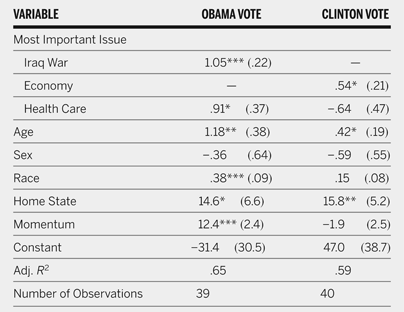
Throughout the primary season, exit polls queried voters in Democratic contests which of three issues—the economy, the war in Iraq, or health care—they rated as the most important problem facing the country. The responses allow us to examine whether the Obama vote rose and fell along with concern about the Iraq war. Beyond issues, each of the candidates appealed to distinctive constituencies. As a black candidate, Obama could be expected to gain strong support among black voters, just as Hillary Clinton would be expected to do well among female voters. While Obama strongly resonated with young voters, Clinton appealed more to older ones. Both could also expect to do well in their respective home states. And given the sequential nature of nominating contests, candidates might benefit from a growth dynamic over time, commonly called “momentum” (Bartels Reference Bartels1988; Brady and Johnston Reference Brady, Johnston, Orren and Polsby1987), in which an early surge is followed by diminishing gains. We used the natural log of the sequence number of a primary or caucus contest as a measure of momentum.
With all these factors considered (see table 2), concern with the Iraq war proves highly significant in relation to the Obama vote.Footnote 1 The importance of this issue translates point for point into a vote for him. Race and age favored Obama as well, with black voters and the youngest cohort (17–29 year olds) backing the candidate strongly. Beyond those factors, Obama benefited from a powerful and lasting momentum, as the estimate in table 2 shows. Obama was able to leverage early showings into later successes. His surprise victory in the first contest, the Iowa caucuses, established this dynamic, the setback in New Hampshire notwithstanding. And it was in Iowa where, according to the poll of Democratic participants, the war was an especially pressing issue.
Determinants of Candidate Choice in Democratic Primaries in 2008

Notes.
* p < .05;
** p < .01;
*** p < .001.
Dependent variable is the percentage of the vote in a given primary (or caucus) cast for Obama or Clinton. Issues are represented by the percentage of voters who picked a given issue as the most important. With three issues to choose from, only two could be included as variables in a vote equation. For the Obama vote, age is represented by the percentage of the 17–29 year group; sex by the percentage of males; race by the percentage of blacks; and home state by Illinois (coded 1, all other states 0). For the Clinton vote, age is represented by the percentage of the group aged 65 and over; sex by the percentage of females; race by the percentage of whites; and home state by New York and Arkansas (coded 1, all other states 0). The “momentum” variable is the natural log of the sequence number of a primary/caucus contest.
Source. Data drawn from Edison Media Research/Mitofsky International (2008) Democratic primary exit polls (including some caucus polls) and candidate votes.
For the Clinton vote, concern with the economy proves significant. Health care, her trademark issue during Bill Clinton's presidency, was no help for her in 2008. Nor was her sex: Hillary Clinton recorded no significant gain among female voters; if anything, she did better, although not significantly, among men. Age proved to be some help, with the oldest cohort of voters (65 years and over) supporting her. Unlike Obama, Clinton failed to generate a favorable momentum, her victory in New Hampshire notwithstanding.Footnote 2
The sharp imprint of the Iraq issue on the 2008 Democratic primaries can be seen in figure 1. This graph displays the Obama vote, adjusted for the influence of the other known factors estimated in table 2. When the effects of race, age, home state, and momentum in particular are held constant, the Obama vote in a given state closely follows the degree of concern with the Iraq war. In states where concern over the war mattered strongly, as in Iowa, Obama did very well. The flip side, of course, is that he did poorly in states like West Virginia where the war mattered little. Obama proved more adept at capturing the passions generated by this issue than did any other Democratic candidate, especially Hillary Clinton.
Obama Vote in 2008 Primaries, by How Important the Iraq War Was Rated (Adjusted for Control Variables)

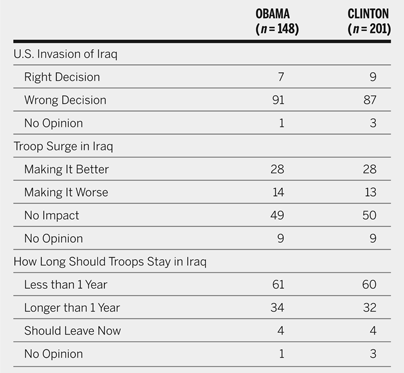
It is natural to suppose that Obama was able to leverage these concerns because in contrast to Clinton and most of the other contenders, he offered a clear stand on Iraq. Table 3 contrasts the views of Obama supporters and Clinton supporters on Iraq.Footnote 3 On the question of whether it was right or wrong to invade Iraq, hardly any daylight can be seen between the two sides: nine of 10 Obama supporters thought that the war was wrong, as did nine of 10 Clinton supporters. On the much-debated question of the “surge,” the similarity is striking as well: half of both sides say that this issue had no impact on their vote. Turning to the future, six of 10 people on both sides said that they wanted the United States out of Iraq in less than one year. In fact, in the New Hampshire exit poll, which asked about policy views regarding Iraq, Clinton beat Obama among proponents of an immediate withdrawal, whereas Obama beat Clinton among proponents of an extended stay.
Attitudes of Obama and Clinton Supporters about the Iraq War, Early 2008, by Percentage

Notes. Data drawn from a CBS News poll of likely Democratic and Republican primary voters, conducted January 9–12, 2008 (CBS News 2008). Democrats: n = 508; Republicans: n = 283.
This pattern is reminiscent of the McCarthy vote 40 years earlier, with hawks outnumbering doves in support of an avowed antiwar candidate. The conclusion is hard to deny, then or now: Obama did not attract primary voters because he took positions on Iraq that were more antiwar, antisurge, or pro–quick withdrawal than the positions taken by Clinton. It would appear that many primary voters were simply not familiar enough with the candidates' policy positions. Hard as that may be to believe, even the relatively elite segment of the electorate that turns out in primaries and caucuses seems to have trouble distinguishing candidates. What filters down to the voters is not so much a candidate's position, but simply the fact that a candidate stresses a certain issue and appeals to popular demand for “change”—areas in which Obama was more credible.
THE REPUBLICAN BATTLE IN 2008
While Democratic contenders were demanding a timeline for withdrawal from a war that looked like a lost cause, McCain hoisted his presidential bid on the platform of increasing the American military effort to win the war in Iraq. In a television interview in August 2006, McCain laid out his strategy in response to the question, “Are we winning in Iraq?”
I don't think so…. But it's a very difficult situation. We've got to win, we do—still do not [have] enough of the kind of troops we need over there, and it's going to be a very difficult process…. It's been well documented now that we didn't have enough there from the beginning…. We make mistakes in every war, and serious mistakes were made here. The question is, are we going to be able to bring the situation under control now? I still believe we can…. I know that military commanders on the ground need more troops, whether they're asking for them or not…. It's not up to the commanders on the ground, it's up to the leaders who assess the entire battlefield situation to decide.
(Meet the Press 2006).McCain's plea for more U.S. troops in Iraq put him at odds not only with the Democrats, but also with his own party, including the president. Bush had yet to sign on to the new policy that came to be known as the “surge” (Woodward Reference Woodward2008). A strong supporter of the decision to remove Saddam Hussein by force, McCain had always been critical of a policy that tried to win the war and the peace in Iraq with too little effort. Iraq promised to be win-win issue for McCain. If the war was not going well, his dissent over strategy would make him an appealing candidate for voters supportive of the decision to invade Iraq. If the adoption of his proposed strategy, the surge, turned the situation in Iraq around, he could rightfully claim credit for the success. Given McCain's vocal stand on Iraq policy, the Iraq war had great potential to play out as a position issue in the Republican race for the presidential nomination, just as Obama's opposite stand had such potential in the Democratic race. At the same time, as in the Democratic contest, the Iraq war could also play out as a valence issue in the Republican race. As Obama did for Democrats, McCain would come across to Republicans as the best candidate to fix a deplorable situation.
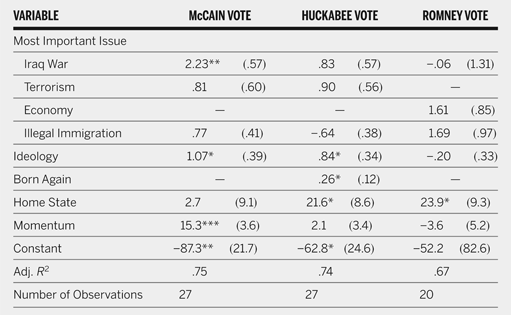
Throughout the primary season, exit polls queried voters in Republican contests which of four issues—the economy, the war in Iraq, terrorism, or illegal immigration—they rated as the most important issue facing the country. The results shown in table 4 make it clear that the McCain vote rose and fell closely with concern about the Iraq war. This issue did not register in the vote for any of his competitors, nor did any other issue make a significant difference.Footnote 4 McCain was the favorite of moderate voters in Republican contests as far as ideology was concerned, but his home state did not treat him as a favorite son. What propelled him to win the GOP nomination, aside from the Iraq issue, was momentum. His victory in the New Hampshire primary sparked a rally for him, his poor showing in the Iowa caucuses notwithstanding. And it was in New Hampshire that the war was an especially pressing issue among Republican primary voters.
Determinants of Candidate Choice in Republican Primaries in 2008

Notes. Dependent variable is the percentage of the vote in a given primary (or caucus) cast for McCain, Huckabee, or Romney. Issues are represented by the percentage of voters who picked a given issue as the most important one. With four issues to choose from, only three could be included as variables in a vote equation. For the McCain vote, ideology is represented by the percentage of moderates (given the three-category scheme of liberal, conservative, and moderate) and home state by Arizona (coded 1, all other states 0). For the Huckabee vote, ideology is represented by the percentage of conservatives; “born again” by the percentage who call themselves so; and home state by Arkansas (coded 1, all other states 0). For the Romney vote, ideology is represented by the percentage of conservatives and home state by Massachusetts and Utah (coded 1, all other states 0). The “momentum” variable is the natural log of the sequence number of a primary/caucus contest.
* p < .05;
** p < .01;
*** p < .001.
Source. Data drawn from Edison Media Research/Mitofsky International (2008) Republican primary exit polls (including some caucus polls) and candidate votes.
As a result, McCain owned the Iraq issue. None of his GOP competitors were able to tap whatever passions the Iraq war generated among Republican primary voters. Huckabee's strength was his appeal to conservatives and born-again voters, two constituencies that strongly overlap in the Republican primary electorate. Unfortunately for him, however, his upset victory in the Iowa caucuses failed to generate much momentum in subsequent contests, which might have carried him to the Republican nomination for president. For Romney, nothing worked, aside from a strong home-state showing in both Massachusetts and Utah.
The sharp imprint of the Iraq issue on the Republican primaries in 2008 can be seen in figure 2. This chart displays the McCain vote, adjusted for the influence of the other known factors estimated in table 4. When the effects of other issues—ideology and momentum in particular—are held constant, the McCain vote in a given state closely follows concern for the Iraq war in that state. In states where the war mattered strongly, such as New Hampshire, McCain did very well. In short, McCain proved more adept than any other Republican candidate at capturing the passions generated by this issue.
McCain Vote in 2008 Primaries, by How Important the Iraq War Was Rated (Adjusted for Control Variables)

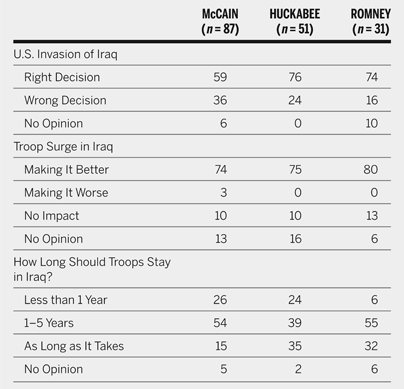
Again, one is hard-pressed to attribute this ability to the candidate's stand on the issue—that is, McCain's strong early support for the invasion of Iraq, as well as his later advocacy for the “surge.” Table 5 contrasts the responses of McCain supporters and Huckabee and Romney supporters to questions about Iraq policy.Footnote 5 On the question of whether it was right or wrong to invade Iraq, some daylight showed between the candidate camps, but not in the expected direction. Instead of being most pro-war, McCain supporters turned out to be the least pro-war. More than one-third called the invasion the wrong decision. McCain supporters, to be sure, were hopeful about the “surge,” his trademark policy, but supporters of Huckabee and Romney proved equally so. In other words, this policy offered no special reason for a voter to pick McCain over these competitors in the Republican primaries. As far as the length of the American commitment in Iraq is concerned, McCain took the long view, whereas his supporters in the primaries took more of a short view as compared to supporters of Huckabee and Romney. Barely one in seven of McCain supporters wanted American troops to stay “as long as it takes.”
Attitudes of McCain, Huckabee, and Romney Supporters about the Iraq War, Early 2008, by Percentage

Notes. Data drawn from a CBS News poll of likely Democratic and Republican primary voters, conducted January 9–12, 2008 (CBS News 2008). Democrats: n = 508; Republicans: n = 283. For the length-of-stay question, the small proportion answering “leave now” was added to the “less than one year” category, and the small proportion answering “longer than five years” was added to the “as long as it takes” category.
While a devoted core of primary voters undoubtedly chose McCain for his policy views on Iraq, many others were simply not familiar enough with his policy stances, even his advocacy of a surge. However sophisticated the political opinions of voters who turn out in primaries and caucuses might be, many still have trouble telling candidates apart on policy positions. Instead, what filters down to voters is a sense of which candidate makes an issue out of a concern that troubles them. McCain tapped into a well of dissatisfaction with Iraq and the Bush administration that existed among Republicans. His supporters were more upset than supporters of other candidates with how things were going in Iraq and showed less approval of the Bush administration. Hence, on the Republican side, too, the Iraq war played out more as a valence issue than as a position issue.
CONCLUSION
In the 2008 presidential nomination campaigns, both Obama and McCain staked out clear positions on the Iraq war, with Obama identifying as an early and consistent opponent of the war and McCain as an advocate of a stronger stand (the “surge”). It is tempting to read the success of each candidate in winning primary and caucus contests as support for the “position” model of politics. Yet among Democrats, Clinton voters turned out to be just as strongly antiwar and in favor of a quick withdrawal from Iraq as did Obama voters. And among Republicans, McCain voters proved to be no more supportive of either the surge or staying “as long as it takes” than were Huckabee or Romney voters. These findings recall the case of the McCarthy vote in the 1968 primaries. Most supporters of this antiwar candidate were actually in favor of a strong stand in Vietnam rather than pulling out. Grasping a candidate's policy position is never an easy task for voters. It is particularly arduous when the rival candidates belong to the same party, as is the case in primary elections.
Then, as now, dissatisfaction with the way a war had turned out drew voters into the arms of candidates who made an issue of the war. In the 2008 Democratic contests, Obama's vote rose and fell with concern about the Iraq war, as did McCain's vote in Republican contests. It did not seem to matter that Obama advocated withdrawal or McCain a surge. For Democrats upset about Iraq, Obama was the candidate who addressed their anger, while for Republicans, McCain was that candidate. In other words, primary voters treated the Iraq war as a valence issue, not as a position issue.
The presidential aspirations of both Obama and McCain also benefited from momentum that was triggered by winning an early contest—Obama in Iowa and McCain in New Hampshire. Granted, neither Obama nor McCain was an unknown long-shot like Jimmy Carter in 1976, but nor were they the anointed frontrunners at the outset of 2008. Both trailed in national polls of likely primary and caucus voters in their respective parties. Both needed a boost from unexpected victories in early contests to become more competitive in later contests. Most important, both managed to obtain this momentum from victories in states where concern with the Iraq war was especially strong. War and momentum combined in 2008 to secure the nomination for both major-party standard-bearers.