1. Introduction
A nice political economy literature has evolved that deals with the size distribution of nations, focusing on the gains and losses of breaking up or integrating regions (e.g. Bolton et al., Reference Bolton, Roland and Spolaore1996; Bolton and Roland, Reference Bolton and Roland1997; Alesina and Spolaore, Reference Alesina and Spolaore1997). Among the key issues that play a role are potential efficiency gains in terms of public good provision from creating larger units, versus associated heterogeneity costs (in terms of policy preferences) and distributional issues. One relevant application concerns scale economies in the production of military might, so it is not surprising that the impact of international conflict on endogenous border formation has been studied in some detail (e.g. Alesina and Spolaore, Reference Alesina and Spolaore2005, Reference Alesina and Spolaore2006). One interpretation of this political economy literature is that it addresses the question why the whole world is not integrated in a single nation (Bolton et al., Reference Bolton, Roland and Spolaore1996).
In this paper we consider the polar opposite question – why do we find clustering of a set of homogenous individuals with similar abilities and preferences into ‘hierarchical groups’ (or nations) in the first place? This amounts to an enquiry into the often-times spontaneous origins and evolution of hierarchic structure in societies. Following Alesina and Spolaore (Reference Alesina and Spolaore2005, Reference Alesina and Spolaore2006), we focus on conflict as a guiding theme.
According to Hirshleifer (Reference Hirschleifer1995), the world was characterized by phases of ‘amorphy’ and ‘anarchy’ prior to the emergence of nation states (‘hierarchy’). Amorphy refers to societies without storage, where resources are consumed on the move. Until recently, societies relied mainly on hunting and gathering for subsistence. Such amorphic societies did not need (organized) defense to prevent others from stealing belongings. Other than the territory occupied for foraging, there was simply not much to steal. This situation changed after the agricultural transition, which began some 10,000 years ago (see Weisdorf, Reference Weisdorf2005). Along with several other major changes to the human lifestyle, the reliance on agriculture resulted in production of surpluses and storage of commodities in a systematic way (e.g., Fernandez-Armesto, Reference Fernandez-Armesto2000). While possibly efficient in terms of aggregate production, storage of surplus also opens the door to theft – enabling a new economic sector (one of thieves and raiders) to emerge. Anarchy characterizes a state where no political or governing authority is present, meaning that there is no law or regulation dictated from above (see Leeson, Reference Leeson2006 for a discussion). Under anarchy, therefore, an agent can seize and defend resources at his or her discretion.Footnote 1 Hierarchy, on the other hand, refers to a state where enforcement decisions are being made by a law-providing and law-regulating authority, counting anything from local chiefdom to a central government covering multiple jurisdictions. It is understood that hierarchy includes the possibility of the regulating authority to exert exploitive power over members of society (e.g. through taxes), as well as providing them public goods (e.g. upholding law and order).
How important is the presence of surplus production and storage in provoking a transition to hierarchy and greater social organization for the purposes of defense? Anthropologists have long recognized that capacity for producing storable resources has a profound impact on the social structure of society, a transformation that is evident even among different hunting and gathering societies. Woodburn (Reference Woodburn1982), for example, draws a distinction between simple and complex hunter-gatherers. Complex hunter-gatherers feature some degree of hierarchy, admit a degree of inequality among citizens and chiefs, and possess economies that rely on stored resources. They are also more likely to engage in organized warfare, exert ownership over specific tracts of land, and practice slavery.Footnote 2 Kelly (Reference Kelly1995: 311), in his synopsis of the differences between simple and complex hunter-gatherers puts it succinctly: ‘storage carries with it the seeds of conflict’. Anthropologists have also invoked the link between storage and hierarchy at higher levels. In his classic text, Harris (Reference Harris1997: 295) points out that taxation is only possible if there is some degree of storage capacity present in the society, and also argues that there are greater possibilities for the development and maintenance of hierarchy in the presence of resources that are storable.Footnote 3
The transition from amorphy to anarchy and on to hierarchy, triggered by the accumulation of wealth (‘lootable assets’), implies an evolutionary trajectory characterized by (i) the absence of thieving and raiding, followed by (ii) the rise of thieving and raiding and decentralized defense of resources, which in turn might eventually give way to (iii) the emergence of hierarchic structure to provide more efficient levels of law and order.
This study provides a model that links technological progress to the existence of hierarchic structures upholding the rule of law. Kings or ruling elites (in what follows we use these terms interchangeably) can provide such a service. Kings tax farmers to finance the provision of law and order, as well as their own consumption. While the political economy literature on the size distribution of nations mentioned above typically assumes a government maximizing the benefits of the median voter, we introduce a selfish ruler maximizing its own surplus. The tradeoff for the people, therefore, is not to balance efficiency gains (public goods) versus heterogeneity costs, but, instead, the people choose between being raided by thieves versus being taxed by a king. We analyze the economic incentives for the transition from anarchy to hierarchy against the backdrop of population growth and endogenous technical change in production.
There are three important prior contributions related to our work.Footnote 4 First, Usher (Reference Usher1989) provides a model of so-called dynastic cycles – alternating periods of peace and prosperity on the one hand, and chaos and decline on the other. A ruling elite provides socially optimal levels of defense, taking the public good nature of deterrence effort into account, bringing stability, and setting the stage for populations to grow. However, diminishing returns to labor will eventually lower incomes (and taxable surplus), eventually undermining the incentive for a ruler to provide public goods. The result is a fall back into chaos and a decline in human population density, which in turn raises incomes. Eventually, sufficient taxable surplus warrants the re-entry of a new king. An important difference between Usher (Reference Usher1989) and our work is that the transition from hierarchy to anarchy is the result of a choice by the ruler in Usher, whereas we assume the people make such choices. For more recent theoretical and empirical work honing in on the incumbent political elite, see Acemoglu and Robinson (Reference Acemoglu and Robinson2005).
Second, Grossman (Reference Grossman2002) considers the question whether individual producers are better off with centralized defenses organized by a ruler or with decentralized defenses (an anarchic system). Leeson (Reference Leeson2006) also focuses on the people, and finds that anarchy may be preferred when markets are thin (assuming a key benefit of governments is their role as facilitator of exchange, rather than joint defense), or when government is costly – hence the continued presence of anarchy in primitive societies (low benefit) and at the global level (high cost). In this spirit, Leeson (Reference Leeson2007) finds that current anarchy and statelessness in Somalia raises welfare of the people compared to the abysmal conditions under Siad Barre's grabbing-hand dictatorship.
Following Grossman, we focus on a ruler that overcomes coordination failures in defense, and extend his model along three dimensions. First, we employ a conventional conflict function to describe the interaction between producers and raiders, and hence the benefits from a switching towards hierarchy. Second, we develop a dynamic model where population size and the level of technology evolve endogenously so that we can analyze the evolution of anarchy to hierarchy. Unlike Grossman, our model suggests the existence of multiple stable equilibria, underdevelopment traps in anarchy, and so on. Third, we explore some of the model's implications using an existing dataset on lifestyle and material culture of indigenous peoples at various stages of development (the Standard Cross-Cultural Sample, or SCCS dataset). Among other things, these data include information on the technological sophistication and governance structure of a varied group of peoples, both past and present.
Third, and related to our work but focusing on the tradeoffs of bandits rather than tradeoffs for the incumbent elite or the people, Olson (Reference Olson1993, Reference Olson2000) shows how anarchy can be replaced by law and order, if roving bandits can earn more through a stationary lifestyle and ‘monopolized theft’ (taxation) than through anarchistic raiding. Rational theft by a monopolist may provide better incentives for investment and production than anarchistic theft by many raiders, increasing the aggregate surplus. Olson's stationary bandit model thus provides an alternative explanation for how regulation structures may emerge from anarchy through the self-interested behavior of bandits and producers. While rich in conceptual insights, Olson does not offer a rigorous framework for analyzing (the dynamics of) anarchy and hierarchy, and does not analyze the intricate interplay between population and technology, which we believe is essential in the current study for understanding the emergence of hierarchy.
Two caveats are relevant, as our model sidesteps two important issues. First, we assume that societies move from anarchy to hierarchy whenever this is in the interest of the people. In that sense, we provide the micro foundations for a regime shift. However, we acknowledge that in reality such shifts need not occur (immediately). For example, producers may be a heterogeneous set of agents, resulting in distributional concerns and stalemates, or there may be coordination issues preventing the emergence of hierarchy. Indeed, a large part of the story of economic history asks the question ‘why didn't certain societies adopt more efficient institutions?’ Second, we ignore potential problems of free riding and cheating, which endanger the emergence of hierarchies. In the context of our model, individual agents have an incentive to undersupply defensive effort in the hierarchic setting, ignoring the external benefits of enforcement. To circumvent this issue, we assume that our king, or political elite, is able to observe defense effort of individual agents at zero cost, but we realize that this is a simplification that will bias the analysis towards the case of the emergence of hierarchic structures. Nevertheless, the qualitative results should go through unaffected by introducing positive monitoring costs for the king.
The paper proceeds as follows. In Section 2, we present the static model. We start off by introducing the anarchic case of a society without a ruler, and then analyze the consequences of introducing a selfish king. We compare payoffs for producers, and determine the conditions under which a king would be voted into office. In Section 3, we introduce population growth and technological change and consider the dynamics of institutional development in more detail. We interpret our specification of technical change as the gradual transition from foraging to early agriculture, and the accompanying emergence of stored (and hence ‘lootable’) commodities. In Section 4, we present and discuss the main results, and, in Section 5, we discuss empirical evidence for the model. Finally, Section 6 concludes.
2. The static model
The case of anarchy
Consider a society consisting of n agents. Some agents earn a living as producers, while other agents support themselves through theft. Agents are risk neutral and profit maximizing, preferring to become thieves whenever that profession is more profitable than producing. The total population is divided between these two types of agents:

where n f denotes the number of producers, and n r denotes the number of thieves or ‘raiders’ in the society. Each raider devotes his entire endowment of time (one unit) to raiding. In contrast, producers split their time between production and defense effort to protect their output from raiders. The time constraint for producers is given by l + d = 1 where l is labor devoted to production and d is defense effort by the producer.
There are two inputs in production, land and labor. The production function is given by f(q, l)=Aq βl μ, where β, μ ≤ 1. Land is available in fixed supply, and we normalize the total land base to unity. After career choices, each producer is allotted an equal share of available land upon which to produce, so each producer receives (1/n f) units of land. To simplify the analysis and exposition, and without affecting the qualitative results, we set μ = 1 in what follows so that the production function for any producer, net of any theft of output, is given by:
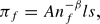
In equation (2), A is a parameter measuring the state of technology (which will be made endogenous below) and s is the share of output retained by the producer. We specify the contest or share function as follows:Footnote 5

where the parameter θ is a proxy for (lack of) security and measures the ease with which output can be stolen. This parameter must take on values less than one-half, as will become evident below. This share function is consistent with the idea that all raiders devote all of their efforts to theft, and each farmer bears an equal fraction of total raiding effort. Using the time constraint and the share function, producers’ payoffs are defined as:
where ψ = n r/n f, or the ratio of raiders to producers in the economy. Under anarchy, which is analogous to an autarkic solution to the model, each producer chooses defensive effort to maximize (4) while taking as given the number of raiders in the population and the defense decisions of other producers. The choice of defense maximizing (4) is:

Plugging (5) into (4) gives the following expression for the optimal returns from producing, given n r and n f:

Now consider the payoffs for raiders. Assuming each raider gets an equal share of the total ‘take’, these payoffs consist of the total resources stolen from producers divided by the number of raiders:

Using the equilibrium value of defense in (5), we have:
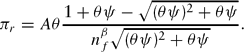
In equilibrium, people are indifferent between producing and raiding so that the returns from each career choice should be the same. Equating (6) and (8) results in the following expression for the ratio of raiders to producers in the economy (or the raid ratio):
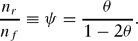
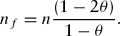
Hence, the fraction of raiders in the population depends only on the security parameter θ. Amorphy, as defined by Hirschleifer (Reference Hirschleifer1995), thus occurs in the special case where θ = 0. As θ increases, so does the relative number of raiders. When θ = ½, all agents prefer to be raiders and per capita income in the economy completely evaporates. Using the total population constraint and the result in (9), we have the following number of producers in the society as:
The returns to productive labor are given by:

Upon substituting (10) in (11), we get an explicit expression for equilibrium income of raiders and farmers:

Note that the returns in (12) depend upon the degree of security present in society, and go to zero as θ goes to ½. We now investigate how these outcomes are affected when a potential king enters the scene.
The case of hierarchy
Following Grossman (Reference Grossman2002), under hierarchy, the ruler organizes defense on behalf of everybody in society (see also McGuire and Olson, Reference McGuire and Olson1996). While individual people still use their own effort to protect their output, the ruler decides on the allocation of time between production and defense. The key difference with anarchy is that the king takes into account that the number of raiders is endogenous with respect to the level of defense. In other words, the ruler internalizes the external effect of deterrence – i.e., that raising defense induces some raiders to become producers instead, as opposed to the anarchic decisions of individual agents that balance foregone production versus the share of output that can be retained. An important simplification in our analysis is that we ignore problems of free riding and cheating, and simply assume that the ruler is able to force ‘his people’ to choose what he deems to be the optimal allocation of time. Specifically, individuals can do better by ignoring the external benefits of defense effort, and supply the privately optimal amount only. If so, the regime would unravel and slide back to an anarchic outcome where the ruler is not the monopolist taxing agent (roving bandits can also profitably enter). To circumvent this issue, we assume that the king is able to costlessly monitor the defensive efforts of the populace, and can credibly commit to punish them sufficiently severely if they do not follow his decisions. For further discussion of these issues, refer to Williamson (Reference Williamson1973).
In return for solving the coordination problem, the king reserves the right to collect taxes, and the cost of hierarchy is that the hierarch is concerned about his own welfare when setting the tax rate. The payoffs to being a producer are now defined as:

where dH denotes the centralized level of defense and τ is the tax rate chosen by the hierarch. Assuming only legitimate activities are subject to taxation, the returns to being a raider are now given by:

The hierarch must set the level of defense and tax rate so that the following condition is satisfied:

otherwise, he collects no tax revenues. Equation (15) reduces to the following condition:

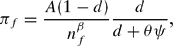
The total tax revenues collected by the hierarch are then defined by yH=n(1−dH)Aτ/n βf. The hierarch chooses defense to maximize tax revenues subject to a ‘participation constraint’ (16), or the condition that people prefer to produce rather than to raid. Note this choice involves an elementary tradeoff. While the hierarch wishes to raise the tax rate, he is restricted in his ability to do so by the fact that raising taxes implies he should simultaneously mandate higher levels of defense (which comes at the expense of foregone production). The reason is that raising the tax rate makes raiding more attractive, ceteris paribus, and this gain in raiding returns must be offset by an increase in defenses. The solution to the hierarch's problem is:

Not surprisingly, centralized defense levels are higher than the anarchic level of defenses, reflecting that the king considers the impact of defense decisions on career choice while individual producers do not.Footnote 6 Plugging in the optimal value of τ and dH into (11) gives the following expression for producers’ income under a ruler:

We can now solve for the critical security level where people are indifferent between being raided and taxed by equating (12) and (18). The critical parameter is defined by the following condition:

Since the right-hand side of (19) monotonically decreases in the magnitude of θ for any value less than ½ and the left-hand side increases and then decreases, there exists a unique point at which the left-hand and right-hand sides of (19) are equal. Denote this threshold value as θ*. It is also straightforward to show that for sufficiently large values of θ, πHf > πAf.
While this model is suited for discussing the tradeoff between autarky and an appropriative government, it says nothing about how the nature of governance is influenced by population and technological progress, or about the different possible phases in the development process of societies over time. A dynamic model is necessary to consider these issues.
3. A dynamic model
We now introduce equations of motion to capture the intertemporal development of population size and the state of technology. Following Galor (Reference Galor, Aghion and Durlauf2005) and others, we assume that technical progress is one of the main drivers of the model, and aim to capture the process of innovation and depreciation (erosion) of the state of technology as follows:

where Ȧ = dA/dt. The first term on the right-hand side captures innovations and the second term captures erosion of technology (δ denotes a depreciation parameter). The specification in (20) assumes the state of technology is increasing in the current state of technology, A, and in the population of producers, which may be due to some ‘innovation by doing’ effect, or because higher population density allows for a faster exchange of ideas, etc. (e.g. Shekhar et al., Reference Shekhar, Dalgaard and Moav2006). Although this is not important for the model that follows, we envisage the gradual increase in A over time as the gradual transition from foraging to early farming.
We posit that as A grows larger, output becomes easier to steal. This might occur because production of more output results in the generation of a surplus, which must be guarded. Moreover, theft may also be facilitated due to changes in the nature of production. For example, if producers rely more on harvesting produce that they have planted or sown themselves, then raiders may have relatively easy access to the stock when it is on the field. We introduce these ideas into the model by assuming that the security parameter θ changes with the level of technology. For simplicity, we assume a linear relation between the state of technology and the ease with which output can be stolen (the results are robust with respect to alternative monotonic relationships):

where z is just a scaling parameter. In line with the earlier discussions on threshold values for the security parameter θ, specification (21) defines an upper limit on productivity for the anarchy and hierarchy models to be sensible – respectively A < Ā = 1/2z and A < Ã = 1/z. Failing to satisfy these conditions implies all become raiders (for the anarchy model) or producers allocate all of their time to defenses and there is no production (for the hierarchy model).
Recall people are indifferent between anarchy and hierarchy when θ=θ* (or A = A*). For θ>θ* (or A > A*), the dynamics of the state of technology are determined in the context of a society governed by a ruler. Instead, for θ<θ* (or A < A*), anarchy prevails and some people prefer to raid rather than produce. This means we must derive two different segments of the Ȧ = 0 isocline associated with (20), or two distinct segments where technology is constant. One segment is relevant for the anarchy context (where some people are raiding, ψ > 0, and not contributing to the accumulation of knowledge) and another one is relevant for the hierarchy context (ψ = 0). Solving for Ȧ = 0 under anarchy and hierarchy results in, respectively:

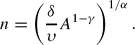
Equations (22a) and (22b) imply that, at A=A*, there is a discontinuity in the Ȧ = 0 isocline, which jumps downwards then (note 0<(1−zA)/(1−2zA)<1).
Specification of a population growth process completes the description of system dynamics. Following a large literature on early economic civilizations (e.g. Brander and Taylor, Reference Brander and Taylor1998, Horan et al., Reference Horan, Bulte and Shogren2005), we describe population dynamics by a simple Malthusian process:
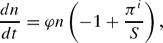
where ϕ is a population growth parameter, i denotes anarchy or hierarchy, and S is a food intake threshold (minimum caloric intake for self-maintenance). For π < S, the population shrinks and for π > S, it grows. We ignore the king's income as his fertility decisions are relatively unimportant relative to those of the population at large, and use the people's income as provided in (12) and (18) (but qualitatively similar outcomes obtain if we would base the analysis on total income in the economy). Condition (23) is readily solved for the ṅ = 0 isocline by setting π = S and, again, there are two distinct isocline segments, depending on whether A is greater or smaller than A*. The isocline segments for anarchy and hierarchy, respectively, are given by:

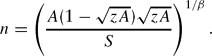
With these building blocks in place, we can now turn to an analysis of the dynamics of population growth and technical change, and the consequences for institutional change.
4. Model results
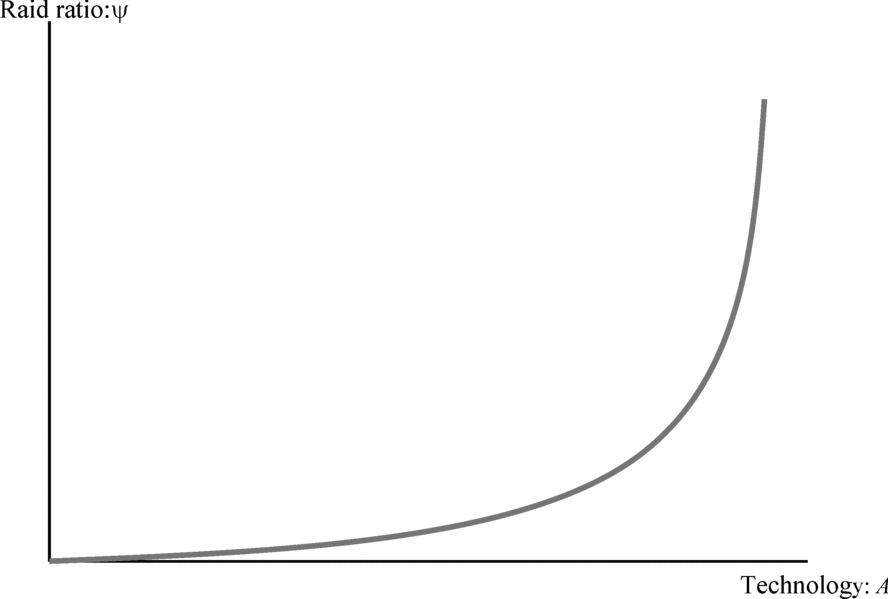
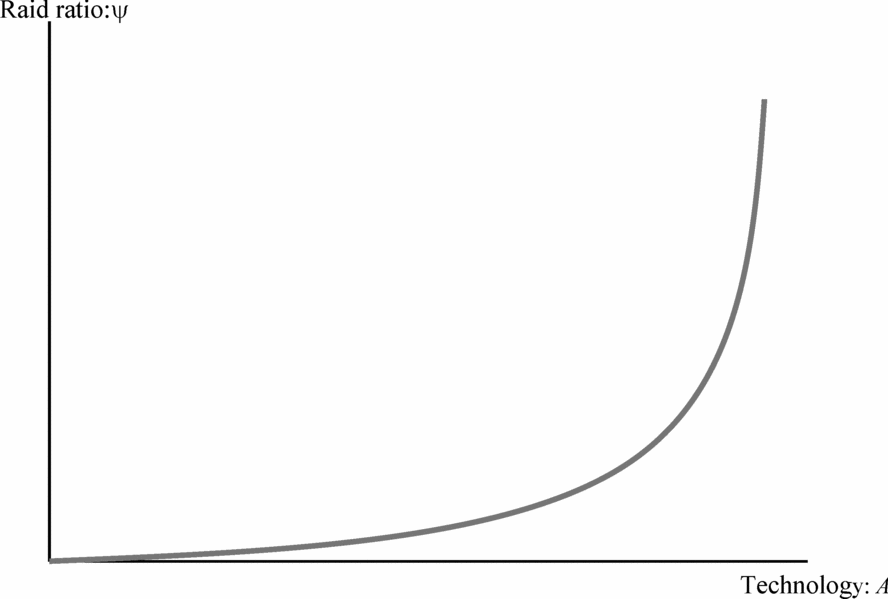
Before we analyze the dynamics and steady states in some detail, it is instructive to consider the impact of technical change on some of the model's key variables in equilibrium. In Figure 1 we demonstrate that the anarchic raid ratio (ψ), or the number of raiders divided by their victims, increases as the state of technology increases. While an increase in productivity increases the returns to both producing and raiding (so that the net effect is neutral),Footnote 7 there is an additional effect due to the assumption that the production and storage of surpluses enhances the ease with which output can be stolen – tipping the balance in favor of becoming a raider. The net effect of technical change on income of producers and raiders is ambiguous, depending on the level of technical change (see Figure 3 below). Technical change raises the value marginal product of labor allocated to production, but since fewer people actually produce the net effect on income is unclear. Specifically, if we consider the case where society is in anarchy before and after the increase in A (so that equation (12) describes income throughout), we can use (21) to show that technical change is detrimental for income if:
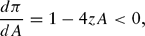
which is the case whenever A > 1/4z, or when the raid ratio curve is sufficiently steep (see Figures 1 and 3).
Raid ratio and technology
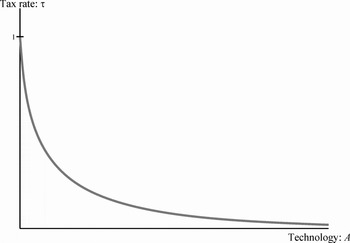
Next, consider the case of hierarchy. In Figure 2, we show that an increase in the state of technology lowers the equilibrium tax rate. Since technical progress makes raiding more attractive, the ruler aims to neutralize the incentive to switch from producing to raiding, and lowering the tax rate so that producers can retain a larger share of their output is one approach to doing this. An alternative approach to restoring the balance between producing and raiding would be to raise the levels of defense, but this comes at the cost of foregone production. To find the optimal tax rate, the ruler balances the foregone profit share from low taxes versus the foregone output from raising defense levels. Hence, while technical advances ambiguously impact on producers’ income under conditions of anarchy, when ruled by a king it makes producers unambiguously better off – it allows them to retain a greater share of a larger pie. One may use (18) to verify that dπH/dA > 0.
Optimal tax rate and technology

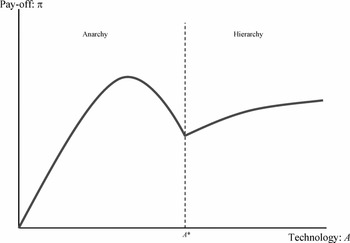
In Figure 3 we provide equilibrium income for anarchic and hierarchical societies. As explained above, the relation between the state of technology and income under anarchy is non-monotonous. The critical level of technology A*, and the associated critical security parameter θ*, is defined by the unique interior intersection of the two income curves.
Pay-offs and technology

The analysis until now implies that simple models with exogenous technical change (i.e., Ȧ = A 0e σt where σ is a parameter) will necessarily undergo the transition from anarchy to hierarchy: eventually the level of technology will be sufficiently high to elect a king in power. Is this also true for our dynamic model with endogenous technical change? The answer is no. For different parameter combinations, we obtain qualitatively different results. In what follows, we illustrate this important point by presenting two interesting cases.
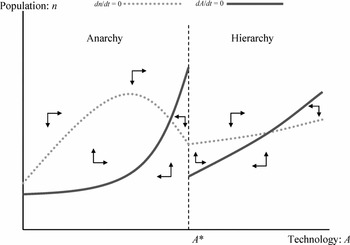
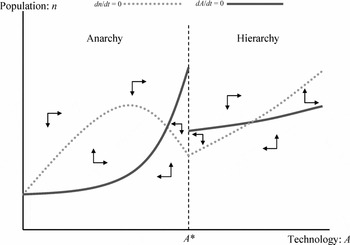
In Figure 4, we provide the phase plane for one possible configuration of parameters, providing the isoclines as derived in (22) and (24).Footnote 8 On the horizontal axis, the state of technology is depicted, and the vertical axis provides population numbers (or density). As before, A* denotes the critical technology level, so that for A < A* the anarchy segments (22a, 24a) are relevant, and for A > A* the hierarchy segments (22b, 24b). The present configuration has two potentially stable interior steady states: in both the anarchy and hierarchy sectors of the phase plane, the Ȧ = 0 isocline cuts the ṅ = 0 isocline from below, which implies that each steady state is a focus or node. The stability of the steady states depends on the relative slopes of the isoclines, and may be analyzed further by examining the eigenvalues of the linearized system in equilibrium.
Population and technology dynamics (two potentially stable steady states)

The existence of a potentially stable steady state in the anarchy sector implies that societies may ‘get stuck’ to the left of A* and never elect a king. These low-tech societies prefer to go untaxed and provide defense on a decentralized basis. We interpret these societies with low productivity levels and little or no storage of commodities as stable foragers’ societies. Other societies, however, will cross the security (or productivity) threshold, possibly because the trajectories cycle outward. Depending on the trajectory, such societies will eventually support a king providing efficient levels of security, or cycle back towards the anarchic segment. Indeed, as in Usher (Reference Usher1989), it may be feasible to have ‘dynastic cycles’ where societies grow and collapse and undergo periodic phases of anarchy.Footnote 9 The model predicts farmers’ societies where storable and ‘lootable’ surpluses are produced will settle down in the hierarchic steady state. This is a prediction that is amenable to empirical testing in section 5.Footnote 10
The phase plane suggests that societies are more likely to become hierarchical if the initial level of technology is ‘high’ (i.e. close to the threshold) or if the population is ‘large.’Footnote 11 In contrast, societies with few people are likely to evolve towards anarchy, even if their initial level of technology places them to the right of the threshold. The reason is that such societies will gradually lose their level of technical sophistication as new innovations fail to keep pace with the erosion of knowledge (similar to the findings in Shekhar et al., Reference Shekhar, Dalgaard and Moav2006). As an interesting aside, while population size is important during the transition phase, the model predicts that equilibrium population size of the anarchy and hierarchy steady state cannot be unambiguously ranked. Indeed, for the combination of parameters underlying Figure 4 we find that the hierarchical society is smaller than the anarchic one. Again, this is a model implication that may be amenable to empirical testing.
In Figure 5 we present an alternative phase plane based on a different set of parameters.Footnote 12 This is the case where the Ȧ = 0 isocline cuts the ṅ = 0 isocline from below in the anarchy sector (as before), and from above in the hierarchy sector of the phase plane. The anarchy steady state is again a focus or node, but the hierarchic steady state is now a saddle point. The separatrix associated with the saddle point divides the hierarchy sector in two parts – below the separatrix the system is pushed (back) towards anarchy, above if the system is pushed on a path of sustained growth where population increases and technical mutually increase each other. In other words, an anarchic society that faces a sufficiently large (temporary) productivity shock – say, a climatic shock or significant technical innovation (possibly through technology import) – will face a fundamentally different future. This will happen if due to the shock the system ‘jumps’ above the separatrix. Not only will it elect a king in power, it will also experience sustained growth where population growth spurs technical change, and where the income increase following technical change permits Malthusian style population growth.
Population and technology dynamics (one potentially stable steady state, one saddle-path stable)

This is not intended as an exhaustive analysis of all potential dynamic outcomes. For example, some parameter values imply the anarchic steady state disappears (i.e., the isoclines do not intersect for values of A below A*) and others imply it changes into a saddle point. The latter possibility suggests that for some initial conditions (specifically, for starting points below the anarchy separatrix), society will become trapped in a vicious circle of population decline and technical regression, and eventually go extinct. For other initial conditions, of course, the transition to hierarchy is inevitable. Detailed knowledge about underlying parameters of societies is necessary to predict the qualitative nature of its long-term fate.
Note that our results will hold even if the risk of theft concerns only a fraction of producers. Clearly, farmers that are not subject to the risk of theft will not consider voting for a king, as this means that they will have to give up income to hedge against a risk that they are not exposed to. Nor, for the same reason, will they invest resources in defending themselves against raids. Would risk-fee farmers not consider becoming raiders, then? The answer is No. Recall that in a non-ruler equilibrium, raiders, as well as farmers subject to the risk of theft, obtain the same income. Since farmers subject to the risk of theft have to invest in defence, their income is lower than that of risk-free farmers. In a non-ruler equilibrium, therefore, raiders will obtain a lower income than that of risk-free farmers, and so, for risk-free farmers, raiding is not an income-maximizing option. Under a ruler, on the other hand, everyone involved will have to pay a share of their income to the ruler, and so risk-free farmers will not consider the ruler option. Effectively, therefore, we can exclude the risk-free farmers from the analysis, which takes us back to the initial exercise that concerns only the fraction of farmers subject to risk.Footnote 13
5. Empirical evidence
In this section, we describe how the emergence of hierarchy relates to basic characteristics of production and the economy. The evidence we present is intended to provide some rough verification of the primary features of our theoretical model, and also provide the reader some additional insight into how hierarchy apparently emerges from anarchy. Since we seek to discuss the evolution of hierarchy from a state in which there is no higher authority or government, it is useful to employ data that allow comparison of societies in which there is no form of higher government with societies in which some form of hierarchy exists. Our approach is therefore to study the incidence of hierarchy in a cross-section of different cultures.
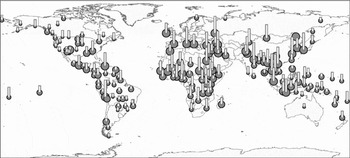
We employ the Standard Cross Cultural Sample (henceforth SCCS), an extensive and well-documented cross-cultural data set originally developed in the work of Murdock and White (Reference Murdock and White1969).Footnote 14 The SCCS contains information on the technology, environment, and culture of 186 different cultures, drawn from ethnographic reports assembled at different places and times from a spectrum of indigenous cultures. As separate data points, it includes sub-Saharan African hunter-gatherers, Native American hunter-gatherers, European peoples, large-scale agricultural nation-state cultures of Meso-America (such as the Aztecs), and historical nation-state peoples (such as the ancient Hebrews and Egyptians), among others. The geographical distribution of the societies in the SCCS is displayed on Map 1, the content of which we shall discuss in more detail momentarily. The majority of the cultures in the SCCS were sampled at a time coinciding with or just after contact with western cultures (the mean date of contact among the cultures is 1850, but some observations – for example, the ancient Egyptians – date from considerably earlier). These cultures can be taken as a reasonably representative of the cultural and technological diversity of human history.Footnote 15

The SCCS contains information that broadly captures the notion of hierarchy developed in our theory. While there are several candidate variables in the SCCS that might be used to measure the degree of hierarchy, available variables vary greatly in quality and completeness. To measure the nature of government in each particular society, we settle on the variable ‘Jurisdictional Hierarchy beyond the Local Community’, which we henceforth refer to as ‘the degree of hierarchy’.Footnote 16 This variable runs on a scale from 1 to 5. A society earns a score of 1 if higher political authority is absent, a score of 2 if petty chiefs are present, and a 3 on the scale if it is a larger chiefdom. The scores 4 and 5 on the scale are reserved for state forms of government, where a society earns a 5 if the governance structure is that of a state with multiple jurisdictions.Footnote 17 Since our theoretical model is basically a dichotomous model of the emergence of hierarchy, we also present some evidence using a dichotomous hierarchy variable. This dichotomous hierarchy variable is constructed by awarding a society a score of 0 if there is no higher political authority (i.e., a score of 1 on the degree of hierarchy scale), and a 1 for all other values on the degree of hierarchy scale.
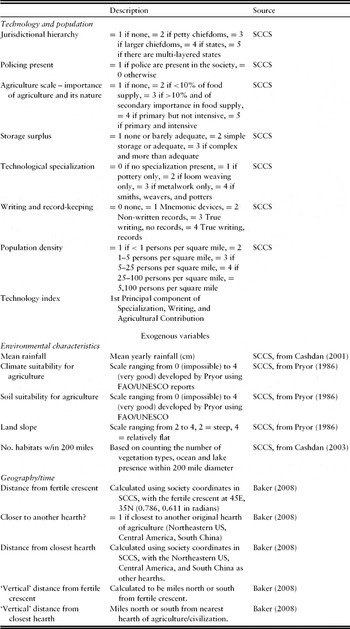
Our theory advanced the view that technological sophistication and the presence of storage are important determinants of the degree of hierarchy, and also that an important function of a hierarchy is policing. Thus, we employ a set of variables in the SCCS to measure technological sophistication, including the degree to which writing and record-keeping are present in a society, a measure of task specialization, a measure of whether or not storage and retention of surplus output is present in a particular society, and the contribution of agriculture to the food supply.Footnote 18 These variables, along with some other variables (which serve as instruments in some of our regressions), are described in Table 1. The SCCS also contains some limited information on the function of the state, and we include some information on whether or not police are present or absent.
Description of variables and sources used in the analysis

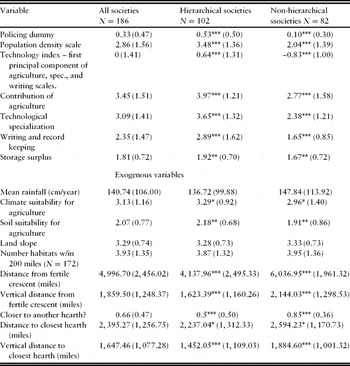
Table 2 presents summary statistics, sorted by the presence or absence of hierarchy as determined by the dichotomous hierarchy variable. A first point of interest is that the presence of hierarchy appears to be correlated with the presence of police in any given society. This suggests that one of the most important functions of a hierarchy is enforcement of law and maintenance of property rights. The correlation coefficient between the police presence dummy and the presence of hierarchy is 0.68 (p < 0.01).
Summary statistics of all variables, by presence or absence of hierarchy

Notes: **Difference in means significant at 5%.
***Difference in means significant at 1% (assuming unequal variances).
To get a better feel for the relationship between hierarchy and technology, and in light of the fact that the technological variables increase together, we have also constructed a univariate index of technology using principal components. The index is assembled from the first principal component of the three variables measuring technological specialization, agricultural importance and sophistication, and the presence of writing and record keeping. The first principal component captures a strongly positive association between the three variables and explains about 64% of the joint variation in the three variables.Footnote 19 We take this to mean that in one common dimension the overall level of technology in the society is increasing. We refer to the index so constructed from this first principal component as ‘the level of technology’, or more succinctly, ‘technology’. The resulting technology index has a mean of zero (by design), a minimum value of –2.34, and a maximum value of 2.40. A society for which the technology value is close to the lower limit can be thought of as one with a low reliance on agriculture, little or no record keeping and writing, and little task specialization. We maintain our fourth technological variable, measuring the presence or absence of storage, separately as we hope to offer some evidence that this variable is an important determinant of hierarchy independent of the behavior of the other measures of technology.
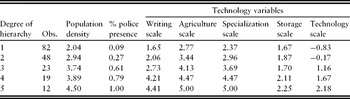
Table 3 breaks down each technological measure, the aggregate measure of technology, the scale variable measuring the importance of storage, population density, and whether or not police are present in the society by the degree of hierarchy. These results suggest that all of these things increase more or less together.
Average population density and technology by the degree of hierarchy

But what roles do technology, population density, and storage play in the emergence of hierarchy? One of the key points of our theoretical model is that the degree of hierarchy, population density, and technology are all jointly determined. In Section 4 of the paper, we showed that the adoption of hierarchy has consequences for the types of technology that may be used, which in turn influences the population that may be sustained. Thus, a more rigorous empirical analysis should treat population and technology as endogenous variables, and appropriate instruments for these variables must be found if the independent impact of technological sophistication or population on the degree of hierarchy is to be determined.
Along these lines, consider once again Map 1. In addition to displaying the geographic distribution of societies in the SCCS, we have plotted two pieces of information for each society. Each society has been marked with a circle, which increases in size as the level of technology of the society increases. Furthermore, each society has also been marked with a vertical column increasing in length with the degree of hierarchy present in the society. From this map, one can see that there are some regularities in the geographical distribution of both technology and hierarchy. In fact, those societies that are hierarchical appear to be grouped closer to historical centers of civilization, and also appear to be centered in areas in which the environment might be considered richer in the sense that hierarchical societies are typically closer to warmer climates. Following this logic, our instruments controlling for the potential endogeneity of population and technology in determining hierarchy derive from both the geographical position and the environmental conditions of each society.
Measures of environmental quality like those described in Table 1 should have little direct impact on the emergence and development of hierarchy. Environmental factors should work through other variables by allowing higher population density, which in turn impacts the adoption and creation of more sophisticated technologies. Thus, it seems reasonable to use as instruments for population density and technology underlying environmental characteristics. These environmental variables are described on Table 1. One cannot be sure, however, from Map 1 that the clustering of hierarchical societies is due solely to similar population density and environment. To further control for this closeness and to allow for the possibility that hierarchical forms of government are learned and adopted from neighbors, we include the distance measures described in Table 1 as further exogenous variables in regressions.Footnote 20
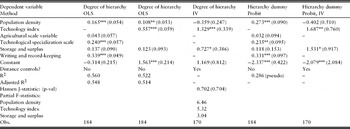
Table 4 presents a series of regressions in which hierarchy is the dependent variable, and various measures of population density and technological sophistication are used as independent variables. Since technology and population density may be endogenous, and because the analysis may suffer from omitted variables and measurement error, we report both OLS results and IV results, including probit specifications in which the dependent variable is our dichotomous measure of the presence or absence of hierarchy. The first two columns on Table 4 are the results of OLS estimation. The second column reports OLS results when the three separate technology measures are replaced by the first principal component of the technology measures. Not surprisingly, the results are similar and suggest that population density, technology, and hierarchy are significantly positively related. The third column of Table 4 presents the results of IV estimation when distance controls are included in the main regression and use environmental characteristics as instruments. Hausman endogeneity tests for the IV regression indicate that one may reject the null hypothesis that population density, technology, and storage are jointly exogenous and therefore treating these variables as endogenous is warranted. Column 3 also includes partial F-statistics for the first-stage regressions, and these suggest that our chosen instrument set performs reasonably well. Moreover, the J-statistic for the regression suggests that the instruments are orthogonal to the model error term.
Some empirical models of hierarchy and technology

Notes: *significant at 10%, **= significant at 5%, ***= significant at 1%. In the case in which an instrumental variables regression is reported, the instruments used are the environmental and geographical variables (described in table 1). Probit IV estimates are obtained using a two-step estimator.
Since our dependent variable is close to being dichotomous, we also include results from probit estimation on Table 4, presented in columns 4 and 5. Column 4 presents a probit model mirroring the OLS specification in column 1 with similar results. Column 5 estimates the probit model, including the distance controls and treating the technology and population density variables as endogenous. The results are again similar to the IV estimation in column 3.
This empirical evidence, while rough, does indicate that technology and the presence of storage appear to exert an important influence on the emergence of hierarchy. As predicted by our theory, there appears to be a relationship between the presence of hierarchy and policing. Moreover, hierarchy appears in part to be caused by greater degrees of technological sophistication and the presence of storage surpluses, independent of other things, such as population density, which may influence the degree of hierarchy.
6. Discussion and conclusions
Why do some societies evolve from anarchy to hierarchy, and why do other societies fail to make that transition? We propose a novel explanation by focusing on internal conflict (raiding) and the tradeoffs between decentralized and centralized levels of defense. While centralized levels of defense are efficient – taking the external effects of deterrence into account – and increase total output relative to anarchic equilibrium levels, there is an associated cost for producers as the ruling elite is capable of taxing away part of the surplus for its own consumption. The main result of the paper is that producers prefer to be taxed, rather than be raided, if production technology is sufficiently advanced. Using a dynamic model with endogenous population and technology we demonstrate that the evolution from anarchy to hierarchy is possible, but not inevitable – some (foraging) societies will prefer to stay egalitarian and anarchic. In reality, various distributional and coordination issues may preclude an immediate shift from anarchy to hierarchy.
Our empirical analysis, based on the Standard Cross Cultural Sample, supports the model's main predictions. Using OLS and IV estimation techniques we find that technology levels are an important driver of the degree of hierarchy in indigenous cultures, and that ‘storage’ plays an important role in this respect. The latter result makes perfect sense in the context of our model because we argue that the ability to stores output is one of the main determinants of raiding and conflict (enhancing the appeal of efficient levels of defense).
Consistent with the theoretical model, our empirical work also downplays the role of population size as a determining factor in the emergence of hierarchic structures. To be specific, it appears that when population is treated as an endogenous model variable determined by geography, environment, and technology, it does not exert a significant impact on the degree of hierarchy. This result is of some interest because it suggests that scale arguments may not be as critical in understanding the formation and development of governance structures, vis-a-vis concerns such as provision of defense and security. That is, the potential efficiency gains from centralized public good provision may not necessarily be an overriding concern for community members when deciding about whether to elect a king, or not.
The theoretical model is very stylized and ignores many salient features of reality. For example, we do not consider that some communities may be able to coordinate on optimal levels of defenses in the absence of a ruler, or that security parameter θ may be subject to technical change (related to technical advances in production, or otherwise). We also ignore the issue of external conflict – including fights over territories of different communities – which may clearly provide an important impetus for centralized organization of defense (see Baker, Reference Baker2003). Finally, by assuming all community members have identical skills, we assume away that there may be internal conflict over whether to switch from anarchy to hierarchy, or not. Members that are more productive than others, or have access to more productive land, will prefer to make the transition at some lower critical value of technology. This could result in societies ‘breaking up’ or in some faction imposing its will on another. Analyzing these issues, and others, is left for future work.