Introduction
Within the field of political theory, a fierce debate continues to rage about the value we should attach to national identities. Defenders of national identity not only point out how pervasive and resilient such identities appear to be, but also suggest that societies whose members are united by means of them are able to achieve a range of desirable ends that would otherwise be unobtainable. On the other side stand a number of critics, including advocates of identity politics, who see national identities as artificial constructs, imposed by states or by dominant ethnic groups on unwilling minorities, and cosmopolitans, who regard these identities as blocking the emergence of an enlightened global consciousness that would allow us to respond impartially to the interests of all human beings, and especially the global poor.
One part of this debate is purely normative in character, but another part involves the making and challenging of empirical claims. This second part is what we refer to here as the national identity argument. The argument takes a number of different forms, but in broad outline it holds that national identity provides the ‘cement’ or ‘glue’ that holds modern, culturally diverse, societies together and allows them to function effectively. When people identify with one another as compatriots, over and above the many more specific gender, ethnic, cultural, or religious identities they may have, they are more likely to display generalized trust, and to show solidarity. This reduces social conflict and increases willingness to cooperate, which in turn makes it easier for the society to produce public goods, to decide a wide range of matters by democratic means, and to channel its resources in the direction of disadvantaged members. (For different versions of this argument within political theory, see Tamir (Reference Tamir1993: chs. 5–6), Miller (Reference Miller1995: chs. 3–4), Canovan (Reference Canovan1996: chs. 4–5), Schnapper (Reference Schnapper1998), Taylor (Reference Taylor1998), Kymlicka (Reference Kymlicka2001: chs. 10–11), and Moore (Reference Moore2001).)
In this broad form, the national identity argument has recently proved appealing to democratic politicians in many states, who have taken steps both to reinforce existing national identities and to extend their range by encouraging marginal groups, especially newly arrived immigrants, to adopt them. Britain for example has introduced citizenship tests for immigrants, and expanded the ‘Britishness’ content of citizenship education in schools. In France, President Sarkozy launched a debate on French national identity in November 2009 that involved grassroots meetings throughout the country attempting to decide what it meant to be French (he had already on coming to office established a new ministry of immigration and national identity, though this initiative was later abandoned). The famously tolerant Dutch have introduced a citizenship test for those from outside the EU that requires extensive knowledge of Dutch history, culture and sexual mores. Although it is difficult to establish the precise basis on which such policies were adopted, it seems unlikely that it was out of a belief in the intrinsic value of national identities. Instead, strengthening national identity was felt to be important for instrumental reasons: for contributing to social integration, tolerance, democracy, or social justice. But if so, we have to ask whether the national identity argument holds water when it is subjected to empirical testing. Do such identities really have the desirable effects that many politicians believe they have?
As this article will reveal, there is no consensus among social scientists about the answer to this question. Although a large body of evidence has been gathered as part of an attempt to test different versions of the national identity argument, the findings are inconclusive and often seemingly contradictory. One of our aims here is to explain why this is so: why it has proved so difficult to subject the national identity argument to a decisive test. Our intention is not to review all of the evidence that has accumulated over the years about the effects that identifying more or less strongly with a national community has on people's political attitudes, and in particular their willingness to support the redistributive policies associated with the welfare state. Instead we focus more narrowly on the way in which national identity has been conceptualized in these studies. We distinguish between four different dimensions along which national identities can be measured, and show that each of these dimensions has different consequences for political beliefs and attitudes. Using these distinctions, we argue that to assess the impact of national identities on support for social justice, we must look not merely at the bare fact of having a national identity that is shared with fellow citizens, but at the form that such an identity takes. This allows us to connect empirical research on the effects of national identity with the debate that has emerged in political theory over ‘liberal nationalism’, as defended by the authors cited above. Liberal nationalists argue that national identities can escape from their ethnic origins, and in the process become more accessible to minority groups, especially immigrant groups who do not initially share in the culture of their host community. On the other hand, they believe that it is not sufficient for citizens merely to share an identity as citizens, an identity focussed entirely on the political institutions and constitution of the state. So they have to perform a balancing act: they must try to foster identities that are ‘thin’ enough to avoid being ethnically exclusive, but ‘thick’ enough to bind people together and motivate then to support social justice. By looking at the evidence about the shape that national identities actually take, we can determine how feasible such a balancing act will turn out to be.
In short, we have three main aims in this article. The first is to clarify the national identity argument, and to evaluate different ways in which it might be tested. The second is to examine the various dimensions of national identity, to see how far they correlate with one another empirically, and to explore the effect of each separate dimension on support for social justice. And the third is to consider the implications of our findings for adherents of liberal nationalism. Our empirical hope is that future research on the effects of national identity will pay closer attention to how identity is conceptualized when attitude surveys are undertaken. Our normative hope is that the debate about whether existing national identities should be reinforced politically will be informed by a better understanding of how these identities, with their different dimensions, shape political attitudes. We begin by setting out the argument itself in more detail.
National identity and social justice
How does the national identity argument apply to issues of social justice? The central claim is that in culturally diverse, market-driven societies, people will only be willing to support socially just institutions and policies – particularly those that together make up the welfare state – if they share a common identity with those who are likely to be net beneficiaries. This applies particularly to policies that create public goods that are available for all to enjoy regardless of whether they have contributed to their production, and policies that predictably redistribute resources from one group of citizens to another, for example from rich to poor or from the able-bodied to the disabled. Supporting such institutions and policies means on the one hand arguing and voting for them in democratic forums and on the other complying with their requirements by, for example, paying taxes honestly and not taking unfair advantage of the benefits they provide. If people paid attention only to their individual or sectional interests, they would not offer such support consistently. The motivation to do so comes from an emotional identification with compatriots that can overcome the competing pull of self-interest.
This argument advances a claim about the conditions under which welfare states in democratic societies can enjoy ongoing and widespread popular support. Although the argument implies that the existence of such identities has been a factor explaining the rise of welfare states in these societies, it does not suggest that this is the only explanatory factor. Thus, it is compatible with the claim that in many cases states have introduced welfare programmes for quite independent reasons, and also with the claim that states have sought to foster the national identities that now support these programmes. (This is in response to critics such as Hibbert (Reference Hibbert2008).) Nor does the national identity argument claim that popular attitudes are the only causal factor keeping the welfare state in existence. Thus, it can accommodate institutional explanations for the persistence of welfare programmes such as those convincingly laid out by Banting (Reference Banting2010). It does, however, imply that in the long run redistributive welfare states will not survive unless underpinned by national identities.
A further point of clarification may be helpful here. The national identity argument claims that where citizens share in a national identity, this motivates them to support social justice in the form especially of the welfare state. It does not rule out the possibility of reverse causation whereby the existence of a welfare state itself serves to foster a shared national identity among those who maintain it by their contributions and benefit from it in turn. This causal claim has been defended by a number of authors (see McEwen and Moreno, Reference McEwen and Moreno2005; McEwen, Reference McEwen2006; Beland and Lecours, Reference Beland and Lecours2008) and certainly seems plausible when applied to developed welfare states such as Canada and the United Kingdom. Notice, however, that it complements the national identity argument rather than replacing it – it suggests the possibility of a benign circle whereby nationhood provides motivational support for welfare state policies, while these policies in turn help to promote a sense of common identity. Equally, of course, if external factors cause national identities to weaken, or oblige states to cut back their welfare expenditure, the causal processes will act in the opposite direction and the circle may become malign. Here we restrict ourselves to evidence about the causal effects of national identities, without wishing to deny that these identities themselves may be influenced, for better or worse, by the social justice policies that states pursue.
As it is usually formulated, the national identity argument not only claims that the existence of such an identity serves to support social justice, but also gives an account of the mechanisms that links identity and outcome together. These mechanisms involve solidarity, a special concern for the welfare of the members of the relevant group, and a willingness to go to their aid, and trust, a belief that the sacrifices you make on their behalf will be reciprocated in turn. Here we take these linking mechanisms for granted in order to focus attention directly on the causal effects of national identity; thus, we will not be considering the extensive body of literature that has grown up to explore the causes and effects of social and political trust (see, for example, Warren, Reference Warren1999; Uslaner, Reference Uslaner2002; Lenard, Reference Lenard2012). Our concern is with national identity as a possible source of solidarity and trust. But what exactly does it mean to have a national identity? There is a long tradition in studies of nationalism of classifying nations as either predominantly civic or predominantly ethnic in character, according to whether the source of national unity is political principles and institutions on the one hand or common descent, customs and culture on the other (see, for example, Kohn, Reference Kohn1944; Smith, Reference Smith1991; Brubaker, Reference Brubaker1992; Greenfeld, Reference Greenfeld1992; for a recent overview, see Karolewski and Suszycki, Reference Karolewski and Suszycki2011: ch. 4). We leave it an open question whether such a classification does useful work when applied to whole nations, but when looking at individual identities it may be important to see where they should be placed on the civic–ethnic spectrum. On the one hand, if the identities that motivate support for social justice turn out to be purely civic in character – focussed on state membership and political principles like democracy and the rule of law – then we would no longer be able to defend a national identity argument. (Whether such purely civic identities could do the necessary work is the issue that in political theory divides advocates of ‘national identity’ such as Tamir (Reference Tamir1993), Miller (Reference Miller1995), and Canovan (Reference Canovan1996) from supporters of ‘citizen identity’ such as Habermas (Reference Habermas1998: ch. 4), Mason (Reference Mason2000: ch. 5), Weinstock (Reference Weinstock2001), and Abizadeh (Reference Abizadeh2002).) On the other hand, if it proves to be the case that existing national identities have a significant ethnic component, then their implications for solidarity and social justice are likely to be more ambiguous. Their motivational force may be strong, but they may discriminate between those who are judged to belong fully to the nation by virtue of descent or cultural affiliation, and those who are seen as more marginal or as excluded from national membership entirely. This may lead their bearers to feel ambivalent about policies whose main beneficiaries are (or are perceived to be) such marginal members. In exploring the effects of national identity, therefore, we must distinguish between different ways of understanding the ‘nation’ with which a person identifies and attempt to trace how these differences influence attitudes towards social justice and the welfare state.
How to test the argument
Bearing these points of clarification in mind, how should the national identity argument be tested? Since most people are likely to identify themselves nationally in one way or another, it will not be fruitful to compare the effects of having such an identity with those of having none. Instead we should look for contrasts either between stronger and weaker identities or between qualitatively different forms of identity, as suggested above. Most studies focus on the strength of identity, since this can more easily be quantified. But then we face another choice. Is what matters the strength of individual identification or the strength of collective identification? In other words, if we want to predict what impact my identity will have on my social justice attitudes, should we look at how strongly I myself identify with my nation, or should we look at how strongly those around me identify? In the latter case, cross-national comparisons can be drawn and their effects traced. The researcher will try to measure the overall strength of national identity in different countries, and test to see whether in countries where national identity was stronger, there was greater support for redistributive and welfare state policies. An important study by Shayo (Reference Shayo2009) has attempted to do this, reaching the conclusion that the relationship between national identity and social justice goes in precisely the wrong direction – where identity is stronger, both support for redistribution, and the actual extent of redistribution to people on low incomes, declines. So we must begin by looking more closely at this piece of research, which threatens to undermine the national identity argument entirely. How is national identity being measured in this study, and does cross-national research of this kind provide an adequate test of the national identity argument?
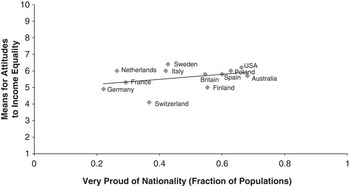
Shayo relies on two sources of evidence: The World Values Surveys (WVS) of 1990 and 1996, and the International Social Survey Program (ISSP) of 1995, both of which contained questions aimed at tapping the strength of national identities. The WVS had a single question that asked respondents how proud they were to be, for example, French on a four-point scale from ‘very’ to ‘not at all’. The ISSP used six items designed to elicit favourable attitudes towards the subject's country, such as ‘I would rather be a citizen of…than of any other country in the world’ with five possible responses from ‘Strongly agree’ to ‘Strongly disagree’. The WVS also asked respondents whether they thought incomes should be made more equal or whether larger income differences were needed as incentives. Respondents positioned themselves on a scale between 1 (pro equality) and 10 (pro larger income differences). Using the WVS data, we can measure the overall strength of national pride in a country by looking at what proportion of the population declare themselves ‘very proud’ of their national membership, and then examine how this correlates with collective attitudes to income equality/inequality. The results for 12 democracies are shown in Figure 1.
National pride and attitude towards income redistribution.
Source: World Values Survey (2005).

This reveals that countries with high levels of national pride are on average marginally more inegalitarian, in popular attitudes, than countries with lower levels of pride. But the gentle gradient of the line shows that this effect is only marginal, albeit in the wrong direction as far as the national identity argument goes.
Shayo himself does not carry out the exercise we have just performed, focussing instead on the effect of individual national pride scores on respondents’ willingness to support income redistribution. He does, however, examine the relationship between overall strength of national identity, using both WVS and ISSP data, and the extent of redistribution that actually occurs in each country, as measured by the percentage income gain of the bottom quintile as a result of taxes and transfers. This reveals a fairly striking pattern, with the countries that redistribute income the most having weaker national identity scores, countries such as West Germany (weak identity, high redistribution) and the United States (strong identity, low redistribution) standing at opposite ends of the scale (see figures 4 and 5 in Shayo, Reference Shayo2009).
Before we conclude that the national identity argument immediately founders in the light of this evidence, however, we need to scrutinize the measure of national identity that is being used. There are in fact two issues here: one is whether national pride questions are a good way of measuring the strength of national identities, if the aim is to test the national identity argument; the other is how valid any such questions are when used cross-nationally. We will address the first question shortly when we look at how different survey questions appear to tap different dimensions of national identity. With regard to the second, there is clearly a danger that what these cross-national surveys are picking up are primarily cultural differences over how acceptable it is to express national pride, rather than varying levels of identification (for a general discussion of the difficulties involved in attempting to measure national identities comparatively, see Svallfors, Reference Svallfors1996). For Americans, it may be a matter of course to express pride in American achievements and venture the opinion that the world would be a better place if more countries were like America, whereas for Germans statements such as ‘Germany should follow its own interests, even if this leads it to conflicts with other countries’ carry such clear historical resonances that we should not be surprised to find them at the bottom of this particular national identity ladder, even outdistancing Belgians, for instance (see Bergsieker (Reference Bergsieker2010) for an analysis of national pride in Germany).
It appears, therefore, that using the WVS and ISSP measures of national pride to reveal cross-national differences in the strength of national identities may yield misleading results. Perhaps for this reason, the overwhelming majority of studies we have consulted looked for individual-level differences within each nation, where it can reasonably be assumed there is much more agreement about what it means to declare yourself more or less proud of your national membership. We shall return later to the question of whether this focus on the individual respondent as the unit of analysis may be misleading in a different way. For the moment, let us explore different ways of testing whether those who display a stronger sense of national identity are also more committed to social justice and the welfare state. How is national identity operationalized in these single-nation studies?
Four dimensions of national identity
No single measure of national identity has become dominant in the field. Instead researchers have used a battery of different questions to tease out how strongly each respondent identifies with his or her country. These questions, we will suggest, fall into four main groups, each representing a separate dimension of national identity. It might in theory be the case that scores on each dimension were always highly correlated, in which case it would not matter much which approach to measuring national identity was being used. But this is not so, and it is therefore a key question from the point of view of the national identity argument how identity has been conceptualized in any particular study.
The first, and in some ways the simplest, dimension is the one we will refer to as ‘national attachment’. It is operationalized in questions such as these; ‘How important is being American to you?’ ‘How well does the term American describe you?’ and statements such as these: ‘I am emotionally attached to America and emotionally affected by its actions’; ‘The fact that I am an American is an important part of my identity’. What these questions are getting at is how strongly the person being interviewed identifies as an X, and how much that identity matters to them. A slightly different question that still nevertheless targets levels of national attachment is used by ISSP: ‘How close do you feel to country X?’
Next we have the national pride dimension, already referred to above. This is measured either straightforwardly – ‘how proud are you to be an X’ – or by inviting comparisons with other countries for example. ‘The world would be a better place if people from other countries were more like the people in X’ or, reverse scored, ‘X has a lot to learn from other countries in running its affairs’. Other questions invite the respondent to take pride in specific national achievements such as economic performance or sporting success.Footnote 1
At first sight, it might appear that national attachment and national pride were two sides of the same coin, and would therefore be strongly correlated, but on reflection this need not be so. National pride involves a positive evaluation of what the country has so far achieved, while it is clearly possible to identify strongly with one's country and yet at the same time feel that there is not much to be proud of in its recent or current performance. This can most easily be seen by considering the reverse statement: ‘There are some things about X today that make me feel ashamed of X’. Someone who agrees with that statement – as indeed about three-quarters of respondents typically do (see McCrone and Surridge (Reference McCrone and Surridge1998), using data from Britain, Germany, Spain, and Sweden) – clearly identifies with X, otherwise why would they feel ashamed? The opposite of national attachment is dissociation, which implies indifference rather than pride or shame.
It might nevertheless be the case that indices of national attachment and of national pride were closely correlated in practice, so that for purposes of testing the national identity argument either measure would serve equally well. Theiss-Morse's (Reference Theiss-Morse2009) study of American identity distinguishes between strong, moderate, and weak identifiers, and shows a consistent relationship between identity strength and pride in the US's political influence, democracy, economic achievements, and history (pp. 134–137). Another American study approached this question by distinguishing between patriotism and nationalism, where the patriotism items were mainly about identification and the nationalism items were mainly about the superiority of America over other countries (Li and Brewer, Reference Li and Brewer2004). This revealed a modest degree of correlation between the two indices, which rose significantly when the respondents were prompted by a statement about 9/11 in which Americans were described as having recognized their ‘core essence’ as Americans after the attack. However, the two constructs being studied did not correspond precisely to the dimensions we have distinguished, because the ‘patriotism’ items included a statement about national pride (I am proud to be an American) and the ‘nationalism’ items included one about unconditional support for the nation (People should support their country even if the country is in the wrong). This last item, we suggest, discloses a third dimension of national identity distinct from both attachment and pride.
This dimension has to do with whether a person's attitude towards his nation is one of uncritical support, or whether he is willing to distance himself from some of its actions and accept that one can be a loyal dissenter. We will call this the uncritical/critical patriotism dimension – others speak of blind vs. constructive patriotism (see Staub, Reference Staub1997; Schatz et al., Reference Schatz, Staub and Lavine1999; Parker, Reference Parker2010). It is operationalized in statements such as ‘I would support my country right or wrong’, ‘It is un-American to criticize this country’, or, on the other side of the fence, ‘My love of country demands that I speak out against popular but potentially destructive policies’. It is worth stressing again that conceptually there is no necessary connection between this dimension of national identity and the two already discussed. One should not assume that a person who is strongly attached to her country and/or scores high on national pride must also be an uncritical patriot. That this is so is easily seen by observing that over 80% of Americans say that they feel close or very close to America and similar numbers declare themselves proud or very proud of its democracy, political influence and history, but only 32% think that people should support their country even when it's in the wrong (Citrin et al., Reference Citrin, Wong and Duff2001: 80). One study that set out to test these connections found a modest correlation between national attachment and uncritical patriotism, and a weaker (but still positive) correlation between national attachment and critical patriotism (Huddy and Khatib, Reference Huddy and Khatib2007). So, although being an uncritical patriot does somewhat increase the chance that you will display a higher level of national attachment and vice versa, one cannot use an uncritical patriotism score as a way of measuring how strong a person's national identity is overall. Moreover, studies that amalgamate items belonging to different dimensions in a single index may yield misleading results. For example, a British study of ‘national sentiment’ combined the following four items:
Britain has a lot to learn from other countries in running its affairs.
I would rather be a citizen of Britain than of any other country in the world.
There are some things about Britain today that make me ashamed to be British. People in Britain are too ready to criticise their country (Heath et al., Reference Heath, Taylor, Brook and Park1999: 158).
These items form a mixed bag. The third is plainly a national pride item, and the fourth captures uncritical patriotism. The others are somewhat ambivalent. The first expresses both a critical attitude towards the status quo, and diminished pride by virtue of the comparison with other countries. The second conveys both national attachment (I want to be British) and national pride (Britain is a better country to be a citizen of….). The authors point out that the resulting scale ‘has a rather meagre Cronbach's alpha (a measure of internal reliability) of 0.35, which is considerably lower than one would wish’. This is what one would expect if the three dimensions of national identity we have distinguished are only modestly correlated.
Failure to keep the different dimensions separate may muddy the waters when it comes to testing the national identity argument. Why is this? Thinking first about uncritical patriotism and then second about national pride, one might expect that these would be associated with an overall political outlook that stands towards the right end of the left–right spectrum. For example, it is reasonable to assume that someone who thinks it is unpatriotic to criticize your country will think this as part of a generally authoritarian political world-view. A strong sense of national pride may also form part of this syndrome, since taking pride may involve the belief that the nation is already in good shape, and therefore nothing much needs to be changed.Footnote 2 So we might find a negative correlation between national identity and support for egalitarian social justice that was actually being driven by a general stance of political conservatism. We need therefore to control for this possibility if the national identity argument is being tested by using national pride or uncritical patriotism indicators, in whole or in part. We return to this issue below. First, we need to introduce the fourth dimension along which national identity has been measured.
This dimension concerns the way in which the nation itself is understood – what kind of entity does a person think she is identifying with when she says that it matters to her that she is Canadian or takes pride in being British? We noted earlier that national identities are often characterized as being either predominantly civic or predominantly ethnic in character. Ethnic national identities may be further subdivided into those that are based on cultural traits, such as religion or social mores, and those that are based on biological features such as race or common ancestry. (Shulman (Reference Shulman2002: 558–559) draws such a line, using ‘ethnic’ exclusively for the latter. The resulting tripartite division (civic/cultural/ethnic) is used in Pehrson et al. (Reference Pehrson, Vignoles and Brown2009)). Most empirical studies, however, treat both of these as ‘cultural’ and simply juxtapose cultural and civic understandings of national identity. A study of British national identity sought to capture this contrast by asking subjects to respond to statements such as ‘A person is truly British if they adhere to a traditional British way of life’ or ‘.…can trace their British ancestry for many generations’, which represent cultural understandings, as opposed to statements such as ‘A person is truly British if they think of Britain as their democratic “home”’ or ‘…. adhere to their citizenship obligations’, which represent civic understandings (Rothi et al., Reference Rothi, Lyons and Chryssochoou2005). Another way of introducing this dimension is to use the national pride question and then distinguish between taking pride in a society's political system and its economic performance, say – call this civic national pride – and pride in a country's history and its achievements in the arts and sciences – cultural national pride (for this distinction, see Hjerm (Reference Hjerm2007); also Domm (Reference Domm2001) who contrasts ‘Political Pride’ with ‘Cultural Pride’ and Citrin and Wright (Reference Citrin and Wright2008) who contrast ‘Political Pride’ with ‘Sociocultural Pride’).
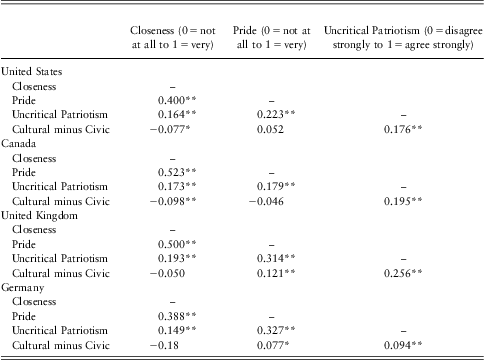
This fourth dimension of national identity is qualitative rather than quantitative in character, but it may of course interact with the other dimensions – for example, those who favour cultural understandings of the nation are more likely to be uncritical patriots (see Rothi et al., Reference Rothi, Lyons and Chryssochoou2005). As Table 1 reveals, the relationship between cultural understandings and national attachment is in general quite weak, but may be stronger in the case of particular cultural features such as race and religion (Theiss-Morse, Reference Theiss-Morse2009: 87–88). However, its main significance for the national identity argument has to do with who is included in the nation and who is not. It should come as no surprise that those who hold predominantly civic understandings of identity are more ready to include culturally ‘deviant’ citizens as compatriots (Theiss-Morse, Reference Theiss-Morse2009: 63–94). Thus, cultural understandings are correlated with negative attitudes towards immigrants, whereas civic understandings are not (see Hjerm, Reference Hjerm1998; Citrin and Wright, Reference Citrin and Wright2008; Citrin and Wright, Reference Citrin and Wright2009). We will later explore the implications this has for attitudes to social justice. But first let us sum up what we have argued so far.
Four dimensions of national identity, correlation matricesa

Notes: Closeness’, ‘Pride’, and ‘Uncritical Patriotism’ are single items derived from the following questions: ‘How close do you feel to [country]?’ (Closeness); ‘How proud are you of being [Country Nationality]?’ (Pride); and ‘People should support their country even if the country is in the wrong’ (Uncritical Patriotism). ‘Cultural minus Civic’ is a subtraction of respondents’ mean on ‘cultural’ items (‘important to have been born in [country]’, ‘important to have lived in [country] for most of one's life’, ‘important to be able to speak [country language]’, ‘important to be a [religion]’, and ‘important to have [country nationality] ancestry’) minus mean on ‘civic’ items (‘important to have [country nationality] citizenship’, ‘important to respect [country nationality] political institutions and laws’, and ‘important to feel [country nationality]’).
Entries are bivariate Pearson correlation coefficients.
**P < 0.01; *P < 0.05.
Source: International Social Survey Programme (2003).
Empirical studies of national identity, including those designed explicitly to test the national identity argument, have measured the nature and extent individuals’ national allegiances in a variety of different ways.Footnote 3 We have distinguished four specific dimensions: strength of national attachment (measured by ‘closeness’ to country), strength of national pride, critical vs. uncritical patriotism, and civic vs. cultural identities. We can now look to see how closely these dimensions correlate in four countries from the ISSP sample. The results are shown in Table 1.
As this table reveals, although the different dimensions correlate to some extent – particular in the case of ‘closeness’ and ‘pride’ – the correlation is very far from perfect. Moreover, there is no reason to expect that a person's standing on each of them will affect their commitment to the welfare state and social justice in the same way. Feeling that it is important to your identity that you are American or Canadian may have quite different consequences in these domains from thinking that you must support your country regardless, for instance. So when considering studies that test the national identity argument, it is important to look closely at how identity has been conceptualized and measured in each case. This may explain why these studies yield apparently contradictory results, as we go on to show.
The effects of national identity on social justice: existing research
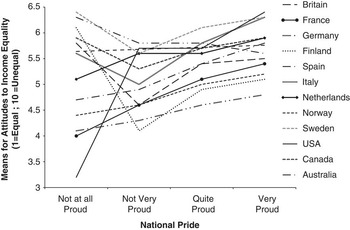
We begin this part of the investigation with the paper by Shayo (Reference Shayo2009) referred to earlier, which directly challenges the national identity argument. It claims that within democracies ‘national identification tends to reduce support for redistribution’ and also that ‘across democracies there is a strong negative relationship between the prevalence of national identification and the level of redistribution’ (p. 147). It also shows a slightly weaker negative relationship between levels of national identification and aggregate social expenditure. We have already raised some doubts about Shayo's cross-national analysis, so here we will focus on his analysis of individual-level differences. Shayo looks at responses to the contrasting propositions ‘incomes should be made more equal’ and ‘we need larger income differences as incentives for individual effort’ and discovers that, although a person's own income has the largest (negative) effect on his egalitarianism, those who declare themselves ‘very proud’ of their country are typically a little less supportive of equality than those who are quite, not very, or not at all proud. An examination of the data aggregated across countries supports this finding;Footnote 4 however, the relationship between individual levels of pride and egalitarianism varies very significantly from country to country, as Figure 2 reveals.
National pride and attitudes to income distribution.
‘National Pride’ is a single item derived from the following question: “How proud are you to be [Country Nationality]”? Very proud (4); Quite proud (3); Not very proud (2); Not at all proud (1).
Source: World Values Survey (2005).

In this figure, two patterns especially stand out. In some countries (e.g. France, Norway, Spain), individual people steadily become somewhat less egalitarian as they display increased levels of national pride. In other countries (e.g. Britain, Canada, Sweden), the people most strongly opposed to greater income equality are those who declare themselves not at all proud of their country; the line dips to the ‘not very proud’ who are the most egalitarian, and then turns upwards as pride levels increase further. Although the numbers disclaiming any national pride are small, it is tempting to conclude that in these countries we can see the emergence of a group of rootless cosmopolitans who are libertarian in their economic views; whereas in other places – the United States especially – lack of national pride indicates a strongly left wing outlook.
Shayo is correct, therefore, to say, that at the individual level an increase in national pride does not translate into increased support for redistribution, but this generalization conceals significant differences between countries. His analysis is also limited by the fact that he explores only one dimension of national identity (national pride), does not control for political ideology, and looks at only one dependent variable, namely attitudes to income distribution.Footnote 5
For more discriminating tests of the national identity argument, we need to turn to single-country studies. There have been a large number of these, from which we have selected three, involving the United Studies, Canada, and the United Kingdom, that we think particularly illuminate the difficulties involved in measuring national identity and tracing its effects on attitudes towards social justice. We begin with the United States where Citrin et al. (Reference Citrin, Wong and Duff2001) studied the relationship between a person's national identity and their policy preferences on a range of issues including immigration, racial policies, and social expenditure. To measure national identity, they used two constructs, one (patriotism) corresponding to what we have called national attachment, and the second (chauvinism) combining two national pride and two uncritical patriotism items. While chauvinism (but not patriotism) was significantly correlated with the belief that immigrants should assimilate and immigration levels should be reduced, neither identity measure proved to be a significant predictor of beliefs about the appropriate level of government spending on health, education, welfare, and the environment – four items of which the first three at least are central to social justice. So, although these data do not provide positive support for the national identity argument, they also suggest that Shayo's (Reference Shayo2009) claim about the negative effects of national pride on support for redistribution appears not to hold, at least in the American case, when redistribution takes the form of tax-financed social expenditure.
In another study, Theiss-Morse (Reference Theiss-Morse2009) suggests why the United States is an ambivalent case for the national identity argument. Using a national attachment measure of identity, she found that ‘strong identifiers are much more likely than weak identifiers to feel an obligation to help fellow group members in many different ways’; this included being a little more likely to feel an obligation to pay taxes (pp. 104–105). However, this did not translate into greater support for welfare programmes – just under half of both strong and weak identifiers recognized such an obligation. Theiss-Morse argues that because strong identifiers are also more likely to have a more exclusive notion of ‘who counts as an American’, they are reluctant to support programmes that they see as being largely directed towards people who are only marginal members of the national community (pp. 109–123). In other words, their enhanced willingness to help goes along with a desire to retain control over who is entitled to receive help, while government welfare programmes are seen as indiscriminate in scope.
Theiss-Morse's evidence suggests that the fourth dimension of national identity – the civic-cultural dimension – may have considerable relevance for the national identity argument in countries where the cultural components of national identity are prominent and which also contain sizeable culturally ‘deviant’ ethnic minorities. Here a comparison with Canada may be relevant, since cultural components of national identity, such as religion, place of birth and language, are seen as considerably less important by Canadians than by Americans (see Jones and Smith, Reference Jones and Smith2001). We turn therefore to a Canadian study that aims explicitly to test the national identity argument about social justice (Johnston et al., Reference Johnston, Banting, Kymlicka and Soroka2010). Social justice is conceptualized in a more sophisticated way in this study, which tests attitudes to redistribution using a range of questions that concern levels of unemployment benefit and beliefs about welfare recipients as well as government action to reduce income differences. By focussing attention on those at the bottom of the income scale, this construct appears to track beliefs about social justice better than the rather bald ‘incomes should be made more equal’ statement used in the WVS. The study also looks at support for public health care and support for state pensions as two separate dimensions of social justice. Equally significant, identification with Canada is assessed using four questions, three of which measure national attachment (e.g. ‘Is being Canadian very important to you, somewhat important, etc.?’) and the fourth of which is a standard national pride question. We have commented earlier on the dangers of composite measures that track different dimensions of national identity, but at least here three out of the four items correspond to the same dimension.
The outcome of the study is that, in the case of attitudes to redistribution, those who have high national identity scores are a little more likely to support redistribution, and this effect increases as one moves up the scale of economic position. In the case of health care, the identity effect is considerably larger, and for pensions somewhere in between (this is most easily seen in the diagrams on p. 362). Moreover, although anti-immigrant feelings are shown to reduce support both for redistribution and for health care, the authors show that having a stronger Canadian identity not only encourages pro-immigrant sentiments, but partly or fully compensates for the negative effects of anti-immigrant feelings on support for social justice.
How far does this Canadian study lend support to the national identity argument? Although the individual-level correlations all point in the right direction, it might be thought that this reflects something specific about Canadian national identity, just as the American evidence suggests that having a culturally laden identity in a society with large and visible minority groups may produce ambivalence towards the state's redistributive and welfare policies. In the Canadian case, elements of the welfare state, especially the public health system, may be seen as partly constitutive of national identity itself, in which case it is not surprising that those who identify more strongly also tend to support such policies. This, in fact, is the main conclusion drawn by the authors of this study. They write: ‘national identity may not have any general tendency to strengthen support for redistribution, but it may do so for those aspects of the welfare state seen as having played a particularly important role in building the nation, or in enabling it to overcome particular challenges or crises’ (Johnston et al., Reference Johnston, Banting, Kymlicka and Soroka2010: 24). Even if this is not the whole story, it suggests the need for caution in drawing general conclusions from single-country studies.
This also applies to a British study that is couched in the form of a critique of the national identity argument (Martinez-Herrera, Reference Martinez-Herrera2010). Using data from the 1997 British General Election Study, this constructs two measures of support for the welfare state – one combining support for income redistribution with opposition to private education and medicine, the other aggregating preferences for increased spending on poverty relief, health, and education – and correlates these with two national identity indicators. The first of these, labelled ‘support for the British political community’, contains two items: ‘I would rather be a citizen of Britain than of any other country in the world’ and ‘The government should do everything it can to keep all parts of Britain together in a single state’. The second indicator, labelled ‘nationalism’, contains three items, all reverse scored: ‘Britain should cooperate with other countries, even if it means giving up some independence’; ‘Britain has a lot to learn from other countries in running its affairs’; ‘There are some things about Britain today that make me ashamed to be British’. Separate analyses were done for England and Scotland and a control for political ideology was introduced in the form of self-placement on a left-right scale. The upshot overall was that, although left-right ideological position had the strongest association with attitudes to the welfare state, both national identity indicators showed independent negative effects on support for social justice, with ‘nationalism’ having the stronger impact (except for the second welfare measure in Scotland).
Although the distinction between ‘support for the political community’ and ‘nationalism’ is helpful in bearing out what we have already suggested, namely that the different dimensions of national identity may impact differently on social attitudes, neither of these indicators captures just one dimension. The ‘nationalism’ construct combines national pride indicators with a question about national self-determination that in the British context is likely to evoke attitudes towards Europe. ‘Support for the political community’ bolts together two very different items, of which the second in particular is especially problematic in the Scottish context. Someone with a strong Scottish national identity may well favour independence for Scotland, and therefore disagree strongly with the proposition that the government should do all it can to hold Britain together. The same person may also be unwilling to assert that she would rather be a citizen of Britain than of any other country – since what she would like most to be is a citizen of Scotland. Thus, in Scotland at least, Martinez-Herrera's first national identity indicator may actually be tracking, not national identity as such, but commitment to the Union – a very different matter. We should not be surprised to find this having a negative correlation with attitudes to redistribution and the welfare state.
Implications
What conclusions relevant to the national identity argument can we draw from the evidence we have surveyed? That argument has certainly not been decisively refuted, but nor has it so far been strongly confirmed. Instead there are at least four implications to be drawn.
First, we have seen how important it is to choose appropriate indicators of national identity when the national identity argument is being put to the test. We have observed that previous studies have often amalgamated different dimensions of identity in a single index, and this can have a distorting effect on the results. In particular, we have raised questions about the use of indicators that track the national pride and uncritical patriotism dimensions of identity, since it is plausible that these dimensions are correlated with right-wing political attitudes, which in turn may correlate with hostility towards the welfare state and social justice. The national identity argument concerns the effects of sympathetic attachments among compatriots, and is therefore best tested by measures that capture the national attachment dimension of identity. As we have been at pains to stress, this is quite different from the evaluative stance towards the nation captured by national pride questions – especially those that invite the respondent to compare his country's achievements with those of others – and from the issue of whether a true patriot is one who supports his government uncritically or is prepared to dissent. Studies that rely on these latter questions, either alone or in combination, may therefore be masking the impact that national identity itself has on support for social justice.
Second, we have found reason to think that that impact may to some extent be contextually specific, varying from one country to the next. For historic reasons, expressing your commitment to the nation – flying the national flag, for instance – may in some places signal a belief in established authority, hostility to foreigners and immigrants, and so forth, while in others it may symbolize a popular revolution against foreign oppressors, or the moment at which a democratic constitution was signed. As we found in the Canadian case, there may also a perceived connection between national identity and certain institutions, including those making up the welfare state. So when single-country evidence is produced that appears either to support or to undermine the national identity argument, this evidence needs to be interpreted in the light of such contextual factors. We argued above that, for the same reason, statistical cross-national comparisons were likely to be misleading. The point now is that a national identity may on the one hand serve as a source of social unity, but on the other, it is also likely to carry with it specific political connotations that arise from the history of the society in question. These two aspects may sometimes pull in opposite directions when social justice and the welfare state are at issue.
Third, although we have spent some time looking at studies that attempt to measure the strength of individual identities, it is important to note that the national identity argument does not directly entail the proposition that the stronger an individual person's national identity is, the more that person will be committed to social justice. Instead, the relevant claim is about the importance of a group of people sharing an identity. It is the collective nature of the identity that is supposed to do the work in fostering solidarity and trust. The argument is that in a large, anonymous society, solidarity and trust are more likely to emerge among people who recognize one another as being in some sense ‘the same’, and that a feeling of sameness is instilled by sharing a national identity. So my having a particular identity is not going to be relevant unless I also believe that the rest of the target group picked out by the identity also shares it. What may matter, then, is not only how strongly a particular person identifies herself with the nation, but also whether she sees those around her as having the same commitment. Unfortunately, this collective quality of national identity will be difficult to measure using the kind of survey evidence that is currently available to social scientists. Nor, as we saw, can cross-national studies serve to fill the gap. The most valuable evidence would be longitudinal data within each country, which might reveal whether there was evidence of a tendency for national identities to weaken over time, and whether this was accompanied by a lessening commitment to social justice.
Finally, it is important to pay more attention to the fourth dimension of national identity that we have distinguished, the civic-cultural dimension. We noted above some American evidence that shows that those who understand ‘what it means to be an American’ in ethno-cultural terms are more likely to express negative attitudes towards immigration and immigrants. A comparative study of national identities found that this connection holds more strongly at the collective level than at the individual level. In other words, what appears to be most significant in explaining anti-immigrant prejudice is not whether the respondent himself has a predominantly civic or predominantly cultural definition of national identity, but whether he belongs to a community in which people on average consider cultural criteria more important (Pehrson et al., Reference Pehrson, Vignoles and Brown2009). Those who have negative feelings about immigrants are in turn inclined to believe that immigrant groups benefit unfairly from the resources made available by the welfare state, and for that reason to be less supportive of increased spending on its services.
Following this logic, support for social justice, in societies where ethnically distinct immigrant groups are prominent, may increase if the civic components of national identity – feeling committed to the society and its values, respecting its institutions, etc. – become relatively more important in people's eyes, while the ethnic components – being born in the country, belonging to the dominant ethnic group, etc. – become less so. So long as immigrant groups are perceived to share in this predominantly civic identity, negative feelings towards them will be dampened down, and the belief that their members are taking unfair advantage of welfare institutions eroded. At the same time, those who have mainly civic understandings of their national identity tend to have a weaker sense of national attachment than those who have mainly cultural understandings. So in multicultural democracies, the historical trend may be towards weaker, but more inclusive, identities. If, at the collective level, strength of national identity matters for commitment to social justice, these two factors may cancel each other out. People may be somewhat less willing to support policies from which they do not expect to benefit themselves, but more willing to include culturally ‘deviant’ individuals among the rightful beneficiaries when such policies are enacted.
Conclusion: lessons for liberal nationalists
The evidence about national identity we have surveyed in this article presents a challenge for liberal nationalists, especially those for whom the connection between national identity and social justice plays an important role in the defence of nationality itself. The challenge they face is to show that in contemporary multicultural societies, national identity can evolve in such a way that it is strong enough to provide motivational support for social justice, but at the same time open and flexible enough to include both existing minority groups and newcomers from diverse cultural backgrounds. Now liberal nationalists have always been open to the charge that they present a picture of national identity that is at odds with the identities that exist in the real world. They depict these identities as constructed over time, and therefore as capable of being modified over time through democratic debate that will include inputs from all sections of the political community. Although there will be continuities, there are no fixed elements to national identity: there is no single feature that cannot be challenged and replaced. The critics claim that national identities are in fact more primordial than this, and in particular are tied more closely to the culture of the ethnic majority (or the group that was once the ethnic majority in societies that have experienced high levels of immigration).
The evidence we have examined lends partial support to the critics’ position. We have seen that those who display the highest level of attachment to their national communities are also somewhat more likely to have higher levels of national pride, to be uncritical patriots, and to define their national identity in cultural rather than civic terms. Closeness correlates most strongly with national pride in each of the four countries represented in Table 1. In principle this linkage should not concern liberal nationalists, since they have no reason not to want citizens to be proud of their country's achievements. A concern would arise only where the sources of pride were such as to exclude cultural minorities. As we have seen, some analysts distinguish ‘civic’ from ‘cultural’ national pride, and it is the latter that might worry liberal nationalists, if the culture that is being celebrated is not accessible to minority groups. But this is not obviously so: taking pride in their country's achievements in the arts and literature, for example, is something that anyone might do regardless of their ethnic background. Pride in the nation's history might seem to be more problematic, but national histories are always being revised to bring them more closely in line with the beliefs of the current generation (thus it is highly unlikely that an American citizen who is proud of his country's history will be thinking of slavery). It nevertheless remains true that minority groups in general display less national pride than cultural majorities (Smith and Kim, Reference Smith and Kim2006), suggesting that the liberal nationalist aim of creating identities that are open to all has not yet been fully realized.
Turning now to the critical/uncritical patriotism dimension, it is critical patriotism that consorts best with liberal nationalism, since the latter wants to encourage a national identity that allows room for political disagreement – there is no single set of values that makes a person authentically American or French. Uncritical patriots tend to identify more strongly with their nation, but as we saw being a critical patriot also increases your national attachment score somewhat, so we do not find, empirically, a sharp conflict between having a national identity and being ready to dissent from the policies that are currently assumed to flow from it.
The contrast between predominantly civic and predominantly cultural national identities presents the greatest challenge for liberal nationalists. Although there is only a weak relationship between national attachment and cultural understandings of national identity in general, a larger effect can be seen for particular elements such as race and religion; that is, people (in Western societies) who identify strongly are more likely to think of ‘being white’ or ‘being Christian’ as part of what it means to be ‘truly an X’. Although liberal nationalists want national identities to continue to include some cultural elements, such inherently exclusive characteristics are not among them. There should be no barriers to being both black and French or Hindu and British, for example. If identities continue to evolve in the direction that liberal nationalists favour, with civic elements becoming more prominent, and exclusive cultural elements disappearing, they may become less intense, but for the reasons given above, no less helpful in motivating support for social justice.
To conclude, we have not been able to show that societies whose members have liberalized national identities are more likely to pursue redistributive policies and to have strong welfare states. The link between national identity and social justice is mediated by country-specific features. But we believe that we have successfully exposed the flaws in the opposing argument. Several of the studies which purport to show a negative relationship between identity and justice rely on incoherent or inappropriate ways of conceptualizing national identity. And we have suggested how a more accurate test of the national identity argument, using aggregate longitudinal data and national attachment indicators, could be constructed.
Acknowledgements
This paper originated as a plenary address by the first author to the Canadian Political Science Association in 2010. The authors thank the commentators on that occasion, Jack Citrin and Avigail Eisenberg for their helpful suggestions, and especially Jack Citrin for sending additional data relevant to the paper. For their comments, authors are grateful to Maria Sobolewska and Eline de Rooij and the two reviewers for this journal.