Introduction
Delirium is a cognitive disorder characterized by acute onset, fluctuating course, and disturbances in consciousness, orientation, memory, thought, perception, and behavior (American Psychiatric Association, 2000). It occurs in hyperactive, hypoactive, or mixed forms in up to 70% of older long-term care (LTC) residents (Rovner et al., Reference Rovner, German, Broadhead, Morriss and Brant1990; Fries et al., Reference Fries, Mehr, Schneider, Foley and Burke1993; Sandberg et al., Reference Sandberg, Gustafson, Brannstrom and Bucht1998; Kiely et al., Reference Kiely, Bergmann, Murphy, Jones, Orav and Marcantonio2003; Voyer et al., Reference Voyer, Richard, Doucet and Carmichael2009; McCusker et al., Reference McCusker2011) and is associated with many poor outcomes (Pitkala et al., Reference Pitkala, Laurila, Strandberg and Tilvis2005; McCusker et al., Reference McCusker2010).
To date, there are few studies of risk factors for delirium in LTC settings. A cross-sectional study reported that only the use of physical restraints was associated with prevalent delirium (Voyer et al., Reference Voyer, Richard, Doucet, Cyr and Carmichael2011). Another study reported that the presence of dementia, moderate to severe cognitive impairment, and depressive symptoms at baseline were independent risk factors for both prevalent and incident delirium (McCusker et al., Reference McCusker2011). McCusker et al. developed a delirium risk screening tool for staff working in LTC facilities (McCusker et al., Reference McCusker2012). The final tool included five items: brief measures of cognitive and functional status and behavioral and emotional problems. Using cut-points of two (or three) over five, the tool had a sensitivity of 90% (63%) and a specificity of 59% (85%) for incident delirium. Overall, area under the curve (AUC) was 0.82 (95% CI = 0.76–0.88). Of note, none of the above studies examined the presence of symptoms of delirium (not meeting criteria for delirium) as a risk factor for incident delirium.
Recently, it was reported that 93% of incident episodes of delirium in older LTC residents were preceded by one or more CAM core symptoms of delirium, often for many weeks (Cole et al., Reference Cole2012). The occurrence of such symptoms long before episodes of incident delirium may be critically important to detection of residents at risk of delirium and the development of interventions to prevent delirium in this population. Thus, the primary objective of this study was to determine if the presence of one or more CAM core symptoms of delirium at the baseline assessment (among residents without prevalent delirium) predicted incident delirium in older LTC residents during six months of observation. Secondary objectives were to determine if the number or the type of symptoms present predicted incident delirium.
Methods
Study design
The study was a secondary analysis of data collected for prospective study of delirium among older LTC residents (McCusker et al., Reference McCusker2011). There were seven study sites in Montreal and Quebec City. Two cohorts of residents aged 65 years or over were enrolled in separately funded, concurrent studies that used the same staff and methods: a cohort of residents with no-moderate cognitive impairment (i.e. MMSE 10 or more) and a cohort of residents with severe cognitive impairment (i.e. MMSE 9 or less). Residents were excluded only if they were unable to communicate in English or French.
Competence to consent was based on the clinical impression of the primary nurse. Competent residents were invited to participate in the study. The legal guardian or a responsible family member of incompetent residents was asked to provide substitute consent. The study was approved by the research ethics boards of McGill University and the study sites.
The research assistant (RA) visited each facility weekly to enroll residents and conduct follow-up assessments. Residents had weekly assessments for up to 24 weeks or until death, withdrawal or transfer to another facility. At the end of the study, data on sociodemographic variables, medical problems, and medication use were abstracted from resident charts, blind to the RA assessments.
Measures
At baseline, the RA completed the Mini-Mental State Exam (MMSE) (Folstein et al., Reference Folstein, Folstein and McHugh1975), Confusion Assessment Method (CAM) (Inouye et al., Reference Inouye, VanDyck, Alessi, Balkin, Siegal and Horwitz1990), Delirium Index (DI) (McCusker et al., Reference McCusker, Cole, Dendukuri and Belzile2004), Hierarchic Dementia Scale (HDS) (Cole and Dastoor, Reference Cole and Dastoor1987), Barthel Index (BI) (Mahoney and Barthel, Reference Mahoney and Barthel1965), and Cornell Scale for Depression in Dementia (CSDD) (Alexopoulos et al., Reference Alexopoulos, Abrams, Young and Shamoian1988). The MMSE, CAM, and DI were repeated weekly for six months.
The MMSE (Folstein et al., Reference Folstein, Folstein and McHugh1975) measures cognition; scores range from 0 to 30; a lower score indicates greater cognitive impairment. The CAM (Inouye et al., Reference Inouye, VanDyck, Alessi, Balkin, Siegal and Horwitz1990) was used to identify the core symptoms of delirium. At each prospective assessment, the RA scored at least the first five items of the MMSE, reviewed the resident's chart for the previous week, and completed the CAM. The DI (McCusker et al., Reference McCusker, Cole, Dendukuri and Belzile2004) measures the severity of seven symptoms of delirium (inattention, disorganized thinking, altered level of consciousness, disorientation, memory impairment, perceptual disturbances, and psychomotor activity); higher scores indicate more severe delirium. The HDS (Cole and Dastoor, Reference Cole and Dastoor1987), validated in an LTC population (Rönnberg and Ericsson, Reference Rönnberg and Ericsson1994), measures the severity of cognitive impairment. HDS scores range from 0 to 200, indicating severe (0–39), moderate (40–99), mild (100–159), and minimal/no (160–200) cognitive impairment.
Measures of physical function and depression were based on information provided by the primary nurse. The BI (Mahoney and Barthel, Reference Mahoney and Barthel1965), a measure of activities of daily living, was scored using the method suggested by Shah et al. (Reference Shah, Vanclay and Cooper1989); scores were categorized as severe–moderate (0–59) and mild to no disability (60 and over). The CSDD measures depression severity in older adults with and without dementia (Alexopoulos et al., Reference Alexopoulos, Abrams, Young and Shamoian1988); a cut-point of six or more indicates clinically significant symptoms. Information on sociodemographic variables, medical problems, dementia status, and medication use at baseline were abstracted from the resident charts and used to compute the Charlson Comorbidity Index (Charlson et al., Reference Charlson, Pompei, Ales and MacKenzie1987). Time since admission was calculated.
Similar to procedures used in our previous studies of delirium, we trained the research staff (who included nurses and psychologists with experience in geriatrics) to recognize the symptoms of delirium by clinical demonstrations, trial rating of cases, and discussion of findings until there was satisfactory agreement between the research staff and the clinical investigator. Before data collection began and during the course of the study, samples of residents were assessed simultaneously and independently by the research staff and the clinical investigator. The sensitivity and specificity of research staff assessments, as compared to the clinical investigator, were calculated for each of the CAM-defined core symptoms of delirium (fluctuation, inattention, disorganized thinking, and altered level of consciousness). Sensitivity ranged from 75% to 100%; specificity ranged from 75% to 91%.
Definition of CAM core symptoms at baseline
CAM core symptoms of delirium at baseline were defined as the presence of one or more of the following: fluctuating course, inattention, disorganized thinking, altered level of consciousness.
Definition of an incident episode of delirium
An incident episode of delirium was defined using CAM criteria for delirium: (1) acute onset and fluctuating course, (2) inattention, and (3) either disorganized thinking or altered consciousness.
Statistical analysis
Only participants without delirium at baseline were included in the analysis. Univariate descriptive statistics of the selected variables were calculated. The adjusted effect of baseline subject characteristics on the incident of first delirium episode was investigated using Cox regression models (Cox, Reference Cox1972).
The dependent variable in all survival analyses was time to first delirium episode during the follow-up, measured in weeks. Subjects were censored upon reaching 24 weeks of follow-up, end of study, or time of withdrawal for any reason. Baseline covariates included symptoms at baseline, age, gender, dementia, HDS, Charlson comorbidity index, ADL impairment, hearing and visual impairment, Cornell score, number of drugs at baseline, delirium risk score (McCusker et al., Reference McCusker2012), and time since admission. We coded “symptoms at baseline” in four different ways: as binary (present or absent), as categorical (0, 1, 2, or 3–4 symptoms at baseline), as continuous (from 0 up to 4 symptoms), or as four separate binary variables indicating presence or absence of inattention, disorganizing thinking, altered consciousness, and fluctuation.
We first performed univariate Cox regressions, one for each of the covariates. Then, we fitted four multivariate Cox regression models, one for each variant of “symptom at baseline”; in each model, symptom present at baseline was forced in and other potential confounders were added by BIC-based stepwise selection (Raftery, Reference Raftery1995). Finally, each model was modified by adding all potential confounders that were selected in at least one stepwise selection.
A sensitivity analysis was performed using four definitions of delirium in the final models: delirium, multiple sources delirium, probable delirium, and multiple sources probable delirium. Delirium was defined by the CAM algorithm (see Methods). Probable delirium was defined by the presence of at least three CAM core symptoms: acute onset or fluctuating course, inattention and disorganized thinking or altered level of consciousness (Inouye et al., Reference Inouye, Leo-Summers, Zhang, Bogardus, Leslie and Agostini2005). Multiple sources delirium was defined as meeting CAM criteria for delirium based on symptoms detected by the RA, symptoms reported by nurses during an interview, and symptoms abstracted from nursing notes at the end of the study (McCusker et al., Reference McCusker2010). Multiple sources probable delirium was defined as meeting CAM criteria for probable delirium (see above) based on symptoms detected by the RA, symptoms reported by nurses during an interview, and symptoms abstracted from nursing notes at the end of the study. Proportional hazards assumptions in the Cox model were tested using Schoenfeld's global test; also, because residents were recruited from seven different residences, we examined the consistency of our findings across residences, a statistical technique called the frailty effect (Cleves et al., Reference Cleves, Gould, Gutierrez and Marchenko2008). Potential interactions between the presence of symptoms, dementia status, and incident delirium were tested. All calculations were performed with SAS 9.2 and Stata 10.0.
Results
Study sample
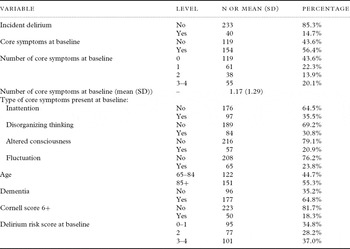
Recruitment began in July 2005; follow-up ended in February 2008. Overall, 1484 residents were screened; 928 (62.6%) were eligible for the study. Consent to participate was obtained for 283 residents. The most common reason for failure to obtain consent was inability to contact a family member. Of the 283 residents for whom consent was obtained, ten were excluded from the study for the following reasons: three died before the baseline assessment, one had an incomplete baseline assessment, one had missing data for dementia status and comorbidity, and five had delirium at baseline. Thus, the sample of analysis included 273 residents. The median number of weekly RA assessments per resident during the six months of observation was 23 (interquartile range 19–24). The baseline characteristics of the 273 residents are shown in Table 1.
Characteristics of long-term care residents (N = 273)

Predictors of incident delirium
CAM core symptoms occurred in 154 (56.4%) of the 273 residents at the baseline assessment. Forty (14.7%) of the 273 residents had at least one episode of CAM-defined incident delirium during the six months of observation. CAM core symptoms were present more or less continuously from the baseline assessment to the onset of delirium among 90% of residents who developed delirium. Among residents who developed delirium during the 24 weeks of observation, the mean (SD) time to occurrence of the index episode of delirium was 10.8 (7.4) weeks.
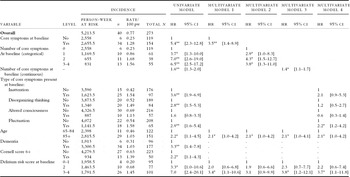
Initially, all measures were included in the statistical analysis. Subsequently, nine (gender, HDS, DI, BI, Charlson comorbidity index, hearing and visual impairment, number of medications, and time since admission) were removed from the analysis because they contributed little to the statistical model building. In the final four multivariate Cox models (Table 2), the Hazard Ratios (HRs) were significant for symptoms, age, and the delirium risk score. In multivariate model 1, the HR for the presence of core symptoms at the baseline assessment was 3.5 (95% CI = 1.4, 8.9). In multivariate model 2, the HRs for the number of core symptoms present as categorical variables were 2.9 (95% CI = 1.0, 8.3) for one symptom present, 4.3 (95% CI = 1.5, 12.7) for two symptoms present, and 3.8 (95% CI = 1.3, 11.0) for three symptoms present. In multivariate model 3, the HR for the number of core symptoms present as a continuous variable was 1.4 (95% CI = 1.1, 1.7). In multivariate model 4, the HRs for individual symptoms ranged from 0.6 to 2.2. Only the HR for one individual symptom, fluctuation, was statistically significant (HR = 2.2, 95% CI = 1.2, 4.2). Altered level of consciousness (HR = 0.6, 95% CI = 0.3, 1.4) appeared to be protective in the multivariate model, although not significantly so; however, it was a risk factor (although non-significant) in the univariate model (HR = 1.6, 95% CI = 0.8, 3.3). The change in the effect of altered level of consciousness might have occurred because of the strong association between altered level of consciousness and the delirium risk score (p-value is <0.0001 from the χ2 test) and the small sample in the subgroup with a low delirium risk score and altered level of consciousness (<6% or 16 patients). Moreover, there were no incident delirium cases in this subgroup.
Predictors of incident delirium (univariate and multivariate Cox models, N = 273)

*p-value < 0.05; **p-value < 0.01; HR: Hazard Ratio from Cox model; 95% CI: 95% Confidence interval.
#HR gives relative risk for one symptom change in “Number of core symptoms at baseline.”
In sensitivity analyses that examined predictors of probable delirium, multisource delirium, and multisource probable delirium, the results for the presence of symptoms were very similar, with the exception that the symptom of inattention rather than fluctuation was a significant predictor of probable delirium. There were no significant interactions between the presence of symptoms, dementia status, and incident delirium in any of the models.
Discussion
We proposed to determine if the presence of one or more CAM core symptoms of delirium at a baseline assessment predicted incident delirium in older LTC residents during six months of observation. CAM core symptoms were frequent in this population. The presence of one or more CAM core symptoms at baseline predicted incident delirium. The more symptoms present, the greater was the risk. Among residents who developed delirium during the 24 weeks of observation, the mean (SD) time to occurrence of the index episode of delirium was 10.8 (7.4) weeks.
Why do CAM core symptoms predict incident delirium in this LTC population? One explanation is that the symptoms may represent a protracted prodrome to delirium. In a previous report, these symptoms were present more or less continuously from the baseline assessment to the onset of delirium among 90% of residents who developed delirium; moreover, there was a small but statistically significant increase in the number of symptoms from baseline up to the onset of delirium (Cole et al., Reference Cole2012). Thus, protracted symptoms may be early markers of underlying medical conditions (e.g. infection, drug toxicity) that eventually become severe enough to cause full delirium. This prodrome hypothesis may be testable by examining repeated measures of medical and physiological variables to determine if these measures are abnormal during the period of protracted CAM core symptoms but become more abnormal just prior to the onset of full delirium. A second explanation is that the symptoms may represent subsyndromal delirium, a possible risk factor for full delirium. A third explanation is that the residents who had symptoms without meeting CAM criteria for delirium may have had full delirium but because of the fluctuating nature of delirium and the fact that assessments were completed only weekly, the diagnosis of the full delirium was missed. This explanation is compatible with the finding that fluctuation was a predictor of delirium. A fourth explanation is that CAM core symptoms may be a step, reversible or not, in the pathogenesis of delirium. These symptoms may reflect abnormalities in neuroanatomical structures (Mesulam, Reference Mesulam and Mesulam1985) or neurotransmitter systems (Gaudreau and Gagnon, Reference Gaudreau and Gagnon2005; van Gool et al., Reference van Gool, van de Beek and Eikelenboom2010), independent of underlying medical conditions that predispose older LTC residents to develop delirium. It is conceivable that these abnormalities may manifest as the presence of CAM core symptoms and set the stage for the development of delirium when affected individuals are exposed to putative precipitating medical conditions such as hypoxia or infection. Although it is likely that such abnormalities occur most often in residents with dementia, it is possible that they occur as focal abnormalities in residents without dementia. Finally, it is arguable that the findings reflect a more general medical phenomenon in which the presence of symptoms of any condition is a risk factor for the development of that full-blown condition.
Whatever the explanation, the presence of one or more CAM core symptoms at baseline appears to predict incident delirium, even though their specificity may be low given that 56% of residents had CAM core symptoms at baseline but only 15% developed incident delirium over six months of observation; however, the specificity may be higher if the period of observation is longer. Because the HR for the presence of symptoms (3.5, see Table 2) was similar to (and independent of) the HR of the delirium risk score (3.4), the identification of LTC residents at risk of delirium by assessment of CAM core symptoms in conjunction with the Delirium Risk Screening Tool (McCusker et al., Reference McCusker2012) should be the subject of further research. Use of such an approach will require special training of clinical staff to detect CAM core symptoms. Following detection, preventive interventions might be modeled on risk factor abatement programs effective in acute care settings (Inouye et al., Reference Inouye1999; Vidan et al., Reference Vidan, Serra, Moreno, Riquelme and Ortiz2005) but address risk factors relevant to LTC settings (McCusker et al., Reference McCusker2011). Alternatively, the interventions may involve early detection and treatment of underlying medical conditions that eventually become severe enough to cause full delirium.
This study has five strengths. The cohort of older LTC residents, representative of seven facilities in two cities, was relative large. Residents were assessed weekly for symptoms of delirium over six months. Assessments were completed by trained staff using reliable and valid measures. The data collection was remarkably complete. Multivariate Cox regression models were used to determine if symptoms predicted incident delirium.
This study has four potential limitations. First, because the assessments were completed only weekly, we may have failed to detect short-lived episodes of delirium. Second, the number of subjects in groups with individual symptoms was small; consequently, the finding that only one type of symptom, fluctuation, predicted incident delirium must be interpreted with caution. Third, even though we trained the RAs to distinguish CAM core symptoms of delirium from symptoms of dementia, we acknowledge that distinguishing some symptoms of delirium from some symptoms of dementia may be difficult at times; however, the mean number of symptoms did not appear to be significantly higher among residents with than without dementia (Cole et al., Reference Cole2012). Finally, the estimate of the mean time to onset of the index episode of delirium was limited to 24 weeks of observation; this estimate may have been considerably longer if the majority of observed residents, some of whom may have developed delirium eventually, were not censored by the end of the period of observation.
To conclude, the presence of CAM core symptoms at baseline assessment predicts incident delirium in older LTC residents. These symptoms were often present for many weeks before the onset of delirium. These findings have potentially important implications for clinical practice and research in LTC settings
Conflict of interest
None.
Description of authors’ roles
M. G. Cole and J. McCusker were involved in the conception and design, obtaining funding, acquisition of data, analysis and interpretation of data, drafting of the manuscript, and supervision. P. Voyer was involved in the conception and design, obtaining funding, acquisition of data, drafting of the manuscript, and supervision. J. Monette and N. Champoux contributed to the conception and design, obtaining funding, and drafting of the manuscript. A. Ciampi, A. Dyachenko, and E. Belzile shared responsibility for the conception and design, obtaining funding, analysis and interpretation of data, and drafting of the manuscript. M. Vu assisted with the acquisition of data, drafting of the manuscript, and supervision.
Acknowledgments
This work was support by the Canadian Institutes of Health Research (IAO69519), Canadian Institute of Aging and Institute of Gender and Health (CRG-82953), the Alzheimer Society of Canada, and the Canadian Nurses Foundation (07-91).