Introduction
Interpersonal functioning is central to social anxiety disorder (SAD), a condition in which anxiety symptoms impair social performance while ‘interpersonal processes shape and perpetuate social fears’ (Alden & Taylor, Reference Alden and Taylor2004, p. 857). However, the behavior of socially anxious individuals has frequently been examined using analogue samples in artificial environments. Research has also focused primarily on the association of social anxiety with safety and avoidance behaviors, neglecting potential linkages between SAD and affiliative, prosocial behaviors. The present investigation addressed these gaps by examining daily patterns of social interaction among individuals diagnosed with SAD using a naturalistic, repeated-measures methodology.
Evidence from self-report and laboratory-based investigations suggests that socially anxious individuals maintain a passive interpersonal stance characterized by submissive, inhibited behavior (e.g. Leary et al. Reference Leary, Knight and Johnson1987; Creed & Funder, Reference Creed and Funder1998; Oakman et al. Reference Oakman, Gifford and Chlebowsky2003). This interaction style is consistent with clinical observations and has been described as an innocuous alternative to avoidance that enables individuals with SAD to ‘remain in the conversation while contributing as little substantive information as possible’ (Schlenker & Leary, Reference Schlenker and Leary1985, pp. 182–183).
The submissive behavior of socially anxious individuals is often conceptualized as reflecting anxiety-related behavioral inhibition. For example, cognitive–behavioral models characterize submissiveness as a safety behavior that is adopted to avoid negative interpersonal outcomes in the face of perceived social evaluation (Clark & Wells, Reference Clark, Wells, Heimberg, Liebowitz, Hope and Schneier1995; Leary & Kowalski, Reference Leary, Kowalski, Heimberg, Liebowitz, Hope and Schneier1995; Alden & Bieling, Reference Alden and Bieling1998). Evolutionary perspectives (Gilbert, Reference Gilbert2001; Gilbert & Trower, Reference Gilbert, Trower, Crozier and Alden2001) view the inhibited behavior of socially anxious individuals as a submissive strategy designed to prevent conflict with dominant group members. While these formulations describe interpersonal passivity among socially anxious individuals as a protective response to elevated anxiety in social situations, the prediction that submissiveness may emerge as a direct response to increased anxiety among individuals with SAD has not been examined empirically.
Some research suggests that social anxiety may also disrupt affiliative behaviors. Socially anxious individuals and individuals with SAD report a variety of interpersonal problems, including difficulty with the expression of both interpersonal warmth and interpersonal dominance (Kachin et al. Reference Kachin, Newman and Pincus2001; Oakman et al. Reference Oakman, Gifford and Chlebowsky2003). Recent work adopting an attachment perspective on social anxiety suggests that patterns of affiliative behavior among individuals with SAD may be linked to relational cues associated with felt security. Although social anxiety is often associated with interpersonal avoidance and fearful attachment, it has also been associated with interpersonal dependency, particularly in the context of close relationships (Davila & Beck, Reference Davila and Beck2002; Darcy et al. Reference Darcy, Davila and Beck2005). This pattern suggests that individuals with SAD may experience approach–avoidance conflicts and be particularly likely to pursue intimacy and affiliation needs with individuals who enhance their sense of emotional security (see Vertue, Reference Vertue2003).
While attachment security has traditionally been investigated as a dispositional variable, recent evidence suggests that felt security may be situationally activated and that event-level elevations in security are associated with concomitant increases in affiliative behavior (Mikulincer & Shaver, Reference Mikulincer and Shaver2005; Mikulincer et al. Reference Mikulincer, Shaver, Gillath and Nitzberg2005). Socially anxious individuals have been observed to exhibit increased interpersonal warmth when they anticipate or receive positive social attention, which may enhance an individual's sense of felt security (Alden & Wallace, Reference Alden and Wallace1995; Alden & Bieling, Reference Alden and Bieling1998). Consistent with the observation of Alden (Reference Alden, Crozier and Alden2001) that the behavior of socially anxious individuals may change strategically depending on whether the individual is trying to avoid negative evaluation or to maintain closeness, and with the suggestion of Gilbert (Reference Gilbert2005) that individuals are more likely to affiliate when they feel socially safe, it is possible that the affiliative behavior of individuals with SAD fluctuates with levels of emotional security. However, this proposed relationship has not been tested directly.
Past investigations of interpersonal patterns associated with SAD have relied almost exclusively on laboratory observations and self-report questionnaires. The former have limited generalizability and the latter are vulnerable to retrospective distortions that can arise when individuals are asked to recall and summarize information about multiple events. The structure of single-occasion data also constrains researchers to the use of between-subject comparisons, forcing the implicit conceptualization of behavior patterns as stable features of the individual rather than as dynamic processes. This approach does not adequately capture theoretical models, which describe the behaviors associated with SAD in terms of flexibly enacted strategies rather than static characteristics. The literature summarized previously describes how individuals with SAD may dynamically adjust their behavior in response to situational cues and thereby makes precise predictions involving within-subject variability that can only be observed across multiple events.
In recent years, research methods have been developed that allow the simultaneous investigation of within-subject variability and between-subject differences (Moskowitz & Young, Reference Moskowitz and Young2006; Moskowitz & Russell, Reference Moskowitz and Russell2009; Moskowitz et al. Reference Moskowitz, Russell, Sadikaj and Sutton2009). The present study used an event-contingent recording procedure (Moskowitz, Reference Moskowitz1994) that gathers reports close in time to naturally occurring social interactions, thereby enhancing the generalizability of findings and reducing the potential for retrospective bias. This is a particularly important consideration for the study of individuals with SAD, who are prone to negatively biased post-event processing (Brozovich & Heimberg, Reference Brozovich and Heimberg2008). Collecting observations for a variety of social settings across several days provides information about situational variability that occurs within participants, permitting the examination of dynamic intra-individual processes such as those postulated by cognitive–behavioral, evolutionary, and attachment theories of SAD.
The present study examined behaviors derived from Wiggins' (Reference Wiggins, Cicchetti and Grove1991) interpersonal circumplex framework, which organizes behavior around a circle defined by the orthogonal dimensions of agency and communion. Agency is represented as a bipolar dimension ranging from assertive–dominant to unassertive–submissive behavior and is conceptualized as behavior that asserts status relative to others. Communion, which is represented as a bipolar dimension ranging from warm–agreeable to cold–quarrelsome behavior, is conceptualized as behavior that promotes interpersonal ties.
As outlined previously, two lines of theory have developed with respect to the interpersonal behavior of socially anxious individuals. Evolutionary and cognitive–behavioral models suggest a self-protective pattern of elevated submissive behavior that is enhanced by situational increases in anxiety. An independent line of thought derived from attachment theory suggests the presence of approach–avoidance conflicts among socially anxious individuals that generate elevated levels of interpersonal warmth in response to increased emotional security. Integrating these two perspectives, we predicted that, relative to normal controls, individuals with SAD would report increased levels of submissive behavior during interactions in which elevated anxiety was reported, and increased levels of agreeable behavior and decreased levels of quarrelsome behavior during interactions in which emotional security was elevated.
Method
Participants
SAD group
Newspaper advertisements invited adults who endorsed a list of SAD symptoms to participate in a study of daily activities. A total of 49 individuals were invited to attend an introductory session where a psychiatrist (P.B. or G.P.) assessed them for the presence of inclusion and exclusion criteria. The psychiatric evaluation was based on both an unstructured interview and diagnoses derived from the Mini-International Neuropsychiatric Interview (MINI; Sheehan et al. Reference Sheehan, Lecrubier, Sheehan, Amorim, Janavs, Weiller, Hergueta, Baker and Dunbar1998). The SAD scale of the MINI was administered twice: once by a research assistant and once by the collaborating psychiatrist. Agreement between these two administrations was 97% (Cohen's κ=0.94). Individuals who met DSM-IV criteria for generalized SAD and were not currently receiving pharmacotherapy or psychotherapy were invited to participate. Individuals with bipolar disorder, psychotic disorder, major depressive disorder, alcohol or substance abuse, and/or suicidality were excluded.
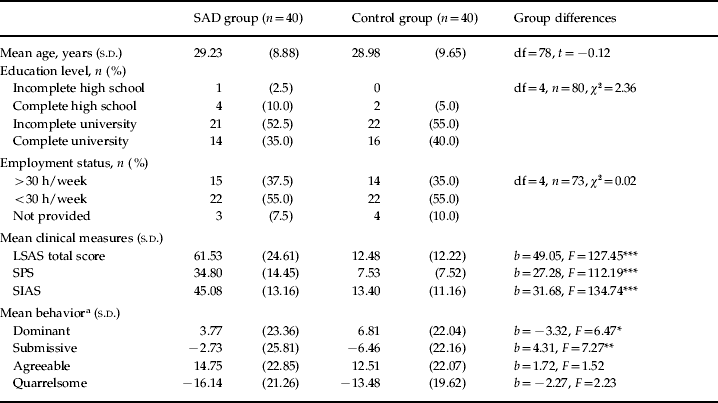
There were 40 individuals (20 men and 20 women) who met research criteria and agreed to participate (see Table 1 for demographic information). Rates of psychiatric co-morbidity were as follows: one individual (2.5%) was diagnosed with concurrent dysthymia, one individual (2.5%) with antisocial personality, and 15 individuals (37.5%) with one or more concurrent anxiety disorders (2.5% with panic, 10% with agoraphobia, 5% with obsessive–compulsive disorder, 2.5% with post-traumatic stress, and 27.5% with generalized anxiety). This pattern is consistent with documented rates of psychiatric co-morbidity observed in individuals with SAD (e.g. Mennin et al. Reference Mennin, Heimberg and Jack2000; Wittchen & Fehm, Reference Wittchen and Fehm2003).
Descriptive statistics and between-group differences for demographic data, clinical measures of social anxiety and event-level interpersonal behaviors

SAD, Social anxiety disorder; s.d., standard deviation; df, degrees of freedom; LSAS, Liebowitz Social Anxiety Scale; SPS, Social Phobia Scale; SIAS, Social Interaction Anxiety Scale.
a Number of observations for event-level variables=3163 for SAD group, 4538 for control group, df for between-group comparisons=1, 78.
* p<0.05, ** p<0.01, *** p<0.0001.
Control group
Control participants were recruited through newspaper advertisements seeking adults to take part in a study of daily activities, and individually matched with the SAD group for age (within 5 years), sex, and education level. A total of 50 potential controls were invited to attend an introductory session, where they were interviewed by the collaborating psychiatrist (P.B. or G.P.). Individuals who did not meet criteria for any psychiatric disorder and were not currently receiving pharmacotherapy or psychotherapy were invited to participate. Of these, five individuals failed to meet research criteria, and five did not complete the event-contingent recording procedure.
The control sample consisted of 20 men and 20 women. Controls did not differ from the SAD group with respect to age, education, or employment status (see Table 1).
Procedure
All study procedures were approved by the Institutional Review Board of McGill University. Participants provided written informed consent after the study had been explained and were remunerated for time spent in the study.
Participants first attended a meeting during which procedures were explained, informed consent was obtained, and the psychiatric assessment was conducted. The Liebowitz Social Anxiety Scale (LSAS; Liebowitz, Reference Liebowitz1987), the Social Phobia Scale (SPS; Mattick & Clarke, Reference Mattick and Clarke1998) and the Social Interaction Anxiety Scale (SIAS; Mattick & Clarke, Reference Mattick and Clarke1998) were also completed. Participants were then asked to complete a one-page record form as soon as possible following each social interaction of at least 5 min duration, each day for 20 days. Forms were returned by mail on the day subsequent to recording.
Event-contingent recording
Event-contingent record forms requested information about characteristics of the social interaction and included measures of interpersonal behavior, affect, emotional security, and type of interaction partner.
Interpersonal behavior was measured using items developed by Moskowitz (Reference Moskowitz1994) to assess dominant behavior (e.g. I assigned someone to a task), submissive behavior (e.g. I gave in), agreeable behavior (e.g. I expressed affection with words or gestures) and quarrelsome behavior (e.g. I criticized the other). For each behavior dimension, twelve items were available. There were four versions of the record form; each contained three items representing each behavior. Multiple forms were used to guard against the tendency for participants to adopt a response set when presented with the same form daily. Scores for each type of behavior were calculated by computing the mean number of items endorsed within each event for each behavior scale and then subtracting the mean frequency for all behaviors within that event. For ease of presentation, final values were multiplied by 100. These ipsatized scores represent the frequency with which items corresponding to a behavioral dimension were checked within a given interaction, adjusted for the participant's rate of responding. Past event-contingent recording studies have indicated that agreeable and dominant behaviors are reported more frequently than submissive and quarrelsome behaviors (e.g. Moskowitz, Reference Moskowitz1994; Brown & Moskowitz, Reference Brown and Moskowitz1998; Côté & Moskowitz, Reference Côté and Moskowitz1998). Consequently, ipsatized values for submissive and quarrelsome behaviors are typically negative.
The record form asked participants to rate how they felt during the interaction, on a seven-point scale, for a series of affect items (Diener et al. Reference Diener, Smith and Fujita1995). Ratings on the item ‘worried/anxious’ represented event-level anxiety. The event-level sadness score was calculated by averaging ratings for the items ‘unhappy’ and ‘depressed/sad’. As the event-level anxiety and sadness scores were not normally distributed, they were subjected to a log transformation prior to analysis.
For each interaction, participants were asked to indicate the extent to which they felt ‘emotionally secure with the other’ on a seven-point scale. The record form also asked participants to characterize their interaction partner; options included supervisor, co-worker, supervisee, friend, romantic partner, parent, sibling, casual acquaintance, and other.
SAD participants completed an average of 80.88 forms (s.d.=40.77, approximately 4 per day) while controls completed an average of 119.05 forms (s.d.=46.45, approximately 6 per day). The between-group difference was significant [t(78)=−3.91, p<0.001]. The smaller number of forms completed by individuals with SAD indicates fewer social interactions and is consistent with impaired social functioning.
Statistical analyses
Multilevel modeling was employed to examine the main and interactive effects of diagnosis (i.e. group membership), anxiety, and emotional security on reported behavior. This statistical procedure permits the analysis of unbalanced data and the simultaneous investigation of between-subject and within-subject effects. Between-person effects indicated how individuals differed according to diagnosis. Within-person effects indicated how the behavior of individuals varied in response to situational fluctuations in anxiety and emotional security. Cross-level interactions indicated whether the relationship of behavior to situational anxiety and emotional security varied across individuals as a function of diagnosis. Analyses were conducted using proc mixed in SAS (version 9.1, SAS Institute Inc., USA).
Model development employed a sequential strategy (Wallace & Green, Reference Wallace, Green, Moskowitz and Hershberger2002). The fixed-effects portion of each model was examined first, using a random intercept and the default error covariance matrix. Alternate specifications of the error covariance structure, autoregressive and heterogeneous compound symmetry, were then explored. These modifications did not improve the fit of any model as assessed by Akaike's Information Criteria (AIC) and Bayesian Information Criteria (BIC). All models were also examined including sex and the interaction of sex with group membership; none of these effects was significant. Finally, all analyses were repeated controlling for the presence of anxiety disorders other than SAD; all main and interaction effects remained significant, indicating that the present results are not accounted for by co-morbid anxiety disorders.
Event-level reports of anxiety and emotional security were centered within participants. A participant's score during a specific interaction on each of these variables therefore represented the extent to which that individual deviated from their overall mean (Kreft & De Leeuw, Reference Kreft and De Leeuw1998). Significant interaction effects were interpreted by calculating simple slope and point estimates. Point estimates for graphs were calculated for interactions in which the event-level predictor of interest was high (+1 s.d.) or low (−1 s.d.).
Results
Preliminary analyses
Descriptive statistics and between-group comparisons for the LSAS, SPS, SIAS and behavior scales are presented in Table 1. On all indices of social anxiety, mean scores for the SAD group exceeded clinical cut-offs and were significantly elevated relative to controls. Individuals with SAD also reported less dominant behavior and more submissive behavior than controls.
Situational anxiety, emotional security and interpersonal behavior
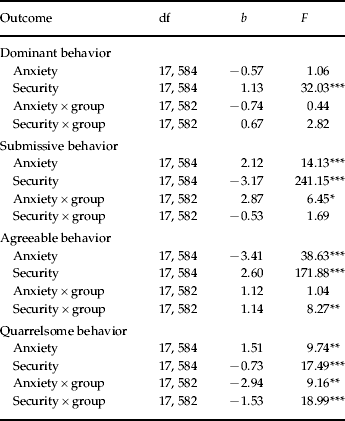
To investigate the relation of situational fluctuations in anxiety and emotional security to interpersonal behavior, multilevel analyses were conducted including main effect terms for anxiety, emotional security and group membership. Cross-level interactions were then added to examine whether the relationship of anxiety and security to behavior differed as a function of diagnosis (see Table 2).
Effects of situational anxiety, situational emotional security and diagnostic status on levels of interpersonal behaviorFootnote

df, Degrees of freedom; SAD, social anxiety disorder.
a Anxiety and security (i.e. emotional security) are event-level variables. There were 40 participants in the SAD group and 40 in the control group. There were 3163 observations, for event-level variables, for the SAD group, and 4538 for the control group.
* p<0.05, ** p<0.01, *** p<0.001.
Situational anxiety
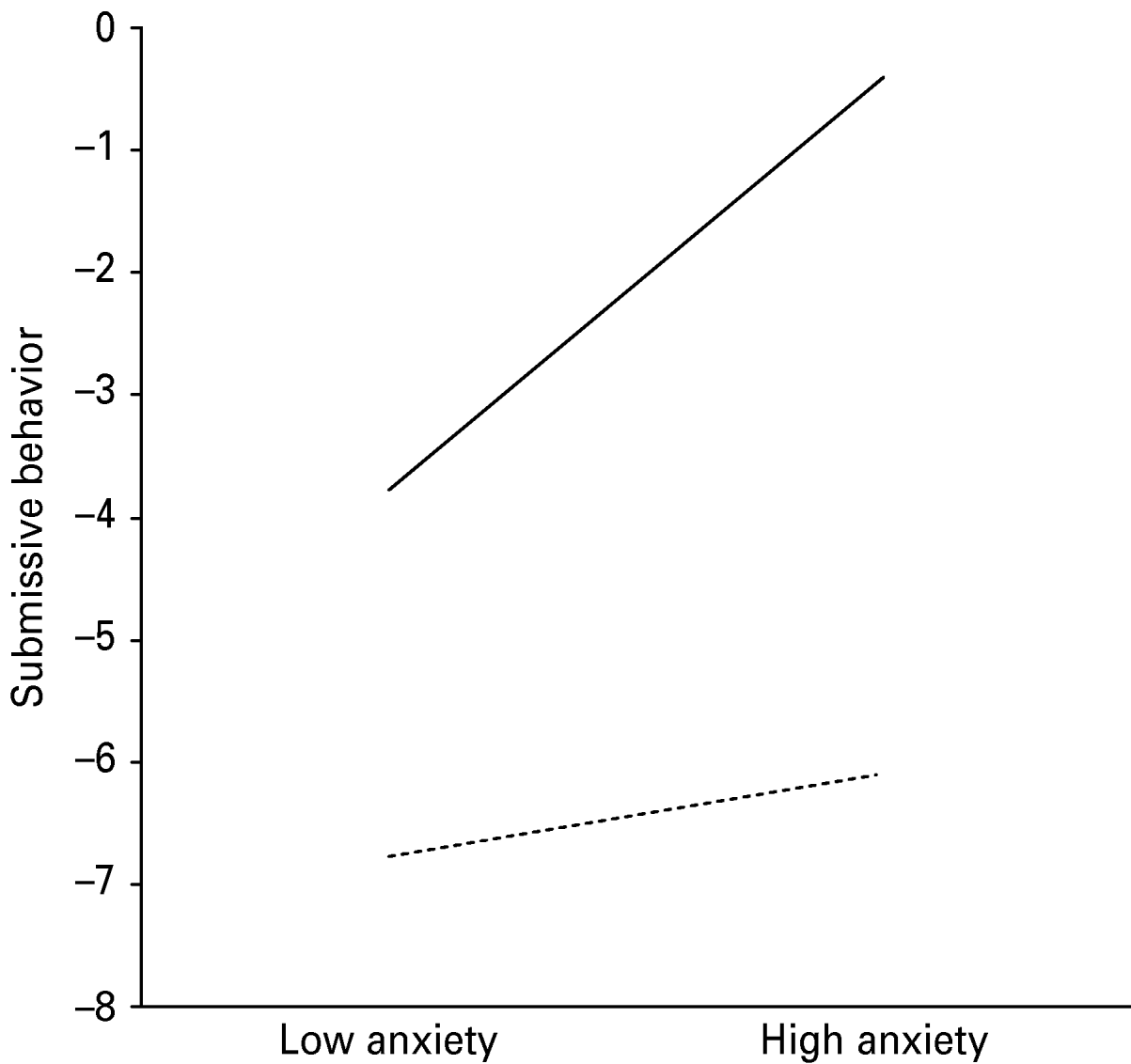
Increased anxiety was associated with reports of decreased agreeable behavior and increased submissive and quarrelsome behavior. Diagnosis interacted with anxiety to predict submissive behavior. As expected, individuals with SAD reported significantly higher levels of submissive behavior during interactions in which anxiety was elevated [slope=3.59, t(7582)=4.36, p<0.0001] (see Fig. 1), while controls did not [slope=0.72, t(7582)=0.93, n.s.]. Investigation of the point estimates revealed that the difference between SAD and control group participants in reported submissive behavior was not significant when situational anxiety was low [t(7582)=1.77, n.s.]. During interactions in which anxiety was elevated, individuals with SAD reported significantly higher levels of submissive behavior than controls [t(7582)=3.36, p<0.001].
Prediction of submissive behavior by situational anxiety and group (——, social anxiety disorder group; ······, control group).

An unpredicted finding was that the interaction of anxiety and diagnosis also predicted quarrelsome behavior. Controls reported significantly greater quarrelsomeness during interactions in which anxiety was elevated [slope=2.82, t(7582)=4.24, p<0.0001], which may reflect the ‘fight’ component of a flight-or-flight response to anxiety. This effect was not found for the SAD group [slope=−0.12, t(7582)=−0.17, n.s.]. In sum, findings indicated that situational elevations in anxiety were associated with reports of increased submissive behavior among individuals with SAD, reports of increased quarrelsome behavior among non-anxious controls, and reports of decreased agreeable behavior in both groups.
Emotional security
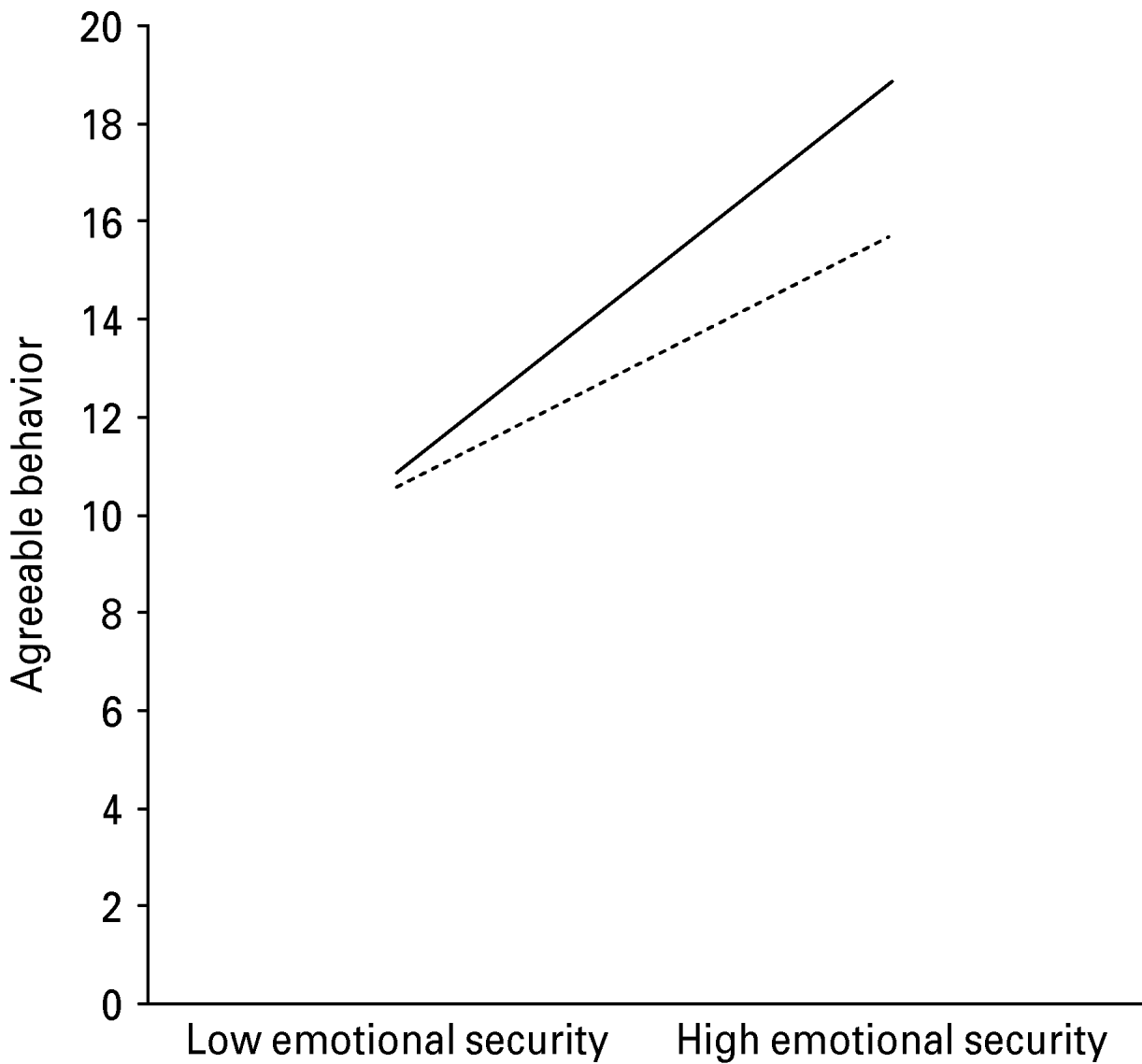
Heightened emotional security was associated with reports of increased agreeable and dominant behavior, and decreased quarrelsome and submissive behavior. The interaction of emotional security and diagnosis predicted reports of agreeable and quarrelsome behaviors. While individuals in both the SAD and control groups reported increased agreeable behavior during interactions in which emotional security was elevated (slopes=3.20 and 2.06, respectively), as predicted, this increase was significantly greater among individuals with SAD [t(7582)=2.88, p<0.01] (see Fig. 2). Investigation of the point estimates revealed that SAD group participants reported significantly higher levels of agreeable behavior than controls during interactions in which security was elevated [t(7582)=2.12, p<0.05], but not during interactions in which security was low [t(7582)=0.19, n.s.].
Prediction of agreeable behavior by emotional security and group (——, social anxiety disorder group; ······, control group).

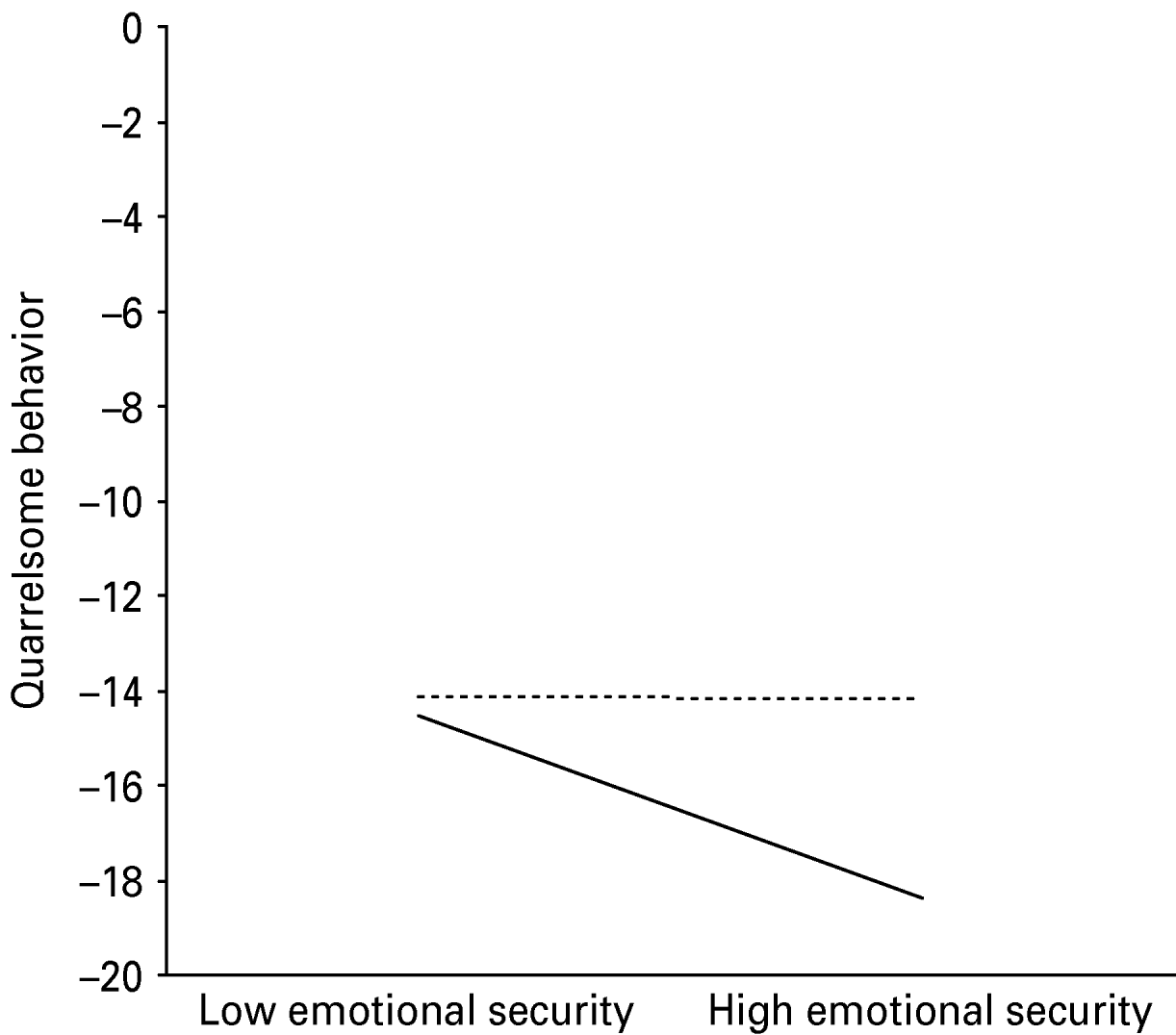
As expected, individuals with SAD reported decreased quarrelsome behavior during interactions in which emotional security was elevated [slope=−1.55, t(7582)=−6.10, p<0.0001] (see Fig. 3), while controls did not [slope=−0.02, t(7582)=−0.08, n.s.]. Investigation of the point estimates revealed that individuals with SAD reported significantly less quarrelsome behavior than controls during interactions in which emotional security was elevated [t(7582)=−2.65, p<0.01], but not when security was low [t(7582)=−0.24, n.s.].
Prediction of quarrelsome behavior by emotional security and group (——, social anxiety disorder group; ······, control group).

In sum, situational increases in emotional security were associated with reports of increased dominant behavior, decreased submissive behavior and increased agreeable behavior. The increase in agreeable behavior was significantly greater among individuals with SAD relative to controls. Finally, members of the SAD group reported a decrease in quarrelsome behavior during interactions in which security was heightened that was not observed among controls.
Further investigations of affect
Past research has demonstrated that unpleasant affective states such as anxiety and sadness frequently co-occur (e.g. Diener et al. Reference Diener, Smith and Fujita1995) and global affect valence has been associated with interpersonal behavior in past event-contingent recording studies (Côté & Moskowitz, Reference Côté and Moskowitz1998; Fournier & Moskowitz, Reference Fournier and Moskowitz2000). The preceding results for anxiety might be attributed to elevations in both anxiety and sadness.
To explore this possibility, previously reported analyses for anxiety were examined with situational sadness statistically controlled. The main effect of event-level sadness and the interaction between sadness and diagnosis was added to the statistical models. All previously reported main effect findings for anxiety and emotional security remained significant. The unpredicted main effect of situational anxiety on quarrelsome behavior among non-anxious controls was not significant when sadness was controlled [b=−0.01, F(1, 7581)=3.58, n.s.]; consequently this effect appears not to be specific to anxiety. All other findings for the interactions with diagnostic status remained significant. In sum, results of these analyses indicate that the main and interactive effects of situational anxiety on reports of interpersonal behavior in individuals with SAD are not accounted for by concurrent elevations in sadness.
Distribution of social interaction partners
SAD is associated with both social avoidance (APA, 2000) and impaired social functioning (e.g. Ruscio et al. Reference Ruscio, Brown, Chiu, Sareen, Stein and Kessler2008). Consequently, it is possible that individuals with SAD tend to interact with a restricted range or unique distribution of social partners. Systematic between-group differences in the nature or distribution of partners might confound diagnostic status with type of partner and therefore lead to interpretive difficulties.
To explore this possibility, the percentage of interactions reported by each participant was calculated for eight different types of social interaction partner. Between-group differences in the percentage of record forms associated with each relationship category were then tested using proc glm in SAS version 9.1 (SAS Institute, 2004). Relative to controls, individuals with SAD reported a higher proportion of interactions with supervisors [b=6.82, F(1, 54)=11.31, p<0.01] and romantic partners [b=10.94, F(1, 47)=4.97, p<0.05]. Previously reported analyses for anxiety and emotional security were therefore examined excluding all interactions with supervisors and romantic partners. All previously reported main effect findings for situational anxiety and emotional security remained significant, as did all findings for the interaction of these variables with diagnostic status, indicating that these results are not accounted for by between-group differences in the distribution of record forms across specific types of social partners.
Discussion
The present study used an event-contingent recording procedure to examine interpersonal patterns associated with generalized SAD. Consistent with past evidence based on self-report and laboratory measures (e.g. Creed & Funder, Reference Creed and Funder1998; Oakman et al. Reference Oakman, Gifford and Chlebowsky2003), main effect findings for reports of naturally occurring social interactions indicated that social anxiety is associated with increased submission and decreased dominance but unrelated to levels of agreeable and quarrelsome behavior. This suggests that the social behavior of individuals with SAD is not inhibited in a global sense; rather, behavioral inhibition is only observed with respect to the agentic dimension of the interpersonal circumplex (i.e. dominant and submissive behaviors).
As expected, individuals with SAD reported higher levels of submissive behavior during interactions in which anxiety was elevated. Cognitive–behavioral models of SAD postulate that a perceived risk of social disapproval elicits anxiety, which activates submissive behaviors to strategically avoid negative interpersonal outcomes (see Clark & Wells, Reference Clark, Wells, Heimberg, Liebowitz, Hope and Schneier1995; Leary & Kowalski, Reference Leary, Kowalski, Heimberg, Liebowitz, Hope and Schneier1995; Rapee & Heimberg, Reference Rapee and Heimberg1997; Alden & Bieling, Reference Alden and Bieling1998). Evolutionary formulations view the submission of socially anxious individuals as a strategy that offers protection from dominant others (Gilbert, Reference Gilbert2001; Gilbert & Trower, Reference Gilbert, Trower, Crozier and Alden2001), suggesting that anxiety and submission are most likely to occur when individuals view themselves as subordinate. These two perspectives are not mutually exclusive, as individuals with SAD may be most likely to perceive an increased risk of disapproval when interacting with individuals to whom they feel subordinate. Similarly, they might be particularly likely to perceive themselves as subordinate when they feel at risk of being rejected.
Group differences in reports of submissive behavior were not significant when anxiety was low, suggesting that individuals with SAD are not particularly submissive in the absence of anxiety-eliciting cues. Some social situations may be perceived as safe environments that do not require self-protective behavior strategies. As theoretical formulations postulate that perceived risk of rejection and appraisals of subordinate status are central to both the elicitation of anxiety and the inhibition of behavior among socially anxious individuals, future research should investigate these variables as potential mediators of situational anxiety effects on interpersonal behavior among individuals with SAD.
Clinical evidence indicates substantial variability with respect to the specific situations and interaction partners that elicit safety behaviors among individuals with SAD (e.g. Eng et al. Reference Eng, Heimberg, Coles, Schneier and Liebowitz2000). The present results suggest a linkage between interpersonal behavior and fluctuations in anxiety among individuals with SAD, highlighting the clinical importance of identifying anxiety-provoking contextual features that activate submissive interpersonal patterns. Therapeutic interventions directed at recognizing and coping with situational anxiety triggers may permit the deconstruction of self-perpetuating interpersonal cycles that maintain clinical symptoms. Concurrent training in assertiveness skills and anxiety-reduction techniques may also be effective in targeting the chronically low levels of dominance and anxiety-related submission associated with SAD in the present research.
Elevated emotional security was associated with reports of increased agreeable and dominant behavior and decreased submissive behavior across all participants. This pattern of findings is consistent with evidence that situational increases in felt security predict enhanced affiliative behaviors in laboratory settings (Mikulincer & Shaver, Reference Mikulincer and Shaver2005; Mikulincer et al. Reference Mikulincer, Shaver, Gillath and Nitzberg2005) and provides naturalistic documentation of this association.
As predicted, the interaction of diagnosis and emotional security was significantly associated with reports of agreeable and quarrelsome behavior. While both groups reported increased agreeable behavior during interactions in which emotional security was elevated, the magnitude of this increase was greater among individuals with SAD. Members of the SAD group also reported less quarrelsome behavior during interactions in which emotional security was heightened. These findings indicate that individuals with SAD respond to situational elevations in security with increased affiliation and the inhibition of behaviors that might lead to conflict or otherwise interfere with interpersonal connectedness. Despite the recognized association between SAD and interpersonal avoidance, these findings indicate that socially anxious individuals do pursue affiliation, particularly when their sense of emotional security is enhanced. Attachment research suggests that such a pattern might stem from approach–avoidance conflicts associated with fearful attachment (Vertue, Reference Vertue2003). To investigate this possibility, future research should examine the role of dispositional attachment style in event-level associations between security and behavior among individuals with SAD.
The present results suggest that the interpersonal manifestations of SAD extend beyond behavioral inhibition, avoidance, and sensitivity to negative cues; socially anxious individuals also respond to positive appraisals with increased affiliation. This suggests that clinical intervention should focus on the identification of contextual and relational features that enhance perceived emotional security among individuals with SAD, rather than target only those likely to elicit anxiety and avoidance. The activation of prosocial behaviors in response to cues such as emotional security may represent an interpersonal strength of individuals with SAD that can be fostered therapeutically and used to promote corrective interpersonal experiences and the reconceptualization of social situations as opportunities for acceptance and connectedness rather than risks for rejection and disapproval.
Limitations and directions for future research
The present research compared the interpersonal patterns of individuals with generalized SAD to a community sample of normal controls. This approach precludes the determination of whether observed between-group differences were linked specifically to SAD or more broadly to the presence of psychopathology. Future research comparing individuals with SAD to other clinical populations, particularly those with whom they share key diagnostic features such as elevated anxiety, would permit more definitive conclusions concerning the specificity of the present findings.
The event-contingent recording procedure employed in the present research does not permit direct observation or control of situational influences. Causal inferences based on the present data are also limited, as event-specific variables were measured concurrently. However, this procedure is unique in permitting the examination of situational variations with respect to individual mean levels and in providing an opportunity to examine interaction patterns across multiple social contexts and interaction partners. Furthermore, the investigation of coupled within-person fluctuations provides stronger evidence for hypothesized causal processes than cross-sectional correlations of one-occasion data. Future research might focus on other contextual features of theoretical interest. For example, perceived and objective relational variables could be compared by identifying social situations that correspond to variations in level of emotional security and social status. Other situational factors of interest might include subjective states, social motivation, perceptions of interaction partners, and social cognitive constructs.
Summary and conclusions
The present investigation examined dynamic patterns of behavior among individuals with SAD using hypotheses drawn from cognitive–behavioral, evolutionary, and attachment perspectives. Results indicated that SAD is associated with an inhibited behavioral style that is enhanced by situational increases in anxiety. Situation-specific elevations in emotional security were associated with reports of heightened affiliative behaviors among socially anxious individuals. These findings are consistent with predictions based on several theoretical perspectives, provide documentation of naturally occurring interpersonal patterns among individuals with SAD, and support the generality of past findings based on laboratory and self-report methods. On a broader level, this research demonstrates that SAD is not exclusively associated with behavioral inhibition and social avoidance by identifying some conditions under which individuals with SAD may view interactions as opportunities for, rather than threats to, interpersonal connectedness.
Acknowledgements
This research was supported by grants from GlaxoSmithKline, the Social Sciences and Humanities Research Council of Canada, and Fonds pour la Formation de Chercheurs et l'Aide à la Recherche du Québec. We extend our appreciation to Carolina Pansera, Melissa Levesque and David Paul for their assistance with data collection.
Declaration of Interest
None.