INTRODUCTION
Globally, mixed crop-livestock farming systems cover 2.5 billion ha of land and produce 92% of global milk supply, all of the buffalo and approximately 70% of the small ruminant meat (Herrero et al., Reference Herrero, Thornton, Notenbaert, Wood, Msangi, Freeman, Bossio, Dixon, Peters, Steeg, Lynam, Rao, Macmillan, Gerard, McDermott, Seré and Rosegrant2010; Thomas et al., 2002). These systems are particularly widespread in South Asia and sub-Saharan Africa and most of the projected future demands for meat and milk are expected to be met from them (Herrero et al., Reference Herrero, Thornton, Notenbaert, Wood, Msangi, Freeman, Bossio, Dixon, Peters, Steeg, Lynam, Rao, Macmillan, Gerard, McDermott, Seré and Rosegrant2010; Thomas et al., 2002). With prospective increasing needs for agricultural products, a subsequent water demand for livestock and crop production is recognized (e.g. Herrero et al., Reference Herrero, Thornton, Notenbaert, Wood, Msangi, Freeman, Bossio, Dixon, Peters, Steeg, Lynam, Rao, Macmillan, Gerard, McDermott, Seré and Rosegrant2010; Molden, Reference Molden2007). Therefore, the ways in which producers in crop-livestock systems respond to these circumstances and how their resource-use decisions affect water productivity (WP) are points of considerable research interest (Herrero et al., Reference Herrero, Thornton, Notenbaert, Wood, Msangi, Freeman, Bossio, Dixon, Peters, Steeg, Lynam, Rao, Macmillan, Gerard, McDermott, Seré and Rosegrant2010). In particular, understanding the relation between intensification pathways (e.g. specialization or improved resource use efficiency) and their impacts on livestock water productivity (LWP) and crop water productivity (CWP) are vital to addresses concerns of ecosystem sustainability (Blümmel et al., Reference Blümmel, Samad, Singh and Amede2009; Haileslassie et al., Reference Haileslassie, Peden, Gebreselassie, Amede and Descheemaeker2009).
Farmers' reactions to increasing demand for agricultural products and associated natural resources (e.g. land and water) in the Indo-Ganga Basin (IGB) shows different degrees of intensification: increasing from the south-east (e.g. West Bengal) to the northwest (e.g. Haryana (Erenstein and Thorpe, Reference Erenstein and Thorpe2009; Erenstein et al., Reference Erenstein, Thorpe, Singh and Varma2007)). The northwest has benefited from India's green revolution, a massive agricultural expansion fueled, largely, by the increased use of groundwater for irrigation (Erenstein and Thorpe Reference Erenstein and Thorpe2009; Rodell et al., Reference Rodell, Velicogna and Famiglietti2009). During the 1960s to 1980s, growing of high-yielding wheat and rice varieties in irrigated fields, combined with the application of fertilizer, resulted in much improved cereal production (Sikka and Gichuki, Reference Sikka and Gichuki2006). As a result, changes in livestock management (functions, herd structure and feed sources) were observed (Erenstein and Thorpe, Reference Erenstein and Thorpe2009). For example, the intensification of dairy production was accompanied by a decrease in the ratio of working animals to milk cows and a more intensive use of water for growing feed and fodder (Singh et al., Reference Singh, Sharma, Singh and Shah2004). Despite these observed changes, livestock production seems to be less intensive compared to crop production, and this strongly suggests that stimuli for livestock intensification have so far been less pronounced in this part of the IGB (Erenstein and Thorpe, Reference Erenstein and Thorpe2009).
In contrast, in the southeastern part of the basin, crop production is mainly rainfed and the increase in yield was mainly achieved through area expansion. Livestock are managed on communal grazing land and provide mainly draught power. High population pressure and, as a result, small landholding size are reported.
Both the rainfed and irrigation-based crop livestock systems suffer from severe water shortages and degrading soils (Erenstein and Thorpe Reference Erenstein and Thorpe2009; Herrero et al., Reference Herrero, Thornton, Notenbaert, Wood, Msangi, Freeman, Bossio, Dixon, Peters, Steeg, Lynam, Rao, Macmillan, Gerard, McDermott, Seré and Rosegrant2010; Rodell et al., Reference Rodell, Velicogna and Famiglietti2009). Per capita water availability in the IGB under projected water demand for 2025 will be lower than 1700 m3 head−1 year−1, which is considered as the cut-off point where water stress starts (Sikka and Gichuki, Reference Sikka and Gichuki2006).
Increasing LWP and CWP are widely advocated as a strategy to mitigate the impacts of water scarcity on sustainable livelihood (Descheemaeker et al., Reference Descheemaeker, Amede, Haileslassie and Bossio2010; Haileslassie et al. Reference Haileslassie, Peden, Gebreselassie, Amede and Descheemaeker2009; Peden et al., Reference Peden, Tadesse, Misra and Molden2007; Rodell et al., Reference Rodell, Velicogna and Famiglietti2009; Singh, Reference Singh2005). However, recent findings suggest that improving WP does not per se guarantee an increase in crop or animal yields (kg ha−1 (Haileslassie et al., Reference Haileslassie, Peden, Gebreselassie, Amede and Descheemaeker2009)). A sustainability-focused approach must involve interventions that address multiple uses of water by identifying an interface between crop and livestock compartments in a crop-livestock mixed system (Descheemaeker et al. Reference Descheemaeker, Amede, Haileslassie and Bossio2010; Haileslassie et al., Reference Haileslassie, Peden, Gebreselassie, Amede and Descheemaeker2009; Peden et al., Reference Peden, Tadesse, Misra and Molden2007).
This study presents a detailed analysis of the livestock-feed-water nexus across a crop-livestock intensification gradient in the IGB of India to improve understanding of the key drivers of LWP. We focused on three districts representing mixed crop-livestock systems under different degrees of intensification. These were those characterized by limited external inputs (e.g. Bankura District, West Bengal state), which we referred to as ‘semi-intensive’; and those largely characterized by high input and with the Green Revolution features (Hisar District, Haryana state and Etawah District, Uttar Pradesh state), which we referred to as ‘intensive’ (Erenstein and Thorpe Reference Erenstein and Thorpe2009; Erenstein et al. Reference Erenstein, Thorpe, Singh and Varma2007; Gregory et al., Reference Gregory, Ingram, Andersson, Betts, Brovkin, Chase, Grace, Gray, Hamilton, Hardy, Howden, Jenkins, Meybeck, Olsso, Ortiz-Monasterio, Palm, Payn, Rummukainen, Schulze, Thiem, Valentin and Wilkinson2002). The overarching objectives were to (i) understand the spatio-temporal dynamics of water requirements for livestock feed production; (ii) explore the magnitude of LWP across intensification gradients; (iii) to suggest mechanisms of water partitioning among system components (i.e. grain and feed).
MATERIALS AND METHODS
Selection and characterization of the case study areas
We selected the IGB as a focus area for this study given its diversity of farming systems. The basin is described as a ‘hotspot’ area in South Asia, where increased WP can benefit the basin community at large (Erenstein and Thorpe Reference Erenstein and Thorpe2009; Erenstein et al., Reference Erenstein, Thorpe, Singh and Varma2007; Herrero et al., Reference Herrero, Thornton, Notenbaert, Wood, Msangi, Freeman, Bossio, Dixon, Peters, Steeg, Lynam, Rao, Macmillan, Gerard, McDermott, Seré and Rosegrant2010; Rodell et al., Reference Rodell, Velicogna and Famiglietti2009). The IGB refers to the compound of the Indus and the Ganga (also known as the Ganges) basins. The Indus Basin covers areas in Tibet, India, Pakistan and Afghanistan. The Indian segment of the basin drains the northwestern states: Jammu and Kashmir, Himachal Pradesh, Punjab, Rajasthan, Haryana and Union Territory of Chandigar, and drains approx. 9.8% of the total geographical area of India. The Ganga Basin is shared by four riparian countries: China, Nepal, India and Bangladesh (Erenstein et al., Reference Erenstein, Thorpe, Singh and Varma2007; Sikka and Gichuki, Reference Sikka and Gichuki2006). The Ganga Basin drains approx. 25% of the total geographic area of India and has diverse agro-climatic regions ranging from the sub-arid in the northwest to hot sub-humid in the southeast. Crop-livestock mixed farming is practiced in the IGB but with different degrees of intensity (Erenstein and Thorpe Reference Erenstein and Thorpe2009; Erenstein et al., Reference Erenstein, Thorpe, Singh and Varma2007).
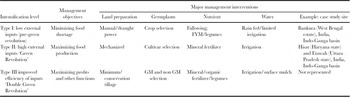
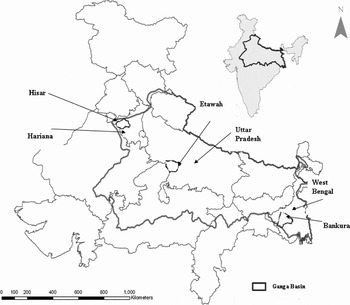
A multi-stage sampling approach was used to select the case study areas: first states representing typical mixed systems were identified (Haryana, Uttara Pradesh and West Bengal). Based on the chief management interventions, such as land preparation, nutrients, water (Gregory et al., Reference Gregory, Ingram, Andersson, Betts, Brovkin, Chase, Grace, Gray, Hamilton, Hardy, Howden, Jenkins, Meybeck, Olsso, Ortiz-Monasterio, Palm, Payn, Rummukainen, Schulze, Thiem, Valentin and Wilkinson2002), we categorized the intensification levels into three groups. In this study, we applied these criteria to identify the case study districts. Accordingly, the case study districts fell under Type I (Bankura) and type II (Hisar and Etawah) (Table 1), which we designated as semi-intensive and intensive systems, respectively (also compare Erenstein and Thorpe (Reference Erenstein and Thorpe2009)) (Figure 1).
Categories of intensification type, major intervention for different agricultural inputs, management objectives and respective case study regions in Indo-Ganga Basin.

Source: modified after Gregory et al. (Reference Gregory, Ingram, Andersson, Betts, Brovkin, Chase, Grace, Gray, Hamilton, Hardy, Howden, Jenkins, Meybeck, Olsso, Ortiz-Monasterio, Palm, Payn, Rummukainen, Schulze, Thiem, Valentin and Wilkinson2002).
FYM: farmyard manure; GM: genetically modified.
Location of the Indo-Ganga Basin and the case study areas.

All the case study systems receive rainfall during the monsoon (June–September (Erenstein et al., Reference Erenstein, Thorpe, Singh and Varma2007; Parthasarathy and Birthal, Reference Parthasarathy and Birthal2008; Sikka and Gichuki, Reference Sikka and Gichuki2006)) and the major landscapes are extensive fluvial plains developed through different pedogenic processes. The nature and properties of the alluvium vary in texture from sandy (northwest) to clayey (southeast) (Sikka and Gichuki, Reference Sikka and Gichuki2006).
Livelihood strategies in the case study systems are predominantly based on crop and livestock production but at different levels of intensification. Erenstein and Thorpe (Reference Erenstein and Thorpe2009) reported that wheat was the dominant food/feed crop in the intensive systems, whilst rice dominated the cropping pattern in the semi-intensive systems. In the major parts of intensive systems, successful crop production is not practised without supplemental irrigation, while in the semi-intensive systems only a small portion of the land is under irrigation. In the intensive systems, buffalo are the major livestock animals, while in semi-intensive systems, cattle are predominant (Erenstein et al., Reference Erenstein, Thorpe, Singh and Varma2007). The purposes of livestock production have also evolved with intensification: in the case study intensive systems, farmers are focusing more on milk production unlike in the semi-intensive systems where the focus is on draught power. In the case study intensive systems, farmers devote a significant share of the cultivated land to fodder crops production and the area declines with a lower degree of intensification (Erenstein et al., Reference Erenstein, Thorpe, Singh and Varma2007). Large ruminants are stall-fed in the case study intensive systems, while grazing on common pool resources is more common in semi-intensive system.
Water productivity concept and framework for analysis
Molden (Reference Molden1997) related WP to the value or benefit derived from the use of water. For example, CWP is defined as crop production per unit of water used. Recent views in WP of agricultural systems are focused on producing more food with the same or less water investment. Definitions of WP are flexible and can vary based on the purpose, scale and domain of analysis. Water productivity allows an understanding of the interfaces between different system elements (e.g. livestock and crop) and thus creates an enabling environment for a better understanding of system water productivity (SWP).
Both LWP and CWP are based on principles of water accounting (Haileslassie et al. Reference Haileslassie, Peden, Gebreselassie, Amede and Descheemaeker2009; Peden et al., Reference Peden, Tadesse, Misra and Molden2007) and is defined as the ratio of livestock beneficial outputs and services to water depleted and degraded in producing these products and services. Peden et al. (Reference Peden, Tadesse, Misra and Molden2007) conceptualized the depleted and degraded water as process and non-process water loss. Process depletion is the water transpired by feed plus that amount incorporated in the plant, while non-process depletion refers to water evaporated from soil and free water surfaces. Degraded water is the water that is polluted, for instance, by livestock droppings and sediment due to open-access to drinking water and over-grazing and compaction. For this study, we adapt the framework employed by Peden et al. (Reference Peden, Tadesse, Misra and Molden2007) in the Nile Basin to analyse the interactions between livestock and water.
Data requirement, generation and flow
Livestock data: values of livestock products and services. In calculating LWP and CWP, four major data sets were required: livestock, crop/land use, land productivity and climate (Descheemaeker et al., Reference Descheemaeker, Amede, Haileslassie and Bossio2010). We used secondary data sources from the case study districts, made field observations and held discussions with key informants to generate the data sets. In the following sections we present details on how these data were generated.
The estimation of livestock products and services requires information on the livestock herd structure (Haileslassie et al., Reference Haileslassie, Peden, Gebreselassie, Amede and Descheemaeker2009). Firstly, therefore, we established the livestock herd structure by breed, age group and level of activity and production (e.g. lactating cows and working oxen) for the period 1992–2003, drawing on the case study districts livestock data (Ramachandra et al., Reference Ramachandra, Taneja, Sampath, Anandan and Angadi2007). Secondly, we converted these structured population data into standard livestock units (SLU equivalent to 350 kg or 1.4 tropical livestock unit) using the conversion coefficients employed by Ramachandra et al. (Reference Ramachandra, Taneja, Sampath, Anandan and Angadi2007).
Data for milk production, number of lactating cows and length of lactation period across years were derived from DAHDF (2006), which also provides detailed data on meat yield and the number of animals slaughtered at registered slaughter houses for the different animal groups (e.g. large and small ruminants). There are multiple gaps in this data, and the missing values were calculated based on relationships between the variables for other years. To convert these data into financial values, we collected prices for the different products (in 2009, from every case study district).
Manure production is one major livestock product across the study systems. It is occasionally considered as recycled and redistributed nutrients (among farms and landscape) rather than being an output per se. Particular care is needed in considering manure as an output when the feed metabolizable energy (ME) demand is used to estimate LWP. In this study, we used manure as an output and also discussed change in LWP value when it is not considered in the computation. Manure production and its nutrient concentration vary significantly by season, feed, level of production and animal activity. Complete data sets addressing these variabilities were lacking and thus we applied literature values for dung productivity of different animal groups (Parthasarathy et al., Reference Parthasarathy, Birthal, Dharmendra, Wickramaratne and Shreshta2004). We estimated the financial value of manure by converting it to N, P and K and considering respective fertilizer equivalent prices.
Draught power is important mainly in the case study semi-intensive system. The calculation of the value of this service requires variables such as the number of bullocks involved, the hiring costs per day and the number of working days per year. But district scale comprehensive data in this regard are not available. We combined information from the literature (Parthasarathy et al., Reference Parthasarathy, Birthal, Dharmendra, Wickramaratne and Shreshta2004) and discussions with key informants to estimate the value of draught power.
Feed supply-demand and related land use. Ramachandra et al., (Reference Ramachandra, Taneja, Sampath, Anandan and Angadi2007) reported four main categories of feed supply in the study systems: pasture from native grazing lands, crop residue, irrigated/rain-fed green fodder and concentrates (e.g. bran and cakes). These data sets on feed biomass were converted to ME in MJ kg−1 using literature data on energy content (e.g. Kearl, Reference Kearl1982) and linked to areas required to grow them to calculate the energy productivity (MJ ha−1 yr−1).
The total energy requirements of an animal were calculated as the sum of the maintenance energy requirements and additional energy to account for the effect of standing and walking, milk production, body weight gain and draft power. We applied ME estimation techniques for tropical regions as reported in King (Reference King1983). Maintenance energy requirement was calculated according to equation 1:
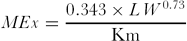
Whereby MEx is ME (MJ day−1 animal−1) for maintenance; LW is the bodyweight and was calculated as the standard livestock units and number of animals. Km (MJ kg−1) is the efficiency with which ME is used for maintenance and related to forage metabolizability. For each of the case study systems, the average dry matter (DM) digestibility value was considered based on the dominant diet composition (i.e. 55% for intensive and 45% for semi-intensive).
One of the productive uses of feed energy is lactation. The ME required for lactation was calculated as given in equation 2:
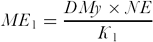
Where MEl is ME for lactation (MJ day−1 cow−1), DMy is daily milk yield, NE is net energy for milk calculated as function of butter fat content (g.kg−1) and solids-non-fat content (g kg−1). We assumed a constant value of fat content across study regions but differentiated between livestock group (i.e. buffalo and cattle). Kl is the efficiency with which ME is converted to milk.
In estimating ME for weight gain, we used equation 3 whereby MEg is ME for weight gain, LWG is live weight gain (kg day−1 animal−1) and W is the actual live weight of an animal (kg).

Calculating the energy requirements of draught animals is data intensive and varies considerably by the duration of work and age of the animal. Given diverse draught power demands subjected to differences in land owned by farmers and cropping pattern, accurate calculation is often difficult. We considered, however, 10% of the MEx as suggested by IPCC (1996). The differences between study sites are captured by the differences in the number of working animals. A certain amount of energy is also required by livestock for walking. But information on these input variables were lacking in the study sites and thus ME for walking was not taken into account.
Assuming that all the ME requirements by the different animal groups are satisfied from the current diet composition (i.e. both in quality and quantity), we distributed the total energy demand to the different feed sources (as a function of their percentage share on the supply side of ME). This was then converted to land requirements for every feed source based on the respective energy productivity of the latter (MJ ha−1 yr−1). Finally, based on feed ME demand and ME supply we estimated the demand supply balances and used these data sets to estimate demand and supply based LWP.
Feed related livestock water requirement. In this study, the water lost through evapotranspiration (ET) in the process of feed production was considered as the water input to livestock feed production. The amount of ET water to produce animal feed depends on several factors: livestock diet composition, crop specific parameters (e.g. Kc), biomass yield, quantity of livestock feed intake, length of growing period and climatic variables in the region where the feed is produced (Figure 1). To calculate ET, we used the reference evapotranspiration (ETo) calculator (Raes et al., Reference Raes, Greerts, Kipkorir, Wellens and Sahli2006) and collected the required data for the study period from metrological stations. ETo calculator estimates ETo on a daily basis using climatic variables (maximum and minimum air temperature, humidity, wind speed and sunshine hours). We applied the KcXET0 approach (Allen et al., Reference Allen, Pereira, Raes and Smith1998) to calculate the ET. We used Kc values for different crops and feeds as reported in Allen et al. (Reference Allen, Pereira, Raes and Smith1998). For those crops without established Kc value, we applied mean values of their family (for example, the mean values of Leguminosae for chickpeas). To reach the total ET per cropping season, it is vital to know the length of growing period for each crop's growing stages. We established these based on literature values (Allen et al., Reference Allen, Pereira, Raes and Smith1998). Length of growing period for different varieties (i.e. short, long, medium) was not taken into account as the district scale production data was aggregated.
The water invested in crop production includes grain and residues (Haileslassie et al. Reference Haileslassie, Peden, Gebreselassie, Amede and Descheemaeker2009). In order to understand the water productivity of enterprises at household or system scale, partitioning the total ET water between feed and grain is important. Some studies assumed that the water used for the production of a unit of grain and residues is equal and thus applying harvest index to partition total ET (Descheemaeker et al., Reference Descheemaeker, Amede, Haileslassie and Bossio2010; Haileslassie et al., Reference Haileslassie, Peden, Gebreselassie, Amede and Descheemaeker2009;). Other studies apply the ratio of cost of crop by-products and grains (Singh et al., Reference Singh, Sharma, Singh and Shah2004). The question is whether the harvest index and economic value approaches reflect the differences in water investment for grain and crop residues. In this study we compare the water partitioning using two approaches: harvest index and ME.
RESULTS
Dynamics of livestock population and their products
In the case study area, livestock population showed a high degree of diversity in its composition. According to the 2003 census, aggregated for all case study areas, cattle dominated with 1.3 million standard livestock units (SLU (51%), followed by buffalo 1.1 million SLU (44%), goats 0.94 million SLU (4%) and sheep 0.17 million SLU (1%). At the system scale, the importance of these livestock groups varied. For example, buffalos constituted ~80% in the case study intensive systems, whilst in the semi-intensive case study systems; cattle had the major share of total SLU (81%).
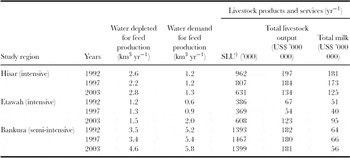
Analysis of livestock population for the period 1992–2003 and combined for all case study systems indicated that the total population of livestock did not change greatly. But when we disaggregated to system scales, a different picture emerged and increases were found for some of the systems (Table 2). The total value of livestock products and services, for all the study systems, was US$438 million for census year 2003 and, overall, milk contributed >90% of this value in the intensive and <50% in semi-intensive case study systems. In the case study semi-intensive system, the major share of livestock products came from traction services. Temporal analysis of the value of livestock products and services for 1992–2003, showed a mixed picture for the case study intensive systems: a decrease in Hisar and increase in Etawah. In contrast, the semi-intensive system did not show marked changes in overall values of products and services (Table 2), in spite of declining milk production.
Standard livestock units (SLU), actual use of and demand for water, livestock outputs and services across study years and spatial scales in intensive and semi-intensive systems of the Indo-Ganga Basin.

†SLU is equivalent to 350 kg live weight or 1.4 tropical livestock unit; water is partitioned by biomass between grain and residues; only buffaloes, shoats and bovines are considered in the calculation.
Assessment of feed quality and quantity: a demand and supply side analysis
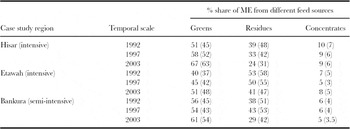
Overall, dry matter and associated feed ME from green fodder (irrigated, rain fed) and crop residues were the most important feed resources for the study period (1992–2003). For the case study semi-intensive region, major feed sources were residues (mainly from rice, 29%), greens (mainly from grazing and open forest, 61%) and concentrates (5%). In the case study intensive regions, the feed composition was more diversified and consisted of green fodder (55% mainly irrigated for Hisar), concentrates (9%) and residues (33%) (Table 3). Between 1992 and 2003, the feed ME share of concentrates did not show remarkable changes (Table 3) for all case study systems. However, in intensive systems, a change in the relative contribution of cultivated fodder was notable (Table 3). This expansion was attended by a proportional reduction in the relative contribution of crop residues to the overall feed ME.
Temporal and spatial variability of different feed source contributions to overall metabolizable enegy (ME) supply (figures in brackets are for share of biomass) in intensive and semi-intensive systems of the Indo-Ganga Basin.

Greens are: grasses from pasture, wetlands, forests and fallow lands and green fodder from irrigated/rain fed forage crops. Residues are: cereal straw/stover: slender straw from rice and wheat, coarse straw from coarse grains such as sorghum, millet and maize; haulms from legumes and oil seeds. Concentrates are: agro-industrial by-products from cereals, legumes and oil seeds. Cereal grain including sorghum millets, broken rice.
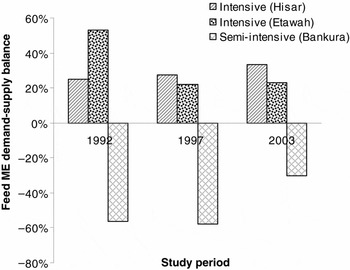
Between 1992 and 2003, the overall feed ME demand for livestock, in the case study intensive region, dropped for Hisar and increased for Etawah District, whilst in the semi-intensive systems, it grew only by 3%. The energy balance remained increasingly positive for part of the case study intensive region (i.e. Hisar District). The energy balance, for the case study semi-intensive system, has remained negative since 1992 but with a decreasing magnitude between 1997 and 2003 (Figure 2).The calculation of the feed ME from the feed demand side assumed the same diet composition for all livestock groups. This meant that the share of each diet presented above was not affected by the overall feed demand.
Feed demand supply balances over time in intensive and semi-intensive mixed crop-livestock systems in the Indo-Ganga Basin of India.

Livestock and feed water productivity across intensification gradients
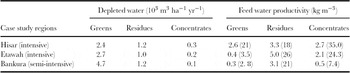
The volume of water depleted varied among the study systems and was highly affected by the type of feed and the attendant agronomic practices (e.g. cropping pattern, fertilizer application (Table 4)). The highest water consumer in the intensive system was green fodder (2350 m−3 ha−1 yr−1 for Hisar mainly cultivated green fodder and 4190 m−3 ha−1 yr−1 for Etawah green fodder from cultivated and communal grazing areas), and a similar trend was observed in the case study semi-intensive system, e.g. greens from communal grazing areas depleted 4680 M−3 ha−1. In contrast, concentrates depleted the smallest volume of water followed by crop residues (Table 4).
Mean values of feed water depletion and biomass water productivity for water partitioned by biomass in the Indo-Ganga Basin for the year 2003 (numbers in brackets are for metabolizable energy water productivity (MJ m−3).

See footnote to Table 3 for details of biomass components.
Water productivity of livestock is strongly linked to the water productivity of feeds (Descheemaeker et al., Reference Descheemaeker, Amede, Haileslassie and Bossio2010). Most noticeable from our results was the strong variability of feed WP across and within the systems (Table 4). Overall, highest mean WP values were observed for the case study intensive system. Among the groups of the different diet components, residues showed the highest feed WP values (kg m−3) followed by concentrates, whilst the opposite was true for WP value in MJ m−3. The least water productive feed sources were those making up the greens (grass from communal grazing, fallow land, grazing under forest).
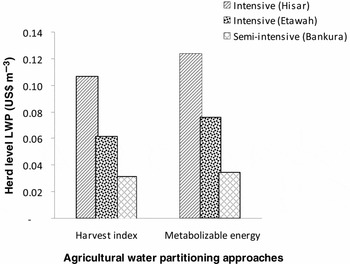
The mean value of herd level LWP, using harvest index based partitioning, manure as an output and feed ME demanded for 2003 for all case study systems, was US$ 0.06 m−3. For the same year, herd level LWP value was higher using the ME-based partitioning approach (including manure as an output). The contribution of manure to the overall differences in LWP values was not striking. The variability of herd level LWP values, calculated based on the feed ME demanded and the feed ME supplied (data not shown), was also remarkable (Figure 3). The supply side LWP calculation showed much lower values compared to the demand side approaches for the case study intensive systems. In contrast, in the semi-intensive system, LWP for the supplied feed ME was higher than LWP from the demand side.
Livestock water productivity as affected by the type of water partitioning approach for demanded feed metabolizable energy in the case study mixed crop livestock systems.

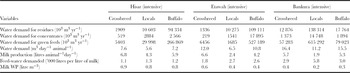
A separate LWP analysis for milk as a major product (i.e. milk based on feed ME demand) showed similar trends across the intensification gradient (Table 5). Thus, in physical terms, the highest milk return for a litre of water depleted was achieved in the intensive systems. Analysis across livestock groups showed the highest value for crossbreed cows followed by buffalo.
Mean values of physical water productivity of milk in intensive and semi-intensive systems of the Indo-Ganga Basin for the year 2003.

All variables were calculated based on feed demand by dairy cattle and existing diet composition.
DISCUSSION AND CONCLUSION
Effects of livestock population dynamics on demand for land and water
Past increases in agricultural production have occurred as the result of increased use of external inputs (intensive) and expansion of agricultural land (semi-intensive systems). In both cases, changes in the structure and productivity of the livestock population have occurred. The impacts of these transformations on land and water requirements of livestock and sustainability of ecosystems have been points of discussion (Gregory et al., Reference Gregory, Ingram, Andersson, Betts, Brovkin, Chase, Grace, Gray, Hamilton, Hardy, Howden, Jenkins, Meybeck, Olsso, Ortiz-Monasterio, Palm, Payn, Rummukainen, Schulze, Thiem, Valentin and Wilkinson2002). The focus of farmers on a certain livestock group (dairy) and the resulting modification of the herd structure (e.g. increase in crossbreeds in intensive systems) were triggered by a number of factors (e.g. market for livestock products and feed availability). The points under discussion were how these drivers have evolved and how they affected the herd structure and levels of productivity.
For example, there was an increase in rice and wheat yield from 0.63 Mg ha−1 in 1991/1992 to 1.37 Mg ha−1 in 1995/1996 in the case study intensive system (Thomas et al., 2002). This has, in turn, increased available livestock feed from crop residues. In this regard Erenstein and Thorpe (Reference Erenstein and Thorpe2009) reported that the reliance of livestock on crop residues, in the Indo-Ganga Basin, is still prominent. As incomes rose with increasing yields, food habits changed to more nutritious and more diversified diets (e.g. dairy products) and this created market opportunities. The increase in the buffalo and crossbreed livestock population and a reduction in low milk yielding indigenous cows in the case study intensive systems could be accounted for by these farmers' investment determinants. Thomas et al. (2002) have also suggested that the size of land holding and the level of intensification have affected herd structure. On farms bigger than 3 ha, more female animals were kept than males and more buffalos than cows and farming practices shifted to semi-mechanization. Perhaps this explains the reason for a higher population of working animals in the case study semi-intensive system, where the arable land holding was low and land preparation was based on draught power (Erenstein et al., Reference Erenstein, Thorpe, Singh and Varma2007). The point is to understand the implications of such a shift in herd structure and level of specialization on land and water requirements, particularly in terms of losses of multiple livestock functions and increases in water demanding feeding regimes (e.g. irrigated fodder, degrading common property resources).
Since 1992, the land for feed production has increased (e.g. irrigated green fodder particularly in the case study intensive system). This contrasts with the decreasing trends in total livestock population and farmers focusing on more productive animals with improved health services, in particular, for the intensive systems. For example, the increased share of green fodder in the animal diet (16% for Hisar and 11% for Etawah) (Table 3) with the intent of increasing milk productivity, resulted in additional water input per animal. This is accounted for by the lower WP of green fodder as compared with crop residue-based feed, for which the total depleted water was shared between food grain and livestock feed. Overall, during the last decades, there has been a trend of increasing milk production per animal as the result of improved feed, increased number of more productive breeds (crossbreed and buffalo) and better health services (DAHDF, 2006; Ramachandra et al., 2004) and, during the same period, there was an increase in water depleted per cow to produce a litre of milk. This also explains that the increase in milk is at the expense of higher water investment and such an approach departs from the current suggestion of producing more agricultural products using the same or lower quantity of water input. This evokes the need to optimize water use and improve biomass productivity of green fodder.
Feed demand and supply: the role of residues and implications on water use
Adequate feed supply largely determines livestock productivity while the way feed is produced affects the sustainable use of water (Blümmel et al., Reference Blümmel, Samad, Singh and Amede2009). Comprehensive data on feed demand-supply balances are, however, very scarce. The result of this study suggested an overall feed supply increased by ~3% (for all systems 2.8–2.9 Mg SLU−1 year−1) between 1992 and 2003. This gain in feed supply is lower than the value (37%) reported by Ramachandra et al. (Reference Ramachandra, Taneja, Sampath, Anandan and Angadi2007) for the whole of India. This difference can be accounted for by strong counterbalance in feed deficit or excess between systems with different degrees of intensification. Similar to the nation-wide feed assessment synthesized by Ramachandra et al. (Reference Ramachandra, Taneja, Sampath, Anandan and Angadi2007), our findings from the case study suggested a strongly negative feed ME balance for the semi-intensive region and surplus feed ME for the intensive systems (compare Erenstein and Thorpe Reference Erenstein and Thorpe2009).
The question is, however, how livestock can survive and produce in states of negative feed ME balances. Thomas et al. (2002) share these apprehensions and argue that demands might be overestimated and supplies underestimated due to inconsistencies in analytical methods. Equally important is the discrepancy and aggregation of dry matter yield for different land uses. For example, Ramachandar (Reference Ramachandra, Taneja, Sampath, Anandan and Angadi2007) reported a significant share of irrigated fodder in semi-intensive systems, which could not be verified during our field observations (see also Erenstein and Thorpe Reference Erenstein and Thorpe2009). Systems are also not self-contained (e.g. feed trading) and they are diverse (in terms of farmers' access to resources). In this respect farm-scale studies (e.g. Clement et al., Reference Clement, Haileslassie, Ishaq, Blümmel, Murty, Samad, Dey, Hiamangshu and Khan2010) suggest that farm households with less access to land and water are challenged by feed scarcity while the better-off farmers have surplus feed (compare Erenstein and Thorpe Reference Erenstein and Thorpe2009) and most often feed balance calculations neglect these variations. In conclusion, such wide ranges of values demonstrate the uncertainty in feed demand and supply estimations and the care needed while interpreting results; future feed demand-supply balance estimation must be able to match seasonal feed availability and livestock activity and above all must take farmers' access to key livelihood capital and intersystem feed flow into account.
The feed sources and the efficiencies with which feed is utilized within the animal determine the amount of water required to produce livestock products and services. Recent studies indicated that an average of 3400 litres of water was required for the production of a litre of milk (Singh et al., Reference Singh, Sharma, Singh and Shah2004). Obviously, this quantity can vary based on the livestock feed sourcing strategies, such as feed from food-feed crops (e.g. residues and concentrates; multiple uses of water) or from fully irrigated fodders and pasture from grazing lands. Our result also illustrated that the water productivity of livestock positively correlates with the percentage share of crop residues in the diet composition and supported the observations reported by Singh et al. (Reference Singh, Sharma, Singh and Shah2004). This raises another questions on how increased crop residues use impacts ecosystem services (e.g. supportive and provision services like nutrient cycling (IITA. 2010)).
Blümmel et al. (Reference Blümmel, Samad, Singh and Amede2009) argue that focusing on WP of residues per se does not warrant gain in milk production and thereby improve the livelihood objectives of poor livestock keepers. According to these authors, there are two severe disadvantages associated with feeding livestock with crop residues: (a) low levels of livestock productivity, because of low intake and feed energy conversion into meat and milk; and (b) high emission of greenhouse gases by livestock. This, therefore, suggests the need to look more closely into the selective and optimum uses of residues (i.e. combination crop variety, processing and proportions to use as a feed source (IITA, 2010). Opportunities exist in focusing on those that have higher digestibility (e.g. pulses) and those that are water productive and supplement the low digestible residues. But this requires diversification of the current cropping pattern in the semi-intensive system, which is largely dominated by paddy rice. For intensive systems, one study suggested that as much as 60% of the residues are burnt every year (Erenstein et al., Reference Erenstein, Thorpe, Singh and Varma2007). These residues could have been traded with feed deficit regions or used as mulch to reduce the evaporative losses from irrigated fields.
Livestock water productivity: variation in space and time
We calculated LWP based on the supplied and demanded ME for 2003. The differences in results between the feed demand and supply based calculation were accounted for by the allocation of extra feed to the livestock in case of surplus feed (in the case study intensive system) or sharing of the available feed by the larger number of livestock in the feed deficit region (case study semi-intensive system). In reality, however, the sustainability of both systems is under threat. Therefore, LWP values must be interpreted with care and compared vis-à-vis the livestock feed demand-supply balance. Considering manure as livestock output or not, did not affect the value of LWP. This is inconsistent with LWP estimation in the highlands of Ethiopia (Haileslassie et al., Reference Haileslassie, Peden, Gebreselassie, Amede and Descheemaeker2009) where manure is mentioned as one of the most important outputs. The difference can be accounted for by lower prices of fertilizer in India compared to Ethiopia.
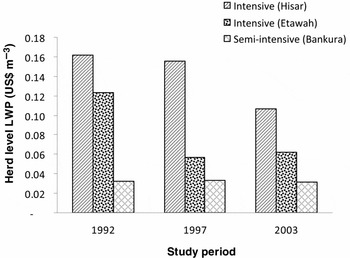
At the systems scale, LWP was estimated to be higher in case study intensive systems (for 2003 US$ 0.11 m−3). This value was on the lower range of LWP reported by Haileslassie et al. (Reference Haileslassie, Peden, Gebreselassie, Amede and Descheemaeker2009) using available feed for a feed deficit area in Ethiopia. In addition to differences in climate, cropping patterns and product prices (e.g. value of fertilizer), the fact that the supply-side based calculation overestimates LWP in feed deficit regions explains these differences. Our estimate of milk water productivity was in agreement with Singh et al. (Reference Singh, Sharma, Singh and Shah2004) who reported dairy LWP for Gujarat (India). According to these authors, dairy farming is highly water-intensive, though the efficiency of water use varies across regions and also across animals/breeds. They showed that Gujarat used 1900–4600 litres of irrigation water per litre of milk produced.
In our study the highest volume of water investment per litre of milk produced was estimated for the indigenous cows in the semi-intensive system, where milk production was not the primary purpose of keeping cows. To have insight into the factors behind intersystem variation, we recalculated LWP by forcing similar climatic variables (ETo). The result indicated that ~39% of the intersystem variability could be explained by climatic differences, whilst 61% can be accounted for by differences in management and natural resources endowment.
Between 1992 and 2003, LWP values showed a decreasing trend for the case study intensive systems (Figure 4). Although the increases in milk productivity reported by DAHDF (2006), contradicts such a decline in LWP value, the following pieces of evidence support our conclusion: first, the focus on green fodder and reduced share of crop residues contributed to higher water consumption per unit of product; second, the reduction in multiple uses of livestock, such as draught power, played an important role in the decrease of LWP over time. This is worrisome in times of increasing concern over water depletion and environmental degradation (Gregory et al. Reference Gregory, Ingram, Andersson, Betts, Brovkin, Chase, Grace, Gray, Hamilton, Hardy, Howden, Jenkins, Meybeck, Olsso, Ortiz-Monasterio, Palm, Payn, Rummukainen, Schulze, Thiem, Valentin and Wilkinson2002; Rodell Reference Rodell, Velicogna and Famiglietti2009) and suggests a need for improved livestock management and balanced feeding to increase LWP. To ensure these, feed rationing practices must take the water productivity, nutritive value and cost of feed into account, and the livestock management practice must give focus to productive breeds and better animal health services.
Livestock water productivity over time in intensive and semi intensive mixed crop livestock systems in the Indo-Ganga Basin of India.

Estimation of LWP values, using ME and harvest index agricultural water partitioning approaches, showed apparent differences: slightly higher LWP value for ME partitioning. The harvest index approach assumes that water used to produce a unit of dry matter of grain and residue is equal and for major crops the value of the harvest index is higher for residues than for the grain. This implies a higher share of water for livestock and thus lower LWP. In reality the concentration of ME in residues is less than in grain and thus the actual benefit that goes to livestock in terms of feed ME is low. This argument was also revealed in recent quantitative analysis of water footprint of energy from biomass (Gerbens-Leenes et al., Reference Gerbens-Leenes, Hoekstra and van der Meer2009). They argued that the water invested in energy carrier crop is not only the function of biomass that is used for energy production, but also it involves combustible energy density of the biomass. Therefore, they combined both the energy content and biomass quantity to estimate the volume of water used to produce energy. Likewise, the point here is that the LWP calculation exercise can benefit from such biomass and energy combining approaches instead of using only the harvest index.
Acknowledgments
The authors are grateful to the Challenge Program Water and Food (CPWF) for financing this project. Our gratitude also goes to the key informants for unlimited co-operation to share information on production and livelihood activities in different systems. We are also indebted to Professional Assistance for Development (PRADAN), Bharatiya Agro Industries Foundation (BAIF), Mr Satyawan Sarpanch and Pawan Kumar for their dedicated field work co-ordination.