Introduction
Neurosyphilis is an infection of the central nervous system caused by Treponema pallidum. Because the clinical manifestations of neurosyphilis are so varied its diagnosis is difficult. Usually an early and a late form will be distinguished. The early form appears a few months or years after infection and primarily affects the meninges and the cerebral or spinal cord vasculature. The late form, which occurs many years after infection, is rare and afflicts particularly the brain and spinal cord parenchyma (Conde-Sendín et al., Reference Conde-Sendín, Hernández-Fleta, Cárdenes-Santana and Amela-Peris2002).
Neurosyphilis can present with psychiatric symptoms such as acute psychosis, paranoid delusions, personality changes, affective disorders and cognitive impairment (Roberts and Emsley, Reference Roberts and Emsley1992).
Diagnostic criteria vary. In U.S. guidelines a reactive cerebrospinal fluid (CSF) nontreponemal antibody test, such as the Veneral Disease Research Laboratory (VDRL) and Cardiolipin Complement Binding Reaction (Cardiolipin CBR) test accompanied by increased CSF leukocyte count and protein level are demanded (Centers for Disease Control and Prevention, 2006). However, as the sensitivity of the VDRL test is only moderate according to German guidelines, a probable diagnosis of neurosyphilis can be made when at least two of the following criteria are fulfilled: (i) chronic progressive neurological and/or psychiatric symptoms with partial remissions or aggravation; (ii) positive influence of antibiotic treatment on the course of the disease and/or on pathological CSF findings; (iii) serological reactive Treponema pallidum haemagglutination (TPHA)- or Treponema pallidum particle agglutination (TPPA-) tests and fluorescent treponemal antibody absorption (FTA-Abs) test. A certain diagnosis can be made when an increased intrathecal Treponema pallidum specific antibody index is found (ITpA- or Hagedorn-index = CSF TPHA test titer/CSF immunglobuline G x serum TPHA test titer/serum immunglobuline G; German Society for Neurology, 2008; Figure 1).
Diagnostic pathway in suspected neurosyphilis (modified according to Centers for Disease Control and Prevention, 2006; German Society for Neurology, 2008; Prange and Matschke, Reference Prange, Matschke, Brandt, Dichgans and Diener2007).
BBB = blood-brain barier; Cardiolipin CBR = Cardiolipin Complement Binding Reaction; CSF = cerebrospinal fluid; FTA Abs test = Fluorescent treponemal antibody absorption test; IgM = Immunglobuline M; ITpA = Intrathecal Treponema pallidum specific antibody index; TPPA test = Treponema pallidum particle agglutination test; Trep. = Treponema; VDRL = Veneral Disease Research Laboratory.

Here we present a case of neurosyphilis which had progressed over six months in an elderly woman showing personality changes and paranoid delusions. These were initially suspected to be symptoms of a neurodegenerative disease. The patient gave written informed consent to the publication of this case report in International Psychogeriatrics.
Case report
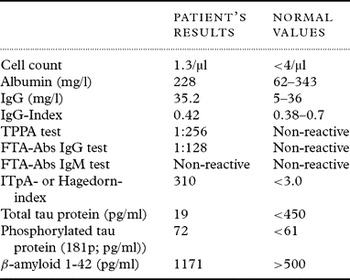
A 90-year-old female immigrant from Eastern Europe with no significant psychiatric or medical history was admitted to the Department of Psychiatry and Psychotherapy in the University Hospital of Tübingen. She had tried to jump out of a window when she believed that bad men were telling her to commit suicide. About six months previously she had developed sleep disturbances, strong headaches, begun talking to herself, and had cut her dress into pieces. On admission she presented with auditory hallucinations such as voices talking to her about suicide and with paranoid delusions such as bad men prosecuting her. Accordingly, she was nervous and restless. Her performance in the Mini-mental State Examination (27/30) and Clock Drawing Test were normal. Apart from a 3/6 systolic murmur in the medical and neurological examination, no significant pathological finding could be detected. In an echocardiography an aortic stenosis was shown but no aneurysm. In cranial magnetic resonance imaging a cerebral atrophy could be detected. Laboratory tests – including analysis of vitamin B12, folic acid, and thyroid stimulating hormone levels – were without significant pathological results. However, a syphilis screening test showed increased TPPA test titer (1:320) and FTA-Abs immunglobuline G test titer (1:320), while FTA-Abs immunglobuline M and Cardiolipin CBR were nonreactive. Results of the CSF analysis are displayed in Table 1.
Cerebrospinal fluid analysis of the patient

FTA Abs test = Fluorescent treponemal antibody absorption test; IgG = Immunglobuline G; IgM = Immunglobuline M; ITpA = Intrathecal Treponema pallidum specific antibody index; TPPA test = Treponema pallidum particle agglutination test.
Initially the patient was treated with risperidone 1mg/day without effect. Guided by the results of the microbiological examinations of serum and CSF we initiated antibiotic treatment. As a non-severe penicillin allergy was known, the patient was treated with ceftriaxone 2 g intravenous every 24 hours for 14 days. After six days of antibiotic treatment, the psychotic symptoms improved. The antipsychotic treatment was therefore discontinued the next day. At the end of antibiotic treatment the patient was free of psychotic symptoms and she was discharged two days later. No recurrence of psychotic symptoms or cognitive deterioration could be observed in follow up investigations up to one year after treatment.
Discussion
A routinely administered syphilis screening test led to the diagnosis of neurosyphilis with good response to antibiotic treatment in the case reported here. As the incidence of syphilis in Western Europe, North America, and particularly Eastern Europe and the developing countries has risen in recent years (German Society for Neurology, 2008), screening for syphilis is frequently applied in our department, especially in patients with severe psychiatric symptoms and who are known to be migrants.
Initially, Alzheimer's disease (AD) was suspected because psychotic symptoms in old age are mostly due to incipient dementia (Broadway and Mintzer, Reference Broadway and Mintzer2007). However, cognitive testing of the patient showed normal results. CSF analysis revealed an increased level of phosphorylated tau (p-tau) protein while total tau protein and ß-amyloid 1-42 were in the normal range. CSF p-tau has a sensitivity of 77.6% and a specificity of 87.9% for the discrimination of patients with AD and healthy elderly people (Mitchell, Reference Mitchell2009). However, no studies have been published investigating CSF p-tau levels in patients with neurosyphilis. In one examination increased levels of CSF total tau were observed in neurosyphilis compared with controls and syphilis without nervous system involvement (Paraskevas et al., Reference Paraskevas, Kapaki, Kararizou, Mitsonis, Sfagos and Vassilopoulos2007). However, the small sample size does not allow the drawing of firm conclusions.
Furthermore, no studies have been published investigating ß-amyloid 1-42 CSF levels in patients with neurosyphilis, although it is well known that chronic bacterial infection may lead to amyloid deposition. Moreover, it is generally accepted that Treponema pallidum is responsible for dementia, brain atrophy and amyloid deposition in the atrophic form of general paresis in syphilis and also that this spirochete can cause several other neurodegenerative disorders (Miklossy, Reference Miklossy2008).
In the presented case the diagnosis of neurosyphilis could be ascertained by an increased Hagedorn-index (German Society for Neurology, 2008). However, the necessity of antibiotic treatment might be discussed due to the lack of activity signs in the CSF. Felman and Nikitas (Reference Felman and Nikitas1980) reported that in some cases the findings of a normal CSF cell count and protein concentration and also a nonreactive CSF nontreponemal test is insufficient to exclude activity of the neurosyphilitic process. Also Russouw et al. (Reference Russouw, Roberts, Emsley and Joubert1994) reported a high proportion of patients with positive TPHA and FTA-Abs tests but nonreactive CSF non-treponemal tests being treated as having active neurosyphilis. The high ITpA-index and the response of the psychotic symptoms to the antibiotic treatment in the case presented here clearly indicated an active infection (Figure 1). The promptness of the response is noteworthy. Usually symptoms of the late form of neurosyphilis improve slowly and defective healing frequently occurs (Prange and Matschke, Reference Prange, Matschke, Brandt, Dichgans and Diener2007). Obviously the acute psychotic symptoms were highly responsive to the antibiotic treatment.
Treatment response can be shown by a decrease of CSF pleocytosis, normalization of blood-brain barrier and/or a decline of the CSF titers of the non-treponemal tests (German Society for Neurology, 2008). However, in the case reported here these parameters were initially normal or not determined. As the TPPA- and FTA-Abs tests as well as the ITpA- or Hagedorn-index are inappropriate for follow-up investigation (German Society for Neurology, 2008), we did not repeat lumbar puncture. Clinical examination of the patient up to one year after discharge indicated treatment success.
Penicillin is still the gold standard treatment but ceftriaxone therapy is reported to be successful even in penicillin-resistant cases (German Society for Neurology, 2008). In our case, the antibiotic treatment with ceftriaxone was preferred as the patient had a non severe allergy to penicillin. Penicillin desensitization is often recommended as an alternative treatment (Centers for Disease Control and Prevention, 2006), but because we needed a quicker and simpler treatment regimen for our elderly patient, we chose to use ceftriaxone therapy.
In the treatment of patients with syphilis, the Jarisch-Herxheimer reaction must be taken into account when an acute febrile reaction – frequently accompanied by headache, myalgia, cardiovascular symptoms, seizures, deterioration of the neuropsychiatric symptoms and leucocytosis – occurs within the first 24 hours after initiation of an antibiotic therapy. The patient should be monitored and symptomatically treated with nonsteroidal anti-inflammatory drugs. The antibiotic treatment should be continued. Corticosteroids may alleviate the symptoms (German Society for Neurology, 2008).
In summary, the case report indicates the relevance of neurosyphilis as a differential diagnosis in patients who develop severe psychiatric symptoms in old age. Because a causal antibiotic treatment is possible this infectious disease should be considered seriously in gerontopsychiatric patients.
Conflict of interest
None.
Description of authors' roles
E. G. examined and treated the patient and wrote the first draft of the paper. T. L. supervised the examination and treatment of the patient and revised the paper.