Introduction
Obstructive sleep apnoea (OSA) is a common disorder, with an estimated prevalence of 1–4 per cent in children.Reference Lumeng and Chervin 1 In adults, there are several medical and surgical OSA treatment modalities available, such as myofunctional therapy,Reference Camacho, Certal, Abdullatif, Zaghi, Ruoff and Capasso 2 oral appliances, positive airway pressure devices, soft tissue surgical procedures,Reference Certal, Zaghi, Riaz, Vieira, Pinheiro and Kushida 3 – Reference Senchak, McKinlay, Acevedo, Swain, Tiu and Chen 5 skeletal surgical proceduresReference Camacho, Liu, Certal, Capasso, Powell and Riley 6 and tracheostomy.Reference Camacho, Certal, Brietzke, Holty, Guilleminault and Capasso 7 In children, adenotonsillectomy,Reference Brietzke and Gallagher 8 myofunctional therapy,Reference Camacho, Certal, Abdullatif, Zaghi, Ruoff and Capasso 2 palate expansionReference Villa, Malagola, Pagani, Montesano, Rizzoli and Guilleminault 9 and allergy management are generally recommended. Recent studies have evaluated the effect of solitary procedures on OSA outcomes.Reference Senchak, McKinlay, Acevedo, Swain, Tiu and Chen 5 , Reference Camacho, Riaz, Capasso, Ruoff, Guilleminault and Kushida 10 Given that adenotonsillectomy is amongst the most common procedures performed for paediatric OSA, the procedure has been systematically studied, by Brietzke and Gallagher,Reference Brietzke and Gallagher 8 Friedman et al.Reference Friedman, Wilson, Lin and Chang 11 and Lee et al.Reference Lee, Hsu, Chang, Lin and Kang 12 Meta-analyses have demonstrated cure rates of between 51 and 82.9 per cent (defined by a post-adenotonsillectomy apnoea–hypopnoea index of less than one event per hour).
Although adenotonsillectomy has been very successful in treating OSA, one of the concerns, especially in children aged less than three years, is the potential for post-operative bleeding. Therefore, in the presence of small tonsils and large adenoids, some have advocated that adenoidectomy alone could be performed as a first procedure. Tonsillectomy could be performed once the child has grown more. Thus far, there have been three review articles evaluating the effects of adenoidectomy alone as a treatment for paediatric OSA.Reference Black and Shott 13 , Reference Caldwell, Hensley, Machaalani, Cheng and Waters 14 However, to our knowledge, a systematic review with meta-analysis has not been performed. In order to determine the isolated effect of adenoidectomy on paediatric OSA, a search of multiple publication databases without regard to language would need to be performed.
This study aimed to systematically search the international literature for studies reporting outcomes for adenoidectomy alone as a treatment for paediatric OSA, and use the data to perform a meta-analysis with random-effects modelling.
Materials and methods
Three authors (MC, SAS and LKR) independently and systematically searched the international literature (in all languages), from the inception of each database through to 1 April 2016.
The databases searched included: PubMed/Medline; Cochrane Library; Web of Science; Book Citation Index – Science; Cumulative Index to Nursing and Allied Health Literature (‘CINAHL’); Scopus; Embase; Google Scholar; and Conference Proceedings Citation Index – Science.
An example of a search strategy for PubMed/Medline is: ‘adenoidect*’ together with ‘sleep apnea’, ‘sleep apnoea’, ‘apnea-hypopnea’, ‘apnoea-hypopnoea’, ‘respiratory disturbance’, ‘sleep study’ or ‘polysomnography’. A separate search was also performed in each database with the following search strategy: ‘isolated adenoidectomy’, ‘adenoidectomy alone’, ‘adenoidectomy as the sole’, ‘adenoidectomy as an isolated’ or ‘only adenoidectomy’, together with ‘sleep apnea’, ‘sleep apnoea’, ‘hypopnea’, ‘apnoea-hypopnoea’, ‘respiratory disturbance’, ‘sleep study’ or ‘polysomnography’.
The Preferred Reporting Items for Systematic Reviews and Meta-Analysis (‘PRISMA’) statement was adhered to as much as possible in the performance of this review.Reference Moher, Liberati, Tetzlaff and Altman 15 As this was a systematic review, and the searches were in publically available databases, with publically available articles, the study was exempt from review by the institutional review boards.
Study selection
The inclusion criteria were as follows: the studies selected needed to comprise children (aged under 18 years) with OSA, who underwent isolated adenoidectomy, in which pre- and post-adenoidectomy (quantitative) data were compared and sleep study outcome data assessed. The articles, published and unpublished, could be written in any language, and the studies could be of any design (case report, case series, cohort study, case–control study or randomised trial). Studies were excluded if: additional surgical procedure(s) were performed and there were no individual data for adenoidectomy-only patients; only qualitative data were available; or they concerned central sleep apnoea patients.
Quality assessment
The National Institute for Health and Care Excellence (NICE) quality assessment tool was used to determine the quality of the included studies, as it allows for the assessment of case series. 16
Statistics
The null hypothesis was that there is no difference in sleep study outcomes pre- and post-adenoidectomy.
SPSS software (version 20.0; IBM, Armonk, New York, USA) was used for statistical analysis. Two-tailed, paired t-tests were employed; a p-value of <0.05 was used to determine statistical significance.
The Cochrane Collaboration's Review Manager software (‘RevMan’), version 5.3, was used for sub-analyses with random-effects modelling. 17 The 95 per cent confidence intervals (CIs), mean differences and standardised mean differences were calculated using the Review Manager software. The magnitudes of effect for standardised mean differences were assigned values of 0.2 (small), 0.5 (medium) or 0.8 (large), based on Cohen's guidelines.Reference Cohen 18 The Cochran Q statistic was employed to evaluate heterogeneity; a p-value of ≤0.10 was used to determine significant heterogeneity.Reference Lau, Ioannidis and Schmid 19 Review Manager software was utilised to calculate the inconsistency (I2 statistic). Levels of inconsistency guidelines were used to assign levels: low inconsistency = 25 per cent, moderate inconsistency = 50 per cent and high inconsistency = 75 per cent.Reference Higgins, Thompson, Deeks and Altman 20 As part of the assessment to determine which study was the source of heterogeneity and inconsistency (if present), the Review Manager software sensitivity analysis function was used; this function allows the removal of one study individually to determine which one(s) was the cause.
If apnoea–hypopnoea index and respiratory disturbance index values were reported, then the apnoea–hypopnoea index was used for the meta-analysis. If only the respiratory disturbance index was reported, the polysomnography scoring criteria were reviewed. If the polysomnography scoring criteria were consistent with the apnoea–hypopnoea index, it was combined with apnoea–hypopnoea index and if consistent with the respiratory disturbance index, a separate analysis was planned for the respiratory disturbance index.
Bias was assessed as recommended by the Cochrane Collaboration, in that at least 10 studies were needed in order to assess the funnel plot for any given variable. If any additional data were needed for the meta-analysis, we planned to contact the corresponding author at least twice to try and obtain the data.
Results
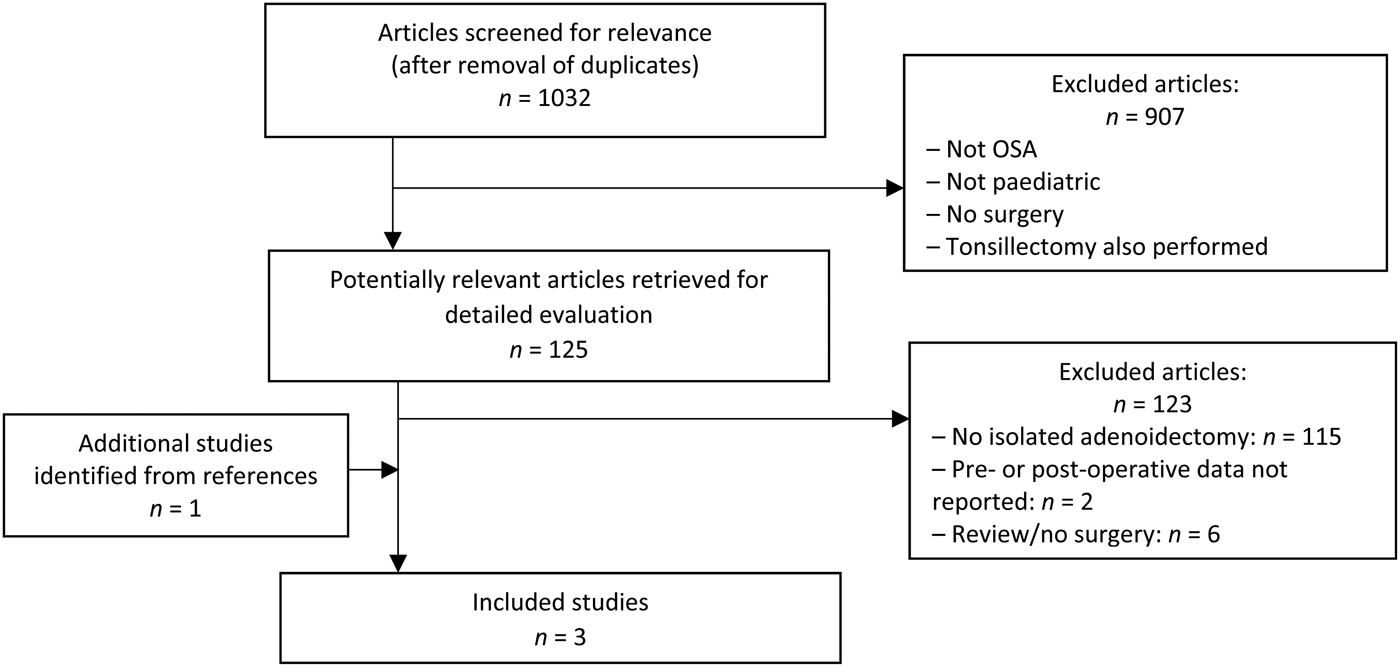
The systematic review searches provided a total of 1032 potentially relevant studies, of which 125 were downloaded for full text review. After reviewing the studies, references and the citing studies, 1 additional study was added, for a total of 126 studies. The final review yielded a total of three studies (47 patients) that reported outcomes for sleep study data pre- and post-adenoidectomy alone (Figure 1).Reference Robison, Wilson, Otteson, Chakravorty and Mehta 21 – Reference Shintani, Asakura and Kataura 23 The NICE quality assessment tool was utilised to determine the quality of the data (Table I).
Flow chart for study selection. OSA = obstructive sleep apnoea

General characteristics and quality criteria of included studies

*Quality assessments of case series were conducted using the National Institute for Health and Care Excellence checklist: (1) were the case series data collected in more than one centre (i.e. multi-centre study)?; (2) is the hypothesis/aim/objective of the study clearly described?; (3) are the inclusion and exclusion criteria (case definition) clearly reported?; (4) is there a clear definition of the outcomes reported?; (5) were data collected prospectively?; (6) is there an explicit statement that patients were recruited consecutively?; (7) are the main study findings clearly described?; and (8) are outcomes stratified (e.g. by abnormal results, disease stage, patient characteristics)? 16 AHI = apnoea–hypopnoea index
Adenoid size was reported by Shatz; all the children had adenoid enlargement causing more than 50 per cent narrowing of the nasopharynx.Reference Shatz 22 However, the other two studies did not specify adenoid size.Reference Robison, Wilson, Otteson, Chakravorty and Mehta 21 , Reference Shintani, Asakura and Kataura 23
The apnoea–hypopnoea index values decreased from a mean ± standard deviation (SD) of 18.1 ± 16.8 (95 per cent CI = 11.9–24.3) to 3.1 ± 5.5 (95 per cent CI = 1.1–5.1) events per hour (28 patients) (Table II). A sub-analysis using random-effects modelling demonstrated a mean difference of −14.43 (95 per cent CI = −21.83 to −7.04) events per hour, with an overall effect Z score of 3.83 (p = 0.0001), Q statistic of p = 0.25 (no statistically significant heterogeneity) and I2 value of 23 per cent (low inconsistency). The standardised mean difference for the apnoea–hypopnoea index values demonstrated a large magnitude of effect (−1.14 (95 per cent CI = −1.71 to −0.57), with an overall effect Z score of 3.91 (p < 0.0001), Q statistic of p = 0.52 (no statistically significant heterogeneity) and I2 value of 0 per cent (no inconsistency). The largest reduction in apnoea–hypopnoea index was observed in children aged less than 12 months (reduction of 56.6–94.9 per cent).
Demographic and quantitative sleep study data pre- and post-adenoidectomy for included studies

*The age of children undergoing adenoidectomy alone was not reported; however, the age range for all patients (including adenotonsillectomy patients) was one to nine years. AHI = apnoea–hypopnoea index; SD = standard deviation; CI = confidence interval; pre-op = pre-operative; post-op = post-operative; O2 = oxygen; NR = not reported
The study by Shintani et al. reported lowest oxygen saturation values, which improved in the 13 children from a mean ± SD of 80.0 ± 9.5 per cent (95 per cent CI = 74.5–85.2) to 85.5 ± 6.0 per cent (95 per cent CI = 82.2–88.8).Reference Shintani, Asakura and Kataura 23
Discussion
This systematic review and meta-analysis revealed four main findings. The first finding was that isolated adenoidectomy performed in paediatric OSA patients can significantly improve obstructed breathing during sleep. In the 47 patients identified in the literature, adenoidectomy alone improved the apnoea–hypopnea index values. Shatz reported a decrease in apnoea–hypopnoea index values by 94.9 per cent for 15 patients under the age of 12 months,Reference Shatz 22 and Shintani et al. noted that apnoea–hypopnoea index values decreased by 66 per cent in 13 paediatric patients.Reference Shintani, Asakura and Kataura 23 Robison et al. did not cite individual patient data and instead reported the change in apnoea–hypopnoea index values for various age ranges.Reference Robison, Wilson, Otteson, Chakravorty and Mehta 21 Only patients aged 18–24 months demonstrated an increased apnoea–hypopnoea index value at 3 per cent, and it is unclear how many of the 19 patients in this study fell within this age range. The apnoea–hypopnoea index values for all other age ranges improved, with the smallest improvement at 10.5 per cent and the greatest improvement at 86 per cent.Reference Robison, Wilson, Otteson, Chakravorty and Mehta 21 While the apnoea–hypopnoea index, as demonstrated by a post-operative sleep study, is the ‘gold standard’ for assessing OSA improvement, there are many other measurements that can demonstrate OSA improvement.
The second finding was that lowest oxygen saturation values can also improve in children after isolated adenoidectomy. According to Shintani and colleagues’ data, isolated adenoidectomy without tonsillectomy or other intervention improves lowest oxygen saturation in paediatric patients with OSA.Reference Shintani, Asakura and Kataura 23 In 13 paediatric patients, Shintani et al. found that pre-operative lowest oxygen saturation was 80.0 ± 9.5 per cent, whereas post-operative lowest oxygen saturation improved to 85.5 ± 6.0 per cent.Reference Shintani, Asakura and Kataura 23 While the oxygen nadir is clearly improved, the duration of the desaturations was not reported. Generalisations regarding the lowest oxygen saturation cannot be made given that there is currently only one publication reporting this outcome. To help determine the true effect of adenoidectomy alone, future studies could report the time spent below 90 per cent oxygen saturation, the duration of the lowest oxygen saturation, the oxygen desaturation index and the mean oxygen saturation.
The third finding was that all three studies demonstrated that isolated adenoidectomy in paediatric OSA patients can significantly improve OSA, while avoiding the additional risks associated with tonsillectomies. The avoidance of post-operative tonsillectomy bleeding improves patient safety, while at the same time isolated adenoidectomy can potentially treat OSA. The current literature indicates that children aged less than 12 months have the biggest apnoea–hypopnoea index improvement. More studies are required to determine which paediatric patients will benefit from adenoidectomy without tonsillectomy. Regardless, the higher oxygen nadir and the apnoea–hypopnoea index improvement achieved with adenoidectomy alone is promising for future treatment of OSA in paediatric patients.
The fourth finding was that while the studies included in this meta-analysis suggest that adenoidectomy alone can benefit paediatric patients with OSA, there are limitations. The number of patients across the three publications is relatively low (totalling 47 patients) compared to other, larger meta-analyses. Therefore, this meta-analysis is constrained by the limited information presented in the three articles reviewed. In addition, only Shatz reported adenoid size (more than 50 per cent obstruction at the level of the nasopharynx).Reference Shatz 22 Furthermore, the studies included only provide level 4 evidence; none is a case–control study, cohort study or randomised trial. In addition, Robison et al. did not report individual post-operative apnoea–hypopnoea index values, but rather reported a per cent change in apnoea–hypopnoea index values based on age ranges.Reference Robison, Wilson, Otteson, Chakravorty and Mehta 21 Robison et al. also did not differentiate which patients had additional medical co-morbidities.Reference Robison, Wilson, Otteson, Chakravorty and Mehta 21
-
• This study reviewed isolated adenoidectomy for obstructive sleep apnoea (OSA) in paediatric patients
-
• Adenoidectomy alone can significantly improve obstructed breathing during sleep, as measured by apnoea–hypopnoea index
-
• Lowest oxygen saturation can also improve in children after isolated adenoidectomy
-
• Adenoidectomy alone can significantly improve OSA in children, while avoiding tonsillectomy-associated risks
Future research is needed. We did not identify any studies that compared adenoidectomy alone to adenoidectomy with intracapsular coblation tonsillectomy (tonsillotomy) as treatment for OSA. A recent meta-analysis by Wang et al. indicated that tonsillotomy (when compared to tonsillectomy) had advantages in the short term, which included ‘lower hemorrhage rate, shorter procedure time and reduced pain’.Reference Wang, Fu, Feng, Guan and Yin 24 Therefore, in younger children with larger tonsils, if the surgeon and/or the patient's family is against a tonsillectomy, a tonsillotomy could be considered.
Conclusion
The international literature indicates that adenoidectomy improves OSA in children, especially in those aged less than 12 months. However, given the low number of studies, adenoidectomy alone remains an area for additional research.