Implications
Suckling piglets are capable of using thermoregulatory behaviours, like posture changes and huddling, to adapt to the thermal environment; however, these strategies are not well developed at 1 week of age. The tendency for piglets to lie close together despite high infrared temperatures has implications for practical use as the resting pattern of pigs is thought to be a reliable response to the thermal comfort; however, this might not be a correct conclusion for young piglets.
Introduction
Piglet mortality is a source of major loss to the swine industry worldwide, with a death rate of 12% to 13% of live-born in the UK (Edwards, Reference Edwards2002) and 14% to 15% in Norway (Norsvin, 2005). Although hypothermia is rarely recorded as cause of death, it might often be the primary cause of starvation and crushing (reviewed by Edwards (Reference Edwards2002)), as hypothermia renders the piglet less viable and in more danger of starvation and crushing (English, Reference English1993). Heat is exchanged by animal and environment at all times via radiation, convection, conduction and evaporation (Curtis, Reference Curtis1983). This heat exchange is especially critical for piglets directly after birth, as piglets suffer a 15°C to 20°C drop in ambient temperature (Herpin et al., Reference Herpin, Damon and Le Dividich2002). This can result in a 2°C drop in body temperature, and the piglet needs up to 48 h to recover to normal body temperature (Berthon et al., Reference Berthon, Herpin, Duchamp, Daucney and Le Dividich1993). In order to increase heat production, piglets depend on muscular shivering thermogenesis, which demands valuable energy (Berthon et al., Reference Berthon, Herpin and Le Dividich1994). To reduce heat loss, on the other hand, is far less energy demanding. One effective strategy to reduce heat loss is by social thermoregulation, as a huddling litter of newborn piglets can reduce their lower critical temperature, which is ideally 34°C, to 25°C to 30°C (Close, Reference Close1992). Huddling behaviour has been seen to reduce with age as the piglets increase their live weight (Boon, Reference Boon1981). A second strategy for the piglet to reduce heat loss is to adjust its postural position; conductive heat loss is reduced by the adoption of a sternum posture from a recumbent posture (Mount, Reference Mount1967). As the piglets grow heavier, the recumbent position is increasingly used as the sleeping position, with some pigs spending over 80% of the night and day in this position in a thermoneutral temperature (Ekkel et al., Reference Ekkel, Spoolder, Hulsegge and Hopster2003); however, little is known about the preferred resting position for suckling piglets.
Room temperature in the farrowing unit is normally kept at the sows’ thermal comfort zone, around 20°C (Svendsen and Svendsen, Reference Svendsen and Svendsen1997). In order to create an optimal thermal environment for the piglets, heat sources are added to the creep area, either as floor heating or more commonly as an infrared (IR) heater. IR heat is preferred by piglets the first 2 days after birth (Zhang and Xin, Reference Zhang and Xin2001). IR heat is more effective than conductive floor heat, both for drying off birth fluid and also to recover body temperature which can take up to 48 h (Berthon et al., Reference Berthon, Herpin, Duchamp, Daucney and Le Dividich1993). Effective environmental temperature theoretically expresses the total effect of a particular environment on an animal’s heat balance. Hence, when supplying radiant heat, the air temperature alone is an insufficient measure of the thermal challenge in that environment (Curtis, Reference Curtis1983). However, several of the studies on piglet thermoregulatory behaviour are based solely on air temperatures (e.g. Mount, Reference Mount1963; Lynch, Reference Lynch1983; Hrupka et al., Reference Hrupka, Leibbrandt, Crenshaw and Benevenga1998).
The aim of this study was to examine the effect of IR temperature on thermoregulatory behaviour in suckling piglets in the first 3 weeks after farrowing. It is hypothesized that the piglets will huddle closer together and adopt a sternum lying posture as IR temperature decreases. Further, it is hypothesized that the use of these thermoregulatory strategies will increase with the age of the piglets.
Material and methods
Experimental design
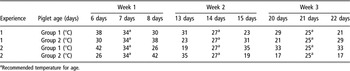
Suckling piglets were exposed to recommended IR temperature conditions at 1, 2 and 3 weeks of age, with a mild offset of 4°C above and below the recommended temperature during the first experiment and a more challenging offset of 8°C above and below the recommended temperature during the second experiment (Table 1). Recommended IR temperatures were based on the IR heat system manufacturer (Veng System, Roslev, Denmark) for conditions commonly seen in practice. Both experiments were conducted at the Pig Research unit at the Norwegian University of Life Sciences. In each experiment, eight litters with 12 to 15 healthy crossbred piglets (Duroc boars with Landrace × Yorkshire sows), born within a 24-h period, were randomly allotted to the experiment.
Temperature design for experiment 1 and experiment 2

aRecommended temperature for age.
The litters were exposed to the experimental conditions at week 1 (6, 7 and 8 days of age), week 2 (13, 14 and 15 days of age) and week 3 (20, 21 and 22 days of age). Within each weekly treatment, half of the litters (group 1) were exposed to IR temperatures 4°C or 8°C lower than recommended on the first day, recommended temperature on the second day and to IR temperatures 4°C or 8°C higher than recommended on the third day (Table 1). The other half of the litters (group 2) were exposed to IR temperatures higher than recommended on the first day, recommended temperature on the second day and lower than recommended on the third day.
Experimental procedure
During each experimental day, 10 piglets from each of the two litters were gently removed from their farrowing pen and placed in one of the two identical experimental creep boxes (Figure 1) at 0800, 1200 and 1600 h at IR temperatures according to the experimental design (Table 1). The experimental creep boxes were in a different room than the farrowing unit, and the piglets were not able to hear sow grunts, which could have affected their behaviour. After all the piglets had settled and were lying steadily (typically around 15 min), a digital photo was taken before the piglets were returned to their respective farrowing pens. At 1 week of age, the nursing pattern is normally once every hour, and this interval increases with age (e.g. Bøe, Reference Bøe1991). As the litters were away from the sow for a maximum of 15 to 20 min, time since last nursing would not likely affect the results. This procedure was then repeated for the remaining litters. The experimental piglets were individually weighed on days 7, 14 and 21 (DIGI scale, 100 g resolution; DIGI Europe, Suffolk, UK).
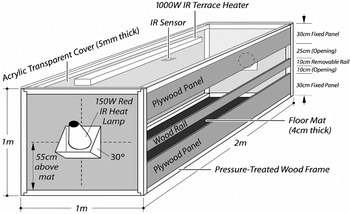
Experimental creep area.

Experimental creep box
Two creep boxes were constructed with materials and dimensions shown in Figure 1. The floor was covered with a dairy-cow mattress assembly with a black, textured rubber (5 mm thick) top layer over a 5 cm thick foam blanket (cow mattress; DeLaval, Tumba, Sweden). The floor area was determined to be more than adequate for 10 large piglets in recumbent position at 21 days of age with no space sharing (Wheeler et al., Reference Wheeler, Vasdal, Flo and Boe2008). Heat from the two 150 W heat lamps was regulated by an IR temperature controller (Model VE122S IR Controller; Veng Systems, Roslev, Denmark), using an IR temperature sensor (Model VE181-50 speed\light sensor; Veng Systems) mounted in the acrylic ceiling panel. These two 150W lamps provided all the heat during evaluation of temperatures 17°C to 25°C, but were supplemented with a larger IR heater for higher temperatures (1000 W; Infra Värmare, Stockholm, Sweden). A dry-bulb air temperature sensor (thermistor; Veng Systems) was positioned close to piglet height, 55 cm from floor, in the corner of the experimental box where it was not impacted by IR radiation. The IR temperature is higher than the air temperature because it includes the effect of the radiant heat supplied by the IR heaters, and thus it is an important factor in the effective environmental temperature experienced by the piglets. The difference between air temperature and IR temperature (ΔT) was 2°C in the lower experimental temperatures, and increased to 8°C during the highest experimental temperatures. More details on creep box construction and IR lamp operation can be found in Wheeler et al. (Reference Wheeler, Vasdal, Flo and Boe2008).
Behaviour observations
At 15 min after all the piglets were lying steadily, a digital photo was taken using a digital camera (Pentax Optio A10, Pentax Europe GmbH/Germany) mounted 1.8 m above the centre of the creep box. Each piglet was scored for lying posture and degree of huddling, using the following ethogram:
Lying posture:
1. Fully recumbent: Whole side of body in contact with floor, all legs to one side
2. Partly recumbent: More than half but not the whole the side of body in contact with floor, one or no legs under body
3. Partly sternum: Less than half the side of body in contact with the floor, legs partly under body
4. Fully sternum: All four legs under the body, with belly in contact with the floor
Huddling:
Low degree of huddling (no body contact):
1. More than 10 cm away from nearest piglet, without any body contact
2. Less than 10 cm away from nearest piglet, but without any body contact
Medium degree of huddling (body contact):
3. Body contact with one other piglet
4. Body contact with two piglets
5. Body contact with three or more piglets
High degree of huddling (on top of other piglets):
6. Less than 50% of piglet body on top of one or more piglets
7. More than 50% of piglet body but not whole body on top of one or more piglets
8. Whole piglet body on top of one or more piglets
A lying posture score (PS) and a huddling score (HS) was calculated by multiplying the number of piglets in each category with the above score for each category based on different lying postures and different degrees of huddling behaviour. A high PS represents a high degree of piglets lying sternum, and a high HS represents a high degree of huddling behaviour.

(P1, P2, P3 and P4 = value for posture category, n1 to n10 = number of piglets in a posture category. Range for score from 10 to 40).

(H1 to H8 = value for huddling category, n1 to n10 = number of piglets in the various categories. Range for score from 10 to 80).
Statistical analysis
The observations were analysed to determine the effect of IR temperature on thermoregulatory behaviour, and each experiment was analysed separately. We employed a general mixed linear model, using the Mixed procedure in SAS version 9.1 (Hatcher and Stephanski, Reference Hatcher and Stephanski1994). The model was:

where ‘score’ is the HS (continuous, range 36 to 107) or lying PS (continuous, range 11 to 40), ‘IR temp’ is effect of IR temperature (class, high, recommended or low), ‘group’ (class) is effect of starting with low or high temperature, ‘litter weight’ is effect of mean litter weight, (covariate, range 2.5 to 10.5 kg), ‘week’ is effect of week (1, 2 or 3) and ‘litter’ is effect of litter (class, 1 to 8). Finally, ‘day*week*litter*group’ is the random effect of the interaction between day (class, 1, 2 or 3), week, litter and group, and ‘e’ is the residual variation not accounted for by the model. The random effect of day*week*litter*group was included to obtain appropriately conservative tests. However, the d.f. did not change to an appropriately low number when including random effects. We thus chose to assign denominator d.f. manually to further ensure conservative tests. The following denominator d.f. were assigned for testing the fixed effects (in the order of the above model): 20, 6, 10, 20, 10 and 10.
Results
Huddling behaviour
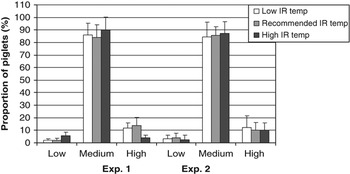
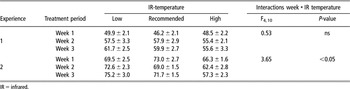
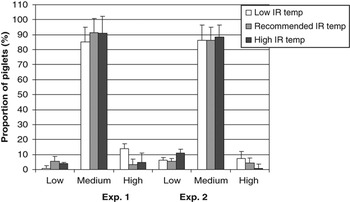
There was a significant interaction between IR temperature and week on HS in experiment 2 (F4,10 = 3.65, P < 0.05), but not in experiment 1 (Table 2). In experiment 2, HS increased in week 1 when IR temperature was decreased; however, there were no changes in HS with changes in IR temperature in experiment 1 (Table 2). Most piglets adopted a medium degree of huddling in both experiments; more than 80% of the piglets were lying in body contact with one or more piglets despite a 16°C change in IR temperature (Figure 2). Less than 10% of the piglets were lying without body contact regardless of IR temperature. The proportion of piglets with a high degree of huddling increased from 5% to 12% with decreased IR temperature in experiment 1, and from 10% to 12% in experiment 2.
Proportion of piglets (%) in different degrees of huddling during week 1.

Average huddling score in the two set of experiments (means ± s.e.)

IR = infrared.
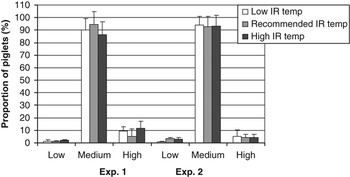
There was a further increase in HS when IR temperature was decreased in week 2 and this effect was even stronger in week 3 in experiment 2 (Table 2). HS tended to increase with decreasing temperatures in experiment 1 as well; however, the effects were not significant. Most piglets still maintained a medium degree of huddling in both experiments; over 80% of the piglets were lying in body contact with one or more piglets during all IR temperatures in week 2 and 3 (Figures 3 and 4). The proportion of piglets lying in body contact increased from 85% to 91%, and from 86% to 90% in week 2 and 3, respectively, when IR temperature was decreased (Figures 3 and 4). Less than 10% of the piglets were lying without body contact regardless of IR temperature. The proportion of piglets lying on top of other piglets (high degree of huddling) increased when IR temperature was decreased in week 2 (Figure 3), but this effect was not present in week 3 (Figure 4). Mean litter weight had no effect on HS. There was no effect of the time of day on huddling behaviour.
Proportion of piglets (%) in different degrees of huddling during week 2.

Proportion of piglets (%) in different degrees of huddling during week 3.

Lying posture
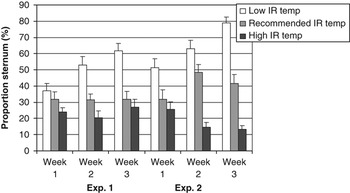
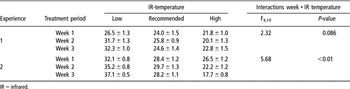
There was a significant interaction between IR temperature and week on PS in experiment 2 (F4,10 = 5.68, P < 0.01), and there was a tendency in experiment 1 (F4,10 = 2.32, P < 0.086) (Table 3). PS increased in week 1 (more piglets lying sternum) when IR temperature was decreased in both experiments. The proportion of piglets lying sternum increased from 24% to 37% when IR temperature decreased by 8°C, and increased from 25% to 52% with a 16°C decrease in IR temperature (Figure 5).
Proportion of piglets (%) lying in sternum posture in weeks 1, 2 and 3 in experiments 1 and 2.

Average posture score in the two set of experiments (means ± s.e.)

IR = infrared.
There was a further increase in PS when IR temperature was decreased in week 2 and this effect was even stronger in week 3 (Table 3). In weeks 2 and 3, the proportion of piglets lying sternum increased from 21% to 53% when IR temperature decreased by 8°C (experiment 1), and increased from 14% to 63% with a 16°C decrease in IR temperature (experiment 2) (Figure 5). In week 3, the proportion of piglets lying sternum increased from 27% to 62% when IR temperature decreased by 8°C, and increased from 13% to 79% with a 16°C decrease in IR temperature (Figure 5). Mean litter weight had a significant effect on PS in experiment 2 (F1,10 = 22.81,P < 0.001), but not in experiment 1. There was no effect of the time of day on posture behaviour.
Discussion
The environmental heat demand is dependant on radiation, conduction, convection and evaporation (Curtis, Reference Curtis1983). Hence, air temperature alone is an inadequate measure of the thermal challenge piglets are exposed to when radiant heat is supplied. The piglets responded moderately to a change in IR temperature at the age of 1 week by a significantly higher PS and an increased proportion of piglets lying fully sternum at low temperatures. This response was clearly more pronounced as the piglets got older (2 and 3 weeks of age). Hence, suckling piglets seem to use posture changes as a thermoregulatory strategy, but the ability was not so well developed at 1 week of age. Although the proportion of piglets lying recumbent increased as the piglets grew older, it was rare that all piglets in a litter were lying recumbent, even at the highest creep temperatures. This is contrary to findings in older animals where use of the recumbent posture increases with weight (Ekkel et al., Reference Ekkel, Spoolder, Hulsegge and Hopster2003).
Only small changes were seen in the huddling behaviour during the first 2 weeks after birth despite large changes in IR temperature. However, in the 3rd week there were clear changes in huddling behaviour with significantly higher HS and a higher proportion of piglets huddling when the temperature was decreased. Hence, it seems that huddling, as a thermoregulatory strategy, is used to a lesser extent than posture changes, the first 2 weeks after birth. Throughout the experiments, piglets exhibited the established positive thigmotaxic effect and showed a preference to settle near littermates. During the 1st week, the piglets were huddling together even at the warmest temperatures, which indicate a strong preference for staying close even though there was no obvious thermoregulatory need for this behaviour. A strong motivation for lying close to litter members regardless of temperature is also reported by others (Hrupka et al., Reference Hrupka, Leibbrandt, Crenshaw and Benevenga2000a and Reference Hrupka, Leibbrandt, Crenshaw and Benevenga2000b). In semi-natural conditions, the litter remains together in or near the nest for the 1st week of their life (Stangel and Jensen, Reference Stangel and Jensen1991). This may have adaptive functions; staying close together may reduce the risk of hypothermia, getting lost or being detected by predators. The possibility for the litter to spread out within the nest might be spatially limited; thus, the strategy of reduced huddling may not be functional at this age. Separation from the sow is known to cause distress in suckling piglets, often registered as vocalizations (e.g. Weary et al., Reference Weary, Appleby and Fraser1999). However, the piglets in this study were separated from the sow as a group and thus the distress was likely reduced. In addition, few vocalizations were registered during the testing period, an indicator that the piglets were not under separation distress.
Huddling behaviour was reduced in the warm temperatures during the 2nd and 3rd week. It is interesting that more than half the litter was huddling with three or more littermates at 21 days of age, at temperatures 8°C above the recommended temperature. The pig’s fat reserves and heat producing ability is thought to be well developed by this age (Herpin et al., Reference Herpin, Damon and Le Dividich2002). Increased litter weight was thought to reduce overall huddling behaviour, as others have shown a reduction in huddling behaviour with increased weight (Boon, Reference Boon1981), but huddling behaviour increased with increased litter weight in our study.
In conclusion, postural changes, rather than changes in degree of huddling were the preferred thermoregulatory strategy for suckling piglets. In the warm temperatures the piglets would lay more recumbent to increase their heat loss, but they still remained huddled close together, even at 3 weeks of age. The tendency for piglets to lie close together despite high IR temperatures has implications for practical use as the resting pattern of pigs is thought to be a reliable response to the thermal comfort; however, this might not be a correct conclusion for young piglets. With IR temperatures 8°C higher than recommended, the experimental temperature was higher than what would normally be seen in commercial farms, and given a chance, the piglets would probably avoid the creep area altogether and lie in the sow area.
Acknowledgements
This work was supported by the Norwegian Research Council. We gratefully acknowledge Arne Svendsen for his help with constructing the experimental creep areas, and Andreas Flø for his help with the temperature sensor software. We would also like to thank Dr Inger Lise Andersen for valuable comments on the manuscript, and Dr Geir Steinheim for valuable help with the statistical analyses.