





1 Introduction
Let F be a global field and
${\mathbb {A}}$
 its ring of adeles. The theory of Rankin-Selberg integrals for L-functions of
${\mathrm {GL}}_n({\mathbb {A}})\times {\mathrm {GL}}_m({\mathbb {A}})$
 , developed by Jacquet, Piatetski-Shapiro and Shalika in a series of papers (see, e.g., [Reference Jacquet, Piatetskii-Shapiro and ShalikaJPSS83, Reference Jacquet and ShalikaJS81a, Reference Jacquet and ShalikaJS81b], and the surveys by Cogdell [Reference CogdellCog04, Reference CogdellCog07]), plays an important role in the study of L-functions and automorphic representations. A key application is the proof of converse theorems, such as those for
${\mathrm {GL}}_3$
 in [Reference Jacquet, Piatetskii-Shapiro and ShalikaJPSS79a, Reference Jacquet, Piatetskii-Shapiro and ShalikaJPSS79b] and for general
${\mathrm {GL}}_n$
 in [Reference Cogdell and Piatetski-ShapiroCPS94, Reference Cogdell and Piatetski-ShapiroCPS99]. These converse theorems have become an important tool in establishing the Langlands functoriality, as illustrated, for instance, in [Reference RamakrishnanRam00, Reference Cogdell, Kim, Piatetski-Shapiro and ShahidiCKPSS01, Reference Kim and ShahidiKS02, Reference KimKim03, Reference Cogdell, Kim, Piatetski-Shapiro and ShahidiCKPSS04, Reference Cogdell, Piatetski-Shapiro and ShahidiCPSS11, Reference Cai, Friedberg and KaplanCFK24].
The first goal of this article is to construct a family of Rankin-Selberg integrals that generalizes those of Jacquet, Piatetski-Shapiro and Shalika. Concretely, we present a family of Rankin-Selberg type integrals that represent, up to a shift, the product Rankin-Selberg L-function

where
$\pi $
 is an irreducible cuspidal automorphic representation of
${\mathrm {GL}}_l({\mathbb {A}})$
 ,
$\tau _1$
 (resp.
$\tau _2$
 ) is an irreducible cuspidal representation of
${\mathrm {GL}}_m({\mathbb {A}})$
 (resp.
${\mathrm {GL}}_n({\mathbb {A}})$
 ). Here l is a positive integer and
$m,n$
 are non-negative integers with
$m+n<l$
 . If
$n=0$
 , our integrals reduce to those defined by Jacquet–Piatetski-Shapiro–Shalika (JPSS for abbreviation). In this sense, our integrals indeed generalize the JPSS Rankin-Selberg convolution integrals.
To give more details, we introduce some notation. For an integer j with
$0\le j\le l-m-n-1$
 , we set
$k=l-m-n-1-j$
 and consider the embedding
$\iota _j:{\mathrm {GL}}_{m+n}\to {\mathrm {GL}}_{l}$
 given by

for
$a\in {\mathrm {Mat}}_{m\times m}, b\in {\mathrm {Mat}}_{m\times n}, c\in {\mathrm {Mat}}_{n\times m}, d\in {\mathrm {Mat}}_{n\times n}.$
 Given an irreducible cuspidal automorphic representation
$\pi $
 (resp.
$\tau _1,\tau _2$
 ) of
${\mathrm {GL}}_l({\mathbb {A}})$
 (resp.
${\mathrm {GL}}_m({\mathbb {A}}), {\mathrm {GL}}_n({\mathbb {A}})$
 ), we consider the integral

Here
$\phi \in \pi $
 is a cusp form, and
$\phi ^{\psi }_{Y_j}$
 is a certain Fourier coefficient of
$\phi $
 along a certain subgroup
$Y_j\subset {\mathrm {GL}}_l$
 . Moreover,
$\mathbf {{s}}=(s_1,s_2)$
 is a pair of complex numbers, and
$E(h,f_{\mathbf {{s}}})$
 is the standard Eisenstein series on
${\mathrm {GL}}_{m+n}({\mathbb {A}})$
 associated with a section
$f_{\mathbf {{s}}}$
 in the representation induced from
$\tau _1||^{s_1-1/2}\otimes \tau _2||^{-s_2+1/2}$
 on the standard Levi subgroup of
${\mathrm {GL}}_{m+n}$
 with partition
$(m,n)$
 . See §2 for the unexplained notations.
Theorem 1.1. The integral
$I_j(\phi ,f_{\mathbf {{s}}})$
 satisfies the following properties.
-
(1) The integral $I_j(\phi ,f_{\mathbf {{s}}})$
 converges absolutely and uniformly in vertical strips for each variable
$s_1,s_2$
in
$\mathbf {{s}}=(s_1,s_2)$
, away from the poles of the Eisenstein series.
-
(2) For decomposable data, when ${\mathrm {Re}}(s_1+s_2)>\frac {n+m}{2}+1$
, we have an Euler product factorization $$ \begin{align*} I_j(\phi,f_{\mathbf{{s}}})= \prod_v \Psi(\rho(s_{j,m,n})W_v,\xi_{f_{\mathbf{{s}},v}};j) \end{align*} $$where $\rho (s_{j,m,n})$
is the right translation by the permutation matrix
$s_{j,m,n}$
defined in (2.2),
$W_v\in \mathcal {W}(\pi _v,\psi _v)$
is a Whittaker function,
$\xi _{f_{\mathbf {{s}},v}}\in {\mathrm {Ind}}_{P_{m,n}(F_v)}^{{\mathrm {GL}}_{m+n}(F_v)}(\mathcal {W}(\tau _{1,v},\psi _v^{-1})|\cdot |^{s_1-\frac {1}{2}}\boxtimes \mathcal {W}(\tau _{2,v},\psi _v^{-1})|\cdot |^{-s_2+1/2})$
, and the local zeta integral is given by $$ \begin{align*} & \Psi(W_v, \xi_{f_{\mathbf{{s}},v}}; j)\\ &=\int_{N_{m+n}(F_v)\backslash {\mathrm{GL}}_{m+n}(F_v)}\int_{\overline U^{j,m,n}(F_v)}W_v\left(\overline u \gamma_{m,n}\begin{pmatrix} h&\\ &I_{l-m-n} \end{pmatrix} \right)\xi_{f_{\mathbf{ {s}},v}}(h)d\overline udh,\end{align*} $$with $N_{m+n}$
the upper triangular unipotent subgroup of
${\mathrm {GL}}_{m+n}$
, and $$ \begin{align*} \overline{U}^{j,m,n}&=\left\{{ \begin{pmatrix} I_m&&&&\\ x&I_{j}&&&\\ &&1&&\\ &&&I_{k}&\\ &&&y& I_n \end{pmatrix} \in {\mathrm{GL}}_l}\right\}, \quad \gamma_{m,n} =\begin{pmatrix} I_m&&\\ &&I_{l-m-n}\\ &I_n& \end{pmatrix}. \end{align*} $$
-
(3) At a finite place v such that all data are unramified, the local zeta integral has the following expression
$$ \begin{align*} \Psi(W_v^0,\xi_{f_{\mathbf{{s}},v}}^0;j) =\frac{L(s_1+\frac{k-j}{2},\pi_v\times \tau_{1,v})L(s_2-\frac{k-j}{2},\widetilde \pi_v\times \widetilde\tau_{2,v})}{L(s_1+s_2,\tau_{1,v}\times \widetilde \tau_{2,v})} \end{align*} $$where $W_v^0,\xi _{f_{\mathbf {{s}},v}}^0$
are spherical vectors suitably normalized, and
$\widetilde \pi _v$
(resp.
$\widetilde \tau _{2,v}$
) is the contragredient representation of
$\pi _v$
(resp.
$\tau _{2,v}$
).
-
(4) Over non-archimedean local fields, there exist $W_v$
and
$\xi _{f_{\mathbf {{s}},v}}$
, such that the local zeta integral
$\Psi (W_v, \xi _{f_{\mathbf {{s}},v}}; j)$
is absolutely convergent and equals
$1$
for all
$\mathbf {{s}}$
. Over archimedean fields, for any
$\mathbf {{s}}$
, there are choices of data
$(W_v^i, \xi _{f_{\mathbf {{s}},v}}^i)$
such that a finite sum of archimedean local zeta integrals
$\sum _i \Psi (W^i_v,\xi _{f_{\mathbf {{s}},v}}^i; j)$
is holomorphic and nonzero in a neighbourhood of
$\mathbf { {s}}$
.


The four parts of Theorem 1.1 are proved in Proposition 2.2, Theorem 2.4, Proposition 3.10 and Proposition 3.5, respectively.
We highlight that our unramified calculation in part (3) of Theorem 1.1 uses the hive model of Littlewood-Richardson coefficients developed by Knutson and Tao [Reference Knutson and TaoKT99]. It generalizes the unramified calculation of JPSS integrals and is applicable to the local integrals of Tamir and Ben-Artzi–Soudry for
${\mathrm {U}}_{2r+1,E/F}\times {\mathrm {Res}}_{E/F}({\mathrm {GL}}_n)$
 in [Reference TamirTam91, Reference Ben-Artzi and SoudryBAS09] at split places.
We also prove that in the local non-archimedean case, there exists a local gamma function
$\Gamma (\mathbf { {s}},\pi _v,(\tau _{1,v},\tau _{2,v}),\psi _v;j)$
 such that

Here, M denotes an intertwining operator. See §3.2 for more details. Moreover, we show that, up to a normalizing factor, we have

Here, the gamma factors on the right side are those defined by JPSS or by Shahidi [Reference ShahidiSha81, Reference ShahidiSha84]. See Proposition 3.9 for a more precise statement.
Remark 1.2. Here are some relationships between our integrals and the previous integrals. If
$n=0$
 , our integral and gamma factors reduce to the case of the JPSS integral and gamma factors (up to certain twists). If
$l=2r+1, m=n$
 and
$j=r-m$
 , then our local zeta integral and local gamma factor are those in [Reference Ben-Artzi and SoudryBAS09] and [Reference Cheng and WangCW25] at split places. If
$l=3$
 and
$m=n=1$
 , the above integral
$I_0(\phi , f_{\mathbf {{s}}})$
 is a special case of the family of integrals considered in [Reference Bump, Furusawa and GinzburgBFG95].
As we mentioned above, one important application of the JPSS Rankin-Selberg integrals is the proof of the converse theorems given by Cogdell and Piatetski-Shapiro in [Reference Cogdell and Piatetski-ShapiroCPS94, Reference Cogdell and Piatetski-ShapiroCPS99], which roughly says that for an admissible irreducible representation
$\pi $
 of
${\mathrm {GL}}_l({\mathbb {A}})$
 for a global field F, if
$L(s,\pi \times \tau )$
 is ‘nice’ (see [Reference Cogdell and Piatetski-ShapiroCPS94, page 165] for the definition) for all irreducible cuspidal automorphic representations
$\tau $
 of
${\mathrm {GL}}_m({\mathbb {A}})$
 with
$1\le m\le l-2$
 , then
$\pi $
 is cuspidal automorphic. In applications to the functoriality problems, it is desirable to reduce the number of twists used in the converse theorem. In this direction, one important open question is the following:
Conjecture 1.3 (Jacquet’s global converse conjecture, see [Reference Cogdell and Piatetski-ShapiroCPS99, §8, Conjecture 1]).
Let F be a global field and let
$\pi =\otimes ^{\prime }_v\pi _v$
 be an irreducible admissible generic representation of
${\mathrm {GL}}_l({\mathbb {A}})$
 such that its central character is trivial on
$F^\times $
 and its L-function
$L(s,\pi )$
 is convergent in some half plane. If
$L(s,\pi \times \tau )$
 is nice for all irreducible cuspidal automorphic representations
$\tau $
 of
${\mathrm {GL}}_m({\mathbb {A}})$
 with
$1\le m\le [l/2]$
 , then
$\pi $
 is cuspidal automorphic.
Many years after the original proof given in [Reference Cogdell and Piatetski-ShapiroCPS94, Reference Cogdell and Piatetski-ShapiroCPS99], it seems very hard to use the original JPSS integral to attack the above conjecture. We expect that our new family of integrals might be useful in the above problem. In fact, using the property (1.1) of the gamma factors, the condition that
$L(s,\pi \times \tau )$
 is nice for all irreducible cuspidal automorphic representations
$\tau $
 of
${\mathrm {GL}}_m$
 with
$1\le m\le [l/2]$
 will provide us with an additional new family of equalities of integrals besides those JPSS integrals.
In this paper, we illustrate the above idea by providing a new proof of the following local counterpart of the above conjecture; hopefully, this new proof could shed some light on the global converse conjecture mentioned above.
Conjecture 1.4 (Jacquet’s local converse conjecture).
Let F be a non-archimedean local field and let
$\pi _1,\pi _2$
 be two generic representations of
${\mathrm {GL}}_l(F)$
 with the same central character. If
$\gamma (s,\pi _1\times \tau ,\psi )=\gamma (s,\pi _2\times \tau ,\psi )$
 for all irreducible generic representations
$\tau $
 of
${\mathrm {GL}}_m(F)$
 with
$1\le m\le [l/2]$
 , then
$\pi _1\cong \pi _2$
 .
As proved in [Reference Jiang, Nien and StevensJNS15], one can replace the ‘generic’ condition in the above conjecture by ‘supercuspidal’. In fact, what we prove is the following
Theorem 1.5 (Theorem 4.1).
Let F be a non-archimedean local field of characteristic different from 2 and let
$\pi _1,\pi _2$
 be two irreducible supercuspidal representations of
${\mathrm {GL}}_l(F)$
 with the same central character. If
$\Gamma (\mathbf {{s}},\pi _1\times (\tau _1,\tau _2),\psi; 0)=\Gamma (\mathbf {{s}},\pi _2\times (\tau _1,\tau _2),\psi; 0)$
 for all irreducible generic representations
$\tau _1$
 (resp.
$\tau _2$
 ) of
${\mathrm {GL}}_m(F)$
 (resp.
${\mathrm {GL}}_n(F)$
 ) with
$0\le n\le [l/2], 0\le m\le [l/2]$
 , then
$\pi _1\cong \pi _2$
 .
Local converse theorems for
${\mathrm {GL}}_l$
 using twists up to
$l-1$
 and
$l-2$
 have been proved in [Reference HenniartHen93, Reference Cogdell and Piatetski-ShapiroCPS99, Reference JPJChe06]. Jacquet’s local converse conjecture has been proved in [Reference ChaiCha19] and [Reference Jacquet and LiuJL18] independently. Our new contribution here is to use the new family of integrals. A proof of Jacquet’s local converse conjecture along this method was promised in [Reference ZhangZha18, §8.2] and in [Reference ZhangZha19, Introduction], where it was believed that the integrals of
${\mathrm {U}}_{l,E/F}\times {\mathrm {Res}}_{E/F}({\mathrm {GL}}_m)$
 at split places for a quadratic extension
$E/F$
 as developed in [Reference Ben-Artzi and SoudryBAS09] were enough. As explained above, these integrals are just our new family of integrals when
$m=n$
 . It turns out that we need to use the entire new family of integrals. The proof of Theorem 1.5 uses partial Bessel functions developed in [Reference Cogdell, Shahidi and TsaiCST17] and is indeed similar to that outlined in [Reference ZhangZha18, §8.2] and in [Reference ZhangZha19, Introduction]. Similar methods have been successfully used in proving local converse theorems of other classical groups over local fields and
$G_2$
 over finite fields; see [Reference ZhangZha18, Reference ZhangZha19, Reference Liu and ZhangLZ22a, Reference Liu and ZhangLZ22b, Reference JoJo22, Reference Hazeltine and LiuHL25, Reference Yan and ZhangYZ24]. See [Reference Liu and ZhangLZ22b] for more references on local converse problems.
Here are some differences between our proof and that given in [Reference ChaiCha19] and [Reference Jacquet and LiuJL18]. The proof of [Reference ChaiCha19] only proved the equality of two partial Bessel functions on the open Bruhat cell, which is enough in the non-archimedean local field case due to the smoothness of partial Bessel functions. However, to our understanding, this is not enough to cover the finite field case, as proved in [Reference NienNie14] because the topology of finite fields is discrete. Our proof, which can also cover the finite field case, proves the equality of two partial Bessel functions on all Bruhat cells. On the other hand, the proof given in [Reference Jacquet and LiuJL18] depends on Kirillov models for representations of
${\mathrm {GL}}_l$
 , while our proof treats
${\mathrm {GL}}_l$
 as a classical group and is thus independent of the existence of Kirillov models. Moreover, our proof provides a stronger result, Theorem 5.1, which gives a condition to detect when
$\gamma (s,\pi _1\times \tau ,\psi )=\gamma (s,\pi _2\times \tau ,\psi )$
 as
$\tau $
 runs over generic representations of
${\mathrm {GL}}_k$
 for
$1\le k\le m$
 for any
$m\le [l/2]$
 . We expect it will be useful to provide finer results on gamma factors and representations of
${\mathrm {GL}}_l$
 . For instance, for a fixed integer
$m\le [l/2]$
 , it might be helpful to classify representations of
${\mathrm {GL}}_l$
 that could be uniquely determined by their gamma factors twisted up to
${\mathrm {GL}}_m$
 .
A special case of the integral
$I_j(\phi , f_{\mathbf {{s}}})$
 constructed in this paper has been used to prove an algebraicity result for special values of a product of Rankin-Selberg L-functions in [Reference Jin and YanJY24]. As with the JPSS integrals, we expect our integrals to have more applications.
In this paper, we only considered the integrals that represent the product of Rankin-Selberg L-functions of
${\mathrm {GL}}_l\times {\mathrm {GL}}_m$
 and
${\mathrm {GL}}_l\times {\mathrm {GL}}_n$
 when
$m+n<l$
 . It is natural to ask if a similar construction is generalizable to the case when
$m+n\ge l$
 . We will address this question in future work.
The paper is organized as follows. In §2, we introduce the global integrals and discuss absolute convergence, the functional equation and the unfolding computations of the global integrals. §3 is devoted to the local theory of the integrals. We prove the existence of a local gamma factor
$\Gamma (\mathbf {{s}}, \pi , (\tau _1, \tau _2), \psi ;j)$
 , and carry out the local unramified computation for the local integrals. In §4, we restate Theorem 1.5 and prepare some necessary tools for the proof. In particular, we recall the notions of partial Bessel functions and a result from [Reference Cogdell, Shahidi and TsaiCST17]. Theorem 1.5 is proved in §5. Actually, we prove a slightly more general result (see Theorem 5.1).
2 The global integrals
2.1 Some general notation
We fix the notation that will be used throughout the paper. For a positive integer k, let
$I_k$
 be the
$k\times k$
 identity matrix. Let
$B_k=T_k N_k\subset {\mathrm {GL}}_k$
 be the standard upper triangular Borel subgroup, with
$T_k$
 the group of diagonal matrices and
$N_k$
 the upper triangular unipotent subgroup. Let
$\overline {N}_k$
 be the opposite of
$N_k$
 , i.e.,
$\overline {N}_k$
 is the lower triangular unipotent subgroup of
${\mathrm {GL}}_k$
 . For positive integers
$m,n$
 , let
${\mathrm {Mat}}_{m\times n}$
 be the set of
$m\times n$
 matrices. We consider the following subgroups of
${\mathrm {GL}}_{m+n}$
 given by

and
$P_{m,n}=M_{m,n}N_{m,n}$
 . Denote
$w_{m,n}=\begin {pmatrix} &I_m\\ I_n&\end {pmatrix}$
 .
In this section, let F be a global field and
${\mathbb {A}}$
 be its ring of adeles. Let
$\psi $
 be a fixed nontrivial additive character of
${\mathbb {A}}$
 , which is trivial on F, and we define a character on
$N_k({\mathbb {A}})$
 , still denoted by
$\psi $
 , by
$\psi (u)=\psi (\sum _{i=1}^{k-1} u_{i,i+1})$
 for
$u\in N_k({\mathbb {A}})$
 .
2.2 Eisenstein series
Notice that the modulus character of
$P_{m,n}$
 is given by

Let
$\tau _1$
 (resp.
$\tau _2$
 ) be an irreducible automorphic cuspidal representation of
${\mathrm {GL}}_{m}({\mathbb {A}})$
 (resp.
${\mathrm {GL}}_n({\mathbb {A}})$
 ), we write
${\boldsymbol \tau }=(\tau _1,\tau _2)$
 . Given a pair of complex numbers
$\mathbf { {s}}:=(s_1,s_2)$
 , we consider the normalized induced representation

Concretely, we associate with each
$u\in {\mathrm {I}}(\mathbf {{s}},{\boldsymbol \tau })$
 the function
$f_{\mathbf {{s}}}(h)=(u(h))(1), h\in {\mathrm {GL}}_{m+n}({\mathbb {A}})$
 . Thus, the space
${\mathrm {I}}(\mathbf {{s}},{\boldsymbol \tau })$
 consists of all functions
$f_{\mathbf {{s}}}: {\mathrm {GL}}_{m+n}({\mathbb {A}})\to {\mathbb {C}}$
 satisfying

where
$a\in {\mathrm {GL}}_m({\mathbb {A}}),b\in {\mathrm {GL}}_n({\mathbb {A}}), u\in N_{m,n}({\mathbb {A}}),h\in {\mathrm {GL}}_{m+n}({\mathbb {A}})$
 and, for a fixed h, the function
$(a,b)\mapsto \varphi _h(a,b)$
 is a cusp form in the space of
$\tau =\tau _1\boxtimes \tau _2$
 of the group
$M_{m,n}({\mathbb {A}})={\mathrm {GL}}_m({\mathbb {A}})\times {\mathrm {GL}}_n({\mathbb {A}})$
 .
Denote
$\widehat {\mathbf {s}}:=(s_2,s_1), 1-{\widehat {\mathbf {s}}}:=(1-s_2,1-s_1)$
 and
$\widehat {\boldsymbol {\tau }}:=(\tau _2,\tau _1)$
 . There is a standard intertwining operator

defined by the integral

By [Reference Mœglin and WaldspurgerMW95, Theorem IV.1.8], the above integral is convergent in a cone of
$\mathbf {{s}}$
 and can be extended to a meromorphic function.
Notice that
${\mathrm {I}}(1-{\widehat {\mathbf {s}}},\widehat {\boldsymbol \tau })$
 is the induced representation

which consists of all functions
$f_{1-{\widehat {\mathbf {s}}}}$
 satisfying

In the above equation,
${\mathrm {diag}}(a,b)\in M_{n,m}({\mathbb {A}}),u\in N_{n,m}({\mathbb {A}}),h\in {\mathrm {GL}}_{m+n}({\mathbb {A}}),$
 and for a fixed h, the function
$(a,b)\mapsto \varphi _h(a,b)$
 is a cusp form in the space of
$\widehat \tau :=\tau _2\otimes \tau _1$
 of the group
$M_{n,m}({\mathbb {A}}).$

Given
$f_{\mathbf {{s}}}\in {\mathrm {I}}(\mathbf {{s}},{\boldsymbol \tau })$
 , we consider the Eisenstein series

The above series converges to an analytic function of
$\mathbf {{s}}$
 in an open cone. When we assume that
$\tau _1, \tau _2$
 are unitary, the open cone can be taken as
$\left \{{(s_1,s_2)\kern1.3pt{\in}\kern1.3pt {\mathbb {C}}^2\mid {\mathrm {Re}}(s_1\kern1.3pt{+}\kern1.3pt s_2)\kern1.3pt{>}\kern1.3pt \frac {m+n}{2}\kern1.3pt{+}\kern1.3pt1}\kern-1pt\right \}$
 . Moreover, the above series
$E(h,f_{\mathbf {{s}}})$
 can be meromorphically continued to
${\mathbb {C}}^2$
 . For the above statements, see [Reference Mœglin and WaldspurgerMW95, §II.1.5, IV.1.8]. Similarly, we can also consider the Eisenstein series

for
$f_{1-{\widehat {\mathbf {s}}}}\in {\mathrm {I}}(1-{\widehat {\mathbf {s}}},\widehat {\boldsymbol {\tau }})$
 . The series
$E(h,f_{1-{\widehat {\mathbf {s}}}})$
 is again convergent in a cone and can be continued meromorphically to
${\mathbb {C}}^2.$

2.3 Global integrals
Fix a positive integer l. Let
$m,n $
 be non-negative integers such that
$l>m+n$
 . For a non-negative integer j with
$0\le j \le l-m-n-1$
 , we set
$k=l-m-n-1-j\ge 0$
 and consider the embedding


for
$a\in {\mathrm {Mat}}_{m\times m}, b\in {\mathrm {Mat}}_{m\times n}, c\in {\mathrm {Mat}}_{n\times m}, d\in {\mathrm {Mat}}_{n\times n}.$
 We also consider the permutation matrix
$s_{j,m,n}\in {\mathrm {GL}}_{l}$
 defined by

The embedding
$\iota _{j,m,n}:{\mathrm {GL}}_{m+n}\to {\mathrm {GL}}_{l}$
 can then be written as

Next, we consider the subgroup
$Y_{j,m,n}$
 of
${\mathrm {GL}}_l$
 defined by

To ease the notation, if
$m,n$
 are understood, we usually drop
$m,n$
 from the subscripts of the above notations. For example, we may write
$Y_{j,m,n}$
 as
$Y_j$
 ,
$\iota _{j,m,n}$
 as
$\iota _j$
 , and
$s_{j,m,n}$
 as
$s_j$
 . We define a character
$\psi _{j}$
 on
$Y_j(F)\backslash Y_j({\mathbb {A}})$
 by

where we write
$x_2=(x_{2,1}, \ldots , x_{2,j})^t, y_2=(y_{2,1}, \ldots , y_{2,j})$
 .
Lemma 2.1. For
$h\in {\mathrm {GL}}_{m+n}({\mathbb {A}})$
 ,
$y\in Y_{j}({\mathbb {A}})$
 , we have
-
(1) $\iota _j(h)^{-1}y\iota _j(h)\in Y_j$
, and -
(2) $\psi _j(\iota _j(h)^{-1}y\iota _j(h))=\psi _j(y).$


Proof. This follows from a simple matrix calculation.
Let
$\pi $
 be an irreducible cuspidal automorphic representation of
${\mathrm {GL}}_{l}({\mathbb {A}})$
 , and for
$\phi \in V_\pi $
 , we consider the following Fourier coefficient of
$\phi $
 along
$Y_j$
 :

This is called a Bessel coefficient of
$\phi $
 . By Lemma 2.1,
$\phi _{Y,\psi }$
 is left
${\mathrm {GL}}_{m+n}(F)$
 -invariant. Thus, for
$f_{\mathbf {{s}}}\in {\mathrm {I}}(\mathbf {{s}},{\boldsymbol \tau })$
 , we can consider the integral

Similarly, we can also consider
$I_j(\phi , M_{w_{m,n}}(f_{\mathbf {{s}}}))$
 . Here we remark that if l is odd and
$m=n$
 ,
$I_{j}(\phi , f_{\mathbf {{s}}})$
 is a Bessel period for
$(\phi , E(\cdot ,f_{\mathbf {{s}}}))$
 considered in [Reference Gan, Gross and PrasadGGP12, §13].
Proposition 2.2. The integral
$I_j(\phi ,f_{\mathbf {{s}}})$
 converges absolutely and uniformly in vertical strips in
${\mathbb {C}}$
 for each variable
$s_1,s_2$
 in
$\mathbf {{s}}=(s_1,s_2)$
 , away from the poles of the Eisenstein series. Moreover, away from the poles of
$E(h,f_{\mathbf { {s}}})$
 and
$E(h,M_{w_{m,n}}(f_{\mathbf {{s}}}))$
 , we have

Proof. The second statement follows from the functional equation of the Eisenstein series; see [Reference Mœglin and WaldspurgerMW95, Theorem IV.1.10]. For the first statement, it is sufficient to show that
$\phi _{Y_j,\psi _j}$
 is rapidly decreasing. The proof is similar to other situations that have appeared elsewhere; see [Reference Ben-Artzi and SoudryBAS09, Lemma 2.1] for one example. We provide some details below, following the same argument as in [Reference Ben-Artzi and SoudryBAS09, Lemma 2.1].
Let
$\Omega $
 be a compact subset of
$B_{m+n}({\mathbb {A}})$
 . Let c be a real number with
$0<c<1$
 , and we define a set
$A_c$
 as follows. We consider the embedding
$\mathbb {R}_{>0}\hookrightarrow {\mathbb {A}}^\times $
 given by
$t\mapsto (t_v)_v$
 , where
$t_v=t$
 if v is an archimedean place, and
$t_v=1$
 if v is a non-archimedean place. Denote the image of this embedding by
$\mathbb {R}_{+, \Delta }$
 . Then
$A_c$
 is the set of all
${\mathrm {diag}}(t_1, \dots , t_{m+n})$
 , such that
$t_i\in \mathbb {R}_{+, \Delta }$
 and
$t_1\ge ct_2\ge c^2t_3\ge \dots \ge c^{m+n-1}t_{m+n}$
 . Then
$\mathcal {S}=\Omega A_c K_{{\mathrm {GL}}_{m+n}({\mathbb {A}})}$
 is a Siegel domain for
${\mathrm {GL}}_{m+n}({\mathbb {A}})$
 . Similarly, let
$\mathcal {S}^\prime =\Omega ^\prime A_c^\prime K_{{\mathrm {GL}}_{l}({\mathbb {A}})}$
 be a Siegel domain for
${\mathrm {GL}}_{l}({\mathbb {A}})$
 , where
$\iota _{j}(\Omega )\subset \Omega ^\prime $
 is a compact subset of
$B_{l}({\mathbb {A}})$
 and
$A^\prime _c$
 is defined similarly. We take c small enough and
$\Omega , \Omega ^\prime $
 large enough so that
${\mathrm {GL}}_{l}({\mathbb {A}})={\mathrm {GL}}_{l}(F)\mathcal {S}^\prime $
 and
${\mathrm {GL}}_{m+n}({\mathbb {A}})={\mathrm {GL}}_{m+n}(F)\mathcal {S}$
 . Now, let
$h=\omega a k\in \mathcal {S}$
 , where
$\omega \in \Omega $
 ,
$a= {\mathrm {diag}}(t_1, \dots , t_{m+n}) \in A_c$
 and
$k\in K_{{\mathrm {GL}}_{m+n}({\mathbb {A}})}$
 . Associated with a, we define

Then
$b\iota _j(a)\in A_c^\prime $
 . Let
$\Omega _b^\prime =\Omega ^\prime \cup \Omega ^\prime \cdot b^{-1}$
 . For fixed
$a\in A_c$
 ,
$\Omega _b^\prime $
 is a compact subset of
$B_{l}({\mathbb {A}})$
 which contains
$\Omega ^\prime $
 . Let
$\mathcal {S}^\prime _b=\Omega ^\prime _b A_c^\prime K_{{\mathrm {GL}}_{l}({\mathbb {A}})}$
 . This is a Siegel domain for
${\mathrm {GL}}_{l}({\mathbb {A}})$
 , which contains
$\mathcal {S}^\prime $
 . Thus,
$\iota _j( h)=(\iota _j(\omega ) b^{-1}) (b \iota _j(a)) \iota _j(k)\in \mathcal {S}_b^\prime $
 . We fix a compact subset
$Y_{j,0}\subset Y_j({\mathbb {A}})$
 such that
$Y_j({\mathbb {A}})=Y_j(F)Y_{j,0}$
 . We may assume that
$Y_{j,0}\subset \Omega ^\prime $
 . Then we have

Let
$N>0$
 be given. Since
$\phi $
 is rapidly decreasing in
$\mathcal {S}^\prime $
 , there exists a constant
$c_0$
 such that for all
$\omega ^\prime \in \Omega ^\prime $
 ,
$a^\prime \in A_c^\prime $
 and
$k^\prime \in K_{{\mathrm {GL}}_{l}({\mathbb {A}})}$
 , we have

Here,
$\|\cdot \|$
 is the norm on
${\mathrm {GL}}_{l}({\mathbb {A}})$
 defined by

where
$g\in {\mathrm {GL}}_l({\mathbb {A}})$
 , v runs over all places of F and
$\| g_v\|_v$
 is the local norm on
${\mathrm {GL}}_l(F_v)$
 defined by

When passing from the Siegel domain
$\mathcal {S}^\prime $
 to the Siegel domain
$\mathcal {S}^\prime _b$
 , the constant
$c_0$
 in (2.6) can be replaced by
$c_0 \|b^{-1}\|^{N_0}=c_0 \|b\|^{N_0}$
 , for some positive number
$N_0$
 , which does not depend on b (see [Reference Mœglin and WaldspurgerMW95, Sec. I.2.10, I.2.11]). Thus, in the integrand in (2.5), we have

Notice that

and

We conclude that

where
$c_1$
 is a positive constant depending on c and
$c_0$
 . Since
$Y_{j,0}$
 is compact, we combine (2.6) and (2.7) to conclude that
$\phi _{Y_j, \psi _j}$
 is rapidly decreasing in
$\mathcal {S}$
 . This completes the proof.
2.4 Unfolding of the global integral
$I_j(\phi ,f_{\mathbf {{s}}})$

For integers
$m,n\ge 0$
 , denote

For a cusp form
$\phi $
 on
${\mathrm {GL}}_{m+n+1}(F)\backslash {\mathrm {GL}}_{m+n+1}({\mathbb {A}})$
 , we define its constant term along
$Z_{m,n}$
 by

We have the following expansion of
$\phi _{Z_{m,n}}$
 .
Lemma 2.3. For
$\phi \in {\mathcal {A}}_0({\mathrm {GL}}_{m+n+1})$
 , the space of cusp forms on
${\mathrm {GL}}_{m+n+1}(F)\backslash $
 ${\mathrm {GL}}_{m+n+1}({\mathbb {A}})$
 , we have

with absolute and uniform convergence on compact subsets of
$g.$
 Here
$W_\phi ^{\psi }$
 is the
$\psi $
 -Whittaker function of
$\phi $
 defined by

Note that when
$n=0$
 , the above expansion is just the usual Fourier expansion of cusp forms, due to Piatetski-Shapiro [Reference Piatetskii-ShapiroPS71] and Shalika [Reference ShalikaSha74]. On the other hand, the above version of the expansion is an easy consequence of the results of Piatetski-Shapiro and Shalika. We give a sketch of the proof below.
Proof. Let

be the usual mirabolic subgroup of
${\mathrm {GL}}_{m+1}$
 . We consider the function
$\phi _1=\phi _1^g$
 on
$Q_m(F)\backslash Q_m({\mathbb {A}})$
 defined by

Then
$\phi _1$
 is a cuspidal automorphic form on
$ Q_m(F)\backslash Q_m({\mathbb {A}})$
 in the sense that for any parabolic subgroup
$P=MU$
 of
$Q_m$
 with unipotent radical U, we have

This can be checked easily using cuspidality of
$\phi $
 ; see [Reference CogdellCog07, Lemma 2.2] for a similar situation. Thus by the Fourier expansion for
$\phi _1$
 , see [Reference Piatetskii-ShapiroPS71, Reference ShalikaSha74], we get that

with absolute and uniform convergence, where
$W_{\phi _1}^\psi $
 is the standard
$\psi $
 -Whittaker function of
$\phi _1$
 . Plugging in the definitions, we get that

where
$u=(u_{ij})\in N_{m}({\mathbb {A}})$
 ,
$\psi ^{-1}(u)=\psi ^{-1}(\sum _i u_{i,i+1})$
 and
$x_m$
 is the last component of x. Similarly, we consider the mirabolic subgroup
$Q_n'$
 of
${\mathrm {GL}}_{n+1}$
 of the form

For fixed
$\gamma _1$
 and g, we consider the function
$\phi _2$
 on
$Q_n'(F)\backslash Q_n'({\mathbb {A}})$
 defined by

Again,
$\phi _2$
 is a cusp form on
$Q_n'(F)\backslash Q_n'({\mathbb {A}})$
 . By a slightly variant form of the Fourier expansion, see, for example, [Reference Cogdell and Piatetski-ShapiroCPS99, §1], Proposition, we have

The above series is also absolutely convergent. Note that

where
$y_1$
 in the first integral is the first component of y. The result follows.
Theorem 2.4. The integral
$I_j(\phi ,f_{\mathbf {{s}}})$
 is Eulerian. More precisely, when
$\mathbf {{s}}$
 is in the cone of absolute convergence of the Eisenstein series (2.1), we have

where

Proof. For notational convenience, we set
$[G]:=G(F)\backslash G({\mathbb {A}})$
 for an algebraic group G over F. In what follows, we assume that
$\mathbf {{s}}$
 is in the cone of absolute convergence, so that the Eisenstein series
$I(h,f_{\mathbf {{s}}})$
 is given by the convergent sum (2.1). By plugging (2.1) into the definition of
$I_j(\phi , f_{\mathbf {{s}}})$
 (see (2.4)), we get

where

By the definition of
$\phi _{Y_j,\psi _j}$
 , together with the left
${\mathrm {GL}}_{l}(F)$
 invariance of
$\phi $
 , we get

Write

then we have

where
$v_1\in N_{j}({\mathbb {A}}),v_2\in N_{k}({\mathbb {A}}), (x_1,x_2,x_3)\in {\mathrm {Mat}}_{j\times (m+n+1)}({\mathbb {A}}), z\in {\mathrm {Mat}}_{j\times k}({\mathbb {A}}), y_3\in {\mathrm {Mat}}_{m\times k}({\mathbb {A}}), y_2\in {\mathrm {Mat}}_{1\times k}({\mathbb {A}}), y_1\in {\mathrm {Mat}}_{n\times k}({\mathbb {A}})$
 and
$t\in {\mathrm {Mat}}_{m\times n}({\mathbb {A}})$
 . Then (2.11) becomes

Write

The right side integral of (2.12) contains the following inner integral

which is

by Lemma 2.3. Plugging (2.13) into (2.12), we get

To simplify the above integral (2.14), we consider its inner integral with respect to
$x_2=[x^1,\dots , x^j]^t\in {\mathrm {Mat}}_{j\times 1}({\mathbb {A}})$
 first, which is

Write
$\gamma _1=(\gamma _{pq})_{1\le p,q\le m+j}$
 , then we have

After conjugation, we get

with

Thus the inner integral of (2.14) with respect to
$x_2$
 is

The above integral over
$x^1,\dots ,x^j$
 is
$1$
 if
$\gamma _{m+j,m+1}=\dots =\gamma _{m+j,m+j-1}=0$
 and
${\gamma _{m+j,m+j}=1}$
 , and is zero otherwise. Note that if
$\gamma _{m+j,m+1}=\dots =\gamma _{m+j,m+j-1}=0$
 , as an element of the coset
$N_{m+j}(F)\backslash {\mathrm {GL}}_{m+j}(F)$
 , we can write

with
$\gamma _1'\in N_{m+j-1}(F)\backslash {\mathrm {GL}}_{m+j-1}(F), \xi \in {\mathrm {Mat}}_{1\times m}(F).$
 By changing the summation notation, integral (2.14) becomes

Here
$y^1$
 is the first component of the element
$y_2\in {\mathrm {Mat}}_{1\times k}({\mathbb {A}}).$
 In other words,
$y_2=[y^1,\dots ,y^k]\in {\mathrm {Mat}}_{1\times k}({\mathbb {A}}).$
 In (2.15), the summation over
$\xi $
 could be absorbed into the integral over the last row of
$x_1$
 . Thus, we get

where we wrote
$x_1=\begin {pmatrix} x_1'\\ (x_{j1},\dots , x_{jm}) \end {pmatrix}$
 ,
$v_1=\begin {pmatrix} v_1'& p \\ &1 \end {pmatrix}$
 with
$p\in {\mathrm {Mat}}_{(j-1)\times 1}({\mathbb {A}})$
 and
$*$
 in
$(F\backslash {\mathbb {A}})^*$
 denotes the number of variables other than the part in
$(x_{j1},\dots ,x_{jm})$
 . We next compute the inner integral over the p-part, which is similar to that above. Note that
$\psi (v_1)=\psi (v_1')\psi (p^{j-1})$
 , where
$p=(p^1,\dots ,p^{j-1})^t$
 . For
$\gamma _1=(\gamma _{ab})_{1\le a,b\le m+j-1}\in {\mathrm {GL}}_{m+j-1}(F)$
 , and
$p=(p^1,\dots ,p^{j-1})^t$
 we have

Thus the inner integral over p in (2.16) is

for certain appropriate g which should be self-evident from the context. The above integral is 1 if
$\gamma _{m+j-1,m+1}=\dots =\gamma _{m+j-1,m+j-2}=0$
 and
$\gamma _{m+j-1,m+j-1}=1$
 , and is zero otherwise. In this case, we can write that

as an element in the coset
$N_{m+j-1}(F)\backslash {\mathrm {GL}}_{m+j-1}(F)$
 , where
$\gamma _1'\in N_{m+j-2}(F)\backslash $
 ${\mathrm {GL}}_{m+j-2}(F), \xi \in F^m$
 . Similarly as above, by absorbing the summation over
$\xi $
 , we get that

where
$v_1'=\begin {pmatrix} v_1"&p'\\ &1 \end {pmatrix}$
 . An inductive argument shows that

The integral over
$y_1,y_2,v_2$
 can be done similarly and we have

We now plug the above formula into (2.10) to get

In order to justify this step, we need to show that the double integral in the second line of (2.17) converges absolutely. This will be done in Subsection 2.6. From (2.17), we obtain

The result follows.
Remark 2.5. Denote

Then (2.9) can be rewritten as

2.5 Unfolding of
$I_j(\phi ,M_{w_{m,n}}(f_{\mathbf {{s}}}))$

Theorem 2.6. The integral
$I_j(\phi ,M_{w_{m,n}}(f_{\mathbf {{s}}}))$
 is Eulerian. More precisely, in the region of absolute convergence of the Eisenstein series
$ E(h, M_{w_{m,n}}(f_{\mathbf {{s}}}))$
 , we have

where

The proof is similar to the proof of Theorem 2.4. We give some details for completeness.
Proof. In the following, we assume that
$m\ge n$
 . If
$n\le m$
 , the matrix calculation performed below is a little bit different, but other parts of the proof go through, and the result is the same. Note that
$\widetilde f_{\mathbf {{s}}}\in {\mathrm {I}}(1-{\widehat {\mathbf {s}}}, \widehat {\boldsymbol \tau })$
 is left invariant under
$N_{n,m}({\mathbb {A}})$
 . When the Eisenstein series
$E(h, \widetilde f_{\mathbf {{s}}}) $
 is absolutely convergent, we can replace it by its infinite series definition to obtain

where

Since
$\phi $
 is left
${\mathrm {GL}}_{l}(F)$
 -invariant, we have

Write

with
$v_1\in N_{j}({\mathbb {A}}), v_2\in N_{k}({\mathbb {A}})$
 and other variables in appropriate matrices spaces. A matrix calculation shows that

Thus we get

Denote

Then inside the integral
$ \phi _{Y_j,\psi _j,N_{n,m}}(h)$
 , there is an inner integral

which, by Lemma 2.3, is

Thus we get

where
$y_1=\begin {pmatrix} y_3' \\ y_1' \end {pmatrix} \in [{\mathrm {Mat}}_{m\times k}],$
 and
$h=\begin {pmatrix} h&\\ &I_{l-m-n} \end {pmatrix}$
 . Note that the above formula is similar to (2.14). By the same method as in the proof of Theorem 2.4, we get that

Plugging the above equation into (2.19), we get that

The result follows.
2.6 Convergence and justifications
In this subsection, we prove the convergence of the double integral in (2.17), for
${\mathrm {Re}}(s_1)\gg 0, {\mathrm {Re}}(s_2)\gg 0$
 . This is standard and similar to many other situations like [Reference Ben-Artzi and SoudryBAS09]. In the following, we will only consider the number field case since the proof in the function field case is easier. Using the Iwasawa decomposition and the fact that
$(N_m(F)\times N_n(F))\backslash (N_m({\mathbb {A}})\times N_n({\mathbb {A}}))$
 is compact, the convergence of the double integral in (2.17), for
${\mathrm {Re}}(s_1)\gg 0, {\mathrm {Re}}(s_2)\gg 0$
 , quickly reduces to the convergence of

where
$t={\mathrm {diag}}(a, b)$
 with
$a\in T_m({\mathbb {A}}), b\in T_n({\mathbb {A}})$
 and
$\mathbf {{t}}_{m,n}(a,b)=\eta _j \iota _j( t) \eta _j^{-1}={\mathrm {diag}}(a,I_{l-m-n},b)$
 . Here,
$N_0$
 ,
$c_1$
 and
$c_2$
 are fixed given positive numbers. Note that the integration over
$K_{{\mathrm {GL}}_l({\mathbb {A}})}$
 is dropped, using reasoning similar to that in [Reference Ben-Artzi and SoudryBAS09, Remark 4.7] (in conjunction with Lemma 2.8 and (2.26)). We may assume that the Whittaker function
$W_\phi ^\psi $
 decomposes as
$\prod _{v}W_v$
 , where
$W_v$
 is a local
$\psi _v$
 -Whittaker function of
$\pi _v$
 , such that outside of a finite set S of places (including the archimedean ones),
$\pi _v$
 is unramified, and
$W_v=W_v^0$
 is the normalized unramified
$\psi _v$
 -Whittaker function of
$\pi _v$
 whose value at the identity is equal to 1. At a place
$v\in S$
 , we assume that
$W_v(I_{l})=1$
 . We assume that for v outside of S,
$\psi _v$
 is unramified. It suffices to prove, for
${\mathrm {Re}}(s_1)\gg 0, {\mathrm {Re}}(s_2)\gg 0$
 , that we have

Lemma 2.7. Let v be a finite place of F. For fixed
$W_v\in {\mathcal {W}}(\pi _v,\psi _v)$
 , and
$t={\mathrm {diag}}(a,b)$
 with
$a\in T_m(F_v), b\in T_n(F_v)$
 , the function

has compact support in
$\overline U^{j,m,n}(F_v)$
 , which is independent of t. If
$W_v=W_v^0$
 , then this support is in
$\overline U^{j,m,n}({\mathcal {O}}_v)$
 .
Proof. The proof is a standard ‘root killing’ argument, and it is similar to the proof of [Reference Ben-Artzi and SoudryBAS09, Lemma 4.1]. We omit the details.
Suppose v is finite. By Lemma 2.7, to prove that the local integral of (2.20) at the place v converges, it suffices to show

for
${\mathrm {Re}}(s_i)\gg 0$
 . Now we recall gauge estimates on Whittaker functions in [Reference Jacquet, Piatetskii-Shapiro and ShalikaJPSS79a, Section 2]. A gauge on
${\mathrm {GL}}_l(F_v)$
 is a function
$\xi $
 on
${\mathrm {GL}}_l(F_v)$
 which is invariant on the left under
$N_l(F_v)$
 , on the right under
${\mathrm {GL}}_l({\mathcal {O}}_v)$
 , and which on
$T_l(F_v)$
 has the form

for

where
$c\ge 0$
 is a real number and
$\Phi \ge 0$
 is a Schwartz-Bruhat function on
$F_v^{l-1}$
 . In particular,
$\xi $
 is invariant under the centre of
${\mathrm {GL}}_l(F_v)$
 . Write
$a\in T_m(F_v)$
 and
$b\in T_n(F_v)$
 as

with
$a_i\in F_v^\times , b_j\in F_v^\times $
 . Then

and

Then for a gauge
$\xi $
 on
${\mathrm {GL}}_l(F_v)$
 , it follows from (2.22) that there is some real number
$c\ge 0$
 and a Schwartz-Bruhat function
$\Phi $
 on
$F_v^{l-1}$
 such that

Write
$|\omega _\pi |_v=\alpha ^{c_0}$
 , where
$\alpha $
 is a non-negative real-valued function on
$F_v^\times $
 and
$c_0$
 is a real number. By [Reference Jacquet, Piatetskii-Shapiro and ShalikaJPSS79a, Proposition 2.3.6], for any Whittaker function
$W_v\in \mathcal {W}(\pi _v,\psi _v)$
 , there is a gauge
$\xi $
 such that

Then (2.21) follows from (2.24) and the estimate (2.25). This proves that the local integral from (2.20) over a finite place v is convergent.
Now we turn to the archimedean places. Let v be an archimedean place, so
$F_v$
 is either
$\mathbb {R}$
 or
$\mathbb {C}$
 . We recall the notion of gauge [Reference Jacquet and ShalikaJS90] in this setting, which is slightly different from the non-archimedean case. Let
$\chi $
 be a sum of positive characters of
$T_l(F_v)$
 trivial on the centre of
${\mathrm {GL}}_l(F_v)$
 . A homogeneous gauge on
${\mathrm {GL}}_l(F_v)$
 is a function
$\xi $
 on
${\mathrm {GL}}_l(F_v)$
 of the form

where
$n\in N_l(F_v)$
 ,
$t={\mathrm {diag}}(t_1, \ldots , t_l)\in T_l(F_v)$
 , k is in the maximal compact subgroup
$K_l$
 of
${\mathrm {GL}}_l(F_v)$
 and
$\Phi>0$
 is a rapidly decreasing function in
$l-1$
 variables. Here,
$\Phi $
 being rapidly decreasing means that, for every set of integers
$N_i$
 ,
$1\le i \le l-1$
 , there is a constant
$C>0$
 such that

We have the following estimate.
Lemma 2.8. Let v be an archimedean place. Let
$\xi $
 be a homogeneous gauge on
${\mathrm {GL}}_l(F_v)$
 . Let
$a\in T_m(F_v)$
 and
$b\in T_n(F_v)$
 , with Iwasawa decompositions

where
$t_1, \ldots , t_{m}, t_{l-n+1}, \ldots , t_l$
 are positive real numbers. Set
$t_{m+1}=t_{m+2}=\cdots =t_{l-n}=1$
 . Given positive integers
$M_1, \ldots , M_j, N_1, \ldots , N_n$
 ,
$L_1, \ldots , L_{l-1}$
 , there exists a positive constant
$C>0$
 such that

Here,
$\chi $
 is a fixed sum of positive characters of
$T_l(F_v)$
 .
Proof. The proof is similar to that of [Reference Jacquet and ShalikaJS90, Lemma 5.2]. See also [Reference Ben-Artzi and SoudryBAS09, Lemma 4.6]. We omit the details.
By [Reference Jacquet and ShalikaJS90, Proposition 2.1], for any Whittaker function
$W_v\in \mathcal {W}(\pi _v, \psi _v)$
 , there is a gauge
$\xi $
 on
${\mathrm {GL}}_l(F_v)$
 such that

Combining (2.26) with Lemma 2.8, we conclude that the archimedean part of the product in (2.20) is convergent.
Now we are ready to prove (2.20). By Lemma 2.7 and due to the convergence of the local integral at each local place, it suffices to prove

Write
$a, b$
 as in (2.23). Similar to [Reference Ben-Artzi and SoudryBAS09, Lemma 4.3], in order for the function

to be non-zero, we must have
$a_1, \ldots , a_m, b_1, \ldots , b_n\in \mathcal {O}_{v}$
 . Thus,

where
$\Phi ^0$
 is the characteristic function of
$\mathcal {O}_{v}^{m+n}$
 . On the other hand, since
$W_\phi ^\psi =\prod _{v\in S} W_v \cdot \prod _{v\not \in S} W_v^0$
 is the Whittaker function of a cusp form
$\phi $
 , there are constants
$B_0, C_0>0$
 , such that, for all
$h\in {\mathrm {GL}}_l({\mathbb {A}})$
 ,

By [Reference Mœglin and WaldspurgerMW95, §1.2.2 (ii)], there is a constant
$C_1$
 (which depends on
$C_0$
 ), such that, for
$t={\mathrm {diag}}(a,b)\in \prod _{v\not \in S} T_{m+n}({\mathbb {A}}^S)$
 with
$a, b$
 as in (2.23), we have

Thus, the product of local integrals over
$v\not \in S$
 in (2.27) is bounded by

This product converges for
${\mathrm {Re}}(s_1)\gg 0, {\mathrm {Re}}(s_2)\gg 0$
 as desired (see, for example, [Reference Ben-Artzi and SoudryBAS09, Lemma 4.5]). This finishes the proof of (2.27), and hence the convergence of the double integral in (2.17), for
${\mathrm {Re}}(s_1)\gg 0, {\mathrm {Re}}(s_2)\gg 0$
 .
3 The local integrals
In this section, let F be a local field. Let
$\psi $
 be a nontrivial additive character of F. We still fix a positive integer l and non-negative integers
$m,n$
 such that
$m+n\le l-1$
 . For
$0\le j\le l-m-n-1$
 , we set
$k=l-m-n-1-j$
 .
3.1 Definition of the local zeta integrals
Let
$\pi $
 be an irreducible generic representation of
${\mathrm {GL}}_l(F)$
 and let
${\mathcal {W}}(\pi ,\psi )$
 be its Whittaker model. Let
$(\tau _1,V_{\tau _1})$
 (resp.
$(\tau _2,V_{\tau _2})$
 ) be an irreducible generic representation of
${\mathrm {GL}}_m(F)$
 (resp.
${\mathrm {GL}}_n(F)$
 ). As in the last section, we write
${\boldsymbol \tau }=(\tau _1,\tau _2)$
 and
$\widehat {\boldsymbol \tau }=(\tau _2,\tau _1)$
 . Let
$\mathbf {{s}}=(s_1,s_2)\in {\mathbb {C}}^2$
 be a pair of complex numbers. Then we can consider the induced representation

We fix
$\psi ^{-1}$
 -Whittaker functionals
$\lambda _{i}$
 of
$\tau _{i}$
 . Recall that a section
$f_{\mathbf {{s}}}\in {\mathrm {I}}(\mathbf { {s}},{\boldsymbol \tau })$
 is a function
$f_{\mathbf {{s}}}: {\mathrm {GL}}_{m+n}(F)\to V_{\tau _1}\boxtimes V_{\tau _2}$
 satisfying certain quasi-invariance properties. We consider the
${\mathbb {C}}$
 -valued function

defined by

Set
${\mathcal {W}}(\mathbf {{s}},{\boldsymbol \tau },\psi ^{-1})=\left \{{\xi _{f_{\mathbf {{s}}}}: f_{\mathbf {{s}}}\in {\mathrm {I}}(\mathbf { {s}},{\boldsymbol \tau })}\right \}$
 . Note that an element
$\xi _{\mathbf {{s}}}$
 satisfies

for
$a_1,b_1\in {\mathrm {GL}}_m(F), a_2,b_2\in {\mathrm {GL}}_n(F), u\in N_{m,n}(F), h\in {\mathrm {GL}}_{m+n}(F)$
 . In particular

for
$ u_1\in N_m(F), u_2\in N_n(F), u\in N_{m,n}(F), h\in {\mathrm {GL}}_{m+n}(F).$
 We usually write
$\xi _{\mathbf {{s}}}(h,I_m,I_n)$
 as
$\xi _{\mathbf {{s}}}(h)$
 for simplicity.
Similarly, we can consider the space
${\mathcal {W}}(1-{\widehat {\mathbf {s}}}, \widehat {\boldsymbol \tau },\psi ^{-1})=\left \{{\xi _{f_{1-{\widehat {\mathbf {s}}}}}: f_{1-{\widehat {\mathbf {s}}}}\in {\mathrm {I}}(1-{\widehat {\mathbf {s}}},\widehat {\boldsymbol {\tau }})}\right \}$
 . Let
$M_{w_{m,n}}: {\mathrm {I}}(\mathbf {{s}},{\boldsymbol \tau })\to {\mathrm {I}}(1-{\widehat {\mathbf {s}}},\widehat {\boldsymbol \tau })$
 be the standard intertwining operator defined by

This integral converges in a cone of
$\mathbf {{s}}$
 and can be extended meromorphically to
${\mathbb {C}}^2$
 ; see [Reference Mœglin and WaldspurgerMW95]. Moreover, to obtain an element in
$I(1-{\widehat {\mathbf {s}}}, \widehat {\boldsymbol \tau })$
 , we need to identify
$\tau _1\boxtimes \tau _2$
 with
$\tau _2\boxtimes \tau _1$
 in the definition of
$M_{w_{m,n}}$
 . Equivalently, we need to compose the above integral with the map
$\tau _1\boxtimes \tau _2\to \tau _2\boxtimes \tau _1$
 defined by
$v_1\boxtimes v_2\to v_2\boxtimes v_1$
 , for
$v_1\in \tau _1, v_2\in \tau _2$
 . We adopt the convention that omits the above identification from the notation. The above intertwining operator gives a map

defined by

For
$W\in {\mathcal {W}}(\pi ,\psi )$
 ,
$\xi _{\mathbf {{s}}}\in {\mathcal {W}}(\mathbf {{s}},{\boldsymbol \tau },\psi ^{-1})$
 , and for j with
$0\le j\le l-m-n-1$
 , we consider the local zeta integrals

where we recall that

Here we remark that the natural numbers
$m,n$
 appearing in the local zeta integral (3.1) are determined by the section
$\xi _{\mathbf {{s}}}$
 , which is an element of
${\mathrm {Ind}}_{P_{m,n}(F)}^{{\mathrm {GL}}_{m+n}(F)}(\tau _1||^{s_1-1/2}\otimes \tau _2||^{-s_2+1/2})$
 . In particular, if we take
$\widetilde \xi _{1-{\widehat {\mathbf {s}}}}\in {\mathcal {W}}(1-{\widehat {\mathbf {s}}},\widehat {\boldsymbol \tau },\psi ^{-1})$
 , we should have

Remark 3.1. In this remark, we assume that F is a global field. If
$\phi =\otimes \phi _v$
 is a cusp form on
${\mathrm {GL}}_l({\mathbb {A}})$
 and
$f_{\mathbf {{s}}}=\otimes f_{\mathbf {{s}},v}\in {\mathrm {I}}(\mathbf {{s}},{\boldsymbol \tau })$
 is a pure tensor of a global section, then Theorem 2.4 and Theorem 2.6 imply that

Here
$\rho $
 denotes the right translation.
Remark 3.2. In this remark, we consider the degenerate case when
$m>0$
 and
$n=0$
 . In this case,
${\boldsymbol \tau }=\tau _1$
 is just a representation of
${\mathrm {GL}}_m(F)$
 , and
$\mathbf {{s}}=s$
 is a single complex number. Moreover, an element
$\xi _{\mathbf {{s}}}$
 has the form
$\xi _{\mathbf {{s}}}(h)=W'(h)|\det (h)|^{s-1/2}$
 and we have
$M_{w_{m,0}}(\xi _{\mathbf {{s}}})=\xi _{\mathbf {{s}}}.$
 Thus

and

Here we notice that
$\gamma _{m,0}=I_l$
 while
$\gamma _{0,m}=\begin {pmatrix} &I_{l-m} \\ I_m & \end {pmatrix}.$
 A simple change of variable shows that

One can compare the above integral with that defined by Jacquet–Piatetski-Shapiro–Shalika in [Reference Jacquet, Piatetskii-Shapiro and ShalikaJPSS83] and observe that

where
$\Psi ^{\mathrm {JPSS}}$
 denotes the integral defined in [Reference Jacquet, Piatetskii-Shapiro and ShalikaJPSS83, p.387]. On the other hand, for
$W\in {\mathcal {W}}(\pi ,\psi )$
 , we denote
$\widetilde W(g)=W(J_l {}^t\!g^{-1})$
 , which represents a Whittaker function of the contragredient representation
$\widetilde \pi $
 of
$\pi $
 . It is easy to check that

Thus we get

Remark 3.3. Similarly, in the degenerate case where
$m=0$
 and
$n>0$
 ,
${\boldsymbol \tau }=\tau _2$
 is just a representation of
${\mathrm {GL}}_n(F)$
 ,
$\mathbf {{s}}=s$
 is a single complex number and an element
$\xi _{\mathbf {{s}}}\in {\mathcal {W}}(\mathbf {{s}},{\boldsymbol \tau },\psi ^{-1})$
 has the form
$\xi _{\mathbf {{s}}}(h)=W^{\prime \prime }(h)|\det (h)|^{-s+1/2}$
 where
$W^{\prime \prime }\in \mathcal {W}(\tau _2,\psi ^{-1})$
 . In this case, we have

and

Remark 3.4. If
$l=2r+1$
 and
$m=n$
 with
$1\le m\le r$
 , then the integral
$\Psi (W,\xi _{\mathbf {{s}}};r-m)$
 is the local zeta integral of
${\mathrm {U}}_{E/F}(2r+1)\times {\mathrm {Res}}_{E/F}({\mathrm {GL}}_m)$
 at split places as in [Reference Ben-Artzi and SoudryBAS09], where
$E/F$
 is a quadratic extension of global fields.
Proposition 3.5. The local zeta integrals
$\Psi (W,\xi _{\mathbf {{s}}}; j)$
 are absolutely convergent for
${\mathrm {Re}}(s_i)\gg 0$
 for
$i=1,2$
 . Over non-archimedean local fields, there exist W and
$\xi _{\mathbf {{s}}}$
 , such that the integral is absolutely convergent and equals 1, for all
$\mathbf {{s}}$
 . Over archimedean fields, for any
$\mathbf {{s}}$
 , there are choices of data
$(W^i, \xi _{\mathbf {{s}}}^i)$
 such that
$\sum _i \Psi (W^i,\xi _{\mathbf {{s}}}^i; j)$
 is holomorphic and nonzero in a neighbourhood of
$\mathbf {{s}}$
 .
Proof. For
$n=0$
 , this was already proved in [Reference Jacquet, Piatetskii-Shapiro and ShalikaJPSS83] over non-archimedean local fields and in [Reference Jacquet and ShalikaJS90] over archimedean fields. Very similar statements can be found in many other places in the literature, for example, [Reference SoudrySou93], [Reference SoudrySou95], [Reference Ginzburg, Rallis and SoudryGRS98], [Reference Ben-Artzi and SoudryBAS09], and [Reference Cai, Friedberg and KaplanCFK22]. We provide some details here for completeness.
First, we consider the case where F is non-archimedean. By the Iwasawa decomposition and the fact that smooth vectors are finite under the maximal compact subgroup, we get that
$\Psi (W,\xi _{\mathbf {{s}}}; j)$
 is a finite sum of integrals of the form

where
$W^\prime \in \mathcal {W}(\pi ,\psi )$
 ,
$W_{\tau _1}\in \mathcal {W}(\tau _1,\psi ^{-1})$
 ,
$W_{\tau _2}\in \mathcal {W}(\tau _2, \psi ^{-1})$
 ,
$t={\mathrm {diag}}(a, b)$
 with
$a\in T_m(F), b\in T_n(F)$
 and
$\mathbf {{t}}_{m,n}(a,b)={\mathrm {diag}}(a,I_{l-m-n},b)$
 . Here the term
$|\det (a)|^{-j} |\det (b)|^{k} $
 comes from conjugating
$\mathbf {{t}}_{m,n}(a,b)$
 to the left of
$\overline u$
 and making a change of variables on
$\overline u$
 . By Lemma 2.7, the last integral is a finite sum of integrals of the form

Now we recall the asymptotic expansion of Whittaker functions [Reference Jacquet, Piatetskii-Shapiro and ShalikaJPSS83, Section 2.5]. There is a finite set
$X_l$
 of functions on
$T_l(F)$
 such that for every
$W\in \mathcal {W}(\pi ,\psi )$
 we have

where
$t={\mathrm {diag}}(t_1t_2\cdots t_l, t_2\cdots t_l, \ldots , t_{l-1}t_l, t_l)\in T_l(F)$
 and
$\phi _\chi \in \mathcal {S}(F^{l-1})$
 . Then for every
$W\in \mathcal {W}(\pi ,\psi )$
 , we have

where
$\phi _\eta \in \mathcal {S}(F^{l-1})$
 is non-negative and
$\eta $
 varies in another finite set
$Y_l$
 of finite functions on
$T_l(F)$
 . Applying the majorization (3.5) to
$W^\prime $
 (and the analogous ones for
$W_{\tau _1}$
 and
$W_{\tau _2}$
 ), we obtain the absolute convergence of the integral (3.4) for
${\mathrm {Re}}(s_i)\gg 0$
 for
$i=1,2$
 . Hence
$\Psi (W,\xi _{\mathbf {{s}}}; j)$
 is absolutely convergent for
${\mathrm {Re}}(s_i)\gg 0$
 for
$i=1,2$
 .
We continue to assume that F is non-archimedean. Since
$N_{m+n}(F)T_{m+n}(F)\overline {N}_{m+n}(F)$
 is an open dense subset of
${\mathrm {GL}}_{m+n}(F)$
 whose complement has Haar measure zero, we may rewrite
$\Psi (W,\xi _{\mathbf {{s}}}; j)$
 as

where
$t={\mathrm {diag}}(a, b)$
 with
$a\in T_m(F)$
 ,
$b\in T_n(F)$
 . Similar to [Reference SoudrySou93, Proposition 6.1], we choose
$\xi _{\mathbf {{s}}}$
 to have support in
$B_{m+n}(F)\cdot \mathcal {V}_1$
 , where
$\mathcal {V}_1$
 is a small open compact subgroup of
${\mathrm {GL}}_{m+n}(F)$
 , and such that
$\xi _{\mathbf {{s}}}(u, b_1, b_2)=W_{\tau _1}(b_1)W_{\tau _2}(b_2)$
 for
$u\in \mathcal {V}_1$
 ,
$b_1\in T_{m}(F), b_2\in T_n(F)$
 . Here,
$W_{\tau _i}\in \mathcal {W}(\tau _i, \psi ^{-1})$
 for
$i=1, 2$
 . We choose
$\mathcal {V}_1$
 to be so small that W is fixed by
$\pi ( {\mathrm {diag}}(\overline {v}, I_{l-m-n}))$
 for
$\overline {v}\in \mathcal {V}_1$
 . Thus,
$\Psi (W,\xi _{\mathbf {{s}}}; j)$
 is equal to

We conjugate
${\mathrm {diag}}(t, I_{l-m-n})$
 to the left of
$\overline u$
 and make a change of variable in
$\overline u$
 to get

Now we choose W,
$W_{\tau _1}$
 and
$W_{\tau _2}$
 such that the function

is the characteristic function of a small neighbourhood of
$(I_m, I_n, I_l)$
 . Thus, the integral can be made constant.
Now we assume F is archimedean. Similar to [Reference SoudrySou93, Lemma 5.2], there is a positive integer
$A_0$
 , such that for any
$\xi _{\mathbf {{s}}}$
 , there is a constant
$c_{\mathbf {{s}}}>0$
 , such that

where
$a\in T_m(F), b\in T_n(F)$
 , and k is in the maximal compact subgroup
$K_l$
 of
${\mathrm {GL}}_l(F)$
 . We then use the Iwasawa decomposition, (2.26) and Lemma 2.8 to conclude the absolute convergence of
$\Psi (W,\xi _{\mathbf {{s}}}; j)$
 .
Now we prove the non-vanishing of the integrals when F is archimedean. Write
$\Psi (W,\xi _{\mathbf {{s}}}; j)$
 in the form (3.6). Similar to [Reference Ginzburg, Rallis and SoudryGRS98, Proposition 6.7], we can choose
$\xi _{\mathbf {{s}}}$
 to have support in
$P_{m,n}(F)\cdot \overline N_{m+n}(F)$
 , and assume

for
$a_1,b_1\in {\mathrm {GL}}_m(F), a_2,b_2\in {\mathrm {GL}}_n(F), u\in N_{m,n}(F), \overline v\in \overline N_{m+n}(F)$
 ,
$W_{\tau _i}\in \mathcal {W}(\tau _i,\psi ^{-1})$
 for
$i=1, 2$
 , and
$\varphi _1\in C_c^\infty (\overline N_{m+n}(F))$
 . With this choice,
$\Psi (W,\xi _{\mathbf {{s}}}; j)$
 is equal to an integral of the form

We consider the
$d\overline v$
 integration first. This is a convolution of
$\varphi _1$
 against
$W\in \mathcal {W}(\pi ,\psi )$
 . By the Dixmier-Malliavin Theorem [Reference Dixmier and MalliavinDM78], a linear combination of the
$d\overline v$
 integrals represents a general element of
$\mathcal {W}(\pi ,\psi )$
 (see [Reference Ginzburg, Rallis and SoudryGRS98, pp. 233] or [Reference SoudrySou95, pp. 219]). Thus, a suitable linear combination of integrals of the form (3.7) gives an integral of the form

We conjugate
${\mathrm {diag}}(t, I_{l-m-n})$
 to the left of
$\overline u$
 to get

Now we choose W so that
$\rho (\gamma _{m,n})W(t\overline u)=\rho (\gamma _{m,n})W(t)\varphi _2(\overline u)$
 for
$t\in B_l(F)$
 ,
$\overline u \in U^{j,m,n}(F)$
 and
$\varphi _2\in C_c^\infty (U^{j,m,n}(F))$
 . Then the above integral becomes

The
$d\overline u$
 integral is a nonzero constant for appropriate
$\varphi _2$
 . For appropriate
$W, W_{\tau _1}, W_{\tau _2}$
 , the
$dt$
 integral is holomorphic and nonzero in a neighbourhood of any given
$\mathbf {{s}}$
 . This proves that there is a linear combination of the local integrals
$\Psi (W,\xi _{\mathbf {{s}}}; j)$
 which is holomorphic and nonzero in a neighbourhood of any given
$\mathbf {{s}}$
 .
3.2 Local functional equations
Proposition 3.6. Let F be a non-archimedean local field of characteristic different from 2. There exists a meromorphic function
$\Gamma (\mathbf { {s}},\pi \times {\boldsymbol \tau },\psi ;j)$
 such that

for any
$W\in {\mathcal {W}}(\pi ,\psi )$
 and
$\xi _{\mathbf {{s}}}\in {\mathcal {W}}(\mathbf {{s}},{\boldsymbol \tau },\psi ^{-1})$
 .
Proof. Recall that

and we have defined a character
$\psi _{j}$
 on
$Y_{j,m,n}(F)$
 ; see (2.3). One can check that for any
$y\in Y_{j,m,n}(F)$
 , we have

and for any
$h=\begin {pmatrix} a& b\\ c&d\end {pmatrix} \in {\mathrm {GL}}_{m+n}(F)$
 with
$a\in {\mathrm {Mat}}_{m\times m}(F)$
 ,

Let

One can define a representation
$\nu _{\mathbf {{s}}}$
 of
$H_{j,m,n}(F)$
 by
$\nu _{\mathbf {{s}}}|_{{\mathrm {GL}}_{m+n}(F)}={\mathrm {I}}(\mathbf {{s}},{\boldsymbol \tau })$
 and
$\nu _{\mathbf {{s}}}|_{Y_{j,m,n}(F)}=\psi _j$
 . Then (3.8) and (3.9) imply that the bilinear form
$(W,\xi _{\mathbf {{s}}})\mapsto \Psi (W,\xi _{\mathbf {{s}}};j)$
 defines an element in

Similarly, the bilinear form
$(W,\xi _{\mathbf {{s}}})\mapsto \Psi (W, M(\mathbf {{s}}, {\boldsymbol \tau })\xi _{\mathbf {{s}}}; j)$
 satisfies the same properties (3.8) and (3.9) and hence
$(W,\xi _{\mathbf {{s}}})\mapsto \Psi (W, M(\mathbf {{s}}, {\boldsymbol \tau })\xi _{\mathbf {{s}}}; j)$
 also defines an element in

By the uniqueness of Bessel models (see [Reference Gan, Gross and PrasadGGP12] and [Reference ChanCha22, Corollary 5.11] when F is of characteristic zero, and [Reference MezerMez23, Theorem 1.9] when F is of positive characteristic different from 2), we have

excluding a discrete set of
$\mathbf {{s}}$
 . This proves the existence of the gamma factor. By Proposition 3.5, there exist data
$W, \xi _{\mathbf {{s}}}$
 such that
$\Psi (W, \xi _{\mathbf {{s}}}; j)$
 is 1, which shows that
$\Gamma (\mathbf {{s}},\pi \times {\boldsymbol \tau },\psi; j)$
 is meromorphic.
Remark 3.7. If F is archimedean, the local integrals still define elements in

It is known that this Hom space has dimension at most one when
$j=0$
 by [Reference Chen and SunCS15] and when
$m=n$
 by [Reference Gan, Gross and PrasadGGP12, Reference Jiang, Sun and ZhuJSZ10]. Thus, in these cases, we still have the local gamma factors
$\Gamma (\mathbf {{s}}, \pi \times {\boldsymbol \tau },\psi; j)$
 . As pointed out in [Reference ChanCha22] in the non-archimedean case, the general multiplicity one result (namely, when
$m\ne n$
 ) should also follow from the general framework of [Reference Gan, Gross and PrasadGGP12]. But it seems that this is not recorded anywhere.
Remark 3.8. By Remark 3.2 and Remark 3.3, we immediately obtain that

and

The gamma factor defined in Proposition 3.6 is indeed just a product of the JPSS local gamma factors defined in [Reference Jacquet, Piatetskii-Shapiro and ShalikaJPSS83]. More precisely, we have the following
Proposition 3.9. Let F be a local non-archimedean field of characteristic different from 2. Then we have

If
$l=2r+1$
 ,
$m=n$
 and
$j=r-m$
 , the gamma factor is just the local gamma factor for
${\mathrm {U}}_{E/F}(2r+1)\times {\mathrm {Res}}_{E/F}({\mathrm {GL}}_m)$
 at split places, and the above relation with JPSS local gamma factors was proved in [Reference Cheng and WangCW25]. To streamline the presentation and to avoid making the main body of the paper too long, we will defer the proof of Proposition 3.9 to Appendix A.
3.3 Unramified calculation
In this subsection, let F be a non-archimedean local field with ring of integers
${\mathcal {O}}$
 . Let
$\varpi \in {\mathcal {O}}$
 be a fixed uniformizer, and
$q=|{\mathcal {O}}/(\varpi )|$
 . Our goal in this subsection is to compute the local zeta integral (3.1) when everything is unramified. In particular, we assume that
$\pi $
 is unramified with Satake parameters
$\boldsymbol {\alpha }={\mathrm {diag}}(\alpha _1,\dots ,\alpha _{l})\in {\mathrm {GL}}_l({\mathbb {C}})$
 and
$\tau _1$
 (resp.
$\widetilde \tau _2$
 ) is unramified with Satake parameters
$\boldsymbol {\beta }^1={\mathrm {diag}}(\beta _1^1,\dots ,\beta _m^1)\in {\mathrm {GL}}_m({\mathbb {C}})$
 (resp.
$\boldsymbol {\beta }^2={\mathrm {diag}}(\beta _1^2,\dots ,\beta _n^2)\in {\mathrm {GL}}_n({\mathbb {C}})$
 ). Moreover, we assume that
$W\in {\mathcal {W}}(\pi ,\psi )$
 is the spherical Whittaker function normalized by
$W(I_l)=1$
 ,
$\xi _{\mathbf {{s}}}$
 is the spherical Whittaker function associated with the normalized spherical section
$f_{\mathbf {{s}}}\in {\mathrm {I}}(\mathbf {{s}},{\boldsymbol \tau })$
 . Let
$W_{\tau _i}\in {\mathcal {W}}(\tau _i,\psi ^{-1})$
 ,
$i=1,2$
 , be the spherical Whittaker function of
$\tau _i$
 normalized such that
$W_{\tau _1}(I_m)=1$
 and
$W_{\tau _2}(I_n)=1$
 . From the definition of
$\xi _{\mathbf {{s}}}$
 , we get

for
$t={\mathrm {diag}}(a,b)\in T_{m+n}(F)$
 , with
$a\in T_m(F), b\in T_n(F)$
 . By Iwasawa decomposition
${\mathrm {GL}}_{m+n}(F)=N_{m+n}(F)T_{m+n}(F)K_{m+n}$
 , where
$K_{m+n}={\mathrm {GL}}_{m+n}({\mathcal {O}})$
 , we have

where
$t={\mathrm {diag}}(a,b)$
 with
$a\in T_m(F), b\in T_n(F)$
 and
$\mathbf {{t}}_{m,n}(a,b)={\mathrm {diag}}(a,I_{l-m-n},b)$
 . Here the term
$|\det (a)|^{-j} |\det (b)|^{k} $
 comes from a modulus character when we change variables on
$\overline u$
 and the term
$\delta _{B_{m+n}}(t)^{-1}$
 comes from the corresponding Haar measure when we use the Iwasawa decomposition. By Lemma 2.7, we have

where
$b^*=J_n ^t\!b^{-1}J_n^{-1}$
 , with
$ J_n=\begin {pmatrix} &&1\\ &\unicode{x22F0} &\\ 1&& \end {pmatrix}$
 . Note that the function
$b\mapsto W_{\tau _2}(b^*)$
 is just the normalized Whittaker function of
$\widetilde \tau _2$
 , namely,
$W_{\tau _2}(b^*)=W_{\widetilde \tau _2}(b).$
 We use the following notations following [Reference Jacquet and ShalikaJS81a]. For an m-tuple
$\mathbf {x}=(x_1,\dots ,x_m)$
 , we write
$\varpi ^{\mathbf {{x}}}=(\varpi ^{x_1},\dots ,\varpi ^{x_m})$
 . Then (3.11) can be written as

Here
$\mathbf {{x}}$
 (resp.
${\mathbf {y}}$
 ) runs over all m-tuples (resp. n-tuples) of all integers,
${\mathbf {y}}^*=(-y_n,\dots ,-y_1)$
 for
${\mathbf {y}}=(y_1,\dots ,y_n)$
 and
$(\mathbf {{x}},0,{\mathbf {y}}^*) $
 denotes the l-tuple
$(x_1,\dots ,x_m,0,\dots ,0,-y_n,\dots ,-y_1)$
 with
$l-m-n$
 zeros in the middle. Denote by
$T^+(m)$
 the m-tuples of integers
$\mathbf { {x}}=(x_1,\dots ,x_m)$
 such that
$x_1\ge x_2\ge \dots \ge x_m\ge 0$
 . Similarly, we define
$T^+(n)$
 . By the Shintani-Casselman-Shalika formula [Reference ShintaniShi76, Reference Casselman and ShalikaCS80], we have
$W(\varpi ^{(\mathbf {{x}},0,{\mathbf {y}}^*)})=0$
 unless
$\mathbf {{x}}\in T^+(m)$
 and
${\mathbf {y}}\in T^+(n)$
 . If
$\mathbf {{x}}\in T^+(m)$
 and
${\mathbf {y}}\in T^+(n)$
 , we have
$W(\varpi ^{(\mathbf {{x}},0,{\mathbf {y}}^*)})=\delta _{B_{l}}^{1/2}(\varpi ^{(\mathbf { {x}},0,{\mathbf {y}}^*)})S_{(\mathbf {{x}},0,{\mathbf {y}}^*)}(\alpha )$
 . Here
$S_{(\mathbf {{x}},0,{\mathbf {y}}^*)}$
 denotes the Schur polynomial associated with
$(\mathbf {{x}},0,{\mathbf {y}}^*)$
 (see [Reference Fulton and HarrisFH91, Appendix A]), or more explicitly,

Moreover, for
$\mathbf {{x}}\in T^+(m), {\mathbf {y}}\in T^+(n)$
 , we have

We can check that

Combining the above formulas, (3.12) becomes

Proposition 3.10. We keep the notations as above. Then

Recall that
$k=l-m-n-1-j$
 and thus
$k-j=l-m-n-1-2j.$

If
$n=0$
 , the above formula is the unramified calculation of the Jacquet–Piatetski-Shapiro–Shalika integral, see [Reference Jacquet and ShalikaJS81a, Proposition 2.4] and also [Reference CogdellCog04, Reference CogdellCog07]. If
$l=2r+1, m=n$
 and
$j=r-m=k$
 , the above unramified calculation is done in [Reference Gelbart and Piatetski-ShapiroGPS84] (when
$r=1$
 ), in [Reference TamirTam91] (for general r when
$m=n=r$
 ) with slightly different normalization, and in [Reference Ben-Artzi and SoudryBAS09] (when
$m=n<r$
 ), where this was the unramified calculation of L-functions for
${\mathrm {U}}_{2r+1,E/F}\times {\mathrm {Res}}_{E/F}({\mathrm {GL}}_r)$
 at split places for a quadratic extension
$E/F$
 .
Proof. Without loss of generality, we assume that
$m\ge n$
 . Write
$T_1=q^{-(s_1+\frac {k-j}{2})}, T_2=q^{-(s_2+\frac {j-k}{2})}$
 . For an m-tuple
$\mathbf {{x}}=(x_1,\dots ,x_m)$
 , denote
$|\mathbf {{x}}|=\sum _{i=1}^m x_i$
 . An m-tuple
$\mathbf {{x}}\in T^+(m)$
 can be identified with a partition of
$|\mathbf {{x}}|$
 and can be represented by a Young diagram; see [Reference Fulton and HarrisFH91, §4] for example. We can then write (3.13) as

On the other hand, we have

Thus we get that

Since

and

where
$\widetilde \alpha ={\mathrm {diag}}(a_1^{-1},\dots ,a_l^{-1})$
 is the Satake parameter for
$\widetilde \pi ,$
 we get that

Comparing (3.15) and (3.16), in order to prove Proposition 3.10, it suffices to show

By [Reference Jacquet and ShalikaJS81a, Proposition 2.4], we have

Here
${\mathbf {z}}=(z_1,\dots ,z_n)$
 can be identified with a partition of
$e=|{\mathbf {z}}|$
 with at most n parts (since
$m\ge n$
 by our assumption) and
$S_{{\mathbf {z}}}$
 (resp.
$S_{({\mathbf {z}},0_{m-n})}$
 ) is the Schur polynomial defined by
${\mathbf {z}}$
 with n (resp. m) variables. Similarly,

A simple matrix calculation shows that

See also [Reference Fulton and HarrisFH91, Exercise 15.50] for a representation theoretic explanation of this formula. Thus the left hand side of (3.17) becomes

while the right side of (3.17) becomes

By the Littlewood-Richardson rule, see [Reference Fulton and HarrisFH91, (A.8)] or [Reference MacdonaldMac95, §I.9], we have

where in the first equation,
$({\mathbf {z}},0_{m-n})$
 is identified with
$|{\mathbf {z}}|$
 as a partition of
$e=|{\mathbf {z}}|$
 with at most n parts, and
$c_{\mathbf {{x}}, {\mathbf {z}}}^{{\mathbf {u}}}, c_{{\mathbf {y}}, {\mathbf {z}}}^{{\mathbf {u}}}$
 are the Littlewood-Richardson coefficients as defined in [Reference Fulton and HarrisFH91, page 454] or [Reference MacdonaldMac95, §I.9.2]. Thus

Thus in order to prove (3.17) and hence Proposition 3.10, it suffices to prove that for any
${\mathbf {u}}\in T^+(m), {\mathbf {v}}\in T^+(n)$
 , one has

For
${\mathbf {v}}=(v_1,\dots ,v_n)\in T^+(n)$
 , we write
${\widetilde {\mathbf {v}}}=(v_1,\dots ,v_1,v_1-v_n,\dots ,v_1-v_2,0)\in T^+(l)$
 . Then
$S_{(0_{l-n},{\mathbf {v}}^*)}(\alpha )=S_{{\mathbf {v}}}(\alpha ) D_{-v_1}(\alpha )$
 , where
$D_{-v_1}(\alpha )=\det ^{-v_1}(\alpha )$
 following the notation of [Reference Fulton and HarrisFH91, §15.5]. Thus using the Littlewood-Richardson rule again, we have

Write
$\lambda =(\lambda _1,\dots ,\lambda _l)$
 . By the definition of Littlewood-Richardson coefficients, if
$c_{{\widetilde {\mathbf {v}}}, {\mathbf {u}}}^\lambda \ne 0$
 , we must have
$\lambda _{m+1}=\dots =\lambda _{l-n-1}=v_1$
 , which means that
$S_{\lambda }\cdot D_{-v_1}=S_{(\lambda _1-v_1,\dots ,\lambda _l-v_1)}$
 must be of the form
$S_{(\mathbf {{x}},0_{l-m-n},{\mathbf {y}}^*)}$
 for
$\mathbf {{x}}\in T^+(m)$
 and
${\mathbf {y}}\in T^+(n)$
 . Thus we get

where
$\lambda =(\lambda _1,\dots ,\lambda _l)=(\mathbf {{x}},0,{\mathbf {y}}^*)+(v_1,\dots ,v_1).$
 Note that
$|{\mathbf {u}}|-|\mathbf { {v}}|=|\mathbf {{x}}|-|{\mathbf {y}}|$
 . Thus in order to prove (3.18), it suffices to show that for any fixed
${\mathbf {u}},\mathbf {{x}} \in T^+(m)$
 and
${\mathbf {v}}, {\mathbf {y}}\in T^+(n)$
 with
$|{\mathbf {u}}|-|\mathbf {{x}}|=|{\mathbf {v}}|-|{\mathbf {y}}|$
 ,

where
$ \lambda =(\lambda _1,\dots ,\lambda _l)=(\mathbf {{x}},0,{\mathbf {y}}^*)+(v_1,\dots ,v_1).$
 The formula (3.19) was proved by Professor T. Tao in a MathOverflow answer [Reference TaoTao] using the hive model for Littlewood-Richardson coefficients introduced in [Reference Knutson and TaoKT99]. A proof of (3.19) based on Tao’s MathOverflow answer [Reference TaoTao] will be reproduced in §3.4 after we introduce some necessary notations and tools.
Remark 3.11. Here we give an example of (3.18). We take
$l=4,m=2,n=1$
 and
${\mathbf {u}}=(2,1),{\mathbf {v}}=(2)$
 . One can check that there are 3 choices of
${\mathbf {z}}$
 , which are
${\mathbf {z}}=(0),{\mathbf {z}}=(1), {\mathbf {z}}=(2)$
 , and correspondingly, there are 3 choices of
${\mathbf {y}}$
 given by
${\mathbf {y}}=(2),{\mathbf {y}}=(1),{\mathbf {y}}=(0)$
 . When
${\mathbf {z}}=(0)$
 , we must have
$\mathbf {{x}}=(2,1)$
 and when
${\mathbf {z}}=(2)$
 , we must have
$\mathbf {{x}}=(1)=(1,0)$
 . But when
${\mathbf {z}}=(1)$
 , there are two choices of
$\mathbf {{x}}$
 , which are
$\mathbf {{x}}=(1,1)$
 or
$\mathbf {{x}}=(2)=(2,0)$
 . One can check that in each case,
$c_{\mathbf { {x}}, {\mathbf {z}}}^{ {\mathbf {u}}}c_{{\mathbf {y}}, {\mathbf {z}}}^{ {\mathbf {v}}}=1$
 . Thus (3.18) becomes

which could be checked directly using the Littlewood-Richardson rule by noting that
$S_{(0,0,0,-2)}=S_{(2,2,2,0)}\cdot D_{-2}$
 , where
$D_{-2}=\det ^{-2}$
 .
3.4 Proof of Tao’s formula (3.19)
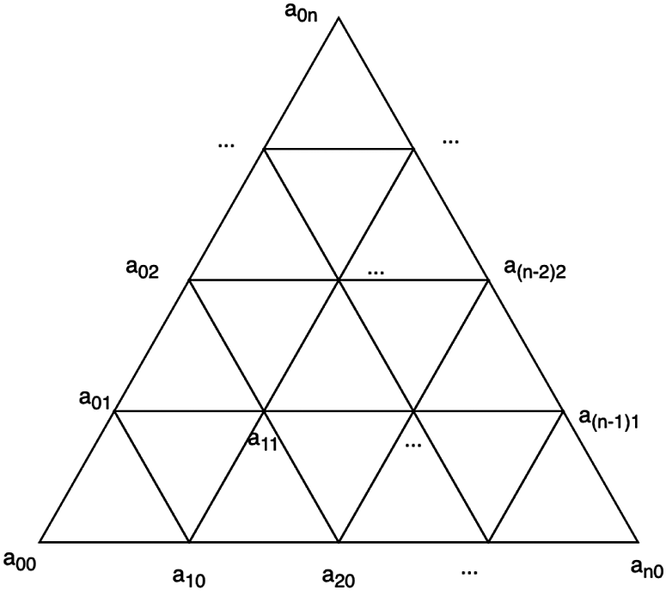
An integral n-hive is an array of integers
$a_{ij}$
 for
$0\le i, j, i+j\le n$
 placed in the vertices of triangles of the following shape
hive.

which satisfies all of the following rhombus inequalities: for each rhombus of the following types

the sum of the two integers at the obtuse vertices must be greater than or equal to the sum of the two integers at the acute vertices.
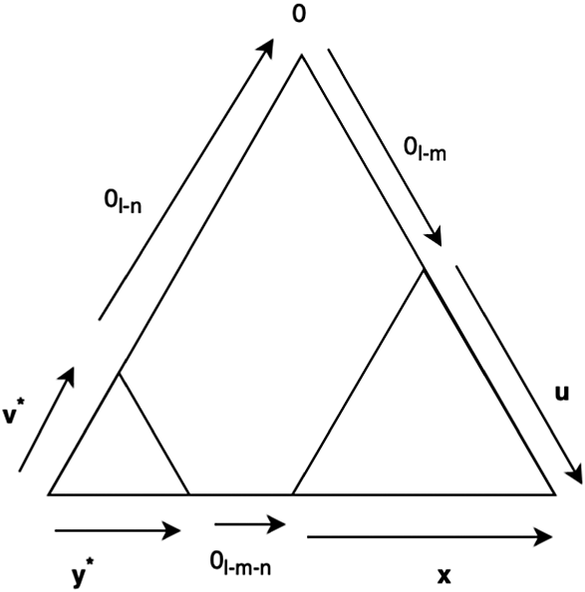
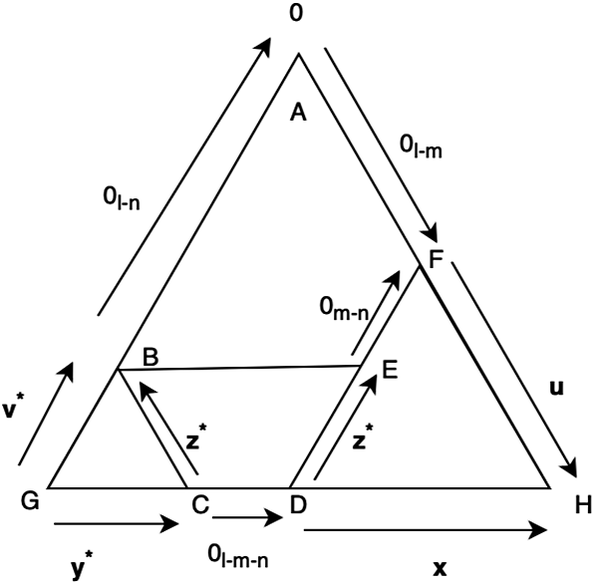
Theorem 3.12 (Knutson-Tao, [Reference Knutson and TaoKT99]).
Let
$\mathbf {{x}}=(x_1,\dots ,x_n), \mathbf { {y}}=(y_1,\dots ,y_n), {\mathbf {z}}=(z_1,\dots ,z_n)$
 be partitions with
$|{\mathbf {z}}|=|\mathbf {{x}}|+|{\mathbf {y}}|$
 , then
$c_{\mathbf { {x}},{\mathbf {y}}}^{{\mathbf {z}}}$
 is the number of n-hives with boundary labels

Here the arrow and the number
$x_i$
 (resp.
$y_j, z_k$
 ) on the arrow indicate that the numbers increase by
$x_i$
 (resp.
$y_j,z_k$
 ) along the direction indicated by the arrow. One can normalize the above n-hive by assigning any integer to any fixed vertex.
We note that different normalization will give the same number of hives. The above theorem is proved in [Reference Knutson and TaoKT99]. See also the appendix of [Reference BuchBuc00] for a different proof given by W. Fulton.
Remark 3.13. We give a simple example which also appeared in [Reference BuchBuc00]. We have
$c_{(2,1),(2,1)}^{(3,2,1)}=2$
 , which can be computed in the following way. There are exactly two
$3$
 -hives with boundary conditions given below,

which are given by
$x=4,5$
 .
We temporarily call the following object an anti-n-hive: an array of integers placed in the vertices of triangles of the shape as in Figure 1 which satisfies the ‘reverse’ rhombus inequalities: for each rhombus below

the sum of the two integers at the obtuse vertices must be less than or equal to the sum of the two integers at the acute vertices.
For any n-hive, if we switch the sign of the number at each vertex, we will get an anti-n-hive. Note that this process will change the boundary conditions, which gives us the following direct corollary.
Corollary 3.14. Let
$\mathbf {{x}}=(x_1,\dots ,x_n), {\mathbf {y}}=(y_1,\dots ,y_n), {\mathbf {z}}=(z_1,\dots ,z_n)$
 be partitions with
$|{\mathbf {z}}|=|\mathbf { {x}}|+|{\mathbf {y}}|$
 , then
$c_{\mathbf {{x}},{\mathbf {y}}}^{{\mathbf {z}}}$
 is the number of anti-n-hives with boundary labels

Here the arrow and the number
$x_i$
 (resp.
$y_j, z_k$
 ) on the arrow indicate that the numbers increase by
$x_i$
 (resp.
$y_j,z_k$
 ) along the direction indicated by the arrow. One can normalize the above n-hive by assigning any integer to any fixed vertex.
Now we can prove Tao’s formula (3.19), which we restate below.
Proposition 3.15. Let
$l,m,n$
 be non-negative integers with
$l\ge m+n+1$
 and
$m\ge n$
 . Given
$\mathbf {{x}}, {\mathbf {u}}\in T^+(m), {\mathbf {y}}, \mathbf { {v}}\in T^+(n)$
 with
$|{\mathbf {u}}|-|\mathbf {{x}}|=|{\mathbf {v}}|-|{\mathbf {y}}|\ge 0 $
 , then

Here
${\mathbf {u}}=(u_1,\dots ,u_m), \mathbf {{x}}=(x_1,\dots ,x_m), {\mathbf {y}}=(y_1,\dots ,y_n), {\mathbf {v}}=(v_1,\dots ,v_n)$
 ,
$\mathbf { {y}}^*=(-y_n,\dots ,-y_2,-y_1)$
 ,
${\widetilde {\mathbf {v}}}=(0_{l-n},\mathbf { {v}}^*)+(v_1,\dots ,v_1)=(v_1,\dots ,v_1,v_1-v_n,\dots ,v_1-v_2,0)\in T^+(l)$
 , and
$\lambda =(\mathbf {{x}},0_{l-m-n},\mathbf { {y}}^*)+(v_1,\dots ,v_1)\in T^+(l)$
 . Moreover,
${\mathbf {u}}$
 in
$c_{{\widetilde {\mathbf {v}}}, {\mathbf {u}}}^\lambda $
 is viewed as an element in
$T^+(l)$
 in the obvious way, namely,
${\mathbf {u}}=({\mathbf {u}},0_{l-n})$
 .
Proof. By Theorem 3.12 and Corollary 3.14, one can see that
$c_{{\widetilde {\mathbf {v}}}, {\mathbf {u}}}^{\lambda }$
 is the number of anti-l-hives with boundary conditions indicated below,

where
$v_1$
 in the left side boundary and bottom boundary means
$(v_1,\dots ,v_1)\in T^+(l)$
 . Here the two interior line segments are not important. For each hive above, we assume that its vertex integers are given by
$(a_{ij})_{0\le i, j, i+j\le l}$
 placed as in Figure 1. Then
$(a_{ij}-(i+j)v_1)_{0\le i, j, i+j\le l}$
 is also an anti-l-hive which has the boundary conditions as indicated in the following Figure 2. We also normalized the anti-l-hive so that the top vertex has value
$0$
 .
boundary conditions for anti-hives which represents
$c_{{\widetilde {\mathbf {v}}}, {\mathbf {u}}}^\lambda $


Thus
$ c_{{\widetilde {\mathbf {v}}}, {\mathbf {u}}}^\lambda $
 is the number of anti-l-hives with boundary conditions as in Figure 2. Using the reverse rhombus inequality, we can check that an anti-l-hive as above must vanish completely in the quadrilateral
$ABEF$
 (including each side) in Figure 3. Moreover, inside the trapezoid
$BCDE$
 , the values of the hive on each horizontal line are the same. In particular, this means that there exists a
${\mathbf {z}}\in T^+(n)$
 such that the boundary conditions on
$CB$
 and
$DE$
 are both given by
${\mathbf {z}}^*$
 .
complete boundary conditions for anti-hives

Figure 3 Long description
A large triangle has vertices labeled 0 at the top, G at the bottom-left, and H at the bottom-right.
Along the perimeter:
- The left edge from G to 0 is labeled with a vector v star pointing upward and a segment label 0 sub l-n.
- The right edge from 0 to H is labeled with a segment label 0 sub l-m and a vector u pointing downward.
- The bottom edge from G to H is divided into segments G-C, C-D, and D-H. A vector y star points from G toward C. A segment label 0 sub l-m-n is below C-D. A vector x points from D toward H.
Internal structure:
- A horizontal line segment B-E is parallel to the base G-H. Point B is on the left edge and point E is on an internal diagonal.
- Point F lies on the right edge 0-H. A vector labeled 0 sub m-n points from E toward F.
- Two parallel upward-pointing vectors labeled z star connect the base to the internal horizontal line: one from C to B and one from D to E.
- The interior region near the top vertex 0 is labeled A.
Thus such a hive is uniquely determined by its values in the anti-hives
$BGC$
 and
$FDH$
 , with the indicated boundary conditions as in Figure 3. Conversely, given anti-hives
$BGC$
 and
$FDH$
 with boundary conditions as in Figure 3, we get an anti-hive with the boundary condition as in Figure 2 using a reverse process. Finally, note that the number of anti-hives
$BGC$
 is
$c_{{\mathbf {y}},{\mathbf {z}}}^{{\mathbf {v}}}$
 and the number of anti-hives
$FDH$
 is
$c_{\mathbf { {x}},{\mathbf {z}}}^{{\mathbf {u}}}$
 . Thus we get

This concludes the proof.
4 A local converse theorem
In the rest of this paper, we assume that F is a non-archimedean local field of characteristic different from 2. Let
${\mathcal {O}}$
 be the ring of integers of F,
${\mathfrak {p}}$
 be the maximal ideal of
${\mathcal {O}}$
 and let
$\varpi \in {\mathfrak {p}}$
 be a fixed uniformizer. The purpose of the rest of this paper is to prove the following
Theorem 4.1. Let l be a positive integer and let
$\pi _1,\pi _2$
 be two irreducible supercuspidal representations of
${\mathrm {GL}}_l(F)$
 with the same central character. If
$\Gamma (\mathbf {{s}},\pi _1\times (\tau _1,\tau _2),\psi ;0)=\Gamma (\mathbf {{s}},\pi _2\times (\tau _1,\tau _2),\psi ;0)$
 for all irreducible generic representations
$\tau _1$
 (resp.
$\tau _2$
 ) of
${\mathrm {GL}}_m(F)$
 (resp.
${\mathrm {GL}}_n(F)$
 ) with
$0\le n\le [l/2], 0\le m\le [l/2]$
 , then
$\pi _1\cong \pi _2$
 .
Remark 4.2. If
$l=2r$
 is even and
$m=n=r$
 , we have not defined the gamma factor
$\Gamma (\mathbf {{s}},\pi \times (\tau _1,\tau _2),\psi ;0)$
 yet, because our local zeta integral (3.1) and hence our local gamma factor defined from that in Proposition 3.6 require
$m+n<l$
 . In the case where
$l=2r, m=n=l$
 , the corresponding local gamma factor used in Theorem 4.1 is the one defined from the local zeta integral of unitary group
${\mathrm {U}}_{E/F}(2r)\times {\mathrm {Res}}_{E/F}({\mathrm {GL}}_r)$
 at a split place; see [Reference Ben-Artzi and SoudryBAS09] and [Reference MorimotoMor25]. Actually, the properties of this gamma factor are well studied. In particular, it has been shown that it is the product of Jacquet–Piatetski-Shapiro–Shalika local gamma factors after normalization; see [Reference MorimotoMor25]. We will review its definition in §4.1.
Remark 4.3. Note that if
$m=n=0$
 , then condition
$\Gamma (\mathbf {{s}},\pi _1\times (\tau _1,\tau _2),\psi ;0)=\Gamma (\mathbf {{s}},\pi _2\times (\tau _1,\tau _2),\psi ;0) $
 is empty. If
$m>0$
 and
$n=0$
 , the corresponding gamma factor
$\Gamma (\mathbf {{s}},\pi _1\times (\tau _1,\tau _2),\psi ;0) $
 is exactly a Jacquet–Piatetski-Shapiro–Shalika local gamma factor up to a shift.
Here we recall Jacquet’s local converse conjecture
Conjecture 4.4. Let
$\pi _1,\pi _2$
 be two irreducible generic representations of
${\mathrm {GL}}_l(F)$
 with the same central character. If
$\gamma (s,\pi _1\times \tau ,\psi )=\gamma (s,\pi _2\times \tau ,\psi )$
 for any irreducible generic representation
$\tau $
 of
${\mathrm {GL}}_m(F)$
 with
$1\le m\le [l/2]$
 , then
$\pi _1\cong \pi _2$
 .
One can assume that
$\pi _1,\pi _2$
 are supercuspidal and remove the central character restriction after the work of [Reference Jiang, Nien and StevensJNS15]. The above conjecture was proved in [Reference ChaiCha19] and [Reference Jacquet and LiuJL18] independently. In the next remark, we will explain that our Theorem 4.1 indeed gives a new proof of Conjecture 4.4.
Remark 4.5. We write
${\mathcal {C}}(0)$
 for the condition that the two representations
$\pi _1,\pi _2$
 have the same central character, which is always assumed. For
$t\ge 1$
 , we denote by
${\mathcal {C}}(t):={\mathcal {C}}(t;\pi _1,\pi _2)$
 the following condition for
$\pi _1,\pi _2:$


for any irreducible generic representation
$\tau _1$
 (resp.
$\tau _2$
 ) of
${\mathrm {GL}}_m(F)$
 (resp.
${\mathrm {GL}}_n(F)$
 ) with
$0\le m,n\le t$
 . To compare our result with Jacquet’s local converse conjecture, we also denote by
${\mathcal {C}}'(t):={\mathcal {C}}'(t; \pi _1,\pi _2)$
 the condition:
$\gamma (s,\pi _1\times \tau ,\psi )=\gamma (s,\pi _2\times \tau ,\psi )$
 for any irreducible generic representation
$\tau $
 of
${\mathrm {GL}}_m(F)$
 with
$1\le m\le t$
 . Note that
$\gamma (1-s,\widetilde \pi \times \widetilde \tau ,\psi )\gamma (s,\pi \times \tau ,\psi ^{-1})=1$
 ; see [Reference Jacquet, Piatetskii-Shapiro and ShalikaJPSS83, §2.9 and §3.1]. Thus, condition
${\mathcal {C}}(t)$
 is, in fact, equivalent to
${\mathcal {C}}'(t)$
 by Proposition 3.9. So our proof of Theorem 4.1 gives a new proof of Jacquet’s local converse conjecture.
The proof of Theorem 4.1 will be given in the next section. In the rest of this section, we introduce some necessary tools that will be used in the proof of Theorem 4.1.
4.1 On the gamma factors for
${\mathrm {GL}}_{2r}\times ({\mathrm {GL}}_r,{\mathrm {GL}}_r)$

Recall that if
$m+n\le l-1$
 , for a generic representation
$\pi $
 of
${\mathrm {GL}}_l(F)$
 ,
$\tau _1$
 (resp.
$\tau _2$
 ) of
${\mathrm {GL}}_m(F)$
 (resp.
${\mathrm {GL}}_n(F)$
 ), our local gamma factor
$\Gamma (\mathbf {{s}},\pi \times (\tau _1,\tau _2),\psi )$
 is defined by the local functional equation

for all
$W\in {\mathcal {W}}(\pi ,\psi )$
 and
$\xi _{\mathbf {{s}}}\in {\mathcal {W}}(\mathbf {{s}},(\tau _1,\tau _2),\psi ^{-1}).$
 See Proposition 3.6. From now on, we will drop the index
$j=0$
 in the local gamma factor and simply write
$\Gamma (\mathbf {{s}},\pi \times (\tau _1,\tau _2),\psi ):=\Gamma (\mathbf {{s}},\pi \times (\tau _1,\tau _2),\psi ;0)$
 . For
$W\in {\mathcal {W}}(\pi ,\psi )$
 ,
$\rho (\gamma _{m,n}^{-1})W$
 is also an element in
${\mathcal {W}}(\pi ,\psi )$
 . Thus, we have

for all
$\xi _{\mathbf {{s}}}\in {\mathcal {W}}(\mathbf {{s}},(\tau _1,\tau _2),\psi ^{-1})$
 . Here
$\rho $
 denotes the right translation, and
$\gamma _{m,n}$
 is the element in
${\mathrm {GL}}_l$
 as defined after (3.1). The local functional equation (4.1) is the one we will use to prove our local converse theorem.
As explained in Remark 4.2, we also need the local gamma factors for
$\Gamma (\mathbf {{s}}, \pi \times (\tau _1,\tau _2),\psi )$
 when
$l=2r$
 and
$m=n=r$
 , which are not covered in our previous sections. This local gamma factor has been defined in [Reference Ben-Artzi and SoudryBAS09] and studied in [Reference MorimotoMor25]. We recall the definition now.
We first endowed
$F^{2r}\oplus F^{2r}$
 with a symplectic structure
$\langle {~,~} \rangle $
 defined by

where
$u_i, v_i\in F^{2r}$
 are viewed as row vectors. For a nontrivial additive character
$\psi $
 of F and for a character
$\mu $
 of
$F^\times $
 , we can consider the Weil representation
$\omega _{\psi ^{-1},\mu , \mu ^{-1}}$
 of
${\mathrm {GL}}_{2r}(F)$
 ; see [Reference MorimotoMor25, §2.2]. Note that we used a slightly different normalization. The Weil representation
$\omega _{\psi ^{-1},\mu , \mu ^{-1}}$
 can be realized on the space
${\mathcal {S}}(F^{r}\times F^{r})$
 , the Bruhat-Schwartz functions on
$F^{2r}$
 . This is the Schrödinger model of the Weil representation. For example, we have the well-known formula

In the following, we assume that
$\mu $
 is understood and omit it from the notation.
Now let
$\pi $
 be an irreducible generic representation of
${\mathrm {GL}}_{2r}(F)$
 ,
$(\tau _1,\tau _2)$
 be a pair of irreducible generic representations of
${\mathrm {GL}}_r(F)$
 and
$\mathbf {{s}}=(s_1,s_2)$
 be a pair of complex numbers. For
$W\in {\mathcal {W}}(\pi ,\psi ), \xi _{\mathbf {{s}}}\in {\mathcal {W}}(\mathbf {{s}},(\tau _1,\tau _2,),\psi ^{-1})$
 , and
$\phi \in {\mathcal {S}}(F^{2r})$
 , we consider the local zeta integral

where
$e_r\in F^r$
 is the vector
$(0,0,\dots ,0,1)$
 . There exists a meromorphic function
$\Gamma (\mathbf {{s}}, \pi \times (\tau _1,\tau _2),\mu ,\psi )$
 such that

for any
$W\in {\mathcal {W}}(\pi ,\psi ), \xi _{\mathbf {{s}}}\in {\mathcal {W}}(\mathbf {{s}}, (\tau _1,\tau _2),\psi ^{-1})$
 and
$\phi \in {\mathcal {S}}(F^r\times F^r).$
 Note that in [Reference Ben-Artzi and SoudryBAS09] and [Reference MorimotoMor25], there is only a single complex variable involved in the local zeta integral and local gamma factor. Here we still use the two variable case.
Remark 4.6. In [Reference MorimotoMor25], the field F is assumed to have characteristic zero. One can extend their results to an odd characteristic local field F without significant difficulty. See the work of Jo [Reference JoJo22] on similar situations. If we don’t assume the existence of local gamma factors for a local field of positive characteristic, then we also have to require that our field F be of characteristic zero in Theorem 4.1 when l is even.
4.2 Howe vectors
Our strategy for the proof of Theorem 4.1 is along the lines of that given in [Reference ZhangZha18] and [Reference ZhangZha19]. One basic tool for us is the partial Bessel functions associated with Howe vectors, as developed in [Reference BaruchBar95]. Here we recall the basic construction. Let
$\psi $
 be a fixed unramified additive character of F and we also view
$\psi $
 as a character of the maximal unipotent subgroup
$N_l\subset {\mathrm {GL}}_l(F)$
 in the usual way. For an integer
$i\ge 0$
 , we consider the open compact subgroup
$K_{{\mathrm {GL}}_l}^i:=I_l+{\mathrm {Mat}}_{l\times l}({\mathfrak {p}}^i)$
 of
${\mathrm {GL}}_l(F)$
 . Consider the character
$\theta _i$
 of
$K_{{\mathrm {GL}}_l}^i$
 defined by

One can check that
$\theta _i$
 is indeed a character of
$K_{{\mathrm {GL}}_l}^i$
 . Consider the element

and
$H_l^i=d_iK^id_i^{-1}$
 , which is still an open compact subgroup of
${\mathrm {GL}}_l(F)$
 . One sees that
$H_l^i$
 has the form

We consider the character
$\psi _i$
 of
$H_l^i$
 defined by

For a subgroup
$U\subset {\mathrm {GL}}_l(F)$
 , we denote
$U^i:=U\cap H_l^i$
 . For example,
$N_l^i$
 denotes
$N_l\cap H_l^i$
 . We also usually drop l from the notation if l is understood. It is easy to see that
$\psi _i|_{N_l^i}=\psi |_{N_l^i}$
 .
Let
$(\pi ,V)$
 be an irreducible generic representation of
${\mathrm {GL}}_l(F)$
 and for
$v\in V$
 , we consider

If
$W\in {\mathcal {W}}(\pi ,\psi )$
 is the Whittaker function associated with v, then we denote
$W_i=W_{v_i}$
 . Note that

Actually, there exists a positive integer
$C(v)>0$
 , such that
$W_i$
 satisfies the additional quasi-invariance property

for all
$u\in N_l,g\in {\mathrm {GL}}_l(F),h\in H_l^i$
 if
$i>C(v)$
 ; see [Reference BaruchBar95, Lemma 3.2]. According to the proof [Reference BaruchBar95, Lemma 3.2], one can take
$C(v)$
 to be any integer such that v is fixed by
$\pi (K^{C(v)}_l)$
 .
Let
$\omega $
 be a character of
$F^\times $
 and we consider the space
$C_c^\infty ({\mathrm {GL}}_l(F),\omega )$
 consisting of smooth functions f on G such that f is compactly supported modulo
$Z_l$
 , the centre of
${\mathrm {GL}}_l(F)$
 , and
$f(zg)=\omega (z)f(g)$
 . If
$\pi $
 is supercuspidal, let
${\mathcal {M}}(\pi )$
 be the space of matrix coefficients of
$\pi $
 . Then
${\mathcal {M}}(\pi )\subset C_c^\infty ({\mathrm {GL}}_l(F),\omega _\pi )$
 . For
$f\in {\mathcal {M}}(\pi )$
 , following [Reference Cogdell, Shahidi and TsaiCST17, page 2089], we consider the function

Note that the integral is convergent by assumption and defines an element in
${\mathcal {W}}(\pi ,\psi )$
 . Moreover, for an appropriate choice of f, we can assume that
$W^f(I_l)=1$
 . See [Reference Cogdell, Shahidi and TsaiCST17, page 2089-2090]. Thus, we can consider
$W^f_i$
 . We also use the notation

4.3 Weyl elements which support Bessel functions
Let
$\Delta =\Delta ({\mathrm {GL}}_l)$
 be the set of simple roots of
${\mathrm {GL}}_l(F)$
 . Then
$\Delta =\{\alpha _k: 1\le k\le l-1\}$
 , where

Let
$\mathbf {{W}}=\mathbf {{W}}({\mathrm {GL}}_l)$
 be the Weyl group of
${\mathrm {GL}}_l(F)$
 . We sometimes identify
$\mathbf {{W}}$
 with the permutation matrix in
${\mathrm {GL}}_l(F)$
 . Denote by e the identity element in
$\mathbf {{W}}$
 , which is represented by
$I_l\in {\mathrm {GL}}_l(F)$
 . For
$w\in \mathbf {{W}}$
 , denote
$C(w)=BwB$
 , where
$B=B_l$
 is the upper triangular subgroup of
${\mathrm {GL}}_{l}(F)$
 . There is a Bruhat order on
$\mathbf {{W}}$
 , which is recalled as follows. Given
$w_1,w_2\in \mathbf {{W}}$
 , then
$w_1\le w_2$
 (or
$w_2\ge w_1$
 ) if and only if
$C(w_1)\subset \overline {C(w_2)}$
 . For
$w\in \mathbf {{W}}$
 , we denote
$\Omega _w=\coprod _{w'\ge w}C(w')$
 . Then
$C(w)$
 is closed in
$\Omega _w$
 and
$\Omega _w$
 is open in G.
Let
${\mathrm {B}}({\mathrm {GL}}_l)=\left \{{w\in \mathbf {{W}}({\mathrm {GL}}_l): \alpha \in \Delta , w\alpha>0\implies w\alpha \in \Delta }\right \}$
 , which is the set of Weyl elements that can support partial Bessel functions.
Let
$w_0=J_{l}\in {\mathrm {GL}}_l(F)$
 , which represents the longest Weyl element of
${\mathrm {GL}}_l(F)$
 . It is well-known that
$w\in {\mathrm {B}}({\mathrm {GL}}_l)$
 if and only if
$w_0 w$
 is the longest Weyl element of the Levi subgroup of a standard parabolic subgroup of
${\mathrm {GL}}_l(F)$
 . For
$w\in {\mathrm {B}}({\mathrm {GL}}_l)$
 , let
$P_w=M_wN_w$
 be the corresponding parabolic subgroup such that
$w_0 w=w_0^{M_w}$
 , where
$M_w$
 is the Levi subgroup of
$P_w$
 and
$w_0^{M_w}$
 is the longest Weyl element of
$M_w$
 . Let
$\theta _w$
 be the subset of
$\Delta $
 which consists of all simple roots in
$M_w$
 . Then we have the relation

The assignment
$w\mapsto \theta _w$
 is a bijection between
${\mathrm {B}}({\mathrm {GL}}_l)$
 and subsets of
$\Delta $
 . Moreover, it is known that the assignment
$w\mapsto \theta _w$
 is order-reversing, i.e.,
$w'\le w$
 if and only if
$\theta _w\subset \theta _{w'}$
 ; see [Reference Cogdell, Piatetski-Shapiro and ShahidiCPSS05, Proposition 2.11]. For example, we have
$\theta _{w_0}=\emptyset $
 and
$\theta _{e}=\Delta $
 .
Given a subset
$\theta \subset \Delta $
 , we will write the corresponding Weyl element in
${\mathrm {B}}({\mathrm {GL}}_l)$
 by
$w_\theta $
 . For an integer k with
$1\le k\le l-1$
 , denote

Lemma 4.7. For every k with
$1\le k\le l-1$
 , we have
$\overline w_k=w_{\Delta -\left \{{\alpha _k}\right \}}.$

Proof. We have

which is the longest Weyl element of the Levi subgroup

The set of simple roots in
$M_{\overline w_k}$
 is
$\Delta -\left \{{\alpha _k}\right \}$
 . Thus we have
$\overline w_k\in {\mathrm {B}}({\mathrm {GL}}_l)$
 and
$\theta _{\overline w_k}=\Delta -\left \{{\alpha _k}\right \}$
 .
Denote

Lemma 4.8. For positive integers
$m,n$
 with
$1\le m+n\le l-1$
 , we have
$\theta _{\widetilde w_{n,m}}=\Delta -\left \{{\alpha _m, \alpha _{l-n}}\right \}$
 .
Proof. We have

which is the longest Weyl element in the Levi subgroup

Thus
$\theta _{\widetilde w_{n,m}}=\Delta -\left \{{\alpha _m, \alpha _{l-n}}\right \}.$

Given
$w,w'\in {\mathrm {B}}({\mathrm {GL}}_l)$
 with
$w>w'$
 , define (following Jacquet [Reference JacquetJac16])

The number
$d_B(w,w')$
 is called the Bessel distance of
$w,w'$
 . By [Reference Cogdell, Piatetski-Shapiro and ShahidiCPSS05, Proposition 2.1] and Lemma 4.7, the set of elements in
${\mathrm {B}}({\mathrm {GL}}_l)$
 which has Bessel distance 1 from the element
$e\in {\mathrm {B}}({\mathrm {GL}}_l)$
 are
$\left \{{\overline w_k, 1\le k\le l-1}\right \}$
 , i.e.,

For
$w,w'\in \mathbf {{W}}$
 with
$w<w'$
 , we denote by
$[w,w']$
 the closed Bruhat interval
$\left \{{w"\in \mathbf {{W}}({\mathrm {GL}}_l)| w\le w"\le w'}\right \}$
 .
4.4 Cogdell-Shahidi-Tsai’s theory on partial Bessel functions
In this subsection, we review certain basic properties of partial Bessel functions developed by Cogdell-Shahidi-Tsai recently in [Reference Cogdell, Shahidi and TsaiCST17].
For
$w\in {\mathrm {B}}({\mathrm {GL}}_l)$
 , we denote

The set
$A_w$
 is in fact the centre of
$M_w$
 .
Theorem 4.9 (Cogdell-Shahidi-Tsai).
Let
$\omega $
 be a character of
$F^\times $
 .
-
(1) Let $w\in \mathbf {{W}}$
,
$m>0$
and
$f\in C_c^\infty (\Omega _w,\omega )$
. Suppose
${\mathcal {B}}_i(wa,f)=0$
for all
$a\in A_w$
. Then there exists
$f_0\in C_c^\infty (\Omega _w-C(w), \omega )$
, such that for sufficiently large i depending only on f, we have
${\mathcal {B}}_i(g,f)={\mathcal {B}}_i(g,f_0)$
for all
$g\in {\mathrm {GL}}_l(F)$
. -
(2) Let $w\in {\mathrm {B}}({\mathrm {GL}}_l)$
. Let
$\Omega _{w,0}$
and
$\Omega _{w,1}$
be
$N_l\times N_l$
and
$T_l$
-invariant open sets of
$\Omega _w$
such that
$\Omega _{w,0}\subset \Omega _{w,1}$
and
$\Omega _{w,1}-\Omega _{w,0}$
is a union of Bruhat cells
$C(w')$
such that
$w'$
does not support a Bessel function, i.e.,
$w'\notin {\mathrm {B}}({\mathrm {GL}}_l)$
. Then for any
$f_1\in C_c^\infty (\Omega _{w,1}, \omega )$
there exists
$f_0\in C_c^\infty (\Omega _{w,0},\omega )$
such that for all sufficiently large i depending only on
$f_1$
, we have
${\mathcal {B}}_i(g,f_0)={\mathcal {B}}_i(g,f_1),$
for all
$g\in {\mathrm {GL}}_l(F)$
.


Proof. Part (1) is [Reference Cogdell, Shahidi and TsaiCST17, Lemma 5.13] and part (2) is [Reference Cogdell, Shahidi and TsaiCST17, Lemma 5.14].
Corollary 4.10. Let
$f_1,f_2\in C_c^\infty ({\mathrm {GL}}_l(F),\omega )$
 with
$W^{f_1}(I_l)=W^{f_2}(I_l)=1$
 . Then there exist functions
$f_{\overline w_k}\in C_c^\infty (\Omega _{\overline w_k},\omega )$
 for all k with
$1\le k\le l-1$
 such that for sufficiently large i (depending only on
$f_1,f_2$
 ) we have

This is essentially [Reference Cogdell, Shahidi and TsaiCST17, Proposition 5.3]; see [Reference Cogdell, Shahidi and TsaiCST17, page 2115] for a similar identity. Almost identical proofs in similar situations are given in [Reference ZhangZha18, Corollary 4.7] and [Reference ZhangZha19, Corollary 2.7]. We omit the proof here and just remark that each term in the expansion of the right side comes from the Weyl elements which have Bessel distance 1 from the trivial Weyl element
$e\in \mathbf {{W}}({\mathrm {GL}}_l)$
 , namely the elements in the set (4.4).
4.5 Construction of certain sections of induced representations
Let
$m,n$
 be two positive integers and
$\tau _1$
 (resp.
$\tau _2$
 ) be an irreducible generic representation of
${\mathrm {GL}}_m(F)$
 (resp.
${\mathrm {GL}}_n(F)$
 ) and let
$\mathbf {{s}}=(s_1,s_2)$
 . Consider

and

Here we identify
$N_{m,n}$
 etc. with its F-rational points and recall that
$H_l^k$
 is defined in Section 4.2.
Let D be a compact open subset of
$N_{m,n}$
 . For
$x\in D$
 and a positive integer i, we consider the set

Lemma 4.11.
-
(1) For any positive integer c, there exists a positive integer $k_1=k_1(D,c)$
such that for all
$k\ge k_1, x\in D, \overline y\in S(x,k)$
, we can write $$ \begin{align*}\overline y x=u_{m,n}(x_1){\mathrm {diag}}(a,b) \overline u_{m,n}(y_1),\end{align*} $$with $a\in K^c_{{\mathrm {GL}}_m}, b\in K_{{\mathrm {GL}}_n}^c$
. Here
$u_{m,n}(x_1)\in N_{m,n}, \overline u_{m,n}(y_1)\in \overline N_{m,n}^k$
. We recall that
$K^c_{{\mathrm {GL}}_m}=I_m+{\mathrm {Mat}}_{m\times m}({\mathfrak {p}}^c)$
.
-
(2) There exists an integer $k_2=k_2(D)$
such that
$S(x,k)=\overline N_{m,n}^k$
for all
$x\in D$
and
$k\ge k_2$
.


Proof. This is an analogue of [Reference BaruchBar95, Lemma 4.1], [Reference ZhangZha18, Lemma 5.1] and the proof is also similar. We provide a sketch below. For
$x\in D$
 and
$\overline y\in S(x,k)$
 , we assume that
$\overline y x= u_{m,n}(x_1){\mathrm {diag}}(a,b) \overline u_{m,n}(y_1)$
 for some
$a\in {\mathrm {GL}}_m(F), b\in {\mathrm {GL}}_n(F), x_1\in {\mathrm {Mat}}_{m\times n}, y_1\in {\mathrm {Mat}}_{n\times m}$
 with
$\overline u_{m,n}(y_1)\in \overline N_{m,n}^k$
 . By abuse of notation, we also write
$\overline y=\overline u_{m,n}(y), x=u_{m,n}(x)$
 . Then from the equation

we get

We can solve that
$a=I_m-xy_1$
 and
$b=I_n+y_1a^{-1}x$
 . Since when
$x\in D$
 , the entries of x are bounded, and the entries of
$y_1$
 go to zero as
$k\to \infty $
 , we can take k large enough such that
$a=I_m-xy_1\in K_{{\mathrm {GL}}_m}^c$
 and
$ b=I_n+y_1a^{-1}x\in K_{{\mathrm {GL}}_n}^c.$
 This proves (1).
By (4.6), we have
$y=y_1a^{-1} =y_1(I_m-xy_1)^{-1}=y_1(I_m+xy_1+(xy_1)^2+\dots )$
 . Again, since each entry of x is bounded, we may take k large such that the entries of
$y_1(xy_1)^t$
 are so large that
$\overline u_{m,n}(y_1(xy_1)^t)\in \overline N_{m,n}^k$
 for
$t\ge 0$
 . This shows that for k large, we have
$\overline u_{m,n}(y)\in \overline N_{m,n}^k$
 and thus
$S(x,k)\subset \overline N_{m,n}^k$
 since
$\overline y=\overline u_{m,n}(y)$
 is arbitrarily chosen. See [Reference ZhangZha18, Lemma 5.1] for a similar and more detailed argument.
Take
$x\in D$
 , we need to show
$ \overline N_{m,n}^k \subset S(x,k)$
 for k large. As above, we write
$x=u_{m,n}(x)$
 by abuse of notation. We first assume that k is so large that if
$\overline u_{m,n}(y)\in \overline N_{m,n}^k$
 , then
$I_n+yx$
 is invertible and
$I_n-x(I_n+yx)^{-1}y$
 is also invertible. This can be done because x has bounded entries and y has small entries if
$\overline u_{m,n}(y)\in \overline N_{m,n}^k$
 when k large. Then we have

with
$ b=I_n+yx, a=I_n-b^{-1}y, x_1=xb^{-1}$
 and
$y_1=(I_n+yx)^{-1}y$
 . In particular,
$ \overline u_{m,n}(y)u_{m,n}(x)\in P_{m,n}\overline N_{m,n}$
 . To show
$ \overline u_{m,n}(y)\in S(x,k)$
 for k large, it suffices to show that one can choose k large so that the above
$ \overline u_{m,n}(y_1)\in \overline N_{m,n}^k$
 . Notice that
$y_1=(I_n+yx)^{-1}y $
 with bounded entries in x and small entries in y, the argument is the same as the above step. We are done.
Given
$v_j\in V_{\tau _j}$
 , the space of
$\tau _j$
 , for
$j=1,2$
 , we consider the following
$\tau _1\boxtimes \tau _2$
 -valued function on
${\mathrm {GL}}_{m+n}(F)$
 .

Proposition 4.12. For any
$v_1,v_2$
 , there exists an integer
$k_3(v_1,v_2)$
 such that
$f_{\mathbf {{s}}}^{k,v_1,v_2}$
 defines a section in
${\mathrm {I}}(\mathbf {{s}},(\tau _1,\tau _2))$
 for any
$k\ge k_3(v_1,v_2)$
 .
Proof. This is an analogue of [Reference ZhangZha18, Lemma 5.2] and we only give a sketch of the proof. We first take a positive integer
$c=c(v_1,v_2)$
 such that
$v_1$
 is fixed by
$K_{{\mathrm {GL}}_m}^c$
 under the action of
$\tau _1$
 and
$v_2$
 is fixed by
$K_{{\mathrm {GL}}_n}^c$
 under the action of
$\tau _2$
 . Now take

For
$k\ge k_3(v_1,v_2),$
 we need to check

for all
$x\in {\mathrm {Mat}}_{m\times n}(F)$
 ,
$a\in {\mathrm {GL}}_m(F), b\in {\mathrm {GL}}_n(F), g\in {\mathrm {GL}}_{m+n}(F)$
 , and there exists an open compact subgroup
$K'\subset {\mathrm {GL}}_{m+n}(F)$
 such that

The first property (4.7) is from the definition and we only address the second one (4.8).
Take a positive integer
$t\ge k$
 such that
$\overline N_{m,n}\cap K_{{\mathrm {GL}}_{m+n}}^t\subset \overline N_{m,n}^k$
 . We take
$K'=K_{{\mathrm {GL}}_{m+n}}^t$
 in (4.8). We have the decomposition

For
$h\in (K_{{\mathrm {GL}}_{m+n}}^t\cap \overline N_{m,n})$
 , we have
$f_{\mathbf {{s}}}^{k,v_1,v_2}(gh)=f_{\mathbf {{s}}}^{k,v_1,v_2}(g) $
 since
$ h\in \overline N_{m,n}^k$
 by assumption on t. For
$h\in (K_{{\mathrm {GL}}_{m+n}}^t\cap M_{m,n})$
 , we write
$h={\mathrm {diag}}(a_0,b_0)$
 . We first notice that
$h^{-1}\overline N_{m,n}^k h\subset \overline N_{m,n}^k$
 , and thus
$f_{\mathbf { {s}}}^{k,v_1,v_2}(g)=0$
 if and only if
$f_{\mathbf {{s}}}^{k,v_1,v_2}(gh)=0$
 . Next, we assume that
$g=u_{m,n}(x){\mathrm {diag}}(a,b)\overline u_{m,n}(y)$
 with
$ \overline u_{m,n}(y)\in \overline N_{m,n}^k$
 . Then
$gh=u_{m,n}(x){\mathrm {diag}}(aa_0,bb_0)\overline u_{m,n}(b_0^{-1}ya_0)$
 . Thus

where in the last step we used
$\det (a_0)=\det (b_0)=1$
 and
$\tau _1(a_0)v_1=v_1,\tau _2(b_0)v_2=v_2$
 (because
$a_0\in K_{{\mathrm {GL}}_m}^t\subset K_{{\mathrm {GL}}_m}^c$
 by the assumption
$t\ge k\ge c$
 ). Finally, we take
$h\in (K_{{\mathrm {GL}}_{m+n}}^t\cap N_{m,n})\subset K_{{\mathrm {GL}}_{m+n}}^c\cap N_{m,n}.$
 Thus by Lemma 4.11, we have
$S(h,k)=S(h^{-1},k)=\overline N_{m,n}^k.$
 In particular, for
$ \overline u_{m,n}(y)\in \overline N_{m,n}^k$
 , we have
$ \overline u_{m,n}(y) h\in P_{m,n}\overline N_{m,n}^k$
 and
$ \overline u_{m,n}(y) h^{-1}\in P_{m,n}\overline N_{m,n}^k$
 . Thus
$f_{\mathbf {{s}}}^{k,v_1,v_2}(g)=0$
 if and only if
$f_{\mathbf {{s}}}^{k,v_1,v_2}(gh)=0$
 . Moreover, by Lemma 4.11 (1), we can write
$\overline u_{m,n}(y) h=u_{m,n}(x_1){\mathrm {diag}}(a_1,b_1)\overline u_{m,n}(y_1) $
 with
$a_1\in K_{{\mathrm {GL}}_m}^c, b_1\in K_{{\mathrm {GL}}_n}^c$
 . Thus for
$g=u_{m,n}(x){\mathrm {diag}}(a,b)\overline u_{m,n}(y)$
 , we have

From the definition, we see that
$ f_{\mathbf {{s}}}^{k,v_1,v_2}(gh)=f_{\mathbf {{s}}}^{k,v_1,v_2}(g)$
 because
$\det (a_1)=\det (b_1)=1$
 ,
$\tau _1(a_1)v_1=v_1,$
 and
$\tau _2(b_1)v_2=v_2.$
 This concludes the proof.
We also consider the action of the intertwining operator
$M_{w_{m,n}}$
 on
$f_{\mathbf {{s}}}^{i,v_1,v_2}$
 :

Lemma 4.13. Let D be an open compact subset of
$N_{m,n}$
 . Then there is an integer
$k_0(D,v_1,v_2)\ge k_3(v_1,v_2)$
 such that for any
$k\ge k_0(D,v_1,v_2)$
 , we have

Proof. We take c to be a common conductor of
$v_1$
 and
$v_2$
 (namely,
$v_1$
 is fixed by
$\tau _1(K_{{\mathrm {GL}}_m}^c)$
 and
$v_2$
 is fixed by
$\tau _2(K_{{\mathrm {GL}}_n}^c)$
 ) and we take
$k_0(D,v_1,v_2)=\max \left \{{k_3(v_1,v_2), k_1(D,c), k_2(D)}\right \}$
 . Assume
$k\ge k_0(D,v_1,v_2)$
 . Then we have
$S(x,k)=\overline N_{m,n}^k$
 by Lemma 4.11. By definition,

For
$u\in N_{n,m}$
 , we have
$ \overline u:=w_{m,n}uw_{m,n}^{-1}\in \overline N_{m,n}.$
 By the definition of
$f_{\mathbf {{s}}}^{k,v_1,v_2} $
 , we have
$f_{\mathbf {{s}}}^{k,v_1,v_2} (\overline u x)\ne 0$
 if and only if
$\overline u x\in P_{m,n}\overline N_{m,n}^k$
 if and only if
$\overline u\in S(x,k)=\overline N_{m,n}^k.$
 Moreover, by Lemma 4.11 (1), we have

with
$x_1\in {\mathrm {Mat}}_{m\times n}(F), \overline u_{m,n}(y_1)\in \overline N_{m,n}^k$
 ,
$a_1\in K_{{\mathrm {GL}}_m}^c, b_1\in K_{{\mathrm {GL}}_n}^c$
 . By definition, we have

Here we recall that there is an extra operator that switches
$v_1\boxtimes v_2$
 to
$v_2\boxtimes v_1$
 in the definition of intertwining operators. This finishes the proof.
In the above lemma, notice that
$w_{m,n}^{-1}=w_{n,m}$
 . As we did in Subsection 3.1, we can consider the corresponding
${\mathbb {C}}$
 -valued function:
$\xi _{\mathbf {{s}}}^{k,v_1,v_2}=\xi _{f_{\mathbf {{s}}}^{k,v_1,v_2} }\in {\mathcal {W}}(\mathbf {{s}},(\tau _1,\tau _2),\psi ^{-1})$
 and
$\widetilde \xi _{1-{\widehat {\mathbf {s}}}}= \xi _{\widetilde f_{1-{\widehat {\mathbf {s}}}}^{k,v_1,v_2}}\in {\mathcal {W}}(1-{\widehat {\mathbf {s}}}, (\tau _2,\tau _1),\psi ^{-1})$
 . By Lemma 4.13, for
$x\in D$
 and
$k\ge k_0(D,v_1,v_2)$
 , we have

for
$x_1\in {\mathrm {Mat}}_{n\times m}(F), a\in {\mathrm {GL}}_m(F), b\in {\mathrm {GL}}_n(F).$
 Here
$W_{v_1}(a)=\lambda _1(\tau _1(a)v_1)$
 for a fixed
$\lambda _1\in {\mathrm {Hom}}_{N_m}(\tau _1,\psi ^{-1})$
 as in Subsection 3.1, and
$W_{v_2}$
 is defined similarly. Notice that
$W_{v_1}\in {\mathcal {W}}(\tau _1,\psi ^{-1})$
 and
$W_{v_2}\in {\mathcal {W}}(\tau _2,\psi ^{-1}).$

4.6 A result of Jacquet-Shalika
Proposition 4.14. Let
$W'$
 be a smooth function on
${\mathrm {GL}}_n(F)$
 which satisfies
$W'(ug)=\psi (u)W'(g)$
 for all
$u\in N_n$
 and for each m, the set
$\left \{{g\in {\mathrm {GL}}_n(F)| W'(g)\ne 0, |\det (g)|=q^m}\right \} $
 is compact modulo
$U_{{\mathrm {GL}}_n}$
 . Assume, for all irreducible generic representations
$\tau $
 of
${\mathrm {GL}}_n(F)$
 and for all Whittaker functions
$W\in {\mathcal {W}}(\tau ,\psi ^{-1})$
 , the following integral

vanishes, where k is a fixed number, then
$W'\equiv 0$
 .
This is a corollary of [Reference Jacquet and ShalikaJS85, Lemma 3.2]. The version as in Proposition 4.14 appeared in [Reference HenniartHen93, Lemme 2.1]. See also [Reference JPJChe06, Corollary 2.1] or [Reference BaruchBar95, Lemma 5.2] for a proof of the current version.
5 Proof of the local converse theorem
In this section, we prove Theorem 4.1. Let
$\pi _1, \pi _2$
 be two irreducible supercuspidal representations of
${\mathrm {GL}}_l(F)$
 sharing the same central character
$\omega $
 . For
$j=1,2$
 , fix
$f_j\in {\mathcal {M}}(\pi _j)$
 such that
$W^{f_j}(I_l)=1$
 .
Theorem 5.1. Let m be an integer with
$0\le m\le [l/2]$
 . Condition
${\mathcal {C}}(m)$
 implies that for each j with
$m+1\le j\le l-1-m$
 , there exist functions
$f_{\overline w_j}\in C_c^\infty (\Omega _{\overline w_j}, \omega )$
 such that for all
$g\in {\mathrm {GL}}_l(F)$
 and for all sufficiently large i (depending only on
$f_1, f_2$
 ), we have

We first show that Theorem 5.1 implies Theorem 4.1.
Theorem 5.1 implies Theorem 4.1.
Assume Theorem 5.1. Then condition
$\mathcal {C}([l/2])$
 gives
$\mathcal {B}_i(g, f_1) = \mathcal {B}_i(g, f_2)$
 for all
$g \in \operatorname {GL}_l(F)$
 and all sufficiently large i. Hence
$W_i^{f_1} = W_i^{f_2}$
 , so
$\mathcal {W}(\pi _1, \psi ) \cap \mathcal {W}(\pi _2, \psi ) \neq \emptyset $
 . Uniqueness of the Whittaker model then forces
$\pi _1 \cong \pi _2$
 .
Remark 5.2. For classical group analogues of Theorem 5.1, see [Reference ZhangZha18, Proposition 6.1] and [Reference ZhangZha19, Theorem 4.1]. Theorem 5.1 appears to be stronger than Theorem 4.1. We expect it to be useful for the following question: given an integer t with
$t \le [l/2]$
 , classify all irreducible supercuspidal representations
$\pi $
 of
$\operatorname {GL}_l(F)$
 that are determined by the collection of gamma factors
$\gamma (s, \pi \times \tau , \psi )$
 as
$\tau $
 ranges over all irreducible generic representations of
$\operatorname {GL}_m(F)$
 with
$1 \le m \le t$
 .
We prove Theorem 5.1 by induction. The base case
$m=0$
 of Theorem 5.1 is precisely Corollary 4.10. For the inductive step, we assume the following
Inductive Hypothesis 5.3. Let m be a positive integer with
$m\le [l/2]$
 . Condition
${\mathcal {C}}(m-1)$
 implies that there exist functions
$f_{\overline w_j}\in C_c^\infty (\Omega _{\overline w_j}, \omega )$
 for each j with
$m\le j\le l-m$
 such that,

for all
$g\in {\mathrm {GL}}_l(F)$
 and all sufficiently large i depending only on
$f_1, f_2$
 .
Assuming the inductive hypothesis above, we employ a second inductive argument to show that condition
$\mathcal {C}(m)$
 implies the existence of functions
$f_{\overline {w}_j} \in C_c^\infty (\Omega _{\overline {w}_j}, \omega )$
 for each j with
$m+1 \le j \le l-1-m$
 such that

holds for all sufficiently large i (depending only on
$f_1, f_2$
 ) and for all
$g \in \operatorname {GL}_l(F)$
 . The functions
$f_{\overline {w}_j}$
 appearing here may differ from those obtained from the
$(m-1)$
 -th step in (5.1); we do not distinguish them notationally.
To proceed with another induction argument, we introduce a refined condition
$\mathcal {C}(m, n)$
 for integers
$0 \le n \le m$
 . We say that
$\pi _1, \pi _2$
 satisfy
$\mathcal {C}(m, n)$
 if they satisfy
$\mathcal {C}(m-1)$
 and additionally

holds for all irreducible generic representations
$\tau _1$
 of
$\operatorname {GL}_m(F)$
 and
$\tau _2$
 of
$\operatorname {GL}_k(F)$
 with
$0 \le k \le n$
 , as well as for all irreducible generic representations
$\tau _2$
 of
$\operatorname {GL}_m(F)$
 and
$\tau _1$
 of
$\operatorname {GL}_k(F)$
 with
$0 \le k \le n$
 . Note that condition
${\mathcal {C}}(m,0)$
 is strictly stronger than
${\mathcal {C}}(m-1)$
 , while condition
${\mathcal {C}}(m,m)$
 coincides with
${\mathcal {C}}(m)$
 .
Recall that for any positive integers
$j, m$
 with
$m+j<l$
 , we have defined an element

in §4.3. Moreover, we know that
$\widetilde w_{j,m}\in {\mathrm {B}}({\mathrm {GL}}_l)$
 and
$\theta _{\widetilde w_{j,m}}=\Delta -\left \{{\alpha _m,\alpha _{l-j}}\right \}$
 by Lemma 4.8.
Theorem 5.4. Let m be a positive integer with
$m\le [l/2]$
 , and let n be an integer with
$0\le n\le m$
 . Then condition
${\mathcal {C}}(m,n)$
 implies that there exist functions
-
• $f_{\overline w_j}\in C_c^\infty (\Omega _{\overline w_j},\omega )$
for each j with
$m+1\le j\le l-m-1$
; -
• $f_{j,m}'\in C_c^\infty (\Omega _{\widetilde w_{j,m}},\omega ) $
for each j with
$n+1\le j\le m$
; and -
• $f_{m,j}"\in C_c^\infty (\Omega _{\widetilde w_{m,j}},\omega )$
for each j with
$n+1\le j\le m$
,


such that

for all
$g\in {\mathrm {GL}}_{l}(F)$
 and for all sufficiently large i (depending only on
$f_1,f_2$
 ).
Remark 5.5. If
$n=m-1$
 , both
$ f_{m,m}'$
 and
$f_{m,m}"$
 are in
$C_c^\infty (\Omega _{\widetilde w_{m,m}},\omega )$
 . By incorporating
$f_{m,m}"$
 into
$f_{m,m}'$
 , the statement of Theorem 5.4 reduces to the following: condition
${\mathcal {C}}(m,m-1)$
 implies the expansion

with certain
$f_{\overline w_j}\in C_c^\infty (\Omega _{\overline w_j},\omega )$
 and
$f^{\prime }_{m,m}\in C_c^\infty (\Omega _{\widetilde w_{m,m}}, \omega ).$

Note that by Theorem 5.4, condition
${\mathcal {C}}(m,m)={\mathcal {C}}(m)$
 implies that

which is exactly the desired expansion. Thus, Theorem 5.4 implies Theorem 5.1, and hence Theorem 4.1. We prove Theorem 5.4 in the remaining part of this section.
5.1 Proof of the base case of Theorem 5.4
In this subsection, we prove the base case of Theorem 5.4, namely, the case when
$n=0$
 .
Let k be a positive integer with
$k<l$
 . Consider the parabolic subgroup
$P_{k,l-k}$
 of
${\mathrm {GL}}_l(F)$
 . Its Levi subgroup
$M_{k,l-k}$
 consists of block diagonal matrices, and a typical element is denoted by

For
$y\in {\mathrm {Mat}}_{m\times (l-m-1)}(F),$
 set

Lemma 5.6. We fix the notations as in Inductive Hypothesis 5.3.
-
(1) We have ${\mathcal {B}}_i(h,f_{\overline w_j})=0, \forall h\in P_{k,l-k}$
. In particular, the inductive hypothesis (5.1) implies that $$ \begin{align*}{\mathcal {B}}_i(h,f_1)={\mathcal {B}}_i(h,f_2),\end{align*} $$for all $h\in P_{k,l-k}$
and i large.
-
(2) For a positive integer j with $m+1\le j\le l-m$
, we have $$ \begin{align*}{\mathcal {B}}_i(\overline w_m \mathbf{{t}}_{m}(a,I_{l-m})u_1(y), f_{\overline w_j})=0, \forall a\in {\mathrm{GL}}_m(F), \forall y\in {\mathrm {Mat}}_{m\times (l-m-1)}(F).\end{align*} $$
In particular, the inductive hypothesis (5.1) implies that
$$ \begin{align*}&{\mathcal {B}}_i(\overline w_m \mathbf{{t}}_{m}(a, I_{l-m})u_1(y),f_1)-{\mathcal {B}}_i(\overline w_m \mathbf{{t}}_{m}(a, I_{l-m})u_1(y),f_2)\\ &\qquad ={\mathcal {B}}_i(\overline w_m \mathbf{{t}}_{m}(a, I_{l-m})u_1(y),f_{\overline w_m}),\end{align*} $$for all $a\in {\mathrm {GL}}_m(F), y\in {\mathrm {Mat}}_{m\times (l-m-1)}(F)$
.
-
(3) For any $a\in {\mathrm {GL}}_m(F)$
, we can take i large enough (which only depends on
$f_{\overline w_m}$
, and hence only on
$f_1,f_2$
), such that $$ \begin{align*}{\mathcal {B}}_i(\overline w_m \mathbf{{t}}_m(a,I_{l-m})u_1(y),f_{\overline w_m})=\left\{\begin{array}{ll} {\mathcal {B}}_i(\overline w_m \mathbf{{t}}_m(a,I_{l-m}),f_{\overline w_m}), & \mathrm{~if~} u_1(y)\in H_l^i,\\ 0, & \mathrm{otherwise}. \end{array} \right.\end{align*} $$
-
(4) For a fixed integer k and i, the set $\{a\in N_m(F)\backslash {\mathrm {GL}}_m(F): {\mathcal {B}}_i(\overline w_m \mathbf { {t}}_m(a,I_{l-m}))\ne 0,$
$|a|=q^k \}$
is compact.


Proof. (1) Recall that

Since
$\mathrm {Supp}(f_{\overline w_j})\subset \Omega _{\overline w_j}$
 , it suffices to show that
$P_{k,l-k}\cap \Omega _{\overline w_j}=\emptyset $
 . Suppose that
$P_{k,l-k}\cap \Omega _{\overline w_j}$
 is not empty, then their intersection must contain a Bruhat cell, namely, there exists a
$w\in \mathbf {{W}}$
 such that
$w\ge \overline w_j$
 and
$C(w)\subset P_{k,l-k}$
 . Since
$P_{k,l-k}$
 is closed in
${\mathrm {GL}}_{l}$
 , we get
$\overline {C(w)}\subset P_{k,l-k}$
 . The condition
$w\ge \overline w_j$
 implies that
$C(\overline w_j)\subset \overline {C(w)}\subset P_{k,l-k}$
 . In particular, we have
$\overline w_j\in P_{k,l-k}$
 . This is a contradiction.
(2) Consider the set

Here we don’t distinguish a Weyl element from its representative. Denote
$w_{\max }^m=\overline w_m {\mathrm {diag}}(J_m, I_{l-m})=\begin {pmatrix} &I_{l-m}\\ J_m& \end {pmatrix}$
 . Since the Weyl element in
${\mathrm {GL}}_m$
 forms a Bruhat interval
$[1,J_m]$
 , the set S is in fact the Bruhat interval
$[\overline w_m, w_{\max }^m]$
 . Since

it suffices to show that for any
$w\in S$
 ,
$C(w)\cap \Omega _{\overline w_j}=\emptyset $
 if
$m+1\le j\le l-m$
 . Suppose that
$C(w)\cap \Omega _{\overline w_j}$
 is non-empty, then
$w\ge \overline w_i$
 . In particular,
$ w_{\max }^m\ge \overline w_j$
 . Note that

which is the longest Weyl element of the Levi subgroup

Note that the set
$\theta _{w_{\max }^m}$
 is the set of all Weyl elements in
$M_{w_{\max }^m}$
 , which is
$\Delta -\left \{{\alpha _1,\dots ,\alpha _m}\right \}$
 . From
$w_{\max }^m\ge \overline w_j$
 , we obtain
$\theta _{w_{\max }^m}\subset \theta _{\overline w_j}$
 , namely,
$\Delta -\left \{{\alpha _1,\dots ,\alpha _m}\right \}\subset \Delta -\left \{{\alpha _j}\right \}$
 . This is impossible because
$j>m$
 .
(3) This can be done using a root killing argument as in Lemma 2.7, or using a support argument as in [Reference ZhangZha18, Lemma 6.3 (3)]. Since the proof is similar to that of [Reference ZhangZha18, Lemma 6.3 (3)], we omit the details.
(4) This is an analogue of [Reference ZhangZha18, Lemma 6.3 (4)] and the proof is similar. We omit the details.
Notice that if
$m>0, n=0$
 , we have defined a gamma factor
$\Gamma (\mathbf {{s}},\pi \times (\tau _1,0),\psi )$
 for an irreducible generic representation
$\tau _1$
 of
${\mathrm {GL}}_m(F)$
 , which is just a shift of Jacquet–Piatetski-Shapiro–Shalika’s local gamma factor. The pair notation
$(\tau _1, 0)$
 is used to maintain the form of a representation of
${\mathrm {GL}}_m(F)\times {\mathrm {GL}}_n(F)$
 even when
$n=0$
 and hence the group
${\mathrm {GL}}_n(F)$
 is trivial. See Remark 3.2.
Proposition 5.7. Condition
${\mathcal {C}}(m,0)$
 gives

and

for all
$a\in {\mathrm {GL}}_m(F).$

This is roughly [Reference JPJChe06, Proposition 3.1]. Since our proof uses partial Bessel functions rather than the Kirillov model (as in [Reference JPJChe06]), we provide a detailed exposition below.
Proof. For any irreducible generic representation
$\tau _1$
 of
${\mathrm {GL}}_m(F)$
 and any
$\xi _{\mathbf {{s}}}=W'|~|^{s-1/2}$
 with
$W'\in {\mathcal {W}}(\tau _1,\overline \psi )$
 , we can consider the integral
$\Psi (\rho (\gamma _{m,0}^{-1}){\mathcal {B}}_i^f, \xi _{\mathbf {{s}}}; 0)$
 for
$f=f_1,f_2$
 , which is

Here we notice that
$\gamma _{m,0}=I_l$
 . See also Remark 3.2. By inductive hypothesis 5.3 and Lemma 5.6 (1), we have

Thus

By the assumption on local gamma factors and the local functional equation (4.1), we have

Plugging in the definitions, see (3.2) or Remark 3.2, we have

where we identify an algebraic group over F with its F-rational points,
$[{\mathrm {GL}}_m] $
 is the abbreviation of
$N_m(F)\backslash {\mathrm {GL}}_m(F)$
 and
$s^*=s-\frac {1}{2}+l-m-1$
 . By Lemma 5.6 (2) and (3), we get

Note that this is true for all irreducible representations
$\tau _1$
 of
${\mathrm {GL}}_m(F)$
 and for all
$W'\in {\mathcal {W}}(\tau _1,\psi ^{-1})$
 . Thus by Proposition 4.14 and Lemma 5.6 (4), we get that

To get the second assertion, we need to use the local gamma factor
$\Gamma (\mathbf {{s}},\pi \times (0,\tau _2),\psi )$
 for a generic representation
$\tau _2$
 of
${\mathrm {GL}}_m(F)$
 . Here
$\mathbf {{s}}=s$
 is a complex number used to do twist on
$\tau _2$
 . The calculation is almost identical to the above. In fact, if we take
$\xi _{\mathbf {{s}}}=W'|~|^{s-1/2}$
 with
$W'\in {\mathcal {W}}(\tau _2,\psi ^{-1})$
 , we can check that

By Lemma 5.6 (1), we have
$\Psi (\rho (\gamma _{0,m}^{-1}){\mathcal {B}}_i^{f_1}, \xi _{\mathbf { {s}}};0)=\Psi (\rho (\gamma _{0,m}^{-1}){\mathcal {B}}_i^{f_2}, \xi _{\mathbf {{s}}};0) $
 . By the local functional equation (4.1), we get that

By (3.2), the above equation becomes

where
$s^*$
 is a translation of s and its precise form is not important here. Then using Proposition 4.14 again, we get that

This finishes the proof.
Corollary 5.8. Assume condition
${\mathcal {C}}(m,0)$
 . Then there exists
-
• $f_{\overline w_j}\in C_c^\infty (\Omega _{\overline w_j},\omega )$
for each j with
$m+1\le j\le l-m-1$
; -
• $f_{j,m}'\in C_c^\infty (\Omega _{\widetilde w_{j,m}},\omega ) $
, for each j with
$1\le j\le m$
; and -
• $f_{m,j}"\in C_c^\infty (\Omega _{\widetilde w_{m,j}},\omega )$
, for each j with
$1\le j\le m$
,


such that

for all
$g\in {\mathrm {GL}}_{l}(F)$
 and for all i large enough depending only on
$f_1,f_2$
 .
Proof. By Lemma 5.6 (2), inductive hypothesis (5.1) and (5.4), we get

As in the proof of Lemma 5.6 (2), we consider
$w_{\max }^m=\begin {pmatrix} &I_{l-m}\\ J_m&\end {pmatrix}$
 . Then for
$w\in [\overline w_m, w_{\max }^m]$
 , we consider the set
$A_w$
 as defined in (4.5). From
$w\le w_{\max }^m$
 , we know that
$A_w\subset A_{w_{\max }^m}$
 which is of the form
${\mathrm {diag}}(a_1,\dots , a_m, a I_{l-m})$
 , for
$a_j, a\in {\mathrm {GL}}_1(F)$
 . Moreover, we know that
$w=\overline w_m \mathbf {{t}}_m(w',I_{l-m})$
 . Thus, for any
$a\in A_w$
 , we know that there exists an element
$z=zI_{l}$
 in the centre of
${\mathrm {GL}}_l(F)$
 and an element
$g\in {\mathrm {GL}}_m(F)$
 such that
$wa=z\overline w_m \mathbf {{t}}_m(b, I_{l-m})$
 . Thus from (5.6), we get that

for all
$w\in [\overline w_m, w_{\max }^m]$
 and all
$a\in A_w$
 . Similarly, if we temporarily denote
$w^{\prime }_{\max }=\overline w_{l-m}{\mathrm {diag}}(I_{l-m}, J_m)$
 , then from (5.5) we have

for all
$w\in {\mathrm {B}}({\mathrm {GL}}_l)$
 with
$\overline w_{l-m}\le w\le w^{\prime }_{\max },$
 and all
$a\in A_w$
 . The result in fact follows from (5.7), (5.8) and Theorem 4.9 directly. We give some details about this implication below.
By the proof of Lemma 5.6 and a simple calculation, we get that

Denote

By applying Theorem 4.9 and (5.7) to
$\overline w_m$
 , we get a function
$\overline f_m\in C_c^\infty (\Omega _{\overline w_m}^\circ ,\omega )$
 such that, after increasing i if necessary, we have

Note that the set
$\left \{{w\in {\mathrm {B}}({\mathrm {GL}}_l): w>\overline w_m, d(w,\overline w_m)=1}\right \}= \{w_{\Delta -\left \{{\alpha _m, \alpha _j}\right \}}, 1\le j\le l-1, j\ne m\}.$
 By a partition of unity argument on
$f_m$
 , there exists a function
$f_{\Delta -\left \{{\alpha _j,\alpha _m}\right \}}\in C_c^\infty (\Omega _{w_{\Delta -\left \{{\alpha _m,\alpha _j}\right \}}},\omega )$
 such that

We consider j in 3 separate ranges. If
$m+1\le j\le l-m-1$
 , since
$ w_{\Delta -\left \{{\alpha _m,\alpha _j}\right \}}\ge \overline w_j$
 ,
$f_{ {\Delta -\left \{{\alpha _j, \alpha _m}\right \}}}$
 can be viewed as an element of
$C_c^\infty (\Omega _{\overline w_j},\omega )$
 and thus can be absorbed into
$f_{\overline w_j}$
 in (5.1). In other words, we can assume that
$f_{ {\Delta -\left \{{\alpha _j, \alpha _m}\right \}}}=0 $
 after replacing
$f_{\overline w_j}$
 by
$f_{\overline w_j}+f_{ {\Delta -\left \{{\alpha _j, \alpha _m}\right \}}}$
 in (5.1). If
$l-1\ge j\ge l-m$
 , we have
$f_{ {\Delta -\left \{{\alpha _j, \alpha _m}\right \}}}\in C_c^\infty (\Omega _{\widetilde w_{l-j,m}}, \omega )$
 . We write
$f_{ {\Delta -\left \{{\alpha _j, \alpha _m}\right \}}}$
 as
$f_{\widetilde w_{l-j},m}'$
 . Thus (5.9) becomes

If
$j<m$
 , then
$\overline w_m\le w_{\Delta -\left \{{\alpha _m,\alpha _j}\right \}}\le w_{\max } $
 , the formula (5.7) and the above decomposition of
$f_{\overline w_m}$
 (5.9) imply that

We then apply Theorem 4.9 to
$w=w_{\Delta -\left \{{\alpha _m,\alpha _j}\right \}}$
 and repeat the above process. We can get that for each k with
$k\ne j, m$
 , there exists a function
$f_{\Delta -\left \{{\alpha _j,\alpha _k,\alpha _m}\right \}}\in C_c^\infty (\Omega _{w_{\Delta -\left \{{\alpha _j,\alpha _k,\alpha _m}\right \}}},\omega )$
 such that

Similarly as above, if
$m+1\le k\le l-m-1$
 , we can assume that
$ f_{\Delta -\left \{{\alpha _j, \alpha _k,\alpha _m}\right \}}=0$
 after replacing
$f_{\overline w_k}$
 in (5.1) by
$f_{\overline w_k}+ f_{\Delta -\left \{{\alpha _j, \alpha _k,\alpha _m}\right \}}$
 . If
$l-1\ge k\ge l-m$
 , we have
$ f_{\Delta -\left \{{\alpha _j, \alpha _k,\alpha _m}\right \}}\in C_c^\infty (\Omega _{\widetilde w_{l-k,m}},\omega )$
 . We can thus absorb
$ f_{\Delta -\left \{{\alpha _j, \alpha _k,\alpha _m}\right \}}$
 to
$f_{\widetilde w_{l-k,m}}'$
 in (5.10) and assume that
$f_{\Delta -\left \{{\alpha _j, \alpha _k,\alpha _m}\right \}}=0 $
 . Then (5.10) becomes

We continue to repeat the above process. Each time, we increase i if necessary, and replace
$f_{\overline w_j}$
 for
$m+1\le j\le l-m-1$
 in (5.1) and
$f_{\widetilde w_{j,m}}'$
 in (5.10) by a new function in the same corresponding space if necessary. After repeating the above process at most m times, we can get

Similarly, using (5.8) and Theorem 4.9, there exist functions
$f_{\widetilde w_{m,j}"}\in C_c^\infty (\Omega _{\widetilde w_{m,j}},\omega )$
 such that

Now the result follows from the inductive hypothesis (5.1), equations (5.12) and (5.13).
5.2 Proof of Theorem 5.4
Note that Corollary 5.8 gives the base case of Theorem 5.4. Given a positive integer n with
$1\le n\le m$
 , we assume that we have proved Theorem 5.4 for
$n-1$
 , namely, we assume the following
Inductive Hypothesis 5.9. Condition
${\mathcal {C}}(m,n-1)$
 implies that there exist functions
-
• $f_{\overline w_j}\in C_c^\infty (\Omega _{\overline w_j},\omega )$
for each j with
$m+1\le j\le l-m-1$
; -
• $f_{j,m}'\in C_c^\infty (\Omega _{\widetilde w_{j,m}},\omega ) $
, for each j with
$n\le j\le m$
; and -
• $f_{m,j}"\in C_c^\infty (\Omega _{\widetilde w_{m,j}},\omega )$
, for each j with
$n\le j\le m$
,


such that

for all
$g\in {\mathrm {GL}}_{l}(F)$
 and for all i large enough depending only on
$f_1,f_2$
 . If
$n=m$
 , (5.14) is reduced to

See Remark 5.5.
We first prepare a lemma. For
$a\in {\mathrm {GL}}_m(F),b\in {\mathrm {GL}}_n(F)$
 , we denote

as before.
Lemma 5.10. We fix the notations as in the Inductive Hypothesis 5.9.
-
(1) For each k with $1\le k\le l-1$
, for i large enough which only depends on
$f_1,f_2$
, and for any
$h\in P_{k,l-k}$
, we have $$ \begin{align*}{\mathcal {B}}_i(h, f_{j,m}')=0, {\mathcal {B}}_i(h,f_{m,j}")=0, \forall j, n\le j\le m.\end{align*} $$
-
(2) For any $a\in {\mathrm {GL}}_m(F), b\in {\mathrm {GL}}_n(F), y\in {\mathrm {Mat}}_{m\times (l-m-1)}(F)$
, we have $$ \begin{align*} \begin{array}{l@{\ }ll} {\mathcal {B}}_i(\widetilde w_{n,m}\mathbf{{t}}_m(a,b)u_1(y),f_{\overline w_j})&=0, & m+1\le j\le l-m-1,\\ {\mathcal {B}}_i(\widetilde w_{n,m}\mathbf{{t}}_m(a,b)u_1(y),f_{j,m}')&=0, & n< j\le m,\\ {\mathcal {B}}_i(\widetilde w_{n,m}\mathbf{{t}}_m(a,b)u_1(y),f_{m,j}")&=0, &n\le j\le m, \mathrm{~if~} n<m. \end{array} \end{align*} $$
In particular, by (5.14), we have
$$ \begin{align*}{\mathcal {B}}_i(\widetilde w_{n,m}\mathbf{ {t}}_m(a,b)u_1(y),f_1)-{\mathcal {B}}_i(\widetilde w_{n,m}\mathbf{{t}}_m(a,b)u_1(y),f_2)={\mathcal {B}}_i(\widetilde w_{n,m}\mathbf{ {t}}_m(a,b)u_1(y),f_{n,m}').\end{align*} $$
-
(3) If $u_1(y)\notin H_l^i$
, we have $$ \begin{align*}{\mathcal {B}}_i(\widetilde w_{n,m}\mathbf{{t}}_m(a,b)u_1(y),f_{n,m}')=0\end{align*} $$for i large enough depending only on $ f_1,f_2$
.
-
(4) For $k_1, k_2\in {\mathbb {Z}}$
, the set $$ \begin{align*}\left\{{(a,b)\in [{\mathrm{GL}}_m]\times [{\mathrm{GL}}_n]| {\mathcal {B}}_i(\tilde w_{n,m}\mathbf{{t}}_{m,n}(a,b), f_{n,m}')\ne 0, |\det(a)|=q^{k_1}, |\det(b)|=q^{k_2}}\right\}\end{align*} $$is compact. Here $[{\mathrm {GL}}_m]$
stands for
$N_m(F)\backslash {\mathrm {GL}}_m(F).$


This is an analogue of [Reference ZhangZha18, Lemma 6.3].
Proof. (1) The proof is the same as the proof of Lemma 5.6 (1) by noticing that
$\widetilde w_{m,j}\notin P_{k,l-k}$
 and
$\widetilde w_{j,m}\notin P_{k,l-k}.$

(2) The proof is also similar to the proof of Lemma 5.6 (2) and we give some details here. We consider the set

Note that the Weyl elements in
${\mathrm {GL}}_m$
 (resp.
${\mathrm {GL}}_n$
 ) form a Bruhat interval
$[1,J_m]$
 (resp.
$[1,J_n]$
 ). Thus for any
$w\in S_{m,n}$
 we have
$\widetilde w_{n,m}\le w\le \widetilde w_{\max }$
 , where

Notice that

We have

From these relations, we can see that
$C(\widetilde w_{\max })\cap \Omega _{\overline w_j}=\emptyset $
 , for all j with
$m+1\le j\le l-m-1$
 ;
$C(\widetilde w_{\max })\cap \Omega _{ \widetilde w_{j,m}}=\emptyset $
 , for all j with
$ n<j\le m$
 ; and
$C(\widetilde w_{\max })\cap \Omega _{w_j"}=\emptyset ,$
 for all j with
$n\le j\le m$
 except the case
$n=j=m$
 . As in the proof of Lemma 5.6 (2), this gives the conclusion. The ‘in particular’ part follows from the expansion (5.14) and (5.15) in the inductive hypothesis 5.9.
(3) This is an analogue of [Reference ZhangZha18, Lemma 6.3 (3)] and the proof is similar. We omit the details.
(4) This is an analogue of [Reference ZhangZha18, Lemma 6.3 (4)]. We also omit the details here.
Proposition 5.11. Assume that
$1\le n\le m\le [l/2]$
 and
$m+n\le l-1$
 . Condition
${\mathcal {C}}(m,n)$
 implies that

and

for all
$a\in {\mathrm {GL}}_m(F), b\in {\mathrm {GL}}_n(F).$

Proof. Given any irreducible generic representation
$\tau _1$
 of
${\mathrm {GL}}_m(F)$
 and
$\tau _2$
 of
${\mathrm {GL}}_n(F)$
 , the assumption says that

We use the local functional equation of the form in (4.1). We first compute

for the section
$\xi _{\mathbf {{s}}}^{k,v_1,v_2}$
 as defined in Subsection 4.5 and
$f=f_1,f_2$
 . Here
$v_j\in \tau _j$
 are arbitrary vectors and we take
$k\ge i$
 large enough. We have

Here
$[{\mathrm {GL}}_{m+n}]$
 stands for
$N_{m+n}(F)\backslash {\mathrm {GL}}_{m+n}(F)$
 and we will use similar notation below. Since
$N_{m,n}M_{m,n}\overline N_{m,n}$
 is dense in
${\mathrm {GL}}_{m+n}(F)$
 , the above integral over
$N_{m+n}(F)\backslash {\mathrm {GL}}_{m+n}(F)$
 can be replaced by
$N_{m+n}\backslash N_{m,n}M_{m,n}\overline N_{m,n}=(N_m\backslash {\mathrm {GL}}_m\times N_n\backslash {\mathrm {GL}}_n)\overline N_{m,n}$
 , where an algebraic group is identified with its F-rational points. For
$h={\mathrm {diag}}(a,b)\overline u_{m,n}(y_2)\in (N_m\backslash {\mathrm {GL}}_m\times N_n\backslash {\mathrm {GL}}_n)\overline N_{m,n} $
 with
$y_2\in {\mathrm {Mat}}_{n\times m}$
 , we can take the Haar measure
$dh=|\det (a)|^{-n}|\det (b)|^{m}d\overline v da db.$
 A simple calculation on the conjugation by
$\gamma _{m,n}$
 shows that

If
$\overline u_{m,n}(y_2)\notin \overline N_{m,n}^k$
 , then
$\xi _{\mathbf {{s}}}\left ({\mathrm {diag}}(a,b)\overline u_{m,n}(y_2)\right )=0 $
 by the definition of
$\xi _{\mathbf {{s}}}^{k,v_1,v_2}$
 ; see §4.5. If
$\overline u_{m,n}(y_2)\in \overline N_{m,n}^k$
 , then
$\begin {pmatrix} I_m &&\\ &I_{l-m-n}&\\ y_2 &&I_n \end {pmatrix}\in \overline N_l\cap H_l^i$
 because
$k\ge i$
 . See the definition of
$\overline N_{m,n}^k$
 in §4.5. By (4.3), we have

Note that by the expansion (5.14), Lemma 5.6 (1) and Lemma 5.10 (1), we have

Thus we get

Then by the local functional equation (4.1) and the assumption on the local gamma factors, we have

or

Here
$\widetilde \xi _{1-{\widehat {\mathbf {s}}}}^{k,v_1,v_2} $
 denotes
$M_{w_{m,n}}(\xi _{1-{\widehat {\mathbf {s}}}}^{k,v_1,v_2})$
 as usual. In the following, we write
${\mathcal {B}}_i^{f_1}-{\mathcal {B}}_i^{f_2} $
 as
${\mathcal {B}}_i$
 for simplicity. We have

Since
$N_{n+m}\backslash P_{n,m}w_{n,m}N_{m,n}\subset N_{n+m}\backslash {\mathrm {GL}}_{n+m}$
 is open and dense, we can replace the integral above over
$N_{n+m}\backslash {\mathrm {GL}}_{n+m} $
 by
$ N_{n+m}\backslash P_{n,m}w_{n,m}N_{m,n}$
 . If
$h={\mathrm {diag}}(b,a)w_{n,m}u_{m,n}(x)\in N_{n+m}\backslash P_{n,m}w_{n,m}N_{m,n}$
 with
$a\in {\mathrm {GL}}_m, b\in {\mathrm {GL}}_n, x\in {\mathrm {Mat}}_{m\times n}$
 , we can take the quotient measure to be

Thus we have

A matrix calculation shows that

where

On the other hand, for
$\overline u\in \overline U^{0,n,m}$
 , we can write

We have

where recall that

After changing variables on x and y, (5.19) becomes

Set

as in Lemma 5.10 (3). By Lemma 5.10 (2) and (3), we have

If
$(y,x)\in D_i$
 , by (4.3), we have

Moreover, by Subsection 4.5, in particular, (4.9), for
$k\ge k_0(D,v_1,v_2)$
 , we have

Thus we get

where
$s_2^*=1-s_2-\frac {m+1}{2}, s_1^*=-(1-s_1)-\frac {n-1}{2}+l-m-n-1$
 . The explicit form of
$s_1^*, s_2^*$
 is not important here. By (5.18), we get

Note that the above formula holds for every
$v_1\in \tau _1,v_2\in \tau _2$
 . Thus by Proposition 4.14 and Lemma 5.10 (4), we get that

This proves the first equation (5.16). The second equation (5.17) follows from the same proof by switching m and n and using the local gamma factor
$\Gamma (\mathbf {{s}},\pi \times (\tau _2,\tau _1),\psi )$
 for an irreducible generic representation
$\tau _1$
 of
${\mathrm {GL}}_m(F)$
 and
$\tau _2$
 of
${\mathrm {GL}}_n(F)$
 . This finishes the proof.
Remark 5.12. Assume
$\pi $
 is unitarizable (this entails no loss of generality for proving Jacquet’s local converse conjecture; see [Reference Jiang, Nien and StevensJNS15]), by [Reference ChaiCha19, Proposition 3.3], we have

for
$f=f_1,f_2$
 . Here
$g^*=J_l{}^t\! g^{-1}J_l$
 . The equation (5.17) can be deduced from (5.16) using (5.20) because
$(\widetilde w_{n,m}\mathbf {{t}}_{m,n}(a,b))^*=\widetilde w_{m,n}\mathbf {{t}}_{n,m}(b^*,a^*) $
 . The identity (5.20) reveals a symmetry between
${\mathcal {B}}_i(\widetilde w_{n,m}\mathbf {{t}}_{m,n}(a,b),f)$
 and
${\mathcal {B}}_i(\widetilde w_{m,n}\mathbf {{t}}_{n,m}(b,a),f)$
 . In our approach, this symmetry is mirrored in the corresponding definition of local gamma factors:
${\mathcal {B}}_i(\widetilde w_{n,m}\mathbf {{t}}_{m,n}(a,b),f) $
 arises naturally in
$\Gamma (\mathbf { {s}},\pi \times (\tau _1,\tau _2),\psi )$
 , while
${\mathcal {B}}_i(\widetilde w_{m,n}\mathbf {{t}}_{n,m}(b,a),f)$
 arises naturally in
$\Gamma (\mathbf {{s}},\pi \times (\tau _2,\tau _1),\psi )$
 , where
$\tau _1$
 (resp.
$\tau _2$
 ) is an irreducible generic representation of
${\mathrm {GL}}_m(F)$
 (resp.
${\mathrm {GL}}_n(F)$
 ).
Corollary 5.13. Suppose that
$1\le n\le m\le [l/2]$
 and
$n+m\le l-1$
 . Then condition
${\mathcal {C}}(m,n)$
 implies that there exist functions
-
• $f_{\overline w_j}\in C_c^\infty (\Omega _{\overline w_j},\omega )$
for each j with
$m+1\le j\le l-m-1$
; -
• $f_{j,m}'\in C_c^\infty (\Omega _{\widetilde w_{j,m}},\omega ) $
, for each j with
$n+1\le j\le m$
; and -
• $f_{m,j}"\in C_c^\infty (\Omega _{\widetilde w_{m,j}},\omega )$
, for each j with
$n+1\le j\le m$
,


such that

for all
$g\in {\mathrm {GL}}_{l}(F)$
 and for all i large enough depending only on
$f_1,f_2$
 .
Proof. The proof is similar to the proof of Corollary 5.8 and is just a simple application of Theorem 4.9. We give some details here. By Lemma 5.10 (2) and Proposition 5.11, condition
${\mathcal {C}}(m,n)$
 gives

for any
$a\in {\mathrm {GL}}_m(F), b\in {\mathrm {GL}}_n(F)$
 . As in the proof of Lemma 5.10 (2), we consider

From the description of
${\mathrm {B}}({\mathrm {GL}}_l)$
 in terms of subsets of
$\Delta $
 , we can check that any
$w\in {\mathrm {B}}({\mathrm {GL}}_l)$
 with
$\widetilde w_{n,m}\le w\le \widetilde w_{\max }$
 has the form
$\widetilde w_{n,m}\mathbf {{t}}_{m,n}(w_1,w_2)$
 for certain
$w_1\in \mathbf {{W}}({\mathrm {GL}}_m), w_2\in \mathbf {{W}}({\mathrm {GL}}_n)$
 . Moreover, for any such w, we have
$A_w\subset A_{\widetilde w_{\max }}$
 . From the definition (4.5), we see that any element
$t\in A_w$
 has the form

with
$z=zI_l$
 in the centre of
${\mathrm {GL}}_l(F)$
 , a diagonal element
$t_1$
 in
${\mathrm {GL}}_m$
 and another diagonal element
$t_2$
 in
${\mathrm {GL}}_n$
 . Thus (5.22) implies that

for all w with
$\widetilde w_{n,m}\le w\le w_{\max }$
 and all
$t\in A_w$
 . If we denote
$w_{\max }'=\widetilde w_{m,n}\mathbf { {t}}_{n,m}(J_n, J_m)$
 , then from (5.17), one can obtain that

As in the proof of Corollary 5.8, the result follows from Theorem 4.9, (5.23) and (5.24). Since this argument is almost identical to the proof of Corollary 5.8, we omit the details.
For odd
$l=2r+1$
 , the proof of Theorem 5.4 (and hence the proofs of Theorems 5.1 and 4.1) is complete. For even
$l=2r$
 , by Corollary 5.13, condition
${\mathcal {C}}(r,r-1)$
 implies that

for some
$f_{r,r}'\in C_c^\infty (\Omega _{\widetilde w_{r,r}},\omega )$
 . In §5.3, we show that condition
${\mathcal {C}}(r,r)$
 forces
$f^{\prime }_{r,r}$
 to vanish after suitably increasing i, thereby completing the proof of Theorems 5.1 and 4.1 in the even case.
5.3 Conclude the proof when l is even
In this final subsection, we assume that
$l=2r$
 is even. Recall that for a character
$\mu $
 of
$F^\times $
 , we have a Weil representation
$\omega _{\psi ^{-1},\mu ,\mu ^{-1}}$
 of
${\mathrm {GL}}_{2r}(F)$
 ; see §4.1 or [Reference MorimotoMor25, §2.2]. For a positive integer c, we consider the function
$\phi ^c\in {\mathcal {S}}(F^r\times F^r)$
 defined by

for
$x=(x_1,x_2,\dots ,x_r)\in F^r, y=(y_1,\dots ,y_r)\in F^r$
 . Here, for a set
$A\subset F$
 ,
$\chi _A$
 denotes the characteristic function of A.
Proposition 5.14. Condition
${\mathcal {C}}(r,r)$
 implies that

for any
$a,b\in {\mathrm {GL}}_r(F)$
 , and for large
$c>i$
 . Here
$a^*=J_r{}^t\! a^{-1} J_r.$

Proof. The calculation below is similar to the case given in [Reference ZhangZha18, §7]. We give a sketch of the proof below. The corresponding local zeta integrals and local functional equations were recalled in §4.1. Similarly to the calculation in Proposition 5.11, we have

Thus, by the assumption on local gamma factors, we have

Again, we denote
${\mathcal {B}}_i={\mathcal {B}}_i^{f_1}-{\mathcal {B}}_i^{f_2}$
 for simplicity, and we get
$\Psi ({\mathcal {B}}_i,\widetilde \xi _{1-{\widehat {\mathbf {s}}}}^{k,v_1,v_2},\phi ^c)=0 .$
 On the other hand, by definition, we have

Here, for simplicity, we write
$\mathbf {{t}}_{r,r}(a,b)={\mathrm {diag}}(a,b)$
 as
$\mathbf {{t}}_r (a,b)$
 ,
$w_{r,r}=\begin {pmatrix} &I_r\\ I_r & \end {pmatrix}$
 as
$w_r$
 and
$u_{r,r}(x)=\begin {pmatrix} I_r &x\\ &I_r \end {pmatrix}$
 as
$u_r(x)$
 . By Lemma 5.10 (2) and (3), we have

If
$u_r(x)\in N_{r,r}\cap H_{2r}^i$
 and
$k\gg 0$
 , by (4.9), we still have

If
$c>i$
 , from the Weil representation formula [Reference MorimotoMor25, §2.2], we can check that

see [Reference ZhangZha18, Lemma 5.5] for a very similar calculation. Here
$\psi $
 is viewed as a character of the maximal unipotent subgroup
$N_l$
 . Thus we get

see [Reference MorimotoMor25, §2.2] for the corresponding Weil representation formulas. On the other hand, for
$u_r(x)\in N_{r,r}\cap H_{2r}^i$
 , by (4.3), we get that

Combining the above calculations, we get that

Here,
$s_1^*$
 and
$-s_2^*$
 are certain translations of
$s_1,-s_2$
 respectively, and
$[{\mathrm {GL}}_r]$
 stands for
$N_r(F)\backslash {\mathrm {GL}}_r(F)$
 . Now the result follows from Proposition 4.14.
Corollary 5.15. Under condition
${\mathcal {C}}(r,r)$
 , we have
${\mathcal {B}}_i(g,f_1)={\mathcal {B}}_i(g,f_2)$
 for all sufficiently large i depending only on
$f_1,f_2$
 .
Proof. The proof follows a similar argument to the proof of Corollary 5.13. Set

which is indeed the longest Weyl element of
${\mathrm {GL}}_{2r}$
 . For a Weyl element
$w\in {\mathrm {B}}({\mathrm {GL}}_{2r})$
 such that
$w_{r,r}\le w\le w_{\max }$
 , we can check that it has the form
$w_{r,r}\mathbf {{t}}_{r,r}(w_1,w_2)$
 for some
$w_1,w_2\in \mathbf { {W}}({\mathrm {GL}}_{r})$
 . We claim that
${\mathcal {B}}_i(tw,f_{r,r}')=0$
 for all
$t\in T_{2l}(F)$
 and all w with
$w_{r,r}\le w\le \widetilde w_{\max }$
 . We write
$t={\mathrm {diag}}(a_1,\dots ,a_{2r})\in T_{2r}(F)$
 . Since
${\mathcal {B}}_i(~,f_{r,r}')$
 has a central character, we can assume that
$a_{r+1}=1$
 .
From
$w\ge w_{r,r}$
 , we have
$\theta _w\subset \theta _{w_{r,r}}=\Delta -\left \{{\alpha _r}\right \}$
 . In particular, we have
$\alpha _r\notin \theta _w$
 and thus
$\beta :=-w(\alpha _r)>0$
 . For a root
$\gamma $
 , we fix an embedding
$x_\gamma : F\to N_{2r}$
 such that
${\mathrm {Im}}(x_\gamma )$
 is the root space of
$\beta $
 . Pick
$y\in {\mathfrak {p}}^{(2\mathrm {ht}\beta +1)i}$
 , where
$\mathrm {ht}(\beta )$
 denotes the height of
$\beta $
 . Then
$x_{-\beta }(y)\in H_{2r}^i$
 , see §4.2. We have

By (4.3), we get that
${\mathcal {B}}_i(twx_{-\beta }(y),f_{r,r}')=\psi (\alpha _r(t)y) {\mathcal {B}}_i(tw,f_{r,r}')$
 . Thus if
${\mathcal {B}}_i(tw,f_{r,r}')\ne 0 $
 , we get that
$\alpha _r(t)y\in {\mathcal {O}}$
 for any
$y\in {\mathfrak {p}}^{(2\mathrm {ht}\beta +1)i}$
 , which implies that
$a_r=\alpha _r(t)\in {\mathfrak {p}}^{-(2\mathrm {ht}\beta +1)i}$
 . If
$\alpha _r(t)\in {\mathfrak {p}}^{-(2\mathrm {ht}\beta +1)i}$
 , we write

for some
$w,w'\in \mathbf {{W}}({\mathrm {GL}}_r).$
 Here
$t_2={\mathrm {diag}}(a_1,\dots ,a_r), t_1={\mathrm {diag}}(a_{r+1},\dots ,a_{2r})$
 . By Proposition 5.14, we get that

Write
$v_1=e_r t_2 w'=[0,0,\dots ,0,a_r]w'=[v_{11},\dots ,v_{1r}]$
 , where only one
$v_{1j}$
 is nonzero, which is
$a_r$
 . Moreover, we write
$v_2=e_rt_1^*w^*=[0,\dots ,0,1]w^*=[v_{21},\dots ,v_{2r}]$
 , where only one entry
$v_{2j}$
 is nonzero, which is 1. From the Weil representation formula, we can take c large enough such that
$\omega _{\psi ^{-1}}(w_{r,r})\phi ^c(e_r t_2 w', e_r t_1^*w^*)\ne 0 $
 ; see [Reference ZhangZha18, Lemma 5.5 (2)] for the detailed calculation in a similar situation. From (5.26), we get
${\mathcal {B}}_i(tw,f_{r,r}')=0$
 for any
$t\in T_{2r}(F), w\in {\mathrm {B}}({\mathrm {GL}}_{2r})$
 with
$w_{r,r}\le w\le w_{\max }$
 . A direct application of Theorem 4.9 shows that
${\mathcal {B}}_i(g,f_{r,r}')=0$
 after increasing i if necessary. This finishes the proof.
This finishes the proof of Theorem 5.4, and thus Theorem 5.1 and Theorem 4.1.
Remark 5.16. Suppose that F is a finite field. Let
$l,m,n$
 be non-negative integers with
$m+n<l$
 . Let
$\pi $
 be an irreducible supercuspidal representation of
${\mathrm {GL}}_l(F)$
 ,
$\tau _1,\tau _2$
 be irreducible generic representations of
${\mathrm {GL}}_m(F)$
 and
${\mathrm {GL}}_n(F)$
 respectively. Then for
$W\in {\mathcal {W}}(\pi ,\psi )$
 and
$f\in {\mathrm {Ind}}_{P_{m,n}(F)}^{{\mathrm {GL}}_{m+n}(F)}(\tau _1\boxtimes \tau _2)$
 , we can still define the local zeta integral
$\Psi (W,f)$
 and the local gamma factor
$\Gamma (\pi \times (\tau _1,\tau _2),\psi )$
 as in §3. As in the p-adic case, modulo a normalization factor, this gamma factor should be the product of the gamma factors
$\gamma (\pi \times \tau _1,\psi )$
 and
$\gamma (\widetilde \pi \times \widetilde \tau _2,\psi )$
 , where these factors were developed in [Reference RodittyRod10] by imitating Jacquet–Piatetski-Shapiro–Shalika’s theory [Reference Jacquet, Piatetskii-Shapiro and ShalikaJPSS83]. The arguments in the preceding sections can be adapted to give a new proof of the finite field analogue of Jacquet’s local converse conjecture, originally established in [Reference NienNie14]. Analogous results for classical groups and the exceptional group
$G_2$
 over finite fields were proved in [Reference Liu and ZhangLZ22a, Reference Hazeltine and LiuHL24, Reference Liu and ZhangLZ22b].
Appendix A. Factorization of the gamma function
In this appendix, we prove Proposition 3.9. By Remark 3.8, it suffices to prove
Proposition A.1. Let F be a non-archimedean local field of characteristic different from 2. Let
$\pi , \tau _1, \tau _2$
 be irreducible generic representations of
${\mathrm {GL}}_{l}(F)$
 ,
${\mathrm {GL}}_m(F)$
 and
${\mathrm {GL}}_n(F)$
 respectively, with
$l>m+n$
 . Then we have

The rest of this appendix is devoted to proving Proposition A.1. We start by discussing the multiplicativity of the normalized intertwining operator
$M^*(\mathbf {{s}}, {\boldsymbol \tau })$
 . Let
$\tau _{1,j}$
 (resp.
$ \tau _{2,j})$
 be representations of
${\mathrm {GL}}_{m_j}$
 (resp.
${\mathrm {GL}}_{n_j}$
 ) for
$j=1, 2$
 , with
$m_1+m_2=m$
 (resp.
$n_1+n_2=n$
 ), and we first assume that

For a partition
$l=r_1+r_2+\cdots +r_k$
 , let
$P_{r_1, r_2, \ldots , r_k}$
 be the standard parabolic subgroup of
${\mathrm {GL}}_{l}$
 whose Levi part
$M_{P_{r_1, r_2, \ldots , r_k}}$
 is isomorphic to
${\mathrm {GL}}_{r_1}\times {\mathrm {GL}}_{r_2}\times \cdots \times {\mathrm {GL}}_{r_k}$
 , and denote its unipotent radical by
$N_{r_1, r_2, \ldots , r_k}$
 .
We consider the induced representation

and we denote its underlying space by
${\mathrm {V}}( (\tau _{1,1},\tau _{1,2}\otimes \tau _{2,1}, \tau _{2,2}), (s_1, s_1, s_2, s_2))$
 . The underlying space
${\mathrm {V}}( (\tau _{1,1},\tau _{1,2}\otimes \tau _{2,1}, \tau _{2,2}), (s_1, s_1, s_2, s_2))$
 consists of smooth functions

such that for
$h\in {\mathrm {GL}}_{m+n}$
 ,
$h_1\in {\mathrm {GL}}_{m_2+n_1}, m\in M_{P_{m_1, m_2, n_1, n_2}}$
 ,
$h_0\in {\mathrm {GL}}_{m_2+n_1}$
 ,
$a_i\in {\mathrm {GL}}_{m_i}$
 , and
$b_i\in {\mathrm {GL}}_{n_i}$
 , we have
-
•
$$ \begin{align*} \begin{aligned} \varphi_{\mathbf{{s}}} &\left( \begin{pmatrix} a_1 &* &*\\ &h_0 & *\\ && b_2 \end{pmatrix} h, h_1, m \right) = \delta_{P_{m_1, m_2+n_1, n_2}}^{\frac{1}{2}} \left( \begin{pmatrix} a_1 & &\\ &h_0 & \\ && a_2 \end{pmatrix} \right) \\ &\quad |\det(a_1)|^{s_1-\frac{1}{2}} |\det(b_2)|^{-s_2+\frac{1}{2}} \varphi_{\mathbf{{s}}} \left( h, h_1 h_0, m \begin{pmatrix} a_1 & &\\ &I_{m_2+n_1} & \\ && a_2 \end{pmatrix} \right), \end{aligned}\end{align*} $$
-
•
$$ \begin{align*} \begin{aligned} \varphi_{\mathbf{{s}}} \left( h, \begin{pmatrix} a_2 &* \\ &b_1\end{pmatrix} h_1, m \right) =& \delta^{\frac{1}{2}}_{P_{m_2, n_1}}\left( \begin{pmatrix} a_2 & \\ &b_1\end{pmatrix} \right) |\det(a_2)|^{s_1-\frac{1}{2}} |\det(b_1)|^{-s_2+\frac{1}{2}} \\ & \varphi_{\mathbf{{s}}} \left( h, h_1, m \begin{pmatrix} I_{m_1} && &\\ &a_2 &&\\ &&b_1&\\ &&&I_{n_2} \end{pmatrix} \right), \end{aligned} \end{align*} $$
-
• for fixed $(h,h_1)\in {\mathrm {GL}}_{m+n}\times {\mathrm {GL}}_{m_2+n_1}$
, the function
$m\mapsto \varphi _{\mathbf {{s}}}(h, h_1, m)$
belongs to the space
$\mathcal {W}(\tau _{1,1},\psi ^{-1})\otimes \mathcal {W}(\tau _{1,2},\psi ^{-1}) \otimes \mathcal {W}(\tau _{2,1},\psi ^{-1}) \otimes \mathcal {W}(\tau _{2,2},\psi ^{-1}).$


For any
$\varphi _{\mathbf {{s}}}\in {\mathrm {V}}( (\tau _{1,1},\tau _{1,2}\otimes \tau _{2,1}, \tau _{2,2}), (s_1, s_1, s_2, s_2))$
 , we define an element

by a Jacquet integral

where
$g\in {\mathrm {GL}}_{m+n}$
 ,
$a\in {\mathrm {GL}}_m$
 ,
$b\in {\mathrm {GL}}_n$
 and

This integral may not converge absolutely. To rectify this, we may twist the representations
$\tau _{i,j}$
 by auxiliary complex parameters
$\zeta _{i,j}$
 for
$i, j=1, 2$
 , and there is a cone where the integral (A.2) is absolutely convergent. In the following, we will skip the parameter
$\zeta _{i,j}$
 .
For
$\theta _{\mathbf {{s}}}=\theta _{s_1, s_2}\in {\mathrm {Ind}}_{P_{m_2,n_1}}^{{\mathrm {GL}}_{m_2+n_1}} ({\mathcal {W}}(\tau _{1,2},\psi ^{-1})||^{s_1-\frac {1}{2}} \otimes {\mathcal {W}}(\tau _{2,1},\psi ^{-1})||^{-s_2+\frac {1}{2}})$
 , recall that we have the standard intertwining operator
$M(\mathbf {{s}}, (\tau _{1,2},\tau _{2,1}))$
 defined by

where
$w_{m_2,n_1}= \begin {pmatrix} &I_{m_2} \\ I_{n_1} & \end {pmatrix}$
 . Then

The normalized intertwining operator is
$M^*(\mathbf {{s}}, (\tau _{1,2},\tau _{2}))=\gamma (s_1+s_2, \tau _{1,2}\times \widetilde \tau _2,\psi )$
 $M(\mathbf {{s}}, (\tau _{1,2},\tau _{2}))$
 , and it is defined to satisfy the functional equation

In the above integral, the measure is taken to be the product measure of self dual Haar measure with respect to
$\psi $
 .
Similarly, we have intertwining operators
$M^*(\mathbf {{s}}, (\tau _{1,1}, \tau _{2,1}))$
 ,
$M^*(\mathbf {{s}}, (\tau _{1,2}, \tau _{2,2}))$
 , and
$M^*(\mathbf {{s}}, (\tau _{1,1}, \tau _{2,2}))$
 . Given any
$\varphi _{\mathbf {{s}}} \in {\mathrm {V}}_{P_{m_1, m_2+n_2, n_1}}^{{\mathrm {GL}}_{m+n}} ((\tau _{1,1}, \tau _{1,2}),(\tau _{2,1}, \tau _{2,2}), (s_1, s_1), (-s_2, -s_2))$
 , we can apply the intertwining operators repeatedly to get the following sections:


By the multiplicativity of intertwining operators [Reference ShahidiSha81], we have

Note that (A.4) still makes sense when
$m_1=n_1=0$
 (so that
$m_2=m, n_2=n$
 ).
Proof of Proposition A.1.
Recall that
$\Psi (W, \xi _{\mathbf {{s}}};j)$
 is given by

We factor the
$dh$
 integration over
${\mathrm {GL}}_m\times {\mathrm {GL}}_n=\{ {\mathrm {diag}}(h_1, h_2): h_1\in {\mathrm {GL}}_m, h_2\in {\mathrm {GL}}_n\}$
 , to obtain

Note that
$\gamma _{m,0}=I_{l}$
 ,
$\gamma _{0,n}=\begin {pmatrix} &I_{l-n} \\ I_n &\end {pmatrix}$
 , and

We decompose
$\overline U^{j,m,n}$
 into
$\overline U^{j,m,0} \overline U^{j,0,n}$
 . Then
$\Psi (W, \xi _{\mathbf {{s}}};j)$
 is equal to

Now we apply the intertwining operator
$M^*((s_1, 0), (\tau _1, 0))$
 to the inner
$d\overline u_1 dh_1$
 integral to obtain

By the same argument as in the proof of [Reference KaplanKap15, (7.1)], Section 8 (see also [Reference KaplanKap13, Section 4] and [Reference MorimotoMor25, Section 4]), one can conclude the proof of Proposition A.1 as follows. We denote the following sections:
$\xi _{\mathbf {{s}}}^\prime =M^*((s_1, 0), (\tau _1, 0))\xi _{\mathbf {{s}}}$
 ,
$\xi _{\mathbf {{s}}}^{\prime \prime }=M^*((s_1, s_2), (\tau _1, \tau _2)) M^*((0,0),(0,0)) \xi _{\mathbf {{s}}}^\prime $
 , and
$\xi _{\mathbf {{s}}}^{\prime \prime \prime }=M^*((0,s_2), (0,\tau _2)) \xi _{\mathbf { {s}}}^{\prime \prime }$
 . By the similar functional equation (A.4) for
$M^*((0,0),(0,0))$
 and
$M^*((s_1, s_2), (\tau _1, \tau _2))$
 , one has
$\Psi (W, \xi _{\mathbf {{s}}}^{\prime \prime }; j)=\Psi (W, \xi _{\mathbf { {s}}}^{\prime }; j).$
 The proof of (A.5) immediately gives

Since
$M^*(\mathbf {{s}}, (\tau _1, \tau _2)) \xi _{\mathbf {{s}}}=\xi _{\mathbf {{s}}}^{\prime \prime \prime }$
 , we have

Thus we obtain

This completes the proof of Proposition A.1.
Acknowledgements
We thank our advisor, Jim Cogdell, for his guidance and support over the years. It is a pleasure to dedicate this paper to him on the occasion of his 70th birthday. Some ideas in this paper grew out of the second-named author’s thesis work under Professor Cogdell’s direction; we are grateful for his many fruitful communications related to this project. Our special thanks go to Professor Terence Tao, who answered a MathOverflow question on Littlewood–Richardson coefficients posed by the second-named author and kindly allowed us to reproduce his answer in §3.4. We also thank Dihua Jiang, Baiying Liu, Kazuki Morimoto and Hang Xue for discussions and helpful communications related to this paper. Finally, we thank the referee for a careful reading and valuable suggestions on the manuscript. The second-named author acknowledges support from a start-up grant at Huazhong University of Science and Technology. The first named author is partially supported by an AMS-Simons Travel Grant. The second named author is partially supported by NSFC grant 12371010.
Competing interests
The authors have none to declare.
Data availability statement
There is no data associated with this research.