‘Analyzing Schubert’: a description, or a prescription? Is the purpose of the book to present an account of how Schubert's music is or has been analyzed, today or in the past, or is it to suggest how we perhaps should analyze it, thus providing a new approach to a repertoire which consistently seems to resist most consecrated analytic methodologies, yet which has elicited a considerable amount of attention from analysts, especially in recent years? The answer is: both, and although the most part of the book is devoted to a critical evaluation of existing analyses and how their choice of method may influence their result, it also proposes a way to overcome what is identified as their shortcomings. Clark herself summarizes her aims in these terms: ‘instead of using music theory to analyze Schubert, [to] use Schubert to analyze music theory’ (p. 54, a goal later recalled on pp. 207 and 269); ‘to expose how an analyst's choice of music theory can shift hermeneutic windows’ (p. 109); and, finally, ‘not to replace existing theory with a new paradigm but rather to work towards a distinctly Schubertian paradigm’ (p. 270). Other than Roman numeral figuring, the theories under scrutiny are mainly Schenkerian reductive analysis and neo-Riemannian transformational analysis; but Clark is also keen to examine ‘how … music theory guides the musicological imagination’ (p. 148), that is, how analysis can be used to support extra-musical readings.
With the exception of Gottfried Wilhelm Fink's early nineteenth-century account of Ganymed,Footnote 1 Clark exclusively discusses contemporary analyses – the less recent dating from the late 1970s or early 1980s. The authors include David Lewin, Carl Dahlhaus, Richard Cohn, Lawrence Kramer, David Beach, Richard Taruskin Poundie Burstein, and others, though Schenker himself is never so far that he cannot be brought into the picture, too, when needed. Analyzing Schubert, therefore, is not a history of the analysis of Schubert's work, even if, as is the habit with music-theoretical essays of a certain scope, it does incorporate some historical background (more as a form of ritual sacrifice to appease the historically minded gods of musicology, perhaps, than as a methodological necessity). Further than the somewhat artificial antimetabole of its formulation, it is in Clark's first-cited objective and the way she pursues it that the core of the book's originality and interest reside. While it could be feared that such ‘analysis of analysis’ may confine the discussion to disputes merely internal to music theory, Clark's merit is to show the difficulty encountered by analysts in getting to grips with the individuality of concrete musical situations and translating them into a common vocabulary of words and symbols. In this respect, Schubert's case is merely one among others, yet probably not the least interesting in the way his music challenges existing theory, be it that of harmony, or form.
Clark's approach, however, raises the question of whether a particular composer's idiom can be considered in isolation, or whether it should not, on the contrary, be related to the wider context of the musical evolution of the period concerned. Our understanding of Schubert's music might thus profit from an assessment of his position with regard to other important nineteenth-century innovators, namely Chopin, Liszt, Wagner, Brahms, and so forth. But also, it questions the connection between Schubert's harmonic behaviour and the definition of tonality on the surface level, and even most importantly on the middleground and background levels (supposing that a background structure can still be discerned). Put simply, what does it mean for Schubert's music to be tonal, and where does a ‘Schubertian paradigm’ fit in with a theory of tonality? If we disregard the validity of a background model of the Schenkerian type, how do the various levels cohere in any hierarchical way? How far can we go in disconnecting the middleground plan of modulations from the surface functionality of chords? Albeit indirectly, Clark's book engages fundamental issues of methodology (the relation of analysis, which deals with the particularities of individual compositions, to theory, which supposedly enounces rules of a general type), but also of epistemology (what is actually a theory in the field of ‘music theory’, especially as opposed to, for instance, a series of ad hoc explanations, and how can we modify existing theories?), besides strictly analytical issues, or aesthetic ones (Schubert's association with Classical ideals and principles on the one hand, and with German Romanticism, particularly literary and philosophical, on the other).
Before addressing a few points in detail, I should like to emphasize some of the positive qualities of the book. Clark, of course, is a long-standing Schubertian, and her understanding of Schubert's music benefits from her sympathetic attitude towards her subject. Her style is never abstruse, even when she deals with complex situations; she is always careful to refer to the musical source, with copious citations of scores. Clark does not indulge in protracted abstract reasonings or introduce intricate concepts, and this allows the book to remain accessible to the reader with average familiarity with music theory. The bibliography is varied and abundant, and generously includes nearly every Schubertian alive (as well as a good deal of the dead); it also contains recent references in both German and French, a sufficiently rare feature to be signalled in view of the practice observed in numerous American publications where material that is not in English seems inexplicably to be shunned. Criticisms are formulated in a measured tone (though it is not difficult to tell when Clark is in strong disagreement), while Clark remains fairly modest when presenting her own input.
The book is divided into four large chapters, the second of which deals with the songs, the third with instrumental music and sonata form, and the fourth with what is termed a ‘Schubertian critique’ of music theory, where we should read, of course, a Clarkian one. (Clark does not examine the sacred music or the operas and I see no reason to hold this against her.) I shall only briefly comment on the first chapter of the book, which is concerned with the patronizing legend of Schubert the ‘natural composer’, to say that Clark does an excellent job of tracing this legend to its nineteenth-century sources and debunking it yet again. Schubert scholarship, however, should move on and let irrelevant prejudices crumble under their own weight.
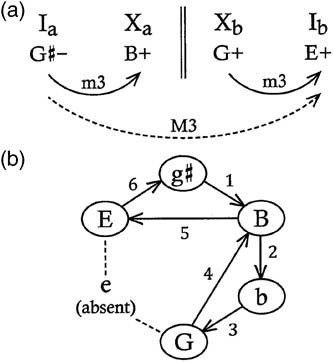
In her discussion of Trost D.523 (p. 100ff), which introduces the analytical problems posed by songs that do not end in the same key as that of their beginning, Clark interestingly confronts analyses by Thomas Denny, Michael Siciliano and Harald Krebs, before offering her own interpretation.Footnote 2 While Denny presents a model of his own, Siciliano's analysis is based on a transformational network and Clark's on the presence of a common, unifying pitch. Krebs alone advocates a monotonal structure described in conventional, Schenkerian terms. I differ with all those views, except probably with Krebs's. I see the song as built around two periods of six and eight bars respectively, followed by a three-bar postlude. Each period has a caesura at about mid-point, following the structure of the poem. The first period ends with a cadence in B major, the second with a cadence in E major. Due to metric placement, duration, and their characteristic melodic formulation, these cadences outweigh both the G♯ minor opening and the G major episode that occupies the first half of the second period. A diagram such as Clark's example 2.12b (p. 101; reproduced below as example 1), in which each key is represented identically as a label on a vertex, flattens reality unduly. (Is G♯ minor a key at all? There is no cadence, and no dominant harmony: we have to wait for the move to the six-four chord on F♯ in bar 4 to actually get tonal meaning.) I would also rather rewrite Denny's analysis, presented in example 2.12a, as Xa Ia ∥ Xb Ib and draw a ‘perfect fifth’ arrow from Ia to Ib to show that the first tonic is in fact the dominant of the second. Finally, I agree with Krebs that the song can be understood as embodying an incomplete Schenkerian structure, where the initial tonic is missing.
Clarke's example 2.12a2,12–b on p. 101.

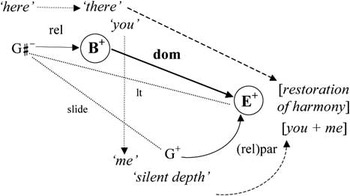
For a ‘crack in the façade’ (p. 104) to appear, a moment of ‘“tension” with some paradigm’ (p. 106) that allows a ‘hermeneutic window’ to open, the breach has to be aurally perceptible as well as deceive some identifiable expectation. Even though Siciliano's description of all four harmonies (with the addition of the ephemeral touch of B minor on the last semiquaver of bar 6) as belonging to a single neo-Riemannian LPR cycle raises curiosity from an abstract, theoretical perspective, it nevertheless leaves the hermeneutic window closed to my ears, and so does Denny's model, which is too vague to be effective. Instead, as the first line of the poem enounces ‘I shall not linger here much longer; soon I shall join you up there’,Footnote 3 it is not difficult to hear the music execute its own move from ‘here’ (G♯ minor) to ‘there’ (B major), followed by a second move leading from the inner ‘silent depth’ of G major to the soothing realm of E major. This topological displacement is intensified by the opposition of ‘you’ and ‘me’ highlighted by the cadences in bars 6 and 10 respectively. Meanwhile, the idea of going from one place to another is reflected by the overall progression from B major to E major. With only two main cadences at his disposal, Schubert's choice was constrained. The song's singularity resides in the seemingly ‘off-key’ beginning of each period: yet G♯ minor belongs to the same RP-cycle as B major, and G major as E major. I have tried to sketch some of this relational complexity in my example 2 below. None of the relations highlighted by Clark or Siciliano in their respective analyses are inaccurate, but they lack the hierarchical articulation that, in my view, would bring them into closer correspondence with the cognitive experience of the song.
Relational complexity in Trost D.523

Ganymed D.544 – one of Schubert's actual songs in multiple keys, starting in A♭ major and ending in F major – presents a different kind of difficulty. I disagree with Clark's statement that the ‘keys are never fulfilled in any Schenkerian sense’ (p. 134). The last section, lasting a full 47 bars, also deploys a full Schenkerian structure in F. All the other sections, on the other hand, present half-structures (i.e., that end with the interruption on $$)(-->$<>\raster="fx1"<$>
<!--$$
). To be sure, this poses a problem for establishing a background structure for the whole song, but each section is quite unproblematic in itself. Lawrence Kramer's Roman numeral degree figuring for bars 47–70, as reproduced in example 2.16, is incomprehensible: E is the tonic for the section in question and the inverted A major chord, reached in bar 64, is a subdominant, returning to the dominant via a C♯–C♮ chromaticism in the lower part. This is a rather banal progression, but the introduction of C♮ prepares the move from V to ♮VI in bar 71 (which is then reinterpreted as V of F). The dominant in bar 68 is structurally important, and I cannot reconcile myself with Clark's example 2.22, which drops the B pitch altogether: in no ideated world could I be brought to hear the successive sixth chords of A major and minor as a pivot III6–iii6 in F. To me, the purpose of analysis is to endeavour to render into words and therefore clarify some essential aspects of the ineffable experience of music. With all respect for Clark's reading, then, what is the conception of analysis that Analyzing Schubert seeks to promote? One can only agree with her, though, that a distinctive Schubertian trait consists in modifying the ‘qualia’ (in Steven Rings's terms)Footnote 4 of a given pitch – normally from
 $$)(-->$<>\hat{3}<$>
<!--$$
,
 $$)(-->$<>\hat{6}<$>
<!--$$
or
 $$)(-->$<>\hat{7}<$>
<!--$$
of a key (i.e. a pitch with two possible diatonic expressions) into, mainly,
 $$)(-->$<>\hat{1}<$>
<!--$$
or
 $$)(-->$<>\hat{5}<$>
<!--$$
of another (i.e. a pitch with a single diatonic expression), or the other way around. Justifiably, Clark makes this the cornerstone of her understanding of Schubert's harmony in the songs and proposes her own notation for these transformations. The question that remains, though, is whether they can be integrated into some syntax.
There is something definitely true about Clark's hypothesis that Schubert's harmony should be construed as being more ‘around a pitch’ than ‘in a key’ (p. 100). But this model is too limited, if only because it would have to integrate chromatic transformation to address most situations, if not all. Is common-tone preservation/chromatic alteration an effect or a cause, though? It is correct to observe that, with Schubert, general models lose their efficiency; but they are still valid in regard to middleground and foreground, which is also where Clark's ‘Schubertian paradigm’ operates. What we lack, however, is a theoretical model that can answer for the background structure of Ganymed, or even, more modestly, for the central harmonic pattern of Selige Welt D.743, examined in pp. 67–73. Current theory is armless when confronted with such problems; it cannot grasp them.
One last remark, this time in relation to the instrumental music: Clark writes, apropos of the ‘Reliquie’ sonata D.840, that ‘after 24 bars of a dominant pedal on F sharp major, the recapitulation bursts in in B major’ (p. 257). The dynamic indicated by Schubert in the passage is in fact pianissimo, so that the new episode hardly ‘bursts in’, especially – as Clark herself mentions – since it is prepared at length by a dominant pedal; more importantly, there is no actual return to the first bars of the movement (albeit in transposition), but a reprise a tone higher of the beginning of the development. As the latter has navigated the whole RP cycle from A to F♯ via C and E♭, it seems that Schubert is now ready to go through a second, similar cycle. This is effectively what he does, as he moves from B to D, and then to F. Yet, the material is no more that of the development; instead, elements of the exposition are gradually brought back in an increasingly recognizable way, until Schubert finally reaches his real dominant to cadence in C, and we realize that we are already into the second period of the first part of the recapitulation. This makes it even more difficult to follow Clark in her attempt at establishing a symmetry of construction between exposition and recapitulation in this Sonata, as she has done more successfully earlier in the chapter for movements built around Schubert's more theoretically compliant opposition of mediant and submediant.
To conclude, Clark's Analyzing Music participates in a positive approach, one that is vitalizing for music theory as an academic field, where different views and hypothesis are confronted, compared and assessed. It is thought provoking in the best sense, questions many aspects of analytical practice and invites a broad reflection on the very nature of that practice and its theoretical underpinnings.