Introduction
Depression during adolescence is a common and growing problem in Western society where prevalence rates are reported to be 3–8% (Lynch & Clarke, Reference Lynch and Clarke2006; Bhatia & Bhatia, Reference Bhatia and Bhatia2007; Prager, Reference Prager2009; Smith & Smith, Reference Smith and Smith2010; Goodman et al. Reference Goodman, Joyce and Smith2011). Adolescent depression is an important area to understand as symptomology may interfere with normal growth/development, educational achievement, interpersonal relationships and lead to suicidality during adolescence/young adulthood (Bhatia & Bhatia, Reference Bhatia and Bhatia2007; Prager, Reference Prager2009; Thapar et al. Reference Thapar, Collishaw, Pine and Thapar2012). However, more knowledge is needed on two aspects of adolescent depression.
First, most published studies using longitudinal data to examine the mental health and psychosocial consequences of adolescent depression only follow-up into young adulthood (e.g. Weissman et al. Reference Weissman, Wolk, Goldstein, Moreau, Adams, Greenwald, Klier, Ryan, Dahl and Wickramaratne1999a , Reference Weissman, Wolk, Wickramaratne, Goldstein, Adams, Greenwald, Ryan, Dahl and Steinberg b ; Fergusson & Woodward, Reference Fergusson and Woodward2002; Dunn & Goodyer, Reference Dunn and Goodyer2006; Lehrer et al. Reference Lehrer, Shrier, Gortmaker and Buka2006; Marmorstein, Reference Marmorstein2009; Nduna et al. Reference Nduna, Jewkes, Dunkle, Jama Shai and Colman2010; Hammen et al. Reference Hammen, Brennan and Le Brocque2013; Tuisku et al. Reference Tuisku, Kiviruusu, Pelkonen, Karlsson, Strandholm and Marttunen2014). These studies with follow-up into young adulthood report that adolescents experiencing depression have increased risks of later mental health problems of depression, anxiety, substance dependence, suicidality (Weissman et al. Reference Weissman, Wolk, Goldstein, Moreau, Adams, Greenwald, Klier, Ryan, Dahl and Wickramaratne1999a , Reference Weissman, Wolk, Wickramaratne, Goldstein, Adams, Greenwald, Ryan, Dahl and Steinberg b ; Fergusson & Woodward, Reference Fergusson and Woodward2002; Dunn & Goodyer, Reference Dunn and Goodyer2006; Tuisku et al. Reference Tuisku, Kiviruusu, Pelkonen, Karlsson, Strandholm and Marttunen2014), interpersonal difficulties, adverse parenting outcomes (Nduna et al. Reference Nduna, Jewkes, Dunkle, Jama Shai and Colman2010; Hammen et al. Reference Hammen, Brennan and Le Brocque2013), risky sexual behavior (Lehrer et al. Reference Lehrer, Shrier, Gortmaker and Buka2006; Nduna et al. Reference Nduna, Jewkes, Dunkle, Jama Shai and Colman2010) and alcohol problems (Marmorstein, Reference Marmorstein2009). However, it is unclear what the longer-term developmental pathways are for these adolescents who experience depression when they reach mature adulthood.
Second, recent research has focused on adolescents who experience sub-threshold depressive symptoms; individuals who report relevant depressive symptoms, but do not meet criteria for a major depressive episode (Bertha & Balázs, Reference Bertha and Balázs2013). Sub-threshold depressive symptoms have been shown to be associated with reduced quality of life and increased risk of developing major depression (Bertha & Balázs, Reference Bertha and Balázs2013). This suggests the need to consider the spectrum of depressive symptoms ranging from those with no symptoms of depression, through those with depressive symptoms which are not sufficient to meet the threshold for a diagnosis of major depression, through to those who meet criteria for a depressive disorder (Lewinsohn et al. Reference Lewinsohn, Solomon, Seeley and Zeiss2000; Bertha & Balázs, Reference Bertha and Balázs2013).
From a developmental perspective, there are various pathways by which adolescent depression may be linked to longer-term adult outcomes (Lewinsohn et al. Reference Lewinsohn, Rohde, Seeley, Klein and Gotlib2003). First, adolescent depression may have a direct effect on later outcomes. There are well established continuities in depression that might be expected to continue into mature adulthood (Pine et al. Reference Pine, Cohen, Cohen and Brook1999; Lewinsohn et al. Reference Lewinsohn, Rohde, Seeley, Klein and Gotlib2003; Keenan-Miller et al. Reference Keenan-Miller, Hammen and Brennan2007; Aalto-Setälä et al. Reference Aalto-Setälä, Marttunen, Tuulio-Henriksson, Poikolainen and Lönnqvist2014; Costello & Maughan, Reference Costello and Maughan2015). Research has suggested that adolescent depression may lead to difficulties in interpersonal relationships or disrupt normal developmental pathways, which in turn may be linked with compromised adult functioning (Lewinsohn et al. Reference Lewinsohn, Rohde, Seeley, Klein and Gotlib2003; Hammen et al. Reference Hammen, Brennan and Le Brocque2013; Costello & Maughan, Reference Costello and Maughan2015).
Second, there is the need to consider the potential confounding effects of prior social and family risk processes (e.g. social disadvantage, child abuse) and individual characteristics (e.g. personality) that are known to be associated with increased risks of depression in adolescence and also linked to later adverse functional outcomes (Fergusson & Woodward, Reference Fergusson and Woodward2002; Costello & Maughan, Reference Costello and Maughan2015). It may also be important to distinguish the effects of depression from the effects of other disorders (e.g. anxiety, conduct disorders) that may be co-morbid with adolescent depression. For example, conduct disordered adolescents are both more likely to have a co-morbid depression and have been shown to be at increased risk of a range of adverse psychosocial outcomes later in adulthood (Fombonne et al. Reference Fombonne, Wostear, Cooper, Harrington and Rutter2001; Lewinsohn et al. Reference Lewinsohn, Rohde, Seeley, Klein and Gotlib2003).
Finally, there is a growing body of evidence suggesting that the consequences of depression for females may be greater than those for males regarding some aspects of functioning in young adulthood [e.g. intimate partner violence (IPV) victimization; Nduna et al. Reference Nduna, Jewkes, Dunkle, Jama Shai and Colman2010; Devries et al. Reference Devries, Mak, Bacchus, Child, Falder, Petzold, Astbury and Watts2013]. This suggests the need to consider gender differences in the linkages between adolescent depression and longer-term adult functioning.
Against this background, we use data from a longitudinal study of a New Zealand birth cohort, the Christchurch Health and Development Study, to examine the linkages between the extent of depression in adolescence (age 14–16 years) and a broad range of measures of adult mental health and psychosocial functioning over the interval from ages 25 to 35 years, reflecting the period of transition into mature adulthood. The aims of this study are to:
-
(1) Document the associations between extent of adolescent depression and later adult mental health and psychosocial outcomes.
-
(2) Examine the extent to which these associations may be explained by the correlated effects of prior social, family context, individual characteristics or co-morbid mental disorders.
-
(3) Examine whether the associations between depression and later outcomes varied by gender.
Method
Participants
Participants were members of the Christchurch Health and Development Study (CHDS) birth cohort. The CHDS is a longitudinal study of 1265 children born in the Christchurch (New Zealand) urban region over a 4-month period during 1977. This cohort has been studied on a total of 23 occasions from birth until age 35 years (Fergusson & Horwood, Reference Fergusson and Horwood2001, Reference Fergusson, Horwood, Joyce, Nicholls, Thomas and Wilkinson2013). The present analysis is based upon a sample of 995 participants who were assessed for depression in adolescence (14–16 years) and also on adult psychosocial outcomes at 30 and/or 35 years. This sample represented 81% of the surviving cohort at age 30. All phases of the study have been subject to ethical approval by the Regional Health and Disabilities Ethics Committee. All data were collected with the signed consent of the study participants.
Extent of adolescent depression (14–16 years)
At the 15- and 16-year assessments, cohort members and their parents were questioned separately about the young person's symptoms of major depression in the previous 12 months using the relevant sections of the self- and parent-report versions of the Diagnostic Interview Schedule for Children (DISC; Costello et al. Reference Costello, Edelbrock, Kalas, Kessler and Klaric1982). Using this information, participants were classified on DSM-III-R symptom criteria for a major depressive episode. Separate classifications were made for self- and parent-reports at each age. A previous analysis had shown that an optimal method of classification of adolescent depression could be derived based on the highest level of symptomology reported by either source (Fergusson et al. Reference Fergusson, Horwood and Lynskey1993, Reference Fergusson, Horwood and Lynskey1995). Data were combined over the two informants and two assessments to derive a three-level classification reflecting the severity of adolescent depression over the period of 14–16 years. This classification was: no depression, the young person experienced no depressive symptoms as recorded for both self- and parent-report (68.1% of the cohort); sub-threshold depression symptoms, the young person was reported to have at least one of the core symptoms of major depression (depressed/irritable mood, loss of interest/pleasure for ⩾2 weeks) but did not meet the diagnostic threshold for a major depressive episode on the basis of either self- or parent-report (18.3% of the cohort); major depression, the young person met diagnostic criteria for a major depressive episode on the basis of either self- or parent-report (13.6% of the cohort). The classification of depressive symptoms were made irrespective of a co-morbid diagnosis of dysthymia.
Outcomes
At 30 and 35 years participants were assessed on a comprehensive interview that examined aspects of the individual's mental health and psychosocial functioning. Interviews typically lasted between 1.5–2.5 h and were conducted by trained lay interviewers at a time and setting nominated by the participant. The following measures were used in the analysis.
Mental health outcomes
At ages 30 and 35 years participants were questioned about their experience of the following mental health problems since the previous assessment.
Major depression and anxiety disorder
Participants were questioned about symptoms of major depression and a range of anxiety disorders (generalized anxiety disorder, panic disorder, agoraphobia, social phobia, specific phobia) since the previous assessment. Questioning was based on the relevant components of the Composite International Diagnostic Interview (CIDI, WHO, 1993) and DSM-IV criteria (APA, 1994). Using this information, dichotomous measures were constructed to reflect whether the participant met diagnostic criteria for a diagnosis of a major depressive episode and/or any anxiety disorder for the intervals 25–30 and 30–35 years.
Suicidal ideation/attempt
Participants were questioned using custom-written survey items about whether they had ever thought about killing themselves or had attempted suicide since the previous assessment (Fergusson et al. Reference Fergusson, Boden and Horwood2008). Using this information, participants were classified on a dichotomous measure reflecting whether they reported any suicidal ideation/attempt for the intervals 25–30 and 30–35 years.
Substance abuse/dependence
Participants were questioned about problems associated with their use of alcohol or illicit drugs in the previous five years, using CIDI items to assess DSM-IV symptom criteria for abuse/dependence. Using this information, participants were classified on dichotomous measures reflecting whether they met diagnostic criteria for alcohol or illicit substance abuse/dependence for the intervals 25–30 and 30–35 years.
Any mental health problem
To provide an overall measure of the burden of mental health problems, the above measures of mental disorder and suicidal ideation/attempt were combined to classify participants as to whether they had experienced any mental health problems for the intervals 25–30 and 30–35 years.
Education and economic circumstances
Degree attainment
At each assessment participants were questioned about their educational qualifications and any changes in these qualifications since the previous assessment. This information included whether the participant had attained a bachelor's or higher-level degree from a university or tertiary institution by age 30 or 35 years.
Welfare dependence
Participants were questioned about any times when they received a government income-tested benefit of job seeker support, sole-parent support or a supported living allowance for the interview periods of 25–30 years and 30–35 years. Using this information, responses were dichotomized into those who had and those who had not received a welfare benefit.
Net weekly personal income
At each assessment, participants were asked to report their usual weekly income from paid employment after tax and other deductions at 30 and 35 years. Earnings in currencies other than New Zealand dollars were converted into New Zealand dollars using Purchasing Power Parities [Organisation for Economic Co-operation and Development (OECD), 2007], scaled to 2012 New Zealand dollar equivalents at age 35.
Partnership and family outcomes
Unintended pregnancies
Participants were asked the total number of times they had ever become pregnant, or got a partner pregnant (males). For each pregnancy reported, participants were questioned as to whether the pregnancy had been planned, that is, both partners were not using contraception with the intention of having a child. Using this information, responses were classified on dichotomous measures to reflect a history of unintended pregnancy occurring before ages 30 and 35 years.
Sole parenthood
At each assessment participants were asked about the presence of a cohabiting spouse/partner and whether they were parenting a dependent child who was living with them. Those who were parenting a dependent child in the absence of a cohabiting spouse/partner were classified as sole parents at each age.
Respondents who reported being in a romantic partner relationship at any time in the past 12 months (n = 879 at age 30 and n = 838 at age 35) were questioned on the following additional measures of partner relationship quality and IPV.
Relationship quality
Partner relationship quality was assessed using the 25-item Intimate Relations Scale (Braiker & Kelley, Reference Braiker, Kelley, Burgess and Huston1979). This scale measured two dimensions: positive partner relations (love and investment) and negative partner relations (ambiguity and conflict). Participants responded to each item using a 3-point scale (1 = does not apply; 2 = applies somewhat; 3 = definitely applies). For the purposes of the present analysis the ambiguity and conflict items were reverse-scored and a total relationship quality score was constructed from an unweighted sum of the 25 items at each age. Internal consistency for both indices was good: α = 0.90 at age 30; α = 0.88 at age 35.
IPV perpetration and victimization
Participants were questioned about their experience of IPV perpetration and victimization in the previous 12-months, using the Revised Conflict Tactics Scales (CTS2; Straus et al. Reference Straus, Hamby, Boney-McCoy and Sugarman1996). Each scale comprised a series of 25 questions regarding the respondent's victimization by, or perpetration of, acts of verbal aggression, physical violence or threats ranging from incidents of minor verbal aggression through to severe physical assault. For the purposes of the present analysis two scale scores representing the extent of IPV victimization and IPV perpetration were constructed for each of the intervals 29–30 and 34–35 years based on a count of the number of different types of intimate partner aggression/violence reported by the participant. These scales had moderate to good internal consistency for IPV perpetration at age 30 (α = 0.74), and 35 (α = 0.70); and for victimization at age 30 (α = 0.79), and 35 (α = 0.77).
Covariates
A range of factors were selected from the CHDS database to control the associations between adolescent depression and adult functional outcomes for the correlated effects of social, family functioning and individual context. These factors spanned domains of family background and functioning, individual characteristics and co-morbid mental health problems (14–16 years). The factors were chosen on the basis that they were: (a) theoretically relevant predictors of depression in adolescence or co-morbid with adolescent depression and (b) known to be linked with one or more adult outcomes (online Supplement 1).
Statistical methods
Unadjusted associations
The first phase of the analysis pooled the repeated observations at ages 30 and 35 to obtain an estimate of the population-averaged associations between the extent of adolescent depression and adult outcomes (Table 1). Linkages between adolescent depression and outcomes were analyzed using a generalized estimating equation (GEE) modeling approach (Zeger & Liang, Reference Zeger and Liang1986) in which each outcome was modeled as a linear function of adolescent depression and age. These models were of the form:
 $$F\left( {{Y_{it}}} \right) = {b_0} + {b_1}{X_{it}} + {b_2}{\rm AGE}_{it},$$
where Y it is the outcome for the ith participant in time period t (t = 30, 35 years), F is the appropriate link-function for the outcome (log odds for dichotomous outcomes, mean for continuous outcomes and log rate for count-based outcomes), X it is the measure of adolescent depression (14–16 years) for each individual i at time t, AGE it is the age of individual i at time period t. In these models, the coefficient b 1 provides an estimate of changes in the outcomes with changes in the adolescent depression measure X it . The models permitted the repeated measures of each outcome for each individual to be correlated. The fit of the linear GEE model for each outcome was compared to the fit of a model in which depression was treated as a categorical measure. These comparisons showed in all cases, a linear model provided an adequate fit to the observed data and no statistically significant departures from linearity were detected.
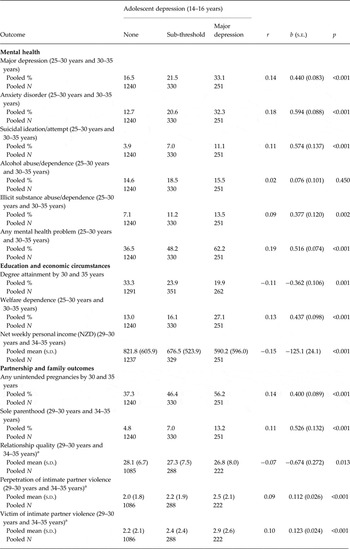
Unadjusted associations between adolescent depression (14–16 years) and a series of mental health and psychosocial outcomes pooled over assessments at 30 and 35 years

s.e., Standard error; s.d., standard deviation; NZD, New Zealand dollars.
a Analysis restricted to respondents in any romantic partnership over the previous 12 months at 30 and 35 years who also had information on adolescent depression at 14–16 years (n = 1596).
Adjusting for covariates
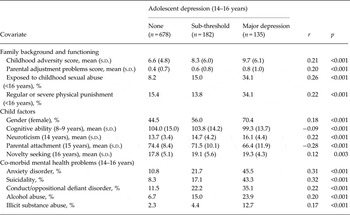
Associations between adolescent depression and covariate factors were then examined (Table 2). Each association was tested for statistical significance using the Mantel–Haenszel χ 2 test and a one-way ANOVA test for linear trend. The strength of each association was summarized by the correlation (r) between adolescent depression and the covariates.
Associations between covariate factors and adolescent depression 14–16 years

The regression models in equation (1) were extended to include the covariate factors. The models were of the general form:
 $$F\left( {{Y_{it}}} \right) = {b_0} + {b_1}{X_{it}} + {b_2}AG{E_{it}} + \Sigma {b_kZ_{ik}},$$
where Z ik is the set of observed covariate factors for each individual i (Table 3). From the fitted models, adjusted effect size estimates for adolescent depression (odds ratios for dichotomous outcomes, incidence rate ratios for count outcomes, and associated 95% confidence intervals) were calculated in the usual manner e(b 1 ± 1.96 s.e. b 1). For outcomes that were significantly associated with adolescent depression after covariate adjustment, effect size estimates were supplemented by estimates of the population attributable risk percent (PAR%), which is the estimated reduction in the outcome rates if major depression (14–16 years) did not exist in the population. The PAR% was calculated with adolescent depression dichotomized into 0 = no depression/sub-threshold depression symptoms and 1 = major depression.
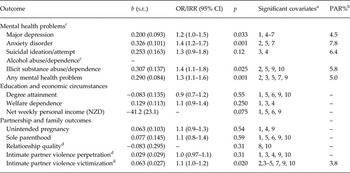
Associations between the extent of adolescent depression (14–16 years) and mental health and psychosocial outcomes pooled over observations at 30 and 35 years, after adjustment for covariate factors

s.e., Standard error; OR, odds ratio; IRR, incidence rate ratio; CI, confidence interval; PAR%, population attributable risk percent; NZD, New Zealand dollars.
a Statistically significant (p < 0.05) covariates: 1 = childhood adversity score; 2 = parental adjustment problems score; 3 = childhood sexual abuse (<16 years); 4 = childhood physical punishment (<16 years); 5 = gender; 6 = cognitive ability (8–9 years); 7 = neuroticism (14 years); 8 = parental attachment (15 years); 9 = novelty seeking (16 years); 10 = conduct/oppositional defiant disorder (14–16 years).
b PAR% = population attributable risk percent. This value was calculated on adolescent depression (14–16 years) dichotomized into two groups of: no/subthreshold depression (n = 860) and major depression (n = 135). PAR% is only reported for outcomes having a statistically significant association with adolescent depression after adjustment for confounding.
c The outcome alcohol abuse/dependence was excluded from the covariate adjusted analysis because of the non-significant association with adolescent depression in Table 1.
d Analysis restricted to respondents in any romantic partnership over the previous 12 months, at 29–30 years and 34–35 years, who also had information on adolescent depression: 30 years (n = 818); 35 years (n = 779); and pooled (n = 1596).
Gender interactions
To examine whether the associations between adolescent depression and outcomes varied between males and females the covariate adjusted models in equation (2) were extended to include multiplicative gender × adolescent depression interactions.
All analyses were conducted using SAS v. 9.3 (SAS Institute Inc., 2012) and Stata v. 12.0 (StataCorp, 2011) for Windows.
Sample size and sample bias
As noted above, the analysis is based on a sample of 995 participants (81% of the surviving cohort) assessed on adolescent depression and outcomes at ages 30 or 35 years. To examine whether selection bias due to the processes of sample attrition influenced the findings, the data were re-analyzed using the data-weighting method described by Carlin et al. (Reference Carlin, Wolfe, Coffey and Patton1999). These analyses produced model parameters and tests of statistical significance were essentially unaffected by missing data, suggesting that the findings were unlikely to have been influenced by selection bias.
Results
Associations between adolescent depression and adult psychosocial outcomes
Table 1 shows the associations between the extent of adolescent depression (14–16 years) and a series of mental health, educational, economic, partnership and family outcomes pooled over assessments at 30 and 35 years. The source data for this table is shown in online Supplement 2. The associations were analyzed by fitting population-averaged regression models to the pooled data in which each outcome was modeled as a linear function of adolescent depression and age (see Method section). For each outcome Table 1 reports: the pooled rate or mean of the outcome for each level of adolescent depression; the estimated regression coefficient (b) for the effect of depression, with the corresponding standard error and test of statistical significance (p value). The strength of each association is summarized by the correlation coefficient (r) relating adolescent depression and the outcome.
The results show the presence of statistically significant (p < 0.05) monotonic associations such that increasing severity of adolescent depression was associated with increasing rates of mental health problems (major depression, anxiety disorder, suicidal ideation/attempt, illicit substance abuse/dependence, any mental health problem); reduced educational attainment and economic circumstances (lower rates of tertiary degree attainment, higher rates of welfare dependence, lower personal income); and more adverse partnership outcomes including unintended pregnancies, sole parenthood, lower relationship quality and higher levels of conflict and violence. However, there was no association between adolescent depression and alcohol abuse/dependence (p = 0.450). In all cases the associations between adolescent depression and later mental health and psychosocial outcomes were small in magnitude (|r| ⩽0.18).
Adjustment for contextual factors
Table 2 shows the associations between adolescent depression and a series of measures of childhood family background and functioning, child characteristics and co-morbid mental health problems 14–16 years (see online Supplement 1). All associations were statistically significant (p < 0.005). Young people who experienced greater severity of depression in adolescence were more likely: to have come from families characterized by greater childhood adversity, parental maladjustment; to have been exposed to child abuse; to be female, with lower IQ; to have higher neuroticism and novelty seeking, and poorer attachment to parents; and to have higher rates of co-morbid mental health problems (anxiety disorders, suicidality, conduct/oppositional defiant disorder, ADHD, substance abuse) in adolescence.
To take into account the correlated effects of the factors in Table 2, the regression models in Table 1 were extended to incorporate these factors as covariates (see Statistical methods). Table 3 summarizes the results of the analyses showing the covariate adjusted regression coefficient, standard error and test of significance for the effect of adolescent depression on each outcome, and the covariates that were statistically significant in the adjusted model. For dichotomous and count outcomes the strength of the adjusted association is summarized by the odds ratio (OR) or incidence rate ratio (IRR) respectively and associated 95% confidence interval for a one-step change on the adolescent depression scale, supplemented by an estimate of PAR% for those outcomes for which the adjusted association with adolescent depression remained statistically significant after covariate adjustment. Examination of the table shows that after covariate adjustment:
-
(a) There remained statistically significant (p < 0.05) associations between the extent of adolescent depression and risks of major depression, anxiety disorder, illicit substance abuse/dependence, any mental health problem and IPV victimization. However, only two associations (anxiety disorder, any mental health problem) remained significant against the Bonferroni corrected p value adjusting for multiple comparisons (p = 0.006). In all cases the residual effect sizes were small with OR/IRR in the range 1.1–1.4 and estimates of PAR% of 3.8–7.8%.
-
(b) For all other education, economic, family and partnership outcomes the adjusted associations with adolescent depression were both small and statistically non-significant.
-
(c) While the significant covariates varied across outcome domains, a number of factors had significant effects across multiple domains. These included the measures of childhood adversity, parental adjustment problems, child abuse, childhood personality factors, and co-morbid adolescent conduct disorders.
To examine the robustness of the findings to the scaling of adolescent depression, the above analyses were repeated using a count of the number of depressive symptoms experienced by the young person over the period from 14–16 years. This analysis produced conclusions consistent with those in Table 3 (see online Supplement 3).
Tests of gender interactions
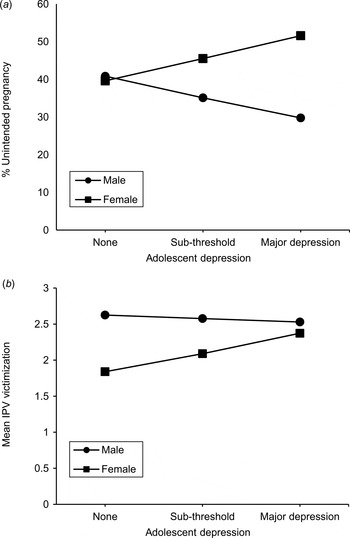
To examine whether the effects of adolescent depression on later outcomes differed by gender, the covariate adjusted models reported in Table 3 were extended to include multiplicative tests of gender × adolescent depression interactions. Significant interactions were identified for two outcomes using the Bonferroni corrected p value (p = 0.006): unintended pregnancy and IPV victimization. The nature of these interactions is explored in Fig. 1, which shows the covariate adjusted rates of each outcome by the extent of adolescent depression estimated from the fitted models. For women, increasing severity of adolescent depression was associated with statistically significant increases (p < 0.05) in rates of unintended pregnancy and IPV victimization; whereas for men, the associations were either much weaker or in the opposite direction, and statistically non-significant.
Adjusted associations between the extent of adolescent depression (14–16 years) and rates of (a) unintended pregnancy and (b) intimate partner violence victimization, pooled over assessments at ages 30 and 35 years, by gender.

Discussion
This study examined associations between the extent of adolescent depression at age 14–16 and a series of mental health and psychosocial outcomes assessed at ages 30 and 35 years. The findings of the study suggest a number of conclusions. First, at the bivariate level there was evidence of small but pervasive associations between severity of adolescent depression and the majority of outcomes examined. Thus, those who experienced depressive symptoms in adolescence were an at-risk group for difficulties in later psychosocial functioning in mature adulthood. These difficulties were not confined to those who met diagnostic criteria for major depression; those with depressive symptoms who did not meet criteria for major depression had risks that were intermediate between those with no symptoms and those who met criteria for major depression.
Statistical adjustment for a range of factors known to be associated with both adolescent depression and later adult outcomes (notably childhood adversity, parental adjustment, child abuse, child personality and adolescent conduct disorders) substantially reduced the strength of these associations. After adjustment there remained modest but significant associations between severity of adolescent depression and rates of major depression, anxiety disorder, illicit substance abuse/dependence, any mental health problem and IPV victimization; although only two associations (anxiety disorder, any mental health problem) remained significant after Bonferroni correction. Estimates of attributable risk suggested adolescent depression accounted for between 3.8% and 7.8% of the rates of these outcomes. Further, with the exception of victimization, there was no evidence that adolescent depression was associated with other educational, economic, partnership or family outcomes after covariate adjustment. These findings are broadly consistent with previous research that has shown evidence of linkages of adolescent depression with risks of mental health problems and IPV victimization in young adulthood but not with other outcomes (Kessler et al. Reference Kessler, Berglund, Foster, Saunders, Stang and Walters1997; Weissman et al. Reference Weissman, Wolk, Goldstein, Moreau, Adams, Greenwald, Klier, Ryan, Dahl and Wickramaratne1999a , Reference Weissman, Wolk, Wickramaratne, Goldstein, Adams, Greenwald, Ryan, Dahl and Steinberg b ; Fergusson & Woodward, Reference Fergusson and Woodward2002; Fergusson et al. Reference Fergusson, Horwood, Ridder and Beautrais2005; Dunn & Goodyer, Reference Dunn and Goodyer2006; Lehrer et al. Reference Lehrer, Shrier, Gortmaker and Buka2006; Keenan-Miller et al. Reference Keenan-Miller, Hammen and Brennan2007; Nduna et al. Reference Nduna, Jewkes, Dunkle, Jama Shai and Colman2010; Devries et al. Reference Devries, Mak, Bacchus, Child, Falder, Petzold, Astbury and Watts2013; Hammen et al. Reference Hammen, Brennan and Le Brocque2013; Tuisku et al. Reference Tuisku, Kiviruusu, Pelkonen, Karlsson, Strandholm and Marttunen2014).
The finding of only modest direct continuities from adolescent depression to adult depression in this study stands in contrast to previous research suggesting stronger continuities in depression from adolescence to young adulthood (Pine et al. Reference Pine, Cohen, Cohen and Brook1999; Fergusson & Woodward, Reference Fergusson and Woodward2002; Aalto-Setälä et al. Reference Aalto-Setälä, Marttunen, Tuulio-Henriksson, Poikolainen and Lönnqvist2014). For example, a previous study on the same cohort in young adulthood (Fergusson & Woodward, Reference Fergusson and Woodward2002), reported an adjusted OR of 3.6 between major depression at age 14–16 and subsequent major depression to age 21. By comparison the adjusted OR for major depression in later adulthood estimated from the present study was 1.4. This suggests that, in addition to the role of personal and family context, there may be a maturational component involved. With the passage of time into mature adulthood many of those who experience problems with depression in adolescence or young adulthood may out-grow these difficulties, resulting in much weaker direct continuities of depression into mature adulthood.
Previous research has pointed to possible scarring effects of adolescent depression that lead by various pathways to an increased susceptibility to compromised psychosocial outcomes in young adulthood (Lewinsohn et al. Reference Lewinsohn, Rohde, Seeley, Klein and Gotlib2003; Hammen et al. Reference Hammen, Brennan and Le Brocque2013; Costello & Maughan, Reference Costello and Maughan2015). The present findings suggest that when maturation and individual/family context are accounted for, any residual scarring effects on longer-term adult functioning are very small, and largely limited to modest impacts on risk of subsequent mental health problems.
An interesting finding of this research has been the differing partnership and family outcomes of adolescent depression for males and females. In particular, there was evidence of gender-specific responsivity such that increasing severity of adolescent depression was associated with increased rates of unintended pregnancy and IPV victimization for females but not for males. A number of explanations may be posited for these findings. First, a number of studies have linked adolescent depression in females to greater sexual risk-taking (more sexual partners, unprotected sex) which may in turn lead to unintended pregnancy, whereas for males depression may lead to fewer sexual partners and reduced risk of unintended pregnancy (Kessler, Reference Kessler1997; Fergusson & Woodward, Reference Fergusson and Woodward2002; Lehrer et al. Reference Lehrer, Shrier, Gortmaker and Buka2006; Hammen et al. Reference Hammen, Brennan and Le Brocque2013). Similarly, females may be at increased risk for IPV victimization due to selection into maladaptive romantic relationships (Keenan-Miller et al. Reference Keenan-Miller, Hammen and Brennan2007; Nduna et al. Reference Nduna, Jewkes, Dunkle, Jama Shai and Colman2010; Devries et al. Reference Devries, Mak, Bacchus, Child, Falder, Petzold, Astbury and Watts2013).
The current study has a number of strengths including: greater length of follow-up than most studies; good sample retention; availability of a wide range of measures of adult psychosocial functioning; comprehensive control for potential confounding factors; and prospective assessment of all measures. However, the study is not without limitations. In particular the findings reported are of a birth cohort studied in a specific historical context, using self-report interview data rather than clinical assessment, potentially limiting the extent to which they can be generalized to other contexts.
Finally, from a clinical perspective the findings reinforce the need to consider the individual/family context in which adolescent depression occurs. Adolescent depression may result in increased susceptibility to later mental health and related difficulties, but the effects of this susceptibility on longer-term adult functioning appear to be very modest in comparison to the impacts of associated context. Clinicians should also be aware of the potential for gender differences in susceptibility, and specifically the implications of adolescent depression for later sexual and partnership relationships of female patients.
Supplementary material
For supplementary material accompanying this paper visit http://dx.doi.org/10.1017/S0033291715002950.
Acknowledgements
This research was funded by grants from the Health Research Council of New Zealand (HRC 11/792), the National Child Health Research Foundation, the Canterbury Medical Research Foundation and the New Zealand Lottery Grants Board.
Declaration of Interest
None.