Introduction
Forages are included in grain rotation to improve productivity, economic returns, soil health and ecosystem functioningReference Entz, Baron, Carr, Meyer, Smith and McCaughey 1 . Despite well-known advantages of forage-crop rotations, only 5–15% of arable land in the Northern Great Plains is rotated with foragesReference Entz, Bullied and Katepa Mupondwa 2 . Profitability and economic stability of cropping systems improve when 2 or 3 years of forages are included in crop rotationsReference Davis, Hill, Chase, Johanns and Liebman 3 . However, in intensive crop production systems farmers are interested in shorter-duration annual forages. Returns from annual forages can be optimized when multiple benefits, such as soil fertility, weed competition and animal live weight gains from grazing forage biomass are drawn from themReference Sims and Slinkard 4 .
Historically, annual forages have received limited attention in the Northern Great Plains as a result of high establishment cost and emphasis on grain monocultures encouraging grain-finished livestockReference McCartney, Fraser and Ohama 5 . Recently, the increasing cost of grain feeding operations and environmental concerns regarding confined animal operations have renewed the interest in annual forages. Marketing opportunities for pasture- or grass-fed meat products are increasing but there is a knowledge gap for potential annual forage species to be used in such systems. Annual forages are generally cut as hay in conventional systems, and used as green manures for soil fertility in organic systemsReference Entz, Guilford and Gulden 6 . Information is limited on potential green manure species and mixtures to be used for enhancing soil nitrogen (N) availability in organic systems.
For many crops, legume biomass needs to provide at least 110 kg N ha−1 for yields in legume-based systems to be similar to synthetic fertilizer-based systemsReference Tonitto, David and Drinkwater 7 . Assuming that on average 20–25 kg of shoot N is fixed for every 1000 kg ha−1 of above-ground dry matter (DM) biomass of legumeReference Peoples, Bowman, Gault, Herridge, McCallum, McCormick, Norton, Rochester, Scammell and Schwenke 8 , there needs to be at least 5000–6000 kg DM ha−1 of legume biomass in order to meet the cash crop N requirement in the following year. Annual legume forages can often produce more than 5000 kg ha−1;Reference McCartney and Fraser 9 however, mineralization of organic N in legume biomass may not be in synchrony with the subsequent cash crop N uptakeReference Crews and Peoples 10 . A number of factors can affect the N contribution from annual forages including the forage type, DM production, time and type of incorporation, and residue placementReference Mohr, Janzen, Bremer and Entz 11 – Reference Vaisman, Entz, Flaten and Gulden 14 . Closer contact of plant material with soil microorganisms (i.e. incorporation) results in faster N mineralization than when it is left on the soil surface (i.e. rolled mulch)Reference Vaisman, Entz, Flaten and Gulden 14 . Similarly, even faster N mineralization can be achieved when plant material is digested in the rumen of cattle (Bos taurus) or sheep (Ovis aries)Reference Russelle 15 . Hence, grazing of green manures may improve the N availability to following cash crops.
When used as a soil fertility-building tool before cash crops, a green manure year incurs a cash crop opportunity loss. Alternatively, when harvested from the land as animal feed, nutrients are removed from the systemReference Entz, Baron, Carr, Meyer, Smith and McCaughey 1 . Grazing of green manures by ruminants has been suggested as a way to improve economic and soil fertility-building value of green manuresReference Gardner and Faulkner 16 , Reference Thiessen Martens and Entz 17 . Such integrated crop–livestock systems minimize external inputs and improve nutrient cyclingReference Davis, Hill, Chase, Johanns and Liebman 3 , Reference Wilkins 18 .
Annual green manures or forages can shift weed community composition and reduce the need to use herbicidesReference Schoofs and Entz 19 . Legumes and cereal–legume mixture green manures are preferred in organic systems because of legumes’ ability to fix atmospheric nitrogen. However, legumes are weak competitors with weeds because of a long lag time between seeding, the establishment and the formation of a competitive ground coverReference Sims and Slinkard 4 . Reduced herbicide use in forage–legume stands increases the proportion of weed biomass but the nutritional quality of such weedy forages may be similar to solid stands of forages with less weedsReference Moyer and Hironaka 20 . In organic systems, legumes are expected to have a proportionally higher biomass when grown in mixtures with non-legumes because of their ability to grow better in low N soils. Weed competitiveness of annual legumes in crop–livestock systems needs to be investigated.
Recently there is renewed interest in grass/legume intercropping. A number of workers in northern climates have evaluated and recommended pea and oat as a potential forage mix that can be adopted in low-input systemsReference Begna, Fielding, Tsegaye, Van Veldhuizen, Angadi and Smith 21 , Reference Carr, Horsley and Poland 22 . Cicek et al.Reference Cicek, Thiessen-Martens, Bamford and Entz 23 showed that soil nitrate content was higher after grazing of oat and pea/oat plots than in ungrazed plots. Although the magnitude of increase in soil nitrate content after grazing was similar for both crops, grazed pea/oat crop contributed more N to the system than the grazed oat. It may be possible to increase the magnitude of N availability compared to a pea/oat mixture if pure legume stands are grazed, because the nitrogen content of urine increases with increasing N concentration of the forageReference Kyvsgaard, Sorensen, Moller and Magid 24 .
Although the forage potential of many annual species has been evaluated, very few studies used grazing as a management effectReference McCartney, Fraser and Ohama 5 . Most research has been focused on the hay, silage or swath grazing potential of annual foragesReference McCartney, Basarab, Okine, Baron and Depalme 25 , Reference Tanaka, Karn, Liebig, Kronberg and Hanson 26 . In integrated crop–livestock systems, annual forages are expected to provide both animal feed and soil fertility amendment. There is a need to establish the effect of grazing of annual forages on soil fertility and subsequent crop productivity. In conventional systems, nutritional composition and DM productivity of a number of annual forages have been investigatedReference McCartney, Fraser and Ohama 5 , Reference McCartney and Fraser 9 , Reference McCartney, Fraser and Ohama 27 . However, there is little information on weed competitiveness and the palatability of potential green manure species. Particularly in organic systems, where soil management history may produce different soil fertilityReference Van Diepeningen, De Vos, Korthals and Van Bruggen 28 and weed pressureReference Ryan, Smith, Mirsky, Mortensen and Seidel 29 than conventional systems, such information is critical. Therefore, the selection criteria for annual forages in organic systems should include: (1) sufficient DM production for livestock; (2) N contribution to following cash crops; (3) weed competitiveness; and (4) nutritional quality and palatability.
The present work is an extension of an earlier studyReference Cicek, Thiessen-Martens, Bamford and Entz 23 where the grazing effect on N availability in grass/legume (pea/oat) versus grass (oat) green manure systems was described. This study compares pea/oat green manure to four legume species and one multispecies mixture. Specifically, the objectives of the present experiment were: (1) to investigate the productivity, weed competitiveness and livestock utilization of six green manures; (2) to compare the productivity, weed competitiveness, utilization and N benefit of various legume species relative to a pea/oat standard green manure; and (3) to compare spring wheat and fall rye productivity and N uptake responses to two green manure management factors—grazing versus incorporation. We hypothesized that more N will be available to wheat and fall rye upon grazing of pure legumes compared to grazing of pea/oat. The outcome of this study will assist our quest to identify the annual green manure forages that fit into the organic systems of temperate regions.
Materials and Methods
Site description and experimental design
Experiments were conducted at the University of Manitoba Ian N. Morrison Research Farm in Carman, Manitoba (49°29′48″N, 98°2′26″W, 267 m above sea level). The region is characterized by an extreme continental climate with very cold winters and warm summers. The frost-free period for crop production is 115–125 days, and occurs primarily between May and September 30 . Long-term average temperatures, precipitation and 2009–2012 growing season monthly temperatures and precipitation are provided in Table 1. The soil at Carman is an Orthic Black Chernozem (Udic Boroll) 31 with a fine sandy loam texture, pH (0–30 cm) of 6.0, and organic matter content (0–30 cm) of 25 g kg−1. Background soil nutrient samples were collected at a depth of 0–30 cm for Experiments 2 and 3. Soil NO3-N, P (Olsen) and K levels were 11, 20, and 569 kg ha−1 in Experiment 2, and, 13, 17, and 477 kg ha−1 in Experiment 3. No background soil samples were collected for Experiment 1. Oat was the preceding crop for all experiments. Previous investigations of the integrated crop–livestock systems have been conducted exclusively under conventional management with fertilizer inputs. The present study was conducted under long-term organic management (since 2004) with no external inputs.
Average monthly growing season air temperatures and precipitation for Carman, Manitoba, Canada from 2009 to 2012.

1 From 1961 to 1990.
Whole-plot treatments were green manure species, and sub-plot treatments were green manure management. The experimental design was a split-plot design, in randomized complete blocks with four blocks. Six green manure species (see Table 2) and two green manure management systems (grazed and incorporated) were included. The sweetclover and mixture treatments were not present in Experiment 1 but were added to Experiments 2 and 3. Therefore, the combined spring wheat and fall rye responses were determined only for three annual legume species (hairy vetch, lentil and soybean) and pea/oat mix. The green manure grazing experiment started in 2009 (Experiment 1) and was repeated in 2010 (Experiment 2) and 2011 (Experiment 3) on neighboring sites within the experimental research station. Each experiment took 3 years to complete. In the first year of the experiments, green manures were seeded in the spring and grazed or incorporated in mid- to late-summer. In the second year, a spring wheat crop was seeded in May on the grazed and incorporated green manure plots. In the third year, a fall rye crop was grown. Experiments 1 and 2 included all three phases of the experiment, but Experiment 3 only included two phases (green manure year and spring wheat year).
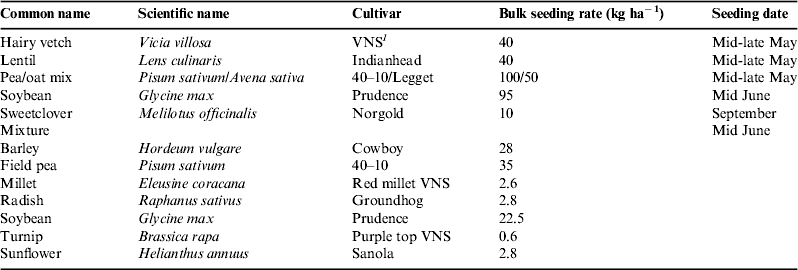
Green manure species cultivars names, seeding rates and dates.

1 Variety not stated.
Spring wheat establishment in Experiment 2 failed as a result of a higher than normal precipitation in fall 2010 and spring 2011. Therefore, wheat DM samples were collected at the stem elongation stage only for Experiment 2. Up to 70% of wheat DM samples in 2010 consisted of weeds (data not shown).
Green manure species and management
Green manure species, cultivars, seeding rates and dates are provided in Table 2. Sweetclover was underseeded to oats in spring 1 year prior to the growing season by hand broadcasting. All the other green manures, as well as wheat and fall rye, were seeded using a JT-A10 air drill seeder (R-Tech Industries Ltd. Homewood, MB) with a row spacing of 20 cm. Following green manure grazing in the first year, spring wheat was seeded in the second year as a first test crop. Fall rye was seeded after wheat harvest in the autumn and as a second test crop. Spring wheat and fall rye were seeded at seeding rates of 125 and 110 kg ha−1, respectively.
Sub-plots were 2 m wide and 9 m long and were surrounded by metal fences for precision and protection. Timing for grazing green manures depended on the amount of biomass production and generally coincided with full bloom stage for legumes and milk stage for oats. Legumes were all inoculated with the appropriate Rhizobium species. Cell-Tech liquid inoculator (Novozymes, Franklinton, NC) was used for soybeans. For peas, lentils and hairy vetch we used NitraStic-C peat-based inoculant (Novozymes, Franklinton, NC). Both the inoculants were applied at the manufacturer's recommended application rates of 75 ml inoculant per 27 kg of seed. Sweetclover was inoculated with a powdered inoculant Nitragin Gold (Novozymes, Franklinton, NC).
Stocking density was based on available green manure biomass and ranged from 2 to 3 ewes (South African Dorper) and 2 to 5 lambs for 24 h (1111–1667 sheep days per ha). For all experiments grazing usually happened in July. All subplots within a replicate were grazed simultaneously. Sheep were put into conditioning plots containing each green manure crop for 24 h before they were put into experimental plots. As such, the sheep started to consume the green manure species being tested a day before they were put into actual plots. Water buckets and shade tents were positioned in opposite ends of the plots to prevent uneven nutrient distribution. A blade-roller was used to terminate the ungrazed side of the green manure plots as soon as the sheep started consuming the grazed side. Blade rollers are able to kill green manures by crimping actionReference Vaisman, Entz, Flaten and Gulden 14 . Both the plots were tandem-disked at the same time upon the completion of grazing. No winter crops can be grown in Manitoba because of snow cover from November to May.
Plant sampling
The above-ground green manure DM production in year 1 was determined by clipping two 0.4 m2 randomly chosen samples from each experimental unit before grazing. Percent forage utilization by grazing was determined by taking the residual above-ground biomass from two 0.4 m2 quadrats, from grazed plots within 3 days after the end of the grazing period. This biomass was washed (to eliminate soil and feces adhering to residual biomass), dried for 48 h at 60 °C, and weighed for DM content. For Experiment 1, post-grazing residual biomass was not washed before drying and weighing. For Experiments 2 and 3, when the conditions were much wetter during grazing, the soil had to be washed off of residual plant material in order to accurately measure biomass.
Weed DM was determined by hand-sorting green manures and weighing the weeds after drying for 48 h at 60 °C. Common weed species were Canada fleabane (Conyza canadensis), barnyardgrass (Echinochloa crus-galli), lambsquarters (Chenopodium album), redroot pigweed (Amaranthus retroflexus), yellow foxtail (Setaria glauca), green foxtail (Setaria viridis), shepherd's-purse (Capsella bursa-pastoris), wild buckwheat (Polygonum convolvulus), lady's thumb (Polygonum persicaria), Canada thistle (Cirsium arvense), quackgrass (Elytrigia repens (L.) Desv. ex Nevski) and dandelion (Taraxacum officinale).
Spring wheat and fall rye biomass samples were harvested at the soft dough stage from 2×0.4 m2 areas in each experimental unit, dried for 48 h at 60 °C and weighed. Spring wheat and fall rye grain for yield estimation was collected from each plot using a Kincaid 8-XP (Kincaid Equipment Manufacturing, Haven, KS) plot harvester. Dry wheat and fall rye DM samples were ground with a mill to pass a 2 mm screen (Wiley No.1 Arthur H. Thomas Co., Philadelphia, PA). Wheat and fall rye grains were ground to flour with a Cyclone Mill (UDY Corporation, Fort Collins, CO) and analyzed for N concentration by combustion analysisReference Sweeney 32 using a LECO FP-528 (LECO, St. Joseph, MI). Wheat and fall rye N uptake at soft dough were calculated as the product of above-ground DM production (kg ha−1) and N concentration.
Statistical analysis
Statistical Analysis System (SAS Institute, 2001) 33 PROC MIXED procedure was used for data analysis. We used analysis of variance (ANOVA) and considered treatment effects as fixed effects and replications as random effects for all measurements. Green manure species were considered as main plots and the management (i.e. grazing and incorporation) were the subplots. Main effects were considered as green manure species, management and experiments. Combined analysis (i.e. testing interaction of green manure species, management and Experiments) was not performed for green manure species productivity, weed content and utilization, because in Experiment 1 the two species (i.e. sweetclover and mixture) were not included. However, the combined analysis was performed for wheat and fall rye productivity. Assumptions of ANOVA were tested by using the PROC UNIVARIATE procedure. All data were verified for normality of residuals and homogeneity of variance. Differences were considered significant at P≤0.05 and means were separated using a Fisher's protected Least Significant Difference (LSD) test.
Results and Discussion
Green manure DM production
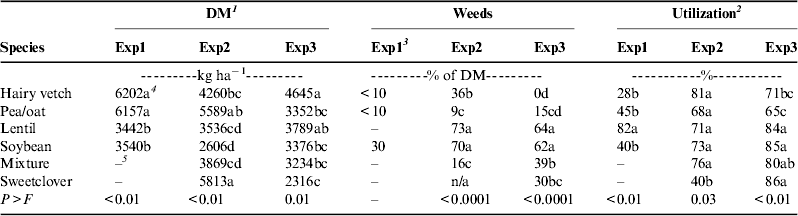
Precipitation varied over 3 years and affected forage DM production. When the precipitation was at long-term average in 2009 (Experiment 1), hairy vetch and pea/oat produced the greatest amount of DM (Tables 1 and 3). During extremely wet conditions in 2010 and 2011 (Experiments 2 and 3), hairy vetch and pea/oat produced on average 25% less DM than in Experiment 1. Although growing season precipitation was well above the long-term average in 2010, soils were not saturated in the spring of that year. In 2011, however, soils were saturated in spring because of the carryover moisture from 2010. Pea/oat, mixture, and sweetclover performed better under late season excess soil moisture (2010) conditions, and the rest of the crops performed better under early season excess moisture conditions. Averaged across the experiments, hairy vetch, pea/oat and sweetclover produced the greatest forage DM; 5036, 5032 and 4064 kg ha−1, respectively (Table 3). In Experiment 2, sweetclover and pea/oat were the greatest DM producers, while in Experiment 3 hairy vetch produced the greatest DM. Lentil, mixture and soybean produced the least amount of DM over 3 years; 3589, 3551 and 3174 kg DM ha−1, respectively (Table 3).
Green manure species DM biomass production, percent weed content and percent utilization by grazing animals for Experiments (Exp) 1, 2 and 3.

1 With weeds.
2 % of pre-grazing DM.
3 Visual ratings.
4 Within columns of same main effect, numbers followed by the same letters are not significantly different according to Fisher's LSD test (P≤0.05).
5 Mixture and sweetclover were not seeded for Experiment 1.
Studies conducted in North Dakota, Manitoba and Alaska reported DM production of pea/oat similar to the present studyReference Vaisman, Entz, Flaten and Gulden 14 , Reference Begna, Fielding, Tsegaye, Van Veldhuizen, Angadi and Smith 21 , Reference Carr, Horsley and Poland 22 . In conventional systems grass–legume mixtures (i.e. pea/oat) are used as a way to increase crude protein value of the forage compared to cereal monocroppingReference McCartney and Fraser 9 . In low-input systems, legumes are intercropped with grasses to capture atmospheric N2, as well as to improve biomass production, weed competition and soil healthReference Hauggaard-Nielsen, Ambus and Jensen 34 . The value of intercropping to increase DM production was not evaluated in the present study. Earlier studies reported inconsistent results as to the advantage of intercropping to increase DM productionReference Carr, Horsley and Poland 22 , Reference Carr, Martin, Caton and Poland 35 .
Hairy vetch is commonly used as a winter annual to provide ground cover from autumn to springReference Teasdale, Devine, Mosjidis, Bellinder and Beste 36 and as mulch in no-till crop production systemsReference Mischler, Duiker, Curran and Wilson 37 , Reference Halde, Gulden, Hammermeister, Ominski, Tenuta and Entz 38 . Hairy vetch is a common green manure in organic systems because it is an effective nitrogen supplierReference Parr, Grossman, Reberg-Horton, Brinton and Crozier 39 . In the present experiment hairy vetch was evaluated as a spring-seeded annual forage. Literature on spring-seeded hairy vetch managed without weed control is scarceReference Halde, Gulden, Hammermeister, Ominski, Tenuta and Entz 38 . When seeded in spring and weeds were controlled, hairy vetch produced an average of 6485 kg DM ha−1 across different locations in Alberta and SaskatchewanReference Fraser, McCartney, Najda and Mir 40 . Hairy vetch DM production in the present experiment was 6202 kg ha−1 in a normal year (Experiment 1) but around 25% less in wet years (Experiments 2 and 3).
Sweetclover is a biennial, high N2-fixing crop which is re-gaining its popularity especially among organic farmers. It is generally underseeded to cereal crops and the biomass production occurs in the second year. When underseeded to wheat, sweetclover production averaged 10,130 kg ha−1 in one Alberta studyReference Blackshaw, Moyer, Doram, Boswall and Smith 41 , but an earlier Alberta study reported sweetclover DM production in the range of 1120–5830 kg ha−1.Reference Moyer, Blackshaw and Huang 42 Unlike other crops, which were seeded in spring of the green manure year, sweetclover in the present study was underseeded to oats in spring, a year previous to the grazing season.
Exploitation of different nutrient niches within the cropping system is made possible by interseeding crops with varying ecophysiological traitsReference Smith, Mortensen and Ryan 43 . Mixtures of multiple species including warm and cool season crops, grasses, legumes and broadleaves have become more popular as annual forages and green manures. The mixture in this study produced a disappointing 3869 kg ha−1 in Experiment 2 and 3234 kg ha−1in Experiment 3. In North Dakota, researchers have been exploring various ‘cocktail mixes’ for late season grazing since 2007Reference Sedivec, Fraase, Neville, Whitted, Nyren and Lardy 44 . Various mixtures of warm-season grasses, legumes and brassicas produced 2120–4207 kg ha−1 of above-ground DM when seeded in mid to late summerReference Fraase 45 . No previous information on multiple species productivity as practiced in the present experiment is available from the Northern Great Plains region.
In summary, hairy vetch produced comparable or more DM than standard pea/oat green manure in all 3 years. Sweetclover produced comparable or less DM than pea/oat. Other green manures always produced less DM than pea/oat. Based on the stability of amount of DM production, hairy vetch and pea/oat are the most reliable species for annual forage production. Lentil and soybean produced the least amount of DM. Dry matter biomass production, therefore, ranked as hairy vetch=pea/oat>sweetclover=mixture>soybean=lentil.
Green manure weed competition
Legumes are poor weed competitors, therefore, weed control in both conventional and organic legume production is a challengeReference Fraser, McCartney, Najda and Mir 40 , Reference Fernandez, Sheaffer, Wyse and Michaels 46 . Including companion crops with legumes reduces the competitive ability of weedsReference Finn, Kirwan, Connolly, Teresa Sebastia, Helgadottir, Baadshaug, Belanger, Black, Brophy, Collins, Cop, Dalmannsdottir, Delgado, Elgersma, Fothergill, Frankow-Lindberg, Ghesquiere, Golinska, Golinski, Grieu, Gustavsson, Hoglind, Huguenin-Elie, Jorgensen, Kadziuliene, Kurki, Llurba, Lunnan, Porqueddu, Suter, Thumm and Luescher 47 . Intercropped pea/oat provided excellent weed control in this study. Averaged over 3 years, weed DM was less than 15% of the total pea/oat DM (Table 3). Hauggaard-Nielsen et al.Reference Hauggaard-Nielsen, Ambus and Jensen 34 showed that intercropped pea/barley was more effective at suppressing weeds than monocropped pea or barley. They determined that uptake of available inorganic N by barley limited the growth of weeds. The multispecies mixture used in the present study was as effective at suppressing weeds as pea/oat mix in Experiment 2 but not in Experiment 3 (Table 3). The mixture was seeded in mid-June because it contained some warm-season species. Late seeding enabled the emergence of warm-season weeds such as barnyardgrass lambsquarters, redroot pigweed, and yellow foxtail, reducing DM production and weed suppressing potential of the mixture. Inferior weed competitive ability of the mixture in Experiment 3 may be attributed to saturated soil conditions during the seeding of the mixture.
The second-most weed-competitive crop compared with pea/oat in this experiment was the hairy vetch, which, averaged over 3 years, contained 15% weed DM (Table 3). Hairy vetch has been used as a solo crop, as well as with other cereals to control weeds in organicReference Halde, Gulden, Hammermeister, Ominski, Tenuta and Entz 38 , Reference Leavitt, Sheaffer, Wyse and Allan 48 and conventional systemsReference Zotarelli, Avila, Scholberg and Alves 49 . It is important to note that in many previous studies, the hairy vetch was terminated with a roller crimper or herbicides, thereby adding new weed control beyond the vetch plant. However, hairy vetch living biomass can limit light penetration and prevent weed seed germination more effectively than mulched hairy vetchReference Teasdale and Daughtry 50 . In the present study we observed that vine-like growth habit of the hairy vetch provided a thick biomass cover and prevented weeds from accessing sunlight.
Sweetclover was also a competitive crop when it produced a substantial amount of biomass, as was the case in Experiment 2. In Experiment 3, however, sweetclover establishment was poor due to saturated soils, and weed DM accounted for 30% of total plant DM. In Alberta, sweetclover biomass contained less than 12% weeds when terminated in full bloom stageReference Blackshaw, Moyer, Doram and Boswell 51 , showing the weed-smothering potential of this species.
Soybean and lentil forage DM contained 30–73% weeds, failing to compete with weeds. While lentil is known to grow slowly at early vegetative stagesReference McDonald, Hollaway and McMurray 52 , the rate of growth of soybean is also slow when the temperatures are lowReference Badaruddin and Meyer 53 (i.e. spring temperatures in Manitoba), rendering both the crops as poor weed competitors. Soybean is a high-quality forage for livestockReference Sheaffer, Orf, Devine and Jewett 54 . When weeds were controlled with herbicides, forage and grain cultivars of soybean produced 5300–8400 kg ha−1 of DMReference McCartney and Fraser 9 . Strategies such as using living mulch in organic soybean production may be an effective strategy to improve soybean DM productivity. For instance, when Italian ryegrass was harvested and used as living mulch for no-till forage soybean, the need to use herbicide was eliminatedReference Kaneko, Uozumi, Touno and Deguchi 55 .
Indianhead lentil was developed as a green manure crop for semi-arid environmentsReference Biederbeck, Bouman, Looman, Slinkard, Bailey, Rice and Janzen 56 . In Manitoba, lentil grown as green manure produced 4820 kg ha−1 of DM when weeds were controlledReference Bullied, Entz, Smith and Bamford 57 . Averaged over 2 years, lentil contained 68% weed DM, much greater than that in pea/oat (i.e. <15%). When grown as organic food grain, seeding dates (early versus late seeding) had no effect on weed DM in lentilReference Smith, Mortensen and Ryan 43 . Baird et al.Reference Baird, Shirtliffe and Walley 58 showed that the weed-suppressing ability and the biomass of organic lentils increased asymptotically as the seeding rate increased. The seeding rate in the present study (205 seeds m−2) was less than the maximum rate (375 seeds m−2) suggested by Baird et al.Reference Baird, Shirtliffe and Walley 58 . A lower seeding rate used in this study may have contributed to the low DM production and consequent poor weed competitive ability of lentil.
None of the species tested in this present study provided weed control as consistent as that observed in pea/oat. Hairy vetch weed competition was similar to pea/oat in 2 of 3 years. Therefore, pea/oat was the most competitive forage tested in the present study.
Green manure utilization by sheep
Utilization for all forages ranged from 28 to 86% (Table 3). In Experiment 1, the highest utilization was for lentil (82%) while sheep utilized other species at similar levels (28–45%). In Experiment 2, utilization did not differ for all species (68–81%) except for sweetclover (40%). Lower utilization of sweetclover in Experiment 2 may be the result of high DM production and consequent woody stems of sweetclover. In Experiment 3, hairy vetch and pea/oat utilization rates were lower than other species. Generally, lower levels of utilization in Experiment 1 can be attributed to a methodological error, where post-grazing residual biomass was not washed before drying and weighing. Averaged over the experiments, sheep appeared to consume more lentil (79%) and mixture (78%) than other species. Averaged over the experiments, utilization of other species ranged from 59 to 66%.
Based on high utilization values, legumes and mixtures tested in the present study show promise as annual forages. There is little information on palatability of annual forages. In Minnesota soybean and cowpea were the most palatable forages compared to kochia (Bassia scoparia), rape (Brassica napus), amaranth (Amaranthus caudatus), sudangrass (Sorghum drummondii), turnip (Brassica rapa) and pearl millet (Pennisetum glaucum), where sheep utilized 82 and 75% of soybeans and cowpea, respectivelyReference Sheaffer, Marten, Jordan and Ristau 59 .
Even though lentil and soybean forage DM contained a high proportion of weeds, palatability by sheep was not decreased relative to less weedy forages (Table 3). Palatability and nutritional properties of some annual and perennial weeds have been shown to be comparable to those of common forage speciesReference Marten and Andersen 60 , Reference Marten, Sheaffer and Wyse 61 . In the present study some visual observations were made for the palatability of weed species. Sheep completely rejected Canada fleabane but consumed other weed species present; barnyardgrass, lambsquarters, redroot pigweed, yellow foxtail, green foxtail, shepherd's-purse, wild buckwheat, lady's thumb, Canada thistle, quackgrass and dandelion. These observations indicate that grazing may be used to control weeds in organic systems. In the present study grazing was used during the green manure phase of an organic rotation. Grazing maybe used at other stages of organic rotations, including before seeding and after harvest (i.e. stubble grazing) of cash crops to control weedsReference Lenssen, Sainju and Hatfield 62 .
Wheat and fall rye N uptake and productivity
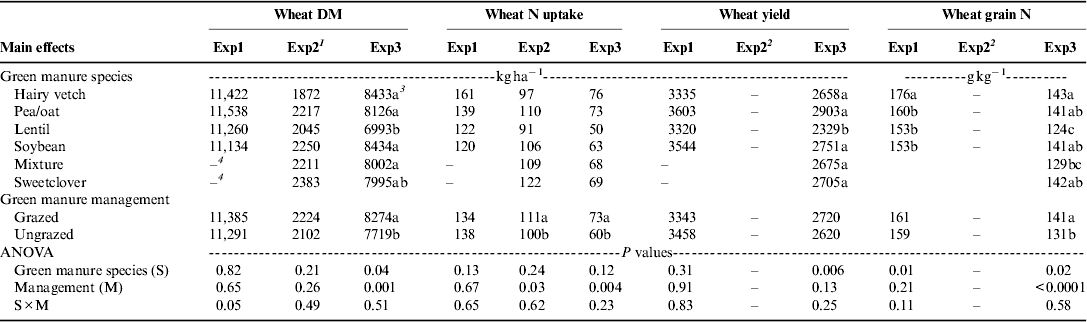
Wheat and fall rye productivity, N uptake, yield and grain N concentration varied over 3 years, responding to precipitation patterns (Tables 1 and 4). Wheat productivity in Experiment 1 was greater than in Experiments 2 and 3 because of floods in spring 2011 and drought conditions in summer 2012 inhibiting the growth of wheat for Experiments 2 and 3, respectively. Wheat grain yields in Experiment 1 ranged from 3320 to 3603 kg ha−1, which were comparable to regional conventional spring wheat yield averages (3500 kg ha−1). As a result of floods in 2011 (Experiment 2), wheat failed to establish and compete with weeds, therefore no yield data were collected. In Experiment 3, as a result of dry conditions, wheat yields ranged from 2329 to 2903 kg ha−1.
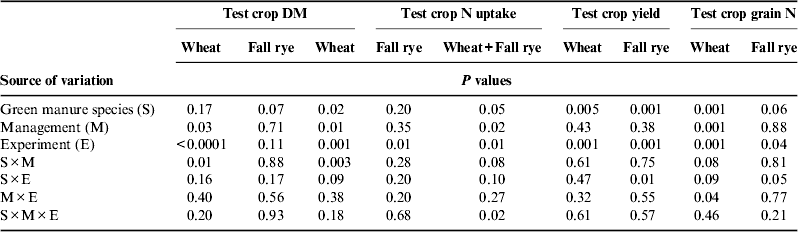
The pressing question in organic systems is how much increase in N availability is achieved upon grazing of legumes in comparison to soil incorporation. Cicek et al.Reference Cicek, Thiessen-Martens, Bamford and Entz 23 showed that soil NO3-N at 0–30 cm was on average 25% higher in grazed oat and pea/oat plots than in ungrazed plots. However, higher NO3-N availability in grazed plots did not always translate into higher wheat or fall rye N uptake in the following years. In the present study, when combined across experiments, there was a clear indication that grazing increased N availability to wheat crops (Tables 4 and 5). The grazing effect was significant for wheat DM production, N uptake and grain N, but not significant for yield across experiments (Table 4). Averaged over 3 years, wheat grown in grazed plots took up 107 kg N ha−1 versus wheat in ungrazed plots taking up 98 kg N ha−1 (Table 5). Wheat N uptake in grazed plots in Experiments 2 and 3 was 108 and 71 kg N ha−1 while that in ungrazed plots was 94 and 60 kg N ha−1, respectively. In Experiment 1 there were no differences between grazed and ungrazed plots in terms of wheat N uptake; 134 versus 138 kg N ha−1. Nitrogen availability from incorporated legumes may be slower than from synthetic fertilizers because most of the N in legume biomass is retained in organic formReference Janzen, Bole, Biederbeck and Slinkard 63 . On the other hand, Bosshard et al.Reference Bosshard, Sorensen, Frossard, Dubois, Maeder, Nanzer and Oberson 64 revealed that N availability from urine was comparable to N availability from a synthetic fertilizer; 41 versus 50% recovery by crops, respectively.
ANOVA for test crop (spring wheat and fall rye) DM biomass, N uptake, grain yield and grain N concentration as affected by green manure species (pea/oat, hairy vetch, lentil and soybean), management (grazing and incorporation) and Experiments (1 and 2).

Wheat dry matter biomass (DM) production at soft dough stage, nitrogen uptake of DM samples, grain yield and grain nitrogen content as affected by green manure species ([S] pea/oat, hairy vetch, lentil and soybean, mixture and sweetclover) and management ([M] grazing and incorporation) for Experiments 1, 2 and 3.

1 Wheat biomass samples collected at stem elongation.
2 Wheat terminated after stem elongation samples in 2011, therefore no yield data available.
3 Within columns of same main effect, numbers followed by the same letters are not significantly different according to Fisher's LSD test (P≤0.05).
4 Mixture and sweetclover were not seeded in 2009.
Nutritional and non-nutritional benefits of legumes to following crops have been broadly discussed in the literatureReference Peoples, Herridge and Ladha 65 , Reference Lafond and Pageau 66 . Biomass management to optimize the N benefit from legumes to following cash crops has also been discussedReference Mohr, Janzen, Bremer and Entz 11 , Reference Shrestha, Hesterman, Copeland, Squire, Fisk and Sheaffer 13 , Reference Vaisman, Entz, Flaten and Gulden 14 . Less attention was paid to grazing of legumes and the nutrient availability to following crops in annual intensive systems. Researchers across the USA have shown that grazing improves productivity of subsequent crops. For instance, crop productivity increased after swath grazing in North DakotaReference Sweeney 32 , winter cover crop grazing in IllionisReference Maughan, Flores, Anghinoni, Bollero, Fernandez and Tracy 67 and summer cover crop grazing under conventional tillage in GeorgiaReference Franzluebbers and Stuedemann 68 . Thus, the present study confirms the importance of grazing to increase N availability and productivity.
A major objective of this paper was to investigate whether more N was available following grazing of legumes compared to pea/oat. Cicek et al.Reference Cicek, Thiessen-Martens, Bamford and Entz 23 showed that grazing a legume-containing green manure (i.e. pea/oat) released more N than grazing of grass (i.e. oat). A significant species×management interaction effect (P=0.08) for total (wheat+fall rye) N uptake in Experiment 1 showed that while grazing hairy vetch and pea/oat biomass improved N availability, lentil and soybean did not (Table 4 and Fig. 1). While the total N uptake in grazed hairy vetch and pea/oat plots was more than in ungrazed hairy vetch and pea/oat plots, total N uptake was similar in grazed or ungrazed lentil and soybean plots. Both lentil and soybean above-ground DM contained more than 60% weed DM, hence little legume DM. Hairy vetch and pea/oat on the other hand had at least 90 and 50% legume DM. These observations suggest that higher proportion of legumes in green manures increases the wheat N uptake following grazing. Although total N uptake (wheat+fall rye) was higher in grazed hairy vetch (246 kg N ha−1) than grazed pea/oat (216 kg N ha−1) for Experiment 1, the difference was not statistically significant (Fig. 1). There was no interaction effect for total N uptake in Experiment 2 (Fig. 1). Based on plant N uptake data, our hypothesis that availability of N increased following grazing of legumes versus pea/oat was rejected.
Total test crop (wheat+fall rye) nitrogen uptake for Experiments 1 and 2 as affected by green manure species (pea/oat, hairy vetch, lentil and soybean) and management (grazing and incorporation).

Similar observations were made for wheat N uptake when combined across 3 years. Wheat grown in grazed hairy vetch and pea/oat plots took up more N (126 and 120 kg N ha−1) than wheat grown in ungrazed hairy vetch and pea/oat plots (104 and 98 kg N ha−1). On the other hand, wheat grown in grazed and ungrazed lentil and soybean plots took up similar amounts of N; 90–98 kg N ha−1. If the benchmark set by Tonitto et al.Reference Tonitto, David and Drinkwater 7 was to be taken into consideration (i.e. need for legumes to supply at least 110 kg N ha−1), then only grazed hairy vetch and pea/oat systems would meet the criterion for satisfactory N supply.
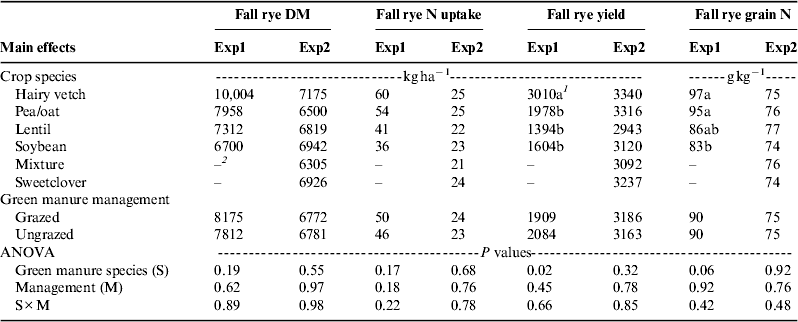
Fall rye productivity was not affected by management. There was significant species effect for Experiment 1 where fall rye grown in hairy vetch plots yielded more than the fall rye grown in other plots (Table 6). Benefits of single-year green manures to second test crops were also observed by Bullied et al.Reference Bullied, Entz, Smith and Bamford 57 .
Fall rye DM biomass production at soft dough stage, nitrogen uptake of DM samples, grain yield and grain nitrogen content as affected by green manure species ([S] pea/oat, hairy vetch, lentil and soybean) and management ([M] grazing and incorporation) for Experiments 1 and 2.

1 Within columns of same main effect, numbers followed by the same letters are not significantly different according to Fisher's LSD test (P≤0.05).
2 Not seeded.
Conclusions
This study confirmed the green manure value of pea/oat and hairy vetch. Additionally, this study established the value of pea/oat and hairy vetch as annual forages for grazing. Pea/oat and hairy vetch produced high levels of DM, competed with weeds, were readily utilized by sheep and provided N benefit to following wheat and fall rye crops. Lentil and soybean failed to compete with weeds, produced little DM and did not provide N benefit to wheat and fall rye compared to pea/oat and hairy vetch.
Grazing pea/oat and hairy vetch improved wheat productivity and N uptake in comparison to soil incorporation of pea/oat and hairy vetch in one of three experiments. In the other two experiments wheat productivity did not differ between treatments. Fall rye productivity was not affected by green manure grazing. Importantly, there were no declines in wheat or fall rye productivity grown after grazing of green manures. Therefore, in addition to the single benefit of soil fertility, an additional benefit was reaped from green manures—potential livestock live weight gain.
We observed no wheat or fall rye yield advantage of grazing of legumes over pea/oat. Future studies should investigate high biomass-producing mixes with hairy vetch (i.e. barley/hairy vetch), which are becoming more popular among producers.