Central and Eastern European countries share a legacy of over 40 years of state socialist domination characterised by a set of distinctive assumptions about gender (Pascall and Kwak, Reference Pascall and Kwak2005), which moulded behaviours and social values of both men and women in unique ways. Governments sustained the role of women as both ‘workers and mothers’ (Pascall and Kwak, Reference Pascall and Kwak2005; Gal and Kilgman, Reference Gal and Kilgman2000), providing generous parental leave schemes and childcare, and guaranteeing (or requiring) full-time employment for all. Thus, the state socialist regime supported the reconciliation of paid and unpaid work (Rostgaard, Reference Rostgaard2004), while at the same it preserved the traditional domestic division of labour and did not encourage men to participate in unpaid domestic work or care (Pascall and Kwak, Reference Pascall and Kwak2005) to an extent that women were more dependent on the state than they were on men (Gal and Kilgman, Reference Gal and Kilgman2000).
The fall of the state socialist regime was followed by a drop of economic activity, accompanied by an increase in unemployment, labour market instability, poverty and profound political, social and economic reforms, which inevitably reshaped the above-described gender relations. Pollert (Reference Pollert2003) argues that the transition is associated with a dramatic decline in gender equality. An increase in fertility rates in the region has also been observed after 1989. The fact that a number of Central and Eastern European countries were exposed at about the same time to the same external shock (the fall of state socialism) allows us to ask interesting questions regarding the effects of regime change/transition on reconciliation between family and professional life and the position of women in the labour market.
The main goal of the present paper is to focus on one particular aspect of the position of women in the labour market and to investigate whether women's perceptions of the consequences of career breaks due to childcare went hand in hand with the alterations in the political and economic system. In other words: Did the transition affect women's perception of the consequences of childbearing? Were women with children in seven Central and Eastern European countries (the Czech Republic, Estonia, Hungary, Poland, Slovakia, Slovenia and Ukraine) more likely to experience negative consequences of career interruptions due to childcare in the period before or after the fall of a given state socialist regime? The analysis is conducted in two main steps. In the first step, the effect of regime change is examined via data pooled in all seven countries. In the subsequent step, we test whether the post-transition parameter varies significantly across countries in the region by estimating the models where the control for post-transition is interacted with country dummy variables.
The main aims of this paper can be summarised as follows:
• It updates previous research on the negative consequences of motherhood for women's careers (McDonald, Reference Mc Donald2000; Stier et al., Reference Stier, Lewin-Epstein and Braun2001) by focusing on Central and Eastern European countries.
• It is the first attempt to assess the perceived impact of the transition from state socialism to a market-based economy in Central and Eastern European on women's further careers after employment interruptions. We hope to show how mothers in seven Central and Eastern European countries (which among them have huge differences regarding the consequences on female participation in the labour market and the reforms of their state family and work reconciliation policies after the transition) have experienced and are still experiencing motherhood and a professional career in different systems, and how consistent family and employment policies are from mothers’ point of view.
• It uses a subjective variable to evaluate the extent to which women's career breaks due to childcare influenced their further careers. Using a subjective variable allows us to explore the effect of career interruptions from the perspective of the individuals concerned. In addition, this approach does not require a normative assumption about what is good and what is bad for women in the labour market (Pascall and Manning, Reference Pascall and Manning2000).Footnote 1
Theoretical framework and hypotheses
Through a variety of mechanisms – such as taxation, labour market legislation, provision of institutionalised care, availability of anti-discrimination policies, length and transferability of parental leave (Hofmeister et al., Reference Hofmeister, Blossfeld, Mills, Blossfeld and Hofmeister2006) – the institutional context within which women live and work affects their career and family decisions (Van der Lippe and Van Dijk, Reference Van der Lippe and Van Dijk2002). Empirical research carried out by Esping-Andersen (Reference Esping-Andersen, Esping-Andersen, Gallie, Hemerijck and Myles2002) is highly relevant for asking about the consequences of career interruptions due to childcare, as it clearly demonstrates a link between institutional provisions and outcomes for women's employment. The author claims that female employment rates in Europe depend on the provision of so-called ‘women-friendly’ policies, including the basic elements of maternity and parental leave, affordable childcare and sick leave to care for children. In the following subsection, we briefly describe the institutional context in Central and Eastern European countries before and after the fall of the state socialist regimes.
Welfare and gender regimes before and after the fall of state socialism
Despite significant differences among countries in terms of how socialism was imposed (Hamplova, Reference Hamplová2003; Manning, Reference Manning2004), a number of authors (Hofmeister et al., Reference Hofmeister, Blossfeld, Mills, Blossfeld and Hofmeister2006; Plomien, Reference Plomien2004; Rostgaard, Reference Rostgaard2004) refer to the characteristics the various state socialist systems share with regard to gender: a high level of support for women's participation in the labour market, generous support for maternal employment by providing childcare facilities and long-term paid childcare leave (childcare leave can be compared to today's parental leave with the difference that it was granted only to women). Long-term formal female inactivity (being a housewife) due to childcare was not recognised as a possible strategy for women. Thus, after giving birth women benefited from maternity and childcare leave and then re-entered the labour market. At first glance, there seem to be many parallels between state socialist gender regimes and the Scandinavian countries, where, similarly, both female employment and fertility rates have historically been very high (Saxonberg and Sirovátka, Reference Saxonberg and Sirovátka2006; Pascall and Kwak, Reference Pascall and Kwak2005). However, the Swedish egalitarian model differs significantly from the coercive state socialist regimes (Hofmeister et al., Reference Hofmeister, Blossfeld, Mills, Blossfeld and Hofmeister2006; Pascall and Kwak, Reference Pascall and Kwak2005), which required rather than enabled women to work full-time despite having children. In addition, researchers often point out that, in socialist states, the public and political discourse on the issue of gender equality concentrated on labour market participation, while largely ignoring such concerns as gender division of household tasks (Pascall and Manning, Reference Pascall and Manning2000; Manning, Reference Manning2004; Večerník, Reference Večerník2007).
After 1989, Central and Eastern European countries underwent a profound transformation followed by a deep economic crisis. As a result, problems such as unemployment, poverty, and social inequality called for restructuring and reforming the old social policies and adapting them to the new market-based context in which they now need to operate (Fultz, 2002, in Fenger, Reference Fenger2005). There is wide agreement among researchers that the transition was synonymous with changes in the state economies, labour markets and welfare services (Pascall and Kwak, Reference Pascall and Kwak2005).
Despite the fact that some researchers argue that post-socialist states have followed individual trajectories of policy development, especially with regard to gender (for example Rostgaard, Reference Rostgaard2004), the majority of authors dealing with welfare issues in post-socialist countries (for example, Cerami, Reference Cerami2006; Fenger, Reference Fenger2005; Hofmeister et al., Reference Hofmeister, Blossfeld, Mills, Blossfeld and Hofmeister2006; Lück and Hofäcker, Reference Lück and Hofäcker2003; Lück, Reference Lück, Blossfeld and Hofmeister2006; Pascall and Kwak, Reference Pascall and Kwak2005) argue that post-socialist states show certain commonalities and can be collectively regarded as a separate welfare-state model.
This paper draws on the comprehensive work of Pascall and Kwak (Reference Pascall and Kwak2005), who develop and apply a framework based on five measures (i.e. paid work, income, care, time and power) to analyse gender relations across post-socialist states and then claim that the post-socialist gender regimes exhibit shared characteristics resulting from their common historical experiences, namely a 40-year period in which both men and women were in the labour force and the subsequent shared economic crisis in the transition from socialism to democracy. The authors conclude that Central and Eastern European countries can be classified as ‘dual-earner regimes, with comparatively strong collective support for women's employment and for parents’ (Pascall and Kwak, Reference Pascall and Kwak2005: 67). Nevertheless, it needs to be pointed out that those regimes have been significantly undermined by the challenges of economic transition, which has eroded the states’ ability to support gender equality. Pollert (Reference Pollert2003) points out that, after transition, countries in the Central and Eastern European region have experienced significant decline in the level of gender equality (measured by the Gender-related Development Index – GDI).Footnote 2 The author claims that ‘capitalist transition not only failed to maximise the female human resource legacy left by the Communist regimes, but damaged it’ (Pollert, Reference Pollert2003: 336).
In order to formulate working hypotheses about the perceived consequences of female career interruptions due to childcare and how those consequences have been affected by the transition, it is important to take a closer look at the specific policy mechanisms that post-socialist states have developed in responses to women's needs to combine work and family life. As pointed out by Cerami (Reference Cerami2006), the general trend in the region is to place more importance on family life, meaning shifting the responsibility of childcare from the government to the parents. Rostgaard (Reference Rostgaard2004) points to a trend among post-socialist governments to encourage the mothers’ role in providing primary care. This change becomes obvious through the drastic restrictions of state support for nursery schools and through a continuation or even prolongation of already relatively long parental leaves. Szeleva and Polakowski (Reference Szelewa and Polakowski2008) argue that, after 1989, parental leave provisions became more universal, i.e. more families with small children have access to such benefits compared with during the socialist era.
Saxonberg and Sirovátka (Reference Saxonberg and Sirovátka2006) are very critical of this approach by the post-socialist governments, as they see the adoption of such policies as ways to explicitly or implicitly encourage women to stay at home, especially in the absence of efforts to challenge the traditional division of childcare within families. Lack of available and/or affordable childcare facilities hampers women's participation in the labour market and encourages them to use the maximum available parental leave. Due to low nominal wages and an unstable economic situation, two-income households are the norm in the region and both partners are expected to work full time. Therefore women try to re-enter the labour market immediately at the end of their paid parental leave; long-term inactivity due to childcare is a rather rare strategy of women with children. In this context, Čermáková (Reference Čermáková1997) states that, due to childcare in post-socialist countries, women's careers are interrupted virtually only by maternity/parental leave. One might think that long parental leave protects women's jobs longer and thus should lead to fewer negative consequences. However, Rhum (Reference Ruhm1998) and Math and Meilland (Reference Math and Meilland2004) state clearly that the longer a person takes parental leave, the more negative the consequences will be concerning their competitiveness in the labour market and their job opportunities when they return to work.
Women who had children after the fall of the state socialist regimes are more exposed to a new social risk – unemployment – than their older counterparts. In the Czech Republic, for example, women aged 20–35 years are most at risk (Hamplová, Reference Hamplová2003). Hašková (Reference Hašková2007) argues that women with children have a higher risk of long-term unemployment than other social groups.
Plomien (Reference Plomien2004) also points out that new labour market conditions have made women more vulnerable to different forms of gender-based discrimination, especially in the private sector. This can be explained by the greater vulnerability of private companies to market developments and shocks as well as by the difficulties of implementing legislation regarding equal opportunities in the private sector in post-socialist countries (Čermáková, Reference Čermáková1997; Hašková and Křížková, Reference Hašková, Křížková and Roth2008).
Summing up the above arguments, we can argue that both before and after the regime fall the most common form of career break due to childcare was childcare/parental leave guaranteed by the state. The difference between pre- and post-transition childcare/parental leave lies mainly in their universality and duration. Women who gave birth after the regime change tend to take leave more often and for longer periods than pre-regime-change mothers. This might have a negative effect on their competitivess in the labour market. Additionally, mothers who interrupted their career due to childcare during the socialist era seem to have faced fewer risks related to their professional careerFootnote 3 than women who had children after 1989 and who were exposed to the higher competitive pressures of the liberal labour market.
We have the following hypotheses:
Hypothesis 1: Women who gave birth during the transition period (after 1987) and subsequently interrupted their careers are more likely to experience negative consequences for their further careers than women who had a career break due to childcare during the socialist era. This trend should hold even after we control for key individual sociodemographic and labour market characteristics.
Despite the shared market shocks and characteristics among post-socialist states, which allow us to test the above hypothesis on the pooled data, we cannot ignore that those countries show well-documented social, cultural and gender-related differences. Pascall and Kwak (Reference Pascall and Kwak2005) and implicitly Pollert (Reference Pollert2003) suggest that Slovenia should be placed on the upper end of the ranking of countries with respect to gender equality (due to its generous state support for gender equality), while Poland trails near the tail as its return to traditional family policies seems more pronounced than in other countries (possibly due to the influence of the Catholic church).
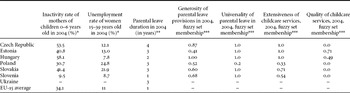
Szelewa and Polakowski (Reference Szelewa and Polakowski2008) claim that the post-socialist countries can be clustered in four distinctive models, depending on the structure and level of work–family reconciling policies and common patterns of childcare after 1989. Their classification is based on four parameters: the extent and quality of childcare services as well as the extent and universality of parental leave provisions (see Table 1, columns 5–8). They argue that countries like the Czech Republic and Slovakia fall under the label of explicit familialism, which can be characterised by long-term paid parental leave and a low level of support for public childcare services, as women are perceived as the main caregivers and their labour market participation is not directly encouraged.
Selected characteristics of seven post-socialist countries

Notes: *Eurostat http://epp.eurostat.ec.europa.eu
**Drew (Reference Drew2004).
***Szelewa and Polakowski (Reference Szelewa and Polakowski2008, data selected from tables 2 and 4). Fuzzy set membership is ‘a representation of an empirical phenomena which is guided by rules stemming from theoretical and substantive knowledge . . . The qualitative anchors are established in the process of calibration’ (Szelewa and Polakowski, Reference Szelewa and Polakowski2008: 118). Interpretation: The closer is the number to 1, the higher is the generosity and extensiveness of provisions. The closer is the number to 0, the lower is the generosity and extensiveness.
An implicit form of familialism can be found in Poland, where women are seen as the main caregivers. Here, formal childcare is not easily accessible, women's participation in the labour market is not encouraged and parental leave benefits are income-tested, thus hardly accessible and not very generous. There is no universal system of financial support for childcare in the country. Estonia belongs to the female mobilising type, where, on the one hand, childcare facilities are easily available and of high quality and, on the other hand, parental leave provisions are not very generous – a combination that does not motivate women to take long-term parental leave.
Hungary went through two policy models. From 1989 to 1997, it exhibited features of the explicit familialism model (defined above). Since 2002, it can be defined as a country with comprehensive state support. This policy type can be characterised by widely available childcare facilities and generous family provisions, which allow women to choose between having their children cared for in childcare facilities or looking after them themselves.
In Slovenia the work–family reconciling policies have also undergone changes. From 1989 to 1991, they had attributes of the implicit familialism model and since 1995 they have become closer to explicit familialism. However, unambiguous positioning of this country is rather difficult.
With respect to Slovenia, there is a discrepancy between the ranking by Pascall and Kwak (Reference Pascall and Kwak2005), which placed Slovenia at the top of their gender equality continuum, and the above-mentioned typology of Szelewa and Polakowski, who identified Slovenia with familialism. The discrepancy stems from the fact that Szelewa and Polakowski base their classification solely on the extent and quality of work–family reconciling state policies, whereas Pascall and Kwak focus also on the position of women in the labour market and on female employment. Thus, different methodologies lead to different labour market outcomes.
In the first half of the 1990s, GDP declined sharply in most of the transitional economies. With regard to the countries analysed in this paper, it was Ukraine that experienced the most dramatic and the most persistent drop in GDP growth. In the first half of the 1990s, the Ukrainian GDP growth rate was –46 per cent, while, for example, in the Czech Republic it was –10 per cent, in Hungary –12 per cent, in Slovakia –19 per cent, in Slovenia –7 per cent and in Estonia –30 per cent. Poland exhibited positive GDP growth of 4 per cent. In the second half of the 1990s, most of the countries in the region started to show economic growth, while Ukraine had to wait until the beginning of the new millennium for its economy to show the first signs of revival (UNECE, 2002).
The countries in Eastern Europe also show differences with regard to the consequences for female employment following labour market restructuring. The following figures underline this cross-country diversity: unemployment rates among young females in Hungary, Slovenia and the Czech Republic are almost equivalent to the EU-15 average (11 per cent in 2004), while in Poland and Slovakia one-fifth to one-fourth of women aged 15–39 years were unwillingly out of the labour market. If we look at the inactivity rates of mothers of young children, it becomes clear that in 2004 more than half of the mothers in Hungary and the Czech Republic were out of the labour market. Slovakia, Estonia and Poland show inactivity rates between 30 per cent and 40 per cent, while in Slovenia less than 10 per cent of women with children up to six years old were not engaged in paid labour. Table 1 summarises some of the indicators mentioned in the previous paragraphs.
Given the arguments pointing toward the heterogeneity of post-socialist states with regard to developments in the labour market and family policy after 1989, we analyse whether the seven above-mentioned countries show substantial differences, first with regard to the perceived consequences of career interruptions due to childcare, and second relating to the effect of transition on those perceived consequences. Based on this, we formulate two additional hypotheses.
Hypothesis 2: These countries show differences in the likelihood of women experiencing negative consequences due to childcare-based career interruptions. Women in countries with poorly performing economies and labour markets as well as poorly developed and not-very-generous policies allowing reconciliation of family and work (such as Ukraine and Poland) are more likely to report negative consequences of career breaks.
Hypothesis 3: The countries analysed will differ in the ways in which the transition has affected women's perceived consequences of their career breaks. We assume that in countries that, after the fall of socialism, developed family policies that support more explicitly reconciliation of family and work and stimulate female employment (i.e. Slovenia, Estonia, Hungary), having a child before or after 1987 affects how women perceive the consequences of career breaks.
Analysing the differences between the various countries allows us to compare the situations in countries that can be considered as opposite poles of the Eastern European gender-regime axis: Poland can be referred to as the ‘strongest case for a return to the male breadwinner model’ and Slovenia as ‘the Sweden of the south’ (Pascall and Kwak, Reference Pascall and Kwak2005: 66). Although it shares the socialist legacy of the other six countries (True, Reference True, McGrand and Runyan2002), Ukraine has made somewhat less progress in gender equality during its transition to a market-based economy (Rutkowski and Scarpetta, Reference Rutkowski and Scarpetta2005). Ukraine has experienced the most dramatic and persistent drop in GDP growth of any of the countries analysed here. The drop in GDP growth in Ukraine in the first half of the 1990s was at least twice as big as in other countries. And in the second half of the 1990s, other countries started to show signs of a growing economy and consequently of GDP growth, whereas Ukraine lagged behind for several years (UNECE, 2002).
Empirical analysis
The analysis is structured in three parts. First, following the theoretical assumptions according to which the post-socialist countries can be seen as members of a coherent gender and welfare regime, the effect of having children during or after state socialism (transition effect) on subsequent experiences in the career development of women is analysed using binary logistic regression on a pooled sample, including the seven Eastern European countries considered here.
The second part of the analysis aims to investigate whether the different cultural and institutional contexts in each of the seven countries affect the experience of negative consequences in career development following interruptions due to childcare. This is achieved by introducing dummy variables for countries in the previous binary logistic regression.
In the third part, we elaborate the model further by including interactions between country and transition variables. By doing this, we try to measure, at the country level, the effects of the transition from socialism to democracy on the perceived consequences of career interruptions. Thus, significant interactions between a country and the transition variable can suggest that there are differences among countries regarding the consequences of taking time off to care for one's children.
Data source
The European Social Survey Data for the analysis has been provided by the European Social Survey (ESS) tracing values, attitudes and behaviours across Europe. The ESS is conducted every two years, via face-to-face interviews. The survey questions include a ‘core’, which remains relatively stable in each round, and two ‘rotating’ supplementary modules, which change in each round and aim to provide in-depth information on areas of particular academic and policy-making interest.
In this paper, we use data from the second round of the ESS project, which was completed in 2004,Footnote 4 in particular from the supplementary question module called ‘Family, Work and Welfare in Europe’. The module was designed to reveal how individuals in different European countries interpret their work, family and general life experiences through the subjective lens of their attitudes and preferences. For our analysis, we adapted one of the ESS questions to use as a dependent variable. In addition, information available in the module allows for the incorporation of both ‘objective’ and ‘subjective’ indicators as explanatory variables.
However, it must be noted that the ESS dataset, and consequently this paper, has several limitations. For a start, the study design is cross-sectional and not longitudinal. Working with cross-sectional data enables the tracing of the experiences of different groups of women, i.e. the ones who have borne children before and after the fall of socialism. However, the results on how women evaluate the effects of their career interruptions at the time of data collection will need to be interpreted with caution, as it is not possible to completely separate the effects of the transition, other historical events, cohort effects or the effects of the life-course stage of individual respondents. Furthermore, the cross-sectional design does not allow for some theoretically important variables – such as the level of income, the presence of a husband/partner, occupational status or experience in the labour force prior to childbirth – to be included in the analysis, as the dataset does not provide information on the status of those variables at the time when the decisions of reconciling paid work and care or even having children at all were made.
Despite these limitations and due to the absence of more adequate longitudinal data, the ESS dataset is at the moment the only source of data from Central and Eastern European countries dealing with the issues of career interruptions and their consequences, and as such it provides at least some retrospective micro-data and thus allows comparison of the situation before and after the fall of socialism.
Sample
The analysis included 4,321 women from seven countries (1,012 from the Czech Republic, 761 from Estonia, 481 from Hungary, 435 from Poland, 401 from Slovenia, 403 from Slovakia and 823 from UkraineFootnote 5). We assume that the sample sizes in the analysed countries are large enough to yield interpretable results. However, we keep in mind that the significance of the estimated coefficients in our regression models might be affected by relatively smaller sample size in some countries (i.e. the smaller the country sample size, the less significant the estimates).
Only women who had children and spent at least some time caring for them full-time were included. They were asked to provide an evaluation of the consequences for their career development only if they had actually spent at least some time away from work due to their childcare responsibilities.
Given this selection of the cases included in the analysis, it should be noted that the sample may have become inherently biased. It is possible that the women excluded from the analysis – i.e. those who had children and did not have any career break due childcare – were not a random group, but rather differed systematically from the rest; for example, they could have exhibited a different level of commitment to their career.
To evaluate for a possible selection bias, we checked how many mothers were excluded from the study because of never having interrupted employment to take care of their children and whether this group of mothers shows significant pre- and post-transition differences. The data reveal that a vast majority of mothers in the analysed countries (almost 90 per cent) report that during their life they have interrupted their careers because of their children. Thus, only about 10 per cent of mothers in the region have been excluded from the analysis. If we compare women who had children before and after 1987, we can observe that, during socialism, career breaks were less common than during the transition period (19 per cent of pre-1987 mothers report that they have never interrupted their careers due to childcare compared to 6 per cent of post-1987 mothers). This trend has been observed in all analysed countries.Footnote 6 This finding corroborates the above-mentioned arguments of Cerami (Reference Cerami2006), Rostgaard (Reference Rostgaard2004) and Saxonberg and Sirovatka (Reference Saxonberg and Sirovátka2006) regarding the reinforcement of traditional division of childcare in the post-socialist countries after regime change.
When we examine whether and how the women excluded from and included in the study differ pre- and post-transition with regard to education, experience with part-time work, number of children and attitudes towards reconciliation of family and paid job, it becomes apparent that excluded mothers (those who have never interrupted their career due to childcare) differ significantly from included respondents only when it comes to education. Excluded mothers are more likely to have only a basic education, and less likely to have a secondary education, than women included in the analysis. This can be explained by the fact that women who did not interrupt their career due to childcare during socialism are in general older women and thus, given the constantly growing level of educational achievement of younger generations, are more likely to exhibit lower educational attainment. Other characteristics of included and excluded mothers did not differ significantly pre- and post-transition.
Dependent variable: consequences of career interruptions due to childcare
A variable was constructed from the question: ‘Do you think that the time spent at home caring for your children has had negative consequences for your occupational career?’ (G122). The women could choose between five answers (‘Yes, definitely’; ‘Yes, probably’; ‘No, probably not’; ‘No, definitely not’; and ‘Don't know’). Only the first four categories of responses were included in the analysis, and they were merged into two broader categories (‘Yes’ and ‘No’), so that the variable could be used as the dependent in a binary logistic regression equation. Only women who had at least one child and had spent some time at home caring for it were invited to answer the above question.Footnote 7
Some remarks must also be made on the nature of the dependent variable. Using women's own perceptions of whether or not career interruptions due to childcare had negative consequences on their careers spares the need to make an assumption about ‘what is best for women’ (Pascall and Manning, Reference Pascall and Manning2000: 244). This is all the more important in a context where objective measures for women's employment developed in the West may have dramatically different meanings within the cultural and institutional configurations of Eastern European states. For example, taking only the question of whether a woman re-enters the workforce after having a child may not be a good indicator of the extent to which it is possible to reconcile work and family, as in Central and Eastern Europe economic necessity is often quoted as a reason for high female employment rates (Saxonberg and Sirovátka, Reference Saxonberg and Sirovátka2006). Therefore, many women, although employed, may actually not have the jobs they aspire to – this at least partly because of their career interruptions due to childcare.
Using another objective indicator of career advancement, such as moving to jobs with more responsibility and higher prestige, would also not provide a complete picture, as it would not take into account the fact that not all women aspire to ‘climb the professional ladder’. For some of them, it may be more valuable to find a stable and secure occupation that allows them to combine work and family life. As a consequence, basing an analysis on such variables can provoke misleading conclusions.
Furthermore, as a self-reported and also retrospective measure, our dependent variable may be influenced by women's moods at the moment of the interview or by the stage of their career. A woman who has recently returned to work, for example, may be more inclined to answer ‘Yes’, compared to a woman who has already had time to level off the possible negative effects of an employment break and re-establish her career.
Key explanatory variables
Transition
Given the main aim of the paper – i.e., to analyse the effect of the transition from state socialism to democracy and a liberal economy on the further careers of women after an employment break – we need to specify how the transition period can be operationalised. Since we want to compare the perceptions of mothers who have had personal experience with career interruption during the state socialist regime with those who have made a career break due to childcare after the fall of socialism, we construct the transition variable on the children's years of birth. Thus, the analysis distinguishes between women who had all their children prior to 1987 and women who had at least one child in the period after 1987.
The year 1987, rather than 1989 or 1990, was taken as the threshold year because the parental leave granted by legislation in post-socialist countries prior to the transition was on average about three years (Brainerd, Reference Brainerd1997). Thus, it can be assumed that women who gave birth during the later years of socialism experienced the consequences of their career interruption in the new post-1990 market situation. This assumption has been confirmed by regression analysis in which we observed no difference in the obtained coefficients and significance levels for women whose children were born between 1987 and 1989 and women who gave birth during or after 1990.
Using the transition variable as defined above, we have to take into account that we will not be able to clearly separate whether the effect of the transition variable on the perceived consequences of career breaks can be attributed to the effect of the period during which the women had their children (so called period effect) or to the generation effect (the fact that younger cohorts of women in general tend to be more work and career-oriented compared to older cohorts (Esping-Andersen, Reference Esping-Andersen, Esping-Andersen, Gallie, Hemerijck and Myles2002, Hakim, Reference Hakim1992, Kuchařová, Reference Kuchařová1999, Večerník, Reference Večerník2007). Additional analyses have proved that there is a significant association between the age of the women included in the analysis and whether their children were born during state socialism or not. The data show that 25 per cent of women who had at least one child after 1987 say that career interruptions due to childcare had negative consequences for their further career, while only 14 per cent of women who interrupted their career before the fall of the state socialist regime had the same experience. The chi-square test revealed a significant relationship between perceived consequences of career breaks and transition (χ = 63.954, df = 1, p = 0.000).
Country
On average about 19 per cent of the women in the seven post-socialist countries analysed perceive their career interruption due to childcare to have had negative consequences for their careers.Footnote 8 Women in Poland, Hungary and Ukraine have the highest proportion of negative experiences regarding consequences of career interruptions due to childcare (21 per cent, 20 per cent and 19 per cent, respectively). On the other hand, Estonia, Slovakia, the Czech Republic and Slovenia show the lowest proportions of negative responses (11 per cent, 13 per cent, 14 per cent and 15 per cent, respectively). The chi-square test reveals a statistically significant relationship between the country and the dependent variable (χ = 37,406, df = 6, p = 0.000). However, those results have been obtained without controlling for other variables and may thus change in the explanatory analysis.
Control variables
Focusing on the structural level alone would fail to give credit to the role of the individual in shaping career outcomes over a lifetime. Thus, in this paper, transition as a structural-level factor is investigated in combination with individual-level factors that could also have played either a positive or a negative role with regard to negative consequences of career interruptions due to childcare. Without the introduction of these necessary controls the estimation of the transition effect would be biased.
The European Commission's Report on Equality between Women and Men (2008) indicates that the female employment rate drops as the number of children per woman rises. The more children a woman has, the more likely it is that she will interrupt her career and stay out of the labour market for a prolonged period.
With regard to education, women with higher educational attainment tend to interrupt their careers due to childcare for shorter periods in order to minimise losses concerning career opportunities and income (Chiplin and Sloane, Reference Chiplin and Sloane1976). They are therefore less likely to feel restrictions or other negative consequences due to career breaks. Education is measured by a variable adapted from the question ‘highest level of education you have achieved’ (F6). The question is asked on a country-specific scale and then harmonised to form a common scale going from 0 = ‘not completed primary education’ through 6 = ‘second stage of tertiary education’. To meet the purposes of the present analysis, the categories were reduced to three: lower secondary or basic, upper secondary and higher education.
Olah and Fratczak (Reference Olah and Fratczak2004) and Hofmeister et al. (Reference Hofmeister, Blossfeld, Mills, Blossfeld and Hofmeister2006) point out that a possibility to work part-time can help resolve the ‘family or work’ dilemma. In post-socialist countries, part-time work is and has been a rather rare phenomenon. Having the possibility to work part-time indicates that the woman works either in the public sector or has a stable position or a good financial background, allowing her to negotiate and pursue such an arrangement. Given this, women who have always worked part-timeFootnote 9 because of their children will report less negative consequences of career breaks than women who have never had such an experience. To measure experience with part-time employment, the ESS questionnaire asked women to estimate how much time they have spent in part-time work due to childcare (G123). The variable is measured on the same scale as the total duration of time spent at home due to childcare. However, as very few women in the sample worked part-time, the only possible way to include the variable in our analysis was to distinguish between the ones who spent at least some time working part-time due to childcare responsibilities and the ones who did not.
When discussing the impacts of career breaks due to childcare on mothers' further careers, it is necessary to consider the duration of these breaks. There are studies that prove that the longer a person stays out of the labour market, the more competences and opportunities he or she loses, and consequently the more difficult it becomes to re-enter the labour market (Ruhm, Reference Ruhm1998, Math and Meilland, Reference Math and Meilland2004; Roman, Reference Roman2006). In the present paper, the variable describing the duration of career interruptions was constructed using the question, ‘Including any time spent on maternity or parental leave, about how long in total did you stay full-time at home because you were caring for your child(ren)?’ (G121). Respondents chose one of seven options, starting with ‘no time at home because of children’ and ending with ‘more than 10 years’. For the purposes of the present analysis, the variable was regrouped into three categories in order to ensure sufficient number of data points per cell.
Various studies (Adler, Reference Adler2002; Hakim, Reference Hakim2003; Crompton and Lyonette, Reference Crompton and Lyonette2005) suggest that both women's family–career preferences and the way they perceive their roles as mothers and workers affect their position in the labour market and therefore might influence their perceptions of the consequences of career breaks due to family responsibilities.
To measure women's attitudes toward reconciliation of paid work and family responsibilities, we opted for the question: ‘For you personally, how important do you think each of the following would be if you were choosing a job?’. The two dimensions that were analysed were ‘a job with good promotion opportunities’ (G113) and ‘a job which allowed you to combine work and family’ (G115). In the dataset, women's responses are ranked on a five-point scale (1 = not important at all, 3 = neither important nor unimportant, 5 = very important). For our analysis, the first three categories were merged into one, coded as ‘not important or neutral’.
Marital status is another factor that plays a role in how respondents perceive the consequences of career breaks due to childcare. According to Kilkey and Bradshaw (Reference Kilkey, Bradshaw and Dainsbury1996), women with a long-term partner have less difficulty reconciling career and childbearing. Due to the fact that the data used in the paper contained only the respondent's current marital status and not the one at the time when the career break took place, we cannot use this control in this study.
Desai and Waite (Reference Desai and Waite1991) claim that the longer a woman's participation in the labour market and the higher her work position and income potential are, the shorter will be any break due to childbearing. However, given the nature of our data, which does not give us retrospective information about occupation, work position and income of a woman at the time of the career break, we cannot control for these variables either.
Analysis
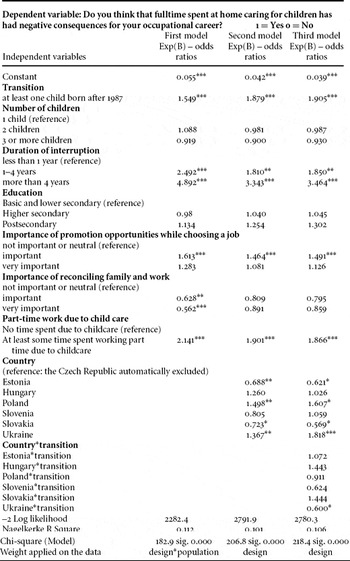
At the first level of the regression analysis the effect of the transition variable is examined on the pooled sample of all countries, while controlling for the theoretically important variables mentioned in the literature review, such as educational attainment, duration of career interruption, number of children, importance of promotion at work, importance to reconcile family and work and part-time work due to childcare. The results of the regression analysis are summarised in the first regression model in Table 2. The effect of the transition is statistically significant and the value of the Exponential Beta indicates that the odds for women who gave birth to a child after 1987 to experience negative consequences are 55 per cent higher than the odds for women who gave birth before the transition. This result is in line with hypothesis 1, which states that women in the seven countries would be more likely to report negative consequences of their career interruptions due to childcare if they had experienced childbirth in the period after the transition.
Binary logistic regression: the effect of transition on perception of the consequences of career interruptions due to childcare

Notes:*** = 0.001 significance level, ** = 0.01 significance level, * = 0.05 significance level.
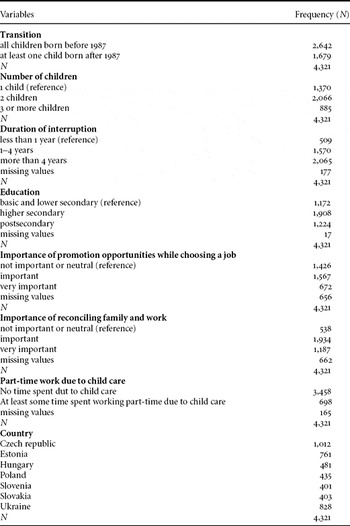
Variables used in the logistic regression are described in detail in appendix table A1.
Interpretation of Exp (B) = odds ratios = how many times more/less likely it is for a particular category of an independent variable to report negative experiences on career breaks compared to the reference category.
Model characteristics: Chi-squares are statistically significant (the data-based model explains the dependent variable better than the constant-based model), the Hosmer and Lemeshow test is not significant in the first and the second model (meaning that model data and real data do not differ) and is significant in the third model.
Source: ESS2–04.
The results of the second regression model (with country dummy variables introduced) are related to hypothesis 2. That hypothesis states that, with the transition from state socialism and selected individual characteristics controlled for, the perceived consequences of career breaks due to childcare will vary significantly by country. The hypothesis was confirmed. Women in Poland and Ukraine have respectively 50 per cent and 40 per cent higher odds of experiencing negative consequences compared to the Czech Republic, whereas women in Estonia and Slovakia are statistically significantly less likely to perceive their career interruptions due to childcare as negative for their further participation in the labour market.Footnote 10 These results indicate that Central and Eastern European countries cannot be considered as a homogenous group regarding the subjectively perceived consequences of labour market withdrawal due to childcare on women's future careers. These findings confirm our expectations that the most negative consequences of career breaks are reported in Poland and Ukraine.
The third regression model in Table 2 is used to confirm or reject hypothesis 3, which suggests that the effect of having a child shortly before or during the transition period differs across post-socialist countries, given their diverging economic and welfare state development after 1989. To test this, we included product terms of country and transition variables in the model. The results reveal that our hypothesis cannot be fully confirmed using the ESS data. The transition effect does not produce significant cross-national differences – with the exception of one: Ukraine. In the comparison of Czech women who gave birth after 1987 and having similar characteristics as Ukrainian women who gave birth after 1987, the odds of the latter to report negative consequences are 1.09 (1.818*0.600) times higher. Thus, they are slightly more likely to report negative consequences. This finding is in agreement with our expectation regarding Ukraine's special position among the analysed countries.
Conclusions
The aim of the present paper was to investigate whether women in Central and Eastern Europe were more likely to have experienced negative consequences regarding their future work life as a result of career interruptions due to childcare in the period following the political and economic transformation in the post-socialist bloc than under the state socialist regimes. The first regression analysis confirmed our hypotheses that, while controlling for the duration of the leave, number of children, individual preferences and human capital characteristics, women from Eastern and Central Europe have higher odds of reporting negative consequences if they gave birth in the post-1987 period than women who had a child during the state socialist regime. Thus, it can be concluded that having a child before or after the fall of socialist regimes in Central and Eastern Europe has a markedly different effect on women's perceptions of the consequences of career interruption. More concretely, women who interrupted their careers due to childcare during the transition period are more likely to report negative consequences than women who did so during socialism.
As mentioned in the theoretical part of this paper, this phenomenon can be explained by the shifts in family and family–work reconciliation policies, as well as by the appearance of unemployment and consequently increasing competitiveness in the labour market. Nevertheless, as pointed out earlier in the text, it is possible that the significant effect of the transition away from socialism can be partially moderated by age and even generational differences. Women who gave birth after 1987 are more likely to be young and thus to focus more on their careers.
The second goal of the analysis was to investigate whether, while controlling for transition and selected individual characteristics, the specific institutional and cultural context of a particular country played a role in increasing or decreasing the probability for reporting negative consequences. Our hypothesis was that the probability of reporting negative consequences of an employment break on women's further careers would vary by country. This has been confirmed. Our results suggest that women living in Poland and Ukraine faced more obstacles to reconciling childcare with their career aspirations. On the other hand, Estonian and Slovakian women show less negatively perceived consequences of career interruptions than the seven-country average.
These differences can be explained by examining labour market and family policy settings in the analysed countries. In Poland, reconciliation of family and professional life has been left very much in the hands of families, and state support is rather modest, i.e. in the country parental leave provisions are the least generous and the childcare services are the least available of any in the whole region. With respect to access to parental leave provisions, Poland also scores very low. Moreover, the country's relatively high unemployment rate for women of reproductive age is an indication for a competitive situation in the labour market not able to absorb female labour supply. Despite the fact that we lack comparable data concerning family–work reconciling policies and female unemployment and inactivity rates in Ukraine, we can assume that the rather negatively perceived consequences of motherhood have to do with the dramatic decline —and lack of recovery over a decade—in economic performance after the fall of socialism.
In contrast to Poland and Ukraine, mothers in Estonia and Slovakia report the least negative consequences of career breaks. In the case of Estonia, this can be attributed to the country's work–family policies supporting women, especially through extensive and high-quality childcare.
In Slovenia, even though the results are not statistically significant, the odds ratios suggest that Slovenian women had less negative experiences due to career breaks than in the reference group. This is very much in line with the fact that Slovenia is the region's front-runner as far as gender equality issues, low inactivity of mothers and low female unemployment rates are concerned.
The aforementioned results suggest that there are notable country-level differences in the perceived consequences of career breaks. Therefore, we would suggest that future research aims to examine more in depth the effect of country-level variables such as female inactivity and unemployment rates, family welfare systems and economic structural differences, in order to further determine the various causes of the negative perception of career interruptions.
The third main finding of the paper is that the transition effect, or more precisely the effect of having and raising a child during the transition period, does not differ significantly across Central and Eastern European countries, with the exception of Ukraine. In other words, the transition effect on the perception of career interruption due to childcare appears to be the same for women living in the Czech Republic, Estonia, Slovakia, Poland, Slovenia or Hungary, but differs for women in Ukraine. Ukrainian women who gave birth after 1987 are slightly more likely to report negative consequences compared to Czech mothers. This might be explained by the exceptional economic hardship the country went through in the 1990s.
All these findings allow us to conclude that in the post-socialist countries analysed in this paper, transition has a significant impact on the perceived consequences of the interruption of labour market participation due to childcare. At the same time, we can say that based on the ESS data, no significant difference regarding the effect of transition on the perceived consequences of career breaks can be identified among the post-socialist countries (with the exception of Ukraine). Thus, it appears that the social and economic processes and changes happening after the end of the state socialist regimes have affected women who had a child during this period in a similar way in most of the analysed countries. Further research should focus on cross-validation of these findings by using other datasets.
Appendix
Description of variables used in the logistic regression model
Source: ESS2–04.