The following words were found scribbled onto a postcard produced by the Art Base Gallery to advertise the 1989 Home Documentation exhibition by the Singaporean artist Tang Da Wu (b. 1943):
-
1) obsession with
carreer [sic] – success
spontaneity
poetry
anti-consumerismFootnote 2
These words are understated, even as they counterpoint the materialistic world that is Singapore's post-independence economic success against a spontaneous art and poetry. The careless misspelling of career implies that perhaps art need not be virtuosic and even can be ordinary, though it engages with the larger forces of change. Tang's text gives some indication of contemporary art's valences amidst a collectivist state's capitalist modernization drive that, until the 1990s, was based on generally ‘pragmatic’ and philistine values.Footnote 3
Tang's own career – unusual for an artist of his generation in its embrace of experimental art forms – runs in opposition to the thrust of the Singapore state's developmentalist direction. Though he works in a number of media, he is best known for his performance art and installations. Tang was born into a Chinese-speaking home and educated in Chinese-medium schools, and his father was a journalist with a Chinese-medium newspaper, Sin Chew Jit Poh (in Mandarin Xingzhou Ribao).Footnote 4 In a multilingual society with four official languages (English, Chinese, Malay and Tamil), where English is the lingua franca, this background testifies to a groundedness in Chinese cultural traditions and art, which Tang brings to bear in his contemporary work. Tang proceeded to the Birmingham Polytechnic School of Fine Art (now the Birmingham School of Art in Birmingham City University), where he took a bachelor of fine arts degree in 1974; then in 1974–5 to the St Martin's School of Art, London (now Central St Martin's), where he studied sculpture; and finally to Goldsmiths College London, where in 1985 he gained a master of fine arts. When living in England, Tang won the Visual Arts Award in 1978, given by what was then the Arts Council of Great Britain, and the Artist Award of 1983, given by what was then the Greater London Arts Council. He also participated in a number of performance festivals or gave solo performances in England and Portugal in the early to mid-1980s.Footnote 5 In 1999, Tang gained regional recognition by winning the tenth Fukuoka Asian Culture Prize (Arts and Culture).Footnote 6
After living in England for some twenty years, Tang finally returned to Singapore in 1987. He was the major figure in, and is regarded as the initiator of, an artists’ community started in 1988 called the Artists Village, in what was then a rural part of the island state called Sembawang. The Village became a centre of vigorous cultural reinvention and artistic alterity.Footnote 7 Tang's influence helped disrupt abstract–modernist art practices in Singapore: apart from his pioneering of performance art, there was a return to figuration in painting, and the figures he depicted often had a relation to nature, generally in the form of animals: a persistent occupation with culture and ecology marks his work. There are also elements of the surreal and the spontaneous, which serve to enhance Tang's communicative mode.Footnote 8
This brief sketch establishes the context for the questions pursued in this article: what might the contemporary performing body look like when it seeks to communicate and to cultivate the need to live well within the natural environment, whether the context of that living well is framed and set upon either by long-standing cultural traditions or by diverse modernizing forces over a period of time? Tang has engaged with a present and a region fractured by the predations of unacceptable cultural norms, by the consequences of colonial modernity or the modern nation state taking on imperial pretensions, and by the subsumption of Singapore society under capitalist modernization. We have in Tang a body that refuses the diminution of time to the present, as is the wont of the forces he engages with.
Tang also undertakes interventions by sometimes elusive, humorous, ironic or (ambiguously) disingenuous means – unlike some overdetermined contemporary performance art – that reject the (continuing) presence of the modernist ‘artist as hero’.Footnote 9 Not for him the heroic icon of the artist as healer or saviour. Part of the cause for this is that communication is a central concern for Tang, provoking self-reflexive thought rather than immediate action; and over the years this has resulted in collaborative artistic workshops, in which he has imaginatively transferred art making from his body to the realm of ordinary people. These workshops become his particular extension of the neo-avant-garde's breaching of art's infrastructures.Footnote 10 In order to explore the implications of this practice at a crucial historical juncture, this article proceeds by situating the emergence of contemporary art in Singapore within South East Asia – essential for seeing why modernization is a crucial issue for contemporary artists – and continues with the examination of continuity within the development of Tang's art from the 1980s to the late 1990s.
Becoming contemporary and contemporary art in Singapore
Can the contemporary body actually resist not only the impact of current forces but also the consequences of historical forces, and even facilitate communicative processes that could possibly lead to a new or renewed means of thinking community? Is the body in the present up to such challenges, given that we occupy a moment in which, the cultural critic Fredric Jameson argues, there is ‘not so much of the abolition of time altogether . . . [but of] its shrinkage to the present’ – which he also describes as ‘the reduction to the present or the reduction to the body’.Footnote 11 As Jameson contended in an earlier essay, if there is ‘nothing left but your temporal present, it follows that you also have nothing left but your own [reduced sense of the] body’:Footnote 12
The problem with the body [taken] as a positive slogan is that the body itself, as a unified entity, is an Imaginary concept (in Lacan's sense); it is what Deleuze calls a ‘body without organs’, an empty totality that organizes the world without participating in it. We experience the body through our experience of the world and of other people, so that it is perhaps a misnomer to speak of the body at all as a substantive with a definite article, unless we have in mind the bodies of others, rather than our own phenomenological referent.Footnote 13
The above passage helps brings to light key qualities of Tang's art in the 1980s and 1990s. The first is that other people's bodies and the world, in Tang's self-conception of his work, are vital for his body, which he asserts is his medium for art. He can and will provoke his audience (sometimes in a direct or alternatively ironic or humorous but usually restrained manner) into self-reflexive thought, or he can take them into a collaborative activity that attempts to suture history to the fractured present. Though Tang's work is varied, his specific emphasis on communication is consistent: without it, there is no art for him. As one curator notes, ‘For [Tang] Da Wu, “communication” is a process of self-knowledge and the recuperation of history, albeit traumatic and painful, empowering his participants with the ability to mediate their own histories and predicaments to contemporary needs’.Footnote 14
The second quality relates to how communication should occur through the body, and the body's relation to time, and therefore to historicity. If an older aesthetics was concerned with deep memory and long tradition, what is the artistic capacity of the (reduced) contemporary body to engage with history when, in art historian Hans Belting's words, ‘history – the locus of identity or of contradiction – [has] lost its authority to the same extent that it became omnipresent and malleable’?Footnote 15 In Tang's case, artistic communication is a work of the body, and his experience of the body is not that of an isolated body, nor is it a body reduced to being a body as a present of time. The experience of the world – certainly of the region, of South East and East Asia – matters, along with that of other bodies. His performing body invokes the specific historical and cultural dimensions of existential experience, of his body's beingness-in-time. This remains so, even as Tang navigates a series of apparently disparate concerns ranging from ‘the environment within specific social or ethnic contexts’ to project-based, collaborative workshops that relate art making to tin mining or to the Japanese invasion of South East Asia during the Pacific War.Footnote 16 By the time he undertakes his collaborative performance and art-making projects from the mid-1990s to the 2000s, Tang's body seems emphatically to become a body, and not the body, of art.
We might therefore take contemporary performance less as a style of the present and more as one part of a congeries of different and differing performance possibilities and counters to the ‘shrinkage [of time] to the present’.Footnote 17 Tang Da Wu's performance from the 1980s is an art that used contemporary art forms to question what the present might be in a deeper way, living as he did in Singapore, a city state that championed the cause of relentless, catch-up modernization. And this brings us to the starting question of becoming contemporary in South East Asian and contemporary art: contemporary art spread, but what were the new conditions of the contemporary that regional artists engaged with, in a zone that wanted to complete a postcolonial, catch-up modernization so that it could ‘attain’ synchronicity with the advanced economies? The contemporary is both an idea of the time we are in and a goal of reacting effectively to the demands of the immediate present.
Tang is said to be a conceptual artist because of his anti-commodity notions of art and the dematerialized nature of his performance practice. The Thai curator and art historian Apinan Poshyananda refers to him as one of a set of important South East Asian artists who ‘received attention for their attempt to redefine conceptualism in terms of local/global contextualizations’; the ‘local’ recontextualization of Western conceptualism for Apinan is manifested in Tang's ‘installations and performances [in the late 1980s and early 1990s that] reexamine[d] Chinese traditions and myths surrounding the eating of animal parts as an aphrodisiac’.Footnote 18 The Singapore contemporary artist and art critic Cheo Chai Hiang writes that Tang ‘returned to Singapore [from England] with a conceptual framework informed by Beuys and Duchamp’, though, as might be expected, he adapts his sources for his own inimitable purposes.Footnote 19
Tang therefore represented one instance of new art in the region. The art historian and curator Ushiroshōji Masahiro contends that it was from the late 1980s to the first half of the 1990s that the ‘basic conventions of [painting and sculpture in] Asian modern art broke down in many countries . . . Asian artists began to use personal things from daily life as art materials and actively pursued unconventional forms of expression, including Installations . . . and Performances’.Footnote 20 The setting for the transformations noted is also crucial, for it alerts us to the simultaneously disruptive and artistically generative capacities of a catch-up modernization in the region at large:
The background to such trends were the drastic changes occurring in Asian countries. As the Cold War world structure collapsed and Communist countries shifted to more open market economies, radical social/political changes shook Asian countries, and rapid economic growth, as well as . . . urbanization, changed the life of Asian people and greatly enhanced it. At the same time, however, such changes also revealed various contradictions, such as environmental problems, growing consumer greed and the disruption of traditional communities . . . The artists who were the pioneers and leaders of these [emerging artistic] movements include Tang Dawu from Singapore and Nalini Malani [b. 1946] from India.Footnote 21
The modernizing imperative – the desire to eradicate teleological distance from the metropolitan West, if you will – is part of a larger understanding of the appearance of contemporary art. With regard to Singapore, specifically, I take the 1980s to be the decade when the contemporary arts emerged fully; and suggestively, it materialized in the decade when the city state, during the so-called East Asian miracle, appeared to enter a period in which we could conceptualize ourselves as sharing, or gaining contemporaneity with, the advanced West's present moment.Footnote 22 The complex multiracial society inherited from British colonialism after independence in 1965, despite the challenges of the Malayan Emergency (1948–60) and the larger Cold War era, had become more the ‘one united people, regardless of race, language or religion’ that the Singapore National Pledge of 1966 envisaged, and possessed more national wealth to go around.
By the late 1990s, various contemporary art forms thought of as marginal or liminal – postmodern or contemporary theatre that experimented with ‘devised’ drama and explored multilingual, local, regional-historical and gendered identities; a visual arts scene that experimented with similar themes via the de-differentiation of various artistic media (but without the rejection of either drawing or painting) that marks contemporary art; and a consciousness of environmental and gender topics – became, effectively, dominant art forms. This is surprising because in the 1980s bland or apolitical modernist art had been the norm. As Jameson has observed, ‘a tendentially more complete modernization in fact generates not [artistic] modernism but postmodernism’ – or, perhaps, in the South East and East Asian region, contemporary art.Footnote 23 Tang Da Wu played a crucial role in the initiation of artistic–cultural change in the city state. While his art does not treat the question of becoming modern at every turn, that question, when taken in relation to his examination of nature and culture, takes on a larger historical and contemporary significance. In his artist statement accompanying his workshop Life in a Tin (1995–9), which sought to understand the historical place of tin as a commodity in the region, he wrote, ‘Modernity struggles against plurality, because plurality and difference can upset and threaten comfortable paradigms based on economic systems that seek total management’.Footnote 24 A later thrust of Tang's performative and communicative workshop practice is to excavate a variety of folk experiences obscured by presentist, modernizing developments.
The art historian T. K. Sabapathy's take on the Singapore state's post-independence modernizing and homogenizing social-engineering policies is that the consequences made local sociocultural formations volatile enough that they (ironically) facilitated the newer art undertakings:
During the 1970s and 1980s, an entirely new urban form [in the modernist public-housing estates of monolithic, slab-like blocks] and system was [sic] built . . . [and] designed to ensure rapid economic growth and generate continuing economic wealth . . . The earlier foundations on which social and familial connections had been built were irreversibly disrupted. Where once there was a subtle network of extended relationships, now there is a sense of separateness, anonymity and estrangement . . . Such conditions propelled younger generation artists to re-examine all that hitherto had been assumed as given, including issues related to the nature of art, and questions regarding the self in relation to social, cultural and environmental conditions.Footnote 25
That is to say, the attempt to force the city state forward in the homogenized direction that the state took to represent progress led to forms of cultural pluralism that actually interrogated the very petit bourgeois and therefore pragmatically philistine norms the state preferred. Modernization locked one into a restrictive version of the ongoing present, in order to maintain ‘continuing economic growth’ and to share fully, in due course, a contemporaneity with the advanced West. Disruptive progress, paradoxically, raised the question, ‘What is progressive art now?’ A sense of history, and not nostalgia, was needed. Younger artists found that the extant versions of local modern art in the 1980s, with their abstract qualities, or nostalgic watercolour recollections of the increasingly eviscerated and evacuated Chinatown and the Singapore river – of a Chinatown whose population now lived mainly in suburban public-housing flats, of a Singapore that no longer existed as depicted – did not address the questions being asked. Contemporary art in the city state thus became a container for a plurality of voices desiring to think through various suppressed histories and/or otherwise disregarded sociocultural questions and less pragmatic environmental matters. The rethinking of modern art that Tang brought back with him from England became one of the sparks that set things off. Footnote 26
An early work exhibited in Singapore in 1980 – a sign of what was to come – was an installation at what was then the National Museum Art Gallery (NMAG) and the Sin Chew Jit Poh Exhibition Centre entitled Earth Work.Footnote 27 It consisted of a set of works originally prepared in 1979 as an environmental installation that included a set of linens – seven pieces that Tang had hung in a gully over three months at a construction site in what was then semi-rural Ang Mo Kio, entitled Gully Curtains – and square wooden boards covered with dried mud in the shape of circles, held in place by glue, while the rain had largely washed away the mud that surrounded the circles – The Product of the Sun and Me (1979) and The Product of the Rain and Me (1979).Footnote 28 The circles referred to the idea of infinity from the Yi Jing (or I Ching), the ancient Chinese Book of Changes. Drawings made using earth pigments (One Hundred Per Cent Old Earth, 1979) were also displayed.
The very title that Tang chose deliberately invoked and indicated his artistic reworking of 1960s land art, or earth art, for his own purposes. A 2016 restaging of Earthwork featured a letter that Tang wrote to the then Ministry of Culture, dated 27 March 1980, requesting a grant-in-aid for the exhibition:
[The proposed exhibition] is my observation of the Singapore red earth, it is very special. I am interested in the changes of the earth due to the rainfalls, the heat and the gravity, apart from its physiographical aspect [sic] . . . My way of working isn't scientific, it is very much philosophical, base[d] upon my ‘zen’ studies and influence[d] by ‘Tao’Footnote 29 and ‘I Ching’. I am also making a [sic] 8mm film call[ed] ‘Earthdance’ as complementing to ‘Earthwork’.Footnote 30
An experimental and a putative trans-media or trans-category art practice is wedded through Tang's (seemingly) plain, (perhaps dis)ingenuous and (certainly) idiosyncratic performative rhetoric – is his tongue firmly in his cheek? – to an environmental awareness inspired by Chinese texts and ideas, using earth from a construction site that represented the state's ongoing urban development. He delivers an understated but pointed critique of urbanization's degrading environmental impact, with no reconciliation offered between the value of the red earth and the urbanization that has exposed it to erosion. The artwork was one in which the historical present of fracture and fragments is privileged, and this present is not vitiated by the ‘philosophical’ studies undergirding the circular shapes used in it – the Chinese cultural texts are not marshalled, as they might be, to valorize a timeless realm. Tang comments in a 1980 interview on the show that artworks should be communicative rather than showy, and possibly pedagogical: ‘Exhibition is a bad word . . . It is showing off your ability. An artist should introduce to others what he sees and learns of something. His works should provoke thoughts, not to please the eyes or to entertain, much less for decoration’.Footnote 31
Significantly, Tang had extended ecological questions to performance art in that period. In 1980 he performed Save the Forest at Epping Forest, at the border between London and Essex: ‘Different recurring motifs can be seen in the photographic documentation [of Save the Forest] – the circle, the repeated movements around a fixed space and the interaction with naturally occurring elements of the landscape’.Footnote 32 Save the Forest itself, a Singapore curator observes, was a continuation of earlier experimental and spontaneous interactions by himself or with students with the land that took place before returning to Singapore and undertaking Earth Work.Footnote 33
By the late 1980s, had Tang developed a more fully formed performance practice which, like his Earth Work installations, would be used to interrogate the fractured present; and his performing body would simultaneously participate in and challenge the experience of his local world, which becomes his practice of communicative art.
The body and communication
In the art forms he uses, Tang seems concerned with art as an active, spontaneous, poetic and communicative process, where the process of making art is a paramount consideration. However, this commitment is not to a self-referential or autonomous aesthetic. His live performances engage with the world, and with ‘everyday life’, a phrase Tang uses.Footnote 34 The everyday for him is also linked to ritual and to the spontaneous: his approach to nature and landscape, along with the changes humans have wrought upon both the natural and the cultural worlds, make him part of the ‘other forms of [non-modernist] art or of experience [in the 1980s] that seemed to exist outside the system, however provisionally or temporarily’.Footnote 35 Tang is perhaps distinctive in his sustained attempts to produce non-commodified art right up to the present day. While he is not averse to selling his paintings, drawings and installations, his performance and project art must ‘live’ and, if possible, the audience for art should be able to participate in the poetic process in a corporate creation of ‘meaning’ that connects with the warp and woof of the everyday.
Therefore art for Tang is an open, pedagogical process, both for the artist and for his audience: they, along with him, should learn. This is in keeping with an ‘idea art’ rather than an ‘object art’, and he has been consistent and insistent on this communicative and pedagogical thrust from the 1980s. Art as a communicative process allows his performance work to respond to the audience in front of him. However, he does not see art, in the first instance, as being activism, as immediately effecting change: what he calls ‘good art’ is that which becomes ‘a sharp needle that can prick you’.Footnote 36 Thus Tang disclaims direct social or political intervention in his work, though those dimensions are there. His social commentaries in his later 1990s workshop projects on the wartime memories of the Japanese Occupation of colonial Malaya and Singapore (Tapioca Friendship Project, 1994–6) and the problems of modernization for the environment in terms of the production of tin in Malaya and present-day West Malaysia (Life in a Tin), he maintains, remain secondary to the communicative process. Whatever issues may be at hand, they can only be seriously addressed when communication is enabled – and for these workshop projects, the experience of the world, and of each other's bodies in history, also arises. The art process is also a ‘thinking’ procedure that can produce self-knowledge.
What is Tang Da Wu, then? He and his body are a medium for art itself – but not, he says, in a manner that implies a loss of control and, by implication, any descent into the overtly irrational. The intuitive, though, is important to his larger engagement with art making. He has said that spontaneity and intuition go together: ideas can change and lose their freshness, and it is intuition that can lead one to the new. The open attitude towards the intuitive accounts for what at times seem to be deliberately unintellectual (though not anti-intellectual) statements on his artistic practices. In response to performance and visual artist Lee Wen's question regarding the meaning of Tang's performances in Singapore in 1982 at the Nanyang Academy of Fine Arts (Five Days at NAFA, 1982), the LaSalle College of Art and the NMAG (Five Days at Museum, 1982), Tang replies, ‘You are not making a message. It's an ability to respond to an audience. I would say that is the first thing’.Footnote 37 The audiences in 1982 did say to him, he recalled, ‘Oh, it's like [you are a] tang kee [a medium or shaman]’. Lee Wen asks, ‘What was your response to that?’ to which Tang responds, ‘Yah, you can read it that way. Why not?’Footnote 38 However, he adds that while intuition mattered, art itself is not a vitalist force that takes over his body: ‘I was quite aware of myself and the audience’.Footnote 39 That is to say, he is still in control even if what he is doing is not an entirely rational act.
A note of caution is required here: invoking the shaman inevitably brings to mind the much-repeated story of Joseph Beuys's plane crash in the Crimea, from which he emerges ‘as shaman and Christ-like redeemer: a soldier who had returned from the dead as artist and who . . . would heal the German people’.Footnote 40 While Tang has an interest in historical and environmental trauma, he does not ascribe cathartic power to art, and he does not offer the image of the artist as saviour. Art, for Tang, becomes a literally embodied set of processes; spontaneity and also play – a word that is part of his artistic vocabulary – become part of this process-preferred notion of art. Performance art, for him, becomes the best expression for a communicative art, as that form requires an audience with whom the artist can interact. It is to Tang's performances, therefore, that I proceed. Tang's work, as I note in the introduction, has a number of interweaving strands, and the performances discussed in this section are extensions of a broad culture-and-ecology dimension, iterated in a context where, increasingly, the questions of social and particularly cultural identities are paramount. The critique of translocal Chinese customs illustrates how one specific instance of the ‘local/global contextualizations of art’, as Apinan phrased it, is effected.Footnote 41 Cultural identity for Tang is an essential and yet not essentialized identity question, though this is a delicate balancing act: ‘In my 20 years in England, I was constantly reminded, in my relationships with people, of my “Chineseness”. I became more aware and interested in my roots and incorporated Chinese elements in my works’.Footnote 42 This recognition of ‘roots’, triggered during his sojourn in England, certainly does not stop him from feeling ashamed of the Chinese consumption of rhinoceros horns and tiger penises as medicine or as aphrodisiacs, which he examines in two of his best-known performances. In them, his body's experience of the world and of the bodies in it has become unequivocal: ‘My rhinoceros and tiger works are my response and can only be understood in an Asian context. The message would be totally lost to a Western audience’.Footnote 43 This cultural consciousness is part of what drives Tang's understanding that his body is not one that tries to reorganize the ‘Asian’ world without participating in it: there is no self-conception of his body as a singular or unified entity, and his practice of communicative art depends on this apperception.
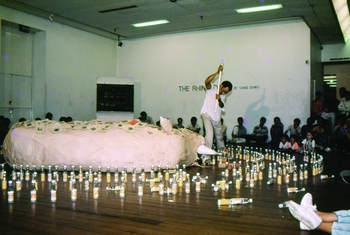
One of the main challenges about studying performance art is that it is ephemeral. This quality is valued because the performance then cannot be turned into an object – but it also poses a problem as to how one critically engages with it, if one were not present at the event. Fleeting ‘event-ness’ becomes truly fleeting. Journalist T. Sasitharan was present at Tang's They Poach the Rhino, Chop Off His Horn and Make This Drink (1989–91), a one-man show in the Room of the Early Pioneers at the NMAG on Saturday, 13 May 1989. Sasitharan offers us a careful account that gives insight into both Tang's charismatic physical and theatrical presence, and the embodied nature of his art. Unless we have a fair sense of the actions that transpired, we may have only unrevealing synopses of his performances, and it is from Sasitharan's writing that I draw the following account.Footnote 44
Tang Da Wu, They Poach the Rhino, Chop Off His Horn and Make This Drink (1989, National Museum Art Gallery, Singapore). Photo by Koh Nguang How. © Archive of Koh Nguang How.

The rhinoceros horn, in Chinese culture, is believed to be able to counter fever, and parts of the horn are infused into drinks which will impart this medicinal quality. This belief has contributed towards the near extinction of the rhino. In the room, filled with more than a hundred observers, is a large paper rhino, built over wire mesh that gives the fragile sculpture its shape, lying on the floor, as if felled by a poacher. The horn is missing. The fragile appearance of the sculpture reflects the poor situation the rhino is in. Next to the spot where the horn should be on the rhino is a white axe, and starting from the spot of the missing horn is a formation of Chinese medicine in bottles, placed next to each other, with these bottles spiralling outwards from the prone rhino and going around it in three layers. The bottles suggest the cause of the rhino's demise. ‘At first, the audience skirted around . . . [the installation], granting it the status and sanctity of art objects . . . Then slowly they began relating to it, picking up bottles and reading the labels’.
The artist enters, a half-hour later than advertised. ‘Using a hand puppet of a small furry mammal, he brought us through the process of confronting the horror and grieving the loss [of the rhino]’. Initially, Tang moves amidst the spiralling line formed by the bottles. But then, suddenly, he pushes away the axe and creates an altar next to the missing horn: ‘The grief was expressed as Chinese ritual mourning, with red candles, joss-paper and joss-sticks. Even though we were all responsible, Chinese culture, in perpetuating the [medicinal] myth, was particularly culpable’.Footnote 45
Tang moves to a blackboard to draw the rhino, but he cannot go on and instead erases the picture and writes tersely of facts related to the rhino's disappearance. Wordlessly, ‘he next enacted the butchery of the poachers. But using the dismembered horn, with contained tension, he tips over every single bottle, destroying the [spiralling] pattern within which the animal was trapped and slaughtered’. After this, Tang speaks directly to the audience – this being a feature of his practice: he tells them that he became aware of the problem through a television programme, adding that ‘Singapore, with its Chinese population, was the ideal place for the performance’. Finally, Sasitharan's judgement: ‘What we witnessed on Saturday was unique. The performances which follow [after Tang's] will never be the same. This is truly an art written on the wind’.
While Tang had researched and thought through what he wanted to present, and prepared an installation that he would interact with, the installation sculpture does not come ‘alive’ fully until the performance begins. The late appearance of the artist himself allows the audience to initiate some hesitant, yet also bold, steps to start to break down the barriers between the formal art objects (the bottles, the axe) and themselves; once they are able to pick up the materials and examine them – actions not possible in an art museum, where the painting or sculpture will be on separated, static display – they are then actually better prepared for the performance that will follow.
When Tang finally appears, he has some idea of what he would like to do, but – as in theatre – he nuances his presentation in relation to audience responses.Footnote 46 At the same time, there is no doubt from Sasitharan's account that the artist exerts a charismatic grip on the audience, and draws them into the ritualistic remembrance of the animal and the ‘soul’ that has been lost. The usage of Chinese ritual and ritual paraphernalia common in Singapore – the joss sticks, the fake paper money that is burnt for one's ancestors – connects to an everyday familiarity to suggest that the issue at hand regarding the demise of animals is not removed from the audience. What further emerges is the ‘localness’ of the artwork: though the conceptual inspiration may be Euro-American in origin, the performance remains rooted in local and translocal Chinese custom. Tang effects an internal critique of Chineseness that he, as a Chinese-educated artist, is suited to undertake. An implicit query for the audience is whether they should receive their cultural norms unquestioningly. And yet, despite cultural specificity, the piece also offers a more universal gesture, as the question of how humanity in general may use animals is brought up. The pedagogical and communicational scope of the work manages to be both precise and broad.
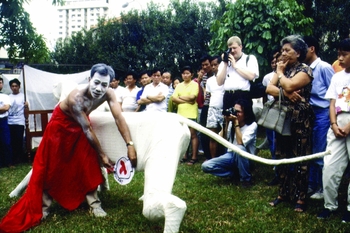
Another performance that can be considered in this vein is Tiger's Whip (1991). As with They Poach the Rhino, it is indicative of Tang's typical performance approach, though this work is inflected more clearly with a daring, in-your-face sense of play that reveals a pointed (and sometimes sharp-edged) sense of humour. This performance dealt with animals and Chinese culture again. The tiger's whip – a euphemism for its penis – is an aphrodisiac and a medicinal product that could then be bought from traditional Chinese medicine shops. As with They Poach the Rhino, culturally specific and unconfined ‘green’ themes are combined in Tiger's Whip. The installation and performance were a follow-up to the rhino event. Tang prepared ten life-sized tigers made from wire mesh covered with white cloth. Many of the tigers are depicted running towards a large, ornate, canopy-covered bed. A tiger is actually in the bed, illustrating the return of a tiger ghost to haunt the aphrodisiac users. Tang – dressed in simple, white, pseudo-ceremonial robes, in keeping with the idea of ritual and daily life – moves in and out of this installation.
Tang Da Wu, Tiger's Whip (1992 version, Keong Saik Road, Singapore). Photo by Koh Nguang How. © Archive of Koh Nguang How.

This time, Tang took the performance out of the museum space and had the temerity to take it right into the heart of Singapore's historic Chinatown, where art truly took place amidst the everyday cultural zone it was engaging with. One of the performances was staged at Keong Siak Street, a narrow road that then had both Chinese medicine shops and brothels lining it.Footnote 47 Tang's own recounting of aspects of his performance is remarkable in many ways, and worth quoting at some length:
Tigers and rhinoceros they are all the Chinese myths, the ridiculous myths. And I like to play with it and I like to bring this to the most appropriate place and perform it there which are the Chinese medicine shops in Chinatown . . . In the morning I go to all these shops to invite them to come and see my performance. They thought I am one of them, like a medicine man in the street, bang your gong and everyone come and see my medicine. But, on the contrary, they see me as a different one, an opposition to them. I enjoy making fun like that, teasing, let everyone rethink again these myths. And the strategy, it's funny and enjoyable for me . . .
After I set up [the installations], I left the whole set there for a long time, for people to watch and to wonder what's going to happen before I perform . . . [M]any people talked to me. I said wait and see, there's the bed, to sleep and to make love. There are many tigers around watching and there is going to be a drama happening later. Well, Keong Siak Street is a central working place of sex houses. I don't criticise that, but just asking, is that appropriate activity. So, yeah, there I tell my story about the myth of the Tiger's penis.Footnote 48
As with They Poach the Rhino, the preparatory work before the event proper has been careful, but even more than the previous rhino event, the barrier between high art and an audience of ordinary people without necessarily any idea of museum art to begin with is broken down. The artist himself becomes an agent provocateur who invites suitable people down to the event, so that a pedagogical process may transpire between them and him, though the chance exists that this event could turn out to be a confrontation. And confrontational moments occur: Tang, ‘who uses speech during his performances, asked them, Would you eat a tiger's penis?’Footnote 49 However, his sense of irony and spontaneous playfulness may offset the possible sharpness of a confrontation – even as the same sense of irony highlights the juxtaposition of life/death and sexuality/sexual desire together on Keong Siak Street, though he says he does not ‘criticise’ that conjuncture; similar to Earthwork, we see the presence of the (dis)ingenuous.
As with They Poach the Rhino, the installations are put on show for a while, before the commencement of the performance, so that ordinary people passing by may be drawn to the installation and perhaps stay for the art experience to follow. Tang may believe art and daily life to be ritualistic and serious matters, but the playfulness of his artistic conceptions deliberately removes any portentousness to the high-cultural experience to follow in the quotidian world. In an artist statement, he asserts, ‘I work, I say, I respond to things not knowing if they are High Art. I do not worry if my works do not fit into the Western art arena’.Footnote 50 Taken together, They Poach the Rhino and Tiger's Whip manifest a keen artistic sensibility intent on deploying the body and installation sculpture to break down the barriers between artist's body and life ‘out there’ in the world. When asked about the difference between ‘performing in a gallery and performing in a public space’, a theoretical pronouncement comes out couched in a homespun manner that captures the visceral quality in public performance: ‘Oh, in a public space outside, it's most real, very real. Of course, for a gallery, anything that goes into the gallery can be art. I don't need that. Yeah, of course, the gallery is not always as good as a street performance’.Footnote 51
A body and not the body of art
By the time we reach the mid-1990s, Tang's appreciation of what performance and communication might mean expands, and he no longer always has an audience per se, but instead has workshop participants drawn immediately into learning and reconstructing sociocultural meaning with him. Workshop participants play with materials – rubber, tin, tapioca – that have either direct or indirect historical resonances that link ecological–cultural issues to an extended context of the modernizing process in the region. Folk histories and knowledge are excavated and reworked to see if new narratives can be created. If, in 1989, for They Poach the Rhino, Tang's body sought to draw in the bodies of his audience to be provoked by his communicative acts, in the 1990s his body invokes various regional historico-cultural occurrences and tries to extend his creating body into the participants’ bodies, into becoming a corporate artistic body. The workshop participants and the art they produce become the very artistic ‘object’ created. As one commentator and artist has observed,
Words like ‘process’, ‘interactivity’, ‘collaboration’ have become standard currency for promoting art with an attitude. A difference with Tang's workshops is that they do not necessarily go on within a specific time frame, after which a real product . . . is produced, to be consumed by an arts public. For Tang the process is the objective in its own real right.Footnote 52
In an interview with Tang when he was an artist-in-residence in Fukuoka after receiving the Fukuoka Art and Culture Prize in 1999, FAAM curator Ushiroshōji Masahiro asked about his newer workshop projects. Tang responded,
There are times that I perform by myself. There are times I perform with people. Quite often my audience become [sic] performer as well. In the workshop [held at the FAAM] the other day, I didn't see any mischievous children. I only saw very lively happening . . . Play. Playing is the most important part of my work. And when I grow up I still want to play.Footnote 53
Spontaneity, art making and the communicational–pedagogical process are still important, and now extended so that more people can become the media for the artistic process. Allan Kaprow's ‘happenings’ are made mundane, applicable to children's activities. Among the workshop projects that Tang conducted are Tapioca Friendship Project (1994–6, and the related Tapioca Prints by the Children of Southeast Asia and Japan, 1994–6), Life in a Tin (1995–9), Rubber Road No U-Turn (1996) and Jantung Pisang [Malay, ‘Banana Heart’]: Heart of a Tree, Heart of a People (1998).
The workshops generally (but not exclusively) involved schoolchildren. They tended to offer ‘open “spaces” for interpersonal communication using all the senses – taste, touch, sight, sound’ – and the raw materials and commodities played with became ‘“symbolic building blocks” of mythologies, memories and self-understanding’.Footnote 54 A procedure developed in which stories were shared by Tang and the participants that related to the materials being introduced; then, the materials would be cut up, boiled or otherwise broken down. Finally, the material is literally and metaphorically reconfigured to see what pleasure can be taken out of them: ‘The hilarity of mucking around with the materials and experiencing textures, shapes, smells and forms helps to facilitate new somatic and symbolic significances’.Footnote 55
Tang has commented on this process in relation to Jantung Pisang, which looked at the diverse significance of the banana and the banana tree, given their use for offerings and even for the generation of ghost stories:
I have two days workshop at [the] Substation [arts centre in Singapore in 1998]. So everybody joined in. We played, we made little drama, we told mythologies and also cooked and ate some of the rare part of the banana tree . . . Everything. So everybody perform, you know. It's very real and there is no different [sic] between audience and performer, we are all melting together . . . I don't know if you called it [sic] performance or not, [and] I don't care, it's a development.Footnote 56
As a result, participants may also see what they have in common. The workshops bring together the artist's body-in-time with other bodies for a more corporate body of art, and collectively there is a contemporary art performance that is not locked into a restricted sense of the present. After all, the banana is not merely any fruit, but one imbricated within ghost stories and other folk tales within the Malay Archipelago – and the children are members of this archipelago. What we see, once again, is Tang's predilection for understated bluntness: this is art, and ‘it's a development’ for all in artistic terms. It really doesn't matter what anyone else thinks. How art communicates in his practice has now expanded since They Poach the Rhino.
Life in a Tin is one workshop indicative of the use of a commodity that has historical resonance with a larger predatory history of colonial modernity. Tang tells stories of how the tin can was invented as a way of preserving food in the nineteenth century, about how the West Malaysian town Ipoh became a mining town during the colonial era, how there was a racial division of labour in tin mines, and how even the indigenous people, the Orang Asli (Malay: ‘original people’) were displaced in order to make way for tin mines. There was play with the tin cans, and mock competitions to create the largest tin-can cities and the tallest tin-can towers, cans that then also fell over when stacked too high – all a reflection of the urbanizing aspirations of contemporary capitalist development.Footnote 57 The children in the competition undertake a lighthearted critique of such aspirations, and in the process, even in a small way, extend the historical and cultural dimensions of their existential experience.
In the artist statement accompanying the workshop, Tang wrote about what ‘constitutes power in the modern age – choice’, and how Singapore, by declaring independence from the Federation of Malaysia in 1965, had made a choice to construct a new society. In contrast, the Orang Asli who lose their land to mining did not always have the choice ‘to express indigenous identity’ as, without the titles to their land, ‘they are powerless’: ‘Either as money, property, land, commodities, control of capital is the one means by which the freedom to choose can be controlled, because with the concept of capital comes the concept of ownership’.Footnote 58 Tang's workshop draws a historical line from the emergence of modern capitalism in the nineteenth century to the problems that indigenous peoples face now. Trauma is not simply that which rests in the past; and historical acts have consequences.
In terms of how materials and collaborative artwork can lead to a tangible enabling of people to mediate history for a contemporary connection, we can look at the Tapioca Friendship Project and the print project associated with it. This took place with schoolchildren in schools in Singapore and in Japan. The workshops in the Japanese schools were arranged under the auspices of the Osaka International Peace Foundation, and the actual workshops commenced in February 1995, the month (notably) of the fiftieth anniversary of the Japanese surrender at the end of the Pacific War. Tang starts the workshop by telling stories about how the tapioca tuber was used as food in the years of the Japanese Occupation of Malaya and Singapore (1941–5). The Singapore children, it is said, became sad and angry at what he recounts, while the Japanese youth did not know about the years of the Occupation.Footnote 59 There is then play with the tapioca as material: it is put into a pot, cooked and eaten. Creative play also takes the form of making personal ink stamps from the tapioca – and so the students are able to transform the tuber into forms of self-expression. Artist Lucy Davis and art critic Lee Weng Choy note,
The Japanese schoolchildren seemed very receptive, but some of the older generation were sceptical. At first, the workshops brought to surface tensions between Singaporeans and Japanese. However, as they progressed the workshops went beyond digging up old wounds. The first prints that the children made were full of recriminations on the Singapore side, but later, the prints expressed personal messages to and from Japanese and Singapore children, and not a few expressed hopes for the future.Footnote 60
Public memory may be necessary, but so are forgiveness, reconciliation and the possible formation of new relationships. The project concluded at the Nanao International Artists’ Camp 1996, Japan, where Tang created two granite sculptures of tapioca entitled Roots Sculpture, one of which bears the text ‘One root one human race’. While the history of the Japanese Empire is not in the first instance about the impact of modernizing forces in the region, it remains linked to that through Japan being the first Asian nation state, and one that took on the colonialist extensions of nineteenth-century European nation building, which gave rise to the need for an empire to be a great modern power.Footnote 61
In some respects there are products from this set of tapioca workshops that get exhibited in Tapioca Prints by the Children of Southeast Asia and Japan, though these are hardly artwork that will sell easily – the tapioca prints that were produced and then exchanged between children of the two countries. In other respects, the workshops retain that will-o’-the-wisp quality of Tang's own individual performance art, for what he aims for here is a community art that creates community itself in the art-making procedures that occur. What is also true is that he at least brings about the possibility of thinking of a renewed community between young and older Singaporeans and Japanese. Tang notes of his residency in Fukuoka that what he valued was the possibility of future developments, of small utopian possibilities:
My starting point [for art making] is to meet people . . . Whenever possible, I will go to you and talk about your culture, tradition and life in this place. And gradually we will develop something. I don't know what . . . Again, this may not be my 100% personal work. It may be everybody's work together.Footnote 62
Tang Da Wu's contemporary performance possesses elements of artistic modernism's valuation of memory and future potentialities – that history may bring us forward. His version of contemporary art does not jettison history and historicity. Tang's performance is a complex mix of ‘authentic’ progress that recalls for the purpose of trying to supersede the region's past and the well-known contemporary rhetoric of the decentred and the plural. But Tang's work firmly resists heroism, functioning in deliberately demotic dimensions: art is ordinary, his body is ordinary, but this is good. He continues with his communicative–pedagogical artwork. A recent exhibition of Tang's, primarily of installation work entitled Our Children, was held between 8 September and 8 October 2017. The show ‘is a showcase of works that illustrate [Tang] Da Wu's teaching experiences, comprising mostly installation pieces’.Footnote 63
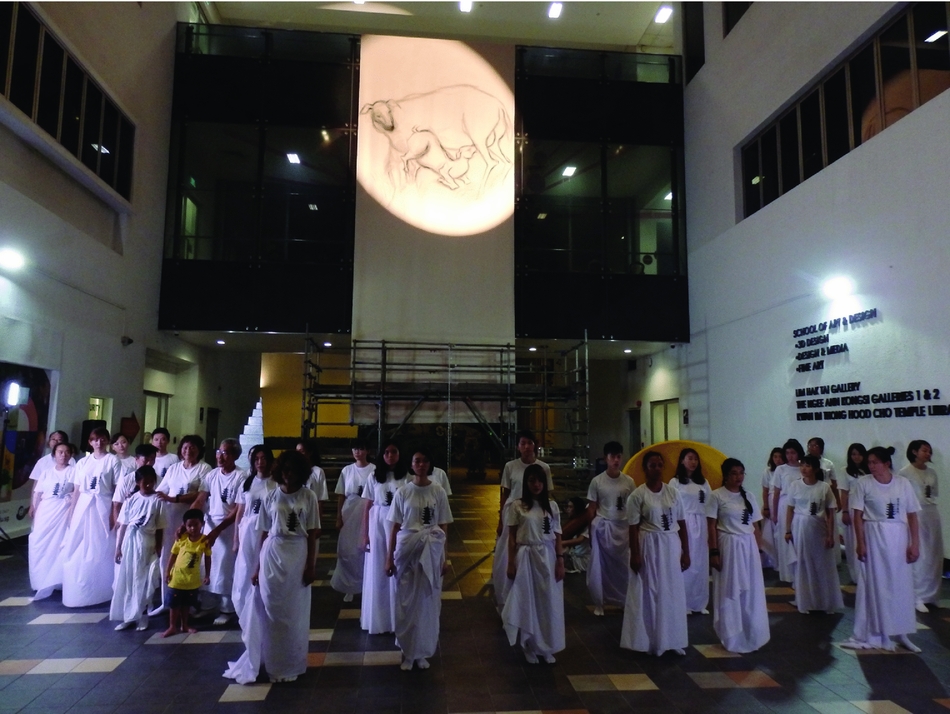
Closing of Our Children (2017) by Station House da Opera. Tang Da Wu holds the boy. Photo by and courtesy of Lai Chee Kien.

The larger historical frame for this exhibition was the recognition of the pioneering efforts of two arts educators, Lim Hak Tai (1893–1963), the first principal of the Nanyang Academy of Fine Art, and Brother Joseph McNally (1923–2002), the founder of the LaSalle College of the Arts. It is fitting that the opening on 9 September included a performance by a group called Station House da Opera, composed mainly of Tang's students from the National Institute of Education. The performance, like the exhibition, was entitled Our Children. It had some thirty-four performers, including two children, nurturing imaginary babies around one of his installation sculptures, One People (2017), a large yellow metal cup with water in it, with the water representing the collective artists’ community that the two art schools have produced. An older woman was the ‘grandmother’, while the performers in their twenties were the ‘children’ – with two ‘grandchildren’ present, who of course stood for art's forthcoming possibilities. While Tang gave the initial concept for the performance, he allowed the group the agency to go beyond his starting idea in their self-representation of their ongoing commitment to nurture art. To the present, Tang's body values history and remains a body, and not the body, of art.