A large literature (with mothers) has established that Infant-Directed Speech (IDS) in the context of parent–infant interaction plays a central role in language development (Saint-Georges et al., Reference Saint-Georges, Chetouani, Cassel, Apicella, Mahdhaoui, Muratori, Laznik and Cohen2013). IDS is characterised by a simplified speech register and, more saliently, prosodic and acoustic modifications of the speech signal itself, including higher pitch, increased pitch range, more pitch variability, and slower speech rate (see Soderstrom, Reference Soderstrom2007, for a review of prosodic and structural differences between IDS and Adult-Directed Speech, ADS). Both the quality and quantity of IDS to which an infant is exposed impacts on their language outcomes (Cristia, Reference Cristia2013), and the characteristics of that IDS in turn largely depend on the infant (Saint-Georges et al., Reference Saint-Georges, Chetouani, Cassel, Apicella, Mahdhaoui, Muratori, Laznik and Cohen2013).
Prosody of IDS and language development
Prosodic features of IDS support language development through attracting the infants’ attention (Kitamura & Burnham, Reference Kitamura and Burnham2003, 3- to 12-month-old infants) and through facilitating word segmentation (Mani & Pätzold, Reference Mani and Pätzold2016, 16-month-old infants). The perceived pitch of a complex sound corresponds to its fundamental frequency (F0). Increased modulation of fundamental frequency is one of the more noticeable prosodic modifications contributing to the unique quality of IDS speech (Kuhl et al., Reference Kuhl, Andruski, Chistovich, Chistovich, Kozhevnikova, Ryskina, Stolyarova, Sundberg and Lacerda1997). Maternal research has indicated that the F0 variability may be the key mechanism by which IDS facilitates language development (Graf Estes & Hurley, Reference Graf Estes and Hurley2013). Some studies suggest that fathers use fewer pitch fluctuations than mothers (VanDam, de Palma, & Strong, Reference VanDam, De Palma and Strong2015), while others report that fathers use more extreme and unpredictable fluctuations than mothers (Benders, Fletcher, & St George, Reference Benders, Fletcher and St George2016). Thus there is no clear consensus about how F0 variability in paternal IDS might be associated with child language development.
Although the link between IDS and child language development is a core concern of this area of research, only a small number of studies have included measures of child language ability in their design. This small body of evidence suggests that mothers’ and fathers’ IDS may be uniquely associated with infant and child language learning. A recent meta-analysis of prosodic aspects of IDS and infant outcomes (Spinelli, Fasolo, & Mesman, Reference Spinelli, Fasolo and Mesman2017) highlighted the paucity of studies (15 of 199 studies) on naturally occurring prosody in relation to infant language, and several shortcomings of these studies. Of the 15 studies, only one included an analysis of fathers’ IDS to infants aged 5 to 12 months (Kaplan, Sliter, & Burgess, Reference Kaplan, Sliter and Burgess2007). They found that fathers’ F0 varied less than mothers’ when addressing infants and that there was no association between fathers’ IDS and infant associative learning.
Maternal prosodic accommodations
Observations of mothers’ speech to infants and infant response to the female voice have traditionally been used to analyse the prosodic features of IDS, and have framed the current understanding of IDS. Analysis of mothers’ IDS has found that it contains higher fundamental frequency (F0), greater F0 variability, and more elongated contours (Suttora et al., Reference Suttora, Salerni, Zanchi, Zampini, Spinelli and Fasolo2017) than ADS. From birth, infants show a preference for the dynamic quality of the F0 in IDS, and modify their responsiveness to their mother's speech as a function of her F0 variability (Butler, O'Sullivan, Shah, & Berthier, Reference Butler, O'Sullivan, Shah and Berthier2014).
It seems intuitive that if, as a large body of research has shown, IDS promotes and facilitates language development, then adult speakers would use it most, and in its most exaggerated form, with those language learners who will benefit most from it, i.e., younger infants and infants and children with less well-developed language skills. Adults adjust their IDS to fit the learner who hears it, based, in part, on perceptions of the child's abilities and needs. In this way, the influence between IDS and child language development is bi-directional: both the quantity and quality of IDS in the process of supporting language development is itself influenced by a host of child characteristics and preferences, including the quantity and quality of the child's language. IDS is dynamically affected by infants’ feedback. For example, mothers vary F0-based cues in their IDS, including the narrowing of F0 range, as their infant gets older and in response to infant feedback (Saint-Georges et al., Reference Saint-Georges, Chetouani, Cassel, Apicella, Mahdhaoui, Muratori, Laznik and Cohen2013), although some studies report no, or very late, age-related changes in maternal IDS (Farran, Lee, Yoo, & Oller, Reference Farran, Lee, Yoo and Oller2016; Liu, Tsao, & Kuhl, Reference Liu, Tsao and Kuhl2007). While few studies have specifically examined the influence of infant gender on prosodic aspects of IDS, there is some evidence that speech to girls has more modulated pitch characteristics than speech to boys, but this may be language- and culture-specific (Kitamura, Thanavishuth, Burnham, & Luksaneeyanawin, Reference Kitamura, Thanavishuth, Burnham and Luksaneeyanawin2002).
Paternal prosodic accommodations
Little is known about paternal prosodic accommodations with children, and the relative paucity of research on IDS with this age group and with fathers in particular provided the rationale for the present study. Research analysing the prosodic features of paternal IDS is particularly sparse (7 of 114 studies included in Saint-Georges et al.’s, 2013, meta-analysis) – reports on a wide range of age cohorts making comparisons difficult – and has yielded mixed results. Some studies report that mothers, but not fathers, use a wider F0 range while talking to infants and children (Fernald et al., Reference Fernald, Taeschner, Dunn, Papousek, De Boysson-Bardies and Fukui1989, 0–24 months; Shute & Wheldall, Reference Shute and Wheldall1995, Reference Shute and Wheldall1999, 12–36 months; VanDam et al., Reference VanDam, De Palma and Strong2015, preschool-age children). Others report that fathers do increase their F0 range and F0 variability (Broesch & Bryant, Reference Broesch and Bryant2017), in one case with two-year-old children, even more than mothers (Warren-Leubaker & Bohannon, Reference Warren-Leubecker and Bohannon1984). Gergeley, Farago, Galambos, and Topal (Reference Gergely, Farago, Galambos and Topal2017) found both parents using IDS with their two-year-olds in a free speech situation only, with mothers using significantly higher pitch in general, and fathers, but not mothers, adjusting their pitch or mean F0 to their children's age. Others found no differences in the modifications made by fathers compared with mothers (Amano, Nakatani, & Kondo, Reference Amano, Nakatani and Kondo2006; Benders et al., Reference Benders, Fletcher and St George2016). De Palma and VanDam (Reference De Palma and VanDam2017) found that fathers, like mothers, used higher F0 with their 30-month-olds when producing IDS compared to ADS; however, they measured only F0 mean, a variable that can be language-specific (Fernald et al., Reference Fernald, Taeschner, Dunn, Papousek, De Boysson-Bardies and Fukui1989) and may not be related to child outcomes (Spinelli et al., Reference Spinelli, Fasolo and Mesman2017), rather than the more meaningful measure of F0 variability.
The current study
This study builds on previous research on prosodic pitch modification in mother–infant interaction by investigating prosodic pitch modifications among father–child dyads. While other studies have explored a variety of parent characteristics that may contribute to individual variation in speech styles, including stress (Harewood, Vallotton, & Brophy-Herb, Reference Harewood, Vallotton and Brophy-Herb2016), depression (Kaplan, Danko, Cejka, & Everhart, Reference Kaplan, Danko, Cejka and Everhart2015), levels of education and SES (Schwab & Lew-Williams, Reference Schwab and Lew-Williams2016), “the realization that the statistical structure of the input to the child is itself dependent on the child” (Yurovsky, Reference Yurovsky2018, p. 74) points us in the direction of the dyad as the unit of analysis and the importance of taking into account the impact of children's linguistic abilities and behaviours on parental input in interaction with them.
Our aim was to extend findings on maternal IDS to consider factors contributing to variability in paternal acoustic features, and to examine links with child language. Based on findings that mothers adapt their speech to include the acoustic modifications typical of IDS as a function of child characteristics, we predict that the same factors will be associated with fathers’ prosody, specifically measures of F0, as have been established in the literature for maternal F0. We hypothesised that child characteristics of age, gender, and language ability would be associated with fathers’ F0 variability in interaction.
Method
Design
This study used a quasi-experimental multi-case design to measure fathers’ F0 variability (F0 range and F0 standard deviation) of IDS and child expressive and receptive language abilities. Child gender and infant age were quasi-independent variables.
Participants
Participants were recruited to a larger ongoing longitudinal study on parent–child interaction. Families (mother, father, and child) were recruited through leaflets distributed to mother and toddler groups and crèches in the region, and through advertisements on social media sites and in a national newspaper. The current study included data from 50 monolingual, Irish English-speaking, biological resident fathers with their 50 children (28 girls). At test, children were aged 22.1 to 27.13 months (M = 24.15, SD = 1.43). Fathers were 23 to 55 years old (M = 37.07, SD = 6.10), with 75.5% aged between 30 and 40 years. 82.9% of fathers had a college-level degree, ranging from Diploma to PhD. The majority of fathers were classified as middle-class. All children were born full term with no identified developmental disorders or delays.
Procedure
The study was conducted at the Infant and Child Research laboratory in the School of Psychology, Trinity College Dublin with the approval of the relevant Research Ethics Committee. From a testing protocol involving multiple assessments and interactional contexts, only demographic information, dyadic father–child free-play interactions, and child language scores on the Bayley Scales of Infant and Toddler Development (BSID) III (Bayley, Reference Bayley2006) were included in this study. The receptive and expressive language scales of the BSID-III were administered by a trained research assistant to the child seated at a table in an observation playroom with the father present. The father was instructed that he could sit with the child and encourage participation, but not prompt or answer for the child. After the test was completed, father and child were left alone with toys in the playroom with the instruction for the father to play with their child as they would at home for five minutes. Speech samples for this analysis were extracted from the entire play session of five minutes. The duration of observation is in line with similar research (e.g., Van Puyvelde, Loots, Gillisjans, Pattyn, & Quintana, Reference Van Puyvelde, Loots, Gillisjans, Pattyn and Quintana2015). Samples were obtained from audio-recordings using a professionally calibrated BeyerDynamic MPC 66 V SW 12-84V microphone connected to a XENYX 802 audio-mixer discreetly mounted on the playroom walls.
Measures
Child language ability
Children's language scores were obtained from the language subscales of the BSID-III. Receptive and expressive language scores above 10 were ranked above the 50th percentile for the population age cohort (Bayley, Reference Bayley2006). The language scales have excellent test–retest reliability (r = .94) (Albers & Grieve, Reference Albers and Grieve2007) and internal consistency (Cronbach α = .97) (Madaschi, Mecca, Macedo, & Paula, Reference Madaschi, Mecca, Macedo and Paula2016). Scaled scores for the subscales of Receptive Language (mean = 12.66, SD = 3.18, range 7–19) and Expressive Language (mean = 11.72, SD = 2.96, range 4–18) were used in this analysis.
Pitch variability measures
Fundamental frequency (F0) is used as the dependent measure to describe IDS in this study to facilitate comparison with findings of similar research. This objective measure can be clearly determined and easily extracted from the speech stream.
Audio extraction
Fifty five-minute audio speech samples recorded during father–child play interactions were manually edited to isolate paternal speech using Audacity, an open source, digital audio-editing software (Audacity Team, 2015). Only the father and child were in the room during the interaction. Hence all the fathers’ speech was addressed to the child. Noise removed from each audio-recording included all child vocalisations and any environmental noise, laughter or other vegetative sounds, and all instances of overlapping vocalisations. All silences were also removed in this initial data-processing phase as is standard in this type of acoustic analysis. To ensure reliability, speech samples were reanalysed to determine that only uncontaminated stretches of paternal speech were included. The average isolated speech sample duration for fathers was 83.11 seconds (SD = 24.59). This does not represent the total duration of paternal speech produced during the interaction, but rather the total duration of uncontaminated speech.
Speech sample analysis
The edited and collated samples of naturalistically produced speech in interaction were analysed using the audio analysis program PRAAT (Boersma & Weenink, Reference Boersma and Weenink2016, V6.0.20). The default “To pitch SPIN…” setting in PRAAT was used to extract and examine three aspects of F0 for fathers:
(1) mean F0, which reflects lower vs. higher average pitch, measured in Hz;
(2) mean F0 range (average of the range from lowest to highest pitch);
(3) mean F0 standard deviation, a measure of the dispersion of F0 in relation to the mean.
Analyses
To investigate relations between child characteristics and fathers’ F0 variability, we fit regression models to determine whether fathers’ F0 measures were associated with each of the child characteristics at age two years.
Results
Descriptive statistics for F0 variability in paternal IDS are presented in Table 1. There was wide variation in individual F0 range and F0 standard deviation scores.
Descriptive statistics for the fundamental frequency (F0) measures

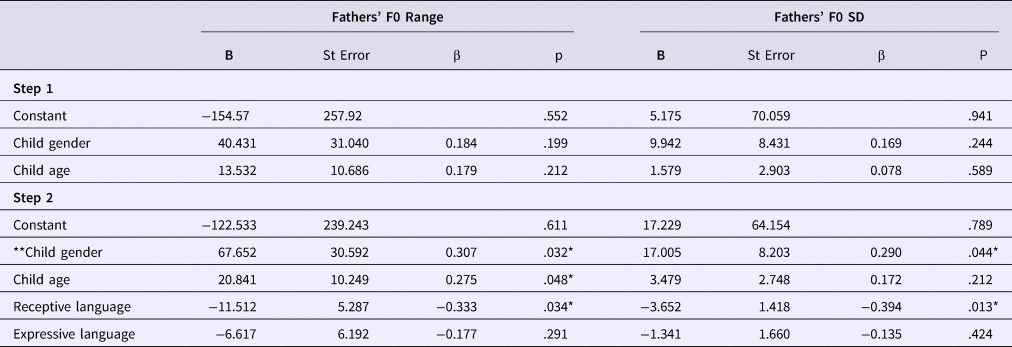
To test the hypothesis that father's F0 variability, indexed by F0 range and F0 SD, is associated with child age, child gender, and child language ability, hierarchical multiple regression analyses were performed (see Table 2). Evidence for a relationship between child language ability and fathers’ F0 modulation was obtained. Fathers’ F0 Range and SD were significantly correlated to children's receptive language ability controlling for child age and gender. Child receptive language score significantly predicted fathers’ F0 range scores (b = –3.33, t(47) = –2.188, p < .05) and fathers’ F0 SD scores (b = –0.39, t(47) = –2.58, p < .05). Child receptive language score explained 18% of variance in fathers’ F0 range scores, (adjusted R2 = .18, F(2,45) = 5.35, p < .01) and 17% of the variance in fathers’ F0 SD scores, (adjusted R2 = .17, F(2,45) = 6.08, p < .01). Fathers display greater F0 variability in interaction with children with lower receptive language ability. There was no relationship between fathers’ F0 variability and child expressive language ability. These results indicate that F0 variability in fathers’ speech may be associated with child level of understanding, and that F0 variability in fathers’ speech is not independently associated with child age or gender. In the first step of each model, neither age nor gender on their own is associated with fathers’ F0 variability.
Hierarchical regression analyses for fathers’ F0 variability in interaction with child

Notes. * significant at p < 0.05; ** Ref boys – fathers show higher range and SD with girls; F0 Range; R2 = 0.032 for model 1, ΔR2 = .183 for model 2; F0 SD; R2= –0.004 for model 1, ΔR2 = .174 for model 2.
Discussion
It has been shown that fathers engage with children differently to mothers in many ways, and that these interactions impact on child language development (Harewood et al., Reference Harewood, Vallotton and Brophy-Herb2016). As previously highlighted, IDS as a construct has been developed from analysis of maternal speech to infants and on infants’ responses to the characteristics of the female voice. Although recent research suggests that mothers and fathers display similar levels of F0 variability in IDS with their children, associations with children's language development or the saliency of that variability for the child may differ. Our findings showed marked within-group variability in the F0 range of fathers, and this wide individual variation has been reported in other studies of IDS (e.g., Narayan & McDermott, Reference Narayan and McDermott2016, with 4- to 16-month-old infants).
Our hypothesis, that the factors known to relate to mothers’ IDS would also be associated with fathers’ IDS, in particular that the increased pitch variability typical of IDS would be associated with younger child age and with less advanced language skills, was partially supported: fathers’ F0 variability was associated with child receptive language ability, independent of child age, gender, or expressive language ability. Higher paternal F0 variability was associated with lower child receptive language ability.
One recent study of North American infants aged 3–20 months reported that infants heard relatively more IDS as they got older, due to less ADS in the input (Bergelson et al., Reference Bergelson, Casillas, Soderstrom, Seidl, Warlaumont and Amatuni2019), and several studies have shown that both mothers and fathers are still using the prosody typical of IDS with 24- to 30-month-olds (Liu et al., Reference Liu, Tsao and Kuhl2007; Warren-Leubaker & Bohannon, Reference Warren-Leubecker and Bohannon1984). Gergeley et al.’s (Reference Gergely, Farago, Galambos and Topal2017) study with children aged 4.8 months to 3.5 years found that fathers showed decreasing speech prosody towards children after two years, while mothers used intense speech prosody independent of the child's age. Thus, at 24 months, fathers’ use of increased F0 as a linguistic device in interaction may be on the wane overall, but our findings suggest that the fathers may be using it selectively with children with lower levels of receptive language ability. Consistent with our findings, in a large study of child-directed speech (CDS) of mothers and fathers to a variety of child cohorts aged two years, Nienhuys, Cross, and Horsborough (Reference Nienhuys, Cross and Horsborough1984) showed that CDS is not adjusted based on children's age but rather according to their linguistic ability, and in particular their receptive language ability. This suggests that the children's contingent feedback rather than their age may play a role in the type of speech they hear.
It is likely that children can make use of both a higher and more dynamic F0, typical of maternal IDS, as well as a lower, less dynamic F0 reported as typical of fathers, possibly to different ends. Children are exposed to a broad range of pitch variability by this age and they can benefit from language input in the infant-directed register until relatively late in development (whether in relation to age or to lexical development) (Mani & Pätzold, Reference Mani and Pätzold2016). Children, however, may attend to different features of their fathers’ and mothers’ IDS at different stages of development to support their language acquisition, and further exploration of the child's uptake of paternal IDS features is warranted. Mothers and fathers may preferentially attend to different aspects of the child's language also. Mothers may be more responsive to child expressive language, and several studies have analysed the robust patterns of maternal imitation and responsivity to infant vocalisations (e.g., Franklin et al., Reference Franklin, Warlaumont, Messinger, Bene, Iyer, Lee, Lambert and Oller2014) which support and drive expressive language. There is a need for a comparative literature on paternal contingent responsiveness with infants.
As fathers’ F0 variability in this study is associated with child receptive, but not expressive, language ability, we suggest that it is being used primarily to foster and promote language and communicative competence, rather than to express affect or emotion. There is a lack of studies examining this hypothesis and more generally “the developmental coupling of fathers’ input and children's language proficiency” (Schwab, Rowe, Cabrera, & Lew-Williams, Reference Schwab, Rowe, Cabrera and Lew-Williams2017, p. 437). Two studies with mothers and two-year-olds found that the effect of IDS on language development was only significant amongst those children with relatively poorer language abilities (Ma, Golinkoff, Houston, & Hirsh-Pasek, Reference Ma, Golinkoff, Houston and Hirsh-Pasek2011; Weisleder & Fernald, Reference Weisleder and Fernald2013). In the current study, fathers may be especially attuned to child receptive language ability and modify their F0 according to child level of understanding by employing a prosodic style more typically used with younger infants. Children with lower receptive language scores had fathers who used increased F0 when speaking to them.
Our findings fit with previous research that reported an association between fathers’ use of conversation-eliciting speech with 24-month-olds and children's receptive vocabulary (Leech, Salo, Rose, & Cabrera, Reference Leech, Salo, Rowe and Cabrera2013). Of interest to this study is the finding that conversation-eliciting speech, namely questions and requests for clarification, is more prevalent in fathers’ than mothers’ IDS. This speech is typically characterised by increased F0 due to the lexical rise at the end of the utterance (Hixon, Weismer, & Hoit, Reference Hixon, Weismer and Hoit2018), and may partially account for the association we found between fathers’ F0 variability and child receptive language, although neither Leech et al. (Reference Leech, Salo, Rowe and Cabrera2013) nor the current study analysed the content of the fathers’ speech. Future research should analyse the prevalence of this type of speech in fathers’ input.
Strengths, limitations, and future directions
A significant strength of this study is a design that addresses many of the methodological concerns highlighted in a recent meta-analysis (Spinelli et al., Reference Spinelli, Fasolo and Mesman2017). The speech samples analysed reflect dynamic speech accommodations of dyadic interaction in a naturalistic observational context, as it is in the context of real-time interaction that prosodic elements of IDS are realised. Also, these findings are based on a sample size, of both participants and speech samples, greater than many previous studies (Benders et al., Reference Benders, Fletcher and St George2016; Broesch & Bryant, Reference Broesch and Bryant2017; Kaplan et al., Reference Kaplan, Sliter and Burgess2007; VanDam et al., Reference VanDam, De Palma and Strong2015; Warren-Leubecker & Bohannon, Reference Warren-Leubecker and Bohannon1984).
A contributory factor to the mixed findings in this literature is the lack of agreement on the length of vocal sample required to obtain a reliable measure of F0 (Benders et al., Reference Benders, Fletcher and St George2016), from individual words and phrases spoken in a fixed speech paradigm (Kaplan et al., Reference Kaplan, Sliter and Burgess2007) to day-long recordings (VanDam et al., Reference VanDam, De Palma and Strong2015) and failure to take into account the context-specificity of IDS (Gergeley et al., Reference Gergely, Farago, Galambos and Topal2017). The ratio of IDS to ADS features in parental speech has been shown to change with child age (Amano et al., Reference Amano, Nakatani and Kondo2006; Bergeleson et al., Reference Bergelson, Casillas, Soderstrom, Seidl, Warlaumont and Amatuni2019; Farran et al., Reference Farran, Lee, Yoo and Oller2016), and consequently samples longer than a single utterance are necessary to reliably measure the overall variability of F0 in the speech directed to a child at any given time. Comparing F0 variability of speech within a parent–child interaction across utterances more accurately reflects the speech heard and the F0 dynamics experienced by the child, rather than a comparison of ADS and IDS (Benders et al., Reference Benders, Fletcher and St George2016; Farren et al., Reference Farran, Lee, Yoo and Oller2016). As highlighted, it is the F0 variability expressed rather than just increased F0 that is the key factor. The inclusion of a standardised language measure is another strength of this study.
It would be useful to have longitudinal data relating fathers’ F0 variability and child language outcomes. Longitudinal research has shown that IDS prosody is linked to language skills (at least for mothers), with the use of exaggerated F0 range in IDS when a child is 24 months associated with language ability one year later (Graf Estes & Hurley, Reference Graf Estes and Hurley2013; Spinelli et al., Reference Spinelli, Fasolo and Mesman2017). In this study, using a concurrent design, fathers’ increased F0 variability could be considered as a response to child receptive ability rather than as a contributory factor to child receptive language ability as outcome, but longitudinal data are needed. Schwab et al.’s (Reference Schwab, Rowe, Cabrera and Lew-Williams2017) longitudinal study of fathers’ use of repetition and two-year-old children's vocabulary concluded that fathers were tailoring their speech to the child's vocabulary levels, i.e., were using more repetition with children with poorer vocabulary, rather than that their increased repetition was the cause of the children's poorer vocabulary.
If a parent is adjusting their speech to the child's level of ability, we would expect to find associations with child language both concurrently and longitudinally, on standardised tests and also in real-time interaction. The next step for this research is to analyse the children's behaviour and vocalisations in the interaction. Previous studies have indicated that child behaviour within interactions influences IDS (Schwab & Lew-Williams, Reference Schwab and Lew-Williams2016), and studies of infant–mother acoustic alignment (Quigley, McNally, & Lawson, Reference Quigley, McNally and Lawson2016; Seidl et al., Reference Seidl, Cristia, Soderstrom, Ko, Abel, Kellerman and Schwichtenberg2018) have revealed interesting patterns. Thus, individual differences in the F0 variability of IDS may be explained by how children respond to and elicit IDS events. Future research should track child responsivity and changes in attention during father–child interaction while measuring F0 fluctuations in IDS. This would help to identify change in the acoustic features of paternal IDS that represent a meaningful difference for the child.
Conclusion
This is one of the few studies to our knowledge that has linked child receptive language ability and acoustic features of fathers’ IDS. Despite not being able to conclusively determine the direction of effects in operation in this coupling, this study has opened up avenues for further research and for further exploration of father–child responsivity patterns. The careful research design supports the generalisability and replicability of these findings and important methodological and conceptual issues have been raised that will need further attention in order to develop our understanding of fathers’ IDS.