Starting in 2005, a homeowners' rights movement began to take shape in China's urban centres. Scholars have looked at how homeowners organize themselves within China's legal and micro-political settings,Footnote 1 and whether their self-organizing efforts can lead to political openings in China.Footnote 2 While homeowners' associations create important opportunities for civic actions and provide a dynamic space for citizens to self-organize and mobilize, some observers find that their activities are mostly contained within gated communities and are largely concerned with the economic interests of the participants.Footnote 3 However, several remarkable shifts have taken place within the movement in recent years. First, the homeowners' claims are moving away from economic rights towards political ones. Second, vigorous efforts are being made to establish cross-community, citywide, and even nationwide, alliances. Third, a group of active leaders has emerged during this process. In Beijing, these leaders represent a major driving force in the movement towards the citywide representation of homeowners' interests. Some of them have taken up leadership roles in other areas as well.
This article looks at the leaders of the various homeowners' associations (yezhu weiyuanhui 业主委员会) (YWH) who mobilize and coordinate activities to protect homeowners' rights. We first provide a brief account of the evolution of the homeowner movement in urban China over the last 20 years. We then briefly examine the main attributes of the individual leaders. Most importantly, we present a typology of these leaders. Depending on whether they took on a leadership role actively or passively, and whether their approach to defending rights was inspired by values or instrumentality, we have identified four types of leader. In the process of leading rights defence activism, a leader can change from one type to another, which we also discuss. We end by reviewing the implications for political development in China.Footnote 4
From Fragmentation to a Movement
The last two decades have seen the decisive emergence of a “middle class” of homeowners in China. Throughout the 1990s, the state commercialized the public housing system by selling off state- or collective-owned apartments to public employees at subsidized prices. Marketization, meanwhile, removed the danwei 单位 -bound housing allocation system, making it possible for people to purchase and own residential property. Since the late 1990s, a mortgage system has also developed apace to facilitate homeownership. By November 2005, 75.7 per cent of urban households in China owned their own property.Footnote 5
The shift into private homeownership has fundamentally changed the relationship urban residents have with the properties they live in. The institutional setting for so-called homeowner self-governance (yezhu zizhi 业主自治) can help us to understand the areas of frequent home-related contentions. Under the old system, housing properties were owned and managed by the urban danweis. Today, residential communities are purchased from a developer who is obliged to transfer the completed property to the owners. The residents of a development or estate (xiaoqu 小区) own their own separate units, but also collectively own all the public facilities in the xiaoqu. After construction is completed and property rights transferred to the homeowners, the property, including all apartment units, utility infrastructure and services, and public facilities, is then managed by a professional property management company (wuye gongsi 物业公司, or simply wuye 物业) (PMC). According to government regulations, each residential community, or xiaoqu, will form its own homeowners' committee. This committee serves as the executive body of the “homeowner assembly” (yezhu dahui 业主大会, referring to the collective of all the homeowners of the given xiaoqu). As the main institution through which homeowners exercise their self-governance rights, YWH has the right and responsibility to represent the homeowners and protect their interests.
In this setting, homeowner contentions often emerge in the following areas: 1) the developer failing to fulfil contractual obligations – for example, delays in project completion and move-in dates, compromised quality of the property, and unfulfilled obligations such as the floor area of individual units turning out to be less than the blueprint specification; 2) infringements of the estate's public properties – for example, the developer may convert some public space into commercial property, such as a store or a club house, and then sell it or rent it out; 3) inadequate or poor service from the PMC – PMC personnel may be incompetent or even abuse or beat homeowners or visitors. The PMC may also charge unreasonable fees for certain services; and 4) government failures – when homeowners want to register their complaints about the developer or the PMC, they may have difficulty accessing government agencies, and their complaints may receive little or no attention. Some government agencies may support the developer because the project will generate GDP and revenue income for the government. In such cases, homeowners have accused the government of being both player and referee.
Homeowners first sought to defend their rights within individual communities, but gradually activists changed tack and began to develop cross-community alliances. Several reasons are behind this change. First, activists discovered the commonalities of issues faced by homeowners across communities. It became clear to them that translocality solutions had to be sought and that allies could be found in other estates and neighbourhoods. Second, they realized that homeowners' self-governance rights are fundamentally antagonistic to developers' (and, occasionally, local authorities') interests, and so took it upon themselves to assert their rights by mobilizing fellow homeowners if necessary. Third, they attributed the root causes of these disputes to China's existing legal and regulatory institutions, as many rules and regulations are underdeveloped or inherently contradictory. As one activist explained:
How to solve issues like this? Relying on individual communities will not help, as the question is how to represent the views of all homeowners as a social group. Only after we bring communities together, stating that this view is not a view of the individual community but of many communities, then the authorities will consider and possibly address the issue.Footnote 6
The links between different communities have increased in strength; in fact, the leaders and participants, their organizations and networks, and their activities are growing into a social movement in China's urban centres.Footnote 7 In Beijing alone, beginning in 2006, leaders of about fifty homeowners' associations started to form cross-community organizations.Footnote 8 In August that year, 32 homeowners' associations applied to the Beijing municipal government for permission to form the Beijing Association of Homeowners' Committees (Beijingshi yezhu weiyuanhui xiehui 北京市业主委员会协会).Footnote 9 Since then, the number of participating YWHs has grown to over 80.Footnote 10 Active leaders have established the Application Board of the Homeowners' Committees Association (Yeshenwei 业申委), which runs a website and holds regular meetings.Footnote 11 Since 2006, the Application Board has organized seminars, discussion meetings, public lectures and other events and activities promoting the interests of homeowners. It has also been active in voicing its desire to form a pan-Beijing organization. In January 2007, at the first annual meeting of the board, a petition was launched calling on the National People's Congress to make certain changes to chapter six of the draft property law that the Congress was then deliberating on. The proposed changes included clarification of property rights regarding the facilities within estates – gardens, access roads and parking spaces – and permission for the establishment of citywide organizations representing homeowners. The petition eventually received support from various homeowners' associations across the country, with around 180,000 people signing the petition.Footnote 12
Through the years, we have followed the homeowners' rights movement in Beijing. One of the co-authors founded and has run the Urban Communities Governance Innovation Research Group at a major university in Beijing since January 2007. This group has formed extensive connections with leading activists in the movement and has had the opportunity to participate in and observe all three annual meetings, all the seminars and many other smaller events organized by the Beijing yeshenwei between January 2007 and April 2009.Footnote 13 The group has also participated in a number of forums organized or co-organized by homeowners' associations in Beijing. During this process, the group has accumulated participatory observations, interview records, questionnaire surveys and documents produced and utilized by homeowners. The following accounts rely on this wide range of data.Footnote 14
Who Emerges as a Leader?
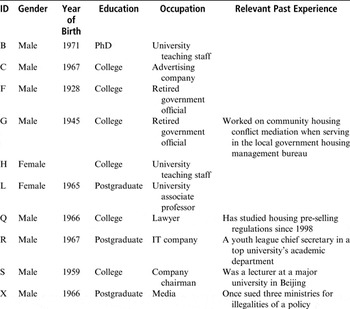
What we found most significant is the emergence of a large number of leaders. These leaders have promoted homeowners' rights by mobilizing resources and engaging with government offices, legal and media institutions, and civic groups such as rights-supporting NGOs. They have also focused on creating a formal platform for homeowners' activities, such as a citywide association for homeowner organizations. We found that these leaders are equipped with good organizational skills, have a good understanding of laws and social and political issues, and have extensive social ties. Beijing now has around 700–800 residential communities with formally organized homeowners' associations. We have identified roughly around a hundred activists who are working to form citywide representation of homeowners' interests. Among these activists, we have identified ten very typical leaders, and have presented their profiles in Table 1.
Characteristics of the Homeowner Movement Leaders

Clearly, these leaders belong to China's emerging urban middle class. They enjoy relatively high incomes, have higher levels of education and mostly work in knowledge-intensive or management jobs, for example, academic staff in universities, lawyers, IT engineers and journalists, amongst others.Footnote 15 As widely accepted by social and political psychology, economic security makes way for the desire and motivation for expression and a sense of empowerment. The story of S is illuminating. As the chairman of the board of directors of a Hong Kong-based company, he felt he had made enough money. For him, individual independence, including political independence, had to be based on economic independence. Now he is economically independent, so he feels, and therefore can “say whatever I want to say.” He desires to be what some media outlets refer to as an “expert on community activism” (shequ huodong zhuanjia 社区活动专家), or a “public intellectual.”Footnote 16 In 2003, when he was running for the local people's congress election, he used his own money for a wide range of campaigning activities.Footnote 17
Together with substantial levels of income, a related key factor is an ability to invest a substantial amount of time. An active leader normally has a secure job, enjoys a flexible schedule, and can rely on others (such as a domestic worker at home) to cover other obligations. The availability of time is a critical factor for activism, as time itself is a critical resource for social mobilization.Footnote 18 In April 2007, R led 20 homeowners of a community in a protest against the action of a developer. Seeing that three days of protest had failed to extract a satisfactory response from the developer, he and another activist declared a hunger strike. The hunger strike lasted for more than 50 hours until the developer offered a concession.Footnote 19 Other leaders also commit large amounts of time to organizing seminars, writing blogs and establishing networks.
Table 1 also shows that all the leaders come from good educational backgrounds. They are knowledgeable about social and political issues and can communicate sophisticated ideas effectively, with some demonstrating high levels of oratory competence. A few of them are teaching staff in universities, and a few others are lawyers, giving them the ability to speak confidently to large audiences. Take leader G, for example. Having gone to college during the 1960s when China was embracing Marxism, his political–philosophical training has proved useful when dealing with current problems:
When we studied political economy in the past, it was the old discourse … Although some of [the teachings] are wrong, the economy is the infrastructure, and politics is the superstructure, this I do believe… A country needs to have a strong economy and a political democracy [as its superstructure]. Democracy is not perfect, but is certainly better than dictatorship… The Chinese Communist Party has provided two pieces of land [for development of democracy]. One is the village election… and another is self-governance of urban communities.Footnote 20
Other studies have found that, to frame their demands, leaders of worker and peasant resistances often rely on the ideological resources of the Maoist era and the laws and policies of the state. Chen describes this as an indication of the lack of alternative ideational resources of these leaders.Footnote 21 In contrast, on average, homeowners' rights leaders are much better equipped with ideational resources. While G (quoted just above), having attended college during Maoist times, shows a great level of eloquence when it comes to the need for institutional change in China, younger leaders educated in the 1980s are clearly more versed in modern legal, political and economic concepts and arguments (as we will continue to show in the interview quotes below). In addition, they are often well connected to liberal intellectual circles in the major cities.Footnote 22 This puts them closer to the rights defence lawyersFootnote 23 and grassroots elites actively contending in local electionsFootnote 24 than to the leaders of worker or peasant protests.
Furthermore, past experience proves an important factor for the emergence of leadership when defending rights.Footnote 25 Most of the leaders interviewed were university students during the 1960s or the 1980s, two periods when college students were highly mobilized in social and political movements. Two of them (F and G) served in the government. This gives them confidence when dealing with government officials and developers, as well as a strong sense of responsibility to “speak up for” their fellow homeowners. A few others (such as F and Q) have worked in a profession related to urban development and construction. This has given them the specialized knowledge that enhances their position when dealing with property or development-related issues. Some have been involved in other rights defence actions, which has equipped them with legal knowledge and activism skills. Mr X, for example, was involved in a high profile litigation, suing three central government ministries.Footnote 26 Some have acquired leadership skills and dispositions during their school or college years. For example, R was a youth league leader in a top university and youth league cadres (tuan ganbu 团干部) in universities basically specialize in organizing and mobilizing people, as he described to us:
From very young I served in various positions as a student cadre (xuesheng ganbu 学生干部), taking up organizational work and social activities. I have always been interested in this.
Finally, these leaders enjoy high stocks of social capital in that they have extensive social networks from which they can frequently draw support. Their networks not only include family, friends, past classmates and co-workers, but, importantly, also activists from other homeowners' associations and civil rights organizations. Most of them seem to be proactively seeking to expand their networks. They often have connections with the media, government offices and academia.Footnote 27 Mr X, for example, as a journalist himself, mobilized a large amount of media attention for the auction of an abandoned half-finished building (lanweilou 烂尾楼).
Clearly, this core of homeowner activists represents the urban, highly educated, white-collar social strata in China. Their access to a wide range of supporting networks, their ability to frame demands in ways that give them protection and support from government mandated policies,Footnote 28 and the plentiful availability of mobilizing resources (such as through internet postings) make them highly effective protest leaders: the petition mentioned above that drew 180,000 supporters in a mere two months is evidence of their mobilizing strengths. A further example can be seen in their ability to exploit interagency cleavages in the government for their benefit. This ability places them in the same category as the environmental activists who embed their causes in the Chinese governmentFootnote 29 and the petitioners who “convert” a government bureau to support their claims.Footnote 30
Age-wise, the majority of these activists are younger than the leaders of peasant resistance: born in the 1960s, most of the homeowner leaders are in their 40s (at the time of our study), while a large proportion of peasant leaders were born in the 1950s and 1940s.Footnote 31 It appears that urban protest leaders become involved in activism during the prime of their professional life, while peasants of a similar age are more likely to be looking for jobs in the cities, leaving rural protest to the older peasants.
A Typology of Protest Leaders
In an early groundbreaking study, depending on whether they proactively take initiatives at work, and whether they derive joy from exercising power and accomplishing tasks, US presidents have been defined as being either “adaptive,” “compulsive,” “compliant” or “withdrawn” leaders.Footnote 32 Similarly, previous scholarship has also produced several typologies of urban activists and their organizations. For example, depending on the types of cases they take up, their commitment to the broader goal of rule of law, and their methods of legal representation, rights defence lawyers in China can be described as one of three types: “moderate,” “critical” or “radical.”Footnote 33 According to whether a YWH is autonomous vis-à-vis the government, and whether it represents the interests of the homeowners, it can fall into one of six categories ranging from purely “non-existent” to “fully empowered.”Footnote 34 Depending on their vocations, their motivation to stand for election, and their campaign strategies, independent candidates in China's local people's congress elections may be classed as either “idealist intellectuals,” “legal rights defenders,” “grassroots elites” or “heads of state-owned sectors.”Footnote 35
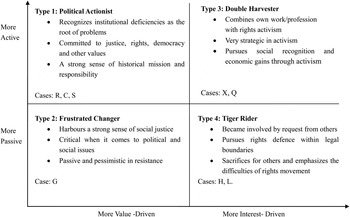
We have followed similar approaches of ideal-typing while developing a typology for the homeowner protest leaders. We denominate a motivation dimension that relates to a civic leader's main purpose for activism. A more interest-driven leader places potential benefits as the main motivation in joining the homeowner movement. The benefits that attract the person may be economic, political, or there may be the potential to realize other gains. A more value-driven leader, on the other hand, joins such a movement aiming to achieve a better, more just and fair (in the mind of the leader) society. To put it another way, a value-driven leader has broader political and social objectives in his or her mind, while an interest-driven leader may focus on more direct and immediate objectives relating to his or her property, neighbourhood and livelihood. The majority of scholarship on homeowner resistance so far seems to emphasize the interest-based and interest-driven type of actors and actions.Footnote 36 We will show that value-based and value-driven activisms are developing apace.
The second dimension we denominate relates to the degree of activeness of an individual homeowner leader. A more active leader proactively takes initiatives when pursuing homeowners' interests. He often actively improves existing institutional structures, or creates new mechanisms to expand the opportunity structure of the homeowners' cause. A more passive one, on the other hand, often reacts to external factors or events, and is more prone to looking for solutions within the existing institutional framework. This is in parallel with the different approaches between “moderate” and “critical” defence lawyers: a moderate (in our case, passive) activist prefers to work through legal and administrative means, while a critical or radical (in our case, active) activist may resort to extra-institutional or political methods, such as sit-ins, rallies or demonstrations.
A two-by-two typology can thus be created, as shown in Figure 1. We name these four types political actionist, frustrated changer, double harvester and tiger rider. We recognize these as ideal types, and in reality we seldom find leaders at the extremes of both dimensions. Nevertheless, the two-by-two space in Figure 1 does present the main tendencies that we observed in their activism.
A Typology of Leaders in the Homeowner Movement

Political actionist (value-driven/active)
Our cases: R, C, S. Benjamin Read describes the emergence of leaders who “have a proclivity to take on social causes and express a long-term desire for more sweeping political reforms.”Footnote 37 Indeed, the defence of homeowners' rights provides a platform for a group of activists committed to broader political goals, who share political beliefs and objectives similar to the “critical weiquan 维权 lawyers” and “intellectual idealists” in other fields of citizen politics in urban China. We definitely find these leaders in our value-driven/active type, which we term political actionists. While they may have initially been drawn into rights activism because their individual interests or rights were infringed, later on their deeds are mostly motivated by political values and ideals. Their concerns transcend the disagreements between developers and PMCs on the one side and homeowners on the other, and focus on the legal and institutional insufficiencies which they see as the root of such problems. As one prominent leader put it:
[Some] legal and institutional issues cannot be resolved simply by a single community. In the documents issued by the [Municipal] Real Estate Bureau, [Municipal] Price Bureau and [Municipal] Construction Commission, there are many wrong policies. When the property law came out it stirred even more conflicts, as it was based on the wrong values. It established the PMC as the main community body, which is definitely wrong. How to solve issues like this?Footnote 38
The values of these leaders are embedded in an idea that civil rights need to be respected and that citizens must be given full protection against capital and the state. Political actionists are optimistic about raising civic awareness among the majority of urban people. They take a view that China will become more and more democratic because Chinese society is becoming stronger and the government needs to respond to the people's calls for more democracy. They see themselves as bearers of historic responsibility in pushing this process forward, believing that self-governance (especially community self-governance) is a major step towards a more democratic country for the Chinese people. As one activist put it, self-governance for urban communities is “a cornerstone of a rejuvenation of the Chinese nation.” These leaders see homeowners' rights as the arena in which their proactive efforts can win institutional changes for China:
Government is more open and receptive than before … Our citizen rights may receive more respect. This is why we have a lot of like-minded people engaged together and where our great vision and power lies. While doing this, at first we were simply working to protect our own interests in the property, but now there is a sense of historical mission and responsibility. We feel obliged to promote social progress, so that the homeowners and citizens can really become aware of their rights.Footnote 39
While this type of leader has not clearly defined their ideal socio-political system, according to their statements in the various materials we collected, it can be described as follows: civil and human rights are respected; grassroots democracy is established and respected; self-government is basically achieved; and a sound legal and institutional regime is in place to guarantee these aspects:
We should now communicate, study and implement our legal rights, so that homeowners and citizens become familiar with and adopt this concept: This is my right… With gained property rights, the protection of human rights can be realized gradually. That is our vision now.Footnote 40
Other interviewees judge these leaders in the same way:
Democracy in China may start from community building. The work of the activists engaging in the defence of community rights at this moment, including the leaders around the Association Application Board and well-known rights defence activists… is not only for this movement, it is not only aimed at resolving [one] conflict, but is to promote development of democracy in China.Footnote 41
We call this type political actionist to emphasize that these leaders engage in actions most actively. They proactively look for innovative methods of mobilization, articulation and engagement to produce desirable outcomes. They aim to remove the broader legal and institutional barriers for the protection of citizen rights without worrying about immediate economic returns to themselves. In 2002, R had a dispute with the PMC. From his personal interest point of view, the involved value was less than one month's salary, but he fought the issue for several years in an attempt to pursue an institutional solution that would prevent the further infringement of the rights of homeowners. Several activists have used hunger strikes as their protest or articulation method.Footnote 42 To champion homeowners' rights, S ran in the local people's congress election as an independent candidate and financed his campaign out of his own purse. These leaders are probably considered the most dangerous type by the developers and PMCs, and probably by the government agencies preoccupied with maintaining social stability as well. As a result, they face pressures from many parties. Some leaders, fearing for their personal safety, have hired bodyguards and are unable to lead a normal life, but they seem ready to face the difficulties at any cost.
Frustrated changer (value-driven/passive)
Our case: G. This type of homeowner leaders' activism is also based on their values and not personal gain, but in contrast with the previously described type, they are not actively seeking to build on or improve the broader legal and political regime, but rather passively resist actual legal and institutional inefficiencies. They have a strong sense of social justice and are very critical when facing injustice and government failures, but they are highly pessimistic regarding the outcome of the homeowners' struggle:
The real estate development has not been regulated, and it is the government that is to be blamed for that… it is because of the local government that defending homeowners' rights is so difficult. The government puts up a face of supporting homeowner self-governance, but in reality it does not support it… The main problem is the government authorities. They take the roles of both player and referee… It is like having two teams of greatly asymmetric strengths playing one game, and the referee is with the stronger team… it is certain that it is us homeowners who will lose the game.Footnote 43
Although they do take action, their approaches are rather passive. Similar to type 1 activists, they believe that China's reform and opening up is on an irreversible course, and that economic progress must bring about changes in the political system. Nevertheless, they often think that such a process is slow and difficult owing to certain interest groups, and their vested interests, that oppose changes. While they support the participation of homeowner activists in people's congresses and other government institutions, they feel such efforts cannot bring immediate results as government bodies are highly influenced by and connected to developers and property management companies.Footnote 44 They tend to view the homeowners' rights movement as just and necessary, but they see themselves as playing a relatively small part in an overall socio-political trend:
China has just begun the process of democratization, and it is a difficult process… it is an inevitable trend, but the development is very slow. This process will go forward, regardless if one promotes it or not; [even if] not promoted, it will go forward… If you can push it forward a bit, it will develop a little bit faster. And if you do nothing, the process will just be a little bit slower.Footnote 45
When asked why he still participated if he already knew it was a losing game, G firmly stated that he joined the effort to push China's democracy forward. Hence, while unable to proactively seek ways to change China's institutional and legal environments, activists of type 2 still commit themselves to defending rights with angry resistance.
Double harvester (interest-driven/active)
Our cases: X, Q. There are proactive leaders who also see the potential benefits in rights activism. They anticipate personal gains that could be economic, political or social, such as improving their reputation or social standing. Junzhi He notes that some heads of state-owned sectors run for election in local people's congresses as they believe that being a delegate will bring about important benefits to their careers or businesses. He also notes that grassroots elites, such as village cadres and owners of private business, would also like to serve as delegates for similar reasons: access to government leaders, networking and business opportunities.Footnote 46 Rights defence activists can also reap similar benefits: if they make a name by representing homeowners' interests, they may be targeted for government co-optation, or they may generate a good reputation and other assets that can help their career or business.
Of course, this does not mean that this type of civil leader has no values. Indeed, in campaigning for rights, these leaders are both value and interest-driven, but they tend to place more consideration on their self interest rather than on broader values. In contrast with the value-driven civic leaders' sole focus on values, the interest-driven/active type is characterized by a “win-win” approach that seeks to bring benefit to the homeowner movement as well to themselves personally. While this type of leader finds the cause of defending homeowners' rights to be worth throwing their weight behind, they also consider the practical benefits it could bring to their own situation. As one of our interviewees, himself a representative of a consulting firm selling their services to homeowners, put it: “[As] we provide our services to homeowners, we only need to put our best efforts into protecting their interests, and our consulting service centre will thrive.”Footnote 47
While they often begin by defending the rights of their own community of homeowners, these leaders usually become consultants or lawyers to homeowners of other communities as well. They continue their involvement (free of charge) in defending homeowners' rights in their own community, but charge a fee if they provide services to homeowners in other neighbourhoods. This type of protest leader has a very good understanding of the issues involved in neighbourhood politics and often has prior experience of involvement with neighbourhood and other civil movements. They tend to make activists and their activities a cornerstone of their businesses. By their continuous involvement, they gain media attention, professional recognition and widespread reputation. For example, Q was voted one of “China's Real Estate Top Ten Most Influential People” in 2004. He also became head of the Real Estate Commission, a major government-endorsed professional association, and was invited to join a highly respected university's Policy Research Centre's Community Governance Project Task Force. Another double harvester protest leader, X, is known in industry-circles as the “big brother of rights defence” (weiquan dage 维权大哥), and serves as secretary-general of a national-level government-sponsored nonprofit organization, and is the vice-president of a national professional association.
The objective of this type of protest leader is then double-edged: while they obtain fame as a righteous and vigorous leader advocating the homeowners' cause, they also receive handsome economic and other returns. Based on this, we name this the double harvester type. In fact, the term in Chinese is highly descriptive: mingli shuangshou 名利双收 – harvesting both fame and profit.
Tiger rider (interest-driven/passive)
Our cases: H, L. Similar to the double harvester type, interest-driven/passive leaders are also motivated by self-interest. But, unlike the proactive double harvester type, a tiger rider activist is usually pressured into taking up a leadership role in the movement and is generally rather passive in their activism. They become involved primarily because of perceived threats to their own interests; of course, these interests could also be linked to the collective interests of a group of homeowners. They are often among the most educated homeowners in a neighbourhood with lower than average levels of education, and so will already command a certain level of respect from their fellow residents. To borrow from Li and O'Brien, they are public figures even before protests break out.Footnote 48 Typically, these leaders have been under pressure from other homeowners in their neighbourhood to support their collective interests.
In our interviews, these tiger rider activists often emphasized that their primary motivation was to support their neighbours in their lawful protest, instead of leading such actions. In addition, as this type of leader is usually acting on behalf of the (homeowners') collective, they feel that their efforts to protect the rights of others has led to their own personal sacrifices, and they often stress how difficult it is to engage in such activism. The case of a high school teacher who was nominated by, and assumed responsibility for, other homeowners is typical:
My sense is that the homeowners and residents [in this community] do not bother to study how to protect their own rights, and the rights protection process [for me] is particularly tiring… They often do not even look [at the documents], and just say: “What do you think should be done?” They do not even look into, do not study these things. You have to explain to them. I have to … talk again to our residents, how they should defend, and what they can defend … Everything is pushed to the homeowners' committee… and the homeowners' committee has to do everything.Footnote 49
We call this type of leader a tiger rider: somewhat unwillingly or reluctantly, they are put in the position of representing their fellow residents. While they find this an unenviable position, they also find it difficult to remove themselves from this situation, mostly because of expectation or peer pressure from their fellow homeowners. The Chinese idiom “riding a tiger and unable to get off” (qihu nanxia 骑虎难下) nicely characterizes their position.
Unwilling to create confrontation with authority, tiger riders particularly emphasize the importance of legal regulations and their proper application. In other words, they are always very careful to work within existing legal and institutional frameworks to protect homeowners' rights. While they tend to note and criticize “weak” laws and call for their amendment, unlike the value-driven/active type of leader they seldom actively promote substantial changes to the existing systems. We find striking similarities with the “moderate lawyering” approach identified by Fu and Gullen, which pursues weiquan through legal rather than political means, and limits clients' actions “to what is permissible in law and to channel their grievances and demands through the court system.”Footnote 50 A tiger rider leader will often show full support to and recognize the importance of official structures:
To successfully establish a homeowners' congress or homeowners' committee, a thorough understanding of relevant government laws and regulations is a basic [requirement], patience and perseverance are key, also gaining support from relevant government departments, including the Community Office of [Municipal] Construction Committee, Street Office and local Residential Committee, is a necessary condition.Footnote 51
Despite the inconveniences and difficulties they face in the process of promoting homeowners' rights, tiger rider leaders feel it is worthwhile taking on the role and duties of homeowners' representatives as “so many homeowners put their trust in us,”Footnote 52 and because “despite the fact that not everyone will praise you, there are more people to shake your hand. It is worth it!”Footnote 53
We observed that the 100 or so activists engaged in defending homeowners' rights do not fall into these four categories with equal probability. The majority of them either fall into type 1 or type 4. Probably 30–40 per cent initially engaged in activism without realizing how difficult it was, and therefore later found themselves in a tiger-riding situation (type 4, tiger riders). Some of them wished to leave the movement, but could not because of various reasons. Another 30 per cent or so emerged to be very committed to the cause, and aimed at producing broader legal and institutional changes in the Chinese political and government systems (type 1, political actionists). Double harvesters (type 3) or frustrated changers (type 2) are in the minority, accounting for 10 per cent, or slightly more, each.
Evolution and Changes of Identity
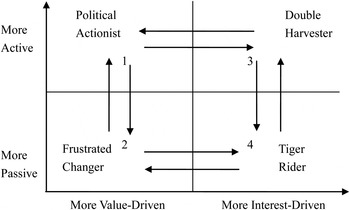
Participation in collective action often becomes a transformative experience for activists “that makes them aware of new possibilities and often leaves them more inclined to take part in other [forms of activism].”Footnote 54 Therefore, individual leaders can move between the different types identified in this study. Leaders can evolve from interest-driven to value-driven and from passive to active, as represented in Figure 2. Reverse movement of types is equally possible. That is, disillusionment, co-optation or other factors may affect leaders, and value-driven activists can become interest-driven ones.Footnote 55
Identity Changes of Homeowner Leaders

From interest-driven to value-driven
For many activists, participation in collective action “may increase their sensitivity to social injustice and inspire them to mount further challenges.”Footnote 56 It can lead them to believe that they are representing not only themselves and their neighbours, but (Chinese) people in general, and bring about the formation of a collective identity, where civic leaders identify themselves as members of a larger community. This in turn facilitates the expansion of their activism beyond the boundaries of the neighbourhood, and encourages them to form links with other social groups and pursue issues that transcend the politics of gated neighbourhoods. Within this context, an individual leader may often develop a sense of historical mission. In the words of one of the civic leaders (partially quoted above):
Democracy in China may start from community building … the efforts [of the leaders engaged in the homeowners' rights movement] to carry out this cause, sacrificing personal interests, it is not only for the movement, it is not only aimed at resolving [one] conflict, but is to promote the development of democracy in China.Footnote 57
In all probability, all value-driven/active leaders (type 1, political actionist) embark upon rights defence activism because their own immediate interests are affected.Footnote 58 But, as their activism develops, they acquire a broader perspective and become active seekers of institutional change. Leader R (quoted above) makes this clear. In some cases, owing to frustration with local authorities as well as positive outcomes resulting from attention from higher-level authorities, protest leaders may develop a self-perception of representing the progressive values and policies of upper levels of government. A good illustration is offered by one homeowners' rights movement leader who believes that China has a democratic system, but that Chinese people “have not embraced democracy in their hearts (neixin bu minzhu 内心不民主) … [starting with community self-governance], we can make community a small fortress of democracy.”Footnote 59
From value-driven to interest-driven
Activists can lose motivation when their efforts are consistently frustrated, as can be witnessed when the passion displayed by rural protest leaders for defending their rights turns to indifference.Footnote 60 In the homeowners' rights movement, difficulties in achieving a positive outcome may also lead activists to review their objectives and strike compromises with authorities and developers. Alternatively, the highly profitable political economy of the housing market provides handsome benefits that some activists find exploitable. As a result, value-driven leaders are attracted by political or economic interests, and change their objectives. However, it is necessary to differentiate between two kinds of interest-driven activities. First, some leaders may spot a business opportunity in rights activism. Although an increasing number of lawyers in China are offering free legal support to various causes, some lawyers can see business opportunities in defending homeowners' rights.Footnote 61 For example, after successfully leading his community's protest against a developer, Mr X's fame attracted homeowners from other communities who sought his advice. Subsequently, he established a specialized consultancy centre. His centre would pursue rights issues for residents within his community, whilst also taking up rights defence cases from other xiaoqus. We call this “for-profit rights defence” (youchang weiquan, 有偿维权).
The second pursuit of personal interests might be viewed as more pitiable. In one community we studied (Community DY), Mr Y was among the earliest to lead fellow residents' collective actions. He was committed to the interests of the whole community, and sacrificed personal time and energy to form his community's homeowners' association, negotiate with the management company, and organize protests. Yet, with the growing strength of the homeowners' collective actions, the management company and the local government decided to buy off the leaders. Mr Y embezzled half of the fee the developer provided to the homeowners' association, and accepted two parking slots offered to him by the management company. Very soon he lost interest in advancing homeowners' interests. In the words of a fellow resident:
The previous director of our homeowners' association … the developer gave him 20,000 yuan as the association's operational fund. He helped himself to 10,000 yuan of it. And the management company gave him two parking slots. He rented out one of them, with the other left unused. We all opposed [his deeds], so the association removed him [as the director].Footnote 62
Y's behaviour is probably an extreme case of leadership degeneration in urban resistance politics. Other cases also see the development of more retiring attitudes of previously active and ambitious leaders. For example, a rights defence leader, Mr N, found a passion in political participation through his activism in the homeowner movement. In 2003, he campaigned for election and won a seat on the local people's congress, with a very high ballot margin. Yet, when he served out his term in 2006, he did not stand for the next congress election. Throughout the same period, his involvement in the homeowners' rights movement gradually declined, eventually to complete disengagement.
The cause of such changes in attitude can be complex. It may be because of the Party-state's successful co-optation, or diminishing enthusiasm owing to the difficulties in achieving positive outcomes even after one has succeeded in winning an election. Indeed, value-driven and active leaders may scale down their goals and plans, and lose the “active” dimension in their identity. Some of these leaders, such as Mr N, give up democracy-seeking ideals; others may turn into a double harvester type, proving the effectiveness of government co-optation. Others may acquire the belief that to make changes, one needs to work with and within the government, and so may strive for a more embedded working relationship with the state. All in all, the arena of defending homeowners' rights represents a microcosm of the complex institutional, structural and political make-up of state–society relations in contemporary China.
Discussion and Conclusion
We found it useful to analyse the leaders of China's urban homeowners' rights movement by viewing their aspirations or motivations as being more value- or interest-driven, and their approaches as being more active or passive. It is tempting to argue that the value-driven/active type of leader brings most value to the homeowners' rights defence efforts. Value-driven leaders find motivation in justice, equality (of rights), democracy, freedom and other fundamental values. They usually harbour high levels of determination despite the pressures and obstacles they face. They are also more resistant to financial incentives offered or co-optation offers from government or capital. By contrast, the commitment offered by interest-driven leaders might be commensurate to the level of personal gain. Should the risk–benefit ratio be low, some of these leaders might not be particularly interested in contributing. Within the active–passive dichotomy, active leaders are proactive in exploiting opportunities and building allies and supporters. Their actions facilitate the state's adaptation to an increasingly autonomous, organized and engaged society. By comparison, a passive leader is often reactive and lacks innovative designs to better citizens' rights and improve governance.
Therefore, it indeed seems that value-driven/active leaders have the highest potential to bring benefit to homeowners. Yet, at present, the Chinese state is apparently effective in both oppressing and co-opting the emerging quasi-political and political actors in society. At the same time, new mechanisms of dialogue and synergy between authorities and society are being created, often known as government or governance innovations.Footnote 63 Against this background, less confrontational, more cooperative and patient approaches may sometimes prove more effective. In this sense, the difference between a “radical” and a “critical” approach to rights defence is well worth pondering.Footnote 64
However, the homeowner movement leaders we studied for this article have helped tens of thousands, or more, homeowners to organize and to acquire a new sense of citizenship. They have helped homeowners from various communities, across widespread locations, and from various professional backgrounds, and have already established a dense social network. They have helped homeowners to acquire a group identity, and to practise collective actions and political participation. In short, they have contributed greatly to the rise of China's civil society. If we believe that a strong civil society is a prerequisite for democratization, then whether a homeowner leader is explicitly seeking legal or political changes, he or she has already contributed to China's democratization in the long run.