Introduction
Social interactions require us to recognize and interpret a stream of verbal, gestural and facial cues from our communication partners and use these cues to infer our partners’ thoughts and feelings. The ability to make sense of and use these social cues is referred to as social cognition (Kelly, McDonald, & Frith, Reference Kelly, McDonald and Frith2017; Kennedy & Adolphs, Reference Kennedy and Adolphs2012). As social interactions evolve over time, individuals must maintain and manipulate social information within working memory. For example, during a conversation, listeners must continually hold and update their mental representations based on information gleaned from their partners’ verbal and nonverbal cues and integrate their new representations with past knowledge to respond in a socially acceptable way.
As social interaction requires coordination of working memory and social cognition, it is important to understand how these two cognitive processes function together. For example, one might expect working memory capacity for social stimuli to vary as a function of working memory factors, like the number of items to be held in mind, and social factors, like whether stimuli are basic or complex emotions. Likewise, working memory for social stimuli might be predicted to engage some combination of brain regions usually activated on working memory tasks and regions specifically linked to social cognition. There is evidence to support these predictions. Neta and Whalen (Reference Neta and Whalen2011), for example, found that typically developing (TD) young adults performed more poorly on a working memory task when they were asked to recall more complex social information (i.e., facial affect vs. facial identity). Further, performance of both tasks was associated with activation in both canonical working memory regions and brain regions known to be involved in social cognition. Similarly, Smith et al. (Reference Smith, Lane, Alkozei, Bao, Smith, Sanova and Killgore2017) found that maintenance of social information, in this case others’ emotions, was associated with activation in brain regions associated with working memory and representation of emotional information. Thornton and Conway (Reference Thornton and Conway2013) reported similar results in a study using three-dimensional faces constructed to show a continuum of trustworthiness. Participants were asked to state whether a face was either as trustworthy or in the same location as a face shown 0, 1 or 2 trials previously. Results for accuracy showed the expected working memory effect, with lower scores as working memory load increased. Participants also had lower accuracy scores on social items than nonsocial items, consistent with the study by Neta and Whalen (Reference Neta and Whalen2011). Results for reaction time, however, revealed an interesting pattern: reaction times were faster for social than nonsocial items. The authors attributed the social speed advantage to precoding or ‘chunking’ of social information, which would allow humans to be more efficient at processing social cues, suggesting that working memory for social stimuli might be more than just the product of these two cognitive functions.
While studies to date provide evidence that performance on social working memory tasks (i.e., tasks that require maintenance and manipulation of high-level social information (Meyer & Collier, Reference Meyer and Collier2020)) requires a combination of working memory and social cognitive skills, most research has focused on adults. Adults have an established repertoire of social knowledge and skills (Kilford, Garrett, & Blakemore, Reference Kilford, Garrett and Blakemore2016) that can support their social performance. By contrast, adolescents are just developing social knowledge and skills (Kilford et al., Reference Kilford, Garrett and Blakemore2016; Steinberg, Reference Steinberg2010) and working memory for social stimuli may be a critical part of this development (Amadó, Serrat, & Vallès-Majoral, Reference Amadó, Serrat and Vallès-Majoral2016; Gordon & Olson, Reference Gordon and Olson1998; Im-Bolter, Agostino, & Owens-Jaffray, Reference Im-Bolter, Agostino and Owens-Jaffray2016). Brain regions that support social cognition and working memory, particularly the prefrontal cortex, undergo major changes during adolescence and continue to develop into early adulthood (Feinberg & Campbell, Reference Feinberg and Campbell2010; Tamnes et al., Reference Tamnes, Herting, Goddings, Meuwese, Blakemore, Dahl and Millis2017). Consistent with these brain changes, performance on behavioral measures of social cognition improves from childhood into early adulthood (Choudhury, Blakemore, & Charman, Reference Choudhury, Blakemore and Charman2006; Humphrey & Dumontheil, Reference Humphrey and Dumontheil2016; Lawrence, Campbell, & Skuse, Reference Lawrence, Campbell and Skuse2015; Thomas, De Bellis, Graham, & LaBar, Reference Thomas, De Bellis, Graham and LaBar2007; Vetter, Drauschke, Thieme, & Altgassen, Reference Vetter, Drauschke, Thieme and Altgassen2018). Working memory also develops through late adolescence (Embury et al., Reference Embury, Wiesman, Proskovec, Mills, Heinrichs-Graham, Wang and Wilson2019; Master et al., Reference Master, Eckstein, Gotlieb, Dahl, Wilbrecht and Collins2020; Simmonds, Hallquist, & Luna, Reference Simmonds, Hallquist and Luna2017), as individuals develop metacognitive skills and improve their strategy use to manage information. Thus, while children are able to recall single units of information as well as adults, the ability to store and strategically organize this information continues to develop into adulthood (Best & Miller, Reference Best and Miller2010; Conklin, Luciana, Hooper, & Yarger, Reference Conklin, Luciana, Hooper and Yarger2007; Master et al., Reference Master, Eckstein, Gotlieb, Dahl, Wilbrecht and Collins2020).
Unfortunately, adolescence also is a period of increased risk for traumatic brain injury (Sarmiento et al., Reference Sarmiento, Thomas, Daugherty, Waltzman, Haarbauer-Krupa, Peterson and Breiding2019; Taylor, Bell, Breiding, & Xu, Reference Taylor, Bell, Breiding and Xu2017). TBIs result from a blow, jolt, or bump to the head and disrupt typical brain functioning (Centers for Disease Control and Prevention, 2021). Falls and motor vehicle accidents are the most common injury mechanisms among adolescents and young adults (Taylor et al., Reference Taylor, Bell, Breiding and Xu2017). Such injuries impose rapid acceleration-deceleration forces upon the brain, resulting in a diffuse injury pattern (Bigler, Reference Bigler2001; Martin-Rodriguez & Leon-Carrion, Reference Martin-Rodriguez and Leon-Carrion2010) that includes areas critical to both social cognition (i.e., medial prefrontal cortex, temporal poles, orbitofrontal cortex) and working memory (i.e., dorsolateral and ventrolateral prefrontal cortex, posterior parietal cortex). Further, TBI often causes diffuse axonal injuries to the white matter tracts that connect social and working memory brain networks (Ryan et al., Reference Ryan, Catroppa, Beare, Silk, Hearps, Beauchamp and Anderson2017; Tuerk et al., Reference Tuerk, Dégeilh, Catroppa, Dooley, Kean, Anderson and Beauchamp2020). As a result of these injuries and associated developmental disruptions, adolescents and adults with TBI have are at risk for impairments in both social cognition (Deighton et al., Reference Deighton, Durish, Taylor, Rubin, Dennis, Bigler and Yeates2019; McDonald et al., Reference McDonald, English, Randall, Longman, Togher and Tate2013; Ryan et al., Reference Ryan, Anderson, Bigler, Dennis, Taylor, Rubin and Beauchamp2020; Tousignant et al., Reference Tousignant, Jackson, Massicotte, Beauchamp, Achim, Vera-Estay and Sirois2018) and working memory (Gorman, Barnes, Swank, Prasad, & Ewing-Cobbs, Reference Gorman, Barnes, Swank, Prasad and Ewing-Cobbs2012; Gorman, Barnes, Swank, & Ewing-Cobbs, Reference Gorman, Barnes, Swank and Ewing-Cobbs2017; Phillips, Parry, Mandalis, & Lah, Reference Phillips, Parry, Mandalis and Lah2017). Adolescents and children with TBI have been reported to have impaired theory of mind (Deighton et al., Reference Deighton, Durish, Taylor, Rubin, Dennis, Bigler and Yeates2019; Dennis et al., Reference Dennis, Simic, Gerry Taylor, Bigler, Rubin, Vannatta and Yeates2012; Ryan et al., Reference Ryan, Catroppa, Beare, Silk, Hearps, Beauchamp and Anderson2017) and facial affect recognition (Babbage et al., Reference Babbage, Yim, Zupan, Neumann, Tomita and Willer2011; Schmidt, Hanten, Li, Orsten, & Levin, Reference Schmidt, Hanten, Li, Orsten and Levin2010; Tonks et al., Reference Tonks, Slater, Frampton, Wall, Yates and Williams2009; Turkstra, McDonald, & DePompei, Reference Turkstra, McDonald and DePompei2001) when compared with their uninjured peers. Ryan et al. (Reference Ryan, Anderson, Bigler, Dennis, Taylor, Rubin and Beauchamp2020) measured social cognition using a composite test battery that required participants to infer the mental states of others from facial affect displays, speech acts, and a nonverbal false-belief scenario. In this large, international study, children and adolescents with complicated mild to severe TBI had poorer social cognition than orthopedic controls and a noninjured comparison group. There is also preliminary evidence that, as in adults, adolescents with TBI are as accurate as their peers in face identification but less accurate in facial affect recognition (Tonks et al., Reference Tonks, Williams, Frampton, Yates, Wall and Slater2008). That is, adolescents with TBI may make more errors when a social demand is added to a general cognitive demand, and thus might have disproportionately lower scores than peers on working memory tasks with complex social stimuli.
For many individuals with TBI, social cognition and working memory impairments are associated with negative social outcomes (Milders, Reference Milders2019) including impairments in social communication (McDonald et al., Reference McDonald, English, Randall, Longman, Togher and Tate2013; Rowley, Rogish, Alexander, & Riggs, Reference Rowley, Rogish, Alexander and Riggs2017), problems in peer and family interactions (Morton & Wehman, Reference Morton and Wehman1995; Rogers & McKinlay, Reference Rogers and McKinlay2019; Yeates et al., Reference Yeates, Swift, Taylor, Wade, Drotar, Stancin and Minich2004) and reduced social integration (Binder, Lancaster, Lengenfelder, Chiaravalloti, & Genova, Reference Binder, Lancaster, Lengenfelder, Chiaravalloti and Genova2019; May et al., Reference May, Milders, Downey, Whyte, Higgins, Wojcik and O’Rourke2017; Tousignant, Sirois, Achim, Massicotte, & Jackson, Reference Tousignant, Sirois, Achim, Massicotte and Jackson2017; Tousignant et al., Reference Tousignant, Jackson, Massicotte, Beauchamp, Achim, Vera-Estay and Sirois2018). Adolescents are at particular risk for poor social outcomes after TBI, because of the combination of high social demands during this developmental stage and potential disruption of ongoing development of brain structures and functions that are critical for social performance (Steinberg, Reference Steinberg2010). Information about the interaction of working memory and social cognition could inform our understanding of everyday social performance in adolescents with TBI and help identify assessment and intervention tools that will improve social outcomes for those affected. As a first step, the objective of this preliminary study was to explore the effects of TBI on adolescents’ working memory for social information, specifically facial affect recognition. To achieve this objective, adolescents and young adults with TBI and uninjured peers completed n-back tasks in which we manipulated both working memory (0-, 1- and 2-back conditions) and social cognitive (facial recognition vs. facial affect recognition) demand. Study hypotheses were as follows:
-
1. Face recognition scores would be higher than emotion recognition scores in both groups, as would scores on items with lower working memory demand.
-
2. Adolescents with TBI would have lower scores than TD peers on all study tasks based on evidence that working memory and social cognition may be impaired after TBI.
-
3. Between-groups differences on the experimental tasks would be disproportionately larger for affect recognition than face recognition and would increase as working memory load increased.
Methods
Participants
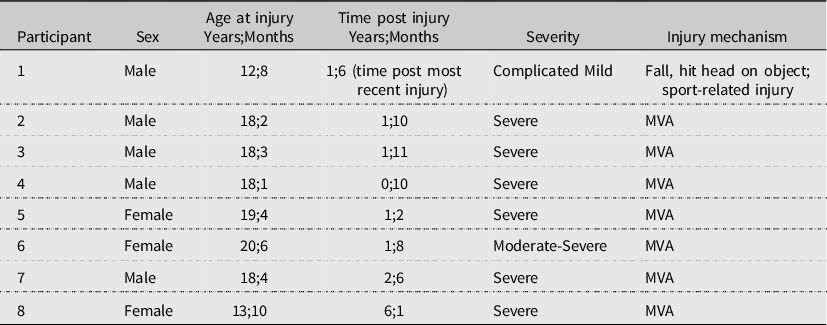
Participants were eight adolescents and young adults with TBI (five males, three females), ages 14–22 years, and eight TD participants matched for age and sex. All were recruited through community sources (e.g., flyers, outreach to community TBI support groups and resource networks) from a mid-sized midwestern city in the US. Participant demographic characteristics are shown in Table 1. As shown in Table 2, seven participants with TBI had sustained moderate-to-severe injuries and one participant sustained three concussions over a 3-year span and had documented cognitive impairments related to those injuries. All participants were injured at least 6 months prior to study enrollment. No participant in either group had a documented history of learning, speech, language or psychiatric diagnosis (premorbidly for the TBI group). All participants were native English speakers by self-report. The two experimental groups did not differ significantly in age, t = 1.37, P = 0.19 however, the TBI group had significantly lower IQ scores, t = −2.78, P = 0.03 as measured by the Kaufman Brief Intelligence Test − Second Edition (Kaufman & Kaufman, Reference Kaufman and Kaufman2004).
Participant Demographic Characteristics

TBI Group Injury Characteristics

Tasks
Emotion recognition and face recognition were assessed using separate computer-based n-back tasks with 0-, 1- and 2-back conditions. Participants completed the tasks while seated at an Apple iMac computer, and tasks were programed in PsyScope (Cohen, MacWhinney, Flatt, & Provost, Reference Cohen, MacWhinney, Flatt and Provost1993). Each stimulus image appeared at the center of the screen for 800 ms. Consecutive images were separated by an interstimulus interval of 1.6 s during which a blank white screen appeared. Stimuli were black and white photographs of 24 adults (12 females, 12 males; 16 white adults, 8 Asian adults) displaying four validated facial emotions (happy, neutral, sad and angry; Biehl et al., Reference Biehl, Matsumoto, Ekman, Hearn, Heider, Kudoh and Ton1997; Ekman & Friesen, Reference Ekman and Friesen1976). Photographs were all processed to the same size (300 pixels by 405 pixels), and features such as hair or shoulders were eliminated with a black filter. For both the face and emotion recognition tasks, participants were instructed, on screen, to respond ‘yes’ if a stimulus image matched the image n-images previously presented. Participants were instructed to use the forward slash (’/’) key for ‘yes’ if they were right-handed or the ‘z’ key if they were left-handed and preferred to respond with their left hand. Before the start of each task, participants were trained on a basic n-back task using a paper example with a series of simple shapes. During the training task, the experimenter explained the tasks and conditions and provided feedback following each correctly identified or missed response. After the paper-based training, participants completed a 10-item computer-based practice trial, which had a 70% hit rate. No feedback was provided during the computer-based practice trial.
Emotion recognition task
In the 0-back condition, participants were instructed to press the response key each time an image of an individual demonstrating a ‘mad’ facial expression appeared on the screen. In the 1-back condition, participants pressed the key when two consecutive faces displayed the same facial emotion, ignoring the person’s identity and attending only to the emotion displayed. Likewise, in the 2-back condition, participants pressed the key when they saw a facial affect that had been displayed two photos previously in the sequence (e.g., happy, neutral, happy). No feedback was given during the experimental tasks.
The 0-back condition included 100 images with 21 possible hits. Participants viewed 160 images in the 1-back conditions with 48 possible hits. A hit was defined as correct identification of the target emotion in the 0-back condition or accurate identification of two consecutive presentations of a given emotion in the 1-back condition. In the 2-back condition, participants viewed 250 faces with 60 possible hits (i.e., 2-back emotion matches). Matches never occurred consecutively in the 1-back condition (e.g., happy, happy, angry, angry), and no more than two matches were presented in a row in the 2-back condition (e.g., happy, angry, happy, angry).
Face recognition task
The structure of the face recognition task was identical to that of the emotion recognition task, with the exception that there were 20 rather than 21 possible hits in the 0-back condition. All faces showed neutral expressions, and participants responded based on identity of the pictured individuals rather than affective features.
The outcome measure for the two tasks was A′, which is the probability of correctly identifying targets (hit rate), calculated for each condition, as a function of the false alarm rate and hit rate (Evans, Selinger, & Pollak, Reference Evans, Selinger and Pollak2011). A′ was calculated according to Donaldson’s formula (Donaldson, Reference Donaldson1992) used in an earlier n-back study of children with TBI (Levin et al., Reference Levin, Hanten, Zhang, Swank, Ewing-Cobbs, Dennis and Hunter2004) : A′ = 0.5 + ([(hits – false alarms)*(1 + hits – false alarms)] / [4*(hits(1 – false alarms))). Scores could range from 0.50 (chance) to 1.0 (perfect target/nontarget discriminability), with higher A′ values indicating better discrimination.
Working memory was measured using the Competing Language Processing Test (CLPT; (Gaulin & Campbell, Reference Gaulin and Campbell1994)). The CLPT was designed to test the ability to temporarily store verbal information in working memory while analyzing sentence meaning (Gaulin & Campbell, Reference Gaulin and Campbell1994). It is comprised of groups of one to six simple spoken sentences. Participants were asked to listen to each sentence and immediately indicate whether the sentence was true or false (e.g., after hearing the sentence ‘Children can play’ the participant should respond, ‘true’). At the end of each sentence group, participants were asked to recall the final words of each sentence in that group (Gaulin & Campbell, Reference Gaulin and Campbell1994). For example, if participants heard, ‘Children can play. Ice is hot’ they would answer, ‘play, hot’ after the second sentence. The dependent measures for the CLPT were accuracy of true/false judgments (percent correct) and the percent of total last words recalled.
Procedures
All participants gave informed consent or assent, depending on their age, at the start of the study protocol. Participants then completed the CLPT and emotion recognition and face identity tasks. Tasks were administered in two separate 2-h sessions and order of administration was randomized across participants. Within both tasks, participants completed the 0-back condition first, then the 1-back and finally the 2-back condition. Each participant was paid $10 per hour. All procedures were approved by the Institutional Review Board at the University of Wisconsin-Madison. The authors assert that all procedures contributing to this work comply with the ethical standards of the relevant national and institutional committees on human experimentation and with the Helsinki Declaration of 1975, as revised in 2008.
Data analysis
Scores on the n-back tasks were compared using a three-way repeated-measures analysis of variance (ANOVA), with group as the between-subjects variable and task (emotion vs. face identity) and working memory level (0-, 1- and 2-back) as within-subjects variables. Three main effects were predicted: a main effect of group, with higher scores in the TD group; a main effect of working memory load, with progressively lower A′ scores in the 0-, 1- and 2-back conditions; and a main effect of task, with lower scores overall for the emotion recognition task. We also predicted an interaction of group by task, with a larger between-groups difference on the emotion recognition task than the face recognition task; and an interaction of group by working memory load, with disproportionately lower scores in the TBI group for the 1- and 2-back emotion recognition task conditions relative to the other task and condition. The criterion alpha level for these comparisons was 0.05. Planned post hoc tests were conducted as appropriate.
CLPT scores were compared between groups to document working memory impairments in the TBI group. One-tailed t-tests were used to compare comprehension accuracy and recall. The criterion alpha level for these comparisons was set at 0.05. All analyses were conducted using STATA™ statistical software.
Results
Before analysis, we examined data for normality and sphericity of distribution. Data did not meet criteria for homoscedasticity, so we used repeated-measures ANOVA for analysis of main and interaction effects, nonparametric Kolmogorov−Smirnov tests for post hoc tests, and Cliff’s d Footnote 1 (Cliff, Reference Cliff1993) for effect size calculations.
Main effects
Results are shown in Fig. 1 (face identity recognition) and Fig. 2 (emotion recognition) and individual participant data are shown in Table 3. Results supported the first two hypotheses. ANOVA showed a significant effect of group, F(1, 94) = 39.37, P < 0.001, with significantly higher scores in the TD group than the TBI group. There was also a significant effect of task, F(1, 94) = 32.54, P < 0.001, with higher scores for face identity recognition than emotion recognition. There was a significant effect of working memory load, F(2, 93) = 26.91, P < 0.001; with significantly higher scores on 0-back trials than 2-back trials, D = 0.50, exact P < 0.001; significantly higher scores on 1-back trials than 2-back trials, D = 0.44, exact P = 0.002; and no significant difference between scores on the 0-back and 1-back trials, D = 0.19, exact P = 0.53.
A data for face identify recognition.

A data for emotion recognition.

Average A′ Scores by Condition and Working Memory Level

Interaction effects
The third hypothesis was partially supported. There was a significant interaction of group by working memory load, F(2, 84) = 5.21, P < 0.01. Post hoc tests revealed that across tasks, there were significant between-groups differences that were smallest for the 0-back trials, D = 0.50, exact P = 0.02, d = 0.38; with a larger difference for the 1-back trials, D = 0.50, exact P = 0.02, d = 0.56; and the largest difference on the 2-back trials, D = 0.69, exact P < 0.001, d = 0.88. There was no significant interaction of group by task, F(1, 84) = 2.38, P = 0.13.
Working memory comparison
The TBI and TD groups did not differ significantly in accuracy judgments on the CLPT, t = 0.04, P = 0.97; however, the TBI group had significantly poorer word recall than did the TD group, t = −2.00, P = 0.04.
Discussion
Evidence that working memory and social cognition are impaired in adolescents and young adults with TBI comes primarily from studies in which the two constructs were tested separately. In real-time social interactions, however, working memory and social cognition interact, thus it was of interest to conduct a preliminary examination of this interaction experimentally. We predicted that adolescents and young adults with TBI would have lower scores overall than would TD peers and would make relatively more errors as working memory load increased. We also predicted that while both groups would make more errors for affect recognition than face recognition, this effect would be greater for participants with TBI. Results supported the first two predictions and provided partial support for the third.
Regarding working memory, participants with TBI had significantly lower scores on both the CLPT, which was used to characterize the samples’ working memory, and the experimental n-back tasks. As expected, between-groups differences on the n-back tasks increased as working memory load increased and scores for the TBI group approached chance performance. These findings extend previous n-back research in children with TBI (Levin et al., Reference Levin, Hanten, Zhang, Swank, Ewing-Cobbs, Dennis and Hunter2004), and agree with previous findings in adolescents with TBI using other working memory tests (e.g., Gorman et al., Reference Gorman, Barnes, Swank and Ewing-Cobbs2017; Moran & Gillon, Reference Moran and Gillon2004; Phillips et al., Reference Phillips, Parry, Mandalis and Lah2017).
In regard to social cognition, results provided further evidence of impairments in emotion recognition in adolescents and young adults with TBI, which have been documented previously using varying stimuli including photographs and voice recordings (Ryan et al., Reference Ryan, Anderson, Bigler, Dennis, Taylor, Rubin and Beauchamp2020; Tonks et al., Reference Tonks, Williams, Frampton, Yates, Wall and Slater2008). Social cognition results were also consistent with previous studies in children and adults with TBI using a variety of experimental media (Binder et al., Reference Binder, Lancaster, Lengenfelder, Chiaravalloti and Genova2019; Rosenberg, McDonald, Dethier, Kessels, & Westbrook, Reference Rosenberg, McDonald, Dethier, Kessels and Westbrook2014; Ryan et al., Reference Ryan, Anderson, Bigler, Dennis, Taylor, Rubin and Beauchamp2020). Taken together, these preliminary findings are consistent with previous research indicating that adolescents’ and young adults’ risk for impaired working memory and social cognition after TBI and indicate a need for additional research with larger samples.
While the findings overall were consistent with previous research, some results were surprising. TBI and TD groups were expected to be similar in the face recognition task when the working memory demand was low and differ only as memory load increased. While our TBI and TD groups were similar in the 0-back face identification condition, the TBI group’s performance declined in the 1- and 2-back conditions. Tonks et al. (Reference Tonks, Williams, Frampton, Yates, Wall and Slater2008) reported similar scores for face identity matching in adolescents with versus without TBI. Likewise, a previous n-back study using face matching showed no difference between adults with severe TBI and uninjured peers, in either a 1-back or 2-back condition (Newsome et al., Reference Newsome, Scheibel, Steinberg, Troyanskaya, Sharma, Rauch and Levin2007). Further, impairments in face recognition are relatively rare after TBI (Valentine, Powell, Davidoff, Letson, & Greenwood, Reference Valentine, Powell, Davidoff, Letson and Greenwood2006). There are, however, caveats to the previously reported findings. First, data from Tonks et al. were from seven adolescents, and while the group average score did not differ from that of typical peers, inspection of individual data revealed that four adolescents with TBI had negative z-scores, with two close to −1.0 and the others more than 1 standard deviation below zero. A fifth participant had a perinatal stroke rather than TBI. Thus, the group average in the Tonks et al. (Reference Tonks, Williams, Frampton, Yates, Wall and Slater2008) study may not represent the risk for face identification problems in adolescents with TBI. The second caveat is that studies reporting no between-groups differences were in adults, and results might not apply to adolescents. For example, a sequential-letter n-back study in adults revealed no group differences at the 0- or 1-back level (Perlstein et al., Reference Perlstein, Cole, Demery, Seignourel, Dixit, Larson and Briggs2004), but a similar study in children with TBI revealed significant deficits even in those with mild or moderate injuries (Levin et al., Reference Levin, Hanten, Zhang, Swank, Ewing-Cobbs, Dennis and Hunter2004). In the latter study, the authors did not report data for individual n-back conditions, so results for 0- and 1-back levels could not be determined. The findings overall, however, suggest that children and adolescents might be more vulnerable than adults to working memory impairments after TBI, perhaps because working memory is still developing at this stage. The findings related to face recognition merit replication, as errors in updating face representations in working memory could have significant social consequences (Binder et al., Reference Binder, Lancaster, Lengenfelder, Chiaravalloti and Genova2019), particularly during the adolescent years when social networks are expanding (Hamm, Farmer, Lambert, & Gravelle, Reference Hamm, Farmer, Lambert and Gravelle2014; Turkstra, Reference Turkstra2000).
For the emotion recognition task, previous evidence of basic emotion recognition impairments after TBI predicted a group difference even in the 0-back condition. The task might have been made even more difficult because the target emotion was anger. Anger has been shown to be more difficult to recognize from facial expressions compared to emotions like happiness (Byom, Duff, Mutlu, & Turkstra, Reference Byom, Duff, Mutlu and Turkstra2019; Rigon, Voss, Turkstra, Mutlu, & Duff, Reference Rigon, Voss, Turkstra, Mutlu and Duff2018; Rosenberg et al., Reference Rosenberg, McDonald, Dethier, Kessels and Westbrook2014). A previous study of facial affect recognition in adolescents with TBI revealed disproportionate impairment in recognition of anger and sadness compared to happiness (Turkstra et al., Reference Turkstra, McDonald and DePompei2001). Similarly, studies of adults with TBI have also reported impairments in anger recognition (Byom et al., Reference Byom, Duff, Mutlu and Turkstra2019; Philippi, Mehta, Grabowski, Adolphs, & Rudrauf, Reference Philippi, Mehta, Grabowski, Adolphs and Rudrauf2009; Rosenberg et al., Reference Rosenberg, McDonald, Dethier, Kessels and Westbrook2014). Selective impairments in recognition of negative emotions such as anger also have been reported in patients with frontotemporal dementia (Lough et al., Reference Lough, Kipps, Treise, Watson, Blair and Hodges2006), brain tumors (Mu et al., Reference Mu, Huang, Li, Ke, Chen, Jin and Chen2012) and multiple sclerosis (Krause et al., Reference Krause, Wendt, Dressel, Berneiser, Kessler, Hamm and Lotze2009), in all cases associated with lesions to the prefrontal cortex. Emotion processing problems may extend to production of emotions, as McDonald et al. (Reference McDonald, Li, De Sousa, Rushby, Dimoska, James and Tate2011) showed selective impairment in facial mimicry of angry versus happy expressions in adults with TBI.
We expected that the combination of working memory load and social stimuli would disproportionately affect participants in the TBI group, but there was no significant interaction of group by task. The lack of a significant interaction should be interpreted with caution, however, because of an apparent floor effect in the TBI group. Inspection of individual data revealed that five of eight participants in the TBI group had scores that were close to chance (less than 0.60) versus only one participant in the TD group. Only two other A′ values in the study approached chance, both on the emotion recognition task: one in the TBI group 0-back condition and one in the TD group 2-back condition. Thus, the high-working memory social condition seemed particularly challenging for adolescents with TBI.
Implications for social outcome
There is evidence that social cognition and working memory impairments can affect social interactions in everyday life. In a study of adults with TBI, also using the Ekman photographs (Spikman et al., Reference Spikman, Milders, Visser-Keizer, Westerhof-Evers, Herben-Dekker and van der Naalt2013), accuracy recognizing anger and sadness was negatively correlated with frequency of other-reported behavior problems in everyday life. Similarly, Binder et al. (Reference Binder, Lancaster, Lengenfelder, Chiaravalloti and Genova2019) reported a significant correlation between facial emotion recognition and community integration post-TBI. There is also evidence that in children and adolescents with TBI, social cognition more broadly, is associated with social skill competence and behavioral problems after TBI (Ryan et al., Reference Ryan, Anderson, Bigler, Dennis, Taylor, Rubin and Beauchamp2020). If impaired emotion recognition affects social outcomes, it also may underlie some of the social problems experienced by adolescents with TBI. For example, if an adolescent with TBI consistently fails to recognize her friends’ facial emotions she may be perceived as indifferent or inappropriate, putting her at risk to lose important peer relationships. Injury in adolescence also may interrupt development of social cognition skills, with downstream effects on adult social performance.
Impaired working memory has also been linked to a variety of problems in social interactions, such as errors in understanding inferences and abstract language (for review see Rowley et al., Reference Rowley, Rogish, Alexander and Riggs2017), impairments in comprehension of the gist of a story (Chapman et al., Reference Chapman, Gamino, Cook, Hanten, Li and Levin2006), and acting without considering consequences of behaviors (Romer et al., Reference Romer, Betancourt, Brodsky, Giannetta, Yang and Hurt2011).
These findings and those of others (Binder et al., Reference Binder, Lancaster, Lengenfelder, Chiaravalloti and Genova2019; McDonald, Reference McDonald2013) suggest that individuals with TBI are at risk for acquired problems ‘reading’ other people and that these problems can have consequences in everyday social life. While social problems are challenging at any age, they may be particularly penalizing for adolescents because of the acute focus on peers and development of interpersonal intimacy skills at this stage of development. For adolescents with TBI, who are navigating a new sense of self and relationships with others, impairments in social cognition may be particularly devastating. While the current findings need to be replicated in larger, more diverse samples, they are in line with previous TBI research supporting clinical consideration of social cognitive abilities post-TBI. Tools and resources exist to support evaluation and treatment of social cognition (for review see Neumann et al., Reference Neumann, Westerhof-Evers, Visser-Keizer, Fasotti, Schönherr, Vink and Spikman2017; Sohlberg et al., Reference Sohlberg, MacDonald, Byom, Iwashita, Lemoncello, Meulenbroek and O’Neil-Pirozzi2019); however, the current findings also suggest the need to consider the working memory demands imposed by social cognitive assessment tools, interventions and adolescents’ daily interactions. If replicated, they may also suggest that social functioning might be supported by environmental modifications that reduce the need to hold social information in working memory.
Limitations and future directions
Results from this preliminary study add additional evidence that adolescents with TBI are at risk for both working memory and facial affect recognition impairments. These results were drawn from a small and racially homogenous sample of participants, limiting generalization of findings to the general adolescent TBI population. Replication with a larger, more diverse sample is an important next step. A larger sample will also be important so that effects of injury-related factors, such as age at injury, on social working memory can be examined.
A larger sample would also allow evaluation of the relationships between IQ and social cognitive and working memory performance in adolescents with TBI. On average, our TBI group had lower estimated IQ scores than the TD group, which may have impacted performance on emotion and facial identification tasks. Performance on working memory and social cognition tasks, while psychometrically distinct from IQ, have been significantly correlated with IQ scores in studies of TD children and adolescents (Ackerman, Beier, & Boyle, Reference Ackerman, Beier and Boyle2005; Lawrence et al., Reference Lawrence, Campbell and Skuse2015) and thus it is an important next step to examine the potentially mediating role of general cognitive ability on social working memory post-TBI.
An additional consideration for future research is the experimental tasks used to measure interacting effects of social cognition and working memory. Cognitive models of working memory (Baddeley, Reference Baddeley2000; Cowan, Reference Cowan2010) informed our hypotheses and choice of social working memory tasks for this preliminary study, however future studies should include more in-depth examinations of verbal and nonverbal working memory and their potential impact on social functioning. The ecological validity of facial affect recognition tasks must also be considered in future research. By design, we focused only on recognition of a single emotion in static, experimentally simplified images of adults, which does not represent the range and timing of emotions encountered in adolescent social life. Participants were tested in a quiet room and had online and offline practice trials before the n-back tasks. For these reasons, the results may underestimate the effects of social cognition impairments in everyday interactions of adolescents with TBI. For other reasons, the results might have overestimated everyday problems: on the surface, n-back tasks are unlike anything a typical adolescent might encounter in daily life, although basic mechanisms underlying task performance might be similar; stimuli were presented without auditory and context cues that support social interactions in daily life. Thus, future studies that use stimuli that more closely approximate typical adolescent emotion recognition demands, could build on this study and connect task performance to measures of social outcome in everyday life.
Conclusions
Human social interaction is complex and requires an array of cognitive processes, including working memory and social cognition, which continue to develop into adolescence and can be disrupted by TBI. Findings from the current study provide further evidence that adolescents and young adults with TBI are at risk for emotion recognition and working memory deficits. Study findings also indicated that the ability to recognize social information was significantly affected by working memory demand, particularly for adolescents with TBI. An unexpected result was that adolescents with TBI performed more poorly than their TD peers in basic facial identification, even when working memory demands were relatively low. These findings and the negative social outcomes associated with working memory and social cognition impairments warrant continued consideration of the interplay among the cognitive processes that support social success in adolescence.
Acknowledgements
The authors wish to thank Drs. Julia Evans and Seth Pollak for their assistance with study methods and materials.
Financial support
This study was supported by the U.S. National Institute on Deafness and Other Communication Disorders (University of Wisconsin-Madison Department of Communication Sciences and Disorders, grant number NIDCD T32DC005359), (L.B., grant number NIDCD F31DC012481) and the Walker Fund.
Conflicts of interest
Authors has no conflicts of interest to disclose.
Ethical standards
The authors assert that all procedures contributing to this work comply with the ethical standards of the relevant national and institutional committees on human experimentation and with the Helsinki Declaration of 1975, as revised in 2008.