Introduction
Horseweed is a winter or summer annual that is member of the Asteraceae family (Weaver Reference Weaver2001). It has high fecundity, with seed production being proportional to plant height. Horseweed can grow up to 1.5 m in height and produce more than 230,000 small, wind-blown seeds per plant (Weaver Reference Weaver2001). Dispersal of seed by wind is enhanced by the attachment of a small pappus; seeds can be dispersed more than 500 km from the mother plant (Shields et al. Reference Shields, Dauer, VanGessel and Neumann2006; Weaver Reference Weaver2001). Horseweed’s prolonged emergence pattern and small seed size make it well-adapted to no-till cropping systems (Main et al. Reference Main, Steckel, Hayes and Mueller2006).
Glyphosate-resistant (GR) horseweed was first confirmed in Delaware, in the United States, in 2001 (VanGessel Reference VanGessel2001). In Canada, it was first confirmed in Essex County, Ontario, in 2010 (Byker et al. Reference Byker, Soltani, Robinson, Tardif, Lawton and Sikkema2013a); it has now been confirmed in 30 counties across southern Ontario (Budd et al. Reference Budd, Soltani, Robinson, Hooker, Miller and Sikkema2017). Worldwide, horseweed is resistant to five modes of action (Heap Reference Heap2020). In the United States, horseweed has evolved resistance to the acetolactate synthase inhibitors, photosystem II (PS II) inhibitors, 5-enolpyruvyl shikimate-3-phosphate synthase inhibitors, and photosystem I diverters, representing Weed Science Society of America (WSSA) Groups 2, 5, 9, and 22, respectively.
Horseweed interference can reduce the yield of agronomic crops. At densities of 100 to 200 plants per square meter, horseweed reduced soybean yield by 90% (Bruce and Kells Reference Bruce and Kells1990). Horseweed interference has been found to reduce soybean yield by 73% to 97% (Budd et al. Reference Budd, Soltani, Robinson, Hooker, Miller and Sikkema2016; Byker et al. Reference Byker, Soltani, Robinson, Tardif, Lawton and Sikkema2013b; Eubank et al. Reference Eubank, Poston, Nandula, Koger, Shaw and Reynolds2008; Hedges et al. Reference Hedges, Soltani, Robinson, Hooker and Sikkema2018).
The practice of burndown plus residual herbicide application in the spring is effective for controlling GR horseweed plants that emerge both in fall and spring (Davis and Johnson Reference Davis and Johnson2008, VanGessel Reference VanGessel2001). Furthermore, Davis et al. (Reference Davis, Kruger, Young and Johnson2010) reported an increase in spring-emerged horseweed when a nonresidual herbicide was applied in the fall. GR horseweed should be controlled prior to emergence to minimize yield loss in most soybean production systems (Bruce and Kells Reference Bruce and Kells1990; Byker et 2013d). Herbicides applied POST provide poor control of GR horseweed in identity-preserved, non-genetically modified and GR soybean. If required, dicamba and 2,4-D choline applied POST can provide acceptable control in dicamba-resistant (XtendTM) and 2,-4-resistant (EnlistTM) soybean, respectively.
Bromoxynil, a member of the benzonitrile family, is a PS II-inhibitor (WSSA Group 6). Bromoxynil acts in the chloroplast thylakoid membrane where the herbicide binds with 215His within the QB-binding niche on the D1 protein of the PS II complex, which stops electron transport, resulting in the production of free radicals and subsequent lipid peroxidation (Shaner Reference Shaner2014; Trebst Reference Trebst1987). In Canada and the United States, bromoxynil is primarily used for annual broadleaf weed control in wheat (Triticum aestivum L.), oat (Avena sativa L.), barley (Hordeum vulgare L.), and field corn (Zea mays L.; Anonymous 2019). Bromoxynil is classified as a contact herbicide with limited translocation in most species (Shaner Reference Shaner2014). Bromoxynil controls a wide range of annual broadleaf weeds at doses of 210 to 560 g ai ha−1 and is often used in combination with other active ingredients to provide effective control of GR horseweed (Anonymous 2019; Shaner Reference Shaner2014). In such instances, a reduced rate of bromoxynil can be used. For example, bromoxynil + pyrasulfotole (174 + 31 g ai ha−1) controlled 97% of GR horseweed in winter wheat at 8 wk after application (WAA; Mahoney et al. Reference Mahoney, McNaughton and Sikkema2016). Metzger et al. (Reference Metzger, Soltani, Raeder, Hooker, Robinson and Sikkema2019) reported that bromoxynil + atrazine (280 + 1,500 g ai ha−1) controlled 94% of multiple-herbicide-resistant horseweed at 8 WAA. The aforementioned studies suggest that there is potential for bromoxynil applied preplant (PP) in soybean for GR horseweed control.
Metribuzin is an asymmetrical triazine (WSSA Group 5), PS II-inhibiting herbicide that is commonly applied as a mix partner to improve annual broadleaf weed control in soybean (Budd et al. Reference Budd, Soltani, Robinson, Hooker, Miller and Sikkema2016; Eubank et al. Reference Eubank, Poston, Nandula, Koger, Shaw and Reynolds2008; Shaner Reference Shaner2014). Similar to bromoxynil, metribuzin also works within the QB-binding niche on the D1 protein of the PS II complex, but it binds with 264Ser (Tietjen et al. Reference Tietjen, Kluth, Andree, Haug, Lindig, Müller and Trebst1991). Metribuzin has provided variable control of GR horseweed when applied alone. Eubank et al (Reference Eubank, Poston, Nandula, Koger, Shaw and Reynolds2008) found that glyphosate + metribuzin (860 + 420 g ai ha−1) controlled 53% and 63% of GR horseweed when it was 15 to 30 cm tall in 2005 and 2006, respectively, in Mississippi. Tardif and Smith (Reference Tardif and Smith2003) reported that metribuzin at 1,120 g ai ha−1 controlled 73% of GR horseweed when it was 1 to 10 cm tall, whereas Byker et al. (Reference Byker, Soltani, Robinson, Tardif, Lawton and Sikkema2013c) reported the same rate provided 97% to 99% control of GR horseweed when it was 8 to 11 cm tall. When mixed with other burndown herbicides including saflufenacil, 2,4-D ester, pyraflufen-ethyl/2,4-D, or S-metolachlor/dicamba, metribuzin (400 g ai ha−1) improved the control of GR horseweed (Budd et al. Reference Budd, Soltani, Robinson, Hooker, Miller and Sikkema2016; Soltani et al. Reference Soltani, Shropshire and Sikkema2020).
The biologically effective dose (BED) is defined as the dose that provides a specific response level (e.g., ED50, ED80, ED95) of control, reduction in density, or reduction in biomass (Dieleman et al. Reference Dieleman, Hamill, Fox and Swanton1996; Knezevic et al. Reference Knezevic, Streibig and Ritz2007). Knezevic et al. (Reference Knezevic, Sikkema, Tardif, Hamill, Chandler and Swanton1998) suggested that benefits of determining the BED can reduce the use of excess amounts of herbicides, and thereby reduce the impact on the environment and maximize profits for growers. There is little published research on the BED of bromoxynil applied alone and mixed with metribuzin for the control of GR horseweed. Control of GR horseweed does not appear on the bromoxynil label in Canada and it is not registered as a PP application before soybean planting (Anonymous 2019). The objective of this study was to determine the BED of bromoxynil applied alone and mixed with metribuzin for control of GR horseweed applied PP to soybean in Ontario.
Materials and Methods
Experimental Methods
Field trials were completed over a 2-yr period (2019, 2020) in five different commercial farm fields in southwestern Ontario with previously confirmed GR horseweed populations. In this study, treatments within each trial were arranged in a randomized complete block design with four replications, each replicate included a weedy (nontreated) control. Glyphosate (450 g ha−1) was applied POST to the entire experimental area to remove the confounding effect of susceptible horseweed biotypes and all other weed species. Glyphosate/dicamba-resistant soybean (DKB12-16) was no-tilled in early May to early June at the rate of approximately 416,000 seeds ha−1. Plots measured 2.25 m wide (3 rows spaced 75 cm apart) by 8 m long with a 2-m alley between replicates.
To determine the BED of bromoxynil and bromoxynil plus metribuzin, a rate titration was used with bromoxynil doses of 35, 70, 140, 280, 560, and 1,120 g ai ha−1 and a titration of bromoxynil plus metribuzin of 35 + 400, 70 + 400, 140 + 400, 280 + 400, 560 + 400, and 1,120 + 400 g ai ha−1. Saflufenacil + metribuzin (25 + 400 g ai ha−1) and glyphosate/dicamba + saflufenacil (1,800 + 25 g ai ha−1) were included to represent the current industry standards for control of GR horseweed applied PP in glyphosate and glyphosate/dicamba-resistant soybean, respectively (Budd et al. Reference Budd, Soltani, Robinson, Hooker, Miller and Sikkema2016; Hedges et al. Reference Hedges, Soltani, Robinson, Hooker and Sikkema2018).
Herbicides were applied using a CO2-pressurized backpack sprayer equipped with four ULD 11002 nozzles (Pentair, New Brighton, MN) calibrated to deliver 200 L ha−1 at a pressure of 260 kPa. Herbicide treatments were applied PP when GR horseweed reached an average of 10 cm in height. Soybean was planted 1 to 10 d after herbicide application. Trial year, location, herbicide application date, horseweed size and density at application, soybean planting, emergence and harvest dates, and soil characteristics are presented in Table 1.
Year, location, application information, crop information, and soil characteristics for five field trials conducted in 2019 and 2020 at various locations in Ontario, Canada.

a Abbreviation: OM, organic matter.
b Size measured as height of bolting plants. Mean of eight measurements per experiment at time of application.
c Mean density based on two stand counts per block within each experiment.
Visual GR horseweed control was assessed at 2, 4, and 8 WAA on a scale of 0% (no control) to 100% (complete control), relative to the nontreated control. Crop injury was assessed at 1, 2, and 4 WAA on a scale of 0% to 100%; 0% represented no visible soybean injury and 100% represented complete plant death. Weed density and aboveground biomass were determined at 8 WAA and expressed as a percent of the nonreated control within each replicate. Horseweed density within each plot was determined from two randomly placed 0.25-m2 quadrats, GR horseweed plants were counted, cut at the soil surface, placed in a paper bag and dried in a kiln to a constant moisture and weighed to determine aboveground biomass. The center two rows of each plot were combined at maturity of the soybean crop, with moisture content and weight of soybean recorded. Soybean seed yields were adjusted to 13.5% seed moisture content prior to statistical analysis.
Statistical Analysis
Nonlinear Regression–Exponential to Maximum
Visual weed control at 2, 4, and 8 WAA and soybean yield (expressed as percent of the yield of the industry standard [dicamba + saflufenacil (1,800 + 25 g ai ha−1) within each replicate] were regressed against bromoxynil and bromoxynil + metribuzin by specifying an exponential to maximum model (Equation 1) within the NLIN procedure in SAS version 9.4 (SAS Institute, Cary, NC):
 $$y = a - b({e^{ - c\,dose}})$$
where a is the upper asymptote, b is the magnitude, and c is the slope.
Weed density and biomass were expressed as a percent of the nontreated control within each replicate using the inverse exponential model (Equation 2):
 $$y = a + b({e^{ - c\,dose}})$$
where a is the lower asymptote, b is the reduction in y from intercept to asymptote, and c is the slope.
The parameters generated from each regression analysis were used to calculate the BED (ED50, ED80, ED95) of bromoxynil and bromoxynil + metribuzin to achieve 50%, 80%, and 95% control, reduction in density, and biomass and soybean yield. Where a predicted dose could not be calculated by the model, it was expressed as “Non-est” in the tables.
Least-Square Means Comparisons
The data across all five site-years were pooled for analysis to determine the BED and to compare with the industry standards. The GLIMMIX procedure in SAS v. 9.4 was used to perform a mixed-model variance analysis. Variance was partitioned into the fixed effect of herbicide treatment and the random effects of environment, replication within environment, and the treatment-by-environment interaction. The Shapiro-Wilk test of normality was used to check for normality among the data along with visual assessments of studentized residuals and scatterplots. Residuals of visible GR horseweed control data at 2, 4, and 8 WAA and yield data followed a normal distribution. The nontreated control data were not included in the analysis. Biomass and density data were assigned a lognormal distribution; means were back transformed using the omega method within the GLIMMIX procedure (M. Edwards, OAC Statistician, University of Guelph, personal communication). Least-square means were separated using the Tukey-Kramer multiple-range test (α = 0.05).
Results and Discussion
Soybean Injury
No soybean injury was observed at 1, 2, and 4 wk after emergence (data not presented).
BED of Bromoxynil and Bromoxynil + Metribuzin for the Control of GR Horseweed
Bromoxynil Applied Alone
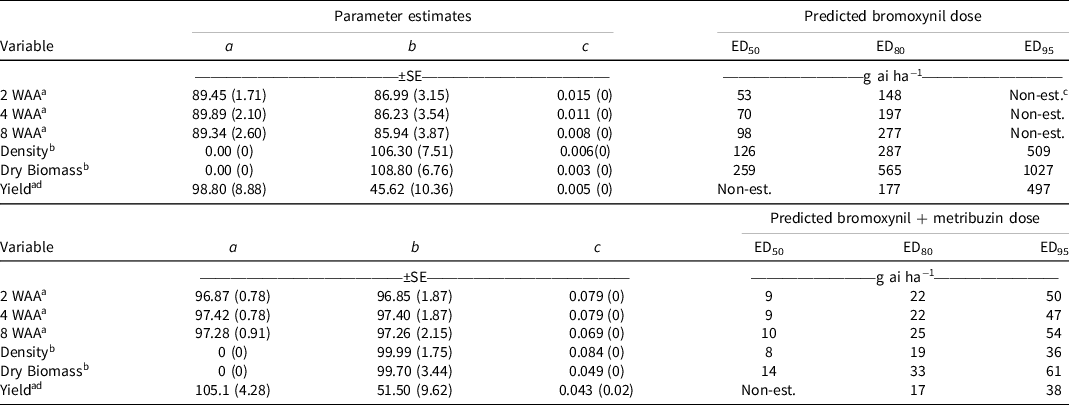
The predicted doses of bromoxynil to control 50%, 80%, and 95% of GR horseweed were 53 and 148 g ai ha−1, and nonestimable, respectively, at 2 WAA (Table 2). The predicted dose of bromoxynil to control 50%, 80%, and 95% of GR horseweed increased to 70 and 197 g ai ha−1, and nonestimable, respectively, at 4 WAA; and to 98 and 277 g ai ha−1, and nonestimable, respectively, at 8 WAA. The predicted doses of bromoxynil to reduce GR horseweed density by 50%, 80%, and 95% were 126, 287, and 509 g ai ha−1, respectively, at 8 WAA. The predicted doses of bromoxynil to reduce GR horseweed biomass were 259, 565, and 1,027 g ai ha−1, respectively, at 8 WAA. The predicted doses of bromoxynil that would result in 50%, 80%, and 95% of the yield of the industry standard were nonestimable, and 177 and 497 g ai ha−1, respectively. Similar rates of bromoxynil have been reported to be effective on other weed species. Corbett et al. (Reference Corbett, Askew, Thomas and Wilcut2004) found that bromoxynil at 420 and 560 g ai ha−1 controlled velvetleaf [Abutilon theophrasti (Medik.)] by 93% and 98%, respectively. Jordan et al. (Reference Jordan, Smith, McClelland and Frans1993) also reported that bromoxynil at 560 to 840 g ai ha−1 controlled velvetleaf. Corbett et al. (Reference Corbett, Askew, Thomas and Wilcut2004) reported that bromoxynil (420 g ai ha−1) controlled Palmer amaranth [Amaranthus palmeri (S. Wats.)] and redroot pigweed [Amaranthus retroflexus (L.)] by 55% and 53%, respectively; increasing the rate to 560 g ai ha−1 improved control to 68% and 76%, respectively. Culpepper and York (Reference Culpepper and York1997) found that bromoxynil used at similar rates as those in the study by Corbett et al. (Reference Corbett, Askew, Thomas and Wilcut2004) controlled Palmer amaranth by 74% to 96% depending on location and year. Corbett et al. (Reference Corbett, Askew, Thomas and Wilcut2004) found that bromoxynil at 420 and 560 g ai ha−1 controlled common ragweed by 90% and 96%, respectively; Ganie and Jhala (Reference Ganie and Jhala2017) reported that bromoxynil (420 g ai ha−1) controlled 99% of common ragweed at 3 WAA. Bromoxynil at 420 and 560 g ai ha−1 controlled common lambsquarters [Chenopodium album (L.)] 94% and 97%, respectively (Corbett et al. Reference Corbett, Askew, Thomas and Wilcut2004). Culpepper and York (Reference Culpepper and York1997) reported that bromoxynil (400 g ai ha−1) controlled 99% of common lambsquarters in bromoxynil-resistant cotton. Results from this study found that the rate of bromoxynil required for the control of GR horseweed is similar to that needed for many other annual broadleaf weed species.
Regression parameters and predicted effective dose of bromoxynil and bromoxynil plus metribuzin for 50%, 80%, and 95% glyphosate-resistant horseweeed control at 2, 4, and 8 wk after application; for 50%, 80%, and 95% reduction in biomass and plant density at 8 WAA; and to achieve 50%, 80%, and 95% of yield from five trials completed in 2019 and 2020. e

a Regression parameters: y = a −b (e −c dose ); Where a is the upper asymptote, b is the magnitude, and c is the slope.
b Regression parameters: y = a + b (e –c dose ); Where a is the lower asymptote, b is the reduction in y from intercept to asymptote, and c is the slope.
c Non-est., predicted dose for parameter could not be computed by the model.
d Expressed as percent of yield in the industry standard (dicamba + saflufenacil [1,800 + 25 g ai ha−1]) among replications.
e Abbreviations: ED, effective dose response level; WAA, weeks after application.
The predicted bromoxynil doses for a reduction in GR horseweed density and biomass were higher than the predicted dose for GR horseweed control at 8 WAA (Table 2). The predicted dose of bromoxynil for 50% control and decrease in density and biomass was 98, 126, and 259 g ai ha−1, respectively; the same trend was observed for 80% control and decrease in density and biomass. Ganie and Jhala (Reference Ganie and Jhala2017) reported that bromoxynil (420 g ai ha−1) applied POST in corn reduced GR common ragweed biomass by 80%. The higher predicted dose of bromoxynil to achieve a 50%, 80%, and 95% reduction in biomass compared to density is because plants that survived bromoxynil application were larger at application resulting in increased biomass at 8 WAA; relatively few plants survived, but those that did rapidly accumulated biomass. Similar results were reported by Budd et al. (Reference Budd, Soltani, Robinson, Hooker, Miller and Sikkema2016) who found that a higher dose of saflufenacil and metribuzin was required to achieve 90% and 95% reduction in biomass when compared to density.
Bromoxynil used at 177 and 497 g ai ha-1 resulted in 80% and 95% soybean yield of the industry standard ((glyphosate/dicamba + saflufenacil) (Table 2). The R50 could not be calculated because GR horseweed interference did not reduce soybean yield 50% in this study.
Bromoxynil + Metribuzin Dose Response
The predicted dose of bromoxynil + metribuzin to control GR horseweed by 50%, 80%, and 95% was 9 to 10, 22 to 25, and 47 to 54 g ai ha−1, respectively, at 2, 4, and 8 WAA (Table 2). The predicted dose of bromoxynil + metribuzin to reduce GR horseweed density by 50%, 80%, and 95% was 8, 19, and 36 g ai ha−1; and the predicted dose to reduce biomass by those percentages was 14, 33, and 61 g ai ha−1, respectively, at 8 WAA. The predicted dose of bromoxynil that would result in 80% and 95% of the industry standard yield was 17 and 38 g ai ha−1, respectively. Limited research exists on the efficacy of bromoxynil + metribuzin. The addition of metribuzin to other herbicides applied PP in soybean has resulted in improved control of GR horseweed. Addition of metribuzin (420 g ai ha−1) to paraquat (840 g ai ha1) increased GR horseweed control from 55% to 94% and 55% to 79% 4 WAA in 2005 and 2006, respectively (Eubank et al. Reference Eubank, Poston, Nandula, Koger, Shaw and Reynolds2008). Addition of metribuzin (400 g ai ha1) to saflufenacil (25 g ai ha1) improved GR horseweed control from 96% to 99% (Budd et al. Reference Budd, Soltani, Robinson, Hooker, Miller and Sikkema2016) and from 93% to 98% 8 WAA (Soltani et al. Reference Soltani, Shropshire and Sikkema2020).
Similar to bromoxynil alone, the predicted doses of bromoxynil + metribuzin for a reduction in GR horseweed biomass were slightly higher than the predicted doses for GR horseweed control and density reduction at 8 WAA (Table 2). The predicted doses of bromoxynil + metribuzin for 50% control and decrease in density and biomass were 10, 8, and 14 g ai ha−1 respectively; the same trend was observed for the predicted doses at 80% and 95%. We suggest that the higher predicted dose for reducing biomass was because the few GR horseweed that survived were larger in size.
Bromoxynil + metribuzin at 17 and 38 g ai ha−1 resulted in 80% and 95% of the industry standard for soybean yield (glyphosate/dicamba + saflufenacil), respectively. The R50 could not be calculated because GR horseweed interference did not reduce soybean yield by 50% in this study.
Bromoxynil, Metribuzin, Bromoxynil + Metribuzin Compared to Industry Standards
Bromoxynil (280 g ai ha−1), metribuzin (400 g ai ha−1), and bromoxynil + metribuzin (280 + 400 g ai ha−1) were compared to the industry standards of saflufenacil + metribuzin (25 + 400 g ai ha−1) and glyphosate/dicamba + saflufenacil (1,800 + 25 g ai ha−1). The industry standard of saflufenacil + metribuzin was selected based on research by Budd et al. (Reference Budd, Soltani, Robinson, Hooker, Miller and Sikkema2016) for GR horseweed control in GR soybean and identity-preserved, non-genetically engineered soybean; glyphosate/dicamba + saflufenacil was selected based on research by Hedges et al. (Reference Hedges, Soltani, Robinson, Hooker and Sikkema2018) for GR horseweed control in glyphosate/dicamba-resistant soybean. Metribuzin or bromoxynil, applied alone, controlled GR horseweed similarly by 76% to 80% and 77% to 85%, respectively. The mixes of bromoxynil + metribuzin, saflufenacil + metribuzin, and glyphosate/dicamba + saflufenacil controlled GR horseweed by 97% to 100% at 2, 4, and 8 WAA; there was no difference in control among the three mixes evaluated (Table 3). Hamill and Zhang (Reference Hamill and Zhang1995) reported that bromoxynil (280 g ai ha−1) plus low rates of metribuzin (100 g ai ha−1) provided effective control of annual broadleaf annual weeds. Soltani et al. (Reference Soltani, Shropshire and Sikkema2020) found that glyphosate/dicamba + saflufenacil and saflufenacil + metribuzin controlled GR horseweed by 97% and 98%, respectively. GR horseweed with bromoxynil declined over time from 85% to 77% at 2 and 8 WAA, respectively; the decrease in control was likely due to the incomplete death of fall-emerged horseweed. There is little research on the use of bromoxynil applied alone for the control of GR horseweed. Because bromoxynil is a contact herbicide with no residual activity, we attribute the decline in control over time due to recovery of large weeds present at the time of application. Eubank et al. (Reference Eubank, Poston, Nandula, Koger, Shaw and Reynolds2008) reported that metribuzin (420 g ai ha−1) controlled GR horseweed by 53% to 63% at 4 WAA, which was considerably lower than the results from our study. Byker et al. (Reference Byker, Soltani, Robinson, Tardif, Lawton and Sikkema2013d) found that when metribuzin was applied at a much higher rate of 1,120 g ai ha−1, GR horseweed control was 97% to 99% at 8 WAA, which was similar to results reported by Soltani et al. (Reference Soltani, Brown and Sikkema2016), who achieved 91% GR horseweed control with 1,120 g ai ha−1 of metribuzin. The improved control in these two studies can be attributed to the much higher rate of metribuzin. GR horseweed control with metribuzin remained relatively constant in this study at 2, 4, and 8 WAA, which was similar to the findings reported by Byker et al. (Reference Byker, Soltani, Robinson, Tardif, Lawton and Sikkema2013c). The mixes of bromoxynil + metribuzin, saflufenacil + metribuzin, and glyphosate/dicamba + saflufenacil provided similar GR horseweed control (97% to 100%) at 2, 4, and 8 WAA.
Glyphosate-resistant horseweed control 2, 4, and 8 wk after application and reduction in plant density and dry biomass at 8 WAA from five field trials conducted in Ontario, Canada in 2019 and 2020.a, e

a Means followed by the same letter within a column do not significantly differ from one another according to Tukey-Kramer’s multiple range test α = 0.05.
b Included Merge® (0.5% vol/vol).
c Nontreated control plots received only glyphosate (900 g ae ha−1).
d Density and biomass of GR horseweed expressed as a percent reduction of the nontreated control within replications.
e Abbreviations: GR, glyphosate resistant; WAA, weeks after application.
Bromoxynil and metribuzin reduced GR horseweed density by 84% to 87% and biomass by 64% to 69%; there was no difference between the two herbicides (Table 3). Bromoxynil + metribuzin, saflufenacil + metribuzin, and glyphosate/dicamba + saflufenacil reduced GR horseweed density by 99% to 100% and biomass by 92% to 100%; there were no differences among the three mixes evaluated.
GR horseweed interference reduced soybean yield up to 48% in this study (Table 3). Reduced GR horseweed interference with the herbicide treatments evaluated resulted in higher soybean yield. Although there were differences in GR horseweed control, density, and biomass, there were no statistical differences in soybean yield across herbicide treatments. Soltani et al. (Reference Soltani, Shropshire and Sikkema2020) reported similar results with few differences in soybean yield due to GR horseweed interference among several herbicide treatments evaluated.
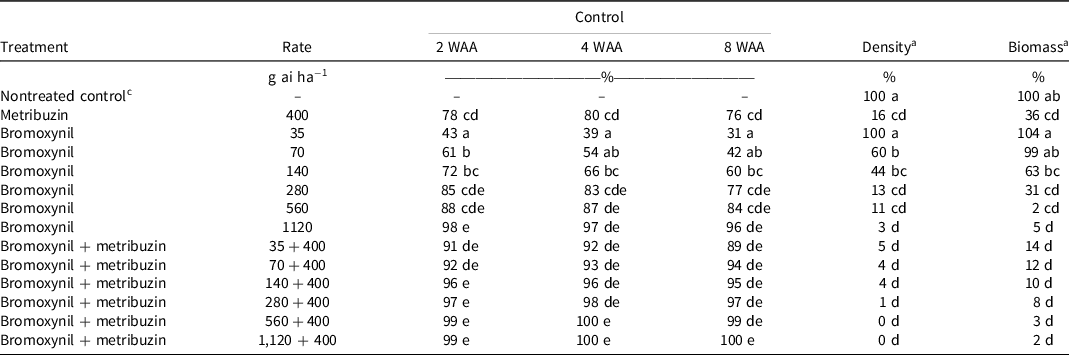
All rates of bromoxynil and bromoxynil + metribuzin are compared in Table 4. The lowest and highest doses of bromoxynil (35 and 1,120 g ai ha−1) provided 31% and 96% control of GR horseweed, respectively, at 8 WAA. Bromoxynil + metribuzin at all doses evaluated provided similar GR horseweed control, ranging from 89% to 100%. Bromoxynil + metribuzin reduced both density and biomass of GR horseweed to a similar degree at all doses evaluated.
Glyphosate-resistant horseweed control at 2, 4, and 8 wk and plant density and dry biomass at 8 WAA with metribuzin, bromoxynil and bromoxynil + metribuzin applied preplant from five field trials conducted in2019 and 2020.b, d

a Density and biomass expressed as a percent of the nontreated control within replications.
b Means followed by a different letter within a column differ significantly according to a Tukey-Kramer multiple range test at P < 0.05.
c Nontreated control plots received only glyphosate (900 g ae ha−1).
d Abbreviation: WAA, weeks after application.
In conclusion, bromoxynil, metribuzin, bromoxynil + metribuzin, saflufenacil + metribuzin, and glyphosate/dicamba + saflufenacil applied PP caused no visible soybean injury in this study. Bromoxynil applied alone provided marginal control of GR horseweed; the predicted doses for 50%, 80%, and 95% control were 98 and 277 g ai ha−1, and nonestimable, respectively, at 8 WAA. The addition of metribuzin to bromoxynil improved GR horseweed control; the predicted doses for 50%, 80%, and 95% control were reduced to 10, 25, and 54 ai ha−1 at 8 WAA. Bromoxynil + metribuzin (280 + 400 g ai ha−1) applied PP provided equivalent GR horseweed control to that of the industry standards saflufenacil + metribuzin, and glyphosate/dicamba + saflufenacil, for which control was 97% to 100% at 2, 4, and 8 WAA. This study indicates that bromoxynil + metribuzin applied PP provides comparable GR horseweed control to the current industry standards.
Acknowledgments
We thank Chris Kramer for his technical support and Dr. Michelle Edwards for her advice on the statistical analysis. Funding for this research program was provided by the Grain Farmers of Ontario, the Ontario Agri-Food Innovation Alliance Research Program (Ontario Ministry of Agriculture, Food and Rural Affairs), and herbicide manufacturers. No other conflicts of interest have been declared.