Introduction
In developing countries, access to ENT services is limited. In Zimbabwe, ENT services are only found in the 2 largest cities, wherein 8 otorhinolaryngologists serve a population of 13 million citizens. 1 , Reference Fagan and Jacobs 2 In the peripheral hospitals, the local healthcare staff may not be sufficiently educated in handling a threatened airway, and the nearest hospital with the necessary ENT services may be several hundred kilometres away. 1 This limited access to physicians trained in advanced airway management is associated with an increased risk of a fatal outcome in cases of acute upper airway obstruction.Reference Cook, Woodall, Harper and Benger 3
The routine use of high-end technical equipment, such as enhanced direct laryngoscopes and fibre-optic nasal intubation, is not possible in most developing countries. Instead, creating a safe surgical airway through emergency cricothyroidotomy may be a life-saving last resort in such countries. In addressing surgically avertable deaths, the World Bank recently named the surgical airway as 1 of the 44 essential life-saving surgical procedures to be learned in the developing world.Reference Mock, Donkor, Gawande, Jamison, Kruk and Debas 4
Education in surgical airway management is a high priority at the ENT department of Rigshospitalet, Copenhagen, Denmark, and an evidence-based training programme on emergency cricothyroidotomy is regularly provided to young doctors.Reference Melchiors, Todsen, Konge, Charabi and von Buchwald 5 In 2011, the ENT departments at Rigshospitalet and at Parirenyatwa Hospital, in Harare, Zimbabwe, initiated a collaboration. This consisted of a bilateral yearly exchange of residents between the departments, a monthly tele-video journal club, bilateral teaching and the initiation of bilateral scientific projects.
In 2011, an academic foundation was created, with one of its goals being to achieve a high level of simulation training in the developing country of Zimbabwe. Two Danish staff members from the ENT department at Rigshospitalet visited Zimbabwe. During a one-month stay, they established a video-based simulation training programme on emergency cricothyroidotomy, in collaboration with colleagues from the ENT department at Parirenyatwa Hospital.Reference Melchiors, Todsen, Nilsson, Wennervaldt, Charabi and Bottger 6 , Reference Konge, Ringsted, Bjerrum, Tolsgaard, Bitsch and Sorensen 7 The process was designed to allow the local Zimbabwean ENT department to continue the training with Zimbabwean doctors using the same model. Previous simulation training programmes have highlighted the importance of local doctor participation for the continuation of a training programme.Reference Long, Spears, Kenady and Roth 8
Early detection and appropriate prompt management of airway obstruction are critical for a favourable outcome. The securing of an airway must be prioritised to avoid an airway obstruction related fatality. The airway can be evaluated using indirect or flexible laryngoscopy, depending on local facilities. Urgent consultation with an otorhinolaryngologist is therefore important in these cases so that they can provide assistance with regard to the surgical aspect of airway management. Typically, access to ENT services is limited in developing countries, and patients with upper airway obstruction are normally managed by the present local emergency doctor, who will not be well educated in surgical airways.
A recognised cause of airway obstruction is Ludwig's angina, a rapidly spreading infection involving the soft tissues of the submandibular, submental and sublingual regions. This infection leads to life-threatening head and neck swelling, resulting in airway obstruction. The disease was initially described by the German surgeon Karl Friedrich Wilhelm von Ludwig in 1836.Reference Murphy 9 – Reference Bakir, Tanriverdi, Gün, Yorgancilar, Yildirim and Tekbaş 11 Angina is derived from the Latin word ‘angered’, which means ‘to strangle’. 12 Other causes of acute airway obstruction are direct trauma to the neck, intubation injuries, foreign bodies in the airway, epiglottitis, vocal fold paralysis, allergic reaction, angioedema, and peritonsillar or parapharyngeal abscesses.Reference Mandal, Kabra and Lodha 13 , Reference Sancheti and Force 14
An established Danish–Zimbabwean collaboration of otorhinolaryngologists enrolled Zimbabwean doctors into an emergency cricothyroidotomy training programme, which involved video-guided simulation on a manikin. We present two patients diagnosed with life-threatening upper airway obstruction who were saved by a surgical airway via an emergency cricothyroidotomy, performed by local Zimbabwean doctors. These doctors had completed the video-based emergency cricothyroidotomy simulation training programme. Our goal is to increase awareness and expertise in surgical handling of upper airway obstruction via emergency cricothyroidotomy in developing countries.
Methods
Local setting
Facilities for the training sessions were provided by the ENT department of Parirenyatwa Hospital, Harare, Zimbabwe. Medical doctors of all specialties at Parirenyatwa Hospital were invited to the training programme, held in March 2015. The equipment provided for training included a manikin (AirSim Advance Crico; Trucorp, Belfast, Northern Ireland, UK), a scalpel with a number 10 blade, a hook, an endotracheal tube, a syringe and a bag valve mask.Reference Melchiors, Todsen, Nilsson, Wennervaldt, Charabi and Bottger 6 , Reference Brofeldt, Panacek and Richards 15 Each participant received an individual training session. The Danish and Zimbabwean ENT representatives provided useful inputs to the technique and equipment. All participants had access to the instruction video and were able to practise emergency cricothyroidotomy on the manikin as many times as needed to feel comfortable with the procedure. As the manikin was donated, expenses primarily consisted of salary compensation to the two Danish staff members from the ENT department at Rigshospitalet.
Ethics
The patients described below gave their permission for publishing the pictures and their case histories in the interests of medical education.
Case presentations
Case one
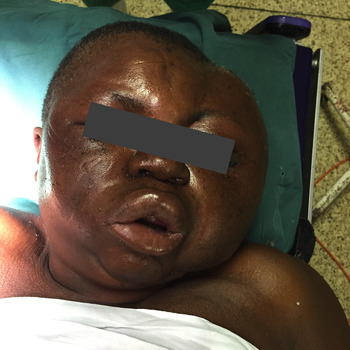
A 56-year-old female presented to the ENT department at Parirenyatwa Hospital, Zimbabwe, with acute respiratory distress due to a massive left-sided swelling of the head and neck (Ludwig's angina) (Figure 1). The patient had no allergies. She had a history of a surgically treated left-sided sinonasal carcinoma and dental caries. During the two years prior to presentation, she had suffered from increased left-sided facial pain, minor swelling, hearing impairment and decreased vision. In the 24 hours prior to admission, the patient developed a fever, increased pain in the left mandibular region and inspiratory stridor. Given the rapid deterioration of her condition, she was referred from a provincial hospital to Parirenyatwa Hospital, 200 km away.
Image of case one, a 56-year-old female, who arrived at the operating theatre with severe left-sided swelling of the head and neck (Ludwig's angina), which led to airway obstruction and hypoxic cardiac arrest. Published with permission of the patient's spouse.

On admission at Parirenyatwa Hospital, the patient was unresponsive, with a Glasgow Coma Scale score of 5 (eye response = 1, motor response = 3, verbal response = 1). She was febrile, with a temperature of 40 °C, and presented clear signs of septic shock. She had tachycardia, with a pulse of 153 beats per minute. She also had hypotension, with blood pressure of 90/53 mmHg with a middle arterial blood pressure of 67 mmHg. Her blood oxygen saturation level was 91–93 per cent, and she received oxygen at a flow rate of 5 litres per minute via a mask.
Initial attempts at primary transoral endotracheal intubation failed because of upper airway obstruction, with tissue swelling and limited visualisation. The ENT team prepared for a tracheostomy. At this stage, the patient suffered respiratory arrest due to hypoxia and developed cardiac arrest. Cardiopulmonary resuscitation was immediately initiated and the otolaryngologists performed an emergency cricothyroidotomy in response to the loss of airway patency. Ventilation with 100 per cent oxygen was established. The patient was resuscitated after 2 minutes of cardiopulmonary resuscitation using the surgically established airway for ventilation.
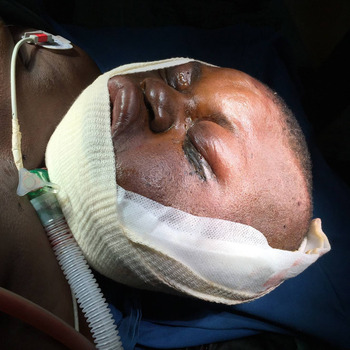
Given the massive swelling and the clinical findings, surgical exploration of the neck was performed. A large left-sided head and neck abscess was identified. A total of 800 ml of thick pus was drained and sterile saline was used to irrigate the cavity. Drains were placed and a head bandage was applied to the left side of the head and neck (Figure 2).
Cardiopulmonary resuscitation and an emergency cricothyroidotomy were successfully performed in case one. This was followed by conversion to a tracheostomy, draining of the abscess, insertion of two drains and application of a compression bandage. Note the reduction in facial swelling. Published with permission of the patient's spouse.

A maxillofacial surgeon extracted a tooth with a root abscess in the left mandibular region and the patient was admitted to the intensive care unit. She was treated with broad-spectrum antibiotics. However, this failed to clear the infection and the patient succumbed to septicaemia 4 days later.
Case two
A 70-year-old male patient was admitted to Parirenyatwa Hospital with large, bilateral, chronic subdural effusions. An elective surgical intervention was performed under full anaesthesia. During the initiation of the anaesthesia, the patient presented with an unexpected difficult airway. There were several failed attempts at intubation before success was achieved with the aid of a bougie.
After extubation, post-surgery, the patient was admitted to the recovery room. Here he developed severe stridor and respiratory arrest due to upper airway obstruction. The nurses initiated ventilation with a bag valve mask. An anaesthesiologist attempted re-intubation, but this was not successful because of severe supraglottic oedema and blood in the larynx. It was not possible to secure an airway and an otorhinolaryngologist was requested.
On the otolaryngologist's arrival 5 minutes later, the patient was turning blue and his oxygen saturation levels had decreased to 70 per cent. He had a silent chest, but he still had a peripheral pulse. Immediately, the ENT doctor performed an acute emergency cricothyroidotomy using a blade, curved artery forceps and a size 7 tracheostomy tube. Ventilation was initiated with 100 per cent oxygen and chest rise was evident. The patient's oxygen saturation levels normalised and he was admitted to the intensive care unit.
Discussion
Simulation training on emergency cricothyroidotomy for local Zimbabwean colleagues contributed to the saving of two lives. We found it feasible to train local doctors in a developing country on a low budget, using a previously produced training video, a manikin, and local standard equipment such as a scalpel and an endotracheal tube. This supports the findings of other studies regarding the feasibility of establishing training programmes in Zimbabwe and other developing countries.Reference Long, Spears, Kenady and Roth 8 , Reference Crofts, Mukuli, Murove, Ngwenya, Mhlanga and Dube 16
We believe that the management of patients with a compromised airway requires doctors specifically trained in the necessary surgical skills to control the airway. Despite the technical straightforwardness of emergency cricothyroidotomy, reports indicate that more than half of attempted cricothyroidotomies fail.Reference Cook, Woodall, Harper and Benger 3 As management of acute airway obstruction is critical, the training of emergency doctors, surgeons and anaesthesiologists in rural areas must be given a high priority.
During their stay in Zimbabwe, the two Danish visiting staff members from the ENT department at Rigshospitalet provided successful classroom teaching to nurses and doctors on how to perform emergency cricothyroidotomy. The Zimbabwean–Danish collaboration should also consider using video-based simulation to train other healthcare personnel, such as local ambulance officers, and nurses in intensive care units, operating theatres and recovery rooms. If possible, access to pre-packed emergency cricothyroidotomy sets should be considered in operating theatres, emergency rooms and recovery rooms.
Our choice of education on emergency cricothyroidotomy using practical self-directed training represents a high level of student participation, with less action required by the teacher, as most of the teaching is performed via video-guided simulation. This method was chosen to enable the most simple, effective and accessible training.
In developing countries, the patients may come from remote areas, and present in rural clinics and hospitals with advanced disease. This geographical challenge further underlines the necessity of the medical teams to include members who are able to assess the airway and perform a secure surgical airway using emergency cricothyroidotomy.
Urgent recognition of airway obstruction is of great importance. Special awareness should be given to patients with iatrogenic trauma from intubation or to children with signs of airway obstruction. Swelling may be a physiological reaction to infection, which may initially present with vague symptoms such as fever and a sore throat. The diagnosis of Ludwig's angina can be elusive, but its progression is associated with trismus, an inability to close the mouth or swallow, neck stiffness, fatigue, otalgia, swelling, redness of the neck, and even stridor due to airway obstruction.Reference Barakate, Jensen, Hemli and Graham 17 , Reference Marcus, Kaplan and Collins 18 In cases of intubation trauma to the larynx, the anaesthesiologist must be aware of potential complications in handling a difficult airway. The anaesthesiologist should consider having the patient closely observed and should not be far away from the recovery room; in addition, a pre-packed emergency cricothyroidotomy set should be prepared.
In cases of a head and neck abscess, surgical exploration and drainage must always be performed, and attention must be given to the risk of the infection involving several spaces of the head and neck.Reference Rega, Aziz and Ziccardi 19 If necrotic tissue is found, meticulous debridement of the area must be performed and the differential diagnosis of necrotising fasciitis must be considered. Broad-spectrum antibiotic treatment should be initiated within the first hour of presentation, if possible. These patients often require admission to intensive care units for effective treatment and control of septic shock and to protect the airway. In cases of head and neck traumas or infection, computed tomography scanning of the head, neck and thorax is recommended to determine the extent of the trauma and infection.Reference Wong and Wang 20 However, in cases of a threatened airway or severe systemic shock, the radiological investigations should never delay surgical intervention to secure the airway.
The benefits of this training can be distributed further by expanding access to the emergency cricothyroidotomy simulation training video. This could be achieving by providing free internet access to the video or by creating a teaching software application (‘app’) for airway handling that includes video-guided training on emergency cricothyroidotomy.
-
• Access to ENT services in Zimbabwe is limited
-
• In life-threatening airway obstruction cases, a surgical airway via emergency cricothyroidotomy may be a last resort rescue procedure
-
• A video-guided simulation training programme on emergency cricothyroidotomy was introduced to doctors in Zimbabwe
-
• Zimbabwean doctors who had completed the video-guided training were able to save two patients with acute airway obstruction
-
• Emergency cricothyroidotomy teaching should be considered for all anaesthetists, surgeons, and emergency and recovery room personnel, in developing countries
Doctors from the ENT departments at Parirenyatwa Hospital, Zimbabwe, and at Rigshospitalet, Denmark, both benefitted from the collaborative work. The staff at these institutes intend to continue the emergency cricothyroidotomy training of Zimbabwean colleagues and take part in other academic initiatives. Future studies should evaluate the emergency cricothyroidotomy skills of the participants who completed the supervised video-guided emergency cricothyroidotomy simulation training programme in Zimbabwe. Testing of emergency cricothyroidotomy skills could be performed on a manikin or on a cadaver for optimal training results.
Conclusion
Zimbabwean doctors who had completed a video-guided simulation training programme on emergency cricothyroidotomy were able to save the lives of two patients with acute airway obstruction. We found it feasible to perform successful simulation training in Zimbabwe. Such training should be considered for all surgeons, anaesthetists and, eventually, emergency and recovery room personnel in developing countries. Our video-guided simulation training programme on emergency cricothyroidotomy has proven its value.
Acknowledgements
This study was funded by the non-profit Mauritzen la Fontaine Foundation. The funding organisation had no role in: the design and conduct of the study; the collection, analysis and interpretation of data; or the preparation, review and approval of the manuscript. The manikin was donated by Trucorp (Belfast, Northern Ireland, UK). We would like to thank the healthcare staff from the Department of Otorhinolaryngology at Parirenyatwa Hospital, Harare, Zimbabwe, for their help in conducting this study. We would also like to thank Lars Holme, consultant at the Department of Otorhinolaryngology of Rigshospitalet, Copenhagen, Denmark, for his appreciated input to the article.