





Machine learning is transforming mental health research by enhancing diagnosis, prediction and treatment–response modelling. Reference Vannucci, Fields, Heleniak, Bloom, Harmon and Nikolaidis1 Compared with many conventional statistical workflows, machine learning efficiently processes diverse data sources, including health records and wearable device inputs, enabling sophisticated predictive modelling of mental health risks. Reference Abd-alrazaq, AlSaad, Aziz, Ahmed, Denecke and Househ2
Traditional psychology has long used quantitative research methods alongside observational, psychometric and clinical approaches, utilising controlled experiments and statistical inference to study human behaviour. Controlled experiments manipulate independent variables while controlling extraneous factors to establish causal relationships under well-specified assumptions. Reference Sheetal, Feng and Savani3 These methods emphasise objectivity and reproducibility, yet have limitations. Controlled experiments often suffer from low ecological validity, because their rigid conditions may not reflect real-world behaviour.
With the rise of machine learning, data-driven models are increasingly complementing and, in some cases, reshaping traditional research paradigms. By leveraging large-scale, high-dimensional data, these models can detect intricate patterns in psychological data that conventional statistical methods might overlook.
Different analytical methods provide researchers with specialised tools to address various research questions, each with unique strengths and applications. Various machine learning approaches offer different computational strategies for analysing psychological data, ranging from linear models and decision trees that provide interpretable results to more complex methods like neural networks and reinforcement learning that can capture intricate patterns but may sacrifice transparency. Reference Haghish, Nes, Obaidi, Qin, Stänicke and Bekkhus4 Given the diverse nature of psychological research, no model is universally superior. Instead, selecting the appropriate model based on research objectives allows for more effective and targeted applications.
Although machine learning offers powerful predictive capabilities for mental health research, its implementation raises a fundamental challenge: balancing predictive power with scientific understanding. As these computational approaches increasingly complement traditional methods, they must provide not only accurate predictions but also insights into why and how these predictions are made. This brings us to a critical aspect of the evolving research paradigm in psychological science. However, this methodological reorientation in mental health research driven by machine learning is not succinctly summarised in the literature. Our aim is to examine how machine learning is transforming psychological research methodologies, particularly how data-driven approaches can complement theory-driven research and the implications for future research paradigms. This methodological reorientation is characterised by three key transitions: from hypothesis testing to pattern discovery; from controlled experimental settings to naturalistic and multidimensional data ecosystems; and from explanatory theoretical models to prediction-informed theory-building and clinical translation. Throughout this article we emphasise that predictive utility, interpretability, causal explanation and clinical actionability are related but distinct aims.
Recent reviews, reporting guidelines and representative studies indicate several observable methodological trends in machine learning-based mental health research, summarised in Box 1.
Observable methodological trends in machine learning-based mental health research

Together, these trends support the framing of machine learning as a bounded methodological reorientation in mental health research.
From explainable machine learning to causal awareness
The inevitable need for interpretability
Psychological and mental health research is not just about building better predictive models, it is also about understanding causal relationships and identifying key influencing factors. In clinical practice, doctors and therapists need to interpret the reasoning behind predictions to develop effective treatment plans and communicate with patients. Complex machine learning models, often referred to as ‘black-box’ models due to their opaque internal workings, present significant challenges in clinical settings. Reference Watson, Krutzinna, Bruce, Griffiths, McInnes and Barnes5 Although some argue that predictive accuracy may be sufficient for certain applications, Reference Ghassemi, Oakden-Rayner and Beam6 we contend that explainability is particularly valuable in mental health research, where understanding mechanisms is crucial for theory development and where transparency can help ensure fairness and prevent biases. For example, a study using the Secure Anonymised Information Linkage database developed machine learning models to predict childhood mental health problems and used Shapley Additive Explanations to identify model-contributing factors, thereby improving interpretability for clinical applications. Reference Crowley, Parkin, Rocheteau, Massou, Friedmann and John7 Such approaches are particularly useful when candidate predictors are numerous, non-linear or heterogeneous, although model comparisons and data type-specific choices remain necessary. Reference Crowley, Parkin, Rocheteau, Massou, Friedmann and John7,Reference Chekroud, Bondar, Delgadillo, Doherty, Wasil and Fokkema8 This example shows how integrating explainability into machine learning models can be essential for moving from accurate prediction towards clinically interpretable and theory-relevant hypotheses, rather than proving causal mechanisms directly.
From linear causality to dynamic systems thinking
Psychological phenomena are rarely the result of simple linear cause–effect relationships: rather, they emerge from complex, multifactorial interactions. Whereas many conventional designs and models emphasise linear or additive associations, numerous studies have demonstrated their limitations in capturing the dynamic and feedback-driven nature of mental processes. Reference Sheetal, Feng and Savani3 To advance psychological research we need to shift from linear causality to a systems-thinking approach, where multiple factors interact through feedback loops and dynamic changes over time. Reference Zhao, Ma, Yao, Wan and Ng9 Machine learning is a useful tool that, through its powerful non-linear function approximation ability and adaptive feature-learning mechanism, can effectively capture complex dynamic structures. Reference Fu, Tang and Zhao10,Reference Vaswani, Shazeer, Parmar, Uszkoreit, Jones and Gomez11 For example, techniques like recurrent neural networks Reference Ji-An, Benna and Mattar12 and long short-term memory networks Reference Xie, Wang, Lin, Luo, Chen and Xu13 are particularly well-suited for modelling temporal dependencies in longitudinal or sequential data, enabling researchers to better understand how mental health conditions evolve over time. However, temporal prediction is not equivalent to causal identification. Claims about feedback loops or cyclic causality require appropriate repeated-measure designs, temporal ordering and causal assumptions, rather than being established by the model architecture alone. By modelling non-linear and dynamic temporal patterns, machine learning may help researchers generate hypotheses about how mental health conditions develop and how interventions may influence outcomes over time.
A useful distinction is therefore needed among four related but different aims. Prediction asks whether a model can accurately estimate future or unobserved outcomes. Interpretability asks which features or patterns contributed to a model output. Causal inference asks what would happen under a hypothetical intervention, conditional on assumptions such as adequate confounding control and temporal ordering. Mechanistic explanation asks why and through which psychological or biological processes an effect occurs. Machine learning therefore serves as a computational bridge linking prediction, interpretation, causal reasoning and mechanistic hypotheses.
Large language models as research tools in mental health
The field of psychological research has been transformed by various machine learning methods, including random forests, support vector machines, neural networks and unsupervised learning approaches. The selection of a particular method typically depends on factors such as input data types, research objectives and the deployment context. In this section we focus on large language models (LLMs) as a particularly impactful example, due to their ability to process and understand vast amounts of unstructured textual data. This makes LLMs directly relevant to the transition from controlled or questionnaire-based data to naturalistic language data, including interviews, clinical notes and digital communication. LLMs have proven useful in areas like sentiment analysis, text-based mental health assessment and diagnostic interviews, where the interaction between language and psychological processes is central. Reference Binz, Akata, Bethge, Brändle, Callaway and Coda-Forno14,Reference Suri, Slater, Ziaee and Nguyen15 By providing this view, we aim to clarify the role of LLMs within the broader machine learning landscape as research tools rather than as substitutes for human participants or clinical judgement.
Machine learning as a tool, not a research object
The methodological status of LLMs in psychological research requires careful clarification. Some scholars argue that psychology also influences machine learning, particularly through behavioural experiments on LLMs. This has led to a new paradigm in artificial intelligence research – treating LLMs as computational models of human cognition, such as language comprehension, reasoning and decision-making. Researchers analyse LLMs’ internal representations and computational processes to infer human cognitive mechanisms, Reference Bao16 while others view LLMs as simulators of human behaviour, using task-based and situational studies to predict human responses in similar contexts. Reference Zhao, Huang, Seligman and Peng17
However, this approach faces substantial criticism. LLMs inherently contain biases, potentially leading to misleading conclusions when applied to human cognition. Reference Abdurahman, Atari, Karimi-Malekabadi, Xue, Trager and Park18–Reference Lin20 Machine learning models, including LLMs, are fundamentally tools – they assist in studying psychological phenomena but cannot replace the research subjects themselves. They are useful for role-play and computational modelling, provided their outputs are validated against human data. Reference Lin19 It is crucial to distinguish between a tool and the actual object of study, avoiding the fallacy of equating LLMs with human cognition or behaviour. Thus, LLMs may be appropriate for processing clinical text, generating hypotheses or modelling bounded task responses, but they should not be treated as direct evidence of human mental states without empirical validation.
Proper application: integrating LLMs as research tools through validation and controlled sampling
Sampling control is fundamental to generating explainable insights from machine learning models in psychological research. Sampling biases can affect the reliability of results Reference Berghoff and Bylund21 and, in language model research, it is essential to increase the diversity of the samples to avoid biased outcomes. Reference Abdurahman, Atari, Karimi-Malekabadi, Xue, Trager and Park18 Additionally, the results must be validated to prevent mistakenly treating the model’s biases as the actual results. Reference Bao16,Reference Lin19 Beyond sampling control, LLMs can serve as valuable research tools when technically refined for psychological applications. These models demonstrate advanced text-processing capabilities that can rival general practitioners in certain medical assessments. Research indicates that domain-specific fine-tuning significantly enhances LLMs’ psychological applications, by adapting their parameters to specialised contexts. Combined with controlled sampling and human data validation, such technical adaptation allows researchers to use LLMs for more nuanced mental health predictive modelling. For example, one Nature study showed that a fine-tuned large prediction model could simulate aspects of human cognitive behaviour when validated against human behavioural data, thereby supporting theoretical interpretation, hypothesis generation and preliminary testing. Reference Binz, Akata, Bethge, Brändle, Callaway and Coda-Forno14 The practical value emerges when these refined models are deployed within clearly defined research parameters and evaluated against established psychological standards.
The discussion of LLMs highlights a shift in psychological research. On the one hand, they can be integrated into established research paradigms; on the other, LLMs, through fine-tuning and application in new contexts, provide new methods to challenge traditional approaches. This dual role demonstrates how LLMs are changing and strengthening psychological and mental health research in both innovative and practical ways, particularly by expanding access to naturalistic language data, supporting pattern discovery in unstructured text and generating hypotheses that require subsequent human-data validation.
Building on recent discussions about the opportunities and risks of using LLMs in psychological research, Table 1 distinguishes LLMs as research tools from their more controversial use as participant proxies or human substitutes. Reference Bao16–Reference Lin20
Distinguishing large language models (LLMs) as research tools from participant substitutes in mental health research

Table 1 Long description
A table with two columns and two rows. The columns are labeled ‘LLM role’ and ‘Methodological implication’. The rows are labeled ‘Research tool’ and ‘Participant proxy/human substitute’. Under ‘Research tool’, it states that LLMs are appropriate for processing clinical text, extracting features from interviews or notes, generating hypotheses, and supporting bounded task modeling, provided that outputs are validated against human-coded or empirical data. Under ‘Participant proxy/human substitute’, it states that LLMs should not be used for direct inference about real populations, mental states, or clinical outcomes unless the task is narrowly defined and externally validated against human behavioral or clinical data.
LLMs may assist in psychological and mental health research, but their outputs should not be treated as direct evidence of human cognition, behaviour or clinical status, without task-specific validation.
Methodological reorientation in psychological and mental health research
With advances in computing technology and interdisciplinary collaboration, psychological and mental health research is undergoing a methodological reorientation. This transformation reflects not only new analytic tools, but also a change in how researchers connect data, prediction, interpretation, causal reasoning and clinical application.
From theoretical to prediction-informed modelling
Psychological research is increasingly incorporating predictive models, which support the forecasting of future behaviours or mental health outcomes alongside theoretical interpretation. Reference Haghish, Nes, Obaidi, Qin, Stänicke and Bekkhus4 Predictive modelling can complement hypothesis-driven approaches, and offers practical utility when models are validated across settings. With the integration of machine learning and big data analytics, predictive models are being widely used to assess mental health risks, detect early warning signs of disorders and inform intervention strategies. Although explanatory models remain essential for theory-building, their combination with predictive approaches enhances both the understanding and practical application in clinical and research settings. A study utilising machine learning causal inference to personalise therapy assignments for grief among veterans demonstrated its practical value in optimising treatment approaches. Reference Argyriou, Gros, Hernandez Tejada, Muzzy and Acierno22 This example shows how integration of explainability into machine learning models can be essential in moving from accurate predictive models towards clinically interpretable and theory-relevant hypotheses. Reference Binz, Akata, Bethge, Brändle, Callaway and Coda-Forno14 Interpretable machine learning can help researchers identify potential causal relationships, generate new research hypotheses and refine existing theories. Reference Ji-An, Benna and Mattar12
From experimental control to causal inference under assumptions
Traditional psychology has relied on controlled experiments to establish causal relationships. However, this approach has significant limitations, including ethical constraints, ecological validity concerns and difficulties in manipulating real-world variables. The advancement of causal inference techniques has empowered researchers to estimate causal effects from observational data under explicit assumptions, thus partly addressing several of these methodological constraints. Reference Sheetal, Feng and Savani3,Reference Prosperi, Guo, Sperrin, Koopman, Min and He23 Causal inference techniques offer the advantage of formalising causal questions in observational data, avoiding some ethical challenges. However, they also come with limitations, such as the challenge of distinguishing correlation from causation and the potential for confounding factors to skew results. Reference VanderWeele24 These advancements are particularly impactful in computational psychiatry, where understanding the causal mechanisms of mental disorders is critical. Reference Lucasius, Ali, Patel, Kundur, Szatmari and Strauss25 This shift expands our ability to investigate mental illness aetiology and intervention efficacy beyond the constraints of controlled laboratory settings, but only when predictive modelling is combined with appropriate study design, domain theory and causal identification strategies.
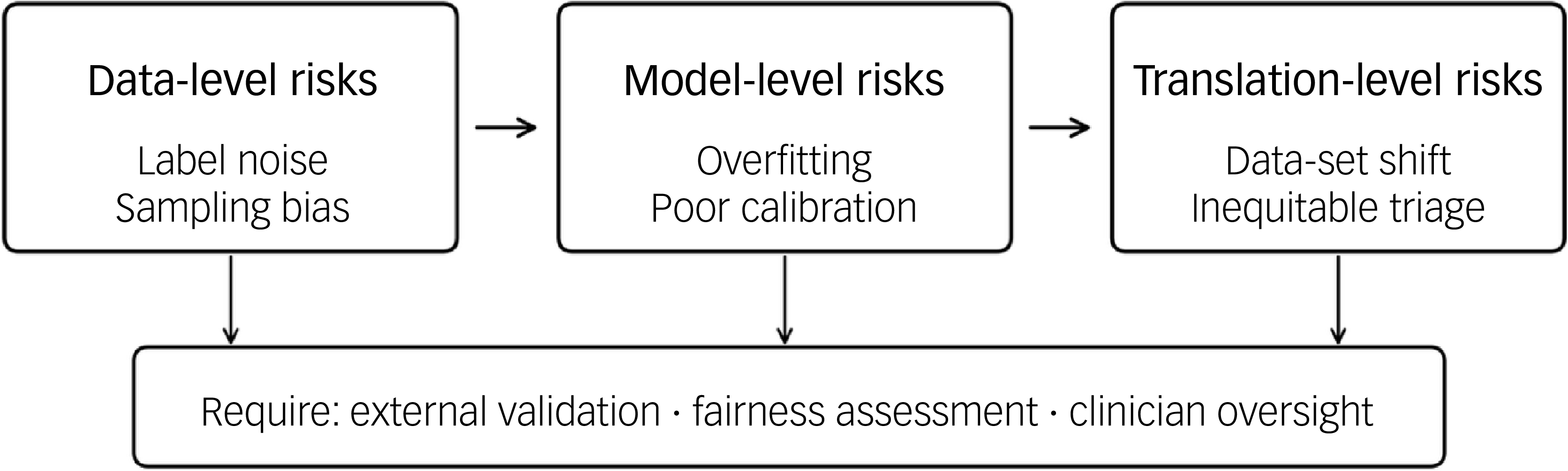
Figure 1 summarises these barriers at the data, model and clinical translation levels. Key risks include data-set shift across settings, label noise in psychiatric outcomes, overfitting in high-dimensional data, weak external validation, poor calibration and inequitable algorithmic triage. These risks do not negate the value of machine learning, but they require transparent reporting, external validation, fairness assessment and clinician oversight before clinical use.
Practical barriers in the clinical translation of machine learning models.

Implications and future directions
Machine learning is catalysing a methodological reorientation in psychological and mental health research, rather than merely updating methodologies. The essence of this transformation lies not in replacing theory-driven explanation with data-driven prediction, but in connecting theory, data, prediction, interpretation and clinical translation more systematically.
This methodological reorientation is characterised by three key transitions: from hypothesis-testing to pattern discovery; from controlled experiments to naturalistic and multidimensional data ecosystems; and from explanatory theoretical models to prediction-informed theory-building and clinical translation. These developments not only enhance our understanding of complex psychological phenomena but also establish a robust foundation for personalised precision interventions.
Future work should therefore prioritise theory-constrained, externally validated and clinically accountable machine learning. The value of machine learning lies not in replacing existing research traditions but in making them more scalable, integrative and responsive to real-world mental health needs.
Data availability
This article does not involve the creation or analysis of any new data, and therefore data availability is not applicable.
Author contributions
H.F. prepared this article and edited subsequent revisions. X.Z. and F.C. provided critical feedback and assisted with the interpretation of results. All authors reviewed and approved the final version of the manuscript.
Funding
This work was funded by STI2030-Major Projects (no. 2021ZD0202000), the National Center for Mental Health (no. SXRH-RW-2025034), the Shanghai Health System Key Discipline Construction Project (no. 2024ZDXK0011), the Shanghai Pudong New Area Science and Technology Development Fund (no. PKJ-2023-Y79) and the Healthcare Talents Elite Programme of Shanghai Pudong New Area (no. 2025PDWSYCBJ-09).
Declaration of interest
None.


 Open access


eLetters
No eLetters have been published for this article.