Introduction
Several factors may affect people's decisions to retire, including the right to early retirement, poor health status or psychological wellbeing. Some people may desire to retire and devote more time to family or leisure activities, whereas others may want to continue working for financial reasons. For women, the latter motivation for delaying retirement can be especially important (Finch, Reference Finch2014). In particular, a long period of inactivity or a reduction in working time may impair a woman's wealth later in life and thus affect her retirement intentions (Pienta, Reference Pienta2003; Finch, Reference Finch2014; Damman, Reference Damman, Parry and McCarthy2017).
Institutional settings and policies supporting female employment may influence retirement decisions as well. Generally, part-time work is considered to facilitate reconciliation between paid work and unpaid housework and to serve as a means for mothers to re-enter the labour market after child-bearing. Although this measure favours mothers' economic activities, it may subsequently delay the decision to retire if lifelong earnings need to be increased. Some other family policy measures are particularly favourable to full-time employment, such as formal child care or relatively long maternal and parental leaves (Stier et al., Reference Stier, Lewin-Epstein and Braun2001; Kangas and Rostgaard, Reference Kangas and Rostgaard2007; Thévenon and Horko, Reference Thévenon and Horko2009). In this study, we examine the effect of mothers' work histories (working schedule and continuity of work) and family histories (child-bearing and marital status) on retirement intentions.
The relevance of our study can be appreciated in light of three major societal changes. The first social change is the ageing process. Because of prolonged life expectancy and the rising proportion of elderly in the total population, policy makers are interested in increasing the retirement age to improve the equity between generations; otherwise, younger generations risk bearing most of the costs related to ageing. However, as life trajectories differ for men and women, especially after parenthood, policy makers need to consider the gender perspective as well. The second social change is the increase in women's participation in the labour market. In the last several decades, women have gained emancipation while retaining the primary responsibility for the family (Esping-Andersen, Reference Esping-Andersen2009; Goldscheider et al., Reference Goldscheider, Bernhardt and Lappegård2015). This situation engenders opportunity costs that produce long-lasting effects in mothers' lives. The third societal process includes new family dynamics. In particular, we are integrating in our analysis the increasing marital and union disruption. How such life circumstances affect retirement in later years is a crucial question to be explored (Liefbroer and Dykstra, Reference Liefbroer and Dykstra2000). In particular, the effect of opportunity costs on retirement intentions can be exacerbated by a separation as follows: if a couple worked under a regime of role specialisation, dissolutions may penalise the partner who has taken charge of unpaid domestic work, which is usually the woman. Being a single mother may expose the individual to an even greater risk of poverty (Nieuwenhuis and Maldonado, Reference Nieuwenhuis and Maldonado2018) and may affect retirement (Tamborini and Purcell, Reference Tamborini and Purcell2016).
In this study, we examined work and family trajectories and their relationship to mothers' retirement intentions. Although other researchers have focused on this link (Pienta, Reference Pienta2003; Finch, Reference Finch2014; Damman, Reference Damman, Parry and McCarthy2017), the comparative perspective is the most important contribution of this study, allowing us to appreciate the combined effect of life histories and welfare regimes on women's retirement intentions.
These elements converge in the following research question: to what extent are the retirement intentions of older mothers explained by their work and family histories, and are these relationships affected by welfare regimes? We use data from the Survey of Health, Ageing and Retirement in Europe (SHARE) and a sub-sample of working mothers aged 50–64 years. Our dependent variable is a binary indicator on whether a mother has the intention to retire as early as possible, according to the SHARE formulation. In this study, expressions such as ‘intention to retire as early as possible’, ‘early retirement intentions' or simply ‘retirement intentions' are used interchangeably. The intention to retire is measured while controlling for entitlements to retire. For this reason, we can say that in our study women's retirement intentions reveal, on the one hand, mothers' perception of having sufficient financial resources at retirement (see our first, second and fifth hypotheses below) and, on the other hand, the degree of mothers' attachment to work (see our third and fourth hypotheses below).
According to the retirement process theory (Beehr, Reference Beehr1986), retirement intention is a powerful indicator of the real decision to withdraw from the labour market. Previous studies have relied primarily on the actual timing of retirement to examine the individual determinants of women's retirement behaviour (Pienta, Reference Pienta1999; Finch, Reference Finch2014; Svensson et al., Reference Svensson, Lundholm, De Luna and Malmberg2015). However, this approach does not reflect the fact that many women are retiring due to employment constraints rather than as a voluntary decision (Dorn and Sousa-Poza, Reference Dorn and Sousa-Poza2010). Consequently, the voluntary part of the retirement decision can be better captured through retirement intentions than through retirement behaviour.
Background
Opportunity costs and retirement intentions
Within the family, women retain the primary responsibility for care and household work (Esping-Andersen, Reference Esping-Andersen2009; Goldscheider et al., Reference Goldscheider, Bernhardt and Lappegård2015). Consequently, after the arrival of a child, women scale down paid labour (Sanchez and Thomson, Reference Sanchez and Thomson1997; Drobnič et al., Reference Drobnič, Blossfeld and Rohwer1999; Brewster and Rindfuss, Reference Brewster and Rindfuss2000; Vlasblom and Schippers, Reference Vlasblom and Schippers2004; van Damme et al., Reference van Damme, Kalmijn and Uunk2009; Campolo et al., Reference Campolo, Pino and Rizzi2016). Although work interruption during child-bearing has become less frequent among mothers born after the Second World War (Rubery et al., Reference Rubery, Smith and Fagan1999; Thévenon and Horko, Reference Thévenon and Horko2009; Hank and Korbmacher, Reference Hank and Korbmacher2013), motherhood is a major cause of the feminisation of part-time work, which allows women to combine paid work with family life (Blossfeld and Hakim, Reference Blossfeld and Hakim1997; Gallie and Russell, Reference Gallie and Russell2009).
From a lifecourse perspective (Elder, Reference Elder, Moen, Elder and Lüscher1995; Moen, Reference Moen1996; Elder and Johnson, Reference Elder, Johnson and Setterston2003), the effect of family histories is a significant feature of women's labour market participation, not only earlier in their life but also later in life relative to their male counterparts (Drobnič et al., Reference Drobnič, Blossfeld and Rohwer1999; Finch, Reference Finch2014). According to the ‘opportunity costs’ theory for retirement (Pienta et al., Reference Pienta, Burr and Mutchler1994; Finch, Reference Finch2014), women may wish to continue their careers later in life to compensate for the disadvantages cumulated in the labour market and to improve their pension opportunities.
The compensatory logic of delayed retirement is well documented in previous studies (Hank, Reference Hank2004; Raymo et al., Reference Raymo, Warren, Sweeney, Hauser and Ho2010). Empirical findings demonstrate that mothers continue in paid employment longer than childless women in their later life (Hank, Reference Hank2004; Finch, Reference Finch2014), although no clear evidence is found for the effect of the number of children (Finch, Reference Finch2014). The experiences of part-time and temporary employment, which are regarded as the means for mothers to re-enter the labour market after an interruption, also extend women's paid employment (Raymo et al., Reference Raymo, Warren, Sweeney, Hauser and Ho2011; Finch, Reference Finch2014).
Based on previous studies and the ‘opportunity costs’ theory, our first hypothesis is:
• Hypothesis 1: Mothers who spend fewer years in paid employment, have changed several jobs and have worked mostly part-time are less likely to have early retirement intentions.
Some authors stress that women with non-standard careers may have a poor ability to stay in the labour market after middle age (Pienta et al., Reference Pienta, Burr and Mutchler1994; Finch, Reference Finch2014). However, an implicit assumption in our study is that these aspects that affect behaviour should not affect intentions.
The necessity of compensating for opportunity costs is lower if a mother can count on their partner's solidarity. In contrast, the need to compensate for opportunity costs may be higher for never-married, widowed and divorced mothers, who, because of the absence of a partner's solidarity, may intend to work longer (Ginn, Reference Ginn2003; Smeaton and McKay, Reference Smeaton and McKay2003; Finch, Reference Finch2014; Damman et al., Reference Damman, Henkens and Kalmijn2015). These mothers may also be characterised by a reduced ability to save for a voluntary private pension (Tamborini and Purcell, Reference Tamborini and Purcell2016). Interestingly, previous studies have demonstrated that divorce increased the probability that mothers but not fathers would work longer (Finch, Reference Finch2014). This result reinforces the ‘opportunity costs’ hypothesis for mothers and seems to exclude the hypothesis that divorced women want to work longer to meet other people and have a social life; in this latter case, the same result would be observed for men (Finch, Reference Finch2014). The second hypothesis of this study is:
• Hypothesis 2: Mothers' compensations for opportunity costs become even more urgent among never-married, divorced or widowed mothers due to the lack of a partner's solidarity; consequently, these mothers are less likely to intend to retire.
Work attachment and retirement intentions
According to the ‘opportunity costs’ hypothesis, women working longer and continuously are expected to retire earlier. However, these women may continue to work due to their attachment to work. At older ages, this phenomenon is also described as ‘status maintenance’ (Hardy, Reference Hardy1991). Based on longitudinal data, Pienta et al. (Reference Pienta, Burr and Mutchler1994), Pienta (Reference Pienta1999) and Hank (Reference Hank2004) show a positive effect of continuous employment during child-bearing years on the delayed retirement of women. Similarly, late parenthood could be related to a greater investment in a career during the early stages of life and a stronger work attachment. A negative association between later motherhood and retirement has been observed by Pienta et al. (Reference Pienta, Burr and Mutchler1994), Hank (Reference Hank2004) and Svensson et al. (Reference Svensson, Lundholm, De Luna and Malmberg2015). Our next hypothesis assumes that:
• Hypothesis 3: Mothers who work during their child-bearing years (when the youngest child is under six years of age) and delay their first birth are less likely to intend to retire.
The role of welfare regimes
In this study, to ascertain how the context modifies retirement intentions, we classify countries according to types of welfare regimes. Through the concepts of ‘defamilisation’ and ‘decommodification’, Esping-Andersen (Reference Esping-Andersen1999) demonstrated that Scandinavian countries offered the best support for mothers' professional activities. Liberal regimes and southern countries offer the least favourable conditions for reconciliation of career and family, although liberal regimes compensate for family policy limitations by increasing labour market flexibility to enable women to more easily enter and exit this market. Conservative countries are in an intermediate position regarding the degree of defamilisation and decommodification.
A similar classification was identified by Blossfeld and Hakim (Reference Blossfeld and Hakim1997). In addition, these authors focused on the Central and Eastern Europe regimes, where the collapse of the socialist economy led to an increase in precarious employment, even though full-time employment was already the norm for mothers. Moreover, they noted the heterogeneity of the conservative group. In particular, the Netherlands is characterised by part-time employment, accounting for more than 50 per cent of women aged between 25 and 54 years (see also data for 2017 in Organisation for Economic Co-operation and Development (OECD), 2018).
The welfare state can affect the retirement intentions of women aged 50–64 in several ways. First, welfare regimes, through their family policies, affect women's work career and family choices, which in turn affect retirement intentions. Several hypotheses related to this concept have been presented above. Second, when considering working women aged 50–64, we may miss some women who exit the labour market before age 50. This is especially true in countries where family policies are lacking or are less supportive of a woman's career, as in Mediterranean and post-Communist countries. Because of the sample selection process, we expect to find that:
• Hypothesis 4: Mothers' work and family trajectories have a weaker effect on retirement intentions in Mediterranean and post-Communist countries.
Finally, the welfare systems affect retirement decisions through their pension systems. In particular, we are interested here in the first tier, defined as the first layer of protection of the elderly (OECD, 2015). The first tier includes basic pension, targeted benefits and minimum pension. Basic pensions are a basic flat rate that is not dependent on previous earnings and contribution years. Usually, a minimum number of years of citizenship is necessary to be eligible. Targeted benefits additionally involve an income test. Whereas basic and targeted pensions are redistributive, minimum pensions are between redistributive and earnings-related benefits because they require a minimum number of contribution years (Queisser et al., Reference Queisser, Whitehouse and Whiteford2007; Möhring, Reference Möhring2015). Consequently, basic and targeted pension schemes are expected to provide better compensation for the opportunity costs related to the non-standard careers of mothers (Möring, 2015). In addition, basic pension can be residence-based or contribution-based. The first type is characteristic of Nordic countries, where 40 years of residence are required for full benefits and shorter periods for lower levels of pension. The same system is applied in the Netherlands. In the Czech Republic, 30 years of residence are required. The amount of the basic pension as a percentage of average earnings also varies between countries. In the Netherlands, the full benefit is 25 per cent of average earnings, corresponding to €1,099.37 in 2014 (OECD, 2015). The amount is more than 20 per cent in Sweden and less than 20 per cent in Denmark. In the Czech Republic, the full benefit is slightly less than 10 per cent (OECD, 2015). In our fifth hypothesis, we expect that:
• Hypothesis 5: The impact of work and family trajectories on retirement intentions is weaker in countries with a basic pension system and with higher benefits associated with the basic pension, as in Nordic countries and the Netherlands.
All other factors being equal, mothers who expect to receive a higher basic pension, as in the Netherlands, should be less negatively affected in their retirement intentions by their past fragmented career. In some welfare system classifications, the Netherlands is included in the conservative group. However, because of the specific features of its welfare system, especially with respect to the presence of a higher basic pension, in this study, we run separate analyses on Dutch mothers.
Data
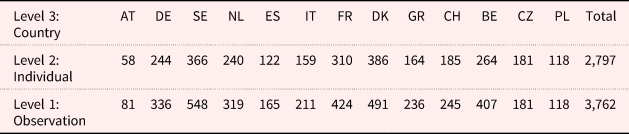
The data originate from the first three waves of the SHARE, which were conducted from 2004 to 2009 in 13 European countries. The earlier family and work histories can only be obtained from SHARELIFE, namely Wave 3 conducted in 2008–2009. Detailed part-time working histories from the first entry into the labour market to the present employment are also available from Wave 3. The subsequent waves provide information on working hours for current employment but preclude us from tracing past part-time work histories. Information on retirement intentions is included only in Waves 1 and 2 conducted in 2004–2007. A total of 13,066 mothers aged 24–100 years participated in Wave 3 and at least one other wave. For our analysis, we select only mothers aged 50–64 when their retirement intentions were asked. We exclude those with missing information on retirement intentions or missing information for the independent variables. Our final sample includes 2,797 mothers nested within 13 countries, yielding 3,762 repeated measurement occasions (Table 1). In the panel design, an individual is observed on several occasions over time, leading to a three-level hierarchical structure with measurement occasions (level 1) nested within individuals (level 2) nested within countries (level 3). We include four welfare regimes following Esping-Andersen's typology, which we label ‘social democratic’ (Denmark, Sweden), ‘conservative’ (Austria, Belgium, Switzerland, Germany, France), ‘Mediterranean’ (Spain, Greece, Italy) and ‘post-Communist’ (Czech Republic, Poland), and the Netherlands.
Sampling structures for the analysis

Notes: AT: Austria. DE: Germany. SE: Sweden. NL: Netherlands. ES: Spain. IT: Italy. FR: France. DK: Denmark. GR: Greece. CH: Switzerland. BE: Belgium. CZ: Czech Republic. PL: Poland.
Measurements
The dependent variable is the log-odds of intending to retire as early as possible. More specifically, the retirement intention is measured based on the following question: ‘Thinking about your present job, would you like to retire as early as you can from this job?’ The question had two possible responses (‘yes’ or ‘no’). The variable is coded 1 if the individual answer is ‘yes’. Concerning the expression ‘as early as you can’ provided by the SHARE survey, previous studies on retirement in Europe interpreted this as having intentions to retire early (Siegrist et al., Reference Siegrist, Wahrendorf, von dem Knesebeck, Jürges and Börsch-Supan2007; Hochman and Lewin-Epstein, Reference Hochman and Lewin-Epstein2013; Wahrendorf et al., Reference Wahrendorf, Dragano and Siegrist2013; Bianco et al., Reference Bianco, Trevisan and Weber2015). Following these studies, we interpret answering ‘yes’ as having intentions to retire early and ‘no’ as having intentions to continue working.
We decided to use this self-reported measure of intentions to retire instead of referring to the actual timing of retirement. Because of involuntary retirement, the need to compensate is difficult to capture when using the actual timing of retirement. Instead, intentions can better capture the opportunity costs of those who need to compensate for them but are forced to retire (van Solinge and Henkens, Reference van Solinge and Henkens2007; Dorn and Sousa-Poza, Reference Dorn and Sousa-Poza2010). The main independent variables are those related to work histories and family histories, which combine current information at each wave and retrospective information from SHARELIFE. To measure work history characteristics, five indicators are created: (a) total years in the labour force; (b) the proportion of full-time and part-time years out of the total years of employment, with two categories: (1) more years in part-time than in full-time and (2) more years in full-time than in part-time or always full-time; (c) working continuity, indicating whether a woman continues to work when she has children under six years of age; (d) the total number of jobs since the respondent first entered the labour market, as continuous variables; and (e) the mean of the index of the mothers’ occupational statuses since the first entry into the labour market using the International Socio-Economic Index of Occupational Status (ISEI). The following four indicators of family histories are employed: (a) marital status, which is coded into the following four categories: (1) married/co-habiting, (2) never married, (3) divorced and (4) widowed; (b) parity as a continuous variable; (c) late first childbirth if the respondent's age at the first birth is older than the mean age at first birth in the country; and (d) the presence of children in the household, reflecting current child-rearing responsibilities. Providing care for grandchildren is also controlled as a dummy variable. Concerning the variable marital status, mothers who are classified as ‘never married’, ‘divorced’ or ‘widowed’ may be involved in a non-registered co-habitation. However, the number of cases is limited (mostly less than 30 cases per wave and category). In addition, in non-registered co-habitations, the level of commitment is lower than that in marriage or registered co-habitation (Liefbroer and Dourleijn, Reference Liefbroer and Dourleijn2006; Perelli-Harris et al., Reference Perelli-Harris, Mynarska, Berrington, Evans, Berghammer, Isupova, Keizer, Klärner, Lappegård and Vignoli2014; Perelli-Harris and Bernardi, Reference Perelli-Harris and Bernardi2015), reducing the likelihood of financial solidarity between the partners (see Hypothesis 2). Consequently, our categorisation of the marital status variable presented above does not consider non-registered partnership.
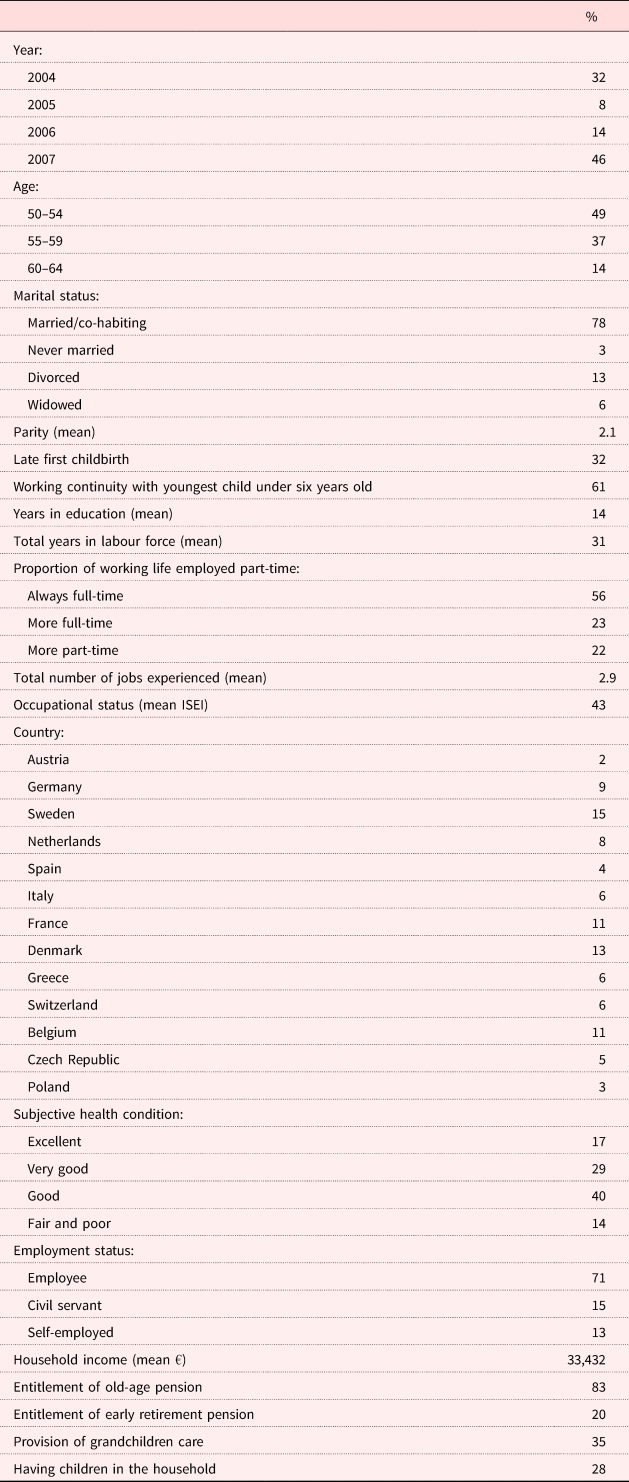
We also control for several socio-demographic and economic characteristics and health-related variables. An individual's age is categorised into three groups (50–54, 55–59 and 60–64 years). Total years of education and logged household income are continuous variables. Using household income as a measure of economic wellbeing assumes an equal distribution of resources within a household. Thus, individual income may be considered a better measurement of income (Finch, Reference Finch2014). However, it has been shown that for married or co-habiting women who can share their partner's income, household income may be a more important determinant of their retirement decision (Pienta and Hayward, Reference Pienta and Hayward2002; Ginn, Reference Ginn2003). Consequently, and similarly to some prior studies (Pienta and Hayward, Reference Pienta and Hayward2002; Hank, Reference Hank2004; Taylor et al., Reference Taylor, Pilkington, Feist, Dal and Hugo2014), we refer to household income. Perceived health conditions are measured using five categories (excellent, very good, good, fair and poor). We control for the entitlement to an old-age pension and early retirement pension as dummy variables, which include both public and private pensions. We also control for the current employment status coded into three categories (employee, civil servant and self-employed) (Table 2).
Descriptive sample statistics (occasions)

Notes: N (observations) = 3,762. N (individuals) = 2,797. ISEI: International Socio-Economic Index of Occupational Status.
Methods
We use a three-level model in which the first two levels are modelled using a multi-level model and the third level is modelled using fixed effects (McNeish and Wentzel, Reference McNeish and Wentzel2017), which is also known as a two-level random intercept model with fixed-effect dummy variables at the country level. Multi-level models include random effects for each higher-level unit to consider the effects of explanatory variables that differ across higher-level units. To handle individual- and country-level variations, we could consider three-level random models, including the individual-level random effects at level 2 and the country-level random effects at level 3. However, a small number of higher-level units can cause biased estimates of the higher-level standard errors (Maas and Hox, Reference Maas and Hox2005). For this study, the random effects for level 2 have an adequate number of units with 2,797 individuals, whereas the number of level 3 units consists of only 13 countries. It is well documented that the application of multi-level modelling to international survey data-sets that include between ten and 30 countries is not appropriate due to their small country-level sample sizes (Bryan and Jenkins, Reference Bryan and Jenkins2016). The fixed-effects approach of including dummy variables for each country is the best option to account for country variations with small samples using multi-level modelling (McNeish and Wentzel, Reference McNeish and Wentzel2017). Thus, we use country fixed effects at the third level instead of country random effects. Möhring (Reference Möhring2012) has shown that the coefficients and significance levels of the individual-level variables estimated using the country fixed-effects model are similar to those from the country random-effects model.
Let y ijc be the binary response for the retirement intention of the i occasion nested in individual j who is nested in country c, where y ijc = 1 if the occasion has intention and y ijc = 0 otherwise, and let π ijc = Pr(y ijc = 1). Then, the two-level random intercept model with the country level modelled as fixed effects (McNeish and Wentzel, Reference McNeish and Wentzel2017) can be written as:
 $$y_{ijc}\; = \; \pi _{ijc}\; + \; \epsilon _{ijc},$$
where
 $$\eqalign{& \log \left( {\displaystyle{{\pi _{ijc}} \over {1-\pi _{ijc}}}} \right)\; = \;\beta _0 + \beta _1x_{1ijc} + \cdots + \beta _{20}x_{20ijc} + \beta _{21}x_{\,jc}\cdots + \beta _{25}x_{25jc} \cr & \quad +\delta _1x_{1jc}x_{1c} + \cdots + \gamma _1x_{1ijc}x_{2c} + \cdots + \alpha _1v_{c1} + \cdots + \alpha _{N-1}v_{cN-1} + \mu _j.} $$
Here, X ijc(x 1ijc + · · ·x 20ijc) is a vector containing all covariates, β 0 is the intercept, β 1–β 20 are coefficients of occasion-level variables, β 21–β 25 are coefficients of individual-level variables, α 1–α N−1 represent fixed effects for the N − 1 countries in the data-sets, and  $\mu _j \sim N\lpar {0,\sigma_\mu^2} \rpar $ is a random intercept varying over individuals (level 2). The random intercept μ j is assumed to be independent across individuals and the covariates X ijc.
We fit the model with the maximum likelihood estimation using Stata 14. In the binary response multi-level model, the results among the penalised quasi-likelihood, maximum likelihood and Markov Chain Monte Carlo are very similar (Rodriguez and Goldman, Reference Rodriguez and Goldman2001). We test multicollinearity by running the variance inflation factor (VIF) and find no multicollinearity (VIF > 10).
Results
Descriptive results
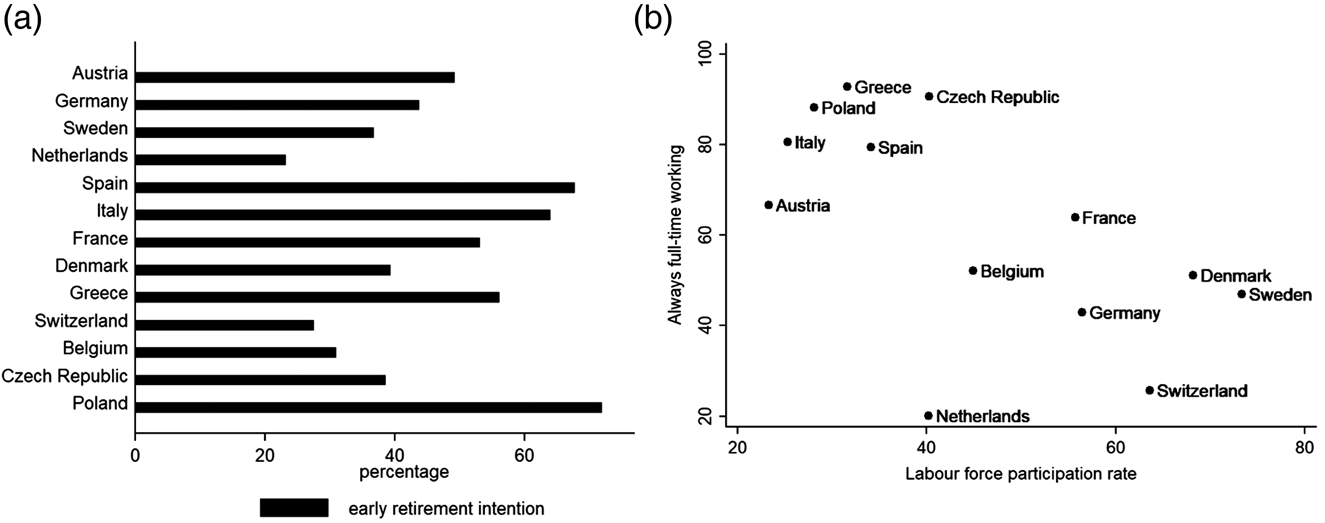
Our descriptive analysis highlights interesting features of our sample. In Mediterranean and post-Communist countries, most mothers aged 50–64 years do not participate in the labour market, and those who participate have been employed full-time (Figure 1b). Mothers in these countries are also more prone to intend to retire, providing the first evidence of the opportunity costs hypothesis (Figure 1a). These preliminary findings also suggest that working mothers can be a select group in some countries, which may influence our multivariate analysis.
(a) Percentage of mothers aged 50–64 years who intend to retire as early as possible. (b) Mothers’ labour force participation rate (%, at 50–64 years old) and percentage of mothers who have always worked full-time during their employed life.

Multivariate results
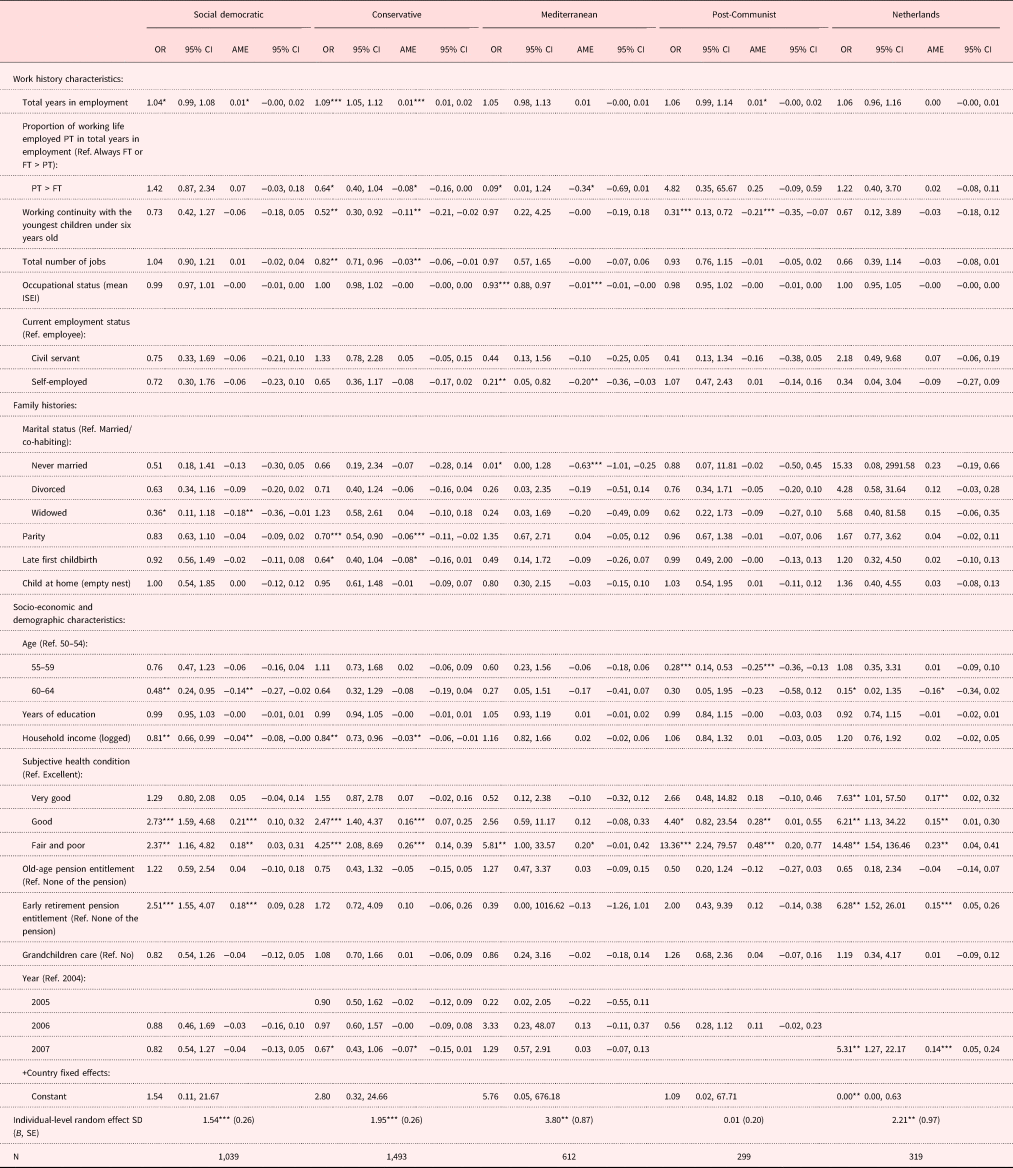
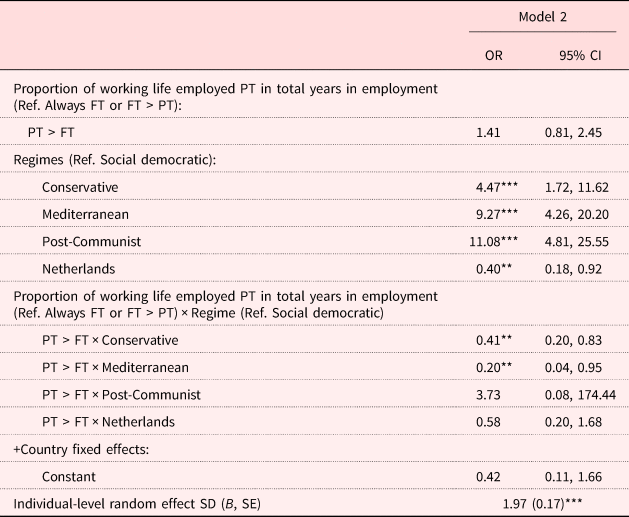
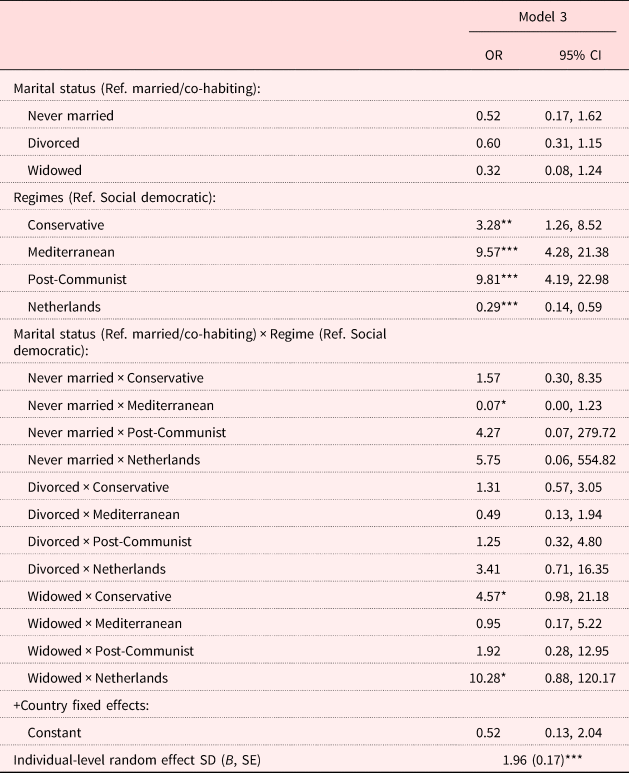
Below, we present findings from our multi-level logit models. The estimated models come from (a) a general model considering data from all countries (Table 3); (b) a stratified analysis by welfare regime (Table 4); and (c) an interaction model, which interacts the welfare regime with the marital status and the time schedule of the past work career (Tables 5 and 6). The effects of the independent variables are presented as odds ratios (OR) and average marginal effects (AME) with their respective 95 percentage confidence interval. However, because marginal effects for interaction terms estimated from logit models do not have a straightforward interpretation (Ai and Norton, Reference Ai and Norton2003), we solely use OR in the interaction models, as suggested by Buis (Reference Buis2010).
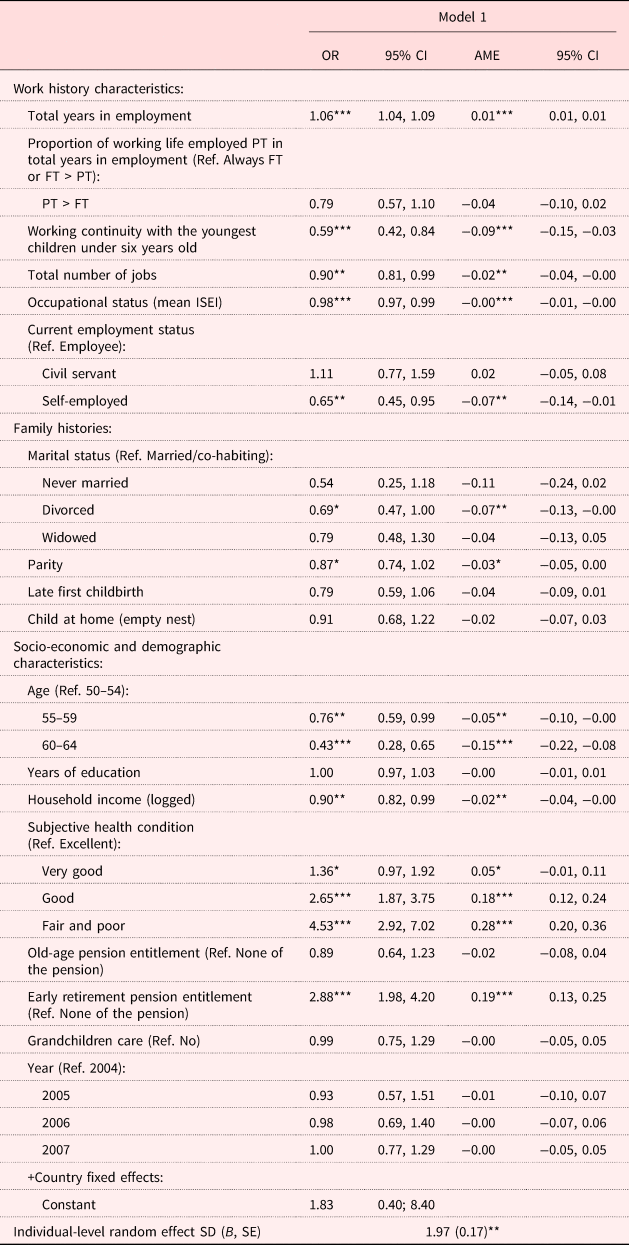
Odds ratios (OR) and average marginal effects (AME) for the multi-level logit model with the country as a fixed effect

Notes: N = 3,762. AME are calculated fixing random effects at zero, with standard error (SE) calculated by the Delta method. CI: confidence interval. FT: full-time. PT: part-time. Ref.: reference category. ISEI: International Socio-Economic Index of Occupational Status. SD: standard deviation.
Source: Authors’ own calculations, Survey of Health, Ageing and Retirement in Europe, Waves 1, 2 and 3.
Significance levels: * p < 0.1, ** p < 0.05, *** p < 0.01.
Odds ratios (OR) and average marginal effects (AME) for the multi-level logit model by welfare regime with the countries as fixed effects

Notes: Social democratic: Sweden and Denmark; Conservative: Austria, Belgium, Switzerland, Germany and France; Mediterranean: Spain, Greece and Italy; Post-Communist: Czech Republic and Poland. AME are calculated fixing random effects at zero, with standard error (SE) calculated by the Delta method. CI: confidence interval. FT: full-time. PT: part-time. Ref.: reference category. ISEI: International Socio-Economic Index of Occupational Status. SD: standard deviation.
Source: Authors’ own calculations, Survey of Health, Ageing and Retirement in Europe, Waves 1, 2 and 3.
Significance levels: * p < 0.1, ** p < 0.05, *** p < 0.01.
Odds ratios (OR) for the multi-level logit model with the country as a fixed effect, only interactions between part-time × welfare regimes

Notes: N = 3,762. Log likelihood = −2,229.444, Akaike information criterion = 4,546.888, Bayesian information criterion = 4,821.127. Model 2 controls for the variables included in Model 1, but the results are omitted to conserve space. Standard error (SE) is calculated by the Delta method. CI: confidence interval. FT: full-time. PT: part-time. Ref.: reference category. SD: standard deviation.
Source: Authors’ own calculations, Survey of Health, Ageing and Retirement in Europe, Waves 1, 2 and 3.
Significance levels: ** p < 0.05, *** p < 0.01.
Odds ratios (OR) for the multi-level logit model with the country as a fixed effect, only interactions between marital status × welfare regimes

Notes: N = 3,762. Log likelihood = −2,224.928, Akaike information criterion = 4,553.857, Bayesian information criterion = 4,877.958. Model 3 controls for the variables included in Model 1, but the results are omitted to conserve space. Standard error (SE) is calculated by the Delta method. CI: confidence interval. FT: full-time. PT: part-time. Ref.: reference category. SD: standard deviation.
Source: Authors’ own calculations, Survey of Health, Ageing and Retirement in Europe, Waves 1, 2 and 3.
Significance levels: * p < 0.1, ** p < 0.05, *** p < 0.01.
Retirement intentions and work history
Table 3 shows that mothers who have worked mostly part-time are less likely to intend to retire than mothers who have worked mostly or always full-time. This result is observed in conservative and Mediterranean countries, where the ORs of the intention to continue working are OR = 1.5 (1/0.64, p < 0.10) and OR = 11 (1/0.09, p < 0.10), respectively (Table 4). On average, having a part-time-dominated working history, while holding other variables at their observed values, reduces the probability of having early retirement intentions by eight percentage points for mothers in conservative countries (AME = −0.08, p < 0.10) and by 34 percentage points for those in Mediterranean countries (AME = −0.34, p < 0.10). The interaction model (Table 5) confirms and increases the statistical significance of the negative association between part-time work and retirement intentions in conservative and Mediterranean countries relative to social democratic countries (the ORs of the intention to continue to work are equal to 2.5 and 5, respectively, p < 0.05). No association is observed in the Netherlands or in social democratic countries.
Longer years of employment are positively associated with early retirement intentions (Table 3). Variations across welfare regimes are observed (Table 4); with one additional year of employment, the odds of intending to retire early are 4 per cent higher (p < 0.10) in social democratic countries and 9 per cent higher in conservative regimes (p < 0.01). In both regimes, the AME on probability of having early retirement intention associated with a one-year increase in total years in employment is one percentage point (AME = 0.01, p < 0.10). The variable ‘total number of jobs’ is also negatively associated with retirement intentions in conservative countries. With an additional job, the odds of intending to continue working are 1.21 times higher than the odds of intending to retire, which corresponds to a three percentage point lower probability of having early retirement intentions on average (OR = 1/0.8, AME = −0.03, p < 0.05; Table 4).
The odds of intending to continue working at later ages are 1.7 times higher for mothers who have continued to work when their child is younger than six years of age, corresponding to a nine percentage point lower likelihood of having early retirement intentions on average (OR = 1/0.59, AME = −0.09, p < 0.001; Table 3). The results vary by welfare regime; for instance, the OR to continue working at later ages is equal to 1.9 in the conservative regime (p < 0.05) and to 3.3 in post-Communist countries (p < 0.001; Table 4).
Retirement intentions and family history
In the general model considering all countries (Table 3), the odds of the intention to continue working among divorced mothers are higher than those among married or co-habiting mothers (OR of the intention to continue to work = 1/0.69 = 1.4). The corresponding AME also denotes that on average, divorced mothers' probability of having early retirement intentions is seven percentage points lower than that for married mothers (AME = −0.07, p < 0.05). However, no significant results are observed in the stratified analysis in Table 4 or in the interaction model in Table 6.
In Mediterranean countries, the odds of the intention to continue working are much higher for single mothers than for married or co-habiting mothers (in the stratified analysis, OR = 1/0.01 = 100, p < 0.10; Table 4). For these countries, on average, single mothers are 63 percentage points less likely to have early retirement intentions than married mothers (AME = −0.63, p < 0.01). The result is also observed in the interaction model when comparing Mediterranean and social democratic countries (OR = 1/0.07 = 15, p < 0.10; Table 6). In social democratic countries, the odds of continuing to work are higher for widowed mothers than for married or co-habiting mothers (OR = 1/0.36 = 2.8, p < 0.10, AME = −0.18, p < 0.05; Table 4). Consistently, the interaction model demonstrates that widowed mothers in conservative countries are more likely to intend to retire than those in social democratic countries (OR = 4.6, p < 0.10; Table 6). Note that in conservative countries, widows who have worked mostly part-time are especially likely to intend to retire (the results of the interaction between the work time schedule and marital status are not shown). However, in the other welfare regimes, the combined effect of marital status and part-time work on retirement intentions cannot be estimated because never-married mothers, divorced mothers and widows are much less likely to work part-time than married/co-habiting mothers. Consequently, we are faced with a small number problems.
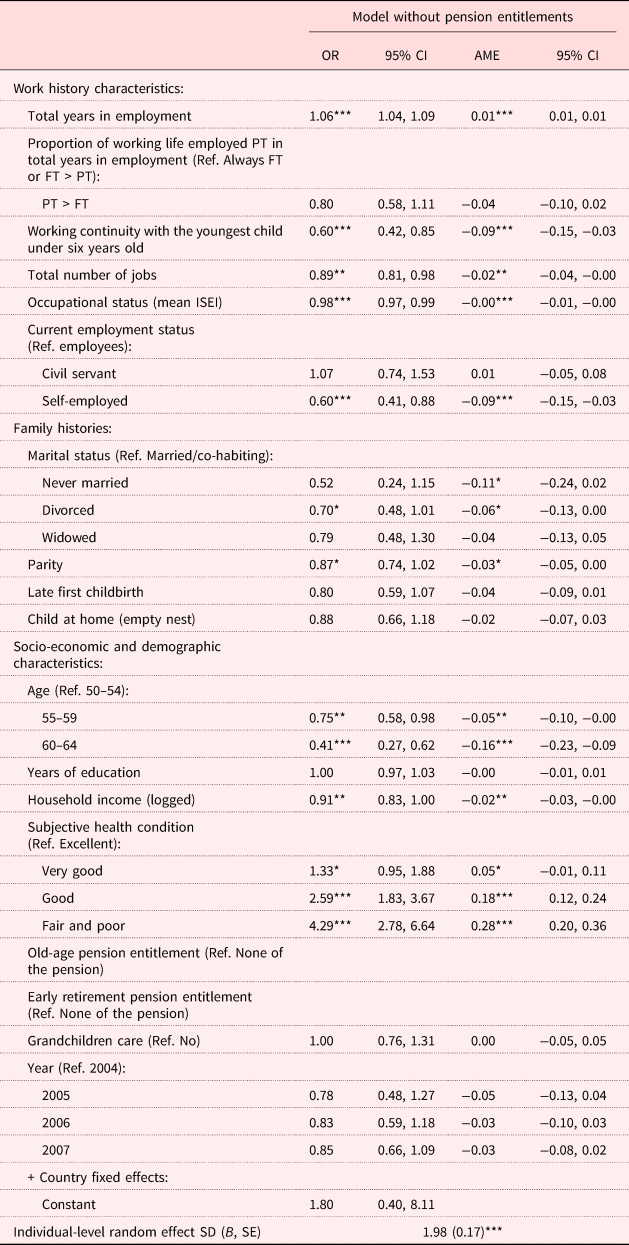
With respect to parity, having more children decreases the intention to retire and increases the intention to continue working. This association is observed in conservative countries, where an additional child increases the odds of intending to continue working by 1.4-fold (OR = 1/0.70, p < 0.01; Table 4). This corresponds to a six percentage point lower probability of early retirement intention on average (AME = −0.06, p < 0.01; Table 4). In conservative countries, late child-bearing is also negatively associated with retirement intentions; the odds of the intention to continue working are higher when the mothers' age at first birth is higher than the country's mean age at first birth than when it is lower (OR = 1/0.64 = 1.55, AME = −0.08, p < 0.10; Table 4). The magnitude and significance of the effects of work histories and family histories on retirement intentions are unchanged, even before controlling for the early and old pension entitlements (see Table A1 in the Appendix).
In our analysis, we interact the welfare regimes with part-time and marital status. The reason for choosing part-time and marital status is our primary interest in opportunity costs and their long-term effects. Although we formulate hypotheses concerning mothers' work attachment in our study, the main reason to control for work attachment is to assess the effect of opportunity costs on retirement intentions better.
Other results
Other factors are also associated with mothers' retirement intentions (Table 3). The intention to retire is positively and significantly associated with the worsening of health conditions. Moreover, a higher household income increases the intention to continue working, corresponding to a two percentage point lower probability of early retirement intentions on average (OR = 1/0.90 = 1.1, AME = −0.02, p < 0.05). Our analysis also demonstrates that an older age is associated with a higher intention of continuing to work. This counterintuitive result may be because older working women are a select group in terms of work attachment.
Additional comparison between countries within the same regimes reveals that the effect of part-time work significantly differs only within social democratic regimes (not shown here). More specifically, having a part-time-dominated work history has significant negative effects on early retirement intentions among Swedish mothers but significant positive effects among Danish mothers. When comparing other countries within the same welfare regime, no significant differences appear between countries with respect to the effects of part-time work or marital status on retirement intentions.
Conclusions
Our analysis of 13 European countries demonstrated that mothers' opportunity costs were associated with later retirement intentions, supporting Hypothesis 1. In all welfare regimes, discontinuous or shorter labour market participation delays the retirement intentions of mothers who need to compensate for lower lifelong earnings. This relationship was observed even after controlling for entitlements to pensions and early pensions. Despite pension entitlements and because of opportunity costs during motherhood, women may want to continue to work in order to improve their pension. In other terms, years of employment allow women to acquire the right to a pension and, in addition, allow them to acquire a satisfactory pension income. Our findings thus capture the remaining effects of work histories on the lower level of pension wealth after controlling for pension entitlements.
In Mediterranean and conservative countries, mothers who have worked mostly part-time intend to work longer, again indicating a strategy to compensate for opportunity costs. No association between part-time work and retirement intentions was observed in the Netherlands or in social democratic countries, where the existing basic pension was likely to compensate partially for the lower earnings of part-time work.
Regarding Hypothesis 2, we expected that never-married, divorced and widowed mothers would be less likely to want to retire than married or co-habiting mothers. Because such mothers could not count on their partner's solidarity at older ages, we assumed that their need to compensate for opportunity costs might be even more urgent. This hypothesis was supported, although the results differed by welfare regime. In Mediterranean countries, never-married mothers are especially willing to continue working. This result can be related to the fact that single motherhood in these countries is less protected than in other welfare regimes.
Hypothesis 2 was also supported in social democratic countries, where widowed mothers were much less likely to intend to retire than married or co-habiting mothers. These results for Nordic countries can be understood in light of some figures. In Denmark, the percentage of a pension or a survivor pension of the total income of widows aged 65 years and older is one of the lowest in the European Union (Ahn, Reference Ahn2005), whereas the survivor pension was abolished in Sweden in 1999 (Miyazato, Reference Miyazato2004). However, Hypothesis 2 is not supported in conservative countries, where widowed mothers are more likely to retire than married and co-habiting mothers. Widows in conservative countries who have worked part-time are even more likely to intend to retire. In countries with a conservative regime, survivor pensions are relatively high (Ahn, Reference Ahn2005), which may enable widows to work part-time without the need to compensate at older ages.
In Hypothesis 3, we assumed that late parenthood and continuity of work in the child-rearing years (when the youngest child was under six years of age) were negatively associated with the intention to retire. These characteristics of mothers' histories were assumed to reflect a greater attachment to the labour market. The hypothesis was supported in post-Communist countries. In this context, especially in the Czech Republic, paid maternity and parental leaves were relatively long, even in the years when the mothers of our sample were in their child-rearing years (data for 2016 in OECD, 2018). In this context, mothers' work interruptions were more likely, and mothers who did not interrupt their work when the child was under the age of six years were a select group with a stronger work attachment and, consequently, a weaker intention to retire.
The work attachment hypothesis was also supported in conservative countries, where both late parenthood and continuity of work during child-rearing years were negatively related to retirement intentions. The negative association between child-rearing and employment for conservative countries is well documented (Drobnič et al., Reference Drobnič, Blossfeld and Rohwer1999). Recent data from Germany demonstrate that having a child between birth and two years of age reduces the employment rate by approximately 20 percentage points relative to mothers with an older child (data for 2010 in OECD, 2018). In the 1990s, discontinuity of work was common in Belgium and France, which were the two other countries in the conservative group (OECD, 2018). In these institutional contexts, mothers who are still working at 50–64 years of age may be a select group with a stronger attachment to work and a weaker intention to retire.
The negative association between household income and retirement intentions in conservative countries and between ISEI and retirement intentions in Mediterranean countries demonstrate that work attachment especially characterised the higher-status social groups.
Note that a negative association between parity and retirement intentions is observed in conservative countries even after controlling for several features of work trajectories. Our results may reflect the opportunity costs of having children that are not considered by the observed work history variables, such as the mothers' lifelong earnings. In addition, mothers with more children who are still in the labour market at 50–64 years of age may be a select group with a stronger attachment to work (Drobnič et al., Reference Drobnič, Blossfeld and Rohwer1999).
In conclusion, due to the ageing populations and to the guarantee equilibrium of the pension system, policy makers are interested in increasing people's working years. Nevertheless, our analysis of retirement intentions reveals that some groups of mothers need to stay longer in the labour market to compensate for lower earnings. These results emphasise inequalities in opportunities for retirement. The differences in results according to the welfare regime demonstrate that inequality in retirement intentions among mothers might be related to their abilities and opportunities to balance work and family during their reproductive years. These differences may also depend on pension benefits compensating for the opportunity costs of mothers at older ages (OECD, 2015).
In Hypothesis 4, we assumed that because of the sample selection process, mothers' work and family trajectories have a weaker effect on retirement intentions in Mediterranean and post-Communist countries. Our findings supported this hypothesis. We observed that conservative countries were more affected by the work–family history than Mediterranean and post-Communist countries, where a smaller proportion of women still work at 50–64 years of age; these women represent a select and motivated group who mostly work full-time and for whom family life has a weaker impact on their career. This characteristic is also defined as the ‘Mediterranean exit or full-time work model’ (Karamessini and Rubery, Reference Karamessini and Rubery2014).
In Hypothesis 5, we expected that the impact of work and family trajectories on retirement intentions is weaker in countries with an existing basic pension system associated with relatively high benefits, as in Nordic countries and in the Netherlands. Our results confirmed this hypothesis, as mothers' work–family histories are less often associated with retirement intentions in social democratic countries and in the Netherlands than in other welfare regimes. These institutional settings seem to compensate for low lifelong earnings and reduce penalties associated with motherhood.
Our study has limitations. First, in the present study, married and co-habiting mothers also included those who previously experienced a marital dissolution or widowhood. Additional research is needed on these mothers, their earlier careers, their family paths, their remarriages and their retirement intentions. For example, remarried mothers can benefit from the financial solidarity of a new partner and feel less compelled to continue working at older ages. Alternatively, they may still prefer to continue working because their previous divorce experience makes them more adverse to the risk of a new separation. Second, if work and family histories are important explanatory factors for mothers' retirement intentions, working behaviour and the retirement intentions of childless women deserve more attention. For example, these women may wish to work longer to enrich their social lives but also to compensate for the lack of a partner's financial solidarity. Third, although our focus was to compare welfare regimes, our additional comparisons to see country-specific differences within the same welfare regimes found different effects of part-time work between Denmark and Sweden; Danish mothers who have worked mostly part-time are more likely to intend to retire early. This finding is consistent with König (Reference König2017), who found that longer years in part-time work lead to the early retirement of Danish women while delaying the retirement of Swedish women. The country-specific differences within the social democratic regime may be due to differences in pursued family policies (Gupta et al., Reference Gupta, Smith and Verner2008) as equalisation of parents' use of parental leave is more promoted in Sweden than Denmark (Pylkkänen and Smith, Reference Pylkkänen and Smith2004). This distinction could make mothers' attachment to work stronger in Sweden than in Denmark. In this case, the lesser attachment to work of Danish mothers would be especially observable among those who had worked mostly part-time. The relatively generous Danish basic pension system may also lower the need for compensation for part-time-dominated working careers (König, Reference König2017). Differences in the effect of part-time working on retirement intentions require further investigation. Finally, our study focuses only on mothers who are still working at ages 50–64 years and their retirement intentions. We exclude mothers who are currently inactive or who interrupt their careers before those ages. Mothers who stay out of the labour market or work in the informal sector for several years may be unable to enter or re-enter the labour market even when they need to improve their economic situations. The group of inactive mothers is particularly important in Mediterranean and post-Communist countries (Figure 1b). Moreover, mothers' inactivity may interact with partnership dissolutions, making their situations even more fragile. The consequences of women's labour inactivity on wellbeing at older ages is beyond the scope of this article but needs to be developed further in future studies.
Author ORCIDs
Younga Kim, 0000-0001-8108-4880
Data
This paper uses data from SHARE Waves 1, 2 and 3 (SHARELIFE; DOIs: 10.6103/SHARE.w1.610, 10.6103/SHARE.w2.610, 10.6103/SHARE.w3.610, see Börsch-Supan et al. (Reference Börsch-Supan, Brandt, Hunkler, Kneip, Korbmacher, Malter, Schaan, Stuck and Zuber2013) for methodological details. The SHARE data collection has been primarily funded by the European Commission through FP5 (QLK6-CT-2001-00360), FP6 (SHARE-I3: RII-CT-2006-062193, COMPARE: CIT5-CT-2005-028857, SHARELIFE: CIT4-CT-2006-028812) and FP7 (SHARE-PREP: No. 211909, SHARE-LEAP: No. 227822, SHARE M4: No. 261982). Additional funding from the German Ministry of Education and Research, the Max Planck Society for the Advancement of Science, the US National Institute on Aging (U01_AG09740-13S2, P01_AG005842, P01_AG08291, P30_AG12815, R21_AG025169, Y1-AG-4553-01, IAG_BSR06-11, OGHA_04-064, HHSN271201300071C) and from various national funding sources is gratefully acknowledged (see www.share-project.org).
Financial support
This work was supported by the ‘MOVE-IN Louvain’ project of Université Catholique de Louvain, co-funded by the Marie Curie Actions of the European Commission; the ARC project ‘Family Transformations: Incentives and Norms’ of the Université Catholique de Louvain; and the CREW project ‘Care, Retirement and Wellbeing of Older People Across Different Welfare Regimes’ founded by BELSPO.
Appendix
Odds ratios (OR) and average marginal effects (AME) for the multi-level logit model with the country as a fixed effect and no pension entitlements